The document provides a comprehensive overview of career guidance in cybersecurity, including definitions, the demand for professionals, various fields and roles, and essential training resources. It discusses the importance of certifications, training initiatives for veterans, and networking opportunities, along with strategies for resume preparation in the cybersecurity job market. Overall, it serves as a resource for both beginners and experienced individuals looking to advance their careers in cybersecurity.
Overview of career in cybersecurity. Introduction of presenter Adam and topics covered in the presentation.
Definition of cybersecurity and pivoting within compromised networks to enhance security practices.
High demand for cybersecurity professionals, significant job growth, and a variety of career options available.
Different controls (technical, administrative, and physical) in cybersecurity and common vulnerabilities.
Educational paths available, including degrees and technical certifications for careers in cybersecurity. Various training resources and scholarship programs available for veterans transitioning into cybersecurity.
Networking opportunities, training programs, and essential resume tips for aspiring cybersecurity professionals.
Final thoughts and invitation to connect via social media for further engagement.
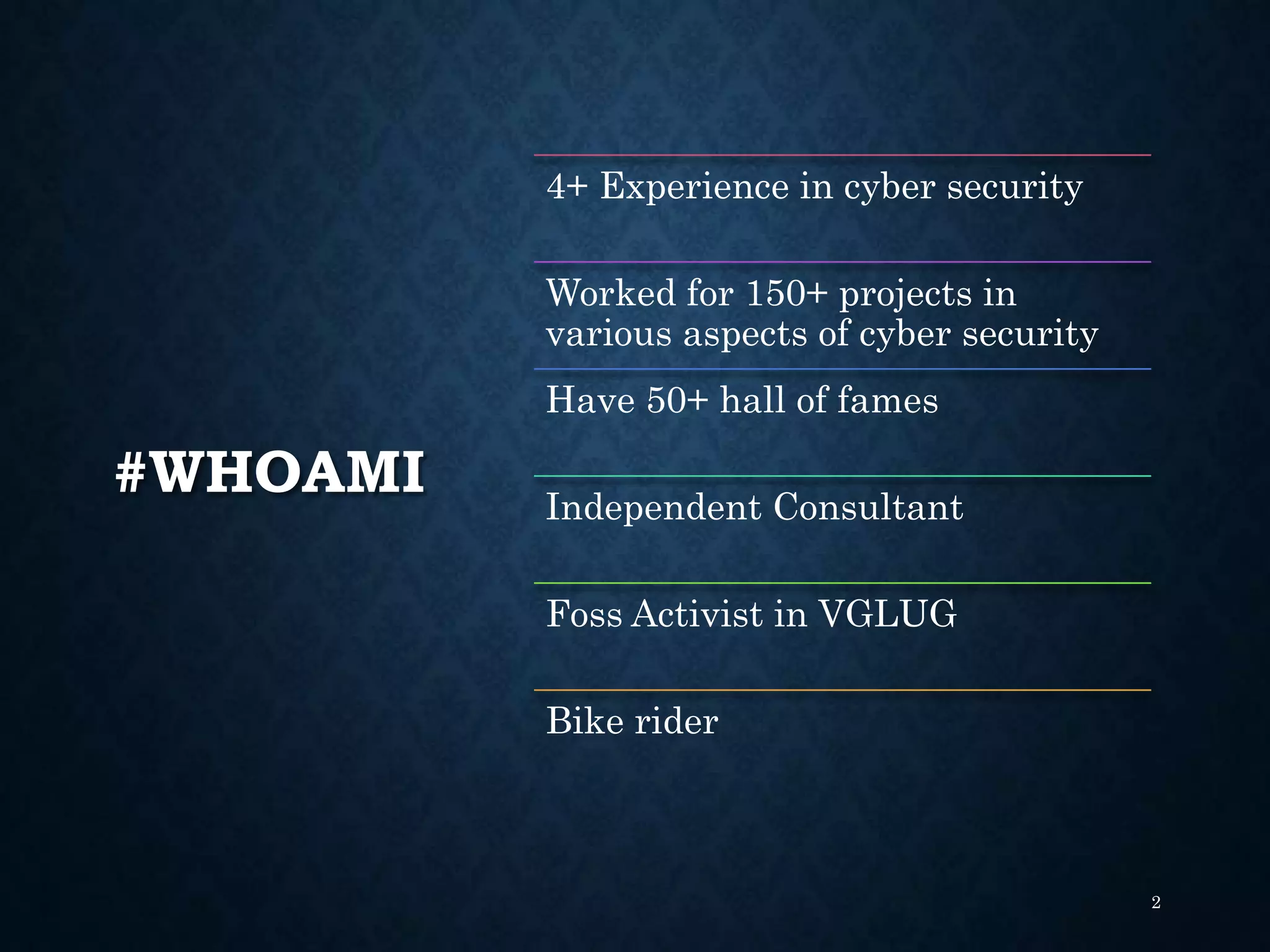
#WHOAMI
2
4+ Experience incyber security
Worked for 150+ projects in
various aspects of cyber security
Have 50+ hall of fames
Independent Consultant
Foss Activist in VGLUG
Bike rider
3.
TOPICS
3
• Define Cybersecurity
•Define Pivoting
• Demand for Cybersecurity Professionals
• Cybersecurity Fields & Careers
• Technical, Physical, and Administrative Controls
• You May Already Be Involved in Cybersecurity
• Training Resources
• Certifications
• Networking
• Professional Reading
• Resumes & Applicant Tracking Systems
4.
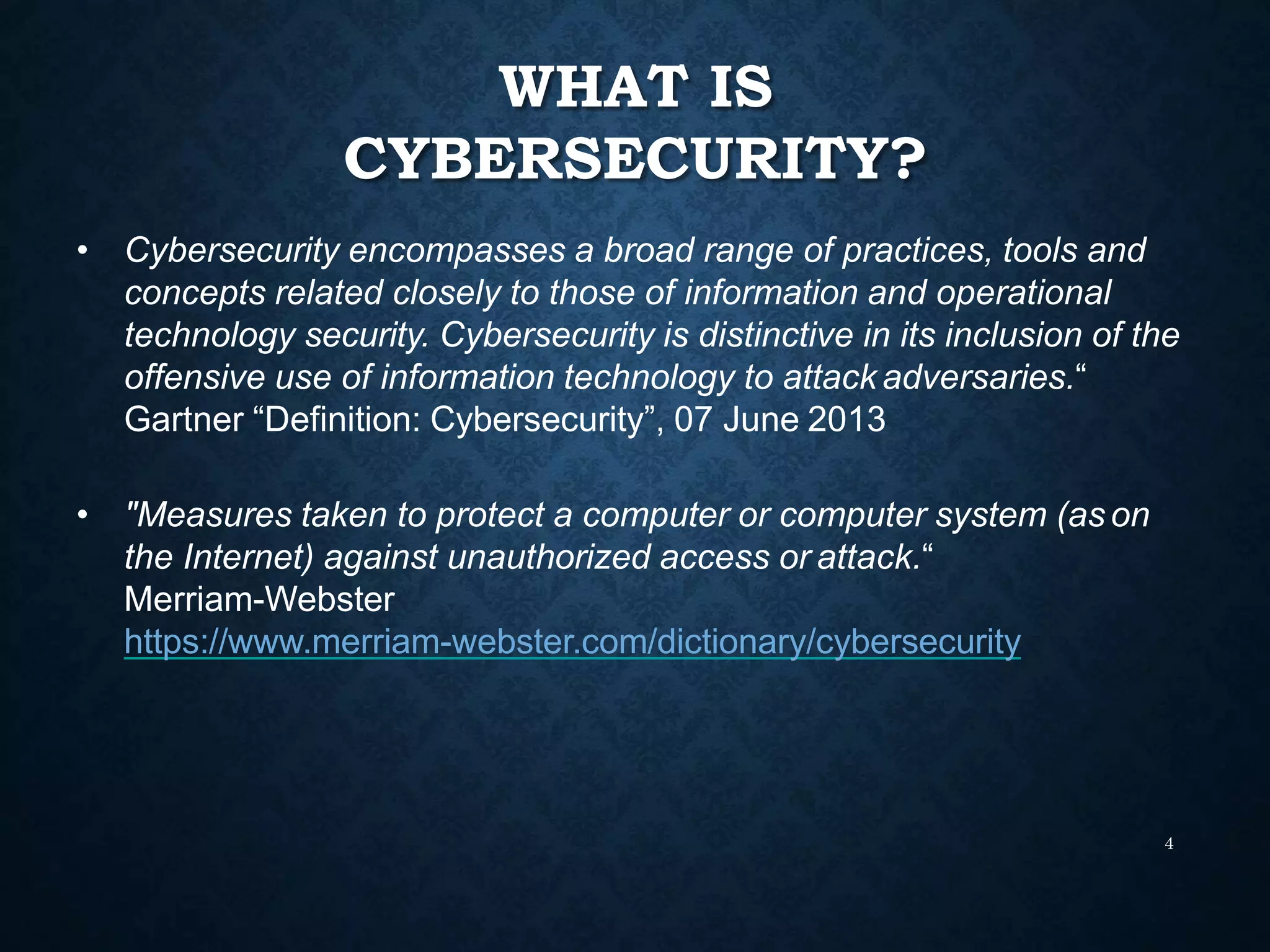
WHAT IS
CYBERSECURITY?
4
• Cybersecurityencompasses a broad range of practices, tools and
concepts related closely to those of information and operational
technology security. Cybersecurity is distinctive in its inclusion of the
offensive use of information technology to attack adversaries.“
Gartner “Definition: Cybersecurity”, 07 June 2013
• "Measures taken to protect a computer or computer system (as on
the Internet) against unauthorized access or attack.“
Merriam-Webster
https://www.merriam-webster.com/dictionary/cybersecurity
5.
WHAT IS
PIVOTING?
5
• Pivotingis the exclusive method of using an instance also known by
‘foothold’ to be able to “move” from place to place inside the
compromised network. It uses the first compromised system
foothold to allow us to compromise other devices and servers that
are otherwise inaccessible directly.
https://resources.infosecinstitute.com/pivoting-exploit-system-
another-network/
6.
DEMAND FOR
CYBERSECURITY PROFESSIONALS
6
•Demand for Cybersecurity Talent Soars, Study Finds
– 25 percent gap between demands for cyber talent and qualified workforce
– Predicts a shortfall of 3.5 million cybersecurity professionals by2021
– Using existing talent
–Closing the gap with “new collar workers”
https://securityintelligence.com/news/demand-for-cybersecurity-talent-soars-study-finds/
• Demand for Cybersecurity Jobs Doubles Over Five Years, But Talent Gap
Remains
https://www.prnewswire.com/news-releases/demand-for-cybersecurity-jobs-
doubles-over-five-years-but-talent-gap-remains-300874877.html
• The 10 highest-paying cybersecurity jobs
https://www.techrepublic.com/article/the-10-highest-paying-cybersecurity-jobs/
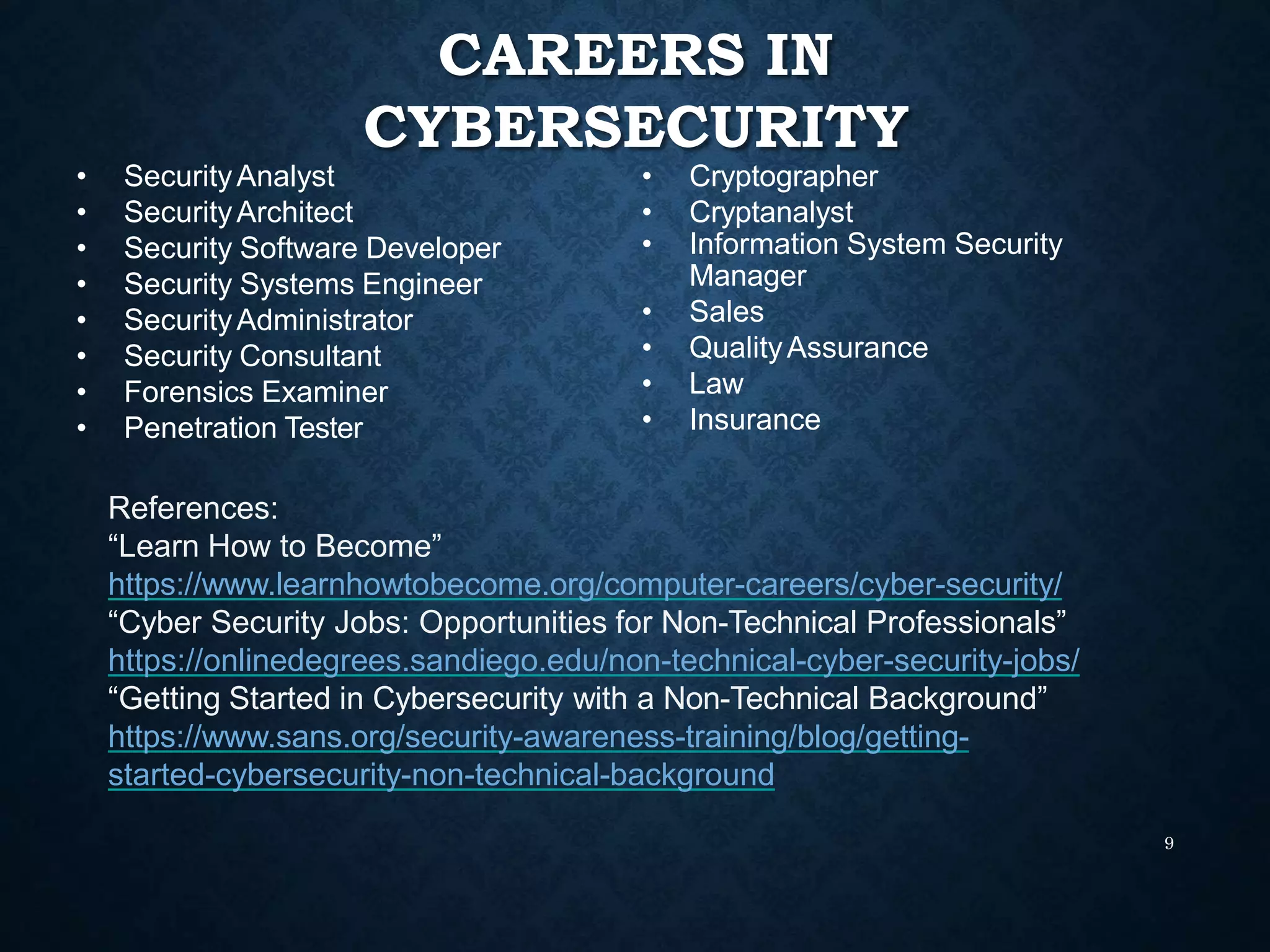
CAREERS IN
CYBERSECURITY
9
• SecurityAnalyst
•SecurityArchitect
• Security Software Developer
• Security Systems Engineer
• SecurityAdministrator
• Security Consultant
• Forensics Examiner
• Penetration Tester
• Cryptographer
• Cryptanalyst
• Information System Security
Manager
• Sales
• QualityAssurance
• Law
• Insurance
References:
“Learn How to Become”
https://www.learnhowtobecome.org/computer-careers/cyber-security/
“Cyber Security Jobs: Opportunities for Non-Technical Professionals”
https://onlinedegrees.sandiego.edu/non-technical-cyber-security-jobs/
“Getting Started in Cybersecurity with a Non-Technical Background”
https://www.sans.org/security-awareness-training/blog/getting-
started-cybersecurity-non-technical-background
10.
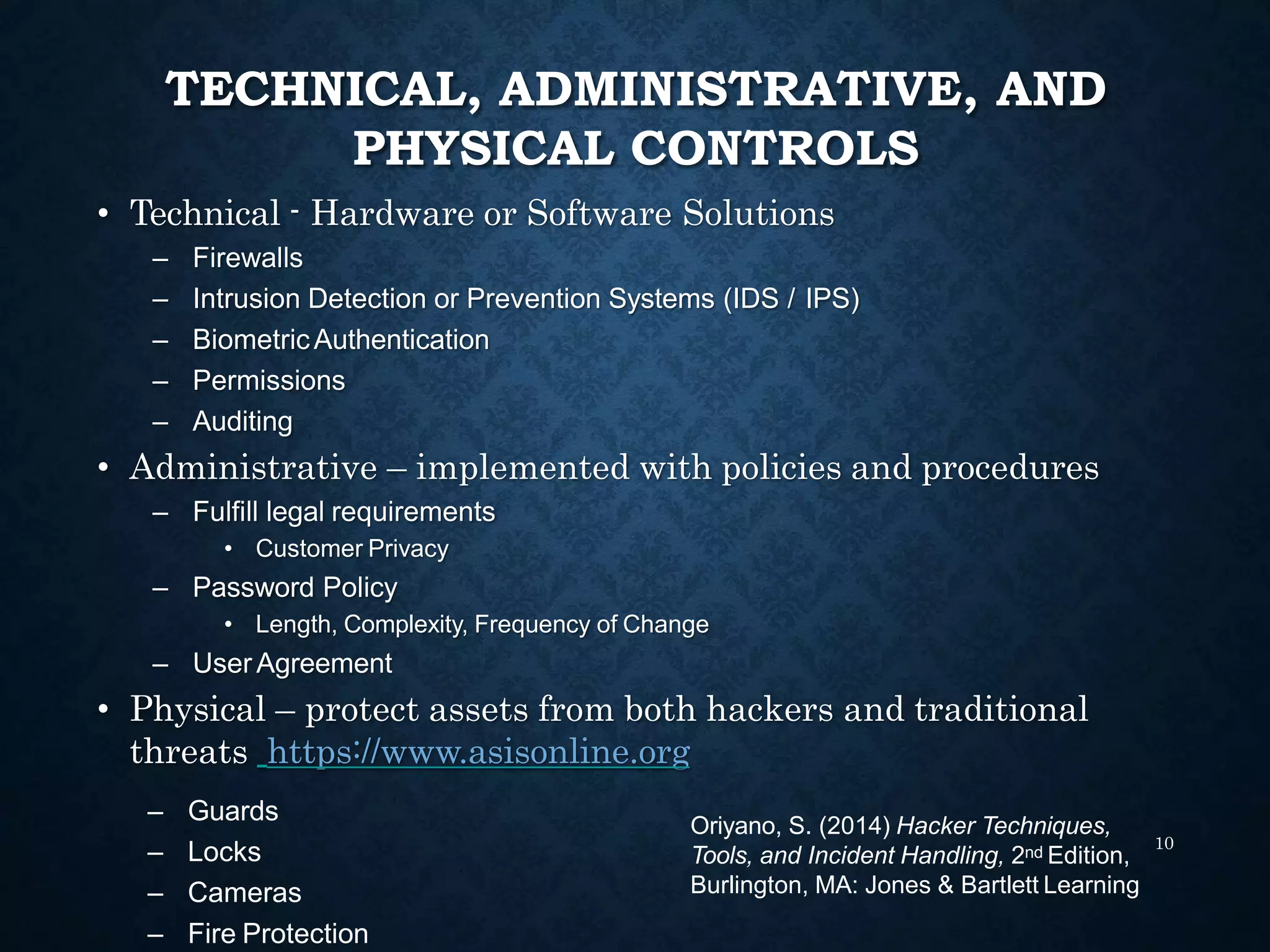
TECHNICAL, ADMINISTRATIVE, AND
PHYSICALCONTROLS
• Technical - Hardware or Software Solutions
– Firewalls
– Intrusion Detection or Prevention Systems (IDS / IPS)
– BiometricAuthentication
– Permissions
– Auditing
• Administrative – implemented with policies and procedures
– Fulfill legal requirements
• Customer Privacy
– Password Policy
• Length, Complexity, Frequency of Change
– UserAgreement
• Physical – protect assets from both hackers and traditional
threats https://www.asisonline.org
10
– Guards
– Locks
– Cameras
– Fire Protection
Oriyano, S. (2014) Hacker Techniques,
Tools, and Incident Handling, 2nd Edition,
Burlington, MA: Jones & Bartlett Learning
11.
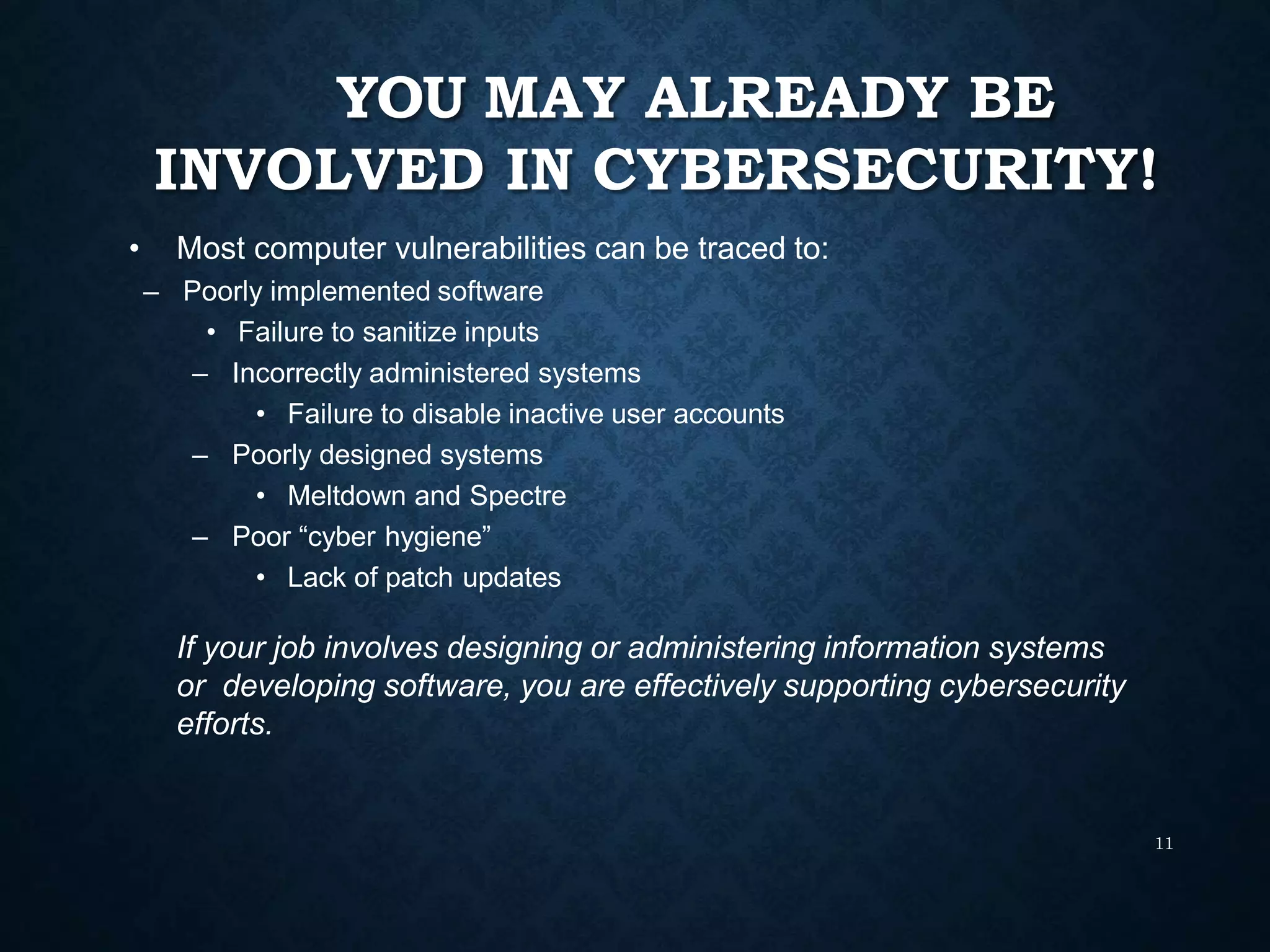
YOU MAY ALREADYBE
INVOLVED IN CYBERSECURITY!
11
• Most computer vulnerabilities can be traced to:
– Poorly implemented software
• Failure to sanitize inputs
– Incorrectly administered systems
• Failure to disable inactive user accounts
– Poorly designed systems
• Meltdown and Spectre
– Poor “cyber hygiene”
• Lack of patch updates
If your job involves designing or administering information systems
or developing software, you are effectively supporting cybersecurity
efforts.
12.
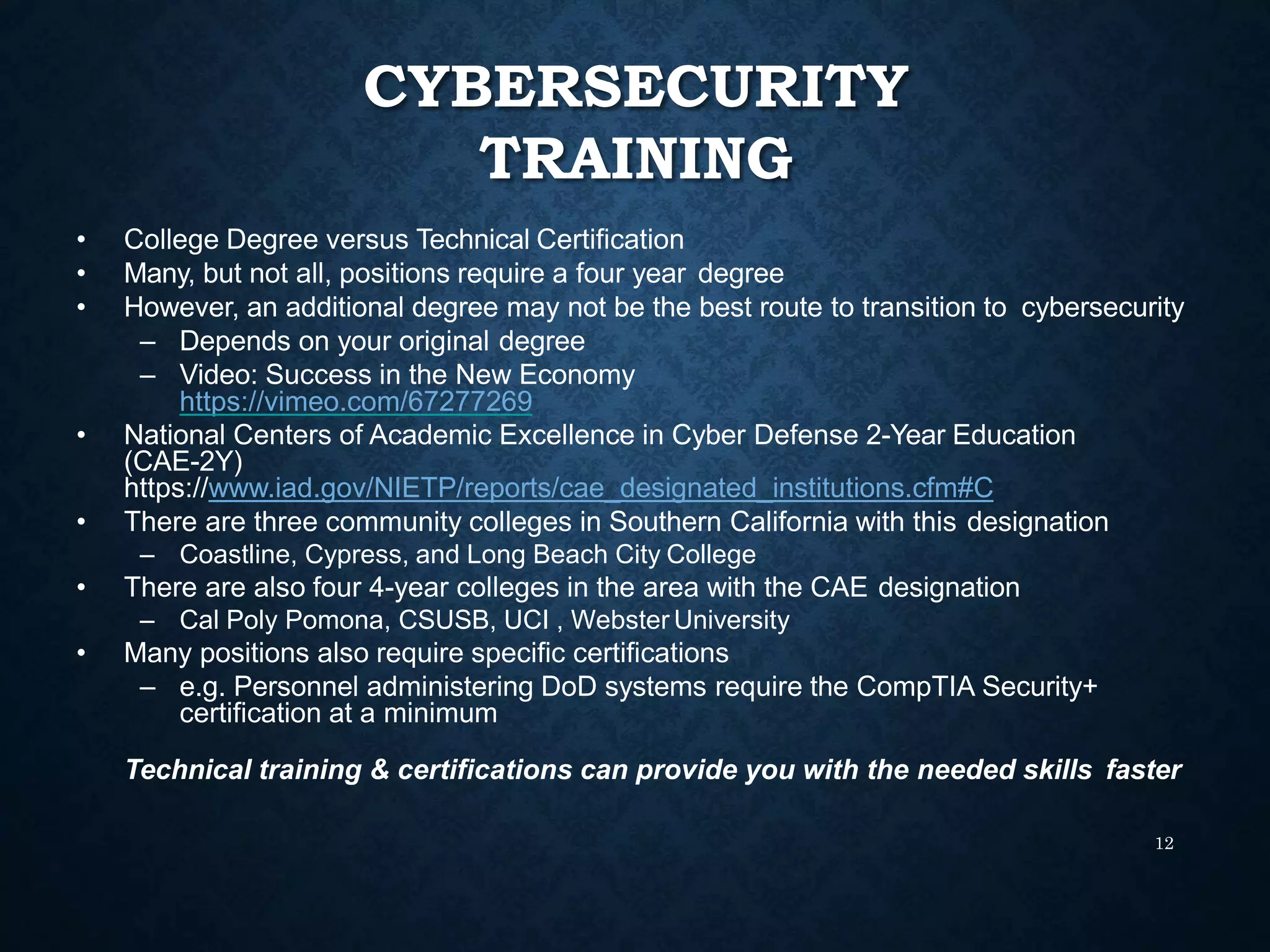
CYBERSECURITY
TRAINING
12
• College Degreeversus Technical Certification
• Many, but not all, positions require a four year degree
• However, an additional degree may not be the best route to transition to cybersecurity
– Depends on your original degree
– Video: Success in the New Economy
https://vimeo.com/67277269
• National Centers of Academic Excellence in Cyber Defense 2-Year Education
(CAE-2Y)
https://www.iad.gov/NIETP/reports/cae_designated_institutions.cfm#C
• There are three community colleges in Southern California with this designation
– Coastline, Cypress, and Long Beach City College
• There are also four 4-year colleges in the area with the CAE designation
– Cal Poly Pomona, CSUSB, UCI , Webster University
• Many positions also require specific certifications
– e.g. Personnel administering DoD systems require the CompTIA Security+
certification at a minimum
Technical training & certifications can provide you with the needed skills faster
13.
TRAINING RESOURCES
FOR VETERANS
13
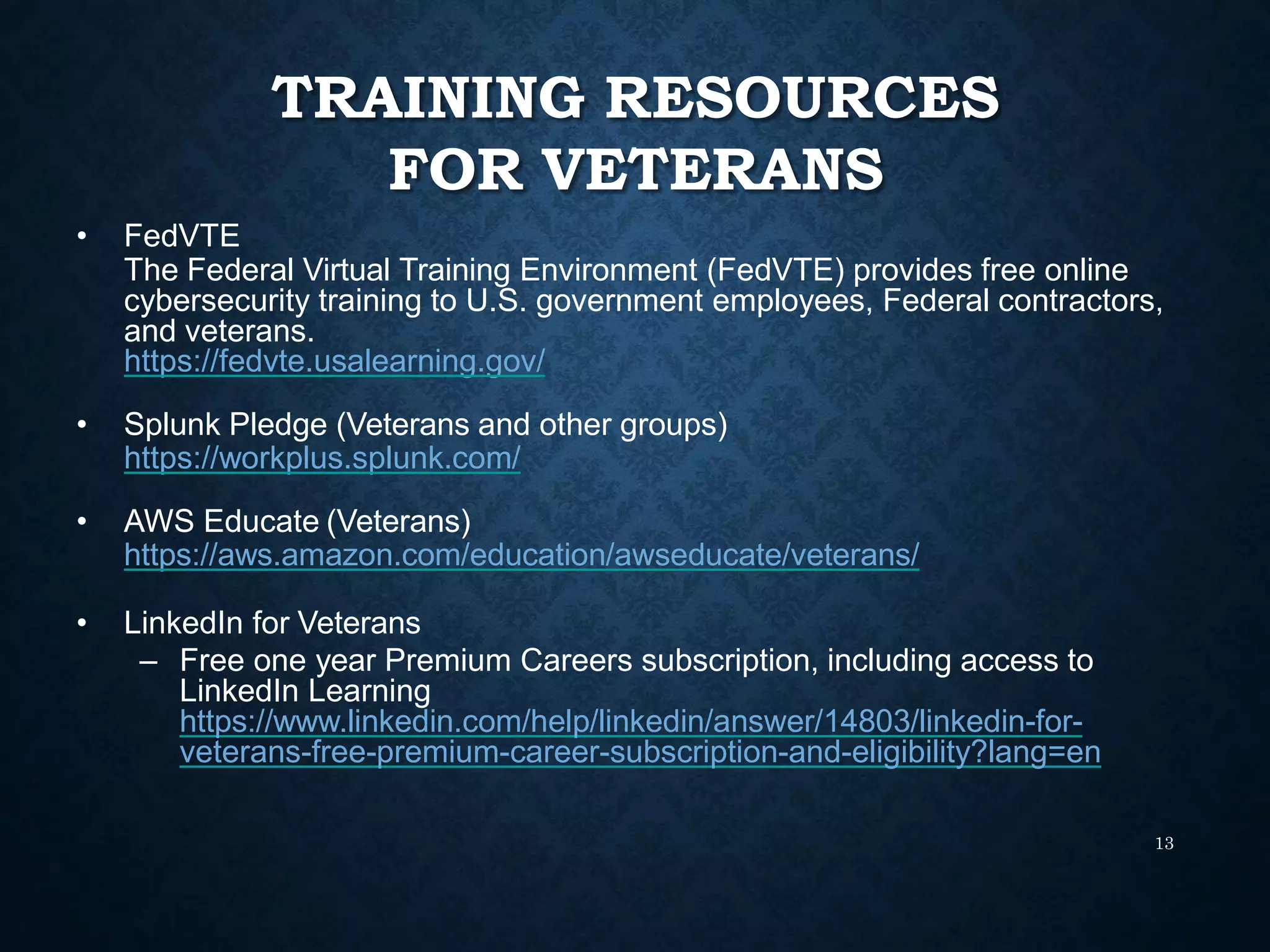
•FedVTE
The Federal Virtual Training Environment (FedVTE) provides free online
cybersecurity training to U.S. government employees, Federal contractors,
and veterans.
https://fedvte.usalearning.gov/
• Splunk Pledge (Veterans and other groups)
https://workplus.splunk.com/
• AWS Educate (Veterans)
https://aws.amazon.com/education/awseducate/veterans/
• LinkedIn for Veterans
– Free one year Premium Careers subscription, including access to
LinkedIn Learning
https://www.linkedin.com/help/linkedin/answer/14803/linkedin-for-
veterans-free-premium-career-subscription-and-eligibility?lang=en
14.
CYBERSECURITY
CERTIFICATIONS
14
• Purpose isto demonstrate a minimum set of skills
• Many positions also require specific certifications
– e.g. Personnel administering DoD systems require at a minimum the CompTIASecurity+
certification
• Search career websites for the certifications
– Dice
– Indeed
– Monster
15.
CYBER WORKFORCE
MANAGEMENT PROGRAM
15
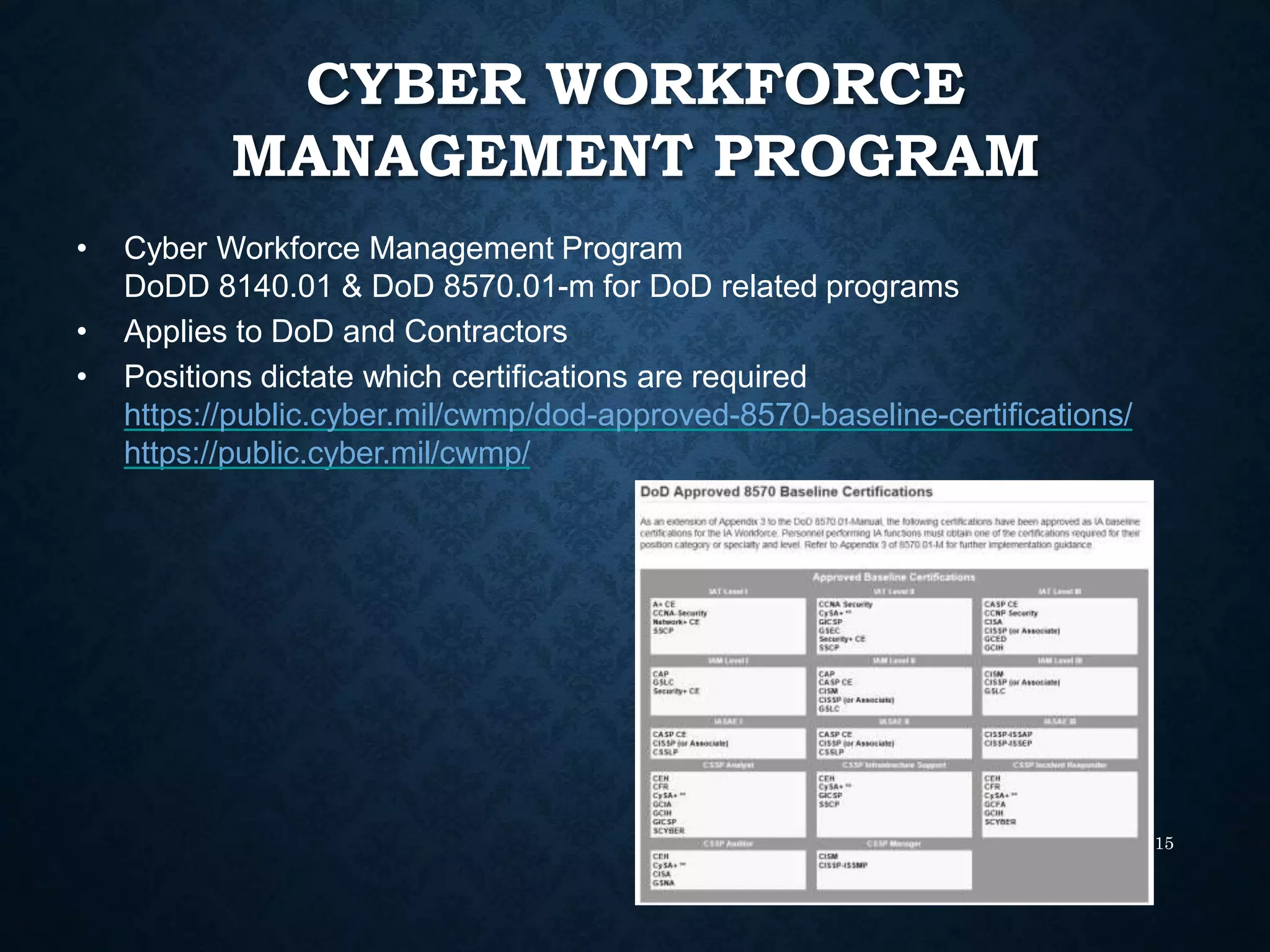
•Cyber Workforce Management Program
DoDD 8140.01 & DoD 8570.01-m for DoD related programs
• Applies to DoD and Contractors
• Positions dictate which certifications are required
https://public.cyber.mil/cwmp/dod-approved-8570-baseline-certifications/
https://public.cyber.mil/cwmp/
16.
COMPTIA
CERTIFICATIONS
16
• Security+
• Network+
•Cybersecurity Analyst (CySA+)
• Advanced Security Practitioner
• Pentest
• Linux+
• Cloud+
https://certification.comptia.org/certifications
https://www.businessnewsdaily.com/10718-comptia-certification-
guide.html
Note: Many of these certifications can be obtained at low cost
through your local community college
17.
INTERNATIONAL INFORMATION
SYSTEMS SECURITYCERTIFICATION
CONSORTIUM (ISC2)
17
• Certified Information Systems Security Professional (CISSP)
– One of the most widely recognized cybersecurity certifications
– Tests security-related managerial skills
• Usually more concerned with policies and procedures
– Requires that you demonstrate five years of professional experience
• Reduced to 4 years if you have a Bachelor’s degree
• Can receive the CISSA if you pass the CISSP exam but do not have
sufficient experience
• Certified Secure Software Lifecycle Professional (CSSLP)
• Several other certifications also offered
• Web site:
– https://www.isc2.org/
– https://www.isc2.org/credentials/default.aspx
18.
SANS
INSTITUTE
18
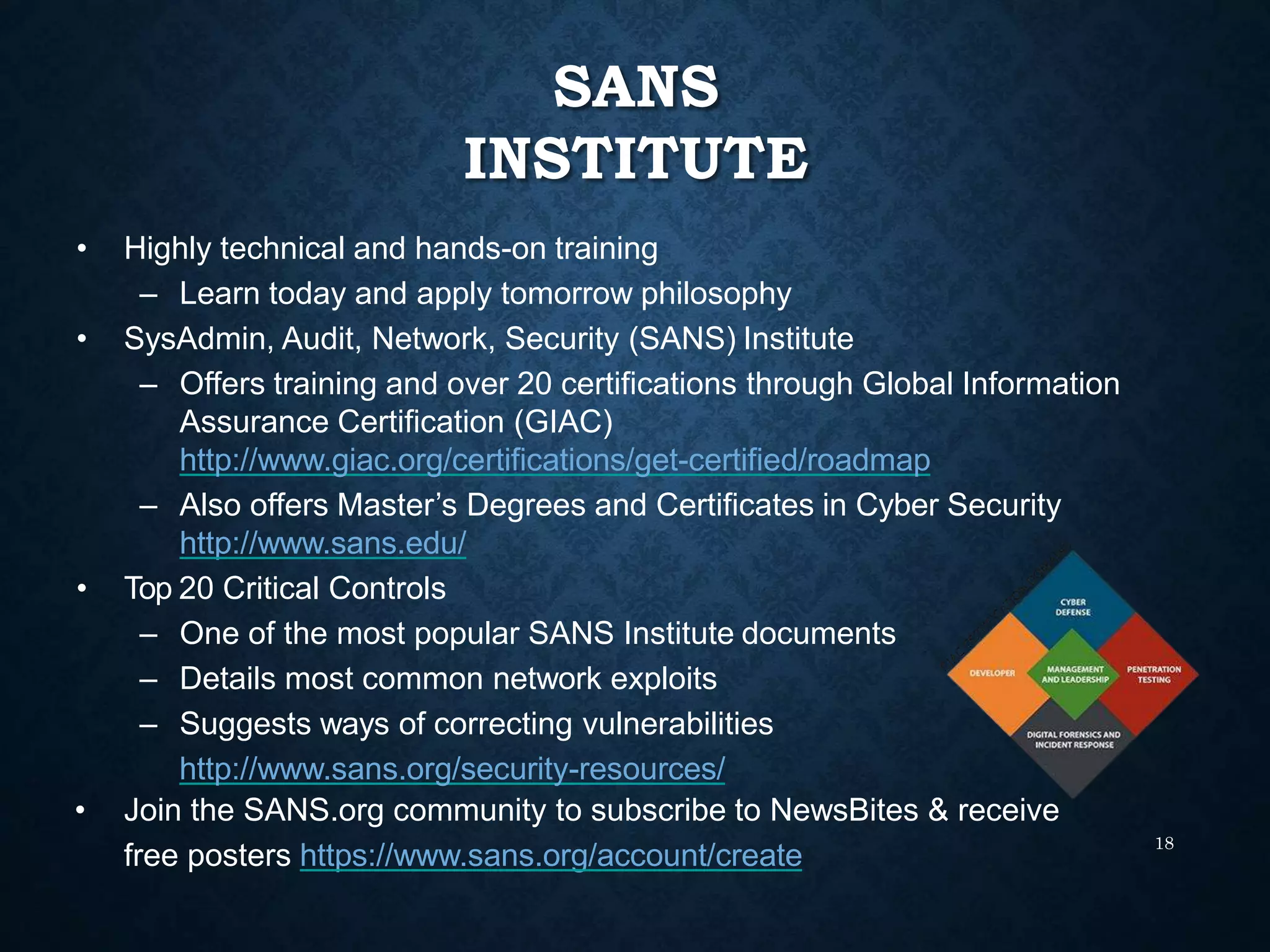
• Highly technicaland hands-on training
– Learn today and apply tomorrow philosophy
• SysAdmin, Audit, Network, Security (SANS) Institute
– Offers training and over 20 certifications through Global Information
Assurance Certification (GIAC)
http://www.giac.org/certifications/get-certified/roadmap
– Also offers Master’s Degrees and Certificates in Cyber Security
http://www.sans.edu/
• Top 20 Critical Controls
– One of the most popular SANS Institute documents
– Details most common network exploits
– Suggests ways of correcting vulnerabilities
http://www.sans.org/security-resources/
• Join the SANS.org community to subscribe to NewsBites & receive
free posters https://www.sans.org/account/create
19.
SANS CYBERTALENT
IMMERSION ACADEMIES
19
•An intensive, accelerated training program that provides SANS world class training
and GIAC certifications to quickly and effectively launch careers in cybersecurity
• 100% scholarship-based and no cost to participants
• VetSuccess - open to transitioning veterans and those transitioned in the last five
years and not currently working in cybersecurity in a civilian role.
• Women's Academy - this Academy is open to career-changers and college seniors
with a background in IT, but not currently working in cybersecurity roles.
• Cyber Workforce Academy - these Academies are made possible by grants,
sponsors and organizations looking to hire cybersecurity talent or help advance the
field by bringing in new talent. Academy eligibility requirements and curricula will be
based on the specific focus and needs of the sponsors.
• Diversity Cyber Academy - SANS and International Consortium of Minority
Cybersecurity Professionals (ICMCP) are partnering to create the SANS - ICMCP:
Diversity Cyber Academy - DCA, combining efforts to increase the career
opportunities for minorities and women in the cybersecurity field.
https://www.sans.org/cybertalent/seekers
20.
EC-COUNCIL
20
• International Councilof Electronic Commerce Consultants
(EC-Council)
• Organization’s most recognized certification is the
Certified Ethical Hacker (CEH)
– Current certification is CEH v10
– Based on 20 domains (subject areas)
• Also offers other certifications
– Forensic Investigator, Application Security Engineer
• BS and MS in Cyber Security
https://www.eccouncil.org/
21.
OFFENSIVE
SECURITY
21
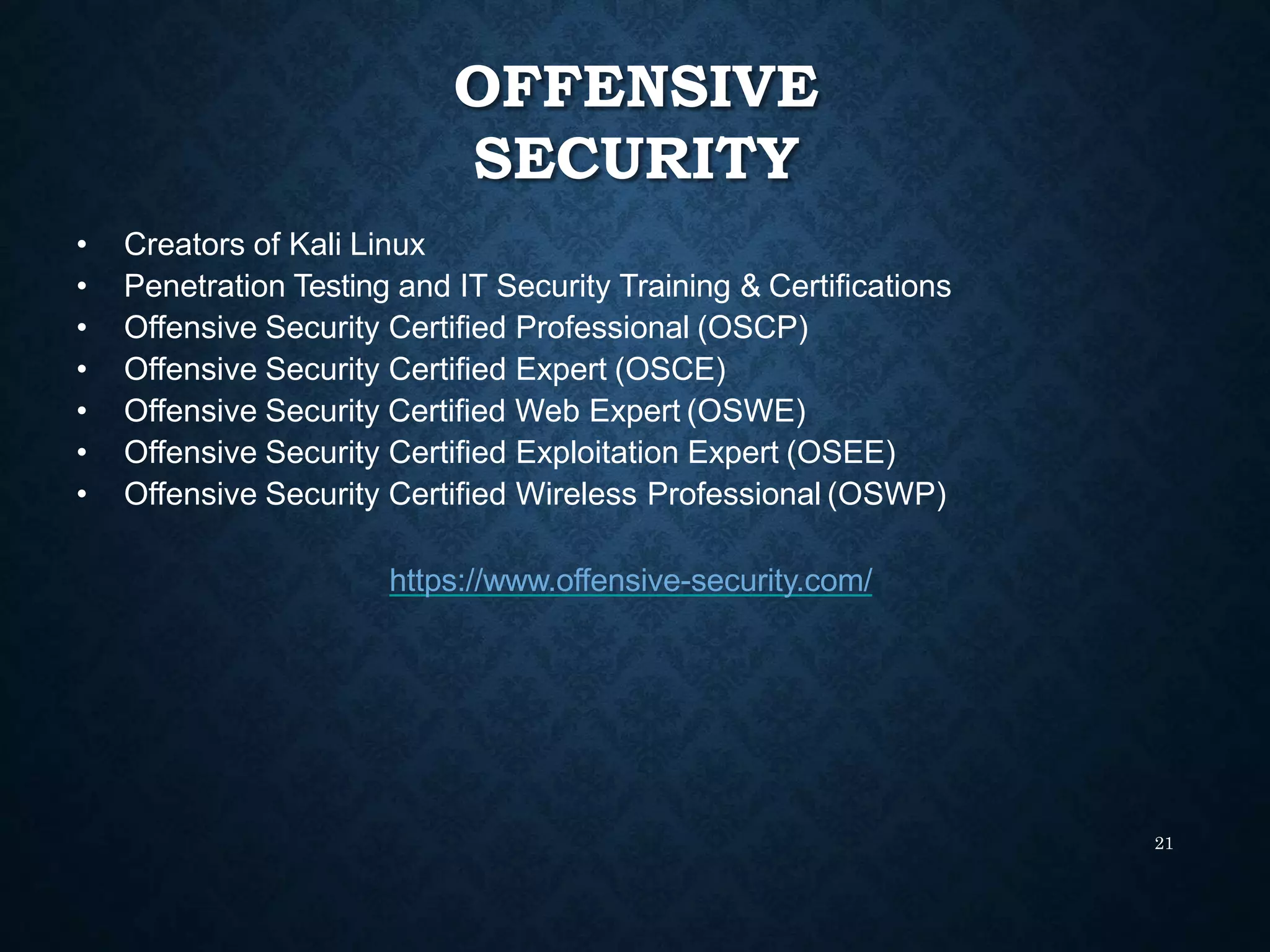
• Creators ofKali Linux
• Penetration Testing and IT Security Training & Certifications
• Offensive Security Certified Professional (OSCP)
• Offensive Security Certified Expert (OSCE)
• Offensive Security Certified Web Expert (OSWE)
• Offensive Security Certified Exploitation Expert (OSEE)
• Offensive Security Certified Wireless Professional (OSWP)
https://www.offensive-security.com/
22.
EMPLOYER TRAINING &COLLABORATION
RESOURCES
22
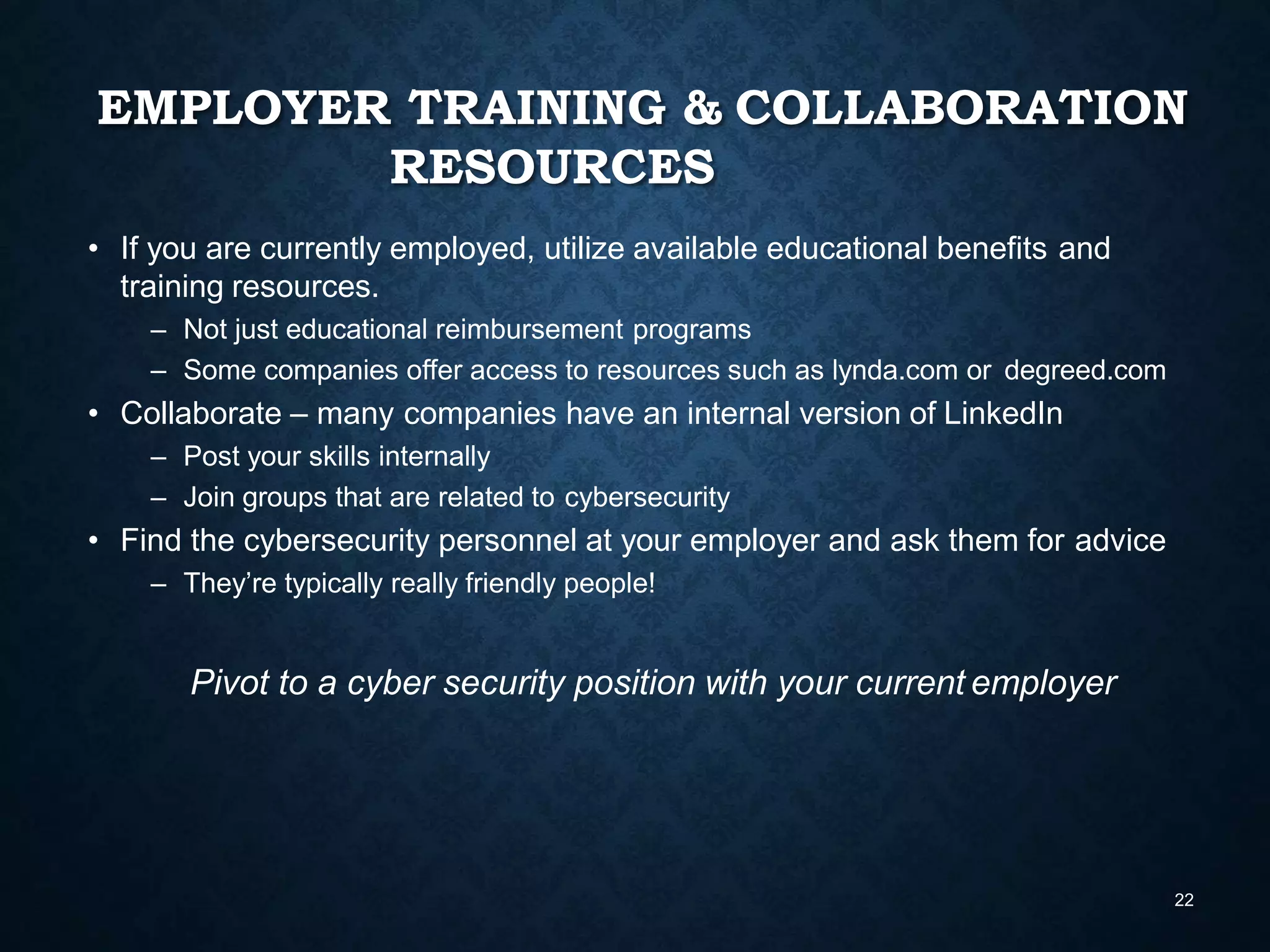
• If you are currently employed, utilize available educational benefits and
training resources.
– Not just educational reimbursement programs
– Some companies offer access to resources such as lynda.com or degreed.com
• Collaborate – many companies have an internal version of LinkedIn
– Post your skills internally
– Join groups that are related to cybersecurity
• Find the cybersecurity personnel at your employer and ask them for advice
– They’re typically really friendly people!
Pivot to a cyber security position with your current employer
23.
OTHER TRAINING
RESOURCES
23
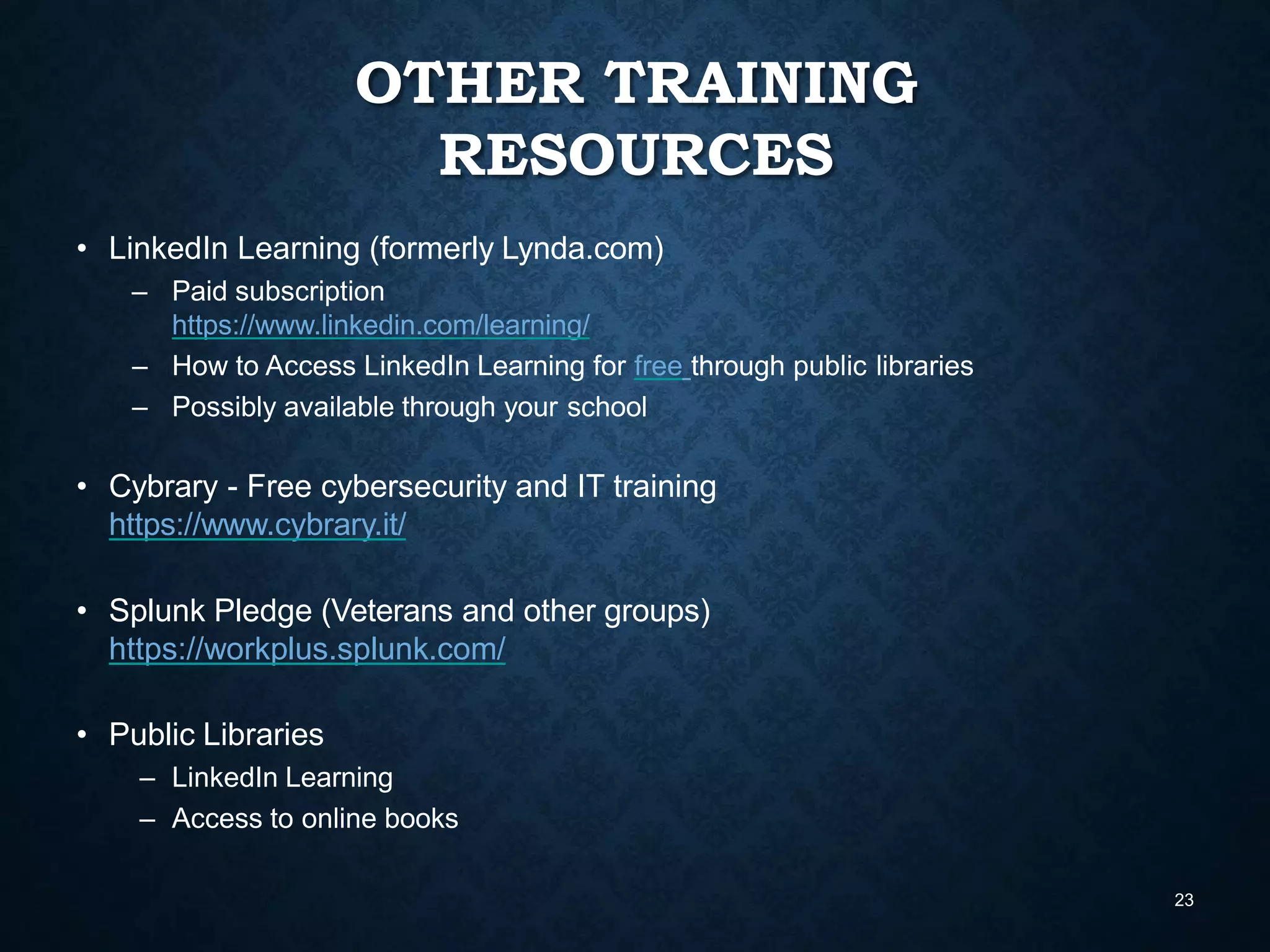
• LinkedInLearning (formerly Lynda.com)
– Paid subscription
https://www.linkedin.com/learning/
– How to Access LinkedIn Learning for free through public libraries
– Possibly available through your school
• Cybrary - Free cybersecurity and IT training
https://www.cybrary.it/
• Splunk Pledge (Veterans and other groups)
https://workplus.splunk.com/
• Public Libraries
– LinkedIn Learning
– Access to online books
24.
FOR THE MORE“EXPERIENCED”
WORKERS AMONG US…
24
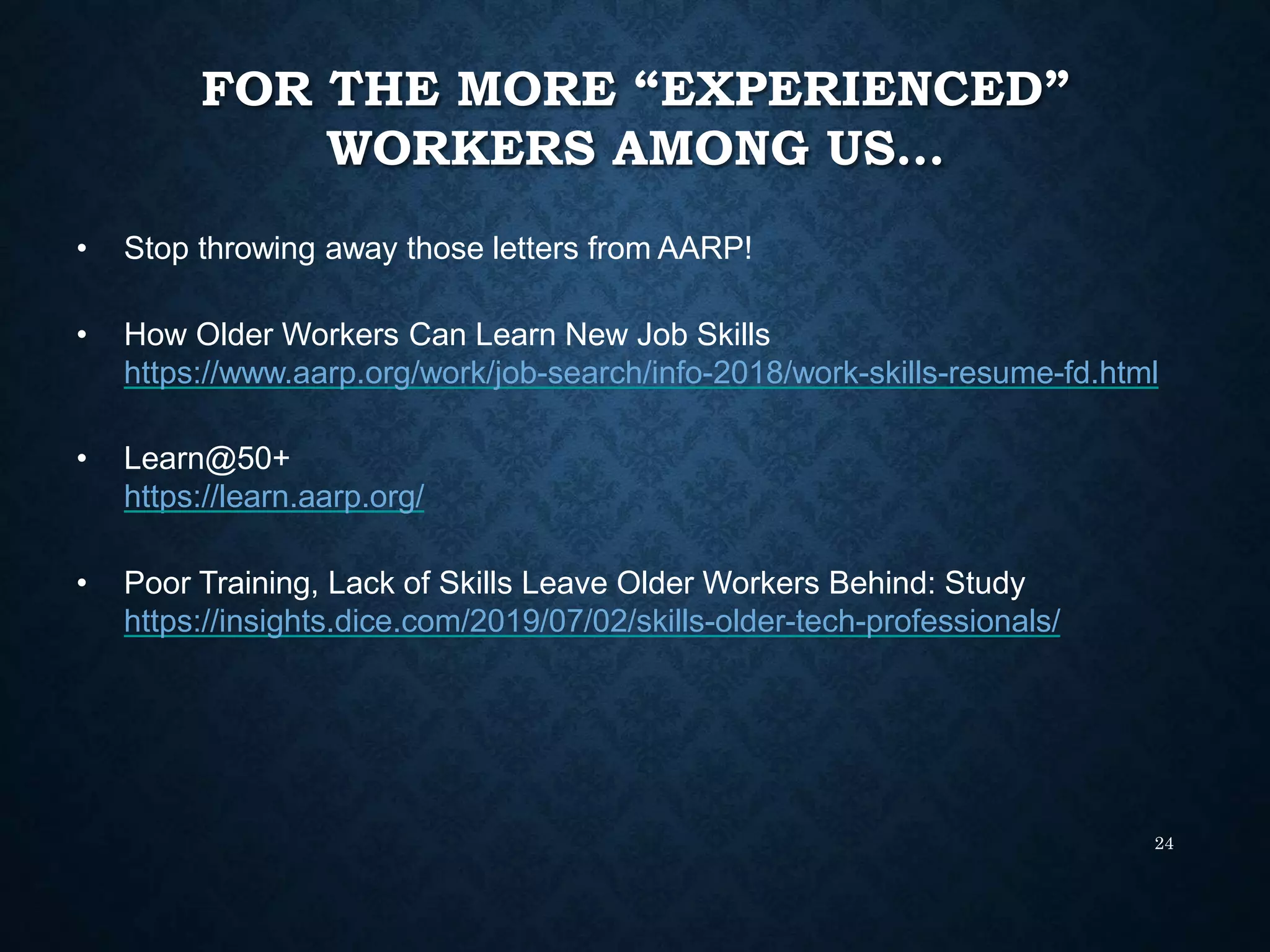
• Stop throwing away those letters from AARP!
• How Older Workers Can Learn New Job Skills
https://www.aarp.org/work/job-search/info-2018/work-skills-resume-fd.html
• Learn@50+
https://learn.aarp.org/
• Poor Training, Lack of Skills Leave Older Workers Behind: Study
https://insights.dice.com/2019/07/02/skills-older-tech-professionals/
25.
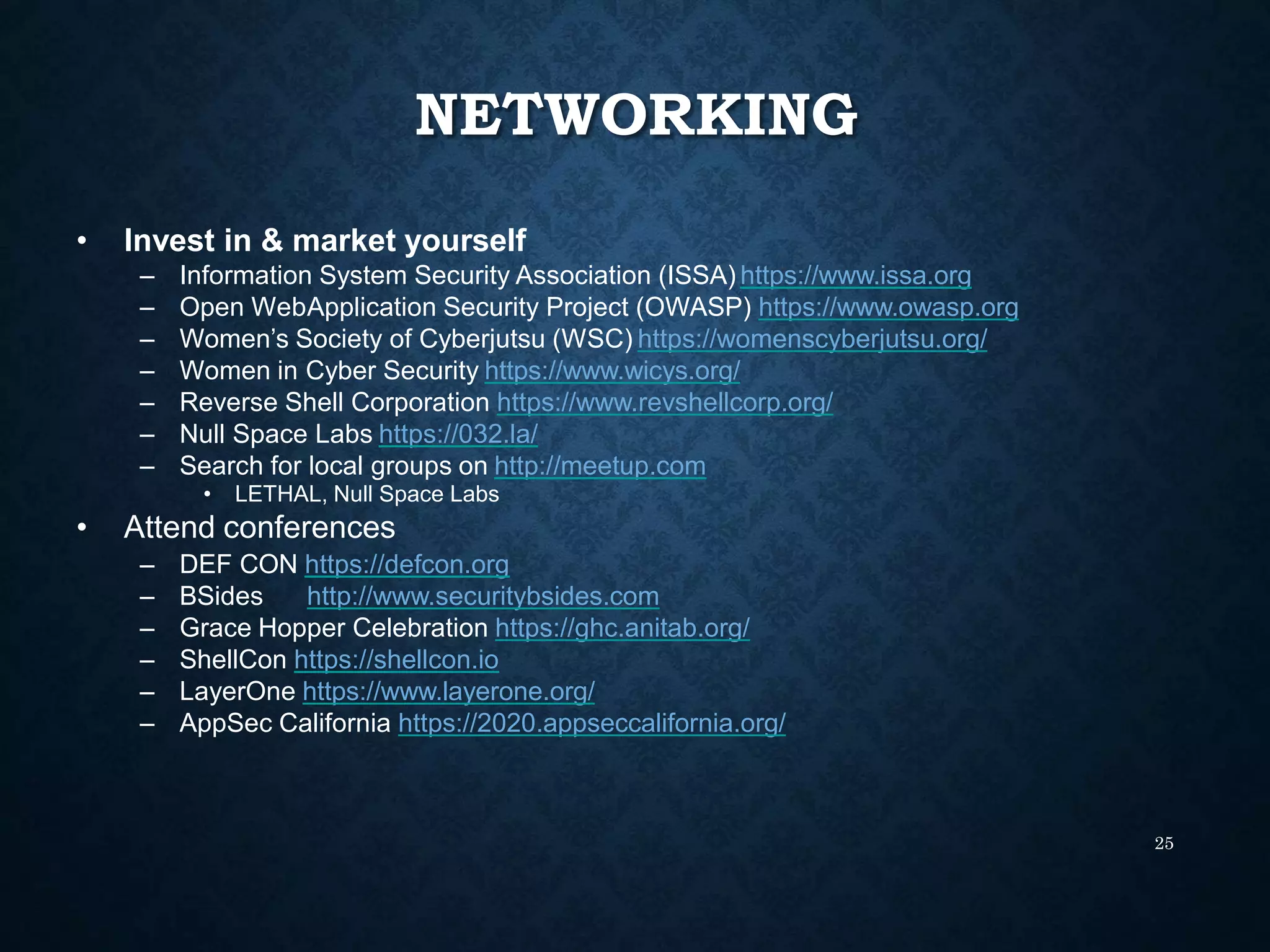
NETWORKING
25
• Invest in& market yourself
– Information System Security Association (ISSA) https://www.issa.org
– Open WebApplication Security Project (OWASP) https://www.owasp.org
– Women’s Society of Cyberjutsu (WSC) https://womenscyberjutsu.org/
– Women in Cyber Security https://www.wicys.org/
– Reverse Shell Corporation https://www.revshellcorp.org/
– Null Space Labs https://032.la/
– Search for local groups on http://meetup.com
• LETHAL, Null Space Labs
• Attend conferences
– DEF CON https://defcon.org
– BSides http://www.securitybsides.com
– Grace Hopper Celebration https://ghc.anitab.org/
– ShellCon https://shellcon.io
– LayerOne https://www.layerone.org/
– AppSec California https://2020.appseccalifornia.org/
26.
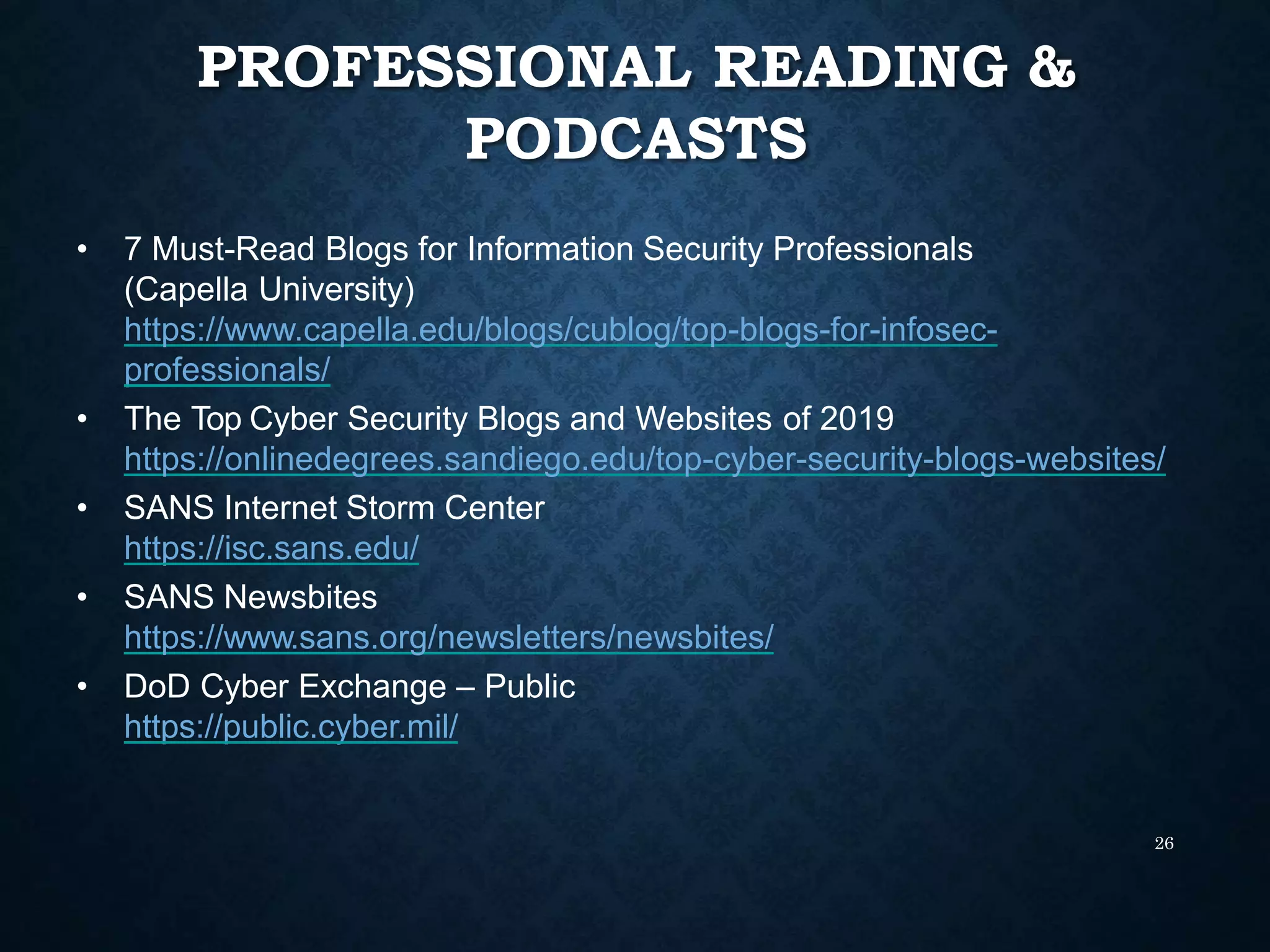
PROFESSIONAL READING &
PODCASTS
26
•7 Must-Read Blogs for Information Security Professionals
(Capella University)
https://www.capella.edu/blogs/cublog/top-blogs-for-infosec-
professionals/
• The Top Cyber Security Blogs and Websites of 2019
https://onlinedegrees.sandiego.edu/top-cyber-security-blogs-websites/
• SANS Internet Storm Center
https://isc.sans.edu/
• SANS Newsbites
https://www.sans.org/newsletters/newsbites/
• DoD Cyber Exchange – Public
https://public.cyber.mil/
27.
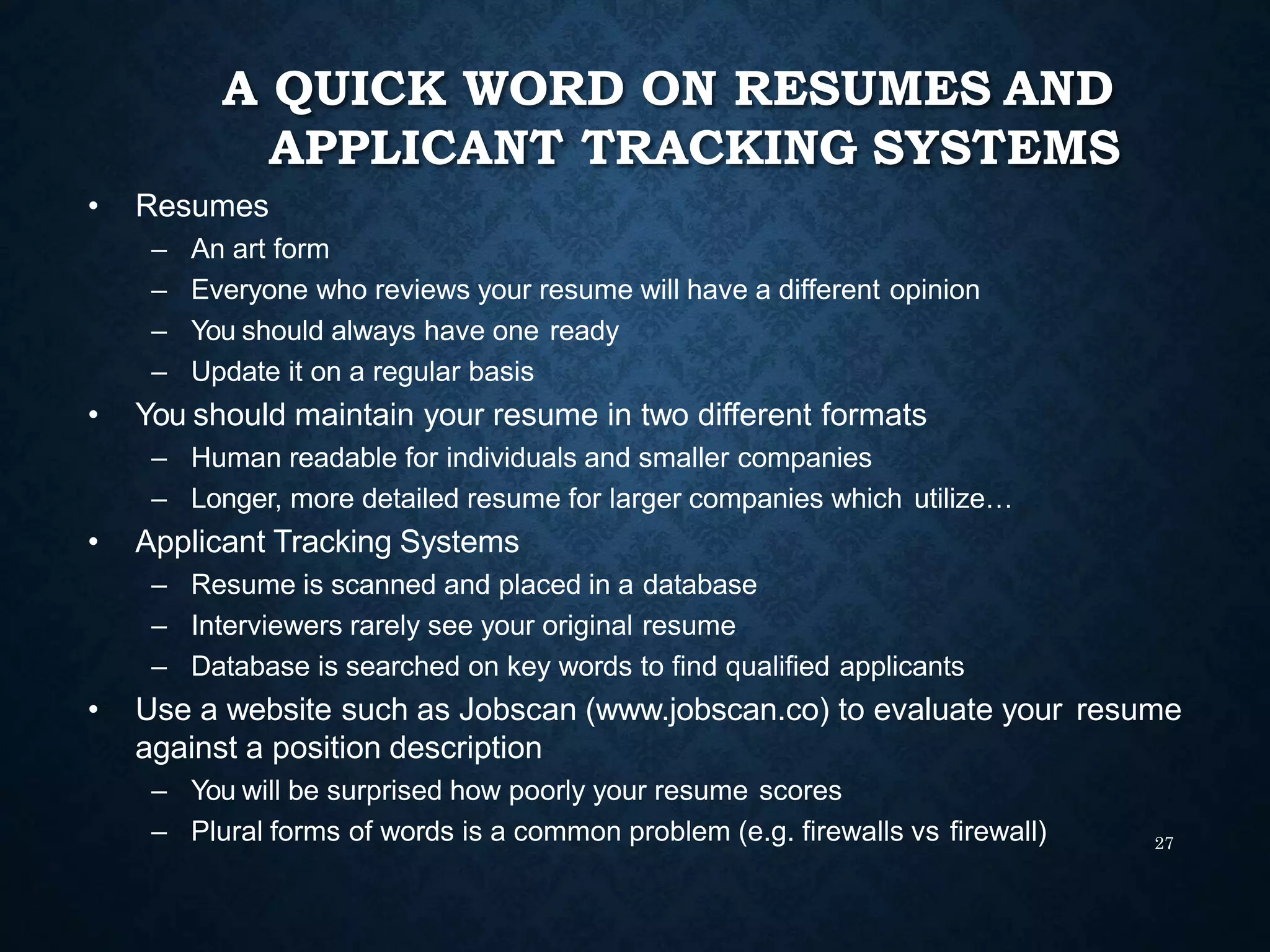
A QUICK WORDON RESUMES AND
APPLICANT TRACKING SYSTEMS
27
• Resumes
– An art form
– Everyone who reviews your resume will have a different opinion
– You should always have one ready
– Update it on a regular basis
• You should maintain your resume in two different formats
– Human readable for individuals and smaller companies
– Longer, more detailed resume for larger companies which utilize…
• Applicant Tracking Systems
– Resume is scanned and placed in a database
– Interviewers rarely see your original resume
– Database is searched on key words to find qualified applicants
• Use a website such as Jobscan (www.jobscan.co) to evaluate your resume
against a position description
– You will be surprised how poorly your resume scores
– Plural forms of words is a common problem (e.g. firewalls vs firewall)