CITY ENGINEERING COLLEGE
Department of Computer Science and Engineering.
G Siri
1CE13CS027
Under the guidance of
Vivekavardhana Reddy
Asst.,Prof.,- Dept. of CSE.
Bengaluru
Securing the Internet of Things in a
Quantum World
By
CONTENTS
INTRODUCTION
LITERATURE SURVEY
EXISTING SYSTEM
PROPOSED SYSTEM
APPROACHES AND METHOD
RESULT AND DISCUSSION
CONCLUSION
REFERENCES
INTRODUCTION
 Currently, we rely on cryptographic algorithms such as AES and
RSA as basic building blocks to secure the communication in the
IoT.
 However, public key schemes like RSA can easily be broken by
the upcoming quantum computers, due to recent advances in
quantum computing.
 We should act now to prepare the IoT for the quantum world. In
this article, we focus on the current state of the art and recent
developments in the area of quantum-resistant cryptosystems for
securing the IoT
Cryptography
κρυπτόσ (kryptós)
“hidden”
+
γράφω (grápho)
“write”
=
Hidden Writing
QUANTUM WORLD
Heisenberg Uncertainty Principle
• Certain pairs of physical properties of a photon are related in such a
way that measuring one property prevents the observer from knowing
the value of the other.
• When measuring the polarization of a photon, the choice of what
direction to measure affects all subsequent measurements.
• If a photon passes through a vertical filter it will have the vertical
orientation regardless of its initial direction of polarization and so with
horizontal orientation.
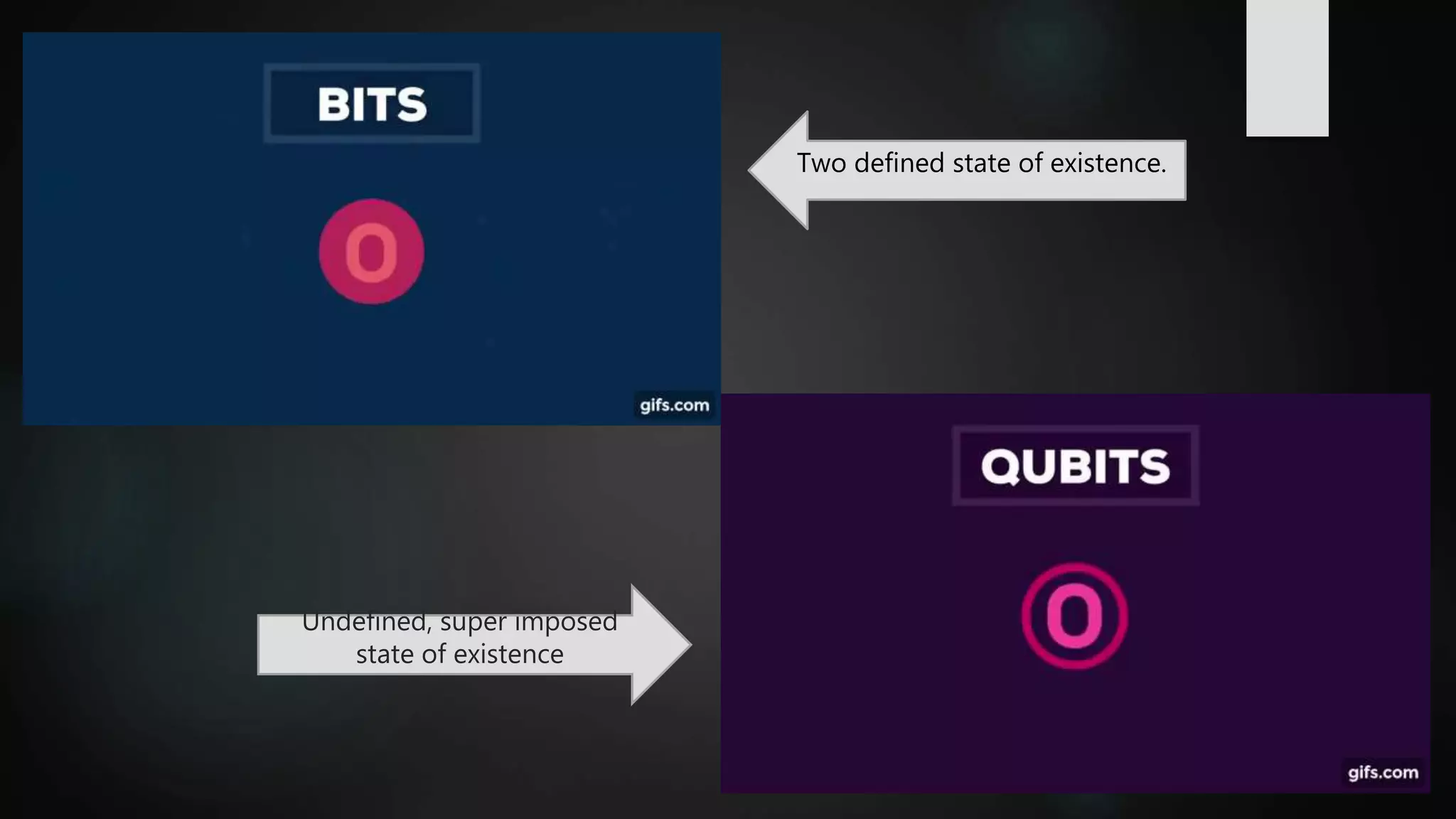
Undefined, super imposed
state of existence
Two defined state of existence.
Uncertainty of a Q-Bit
The q-bit collapses into one of the definite state on being measured.
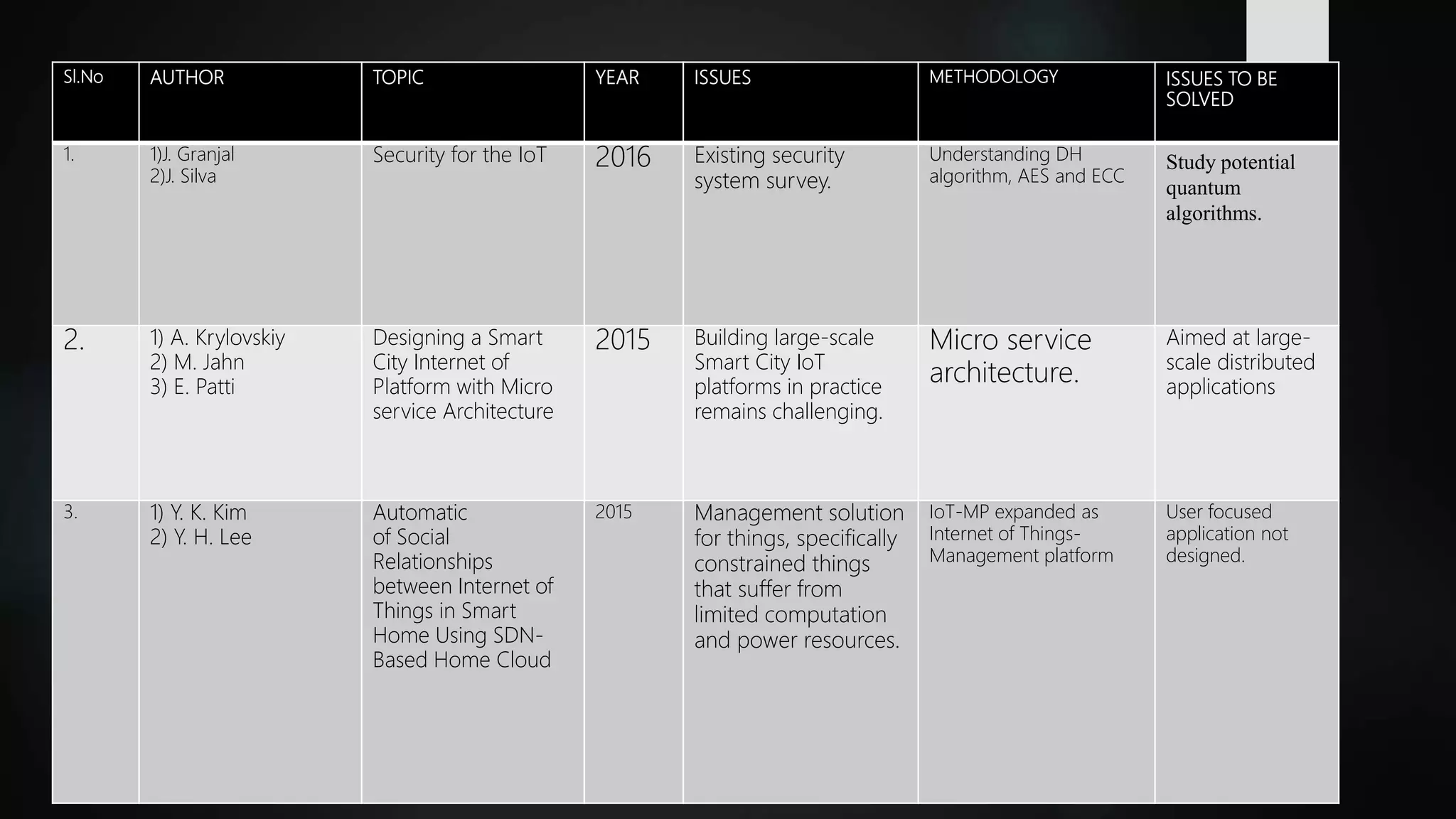
Sl.No AUTHOR TOPIC YEAR ISSUES METHODOLOGY ISSUES TO BE
SOLVED
1. 1)J. Granjal
2)J. Silva
Security for the IoT 2016 Existing security
system survey.
Understanding DH
algorithm, AES and ECC
Study potential
quantum
algorithms.
2. 1) A. Krylovskiy
2) M. Jahn
3) E. Patti
Designing a Smart
City Internet of
Platform with Micro
service Architecture
2015 Building large-scale
Smart City IoT
platforms in practice
remains challenging.
Micro service
architecture.
Aimed at large-
scale distributed
applications
3. 1) Y. K. Kim
2) Y. H. Lee
Automatic
of Social
Relationships
between Internet of
Things in Smart
Home Using SDN-
Based Home Cloud
2015 Management solution
for things, specifically
constrained things
that suffer from
limited computation
and power resources.
IoT-MP expanded as
Internet of Things-
Management platform
User focused
application not
designed.
EXISTING SYSTEM
Available encryption systems can be based on two broad
classification.
1. Symmetric key cryptography
2. Asymmetric key cryptography (Public key)
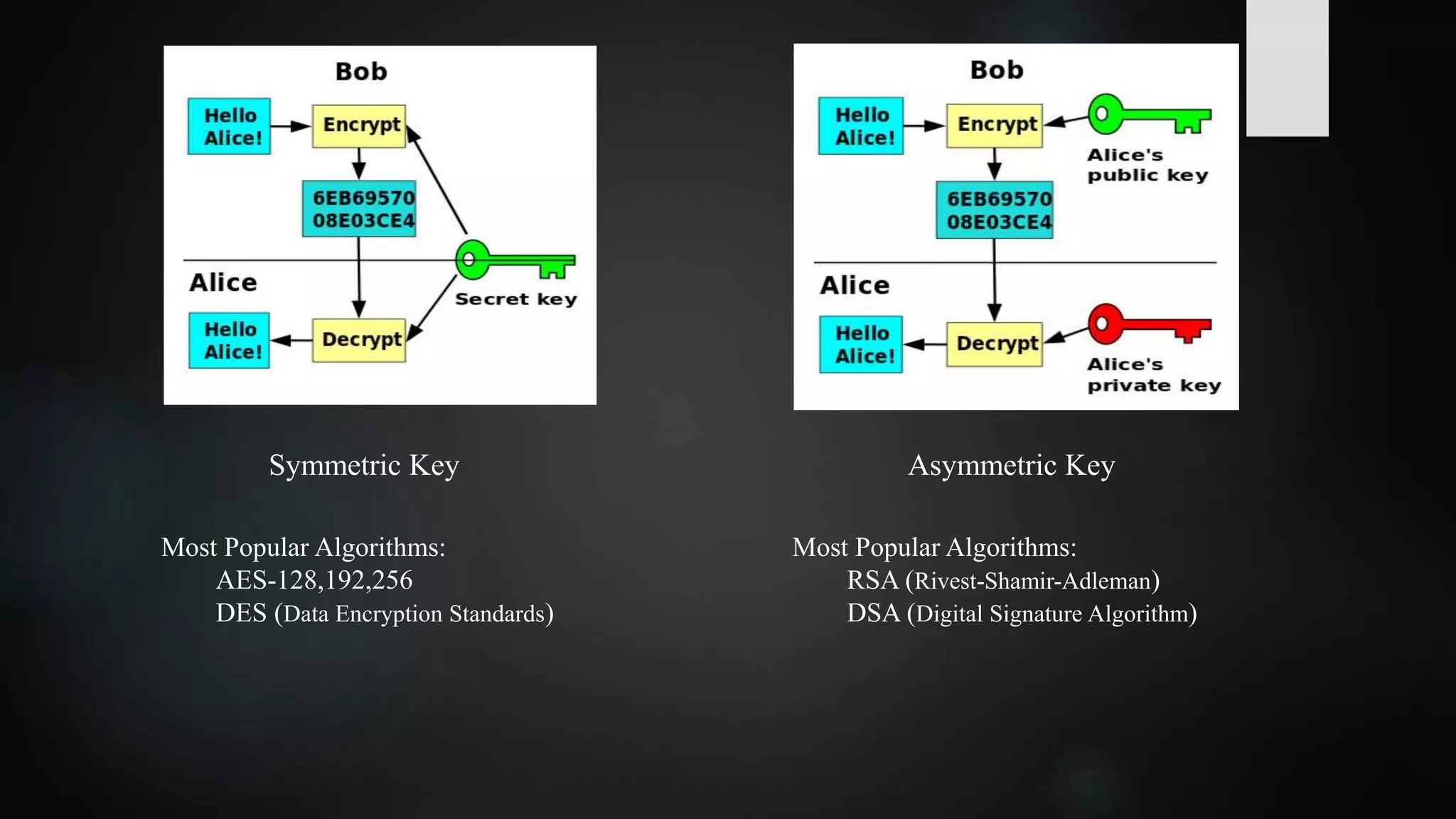
Symmetric Key
Most Popular Algorithms:
AES-128,192,256
DES (Data Encryption Standards)
Asymmetric Key
Most Popular Algorithms:
RSA (Rivest-Shamir-Adleman)
DSA (Digital Signature Algorithm)
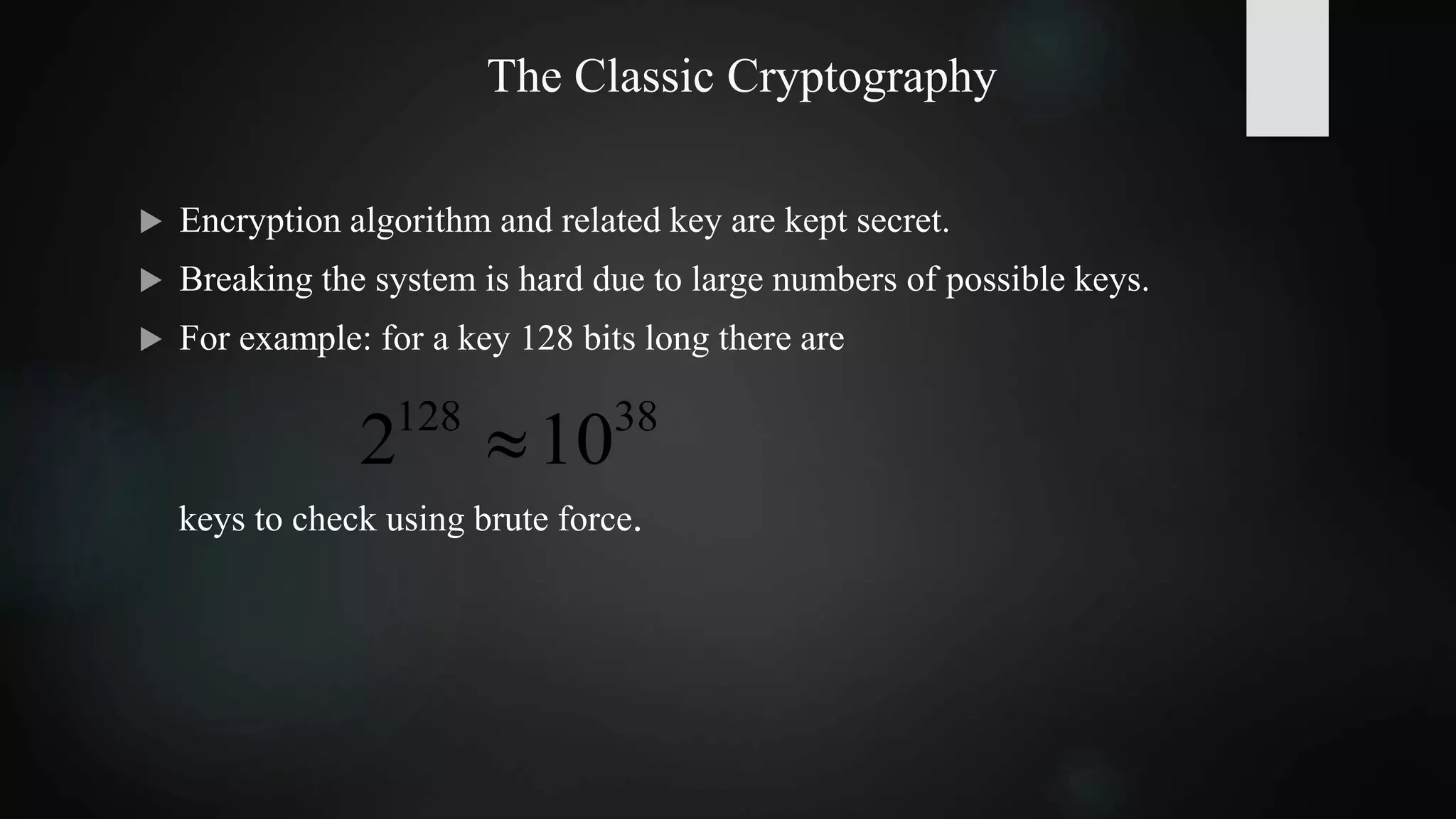
keys to check using brute force.
The Classic Cryptography
 Encryption algorithm and related key are kept secret.
 Breaking the system is hard due to large numbers of possible keys.
 For example: for a key 128 bits long there are
38128
102 
RSAAlgorithm
 The most widely used PKC is the RSA algorithm based on the difficulty of
factoring a product out two large primes.
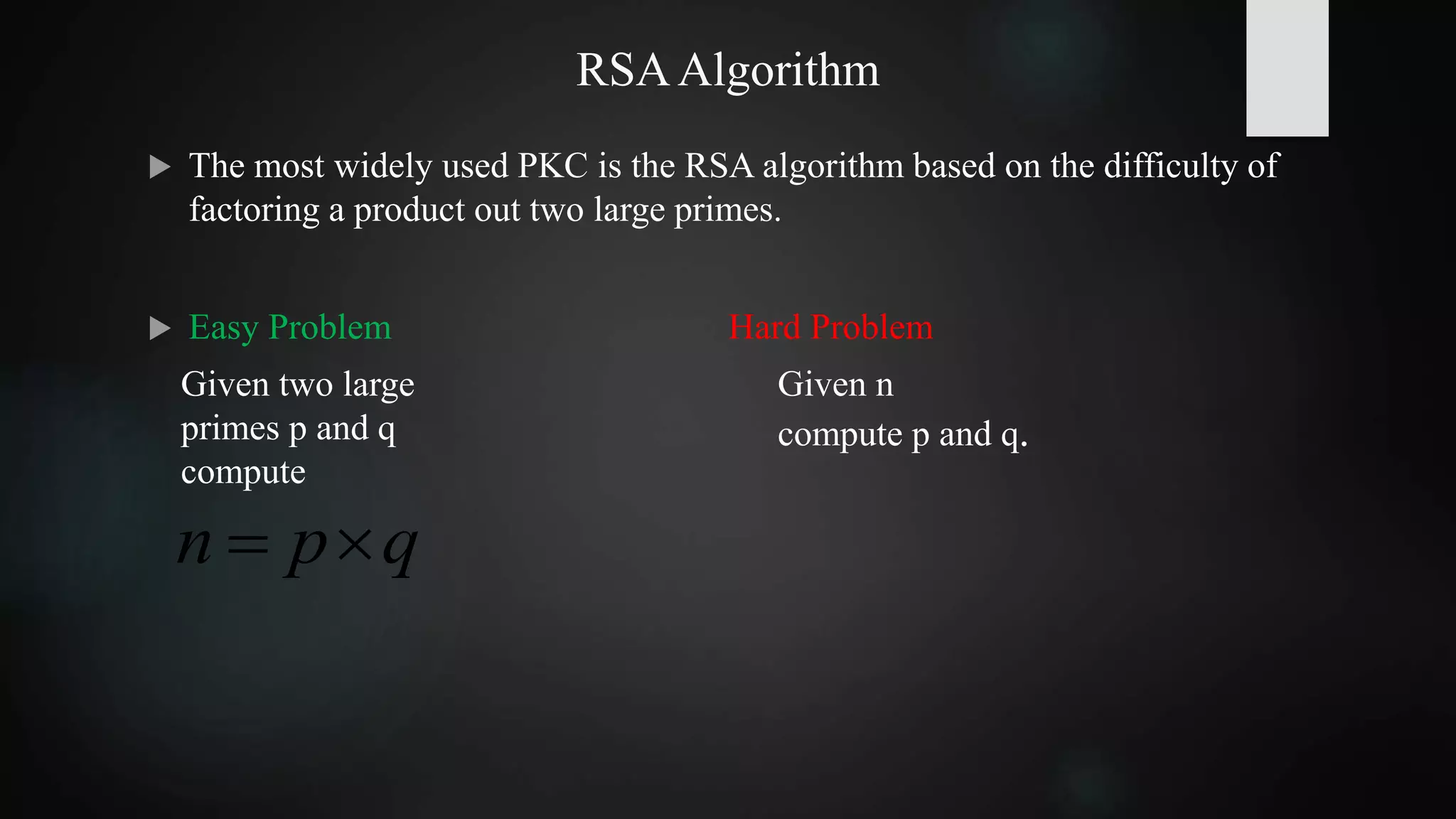
 Easy Problem Hard Problem
qpn 
Given two large
primes p and q
compute
Given n
compute p and q.
Factoring A Product Of Two Large Primes
 The best known conventional algorithm requires the solution time proportional
to:
 Shor’s algorithm easily solves the large T(n) problem on a Quantum computer,
hence RSA cannot be safe in a Quantum world.
])ln(ln)(lnexp[)( 3/23/1
nncnT 
For p & q 65 digits long T(n) is approximately
one month using cluster of workstations.
For p&q 200 digits long T(n) is astronomical.
Factorizing using Quantum Computing
AES Algorithm
 AES algorithm is the most widely deployed Symmetric key
algorithm.
 It is considered to be most efficient in AES-128 bit encryption
method.
 The best known attack against this algorithm is a Brute-Force
search covering all possible keys.
 Grover’s algorithm speeds up this process in a Quantum
Machine. Therefore, AEC is breakable by a Quantum computer.
PROPOSED SYSTEM
According to NIST (National Institute for Standards and Technology),
widely accepted quantum-resistant public-key cryptosystems include:
Hash-based Signatures.
Code-based cryptosystems.
 The construction of hash-based signatures employs only hash functions, and therefore
minimizes the security requirements for building digital signature schemes.
 The first hash-based signature scheme was proposed by Merkle, who used a binary hash
tree to construct the signatures.
 A common requirement of the hash-based signature schemes is the need to record
information about previously signed messages, which is called “state.” This can lead to
problems when signatures are generated on several devices since these devices have to be
synchronized after each signature generation.
 To avoid this, a stateless hash-based signature scheme called SPHINCS has been proposed,
which can be described as a multi-tree version of XMSS
Hash-based Cryptosystem
 Prof. McEliece proposed the first code-based cryptosystem in 1978.
 It was an error correcting code called the Goppa Code.
 The basic idea of McEliece scheme can be described as follows:
 A message is encrypted into a code word with some added errors.
 Only the private key holder can remove errors and recover the original message.
 There is no quantum attack known that breaks the McEliece cryptosystem.
Code-based Cryptosystem
APPROACHES AND METHODS
 In order to secure AES against the quantum computers, the key
size is expected to be double than the original.
 That is, if the key size is 128-bit, it has to be 256 bit and so on.
 This slows down the Grover’s algorithm, making it safe for AES
to function.
Securing AES
Securing RSA
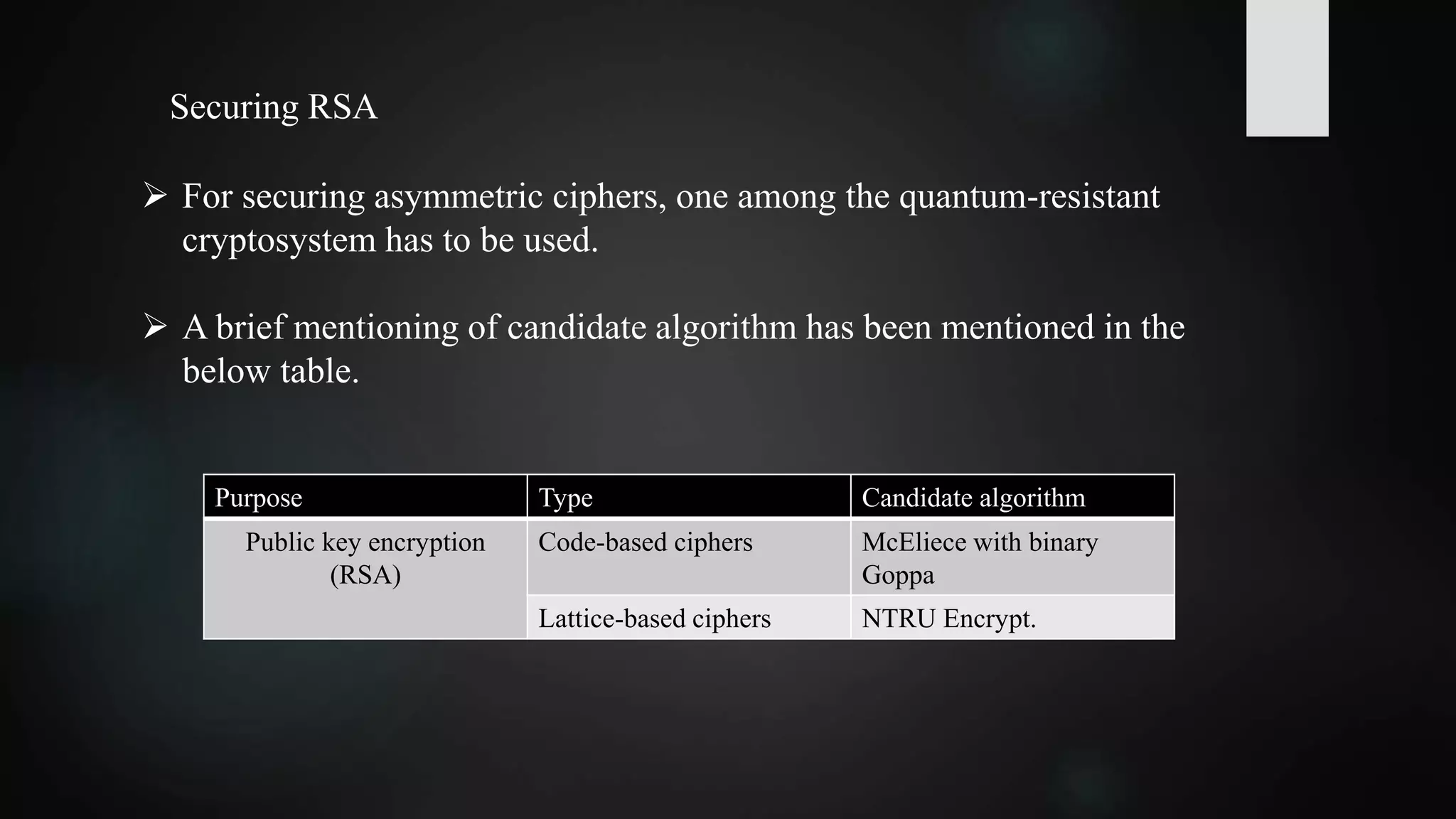
 For securing asymmetric ciphers, one among the quantum-resistant
cryptosystem has to be used.
 A brief mentioning of candidate algorithm has been mentioned in the
below table.
Purpose Type Candidate algorithm
Public key encryption
(RSA)
Code-based ciphers McEliece with binary
Goppa
Lattice-based ciphers NTRU Encrypt.
RESULTS AND DISCUSSIONS
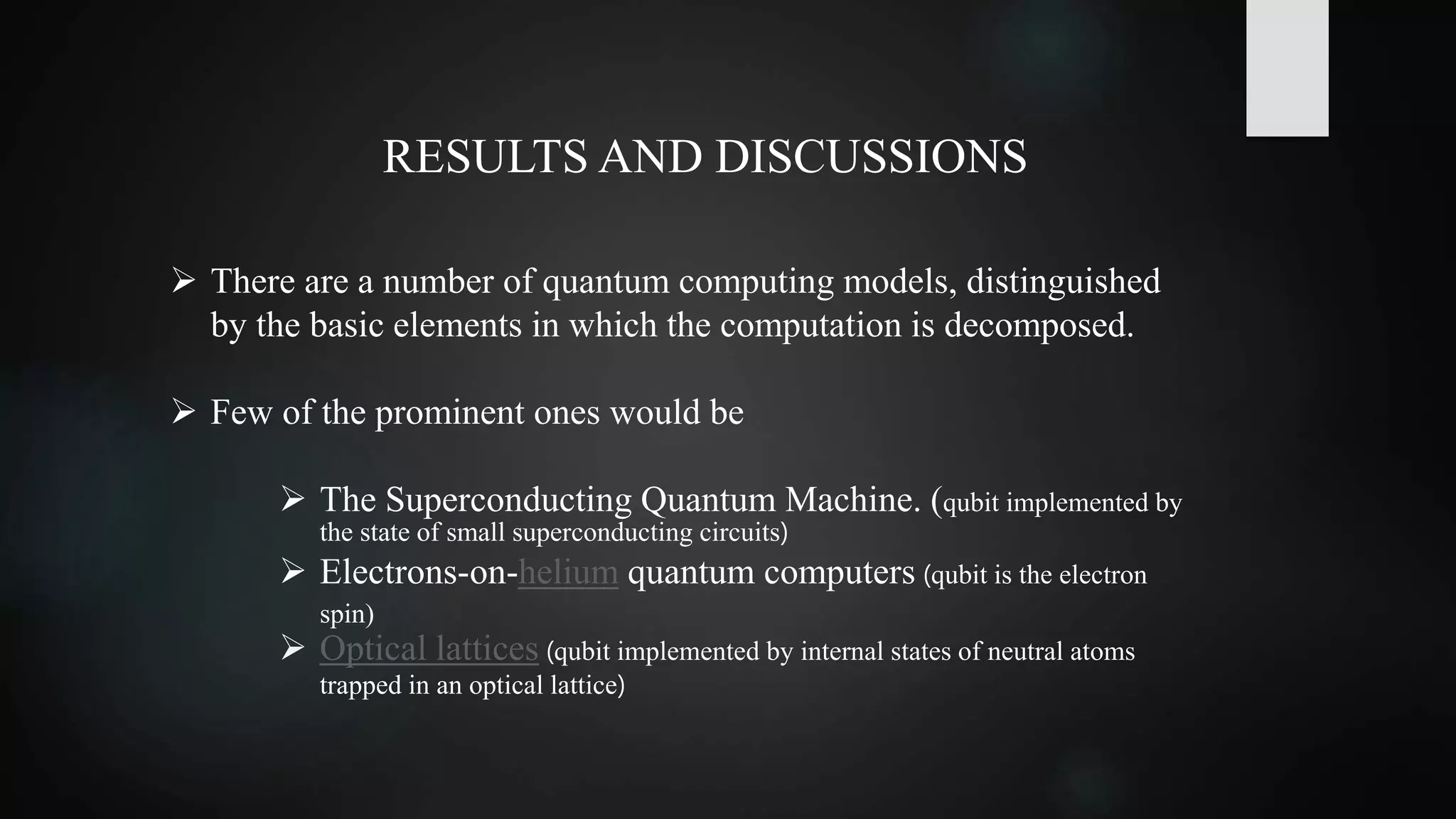
 There are a number of quantum computing models, distinguished
by the basic elements in which the computation is decomposed.
 Few of the prominent ones would be
 The Superconducting Quantum Machine. (qubit implemented by
the state of small superconducting circuits)
 Electrons-on-helium quantum computers (qubit is the electron
spin)
 Optical lattices (qubit implemented by internal states of neutral atoms
trapped in an optical lattice)
State of the QC Technology.
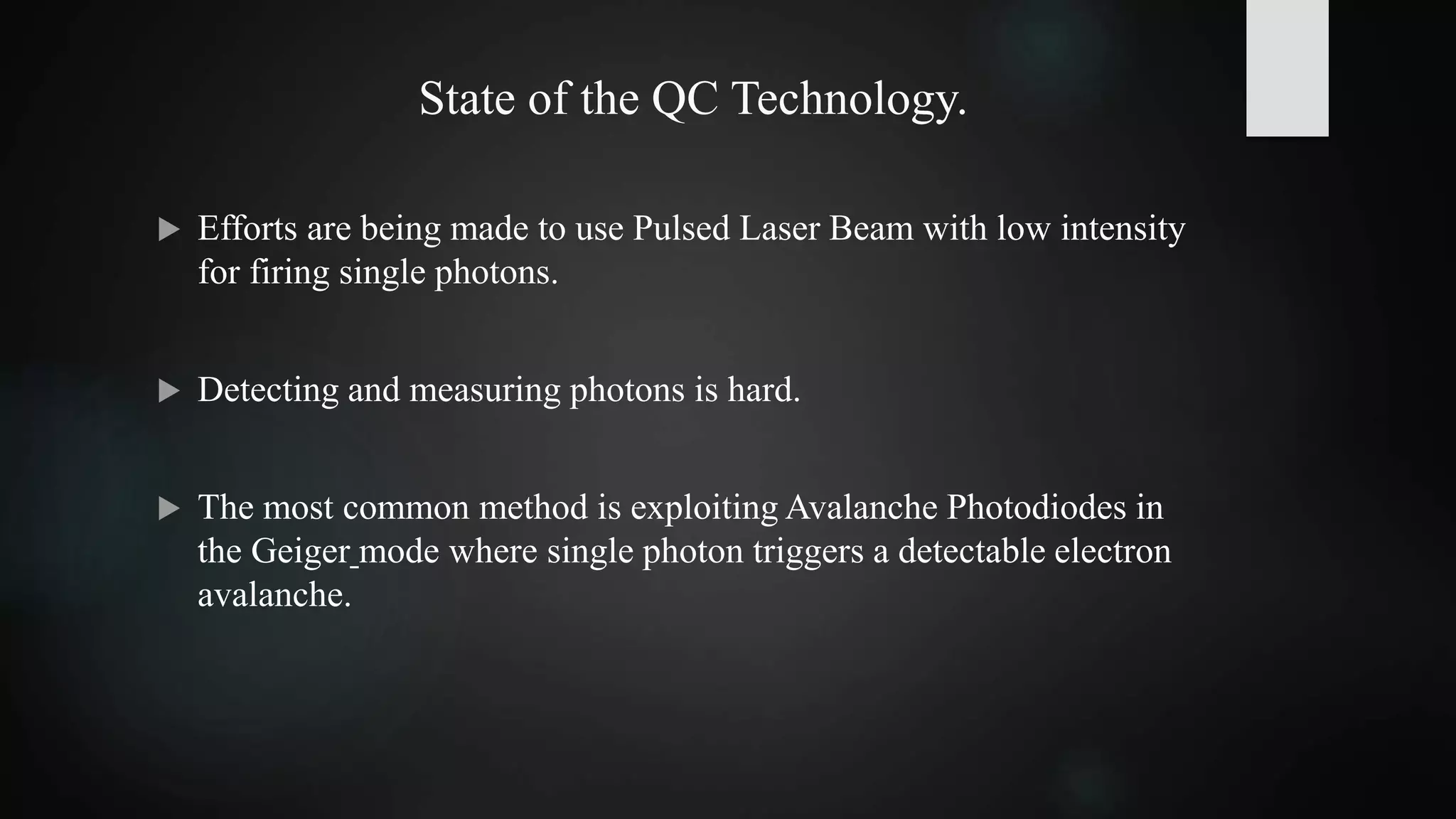
 Efforts are being made to use Pulsed Laser Beam with low intensity
for firing single photons.
 Detecting and measuring photons is hard.
 The most common method is exploiting Avalanche Photodiodes in
the Geiger mode where single photon triggers a detectable electron
avalanche.
State of the QC technology.
 Key transmissions can be achieved for about 200 km distance.
 For longer distances we can use repeaters. But practical repeaters are a
long way in the future.
 The option of using satellites is also considered, but the distance proves
to be a set-back factor.
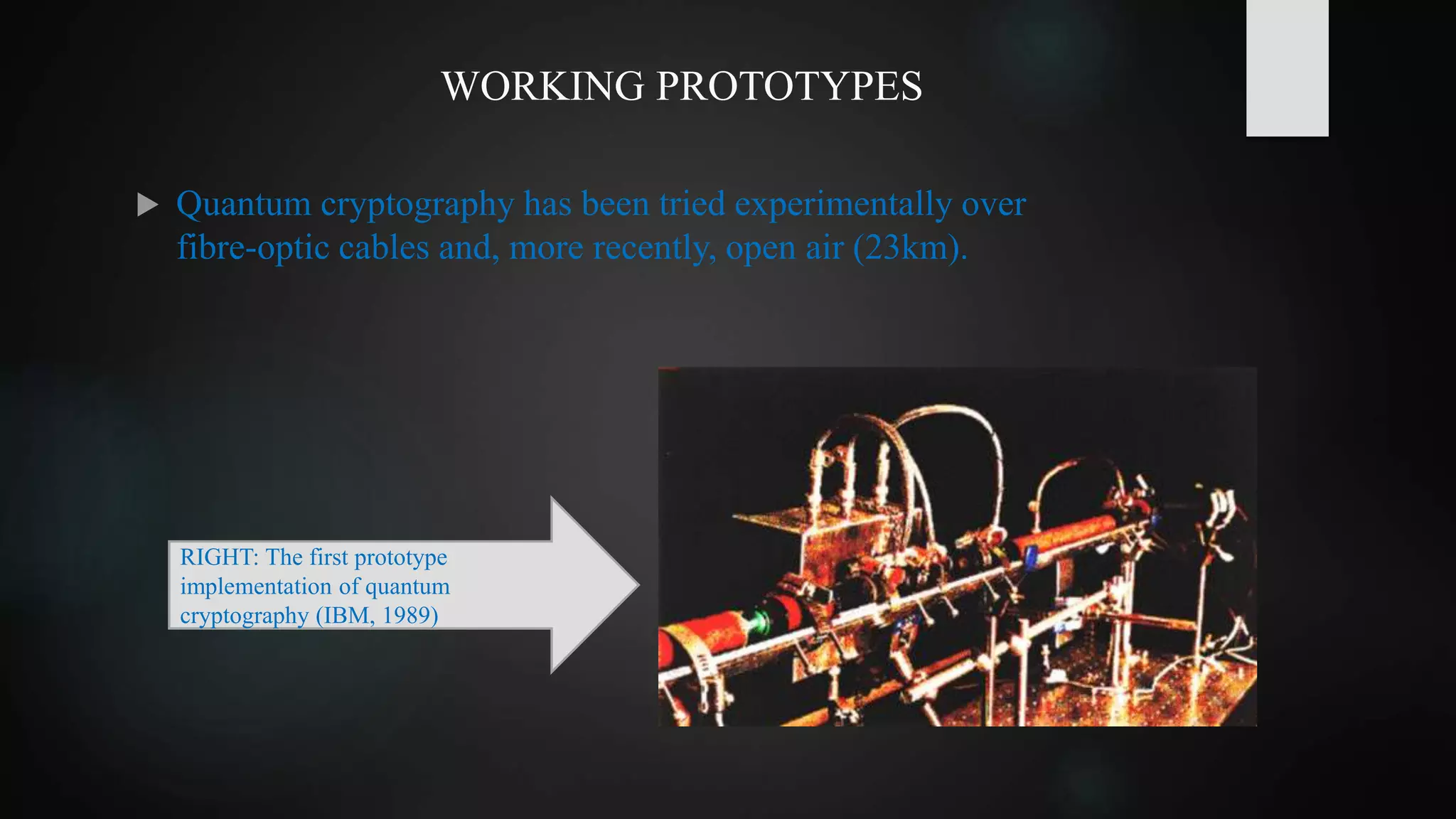
WORKING PROTOTYPES
 Quantum cryptography has been tried experimentally over
fibre-optic cables and, more recently, open air (23km).
RIGHT: The first prototype
implementation of quantum
cryptography (IBM, 1989)
CONCLUSION
Recent advances in quantum computing have demonstrated the urgency of
developing quantum-resistant algorithms for securing communication in the
IoT.
The impacts of large-scale quantum computers is evident, on the security of
the cryptographic schemes widely used today.
The biggest stumbling block, for quantum computing, is scalability. Most
demonstrations of progress towards quantum computing use at most a few
qubits. So, the development of quantum computers could take anywhere
between 5 years to a decade.
However, it is important to stay cautious and protect data on the web from
today.
Thank You

Technical Seminar on Securing the IoT in the Quantum World

  • 1.
    CITY ENGINEERING COLLEGE Departmentof Computer Science and Engineering. G Siri 1CE13CS027 Under the guidance of Vivekavardhana Reddy Asst.,Prof.,- Dept. of CSE. Bengaluru Securing the Internet of Things in a Quantum World By
  • 2.
    CONTENTS INTRODUCTION LITERATURE SURVEY EXISTING SYSTEM PROPOSEDSYSTEM APPROACHES AND METHOD RESULT AND DISCUSSION CONCLUSION REFERENCES
  • 3.
    INTRODUCTION  Currently, werely on cryptographic algorithms such as AES and RSA as basic building blocks to secure the communication in the IoT.  However, public key schemes like RSA can easily be broken by the upcoming quantum computers, due to recent advances in quantum computing.  We should act now to prepare the IoT for the quantum world. In this article, we focus on the current state of the art and recent developments in the area of quantum-resistant cryptosystems for securing the IoT
  • 5.
  • 6.
  • 7.
    Heisenberg Uncertainty Principle •Certain pairs of physical properties of a photon are related in such a way that measuring one property prevents the observer from knowing the value of the other. • When measuring the polarization of a photon, the choice of what direction to measure affects all subsequent measurements. • If a photon passes through a vertical filter it will have the vertical orientation regardless of its initial direction of polarization and so with horizontal orientation.
  • 8.
    Undefined, super imposed stateof existence Two defined state of existence.
  • 9.
    Uncertainty of aQ-Bit The q-bit collapses into one of the definite state on being measured.
  • 10.
    Sl.No AUTHOR TOPICYEAR ISSUES METHODOLOGY ISSUES TO BE SOLVED 1. 1)J. Granjal 2)J. Silva Security for the IoT 2016 Existing security system survey. Understanding DH algorithm, AES and ECC Study potential quantum algorithms. 2. 1) A. Krylovskiy 2) M. Jahn 3) E. Patti Designing a Smart City Internet of Platform with Micro service Architecture 2015 Building large-scale Smart City IoT platforms in practice remains challenging. Micro service architecture. Aimed at large- scale distributed applications 3. 1) Y. K. Kim 2) Y. H. Lee Automatic of Social Relationships between Internet of Things in Smart Home Using SDN- Based Home Cloud 2015 Management solution for things, specifically constrained things that suffer from limited computation and power resources. IoT-MP expanded as Internet of Things- Management platform User focused application not designed.
  • 11.
    EXISTING SYSTEM Available encryptionsystems can be based on two broad classification. 1. Symmetric key cryptography 2. Asymmetric key cryptography (Public key)
  • 12.
    Symmetric Key Most PopularAlgorithms: AES-128,192,256 DES (Data Encryption Standards) Asymmetric Key Most Popular Algorithms: RSA (Rivest-Shamir-Adleman) DSA (Digital Signature Algorithm)
  • 13.
    keys to checkusing brute force. The Classic Cryptography  Encryption algorithm and related key are kept secret.  Breaking the system is hard due to large numbers of possible keys.  For example: for a key 128 bits long there are 38128 102 
  • 14.
    RSAAlgorithm  The mostwidely used PKC is the RSA algorithm based on the difficulty of factoring a product out two large primes.  Easy Problem Hard Problem qpn  Given two large primes p and q compute Given n compute p and q.
  • 17.
    Factoring A ProductOf Two Large Primes  The best known conventional algorithm requires the solution time proportional to:  Shor’s algorithm easily solves the large T(n) problem on a Quantum computer, hence RSA cannot be safe in a Quantum world. ])ln(ln)(lnexp[)( 3/23/1 nncnT  For p & q 65 digits long T(n) is approximately one month using cluster of workstations. For p&q 200 digits long T(n) is astronomical.
  • 18.
  • 19.
    AES Algorithm  AESalgorithm is the most widely deployed Symmetric key algorithm.  It is considered to be most efficient in AES-128 bit encryption method.  The best known attack against this algorithm is a Brute-Force search covering all possible keys.  Grover’s algorithm speeds up this process in a Quantum Machine. Therefore, AEC is breakable by a Quantum computer.
  • 20.
    PROPOSED SYSTEM According toNIST (National Institute for Standards and Technology), widely accepted quantum-resistant public-key cryptosystems include: Hash-based Signatures. Code-based cryptosystems.
  • 21.
     The constructionof hash-based signatures employs only hash functions, and therefore minimizes the security requirements for building digital signature schemes.  The first hash-based signature scheme was proposed by Merkle, who used a binary hash tree to construct the signatures.  A common requirement of the hash-based signature schemes is the need to record information about previously signed messages, which is called “state.” This can lead to problems when signatures are generated on several devices since these devices have to be synchronized after each signature generation.  To avoid this, a stateless hash-based signature scheme called SPHINCS has been proposed, which can be described as a multi-tree version of XMSS Hash-based Cryptosystem
  • 22.
     Prof. McElieceproposed the first code-based cryptosystem in 1978.  It was an error correcting code called the Goppa Code.  The basic idea of McEliece scheme can be described as follows:  A message is encrypted into a code word with some added errors.  Only the private key holder can remove errors and recover the original message.  There is no quantum attack known that breaks the McEliece cryptosystem. Code-based Cryptosystem
  • 23.
    APPROACHES AND METHODS In order to secure AES against the quantum computers, the key size is expected to be double than the original.  That is, if the key size is 128-bit, it has to be 256 bit and so on.  This slows down the Grover’s algorithm, making it safe for AES to function. Securing AES
  • 24.
    Securing RSA  Forsecuring asymmetric ciphers, one among the quantum-resistant cryptosystem has to be used.  A brief mentioning of candidate algorithm has been mentioned in the below table. Purpose Type Candidate algorithm Public key encryption (RSA) Code-based ciphers McEliece with binary Goppa Lattice-based ciphers NTRU Encrypt.
  • 25.
    RESULTS AND DISCUSSIONS There are a number of quantum computing models, distinguished by the basic elements in which the computation is decomposed.  Few of the prominent ones would be  The Superconducting Quantum Machine. (qubit implemented by the state of small superconducting circuits)  Electrons-on-helium quantum computers (qubit is the electron spin)  Optical lattices (qubit implemented by internal states of neutral atoms trapped in an optical lattice)
  • 26.
    State of theQC Technology.  Efforts are being made to use Pulsed Laser Beam with low intensity for firing single photons.  Detecting and measuring photons is hard.  The most common method is exploiting Avalanche Photodiodes in the Geiger mode where single photon triggers a detectable electron avalanche.
  • 27.
    State of theQC technology.  Key transmissions can be achieved for about 200 km distance.  For longer distances we can use repeaters. But practical repeaters are a long way in the future.  The option of using satellites is also considered, but the distance proves to be a set-back factor.
  • 28.
    WORKING PROTOTYPES  Quantumcryptography has been tried experimentally over fibre-optic cables and, more recently, open air (23km). RIGHT: The first prototype implementation of quantum cryptography (IBM, 1989)
  • 29.
    CONCLUSION Recent advances inquantum computing have demonstrated the urgency of developing quantum-resistant algorithms for securing communication in the IoT. The impacts of large-scale quantum computers is evident, on the security of the cryptographic schemes widely used today. The biggest stumbling block, for quantum computing, is scalability. Most demonstrations of progress towards quantum computing use at most a few qubits. So, the development of quantum computers could take anywhere between 5 years to a decade. However, it is important to stay cautious and protect data on the web from today.
  • 30.