
Fault Detection Scheme for AES 
Using Composite Field 
BY 
AJAL.A.J 
EPGPM – IIM K
PRESENTATION 
OVERVIEW 
••RRIIJJNNDDAAEELL AALLGGOORRIITTHHMM 
••SSYYSSTTEEMM AARRCCHHIITTEECCTTUURREE 
••SSIIMMUULLAATTIIOONN RREESSUULLTTSS 
FFUUTTUURREE DDEEVVEELLOOPPMMEENNTT
INTRODUCTION 
• The cipher Rijndael is one of the five finalists of 
the Advanced Encryption Standard (AES) 
• The algorithm has been designed by Joan Daemen 
and Vincent Rijmen 
• It is a Block cipher. 
• The hardware implementation with 128-bit blocks 
and 128-bit keys is presented. 
• VLSI optimizations of the Rijndael algorithm are 
discussed and several hardware design 
modifications and techniques are used, such as 
memory sharing and parallelism.
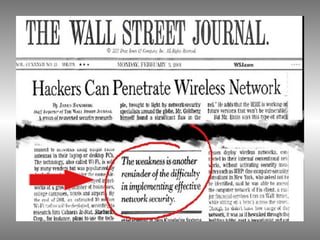
Critical N/W Security Elements 
Critical communications private 
(confidentiality) 
Know who we are dealing with (identity) 
Guarantee messages unaltered (integrity) 
Assert rights over content use (authorization) 
All critical systems up-and-running 
(availability)
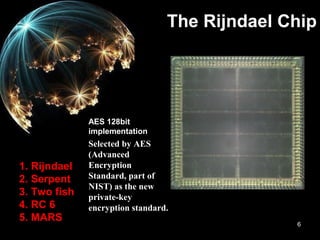
The Rijndael Chip 
6 
1. Rijndael 
2. Serpent 
3. Two fish 
4. RC 6 
5. MARS 
AES 128bit 
implementation 
Selected by AES 
(Advanced 
Encryption 
Standard, part of 
NIST) as the new 
private-key 
encryption standard.
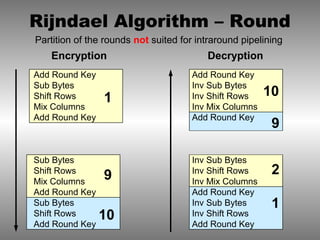
Rijndael Algorithm – Round 
Partition of the rounds not suited for intraround pipelining 
Add Round Key 
Sub Bytes 
Shift Rows 
Mix Columns 
Add Round Key 
Sub Bytes 
Shift Rows 
Mix Columns 
Add Round Key 
Sub Bytes 
Shift Rows 
Add Round Key 
Add Round Key 
Inv Sub Bytes 
Inv Shift Rows 
Inv Mix Columns 
Add Round Key 
Inv Sub Bytes 
Inv Shift Rows 
Inv Mix Columns 
Add Round Key 
Inv Sub Bytes 
Inv Shift Rows 
Add Round Key 
1 
9 
10 
10 
9 
2 
1 
Encryption Decryption
Rijndael Architecture - Overview 
Parallel 
Round 1 
Round Key 
Register 
Key 
Generator 
Parallel 
Round 2 
AddKey 
Key Reg Data Reg 
Controller 
32 128 
128 
32 
128 32 
128 128 
128 128 
Data Reg 
Largest potential for optimizations in rounds
It all starts with a key 
• What is a key? 
• Encryption algorithm is like a recipe for 
spaghetti. Key is like the choice of sauce 
that changes the end result. 
Plain text 
I am going to the 
market 
Decrypting Text 
That’s encryption! 
Cipher text 
K co iqkpi vq vjg 
octmgv 
Encrypt – Garble so it’s unreadable 
Decrypt – Ungarble so it can be read again 
encrypt algorithm – add 
x letters 
hard to read, 
UNLESS you know 
the key 
Encrypting Text 
Plain text 
I am going to the 
market 
CipherText 
K co iqkpi vq vjg 
octmgv 
decryption algorithm – 
subtract x letters 
key - 2
BLOCK DIAGRAM - DECRYPTION 
CORES
Parallel impletation of S-Boxes 
Rijndael S-box consists of two operations 
Encryption 
Path 
Decryption 
Path 
SubBytes 
Inv Sub 
Bytes 
Inv Aff Trans 
Mult Inverse 
Aff Trans 
Mult Inverse 
Multiplicative inverse can be shared
Encryption Simulation Result
Decryption Simulation Result
Synthesis Report And Result Of 
AES Fault Detection Schemes
Comparison of s- box 
Design Area Delay Power 
LUT-Based 262144 31.824ns 35mw 
Composite Field 
Based 
28514 8.129ns 34mw
Output Waveform for composite 
field s-box without error
Output wave form of encryption 
algorithm for composite field s-box 
without error
Output wave form decryption 
algorithm for composite field s-box 
without error
Output wave form decryption 
algorithm for composite field s-box 
with error
Map report 
-------------- 
• Number of errors: 0 
• Number of warnings: 0
HDL SYNTHESIS REPORT 
Macro Statistics 
# ROMs : 56 
16x128-bit ROM : 56 
# Multiplexers : 66 
8-bit 10-to-1 MUX : 10 
8-bit 16-to-1 MUX : 56 
# XORs : 171 
128-bit xor2 : 11 
8-bit xor2 : 150 
8-bit xor3 : 10
Performance Comparison 
Implementation Encryption Speed 
Software implementation 
(ANSI C) 
27Mb/s 
Visual C++ 70.5Mb/s 
Hardware Implementation 
(Altra) 
268Mb/s 
Proposed VHDL 
(Virtex II) 
2.18Gb/s
FUTURE 
DEVELOPMENT 
• For future development, estimation on the real time 
required for key initialization and time for a whole 
encryption should be done on the real chip. 
• Research is still going on the encryptor core for higher 
bit lengths. 
• FPGA based solutions have shown significant speedups 
compared with software based approaches 
• The widespread adoption of distributed, wireless, and 
mobile computing makes the inclusion of privacy, 
authentication and security 
• Power consumption will remain a critical factor 
,especially when cryptographic applications will move into 
embedded context
CONCLUSION 
• In this paper, a VLSI implementation for the Rijndael encryption 
algorithm is presented 
• The combination of security, and high speed implementation, 
makes it a very good choice for wireless systems. 
• The whole design was captured entirely in VHDL language 
using a bottom-up design and verification methodology 
• The proposed VLSI implementation of the algorithm reduces the 
covered area and achieves a data throughput up to 2.18Gbit/sec. 
• An optimized coding for the implementation of Rijndael 
algorithm for 128 bits has been developed 
• Architectural innovations like on the fly round key generation, 
which facilitates simultaneous execution of sub bytes, shift rows 
and mix columns and round key generation has been 
incorporated in our coding.
FUTURE WORK 
• We have presented a high performance parity based low complexity fault 
detection scheme for the AES using the S-box and the inverse S-box in 
composite fields. 
• In our implementations, we used parity method in case of s box and 
ensured that error detection at s box takes two times which improves the 
fault coverage to a great extent. According to our simulation results, with 
acceptable error coverage, the structure-independent schemes proposed 
in this paper have the highest efficiencies, showing reasonable area and 
time complexity overheads. Based on the AES structure chosen, the 
performance goals to achieve, and the resources available, one can use 
combinations of the presented schemes in order to have much more 
reliable AES encryption and decryption structure.
FUTURE WORK
[1] National Institute of Standards and Technologies, Announcing 
the Advanced Encryption Standard (AES) FIPS 197, Nov. 2001. 
[2] R. Karri, K. Wu, P. Mishra, and K. Yongkook, “Fault-based 
side-channel cryptanalysis tolerant Rijndael symmetric block 
cipher architecture,” in Proc. DFT, Oct. 2001, pp. 418–426. 
[3] R. Karri, K. Wu, P. Mishra, and Y. Kim, “Concurrent error 
detection schemes for fault-based side-channel cryptanalysis of 
symmetric block ciphers,” IEEE Trans. Comput.-Aided Des. Integr. 
Circuits Syst., vol. 21, no. 12, pp. 1509–1517, Dec. 2002. 
[4] A. Satoh, T. Sugawara, N. Homma, and T. Aoki, “High-performance 
concurrent error detection scheme for AES 
hardware,” in Proc. CHES, Aug. 2008, pp. 100–112.
[5] L. Breveglieri, I. Koren, and P. Maistri, “Incorporating error detection and online 
reconfiguration into a regular architecture for the advanced encryption standard,” in Proc. DFT, 
Oct. 2005, pp. 72–80. 
[6] M. Karpovsky, K. J. Kulikowski, and A. Taubin, “Differential fault analysis attack resistant 
architectures for the advanced encryption standard,” in Proc. CARDIS, Aug. 2004, vol. 153, pp. 
177–192. 
[7] P. Maistri and R. Leveugle, “Double-data-rate computation as a countermeasure against fault 
analysis,” IEEE Trans. Computers, vol. 57, no. 11, pp. 1528–1539, Nov. 2008. 
[8] C. H. Yen and B. F.Wu, “Simple error detection methods for hardware 
implementation of advanced encryption standard,” IEEE Trans. Computers, vol. 55, no. 6, pp. 
720–731, Jun. 2006. 
[9] G. Bertoni, L. Breveglieri, I. Koren, P. Maistri, and V. Piuri, “A parity code based fault 
detection for an implementation of the advanced encryption standard,” in Proc. DFT, Nov. 2002, 
pp. 51–59. 
[10] G. Bertoni, L. Breveglieri, I. Koren, P. Maistri, and V. Piuri, “Error analysis and detection 
procedures for a hardware implementation of the advanced encryption standard,” IEEE Trans. 
Computers, vol. 52, no. 4, pp. 492–505, Apr. 2003. 
[11] C. Moratelli, F. Ghellar, E. Cota, and M. Lubaszewski, “A fault-tolerant DFA-resistant AES 
core,” in Proc. ISCAS, 2008, pp. 244–247. 
[12] M. Mozaffari-Kermani and A. Reyhani-Masoleh, “Parity-based fault detection architecture 
of S-box for advanced encryption standard,” in Proc. DFT, Verbauwhede, “A systematic 
evaluation of compact hardware implementations for the Rijndael S-box,” in Proc. CT-RSA, Feb. 
2005, pp. 323–333. Oct. 2006, pp. 572 580.
[13] S.-Y. Wu and H.-T. Yen, “On the S-box architectures with concurrent error detection for the 
advanced encryption standard,” IEICE Trans. Fundam. Electron., Commun. Comput. Sci., vol. 
E89-A, no. 10, pp. 2583–2588, Oct. 2006. 
[14] A. E. Cohen, “Architectures for Cryptography Accelerators,” Ph.D. dissertation, Univ. 
Minnesota, Twin Cities, Sep. 2007. 
[15] M. Mozaffari-Kermani and A. Reyhani-Masoleh, “A lightweight concurrent fault detection 
scheme for the AES S-boxes using normal basis,” in Proc. CHES, Aug. 2008, pp. 113–129. 
[16] D. Canright, “A very compact S-box for AES,” in Proc. CHES, Aug. 2005, pp. 441–455. 
[17] A. Satoh, S. Morioka, K. Takano, and S. Munetoh, “A compact Rijndael hardware 
architecture with S-box optimization,” in Proc. ASIACRYPT, Dec. 2001, pp. 239–254. 
[18] J.Wolkerstorfer, E. Oswald, and M. Lamberger, “An ASIC implementation of the AES 
SBoxes,” in Proc. CT-RSA, 2002, pp. 67–78. 
[19] V. Rijmen, Dept. ESAT, Katholieke Universiteit Leuven, Leuven, Belgium, Efficient 
Implementation of the Rijndael S-Box, 2000. 
[20] X. Zhang and K. K. Parhi, “High-speed VLSI architectures for the AES algorithm,” IEEE 
Trans. Very Large Scale Integr. (VLSI) Syst., vol. VLSI-12, no. 9, pp. 957–967, Sep. 2004. 
[21] X. Zhang and K. K. Parhi, “On the optimum constructions of composite field for the AES 
algorithm,” IEEE Trans. Circuits Syst. II, Exp. Briefs, vol. 53, no. 10, pp. 1153–1157, Oct. 2006. 
[22] N. Mentens, L. Batina, B. Preneel, and I. Verbauwhede, “A systematic evaluation of compact 
hardware implementations for the Rijndael S-box,” in Proc. CT-RSA, Feb. 2005, pp. 323–333.
QUERRIES ? ? ? 
AJAL.A.J 
MOB: 0-8907305642

Fault Detection Scheme for AES Using Composite Field

  • 1.
    Fault Detection Schemefor AES Using Composite Field BY AJAL.A.J EPGPM – IIM K
  • 2.
    PRESENTATION OVERVIEW ••RRIIJJNNDDAAEELLAALLGGOORRIITTHHMM ••SSYYSSTTEEMM AARRCCHHIITTEECCTTUURREE ••SSIIMMUULLAATTIIOONN RREESSUULLTTSS FFUUTTUURREE DDEEVVEELLOOPPMMEENNTT
  • 3.
    INTRODUCTION • Thecipher Rijndael is one of the five finalists of the Advanced Encryption Standard (AES) • The algorithm has been designed by Joan Daemen and Vincent Rijmen • It is a Block cipher. • The hardware implementation with 128-bit blocks and 128-bit keys is presented. • VLSI optimizations of the Rijndael algorithm are discussed and several hardware design modifications and techniques are used, such as memory sharing and parallelism.
  • 5.
    Critical N/W SecurityElements Critical communications private (confidentiality) Know who we are dealing with (identity) Guarantee messages unaltered (integrity) Assert rights over content use (authorization) All critical systems up-and-running (availability)
  • 6.
    The Rijndael Chip 6 1. Rijndael 2. Serpent 3. Two fish 4. RC 6 5. MARS AES 128bit implementation Selected by AES (Advanced Encryption Standard, part of NIST) as the new private-key encryption standard.
  • 7.
    Rijndael Algorithm –Round Partition of the rounds not suited for intraround pipelining Add Round Key Sub Bytes Shift Rows Mix Columns Add Round Key Sub Bytes Shift Rows Mix Columns Add Round Key Sub Bytes Shift Rows Add Round Key Add Round Key Inv Sub Bytes Inv Shift Rows Inv Mix Columns Add Round Key Inv Sub Bytes Inv Shift Rows Inv Mix Columns Add Round Key Inv Sub Bytes Inv Shift Rows Add Round Key 1 9 10 10 9 2 1 Encryption Decryption
  • 8.
    Rijndael Architecture -Overview Parallel Round 1 Round Key Register Key Generator Parallel Round 2 AddKey Key Reg Data Reg Controller 32 128 128 32 128 32 128 128 128 128 Data Reg Largest potential for optimizations in rounds
  • 9.
    It all startswith a key • What is a key? • Encryption algorithm is like a recipe for spaghetti. Key is like the choice of sauce that changes the end result. Plain text I am going to the market Decrypting Text That’s encryption! Cipher text K co iqkpi vq vjg octmgv Encrypt – Garble so it’s unreadable Decrypt – Ungarble so it can be read again encrypt algorithm – add x letters hard to read, UNLESS you know the key Encrypting Text Plain text I am going to the market CipherText K co iqkpi vq vjg octmgv decryption algorithm – subtract x letters key - 2
  • 10.
    BLOCK DIAGRAM -DECRYPTION CORES
  • 11.
    Parallel impletation ofS-Boxes Rijndael S-box consists of two operations Encryption Path Decryption Path SubBytes Inv Sub Bytes Inv Aff Trans Mult Inverse Aff Trans Mult Inverse Multiplicative inverse can be shared
  • 15.
  • 16.
  • 17.
    Synthesis Report AndResult Of AES Fault Detection Schemes
  • 18.
    Comparison of s-box Design Area Delay Power LUT-Based 262144 31.824ns 35mw Composite Field Based 28514 8.129ns 34mw
  • 19.
    Output Waveform forcomposite field s-box without error
  • 20.
    Output wave formof encryption algorithm for composite field s-box without error
  • 21.
    Output wave formdecryption algorithm for composite field s-box without error
  • 22.
    Output wave formdecryption algorithm for composite field s-box with error
  • 23.
    Map report -------------- • Number of errors: 0 • Number of warnings: 0
  • 24.
    HDL SYNTHESIS REPORT Macro Statistics # ROMs : 56 16x128-bit ROM : 56 # Multiplexers : 66 8-bit 10-to-1 MUX : 10 8-bit 16-to-1 MUX : 56 # XORs : 171 128-bit xor2 : 11 8-bit xor2 : 150 8-bit xor3 : 10
  • 25.
    Performance Comparison ImplementationEncryption Speed Software implementation (ANSI C) 27Mb/s Visual C++ 70.5Mb/s Hardware Implementation (Altra) 268Mb/s Proposed VHDL (Virtex II) 2.18Gb/s
  • 36.
    FUTURE DEVELOPMENT •For future development, estimation on the real time required for key initialization and time for a whole encryption should be done on the real chip. • Research is still going on the encryptor core for higher bit lengths. • FPGA based solutions have shown significant speedups compared with software based approaches • The widespread adoption of distributed, wireless, and mobile computing makes the inclusion of privacy, authentication and security • Power consumption will remain a critical factor ,especially when cryptographic applications will move into embedded context
  • 37.
    CONCLUSION • Inthis paper, a VLSI implementation for the Rijndael encryption algorithm is presented • The combination of security, and high speed implementation, makes it a very good choice for wireless systems. • The whole design was captured entirely in VHDL language using a bottom-up design and verification methodology • The proposed VLSI implementation of the algorithm reduces the covered area and achieves a data throughput up to 2.18Gbit/sec. • An optimized coding for the implementation of Rijndael algorithm for 128 bits has been developed • Architectural innovations like on the fly round key generation, which facilitates simultaneous execution of sub bytes, shift rows and mix columns and round key generation has been incorporated in our coding.
  • 38.
    FUTURE WORK •We have presented a high performance parity based low complexity fault detection scheme for the AES using the S-box and the inverse S-box in composite fields. • In our implementations, we used parity method in case of s box and ensured that error detection at s box takes two times which improves the fault coverage to a great extent. According to our simulation results, with acceptable error coverage, the structure-independent schemes proposed in this paper have the highest efficiencies, showing reasonable area and time complexity overheads. Based on the AES structure chosen, the performance goals to achieve, and the resources available, one can use combinations of the presented schemes in order to have much more reliable AES encryption and decryption structure.
  • 39.
  • 40.
    [1] National Instituteof Standards and Technologies, Announcing the Advanced Encryption Standard (AES) FIPS 197, Nov. 2001. [2] R. Karri, K. Wu, P. Mishra, and K. Yongkook, “Fault-based side-channel cryptanalysis tolerant Rijndael symmetric block cipher architecture,” in Proc. DFT, Oct. 2001, pp. 418–426. [3] R. Karri, K. Wu, P. Mishra, and Y. Kim, “Concurrent error detection schemes for fault-based side-channel cryptanalysis of symmetric block ciphers,” IEEE Trans. Comput.-Aided Des. Integr. Circuits Syst., vol. 21, no. 12, pp. 1509–1517, Dec. 2002. [4] A. Satoh, T. Sugawara, N. Homma, and T. Aoki, “High-performance concurrent error detection scheme for AES hardware,” in Proc. CHES, Aug. 2008, pp. 100–112.
  • 41.
    [5] L. Breveglieri,I. Koren, and P. Maistri, “Incorporating error detection and online reconfiguration into a regular architecture for the advanced encryption standard,” in Proc. DFT, Oct. 2005, pp. 72–80. [6] M. Karpovsky, K. J. Kulikowski, and A. Taubin, “Differential fault analysis attack resistant architectures for the advanced encryption standard,” in Proc. CARDIS, Aug. 2004, vol. 153, pp. 177–192. [7] P. Maistri and R. Leveugle, “Double-data-rate computation as a countermeasure against fault analysis,” IEEE Trans. Computers, vol. 57, no. 11, pp. 1528–1539, Nov. 2008. [8] C. H. Yen and B. F.Wu, “Simple error detection methods for hardware implementation of advanced encryption standard,” IEEE Trans. Computers, vol. 55, no. 6, pp. 720–731, Jun. 2006. [9] G. Bertoni, L. Breveglieri, I. Koren, P. Maistri, and V. Piuri, “A parity code based fault detection for an implementation of the advanced encryption standard,” in Proc. DFT, Nov. 2002, pp. 51–59. [10] G. Bertoni, L. Breveglieri, I. Koren, P. Maistri, and V. Piuri, “Error analysis and detection procedures for a hardware implementation of the advanced encryption standard,” IEEE Trans. Computers, vol. 52, no. 4, pp. 492–505, Apr. 2003. [11] C. Moratelli, F. Ghellar, E. Cota, and M. Lubaszewski, “A fault-tolerant DFA-resistant AES core,” in Proc. ISCAS, 2008, pp. 244–247. [12] M. Mozaffari-Kermani and A. Reyhani-Masoleh, “Parity-based fault detection architecture of S-box for advanced encryption standard,” in Proc. DFT, Verbauwhede, “A systematic evaluation of compact hardware implementations for the Rijndael S-box,” in Proc. CT-RSA, Feb. 2005, pp. 323–333. Oct. 2006, pp. 572 580.
  • 42.
    [13] S.-Y. Wuand H.-T. Yen, “On the S-box architectures with concurrent error detection for the advanced encryption standard,” IEICE Trans. Fundam. Electron., Commun. Comput. Sci., vol. E89-A, no. 10, pp. 2583–2588, Oct. 2006. [14] A. E. Cohen, “Architectures for Cryptography Accelerators,” Ph.D. dissertation, Univ. Minnesota, Twin Cities, Sep. 2007. [15] M. Mozaffari-Kermani and A. Reyhani-Masoleh, “A lightweight concurrent fault detection scheme for the AES S-boxes using normal basis,” in Proc. CHES, Aug. 2008, pp. 113–129. [16] D. Canright, “A very compact S-box for AES,” in Proc. CHES, Aug. 2005, pp. 441–455. [17] A. Satoh, S. Morioka, K. Takano, and S. Munetoh, “A compact Rijndael hardware architecture with S-box optimization,” in Proc. ASIACRYPT, Dec. 2001, pp. 239–254. [18] J.Wolkerstorfer, E. Oswald, and M. Lamberger, “An ASIC implementation of the AES SBoxes,” in Proc. CT-RSA, 2002, pp. 67–78. [19] V. Rijmen, Dept. ESAT, Katholieke Universiteit Leuven, Leuven, Belgium, Efficient Implementation of the Rijndael S-Box, 2000. [20] X. Zhang and K. K. Parhi, “High-speed VLSI architectures for the AES algorithm,” IEEE Trans. Very Large Scale Integr. (VLSI) Syst., vol. VLSI-12, no. 9, pp. 957–967, Sep. 2004. [21] X. Zhang and K. K. Parhi, “On the optimum constructions of composite field for the AES algorithm,” IEEE Trans. Circuits Syst. II, Exp. Briefs, vol. 53, no. 10, pp. 1153–1157, Oct. 2006. [22] N. Mentens, L. Batina, B. Preneel, and I. Verbauwhede, “A systematic evaluation of compact hardware implementations for the Rijndael S-box,” in Proc. CT-RSA, Feb. 2005, pp. 323–333.
  • 44.
    QUERRIES ? ?? AJAL.A.J MOB: 0-8907305642

Editor's Notes

  • #3 <number>
  • #4 In cryptography, a block cipher is a deterministic algorithm operating on fixed-length groups of bits, called blocks, with an unvarying transformation that is specified by a symmetric key