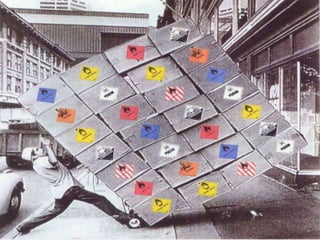
UNEP / ICCA Workshop
TEMA
June 2014
1
DG and GHS Classification System
2
Classification of Chemicals
3
Dangerous Goods can be either a
SUBSTANCE or an ARTICLE:
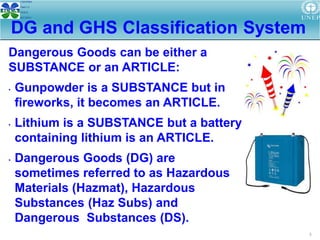
• Gunpowder is a SUBSTANCE but in
fireworks, it becomes an ARTICLE.
• Lithium is a SUBSTANCE but a battery
containing lithium is an ARTICLE.
• Dangerous Goods (DG) are
sometimes referred to as Hazardous
Materials (Hazmat), Hazardous
Substances (Haz Subs) and
Dangerous Substances (DS).
4
The UN System for identifying a
DG for transport, storage and
handling assigns key identifiers:
• Proper Shipping Name.
• UN Number.
• Classification.
5
• The name that MUST be quoted
on all packages, bulk containers
and documentation.
• A chemical or product may have
several different names. The
designated UN PSN MUST be
used.
Proper Shipping Name (PSN)
6
Proper Shipping Name
Most accurate description of the item
on the DG list, e.g.
Potassium Cyanide together with Class
and Description:
UN1680 Potassium Cyanide, Solid 6.1
7
UN Number
Overcome Language Barrier
1001–0999 Explosives.
1000– Pure chemicals, e.g. Acetone,
Sulphuric Acid.
Generic ‘families’ of
chemicals, e.g. Flammable
Liquid.
Not Otherwise Specified
(N.O.S)
8
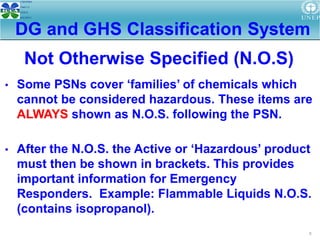
• Some PSNs cover ‘families’ of chemicals which
cannot be considered hazardous. These items are
ALWAYS shown as N.O.S. following the PSN.
• After the N.O.S. the Active or ‘Hazardous’ product
must then be shown in brackets. This provides
important information for Emergency
Responders. Example: Flammable Liquids N.O.S.
(contains isopropanol).
Not Otherwise Specified (N.O.S)
9
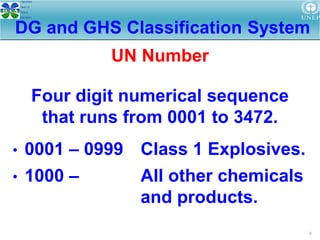
Four digit numerical sequence
that runs from 0001 to 3472.
• 0001 – 0999 Class 1 Explosives.
• 1000 – All other chemicals
and products.
UN Number
10
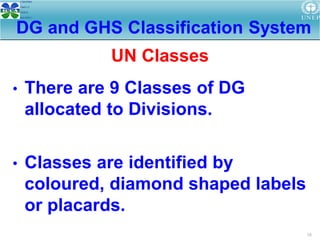
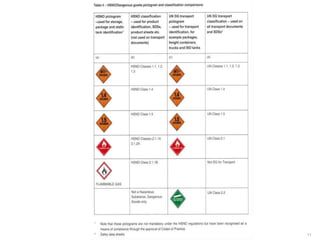
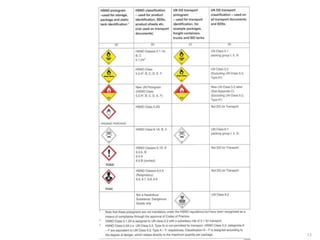
• There are 9 Classes of DG
allocated to Divisions.
• Classes are identified by
coloured, diamond shaped labels
or placards.
UN Classes
11
12
13
14
16
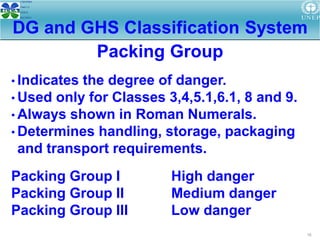
Packing Group
• Indicates the degree of danger.
• Used only for Classes 3,4,5.1,6.1, 8 and 9.
• Always shown in Roman Numerals.
• Determines handling, storage, packaging
and transport requirements.
Packing Group I High danger
Packing Group II Medium danger
Packing Group III Low danger
17
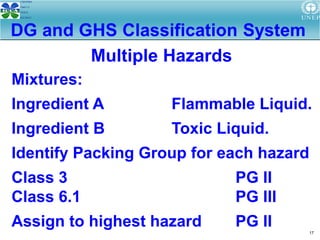
Multiple Hazards
Mixtures:
Ingredient A Flammable Liquid.
Ingredient B Toxic Liquid.
Identify Packing Group for each hazard
Class 3 PG II
Class 6.1 PG III
Assign to highest hazard PG II
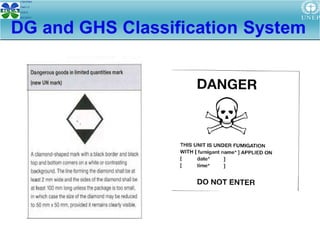
18
• Must be displayed on
all transport units
(trucks, freight
containers, tanks)
carrying DG.
• Must be displayed on
all vehicles carrying
Bulk DG.
1

DG and GHS Classification System Part II

  • 1.
    UNEP / ICCAWorkshop TEMA June 2014 1 DG and GHS Classification System
  • 2.
  • 3.
    3 Dangerous Goods canbe either a SUBSTANCE or an ARTICLE: • Gunpowder is a SUBSTANCE but in fireworks, it becomes an ARTICLE. • Lithium is a SUBSTANCE but a battery containing lithium is an ARTICLE. • Dangerous Goods (DG) are sometimes referred to as Hazardous Materials (Hazmat), Hazardous Substances (Haz Subs) and Dangerous Substances (DS).
  • 4.
    4 The UN Systemfor identifying a DG for transport, storage and handling assigns key identifiers: • Proper Shipping Name. • UN Number. • Classification.
  • 5.
    5 • The namethat MUST be quoted on all packages, bulk containers and documentation. • A chemical or product may have several different names. The designated UN PSN MUST be used. Proper Shipping Name (PSN)
  • 6.
    6 Proper Shipping Name Mostaccurate description of the item on the DG list, e.g. Potassium Cyanide together with Class and Description: UN1680 Potassium Cyanide, Solid 6.1
  • 7.
    7 UN Number Overcome LanguageBarrier 1001–0999 Explosives. 1000– Pure chemicals, e.g. Acetone, Sulphuric Acid. Generic ‘families’ of chemicals, e.g. Flammable Liquid. Not Otherwise Specified (N.O.S)
  • 8.
    8 • Some PSNscover ‘families’ of chemicals which cannot be considered hazardous. These items are ALWAYS shown as N.O.S. following the PSN. • After the N.O.S. the Active or ‘Hazardous’ product must then be shown in brackets. This provides important information for Emergency Responders. Example: Flammable Liquids N.O.S. (contains isopropanol). Not Otherwise Specified (N.O.S)
  • 9.
    9 Four digit numericalsequence that runs from 0001 to 3472. • 0001 – 0999 Class 1 Explosives. • 1000 – All other chemicals and products. UN Number
  • 10.
    10 • There are9 Classes of DG allocated to Divisions. • Classes are identified by coloured, diamond shaped labels or placards. UN Classes
  • 11.
  • 12.
  • 13.
  • 14.
  • 16.
    16 Packing Group • Indicatesthe degree of danger. • Used only for Classes 3,4,5.1,6.1, 8 and 9. • Always shown in Roman Numerals. • Determines handling, storage, packaging and transport requirements. Packing Group I High danger Packing Group II Medium danger Packing Group III Low danger
  • 17.
    17 Multiple Hazards Mixtures: Ingredient AFlammable Liquid. Ingredient B Toxic Liquid. Identify Packing Group for each hazard Class 3 PG II Class 6.1 PG III Assign to highest hazard PG II
  • 18.
    18 • Must bedisplayed on all transport units (trucks, freight containers, tanks) carrying DG. • Must be displayed on all vehicles carrying Bulk DG.
  • 19.