Chapter 11: Sequences, Series, and Power Series
Section 11.9: Representation of Functions as Power Series
Alea Wittig
SUNY Albany
Outline
Representations of Functions as Power Series
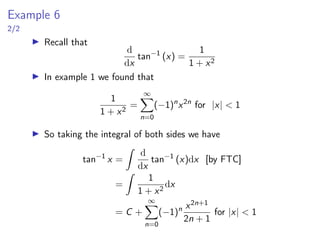
Differentiation and Integration of Power Series
Representations of Functions as Power Series
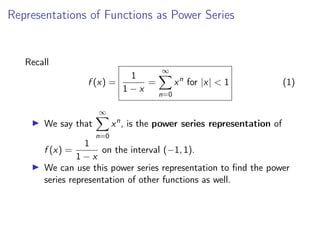
Recall
f (x) =
1
1 − x
=
∞
X
n=0
xn
for |x| < 1 (1)
▶ We say that
∞
X
n=0
xn
, is the power series representation of
f (x) =
1
1 − x
on the interval (−1, 1).
▶ We can use this power series representation to find the power
series representation of other functions as well.
Example 1
1/2
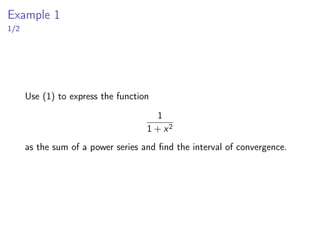
Use (1) to express the function
1
1 + x2
as the sum of a power series and find the interval of convergence.
Example 1
2/2
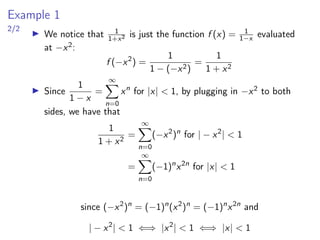
▶ We notice that 1
1+x2 is just the function f (x) = 1
1−x evaluated
at −x2:
f (−x2
) =
1
1 − (−x2)
=
1
1 + x2
▶ Since
1
1 − x
=
∞
X
n=0
xn
for |x| < 1, by plugging in −x2 to both
sides, we have that
1
1 + x2
=
∞
X
n=0
(−x2
)n
for | − x2
| < 1
=
∞
X
n=0
(−1)n
x2n
for |x| < 1
since (−x2
)n
= (−1)n
(x2
)n
= (−1)n
x2n
and
| − x2
| < 1 ⇐⇒ |x2
| < 1 ⇐⇒ |x| < 1
Example 2
1/3
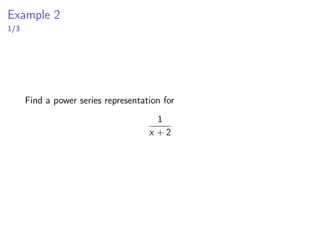
Find a power series representation for
1
x + 2
Example 2
2/3
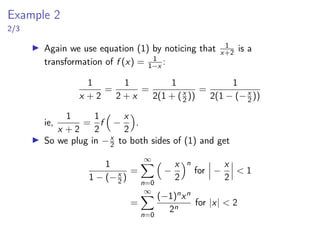
▶ Again we use equation (1) by noticing that 1
x+2 is a
transformation of f (x) = 1
1−x :
1
x + 2
=
1
2 + x
=
1
2(1 + (x
2 ))
=
1
2(1 − (−x
2 ))
ie,
1
x + 2
=
1
2
f

−
x
2

.
▶ So we plug in −x
2 to both sides of (1) and get
1
1 − (−x
2 )
=
∞
X
n=0

−
x
2
n
for
−
x
2
1
=
∞
X
n=0
(−1)nxn
2n
for |x|  2
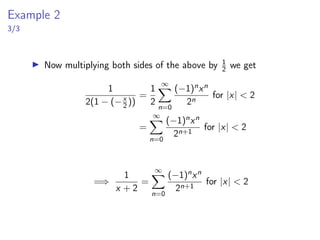
Example 2
3/3
▶ Now multiplying both sides of the above by 1
2 we get
1
2(1 − (−x
2 ))
=
1
2
∞
X
n=0
(−1)nxn
2n
for |x|  2
=
∞
X
n=0
(−1)nxn
2n+1
for |x|  2
=⇒
1
x + 2
=
∞
X
n=0
(−1)nxn
2n+1
for |x|  2
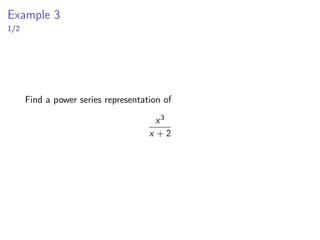
Example 3
1/2
Find a power series representation of
x3
x + 2
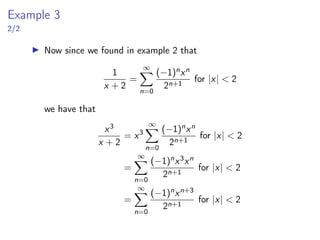
Example 3
2/2
▶ Now since we found in example 2 that
1
x + 2
=
∞
X
n=0
(−1)nxn
2n+1
for |x|  2
we have that
x3
x + 2
= x3
∞
X
n=0
(−1)nxn
2n+1
for |x|  2
=
∞
X
n=0
(−1)nx3xn
2n+1
for |x|  2
=
∞
X
n=0
(−1)nxn+3
2n+1
for |x|  2
Differentiation and Integration of Power Series
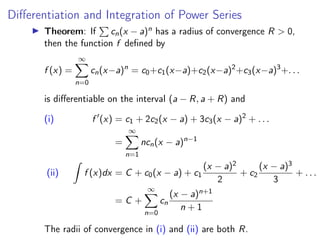
▶ Theorem: If
P
cn(x − a)n has a radius of convergence R  0,
then the function f defined by
f (x) =
∞
X
n=0
cn(x−a)n
= c0+c1(x−a)+c2(x−a)2
+c3(x−a)3
+. . .
is differentiable on the interval (a − R, a + R) and
(i) f ′
(x) = c1 + 2c2(x − a) + 3c3(x − a)2
+ . . .
=
∞
X
n=1
ncn(x − a)n−1
(ii)
Z
f (x)dx = C + c0(x − a) + c1
(x − a)2
2
+ c2
(x − a)3
3
+ . . .
= C +
∞
X
n=0
cn
(x − a)n+1
n + 1
The radii of convergence in (i) and (ii) are both R.
Remark
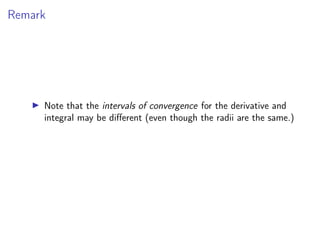
▶ Note that the intervals of convergence for the derivative and
integral may be different (even though the radii are the same.)
Example 4
1/2
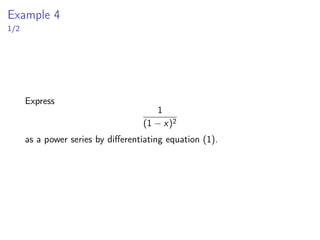
Express
1
(1 − x)2
as a power series by differentiating equation (1).

Section 11.9

  • 1.
    Chapter 11: Sequences,Series, and Power Series Section 11.9: Representation of Functions as Power Series Alea Wittig SUNY Albany
  • 2.
    Outline Representations of Functionsas Power Series Differentiation and Integration of Power Series
  • 3.
  • 4.
    Representations of Functionsas Power Series Recall f (x) = 1 1 − x = ∞ X n=0 xn for |x| < 1 (1) ▶ We say that ∞ X n=0 xn , is the power series representation of f (x) = 1 1 − x on the interval (−1, 1). ▶ We can use this power series representation to find the power series representation of other functions as well.
  • 5.
    Example 1 1/2 Use (1)to express the function 1 1 + x2 as the sum of a power series and find the interval of convergence.
  • 6.
    Example 1 2/2 ▶ Wenotice that 1 1+x2 is just the function f (x) = 1 1−x evaluated at −x2: f (−x2 ) = 1 1 − (−x2) = 1 1 + x2 ▶ Since 1 1 − x = ∞ X n=0 xn for |x| < 1, by plugging in −x2 to both sides, we have that 1 1 + x2 = ∞ X n=0 (−x2 )n for | − x2 | < 1 = ∞ X n=0 (−1)n x2n for |x| < 1 since (−x2 )n = (−1)n (x2 )n = (−1)n x2n and | − x2 | < 1 ⇐⇒ |x2 | < 1 ⇐⇒ |x| < 1
  • 7.
    Example 2 1/3 Find apower series representation for 1 x + 2
  • 8.
    Example 2 2/3 ▶ Againwe use equation (1) by noticing that 1 x+2 is a transformation of f (x) = 1 1−x : 1 x + 2 = 1 2 + x = 1 2(1 + (x 2 )) = 1 2(1 − (−x 2 )) ie, 1 x + 2 = 1 2 f − x 2 . ▶ So we plug in −x 2 to both sides of (1) and get 1 1 − (−x 2 ) = ∞ X n=0 − x 2 n for
  • 11.
  • 14.
  • 15.
    Example 2 3/3 ▶ Nowmultiplying both sides of the above by 1 2 we get 1 2(1 − (−x 2 )) = 1 2 ∞ X n=0 (−1)nxn 2n for |x| 2 = ∞ X n=0 (−1)nxn 2n+1 for |x| 2 =⇒ 1 x + 2 = ∞ X n=0 (−1)nxn 2n+1 for |x| 2
  • 16.
    Example 3 1/2 Find apower series representation of x3 x + 2
  • 17.
    Example 3 2/2 ▶ Nowsince we found in example 2 that 1 x + 2 = ∞ X n=0 (−1)nxn 2n+1 for |x| 2 we have that x3 x + 2 = x3 ∞ X n=0 (−1)nxn 2n+1 for |x| 2 = ∞ X n=0 (−1)nx3xn 2n+1 for |x| 2 = ∞ X n=0 (−1)nxn+3 2n+1 for |x| 2
  • 18.
  • 19.
    Differentiation and Integrationof Power Series ▶ Theorem: If P cn(x − a)n has a radius of convergence R 0, then the function f defined by f (x) = ∞ X n=0 cn(x−a)n = c0+c1(x−a)+c2(x−a)2 +c3(x−a)3 +. . . is differentiable on the interval (a − R, a + R) and (i) f ′ (x) = c1 + 2c2(x − a) + 3c3(x − a)2 + . . . = ∞ X n=1 ncn(x − a)n−1 (ii) Z f (x)dx = C + c0(x − a) + c1 (x − a)2 2 + c2 (x − a)3 3 + . . . = C + ∞ X n=0 cn (x − a)n+1 n + 1 The radii of convergence in (i) and (ii) are both R.
  • 20.
    Remark ▶ Note thatthe intervals of convergence for the derivative and integral may be different (even though the radii are the same.)
  • 21.
    Example 4 1/2 Express 1 (1 −x)2 as a power series by differentiating equation (1).