THE CHAIN RULE
Basic Calculus:
Quarter 3 –Module 7
G U D I TO, O D ETT E N .
1 1 – LU M I N E SC E NC E
THE CHAIN RULE
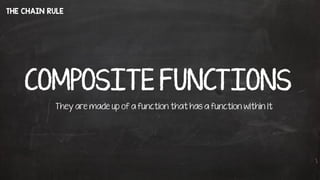
COMPOSITE FUNCTIONS
They are made up of a function that has a function within it
THE CHAIN RULE
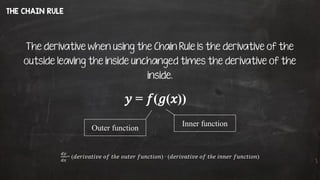
The derivative when using the Chain Rule is the derivative of the
outside leaving the inside unchanged times the derivative of the
inside.
𝑦 = 𝑓(𝑔(𝑥))
Inner function
Outer function
𝑑𝑦
𝑑𝑥
= (𝑑𝑒𝑟𝑖𝑣𝑎𝑡𝑖𝑣𝑒 𝑜𝑓 𝑡ℎ𝑒 𝑜𝑢𝑡𝑒𝑟 𝑓𝑢𝑛𝑐𝑡𝑖𝑜𝑛) ∙ (𝑑𝑒𝑟𝑖𝑣𝑎𝑡𝑖𝑣𝑒 𝑜𝑓 𝑡ℎ𝑒 𝑖𝑛𝑛𝑒𝑟 𝑓𝑢𝑛𝑐𝑡𝑖𝑜𝑛)
THE CHAIN RULE
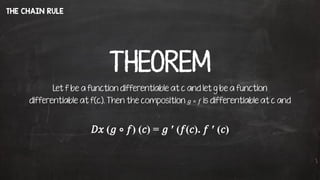
THEOREM
Let f be a function differentiable at c and let g be a function
differentiable at f(c). Then the composition 𝑔 ∘ 𝑓 is differentiable at c and
𝐷𝑥 (𝑔 ∘ 𝑓) (𝑐) = 𝑔 ′ (𝑓(𝑐). 𝑓 ′ (𝑐)
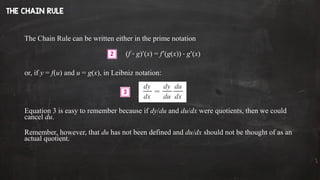
The Chain Rule can be written either in the prime notation
(f  g)(x) = f(g(x))  g(x)
or, if y = f(u) and u = g(x), in Leibniz notation:
Equation 3 is easy to remember because if dy/du and du/dx were quotients, then we could
cancel du.
Remember, however, that du has not been defined and du/dx should not be thought of as an
actual quotient.
THE CHAIN RULE
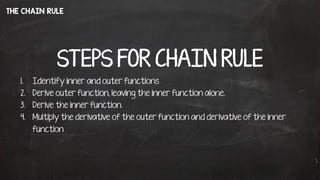
STEPS FOR CHAIN RULE
1. Identify inner and outer functions
2. Derive outer function, leaving the inner function alone.
3. Derive the inner function.
4. Multiply the derivative of the outer function and derivative of the inner
function
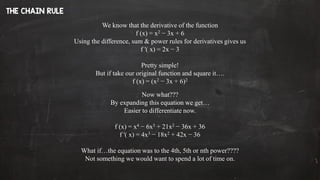
We know that the derivative of the function
f (x) = x2 − 3x + 6
Using the difference, sum & power rules for derivatives gives us
f '( x) = 2x − 3
Pretty simple!
But if take our original function and square it….
f (x) = (x2 − 3x + 6)2
Now what???
By expanding this equation we get…
Easier to differentiate now.
f (x) = x4 − 6x3 + 21x2 − 36x + 36
f '( x) = 4x3 − 18x2 + 42x − 36
What if…the equation was to the 4th, 5th or nth power????
Not something we would want to spend a lot of time on.
THE CHAIN RULE
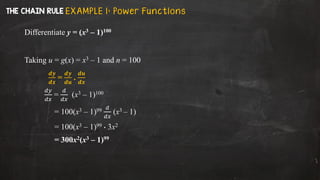
Differentiate y = (x3 – 1)100
Taking u = g(x) = x3 – 1 and n = 100
𝒅𝒚
𝒅𝒙
=
𝒅𝒚
𝒅𝒖
.
𝒅𝒖
𝒅𝒙
𝑑𝑦
𝑑𝑥
=
𝑑
𝑑𝑥
(x3 – 1)100
= 100(x3 – 1)99 𝑑
𝑑𝑥
(x3 – 1)
= 100(x3 – 1)99  3x2
= 300x2(x3 – 1)99
E X A M P L E 1 : Po w er Fu n ct i on s
THE CHAIN RULE
TRIGONOMETRIC FUNCTION
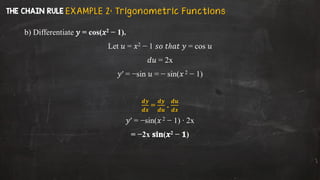
b) Differentiate 𝑦 = cos(𝑥2 − 1).
Let 𝑢 = 𝑥2 − 1 𝑠𝑜 𝑡ℎ𝑎𝑡 𝑦 = cos 𝑢
𝑑𝑢 = 2x
𝑦′ = −sin 𝑢 = − sin(𝑥 2 − 1)
𝒅𝒚
𝒅𝒙
=
𝒅𝒚
𝒅𝒖
.
𝒅𝒖
𝒅𝒙
𝑦′ = −sin(𝑥 2 − 1) ∙ 2x
= −2x 𝐬𝐢𝐧(𝒙2 − 𝟏)
E X A M P L E 2 : Tr igon o m etr i c Fu n ct i on s
-
THE CHAIN RULE
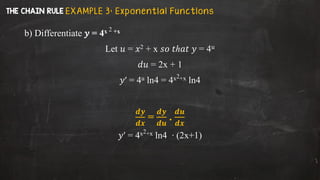
b) Differentiate 𝑦 = 4x 2 +x
Let 𝑢 = 𝑥2 + x 𝑠𝑜 𝑡ℎ𝑎𝑡 𝑦 = 4𝑢
𝑑𝑢 = 2x + 1
𝑦′ = 4u ln4 = 4x2+x ln4
𝒅𝒚
𝒅𝒙
=
𝒅𝒚
𝒅𝒖
.
𝒅𝒖
𝒅𝒙
𝑦′ = 4x2+x ln4 ∙ (2x+1)
E X A M P L E 3 : E x p on ent i al Fu n ct i on s
THE CHAIN RULE
Basic Calculus:
Quarter 3 –Module 7
G U D I TO, O D ETT E N .
1 1 – LU M I N E SC E NC E

Chain rule

  • 1.
    THE CHAIN RULE BasicCalculus: Quarter 3 –Module 7 G U D I TO, O D ETT E N . 1 1 – LU M I N E SC E NC E
  • 2.
    THE CHAIN RULE COMPOSITEFUNCTIONS They are made up of a function that has a function within it
  • 3.
    THE CHAIN RULE Thederivative when using the Chain Rule is the derivative of the outside leaving the inside unchanged times the derivative of the inside. 𝑦 = 𝑓(𝑔(𝑥)) Inner function Outer function 𝑑𝑦 𝑑𝑥 = (𝑑𝑒𝑟𝑖𝑣𝑎𝑡𝑖𝑣𝑒 𝑜𝑓 𝑡ℎ𝑒 𝑜𝑢𝑡𝑒𝑟 𝑓𝑢𝑛𝑐𝑡𝑖𝑜𝑛) ∙ (𝑑𝑒𝑟𝑖𝑣𝑎𝑡𝑖𝑣𝑒 𝑜𝑓 𝑡ℎ𝑒 𝑖𝑛𝑛𝑒𝑟 𝑓𝑢𝑛𝑐𝑡𝑖𝑜𝑛)
  • 4.
    THE CHAIN RULE THEOREM Letf be a function differentiable at c and let g be a function differentiable at f(c). Then the composition 𝑔 ∘ 𝑓 is differentiable at c and 𝐷𝑥 (𝑔 ∘ 𝑓) (𝑐) = 𝑔 ′ (𝑓(𝑐). 𝑓 ′ (𝑐)
  • 5.
    The Chain Rulecan be written either in the prime notation (f  g)(x) = f(g(x))  g(x) or, if y = f(u) and u = g(x), in Leibniz notation: Equation 3 is easy to remember because if dy/du and du/dx were quotients, then we could cancel du. Remember, however, that du has not been defined and du/dx should not be thought of as an actual quotient.
  • 6.
    THE CHAIN RULE STEPSFOR CHAIN RULE 1. Identify inner and outer functions 2. Derive outer function, leaving the inner function alone. 3. Derive the inner function. 4. Multiply the derivative of the outer function and derivative of the inner function
  • 7.
    We know thatthe derivative of the function f (x) = x2 − 3x + 6 Using the difference, sum & power rules for derivatives gives us f '( x) = 2x − 3 Pretty simple! But if take our original function and square it…. f (x) = (x2 − 3x + 6)2 Now what??? By expanding this equation we get… Easier to differentiate now. f (x) = x4 − 6x3 + 21x2 − 36x + 36 f '( x) = 4x3 − 18x2 + 42x − 36 What if…the equation was to the 4th, 5th or nth power???? Not something we would want to spend a lot of time on.
  • 8.
  • 9.
    Differentiate y =(x3 – 1)100 Taking u = g(x) = x3 – 1 and n = 100 𝒅𝒚 𝒅𝒙 = 𝒅𝒚 𝒅𝒖 . 𝒅𝒖 𝒅𝒙 𝑑𝑦 𝑑𝑥 = 𝑑 𝑑𝑥 (x3 – 1)100 = 100(x3 – 1)99 𝑑 𝑑𝑥 (x3 – 1) = 100(x3 – 1)99  3x2 = 300x2(x3 – 1)99 E X A M P L E 1 : Po w er Fu n ct i on s
  • 10.
  • 11.
    b) Differentiate 𝑦= cos(𝑥2 − 1). Let 𝑢 = 𝑥2 − 1 𝑠𝑜 𝑡ℎ𝑎𝑡 𝑦 = cos 𝑢 𝑑𝑢 = 2x 𝑦′ = −sin 𝑢 = − sin(𝑥 2 − 1) 𝒅𝒚 𝒅𝒙 = 𝒅𝒚 𝒅𝒖 . 𝒅𝒖 𝒅𝒙 𝑦′ = −sin(𝑥 2 − 1) ∙ 2x = −2x 𝐬𝐢𝐧(𝒙2 − 𝟏) E X A M P L E 2 : Tr igon o m etr i c Fu n ct i on s
  • 12.
  • 13.
    b) Differentiate 𝑦= 4x 2 +x Let 𝑢 = 𝑥2 + x 𝑠𝑜 𝑡ℎ𝑎𝑡 𝑦 = 4𝑢 𝑑𝑢 = 2x + 1 𝑦′ = 4u ln4 = 4x2+x ln4 𝒅𝒚 𝒅𝒙 = 𝒅𝒚 𝒅𝒖 . 𝒅𝒖 𝒅𝒙 𝑦′ = 4x2+x ln4 ∙ (2x+1) E X A M P L E 3 : E x p on ent i al Fu n ct i on s
  • 14.
    THE CHAIN RULE BasicCalculus: Quarter 3 –Module 7 G U D I TO, O D ETT E N . 1 1 – LU M I N E SC E NC E