









11 SECRETS
To E-commerce Business Success
Over the past 10
years,
e-commerce sales in
the U.S. have grown
at an average annual
rate of 13%,
reaching over $281
billion in annual
revenues.
Low start-up costs have facilitated
strong growth, with the number of
ecommerce sites anticipated to rise
18.4% per year in the coming years.
Below are the 11 key steps
to start a successful
e-commerce business.
Need Help with your
E-commerce Business
Plan?
Product Selection
Choosing the right products to sell online can
have a huge impact on whether or not your
e-commerce website is successful. Factors
that need to be considered include:
• Market Size
• Price Point
• Margins
• Local Availability
• Shipping Size/Cost
Have a (Business) Plan
A business plan will be your road map
that helps bring your ideas and
thoughts together. A business plan is
vital so that you can determine how to
best move forward and most
effectively compete.
Setting up the Business
To set-up your business, you will
need to complete the following tasks:
 Select the business structure- sole
proprietor, LLC, Corporation or
partnership
 Register your business with the
IRS and Secretary of State.
 Obtain an Employer Identification
Number (EIN)
 Open a business bank account and
file your business taxes.
Secure the Domain
Ideally, you’ll get your
business name as your
domain name, but if it’s not
available, choose a URL that’s
easy to say and spell, and
relates to your business.
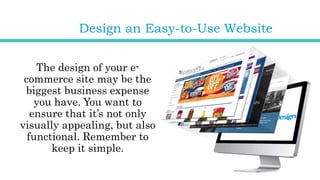
Design an Easy-to-Use Website
The design of your e-
commerce site may be the
biggest business expense
you have. You want to
ensure that it’s not only
visually appealing, but also
functional. Remember to
keep it simple.
Identify Vendors
You must find the best quality and best prices for the
products you sell or materials you use to create your
products, and negotiate the best prices and terms with
your vendors.
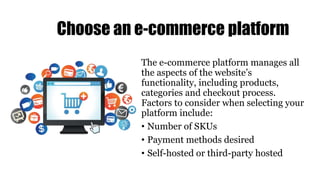
Choose an e-commerce platform
The e-commerce platform manages all
the aspects of the website’s
functionality, including products,
categories and checkout process.
Factors to consider when selecting your
platform include:
• Number of SKUs
• Payment methods desired
• Self-hosted or third-party hosted
Your website is your online storefront,
so make it customer-friendly.
Write captivating product descriptions,
shoot beautiful product photography,
and optimize this content.
Build Your Store
Stock your Inventory
Make sure you have enough product to launch.
It’s better to have too much inventory than not enough. Pay attention
to how your sales increase so you can be smart with future orders.
Have a plan to get traffic to your site in a
very direct way. Utilize Search Engine
Optimization efforts and back links to
drive traffic to your site. Other effective
tactics include:
• Email marketing
• Social media
• Search Engine Marketing
• Testimonials and referrals
Drive Traffic
Metrics are used to drive improvements and
help businesses focus on what’s important. It’s
important to identify your Key Performance
Indicators (KPIs). Some key e-commerce KPIs
include:
• Cost Per Customer Acquisition
• Average Order Value
• Conversion Rate
• Bounce Rate
• Shopping Cart Abandonment Rate
• Website Traffic
• Gross Profit per Sale
• Customer Lifetime Value
Tracking Your Metrics
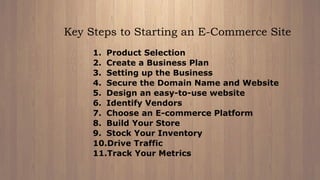
Key Steps to Starting an E-Commerce Site
1. Product Selection
2. Create a Business Plan
3. Setting up the Business
4. Secure the Domain Name and Website
5. Design an easy-to-use website
6. Identify Vendors
7. Choose an E-commerce Platform
8. Build Your Store
9. Stock Your Inventory
10.Drive Traffic
11.Track Your Metrics
BusinessPlanTemplate.com
helps entrepreneurs, business
owners and executives create
plans to grow their organizations.
Learn more about our Business
Plan Services at
www.businessplantemplate.com

Secrets to E-commerce Success

  • 1.
    11 SECRETS To E-commerceBusiness Success
  • 2.
    Over the past10 years, e-commerce sales in the U.S. have grown at an average annual rate of 13%, reaching over $281 billion in annual revenues.
  • 3.
    Low start-up costshave facilitated strong growth, with the number of ecommerce sites anticipated to rise 18.4% per year in the coming years.
  • 4.
    Below are the11 key steps to start a successful e-commerce business.
  • 5.
    Need Help withyour E-commerce Business Plan?
  • 6.
    Product Selection Choosing theright products to sell online can have a huge impact on whether or not your e-commerce website is successful. Factors that need to be considered include: • Market Size • Price Point • Margins • Local Availability • Shipping Size/Cost
  • 7.
    Have a (Business)Plan A business plan will be your road map that helps bring your ideas and thoughts together. A business plan is vital so that you can determine how to best move forward and most effectively compete.
  • 8.
    Setting up theBusiness To set-up your business, you will need to complete the following tasks:  Select the business structure- sole proprietor, LLC, Corporation or partnership  Register your business with the IRS and Secretary of State.  Obtain an Employer Identification Number (EIN)  Open a business bank account and file your business taxes.
  • 9.
    Secure the Domain Ideally,you’ll get your business name as your domain name, but if it’s not available, choose a URL that’s easy to say and spell, and relates to your business.
  • 10.
    Design an Easy-to-UseWebsite The design of your e- commerce site may be the biggest business expense you have. You want to ensure that it’s not only visually appealing, but also functional. Remember to keep it simple.
  • 11.
    Identify Vendors You mustfind the best quality and best prices for the products you sell or materials you use to create your products, and negotiate the best prices and terms with your vendors.
  • 12.
    Choose an e-commerceplatform The e-commerce platform manages all the aspects of the website’s functionality, including products, categories and checkout process. Factors to consider when selecting your platform include: • Number of SKUs • Payment methods desired • Self-hosted or third-party hosted
  • 13.
    Your website isyour online storefront, so make it customer-friendly. Write captivating product descriptions, shoot beautiful product photography, and optimize this content. Build Your Store
  • 14.
    Stock your Inventory Makesure you have enough product to launch. It’s better to have too much inventory than not enough. Pay attention to how your sales increase so you can be smart with future orders.
  • 15.
    Have a planto get traffic to your site in a very direct way. Utilize Search Engine Optimization efforts and back links to drive traffic to your site. Other effective tactics include: • Email marketing • Social media • Search Engine Marketing • Testimonials and referrals Drive Traffic
  • 16.
    Metrics are usedto drive improvements and help businesses focus on what’s important. It’s important to identify your Key Performance Indicators (KPIs). Some key e-commerce KPIs include: • Cost Per Customer Acquisition • Average Order Value • Conversion Rate • Bounce Rate • Shopping Cart Abandonment Rate • Website Traffic • Gross Profit per Sale • Customer Lifetime Value Tracking Your Metrics
  • 17.
    Key Steps toStarting an E-Commerce Site 1. Product Selection 2. Create a Business Plan 3. Setting up the Business 4. Secure the Domain Name and Website 5. Design an easy-to-use website 6. Identify Vendors 7. Choose an E-commerce Platform 8. Build Your Store 9. Stock Your Inventory 10.Drive Traffic 11.Track Your Metrics
  • 18.
    BusinessPlanTemplate.com helps entrepreneurs, business ownersand executives create plans to grow their organizations. Learn more about our Business Plan Services at www.businessplantemplate.com