Electronic Commerce
Business Models
Starting an E-Commerce Business
E-Commerce
1
What is E-Commerce?
2
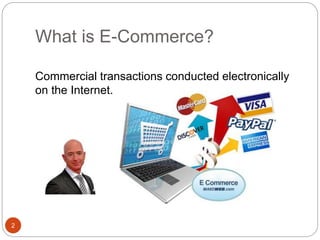
Commercial transactions conducted electronically
on the Internet.
Business Models of E-Commerce
3
1. Business to Consumer (B2C):
When a business sells a good or service to an individual
consumer (e.g. You buy a Louis Vuitton bag online).
2. Business to Business (B2B):
When a business sells a good or service to another business
(e.g. Webcampus is sold to many Universities)
3. Consumer to Consumer (C2C):
When a consumer sells a good or service to another
consumer (e.g. A person sells a boat on eBay to another
person).
4. Consumer to Business (C2B):
When a consumer sells their own products or services to a
business or organization (e.g. A photographer sells images to
businesses on shutterstock.com).
Benefits of E-Commerce
4
 Global markets
 24X7X365 availability
 Reduce costs
 Inventory management
 Targeted marketing
 Servicing niche markets
 Work from anywhere
How to start an E-Commerce
Business
5
 Choosing and sourcing a product
 Conducting research and planning ahead
 Getting your brand right (company name, logos,
etc.)
 Decide how you will sell
 Build a platform from scratch
 Data Science Analytics are controlled by you.
 Use off-the-shelf platforms (Amazon, Shopify etc.)
 Data Science Analytics are controlled by the platform.
 You must conform to rules of the platform (eg must ship in 2
days)
Before Launching
6
 Set up social media profile (facebook, Twitter,
snapchat)
 Get E-mail marketing ready (database of
customers)
 Run your business though Shopify Store Grader
After Launching
7
 Marketing your store
 Optimizing your conversations.
 Expand and refresh you inventory.
Current e-Commerce footprint
8
 In USA 2016 has $322.17M in sales.
 Expected to be $4 Trillion in sales in 2020
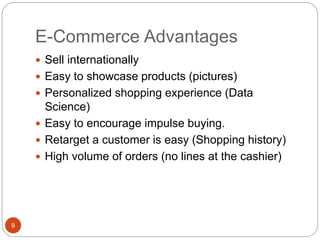
E-Commerce Advantages
9
 Sell internationally
 Easy to showcase products (pictures)
 Personalized shopping experience (Data
Science)
 Easy to encourage impulse buying.
 Retarget a customer is easy (Shopping history)
 High volume of orders (no lines at the cashier)
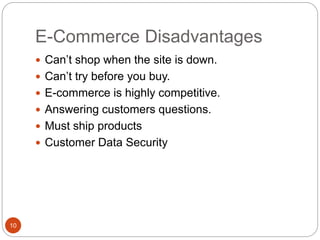
E-Commerce Disadvantages
10
 Can’t shop when the site is down.
 Can’t try before you buy.
 E-commerce is highly competitive.
 Answering customers questions.
 Must ship products
 Customer Data Security
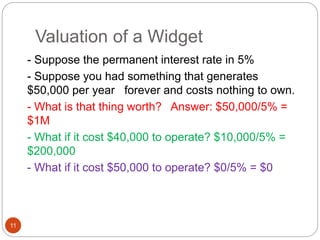
Valuation of a Widget
11
- Suppose the permanent interest rate in 5%
- Suppose you had something that generates
$50,000 per year forever and costs nothing to own.
- What is that thing worth? Answer: $50,000/5% =
$1M
- What if it cost $40,000 to operate? $10,000/5% =
$200,000
- What if it cost $50,000 to operate? $0/5% = $0
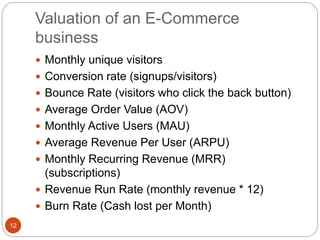
Valuation of an E-Commerce
business
12
 Monthly unique visitors
 Conversion rate (signups/visitors)
 Bounce Rate (visitors who click the back button)
 Average Order Value (AOV)
 Monthly Active Users (MAU)
 Average Revenue Per User (ARPU)
 Monthly Recurring Revenue (MRR)
(subscriptions)
 Revenue Run Rate (monthly revenue * 12)
 Burn Rate (Cash lost per Month)
Selling your E-Commerce
Business
13
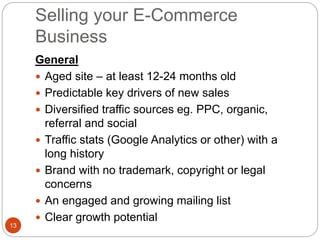
General
 Aged site – at least 12-24 months old
 Predictable key drivers of new sales
 Diversified traffic sources eg. PPC, organic,
referral and social
 Traffic stats (Google Analytics or other) with a
long history
 Brand with no trademark, copyright or legal
concerns
 An engaged and growing mailing list
 Clear growth potential
Selling your E-Commerce
Business
14
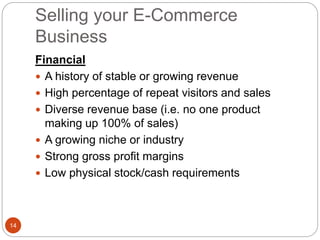
Financial
 A history of stable or growing revenue
 High percentage of repeat visitors and sales
 Diverse revenue base (i.e. no one product
making up 100% of sales)
 A growing niche or industry
 Strong gross profit margins
 Low physical stock/cash requirements
Selling your E-Commerce
Business
15
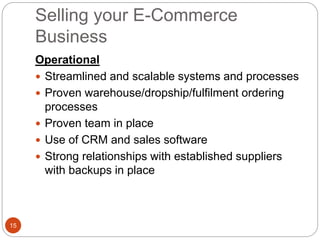
Operational
 Streamlined and scalable systems and processes
 Proven warehouse/dropship/fulfilment ordering
processes
 Proven team in place
 Use of CRM and sales software
 Strong relationships with established suppliers
with backups in place
Places to sell your business
16
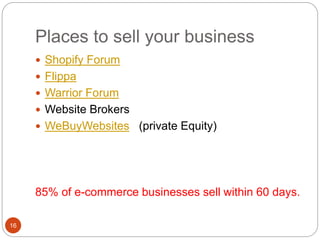
 Shopify Forum
 Flippa
 Warrior Forum
 Website Brokers
 WeBuyWebsites (private Equity)
85% of e-commerce businesses sell within 60 days.
Protecting your copyright
17
 Protect your database by copyright and your
business name, logo, domain name and product
name as trademarks. You can use industrial
design law to protect screen displays, computer-
generated graphics and web pages.
 The hidden aspects of a website, including
source code, algorithms, technical descriptions,
programs, logic flow charts and data base
contents, can be protected by trade secret law, as
long as they’re not publicly disclosed and
reasonable steps have been taken to keep them
confidential
How to implement protection
18
 You must protect your IP rights at an early stage.
Failure to do so means you’re in danger of losing
your legal rights. You should register your
trademark as soon as possible. You should also
register your domain name, using one which
reflects your business name or trademark.
 You should take steps to register your domain
name as a trademark as well. In doing this, you
will strengthen your power against anyone who
attempts to use the domain name to market
similar services or products. It also prevents
anyone else from registering the same name as
their own trademark. In addition, you must
register your website and any copyright material
at the national copyright office

introE-Commerce.pptx

  • 1.
    Electronic Commerce Business Models Startingan E-Commerce Business E-Commerce 1
  • 2.
    What is E-Commerce? 2 Commercialtransactions conducted electronically on the Internet.
  • 3.
    Business Models ofE-Commerce 3 1. Business to Consumer (B2C): When a business sells a good or service to an individual consumer (e.g. You buy a Louis Vuitton bag online). 2. Business to Business (B2B): When a business sells a good or service to another business (e.g. Webcampus is sold to many Universities) 3. Consumer to Consumer (C2C): When a consumer sells a good or service to another consumer (e.g. A person sells a boat on eBay to another person). 4. Consumer to Business (C2B): When a consumer sells their own products or services to a business or organization (e.g. A photographer sells images to businesses on shutterstock.com).
  • 4.
    Benefits of E-Commerce 4 Global markets  24X7X365 availability  Reduce costs  Inventory management  Targeted marketing  Servicing niche markets  Work from anywhere
  • 5.
    How to startan E-Commerce Business 5  Choosing and sourcing a product  Conducting research and planning ahead  Getting your brand right (company name, logos, etc.)  Decide how you will sell  Build a platform from scratch  Data Science Analytics are controlled by you.  Use off-the-shelf platforms (Amazon, Shopify etc.)  Data Science Analytics are controlled by the platform.  You must conform to rules of the platform (eg must ship in 2 days)
  • 6.
    Before Launching 6  Setup social media profile (facebook, Twitter, snapchat)  Get E-mail marketing ready (database of customers)  Run your business though Shopify Store Grader
  • 7.
    After Launching 7  Marketingyour store  Optimizing your conversations.  Expand and refresh you inventory.
  • 8.
    Current e-Commerce footprint 8 In USA 2016 has $322.17M in sales.  Expected to be $4 Trillion in sales in 2020
  • 9.
    E-Commerce Advantages 9  Sellinternationally  Easy to showcase products (pictures)  Personalized shopping experience (Data Science)  Easy to encourage impulse buying.  Retarget a customer is easy (Shopping history)  High volume of orders (no lines at the cashier)
  • 10.
    E-Commerce Disadvantages 10  Can’tshop when the site is down.  Can’t try before you buy.  E-commerce is highly competitive.  Answering customers questions.  Must ship products  Customer Data Security
  • 11.
    Valuation of aWidget 11 - Suppose the permanent interest rate in 5% - Suppose you had something that generates $50,000 per year forever and costs nothing to own. - What is that thing worth? Answer: $50,000/5% = $1M - What if it cost $40,000 to operate? $10,000/5% = $200,000 - What if it cost $50,000 to operate? $0/5% = $0
  • 12.
    Valuation of anE-Commerce business 12  Monthly unique visitors  Conversion rate (signups/visitors)  Bounce Rate (visitors who click the back button)  Average Order Value (AOV)  Monthly Active Users (MAU)  Average Revenue Per User (ARPU)  Monthly Recurring Revenue (MRR) (subscriptions)  Revenue Run Rate (monthly revenue * 12)  Burn Rate (Cash lost per Month)
  • 13.
    Selling your E-Commerce Business 13 General Aged site – at least 12-24 months old  Predictable key drivers of new sales  Diversified traffic sources eg. PPC, organic, referral and social  Traffic stats (Google Analytics or other) with a long history  Brand with no trademark, copyright or legal concerns  An engaged and growing mailing list  Clear growth potential
  • 14.
    Selling your E-Commerce Business 14 Financial A history of stable or growing revenue  High percentage of repeat visitors and sales  Diverse revenue base (i.e. no one product making up 100% of sales)  A growing niche or industry  Strong gross profit margins  Low physical stock/cash requirements
  • 15.
    Selling your E-Commerce Business 15 Operational Streamlined and scalable systems and processes  Proven warehouse/dropship/fulfilment ordering processes  Proven team in place  Use of CRM and sales software  Strong relationships with established suppliers with backups in place
  • 16.
    Places to sellyour business 16  Shopify Forum  Flippa  Warrior Forum  Website Brokers  WeBuyWebsites (private Equity) 85% of e-commerce businesses sell within 60 days.
  • 17.
    Protecting your copyright 17 Protect your database by copyright and your business name, logo, domain name and product name as trademarks. You can use industrial design law to protect screen displays, computer- generated graphics and web pages.  The hidden aspects of a website, including source code, algorithms, technical descriptions, programs, logic flow charts and data base contents, can be protected by trade secret law, as long as they’re not publicly disclosed and reasonable steps have been taken to keep them confidential
  • 18.
    How to implementprotection 18  You must protect your IP rights at an early stage. Failure to do so means you’re in danger of losing your legal rights. You should register your trademark as soon as possible. You should also register your domain name, using one which reflects your business name or trademark.  You should take steps to register your domain name as a trademark as well. In doing this, you will strengthen your power against anyone who attempts to use the domain name to market similar services or products. It also prevents anyone else from registering the same name as their own trademark. In addition, you must register your website and any copyright material at the national copyright office