By
Ryhan Ebad
 Understand what makes an effective
executive secretary
 Be a strategic partner to your boss
 Analyze and maximize the use of time
 Improve communication skills
 Take responsibility and manage crises
 Dealing with difficult people are situation
 Achieve confidence through assertiveness
 Work under pressure to achieve objectives
 Successfully organize meetings
 Operate a switchboard and receive visitors
so that all callers/visitors are dealt with
promptly, courteously, and accurately.
 Receive and correctly route incoming and
outgoing telephone calls at a switchboard
or multi-line phone and maintain long
distance call logs. Take and distribute
accurate messages.
 Greet visitors and determine the nature of
their visit; maintain visitor logs; alert
appropriate party of visitor arrival or direct
visitors to appropriate office, department
or employee.
 Respond to routine inquiries from internal or
external sources, for example on the
organization's location, hours of operation,
phone numbers, or email address.
 Perform miscellaneous administrative
activities such as booking meeting rooms,
typing, organizing and distributing mail,
receiving and sending courier packages.
 Effective Communication
 Assertiveness
 Scheduling and Meeting Management
 Effective Use of technology
 Time and Stress Management
 Travel Planning
 Upkeep of Office
 Maintain Documents
 Develop clear systems for maintaining
information.
 Ensure everyone is aware of meetings,
venues and times.
 Work with your boss to prepare for meetings
and create the agenda.
 Be flexible, reliable, and well organized.
 Learn to prioritize workload.
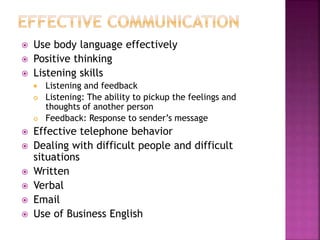
 Use body language effectively
 Positive thinking
 Listening skills
 Listening and feedback
 Listening: The ability to pickup the feelings and
thoughts of another person
 Feedback: Response to sender’s message
 Effective telephone behavior
 Dealing with difficult people and difficult
situations
 Written
 Verbal
 Email
 Use of Business English
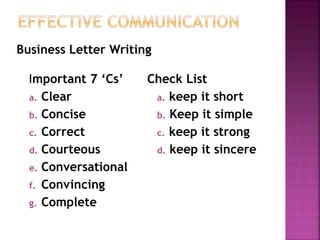
Important 7 ‘Cs’
a. Clear
b. Concise
c. Correct
d. Courteous
e. Conversational
f. Convincing
g. Complete
Check List
a. keep it short
b. Keep it simple
c. keep it strong
d. keep it sincere
Business Letter Writing
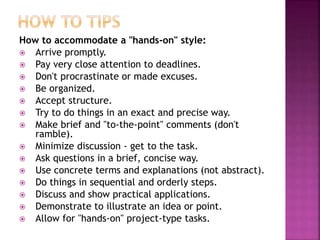
How to accommodate a "hands-on" style:
 Arrive promptly.
 Pay very close attention to deadlines.
 Don't procrastinate or made excuses.
 Be organized.
 Accept structure.
 Try to do things in an exact and precise way.
 Make brief and "to-the-point" comments (don't
ramble).
 Minimize discussion - get to the task.
 Ask questions in a brief, concise way.
 Use concrete terms and explanations (not abstract).
 Do things in sequential and orderly steps.
 Discuss and show practical applications.
 Demonstrate to illustrate an idea or point.
 Allow for "hands-on" project-type tasks.
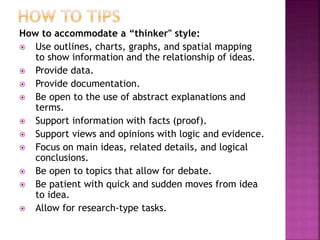
How to accommodate a “thinker" style:
 Use outlines, charts, graphs, and spatial mapping
to show information and the relationship of ideas.
 Provide data.
 Provide documentation.
 Be open to the use of abstract explanations and
terms.
 Support information with facts (proof).
 Support views and opinions with logic and evidence.
 Focus on main ideas, related details, and logical
conclusions.
 Be open to topics that allow for debate.
 Be patient with quick and sudden moves from idea
to idea.
 Allow for research-type tasks.
How to accommodate a “explorer" style:
 Be open to new ideas and willing to discuss.
 Be open to change.
 Allow room for creative innovation.
 Be open-minded to opinions and views.
 Be attentive and show interest.
 Relate ideas to the real world (use real world
examples).
 Focus on processes and applications rather than facts.
 Be willing to take a risk or investigate.
 Be patient with disorganization.
 Share humor and laugh at jokes.
 Be patient when jumps from one idea to another.
 Allow for innovative- and creative-type tasks.
How to accommodate a “free thinker" style:
 Smile, use humor, and be friendly.
 Share personal experiences.
 Participate in discussions and activities.
 Lean forward - be attentive and show interest.
 Use gestures and positive body language.
 Apply personal meaning to ideas.
 Show how ideas and details apply to life.
 Show interest and concern for people.
 Be patient if describes extensively.
 Avoid questioning or challenging the person's
insight or logic.
 Be patient with interruptions.
 Don't force structure - allow room for flexibility.
 Allow for interactive-type tasks.
Assertiveness is a way of thinking and behaving that allows
a person to stand up for his or her rights while respecting
the rights of others.
The following will enhance your assertiveness skills.
Assertive listening is one of the most important advocacy
skills we will discuss. The goals of assertive listening are:
 to let the other know that you want to understand
his or her point of view
 to understand accurately what another is saying
 to let the other know that he or she has been
understood
Remember that understanding is different from
agreement. You can understand what another is saying but
still disagree with him or her.
You can let others know you are interested in hearing and
understanding their points of view in several ways. You can
tell them you are interested.
Here are some examples of how you could phrase such a
statement:
 I'd like to hear your views on....
 I'd like to understand your views on....
 Could you tell me about them?
 I'm confused about your stand on....
 Would you tell me more about how you see the
situation?
 I think we are approaching this from two different
perspectives.
 What does the situation look like from your
perspective?
 I 'd like to hear your thoughts on
Listening for accuracy takes concentration and requires
you to give your full attention to what the other is saying.
 It is easier to listen for accuracy when you feel relaxed.
 If you are tense and your own thoughts are racing,
excuse yourself for a minute and go to another room.
 Take a few deep breaths to relax and clear your mind
before returning.
Assertive Listening.
 You can test whether or not you have understood the
other party by summarizing your understanding of what
was said and asking for verification.
 This not only lets you know whether you have
understood the other correctly, it also lets the other
person know they have been understood.
Nonverbal Assertiveness
 Even when we are silent we communicate a lot --
through our eyes, facial expression, posture, gestures
and personal appearance.
 Through these nonverbal behaviors we communicate who
we are and how we feel.
Elements of Nonverbal Behavior
Nonverbal behaviors are harder to control than verbal
behaviors, but with awareness and practice you can
become effective in communicating non verbally as well as
verbally.
 Eye contact
 Posture
 Facial Expression
 Plan and schedule meetings and reviews
 Board/ Top management
 Meeting with other functions
 With direct reports
 Integrate with Microsoft Office (Outlook, Excel)
 Send meeting invite and confirm attendance
 Track and improve adherence
 Prepare and monitor meeting minutes
 Things to do list
 Plan in advance
 Give enough notice for the receiving company
 Book tickets in advance and get confirmation
 Avail best fares
 Checklist for travel/visits
 Prepare agenda and send to participants
 Prepare and circulate reports
 Timely settlement of travel claims
 Visitors arrangement checklist
 Audit and identification of abnormalities
 Improvement and standardization
 Continuous audit to retain improvements
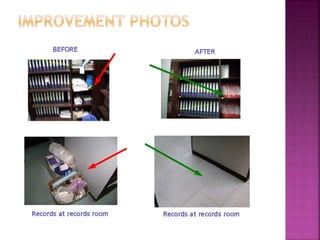
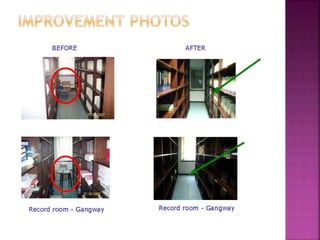
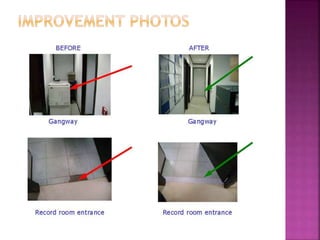
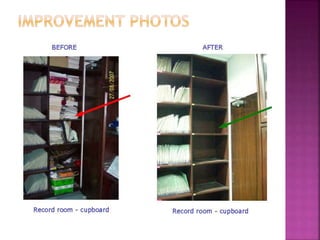
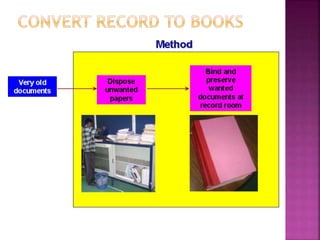
 Disposal of unwanted things
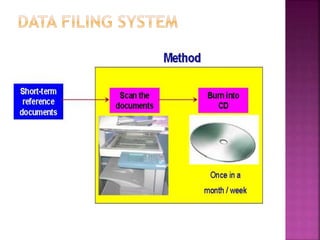
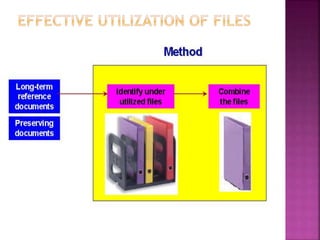
 Prepare list of documents both physical and
digital.
 Establish retention period of documents.
 Establish safe storage.
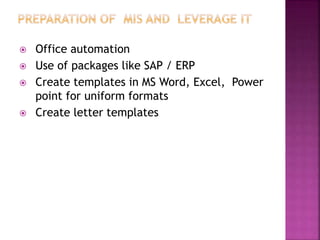
 Office automation
 Use of packages like SAP / ERP
 Create templates in MS Word, Excel, Power
point for uniform formats
 Create letter templates
 Time is money !!
 Set goal and prioritize
 Analyze how and where time is spent
 Reduce time wasting activities
 Time saving techniques
 Preparing check list for different routine and
important activities
 Office automation
 Devise and agenda for change and
effectiveness
 Learning to say ‘No’
 Time and Business: Success depends on
 Response time
 Lead time
 Up time
 On time
Remember! Time is an important parameter
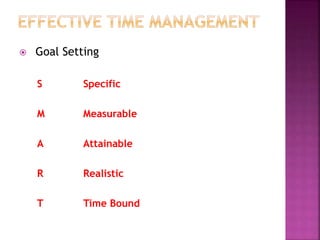
 Goal Setting
S Specific
M Measurable
A Attainable
R Realistic
T Time Bound
You can benefit from this mutual dependence
and develop a very productive relationship with
your boss by focusing on:
 Compatible work styles:
 Bosses process information differently.
 "Listeners" prefer to be briefed in person so they can ask
questions.
 "Readers" want to process written information first, and
then meet to discuss.
 Decision-making styles also vary. Some bosses are highly
involved. Touch base with them frequently.
 Others prefer to delegate. Inform them about important
decisions you've already made.
 Mutual expectations:
 Don't passively assume you know what the boss
expects.
 Find out!
 With some bosses, write detailed outlines of
your work for their approval. With others,
carefully planned discussions are key.
 Also, communicate your expectations to find
out if they are realistic. Persuade the boss to
accept the most important ones.
 Information flow:
 Managers typically underestimate what their
bosses need to know—and what they do know.
 Keep the boss informed through processes that
fit his style.
 Be forthright about both good and bad news.
 Dependability and honesty:
 Trustworthy subordinates only make promises
they can keep and don't shade the truth or play
down difficult issues.
 Good use of time and resources:
 Don't waste your boss's time with trivial issues.
 Selectively draw on his time and resources to
meet the most important goals—yours, his, and
the company's.
Meetings and Schedules
 Meeting notice is sent to all the participants
well in advance
 Time is blocked on all participants on
scheduling program (Office Outlook/ Lotus
Notes)
 Meeting preparation and internal reviews
before the meeting
 Reminder alerts before meeting
 Circulation of MOM (Minutes of Meeting) for
action and agenda for next meeting
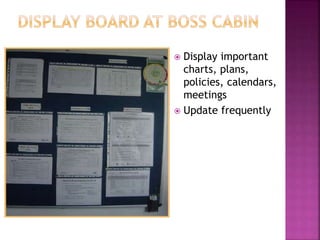
 Display important
charts, plans,
policies, calendars,
meetings
 Update frequently
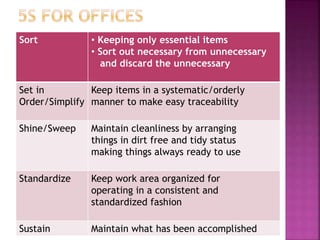
5S is a systematic approach for improvement
of quality and safety by organizing a
workplace. It is a methodology which
advocates;
 What should be kept
 Where should be kept
 How should be kept
5S is a Japanese concept of housekeeping
having reference to five Japanese words
starting with letter ‘S’.
Sort • Keeping only essential items
• Sort out necessary from unnecessary
and discard the unnecessary
Set in
Order/Simplify
Keep items in a systematic/orderly
manner to make easy traceability
Shine/Sweep Maintain cleanliness by arranging
things in dirt free and tidy status
making things always ready to use
Standardize Keep work area organized for
operating in a consistent and
standardized fashion
Sustain Maintain what has been accomplished
Approach to Stress
 Common stress creating beliefs
 I must always be on time
 I must say YES when the boss asked to do
something
 I must get along with everybody
 I must be available to people when they are in
need
 All the ‘musts’ and ‘shoulds’ that govern our
life
Here are some tips for dealing with difficult
people and difficult situations:
 Meet privately – having an audience causes
more defensiveness.
 Expect that difficult situations will take
time to resolve – if you feel rushed, ask to
meet at a later, specific time.
 Don't take things personally. Recognize that
your role is to be calm and objective. (Vent
later with a friend or colleague if you need
to.)
Use Active Listening Skills
 Clarification – ask questions to clarify if you are
unsure
 Paraphrasing – rephrase content
 Reflection – rephrase feelings
 Summarization – listen for themes or main
points
 Physical cues – use head nods, eye contact,
open body posture; this lets the listener know
that you are listening
Identify The Problem
 Clarify the expectations of the interaction
 Encourage the person to talk – this provides
you more understanding of the “real” issues
involved and often provides clues for possible
solutions.
 Reframe the problem so that it is not personal
 Make the problem something that you are both
working on collaboratively to solve.
Problem Solve
 As much as possible, do so collaboratively.
 Ask what he or she has done to try to resolve
the problem.
 Provide the opportunity for everyone to “save
face.”
Know Your Limits
 You are not able or responsible to solve all
problems.
 Once you have done what you reasonably can
do
 don't beat yourself up if the outcome is not totally
satisfactory to each of you.
 Don't let the other person's problem become
your problem.
 Your job is to problem-solve, not to simply take on
other people's problems.
More Tips...
 Work on one problem at a time
 Make requests, not ultimatums
 Focus on the present not the past. Focus on what
you want, not on what you don't want
 Note progress
 Acknowledge progress to the other person
 Reward yourself for achievements
 Be Realistic –
 change takes time
 appreciate the small steps of improvement
 Stay friendly –
 work up to the more difficult topics
 don't make negative comments
 Focus on the positive
 Be optimistic –
 remember the good things about this person
 try not to generalize criticisms (do not use "always"
or "never").
 Say things in ways that will be easy to hear
 Make sure you understand what is being said.
 "What I heard you say was. . . “Is that what you
meant?"
 Changing the cause of stress
 Developing skills to cope
 A balance life style
 Working on my mind
 Coping better with stress
 Relaxation (meditation, yoga, stretch ups, music,
etc.)
 Counseling
 Physical work out
For any comments please email:
ryhanebad@yahoo.com

SECRETARY SKILLS.pptx

  • 1.
  • 2.
     Understand whatmakes an effective executive secretary  Be a strategic partner to your boss  Analyze and maximize the use of time  Improve communication skills  Take responsibility and manage crises  Dealing with difficult people are situation  Achieve confidence through assertiveness  Work under pressure to achieve objectives  Successfully organize meetings
  • 3.
     Operate aswitchboard and receive visitors so that all callers/visitors are dealt with promptly, courteously, and accurately.  Receive and correctly route incoming and outgoing telephone calls at a switchboard or multi-line phone and maintain long distance call logs. Take and distribute accurate messages.  Greet visitors and determine the nature of their visit; maintain visitor logs; alert appropriate party of visitor arrival or direct visitors to appropriate office, department or employee.
  • 4.
     Respond toroutine inquiries from internal or external sources, for example on the organization's location, hours of operation, phone numbers, or email address.  Perform miscellaneous administrative activities such as booking meeting rooms, typing, organizing and distributing mail, receiving and sending courier packages.
  • 5.
     Effective Communication Assertiveness  Scheduling and Meeting Management  Effective Use of technology  Time and Stress Management  Travel Planning  Upkeep of Office  Maintain Documents
  • 6.
     Develop clearsystems for maintaining information.  Ensure everyone is aware of meetings, venues and times.  Work with your boss to prepare for meetings and create the agenda.  Be flexible, reliable, and well organized.  Learn to prioritize workload.
  • 7.
     Use bodylanguage effectively  Positive thinking  Listening skills  Listening and feedback  Listening: The ability to pickup the feelings and thoughts of another person  Feedback: Response to sender’s message  Effective telephone behavior  Dealing with difficult people and difficult situations  Written  Verbal  Email  Use of Business English
  • 8.
    Important 7 ‘Cs’ a.Clear b. Concise c. Correct d. Courteous e. Conversational f. Convincing g. Complete Check List a. keep it short b. Keep it simple c. keep it strong d. keep it sincere Business Letter Writing
  • 9.
    How to accommodatea "hands-on" style:  Arrive promptly.  Pay very close attention to deadlines.  Don't procrastinate or made excuses.  Be organized.  Accept structure.  Try to do things in an exact and precise way.  Make brief and "to-the-point" comments (don't ramble).  Minimize discussion - get to the task.  Ask questions in a brief, concise way.  Use concrete terms and explanations (not abstract).  Do things in sequential and orderly steps.  Discuss and show practical applications.  Demonstrate to illustrate an idea or point.  Allow for "hands-on" project-type tasks.
  • 10.
    How to accommodatea “thinker" style:  Use outlines, charts, graphs, and spatial mapping to show information and the relationship of ideas.  Provide data.  Provide documentation.  Be open to the use of abstract explanations and terms.  Support information with facts (proof).  Support views and opinions with logic and evidence.  Focus on main ideas, related details, and logical conclusions.  Be open to topics that allow for debate.  Be patient with quick and sudden moves from idea to idea.  Allow for research-type tasks.
  • 11.
    How to accommodatea “explorer" style:  Be open to new ideas and willing to discuss.  Be open to change.  Allow room for creative innovation.  Be open-minded to opinions and views.  Be attentive and show interest.  Relate ideas to the real world (use real world examples).  Focus on processes and applications rather than facts.  Be willing to take a risk or investigate.  Be patient with disorganization.  Share humor and laugh at jokes.  Be patient when jumps from one idea to another.  Allow for innovative- and creative-type tasks.
  • 12.
    How to accommodatea “free thinker" style:  Smile, use humor, and be friendly.  Share personal experiences.  Participate in discussions and activities.  Lean forward - be attentive and show interest.  Use gestures and positive body language.  Apply personal meaning to ideas.  Show how ideas and details apply to life.  Show interest and concern for people.  Be patient if describes extensively.  Avoid questioning or challenging the person's insight or logic.  Be patient with interruptions.  Don't force structure - allow room for flexibility.  Allow for interactive-type tasks.
  • 13.
    Assertiveness is away of thinking and behaving that allows a person to stand up for his or her rights while respecting the rights of others. The following will enhance your assertiveness skills. Assertive listening is one of the most important advocacy skills we will discuss. The goals of assertive listening are:  to let the other know that you want to understand his or her point of view  to understand accurately what another is saying  to let the other know that he or she has been understood Remember that understanding is different from agreement. You can understand what another is saying but still disagree with him or her.
  • 14.
    You can letothers know you are interested in hearing and understanding their points of view in several ways. You can tell them you are interested. Here are some examples of how you could phrase such a statement:  I'd like to hear your views on....  I'd like to understand your views on....  Could you tell me about them?  I'm confused about your stand on....  Would you tell me more about how you see the situation?  I think we are approaching this from two different perspectives.  What does the situation look like from your perspective?  I 'd like to hear your thoughts on
  • 15.
    Listening for accuracytakes concentration and requires you to give your full attention to what the other is saying.  It is easier to listen for accuracy when you feel relaxed.  If you are tense and your own thoughts are racing, excuse yourself for a minute and go to another room.  Take a few deep breaths to relax and clear your mind before returning. Assertive Listening.  You can test whether or not you have understood the other party by summarizing your understanding of what was said and asking for verification.  This not only lets you know whether you have understood the other correctly, it also lets the other person know they have been understood.
  • 16.
    Nonverbal Assertiveness  Evenwhen we are silent we communicate a lot -- through our eyes, facial expression, posture, gestures and personal appearance.  Through these nonverbal behaviors we communicate who we are and how we feel. Elements of Nonverbal Behavior Nonverbal behaviors are harder to control than verbal behaviors, but with awareness and practice you can become effective in communicating non verbally as well as verbally.  Eye contact  Posture  Facial Expression
  • 17.
     Plan andschedule meetings and reviews  Board/ Top management  Meeting with other functions  With direct reports  Integrate with Microsoft Office (Outlook, Excel)  Send meeting invite and confirm attendance  Track and improve adherence  Prepare and monitor meeting minutes  Things to do list
  • 18.
     Plan inadvance  Give enough notice for the receiving company  Book tickets in advance and get confirmation  Avail best fares  Checklist for travel/visits  Prepare agenda and send to participants  Prepare and circulate reports  Timely settlement of travel claims  Visitors arrangement checklist
  • 19.
     Audit andidentification of abnormalities  Improvement and standardization  Continuous audit to retain improvements  Disposal of unwanted things
  • 27.
     Prepare listof documents both physical and digital.  Establish retention period of documents.  Establish safe storage.
  • 28.
     Office automation Use of packages like SAP / ERP  Create templates in MS Word, Excel, Power point for uniform formats  Create letter templates
  • 32.
     Time ismoney !!  Set goal and prioritize  Analyze how and where time is spent  Reduce time wasting activities  Time saving techniques  Preparing check list for different routine and important activities  Office automation  Devise and agenda for change and effectiveness  Learning to say ‘No’
  • 33.
     Time andBusiness: Success depends on  Response time  Lead time  Up time  On time Remember! Time is an important parameter
  • 34.
     Goal Setting SSpecific M Measurable A Attainable R Realistic T Time Bound
  • 35.
    You can benefitfrom this mutual dependence and develop a very productive relationship with your boss by focusing on:  Compatible work styles:  Bosses process information differently.  "Listeners" prefer to be briefed in person so they can ask questions.  "Readers" want to process written information first, and then meet to discuss.  Decision-making styles also vary. Some bosses are highly involved. Touch base with them frequently.  Others prefer to delegate. Inform them about important decisions you've already made.
  • 36.
     Mutual expectations: Don't passively assume you know what the boss expects.  Find out!  With some bosses, write detailed outlines of your work for their approval. With others, carefully planned discussions are key.  Also, communicate your expectations to find out if they are realistic. Persuade the boss to accept the most important ones.
  • 37.
     Information flow: Managers typically underestimate what their bosses need to know—and what they do know.  Keep the boss informed through processes that fit his style.  Be forthright about both good and bad news.  Dependability and honesty:  Trustworthy subordinates only make promises they can keep and don't shade the truth or play down difficult issues.
  • 38.
     Good useof time and resources:  Don't waste your boss's time with trivial issues.  Selectively draw on his time and resources to meet the most important goals—yours, his, and the company's.
  • 39.
    Meetings and Schedules Meeting notice is sent to all the participants well in advance  Time is blocked on all participants on scheduling program (Office Outlook/ Lotus Notes)  Meeting preparation and internal reviews before the meeting  Reminder alerts before meeting  Circulation of MOM (Minutes of Meeting) for action and agenda for next meeting
  • 40.
     Display important charts,plans, policies, calendars, meetings  Update frequently
  • 41.
    5S is asystematic approach for improvement of quality and safety by organizing a workplace. It is a methodology which advocates;  What should be kept  Where should be kept  How should be kept 5S is a Japanese concept of housekeeping having reference to five Japanese words starting with letter ‘S’.
  • 42.
    Sort • Keepingonly essential items • Sort out necessary from unnecessary and discard the unnecessary Set in Order/Simplify Keep items in a systematic/orderly manner to make easy traceability Shine/Sweep Maintain cleanliness by arranging things in dirt free and tidy status making things always ready to use Standardize Keep work area organized for operating in a consistent and standardized fashion Sustain Maintain what has been accomplished
  • 43.
    Approach to Stress Common stress creating beliefs  I must always be on time  I must say YES when the boss asked to do something  I must get along with everybody  I must be available to people when they are in need  All the ‘musts’ and ‘shoulds’ that govern our life
  • 44.
    Here are sometips for dealing with difficult people and difficult situations:  Meet privately – having an audience causes more defensiveness.  Expect that difficult situations will take time to resolve – if you feel rushed, ask to meet at a later, specific time.  Don't take things personally. Recognize that your role is to be calm and objective. (Vent later with a friend or colleague if you need to.)
  • 45.
    Use Active ListeningSkills  Clarification – ask questions to clarify if you are unsure  Paraphrasing – rephrase content  Reflection – rephrase feelings  Summarization – listen for themes or main points  Physical cues – use head nods, eye contact, open body posture; this lets the listener know that you are listening
  • 46.
    Identify The Problem Clarify the expectations of the interaction  Encourage the person to talk – this provides you more understanding of the “real” issues involved and often provides clues for possible solutions.  Reframe the problem so that it is not personal  Make the problem something that you are both working on collaboratively to solve.
  • 47.
    Problem Solve  Asmuch as possible, do so collaboratively.  Ask what he or she has done to try to resolve the problem.  Provide the opportunity for everyone to “save face.”
  • 48.
    Know Your Limits You are not able or responsible to solve all problems.  Once you have done what you reasonably can do  don't beat yourself up if the outcome is not totally satisfactory to each of you.  Don't let the other person's problem become your problem.  Your job is to problem-solve, not to simply take on other people's problems.
  • 49.
    More Tips...  Workon one problem at a time  Make requests, not ultimatums  Focus on the present not the past. Focus on what you want, not on what you don't want  Note progress  Acknowledge progress to the other person  Reward yourself for achievements
  • 50.
     Be Realistic–  change takes time  appreciate the small steps of improvement  Stay friendly –  work up to the more difficult topics  don't make negative comments  Focus on the positive
  • 51.
     Be optimistic–  remember the good things about this person  try not to generalize criticisms (do not use "always" or "never").  Say things in ways that will be easy to hear  Make sure you understand what is being said.  "What I heard you say was. . . “Is that what you meant?"
  • 52.
     Changing thecause of stress  Developing skills to cope  A balance life style  Working on my mind  Coping better with stress  Relaxation (meditation, yoga, stretch ups, music, etc.)  Counseling  Physical work out
  • 53.
    For any commentsplease email: ryhanebad@yahoo.com