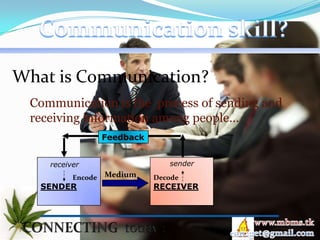
What is Communication?
 Communication is the process of sending and
 receiving information among people…
                   Feedback


    receiver                     sender
          Encode   Medium     Decode
   SENDER                     RECEIVER
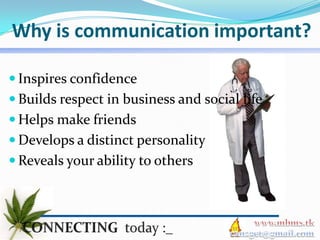
Why is communication important?

 Inspires confidence
 Builds respect in business and social life
 Helps make friends
 Develops a distinct personality
 Reveals your ability to others
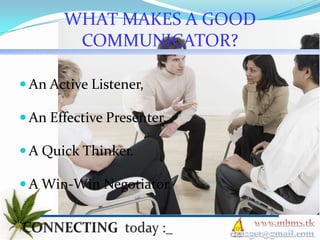
WHAT MAKES A GOOD
        COMMUNICATOR?

 An Active Listener,

 An Effective Presenter,

 A Quick Thinker.

 A Win-Win Negotiator.
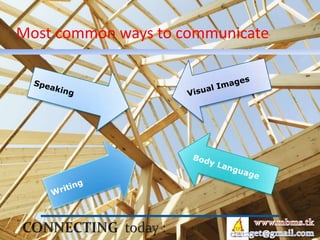
Most common ways to communicate
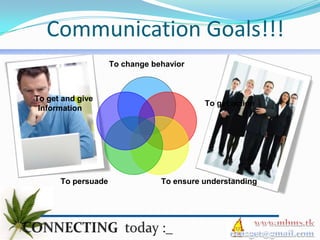
Communication Goals!!!
                    To change behavior


To get and give
                                          To get action
 Information


      To persuade               To ensure understanding
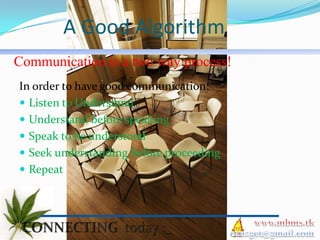
A Good Algorithm
Communication is a two way process!
In order to have good communication:
 Listen to Understand
 Understand before speaking
 Speak to be understood
 Seek understanding before proceeding
 Repeat
Common Communication Errors:
 Finishing others’ sentences
 Preparing our response before someone has
  completed speaking
 Multitasking while ‘listening’
 Filtering content or meaning based on the
  speaker
 Speaking for others (we…)
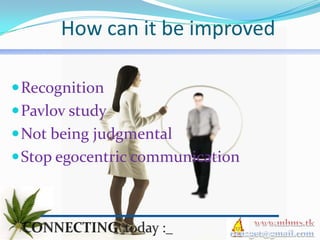
How can it be improved

 Recognition
 Pavlov study
 Not being judgmental
 Stop egocentric communication
Click
The
 Rule
  of
24!
AGENDA
   Video
   The Rule of    24!
    defined
   Brainstorm
   Raceway game
   Ten ways   Rule of
    24! helps you
   Put the Rule of 24!
    to work
It’s about going


from this... …to this!
Work to a
deadline.

       Make it 24
         hours.
“Just having satisfied
customers isn’t good
enough anymore.
If you really want a
booming
business, you have
to create   Raving
Fans.”      - Ken Blanchard
Brainstorm mrotsniar B
Identify the top 3 “time-
stretchers” for your gap.

Develop 1 clever way to
compress the gap.
Start your race

 Ten ways
Rule of 24!
 helps you
Raving Fans
    refer their
       friends.

Yeeehaaawww!
Get it
off
your
plate.
Test
                their
                resolve.
A light at the end of the tunnel
            is good…
…and a short
tunnel is even better.
Success
Breeds
Success.
Work
     Life
    Balance.
   When you prioritize and control
    your calendar you get more
    done in less time.
   And your mind doesn’t take
    home lingering unfinished
    business. You can focus on what
    matters most – family.
Put the
Rule of 24!
  to work
 Plan every day in advance.
Apply the 80/20 rule to
           everything.

        Take it one oil
       barrel at a time.
Plan to do paperwork
           every day…
                         Prospect a
                           little bit

                        every week.


    plan for
    emergencies
There will never be enough time to get
            everything done.
                                               “You be
                                              a winner
But there will always be enough time to get
     the most important things done.          if you’re
Be wary of


“You can’t be a winner if
you’re a whiner, wiener.”
Turn    Silence
     your    helps you
   e-mail    focus.
chime off.
Make it
easy to
focus.
Clean off
your desk
every
night.

Get a next
step.

Sell them the chain


 a link at a time.
Ask probing
questions.
Go pick it up!
Don’t
 chase
smoke!
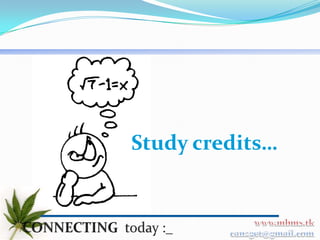
Study credits…
…so you can
   approach
 Credit with
 confidence.
Click
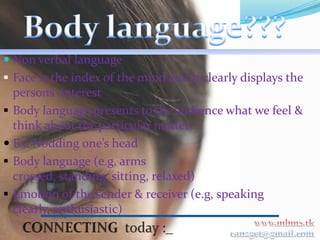
 Non verbal language
 Face is the index of the mind and it clearly displays the
  persons interest
 Body language presents to the audience what we feel &
  think about the particular matter
 Ex: Nodding one’s head
 Body language (e.g, arms
  crossed, standing, sitting, relaxed)
 Emotion of the sender & receiver (e.g, speaking
 clearly, enthusiastic)
Click
 Presentation skills include planning, preparation
 & delivery of the message

 Making a formal speech is one form of
 presentation

 Presentation skills can be broadly categorized
 into physical oral, & electronic
 Success in life depends on presenting ideas in an
 appropriate manners

 Look at the eyes of audience & speak in a
  natural, conversational voice

 Appropriate voice will make the presentation effective
  and interesting

 Ask for feed back from your audience about your
  presentation & change accordingly

 In presentation especially, stop occasionally to ask the
  audience understand what you have said
Click
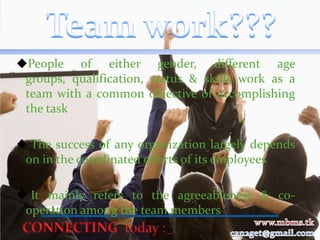
People   of either gender, different age
 groups, qualification, status & skills work as a
 team with a common objective of accomplishing
 the task

 The success of any organization largely depends
 on in the coordinated efforts of its employees

 It mainly refers to the agreeableness & co-
 operation among the team members
Click
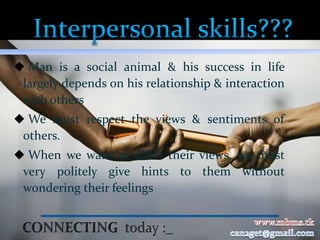
 Man is a social animal & his success in life
 largely depends on his relationship & interaction
 with others
 We must respect the views & sentiments of
 others.
 When we want to differ their views, we must
 very politely give hints to them without
 wondering their feelings
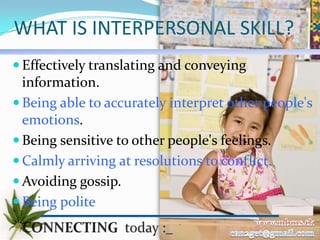
WHAT IS INTERPERSONAL SKILL?
 Effectively translating and conveying
  information.
 Being able to accurately interpret other people's
  emotions.
 Being sensitive to other people's feelings.
 Calmly arriving at resolutions to conflict.
 Avoiding gossip.
 Being polite
Click
 Professional ethics is the need of the hour in India
 When a person is at the work spot, he must think of
 his work only
 He must put his heart & soul into the work
 Each employee is a organic part of the organization &
 must strive to contribute his mite to the successful
 functioning of the organization
Softskill 528
Softskill 528

Softskill 528

  • 5.
    What is Communication? Communication is the process of sending and receiving information among people… Feedback receiver sender Encode Medium Decode SENDER RECEIVER
  • 6.
    Why is communicationimportant?  Inspires confidence  Builds respect in business and social life  Helps make friends  Develops a distinct personality  Reveals your ability to others
  • 10.
    WHAT MAKES AGOOD COMMUNICATOR?  An Active Listener,  An Effective Presenter,  A Quick Thinker.  A Win-Win Negotiator.
  • 11.
    Most common waysto communicate
  • 12.
    Communication Goals!!! To change behavior To get and give To get action Information To persuade To ensure understanding
  • 13.
    A Good Algorithm Communicationis a two way process! In order to have good communication:  Listen to Understand  Understand before speaking  Speak to be understood  Seek understanding before proceeding  Repeat
  • 14.
    Common Communication Errors: Finishing others’ sentences  Preparing our response before someone has completed speaking  Multitasking while ‘listening’  Filtering content or meaning based on the speaker  Speaking for others (we…)
  • 15.
    How can itbe improved  Recognition  Pavlov study  Not being judgmental  Stop egocentric communication
  • 16.
  • 17.
    The Rule of 24!
  • 18.
    AGENDA  Video  The Rule of 24! defined  Brainstorm  Raceway game  Ten ways Rule of 24! helps you  Put the Rule of 24! to work
  • 19.
    It’s about going fromthis... …to this!
  • 20.
    Work to a deadline. Make it 24 hours.
  • 21.
    “Just having satisfied customersisn’t good enough anymore. If you really want a booming business, you have to create Raving Fans.” - Ken Blanchard
  • 22.
    Brainstorm mrotsniar B Identifythe top 3 “time- stretchers” for your gap. Develop 1 clever way to compress the gap.
  • 23.
    Start your race Ten ways Rule of 24! helps you
  • 24.
    Raving Fans refer their friends. Yeeehaaawww!
  • 25.
  • 26.
    Test their resolve. A light at the end of the tunnel is good…
  • 27.
    …and a short tunnelis even better.
  • 28.
  • 29.
    Work Life Balance.  When you prioritize and control your calendar you get more done in less time.  And your mind doesn’t take home lingering unfinished business. You can focus on what matters most – family.
  • 30.
    Put the Rule of24! to work Plan every day in advance.
  • 31.
    Apply the 80/20rule to everything. Take it one oil barrel at a time.
  • 32.
    Plan to dopaperwork every day… Prospect a little bit every week. plan for emergencies
  • 33.
    There will neverbe enough time to get everything done. “You be a winner But there will always be enough time to get the most important things done. if you’re
  • 34.
    Be wary of “Youcan’t be a winner if you’re a whiner, wiener.”
  • 35.
    Turn Silence your helps you e-mail focus. chime off.
  • 36.
    Make it easy to focus. Cleanoff your desk every night.
  • 37.
  • 38.
    Sell them thechain a link at a time.
  • 39.
  • 40.
  • 41.
  • 42.
  • 43.
    …so you can approach Credit with confidence.
  • 44.
  • 45.
     Non verballanguage  Face is the index of the mind and it clearly displays the persons interest  Body language presents to the audience what we feel & think about the particular matter  Ex: Nodding one’s head  Body language (e.g, arms crossed, standing, sitting, relaxed)  Emotion of the sender & receiver (e.g, speaking clearly, enthusiastic)
  • 46.
  • 47.
     Presentation skillsinclude planning, preparation & delivery of the message  Making a formal speech is one form of presentation  Presentation skills can be broadly categorized into physical oral, & electronic
  • 48.
     Success inlife depends on presenting ideas in an appropriate manners  Look at the eyes of audience & speak in a natural, conversational voice  Appropriate voice will make the presentation effective and interesting  Ask for feed back from your audience about your presentation & change accordingly  In presentation especially, stop occasionally to ask the audience understand what you have said
  • 49.
  • 50.
    People of either gender, different age groups, qualification, status & skills work as a team with a common objective of accomplishing the task  The success of any organization largely depends on in the coordinated efforts of its employees  It mainly refers to the agreeableness & co- operation among the team members
  • 51.
  • 52.
     Man isa social animal & his success in life largely depends on his relationship & interaction with others  We must respect the views & sentiments of others.  When we want to differ their views, we must very politely give hints to them without wondering their feelings
  • 53.
    WHAT IS INTERPERSONALSKILL?  Effectively translating and conveying information.  Being able to accurately interpret other people's emotions.  Being sensitive to other people's feelings.  Calmly arriving at resolutions to conflict.  Avoiding gossip.  Being polite
  • 54.
  • 55.
     Professional ethicsis the need of the hour in India  When a person is at the work spot, he must think of his work only  He must put his heart & soul into the work  Each employee is a organic part of the organization & must strive to contribute his mite to the successful functioning of the organization