Secret writing
• Purpose
• To send info without interception
• User
• Prisoner
• Lovers
• Spies
• Historical perspective
• Since ancient dynasty
» Roman
» Greek
Methods to hide info
• Message on head
• Feeding to animal
• Microdots
• Scrambled optical fibre
• Dot code(Pin code)
• Knot code
• Playing card code
• Red Blue code
• Crayon Cover
• Crease Code
• Swizzle stick code
Secret writing
• Types
– Organic Fluid
» Plants secretion
» Milk
» Fruit juice
» Saliva
» Vegetable juices
» Urine
» Diluted blood
» Development (Heat, Phenolphthalein,
– Invisible ink(Sympathetic inks)
» Ounce of alum & Pint of vinegar for writing on egg(Peeling)
» A solution of sodium nitrate and starch in water (KI)
» Solution of painkiller, antipyretics or laxative medicines
» Iron sulphate(KCN, Na2Co3)
» copper sulphate(Ammonia Fumes)
» Titrimetric reagnets
• Miniature writing
• Micro writing
• Hieroglyphics
• Egyptian script
• Ciphers
• Algorithm
• Cryptograms
• The hidden information
CIPHER
A cipher is a method of transforming readable information (plaintext) into an unreadable format
(ciphertext) to protect the information from unauthorized access
TYPES OF CIPHER
There are 2 types of cipher
1. Substitution cipher
2. Transposition cipher
In SUBSTITUTION CIPHER, each character or group of characters in the plaintext is replaced
with a different character or group of characters. There are several types of substitution ciphers:
• Caesar Cipher: Shifts each letter in the plaintext by a fixed number of places down the
alphabet. For example, with a shift of 3, "A" becomes "D", "B" becomes "E", and so on.
• Monoalphabetic Substitution Cipher: Replaces each letter in the plaintext with a unique
corresponding letter according to a fixed key. For example, using a substitution alphabet like
QWERTYUIOPASDFGHJKLZXCVBNM, "HELLO" might be encrypted to "ITSSG".
• Polyalphabetic Substitution Cipher: Uses multiple substitution alphabets based on a
keyword or system. For example, the Vigenère cipher uses a keyword to determine the shift
for each letter, creating a more complex encryption.
• Homophonic Substitution Cipher: Replaces each letter with one of several possible symbols
to obscure frequency analysis. For instance, the letter "E" might be encrypted as 1, 2, 3, etc.
• Polygram Substitution Cipher: Substitutes groups of letters (like bigrams or trigrams) rather
than individual letters. For example, "TH" could be substituted with a unique symbol or a
different bigram.
SUBSTITUTION CIPHER
A substitution cipher is a type of encryption method where each character in the
plaintext is replaced with a different character according to a fixed system or key. The
key determines how each character is substituted.
Substitution of letter with another letter or symbol
Types of Substitution Ciphers
1. Caesar Cipher: A type of substitution cipher where each letter in the plaintext is
shifted a fixed number of places down the alphabet.
For example, with a shift of 3
Plaintext: A B C D E F G H I J
Ciphertext: D E F G H I J K L M
So, "HELLO" with a shift of 3 becomes "KHOOR
2. MONOALPHABETIC SUBSTITUTION
Monoalphabetic substitution is a type of cipher where each letter in the plaintext is replaced with
a fixed, unique letter from the alphabet in the ciphertext. This means that every occurrence of a
specific letter in the plaintext is consistently replaced with the same letter in the ciphertext
throughout the entire message.
For example, if 'A' is replaced by 'M', then every 'A' in the plaintext will be replaced by 'M' in the
ciphertext, and this substitution rule remains constant.
In summary, monoalphabetic substitution involves a one-to-one mapping between letters of the
plaintext alphabet and letters of the ciphertext alphabet.
So if your original message is "HELLO" and your code says:
H -> T
E -> R
L -> F
O -> S
Then "HELLO" would turn into "TRFFS".
For example, if you use the key QWERTYUIOPASDFGHJKLZXCVBNM, where each letter of
the alphabet is substituted by its corresponding letter in this key, then:
•Plaintext alphabet: A B C D E F G H I J K L M N O P Q R S T U V W X Y Z
•Ciphertext alphabet: Q W E R T Y U I O P A S D F G H J K L Z X C V B N M
So, "HELLO" might be encrypted to "ITSSG".
Each letter of the plaintext is replaced with a corresponding letter in the ciphertext according to a
fixed key.
POLYALPHABETIC SUBSTITUTION
A polyalphabetic substitution cipher is a type of encryption where you use multiple
alphabet systems to encode a message. This makes it harder to crack than simpler
ciphers because it mixes up the substitutions in a more complex way.
VIGENERE SUBSTITUTION CIPHER
In addition to the plaintext, the Vigenère cipher also requires a keyword, which is repeated so
that the total length is equal to that of the plaintext.
For example, suppose the plaintext is MICHIGAN TECHNOLOGICAL UNIVERSITY and
the keyword is HOUGHTON.
Then, the keyword must be repeated as follows:
MICHIGAN TECHNOLOGICAL UNIVERSITY
HOUGHTON HOUGHTONHOUGH TONHOUGNTO
We follow the tradition by removing all spaces and punctuation, converting all letters to upper
case, and dividing the result into 5-letter blocks. As a result, the above plaintext and keyword
become the following:
MICHI GANTE CHNOL OGICA LUNIV ERSIT Y
HOUGH TONHO UGHTO NHOUG HTONH OUGHT O
To encrypt, pick a letter in the plaintext and its corresponding letter in the keyword, use the
keyword letter and the plaintext letter as the row index and column index, respectively, and the
entry at the row-column intersection is the letter in the ciphertext.
For example, the first letter in the plaintext is M and its corresponding keyword letter is H. This
means that the row of H and the column of M are used, and the entry T at the intersection is the
encrypted result.
Similarly, since the letter N in MICHIGAN corresponds to the letter N in the keyword, the entry at
the intersection of row N and column N is A which is the encrypted letter in the ciphertext.
Repeating this process until all plaintext letters are processed, the ciphertext is
TWWNPZOAASWNUHZBNWWGS NBVCSLYPMM. The following has the plaintext,
repeated keyword and ciphertext aligned together.
MICHI GANTE CHNOL OGICA LUNIV ERSIT Y
HOUGH TONHO UGHTO NHOUG HTONH OUGHT O
TWWNP ZOAAS WNUHZ BNWWG SNBVC SLYPM M
A Homophonic substitution cipher is a type of encryption where each letter in the plaintext
can be replaced by multiple possible symbols or characters in the ciphertext. This makes it
harder for someone to figure out what the original message is just by looking at the encrypted
text.
How It Works
1.Assign Multiple Symbols: Each letter in the alphabet is mapped to several different symbols
or characters. For example, the letter "E" (which is very common in English) might be
represented by several different symbols like 1, 2, 3, etc.
2.Encrypt the Message: When you encrypt a message, you choose one of the possible symbols
for each letter based on a system or randomly. So, if the plaintext has the letter "E", you might
replace it with 1, 2, or 3 each time you see "E".
3.Create the Ciphertext: The result is a ciphertext where the same letter from the plaintext
might appear as different symbols in the encrypted message
Why It’s More Secure
•Obscures Letter Frequency: Since each letter can be replaced by multiple symbols, the
frequency of letters in the ciphertext doesn't match the frequency in the plaintext as directly.
This makes it harder to use frequency analysis (a common method for breaking ciphers) to
decode the message.
Example Setup
Define Symbols for Each Letter: Suppose we assign multiple symbols to each letter:
1. A → 1, 2
2. B → 3, 4
3. C → 5, 6
4. D → 7, 8
5. E → 9, 10
6. F → 11, 12
7. (and so on for other letters)
8. Plaintext Message: "BAD“
Encrypt the Message: Replace each letter in the plaintext with one of its assigned symbols.
Let's choose the symbols as follows:
9. A → 2
10.B → 4
11.D → 7
So "BAD" would be encrypted as "4 2 7".
Another Example of Encryption
To show the variability:
•A → 1
•B → 3
•D → 8
•Then "BAD" could also be encrypted as "1 3 8"
TRANSPOSITION CIPHER
A transposition cipher is a type of encryption method where the positions of characters
in the plaintext are shifted according to a regular system to create the ciphertext. Unlike
substitution ciphers, which replace characters with other characters, transposition
ciphers rearrange the characters while keeping the original characters unchanged.
Here's a basic overview of how transposition ciphers work:
1.Rearrangement: Characters in the plaintext are rearranged according to the key. For
example, you might write the plaintext in a grid and then read it off in a different order.
2.Key or System: The method for rearranging the characters is determined by a key or
algorithm. This key might be a number, a word, or a set of instructions.
Types include:
Columnar Transposition Cipher: Writes the plaintext into a grid with a fixed number
of columns and then reads the columns in a specified order based on a key.
Rail Fence Cipher: Writes the plaintext in a zigzag pattern across multiple lines (rails)
and then reads off the lines to produce the ciphertext.
Route Cipher: Uses a grid to write the plaintext and then reads the characters out in a
specified route or pattern, such as spiraling inward or snaking through the grid.
Permutation Cipher: Rearranges the order of characters in the plaintext according to a
permutation key.
Cryptography
• Transposition cipher
» Rearrangement of letter
• Substitution Cipher
» Substitution of letter with another letter or symbol
• Monoalphabetic
• Polyalphabetic
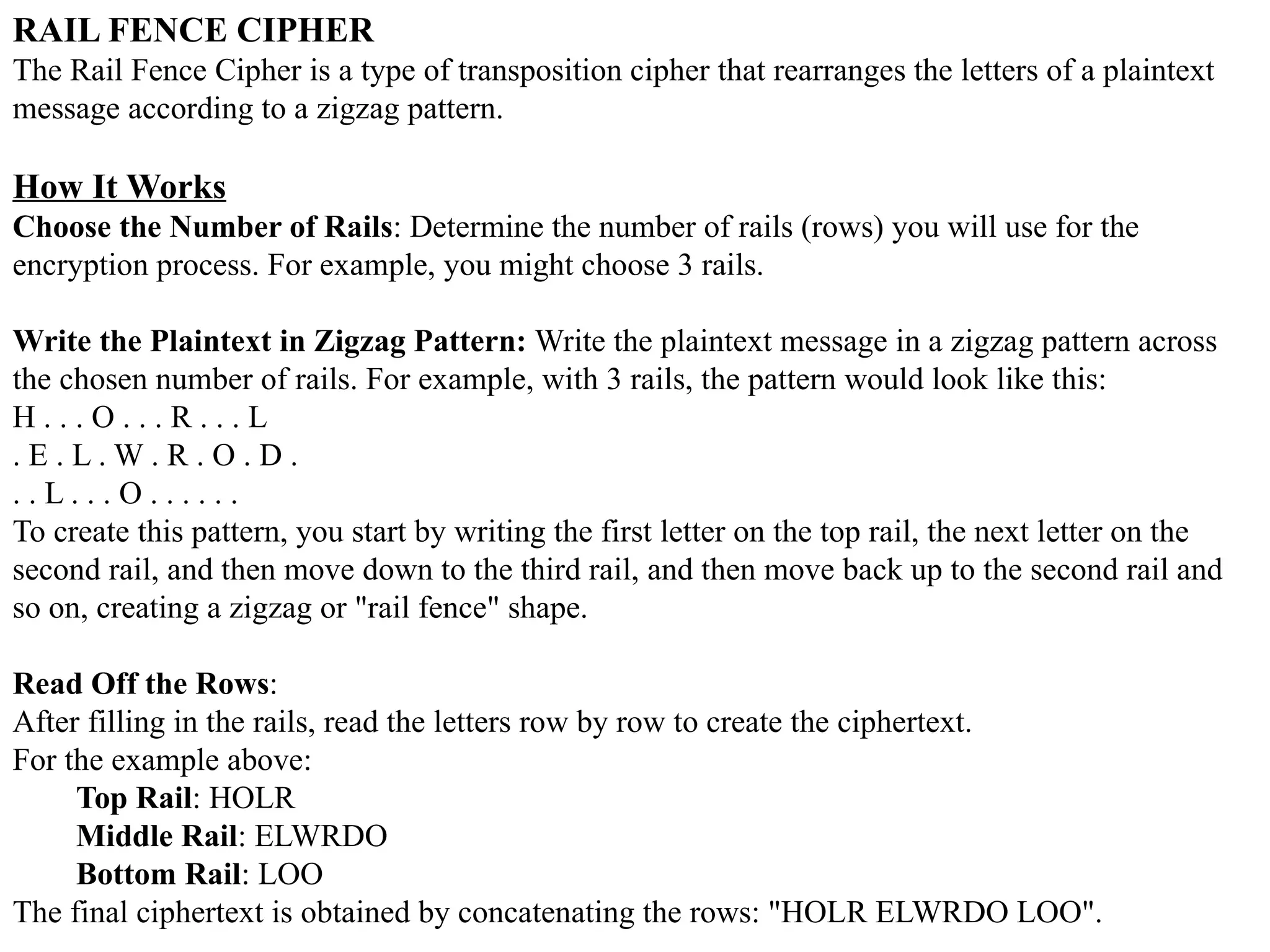
RAIL FENCE CIPHER
The Rail Fence Cipher is a type of transposition cipher that rearranges the letters of a plaintext
message according to a zigzag pattern.
How It Works
Choose the Number of Rails: Determine the number of rails (rows) you will use for the
encryption process. For example, you might choose 3 rails.
Write the Plaintext in Zigzag Pattern: Write the plaintext message in a zigzag pattern across
the chosen number of rails. For example, with 3 rails, the pattern would look like this:
H . . . O . . . R . . . L
. E . L . W . R . O . D .
. . L . . . O . . . . . .
To create this pattern, you start by writing the first letter on the top rail, the next letter on the
second rail, and then move down to the third rail, and then move back up to the second rail and
so on, creating a zigzag or "rail fence" shape.
Read Off the Rows:
After filling in the rails, read the letters row by row to create the ciphertext.
For the example above:
Top Rail: HOLR
Middle Rail: ELWRDO
Bottom Rail: LOO
The final ciphertext is obtained by concatenating the rows: "HOLR ELWRDO LOO".
Decryption Process
• Reconstruct the Zigzag Pattern: Determine the number of characters that belong to each rail
based on the ciphertext length and the number of rails used.
• Fill in the Rails: Using the ciphertext, fill the rails with characters in the zigzag pattern,
similar to the encryption process.
• Read Off the Columns: Read the message in the zigzag pattern to retrieve the original
plaintext.
Transposition Cipher
• Rail Fence Cipher
• Encryption
• Decryption
TWISTED PATH CIPHER
The Twisted Path Cipher is a type of transposition cipher used to encrypt data by
rearranging the order of characters. Here's a simplified breakdown:
• Grid Layout: Think of the plaintext (the original message) as being written into a
grid or matrix. For example, if you have a message and a grid with a certain number
of columns, you'd write the message into the grid row by row.
• Rearrangement: Instead of reading off the characters from the grid in the usual
row-by-row or column-by-column manner, you read them in a twisted or non-
standard pattern. This pattern is what makes the cipher "twisted." The specific
pattern used can vary.
• Encryption: By following the twisted path, you get a rearranged string of
characters, which is the ciphertext (the encrypted message).
• Decryption: To decrypt, you reverse the process. You use the same twisted path
pattern to rearrange the characters back into their original order.
Transposition Cipher
• Twisted path Cipher
• Encryption
• Decryption
Substitution Ciphers
Monoalphabetic
• Shift Cipher(Caesar Cipher)
• Encryption
• Decryption
DATE SHIFT CIPHER
A date shift cipher uses a specific date to determine the shift value for a Caesar cipher. For
simplicity, let’s break down how you can apply a date to create a shift cipher:
Steps to Create a Date Shift Cipher:
1.Choose the Date: For this example, let’s use "March 7, 2024.“
2.Determine the Shift Value: You can use different parts of the date. For simplicity, let’s use the
day of the month. So, the shift value is 7.
3.Create the Cipher:
1. Plaintext: "HELLO WORLD"
2. Shift Value: 7
Encoding Process:
To encode a message, shift each letter of the plaintext forward by the shift value in the alphabet.
If shifting a letter goes past 'Z', wrap around to the beginning of the alphabet.
Example Encoding:
H shifted by 7 places becomes O
E shifted by 7 places becomes L
L shifted by 7 places becomes S
O shifted by 7 places becomes V
W shifted by 7 places becomes D
R shifted by 7 places becomes Y
L shifted by 7 places becomes S
D shifted by 7 places becomes K
Applying this shift to the entire message:
Plaintext: "HELLO WORLD"
Ciphertext: "OLSSV DLYSK“
Statement: Let's use the date "August 16, 2024" to create a cipher. In this case, we'll use the day
of the month (16) as the shift value.
Plaintext: "MEET ME AT THE PARK“
Cipher Process:
Shift Value: 16 (from the day of the month)
Alphabet Shift: Each letter in the plaintext will be shifted 16 places forward in the alphabet.
Here's how you can encode it:
M shifted by 16 places becomes C
E shifted by 16 places becomes U
A shifted by 16 places becomes Q
T shifted by 16 places becomes J
Applying this shift to the entire message, we get:
Ciphertext: "CUUC CU QJ JX JX NBFQ“
So, using the date August 16 for our shift value, the original statement "MEET ME AT THE
PARK" is encoded as "CUUC CU QJ JX JX NBFQ."
Substitution Ciphers
Polyalphabetic
• Date Shift Cipher
• Encryption
• Decryption
Keyword cipher
It is a type of substitution cipher that uses a keyword to provide a key for encrypting and
decrypting messages.
Steps to Create and Use a Keyword Cipher
1. Choose a Keyword
• Select a keyword: This is a word or phrase used to generate the cipher alphabet. For
simplicity, use a single word with unique letters.
2. Create the Cipher Alphabet
• Write the Keyword: Start with the keyword and remove any duplicate letters
• Complete the Cipher Alphabet: Write out the remaining letters of the alphabet, skipping
those already used in the keyword
3. Encrypt a Message
• Write the Message: Write down the message you want to encrypt using the standard
alphabet.
• Substitute Letters: Replace each letter in the message with the corresponding letter from the
cipher alphabet
4. Decrypt a Message
• Write the Encrypted Message: Write down the encrypted message.
• Substitute Letters Back: Replace each letter in the encrypted message with the
corresponding letter from the standard alphabet.
ALPHABETS: A,B,C,D,E,F,G,H,I,J,K,L,M,N,O,P,Q,R,S,T,U,V,W,X,Y,Z
KEYWORD: ANDREW CIPHER
PLAIN TEXT: GOOD MORNING
Step 1: Place keywords
A,B,C,D,E,F,G,H,I,J,K,L,M,N,O,P,Q,R,S,T,U,V,W,X,Y,Z.
A,N,D,R,E,W,C,I,P,H,B,F,,G,J,K,L,M,O,Q,S,T,U,V,W,X,Y,Z
Encrypt the Plain text : GOOD MORNING
CIPHER TEXT:CKKR GKOJPJC
Substitution Ciphers
• Key Word Cipher
• Encryption
• Decryption
Pig pen cipher,
It is also known as the Masonic cipher or Freemason's cipher, is a substitution cipher that uses a
grid-like system to encode letters. It’s called the Pigpen cipher because the symbols used
resemble a pigpen or a series of grids and lines.
STEPS
• Create the Grid:
Draw a grid of 3x3 squares and divide it into two parts.
The first part contains the letters A-I, and the second part contains J-R (or sometimes J-Z,
depending on the variant).
• Label the Grids:
Add lines to the grid. The grid for A-I has 8 symbols (divided by the lines). The grid for J-R has
similar markings but slightly different in design.
Encoding
• Write the Message:
Write down the message you want to encode. For simplicity, remove any punctuation or spaces.
• Substitute Each Letter:
Look up each letter in your grid. Each letter is represented by a symbol made up of the lines that
outline its grid position.
Decoding
• Recognize the Symbols: Start with the symbols that were used to encode the message.
• Use the Grid: Refer back to the grid to decode each symbol. Each symbol corresponds to a
specific letter.
• Reconstruct the Message: Once all symbols are decoded, reconstruct the original message.
Substitution Ciphers
• Pig Pen Cipher(Mason’s Cipher)
• Encryption
• Decryption
The Polybius square, also known as the Polybius checkerboard,
It is an ancient Greek cipher that uses a 5x5 grid to encode letters into pairs of
numbers. It’s a simple substitution cipher that was historically used for communication
in a more secure manner.
Setting Up the Polybius Square
Create the 5x5 Grid: The grid contains 25 cells, one for each letter of the alphabet. Typically,
the letters "I" and "J" are combined into a single cell to fit all letters into the 5x5 grid.
Encoding with the Polybius Square
• Write the Message: Prepare the message you want to encode. Remove any spaces and
replace "J" with "I" (or vice versa) if needed.
• Find Each Letter in the Grid: For each letter in your message, find its position in the grid.
Each letter is encoded as a pair of numbers indicating its row and column.
• Write the Encoded Message: Replace each letter with its corresponding pair of numbers.
Decoding with the Polybius Square
• Receive the Encoded Message: Obtain the sequence of number pairs.
• Find Each Pair in the Grid: Locate each pair of numbers in the grid to identify the
corresponding letter
Substitution Ciphers
• Polybius Checkerboard
• Encryption
• Decryption
Substitution Ciphers
• Random Substitution Cipher
• Encryption
• Decryption
Substitution Ciphers
• The Shadows Code
• Encryption
• Decryption
Polyalphabetic Substitution Ciphers
• Porta’s diagraphic cipher
Polyalphabetic Substitution Ciphers
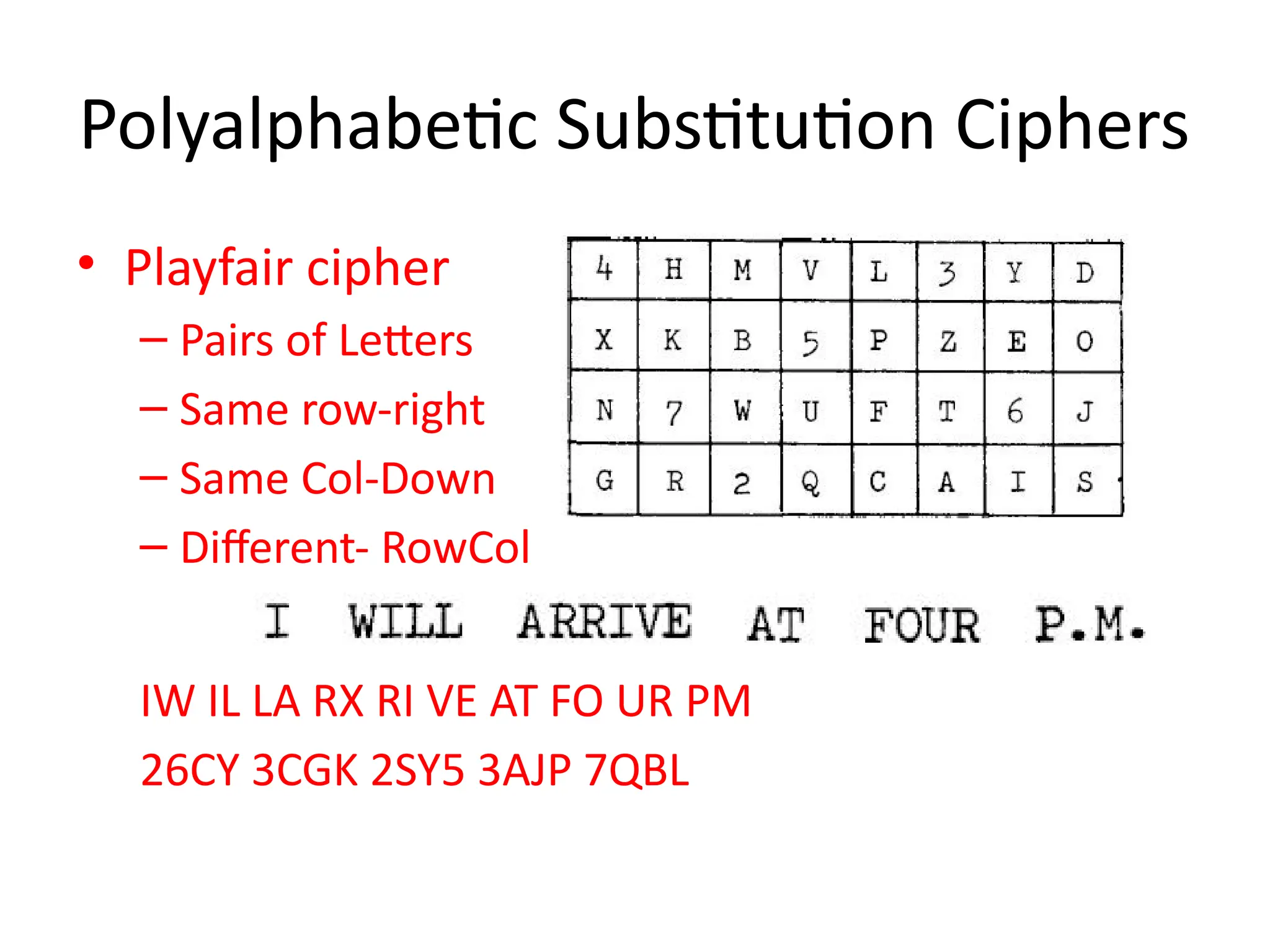
• Playfair cipher
– Pairs of Letters
– Same row-right
– Same Col-Down
– Different- RowCol
IW IL LA RX RI VE AT FO UR PM
26CY 3CGK 2SY5 3AJP 7QBL
Polyalphabetic Substitution Ciphers
• Alberti cipher:
Polyalphabetic Substitution Ciphers
• Trimethius cipher(tabula recta):
Polyalphabetic Substitution Ciphers
• Vigenère cipher
• keyword
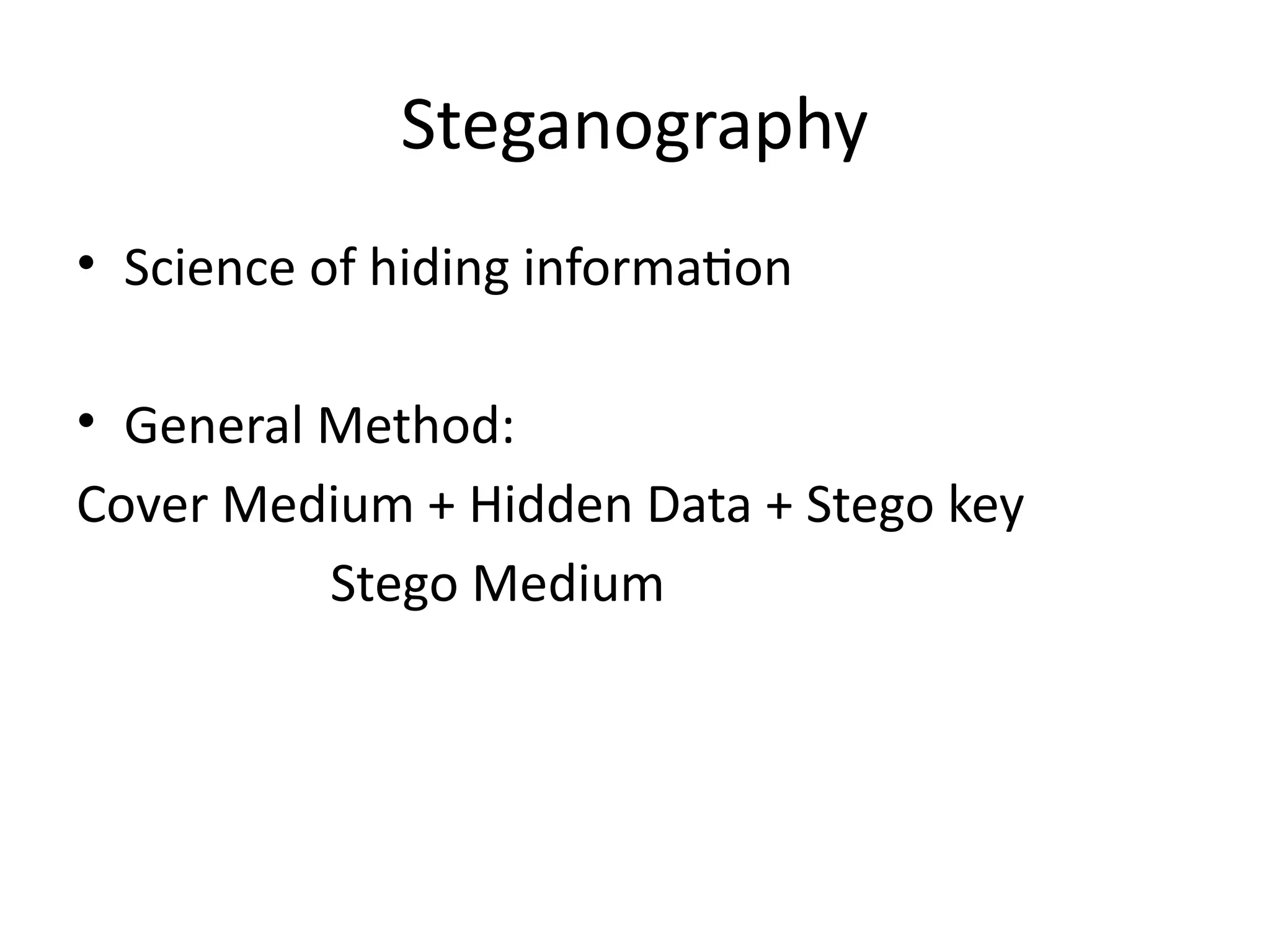
Steganography
• Science of hiding information
• General Method:
Cover Medium + Hidden Data + Stego key
Stego Medium

Secret writing in forensic science .pptx

  • 1.
    Secret writing • Purpose •To send info without interception • User • Prisoner • Lovers • Spies • Historical perspective • Since ancient dynasty » Roman » Greek
  • 2.
    Methods to hideinfo • Message on head • Feeding to animal • Microdots • Scrambled optical fibre • Dot code(Pin code) • Knot code • Playing card code • Red Blue code • Crayon Cover • Crease Code • Swizzle stick code
  • 3.
    Secret writing • Types –Organic Fluid » Plants secretion » Milk » Fruit juice » Saliva » Vegetable juices » Urine » Diluted blood » Development (Heat, Phenolphthalein, – Invisible ink(Sympathetic inks) » Ounce of alum & Pint of vinegar for writing on egg(Peeling) » A solution of sodium nitrate and starch in water (KI) » Solution of painkiller, antipyretics or laxative medicines » Iron sulphate(KCN, Na2Co3) » copper sulphate(Ammonia Fumes) » Titrimetric reagnets
  • 4.
    • Miniature writing •Micro writing • Hieroglyphics • Egyptian script • Ciphers • Algorithm • Cryptograms • The hidden information
  • 5.
    CIPHER A cipher isa method of transforming readable information (plaintext) into an unreadable format (ciphertext) to protect the information from unauthorized access TYPES OF CIPHER There are 2 types of cipher 1. Substitution cipher 2. Transposition cipher In SUBSTITUTION CIPHER, each character or group of characters in the plaintext is replaced with a different character or group of characters. There are several types of substitution ciphers: • Caesar Cipher: Shifts each letter in the plaintext by a fixed number of places down the alphabet. For example, with a shift of 3, "A" becomes "D", "B" becomes "E", and so on. • Monoalphabetic Substitution Cipher: Replaces each letter in the plaintext with a unique corresponding letter according to a fixed key. For example, using a substitution alphabet like QWERTYUIOPASDFGHJKLZXCVBNM, "HELLO" might be encrypted to "ITSSG". • Polyalphabetic Substitution Cipher: Uses multiple substitution alphabets based on a keyword or system. For example, the Vigenère cipher uses a keyword to determine the shift for each letter, creating a more complex encryption. • Homophonic Substitution Cipher: Replaces each letter with one of several possible symbols to obscure frequency analysis. For instance, the letter "E" might be encrypted as 1, 2, 3, etc. • Polygram Substitution Cipher: Substitutes groups of letters (like bigrams or trigrams) rather than individual letters. For example, "TH" could be substituted with a unique symbol or a different bigram.
  • 6.
    SUBSTITUTION CIPHER A substitutioncipher is a type of encryption method where each character in the plaintext is replaced with a different character according to a fixed system or key. The key determines how each character is substituted. Substitution of letter with another letter or symbol Types of Substitution Ciphers 1. Caesar Cipher: A type of substitution cipher where each letter in the plaintext is shifted a fixed number of places down the alphabet. For example, with a shift of 3 Plaintext: A B C D E F G H I J Ciphertext: D E F G H I J K L M So, "HELLO" with a shift of 3 becomes "KHOOR
  • 7.
    2. MONOALPHABETIC SUBSTITUTION Monoalphabeticsubstitution is a type of cipher where each letter in the plaintext is replaced with a fixed, unique letter from the alphabet in the ciphertext. This means that every occurrence of a specific letter in the plaintext is consistently replaced with the same letter in the ciphertext throughout the entire message. For example, if 'A' is replaced by 'M', then every 'A' in the plaintext will be replaced by 'M' in the ciphertext, and this substitution rule remains constant. In summary, monoalphabetic substitution involves a one-to-one mapping between letters of the plaintext alphabet and letters of the ciphertext alphabet. So if your original message is "HELLO" and your code says: H -> T E -> R L -> F O -> S Then "HELLO" would turn into "TRFFS".
  • 8.
    For example, ifyou use the key QWERTYUIOPASDFGHJKLZXCVBNM, where each letter of the alphabet is substituted by its corresponding letter in this key, then: •Plaintext alphabet: A B C D E F G H I J K L M N O P Q R S T U V W X Y Z •Ciphertext alphabet: Q W E R T Y U I O P A S D F G H J K L Z X C V B N M So, "HELLO" might be encrypted to "ITSSG". Each letter of the plaintext is replaced with a corresponding letter in the ciphertext according to a fixed key.
  • 9.
    POLYALPHABETIC SUBSTITUTION A polyalphabeticsubstitution cipher is a type of encryption where you use multiple alphabet systems to encode a message. This makes it harder to crack than simpler ciphers because it mixes up the substitutions in a more complex way. VIGENERE SUBSTITUTION CIPHER
  • 10.
    In addition tothe plaintext, the Vigenère cipher also requires a keyword, which is repeated so that the total length is equal to that of the plaintext. For example, suppose the plaintext is MICHIGAN TECHNOLOGICAL UNIVERSITY and the keyword is HOUGHTON. Then, the keyword must be repeated as follows: MICHIGAN TECHNOLOGICAL UNIVERSITY HOUGHTON HOUGHTONHOUGH TONHOUGNTO We follow the tradition by removing all spaces and punctuation, converting all letters to upper case, and dividing the result into 5-letter blocks. As a result, the above plaintext and keyword become the following: MICHI GANTE CHNOL OGICA LUNIV ERSIT Y HOUGH TONHO UGHTO NHOUG HTONH OUGHT O To encrypt, pick a letter in the plaintext and its corresponding letter in the keyword, use the keyword letter and the plaintext letter as the row index and column index, respectively, and the entry at the row-column intersection is the letter in the ciphertext. For example, the first letter in the plaintext is M and its corresponding keyword letter is H. This means that the row of H and the column of M are used, and the entry T at the intersection is the encrypted result.
  • 11.
    Similarly, since theletter N in MICHIGAN corresponds to the letter N in the keyword, the entry at the intersection of row N and column N is A which is the encrypted letter in the ciphertext. Repeating this process until all plaintext letters are processed, the ciphertext is TWWNPZOAASWNUHZBNWWGS NBVCSLYPMM. The following has the plaintext, repeated keyword and ciphertext aligned together. MICHI GANTE CHNOL OGICA LUNIV ERSIT Y HOUGH TONHO UGHTO NHOUG HTONH OUGHT O TWWNP ZOAAS WNUHZ BNWWG SNBVC SLYPM M
  • 12.
    A Homophonic substitutioncipher is a type of encryption where each letter in the plaintext can be replaced by multiple possible symbols or characters in the ciphertext. This makes it harder for someone to figure out what the original message is just by looking at the encrypted text. How It Works 1.Assign Multiple Symbols: Each letter in the alphabet is mapped to several different symbols or characters. For example, the letter "E" (which is very common in English) might be represented by several different symbols like 1, 2, 3, etc. 2.Encrypt the Message: When you encrypt a message, you choose one of the possible symbols for each letter based on a system or randomly. So, if the plaintext has the letter "E", you might replace it with 1, 2, or 3 each time you see "E". 3.Create the Ciphertext: The result is a ciphertext where the same letter from the plaintext might appear as different symbols in the encrypted message Why It’s More Secure •Obscures Letter Frequency: Since each letter can be replaced by multiple symbols, the frequency of letters in the ciphertext doesn't match the frequency in the plaintext as directly. This makes it harder to use frequency analysis (a common method for breaking ciphers) to decode the message.
  • 13.
    Example Setup Define Symbolsfor Each Letter: Suppose we assign multiple symbols to each letter: 1. A → 1, 2 2. B → 3, 4 3. C → 5, 6 4. D → 7, 8 5. E → 9, 10 6. F → 11, 12 7. (and so on for other letters) 8. Plaintext Message: "BAD“ Encrypt the Message: Replace each letter in the plaintext with one of its assigned symbols. Let's choose the symbols as follows: 9. A → 2 10.B → 4 11.D → 7 So "BAD" would be encrypted as "4 2 7". Another Example of Encryption To show the variability: •A → 1 •B → 3 •D → 8 •Then "BAD" could also be encrypted as "1 3 8"
  • 14.
    TRANSPOSITION CIPHER A transpositioncipher is a type of encryption method where the positions of characters in the plaintext are shifted according to a regular system to create the ciphertext. Unlike substitution ciphers, which replace characters with other characters, transposition ciphers rearrange the characters while keeping the original characters unchanged. Here's a basic overview of how transposition ciphers work: 1.Rearrangement: Characters in the plaintext are rearranged according to the key. For example, you might write the plaintext in a grid and then read it off in a different order. 2.Key or System: The method for rearranging the characters is determined by a key or algorithm. This key might be a number, a word, or a set of instructions.
  • 15.
    Types include: Columnar TranspositionCipher: Writes the plaintext into a grid with a fixed number of columns and then reads the columns in a specified order based on a key. Rail Fence Cipher: Writes the plaintext in a zigzag pattern across multiple lines (rails) and then reads off the lines to produce the ciphertext. Route Cipher: Uses a grid to write the plaintext and then reads the characters out in a specified route or pattern, such as spiraling inward or snaking through the grid. Permutation Cipher: Rearranges the order of characters in the plaintext according to a permutation key.
  • 16.
    Cryptography • Transposition cipher »Rearrangement of letter • Substitution Cipher » Substitution of letter with another letter or symbol • Monoalphabetic • Polyalphabetic
  • 17.
    RAIL FENCE CIPHER TheRail Fence Cipher is a type of transposition cipher that rearranges the letters of a plaintext message according to a zigzag pattern. How It Works Choose the Number of Rails: Determine the number of rails (rows) you will use for the encryption process. For example, you might choose 3 rails. Write the Plaintext in Zigzag Pattern: Write the plaintext message in a zigzag pattern across the chosen number of rails. For example, with 3 rails, the pattern would look like this: H . . . O . . . R . . . L . E . L . W . R . O . D . . . L . . . O . . . . . . To create this pattern, you start by writing the first letter on the top rail, the next letter on the second rail, and then move down to the third rail, and then move back up to the second rail and so on, creating a zigzag or "rail fence" shape. Read Off the Rows: After filling in the rails, read the letters row by row to create the ciphertext. For the example above: Top Rail: HOLR Middle Rail: ELWRDO Bottom Rail: LOO The final ciphertext is obtained by concatenating the rows: "HOLR ELWRDO LOO".
  • 18.
    Decryption Process • Reconstructthe Zigzag Pattern: Determine the number of characters that belong to each rail based on the ciphertext length and the number of rails used. • Fill in the Rails: Using the ciphertext, fill the rails with characters in the zigzag pattern, similar to the encryption process. • Read Off the Columns: Read the message in the zigzag pattern to retrieve the original plaintext.
  • 19.
    Transposition Cipher • RailFence Cipher • Encryption • Decryption
  • 20.
    TWISTED PATH CIPHER TheTwisted Path Cipher is a type of transposition cipher used to encrypt data by rearranging the order of characters. Here's a simplified breakdown: • Grid Layout: Think of the plaintext (the original message) as being written into a grid or matrix. For example, if you have a message and a grid with a certain number of columns, you'd write the message into the grid row by row. • Rearrangement: Instead of reading off the characters from the grid in the usual row-by-row or column-by-column manner, you read them in a twisted or non- standard pattern. This pattern is what makes the cipher "twisted." The specific pattern used can vary. • Encryption: By following the twisted path, you get a rearranged string of characters, which is the ciphertext (the encrypted message). • Decryption: To decrypt, you reverse the process. You use the same twisted path pattern to rearrange the characters back into their original order.
  • 21.
    Transposition Cipher • Twistedpath Cipher • Encryption • Decryption
  • 22.
    Substitution Ciphers Monoalphabetic • ShiftCipher(Caesar Cipher) • Encryption • Decryption
  • 23.
    DATE SHIFT CIPHER Adate shift cipher uses a specific date to determine the shift value for a Caesar cipher. For simplicity, let’s break down how you can apply a date to create a shift cipher: Steps to Create a Date Shift Cipher: 1.Choose the Date: For this example, let’s use "March 7, 2024.“ 2.Determine the Shift Value: You can use different parts of the date. For simplicity, let’s use the day of the month. So, the shift value is 7. 3.Create the Cipher: 1. Plaintext: "HELLO WORLD" 2. Shift Value: 7 Encoding Process: To encode a message, shift each letter of the plaintext forward by the shift value in the alphabet. If shifting a letter goes past 'Z', wrap around to the beginning of the alphabet.
  • 24.
    Example Encoding: H shiftedby 7 places becomes O E shifted by 7 places becomes L L shifted by 7 places becomes S O shifted by 7 places becomes V W shifted by 7 places becomes D R shifted by 7 places becomes Y L shifted by 7 places becomes S D shifted by 7 places becomes K Applying this shift to the entire message: Plaintext: "HELLO WORLD" Ciphertext: "OLSSV DLYSK“
  • 25.
    Statement: Let's usethe date "August 16, 2024" to create a cipher. In this case, we'll use the day of the month (16) as the shift value. Plaintext: "MEET ME AT THE PARK“ Cipher Process: Shift Value: 16 (from the day of the month) Alphabet Shift: Each letter in the plaintext will be shifted 16 places forward in the alphabet. Here's how you can encode it: M shifted by 16 places becomes C E shifted by 16 places becomes U A shifted by 16 places becomes Q T shifted by 16 places becomes J Applying this shift to the entire message, we get: Ciphertext: "CUUC CU QJ JX JX NBFQ“ So, using the date August 16 for our shift value, the original statement "MEET ME AT THE PARK" is encoded as "CUUC CU QJ JX JX NBFQ."
  • 26.
    Substitution Ciphers Polyalphabetic • DateShift Cipher • Encryption • Decryption
  • 27.
    Keyword cipher It isa type of substitution cipher that uses a keyword to provide a key for encrypting and decrypting messages. Steps to Create and Use a Keyword Cipher 1. Choose a Keyword • Select a keyword: This is a word or phrase used to generate the cipher alphabet. For simplicity, use a single word with unique letters. 2. Create the Cipher Alphabet • Write the Keyword: Start with the keyword and remove any duplicate letters • Complete the Cipher Alphabet: Write out the remaining letters of the alphabet, skipping those already used in the keyword 3. Encrypt a Message • Write the Message: Write down the message you want to encrypt using the standard alphabet. • Substitute Letters: Replace each letter in the message with the corresponding letter from the cipher alphabet 4. Decrypt a Message • Write the Encrypted Message: Write down the encrypted message. • Substitute Letters Back: Replace each letter in the encrypted message with the corresponding letter from the standard alphabet.
  • 28.
    ALPHABETS: A,B,C,D,E,F,G,H,I,J,K,L,M,N,O,P,Q,R,S,T,U,V,W,X,Y,Z KEYWORD: ANDREWCIPHER PLAIN TEXT: GOOD MORNING Step 1: Place keywords A,B,C,D,E,F,G,H,I,J,K,L,M,N,O,P,Q,R,S,T,U,V,W,X,Y,Z. A,N,D,R,E,W,C,I,P,H,B,F,,G,J,K,L,M,O,Q,S,T,U,V,W,X,Y,Z Encrypt the Plain text : GOOD MORNING CIPHER TEXT:CKKR GKOJPJC
  • 29.
    Substitution Ciphers • KeyWord Cipher • Encryption • Decryption
  • 30.
    Pig pen cipher, Itis also known as the Masonic cipher or Freemason's cipher, is a substitution cipher that uses a grid-like system to encode letters. It’s called the Pigpen cipher because the symbols used resemble a pigpen or a series of grids and lines. STEPS • Create the Grid: Draw a grid of 3x3 squares and divide it into two parts. The first part contains the letters A-I, and the second part contains J-R (or sometimes J-Z, depending on the variant). • Label the Grids: Add lines to the grid. The grid for A-I has 8 symbols (divided by the lines). The grid for J-R has similar markings but slightly different in design. Encoding • Write the Message: Write down the message you want to encode. For simplicity, remove any punctuation or spaces. • Substitute Each Letter: Look up each letter in your grid. Each letter is represented by a symbol made up of the lines that outline its grid position.
  • 31.
    Decoding • Recognize theSymbols: Start with the symbols that were used to encode the message. • Use the Grid: Refer back to the grid to decode each symbol. Each symbol corresponds to a specific letter. • Reconstruct the Message: Once all symbols are decoded, reconstruct the original message.
  • 32.
    Substitution Ciphers • PigPen Cipher(Mason’s Cipher) • Encryption • Decryption
  • 33.
    The Polybius square,also known as the Polybius checkerboard, It is an ancient Greek cipher that uses a 5x5 grid to encode letters into pairs of numbers. It’s a simple substitution cipher that was historically used for communication in a more secure manner. Setting Up the Polybius Square Create the 5x5 Grid: The grid contains 25 cells, one for each letter of the alphabet. Typically, the letters "I" and "J" are combined into a single cell to fit all letters into the 5x5 grid. Encoding with the Polybius Square • Write the Message: Prepare the message you want to encode. Remove any spaces and replace "J" with "I" (or vice versa) if needed. • Find Each Letter in the Grid: For each letter in your message, find its position in the grid. Each letter is encoded as a pair of numbers indicating its row and column. • Write the Encoded Message: Replace each letter with its corresponding pair of numbers. Decoding with the Polybius Square • Receive the Encoded Message: Obtain the sequence of number pairs. • Find Each Pair in the Grid: Locate each pair of numbers in the grid to identify the corresponding letter
  • 34.
    Substitution Ciphers • PolybiusCheckerboard • Encryption • Decryption
  • 35.
    Substitution Ciphers • RandomSubstitution Cipher • Encryption • Decryption
  • 36.
    Substitution Ciphers • TheShadows Code • Encryption • Decryption
  • 37.
    Polyalphabetic Substitution Ciphers •Porta’s diagraphic cipher
  • 38.
    Polyalphabetic Substitution Ciphers •Playfair cipher – Pairs of Letters – Same row-right – Same Col-Down – Different- RowCol IW IL LA RX RI VE AT FO UR PM 26CY 3CGK 2SY5 3AJP 7QBL
  • 39.
  • 40.
    Polyalphabetic Substitution Ciphers •Trimethius cipher(tabula recta):
  • 41.
    Polyalphabetic Substitution Ciphers •Vigenère cipher • keyword
  • 42.
    Steganography • Science ofhiding information • General Method: Cover Medium + Hidden Data + Stego key Stego Medium