Presented by Charlis Cunningham
April 28, 2015
University of Cincinnati
CI 7090
 The purpose of this literature review:
 Understand what best teaching practices are for
early childhood English language learners (ELLs)
 Define what integrated teaching is
 Understand how integrated methods of
instruction impacts young ELLs
 There is an emphasis on integrated and
interdisciplinary teaching
 Society has a high demand for critical
thinkers and creativity in its workforce
 21st century skills:
 Critical thinking and problem solving, communication
and collaboration, and creativity and innovation
 ELLs are a growing population in the U.S., achieve below
their native English speaking peers, have high dropout
rates, face inequitable learning situations in mainstream
classrooms
 Integrated teaching is an instructional
approach to curriculum that incorporates one
subject within others, and it can provide
connections to students’ lives outside of the
school environment
 It is commonly identified as:
 Integrated instruction
 Interdisciplinary instruction
 Multidisciplinary instruction
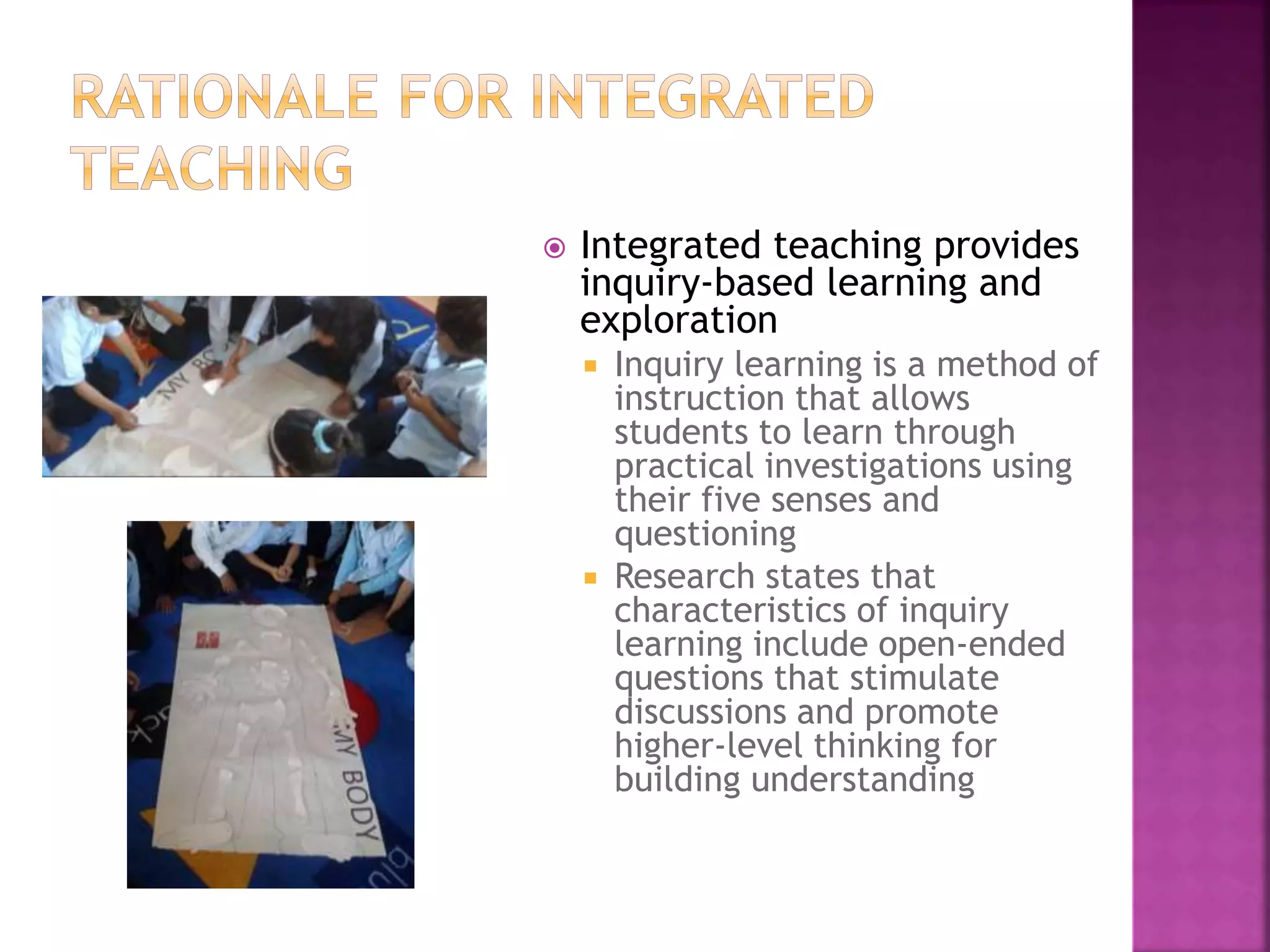
 Integrated teaching provides
inquiry-based learning and
exploration
 Inquiry learning is a method of
instruction that allows
students to learn through
practical investigations using
their five senses and
questioning
 Research states that
characteristics of inquiry
learning include open-ended
questions that stimulate
discussions and promote
higher-level thinking for
building understanding
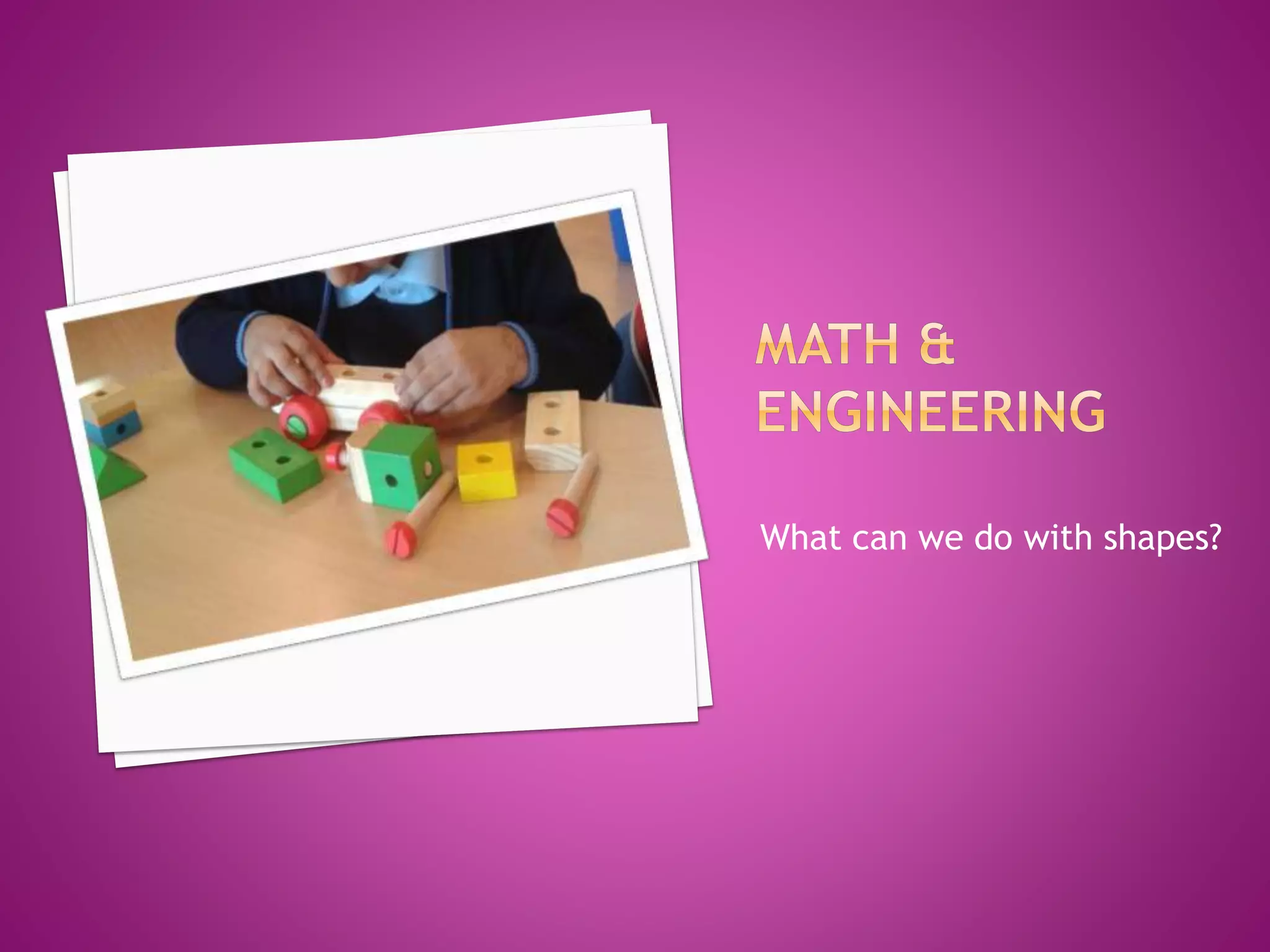
What can we do with shapes?
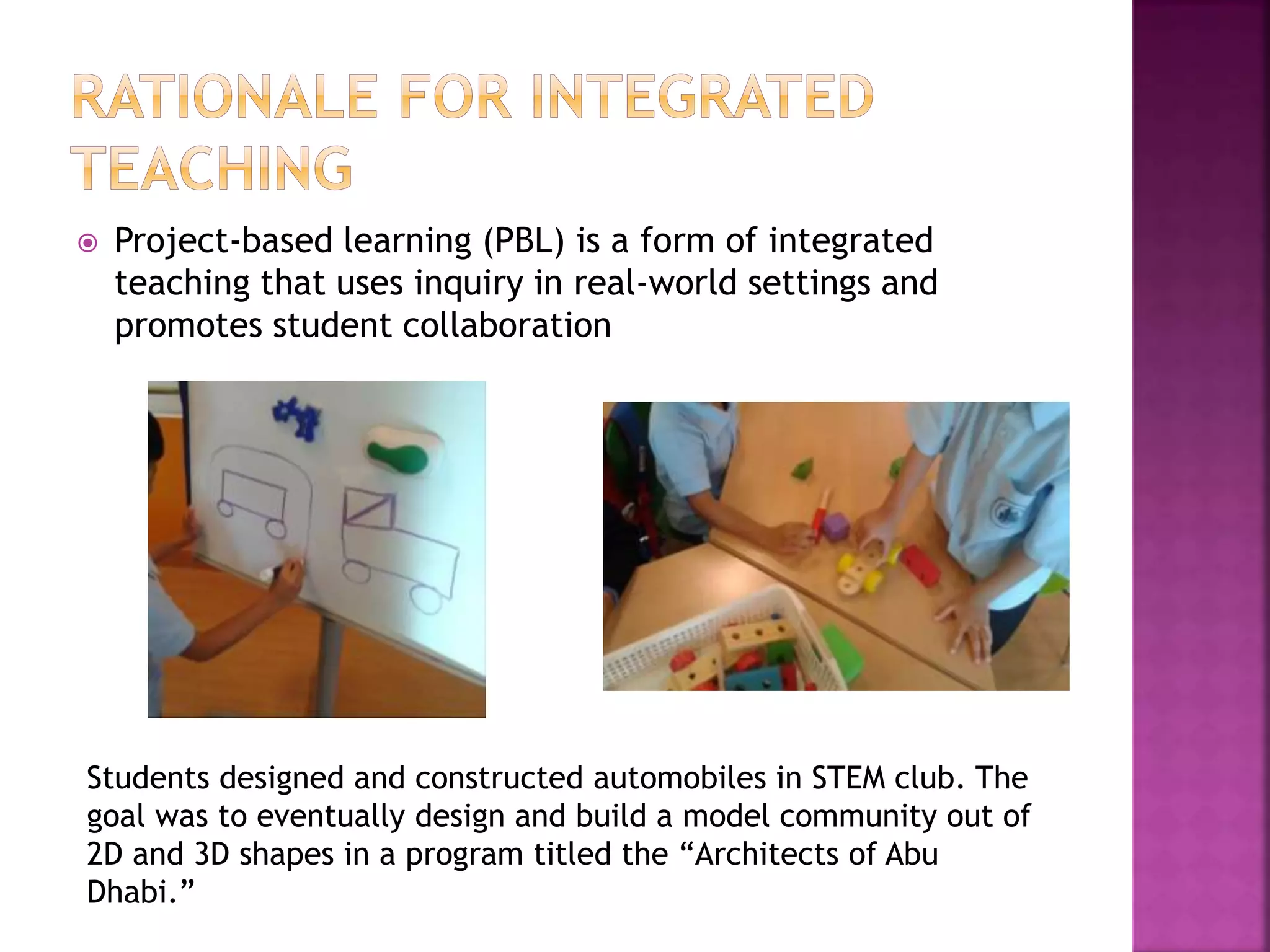
 Project-based learning (PBL) is a form of integrated
teaching that uses inquiry in real-world settings and
promotes student collaboration
Students designed and constructed automobiles in STEM club. The
goal was to eventually design and build a model community out of
2D and 3D shapes in a program titled the “Architects of Abu
Dhabi.”
 Integrated teaching moves beyond the
classroom and connects to students’ lives.
 Student sociocultural background
 Prior knowledge
 Student interests
 Research states that learning is optimized for
ELLs when the learning environment helps
them connect to their various backgrounds.
 This can bring equity to the classroom in cases
where the culture of multilingual or immigrant
ELLs are usually excluded from school curriculum
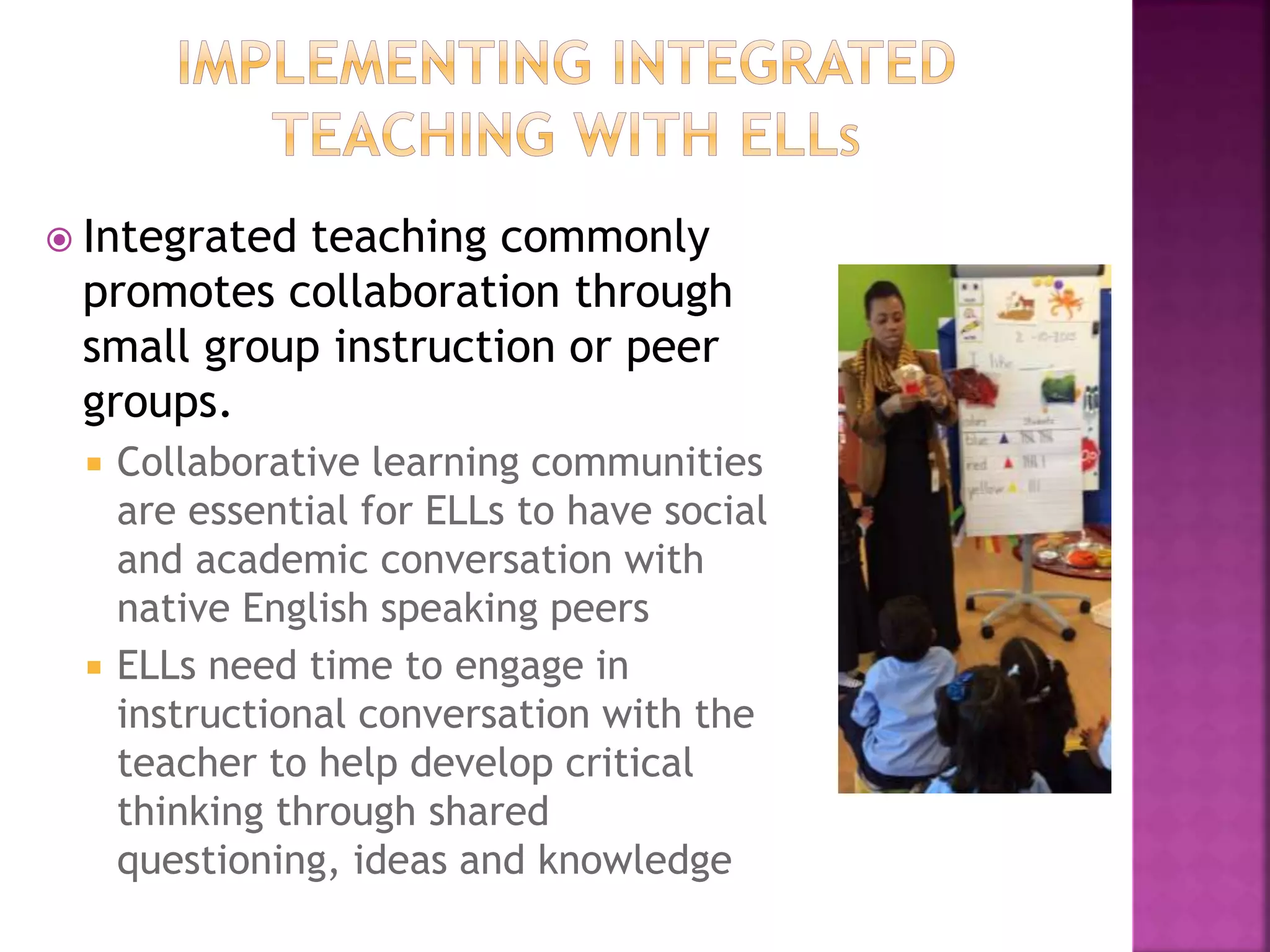
 Integrated teaching commonly
promotes collaboration through
small group instruction or peer
groups.
 Collaborative learning communities
are essential for ELLs to have social
and academic conversation with
native English speaking peers
 ELLs need time to engage in
instructional conversation with the
teacher to help develop critical
thinking through shared
questioning, ideas and knowledge
 Non-ELLs are experiencing a greater benefit
from integration than their ELL peers
 ELLs do not capitalize on opportunities to
become self-sufficient like their English only (EO)
peers
 ELLs need better differentiation to grasp
language skills along with academic content
 Teachers must design small groups to meet ELLs
needs
 Educators need more knowledge on how to
instruct ELLs
 Teachers should be prepared to deliver
integrated instruction
 Teachers should understand their student
demographic
 Teachers need to be familiar with language
acquisition and how it is connected to all school
learning
 Helping ELLs with academic content means providing
cultural and linguistic instructional support
 Most of the research agrees that students
develop conversational language before
academic
 ELLs should be encouraged to nurture their
English ability by using it frequently
 Educators should be careful not to neglect the
development of cognitive skills by heavily
focusing on language skills
 Providing non-linguistic materials helps ELLs
demonstrate what they know in a non-verbal
form
 ELLs need clear, explicit objectives and
expectations in content area classrooms
 This can ease any tension from cultural clashes
between curricula and students, teachers and
students, and student peers
 It can serve as motivation for ELLs
 Providing a success criteria for assignments and
activities is good teaching practice
 Integrated teaching is often nested in project-
based learning, inquiry learning, or
interdisciplinary subjects like STEM and STEAM
 These teaching practices are integral parts of 21st
century skills
 A repeated theme in the literature supported
student collaboration and authentic learning
situations
 Discrepancies in the research on integrated
instruction advocated for single subject
instruction, particularly in math and science
disciplines
 There are implications for social change
regarding English as a second or other language
(ESOL) education and teacher knowledge on best
practices for instructing ELLs
 It is important to explore how schools, education
programs and national reforms will better
prepare teachers for integrated teaching
 There was a disproportionate amount of
information on early childhood ELLs and
integrated teaching at this level
 A large amount of research was conducted in studies
with upper elementary, middle school, and high
school students
 Committee on Integrated STEM Education, National Academy of Engineering, &
National Research Council. (2014). STEM integration in K-12 education: Status,
prospects, and an agenda for research. Washington, D.C.: National Academies Press.
Retrieved from http://www.ebrary.com
 Haynes, J. & Zacarian, D. (2010). Teaching English language learners across content
areas. Alexandria, VA: Association for Supervision & Curriculum Development.
 Huerta, M. & Jackson, J. (2010). Connecting literacy and science to increase
achievement for English language learners. Early Childhood Education Journal, 38,
205-211. doi:10.1007/s10643-010-0402-4
 Thomas, J. W. (2000). A review of research on project-based learning. Retrieved
from http://www.bie.org/index.php/site/RE/pbl_research/29.
 Trilling, B., & Fadel, C. (2009). 21st century skills: Learning for life in our times.
San Francisco, CA: Jossey-Bass.
 United States Department of Education, National Center for Education Statistics.
(2014). The Condition of Education 2014 [NCES 2014-083]. Retrieved from
http://nces.ed.gov/pubsearch
 Velez, F. (2010). Meeting the needs of English learners in project-based learning
schools (Order No. 3451948). Available from ProQuest Dissertations & Theses A&I;
ProQuest Dissertations & Theses Global. (863572737). Retrieved from
http://search.proquest.com/docview/863572737?accountid=2909
 Wood, K. E. (2009). Interdisciplinary instruction for all learners K-8: A practical
guide. New York, NY: Pearson College Division.

The Effects of Integrated Teaching

  • 1.
    Presented by CharlisCunningham April 28, 2015 University of Cincinnati CI 7090
  • 2.
     The purposeof this literature review:  Understand what best teaching practices are for early childhood English language learners (ELLs)  Define what integrated teaching is  Understand how integrated methods of instruction impacts young ELLs
  • 3.
     There isan emphasis on integrated and interdisciplinary teaching  Society has a high demand for critical thinkers and creativity in its workforce  21st century skills:  Critical thinking and problem solving, communication and collaboration, and creativity and innovation  ELLs are a growing population in the U.S., achieve below their native English speaking peers, have high dropout rates, face inequitable learning situations in mainstream classrooms
  • 4.
     Integrated teachingis an instructional approach to curriculum that incorporates one subject within others, and it can provide connections to students’ lives outside of the school environment  It is commonly identified as:  Integrated instruction  Interdisciplinary instruction  Multidisciplinary instruction
  • 5.
     Integrated teachingprovides inquiry-based learning and exploration  Inquiry learning is a method of instruction that allows students to learn through practical investigations using their five senses and questioning  Research states that characteristics of inquiry learning include open-ended questions that stimulate discussions and promote higher-level thinking for building understanding
  • 6.
    What can wedo with shapes?
  • 7.
     Project-based learning(PBL) is a form of integrated teaching that uses inquiry in real-world settings and promotes student collaboration Students designed and constructed automobiles in STEM club. The goal was to eventually design and build a model community out of 2D and 3D shapes in a program titled the “Architects of Abu Dhabi.”
  • 8.
     Integrated teachingmoves beyond the classroom and connects to students’ lives.  Student sociocultural background  Prior knowledge  Student interests  Research states that learning is optimized for ELLs when the learning environment helps them connect to their various backgrounds.  This can bring equity to the classroom in cases where the culture of multilingual or immigrant ELLs are usually excluded from school curriculum
  • 9.
     Integrated teachingcommonly promotes collaboration through small group instruction or peer groups.  Collaborative learning communities are essential for ELLs to have social and academic conversation with native English speaking peers  ELLs need time to engage in instructional conversation with the teacher to help develop critical thinking through shared questioning, ideas and knowledge
  • 10.
     Non-ELLs areexperiencing a greater benefit from integration than their ELL peers  ELLs do not capitalize on opportunities to become self-sufficient like their English only (EO) peers  ELLs need better differentiation to grasp language skills along with academic content  Teachers must design small groups to meet ELLs needs  Educators need more knowledge on how to instruct ELLs  Teachers should be prepared to deliver integrated instruction
  • 11.
     Teachers shouldunderstand their student demographic  Teachers need to be familiar with language acquisition and how it is connected to all school learning  Helping ELLs with academic content means providing cultural and linguistic instructional support  Most of the research agrees that students develop conversational language before academic  ELLs should be encouraged to nurture their English ability by using it frequently
  • 12.
     Educators shouldbe careful not to neglect the development of cognitive skills by heavily focusing on language skills  Providing non-linguistic materials helps ELLs demonstrate what they know in a non-verbal form  ELLs need clear, explicit objectives and expectations in content area classrooms  This can ease any tension from cultural clashes between curricula and students, teachers and students, and student peers  It can serve as motivation for ELLs  Providing a success criteria for assignments and activities is good teaching practice
  • 13.
     Integrated teachingis often nested in project- based learning, inquiry learning, or interdisciplinary subjects like STEM and STEAM  These teaching practices are integral parts of 21st century skills  A repeated theme in the literature supported student collaboration and authentic learning situations  Discrepancies in the research on integrated instruction advocated for single subject instruction, particularly in math and science disciplines
  • 14.
     There areimplications for social change regarding English as a second or other language (ESOL) education and teacher knowledge on best practices for instructing ELLs  It is important to explore how schools, education programs and national reforms will better prepare teachers for integrated teaching  There was a disproportionate amount of information on early childhood ELLs and integrated teaching at this level  A large amount of research was conducted in studies with upper elementary, middle school, and high school students
  • 15.
     Committee onIntegrated STEM Education, National Academy of Engineering, & National Research Council. (2014). STEM integration in K-12 education: Status, prospects, and an agenda for research. Washington, D.C.: National Academies Press. Retrieved from http://www.ebrary.com  Haynes, J. & Zacarian, D. (2010). Teaching English language learners across content areas. Alexandria, VA: Association for Supervision & Curriculum Development.  Huerta, M. & Jackson, J. (2010). Connecting literacy and science to increase achievement for English language learners. Early Childhood Education Journal, 38, 205-211. doi:10.1007/s10643-010-0402-4  Thomas, J. W. (2000). A review of research on project-based learning. Retrieved from http://www.bie.org/index.php/site/RE/pbl_research/29.  Trilling, B., & Fadel, C. (2009). 21st century skills: Learning for life in our times. San Francisco, CA: Jossey-Bass.  United States Department of Education, National Center for Education Statistics. (2014). The Condition of Education 2014 [NCES 2014-083]. Retrieved from http://nces.ed.gov/pubsearch  Velez, F. (2010). Meeting the needs of English learners in project-based learning schools (Order No. 3451948). Available from ProQuest Dissertations & Theses A&I; ProQuest Dissertations & Theses Global. (863572737). Retrieved from http://search.proquest.com/docview/863572737?accountid=2909  Wood, K. E. (2009). Interdisciplinary instruction for all learners K-8: A practical guide. New York, NY: Pearson College Division.

Editor's Notes

  • #2 15-20 minutes, overview of the project focus and problem statement, topics of her lit review, outcomes and what are the implications of this project on her personal instructional abilities and future classroom.”
  • #4 (NCES, 2014; Trilling & Fadel, 2009)
  • #5 (Roberts & Cantu, 2012) (Wood, 2009)
  • #6 (Committee on Integrated STEM Education, 2014) (Huerta & Jackson, 2010)
  • #7 Vocabulary practice for math- 2D and 3D shapes, round, straight, Questions- Which shapes go/roll, stack, are flat, etc.?
  • #8 (Thomas, 2000)
  • #11 (Velez, 2010)
  • #12 Haynes & Zacarian, 2010; Huerta & Jackson, 2010
  • #13 Haynes & Zacarian, 2010; Huerta & Jackson, 2010