ESOL Consent Decreegroup 5Kaley Craig, Nicole Irizarry, Melanie Ortiz, Fantasy Thomas, Melaya Becerra, Kimberly Duque
Abbreviations to knowESOL- English for Speakers of Other LanguagesELL- English Language Learners LEP- Limited English Proficiency
The ESOL Consent Decree was signed on August 14, 1990 as a settlement agreement ending the court case League of United Latin American Citizens (LULAC) VS. Florida Department of Education. The case was related to a federal lawsuit that had been filed in the Southern District of Florida claiming that the state had not complied with laws that ensure school districts provide equal and comprehensible instruction to LEP students.
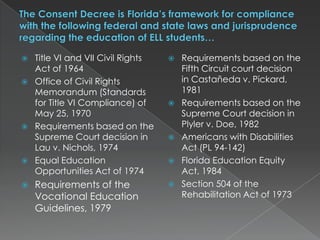
The Consent Decree is Florida’s framework for compliance with the following federal and state laws and jurisprudence regarding the education of ELL students… Title VI and VII Civil Rights Act of 1964Office of Civil Rights Memorandum (Standards for Title VI Compliance) of May 25, 1970Requirements based on the Supreme Court decision in Lau v. Nichols, 1974Equal Education Opportunities Act of 1974Requirements of the Vocational Education Guidelines, 1979Requirements based on the Fifth Circuit court decision in Castañeda v. Pickard, 1981Requirements based on the Supreme Court decision in Plyler v. Doe, 1982Americans with Disabilities Act (PL 94-142)Florida Education Equity Act, 1984Section 504 of the Rehabilitation Act of 1973
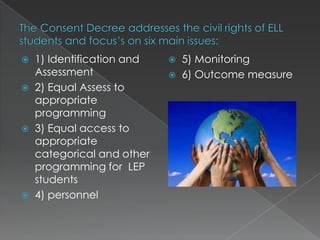
The Consent Decree addresses the civil rights of ELL students and focus’s on six main issues:1) Identification and Assessment2) Equal Assess to appropriate programming3) Equal access to appropriate categorical and other programming for  LEP students4) personnel 5) Monitoring 6) Outcome measure
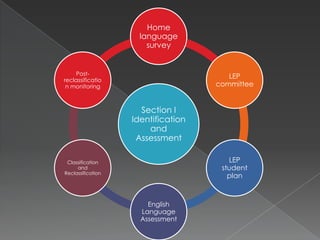
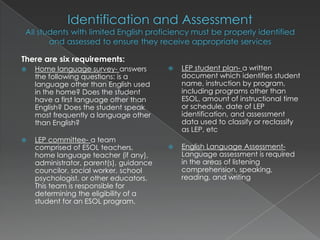
Identification and Assessment All students with limited English proficiency must be properly identified and assessed to ensure they receive appropriate servicesLEP student plan- a written document which identifies student name, instruction by program, including programs other than ESOL, amount of instructional time or schedule, date of LEP identification, and assessment data used to classify or reclassify as LEP, etcEnglish Language Assessment- Language assessment is required in the areas of listening comprehension, speaking, reading, and writingThere are six requirements:Home language survey- answers the following questions: is a language other than English used in the home? Does the student have a first language other than English? Does the student speak most frequently a language other than English? LEP committee- a team comprised of ESOL teachers, home language teacher (if any), administrator, parent(s), guidance councilor, social worker, school psychologist, or other educators. This team is responsible for determining the eligibility of a student for an ESOL program.
Classification and Reclassification- Students classified as LEP continue to receive appropriate instruction until such time as the student is reclassified as English proficient, or otherwise exited from the ESOL program by the LEP committee.Post-Reclassification monitoring- The performance of students who have been exited from the ESOL program must be reviewed to identify any patterns of continuing under performance on appropriate test and/or grades
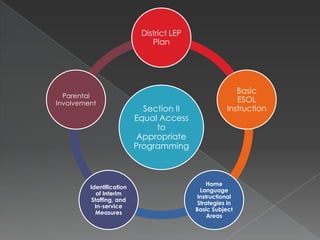
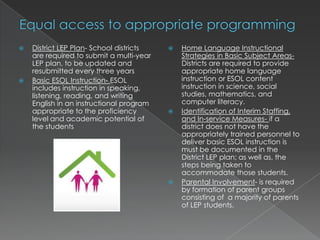
Equal access to appropriate programming District LEP Plan- School districts are required to submit a multi-year LEP plan, to be updated and resubmitted every three yearsBasic ESOL Instruction- ESOL includes instruction in speaking, listening, reading, and writing English in an instructional program appropriate to the proficiency level and academic potential of the studentsHome Language Instructional Strategies in Basic Subject Areas- Districts are required to provide appropriate home language instruction or ESOL content instruction in science, social studies, mathematics, and computer literacy.Identification of Interim Staffing, and In-service Measures- if a district does not have the appropriately trained personnel to deliver basic ESOL instruction is must be documented in the District LEP plan; as well as, the steps being taken to accommodate those students.Parental Involvement- is required by formation of parent groups consisting of  a majority of parents of LEP students.
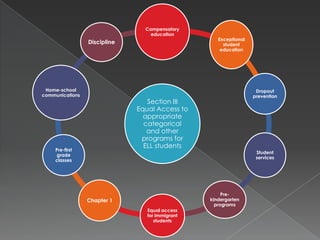
Equal access is required for LEP students, as well as understandable instruction in a manner appropriate to the students' level of English proficiencyCompensatory education- Equal access is required for LEP students, as well as understandable instruction in a manner appropriate to the students' level of English proficiency. Requirements under this section include both Chapter 1 basic and/or migrant education, as well as compensatory programming.. Exceptional student education- Requirements under this section apply both to handicapped and gifted students, and repeat equal access requirements previously given for regular education of LEP studentsDropout prevention-  Three requirements are given for dropout prevention programs and services: (a)equal access for LEP students, (b) annual report of the number of students served by dropout prevention programs by race, national origin, limited English proficiency, and type of service, and (c) LEP parent participation in the development of the district's comprehensive program plan for dropout preventionStudent services- Equal access to student services (e.g. counseling) is required for LEP students, pursuant to F.S. (Florida Statute) Section 230.2313.Pre-kindergarten programs- Equal access to pre-kindergarten programs is required for LEP students, including programs such as Head Start, Migrant Pre-Kindergarten, Pre-Kindergarten Early Intervention, and related programs
Equal access for immigrant students- Free, equal, and unhindered access to appropriate schooling is required for all immigrant students in compliance with a 1982 U.S. Supreme Court ruling (Plyler vs. Doe). Chapter 1- Equal access is required for limited English proficient students who are within the targeted program, school, and/or area where the funds are expendedPre-first grade classes. All pre-first grade classes must comply with applicable requirements of federal and state lawHome-school communications. All written and oral communications between school personnel and parents of current or former LEP are to be in the parents' primary language or other mode of        Communication commonly used by the parents, unless clearly not feasible. Discipline. No national origin minority or limited English proficient student will be subjected to any disciplinary action because of his/her use of a language other than English.
Section IV: PersonnelThis section details the certificate coverage and in service training teachers must have in order to be qualified to instruct ESOL studentsThere are requirements in six areas: 1. certification and in-service 2. certification required as appropriate     coverage 3. exemptions 4. supply of personnel 5. in-service evaluation  6. Implementation
Section V: Monitoring IssuesThe Florida Department of Education is  in charge  of monitoring local school districts to ensure compliance with the provisions of the Consent Decree according to federal and state law and regulations is followed
Section VI- Outcome measuresThe Florida Department of Education is required to develop an evaluation system to address equal access and program effectiveness. The purpose of the evaluation system is to collect and analyze data regarding the progress of ELL students and include comparisons between the LEP population and the non-ELL population.Evaluation should include: retention rates, graduation rates, dropout rates, grade point averages and state assessment scores
The END
Sources: http://www.fldoe.org/aala/cdpage2.asphttp://www.fldoe.orghttp://www.fldoe.org/aala/lulac.asphttp://www.fldoe.org/aala/

Esol decree

  • 1.
    ESOL Consent Decreegroup5Kaley Craig, Nicole Irizarry, Melanie Ortiz, Fantasy Thomas, Melaya Becerra, Kimberly Duque
  • 2.
    Abbreviations to knowESOL-English for Speakers of Other LanguagesELL- English Language Learners LEP- Limited English Proficiency
  • 3.
    The ESOL ConsentDecree was signed on August 14, 1990 as a settlement agreement ending the court case League of United Latin American Citizens (LULAC) VS. Florida Department of Education. The case was related to a federal lawsuit that had been filed in the Southern District of Florida claiming that the state had not complied with laws that ensure school districts provide equal and comprehensible instruction to LEP students.
  • 4.
    The Consent Decreeis Florida’s framework for compliance with the following federal and state laws and jurisprudence regarding the education of ELL students… Title VI and VII Civil Rights Act of 1964Office of Civil Rights Memorandum (Standards for Title VI Compliance) of May 25, 1970Requirements based on the Supreme Court decision in Lau v. Nichols, 1974Equal Education Opportunities Act of 1974Requirements of the Vocational Education Guidelines, 1979Requirements based on the Fifth Circuit court decision in Castañeda v. Pickard, 1981Requirements based on the Supreme Court decision in Plyler v. Doe, 1982Americans with Disabilities Act (PL 94-142)Florida Education Equity Act, 1984Section 504 of the Rehabilitation Act of 1973
  • 5.
    The Consent Decreeaddresses the civil rights of ELL students and focus’s on six main issues:1) Identification and Assessment2) Equal Assess to appropriate programming3) Equal access to appropriate categorical and other programming for LEP students4) personnel 5) Monitoring 6) Outcome measure
  • 7.
    Identification and AssessmentAll students with limited English proficiency must be properly identified and assessed to ensure they receive appropriate servicesLEP student plan- a written document which identifies student name, instruction by program, including programs other than ESOL, amount of instructional time or schedule, date of LEP identification, and assessment data used to classify or reclassify as LEP, etcEnglish Language Assessment- Language assessment is required in the areas of listening comprehension, speaking, reading, and writingThere are six requirements:Home language survey- answers the following questions: is a language other than English used in the home? Does the student have a first language other than English? Does the student speak most frequently a language other than English? LEP committee- a team comprised of ESOL teachers, home language teacher (if any), administrator, parent(s), guidance councilor, social worker, school psychologist, or other educators. This team is responsible for determining the eligibility of a student for an ESOL program.
  • 8.
    Classification and Reclassification-Students classified as LEP continue to receive appropriate instruction until such time as the student is reclassified as English proficient, or otherwise exited from the ESOL program by the LEP committee.Post-Reclassification monitoring- The performance of students who have been exited from the ESOL program must be reviewed to identify any patterns of continuing under performance on appropriate test and/or grades
  • 10.
    Equal access toappropriate programming District LEP Plan- School districts are required to submit a multi-year LEP plan, to be updated and resubmitted every three yearsBasic ESOL Instruction- ESOL includes instruction in speaking, listening, reading, and writing English in an instructional program appropriate to the proficiency level and academic potential of the studentsHome Language Instructional Strategies in Basic Subject Areas- Districts are required to provide appropriate home language instruction or ESOL content instruction in science, social studies, mathematics, and computer literacy.Identification of Interim Staffing, and In-service Measures- if a district does not have the appropriately trained personnel to deliver basic ESOL instruction is must be documented in the District LEP plan; as well as, the steps being taken to accommodate those students.Parental Involvement- is required by formation of parent groups consisting of a majority of parents of LEP students.
  • 12.
    Equal access isrequired for LEP students, as well as understandable instruction in a manner appropriate to the students' level of English proficiencyCompensatory education- Equal access is required for LEP students, as well as understandable instruction in a manner appropriate to the students' level of English proficiency. Requirements under this section include both Chapter 1 basic and/or migrant education, as well as compensatory programming.. Exceptional student education- Requirements under this section apply both to handicapped and gifted students, and repeat equal access requirements previously given for regular education of LEP studentsDropout prevention- Three requirements are given for dropout prevention programs and services: (a)equal access for LEP students, (b) annual report of the number of students served by dropout prevention programs by race, national origin, limited English proficiency, and type of service, and (c) LEP parent participation in the development of the district's comprehensive program plan for dropout preventionStudent services- Equal access to student services (e.g. counseling) is required for LEP students, pursuant to F.S. (Florida Statute) Section 230.2313.Pre-kindergarten programs- Equal access to pre-kindergarten programs is required for LEP students, including programs such as Head Start, Migrant Pre-Kindergarten, Pre-Kindergarten Early Intervention, and related programs
  • 13.
    Equal access forimmigrant students- Free, equal, and unhindered access to appropriate schooling is required for all immigrant students in compliance with a 1982 U.S. Supreme Court ruling (Plyler vs. Doe). Chapter 1- Equal access is required for limited English proficient students who are within the targeted program, school, and/or area where the funds are expendedPre-first grade classes. All pre-first grade classes must comply with applicable requirements of federal and state lawHome-school communications. All written and oral communications between school personnel and parents of current or former LEP are to be in the parents' primary language or other mode of Communication commonly used by the parents, unless clearly not feasible. Discipline. No national origin minority or limited English proficient student will be subjected to any disciplinary action because of his/her use of a language other than English.
  • 14.
    Section IV: PersonnelThissection details the certificate coverage and in service training teachers must have in order to be qualified to instruct ESOL studentsThere are requirements in six areas: 1. certification and in-service 2. certification required as appropriate coverage 3. exemptions 4. supply of personnel 5. in-service evaluation 6. Implementation
  • 15.
    Section V: MonitoringIssuesThe Florida Department of Education is in charge of monitoring local school districts to ensure compliance with the provisions of the Consent Decree according to federal and state law and regulations is followed
  • 16.
    Section VI- OutcomemeasuresThe Florida Department of Education is required to develop an evaluation system to address equal access and program effectiveness. The purpose of the evaluation system is to collect and analyze data regarding the progress of ELL students and include comparisons between the LEP population and the non-ELL population.Evaluation should include: retention rates, graduation rates, dropout rates, grade point averages and state assessment scores
  • 17.
  • 18.