The WIDA ELP Standards are designed for the many audiences in the field of education who are impacted by ELLs. These audiences  include: ELLs and their family members; teachers; principals; program, district and regional administrators; test developers; teacher educators; and other stakeholders in the educational lives of ELLs. By developing the ELP standards, the WIDA Consortium has responded to demands to link language learning with state academic content standards and to address educators’ needs in three different areas: 1) Pedagogy, 2) Assessment, and 3) Educational policy.
WIDA ELP standards  focus on academic  language ; academic content standards focus on academic  content . Language proficiency  involves the  language  associated with the content areas. Content knowledge  reflects the declarative (what) and procedural knowledge (how) associated with the  content . WIDA Consortium / CAL / Metritech
To facilitate ELL students’ English proficiency attainment, access to content knowledge, and ultimately, their academic success  To provide a curriculum/assessment  resource  anchored in academic content standards WIDA Consortium / CAL / Metritech
To establish a  common yardstick  to define and measure how ELLs acquire language across the domains of listening, speaking, reading, and writing To comply with federal law (No Child Left Behind Act of 2001) requiring ELP standards and ELP standards-based assessments WIDA Consortium / CAL / Metritech
There are five WIDA English Language Proficiency (ELP) Standards, which appear in two frameworks: Summative and Formative. The two frameworks can be used for planning curriculum, instruction and assessment of English language learners (ELLs).  The common elements of the two frameworks are the 1) ELP standards, 2) language domains, 3) grade level clusters, and 4) language proficiency levels. WIDA Consortium / CAL / Metritech
WIDA Consortium / CAL / Metritech Frameworks for Formative & Summative Assessment (2) English Language Proficiency Standards (5) Language Domains (4) Grade Level Clusters (5) Language Proficiency Levels (5) MPIs are the lowest level of expression of the standards Model Performance Indicators
Summative Is amenable to large-scale testing under standardized conditions Includes visual and graphic supports Contains model performance indicators that are observable and measurable Formative Corresponds to everyday classroom practice Includes visual, graphic, and interactive supports Contains model performance indicators that include strategies, technology, and long-term projects WIDA Consortium / CAL / Metritech
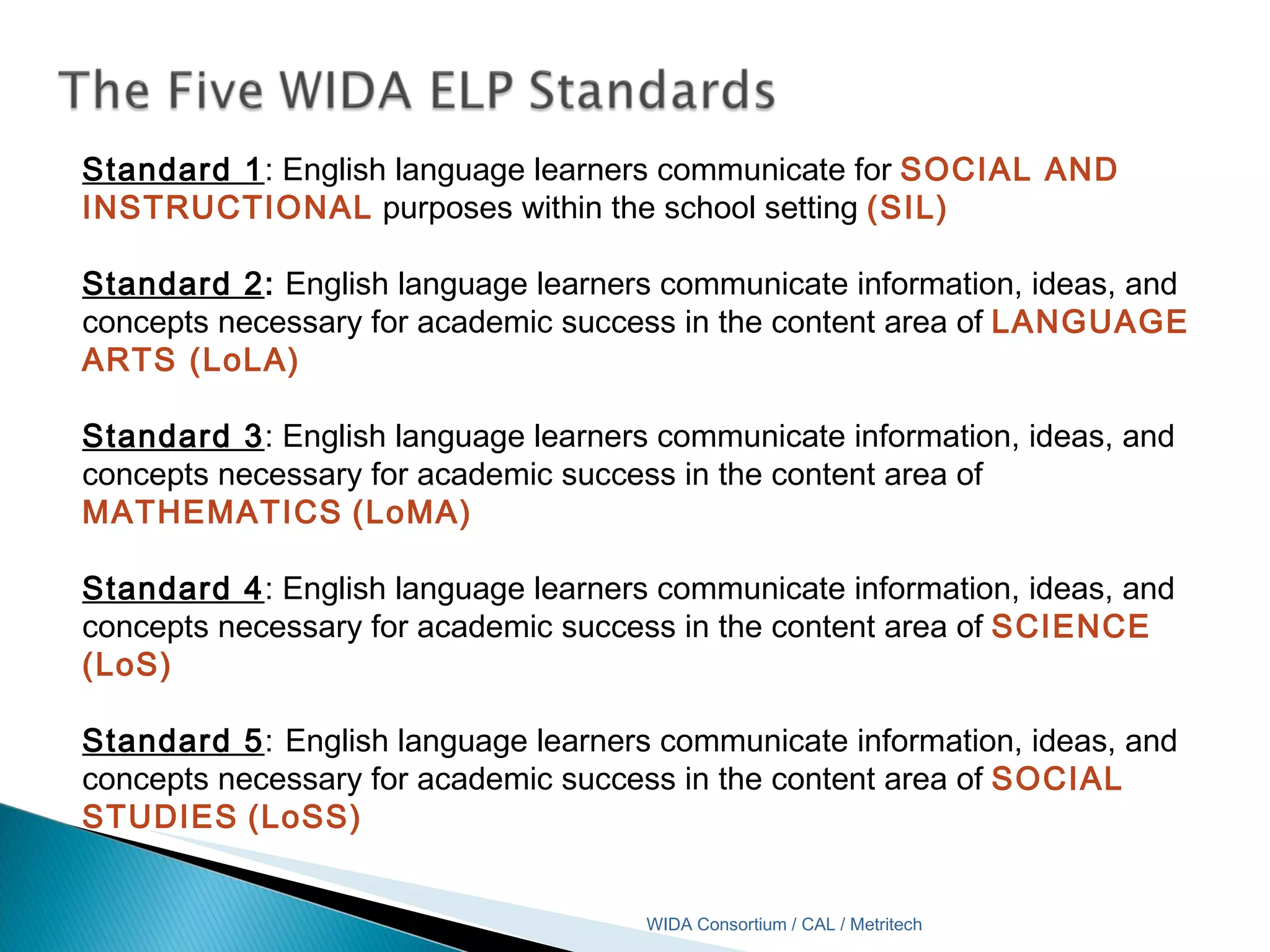
WIDA Consortium / CAL / Metritech Standard 1 :   English language learners communicate for  SOCIAL AND INSTRUCTIONAL  purposes within the school setting  (SIL) Standard 2 :  English language learners communicate information, ideas, and concepts necessary for academic success in the content area of  LANGUAGE ARTS (LoLA) Standard 3 :   English language learners communicate information, ideas, and concepts necessary for academic success in the content area of  MATHEMATICS   (LoMA) Standard 4 :   English language learners communicate information, ideas, and concepts necessary for academic success in the content area of  SCIENCE   (LoS) Standard 5 :   English language learners communicate information, ideas, and concepts necessary for academic success in the content area of  SOCIAL STUDIES   (LoSS)
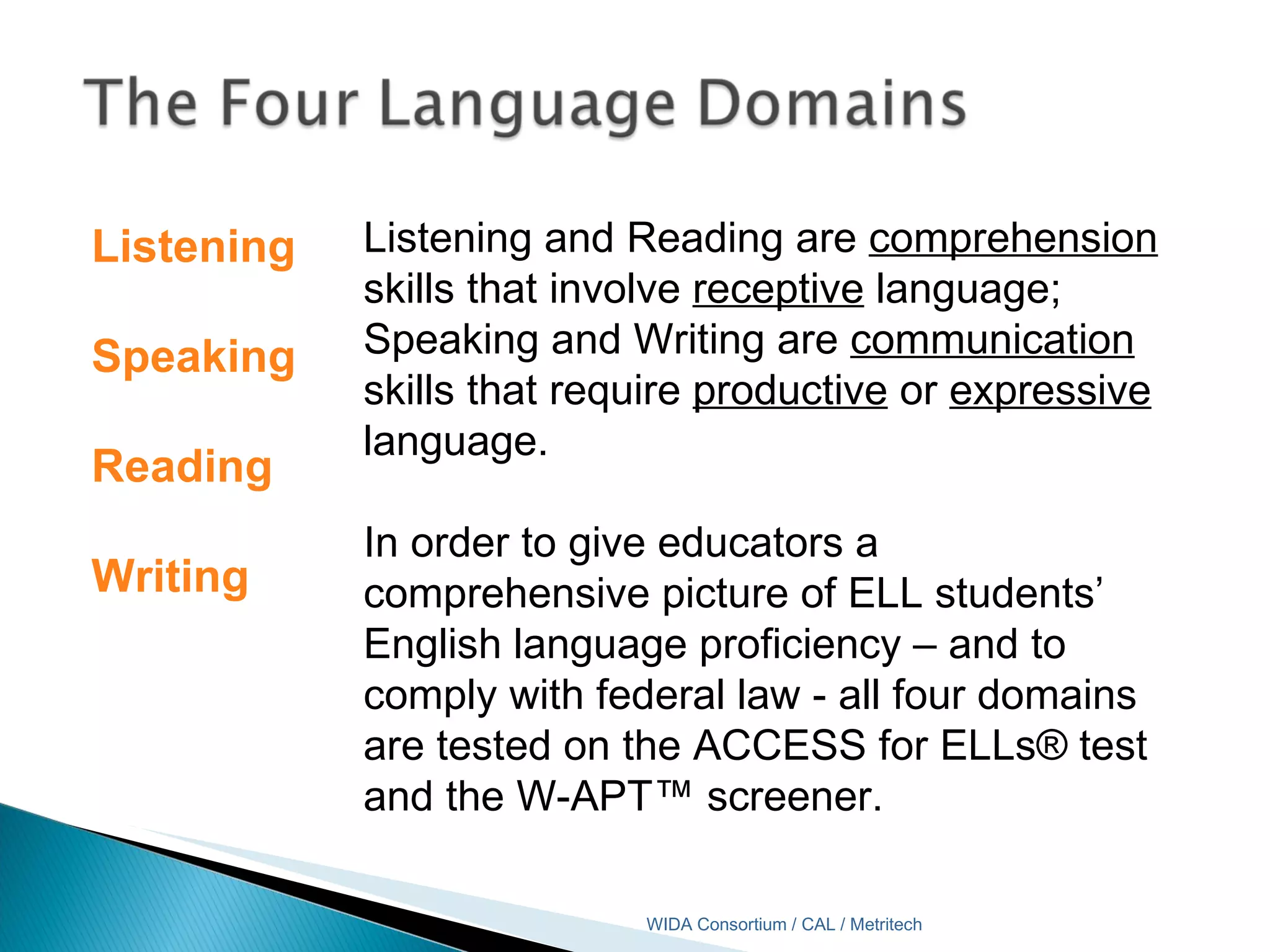
WIDA Consortium / CAL / Metritech Listening  Speaking   Reading    Writing Listening and Reading are  comprehension  skills that involve  receptive  language; Speaking and Writing are  communication  skills that require  productive  or  expressive  language. In order to give educators a comprehensive picture of ELL students’ English language proficiency – and to comply with federal law - all four domains are tested on the ACCESS for ELLs ® test and the W-APT™ screener.
The 2007 WIDA ELP Standards are clustered: PreK − K Grades 1 − 2 Grades 3 − 5 Grades 6 − 8 Grades 9 − 12 WIDA Consortium / CAL / Metritech
WIDA Consortium / CAL / Metritech 6 ENTERING BEGINNING DEVELOPING EXPANDING 1 2 3 4 5 BRIDGING REACHING
Linguistic Complexity :  The amount and quality of speech or writing for a given situation Vocabulary Usage :  The specificity of words or phrases for a given context Language Control :  The comprehensibility of the communication based on the amount and type of errors WIDA Consortium / CAL / Metritech ENTERING BEGINNING DEVELOPING EXPANDING BRIDGING 5 4 3 2 1 6 REACHING
Adapted from Gottlied, M., Cranley, M. E., & Oliver, A. R. (2007). English Language Proficiency Standards and Resource Guide. Prekindergarten through Grade 12. WIDA Consortium. WIDA Consortium / CAL / Metritech

WIDA ELP Standards

  • 1.
    The WIDA ELPStandards are designed for the many audiences in the field of education who are impacted by ELLs. These audiences include: ELLs and their family members; teachers; principals; program, district and regional administrators; test developers; teacher educators; and other stakeholders in the educational lives of ELLs. By developing the ELP standards, the WIDA Consortium has responded to demands to link language learning with state academic content standards and to address educators’ needs in three different areas: 1) Pedagogy, 2) Assessment, and 3) Educational policy.
  • 2.
    WIDA ELP standards focus on academic language ; academic content standards focus on academic content . Language proficiency involves the language associated with the content areas. Content knowledge reflects the declarative (what) and procedural knowledge (how) associated with the content . WIDA Consortium / CAL / Metritech
  • 3.
    To facilitate ELLstudents’ English proficiency attainment, access to content knowledge, and ultimately, their academic success To provide a curriculum/assessment resource anchored in academic content standards WIDA Consortium / CAL / Metritech
  • 4.
    To establish a common yardstick to define and measure how ELLs acquire language across the domains of listening, speaking, reading, and writing To comply with federal law (No Child Left Behind Act of 2001) requiring ELP standards and ELP standards-based assessments WIDA Consortium / CAL / Metritech
  • 5.
    There are fiveWIDA English Language Proficiency (ELP) Standards, which appear in two frameworks: Summative and Formative. The two frameworks can be used for planning curriculum, instruction and assessment of English language learners (ELLs). The common elements of the two frameworks are the 1) ELP standards, 2) language domains, 3) grade level clusters, and 4) language proficiency levels. WIDA Consortium / CAL / Metritech
  • 6.
    WIDA Consortium /CAL / Metritech Frameworks for Formative & Summative Assessment (2) English Language Proficiency Standards (5) Language Domains (4) Grade Level Clusters (5) Language Proficiency Levels (5) MPIs are the lowest level of expression of the standards Model Performance Indicators
  • 7.
    Summative Is amenableto large-scale testing under standardized conditions Includes visual and graphic supports Contains model performance indicators that are observable and measurable Formative Corresponds to everyday classroom practice Includes visual, graphic, and interactive supports Contains model performance indicators that include strategies, technology, and long-term projects WIDA Consortium / CAL / Metritech
  • 8.
    WIDA Consortium /CAL / Metritech Standard 1 : English language learners communicate for SOCIAL AND INSTRUCTIONAL purposes within the school setting (SIL) Standard 2 : English language learners communicate information, ideas, and concepts necessary for academic success in the content area of LANGUAGE ARTS (LoLA) Standard 3 : English language learners communicate information, ideas, and concepts necessary for academic success in the content area of MATHEMATICS (LoMA) Standard 4 : English language learners communicate information, ideas, and concepts necessary for academic success in the content area of SCIENCE (LoS) Standard 5 : English language learners communicate information, ideas, and concepts necessary for academic success in the content area of SOCIAL STUDIES (LoSS)
  • 9.
    WIDA Consortium /CAL / Metritech Listening Speaking   Reading   Writing Listening and Reading are comprehension skills that involve receptive language; Speaking and Writing are communication skills that require productive or expressive language. In order to give educators a comprehensive picture of ELL students’ English language proficiency – and to comply with federal law - all four domains are tested on the ACCESS for ELLs ® test and the W-APT™ screener.
  • 10.
    The 2007 WIDAELP Standards are clustered: PreK − K Grades 1 − 2 Grades 3 − 5 Grades 6 − 8 Grades 9 − 12 WIDA Consortium / CAL / Metritech
  • 11.
    WIDA Consortium /CAL / Metritech 6 ENTERING BEGINNING DEVELOPING EXPANDING 1 2 3 4 5 BRIDGING REACHING
  • 12.
    Linguistic Complexity : The amount and quality of speech or writing for a given situation Vocabulary Usage : The specificity of words or phrases for a given context Language Control : The comprehensibility of the communication based on the amount and type of errors WIDA Consortium / CAL / Metritech ENTERING BEGINNING DEVELOPING EXPANDING BRIDGING 5 4 3 2 1 6 REACHING
  • 13.
    Adapted from Gottlied,M., Cranley, M. E., & Oliver, A. R. (2007). English Language Proficiency Standards and Resource Guide. Prekindergarten through Grade 12. WIDA Consortium. WIDA Consortium / CAL / Metritech

Editor's Notes

  • #11 The clustering of grade levels reflects the fact that language proficiency increases over a time period that does not necessarily correspond with grade level. That is, a sixth grade ELL who has been in U.S. schools for three years will likely be at a higher level of English language proficiency than a ninth grader who has just recently arrived in the U.S.
  • #13 The criteria used to determine the performance definitions for each proficiency level are based on Linguistic Complexity, Vocabulary Usage and Language Control. At the two lower proficiency levels, it is assumed that ELLs would need extralinguistic support via graphic and visual aids in order to carry out language functions. This requirement also motivates the use of graphics for test items at these levels. These three criteria are the basis for the test items on the W-APT and ACCESS.