The Learning Process
   and the Brain
      Erica Schmidt
       Dr. Virginia Bullock
         EDUC - 6651C-1
        January 19, 2013
“Brain research can facilitate a shift in focus
         from teaching to learning”
               (Laureate Education Inc., 2008)
               (Laureate Education Inc., 2008)
Perspective of Learners
 from the Past and the
        Present
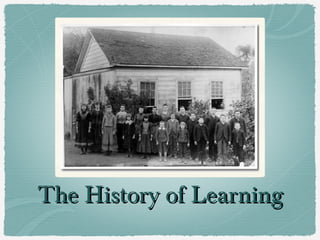
The History of Learning
Overview

Before the Industrial Revolution,
students learned by watching and
listening to people they knew-
Apprenticeship programs became
popular
Industrial Revolution brought a shift in learning
theories

  People followed rituals that had proven effective
  for some students

  Education focused on “reading, writing, arithmetic”
  with little to no application.
Throughout the 20th Century many Theorist
and theories began to emerge and take shape
Behaviorism

B.F. Skinner-1953
teacher or instructor rewards or punished
students for behavior
“The idea is that certain stimuli will produce
certain results” (Beers, 2006, p.8)
How does Behaviorism relate to the brain?
“[Behaviorism] discounts the activities of the brain. It
does not explain how behavior changes and new
learning occurs in the absence of reward and
punishment” (Beers, 2006, p.9)
Social Cognition

Lev Vygotsky- 1978
A student’s learning depends on his surroundings
and his culture.
“Focusing on the child without understanding her
culture provides only limited information to assist the
child’s intellectual growth” (Beers, 2006, p.9)
Developmental Stages and
  Cognitive Structures
Jean Piaget-1970
A child’s cognitive structures depend on the stages
of a child’s development.
some experiences reinforce cognitive behavior, while
some change it
Social Learning Theory

Albert Bandura- 1977
Learning occurs through observation.
Four conditions must be present for social learning to
occur: attention, retention, motor reproduction,
motivation.
Current Learning Theories
Overview


There has been a shift in focus from how best a
student can learn, to how much a student can learn
Students can learn in a variety of ways
Most learners can be classified into one of the
following learning styles

Perceivers

  concrete- learn from acting or doing

  abstract- learn from observing
Processors

 active- uses information as soon as they get it

 reflective-spend time thinking over the information
Visual learners-learn best when presented with
visual representations

Auditory learners- learn best when information is
presented orally

Kinesthetic learners-learn best by using their own
hands
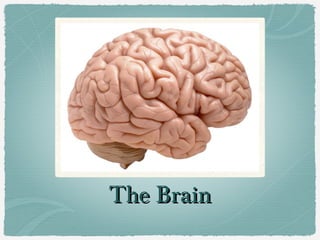
The Brain
Basic Anatomy
The brain is made of four major lobes
    1. Occipital lobe- responsible for vision
    2. Temporal lobe- responsible for hearing
    3. Frontal lobe- responsible for higher
       thinking and language development and
       communication
    4. Motor Cortex- controls movement
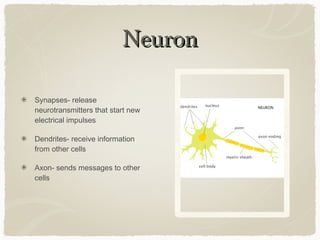
Neuron

Synapses- release
neurotransmitters that start new
electrical impulses

Dendrites- receive information
from other cells

Axon- sends messages to other
cells
Brain Based Research
      Findings
Learning- making connections between thousands of
neurons

Memory- the ability to reactivate a prior make
connection

The job of the teacher is to find a way to cement that
connection.
Recent research in brain function has
made 4 major findings in the connection
between the brain and learning. These
are as follows:
experience (neuroplasticity)


      The human brain is “plastic” and can be
      changed based on what you do with it.
      What impact does this finding have on the
      teachers role in the classroom?
        “Teachers don’t just teach kids, they
        literally shape their brains” (LEI, 2008)
        The entire classroom atmosphere
        impacts learning
#2 The brain seeks meaningful patterns

 If information is not meaningful to a person, they
 will not remember-the brain was made to forget.
 What impact does this finding have on the
 teachers role in the classroom?
        The more methods we use, the better
        students will remember
        Concrete experience is always the best
        teaching method.
#3 Emotion is a catalyst for learning
“Two small but powerful structures deep within
in each hemisphere called the amygdala
regulate our emotional responses. These
emotional responses have the ability to either
impede or enhance learning” (Wolfe, 2013)
What impact does this finding have on the
teachers role in the classroom?
  When motivating and captivating a student
  through emotion, find a level that is
  appropriate but not so high that learning shuts
  down
#4 There are two types of memory
1. Procedural
       Unconscious process; routine
       Rote rehearsal
       “Drill and Kill”
1. Declarative
       Episodic; semantic
       What you can declare
How can these implications impact the
          classroom teacher?

 Orchestrated immersion: Learning environments are
created that immerse students in a learning
experience. (Wilson, 2009)
  example- When a kindergarten class is studying
  countries around the world, the teacher may
  transform the classroom using decorations, toys,
  music, etc. to immerse students in the new culture.
Relaxed alertness: An effort is made to
eliminate fear, while maintaining a highly
challenging environment (Wilson, 2009)

  Example- Teacher plays soft classical music
  during a test; Classroom walls are painted
  light blue; calming scents are used in the
  classroom

  “Children are stretched to maximize their
  cognitive potentials in teaching environments
  that are supportive, comfortable, and non-
  threatening.” (Wilson, 2009)
Active processing: Information is intentionally
connected to prior learning. (Wilson, 2009)

  Example- Kindergarten teacher teaches skip
  counting (counting by 2s, 5s, 10s). Third grade
  teacher pulls from that prior knowledge as she is
  teaching multiplication.
Our job is not to help
kids do well on tests or in
   school. Our job is to
 prepare kids do well in
        life. (LEI, 2008)
Resources
Beers, B. (2006). Learning-driven schools: A practical guide for teachers and principals. Alexandria, VA: Association for
Supervision of Curriculum and Development.


Laureate Education, Inc. (Executive Producer). (2008). The relationship between teaching and learning. Teacher
Leadership in the Classroom. Baltimore, MD: Alexander, P.


Wilson, Leslie O. (2009). Overview of Brain Based Education .ED 790 - Brain Based Education. Retrieved from
http://www4.uwsp.edu/education/lwilson/brain/bboverview.htm


Wolfe, Patricia. (2013). Brain Research and Education: Fact of Fad? Pat Wolfe, Mind Matters Inc. Retrieved from
http://patwolfe.com/2011/09/brain-research-and-education-fad-or-foundation/


Images:


     Schoolhouse-Photo-lo-res.jpg retrieved from http://www.schoolhousevineyard.com


     learn_mark_brennan_cc-by-nc-sa2_flickr_heycoach-1197947341.jpg                   retrieved from www.infed.org


     human-brain.jpg retrieved from www.wisegeek.org

App2 schmidte(final)

  • 1.
    The Learning Process and the Brain Erica Schmidt Dr. Virginia Bullock EDUC - 6651C-1 January 19, 2013
  • 2.
    “Brain research canfacilitate a shift in focus from teaching to learning” (Laureate Education Inc., 2008) (Laureate Education Inc., 2008)
  • 3.
    Perspective of Learners from the Past and the Present
  • 4.
  • 5.
    Overview Before the IndustrialRevolution, students learned by watching and listening to people they knew- Apprenticeship programs became popular
  • 6.
    Industrial Revolution broughta shift in learning theories People followed rituals that had proven effective for some students Education focused on “reading, writing, arithmetic” with little to no application.
  • 7.
    Throughout the 20thCentury many Theorist and theories began to emerge and take shape
  • 8.
    Behaviorism B.F. Skinner-1953 teacher orinstructor rewards or punished students for behavior “The idea is that certain stimuli will produce certain results” (Beers, 2006, p.8)
  • 9.
    How does Behaviorismrelate to the brain? “[Behaviorism] discounts the activities of the brain. It does not explain how behavior changes and new learning occurs in the absence of reward and punishment” (Beers, 2006, p.9)
  • 10.
    Social Cognition Lev Vygotsky-1978 A student’s learning depends on his surroundings and his culture. “Focusing on the child without understanding her culture provides only limited information to assist the child’s intellectual growth” (Beers, 2006, p.9)
  • 11.
    Developmental Stages and Cognitive Structures Jean Piaget-1970 A child’s cognitive structures depend on the stages of a child’s development. some experiences reinforce cognitive behavior, while some change it
  • 12.
    Social Learning Theory AlbertBandura- 1977 Learning occurs through observation. Four conditions must be present for social learning to occur: attention, retention, motor reproduction, motivation.
  • 13.
  • 14.
    Overview There has beena shift in focus from how best a student can learn, to how much a student can learn Students can learn in a variety of ways
  • 15.
    Most learners canbe classified into one of the following learning styles Perceivers concrete- learn from acting or doing abstract- learn from observing
  • 16.
    Processors active- usesinformation as soon as they get it reflective-spend time thinking over the information
  • 17.
    Visual learners-learn bestwhen presented with visual representations Auditory learners- learn best when information is presented orally Kinesthetic learners-learn best by using their own hands
  • 18.
  • 19.
    Basic Anatomy The brainis made of four major lobes 1. Occipital lobe- responsible for vision 2. Temporal lobe- responsible for hearing 3. Frontal lobe- responsible for higher thinking and language development and communication 4. Motor Cortex- controls movement
  • 20.
    Neuron Synapses- release neurotransmitters thatstart new electrical impulses Dendrites- receive information from other cells Axon- sends messages to other cells
  • 21.
  • 22.
    Learning- making connectionsbetween thousands of neurons Memory- the ability to reactivate a prior make connection The job of the teacher is to find a way to cement that connection.
  • 23.
    Recent research inbrain function has made 4 major findings in the connection between the brain and learning. These are as follows:
  • 24.
    experience (neuroplasticity) The human brain is “plastic” and can be changed based on what you do with it. What impact does this finding have on the teachers role in the classroom? “Teachers don’t just teach kids, they literally shape their brains” (LEI, 2008) The entire classroom atmosphere impacts learning
  • 25.
    #2 The brainseeks meaningful patterns If information is not meaningful to a person, they will not remember-the brain was made to forget. What impact does this finding have on the teachers role in the classroom? The more methods we use, the better students will remember Concrete experience is always the best teaching method.
  • 26.
    #3 Emotion isa catalyst for learning “Two small but powerful structures deep within in each hemisphere called the amygdala regulate our emotional responses. These emotional responses have the ability to either impede or enhance learning” (Wolfe, 2013) What impact does this finding have on the teachers role in the classroom? When motivating and captivating a student through emotion, find a level that is appropriate but not so high that learning shuts down
  • 27.
    #4 There aretwo types of memory 1. Procedural Unconscious process; routine Rote rehearsal “Drill and Kill” 1. Declarative Episodic; semantic What you can declare
  • 28.
    How can theseimplications impact the classroom teacher? Orchestrated immersion: Learning environments are created that immerse students in a learning experience. (Wilson, 2009) example- When a kindergarten class is studying countries around the world, the teacher may transform the classroom using decorations, toys, music, etc. to immerse students in the new culture.
  • 29.
    Relaxed alertness: Aneffort is made to eliminate fear, while maintaining a highly challenging environment (Wilson, 2009) Example- Teacher plays soft classical music during a test; Classroom walls are painted light blue; calming scents are used in the classroom “Children are stretched to maximize their cognitive potentials in teaching environments that are supportive, comfortable, and non- threatening.” (Wilson, 2009)
  • 30.
    Active processing: Informationis intentionally connected to prior learning. (Wilson, 2009) Example- Kindergarten teacher teaches skip counting (counting by 2s, 5s, 10s). Third grade teacher pulls from that prior knowledge as she is teaching multiplication.
  • 31.
    Our job isnot to help kids do well on tests or in school. Our job is to prepare kids do well in life. (LEI, 2008)
  • 32.
    Resources Beers, B. (2006).Learning-driven schools: A practical guide for teachers and principals. Alexandria, VA: Association for Supervision of Curriculum and Development. Laureate Education, Inc. (Executive Producer). (2008). The relationship between teaching and learning. Teacher Leadership in the Classroom. Baltimore, MD: Alexander, P. Wilson, Leslie O. (2009). Overview of Brain Based Education .ED 790 - Brain Based Education. Retrieved from http://www4.uwsp.edu/education/lwilson/brain/bboverview.htm Wolfe, Patricia. (2013). Brain Research and Education: Fact of Fad? Pat Wolfe, Mind Matters Inc. Retrieved from http://patwolfe.com/2011/09/brain-research-and-education-fad-or-foundation/ Images: Schoolhouse-Photo-lo-res.jpg retrieved from http://www.schoolhousevineyard.com learn_mark_brennan_cc-by-nc-sa2_flickr_heycoach-1197947341.jpg retrieved from www.infed.org human-brain.jpg retrieved from www.wisegeek.org