Fourth report


                                                                        Second Administrative Reforms Commission


                                                                                                 “You must be the change
             Second Administrative Reforms Commission
                       Government of India
                                                                                               you wish to see in the world.   ”
                                                                                                        Mahatma Gandhi
2nd Floor, Vigyan Bhawan Annexe, Maulana Azad Road, New Delhi 110 011
         e-mail : arcommission@nic.in website : http://arc.gov.in                                     January 2007
GOVERNMENT OF INDIA


SECOND ADMINISTRATIVE REFORMS COMMISSION


              FOURTH REPORT


      ETHICS IN GOVERNANCE


               JANUARY 2007
PREFACE


                                                           “As human beings, our greatness lies not so much in being able to remake the world - that is the myth of the
                                                           atomic age - as in being able to remake ourselves”

                                                                                                                                                   Mahatma Gandhi

                                                                The Mahatma’s vision of a strong and prosperous India - Purna Swaraj - can never become a
                                                           reality if we do not address the issue of the stranglehold of corruption on our polity, economy and
                                                           society in general.

                                                                Governance is admittedly the weak link in our quest for prosperity and equity. Elimination of
                                                           corruption is not only a moral imperative but an economic necessity for a nation aspiring to catch
                                                           up with the rest of the world. Improved governance in the form of non-expropriation, contract
                                                           enforcement, and decrease in bureaucratic delays and corruption can raise the GDP growth rate
                                                           significantly. The six perceived governance quality measures, each an aggregate of a number of
                                                           sub-measures, are: voice and accountability; absence of political instability and violence; government
                                                           effectiveness; reasonableness of the regulatory burden; the rule of law; and the absence of graft. Of
                                                           these, the last two are the most directly significant in the context of ethical governance. ‘Rule of
                                                           law’ measures whether crime is properly punished or not; enforceability of contracts; extent of
                                                           black market; enforceable rights of property; extent of tax evasion; judiciary’s independence; ability
                                                           of business and people to challenge government action in courts etc. ‘Absence of graft’ measures
                                                           relative absence of corruption among government, political and bureaucratic officials; of bribes
                                                           related to securing of permits and licences; of corruption in the judiciary; of corruption that scares
                                                           off foreign investors.

                                                                There is a perception that the public services have remained largely exempt from the imposition
                                                           of penalties due to the complicated procedures that have arisen out of the Constitutional guarantee
                                                           against arbitrary and vindictive action. Those Constitutional safeguards have in practice shielded the
                                                           guilty against the swift and certain punishment for abuse of public office for private gain.
                                                           A major corollary has been the erosion of accountability. The huge body of jurisprudential precedents
                                                           has crowded out the real intent of Article 311, and created a heap of roadblocks in reducing corruption.
                                                           Such a provision is not available in any of the democratic countries including the UK. While the
                                                           honest have to be protected, the dishonest seem to corner the full benefit of Article 311. Hence there
                                                           is need for a comprehensive examination of the entire corpus of administrative jurisprudence to
“You must be the change you wish to see in the world.”     rationalise and simplify the procedures. One of the indicators of lax enforcement is delay in sanctioning
                                          Mahatma Gandhi   prosecution of a delinquent by the competent authority. Reference may be made to the Annual
                                                           Report of the Central Vigilance Commission for the year 2004. Out of 153 cases for sanction, 21
                                                           cases were pending for more than 3 years, 26 cases between 2-3 years, 25 between 1-2 years. The
                                                           departmental enquiries are soft-pedalled either out of patronage or misplaced compassion.
Integrity is much more than financial honesty. Public office should be treated as a           Napoleon who said, ‘Law should be so succinct that it can be carried in the pocket of the
trust. There are two facets to corruption: (1) the institution which is highly corrupt;            coat and it should be so simple that it can be understood by a peasant’.
(2) individuals who are highly corrupt. There is a need to work on public profiteering and
also value to be attributed to the services rendered by officers. Interlocking accountability           While it may not always be possible to establish the criminal offence of
is a process by which evaluation could be done easily and accountability ensured.                  misappropriation in a court of law, the Government servant can still be removed from
                                                                                                   service for causing serious monetary loss to the State. An engineer may have deliberately
    Building trust and confidence requires an environment where there is a premium on              permitted the construction of a defective irrigation dam or building. It may not be possible
transparency, openness, boldness, fairness and justice. We should encourage this.                  to get him convicted in court on charges of corruption but he could be removed from
                                                                                                   service on grounds of incompetence. A tax official may have connived to allow the leakage
     Clearly, the absence of rules is not the problem. One cannot mandate honesty. The             of revenue for return favours in the future. Such conduct may not provide the ingredients
rule of law can only defeat the perverse mind. However, it cannot defeat the perversity of         of a criminal offence but can lead to his exit from service.
the heart. In to the words of Aleksandr Solzhenitsyn: “The line separating good and evil
passes not between states nor between classes… but through the middle of every human                    The standard for probity in public life should be not only conviction in a criminal
heart”. We have no destinies other than those we forge ourselves. He who administers               court but propriety as determined by suitable independent institutions specifically
government by means of his virtues may be compared to the Pole star which keeps its                constituted for the purpose. We have broadly copied the British model of governance.
place and all other stars turn towards it. When the ruler himself is right, the people             Ministers in Tony Blair’s government have had to resign on such minor improprieties as
naturally follow him in his right course. If governance is by men who are derelict, the            a telephone call to the concerned person to fast track the issue of a visa for the ‘nanny’ of
governed will suffer. We have to keep in mind Plato’s injunction:                                  the Minister’s child or the grant of British citizenship to a generous contributor to a
                                                                                                   cause supported by the Government. Such principles were upheld and pronounced by
     “The punishment suffered by the wise who refuse to take part in government,                   Jawaharlal Nehru in the Mudgal case in which the said Lok Sabha Member was expelled
is to suffer under the government of bad men”                                                      by Parliament on 24th September, 1951 even when the Member volunteered to resign.
                                                                                                   The Mudgal case is often cited as the noblest example of the early leadership’s efforts at
     Good governance must be founded on moral virtues ensuring stability and harmony.
                                                                                                   setting high standards of conduct in parliamentary life.
Confucius described righteousness as the foundation of good governance and peace. The
art of good governance simply lies in making things right and putting them in their                      We need to reverse the slide by prescribing stringent standards of probity in public
right place. Confucius’s prescription for good governance is ideally suited for a country          life instead of providing shelter to public figures of suspect integrity behind the argument
like India where many of our present day players in governance do not adhere to any                of their not having been convicted in a court. The standard should be one of not only the
principle and ensure only their own interests.                                                     conduct of Caesar’s wife but of Caesar himself.
    Confucius emphasizes the righteousness for life and character building. This is in                   The solution to the problem of corruption has to be more systemic than any other
conformity with Dharma or righteousness as taught by all religions in the world and                issue of governance. Merely shrinking the economic role of the state by resorting to
preached in Buddhism very predominantly in its fourth noble truth. He also emphasizes              deregulation, liberalization and privatization is not necessarily the solution to addressing
that man himself must become righteous and then only there shall be righteousness in               the problem. Prevalent institutional arrangements have to be reviewed and changes made
the world. This is comparable with what Gandhiji said, “Be the change you wish to see in           where those vested with power are made accountable, their functioning made more
the world”.                                                                                        transparent and subjected to social audit with a view to minimize discretionary decisions.
                                                                                                   All procedures, laws and regulations that breed corruption and come in the way of efficient
     So, in the ultimate analysis, it is a question of ethics. Ethics is a set of standards that
                                                                                                   delivery system will have to be eliminated. The perverse system of incentives in public
helps guide conduct. One of the problems is that the present codes of conduct are not
                                                                                                   life, which makes corruption a high return low risk activity, need to be addressed. In this
direct and to the point. They are full of vague sermons that rarely indicate prohibitions
                                                                                                   context, public example has to be made out of people convicted on corruption charge
directly. For formulating a code of ethics, it would be useful to keep in mind the advice of
and the legal process in such cases has to be expedited. This hopefully, will also address                                         Government of India
the growing permissiveness in the society, in the more recent times, to the phenomenon                             Ministry of Personnel, Public Grievances & Pensions
of corruption. In addition, with changes in economic policy regime, regulatory bodies                          Department of Administrative Reforms and Public Grievances
that guide and monitor the functioning of the relevant economic agents, lay down the
rules of conduct in the interest of consumers and devise such practices that help in efficient                                             Resolution
functioning of the system, will have to be established in many sectors of the economy                                                                      New Delhi, the 31st August, 2005
that are now being opened up. At the same time, social monitoring through empowered
autonomous and credible structures will have to be established even for the highest of           No. K-11022/9/2004-RC. — The President is pleased to set up a Commission of Inquiry to
the public offices. Right to information has to be the starting point for some of these          be called the second Administrative Reforms Commission (ARC) to prepare a detailed
changes.                                                                                         blueprint for revamping the public administration system.

    The focus should be on e-governance and systemic change. An honest system of                 2.   The Commission will consist of the following :
governance will displace dishonest persons. As Gladstone so aptly said, “The purpose of
                                                                                                        (i)        Shri Veerappa Moily - Chairperson
a government is to make it easy for people to do good and difficult to do evil”.
                                                                                                        (ii)       Shri V Ramachandran - Member
                                                                                                                         .
     We always find alibi for our lapses by quoting trespass from other democratic
                                                                                                        (iii)      Dr. A.P Mukherjee - Member
                                                                                                                          .
institutions, by resorting to a blame game. The executive/civil services blame interference
by the political executive or legislatures and vice versa; legislators blame the judiciary              (iv)       Dr. A.H. Kalro - Member
and vice versa – the main problem lies in each one leaving space for others to occupy. If               (v)        Dr. Jayaprakash Narayan - Member
any of the democratic institutions leaves space, the mafia or extra-constitutional authority
                                                                                                        (vi)       Smt. Vineeta Rai - Member-Secretary
occupies that space. Realization of its own authority and discharging its sphere of
responsibility, developing accountability and responsiveness are the real solutions to the       3.   The Commission will suggest measures to achieve a proactive, responsive, accountable,
conflicting situations of eroding democratic polity. I conclude by quoting an ancient                 sustainable and efficient administration for the country at all levels of the government.
subhashit (good message) -                                                                            The Commission will, inter alia, consider the following :
     “Rivers do not drink their waters themselves, nor do trees eat their fruit, nor                  (i)       Organisational structure of the Government of India
do the clouds eat the grains raised by them. The wealth of the noble is used solely                   (ii)      Ethics in governance
for the benefit of others.”
                                                                                                      (iii)     Refurbishing of Personnel Administration
                                                                                                      (iv)      Strengthening of Financial Management Systems
                                                                                                      (v)       Steps to ensure effective administration at the State level
                                                                                                      (vi)      Steps to ensure effective District Administration
New Delhi                                                              (M. Veerappa Moily)
January 16, 2007                                                                 Chairman             (vii) Local Self-Government/Panchayati Raj Institutions
                                                                                                      (viii) Social Capital, Trust and Participative public service delivery
                                                                                                      (ix)      Citizen-centric administration
                                                                                                      (x)       Promoting e-governance
(xi)   Issues of Federal Polity                                                                                           Government of India
                                                                                                               Ministry of Personnel, Public Grievances & Pensions
     (xii) Crisis Management
                                                                                                                     Department of Administrative Reforms
     (xiii) Public Order                                                                                                      and Public Grievances
                                                                                                                                       ……
Some of the issues to be examined under each head are given in the Terms of Reference
attached as a Schedule to this Resolution.
                                                                                                                                  RESOLUTION
4.   The Commission may exclude from its purview the detailed examination of                                                                           New Delhi, the 24th July, 2006
     administration of Defence, Railways, External Affairs, Security and Intelligence, as
     also subjects such as Centre-State relations, judicial reforms etc. which are already      No. K-11022/9/2004-RC (Vol.II) – The President is pleased to extend the term of the
     being examined by other bodies. The Commission will, however, be free to take the          second Administrative Reforms Commission by one year upto 31.8.2007 for submission of
     problems of these sectors into account in recommending re-organisation of the              its Reports to the Government.
     machinery of the Government or of any of its service agencies.                                                                                                        Sd/-
                                                                                                                                                                      (Rahul Sarin)
5.   The Commission will give due consideration to the need for consultation with the                                             Additional Secretary to the Government of India
     State Governments.

6.   The Commission will devise its own procedures (including for consultations with the
     State Government as may be considered appropriate by the Commission), and may
     appoint committees, consultants/advisers to assist it. The Commission may take into
     account the existing material and reports available on the subject and consider building
     upon the same rather than attempting to address all the issues ab initio.

7.   The Ministries and Departments of the Government of India will furnish such
     information and documents and provide other assistance as may be required by the
     Commission. The Government of India trusts that the State Governments and all
     others concerned will extend their fullest cooperation and assistance to the Commission.

8.   The Commission will furnish its report(s) to the Ministry of Personnel, Public
     Grievances & Pensions, Government of India, within one year of its constitution.


                                                                            Sd/-
                                                                      (P Suvrathan)
                                                                        .I.
                                          Additional Secretary to Government of India
CONTENTS                                                          5.3 Role of Media                                      132
                                                                                                   5.4 Social Audit                                       133
Chapter 1   Introduction                                                           1
                                                                                                   5.5 Building Societal Consensus                        134
Chapter 2   Ethical Framework                                                      8
                                                                                       Chapter 6   Systemic Reforms                                       135
            2.1 Ethics in Politics                                                 8
                                                                                                   6.1 Importance of Systemic Reforms                     135
            2.2 Ethics in Public Life                                             18
                                                                                                   6.2 Promoting Competition                              137
            2.3 International Approach                                            21
                                                                                                   6.3 Simplifying Transactions                           138
            2.4 Ethical Framework for Ministers                                   22
                                                                                                   6.4 Using Information Technology                       140
            2.5 Ethical Framework for Legislators                                 28
                                                                                                   6.5 Promoting Transparency                             142
            2.6 Office of Profit                                                  37
                                                                                                   6.6 Integrity Pacts                                    143
            2.7 Code of Ethics for Civil Servants                                 41
                                                                                                   6.7 Reducing Discretion                                144
            2.8 Code of Ethics for Regulators                                     45
                                                                                                   6.8 Supervision                                        145
            2.9 Ethical Framework for the Judiciary                               47
                                                                                                   6.9 Ensuring Accessibility and Responsiveness          147
Chapter 3   Legal Framework for Fighting Corruption                               58               6.10 Monitoring Complaints                             149
            3.1 Evolution of the Anti-Corruption Laws in India                    58               6.11 Reforming the Civil Services                      149
            3.2 The Prevention of Corruption Act, 1988                            60               6.12 Risk Management for Preventive Vigilance          150
            3.3 Corruption Involving the Private Sector                           71               6.13 Audit                                             152
            3.4 Confiscation of Properties Illegally Acquired by Corrupt Means    74               6.14 Proactive Vigilance on Corruption                 153
            3.5 Prohibition of ‘Benami’ Transactions                              77               6.15 Intelligence Gathering                            155
            3.6 Protection to Whistleblowers                                      77               6.16 Vigilance Network                                 156
            3.7 Serious Economic Offences                                         79               6.17 Sector Specific Recommendations                   157
            3.8 Prior Concurrence for Registration of Case: Section 6A of         86
                                                                                       Chapter 7   Protecting the Honest Civil Servant                    158
                 the Delhi Special Police Establishment Act, 1946
            3.9 Immunity Enjoyed by Legislators                                   87   Chapter 8   International Cooperation                              163
            3.10 Constitutional Protection to Civil Servants - Article 311        89   Chapter 9   Relationship between the Political Executive and       166
            3.11 Disciplinary Proceedings                                         98               the Permanent Civil Service
            3.12 Statutory Reporting Obligations                                 105               Conclusion                                             172
Chapter 4   Institutional Framework                                              106               Summary of Recommendations                             173
            4.1 Existing Institutions/Agencies                                   106   LIST OF BOXES
            4.2 Evaluation of the Anti-Corruption Machinery in India             108
                                                                                       Box No.     Title
            4.3 The Lok Pal                                                      111
                                                                                       2.1         Ethics in the UK                                         9
            4.4 The Lokayukta                                                    116
                                                                                       2.2         Corruption and Hypocrisy                                17
            4.5 Ombudsman at the Local Level                                     120
                                                                                       2.3         Need for Ethical Code                                   18
            4.6 Strengthening Investigation and Prosecution                      122
                                                                                       2.4         An Extract from the Code of Good Governance of Spain    20
Chapter 5   Social Infrastructure                                                125   2.5         The Constitution of Belize and Code of Conduct          22
            5.1 Citizens’ Initiatives                                            125   2.6         Edmund Burke on Parliament                              38
            5.2 False Claims Act                                                 130   2.7         Evolution of Morality                                   44
2.8           The Seven Social Sins                                                44   LIST OF ABBREVIATIONS
2.9           The Credibility of a Profession                                      45   Abbreviation Full Form
2.10          Independence of Judiciary                                            49   ADB          Asian Development Bank
3.1           The Whistleblowers                                                   78   AIR          All India Reporter
3.2           The Need for a Serious Frauds Office                                 79   APS          Australian Public Service
5.1           The ICAC of Hong Kong                                               125   CAT          Central Administrative Tribunal
5.2           Recoveries under the US False Claims Act                            130   CBI          Central Bureau of Investigation
5.3           Purpose of the False Claims Act                                     130   CJI          Chief Justice of India
LIST OF TABLES                                                                          CLB          Company Law Board
                                                                                        CrPC         Code of Criminal Procedure
Table No.     Title
                                                                                        CVC          Central Vigilance Commission
2.1           International Comparison of Appointments to the Supreme Court        51
                                                                                        CVO          Chief Vigilance Officer
4.1           International Comparison of Persons Convicted for Bribery           110
                                                                                        DDA          Delhi Development Authority
LIST OF FIGURES                                                                         DySP         Deputy Superintendent of Police
Figure No.    Title                                                                     IPC          Indian Penal Code
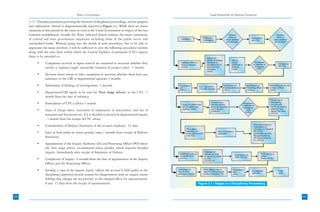
3.1           Stages in a Disciplinary Proceeding                                 101   MCOCA        Maharashtra Control of Organised Crime Act
4.1           Analysis of Cases Prosecuted by CBI under the                       108   MLA          Member of Legislative Assembly
              Prevention of Corruption Act
                                                                                        MLALADS      Member of Legislative Assembly Local Area Development Scheme
4.2           Analysis of Cases Investigated and Prosecuted by                    108
              State Anti Corruption Wings                                               MP           Member of Parliament
4.3           Comparison of Conviction Rates of CBI and State Anti Corruption     109   MPLADS       Member of Parliament Local Area Development Scheme
              Organisations                                                             NCRWC        National Commission to Review the Working of the Constitution
4.4           Pendency of Cases in Courts                                         109   NGO          Non Governmental Organisation
LIST OF ANNEXURES                                                                       NJC          National Judicial Council
Annexure I    (1) Speech of Mr. Justice Y K Sabharwal, Chief Justice of India,    195   OECD         Organization for Economic Cooperation and Development
                    at the National Colloquium                                          PIL          Public Interest Litigation
              (2) Speech of Shri M Veerappa Moily, at the National Colloquium     214   PSU          Public Sector Undertaking
              (3) Speech of Minister of State for Personnel, Public Grievances    227
                    & Pensions and Parliamentary Affairs, Shri Suresh Pachouri,         RBI          Reserve Bank of India
                    at the National Colloquium                                          SEBI         Securities and Exchange Board of India
              (4) List of Participants at the National Colloquium                 231   SFIO         Serious Frauds Investigation Office
              (5) Recommendations of the National Colloquium                      233   SFO          Serious Frauds Office
              (6) Questionnaire                                                   240   SPE          Special Police Establishment
Annexure VII Systemic Reforms in a Few Sectors                                    244   UK           United Kingdom
Annexure VIII Honesty in Finland                                                  261   UN           United Nations
                                                                                        UPSC         Union Public Service Commission
                                                                                        US           United States
INTRODUCTION                                                                                  1
1.1 Ethics is a set of standards that society places on itself and which helps guide behaviour,
choices and actions. The Commission is painfully aware that standards do not, by themselves,
ensure ethical behaviour; that requires a robust culture of integrity. The crux of ethical
behaviour does not lie in bold words and expressions enshrined as standards, but in their
adoption in action, in sanctions against their violations, in putting in place competent
disciplinary bodies to investigate allegations of violations and impose sanctions quickly and
in promoting a culture of integrity.

1.2 Corruption is an important manifestation of the failure of ethics. The word ‘corrupt’ is
derived from the Latin word ‘corruptus’, meaning ‘to break or destroy’. The word ‘ethics’ is
from the original Greek term ethikos, meaning ‘arising from habit’. It is unfortunate that
corruption has, for many, become a matter of habit, ranging from grand corruption involving
persons in high places to retail corruption touching the everyday life of common people.

1.3 Anti-corruption interventions so far made are seen to be ineffectual and there is widespread
public cynicism about them. The interventions are seen as mere posturing without any real
intention to bring the corrupt to book. They are also seen as handy weapons for partisan,
political use to harass opponents. Corruption is so deeply entrenched in the system that
most people regard corruption as inevitable and any effort to fight it as futile. This cynicism
is spreading so fast that it bodes ill for our democratic system itself.

1.4 There are two, somewhat contrary, approaches in dealing with corruption and abuse of
office. The first is overemphasis on values and character. Many people lament the decline in
values and the consequent rise in corruption. The implicit assumption is that until values
are restored, nothing much can be done to improve the conduct of human beings. The
second approach is based on the belief that most human beings are fundamentally decent
and socially conscious, but there is always a small proportion of people, which cannot reconcile
individual goals with the good of society. Such deviant people tend to pursue personal gain
at the cost of public good and the purpose of organized government is to punish such
deviant behaviour. If good behaviour is consistently rewarded and bad behaviour consistently
punished, the bulk of the people follow the straight and narrow path. However, if good

                                                                                                   1
Ethics in Governance                                                                                      Introduction


    behaviour is not only not rewarded, but is actually fraught with difficulties and bad behaviour      1.8 The experience of the past six decades in our country and elsewhere offers us valuable
    is not only not punished, but is often extravagantly rewarded, then the bulk of the people           lessons in curbing corruption. It is generally recognized that monopoly and discretion increase
    tend to stray from the honourable path.                                                              the propensity to corruption while competition and transparency reduce corruption. This
                                                                                                         has been dramatically witnessed in India in the wake of economic liberalization. As
    1.5 In the real world, both values and institutions matter. Values are needed to serve as            competition came in and choice expanded, corruption plummeted. Telephones, steel, cement,
    guiding stars, and they exist in abundance in our society. A sense of right and wrong is             sugar and even two-wheelers are among the many sectors, which have seen enhanced supply
    intrinsic to our culture and civilization. But values need to be sustained by institutions to be     and choice, reducing or even eliminating corruption. Similarly, wherever technology and
    durable and to serve as an example to others. Values without institutional support will soon         transparency have been introduced, corruption has been significantly contained.
    be weakened and dissipated. Institutions provide the container, which gives shape and content        Computerization and access to information have made many services from railway reservation
    to values. This is the basis of all statecraft and laws and institutions. While incentives and       to issuing of driving licenses increasingly free from corruption.
    institutions matter for all people, they are critical in dealing with the army of public servants
    – elected or appointed – endowed with authority to make decisions and impact on human                1.9 A factor which increases corruption is over-centralization. The more remotely power is
    lives and exercising the power to determine allocation of resources. Public office and control       exercised from the people, the greater is the distance between authority and accountability.
    over public purse offer enormous temptation and opportunity to promote private gain at               The large number of functionaries between the citizen and final decision-makers makes
    public cost. Therefore, creation of institutions and designing of incentives are of utmost           accountability diffused and the temptation to abuse authority strong. For a large democracy,
    importance in promoting ethical conduct of public servants.                                          India probably has the smallest number of final decision makers. Local Government is not
                                                                                                         allowed to take root and power has been concentrated both horizontally and vertically in a
    1.6 In our society, corruption and abuse of office has been aggravated by three factors. First,      few hands. The net results are weakened citizenry and mounting corruption.
    there is a colonial legacy of unchallenged authority and propensity to exercise power arbitrarily.
    In a society which worships power, it is easy for public officials to deviate from ethical           1.10 It is well recognized that every democracy requires the empowerment of citizens in
    conduct. Second, there is enormous asymmetry of power in our society. Nearly 90% of our              order to hold those in authority to account. Right to Information, effective citizens’ charters,
    people are in the unorganized sector. Quite a number of them lead a precarious existence,            opportunity and incentives to promote proactive approach of citizens, stake-holders’
    depending on subsistence wages with no job security. And nearly 70% of the organized                 involvement in delivery of public services, public consultation in decision making and social
    workers with job security and regular monthly wage are employed by the state directly or             auditing are some of the instruments of accountability that dramatically curbed corruption
    through public sector undertakings. Almost all these employees are ‘educated’ in a largely           and promoted integrity and quality of decision making.
    illiterate and semiliterate society and economically even the lowliest of public servants are
    better off than most people in the country. What is more, their employment in government             1.11 In the ultimate analysis, the state and a system of laws exist in order to enforce
    comes with all the trappings of power. Such asymmetry of power reduces societal pressure             compliance and promote desirable behaviour. Therefore, enforcement of rule of law and
    to conform to ethical behaviour and makes it easy to indulge in corruption.                          deterrent punishment against corruption are critical to build an ethically sound society. A
                                                                                                         detailed analysis of our anti-corruption mechanisms and the causes of their failure is necessary
    1.7 Third, as a conscious choice, the Indian state in the early decades after Independence           in order to strengthen the forces of law and deter the corrupt public servants.
    chose a set of policies whose unintended consequence was to put the citizen at the mercy of
    the State. Over regulation, severe restrictions on economic activity, excessive state control,       1.12 Perhaps the most important determinant of the integrity of a society or the prevalence
    near-monopoly of the government in many sectors and an economy of scarcity all created               of corruption is the quality of politics. If politics attracts and rewards men and women of
    conditions conducive to unbridled corruption. In addition, many state subsidies and                  integrity, competence and passion for public good, then the society is safe and integrity is
    beneficiary-oriented programmes in a situation of asymmetry of power converted the public            maintained. But if honesty is incompatible with survival in politics, and if public life attracts
    servant into patron and master and reduced most citizens into mendicants. This at once               undesirable and corrupt elements seeking private gain, then abuse of authority and corruption
    enhanced opportunities to indulge in corruption and reduced the citizens’ capacity to resist         become the norm. In such a political culture and climate, desirable initiatives will not yield
    extortionary demands.
2                                                                                                                                                                                                            3
Ethics in Governance                                                                                      Introduction


    adequate dividends. Competition and decentralization certainly reduce corruption in certain        1.15 In India, some recent anti-corruption initiatives are steps in the right direction. The
    sectors. But if the demand for corruption is fuelled by inexhaustible appetite for illegitimate    Supreme Court has ruled that candidates contesting elections should file details regarding
    funds in politics, then other avenues of corruption will be forcibly opened up. As a result,       their wealth, educational qualifications and criminal antecedents along with their nomination
    even as corruption declines in certain areas, it shifts to other, sometimes more dangerous,        papers. The Right to Information Act, which has recently been enacted, is a potent weapon
    areas in which competition cannot be introduced and the state exercises a natural monopoly.        to fight corruption. The introduction of information communication technologies, e-
    What is needed with liberalisation is corresponding political and governance reform to alter       governance initiatives and automation of corruption prone processes in administration have
    the incentives in politics and public office and to promote integrity and ethical conduct.         succeeded in reducing corruption.

    1.13 All forms of corruption are reprehensible and we need to promote a culture of zero-           1.16 Much more remains to be done however, and beyond the realm of existing regulation.
    tolerance of corruption. But some forms of corruption are much more pernicious than others         The escalating levels of corruption in various segments of our economy resulting in large-
    and deserve closer attention. In a vast majority of cases of bribery, the citizen is a victim of   scale generation of black money, serious economic offences and fraud, and money laundering
    extortion and is compelled to pay a bribe in order to get a service to which he is entitled.       leading even to the funding of terrorist activities against the State, have created a grave
    Experience has taught most citizens that there is a vicious cycle of corruption operating and      situation which needs to be dealt with severely. Benami properties of corrupt public servants
    they often end up losing much more by resisting corruption. Delays, harassment, lost               need to be forfeited, as also the assets illegally acquired from corrupt practices. Whistleblower
    opportunity, loss of precious time and wages, uncertainty and, at times, potential danger of       legislation has to be put in place to protect informants against retribution. Also, we have to
    loss of life or limb could result from resistance to corruption and non-compliance with            suitably strengthen the institutional framework for investigating corrupt practices and
    demands. In such cases, the citizen is an unwilling victim of coercive corruption. But there       awarding exemplary punishment to the corrupt thereby raising the risk associated with
    are several cases of collusion between the bribe giver and corrupt public servant. In such         corrupt behaviour.
    cases of collusive corruption, both parties benefit at immense cost to society. Awarding of
    contracts for public works and procurement of goods and services, recruitment of employees,        1.17 Ethics in governance, however, has a much wider import than what happens in the
    evasion of taxes, substandard projects, collusive violation of regulations, adulteration of        different arms of the government. An across-the-board effort is needed to fight deviations
    foods and drugs, obstruction of justice and concealing or doctoring evidence in investigation      from ethical norms. Such an effort needs to include corporate ethics and ethics in business;
    are all examples of such dangerous forms of corruption. As the economy is freed from state         in fact, there should be a paradigm shift from the pejorative ‘business ethics’ to ‘ethics in
    controls, extortionary corruption declines and collusive corruption tends to increase.             business’. There is need for ethics in every profession, voluntary organization and civil society
    We need to fashion strong and effective instruments to deal with this growing menace of            structure as these entities are now vitally involved in the process of governance. Finally,
    collusive corruption, which is undermining the very foundations of our democracy and               there should be ethics in citizen behaviour because such behaviour impinges directly on
    endangering society.                                                                               ethics in government and administration.

    1.14 Corruption is a global phenomenon and has also become a serious global concern. The           1.18 One of the terms of reference of the Administrative Reforms Commission pertains to
    United Nations Convention against Corruption was adopted by the UN General Assembly                ethics in governance, specifically the following aspects:-
    in October 2003, providing an international instrument against corruption. The ADB-
                                                                                                             A.     Vigilance and Corruption:
    OECD Anti-Corruption Action Plan, which has been signed by the Government of India, is
    a broad understanding to further the cause of inter-regional cooperation in the matter of                       •      Strengthening pro-active vigilance to eliminate corruption and harassment to honest
    prevention of corruption. The World Bank has also declared war against corruption by                                   civil servants including, wherever necessary, limiting executive discretion.
    refusing to fund projects whose implementation is tainted by corrupt practices. At the annual
    meeting of the International Monetary Fund and the World Bank Group in Singapore in                             •      Addressing systemic deficiencies manifesting in reluctance to punish the corrupt.
    2006, a joint statement was issued with major multilateral financial institutions agreeing on
    a framework for preventing and combating fraud and corruption in the activities and                             •      (a) Identify procedures, rules and regulations and factors which lead to corruption
    operations of their institutions.                                                                                      (b) suggest measures to combat corruption and arbitrary decision making, and
4                                                                                                                                                                                                                5
Ethics in Governance                                                                                   Introduction


                                (c) suggest a framework for their periodical review in consultation with the      immense help to the Commission in articulating its recommendations. The Commission
                                stakeholders.                                                                     expresses its appreciation for the valuable contribution made by Shri S K Das, Consultant
                                                                                                                  ARC in drafting this Report.
              B.       Relationship between Political Executive and Permanent Civil Service:
                                                                                                                  1.22 As issues relating to ethics in governance cut across other terms of reference, an attempt
                       •        To suggest improvements in the institutional arrangements for smooth, efficient   has been made to deal with the major issues in this Report. The Report is organized in nine
                                and harmonious relationship between civil service and the political executive.    chapters dealing with different aspects of ethics in governance. The recommendations range
                                                                                                                  from those seeking to change the legal framework to those which could be implemented
              C.       Code of Conduct for different organs of Government :
                                                                                                                  through executive directions within a short time frame. Recommendations which could be
                       •        Political Executive, Civil Services, etc.                                         implemented immediately through executive direction are identified by prefixing a symbol
                                                                                                                  ‘*’, in the Summary of Recommendations.
        1.19 While the Commission has examined items A & C in considerable detail in this Report;
        item B will be dealt with comprehensively in the ARC’s report on Civil Services Reforms.
        The Commission has examined the relevant laws, codes and manuals, which deal with ethics
        and corruption. It has critically studied the institutional framework that investigates
        corruption and brings the corrupt to book. It has also looked at the corruption prone processes
        in government and examined the systems, rules and procedures, which govern these processes.

        1.20 In order to ascertain views from different stakeholders on ethics in governance, the
        Commission organized a National Colloquium at the National Judicial Academy, Bhopal in
        September 2006. The Commission expresses its deep gratitude to the then Chief Justice of
        India, Mr. Justice Shri Y K Sabharwal who delivered the valedictory address1, the Minister
        of State for Personnel Public Grievances & Pensions and Parliamentary Affairs Shri Suresh
        Pachouri who presided over the inaugural function2 and to Mr. Justice S.B.Sinha for his
        valuable suggestions. The Chairman ARC addressed the gathering3. The list of participants
        at the National Colloquium organized by the Commission on the subject is at Annexure
        I(4). The recommendations of the Colloquium are at Annexure I(5). The questionnaire
        circulated to various stakeholders is at Annexure I(6).

        1.21 The Commission would like to place on record its gratitude to the Lokayuktas,
        representatives of CVC and the state anti corruption wings, members of ‘citizens’ initiatives’,
        officers of Government of India and the State Governments for their active participation in
        the workshop. The Commission also expresses its deep gratitude to Mr Justice J S Verma,
        former CJI; Mr Justice M N Venkatachaliah, former CJI; Mr. Justice Santosh Hegde,
        former Judge, Supreme Court; Mr Justice N Venkatchala, former Lokayukta Karnataka;
        Shri Fali Nariman; Shri B V Acharya, former Advocate General, Karnataka;
        Shri K R Chamayya, former Law Secretary, Government of Karnataka; Shri K Eshwara
        Bhat, former Law Secretary, Government of Karnataka and Admiral R H Tahiliani (Retd),
        Chairman, Transparency International, India, whose views and suggestions have been of
6                                                                                                                                                                                                                   7
    1
      Speech at Annexure I(1)
    2
      Speech at Annexure I(3)
    3
      Speech at Annexure I(2)
Ethical Framework


                                                                                                           issues in detail in its ensuing Report on Public Order. It only needs to be stated here that,
                                                                                                           in this situation, the criminal who, paradoxically, is able to ensure speedy justice in some


    2    ETHICAL FRAMEWORK
                                                                                                           cases becomes almost a “welcome character”! On his part, the criminal builds on this
                                                                                                           “acceptance” and is emboldened to enter politics and elections. The opportunity to influence
                                                                                                           crime investigations and to convert the policemen
                                                                                                           from being potential adversaries to allies is the                Box 2.1: Ethics in the UK
                                                                                                                                                                   Over 80 years ago, the first Labour Government
                                                                                                           irresistible magnet drawing criminals to politics. led by Ramsey Mc Donald in the U.K, fell in
                                                                                                           The elected position and the substantial protection the wake of the “Campbell Affair”, because the
        2.1 Ethics and Politics                                                                            that it can give, helps him either to further and governmentcase of sedition for purelycriminal
                                                                                                                                                                   charges in a
                                                                                                                                                                                  decided to withdraw
                                                                                                                                                                                                          political
                                                                                                           expand his activities or to evolve into an entity with reasons. The resultant outcry led to the
        2.1.1 Introduction                                                                                 higher political ambitions. As for political parties, government being voted out of office and to
        2.1.1.1 Any discussion on an ethical framework for governance in a democracy must                                                                          fresh polls. Since then, British Ministers and
                                                                                                           such individuals bring into the electoral process, high officials, it is said, have rarely dared to
        necessarily begin with ethical values in politics. Politics and those engaged in it, play a        their ability to secure votes through use of money interfere in crime investigation or prosecution.
        vital role in the legislative and executive wings of the State whose acts of commission and        and muscle power.
        omission in working the Constitution and the rule of law become the point of intervention
        for the judiciary. While it is unrealistic and simplistic to expect perfection in politics in an   2.1.1.3 This is a short-term win-win situation for all, except for public good and good
        ethically imperfect environment, there is no denying the fact that the standards set in            governance. All this has not taken place everywhere, but to the extent that it did, it led to
        politics profoundly influence those in other aspects of governance. Those in politics have         a situation when the Election Commission formally stated that one in six legislators in India
        a clear and onerous responsibility. India was fortunate that high standards of ethical conduct     faced grave criminal charges. It was then time for urgent corrective steps.
        were an integral part of the freedom struggle. Unfortunately, ethical capital started getting
        eroded after the transfer of power. Excesses in elections (in campaign-funding, use of             2.1.1.4 Large, illegal and illegitimate expenditure in elections is another root cause of
        illegitimate money, quantum of expenditure, imperfect electoral rolls, impersonation,              corruption. While there are formal limits to expenditure and some steps have been put in
        booth-capturing, violence, inducements and intimidation), floor-crossing after elections           place in an attempt to check them, in reality, actual expenditure is alleged to be far higher.
        to get into power and abuse of power in public office became major afflictions of the              Abnormal election expenditure has to be recouped in multiples to sustain the electoral
        political process over the years. Political parties, governments and more importantly the          cycle! This results in ‘unavoidable’ and ubiquitous corruption altering the nature of political
        Election Commission and the Supreme Court have taken several steps since the late 1980s            and administrative power and undermining trust and democracy. Cleansing elections is the
        in an attempt to eliminate the gross abuses that had virtually become the norm.Yet, there          most important route to improve ethical standards in politics, to curb corruption and rectify
        is a widespread view that much more needs to be done to cleanse our political system.              maladministration.
        Along with that of corruption, this issue was raised in every public hearing held by the
                                                                                                           2.1.2 Recent Improvements
        Commission during its visits to the States.
                                                                                                           Despite all the flaws in the functioning of a democracy, it has a measure of self correction. As
        2.1.1.2 Criminalization of politics – ‘participation of criminals in the electoral process’ - is   stated earlier, significant efforts have been made over the last two decades to bring about
        the soft underbelly of our political system. The growth of crime and violence in society (to       meaningful electoral reforms. Some have observed that the past decade has seen more political
        the point of encouraging ‘mafia’ in many sectors) is due to a number of root causes.               reform in India than in any other large democracy after the Second World War. Briefly
        Flagrant violation of laws, poor quality of services and the corruption in them, protection        stated, the more important of the reforms relate to :
        for law-breakers on political, group, class, communal or caste grounds, partisan interference
                                                                                                           2.1.2.1 Improvement in Accuracy of Electoral Rolls:
        in investigation of crimes and poor prosecution of cases, inordinate delays lasting over
                                                                                                                  •     The Election Commission has made efforts to make voter registration more accessible
        years and high costs in the judicial process, mass withdrawal of cases, indiscriminate grant
                                                                                                                        to voters and involve, to some extent, post offices in revision of Electoral rolls.
        of parole, etc., are the more important of the causes. The Commission will deal with these
8                                                                                                                                                                                                                     9
Ethics in Governance                                                                                 Ethical Framework


           •      Printed electoral rolls/CDs have been made available for sale.                               •      It has been decided that the death of an independent candidate would not lead
                                                                                                                      to the cancellation of an election.
           •      Computerisation of entire electoral rolls of over 620 million voters has been
                  initiated.                                                                             2.1.2.6 Reduction in size of Council of Ministers:
                                                                                                         A recommendation to restrict the size to 10% was made by the first Administrative Reforms
           •      The provision of photo-identity cards for all voters has been started.                 Commission more than three decades ago. The Constitution (Ninety-first Amendment)
                                                                                                         Act, 2003 restricts the size of the Council of Ministers to 15% of the strength of the Lower
     Studies by civil society organizations like Loksatta have shown considerable improvement
                                                                                                         House in Parliament/State legislature. The amendment is a step towards moderating the
     and reduction in errors in electoral rolls between 1999 and 2004.
                                                                                                         number of Ministers to some extent.
     2.1.2.2 Disclosure of Antecedents of Candidates:
                                                                                                         2.1.3 Issues in Political Reforms
            •      The Supreme Court has directed that a candidate should declare any conviction
                                                                                                         Despite the measures taken, improvements are marginal in the case of important problems
                   by a court or whether a criminal case is pending against him;
                                                                                                         of criminalization, the use of money in elections, subtle forms of inducements and patronage
           •      The direction to file a declaration of assets and liabilities of the candidate and     in the form of chairmanships and memberships of public units and the anomaly of legislators
                  family members would enable a check at the time of the next elections.                 functioning as disguised executives. More effective steps have, therefore, been suggested
                                                                                                         and the Commission would like to deal with the more important of them.
     2.1.2.3 Disqualification of Persons Convicted of Criminal Offence:
            •     The Supreme Court ruled in 2005 that Section 8(4) of the Representation of             2.1.3.1 Reform of Political Funding
                  the People Act was unconstitutional as it violated equality before law. Now all        2.1.3.1.1 In India, one of the sources of funding of political parties has been through private
                  convicted candidates stand at an election on the same footing, whether at the          donations. Internationally, there are three broad patterns of state funding for political parties
                  time of conviction they were incumbent legislators or not. (However, during            and elections. One is the minimalist pattern, wherein elections alone are partially subsidized
                  the term of a legislator, exemption from disqualification does apply if an appeal      usually through specific grants or state rendered services. Candidates are accountable to the
                  is pending and sentence is stayed).                                                    public authority for observance, reporting and disclosure of expenditure for the limited
                                                                                                         election period. The UK, Ireland, Australia, New Zealand and Canada are examples of this
     2.1.2.4 Enforcement of the Code of Conduct:                                                         pattern, while the US is a variant of the same with election funding being largely private
            •      Using its over-all powers to “superintend, control and direct” elections under        and subjected to strict reporting and disclosure requirements as well as limits on contributions.
                   Article 324 of the Constitution, the Election Commission has made the Code of
                   Conduct for elections binding in all respects, issuing directions regarding timings   2.1.3.1.2 The second, maximalist pattern of state funding involves public funding not merely
                   of campaigns, prohibition of festoons/cutouts, insistence on daily expenditure        for elections but even for other party activities, as in Sweden and Germany. This pattern
                   statements, appointment of a large number of observers, ordering of re-poll in        involves less detailed regulation of contributions and expenditure because parties are
                   specific polling booths and other such steps.                                         dependent largely on state support and local requirements enforce internal democracy as
                                                                                                         well as general transparency.
     2.1.2.5 Free and fearless polling:
            •      Policing arrangements have been improved, including greater use of Central            In between, there are a variety of mixed patterns involving partial reimbursement for public
                   Forces and holding of elections for more than one day in a State, and measures        funding of elections on a matching grant basis such as in France, Netherlands and South Korea.
                   like sealing of borders, etc.
                                                                                                         2.1.3.1.3 While the Representation of the People Act puts limits on election expenditure,
           •      Electronic voting machines have been introduced throughout the country (in             company donations to political party were banned in 1969 but later allowed by an amendment
                  the parliamentary elections of 2004).                                                  of the Companies Act in 1985. The Dinesh Goswami Committee on Electoral Reforms set
                                                                                                         up in 1990 recommended limited support, in kind, for vehicle fuel, hire charges of
10                                                                                                                                                                                                           11
Ethics in Governance                                                                                Ethical Framework


     microphones, copies of electoral rolls etc., while simultaneously recommending a ban on           2.1.3.1.6 Recommendation:
     company donations. Subsequent developments include parties being forced to file returns
     under the Income Tax and Wealth Tax Acts after the Supreme Court issued notices and also                a.     A system for partial state funding should be introduced in order to reduce
     passed an order on 4th April, 1996 which effectively repealed Explanation-I of Section 77 of                   the scope of illegitimate and unnecessary funding of expenditure for
     the Representation of People Act and clubbed expenditure by third party(s) as well as by the                   elections.
     political party under the expenditure ceiling limits prescribed under the Representation of
                                                                                                       2.1.3.2 Tightening of anti-defection law:
     People Act. Another Committee, the Indrajit Gupta Committee on State Funding of Elections
                                                                                                       2.1.3.2.1 Defection has long been a malaise of Indian political life. It represents manipulation
     has recommended partial state-funding mainly in kind. However, the National Committee
                                                                                                       of the political system for furthering private interests, and has been a potent source of
     for Review of the Constitution has expressed the view that until better regulatory mechanism
                                                                                                       political corruption. The anti-defection legislation that was enacted to combat this malaise,
     for political parties can be developed in India, state funding of elections should be deferred.
                                                                                                       fixed a certain number above which defection in a group was permitted. Legalising such
     2.1.3.1.4 Parliament in 2003 unanimously enacted the Election and Other Related Laws              selective defection however, provided opportunities for transgressing political ethics and
     (Amendment) Act in a spirit of bipartisanship. It took into consideration the recommendations     opportunism. There is no doubt that permitting defection in any form or context is a travesty
     of the Committee on Electoral Reforms (Dinesh Goswami Committee, 1990) , the Committee            of ethics in politics.
     on State Funding of Elections (Indrajit Gupta Committee, 1999) and the Law Commission
                                                                                                       2.1.3.2.2 The 91st Amendment to the Constitution was enacted in 2003 to tighten the anti-
     of India (170th report on Reform of Electoral Laws, 1999). The Law Minister while
                                                                                                       defection provisions of the Tenth Schedule, enacted earlier in 1985. This Amendment makes
     introducing the Bill, acknowledged the recommendations of the Dr. Manmohan Singh
                                                                                                       it mandatory for all those switching political sides – whether singly or in groups – to resign
     Committee on Party Finances set up by the Indian National Congress in 2002. The Act
                                                                                                       their legislative membership. They now have to seek re-election if they defect and cannot
     contains the following key provisions:
                                                                                                       continue in office by engineering a ‘split’ of one-third of members, or in the guise of a
           •      Full tax exemption to individuals and corporates on all contributions to political   ‘continuing split of a party’. The Amendment also bars legislators from holding, post-
                  parties.                                                                             defection, any office of profit. This Amendment has thus made defections virtually impossible
                                                                                                       and is an important step forward in cleansing politics. Besides, the Election Commission has
           •      Effective repeal of Explanation I under Section 77 of the Representation of the      also insisted on internal elections in political parties to elect their leaders.
                  People Act. Expenditure by third parties and political parties now comes under
                  ceiling limits, and only travel expenditure of leaders of parties is exempt.         2.1.3.2.3 The Election Commission has recommended that the question of disqualification
                                                                                                       of members on the ground of defection should also be decided by the President/Governor
           •      Disclosure of party finances and contributions over Rs.20,000.                       on the advice of the Election Commission. Such an amendment to the law seems to be
                                                                                                       unfortunately necessary in the light of the long delays seen in some recent cases of obvious
           •      Indirect public funding to candidates of recognized parties – including free         defection.
                  supply of electoral rolls (already in vogue), and such items as the Election
                  Commission decides in consultation with the union government.                        2.1.3.2.4 Recommendation:

           •      Equitable sharing of time by the recognized political parties on the cable                 a.     The issue of disqualification of members on grounds of defection should
                  television network and other electronic media (public and private).                               be decided by the President/Governor on the advice of the Election
                                                                                                                    Commission.
     2.1.3.1.5 In order to eradicate the major source of political corruption, there is a compelling
     case for state funding of elections. As recommended by the Indrajit Gupta Committee on            2.1.3.3 Disqualification:
     State Funding of Elections, the funding should be partial state funding mainly in kind for        2.1.3.3.1 It has been suggested that disclosure of past acquittals in respect of serious criminal
     certain essential items.                                                                          charges will be of value. Given the delays in our criminal justice system, disqualification
12                                                                                                                                                                                                         13
Ethics in Governance                                                                 Ethical Framework


     after conviction for crimes may be an insufficient safeguard. There are candidates who face        Related Laws (Amendment) Act, 2003, following various reports mentioned in para 2.1.3.1.4
     grave criminal charges like murder, abduction, rape and dacoity, unrelated to political            will be strengthened if this is made mandatory under law. The Election Commission has
     agitations. In such cases, there is need for a fair reconciliation between the candidate’s right   reiterated this proposal. This needs to be acted upon early. The audited accounts should be
     to contest and the community’s right to good representation. As a rule, it would be rash and       available for information of the public.
     undemocratic to disqualify candidates on some pretext or other. An election outcome must
     be decided by the people who are the ultimate sovereigns through the ballot box. Election          2.1.4 Coalition and Ethics
     by indiscriminate disqualification is a stratagem sometimes resorted to by dictatorships to        2.1.4.1 The phenomenon of coalition politics has emerged as a strong presence in the Indian
     pervert the democratic process. However, in the present situation, on balance, in cases of         polity in recent years. The very diversity and complexity of the Indian electorate and our
     persons facing grave criminal charges framed by a trial court after a preliminary enquiry,         vibrant democracy has made this a familiar aspect of our electoral process. Coalitions are
     disallowing them to represent the people in legislatures until they are cleared of charges         often necessitated by the fact that, in a multiparty system such as ours, it is difficult today
     seems to be a fair and prudent course. But care must by exercised to ensure that no political      for a single party to obtain a clear majority in the Legislature. In order to make coalitions
     vendetta is involved in such charges and people facing charges related to political agitations     legitimate, it is necessary for the coalition partners to reach an understanding based on
     are not victimized. The draft Ordinance of July 2002 relating to disclosure of candidate           broad-based programmes to ensure that the goals of socio-economic development are met.
     details following a Supreme Court judgment provided for disqualification of candidates             Such an understanding needs to be translated into a common minimum programme and
     facing charges related to grave and heinous offences. The heinous offences listed were murder,     announced either prior to the election or before the formation of the coalition government.
     abduction, rape, dacoity, waging war against India, organised crime and narcotics offences.
                                                                                                        2.1.4.2 The ethics of coalition government is, however, seriously strained when the coalition
     It also seems reasonable to disqualify persons facing corruption charges, provided the charges
                                                                                                        partners change partnerships mid-stream and new coalitions are formed, primarily driven
     have been framed by a judge/magistrate after prima facie evidence. The Election Commission4
                                                                                                        by opportunism and craving for power in utter disregard of the common minimum
     has suggested that as a precaution against motivated cases, it may be provided that only
                                                                                                        programme agreed to for the realization of the goal of socio-economic development. The
     cases filed six months before an election would lead to such disqualification.
                                                                                                        common programme, which has been explicitly mandated by the electorate prior to the
     2.1.3.3.2 Recommendation:                                                                          election, or implicitly after the election but before the formation of the government, becomes
                                                                                                        non-existent, and the power given by the people is abused. To maintain the will of the
                a.      Section 8 of the Representation of the People Act, 1951 needs to be             people, it is necessary to lay down an ethical framework to ensure that such exercises in
                        amended to disqualify all persons facing charges related to grave and           opportunism, through redrawing of coalitions between elections, do not take place.
                        heinous offences and corruption, with the modification suggested by the
                        Election Commission.                                                            2.1.4.3 Recommendation:

     2.1.3.4 False Declarations:                                                                              a.     The Constitution should be amended to ensure that if one or more parties
     2.1.3.4.1 The Election Commission has recommended that all false declarations before the                        in a coalition with a common programme mandated by the electorate
     Returning Officer, Electoral Officer, Chief Electoral Officer or the Election Commission                        either explicitly before the elections or implicitly while forming the
     should be made an electoral offence under Section 31 of the Representation of the People                        government, realign midstream with one or more parties outside the
     Act (now restricted to statements relating to preparation/revision, inclusion/exclusion in                      coalition, then Members of that party or parties shall have to seek a fresh
     electoral rolls). The proposed amendment will act as an effective deterrent against false                       mandate from the electorate.
     statements.
                                                                                                        2.1.5 Appointment of the Chief Election Commissioner/Commissioners
     2.1.3.5 Publication of Accounts by Political Parties:                                              2.1.5.1 The present procedure of appointment of the Chief Election Commissioner and
     2.1.3.5.1 Political parties have a responsibility to maintain proper accounts of their income      other Election Commissioners, is laid down in Article 324 of the Constitution and stipulates
     and expenditure and get them audited annually. The steps taken in the Election and Other           that they are to be appointed by the President on the advice of the Prime Minister.

14                                                                                                                                                                                                        15
     4
         Source: “Proposed Electoral Reforms”. Election Commission of India, 2004. www.eci.gov.in
Ethics in Governance                                                                                 Ethical Framework


     2.1.5.2 During debates in the Constituent Assembly on the procedure for appointment,            up Special Tribunals as provided for under Article 323B of the Constitution. While doing
     there were suggestions that the person appointed as the Chief Election Commissioner should      so, it would have to be specifically ensured that the decisions of such tribunals are final with
     enjoy the confidence of all parties and therefore his appointment should be confirmed by a      appeal jurisdiction being restricted to the Supreme Court alone as already provided in the
     2/3 majority of both the Houses. Thus even at that stage, there was a view that the procedure   Constitution. Such Tribunals may have two members, one a Judge of the High Court, and
     for appointment should be a broad based one, above all partisan considerations. In recent       the other, an administrative member. In case of difference of opinion between the two, the
     times, for statutory bodies such as the National Human Rights Commission (NHRC) and             matter may be referred to the High Court.
     the Central Vigilance Commission (CVC), appointment of Chairperson and Members are
     made on the recommendations of a broad based Committee. Thus, for the appointment of            2.1.6.3 Recommendation:
     the Chief Vigilance Commissioner, the Committee consists of the Prime Minister, the Home
                                                                                                           a.     Special Election Tribunals should be constituted at the regional level under
     Minister and the Leader of the Opposition in the Lok Sabha, whereas for the NHRC, the
                                                                                                                  Article 323B of the Constitution to ensure speedy disposal of election
     Committee is chaired by the Prime Minister and has as its members, the Speaker of the Lok
                                                                                                                  petitions and disputes within a stipulated period of six months. Each
     Sabha, the Home Minister, the Leader of the Opposition in the Lok Sabha, the Leader of the
                                                                                                                  Tribunal should comprise a High Court Judge and a senior civil servant
     Opposition in the Rajya Sabha and the Deputy Chairman of the Rajya Sabha.
                                                                                                                  with at least 5 years of experience in the conduct of elections (not below
     2.1.5.3 Given the far reaching importance and critical role of the Election Commission in                    the rank of an Additional Secretary to Government of India/Principal
     the working of our democracy, it would certainly be appropriate if a similar collegium is                    Secretary of a State Government). Its mandate should be to ensure that
     constituted for selection of the Chief Election Commissioner and the Election                                all election petitions are decided within a period of six months as provided
     Commissioners.                                                                                               by law. The Tribunals should normally be set up for a term of one year
                                                                                                                  only, extendable for a period of 6 months in exceptional circumstances.
     2.1.5.4 Recommendation:
                                                                                                     2.1.7 Grounds of Disqualification for Membership
           a.    A collegium headed by the Prime Minister with the Speaker of the Lok                2.1.7.1 Article 102 of the Constitution provides for disqualification for membership of either
                 Sabha, the Leader of Opposition in the Lok Sabha, the Law Minister and              House of Parliament under certain specific circumstances, which are as follows:-
                 the Deputy Chairman of the Rajya Sabha as members should make                             (1)    A person shall be disqualified for being chosen as, and for being, a member of either House
                 recommendations for the consideration of the President for appointment                           of Parliament -
                 of the Chief Election Commissioner and the Election Commissioners.
                                                                                                                  (a)    if he holds any office of profit under the Government of India or the Government of
     2.1.6 Expediting Disposal of Election Petitions                                                                     any State, other than an office declared by Parliament by law not to disqualify its
     2.1.6.1 Election petitions in India are at present to be filed in the High Court. Under the                         holder;
     Representation of the People Act, such petitions should be disposed of within a period of                    (b)    if he is of unsound mind and stands so declared by a competent court;
     6 months. In actual practice however, such petitions remain pending for years and in the
     meanwhile, even the full term of the House expires thus rendering the election petition                      (c)    if he is an undischarged insolvent;
     infructuous. There have been suggestions from other high level committees and eminent                        (d)    if he is not a citizen of India, or has      Box 2.2: Corruption and Hypocrisy
     persons that a separate judicial set-up may be required. The National Commission to                                 voluntarily acquired the citizenship      Corruption and hypocrisy ought not to be
                                                                                                                                                                   inevitable products of democracy, as they
     Review the Working of the Constitution (NCRWC) recommended that special election                                    of a foreign State, or is under any       undoubtedly are today.
     benches should be constituted in the High Courts earmarked exclusively for the disposal of                          acknowledgement of allegiance or                                    Mahatma Gandhi
     election petitions.                                                                                                 adherence to a foreign State;

     2.1.6.2 The Commission is of the view that given the huge existing case load in the High                     (e)    if he is so disqualified by or under any law made by Parliament.
     Courts, it would be possible to ensure speedy disposal of election petitions only by setting                        Explanation - For the purpose of this clause a person shall not be deemed to hold an
16                                                                                                                                                                                                              17
Ethics in Governance                                                                                            Ethical Framework


                         office of profit under the Government of India or the Government of any State by          every holder of public office is accountable ultimately to the people. Such accountability is
                         reason only that he is a Minister either for the Union or for such State.                 enforced through a system of laws and rules, which the elected representatives of the people
                                                                                                                   enact in their legislatures. Ethics provides the basis for the creation of such laws and rules. It
           (2)    A person shall be disqualified for being a member of either House of Parliament if he is so
                                                                                                                   is the moral ideas of people that give rise to and shapes the character of laws and rules. Our
                  disqualified under the Tenth Schedule.
                                                                                                                   legal system emanates from a shared vision of what is good and just.
     2.1.7.2 It is evident from Article 102(e) that Parliament has also been authorized to pass a
     law to include any further conditions for such disqualification. So far, no such law has been                 2.2.2 The fundamental principle in a democracy is that all persons holding authority derive
     enacted. In view of recent development leading to expulsions of some Members of Parliament,                   it from the people; in other words, all public functionaries are trustees of the people. With
     it may be desirable to comprehensively spell out other circumstances under which the                          the expansion of the role of government, public functionaries exercise considerable influence
     Members of Parliament can be disqualified. This could be done by enacting such a law                          over the lives of people. The trusteeship relationship between the public and the officials
     under Article 102 (e). This would remove any ambiguity in the matter and also re-affirm                       requires that the authority entrusted to the officials be exercised in the best interest of the
     the supremacy of Parliament in all such matters.                                                              people or in ‘public interest’.

     2.1.7.3 Recommendation:                                                                                       2.2.3 The role of ethics in public life has many dimensions. At one end is the expression of
                                                                                                                   high moral values and at the other, the specifics of action for which a public functionary can
           a.     Appropriate legislation may be enacted under Article 102(e) of the                               be held legally accountable. Any framework of ethical behaviour must include the following
                  Constitution spelling out the conditions for disqualification of                                 elements:
                  membership of Parliament in an exhaustive manner. Similarly, the States
                  may also legislate under Article 198 (e).                                                              a.     Codifying ethical norms and practices.
     2.1.8 The proposals highlighted in the preceding                                                                    b.     Disclosing personal interest to avoid conflict between public interest and personal
                                                                      Box 2.3: Need for Ethical Code
     paragraphs require serious discussion amongst our                                                                          gain.
                                                                Senator Fulbright identified a problem of
     political parties. Whether these are adopted sooner        government employees who committed ethical
     or later, will depend upon them. We are among a            lapses not amounting to criminal conduct. He             c.     Creating a mechanism for enforcing the relevant codes.
                                                                asked-
     handful of democracies which sustained freedom and
     stability for six long decades among nations liberated
                                                                What should be done about men who do not                 d.     Providing norms for qualifying and disqualifying a public functionary from
                                                                directly and blatantly sell the favors of their
     after the Second World War. Democratic maturity            offices for money and so place themselves within                office.
                                                                the penalties of the law? How do we deal with
     needs time, patience, and genuine efforts to find          those who, under the guise of friendship, accept   2.2.4 A system of laws and rules, however elaborate, cannot provide for all situations. It is
     rational answers to complex problems and willingness       favors, which offend the spirit of the law but
                                                                do not violate its letter?                         no doubt desirable, and perhaps possible, to govern the conduct of those who occupy positions
     to reconcile conflicting views. All great democracies
                                                                He further elaborated-                             in the lower echelons and exercise limited or no discretion. But the higher the echelon in
     went through the tortuous process of democratic            One of the most disturbing aspects of this         public service, the greater is the ambit of discretion. And it is difficult to provide for a
     transformation. The power of ideas, high quality of        problem of moral conduct is the revelation that
                                                                among so many influential people, morality has     system of laws and rules that can comprehensively cover and regulate the exercise of discretion
     leadership, inspiration and a spirit of idealism are       become identical with legality. We are certainly   in high places.
     the necessary conditions to build a great democracy        in a tragic plight if the accepted standard by
                                                                which we measure the integrity of a man in
     free from major distortions. India has the strength        public life is that he keep within the letter of   2.2.5 One of the most comprehensive statements of what constitutes ethical standards for
     and resilience to build such a democracy and our           the law.                                           holders of public office came from the Committee on Standards in Public Life in the United
     political parties should rise to the occasion.             Source: Senate Ethics Manual 2003                  Kingdom, popularly known as the Nolan Committee, which outlined the following seven
                                                                Editions:page-6; retrieved from -
                                                                ethics.senate.gov/downloads/pdffiles/              principles of public life:
     2.2 Ethics in Public Life                                  manual.pdf
                                                                                                                         1.     Selflessness: Holders of public office should take decisions solely in terms of public interest.
     2.2.1 Ethics is grounded in the notion of responsibility and accountability. In democracy,
18                                                                                                                                                                                                                                 19
Ethics in Governance                                                                                                                 Ethical Framework


                  They should not do so in order to gain              Box 2.4: An Extract from the Code of                   citizen. It is at the interface of public action and private interest that the need arises for
                  financial or other material benefits for                 Good Governance of Spain                          establishing not just a code of ethics but a code of conduct. A code of ethics would cover
                  themselves, their family or their friends.       Nonetheless, at the present juncture, it is               broad guiding principles of good behaviour and governance while a more specific code of
                                                                   necessary for public authorities to offer citizens        conduct should, in a precise and unambiguous manner, stipulate a list of acceptable and
           2.     Integrity: Holders of public office should not   an undertaking that all the senior offices must
                                                                   satisfy not only the obligations laid down by             unacceptable behaviour and action.
                  place themselves under any financial or other    law, but, in addition, their conduct must be
                  obligation to outside individuals or             inspired and be guided by principles of ethics            2.3 International Approach
                                                                   and good conduct which have not yet been
                  organizations that might influence them in       expressly stated in the regulations – although            2.3.1 By its Resolution 58/4 of 31st October, 2003, the General Assembly adopted the
                  the performance of their official duties.        they are no doubt implicit – and which offer a
                                                                   code of good governance….                                 United Nations Convention against Corruption5. Article 8 of the Resolution states:
           3.     Objectivity: In carrying out public business,    First. Basic principles — Members of the                  “Codes of conduct for public officials
                  including making public appointments,            Government and the senior officers of the
                                                                   General State Administration shall carry out
                  awarding contracts or recommending               their activities in accordance with the
                                                                                                                                     1.        In order to fight corruption, each State Party shall promote, inter alia, integrity, honesty
                  individuals for rewards and benefits, holders    Constitution and the rest of the legal system,                              and responsibility among its public officials, in accordance with the fundamental principles
                  of public office should make choices on merit.   following the following principles of ethics and                            of its legal system.
                                                                   good conduct developed in this Code:
                                                                   objectivity, integrity, neutrality, responsibility,
           4.     Accountability: Holders of public office are     credibility, impartiality, confidentiality,
                                                                                                                                     2.        In particular, each State Party shall endeavour to apply, within its own institutional and
                  accountable for their decisions and actions to   dedication to public service, transparency,                                 legal systems, codes or standards of conduct for the correct, honourable and proper performance
                                                                   exemplary conduct, austerity, accessibility,                                of public functions.
                  the public and must submit themselves to         efficiency, honesty and promotion of the cultural
                  whatever scrutiny is appropriate to their        and environmental environment and of equality
                                                                                                                                     3.        For the purposes of implementing the provisions of this article, each State Party shall,
                  office.                                          between the sexes….
                                                                                                                                               where appropriate and in accordance with the fundamental principles of its legal system,
                                                                   Source: http://www.oecd.org/dataoecd/17/35/
                                                                   35521364.pdf; retrieved on 7-12-06                                          take note of the relevant initiatives of regional, interregional and multilateral
           5.     Openness: Holders of public office should be
                                                                                                                                               organizations, such as the International Code of Conduct for Public Officials contained
                  as open as possible about all the decisions and
                                                                                                                                               in the annex to General Assembly resolution 51/59 of 12 December 1996.
                  actions they take. They should give reasons for their decisions and restrict information
                  only when the wider public interest clearly demands.                                                               4.        Each State Party shall also consider, in accordance with the fundamental principles of its
                                                                                                                                               domestic law, establishing measures and systems to facilitate the reporting by public officials
           6.     Honesty: Holders of public office have a duty to declare any private interests relating to                                   of acts of corruption to appropriate authorities, when such acts come to their notice in the
                  their public duties and to take steps to resolve any conflicts arising in a way that protects                                performance of their functions.
                  the public interest.
                                                                                                                                     5.        Each State Party shall endeavour, where appropriate and in accordance with the
           7.     Leadership: Holders of public office should promote and support these principles by leadership                               fundamental principles of its domestic law, to establish measures and systems requiring
                  and example.                                                                                                                 public officials to make declarations to appropriate authorities regarding, inter alia,
                                                                                                                                               their outside activities, employment, investments, assets and substantial gifts or benefits
     2.2.6 These principles of public life are of general applicability in every democracy. Arising
                                                                                                                                               from which a conflict of interest may result with respect to their functions as public officials.
     out of such ethical principles a set of guidelines of public behaviour in the nature of a code of
     conduct becomes essential for public functionaries. Indeed any person who is privileged to                                      6.        Each State Party shall consider taking, in accordance with the fundamental principles of
     guide the destiny of the people must not only be ethical but must be seen to practice these                                               its domestic law, disciplinary or other measures against public officials who violate the
     ethical values. Although all citizens are subject to the laws of the land, in the case of public                                          codes or standards established in accordance with this article.”
     servants there must be standards of behaviour more stringent than those for an ordinary
                                                                                                                             2.3.2 Various countries have, from time to time, addressed the issue of prescribing a Code of
20                                                                                                                                                                                                                                                 21
                                                                                                                         5
                                                                                                                             India is a signatory to the Convention, but yet to rarify it.
Ethics in Governance                                                                                              Ethical Framework


     Conduct/Ethics for its Ministers, legislators                                                                                                the People Act, 1951, and any other law for the time being in force, a person before taking
                                                                                   Box. 2.5: The Constitution of Belize and
     and civil servants. There is a Ministerial Code                                             Code of Conduct                                  office as a Minister, shall:
     in UK, in the US Senate a Code of Conduct                              Section 121(1): The persons to whom this section applies
     and in Canada a ‘Guide for Ministers’. In                                   shall conduct themselves in such a way as not-
                                                                                                                                                  a.     disclose to the Prime Minister, or the Chief Minister, as the case may be, details of
     Belize, the Code of Conduct for public                                       (a) to place themselves in positions in which they
                                                                                                                                                         the assets and liabilities, and of business interests, of himself and of members of his
     functionaries is prescribed in the Constitution                                  have or could have a conflict of interest;                         family. The details to be disclosed shall consist of particulars of all immovable
     itself 6.                                                                    (b)   to compromise the fair exercise of their public                  property and the total approximate value of (i) shares and debentures, (ii) cash
                                                                                        or official functions and duties;                                holdings and (iii) jewellery;
     2.4 Ethical Framework for Ministers                                          (c)   to use their office for private gain;
                                                                                  (d) to demean their office or position;
                                                                                                                                                  b.     sever all connections, short of divesting himself of the ownership, with the conduct
     2.4.1 As stated in the foregoing paragraph, a                                                                                                       and management of any business in which he was interested before his appointment
                                                             (e) to allow their integrity to be called into
     number of countries have prescribed a Code                    question; or                                                                          as Minister; and
     of Conduct/Ethics for Ministers. In Canada,             (f) to endanger or diminish respect for, or
     the ‘Guide for Ministers (2006)’ sets out core                confidence in the integrity of the Government.                                 c.     with regard to a business concern which supplies goods or services to the Government
     principles regarding the role and This section applies to the Governor-General, members of the                                                      concerned or to undertakings of that Government (excepting in the usual course of
     responsibilities of Ministers. This includes the National Assembly, members of the Belize Advisory Council,                                         trade or business and at standard or market rates) or whose business primarily
                                                       members of the Public Services Commission, members of the                                         depends on licenses, permits, quotas, leases, etc., received or to be received from the
     central tenet of ministerial responsibility, both Elections and Boundaries Commission, public officers, officers of
     individual and collective, as well as Ministers’ statutory corporations and government agencies, and such other                                     Government concerned, divest himself of all his interests in the said business and
     relations with the Prime Minister and officers as may be prescribed by law enacted by the National                                                  also of the management thereof.
                                                       Assembly.
     Cabinet, their portfolios, and Parliament. It
                                                                                                                                                         Provided, however, that he may transfer in the case of (b) his interest in the
     outlines standards of conduct expected of Ministers as well as addressing a range of
                                                                                                                                                         management, and in the case of (c) both ownership and management, to any adult
     administrative, procedural and institutional matters7. In UK, the Ministerial Code provides
                                                                                                                                                         member of his family or adult relative, other than his wife (or husband, as the case
     guidance to Ministers on how they should act and arrange their affairs in order to uphold
                                                                                                                                                         may be), who was prior to his appointment as Minister associated with the conduct
     these standards. It lists the principles which may apply in particular situations drawing on
                                                                                                                                                         or management or ownership of the said business. The question of divesting himself
     past precedent. It also stipulates that:
                                                                                                                                                         of his interests would not arise in case of holding of share in public limited companies
     “Ministers are personally responsible for deciding how to act and conduct themselves in the light of the                                            except where the Prime Minister, or the Chief Minister, as the case may be, considers
     Code and for justifying their actions and conduct in Parliament. The Code is not a rulebook, and it is                                              that the nature or extent of his holding is such that it is likely to embarrass him in
     not the role of the Secretary of the Cabinet or other officials to enforce it or to investigate Ministers                                           the discharge of his official duties.
     although they may provide Ministers with private advice on matters which it covers.
                                                                                                                                             2.   After taking office, and so long as he remains in office, the Minister shall:-
     Ministers only remain in office for so long as they retain the confidence of the Prime Minister. He is the
                                                                                                                                                  (a)    furnish annually by the 31st March to the Prime Minister, or the Chief Minister,
     ultimate judge of the standards of behaviour expected of a Minister and the appropriate consequences of
                                                                                                                                                         as the case may be, a declaration regarding his assets and liabilities;
     a breach of those standards, although he will not expect to comment on every allegation that is brought
     to his attention.”8                                                                                                                          (b)    refrain from buying from or selling to, the Government any immovable property
                                                                                                                                                         except where such property is compulsorily acquired by the Government in usual
     2.4.2 Government of India has prescribed a Code of Conduct which is applicable to Ministers
                                                                                                                                                         course;
     of both the Union and State Governments. The Code of Conduct merits reproduction here.
                                                                                                                                                  (c)    refrain from starting, or joining, any business;
                1.       In addition to the observance of the provisions of the Constitution, the Representation of
22                                                                                                                                                                                                                                                  23
     6
         Section 121(1), The Constitution of Belize, retrieved from http://www.belizelaw.org/e_library/constitution.html, on 30-11-06
     7
         Source: Accountable Government, a Guide for Ministers-2006; retrieved from http://www.pm.gc.ca/grfx/docs/guide_e.pdf, on 24-11-06
     8
         Source: http://www.cabinetoffice.gov.uk/propriety_and_ethics/publications/pdf/Ministerial_code.pdf
Ethics in Governance                                                                                      Ethical Framework


           (d)    ensure that the members of his family do not start, or participate in, business                     (b)    not permit a member of his family, contract debts of a nature likely to embarrass or
                  concerns, engaged in supplying goods or services to that Government (excepting in                          influence him in the discharge of his official duties.
                  the usual course of trade or business and at standard or market rates) or dependent
                  primarily on grant of licenses, permits, quotas, leases, etc., from that Government;          4.2   A Minister may receive gifts when he goes abroad or from foreign dignitaries in India.
                  and                                                                                                 Such gifts fall into two categories. The first category will include gifts, which are of
                                                                                                                      symbolic nature, like a sword of honour, ceremonial robes etc. and which can be retained
           (e)    report the matter to the Prime Minister, or the Chief Minister as the case may be,                  by the recipients. The second category of gifts would be those which are not of symbolic
                  if any member of his family sets up, or joins in the conduct and management of, any                 nature. If its value is less than Rs. 5,000/- it can be retained by the Minister. If,
                  other business.                                                                                     however, there is any doubt about the estimated value of the gifts, the matter should be
                                                                                                                      referred to the Toshakhana for valuation. If the value of the gift, on assessment is found to
     3.1   No Minister should:-                                                                                       be within the prescribed limit of Rs.5,000/- the gift will be returned to the Minister.
                                                                                                                      If it exceeds Rs.5,000/- the recipient will have the option to purchase it from the
           (a)    personally, or through a member of his family, accept contribution for any purpose,
                                                                                                                      Toshakhana by paying the difference between the value as assessed by the Toshakhana
                  whether political, charitable or otherwise. If any purse or cheque intended for a
                                                                                                                      and Rs.5,000/-. Only gifts of household goods which are retained by the Toshakhana,
                  registered society, or a charitable body, or an institution recognized by a public
                                                                                                                      such as carpets, paintings, furniture etc. exceeding Rs.5,000/- in value, will be kept in
                  authority, or a political party is presented to him, he should pass it on as soon as
                                                                                                                      Rashtrapati Bhavan, Prime Minister’s House or Raj Bhavan as State property.
                  possible to the organisation for which it is intended; and
                                                                                                                      (Note: The value of the gift refers to its approximate market value in the country of origin).
           (b)    associate himself with the raising of funds except for the benefit of (i) a registered
                                                                                                                4.3   In case of grant of an award by any organisation to a Minister/a person holding the
                  society, or a charitable body, or an institution recognised by a public authority and
                                                                                                                      Minister’s status/rank, the following procedure may be followed:-
                  (ii) a political party. He should, however, ensure that such contributions are sent
                  to a specified office bearer, etc. of the society or body or institution of party concerned         (a)    the credentials of the organisation giving award may be gone into;
                  and not to him. Nothing herein before shall prevent a Minister from being associated
                  with the operation for disbursement of funds raised as above.                                       (b)    if the credentials of the body giving the awards are unimpeachable, the award as
                                                                                                                             such, may be accepted but the cash part should not be accepted;
     3.2   A Minister, including the Union Ministers, the Chief Ministers and other Ministers of
           State Governments/Union Territories, should not permit their spouse and dependents to                      (c)    if the awards relate to the work done by the individual prior to his holding the
           accept employment under a Foreign Government, in India or abroad, or in a foreign                                 office of Minister, such awards may be accepted but in all such cases, specific approval
           organisation (including commercial concerns) without prior approval of the Prime Minister.                        of the Prime Minister or the Chief Minister as the case may be, should be obtained.
           Where the wife or a dependent of a Minister is already in such employment, the matter                             The Chief Minister and other Ministers shall have to take permission of the Prime
           should be reported to the Prime Minister for decision whether the employment should or                            Minister and the Union Home Minister; and
           should not continue. As a general rule, there should be total prohibition on employment
           with a Foreign Mission.                                                                                    (d)    those instances, where a Minister is to receive any award by any organisation
                                                                                                                             which has connections with any Foreign Agencies/Organisations, such a Minister/
     4.1   A Minister should-                                                                                                a person holding the Minister’s status/rank, will have to seek prior approval of the
                                                                                                                             Prime Minister of India.
           (a)    not accept valuable gifts except from close relatives, and he or members of his family
                  should not accept any gifts at all from any person with whom he may have official             4.4   A Minister should follow the instructions given from time to time by the Prime Minister
                  dealings; and                                                                                       in matters relating to attending functions arranged by foreign missions in India or abroad,
                                                                                                                      and also for accepting the membership of any foreign trust, institution or organisation
                                                                                                                      other than UN Organisations of which India is a Member.
24                                                                                                                                                                                                                      25
Ethics in Governance                                                                                   Ethical Framework


           5.     A Minister should-                                                                                  d.    Ministers must ensure that no conflict arises, or appears to arise, between their
                                                                                                                            public duties and their private interests;
                  (a)    while on official tour, as far as practicable, stay in accommodation belonging to
                         himself or maintained by Government, Government undertakings, public bodies                  e.    Ministers in the Lok Sabha must keep separate their roles as Minister and
                         or institutions (such as circuit houses, dak bungalows etc) or in recognised hotels;               constituency member;
                         and
                                                                                                                      f.    Ministers must not use government resources for party or political purposes;
                  (b)    avoid attending, as far as possible, ostentatious or lavish parties given in his                   they must accept responsibility for decisions taken by them and not merely
                         honour.                                                                                            blame it on wrong advice.

           6.     The authority for ensuring the observance of the Code of Conduct will be the Prime                  g.    Ministers must uphold the political impartiality of the Civil Service and not ask
                  Minister in the case of Union Ministers, the Prime Minister and the Union Home                            civil servants to act in any way, which would conflict with the duties and
                  Minister in the case of Chief Ministers, and the Chief Minister concerned in the case of                  responsibilities of civil servants;
                  State Ministers except where it is otherwise specified. The said authority would follow
                  such procedure as it might deem fit, according to the facts and circumstances of each case,         h.    Ministers must comply with the requirements which the two Houses of
                  for dealing with or determining any alleged or suspected breach of this Code.                             Parliament lay down from time to time;

                  Explanation: In this code, a Minister’s family shall include his wife (or husband, as the           i.    Ministers must recognize that misuse of official position or information is
                  case may be) not legally separated from him(or her), minor children, and any other                        violation of the trust reposed in them as public functionaries;
                  persons related by blood or marriage to, and wholly dependent on the Minister.
                                                                                                                      j.    Ministers must ensure that public moneys are used with utmost economy and
     2.4.3 The Code of Conduct is a starting point for ensuring good conduct by Ministers.                                  care;
     However, it is not comprehensive in its coverage and is more in the nature of a list of
                                                                                                                      k.    Ministers must function in such a manner as to serve as instruments of good
     prohibitions; it does not amount to a Code of Ethics. It is therefore necessary that in addition
                                                                                                                            governance and to provide services for the betterment of the public at large and
     to the Code of Conduct, there should be a Code of Ethics to provide guidance on how
                                                                                                                            foster socio-economic development; and
     Ministers should uphold the highest standards of constitutional and ethical conduct in the
     performance of their duties. The Code should be based on the overarching duty of Ministers                       l.    Ministers must act objectively, impartially, honestly, equitably, diligently and
     to comply with the law, to uphold the administration of justice and to protect the integrity                           in a fair and just manner.
     of public life. It should also lay down the principles of minister-civil servant relationship.
     The Code of Ethics should also reflect the seven principles of public life as enumerated in                2.4.4 The authority for ensuring the observance of the present Code of Conduct is the Prime
     para 2.2.5. The Commission has examined the code of conduct in other countries and is of                   Minister in the case of Union Ministers, the Prime Minister and the Union Home Minister
     the view that a Code of Ethics and a Code of Conduct for Ministers should include the                      in the case of Chief Ministers, and the Chief Minister concerned in the case of Ministers of
     following:                                                                                                 the State Government. The Commission is of the view that dedicated units should be set up
                                                                                                                in the offices of the Prime Minister and the Chief Ministers of the states to monitor the
           a.     Ministers must uphold the highest ethical standards;                                          observance of the Code of Conduct. An annual report indicating violations should be
                                                                                                                submitted to the appropriate legislature for consideration. Besides, the present Code of
           b.     Ministers must uphold the principle of collective responsibility;
                                                                                                                Conduct is not in the public domain and, as a result, members of the public are perhaps not
           c.     Ministers have a duty to Parliament to account, and be held to account, for the               aware that such a code exists. The Commission would like to recommend that the Code of
                  policies, decisions and actions of their departments and agencies;                            Conduct for Ministers, duly amplified, should be put in the public domain as some other

26                                                                                                                                                                                                              27
Ethics in Governance                                                                                                                         Ethical Framework


     countries have done.9 As coalition politics has become the order of the day it is particularly                                            2.5.1.2 The US Constitution, in Article I, Section 5, grants broad authority to Congress to
     appropriate to ensure that the ministers from the coalition partners both at the Centre and                                               discipline its Members. However, the present Congressional Ethics Committees and formal
     the State also adhere to the Code of Ethics/Conduct and the Prime Minister and the Chief                                                  rules governing the conduct of Members, officers, and employees did not exist until the
     Ministers are duty bound to put violation of these Codes in public domain.                                                                1960’s. Earlier disciplinary actions by Congress against Members took place on an ad hoc
                                                                                                                                               basis. In 1964, the Senate adopted S. Res. 338, 88th Congress, which created the Senate
     2.4.5 Recommendations:
                                                                                                                                               Select Committee on Standards and Conduct. This six-member Committee was bipartisan
                a.       In addition to the existing Code of Conduct for Ministers, there should                                               with advisory functions and investigative authority to ‘‘receive complaints and investigate
                         be a Code of Ethics to provide guidance on how Ministers should uphold                                                allegations of improper conduct which may reflect upon the Senate, violations of law, and
                         the highest standards of constitutional and ethical conduct in the                                                    violations of rules and regulations of the Senate.’’ In 1968, the Senate adopted its first
                         performance of their duties.                                                                                          official code of conduct, with substantial revision and amendment of the Code occurring in
                                                                                                                                               1977. The Committee’s name was changed to the Select Committee on Ethics10. The Senate
                b.       Dedicated units should be set up in the offices of the Prime Minister and                                             Code of Conduct regulates financial disclosures, gifts, travel reimbursements, conflicting
                         the Chief Ministers to monitor the observance of the Code of Ethics and                                               interests, post employment restrictions, employment practices etc.
                         the Code of Conduct. The unit should also be empowered to receive public
                         complaints regarding violation of the Code of Conduct.                                                                2.5.1.3 The UK House of Commons adopted the present Code of Conduct for its Members
                                                                                                                                               vide their Resolution dated 19th July, 1995. The purpose of this Code of Conduct is to assist
                c.       The Prime Minister or the Chief Minister should be duty bound to ensure                                               Members in the discharge of their obligations to the House, their constituents and the
                         the observance of the Code of Ethics and the Code of Conduct by Ministers.                                            public at large by providing guidance on the standards of conduct expected of Members in
                         This would be applicable even in the case of coalition governments where                                              discharging their parliamentary and public duties. It is also stated that the obligations set
                         the Ministers may belong to different parties.                                                                        out in this Code are complementary to those which apply to all Members by virtue of the
                                                                                                                                               procedural and other rules of the House and the rulings of the Chair.11
                d.       An annual report with regard to the observance of these Codes should be
                         submitted to the appropriate legislature. This report should include                                                  2.5.2 The Committee on Ethics of the Rajya Sabha:
                         specific cases of violations, if any, and the action taken thereon.                                                   2.5.2.1 Chapter XXIV of the Rules of Procedure and Conduct of Business in the Council of
                                                                                                                                               States, provides for constitution of the Committee on Ethics to oversee the moral and ethical
                e.       The Code of Ethics should inter alia include broad principles of the                                                  conduct of Members. The Committee on Ethics was first constituted by the Chairman of the
                         Minister-civil servant relationship and the Code of Conduct should                                                    House on 4th March 1997. In its First Report, the Committee had, inter-alia, dealt with
                         stipulate the details as illustrated in para 2.4.3.                                                                   matters such as values in public life, criminalisation of politics and electoral reforms. It
                                                                                                                                               suggested a framework for a Code of Conduct for Members of the Rajya Sabha12. In its
                f.       The Code of Ethics, the Code of Conduct and the annual report should
                                                                                                                                               Second Report, the Committee emphasized the procedural aspects of enforcing the Code of
                         be put in the public domain.
                                                                                                                                               Conduct suggested in the First Report, including maintenance of ‘Register of Members’
     2.5 Ethical Framework for Legislators                                                                                                     Interests’, declaration of interests by Members, procedure for inquiry and penalties. In the
                                                                                                                                               Third Report, the Committee dealt with issues germane to the behaviour of Members in the
     2.5.1 Ethical Framework for Legislators in Other Countries:                                                                               House as well as outside of it. In the Fourth Report, the Committee dealt with discipline
     2.5.1.1Among the four pillars of an ideal democratic structure, the legislature has the most                                              and decorum in the Council, declaration of assets and liabilities, registration of interests,
     important position. It is the expression of the will of the people and the executive is answerable                                        Code of Conduct and the Committee’s power to recommend sanctions.13
     to it. This demands that the requirement of ethical standards for the executive must be
     preceded by an equally emphatic requirement of ethical standards for legislators.                                                         2.5.2.2 The following is the existing framework of the Code of Conduct for Members of the
                                                                                                                                               Rajya Sabha14:
28                                                                                                                                            10
                                                                                                                                              11
                                                                                                                                                 Source: http://ethics.senate.gov/downloads/pdffiles/manual.pdf                                                                  29
                                                                                                                                                 Source: http://www.publications.parliament.uk/pa/cm/code02.htm; retrieved on 30-11-06
                                                                                                                                              12
     9                                                                                                                                           Both, First and Second Reports of the Committee were discussed and adopted together by Rajya Sabha on the 15th December, 1999
         The UK Ministerial Code is available at http://www.cabinetoffice.gov.uk/propriety_and_ethics/publications/pdf/Ministerial_code.pdf   13
                                                                                                                                                 Extracted from the Sixth Report of the Committee on Ethics http://rajyasabha.nic.in/book2/reports/ethics/6threport.htm
                                                                                                                                              14
                                                                                                                                                 Source: http://rajyasabha.nic.in/code.htm; retrieved on 8-12-06
Ethics in Governance                                                                                                    Ethical Framework


     The Members of Rajya Sabha should acknowledge their responsibility to maintain the public trust                        (xi) Members should not misuse the facilities and amenities made available to them.
     reposed in them and should work diligently to discharge their mandate for the common good of the people.
                                                                                                                            (xii) Members should not be disrespectful to any religion and work for the promotion of secular
     They must hold in high esteem the Constitution, the Law, Parliamentary Institutions and, above all,
                                                                                                                                  values.
     the general public. They should constantly strive to translate the ideals laid down in the Preamble to the
     Constitution into a reality. The following are the principles which they should abide by in their dealings:            (xiii) Members should keep uppermost in their mind the fundamental duties listed in part IV A
                                                                                                                                   of the Constitution.
            (i)    Members must not do anything that brings disrepute to the Parliament and affects their
                   credibility.                                                                                             (xiv) Members are expected to maintain high standards of morality, dignity, decency and values
                                                                                                                                  in public life.
            (ii)   Members must utilize their position as Members of Parliament to advance general well-
                   being of the people.                                                                            2.5.3 The Committee on Ethics of the Lok Sabha
                                                                                                                   2.5.3.1 There is a Committee on Ethics of the Lok Sabha to oversee the moral and ethical
            (iii) In their dealings if Members find that there is a conflict between their personal interests
                                                                                                                   conduct of Members of that House15. The Committee on Ethics (Thirteenth Lok Sabha) in
                  and the public trust, which they hold, they should resolve such a conflict in a manner that
                                                                                                                   its First Report16 observed that norms of ethical behaviour for members have been adequately
                  their private interests are subordinated to the duty of their public office.
                                                                                                                   provided for in the Rules of Procedure and Conduct of Business in the Lok Sabha, directions
            (iv)   Members should always see that their private financial interests and those of the members       by the Speaker and in the conventions which have evolved over the years on the basis of
                   of their immediate family do not come in conflict with the public interest and if any such      recommendations made by various Parliamentary Committees. Apart from the existing
                   conflict ever arises, they should try to resolve such a conflict in a manner that the public    norms, the Committee recommended that the members should abide by the following general
                   interest is not jeopardized.                                                                    ethical principles17:
            (v)    Members should never expect or accept any fee, remuneration or benefit for a vote given or               i.       Members must utilize their position to advance general well being of the people.
                   not given by them on the floor of the House, for introducing a Bill, for moving a resolution,
                   putting a question or abstaining from asking a question or participating in the deliberations            ii.      In case of conflict between their personal interest and public interest, they must resolve the
                   of the House or a Parliamentary Committee.                                                                        conflict so that personal interests are subordinate to the duty of public office.
            (vi)   Members should not take a gift, which may interfere with honest and impartial discharge
                                                                                                                            iii.     Conflict between private financial/family interest should be resolved in a manner that the
                   of their official duties. They may, however, accept incidental gifts or inexpensive mementoes
                                                                                                                                     public interest is not jeopardized.
                   and customary hospitality.
            (vii) Members holding public offices should use public resources in such a manner as may lead                   iv.      Members holding public offices should use public resources in such a manner as may lead
                  to public good.                                                                                                    to public good.

            (viii) If Members are in possession of confidential information owing to their being Members of                 v.       Members must keep uppermost in their mind the fundamental duties listed in Part-IV of
                   Parliament or Members of Parliamentary Committees, they should not disclose such                                  the Constitution.
                   information for advancing their personal interests.
                                                                                                                            vi.      Members should maintain high standards of morality, dignity, decency and values in
            (ix) Members should desist from giving certificates to individuals and institutions of which                             public life.
                 they have no personal knowledge and are not based on facts.
                                                                                                                   2.5.3.2 As per available information, only a few State Legislatures such as Andhra Pradesh,
            (x)    Members should not lend ready support to any cause of which they have no or little
                                                                                                                   Orissa etc. have adopted Codes of Conduct for their Legislators. A Resolution was unanimously
                   knowledge.
                                                                                                                   adopted at the ‘All India Conference of Presiding Officers, Chief Ministers, Ministers of
                                                                                                                   Parliamentary Affairs, Leaders and Whips of Parties on Discipline and Decorum in Parliament
30                                                                                                                                                                                                                                    31
                                                                                                                   15
                                                                                                                      The present Committee on Ethics was constituted by Speaker on 28th April, 2005.
                                                                                                                   16
                                                                                                                      Presented to the Speaker on 31st August, 2001
                                                                                                                   17
                                                                                                                      Adopted by the House on 16th May, 2002
Ethics in Governance                                                                                      Ethical Framework


     and Legislatures of States and Union Territories’ held at New Delhi on 25th November,                 prescribed. A closely related mechanism is declaration of the assets and liabilities of the
     2001. The Resolution included adoption of a Code of Conduct for Legislators. It was also              members at regular intervals.
     recommended that Ethics Committees be constituted in all Legislatures where these have
     not already been constituted for enforcing the Code of Conduct.                                       2.5.5.2 The Committee on Ethics (Thirteenth Lok Sabha), in its First Report (31-8-2001)
                                                                                                           recommended that it may be made mandatory for each Member of the Lok Sabha to disclose
     2.5.4 Disclosure of Interest                                                                          his/her income, assets and liabilities. It further recommended that a register of Members’
                                                                                                           Interests may be maintained in the Lok Sabha Secretariat, which should be treated as
     2.5.4.1 One way of avoiding conflict between public and private interest is through disclosure
                                                                                                           confidential and the information contained therein should be made available to any person
     of one’s interest. This by itself cannot resolve the conflict of interest but is a good first step
                                                                                                           only with the permission of the Speaker.20 However in its Second Report (20-11-2002), the
     as it acknowledges the possibility of such a conflict. Legislatures in different countries have
                                                                                                           Committee observed that since the requirement of financial disclosures and declaration of
     adopted different approaches to this issue. In some countries the automatic outcome of such
                                                                                                           interests by members, as recommended by them in their First Report, has been fully met
     a disclosure is abstention from participation in the decision making process, whereas in
                                                                                                           with the promulgation of the Ordinance21, there was no need for further action at that stage
     other countries, the decision is left to the Chair.
                                                                                                           by the Committee.
     2.5.4.2 The disclosure of one’s interest can be done in different ways and at different stages
                                                                                                           2.5.5.3 Rule 293 (Rules of Procedure and Conduct of Business in the Council of States)
     of a public service career. One system could be an ad-hoc disclosure of a private interest
                                                                                                           stipulates that a ‘Register of Members’ Interests’ has to be maintained by the Committee on
     when such a clash is anticipated. The rules of the US Congress and the Australian and
                                                                                                           Ethics. The Committee on Ethics of the Rajya Sabha, in its Fourth Report, recommended
     Canadian Parliaments do not allow a legislator to vote if they have a direct pecuniary interest.
                                                                                                           that to start with the following interests of Members should be entered in the Register:22
     Another system is prior registration of interest. This again can cover a variety of personal
     and pecuniary interests including those of close family members.                                                   i)     Remunerative Directorship;
     2.5.4.3 In India, disclosure of interest is provided in both Houses of Parliament, in different                   ii)     Regular Remunerated Activity;
     ways. It has been ruled by the Chairman of the Rajya Sabha that a Member having a personal
     pecuniary or direct interest on a matter before the House is required, while taking part in                      iii)     Shareholding of Controlling Nature;
     the proceedings in that matter, to declare the nature of interest.{Rulings and Observations
     from the Chair 1952-2000(469), p 338}18.                                                                         iv)      Paid Consultancy; and

     2.5.4.4 The Rules of Procedure and Conduct of Business in the Lok Sabha prescribe that if                         v)       Professional Engagement
     the vote of a Member in a division in the House is challenged on grounds of personal,
                                                                                                           2.5.6 Filing Assets and Liabilities Statement
     pecuniary or direct interest in the matter to be decided, the Speaker may examine the issue
                                                                                                           2.5.6.1 The Representation of the People Act, 1951, has been amended by the Representation
     and decide whether the vote of the Member should be disallowed or not and his decision
                                                                                                           of the People (Third Amendment) Act, 2002. A new Section, 75A, has been inserted which
     shall be final19. Furthermore, the Handbook for Members provides that a Member having
                                                                                                           stipulates that every elected candidate for a House of Parliament or the Legislature of the
     personal, pecuniary or direct interest in a matter to be decided by the House is expected,
                                                                                                           State, shall, within ninety days from the date on which he/she makes and subscribes an oath
     while taking part in the proceedings on that matter, to declare his interest.
                                                                                                           or affirmation, files the details of his/her assets/liabilities to the Chairman of the Council of
     2.5.5 Register of Interests                                                                           State or the Legislative Council, or the Speaker of Lok Sabha or the Legislative Assemblies
     2.5.5.1 A specific mechanism for disclosure of private interests is maintenance of a ‘Register        as the case may be. Accordingly, the Members of the Lok Sabha (Declaration of Assets and
     of Interests’. Legislators are expected to record in the register all their interests periodically.   Liabilities) Rules, 2004, and the Members of the Rajya Sabha (Declaration of Assets and
     In order to make the system practical, the types of interest, which require disclosure, are           Liabilities) Rules have been formulated.


32                                                                                                         20
                                                                                                                                                                                                                                                        33
                                                                                                                Adopted by the House on 16th May, 2002
                                                                                                           21
     18                                                                                                         The Representation of the People (Amendment) Ordinance, 2002. Section 75A was inserted in the Representation of the People Act, 1951,
          Source: http://rajyasabha.nic.in/rulings/rulingmain.html                                              which required every Member to file a statement of his/her assets and liabilities.
     19
          Rule 371, Rules of Procedure and Conduct of Business in Lok Sabha                                22
                                                                                                                The Report was adopted unanimously by the Council on the 20th April, 2005
Ethics in Governance                                                                                                                Ethical Framework


     2.5.6.2 From the above it is evident that both Houses of Parliament have provided for                                            Council of States’ stipulate that the Committee on Ethics would oversee the moral and
     Codes of Conduct and also norms for disclosure of interest and declaration of assets and                                         ethical conduct of Members and examine cases concerning the alleged breach of the Code of
     liabilities of their Members. The Committees on Ethics of both the Lok Sabha and the Rajya                                       Conduct by Members as also cases concerning allegations of any other ethical misconduct of
     Sabha have been mandated to oversee the moral and ethical conduct of members.                                                    members. The Committee may also take up matters suo motu. If, upon enquiry, it is found
                                                                                                                                      that a Member has indulged in unethical behaviour or that there is other misconduct or that
     2.5.7 Enforcement of Ethical Norms in Legislatures                                                                               the Member has contravened the Code/Rules, the Committee may recommend the imposition
     2.5.7.1 In India, both Houses of Parliament have on occasions acted firmly against violation                                     of an appropriate sanction. The Chairman of the Rajya Sabha referred the incident regarding
     of ethical principles. As early as in 1951, an ad hoc Committee of the House was appointed                                       the telecast by ‘Aaj Tak’ channel, involving one Member of the House, to the Ethics
     by the Provisional Parliament to investigate into the conduct of Shri H G Mudgal. The                                            Committee. The Committee came to the conclusion that the Member had contravened para
     Committee came to the conclusion that Shri Mudgal’s conduct in accepting money and                                               5 of the Code of Conduct for Members of the Rajya Sabha and acted in a manner, which
     other benefits from the Bombay Bullion Association for extending certain favours to them                                         seriously impaired the dignity of the House and brought the whole institution of Parliamentary
     in Parliament, was derogatory to the dignity of the House and inconsistent with the expected                                     democracy into disrepute. The Committee recommended the expulsion of the Member from
     standards of behaviour. Prime Minister Nehru summarized the issue succinctly, as follows:-                                       the House and the House accepted the recommendation.

              “The question arises whether in the present case this should be done or something else. I do submit                     2.5.7.4 While the enunciation of ethical values and codes of conduct puts moral pressure on
              that it is perfectly clear that this case is not even a case which might be called a marginal case,                     public functionaries, they need to be backed by an effective monitoring and enforcement
              where people may have two opinions about it, where one may have doubts if a certain course                              regime. Legislatures the world over have adopted different models for this purpose. The
              suggested is much too severe. The case if I may say so, is as bad as it could well be. If we consider                   Canadian Conflict of Interest and Post-Employment Code for public office holders (2006)
              even such a case as a marginal case or as one where perhaps a certain amount of laxity might be                         relies on an Ethics Commissioner to oversee the Code and to provide advice. The Ethics
              shown, I think it will be unfortunate from a variety of points of view, more especially because,                        Commissioner is an Officer of Parliament appointed under Section 72.01 of the Parliament of
              this being the first case of its kind coming up before the House, if the House does not express its                     Canada Act. The Commissioner reports on the inquiries he conducts pursuant to the Members’
              will in such matters in clear, unambiguous and forceful terms, then doubts may very well arise in                       Code and makes annual reports to the House of Commons on his activities in relation to its
              the public mind as to whether the House is very definite about such matters or not. Therefore I do                      Members. Based on the recommendations of the Nolan Committee, the House of Commons
              submit that it has become a duty for us and an obligation to be clear, precise and definite. The                        has established the office of Parliamentary Commissioner for Standards. The Commissioner’s
              facts are clear and precise and the decision should also be clear and precise and unambiguous.                          main responsibilities are24:
              And I submit the decision of the House should be, after accepting the finding of this report, to
              resolve that the Member should be expelled from the House.”23                                                                       •       Overseeing the maintenance and monitoring the operation of the Register of Members’
                                                                                                                                                          Interests.
     2.5.7.2 Similar issues came to the fore again half a century later. In December, 2005,
     allegations of improper conduct, made in news telecasts of the ‘Aaj Tak’ (12th Dec. 2005)                                                    •       Providing advice on a confidential basis to individual Members and to the Select Committee
     television channel, regarding the acceptance of money by ten Members of the Lok Sabha for                                                            on Standards and Privileges about the interpretation of the Code of Conduct and Guide
     asking questions or raising other matters in the House, were enquired into by an Enquiry                                                             to the Rules relating to the Conduct of Members.
     Committee of the House (Committee to inquire into allegations of improper conduct on the
     part of some members). The Committee came to the conclusion that the conduct of the said                                                     •       Preparing guidance and providing training for Members on matters of conduct, propriety
     Members was unbecoming of a Member of Parliament and also unethical. The Committee                                                                   and ethics.
     recommended the expulsion of the Members from the House, a proposal that was accepted
                                                                                                                                                  •       Monitoring the operation of the Code of Conduct and Guide to the Rules and, where
     by the House.
                                                                                                                                                          appropriate, proposing possible modifications of it to the Committee.
     2.5.7.3 As already mentioned, the ‘Rules of Procedure and Conduct of Business in the

34                                                                                                                                                                                                                                                     35
     23                                                                                                                               24
          Observations made by Pandit Jawahar Lal Nehru, India’s first Prime Minister while speaking on the motion for expulsion of        Source: http://www.parliament.uk/about_commons/pcfs.cfm, retrieved on 30-11-06
          Shri H D Mudgal on 24 September, 1951
Ethics in Governance                                                                                   Ethical Framework


           •      Receiving and investigating complaints about Members who are allegedly in breach of the    2.6 Office of Profit
                  Code of Conduct and Guide to the Rules, and reporting his findings to the Committee.
                                                                                                             2.6.1 The Constitution of India lays down that legislators would be disqualified for being
           •      In addition, the Commissioner’s office is responsible for maintaining and monitoring the   chosen as, and for being, a member of the legislature if they were to hold any office of profit
                  operation of various registers and lists; providing advice about them; and receiving and   under the government other than an office declared by the legislature by law not to disqualify
                  investigating complaints about them.                                                       its holder. The underlying idea was to obviate a conflict of interest between the duties of
                                                                                                             office and their legislative functions. The principle debarring holders of office of profit under
     2.5.7.5 The constitution of the Office of Parliamentary Commissioner for Standards has                  the government from being a legislator is that such a person cannot exercise his functions
     helped the House by bringing greater transparency in matters relating to ethical standards.             independently of the executive of which he is a part. The principle can be traced to
     It has also helped the Members by providing them timely advice in matters relating to the               developments in British constitutional history, in the course of which it came to be established
     Code of Conduct. The Commission is of the view that both Houses of Parliament may                       that the Crown and its officers shall have no say in Parliament. The Constitution makers
     consider creation of a similar office. It is envisaged that this Office would function under the        quite rightly wanted the legislative office to be insulated from executive influence and
     Speaker. It could also assist the Ethics Committee in the discharge of its functions, provide           manipulation.
     advice to the Members when required and maintain records.
                                                                                                             2.6.2 Constitutional theory envisages that the elected legislature exercises oversight functions
     2.5.7.6 Recommendations:                                                                                over government. The making of laws, approval of the budget and monitoring of all
                                                                                                             government actions are within the purview of the legislature. The executive branch of
           a.     An Office of ‘Ethics Commissioner’ may be constituted by each House of
                                                                                                             government should implement the laws, utilize the public money for the approved purposes
                  Parliament. This Office, functioning under the Speaker/Chairman, would
                                                                                                             and be accountable to the legislature in its functioning. Therefore, if the legislators are
                  assist the Committee on Ethics in the discharge of its functions, and advise
                                                                                                             beholden to the executive, the legislature can no longer retain its independence and loses
                  Members, when required, and maintain necessary records.
                                                                                                             the ability to control the Council of Ministers and the army of officials and public servants.
           b.     In respect of States, the Commission recommends the following:                             From this perspective, the Constitutional embargo on office of profit for legislators is both
                                                                                                             necessary and welcome.
                  i.     All State legislatures may adopt a Code of Ethics and a Code of
                         Conduct for their Members.                                                          2.6.3 We accepted the Westminster model because of familiarity and historical association.
                                                                                                             In this model, the executive (Council of Ministers) is drawn from the legislature. While in
                  ii.    Ethics Committees may be constituted with well defined procedures                   theory, the legislature holds the government to account, in reality it is often noticed that the
                         for sanctions in case of transgressions, to ensure the ethical conduct              government controls the legislature as long it has a majority in the House. The key issue for
                         of legislators.                                                                     the government’s survival is sustaining its majority. Much of the struggle for power,
                                                                                                             compromise on cabinet composition, and patronage are linked to this need to satisfy the
                  iii.   ‘Registers of Members’ Interests’ may be maintained with the                        majority of legislators. This is the reason why the size of the Council of Ministers became
                         declaration of interests by Members of the State legislatures.                      unwieldy over the decades. Finally, the 91st Amendment to the Constitution enacted in
                                                                                                             2003 limited the size of Council of Ministers to 15% of the Lower House. Chairmanships of
                  iv.    Annual Reports providing details including transgressions may be
                                                                                                             Corporations, Parliamentary Secretaryships of various ministries, and other offices of profit
                         placed on the Table of the respective Houses.
                                                                                                             are often sops to legislators to satisfy their aspirations for rank, status and privilege and a
                  v.     An Office of ‘Ethics Commissioner’ may be constituted by each                       way of buying peace for the government. This is undoubtedly a perversion of the theory of
                         House of the State legislatures. This Office would function under                   separation of powers. But as long as such perversion is integral to our model of democracy,
                         the Speaker/Chairman, on the same basis as suggested for                            it would be very inadequate if we limited this discussion only to technical and legal issues
                         Parliament.                                                                         relating to office of profit.
36                                                                                                                                                                                                               37
Ethics in Governance                                                                                                          Ethical Framework


     2.6.4 Constitutionally, a person cannot be a Minister       Box 2.6: Edmund Burke on Parliament                  works to satisfy the needs of their constituencies. However, these schemes do seriously erode
     unless he is an MP/MLA/MLC. Even if a non-MP/             Over 230 years ago (in 1774!) Edmund Burke,            the notion of separation of powers, as the legislator directly becomes the executive. The
     MLA/MLC is made a Minister, he must become an             while addressing his electors in Bristol, spoke        argument advanced that legislators do not directly handle public funds under these schemes,
                                                               as follows:
     MP/MLA/MLC within six months. Given this                                                                         as these are under the control of the District Magistrate is flawed. In fact, no Minister
     context, the executive and legislature are fused in       Your representative owes you, not his industry
                                                               only, but his judgment; and he betrays, instead
                                                                                                                      directly handles public money. Even the officials do not personally handle cash, except the
     our system. But in countries like Britain and             of serving you, if he sacrifices it to your opinion.   treasury officials and disbursing officers. Making day-to-day decisions on expenditure after
     Germany, such fusion is not, by and large, leading        Parliament is not a congress of ambassadors            the legislature has approved the budget, is a key executive function.
     to corruption or patronage. That is because a political   from different and hostile interests; which
     culture has been evolved, in which public office is a     interests each must maintain, as an agent and          2.6.8 Several constitutional experts and legal luminaries have pointed out the
                                                               advocate, against other agents and advocates;
     means for promoting social good and not for private       but parliament is a deliberative assembly of one
                                                                                                                      unconstitutionality of the above schemes. A report, “MPLADS: Concept, Confusion and
     or family gain. In our case, at times public office is    nation, with one interest, that of the whole;          Contradictions”, written by former Public Accounts Committee Chairman Era Sezhiyan,
                                                               where, not local purposes, not local prejudices        states that the scheme (MPLADS) distorted the MPs’ role in the federal system and diverted
     perceived to be an extension of one’s property. That      ought to guide, but the general good, resulting
     is why, sometimes, public offices are a source of huge    from the general reason of the whole. You              funds which should have actually gone to agencies like the Panchayati Raj institutions.
     corruption and a means of extending patronage.            choose a member indeed; but when you have              Apart from infringing on the rights of the local governments, the most serious objection to
                                                               chosen him, he is not member of Bristol, but
                                                               he is a member of parliament.
                                                                                                                      the scheme is the conflict of interest that arises when legislators take up executive roles.
     2.6.5 Given this proclivity and the compulsions                                                                  A similar issue was examined in 1959 by a committee of the Congress party in Parliament,
     under which any government functions, there is need to re-examine the definition of office of                    chaired by V K Krishna Menon, which went into the question of parliamentary supervision
     profit. Articles 102 and 191 of the Constitution relating to office of profit have been violated                 for state undertakings. At that time the issue of nomination of Members of Parliament on
     in spirit over the years even when the letter is adhered to. As a result, the Legislatures kept on               governing bodies of Public Sector Undertakings came up. The V K Krishna Menon Committee
     expanding the list of exemptions from disqualification under Articles 102 and 191. For instance,                 held that “the overwhelming weight of considerations” must be against such appointments25.
     the Act 10 of 1959 listed scores of offices in the exemptions from disqualification under Article
     102. There does not appear to be a clear rationale to such a list, except perhaps the expediency                 2.6.9 Therefore it seems necessary to sharply define office of profit to ensure clearer separation of
     to protect holders of certain offices from time to time. Similar laws have been enacted by State                 powers. Legislators who are not Ministers often do have significant expertise from their own
     Legislatures under Article 191, exempting hundreds of offices from disqualification for the                      personal or professional background. In addition, their experience in public service gives them
     State Legislature. Each time a legislator is appointed by the executive to an office which might                 unique insights and understanding of public policy. Such expertise and insights would be valuable
     be classified an office of profit, a law is enacted including that office in the list of exempted                inputs to the executive in policy making. Therefore, Committees and Commissions of a purely
     categories.                                                                                                      advisory nature can be constituted with legislators. The mere fact of such positions carrying
                                                                                                                      certain remuneration and other perks does not make them executive offices. The Constitution
     2.6.6 Often, the crude criterion applied is whether or not the office carries a remuneration.                    recognized that holding of such offices in expert and advisory bodies does not violate separation
     In the process, the real distinction of whether executive authority is exercised in terms of                     of powers and left it to Parliament and State Legislatures to exempt such non-executive offices
     decision making or direct involvement in deployment of public funds is often lost sight of.                      from disqualification. But appointment in statutory or non-statutory executive authorities with
     The Supreme Court’s clarification about the appointment and removal being in the hands                           direct decision making powers and day-to-day control of field personnel, or positions on the
     of the executive branch of government does not help either, because many appointments                            governing boards of public sector undertakings or as government nominees in private enterprises
     made may be in advisory capacities.                                                                              clearly carry direct executive responsibilities and involve decision making powers. Such
                                                                                                                      appointments would undoubtedly violate separation of powers. Giving discretionary powers to
     2.6.7 Nor do the existing norms apply to Local Area Development Schemes under which                              legislators to sanction or approve public works is clearly an exercise of executive function, whether
     legislators are empowered to sanction public works and authorize expenditure of funds                            or not the government appoints the legislators to a designated office. It is necessary to sharply
     granted under MPLADs and MLALADs schemes. Several party leaders and legislators feel                             distinguish executive functions and exercise of executive authority while defining office of profit,
     the need for discretionary public funds at their disposal in order to quickly execute public                     irrespective of whether such a role or office carries remuneration and perks.
38                                                                                                                                                                                                                                                      39
                                                                                                                      25
                                                                                                                           Extracted from: “A chronic aberration: a review of ‘Members of Parliament Local Area Development Scheme (MPLADS): Concept,
                                                                                                                           Confusion, Contradictions’ by Era Sezhiyan”, by V Ramachandran, Economic and Political Weekly, June 2005.
Ethics in Governance                                                                               Ethical Framework


     2.6.10 Given these circumstances, it would be appropriate to amend the law on the following                                     undertakings and statutory and non-statutory authorities directly
     lines:                                                                                                                          deciding policy or managing institutions or authorizing or approving
                                                                                                                                     expenditure shall be treated as offices of profit, and no legislator
               •       All offices in purely advisory bodies where the experience and insights of a legislator                       shall hold such offices.
                       would be inputs in governmental policy will not be treated as offices of profit,
                       irrespective of the remuneration and perks associated with such an office.                             iii.   If a serving Minister, by virtue of office, is a member or head of
                                                                                                                                     certain organizations like the Planning Commission, where close
               •       All offices involving executive decision making and control of public funds,                                  coordination and integration between the Council of Ministers
                       including positions on the governing boards of public undertakings and statutory                              and the organization or authority or committee is vital for the
                       and non-statutory authorities directly, deciding policy or managing institutions                              day-to-day functioning of government, it shall not be treated as
                       or authorizing or approving expenditure shall be treated as offices of profit, and                            office of profit.
                       no legislator shall hold such offices. (Discretionary funds at the disposal of
                       legislators or the power to determine specific projects and schemes, or select                         (The use of discretionary funds at the disposal of legislators, the power
                       the beneficiaries or authorize expenditure shall constitute discharge of executive                     to determine specific projects and schemes, or select the beneficiaries or
                       functions and will invite disqualification under Articles 102 and 191, irrespective                    authorize expenditure shall constitute discharge of executive functions
                       of whether or not a new office is notified and held).                                                  and will invite disqualification under Articles 102 and 191, irrespective
                                                                                                                              of whether or not a new office is notified and held.)
               •       If a serving Minister, by virtue of office, is a member or head of certain
                       organizations like the Planning Commission, where close coordination and                        b.     Schemes such as MPLADS and MLALADS should be abolished.
                       integration between the Council of Ministers and the organization or authority
                       or committee is vital for the day-to-day functioning of government, it shall not                c.     Members of Parliament and Members of State Legislatures should be
                       be treated as office of profit.                                                                        declared as ‘Public Authorities’ under the Right to Information Act, except
                                                                                                                              when they are discharging legislative functions.
     2.6.11 The Supreme Court has held that members of legislatures are public servants under
     the Prevention of Corruption Act26. The Commission feels that Members of Parliament and                     2.7 Code of Ethics for Civil Servants
     the Members of State Legislatures should be declared as ‘Public Authorities’ under the
     Right to Information Act except when they are discharging legislative functions.                            2.7.1 The Committee on Prevention of Corruption (‘Santhanam Committee’-1964) had
                                                                                                                 remarked:
     2.6.12 Recommendations:
                                                                                                                       “For a country like India, development of her material resources and raising the standards of life
               a.      The Law should be amended to define office of profit based on the                               of all classes are, indeed imperative. At the same time, the deterioration in the standards of
                       following principles:                                                                           public life has to be arrested. Ways and means have to be found to ensure that idealism and
                                                                                                                       patriotism have the proper place in the ambition of our youth. The lack of moral earnestness,
                       i.       All offices in purely advisory bodies where the experience, insights                   which has been a conspicuous feature of recent years, is perhaps the greatest single factor which
                                and expertise of a legislator would be inputs in governmental policy,                  hampers the growth of strong traditions of integrity and efficiency.”
                                shall not be treated as offices of profit, irrespective of the
                                remuneration and perks associated with such an office.                           2.7.2 The inculcation of values facilitating the subordination of the self to a larger, societal
                                                                                                                 good, and engendering a spirit of empathy for those in need of ameliorative state interventions
                       ii.      All offices involving executive decision making and control of public            are not skills which could be easily imbibed after joining the civil services. Such attitudes need
                                funds, including positions on the governing boards of public                     nurturing over not merely individual life-times, but through successive generations - the ‘right’

40                                                                                                                                                                                                                          41
     26
          P V Narasimha Rao v State (CBI/SPE) AIR 1998 SC 2120
Ethics in Governance                                                                                    Ethical Framework


     ethos takes long to evolve. Nevertheless, it must be accepted that our civil service system has       prescribed for civil servants in India although such codes exist in other countries. What we
     a tradition of attitudes and achievements which sets examples to be emulated by current and           have in India are several Conduct Rules, which prohibit a set of common activities. These
     prospective civil servants. It must also be accepted that the existing framework for maintaining      Conduct Rules do serve a purpose, but they do not constitute a Code of Ethics. There is, of
     and promoting the norms of ‘right conduct’ cannot be enforced through a rigid mindless                late, a concern that more ‘generic norms’ need to be added to the list of accepted conduct.
     enforcement of laws and rules. It is all a question of striking the right balance. Within the civil   In this context, conflict of interest is an important area which should be adequately addressed
     services there are formal, enforceable codes setting out norms of expected behaviour with             in these codes. It is necessary to build safeguards to prevent conflict of interest. A draft
     ‘sanctions’ prescribed for unacceptable departures from such norms. There are also inchoate           ‘Public Service Bill’ now under consideration of the Ministry of Personnel, Public Grievances
     conventions of propriety and acceptable behaviour without formal sanctions but with non-              and Pensions seeks to lay down a number of generic expectations from civil servants, which
     observance of such practices and conventions attracting social disapproval and stigma.                are referred to as “values”. The salient ‘values’ envisaged in the Bill are:
                                                                                                                 •      Allegiance to the various ideals enshrined in the preamble to the Constitution
     2.7.3 The current set of ‘enforceable norms’ are ‘Conduct Rules’, typified by the Central
     Civil Services (Conduct) Rules - 1964 and analogous rules applicable to members of the All                  •      Apolitical functioning
     India Services or employees of various State Governments. The norms prescribed in such                      •      Good governance for betterment of the people to be the primary goal of civil service
     rules are much older than the Rules themselves. Thus specific acts were proscribed from                     •      Duty to act objectively and impartially
     time to time through notifications under the Fundamental Rules and the Civil Service
     Regulations. Some examples are the disapproval of habitual lending and indiscriminate                       •      Accountability and transparency in decision-making
     borrowing (1869), and the banning of various actions – accepting gifts (1876), buying and                   •      Maintenance of highest ethical standards
     selling property (1881), making commercial investments (1885), promoting companies                          •      Merit to be the criteria in selection of civil servants consistent, however, with the cultural,
     (1885) and accepting commercial employment after retirement (1920). The breach of such                             ethnic and other diversities of the nation
     prohibitions entailed punitive actions like removal from service. There were, of course,
                                                                                                                 •      Ensuring economy and avoidance of wastage in expenditure
     provisions like ‘illegal gratification’ or bribery - Sections 161 to 165 of the IPC - or ‘criminal
     breach of trust by a public servant’ - Section 409 IPC - which provide for terms of                         •      Provision of healthy and congenial work environment
     imprisonment. In 1947, with the enactment of the Prevention of Corruption Act, a new set                    •      Communication, consultation and cooperation in performance of functions i.e. participation
     of offences was also created.                                                                                      of all levels of personnel in management.

     2.7.4 In the 1930s, a compendium of instructions containing ‘do’s and don’ts’ was issued              2.7.6 The draft Bill also envisages a Public Service Code and a Public Service Management
     and collectively called ‘Conduct Rules’. The compendium was converted in the form of                  Code laying down more specific duties and responsibilities. Violation of the Code would
     distinct rules in 1955. The Santhanam Committee recommended considerable enlargement                  invite punishments akin to the current major and minor penalties by the heads of institutions/
     of such rules resulting in the 1964 version. These rules have subsequently been updated to            organizations. A ‘Public Service Authority’ is also envisaged to oversee implementation of
     include additional norms of behaviour. Some of the additions are: the requirement of observing        the Code and values indicated above and to render advice in the matter of the values and the
     courtesy, prohibiting demanding and accepting dowry, prohibiting sexual harassment of                 Code. The Commission has decided that a detailed examination of the proposed draft Bill
     women employees, and, recently, prohibition to employ children below 14 years of age as               will be appropriately made in its forthcoming report on Civil Services Reforms.
     domestic help. This is understandably a continuing process, and reflects the changing, often
     increasing expectations of society, from the civil services.                                          2.7.7 The various issues discussed above are not significant only for the civil services. They
                                                                                                           are important for all segments of the bureaucracy and, equally so, for all local bodies and
     2.7.5 The code of behaviour as enunciated in the Conduct Rules, while containing some                 their employees. After the 73rd and the 74th Amendments of the Constitution, the local
     general norms like ‘maintaining integrity and absolute devotion to duty’ and not indulging            bodies now have an important role to play in the nation’s development and have major
     in ‘conduct unbecoming of a government servant’, is generally directed towards cataloguing            executive powers. It is essential that the need for relevant codes for these bodies and their
     specific activities deemed undesirable for government servants. There is no Code of Ethics            employees, and for any public authority, is recognized.
42                                                                                                                                                                                                                        43
Ethics in Governance                                                                                                     Ethical Framework


     2.7.8 In 1999, the Government of Australia enacted           Box 2.7: Evolution of Morality                                                  parastatal organizations. Any transgression of these values should be
     the Australian Public Service Act, which prescribes “...we know that as knowledge comes, person                                              treated as misconduct, inviting punishment.
     a set of Public Service Values. These are not merely grows, morality is evolved, and idea of non-
     aspirational statements of intent, but all employees separateness begins. Whether men understand                                    b)       Conflict of interest should be comprehensively covered in the Code of Ethics
                                                          it or not, they are impelled by that power behind
     are expected to uphold these values and comply to become unselfish. That is the foundation of                                                and in the Code of Conduct for officers. Also, serving officials should not
     with the Code, even as senior executives are morality. It is the quintessence of all ethics,                                                 be nominated on the Boards of Public undertakings. This will, however,
     expected to promote these values. Interestingly, the preached in anyin the world...”any religion, or
                                                          by any prophet
                                                                              language, or                                                        not apply to non-profit public institutions and advisory bodies.
     Public Service Commissioner is authorized to
                                                                                        -Swami Vivekananda                    2.8 Code of Ethics for Regulators
     evaluate the extent to which agencies incorporate
     and uphold the values, and the adequacy of the                                                                           2.8.1 There are codes of conduct for professionals and other trades. In fact, such codes have
     systems and procedures required to ensure compliance with the Code. He has both statutory                                existed in society since time immemorial. For example, Hammurabi’s code prescribed:27
     powers and policy responsibilities. These include an annual report to Parliament on the
                                                                                                                                         •        If a builder builds a house, and constructs it well, the owner will pay two shekels for each
     state of the service, including an evaluation of the extent to which various agencies of
                                                                                                                                                  surface of the house.
     Government have incorporated the values.
                                                                                                                                         •        If a builder builds a house for someone, and does not construct it properly, and the house
     2.7.9 The Commission is of the view that there should be a set of Public Service Values                                                      which he built, falls down and kill its owner, then that builder shall be put to death.
     which should be stipulated by law. As in the case of Australia, there should be a mechanism
     to ensure that civil servants constantly aspire towards these values. The values prescribed in                           2.8.2 The prescription and enforcement of Codes of Conduct for different sections of
     the draft Public Services Bill, 2006 is a step in the                                                                    society is generally through internal regulatory mechanisms. Guilds are the oldest
                                                                  Box 2.8: The Seven Social Sins
     right direction. The Commission will examine this The Seven Social Sins, as quoted by Mahatma                            example of such a mechanism. A guild was an association of persons of the same trade
     Bill in detail in its report on Civil Services Reforms. Gandhi in “Young India,” 1925                                    or pursuits, formed to protect mutual interests and maintain standards28. With the
                                                                                1.      Politics without principles           emergence of competition and industrialization, guilds have, more or less, ceased to
     2.7.10 It has been noticed that normally codes of                          2.      Wealth without work                   exist. However, the last century has seen the emergence of a large number of professions,
                                                                                3.      Leisure without conscience.
     conduct are prescribed for a ‘service’. Along with                         4.      Knowledge without character           especially in what is today termed as the services sector. These professions initially
     this, it would be desirable that organizations also                        5.      Commerce without morality             organized themselves into different types of associations in order to pursue common
                                                                                6.      Science without humanity
     prescribe codes of conduct. This is particularly true                      7.      Worship without sacrifice
                                                                                                                              objectives and also to evolve acceptable norms of behaviour and mechanisms to enforce
     of organizations having public interface.                                                                                them. In some cases, such mechanisms have been
                                                                                                                                                                                   Box 2.9: The Credibility of a Profession
                                                                                                                              provided statutory backing. The Indian Medical
     2.7.11 The Commission feels that the prevailing practice of nominating serving officers on                               Council Act, 1956 (102 of 1956), prescribes that The credibility of a (professional) council
                                                                                                                                                                                   including its ‘disciplinary body’ in respect
     the boards of public sector bodies may compromise with the desired objectivity and                                       the Council may prescribe standards of of any profession - whether it is law,
     independence necessary for decision making in these bodies. Also, the government is both                                 professional conduct and etiquette and a Code of medicine, accountancy or any other vocation
     the owner and the sovereign authority controlling the public undertaking. It would be                                                                                         - depends upon how they deal with cases of
                                                                                                                              Ethics for medical practitioners. The Medical delinquency involving serious misconduct
     unrealistic and imprudent for an official to sit in judgement of a decision taken by a Board                             Council has accordingly made regulations relating which has a tendency to erode the credibility
     of which he is a Member. There is a case for not nominating nor permitting serving officers                              to the Professional Conduct – ‘Etiquette and and reputation of the said profession” and
                                                                                                                                                                                   “the punishment, of course, has to be
     to be nominated on boards of public sector bodies since there could be a conflict of interest.                           Ethics for Registered Medical Practitioners’.29 The commensurate with the gravity of the
                                                                                                                              Advocates Act, 1961 incorporates the functions misconduct”,
     2.7.12 Recommendations†:
                                                                                                                              of the Bar Council of India, which include laying Supreme Court in : Shambhu Ram Yadav vs
               a)       ‘Public Service Values’ towards which all public servants should aspire,                              down standards of professional conduct and Hanum Das Khatry, dated 26.07.2001
                                                                                                                                                                                   (retrieved from http://judis.nic.in)
                        should be defined and made applicable to all tiers of Government and                                  etiquette for advocates. The Chartered
44                                                                                                                                                                                                                                               45
                                                                                                                              27
     †
         More detailed set of recommendations will be made in the Commission’s forthcoming Report on Civil Services Reforms        Source: http://www.wsu.edu/~dee/MESO/CODE.HTM, retrieved on 15-12-06
                                                                                                                              28
                                                                                                                                   Source: http://www.answers.com/topic/guild; retrieved on 10-12-06
                                                                                                                              29
                                                                                                                                   Issued on 11th March 2002.
Ethics in Governance                                                                                          Ethical Framework


     Accountants Act, 1949 stipulates the creation of the Institute of Chartered Accountants         2.9 Ethical Framework for the Judiciary
     of India for regulation of the profession of chartered accountancy in India. The Chartered
     Accountants Act, 1949 and the Schedules to the Act also set out the acceptable forms            2.9.1 In the Terms of Reference of the Commission, it has been stated:
     of behaviour of members of the profession. The Press Council of India functions under                 “The Commission may exclude from its purview the detailed examination of administration of
     the Press Council Act, 1978. It is a statutory, quasi-judicial body, which acts as a watchdog         Defence, Railways, External Affairs, Security and Intelligence, as also subjects such as Centre-
     of the press. It adjudicates the complaints against and by the press for violation of                 State relations, judicial reforms etc, which are already being examined by other bodies. The
     ethics and for violation of the freedom of the press respectively. The objects and functions          Commission will, however, be free to take the problems of these sectors into account in recommending
     of the Council include laying down a code of conduct for newspapers, news agencies                    re-organisation of the machinery of the Government or of any of its service agencies”.
     and journalists in accordance with high professional standards. The Press Council of
                                                                                                     Thus even though detailed examination of judicial reforms is not strictly within the purview
     India has issued the Norms of Journalistic Conduct, to which the media is supposed to
                                                                                                     of the Administrative Reforms Commission, it is necessary to refer to a few important elements
     adhere. The Institution of Engineers (Incorporated under the Royal Charter, 1935) has
                                                                                                     of reforms relating to the judiciary because of the critical role that the judiciary has in
     prescribed a ‘Code of Ethics for Corporate Members.’
                                                                                                     ensuring ethical governance.
     2.8.3 Apart from internal regulators, there is another category of regulators, which may
     be termed as ‘External Regulators’. An example of an external regulator is the All India        2.9.2 Independence of the judiciary is inextricably linked with judicial ethics. An independent
     Council of Technical Education (AICTE), which is a statutory body, established for proper       judiciary enjoying public confidence is a basic necessity of the rule of law. Any conduct on
     planning & co-ordinated development of the technical education system throughout the            the part of a judge, which demonstrates a lack of integrity and dignity, will undermine the
     country. The introduction of competition in erstwhile governmental functions has seen           trust reposed in the judiciary by the citizens. The conduct of a judge should, therefore,
     the emergence of a number of ‘External Regulators’. The Telecom Regulatory Authority            always be above reproach.
     of India and the State Power Regulatory Authorities are some other examples.
                                                                                                     2.9.3 In the United States, Federal Judges abide by the Code of Conduct for United States
     2.8.4 In spite of the existence of a plethora of Codes of Conduct for almost all important      Judges, a set of ethical principles and guidelines adopted by the Judicial Conference of the
     professions, it is often pointed out that adherence to ethical norms has been generally         United States. The Code of Conduct provides guidance for judges on issues of judicial integrity
     unsatisfactory. Decline in ethical values in the professions has adversely impacted on          and independence, judicial diligence and impartiality, permissible extra-judicial activities,
     the governance of the country and is an important reason for increasing corruption in           and the avoidance of impropriety or even its appearance.30 In Canada, there is no written
     public life. The role of external regulators would also increase as government’s functions      Code of Conduct for federally appointed judges but, various documents published by the
     are thrown open. In such cases, prescribing ethical norms for the regulators themselves         Canadian Judicial Council over the years describe the ethical standards to which judges
     as well as for the service providers would become essential. Even more important would          aspire. The Canadian Judicial Council was created in 1971, with a broad legislative mandate
     be evolution of objective, transparent and fair decision making processes and enforcement       in the area of judicial governance. The main objective of the Council is to promote efficiency
     mechanisms. The Commission would in a separate report, examine all issues related to            and uniformity and to improve the quality of judicial service in all superior courts in Canada.
     professions, regulatory bodies and their ethics, However, the Commission feels that
                                                                                                     2.9.4 The Supreme Court of India in its Full Court Meeting held on May 7, 1997 unanimously
     there should be a Code of Ethics and a comprehensive and enforceable Code of Conduct
                                                                                                     adopted a charter called the ‘Restatement of Values of Judicial Life’, generally known as
     for all major professions.
                                                                                                     the Code of Conduct for judges. It reads as under:31
     2.8.5 Recommendation:
                                                                                                               a.      Justice must not merely be done but it must also be seen to be done. The behaviour and
           a.    A comprehensive and enforceable Code of Conduct should be prescribed                                  conduct of members of the higher judiciary must reaffirm the people’s faith in the impartiality
                 for all professions, with statutory backing.                                                          of the judiciary. Accordingly, any act of a Judge of the Supreme Court or a High Court,
                                                                                                                       whether in official or personal capacity, which erodes the credibility of this perception has
                                                                                                                       to be avoided.
46                                                                                                                                                                                                                               47
                                                                                                     30
                                                                                                          Source : http://www.uscourts.gov/understand03/content_5_0.html, retrieved on 10-12-06
                                                                                                     31
                                                                                                          Source: Judicial Independence Fiscal Autonomy and Accountability; Justice S.B. Sinha; Judge, Supreme Court of India;
                                                                                                          http://jrn21.supremecourt.gov.ph/files/documents/paper%20-%20Justice%20S.B.%20Sinha%20_India_.pdf
Ethics in Governance                                                                                             Ethical Framework


     b.   A Judge should not contest the election to any office of a club, society or other association;           p.     Every Judge must, at all times, be conscious         Box 2.10: Independence of Judiciary
          further he shall not hold such elective office except in a society or association connected with                that he is under the public gaze and there         “A judiciary independent of a king or executive
          the law.                                                                                                        should be no act or omission by him which is      alone is a good thing; but independence of the
                                                                                                                          unbecoming of the high office he occupies and     will of the nation is a solecism, at least in a
     c.   Close association with individual members of the Bar, particularly those who practise in                                                                          republican government”.
          the same court, shall be eschewed.                                                                              the public esteem in which that office is held.
                                                                                                                                                                                                          - Thomas Jefferson
     d.   A Judge should not permit any member of his immediate family, such as a spouse, son,                     These are only the “Restatement of the Values of
          daughter, son-in-law or daughter-in-law or any other close relative, if a member of the                  Judicial Life” and are not meant to be exhaustive but illustrative of what is expected of a Judge.
          Bar, to appear before him or even be associated in any manner with a cause to be dealt
          with by him.                                                                                       2.9.5 The following two Resolutions were also adopted in the said Full Court Meeting of the
                                                                                                             Supreme Court of India:
     e.   No member of his family, who is a member of the Bar, shall be permitted to use the
          residence in which the Judge actually resides or other facilities for professional work.                 “RESOLVED that an in-house procedure should be devised by the Hon’ble Chief Justice of India
     f.   A Judge should practise a degree of aloofness consistent with the dignity of his office.                 to take suitable remedial action against Judges who by their acts of omission or commission do not
                                                                                                                   follow the universally accepted values of judicial life including those indicated in the “Restatement
     g.   A Judge shall not hear and decide a matter in which a member of his family, a close                      of Values of Judicial Life”.
          relation or a friend is concerned.
     h.   A Judge shall not enter into public debate or express his views in public on political                   RESOLVED FURTHER THAT every Judge should make a declaration of all his/her assets in
          matters or on matters that are pending or are likely to arise for judicial determination.                the form of real estate or investments (held by him/her in his/her own name or in the name of his/
                                                                                                                   her spouse or any person dependent on him/her) within a reasonable time of assuming office and
     i.   A Judge is expected to let his judgments speak for themselves. He shall not give interviews              in the case of sitting Judges within a reasonable time of adoption of this Resolution and thereafter
          to the media.                                                                                            whenever any acquisition of a substantial nature is made, it shall be disclosed within a reasonable
     j.   A Judge shall not accept gifts or hospitality except from his family, close relations and                time. The declaration so made should be to the Chief Justice of the Court. The Chief Justice
          friends.                                                                                                 should make a similar declaration for the purpose of the record. The declaration made by the
     k.   A Judge shall not hear and decide a matter in which a company in which he holds shares                   Judges or the Chief Justice, as the case may be, shall be confidential”.
          is concerned unless he has disclosed his interest and no objection to his hearing and deciding     2.9.6 The Restatement of Values of Judicial Life is a comprehensive but not exhaustive code
          the matter is raised.                                                                              of ethics. As stated earlier, mere prescription of a Code of Conduct is not an end in itself.
     l.   A Judge shall not speculate in shares, stocks or the like.                                         Along with the Code of Conduct, a mechanism for enforcing the code needs to be evolved.
     m.   A Judge should not engage directly or indirectly in trade or business, either by himself or        It would be desirable to designate a senior Judge of the Supreme Court as the ‘Judicial
          in association with any other person. (Publication of a legal treatise or any activity in the      Values Commissioner’. The Judicial Values Commissioner should be empowered to enquire
          nature of a hobby shall not be constructed as trade or business).                                  into cases of violation of the Code of Conduct and report the matter to the Chief Justice of
                                                                                                             India for taking action. The Judicial Values Commissioner should have jurisdiction over the
     n.   A Judge should not ask for, accept contributions or otherwise actively associate himself           judges of the Supreme Court, and members of other judicial and quasi-judicial bodies.
          with the raising of any fund for any purpose.                                                      A similar institution should also be constituted at the state level. Closely linked with this is
     o.   A Judge should not seek any financial benefit in the form of a perquisite or privilege             the issue of judicial accountability. The need for an effective mechanism for the enforcement
          attached to his office unless it is clearly available. Any doubt in this behalf must be got        of judicial accountability cannot be overemphasized.
          resolved and clarified through the Chief Justice.


48                                                                                                                                                                                                                             49
Ethics in Governance                                                                                               Ethical Framework


     2.9.7 Judicial independence and accountability should go together. Article 235 of the               would indicate that across these countries, there is a collegium to recommend persons to the
     Constitution of India provides for the ‘control’ of the High Court over the subordinate             higher judiciary and this collegium included persons, presumably of eminence, but not
     judiciary, clearly indicating that the provision of an effective mechanism to enforce judicial      necessarily from the judiciary itself.
     accountability is a part of our constitutional philosophy. But this does not in any way
     compromise the independence of the judiciary at that level. In fact, it respects and strengthens          Table 2.1: International Comparison of Appointments to the Supreme Court
     the directive principle of separation of the judiciary from the executive as enshrined in Article
                                                                                                         Country/ Name                          Appointing                                   Appointment Process
     50 of the Constitution. It cannot be doubted that the independence of a subordinate judge
                                                                                                         of the Apex Court                       Authority
     is as important as that of a Judge in a High Court or in the Supreme Court. If this is
     accepted, then there should be no reason not to consider an accountability mechanism for            UK/ Supreme Court                   The Supreme Court               The Lord Chancellor is required to convene
     the higher judiciary. What then should be that mechanism?                                           of the United                       consists of 12 judges           a selection commission for the selection of a
                                                                                                         K i n g d o m 32                    appointed by Her                person to be recommended. The selection
     2.9.8 Article 124 vests the power of appointment of the Chief Justice of India (CJI) and the
                                                                                                         {Section 23(1)}                     Majesty by letters              commission consists of 5 members including
     Judges to the Supreme Court in the President. It is stipulated that the President shall appoint
                                                                                                                                             patent. {Section 23             the President and Deputy President of the
     a Judge of the Supreme Court, after consultation with such of the Judges of the Supreme
                                                                                                                                             (2)}.                           Supreme Court and one member each of the
     Court and of the High Courts as the President may deem necessary. The appointment of
                                                                                                                                                                             following bodies: (i) the Judicial
     Judges of the High Courts is also made by the President of India. The President has to                                                  A recommendation                Appointments Commission (ii) the Judicial
     consult the CJI, the Governor of the State and the Chief Justice of the High Court. A                                                   in this regard is               Appointments Board of Scotland (iii) the
     Presidential reference was made on 23rd July, 1998 to the Supreme Court in which nine                                                   made by the Prime               Northern Ireland Judicial Appointments
     questions were referred for consideration by the Supreme Court. One of the principles laid                                              Minister. (Section              Commission (Schedule 8). The selection
     down by the Supreme Court was that the Chief Justice of India has to form a collegium of                                                26).                            commission must consult senior judges, the
     four senior-most puisne Judges of the Supreme Court . This is necessary for appointments of
                                                                                                                                                                             Lord Chancellor, the First Minister in
     judges to the Supreme Court or to transfer a High Court Chief Justice or a High Court
                                                                                                                                                                             Scotland, the Assembly First Secretary in
     judge, and the opinion of the collegium will have primacy in the matter of appointments. It
                                                                                                                                                                             Wales and the Secretary of State for Northern
     further clarified that it is open to the executive to inform the collegium of its objections.
                                                                                                                                                                             Ireland and make a report to the Lord
     However, if the Chief Justice and his companion judges are still of the view that there is no
                                                                                                                                                                             Chancellor about the selection. (Section 27).
     reason to withdraw their recommendation, then that appointment should be made as a
                                                                                                                                                                             On receipt of the report, the Lord
     matter of healthy convention. However, even if two judges have serious reservations about
                                                                                                                                                                             Chancellor consults the same dignitaries as
     a particular appointment, then it should not be made.
                                                                                                                                                                             in the case of the selection commission. After
     2.9.9 The system of appointments to the higher courts, as stipulated by the Constitution                                                                                consultation, he may either notify the
     and as interpreted by the Supreme Court, has always placed the highest premium on judicial                                                                              selection to the Prime Minister, or reject it
     independence. In India, it is only a collegium of judges that recommends to the President                                                                               or require the commission to reconsider it.
     names for elevation to the bench and there is no outside advice available for this purpose.                                                                             This process may involve three stages. Even
     Judicial pronouncements have made the recommendation binding. Perhaps in no other                                                                                       then, the Lord Chancellor may notify a
     country in the world does the judiciary have a final say in its own appointments. In India,                                                                             person who was not selected on basis of
     neither the executive nor the legislature has much say in who is appointed to the Supreme                                                                               reasons recorded in writing. (Sections 28,
     Court or the High Courts. The current system of appointments is not open to public scrutiny                                                                             29 and 30).
     and thus lacks accountability and transparency. A comparative analysis of the appointment                                                                               Notification by Lord Chancellor is binding
     mechanism for judges in different countries is given in Table 2.1. A glance at the table                                                                                on the Prime Minister.{Section 26(3)}.
                                                                                                                                                                                                          Contd. on page 52
50                                                                                                                                                                                                                            51
                                                                                                         32
                                                                                                              Based on the Constitutional Reform Act 2005. References in parentheses are to this Act.
Ethics in Governance                                                                                                                                       Ethical Framework


     Contd. from page 51
                                                                                                                             Table 2.1 Contd.               2.9.10 A closely related aspect of the accountability of judges is the mechanism for removal
                                                                                                                                                            of judges for deviant behaviour. Other than impeachment under Articles 124(4) and 217(1),
          Country/ Name                          Appointing Authority                               Appointment Process                                     there is no mechanism to proceed against any inappropriate behaviour or misdemeanour of
          of the Apex Court                                                                                                                                 judges. At the time of framing the Constitution, it was felt that judicial conventions and
                                                                                                                                                            norms would constitute strong checks. However, the impeachment provisions have turned
          USA/Supreme Court of President of the United                                   President of the United States makes
                                                                                                                                                            out to be impracticable as it is virtually impossible to initiate any impeachment proceedings,
          the United States33  States with the advice                                    the nomination. The Senate Judiciary
                                                                                                                                                            let alone successfully conclude them. There are five stages, all of them difficult to accomplish.
                               and consent of the                                        Committee conducts hearings and
                                                                                                                                                            First is a mandatory presentation of not less than hundred Lok Sabha members or fifty
                               Senate.                                                   makes a report to the Senate. Simple
                                                                                                                                                            Rajya Sabha members for giving notice. At the second stage, the Speaker or the Chairman
                                                                                         majority vote of the Senate is required
                                                                                                                                                            has to admit the motion; if he does not admit it, the matter ends there. In the third stage, if
                                                                                         to confirm the nomination.
                                                                                                                                                            there is one, a committee is appointed to conduct an enquiry. The fourth stage is that the
          France/Cour de                         President of the                        President of the Republic presides over                            committee makes a report and forwards it to the Speaker or the Chairman. The fifth and
          Cassation34                            Republic on receipt                     CSM and the Minister of Justice is its                             final stage is reached when the two Houses of Parliament proceed to act in the manner
                                                 of proposals for                        ex officio Vice-President. In addition,                            prescribed by Section 6(3) of the Judges (Inquiry) Act. Inadequacy of the existing mechanism
                                                 appointments from                       there are 16 other members. Four of                                was affirmed in the K Veeraswami case, 1991(3) SCC 65536 and the infructuous impeachment
                                                 Conseil Superieur de la                 the members are not magistrates. They                              proceedings in the case of V Ramaswami37 even after adverse findings of the Judges’
                                                 Magistrature (CSM).                     are prominent public figures. The                                  Committee under the Judges Inquiry Act, 1968.
                                                 (Article 65 of the                      remaining twelve members are split in
                                                                                                                                                            2.9.11 The issue of appointment and removal of judges was examined by the National
                                                 Constitution).                          two formations: one dealing with
                                                                                                                                                            Commission to Review the Working of the Constitution. The Commission recommended
                                                                                         sitting judges and one dealing with
                                                                                                                                                            the constitution of a National Judicial Commission which would have the effective
                                                                                         public prosecutors. The formation
                                                                                                                                                            participation of both the executive and the judicial wings of the State “as an integrated
                                                                                         dealing with sitting judges is composed
                                                                                                                                                            scheme for the machinery for appointment of judges”.
                                                                                         of five sitting judges and one public
                                                                                         prosecutor. The four members who are                               2.9.12 The Government introduced the Constitution (Ninety-eighth Amendment) Bill in
                                                                                         not magistrates sit in both formations.                            the Lok Sabha in 2003. This Bill sought to create a National Judicial Commission (NJC)
                                                                                                                                                            headed by the Chief Justice of India with two Judges of the Supreme Court next to the CJI
          Germany/Federal              Court consists of two                             The judges to be elected by the
                                    35
                                                                                                                                                            in seniority; the Union Minister for Law and Justice; and one eminent citizen to be nominated
          Constitutional Court         panels of 8 judges. Half                          Bundesrat are elected with two thirds
                                                                                                                                                            by the President in consultation with the Prime Minister, as members. The Bill also proposed
          (Bundesverfassungsgericht)   of each panel are                                 of the vote of the Bundesrat. In case of
                                                                                                                                                            to empower the National Judicial Commission to draw up a code of ethics for judges, and to
                                       elected       by    the                           the Bundestag, the judges are elected
                                                                                                                                                            inquire into cases of misconduct of a judge (other than those punishable with his/her removal).
                                       Bundestag (Lower                                  indirectly. The Bundestag, by
                                                                                                                                                            This Bill could not be passed.
                                       House of Parliament)                              proportional representation, elects a
                                       and the Bundesrat                                 twelve-member electoral committee.                                 2.9.13 The Law Commission in its 195th Report, examined the draft Judges (Inquiry) Bill,
                                       (Federal Council).                                To be elected, a judge requires at least                           2005. It stated:
                                                                                         eight votes.
                                                                                                                                                                       Judicial independence is not absolute. Judicial independence and accountability are two sides of
                                                                                                                                                                       the same coin. The present proposals in the Bill of 2005 together with our recommendations for

                                                                                                                                                            36
                                                                                                                                                                 In 1991, in a case arising from the discovery of large sums of money from the residence of Justice K Veeraswami, the then Chief Justice of Madras
52                                                                                                                                                               High Court; when the CBI initiated prosecution prioceedings, the Supreme Court ruled that no FIR can be registered against a judge nor a criminal       53
     33
                                                                                                                                                                 investigation be initiated without prior consent of the Chief Justice of India.
           Source: http://encarta.msn.com/encyclopedia_761574302/Supreme_Court_of_the_United_States.html                                                    37
                                                                                                                                                                 The charges against the judge dealt with irregularities in purchases. These purchases were audited by the CAG and it was in that process the evidence
     34
           Source: http://www.conseil-superieur-magistrature.fr/presentationenglish/membership.htm                                                               of wrong deals came to light. The three judge-statutory committee found Justice Ramaswamy guilty on charges of corruption. However, the
     35
           Based on Federal Constitutional Court Act (Gesetz uber das Bundesverfassungsgericht), source:http://www.inscomp.org/gla/statutes/BVerfGG.htm#6        impeachment motion failed on the floor of the house.
Ethics in Governance                                                                                Ethical Framework


           enabling the Judicial Council to impose ‘minor measures’ including stoppage of assignment of   National Judicial Council has representation from the executive, the legislature and the
           judicial work are constitutional. They ought not to be viewed as an encroachment on Judicial   judiciary.
           Independence by the Executive or by the Legislature. (p.341)
                                                                                                          2.9.18 As pointed out in para 2.9.10, the impeachment process for removing errant judges
     2.9.14 The Law Commission observed that the Bill of 2005, which provides for the                     has failed. Given the vital position of higher Courts in our constitutional scheme, and the
     establishment of a National Judicial Council consisting only of judges is constitutionally           critical role higher courts are playing to correct the distortions in the functioning of other
     valid and is consistent with the concept of independence of the judiciary, judicial accountability   institutions and organs of state, it is of paramount importance to ensure both competence
     and doctrine of separation of powers. (p.363)                                                        and integrity in the higher judiciary. As Table 2.1 shows, in all major democracies,
                                                                                                          appointments are made by either the executive directly, or with the advice and consent of
     2.9.15 While supporting the idea of a Code of Conduct for the Judiciary, it recommended              the legislature or through an elective process by the legislature.
     that the Code should be published in the Gazette of India, and till such time the Judicial
     Council publishes a Code of Conduct, the Bill must provide that the ‘Restatement of Values           2.9.19 The Commission is of the considered view that appointment of judges in higher
     of Judicial Life’ adopted by the Supreme Court in its Resolution dated May 7th, 1997 shall           courts should be with the participation of the executive, legislature and the Chief Justice
     be treated as the Code of Conduct for the purposes of the proposed law. It also favoured the         and it should be a bipartisan process above day-to-day politics. Therefore, the proposed
     suggestion that a breach of the Code of Conduct could be treated as misbehaviour.                    National Judicial Council should comprise representatives of all three organs of State - the
                                                                                                          legislature, the judiciary and the executive. Such a body can devise its own procedures in
     2.9.16 Government is contemplating introduction of The Judges’ (Inquiry) Bill, 2006. The             identifying and screening the candidates for the higher judiciary.
     Bill seeks to establish a National Judicial Council to undertake preliminary investigations
     and enquiring into allegations of misbehaviour and incapacity of a Judge of the Supreme              2.9.20 The Commission is also of the considered view that the NJC should be entrusted
     Court or High Court and to regulate the procedure for such investigation, inquiry and                with the responsibility of recommending removal of judges of higher courts. Such
     proof, and for imposing minor measures. It further provides that the Council in the interest         recommendations should be binding on the President, and Articles 124 and 217 of the
     of administration of justice, issue a code of conduct containing guidelines for the conduct          Constitution should be amended accordingly. This revised procedure for removal of judges
     and behaviour for judges. The Bill also provides that every judge at the time of appointment         is necessitated by the failure of the impeachment process in India. According to Article II,
     and annually thereafter, shall give intimation of his assets and liabilities to the Chief Justice    Section 4 of the US Constitution, the President, Vice President and all civil officers of the
     of India or the Chief Justice of the High Court as the case may be. It has been provided that        United States shall be removed from office or impeachment for, and conviction of treason,
     any person may make a complaint in writing involving any allegation of misbehaviour or               bribery or other high crimes and misdemeanors. So far, 17 federal officials including two
     incapacity in respect of a judge to the Council. The Council thereafter may inquire into the         Presidents, one Cabinet officer, one senator and 13 federal judges faced impeachment
     case and if it is of the opinion that the charges proved do not warrant removal of the judge,        proceedings. While the two Presidents, Andrew Johnson and Bill Clinton were acquitted,
     it may impose the prescribed minor measures. In case the Council is satisfied that the charges       one other President, Richard Nixon chose to resign in the face of certain impeachment and
     which have been proved are of serious nature warranting the removal of the judge then it             removal. The preponderance of judges among those who faced impeachment is evident in
     shall advise the President accordingly.                                                              the US. Out of the 13 judges who were impeached, 9 were removed from office and 4 were
                                                                                                          acquitted. Thus, the impeachment process worked satisfactorily in the US. But the failure
     2.9.17 While the constitution of the National Judicial Council is a positive development in          of the impeachment process in India, as well as the inability of the system to address serious
     the direction of ensuring greater judicial accountability, the composition of the Council            questions of probity in the judiciary necessitate a revised, transparent, accountable and a
     needs to be broadbased, and its powers enhanced so that it can exercise the necessary oversight      bipartisan process for enquiry into judicial misconduct and removal of judges.
     of the judiciary. It is necessary to ensure that only candidates of the highest integrity and
     ability are appointed to these courts and that, once appointed, they perform their duties            2.9.21 A bipartisan body comprising high dignitaries of great standing would be the ideal
     with highest standards of integrity, honesty, dedication and competence. This requires most          institution which can be entrusted with the grave responsibility of enquiring into complaints
     meticulous scrutiny at the time of appointment. Such scrutiny would be ensured if the

54                                                                                                                                                                                                         55
Ethics in Governance                                                                    Ethical Framework


     and charges against judges and recommending removal. Accordingly, the Commission is of                 •     The Chief Justice of the concerned High Court
     the view that the National Judicial Council, constituted as above, should have the power to
     enquire into judicial misconduct and recommend to the President, removal of judges. Such          b.   The National Judicial Council should be authorized to lay down the Code
     recommendations should be binding on the President. Articles 124 and 217 should be                     of Conduct for judges, including the subordinate judiciary.
     amended suitably. The NJC should have the power to devise its own procedures in discharge         c.   The National Judicial Council should be entrusted with the task of
     of its onerous functions.                                                                              recommending appointments of Supreme Court and High Court Judges.
                                                                                                            It should also be entrusted the task of oversight of the judges, and should
     2.9.22 The Constitution of a NJC would have to be done by providing for it under Article
                                                                                                            be empowered to enquire into alleged misconduct and impose minor
     124 of the Constitution (and also Articles 217 and 218). Simultaneously, changes would
                                                                                                            penalties. It can also recommend removal of a judge if so warranted.
     also have to made in the Judges (Inquiry) Act, 1968. The creation of such a Council will
     require changes in three places in the existing laws. Any change in the process of appointment    d.   Based on the recommendations of the NJC, the President should have
     to the Supreme Court will require that Article 124 of the Constitution be amended to                   the powers to remove a Supreme Court or High Court Judge.
     provide for a National Judicial Council. A similar amendment will have to be made to
     Article 217. Also, since the Council is to have the authority to oversee and discipline judges,   e.   Article 124 of the Constitution may be amended to provide for the
     further changes will need to be made to Article 217 (Clause 4).                                        National Judicial Council. A similar change will have to be made in Article
                                                                                                            217. Also, since the Council is to have the authority to oversee and
     2.9.23 Recommendations:                                                                                discipline judges, further changes will need to be made to Article 217
                                                                                                            (Clause 4).
           a.     A National Judicial Council should be constituted, in line with universally
                  accepted principles where the appointment of members of the judiciary                f.   A Judge of the Supreme Court should be designated as the Judicial Values
                  should be by a collegium having representation of the executive,                          Commissioner. He/she should be assigned the task of enforcing the code
                  legislature and judiciary. The Council should have the following                          of conduct. Similar arrangement should also be made in the High Court.
                  composition:
                  •     The Vice-President as Chairperson of the Council
                  •     The Prime Minister
                  •     The Speaker of the Lok Sabha
                  •     The Chief Justice of India
                  •     The Law Minister
                  •     The Leader of the Opposition in the Lok Sabha
                  •     The Leader of the Opposition in the Rajya Sabha

                  In matters relating to the appointment and oversight of High Court
                  Judges, the Council will also include the following members:
                  •     The Chief Minister of the concerned State


56                                                                                                                                                                                        57
Legal Framework for Fighting Corruption


                                                                                                          instead of the existing two years. Also a new Section 165A was inserted in the IPC, which
                                                                                                          made abetting of offences, defined in Sections 161 and 165 of IPC, an offence. It was also


     3    LEGAL FRAMEWORK FOR FIGHTING CORRUPTION
                                                                                                          stipulated that all corruption related offences should be tried only by special judges.

                                                                                                          3.1.5 Amendments in 1964: The anti-corruption laws underwent comprehensive amendments
                                                                                                          in 1964. The definition of ‘Public Servant’ under the IPC was expanded (The Santhanam
                                                                                                          Committee had also recommended an expanded definition of the term ‘Public Servant’).
                                                                                                          The CrPC was amended to provide in camera trial if either party or the court so desires. The
     3.1 Evolution of the Anti-Corruption Laws in India                                                   presumption which was available under Section 4 of The Prevention of Corruption Act, was
                                                                                                          extended to include offences defined under Sections 5(1) and 5(2). The definition of ‘criminal
     3.1.1 In the pre-independence period, the Indian Penal Code (IPC) was the main tool to               misconduct’ was expanded and possession of assets disproportionate to the known sources
     combat corruption in public life. The Code had a chapter on ‘Offences by Public Servants’.           of income of a public servant, was made an offence. Section 5(A) was amended so as to
     Sections 161 to 165 provided the legal framework to prosecute corrupt public servants. At            empower the State Governments to authorize officers of the rank of Inspectors of Police to
     that time the need for a special law to deal with corruption was not felt.                           investigate cases under the Act (earlier, this could be done only with the approval of the
                                                                                                          Magistrate (The Santhanam Committee recommended this). Police officers, competent to
     3.1.2 The Second World War created shortages which gave opportunity to unscrupulous                  investigate cases under the Act, were empowered to inspect bankers’ records, if they had
     elements to exploit the situation leading to large scale corruption in public life. This situation   reasons to suspect commission of an offence under the Act (This power is available under
     continued even after the war. The lawmakers concerned about this menace, felt that drastic           Section 94 CrPC, but only after a case has been registered. This was also one of the
     legislative measures need to be taken. Hence the Prevention of Corruption Act, 1947 was              recommendations of the Santhanam Committee).
     enacted to fight the evils of bribery and corruption.
                                                                                                          3.1.6 The Prevention of Corruption Act, 1988: This Act received Presidential assent on 9th
     3.1.3 The Prevention of Corruption Act 1947: This Act did not redefine nor expand the definition     September, 1988. It consolidates the provisions of the Prevention of Corruption Act 1947,
     of offences related to corruption, already existing in the IPC. Similarly, it also adopted the       the Criminal Law Amendment Act, 1952 and some provisions of IPC. Besides, it has certain
     same definition of ‘Public Servant’ as in the IPC38. However the law defined a new offence -         provisions intended to effectively combat corruption among public servants. The salient
     ‘Criminal misconduct in discharge of official duty’ - for which enhanced punishment                  features of the Act are as follows:
     (minimum 1 year to maximum 7 years) was stipulated. In order to shift the burden of proof
     in certain cases to the accused, it was provided that whenever it was proved that a public                 a.    The term ‘ Public Servant’ is defined in the Act. The definition is broader than
     servant had accepted any gratification, it shall be presumed that the public servant accepted                    what existed in the IPC.
     such a gratification as a motive or reward under Section 161 of IPC. In order to prevent
     harassment to honest officers, it was mandated that no court shall take cognizance of offences             b.    A new concept – ‘Public Dduty’ is introduced in the Act.
     punishable under Sections 161,164 and 165 without the permission of the authority
                                                                                                                c.    Offences relating to corruption in the IPC have been brought in Chapter 3 of
     competent to remove the charged public servant. The Act also provided that the statement
                                                                                                                      the Act, and they have been deleted from the Indian Penal Code.
     by bribe-giver would not subject him to prosecution.39 It was considered necessary to grant
     such immunity to the bribe-giver, who might have been forced by circumstances into giving                  d.    All cases under the Act are to be tried only by Special Judges.
     a bribe. If this immunity was not provided, all complainants would become liable for
     punishment, which would deter them from giving complaints against any public official                      e.    Proceedings of the court have to be held on a day-to-day basis.
     who accepted a bribe.
                                                                                                                f.    Penalties prescribed for various offences are enhanced.
     3.1.4 The Criminal Law (Amendment) Act, 1952 brought some changes in laws relating to
     corruption. The punishment specified under Section 165 of IPC was enhanced to three years
58                                                                                                                                                                                                         59
     38
          Section 2; The Prevention of Corruption Act, 1947
     39
          Section 8; The Prevention of Corruption Act, 1947
Ethics in Governance                                                                       Legal Framework for Fighting Corruption


                g.       CrPC is amended (for the purposes of this Act only) to provide for expeditious                 3.2.1.2 The Prevention of Corruption Act, 1988, lists offences of bribery and other related
                         trial {Section 22 of the Act provides for amended Sections 243, 309, 317 and                   offences and the penalties from Sections 7 to 15. These offences broadly cover acceptance of
                         397 of CrPC}.                                                                                  illegal gratification as a motive or reward for doing or forbearing to do any official act, or
                                                                                                                        favouring or disfavouring any person; obtaining a valuable thing without consideration or
                h.       It has been stipulated that no court shall stay the proceedings under the Act on               inadequate consideration; and criminal misconduct involving receiving gratification,
                         the grounds of any error or irregularity in the sanction granted, unless in the                misappropriation, obtaining any pecuniary advantage to any person without any public
                         opinion of the court it has led to failure of justice.40                                       interest, or being in possession of pecuniary resources or property disproportionate to his
                                                                                                                        known sources of income. Attempts to commit such offences and abetment are also listed as
                i.       Other existing provisions regarding presumptions, immunity to bribe-giver,
                                                                                                                        offences, in keeping with the principles usually applied in criminal law. The accent is thus on
                         investigation by an officer of the rank of DySP, access to bank records etc have
                                                                                                                        consideration, gratification of all kinds and pecuniary advantage.
                         been retained.
                                                                                                                        3.2.1.3 However, experience of the past decades shows that such an indirect definition of
     3.2             The Prevention of Corruption Act, 1988
                                                                                                                        corrupt practices is paradoxically restrictive and a whole range of official conduct, detrimental
     3.2.1 Defining Corruption                                                                                          to public interest, is not covered by strong penal provisions. In particular, there are four
     3.2.1.1 The Prevention of Corruption Act does not provide a definition of ‘Corruption’.                            types of official conduct which cause immense damage to public interest, which do not
     Interestingly, Finland, which is the least corrupt nation according to the Transparency                            explicitly constitute violation of criminal law.
     International’s Corruption Perception Index also does not have any formal definition of
                                                                                                                        3.2.1.4 The first and possibly the most important of these is gross perversion of the
     corruption in its laws. Even the United Nations Convention against Corruption does not
                                                                                                                        Constitution and democratic institutions, including, wilful violation of the oath of office.
     provide a definition of corruption. It lays down in Article 5, some preventive anti-corruption
                                                                                                                        Constitutional functionaries have sometimes been found to indulge in such constitutional
     policies and practices. They are:
                                                                                                                        perversion out of partisan considerations or personal pique. In most such cases, there may be
                1.       Each State Party shall, in accordance with the fundamental principles of its legal system,     neither illegal consideration nor pecuniary advantage, nor any form of gratification involved.
                         develop and implement or maintain effective, coordinated anti-corruption policies that         In some of those cases, the Supreme Court held individuals holding high office guilty of
                         promote the participation of society and reflect the principles of the rule of law, proper     gross misconduct amounting to perversion of the Constitution. In such cases, except public
                         management of public affairs and public property, integrity, transparency and                  opinion, political pressure and dictates of the conscience of the individual, there are no legal
                         accountability.                                                                                provisions to punish the perpetrators.

                2.       Each State Party shall endeavour to establish and promote effective practices aimed at the     3.2.1.5 The second such class of offences is abuse of authority unduly favouring or harming
                         prevention of corruption.                                                                      someone, without any pecuniary consideration or gratification. In such cases, often partisan
                                                                                                                        interests, nepotism and personal prejudices play a role, though no corruption is involved in
                3.       Each State Party shall endeavour to periodically evaluate relevant legal instruments and       the restrictive, ‘legal’ sense of the term. Nevertheless, the damage done by such wilful acts
                         administrative measures with a view to determining their adequacy to prevent and fight         or denial of one’s due by criminal neglect have profound consequences to society and
                         corruption.                                                                                    undermine the very framework of ethical governance and rule of law.

                         States Parties shall, as appropriate and in accordance with the fundamental principles of      3.2.1.6 Third, obstruction or perversion of justice by unduly influencing law enforcement
                         their legal system, collaborate with each other and with relevant international and regional   agencies and prosecution is a common occurrence in our country. Again in most such cases,
                         organizations in promoting and developing the measures referred to in this Article. That       partisan considerations, nepotism and prejudice, and not pecuniary gain or gratification,
                         collaboration may include participation in international programmes and projects aimed         may be the motive. The resultant failure of justice undermines public confidence in the
                         at the prevention of corruption.                                                               system and breeds anarchy and violence.

60                                                                                                                                                                                                                          61
                                                                                                                                                                                                                            1
     40
          Section 19(3)(b); The Prevention of Corruption Act, 1947
Ethics in Governance                                                                                    Legal Framework for Fighting Corruption


     3.2.1.7 Finally, squandering public money, including ostentatious official life-styles, has        not submit to the extortionary demands of the public servant, he ends up losing much more
     become more common. In all such cases, there is neither private pecuniary gain nor specific        than the bribe. The delays, harassment, uncertainty, lost opportunity, loss of work and wages
     gain or loss to any citizen. There is also no misappropriation involved. The public exchequer      - all resulting from non-compliance with demands for a bribe - are so great that the citizen
     at large suffers and both public interest and citizens’ trust in government are undermined.        is sucked into a vicious cycle of corruption for day-to-day survival. Besides, there is another
                                                                                                        category of cases where the bribe-giver and bribe-taker together fleece society, and the bribe-
     3.2.1.8 It is generally believed that all these four types of wilful abuse of office are on the    giver is as guilty or even more guilty than the bribe-taker. These are cases of execution of
     increase in our country at all levels and need to be firmly curbed if we are to protect public     substandard works, distortion of competition, robbing the public exchequer, commissions in
     interest and our democratic system. Otherwise, public servants – elected or appointed – will be    public procurement, tax evasion by collusion, and causing direct harm to people by spurious
     seen not as custodians of public interest and sentinels of democracy but as opportunists working   drugs and violation of safety norms. These two categories of corruption are also termed as
     for personal aggrandizement and pursuing private agendas while occupying public office.            ‘coercive’ and ‘collusive’ corruption respectively. With the rapidly growing economy, cases of
                                                                                                        coercive corruption are on the increase, and, at times, these often assume the magnitude of
     3.2.1.9 There is therefore need for classifying the following as offences under the Prevention
                                                                                                        ‘serious economic offences’.
     of Corruption Act:
                                                                                                        3.2.2.2 Chapter III of the Prevention of Corruption Act lays down various offences and
           •      Gross perversion of the Constitution and democratic institutions amounting to
                                                                                                        penalties. Section 7 makes acceptance of illegal gratification by a public servant for doing
                  wilful violation of oath of office
                                                                                                        any official act an offence. Though giving bribe is not separately defined as an offence, the
           •      Abuse of authority unduly favouring or harming someone                                bribe-giver is guilty of the offence of ‘abetment’ and is liable for the same punishment as the
                                                                                                        bribe-taker.41 Section 24 of the Act, however, provides immunity from prosecution to a
           •      Obstruction of justice                                                                bribe-giver if he/she gives a statement in a court of law that he/she offered bribe. However,
                                                                                                        the Prevention of Corruption Act does not differentiate between ‘corecive’ and ‘collusive’
           •      Squandering public money                                                              corruption.
     3.2.1.10 Recommendation:                                                                           3.2.2.3 Systemic reforms are very effective in combating coercive corruption. Besides, even
                                                                                                        though the general conviction rate in cases of corruption is low, it is observed that the rate of
           a.     The following should be classified as offences under the Prevention of
                                                                                                        conviction in cases of coercive corruption is more than in collusive corruption. The reason for
                  Corruption Act:
                                                                                                        this is, the bribe-giver is also the victim and because of the immunity provided to him under
                  •     Gross perversion of the Constitution and democratic institutions                Section 24 of the Prevention of Corruption Act, he often comes forward to depose against
                        amounting to wilful violation of oath of office.                                the bribe-taker. Besides, the ‘trap cases’ by the vigilance machinery are quite effective in
                                                                                                        such cases. The same is not true for ‘collusive’ corruption. Getting conviction in these cases
                  •     Abuse of authority unduly favouring or harming someone.                         is extremely difficult as both, the bribe-giver and the bribe-taker collude and are beneficiaries
                                                                                                        of the transaction. The negative impact of collusive corruption is much more adverse and the
                  •     Obstruction of justice.                                                         government and often the society, at large, are the sufferers.
                  •     Squandering public money.                                                       3.2.2.4 The Commission is of the view that ‘collusive’ corruption needs to be dealt with by
                                                                                                        effective legal measures so that both the bribe-giver and the bribe-taker do not escape
     3.2.2 Collusive Bribery
                                                                                                        punishment. Also, the punishment for collusive corruption should be made more stringent.
     3.2.2.1 In any corrupt transaction, there are two parties - the bribe-giver and the bribe-
                                                                                                        In cases of collusive corruption, the ‘burden of proof’ should be shifted to the accused.
     taker. The offence of bribery can be classified into two categories. In one category the bribe
     giver is a victim of extortion, he is compelled to pay for a simple service, because if he does

62                                                                                                                                                                                                          63
                                                                                                                                                                                                            1
                                                                                                        41
                                                                                                             Section 12 of The Prevention of Corruption Act
Ethics in Governance                                                                           Legal Framework for Fighting Corruption


     3.2.2.5 The basic principle of our criminal justice system is that every person is presumed to be                  c.     The punishment for all such cases of collusive bribery should be
     innocent till he/she is proved guilty. In other words, the burden of proving the charges lies                             double that of other cases of bribery. The law may be suitably amended
     totally on the prosecution. However, the Indian Evidence Act itself provides certain exceptions                           in this regard.
     to this principle. For Example, Section 113A of the Indian Evidence Act provides that
     “When the question is whether the commission of suicide by a woman had been abetted by her husband           3.2.3 Sanction for Prosecution
     or any relative of her husband and it is shown that she had committed suicide within a period of seven       3.2.3.1 Section 19 of the Prevention of Corruption Act provides that previous sanction of
     years from the date of her marriage and that her husband or such relative of her husband had subjected       the competent authority is necessary before a court takes cognizance of the offences defined
     her to cruelty, the court may presume, having regard to all the other circumstances of the case, that such   under Sections 7, 10, 11, 13 and 15 of the Act. The objective of this provision is to prevent
     suicide had been abetted by her husband or by such relative of her husband”. Similarly, Section              harassment to honest public servants through malicious or vexatious complaints. The
     13(1)(e) of the Prevention of Corruption Act stipulates that a public servant is said to commit              sanctioning authority is expected to apply his/her mind to the evidence placed before him/
     the offence of criminal misconduct if he/she cannot satisfactorily account for the property in               her and be satisfied that a prima facie case exists against the accused public servant. Although
     his/her possession, which is disproportionate to his/her known sources of income. It is therefore            the intention of this provision is clear, it has been argued that this clause has sometimes
     implied that the burden is on the accused public servant to justify his possessions in relation              been used by a sanctioning authority to shield dishonest officials. There have also been cases
     to the sources of income. Also Section 20 of the Prevention of Corruption Act stipulates that                where there have been inordinate delays in grant of such sanction. There have also been
     if it is proved that the accused public servant has accepted any gratification, the court is                 instances where unintentional defects in the grant of sanction has been used by the accused
     under an obligation to presume that the gratification was for a reward as mentioned in                       to challenge the sanction and have it set aside, thus nullifying the entire proceedings. The
     Section 7 and the burden of proof shifts to the accused.                                                     Commission has examined various aspects related to sanctions and is of the view that there
                                                                                                                  are some areas requiring improvements, and this would need some amendments to the Law.
     3.2.2.6 Section 7 of the Prevention of Corruption Act, therefore, needs to be amended to                     These are dealt with in the following paras:
     provide for a special offence of ‘collusive bribery’. An offence could be classified as ‘collusive
     bribery’ if the outcome or intended outcome of the transaction leads to a loss to the state,                 3.2.3.1.1 Dispensing with sanction in cases where public servants have been trapped red-handed
     public or public interest. In all such cases if it is established that the interest of the state or          or in cases of possessing assets disproportionate to their known sources of income: There are a
     public has suffered because of an act of a public servant, then the court shall presume that                 number of cases of public servants being caught red handed while demanding/accepting
     the public servant and the beneficiary of the decision committed an offence of ‘collusive                    bribes. The omnibus protection given under Section 19 of the Prevention of Corruption Act
     bribery’. The punishment for all such cases should be increased to 10 years.                                 sometimes comes in the way of bringing corrupt public servants to justice as often the
                                                                                                                  sanction is delayed or denied. The intention of the legislation appears to be to provide
     3.2.2.7 Recommendations:                                                                                     adequate protection to public servants in the discharge of their legitimate official duties.
                                                                                                                  This objective can well be served if this provision is limited to such cases where the alleged
            a.     Section 7 of the Prevention of Corruption Act needs to be amended to                           misconduct is directly connected with the discharge of official duties. Such a protection is
                   provide for a special offence of ‘collusive bribery’. An offence could be                      not required for offences which are basically based on the direct evidence of:
                   classified as ‘collusive bribery’ if the outcome or intended outcome of the
                   transaction leads to a loss to the state, public or public interest.                                 i.     Demand or/and acceptance of bribes,

            b.     In all such cases if it is established that the interest of the state or public                      ii.    Obtaining valuable things without or with inadequate consideration, and
                   has suffered because of an act of a public servant, then the court shall
                   presume that the public servant and the beneficiary of the decision                                  iii.   Cases of possession of assets disproportionate to the known source of income.
                   committed an offence of ‘collusive bribery’.
                                                                                                                        Therefore, there is a case for excluding the protection given in the above mentioned
                                                                                                                        circumstances.

64                                                                                                                                                                                                                   65
                                                                                                                                                                                                                     21
Ethics in Governance                                                                           Legal Framework for Fighting Corruption


     3.2.3.1.2 Validity of sanction for prosecution: It has been found that sanctioning authorities                “A second issue that was raised in this case concerned the authority competent to sanction
     are often summoned to adduce evidence on the sanction they had given, and this takes place                    prosecution against a member in respect of an offence involving acceptance of a consideration
     several years later. A number of cases are discharged/acquitted on the grounds that the                       for speaking or voting in a particular manner or for not voting in either House of Parliament.
     sanctioning authority had not applied its mind while giving the sanction. Moreover, this                      A Member of Parliament is not appointed by any authority. He is elected by his or her
     often happens after all the other evidences have been adduced in the trial!                                   constituency or by the State Assembly and takes his or her seat on taking the oath prescribed
                                                                                                                   by the Constitution. While functioning as a Member, he or she is subject to the disciplinary
     The objective of Section 19 of the Prevention of Corruption Act was to prevent prosecution                    control of the presiding officer in respect of functions within the Parliament or in its
     without sanction of the competent authority. In many such cases, the issue of the validity of                 Committees. It would, therefore, stand to reason that sanction for prosecution should be
     sanctions gets raised after the prosecution has adduced all evidence. This is not fair to the                 given by the Speaker or the Chairman, as the case may be.
     sanctioning authority who may have given this sanction several years earlier. It is also not
     fair to the accused who has undergone a major part of the prosecution process, particularly             The Commission is of the view that the Authority for according sanction for prosecution
     if the sanction is found to be untenable. Moreover, it has also been noted that sanctioning             under Section 19 of the Prevention of Corruption Act, should be stipulated in case of
     authorities are often not able to attend the court because of other official preoccupation and          elected representatives. This Authority, in case of Members of Parliament should be the
     this also contributes to delay in concluding trial.                                                     Speaker or Chairman, as the case may be. A similar procedure may be adopted by State
                                                                                                             Legislatures.
     The Commission feels that there is need for amending the Prevention of Corruption Act to
     ensure that sanctioning authorities are not summoned as witnesses and if a trial court desires          3.2.3.1.4 Protection to those persons who have ceased to be public servants at the time of taking
     to summon the sanctioning authority, it should record the reasons for doing so. This should             cognizance of the offence by the court: Section 19(1) of the Prevention of Corruption Act reads as
     be at the first stage, even before framing of charges by the court.                                     follows:

     3.2.3.1.3 Sanctioning authority for MPs and MLAs: Section 2 (definition) of the Prevention                    “ No court shall take cognizance of an offence punishable under Sections 7,10,11,13 and 15
     of Corruption Act does not explicitly include MPs or MLAs. This issue, whether elected                        alleged to have been committed by a public servant, except with the previous sanction,
     representatives are public servants or not, came up for determination before various courts.
     The Supreme Court in P Narasimha Rao v .State (CBI/SPE) held as follows:
                              .V.                                                                                         (a)    in the case of a person who is employed in connection with the affairs of the Union
                                                                                                                                 and is not removable from his office save by or with the sanction of the Central
           “ We think that the view of the Orissa High Court that a member of a Legislative Assembly                             Government, of that Government;
           is a public servant is correct. Judged by the test enunciated by Lord Atkin in Mc. Millan
           v Gust and adopted by Sikri, J. in Kanta Khaturia case, the position of a Member of                            (b)    in the case of a person who is employed in connection with the affairs of a State and
           Parliament, or of Legislative Assembly, is subsisting, permanent and substantive; it has an                           is not removable from his office save by or with the sanction of the State Government,
           existence independent of the person who fills it and it is filled in succession by successive                         of that Government;
           holders. The seat of each constituency is permanent and substantive. It is filled, ordinarily
                                                                                                                          (c)    in the case of any other person, of the authority competent to remove him from his
           for the duration of the legislative term, by the successful candidate in the election for the
                                                                                                                                 office.”
           constituency. When the legislative term is over, the seat is filled by the successful candidate
           at the next election. There is, therefore, no doubt in our minds that a Member of Parliament,     An issue has arisen whether such sanction would be necessary in case the accused is no
           or of a Legislative Assembly, holds an office and he is required and authorized thereby to        longer a public servant on the day of taking of cognizance by the court. The Supreme Court
           carry out a public duty. In a word, a Member of Parliament or of a Legislative Assembly is        has held that where the accused had ceased to be a public servant on the day the court took
           a public servant for the purposes of the said Act”.                                               cognizance of the offence, the provisions of Section 6 (Prevention of Corruption Act, 1947)
                                                                                                             would not apply and the prosecution against him will not be vitiated by the lack of a
     The National Commission for Review of the Constitution (NCRWC) recommended as
                                                                                                             previous sanction by the competent authority.
     follows:
66                                                                                                                                                                                                                        67
                                                                                                                                                                                                                          21
Ethics in Governance                                                                                                     Legal Framework for Fighting Corruption


     The objective of this provision was to provide protection to the public servant from                                                              e.       In all cases where the Government of India is empowered to grant sanction
     malicious prosecution, and his/her status at the time of the commission of the alleged                                                                     for prosecution, this power should be delegated to an Empowered
     offence is relevant rather than his/her status at the time of taking cognizance of the                                                                     Committee comprising the Central Vigilance Commissioner and the
     offence by the court. The interpretation given by the courts may lead to a situation                                                                       Departmental Secretary to Government. In case of a difference of opinion
     where a person who superannuates, or resigns from service would not get the protection                                                                     between the two, the matter could be resolved by placing it before the
     of this provision, even if the alleged offence was committed while he/she was in service.                                                                  full Central Vigilance Commission. In case, sanction is required against a
     Therefore, the law should be amended so that retired public servants can also get the                                                                      Secretary to Government, then the Empowered Committee would
     same level of protection, as a serving public servant.                                                                                                     comprise the Cabinet Secretary and the Central Vigilance Commissioner.
                                                                                                                                                                Similar arrangements may also be made at the State level. In all cases the
     3.2.3.1.5 Expediting sanctions: It has been represented to the Commission that many a                                                                      order granting sanction for prosecution or otherwise shall be issued within
     time there is substantial delay in obtaining sanction for prosecution from government,                                                                     two months. In case of refusal, the reasons for refusal should be placed
     with the result that corrupt officials are often not brought to book. The Commission is                                                                    before the respective legislature annually.
     of the view that the procedure for granting sanction, where government is the competent
     authority, needs to be streamlined so that there is no delay in processing such cases.                                                 3.2.4 Liability of Corrupt Public Servants to Pay Damages
     The Commission would like to recommend that at the level of the Union Government,                                                      3.2.4.1 While corrupt acts of a public servant are liable for punishment under the
     the sanction for prosecution should be processed by an Empowered Committee consisting                                                  Prevention of Corruption Act, there is no civil liability for the wrong doer nor is there a
     of the Central Vigilance Commissioner and the Departmental Secretary to Government42.                                                  provision for compensation to the person/organization which has been wronged or has suffered
     In case of a difference of opinion between the two, it could be resolved by placing the                                                damage because of the misconduct of the public servant. The Constitutional Review
     subject before the full Central Vigilance Commission. In case, sanction is sought against                                              Committee had recommended the enactment of a comprehensive law to provide for the
     a Secretary to Government, the Empowered Committee would comprise the Cabinet                                                          creation of liability in cases where public servants cause loss to the State by malafide actions
     Secretary and the Central Vigilance Commissioner.                                                                                      or omissions (para 6.17).

     3.2.3.2 Recommendations:                                                                                                               3.2.4.2 The Supreme Court did impose exemplary damages in cases of improper allotment
                                                                                                                                            of petrol pumps43. However, this order was later reversed in a Review Petition44 in which
               a.       Prior sanction should not be necessary for prosecuting a public servant                                             the Court held that though exemplary damages could be awarded against public servants
                        who has been trapped red-handed or in cases of possessing assets                                                    it was not justified in these cases. The Commission is of the view that in cases where
                        disproportionate to the known sources of income.                                                                    public servants cause loss to the State or citizens by their corrupt acts, they should be
                                                                                                                                            made liable to make good the loss so caused, and in addition, should be made liable for
               b.       The Prevention of Corruption Act should be amended to ensure that
                                                                                                                                            damages. This may be provided by insertion of a chapter in the Prevention of Corruption
                        sanctioning authorities are not summoned and instead the documents
                                                                                                                                            Act. The circumstances of cases where such damages would be payable, the principles of
                        can be obtained and produced before the courts by the appropriate
                                                                                                                                            assessing the damages and the criteria for awarding the damages to the persons who
                        authority.
                                                                                                                                            have been wronged should be clearly spelt out. It should also be ensured that adequate
               c.       The Presiding Officer of a House of Legislature should be designated as                                             safeguards are provided so that bona fide mistakes should not end in award of such
                        the sanctioning authority for MPs and MLAs respectively.                                                            damages, otherwise public servants would be discouraged from taking decisions in a
                                                                                                                                            fair and expeditious manner.
               d.       The requirement of prior sanction for prosecution now applicable to
                        serving public servants should also apply to retired public servants for
                        acts performed while in service.

68                                                                                                                                                                                                                                             69
                                                                                                                                                                                                                                               21
     42                                                                                                                                     43
          Section 19(1) stipulates that sanction should be provided by the authority competent to remove the accused public servant. This        (1996) 6 Supreme Court Cases 593
                                                                                                                                            44
          would necessitate an amendment to Section 19.                                                                                          (1999) 6 Supreme Court Cases 667
Ethics in Governance                                                                      Legal Framework for Fighting Corruption


     3.2.4.3 Recommendation:                                                                          Judges, they have been saddled with numerous other non-corruption cases with the result
                                                                                                      that trials in corruption cases get delayed.
           a.    In addition to the penalty in criminal cases, the law should provide that
                 public servants who cause loss to the state or citizens by their corrupt             3.2.5.5 The Commission feels that there is need to fix a time limit for various stages of trial
                 acts should be made liable to make good the loss caused and, in addition,            in corruption cases. This could be done through an amendment to the CrPC. More importantly,
                 be liable for damages. This could be done by inserting a chapter in the              the existing provisions for conducting trials on a day-to-day basis should be meticulously
                 Prevention of Corruption Act.                                                        adhered to.

     3.2.5 Speeding up Trials under the Prevention of Corruption Act:                                 3.2.5.6 Recommendations:
     3.2.5.1 The average time taken by trial courts in the disposal of cases has increased
     over the years. At the end of 1996, the number of cases pending trial were 8225 where-                 a.     A legal provision needs to be introduced fixing a time limit for various
     as at the end of the year, the number of cases pending trial rose to 12703. In the year                       stages of trial. This could be done by amendments to the CrPC.
     2005 the number of cases registered were 3008, 2162 cases were chargesheeted and in
                                                                                                            b.     Steps have to be taken to ensure that judges declared as Special Judges
     2048 cases, trials were completed. (These figures pertain to cases taken up by the State
                                                                                                                   under the provisions of the Prevention of Corruption Act give primary
     Anti-Corruption Wings, extracted from ‘Crime in India’ published by the National
                                                                                                                   attention to disposal of cases under the Act. Only if there is inadequate
     Crime Records Bureau).
                                                                                                                   work under the Act, should the Special Judges be entrusted with other
     3.2.5.2 A major cause of delay in the trial of cases is the tendency of the accused to obtain                 responsibilities.
     frequent adjournments on one plea or the other. There is also a tendency on the part of
                                                                                                            c.     It has to be ensured that the proceedings of courts trying cases under the
     the accused to challenge almost every interim order passed even on miscellaneous
                                                                                                                   Prevention of Corruption Act are held on a day-to-day basis, and no
     applications by the trial court, in the High Court and later, in the Supreme Court and
                                                                                                                   deviation is permitted.
     obtaining stay of the trial. Such types of opportunities to the accused need to be restricted
     by incorporating suitable provisions in the CrPC. It may also be made mandatory for the                d.     The Supreme Court and the High Courts may lay down guidelines to
     judges to examine all the witnesses summoned and present on a given date. Adjournments                        preclude unwarranted adjournments and avoidable delays.
     should be given only for compelling reasons.
                                                                                                      3.3 Corruption Involving the Private Sector
     3.2.5.3 In order to ensure speedy trial of corruption cases, the Prevention of Corruption Act
     made the following provisions:                                                                   3.3.1 According to the Bribe Payers Index 2006 of Transparency International, businesses
                                                                                                      from India, China and Russia, who are at the bottom of the index, had the greatest propensity
           a.    All cases under the Act are to be tried only by a Special Judge.                     to pay bribes. This raises the issue of how corruption in private bodies should be dealt with.
           b.    The proceedings of the court should be held on a day-to-day basis.                   3.3.2 Corruption in the private sector does not come under the purview of the Prevention of
                                                                                                      Corruption Act. However, if the private sector (or any person engaged by them) is involved
           c.    No court shall stay the proceedings under the Act on the grounds of any error
                                                                                                      in bribing any public authority then he/she is liable to be punished for the offence of abetment
                 or irregularity in the sanction granted, unless in the opinion of the court it has
                                                                                                      of bribery under the Prevention of Corruption Act. A large number of public services, which
                 led to failure of justice.
                                                                                                      were traditionally done by government agencies, are being entrusted to non-government
     3.2.5.4 The experience with the trial of cases under the Act, has been disappointing in spite    agencies. In such cases, persons engaged by the private agency replace the role of erstwhile
     of the provisions which were considered as path-breaking at the time. Although the judges        public servants. It is therefore necessary to bring such agencies within the fold of the Prevention
     trying corruption cases under the Prevention of Corruption Act have been declared as Special     of Corruption Act. Also, a large number of Non-Governmental Organizations receive

70                                                                                                                                                                                                          71
                                                                                                                                                                                                            21
Ethics in Governance                                                                                Legal Framework for Fighting Corruption


     substantial aid from government. As these agencies spend public money it would be desirable                                      have sufficient internal auditing controls to assist in preventing and detecting acts
     that persons engaged by such organizations be deemed to be public servants for the purpose                                       of corruption and that the accounts and required financial statements of such
     of the Prevention of Corruption Act.                                                                                             private enterprises are subject to appropriate auditing and certification procedures.

     3.3.3 Article 12 of UN Convention against Corruption, to which India is a signatory, however,                      3.     In order to prevent corruption, each State Party shall take such measures as may be
     deals with corruption in the private sector:                                                                              necessary, in accordance with its domestic laws and regulations regarding the maintenance
                                                                                                                               of books and records, financial statement disclosures and accounting and auditing
           1.    Each State Party shall take measures, in accordance with the fundamental principles of                        standards, to prohibit the following acts carried out for the purpose of committing any of
                 its domestic law, to prevent corruption involving the private sector, enhance accounting                      the offences established in accordance with this Convention:
                 and auditing standards in the private sector and, where appropriate, provide effective,
                 proportionate and dissuasive civil, administrative or criminal penalties for failure to                       (a)    The establishment of off-the-books accounts;
                 comply with such measures.
                                                                                                                               (b)    The making of off-the-books or inadequately identified transactions;
           2.    Measures to achieve these ends may include, inter alia:
                                                                                                                               (c)    The recording of non-existent expenditure;
                 (a)    Promoting cooperation between law enforcement agencies and relevant private
                        entities;                                                                                              (d)    The entry of liabilities with incorrect identification of their objects;

                 (b)    Promoting the development of standards and procedures designed to safeguard the                        (e)    The use of false documents; and
                        integrity of relevant private entities, including codes of conduct for the correct,
                                                                                                                               (f)    The intentional destruction of bookkeeping documents earlier than foreseen by the
                        honourable and proper performance of the activities of business and all relevant
                                                                                                                                      law.
                        professions and the prevention of conflicts of interest, and for the promotion of the
                        use of good commercial practices among businesses and in the contractual relations              4.     Each State Party shall disallow the tax deductibility of expenses that constitute bribes,
                        of businesses with the State;                                                                          the latter being one of the constituent elements of the offences established in accordance
                                                                                                                               with articles 15 and 16 of this Convention and, where appropriate, other expenses incurred
                 (c)    Promoting transparency among private entities, including, where appropriate,
                                                                                                                               in furtherance of corrupt conduct.
                        measures regarding the identity of legal and natural persons involved in the
                        establishment and management of corporate entities;                                       3.3.4 The Prevention of Bribery Ordinance (PBO) of Hong Kong deals specifically with
                                                                                                                  corruption in the private sector. For example, Section 9 of PBO safeguards the interests of
                 (d)    Preventing the misuse of procedures regulating private entities, including procedures
                                                                                                                  private companies by protecting employers from employees who are corrupt. Section 9 also
                        regarding subsidies and licenses granted by public authorities for commercial
                                                                                                                  prohibits an agent from soliciting or accepting an advantage without his principal’s permission
                        activities;
                                                                                                                  when conducting his principal’s affairs or business.
                 (e)    Preventing conflicts of interest by imposing restrictions, as appropriate and for a
                                                                                                                  3.3.5 In India, the Companies Act, 1956 provides the statutory framework which governs
                        reasonable period of time, on the professional activities of former public officials or
                                                                                                                  the internal processes of a Company. The Company is a juridical person whose internal
                        on the employment of public officials by the private sector after their resignation or
                                                                                                                  processes are determined by the Companies Act and its Articles of Association. In case
                        retirement, where such activities or employment relate directly to the functions
                                                                                                                  of non-compliance, the penal provisions are invoked against the Company and its officers
                        held or supervised by those public officials during their tenure; and
                                                                                                                  in default. The Companies Act, 1956 contains penal provisions against criminal offences
                 (f)    Ensuring that private enterprises, taking into account their structure and size,          by companies and their directors and officers. Though the offence of corruption or
                                                                                                                  bribery is not specified under the Companies Act, 1956, instances of wrong doing by
72                                                                                                                                                                                                                            73
                                                                                                                                                                                                                              21
Ethics in Governance                                                                        Legal Framework for Fighting Corruption


     Companies and their officers are addressed through the mechanisms of Accounts and               At present, for attachment and forfeiture of illegally acquired property of public servants
     Audit (Section 211), Inspection under Section 209A, Technical Scrutiny of Balance               the provisions of the Criminal Law Amendment Ordinance, 1944 are invoked. Under
     Sheet (Section 234), Investigation under Section 235/237 or Section 247, special audit          this Ordinance, there is a provision for interim attachment of the property illegally
     under Section 233A, reference to Company Law Board (CLB) under Section 388B etc.                acquired. The Special Judge is empowered to do so based on an application by an
     Besides, Companies are required to have audit committees of the Board of Management             authorized person. Depending upon the outcome of the criminal case, the attached
     to look into various aspects related to financial propriety. The Commission feels that          property is either forfeited or released.
     corruption in the private sector should be addressed by effective enforcement of
     ‘Regulations on Corporate Governance’.                                                          3.4.3 Another shortcoming in the existing provisions is that the procedure for attachment
                                                                                                     can start only after the court has taken cognizance of the offence. In actual situations,
     3.3.6 The Commission is further of the view that corruption within the private sector           this may be too late as the accused may get enough time to hide or adjust his/her ill
     should be tackled through the effective enforcement of existing laws and regulations.           gotten wealth. Moreover, under the existing provisions, the State or the Union
     Bringing the activities of the entire private sector within the fold of the Prevention of       Government has to authorize the filing of a request seeking attachment. This could
     Corruption Act is neither desirable nor practical. (‘Serious Economic Offences’ is dealt        also be time consuming.
     with later in this Chapter in para 3.7)
                                                                                                     3.4.4 In the case of DDA v Skipper Construction Company (private limited), the Supreme
     3.3.7 Recommendations:                                                                          Court observed:

           a.    The Prevention of Corruption Act should be suitably amended to include                    “A law providing for forfeiture of properties acquired by holders of public offices by indulging in
                 in its purview private sector providers of public utility services.                       corrupt and illegal acts and deals is a crying necessity in the present state of our society”.

           b.    Non-Governmental agencies, which receive substantial funding, should                3.4.5 The Law Commission in its 166th Report (1999) observed as follows:
                 be covered under the Prevention of Corruption Act. Norms should be                        “ The Prevention of Corruption Act has totally failed in checking corruption. In spite of the
                 laid down that any institution or body that has received more than 50%                    fact that India is rated as one of the most corrupt countries in the world, the number of
                 of its annual operating costs, or a sum equal to or greater than Rs 1 crore               prosecutions and more so the number of convictions are ridiculously low. A corrupt Minister
                 during any of the preceding 3 years should be deemed to have obtained                     or a corrupt top civil servant is hardly ever prosecuted under the Act, and in the rare event
                 ‘substantial funding’ for that period and purpose of such funding.                        of his/her being prosecuted, the prosecution hardly reaches conclusion. At every stage there
                                                                                                           will be revisions and writs to stall the process.”
     3.4 Confiscation of Properties Illegally Acquired by Corrupt Means
                                                                                                     3.4.6 In the same Report, the Law Commission had suggested enactment of a law for forfeiture
     3.4.1 Prosecution and subsequent conviction of corrupt public servants has not been             of property of corrupt public servants and a Bill titled ‘The Corrupt Public Servants (Forfeiture
     commensurate with the extent of corruption. As mentioned earlier, the level of proof required   of Property)’ was annexed. The Report is pending consideration of the Government since
     and the procedural hurdles have ensured that a large number of corrupt public servants are      February 1999. The relevant provision of the Bill reads as follows:
     not convicted. Even worse, they often flaunt their ill-gotten wealth with impunity. It is
     necessary that apart from criminal prosecution, the corrupt public servant should also be             “where any person holds any illegally acquired property in contravention of the provisions of
     denied the ownership of his/her ill gotten wealth.                                                    sub-section (1), such property shall be liable to be forfeited to the Central Government in accordance
                                                                                                           with provisions of the Act”.
     3.4.2 The Prevention of Corruption Act provides for confiscation of assets of public
     servants in excess of their known sources of income. However, the provision has proved          3.4.7 Under the draft Bill, a public servant is prohibited from holding any ‘illegally acquired
     inadequate because such forfeiture is possible only on conviction for the relevant offences.    property’, and it is provided that such property shall be liable to be forfeited to the


74                                                                                                                                                                                                                  75
                                                                                                                                                                                                                    21
Ethics in Governance                                                                                Legal Framework for Fighting Corruption


     government. Powers of forfeiture are proposed to be given to the Competent Authority               3.5 Prohibition of ‘Benami’45 Transactions
     (CVC). The provisions of the proposed Bill regarding forfeiture are in addition to the provision
     relating to conviction for a minimum period of seven years, which may extend up to fourteen        3.5.1 The Law Commission, in its 57th and 130th Reports, had recommended enactment of
     years. The provisions of the proposed Bill apply not only to the public servant but also to        a legislation prohibiting Benami transactions and acquiring properties held Benami. A law
     every person who is a “relative” of the public servant or an “associate” of such person or the     entitled The Benami Transactions (Prohibition) Act, 1988 was passed in 1988. The Act
     holder of any property which was at any time previously held by the public servant, unless         precludes the person who acquired the property in the name of another person from claiming
     such holder proves that he was a transferee in good faith for adequate consideration. It is        it as his own. Section 3 of the Act prohibits Benami transactions while Section 4 prohibits
     also stipulated in the draft Bill that the burden of proving that the property sought to be        the acquirer from recovering the property from the Benamidar.
     forfeited has not been acquired illegally, is on the accused public servant. As the proceedings
                                                                                                        3.5.2 Section 5 of the Act permits acquisition of property held benami. It states
     would be of a civil nature, the level of proof would not be as stringent as in a criminal trial.
                                                                                                              “(1) All properties held benami shall be subject to acquisition by such authority, in such
     3.4.8 The Commission notes that the Jammu and Kashmir Legislature has passed ‘The                               manner and after following such procedure as may be prescribed.
     Prevention of Corruption (Amendment) Act, 2006’. This Act provides for seizure and
                                                                                                                  (2)     For the removal of doubts, it is hereby declared that no amount shall be payable for
     forfeiture of properties of a public servant that have been acquired by acts of omission and
                                                                                                                          the acquisition of any property under sub-section (1)”.
     commission which constitute an offence of criminal misconduct under Section 5 of the
     Prevention of Corruption Act. The initial powers of seizure have been given to the                 3.5.3 Unfortunately, in the last 18 years, Rules have not been prescribed by the government
     Investigating Officer. However, the seizure order made by the Investigating Officer has to         for the purposes of sub-section (1) of Section 5, with the result that the government is not
     be placed before a ‘Designated Authority’ within 48 hours for confirmation or otherwise.           in a position to confiscate properties acquired by the real owner in the name of his benamidars.
     The Designated Authority is notified by the State Government and is an officer not below           The wealth amassed by corrupt public servants is often kept in ‘Benami’ accounts or invested
     the rank of Secretary to Government. An appeal against the order of the Designated                 in properties in others’ names. Strict enforcement of the the Benami Transactions (Prohibition)
     Authority lies with the Special Court. The Special Court if satisfied about such seizure, may      Act, 1988, could unearth such properties and make property accumulation difficult for
     order forfeiture of such property. Thus, the scope of the Jammu and Kashmir Prevention of          corrupt officers and also work as a deterrent for others.
     Corruption (Amendment) Act 2006, is somewhat limited as compared to the draft Bill
     suggested by the Law Commission. Moreover, the Act of Jammu and Kashmir provides for               3.5.4 Recommendation:
     confiscation only on conviction.
                                                                                                                  a.      Steps should be taken for immediate implementation of the Benami
     3.4.9 The Commission is of the view that for confiscation of the property of a public servant                        Transactions (Prohibition) Act, 1988.
     convicted for possession of disproportionate assets, the law should shift the burden of proof
     to the public servant who is convicted. The presumption, in such cases, should be that the         3.6 Protection to Whistleblowers
     disproportionate assets found in the possession of the public servant were acquired by him
                                                                                                        3.6.1 Whistleblowers play a crucial role in providing information about corruption. Public
     though corrupt means and a proof of preponderance of probability should be sufficient for
                                                                                                        servants who work in a department/agency know the antecedents and activities of others in
     confiscation of property. These requirements are adequately met in the draft Bill proposed
                                                                                                        their organization. They are, however, often unwilling to share the information for fear of
     by the Law Commission.
                                                                                                        reprisal. There is a very close connection between the public servant’s willingness to disclose
     3.4.10 Recommendation:                                                                             corruption in his organization and the protection given to him and his/her identity. If adequate
                                                                                                        statutory protection is granted, there is every likelihood that the government would be able
           a.     The Corrupt Public Servants (Forfeiture of Property) Bill as suggested                to get substantial information about corruption.The term “whistleblowing” itself is a relatively
                  by the Law Commission should be enacted without further delay.                        recent addition to our lexicon. In the United States, in the post-Watergate era, after the
                                                                                                        trials and tribulations of Daniel Ellsberg, the man who “blew the whistle” on the so called

76                                                                                                                                                                                                                                      77
                                                                                                                                                                                                                                        21
                                                                                                        45
                                                                                                             ‘Benami’ is a Hindi word meaning ‘without name’. It is commonly used to denote immoral transfers of property in names of
                                                                                                             others or even fictitious names, with an intention to escape from certain laws.
Ethics in Governance                                                                                                               Legal Framework for Fighting Corruption


     “Pentagon papers”, whistleblowing has not only                                  Box 3.1: The Whistleblowers                                            •            Acts of harassment or victimization of or retaliation against, a
     been protected by statute but is also encouraged                        Manjunath Shanmugam working with Indian Oil                                                 whistleblower should be criminal offences with substantial penalty
     as an ethical duty on the part of the citizens.                         Corporation (IOC) was a graduate of the Indian                                              and sentence.
                                                                             Institute of Management, Lucknow. He refused
     Furthermore, after the spectacular collapse of                          bribes and ignored threats to his life in his fight
     Enron and WorldCom, the US Congress passed                              against adulteration by the petrol pump owners.        3.7 Serious Economic Offences
     the Sarbanes-Oxley Act of 2002, granting                                He paid the price. He was shot dead on 19th
                                                                             November, 2005 allegedly at the behest of corrupt      3.7.1 Economic Offences, called frauds in common parlance (the term itself has been
     sweeping protection to whistleblowers in publicly                       petrol pump owners.
                                                                                                                                    defined in the Indian Contract Act47) have become a matter of concern because of an
     traded companies. Anyone retaliating against a                          Satyendra Dubey, working with the National             increasing trend both in terms of size and complexity. This worrying trend has its roots in
     corporate whistleblower can now be imprisoned                           Highways Authority of India (NHAI), exposed
                                                                             the rampant corruption in construction of roads.       the rapid pace at which the Indian economy is growing and the financial sector is
     for up to 10 years46.
                                                                             He was also found dead on 27th November, 2003.         diversifying. The impact of some of these crimes is widespread and can cause much damage
     3.6.2 Laws providing such protection exist in the UK, the USA, Australia and New Zealand.                                      to the economy seriously affecting the public at large and sometimes even becoming a
     The UK Public Interest Disclosure Act, 1998, the Public Interest Disclosure Act, 1994 of                                       threat to national security. These economic
     Australia, the Protected Disclosure Act, 2000 of New Zealand, and the Whistle blowers                                          offences      include      tax     evasion,       Box 3.2: The Need for a Serious Frauds Office

     Protection Act, 1984 of USA are legislations providing protection to whistleblowers. All                                       counterfeiting, distorting share markets, Investigations into the recent stock market ‘scam’ have
     these laws generally provide for preserving the anonymity of the whistleblower and                                             falsification of accounts, frauds in the underscored the limitations of a fragmented approach in
                                                                                                                                                                                  our enforcement machinery. Though a number of agencies
     safeguarding him/her against victimization within the organization.                                                            banking system, smuggling, money investigated the highly publicised fraud, none really got
                                                                                                                                    laundering, insider trading and even the holistic picture of what really happened. The chances
     3.6.3 The Law Commission in its 179th Report has proposed a Public Interest Disclosure                                         bribery. In a world of increasing financial of effectively punishing the fraudsters, in such a situation,
                                                                                                                                                                                  are very slim.
     (Protection of Informers) Bill, which provides protection to whistleblowers. The Bill has                                      activity, with new instruments for such
                                                                                                                                                                                  Financial frauds in the corporate world are very complex
     provisions for providing safeguards to the whistleblowers against victimization in the                                         activity and new technology to facilitate in nature, and can be properly investigated only by a multi-
     organization. It also has a provision that the whistleblower may himself seek transfer in case                                 it, the present laws are not adequate to disciplinary team of experts; there are limits to what even
                                                                                                                                                                                  gifted amateurs can achieve, especially when they do not
     he apprehends any victimization in the current position. In order to ensure protection to                                      combat new economic crimes.                   have a common platform and different enforcement
     whistleblowers, it is necessary that immediate legislation may be brought on the lines proposed                                                                                                                          agencies concerned play a lone hand from their respective
     by the Law Commission.                                                                                                         3.7.2 There are a large number of laws turfs. There is a need to provide for a more concerted
                                                                                                                                    governing economic offences. These include approach, perhaps by creating an office along the lines of
                                                                                                                                                                                    the Serious Fraud Office (SFO) in the United Kingdom.
     3.6.4 Recommendation:                                                                                                          the Indian Penal Code (IPC); the Banking
                                                                                                                                                                                    Source: Report of the Committee on Corporate Audit and
                                                                                                                                    Regulation Act, 1949; the Companies Act, Governance (Naresh Chandra Committee, 2002)
               a.       Legislation should be enacted immediately to provide protection to                                          1956; the Customs Act, 1962; the Income
                        whistleblowers on the following lines proposed by the Law Commission:                                       Tax Act, 1961; the Essential Commodities Act, the Conservation of Foreign Exchange and
                                                                                                                                    the Prevention of Smuggling Activities Act, the Foreign Exchange Management Act, the
                        •       Whistleblowers exposing false claims, fraud or corruption should
                                                                                                                                    Prevention of Food Adulteration Act, the Indian Patents Act etc. In a large number of these
                                be protected by ensuring confidentiality and anonymity, protection
                                                                                                                                    Acts, investigations are carried out by the police. Some states have also established Economic
                                from victimization in career, and other administrative measures to
                                                                                                                                    Offences Wings to guide such investigations. In respect of some Central Laws, investigations
                                prevent bodily harm and harassment.
                                                                                                                                    are taken up by designated agencies under the law. The Central Bureau of Investigation also
                        •       The legislation should cover corporate whistleblowers unearthing                                    takes up cases by way of referral by other authorities or on directions by the government or
                                fraud or serious damage to public interest by willful acts of omission                              the courts. It is generally felt that the punishment provided under the existing laws is not
                                or commission.                                                                                      enough of a deterrent; as a result these offences have become a high gain low risk activity.


78                                                                                                                                                                                                                                                                                                                           79
                                                                                                                                                                                                                                                                                                                             21
                                                                                                                                   47
                                                                                                                                        Section 17 of the Contract Act defines fraud as follows: “Fraud means and includes any of the following acts committed by a party to a contract, with his connivance, or by
     46
          Source: Raghu Dayal-“Whistleblowers need to be protected”-ET: 26-12-06                                                        his agent, with intent to deceive another party thereto or his agent, or to induce him to enter into the contract: (a) suggestion as a fact, of that which is not true, by one who
                                                                                                                                        does not believe it to be true; (b) active concealment of a fact by one having knowledge of belief of that fact; (c) a promise made without any intention of performing it; (d)
                                                                                                                                        any other fact fitted to deceive; (e) any such act or omission as the law specifically describes to be fraudulent”.
Ethics in Governance                                                                       Legal Framework for Fighting Corruption


     3.7.3 Of late, economic offences, have been drawing more attention because these are being           provisions have been made for constitution of a Financial Fraud Enquiry Committee and a
     used to fund criminal and even terrorist activities. In 1993, the N.N. Vohra Committee had           Bureau of Investigation of Financial Fraud. An amendment has been suggested in the I.P  .C.
     revealed the powerful nexus between those who violated the economic laws, politicians and            by insertion of a new chapter XXIV containing Sec.512 and 513(a). The proposed Section
     government functionaries, which resulted in protection of large-scale economic crimes. That          512 defines ‘Financial Fraud’ to mean and include “any of the following acts committed by
     Committee had also pointed out that in those cases, which became public, only nominal                a person or with his connivance, or by his agent, in his dealings with any bank or financial
     action was taken against the offenders.                                                              institution or any other entity holding public funds:

     3.7.4 Developed countries have responded to the challenge of such offences by constituting                 •     the suggestion, as a fact, of that which is not true, by one who does not believe
     a specialized machinery to deal with serious economic crimes. In England and Wales, the                          it to be true;
     Serious Frauds Office (SFO) was formed in April 1988, in response to the need for a unified
     organisation for the investigation and prosecution of serious fraud cases. The Office is headed            •     active concealment of a fact by one having knowledge or belief of the fact;
     by the Director who is appointed by and accountable to the Attorney General. This office
                                                                                                                •     a promise made without any intention of performing it;
     has multi-disciplinary teams with expertise in law, accountancy, investigation etc.
     Investigations are led by Case Controllers who are generally experienced lawyers. The SFO                  •     any other act fitted to deceive;
     derives powers under the Criminal Justice Act, 1987, and also prosecutes its own cases,
     without having to refer to the Crown Prosecution Service (CPS). It needs to be mentioned                   •     any such act or omission as the law specially declares to be fraudulent provided
     that the Criminal Justice Act, 1987 does not define ‘serious fraud’. The Director of the SFO                     that whoever acquires, possesses or transfers any proceeds of financial fraud or
     is empowered under Section 1(3) of the Act to “investigate any suspected offence which                           enters into any transaction which is related to proceeds of fraud either directly
     appears to him on reasonable grounds to involve serious or complex fraud”.                                       or indirectly or conceals or aids in the concealment of the proceeds of financial
                                                                                                                      fraud, commits financial fraud.”
     3.7.5 In New Zealand, the Serious Fraud Office (SFO) constituted under the SFO Act,
     detects, investigates and prosecutes cases of serious fraud. The SFO Act, 1990 gives the             3.7.7 The proposed Section 513(a) provides for punishment for financial fraud. Following
     SFO powers to obtain evidence during the course of its investigations. The SFO is headed             the Davie Committee Report of England, Explanation (2) to the proposed Section 513(a)
     by a Director who is empowered to investigate serious frauds. In determining what constitutes        provides guidelines for classifying serious financial frauds. Thus, “if and only if, the case:
     a serious fraud, the Director has to consider- (a) The suspected nature and consequences of
     the fraud; (b) The suspected scale of the fraud; (c) The legal, factual, and evidential complexity         •     involves a sum exceeding Rs. Ten crores; or
     of the matter; (d)Any relevant public interest considerations.
                                                                                                                •     is likely to give rise to widespread public concern; or
     3.7.6 The Mitra Committee Report (The Report of the Expert Committee on Legal Aspects
                                                                                                                •     its investigation and prosecution are likely to require high specialized knowledge
     of Bank Frauds 2001) submitted to the Reserve Bank of India pointed out that criminal
                                                                                                                      of financial market or of the behaviour of banks or other financial institutions; or
     jurisprudence in India based on proof beyond doubt was too weak an instrument to control
     bank frauds. The Committee recommended a two-pronged strategy for systemic reforms                         •     involves significant international dimensions; or
     through strict implementation of Regulator’s Guidelines and obtaining compliance
     certificates. Second, a punitive approach by defining scams as a serious offence with the                  •     in the investigation of which there is requirement of legal, financial, investment
     burden of proof shifting to the accused and with a separate investigative authority for serious                  and investigative skills to be brought together; or
     frauds, and special courts and prosecutors for trying such cases was recommended. The
     Committee suggested the creation of a Statutory Fraud Committee under the Reserve Bank                     •     which appear to be complex to the regulators, banks, Union Government or
     of India. It also recommended a legislation called “The Financial Fraud (Investigation,                          any financial institution;
     Prosecution, Recovery and Restoration of Property) Bill, 2001.” In its proposed draft,
80                                                                                                                                                                                                           81
Ethics in Governance                                                                               Legal Framework for Fighting Corruption


           can it be classified as ‘financial fraud’ for the express purposes of the proposed                         “In addition to investigation, there is also a need to take up prosecution of the concerned corporate
           Act. This draft Act also provides for establishment of special courts and amendment                        and officers in default in the appropriate forum. For this purpose, procedures would need to be
           to the Indian Evidence Act, 1872 relating to trial of cases pertaining to financial                        simplified to enable SFIO to move swiftly and purposefully for successful prosecution of the guilty.
           frauds.                                                                                                    To enable this, there are certain ambiguities in the law which would have to be removed to enable
                                                                                                                      SFIO to take up prosecution under the IPC in addition to violation of the Companies Act. The
     3.7.8 The Committee also recommended the inquisitorial system of proof in the evidential                         Committee recommends that a separate statute may be framed to regulate and guide the functioning
     process. For this, they have suggested amendment of the Indian Evidence Act so that mens                         of the (SFIO) and to address such issues to enable successful investigation and prosecution of cases
     rea could be presumed by the court.                                                                              of corporate fraud. Therefore, presence of SFIO may be recognized in the Companies Act. Officers
                                                                                                                      of the SFIO may also be authorised by Central Government to file complaints for offences under
     3.7.9 The Naresh Chandra Committee on Corporate Audit and Finance recommended in
                                                                                                                      Criminal Procedure Code in addition to for offences under the Companies Act.
     2002:
                                                                                                                       The Committee took note of the fact that corporate frauds were generally the result of very
           1.    A Corporate Serious Fraud Office (CSFO) should be set up in the Department of Company
                                                                                                                      complex and intricate series of actions. It may not be easy for the law enforcement agencies at the
                 Affairs with specialists inducted on the basis of transfer/deputation and on special term
                                                                                                                      State Government level to respond effectively to such situations in the absence of proper training
                 contracts.
                                                                                                                      and development of skills of the concerned law enforcing personnel for such investigations. The
           2.    This should be in the form of a multi-disciplinary team that not only uncovers the fraud,            Committee recommends that the SFIO, set up by the Central Government, should serve as a
                 but is able to direct and supervise prosecutions under various economic legislations through         Nodal Agency for development of such expertise and its dissemination to the State Governments,
                 appropriate agencies.                                                                                who may also be encouraged to set up similar organisations and provide requisite specialization
                                                                                                                      as a part of their action against economic offences. This would also enable better coordination in
           3.    There should be a Task Force constituted for each case under a designated team leader.               respect of prosecution of offences under IPC”

           4.    In the interest of adequate control and efficiency, a Committee headed by the Cabinet          3.7.12 The West Bengal National University of Juridical Sciences, Kolkata had also
                 Secretary should directly oversee the appointments to, and functioning of this office, and     undertaken a project on drafting of an Economic Offences Code for India. The draft code,
                 coordinate the work of concerned departments and agencies.                                     entitled ‘Serious Economic Offences (Prevention, Control, Investigation and Trial) Act’ defines
                                                                                                                ‘Serious Economic Offence’ to mean “any dishonest, fraudulent or illegal transaction involving
           5.    Later, a legislative framework, along the lines of the SFO in the UK, should be set up to      money or property of the value exceeding Rupees Five Crores or such other amount as may
                 enable the CSFO to investigate all aspects of the fraud, and direct the prosecution in         be prescribed, which –
                 appropriate cases.
                                                                                                                      a)     has serious impact on the national economy or the national security of India, or
     3.7.10 A Serious Frauds Investigation Office (SFIO) was set up in 2003 as a specialised
     multi-disciplinary organisation to deal with cases of serious corporate frauds. It has experts                   b)     affects, or is likely to prejudicially affect, the social, economic or political relation
     from the financial sector, capital market, banks, accountancy, forensic audit, taxation, law,                           of India with other nations, or
     information technology, company law, customs and investigation. SFIO presently carries
     out investigations under the provisions of Sections 235 to 247 of the Companies Act. Its                         c)     has adversely affected large number of citizens of India as victims of the offence,
     Charter includes forwarding of its investigation reports on violations of the provisions of                             or
     other Acts to the concerned agencies for prosecution/appropriate action.
                                                                                                                      d)     involves person holding high positions of public trust or public duty in
     3.7.11 The Expert Committee on Company Law, headed by Dr. Jamshed J. Irani (2004)                                       government, public or private undertakings, including banks and other financial
     had observed:                                                                                                           institutions or other body corporates, and shall also include such offence
                                                                                                                             committed by persons within India or in any place beyond India.”
82                                                                                                                                                                                                                            83
Ethics in Governance                                                     Legal Framework for Fighting Corruption


     3.7.13 The draft Bill envisages the constitution of a high-powered and autonomous               establishment of a new and adequately empowered Serious Frauds Office (SFO) which
     body called the ‘Commission for the Control of Serious Economic Offences’ to ensure             would, necessarily, subsume the existing SFIO. The Serious Frauds Office thus constituted
     effective implementation of this law. Establishment of special courts and special rules of      should be under the control and supervision of a Serious Frauds Monitoring Committee
     procedure and evidence relating to investigation and trial of serious economic offence          chaired by the Cabinet Secretary with representatives from the financial sector, capital
     have also been provided.                                                                        and futures markets, commodity markets, accountancy, direct and indirect taxation, forensic
                                                                                                     audit, criminal and company law, investigation and information technology. The SFO
     3.7.14 During the hearing of a PIL filed in the Supreme Court by an NGO, Common                 should be empowered to take up cases suo motu or upon reference by the Union or the
     Cause, the Reserve Bank of India suggested the creation of an independent and insulated         State Governments.
     Serious Frauds Office. This PIL was in relation to the mammoth size of non-performing
     assets plaguing the banking sector and the frequency of economic offences. While appreciating   3.7.18 As getting conviction for economic offences under the existing laws is difficult and
     the suggestion, the Hon’ble Supreme Court has asked the Union Government to respond to          moreover, because these offences many times generate funds for other organized crimes
     the idea on priority basis.48                                                                   and terrorist activities, the Commission agrees with the suggestion made by the Mitra
                                                                                                     Committee that for ‘Serious Frauds’ the Court may presume the existence of mens rea.
     3.7.15 The Commission had discussions on this issue with the Reserve Bank of India, the
     Security and Exchange Board of India and the ICICI Bank. SEBI is of the view that given         3.7.19 Recommendations:
     the absence of an adequate number of persons of appropriate level with skill sets in the
     area of financial investigation, it might be worthwhile to strengthen existing institutions           a.    A new law on ‘Serious Economic Offences’ should be enacted.
     rather than create new institutions. ICICI Bank is of the view that strong investigation,
                                                                                                           b.    A Serious Economic Offence may be defined as :
     law enforcement and judicial systems would go a long way in the development of a an
     effective fraud control mechanism in the financial system; and the Economic Offences                        i.     One which involves a sum exceeding Rs 10 crores; or
     Wing and the Cyber Crime wing in the bank are lending specialization and expertise in
     dealing with frauds/crimes related to Banking. They also stated that a similar specialization               ii.    is likely to give rise to widespread public concern; or
     and dispensation in the Judiciary will be of immense help in trying cases of frauds in the
     financial system. RBI was of the view that the recommendations of the Mitra Committee                       iii.   its investigation and prosecution are likely to require highly
     should be implemented.                                                                                             specialized knowledge of the financial market or of the behaviour
                                                                                                                        of banks or other financial institutions; or
     3.7.16 The Commission is of the view that the current provisions in the Banking Regulation
     Act, 1949; SEBI Act, 1992 and the Companies Act, 1956 are not strong enough to                              iv.    involves significant international dimensions; or
     prevent large scale fraudulent practices nor are they deterrent enough. The present
                                                                                                                 v.     in the investigation of which there is requirement of legal, financial,
     regulatory bodies like RBI, SEBI and Department of Company Affairs are not adequately
                                                                                                                        investment and investigative skills to be brought together; or
     empowered to address criminality involved in such scams and frauds. There is, therefore,
     need for a separate institution for investigation and prosecution of serious financial fraud                vi.    which appear to be complex to the Union Government, regulators,
     cases and recovery of assets involved therein.                                                                     banks, or any financial institution.
     3.7.17 There is need to define ‘Serious Economic Offence’ under a statute and prescribe               c.    A Serious Frauds Office (SFO) should be set up (under the new law),
     deterrent punishment for it. The existing SFIO, though a positive step, can investigate                     to investigate and prosecute such offences. It should be attached to
     offences only under the Companies Act. The complex and multi-disciplinary nature of                         the Cabinet Secretariat. This office shall have powers to investigate
     ‘Serious Economic Offences’ would require the constitution of an empowered body to                          and prosecute all such cases in Special Courts constituted for this
     investigate and prosecute the cases under all such offences. This would require the                         purpose. The SFO should be staffed by experts from diverse disciplines
84                                                                                                                                                                                                 85
     48
          Reported in The Times of India, New Delhi Edition on 11th November, 2006
Ethics in Governance                                                                             Legal Framework for Fighting Corruption


                  such as the financial sector, capital and futures market, commodity                             3.8.3 The counter argument is that officers at the level of Joint Secretaries and above
                  markets, accountancy, direct and indirect taxation, forensic audit,                             have an important role in decision making in the government. Also while taking these
                  investigation, criminal and company law and information technology.                             decisions or rendering advice they should be able to do so without any fear or favour.
                  The SFO should have all powers of investigation as stated in the                                Exposing these officers to frequent enquiries could have a demoralizing effect on them
                  recommendation of the Mitra Committee. The existing SFIO should                                 and encourage them most of the time to ‘save their skin’ and not act in a manner that
                  be subsumed in this.                                                                            would best serve the public interest.

           d.     A Serious Frauds Monitoring Committee should be constituted to oversee                          3.8.4 The Commission on balance is of the view that it would be necessary to protect honest
                  the investigation and prosecution of such offences. This Committee, to                          civil servants from undue harassment, but at the same time in order to ensure that this
                  be headed by the Cabinet Secretary, should have the Chief Vigilance                             protection is not used as a shield by the corrupt, it would be appropriate if this permission
                  Commissioner, Home Secretary, Finance Secretary, Secretary Banking/                             is given by the Central Vigilance Commissioner in consultation with the Secretary to
                  Financial Sector, a Deputy Governor RBI, Secretary, Department of                               Government concerned and if the Secretary is involved, a committee comprising the Central
                  Company Affairs, Law Secretary, Chairman SEBI etc as members.                                   Vigilance Commissioner and the Cabinet Secretary may consider the case for granting of
                                                                                                                  permission. In case of Cabinet Secretary such permission may be given by the Prime Minister.
           e.     In case of involvement of any public functionary in a serious fraud, the
                  SFO shall send a report to the Rashtriya Lokayukta and shall follow the                         3.8.5 Recommendation:
                  directions given by the Rashtriya Lokayukta (see para 4.3.15).
                                                                                                                        a.    Permission to take up investigations under the present statutory
           f.     In all cases of serious frauds the Court shall presume the existence                                        arrangement should be given by the Central Vigilance Commissioner in
                  of mens rea of the accused, and the burden of proof regarding its                                           consultation with the concerned Secretary. In case of investigation against
                  non-existence, shall lie on the accused.                                                                    a Secretary to Government, the permission should be given by a
                                                                                                                              Committee comprising the Cabinet Secretary and the Central Vigilance
     3.8. Prior Concurrence for Registration of Cases: Section 6A of the Delhi Special                                        Commissioner. This would require an amendment to the Delhi Special
     Police Establishment Act, 1946                                                                                           Police Establishment Act. In the interim the powers of the Union
                                                                                                                              Government may be delegated to the Central Vigilance Commissioner, to
     3.8.1 As per Section 6-A of the Delhi Special Police Establishment Act, 1946
                                                                                                                              be exercised in the manner stated above. A time limit of 30 days may be
           “The Delhi Special Police Establishment shall not conduct any inquiry or investigation into any
                                                                                                                              prescribed for processing this permission.
           offence alleged to have been committed under the Prevention of Corruption Act, 1988 except with
           the previous approval of the Central Government where such allegation relates to-                      3.9 Immunity Enjoyed by Legislators
                  b.     the employees of the Central Government of the level of Joint Secretary and above; and
                                                                                                                  3.9.1 The National Commission to Review the Working of the Constitution recommended
                  c.     such officers as are appointed by the Central Government in corporations established     (Para 5.15.6) that Article 105(2) may be amended to clarify that the immunity enjoyed by
                         by or under any Central Act, Government companies, societies and local authorities       Members of Parliament under parliamentary privileges should not cover corrupt acts
                         owned or controlled by that Government.                                                  committed by them in connection with their duties in the House or otherwise. Such a
                                                                                                                  recommendation was made because corrupt acts include accepting money or other valuable
     3.8.2 It has been argued that given the prevailing corruption ridden environment, there is                   considerations to speak and/or vote in a particular manner and, for such acts, they should be
     danger of such a provision being misused to protect corrupt senior public servants, and if at                liable for action under the ordinary law of the land.
     all such a protection is to be given, the power should vest with an independent body like the
     CVC, which can take an objective stand.

86                                                                                                                                                                                                                87
Ethics in Governance                                                                          Legal Framework for Fighting Corruption


     3.9.2 The NCRWC stated as follows                                                                   3.10 Constitutional Protection to Civil Servants – Article 311

           “The law of immunity of members under the parliamentary privilege law was tested              3.10.1 Civil servants in India enjoy unique protection in terms of specific provisions in Part
           in PV Narsimha Rao Vs. State (CBI/SPE), (AIR 1998 SC 2120). The substance                     XIV of the Constitution, which authorize the regulation of their conditions of service. Article
           of the charge was that certain members of Parliament had conspired to bribe certain           309 stipulates that subject to the provisions of the Constitution, acts of appropriate legislature
           other members to vote against a no-confidence motion in Parliament. By a majority             may regulate the recruitment and conditions of service of persons appointed to public services
           decision the Court arrived at the conclusion that while bribe-givers, who were Members        and posts in connection with the affairs of the Union or of a State. Under Article 310, -
           of Parliament, could not claim immunity under Article 105, the bribe-takers, also             persons serving the Union or a State hold office during the pleasure of the President or the
           Members of Parliament, could claim such immunity if they had actually spoken or               Governor of the State as the case may be. The exercise of this pleasure is, however,
           voted in the House in the manner indicated by the bribe-givers. It is obvious that this       circumscribed by the provisions of Article 311. The Article reads as follows :
           interpretation of the immunity of Members of Parliament runs counter to all notions of
           justice, fair play and good conduct expected from Members of Parliament. Freedom of                 “Dismissal, removal or reduction in rank of persons employed in civil capacities under the Union
           speech inside the House cannot be used by them to solicit or to accept bribes, which is an          or a State–
           offence under the criminal law of the country. The decision of the court in the aforesaid
                                                                                                               (1)    No person who is a member of a civil service of the Union or an all-India service or a civil
           case makes it necessary to clarify the true intent of the Constitution. To maintain the
                                                                                                                      service of a State or holds a civil post under the Union or a State shall be dismissed or
           dignity, honour and respect of Parliament and its members, it is essential to put it
                                                                                                                      removed by an authority subordinate to that by which he was appointed.
           beyond doubt that the protection against legal action under Article 105 does not extend
           to corrupt acts”.                                                                                   (2)    No such person as aforesaid shall be dismissed or removed or reduced in rank except after
                                                                                                                      an inquiry in which he has been informed of the charges against him and given a reasonable
     3.9.3 Right to equality and equal protection of law is a fundamental right and the Constitution
                                                                                                                      opportunity of being heard in respect of those charges:
     enshrines this principle of equality. The Ruling in the above case creates an anomalous
     situation wherein the Members of Parliament are immune from prosecution for their corrupt                 Provided that where, it is proposed after such inquiry, to impose upon him any such penalty, such
     acts if they are related to voting or speaking in the Parliament. This runs contrary to norms             penalty may be imposed on the basis of the evidence adduced during such inquiry and it shall not
     of justice and fair-play. Members of Parliament, being the lawmakers have to maintain the                 be necessary to give such person any opportunity of making representation on the penalty proposed:
     highest standards of integrity and probity. It is, therefore, necessary to amend the Constitution
     to remove this anamoly.                                                                                   Provided further that this clause shall not apply —

     3.9.4 Recommendations:                                                                                    (a)    where a person is dismissed or removed or reduced in rank on the ground of conduct which
                                                                                                                      has led to his conviction on a criminal charge; or
           a.     The Commission, while endorsing the suggestion of the National
                  Commission to Review the Working of the Constitution, recommends                             (b)    where the authority empowered to dismiss or remove a person or to reduce him in rank is
                  that suitable amendments be effected to Article 105(2) of the Constitution                          satisfied that for some reason, to be recorded by that authority in writing, it is not reasonably
                  to provide that the immunity enjoyed by Members of Parliament does                                  practicable to hold such inquiry; or
                  not cover corrupt acts committed by them in connection with their duties
                  in the House or otherwise.                                                                   (c)    where the President or the Governor, as the case may be, is satisfied that in the interest of
                                                                                                                      the security of the State it is not expedient to hold such inquiry.
           b.     The Commission also recommends that similar amendments may be made
                  in Article 194(2) of the Constitution in respect of members of the state                     (3)    If, in respect of any such person as aforesaid, a question arises whether it is reasonably
                  legislatures.                                                                                       practicable to hold such inquiry as is referred to in clause (2), the decision thereon of the

88                                                                                                                                                                                                                        89
Ethics in Governance                                                                          Legal Framework for Fighting Corruption


                  authority empowered to dismiss or remove such person or to reduce him in rank shall be   3.10.6 Besides, judicial review is an integral part of our Constitution and a substantial
                  final.”                                                                                  portion of the appellate work of the Supreme Court concerns Article 311. A random
                                                                                                           check of the decided cases from the Index notes of the Supreme Court cases yields various
     3.10.2 The procedure laid down in Article 311, subject to the provisos, or exceptions, therein,       rulings, which indicate that the Article is not an obstacle in dealing with delinquent public
     is intended to, first, assure a measure of security of tenure to government servants, who are         servants:
     covered by the Article and, second, provide certain safeguards against arbitrary dismissal or
     removal of a government servant or reduction to a lower rank. These provisions are enforceable              (i)     The disciplinary authority is free to take a view contrary to the finding of ‘not
     in a court of law and where there is an infringement of Article 311 orders passed by the                            guilty’ by the inquiry officer. (High Court v Shrikant Patil 2000 1SCC 416).
     disciplinary authority are ab-initio void. The provisions of Articles 310 and 311, apply to all
     government servants.                                                                                        (ii)    Where the charges are proved in a departmental inquiry while the person is
                                                                                                                         acquitted of the same charges in criminal prosecution, acquittal will have no
     Arguments in favour of retaining Article 311                                                                        effect on disciplinary action as the degree of proof required in the two proceedings
                                                                                                                         is quite different. (Senior Superintendent v A. Gopalan AIR 1999 SC 1514).
     3.10.3 Article 311 of the Constitution has been a matter of much debate over the past fifty
     years. Arguments range from its retention in its present form, or even strengthening it, to                 (iii)   Where the appointing authority is the President or the Governor, it is not
     its total deletion. Those in favour of retaining Article 311 argue that the Article subjects the                    necessary for these office-holders to be personally satisfied about the justification
     doctrine of pleasure contained in the preceding Article 310 to certain safeguards. Indeed,                          for disciplinary penalty. (Union v Sripati Ranjan 1975 4 SC 699).
     this Article earlier also envisaged giving an opportunity to the accused official to protest the
     quantum of punishment proposed if the charges were proved - this requirement was, however,                  (iv)    Where the three eventualities envisaged in second proviso to Article 311 (2)
     dispensed with through the 42nd amendment to the Constitution.                                                      are attracted, recourse to Article 14 cannot be had to get an opportunity of
                                                                                                                         being heard. (Union v Tulsiram Patel 1985 3 SCC 398).
     3.10.4 It is further argued that the safeguards under Article 311 are focused and that the
     framers of the Constitution were mindful of the rare eventualities in which even such minimal               (v)     Where witnesses are intimidated, it is open to the disciplinary authority to take
     safeguards would not be necessary. Indeed, the safeguard of an opportunity of being heard                           a view that an inquiry is not “reasonably practicable” (Satyavir v Union 1985 4
     has been held to be a fundamental principle of natural justice. Even if Article 311 were to be                      SCC 252).
     repealed, it is argued, the need for giving an opportunity to be heard cannot be dispensed
                                                                                                                 (vi)    Article- 311 is also not attracted if age of retirement is reduced. ( Andhra Pradesh
     with. The requirement that only an authority which is the appointing authority or any
                                                                                                                         v Moinuddin AIR 1994 SC 1474).
     other authority superior to it can impose a punishment of dismissal or removal also appears
     reasonable as the government follows a hierarchical structure where the appointing authority                (vii) Compulsory retirement also does not attract the aforesaid Article (Biswanath v
     for different categories of employees are assigned to different levels- the obvious principle                     Bihar 2001 SCC 2 305).
     being that for positions having higher responsibility, the appointing authority is higher up
     in the hierarchy.                                                                                           (viii) Courts do not sit in appeal over findings of Departmental inquiries. The role of
                                                                                                                        the higher courts is restricted to ascertain whether the inquiry was fairly or
     3.10.5 Moreover, if Article 310 stands without the procedural safeguards of Article 311, it                        properly conducted; once that is proved, the court will not interfere with the
     is highly unlikely that the rules governing disciplinary proceedings and departmental inquiries                    ultimate finding. The court will interfere only in cases where there is no evidence
     can be dispensed with on the ground that the President or the Governor have a right to                             whatsoever to support the finding of guilt. (Kuldeep v Commissioner of Police 1999
     dismiss an official from service without proving charges after due inquiry. In such a situation                    2 SCC 10).
     the only outcome would be an increase in litigation concerning service matters.


90                                                                                                                                                                                                               91
Ethics in Governance                                                                       Legal Framework for Fighting Corruption


     3.10.7 It is argued that it is the rules governing disciplinary enquiries, and not Article 311                   against it before taking a decision on the charges. (Union of India v. Mohd. Ramzan
     itself, that are responsible for the delays in enquiry and even in the removal of delinquent                     Khan, 1991 (1)SLR SC 159 : AIR 1991 SC 471)
     government servants. Most of the relevant procedures antedate the Constitution and little
     information exists about their origin, or, in some cases, even about their raison d’etre. It will         (v)    (a)   Adverse entries awarded to an employee lose their significance on his
     be clear from the rulings cited above that the Supreme Court has adopted a judicious approach                          promotion to a higher post and cannot be taken into consideration for
     to Article 311 and it would be unreasonable to take the view that the said Article has                                 forming opinion for prematurely retiring him.
     proved a panacea for delinquent Government employees.
                                                                                                                      (b)   Uncommunicated remarks or remarks pending disposal of representation
     Arguments in favour of repealing Article 311                                                                           cannot be the basis for premature retirement. (Brij Mohan Singh Chopra v.
                                                                                                                            State of Punjab, 1987 (2) SLR SC 54).
     3.10.8 But the argument above is itself the starting point of the argument in favour of
     repealing Article 311. It can be argued that if the decisions of the judiciary did not obviate            (vi)   It has been been observed, “But even if the Government has, by contract or
     the need to act against delinquent officials, then why retain the Article with its potential to                  under the rules, the right to terminate the employment without going through
     protect the corrupt through any unintended interpretation? Indeed, it is not as if in all cases                  the procedure prescribed for inflicting the punishment of dismissal or removal
     involving Article 311 the Supreme Court has taken a ‘pro Government’ stance. There are                           or reduction in rank, the Govenment may, nevertheless, choose to punish the
     cases where the apex court has struck down the actions of the disciplinary authority or the                      servant and if the termination of service is sought to be founded on misconduct,
     Government. Some instances can be cited illustratively;                                                          negligence, inefficiency or other disqualification, then it is a punishment and
                                                                                                                      the requirements of Article 311 must be complied with.” (P Dhingra v Union
                                                                                                                                                                                   .L.
           (i)     Where a temporary servant was accused of accepting bribe, it was held that the                     of India, 1958 SCR p.828 at 862).
                   matter should have been dealt with in accordance with Article 311 and if proved
                   guilty the penalty of dismissal, instead of termination of service should have        3.10.9 There are a number of decisions of the lower courts which have tied down the
                   been imposed. (Madan Gopal v Punjab AIR 1963 SC 531).                                 disciplinary authorities with technical detail where the procedure has become more important
                                                                                                         than the substance.
           (ii)     Where a temporary constable was discharged from service, it was held that
                   “the order of discharge, though couched in innocuous terms and stated to be           3.10.10 In present times, the position prevailing in India has to be viewed against the
                   made in accordance with (the rules) was really a camouflage for an order of           practice followed in other countries, where such punitive action is possible with a hearing
                   dismissal from service on the ground of misconduct as found on an enquiry into        permitted at the discretion of the appropriate authority, not as a matter of right. Even in the
                   the allegations behind her back. It was penal in nature as it cast a stigma on the    UK, whose administrative systems were adopted in India, such freedom does not exist.
                   service career of the appellant. The order was made without serving the appellant     India is perhaps one of very few countries where a public servant, who, though an agent of
                   any charge sheet, without asking for any explanation from her, without giving         the government, has the power to invoke Constitutional rights against the government
                   any opportunity to show cause against the purported order of dismissal from           which is his/her employer.
                   service and without giving any opportunity to cross-examine the witnessess. It,
                   therefore, contravenes Article 311(2) of the Constitution and is liable to be         3.10.11 The Constitution has been amended to recognize the needs of governance as felt
                   quashed and set aside.” (Smt. Rajinder Kaur v State of Punjab and Another, AIR        from time to time. The Indian Constitution, and Part XIV thereof, was drafted at a time
                   1986 SC 1790).                                                                        when, in the aftermath of partition, and post-colonial administrative upheavals, it was felt
                                                                                                         necessary to prescribe certain guarantees to the bureaucracy. In the present scenario, that
           (iii)   Where an inquiry was held at a place away from the place of posting and               protection does not appear quite necessary. For one, the recent growth of the economy has
                   the accused employee could not attend the proceedings due to lack of                  ensured that Government is no longer the only significant source of employment. Indeed,
                   funds as he was not paid any subsistence allowance (during the period                 in the present debate of even providing outcome oriented contractual appointments for
                   of suspension), it was held that the inquiry was vitiated. (Fakirbhai v Presiding     senior positions, there is a new focus on the question of permanency in the civil services.
                   Officer 1986 3 SCC 111).                                                              Inflexibility and compartmentalization, created over decades within the bureaucratic
                                                                                                         structure, has been encouraged by the difficulty in even transferring staff who have rushed
           (iv)    It is necessary for the Disciplinary Authority to furnish copy of report of Inquiry   to courts against their transfer; this was presumably not the intention of the framers of the
                   Officer to Charged Officer and give him an opportunity to make a representation       Constitution. The increase in corruption and inefficiency in Government has been
92                                                                                                                                                                                                          93
Ethics in Governance                                                                          Legal Framework for Fighting Corruption


     acknowledged as requiring major “surgery”. The role of Government as a model employer                      “….In view of the constitutional requirements and the judicial pronouncements, we consider
     cannot take away from the fact that public good must override individual right, certainly of               that it would not be possible to radically simplify the procedure unless the Constitution is suitably
     the corrupt and inefficient public servant.                                                                amended. However, we examined the possibility of simplifying the procedure in relation to
                                                                                                                disciplinary proceedings to the extent possible within the existing legal framework”.
     3.10.12 It is no doubt essential that reasonable opportunity is provided to a government
     official against what might be arbitrary or vindictive action. But this should be only                3.10.15 The Hota Committee, while recommending measures to make civil services
     reasonable, not excessive, and that must be the criteria for assessing the nature of legal            responsive, citizen, friendly and ethical, has stated as follows:
     protection that the employee must receive. The protection required to be provided in
     terms of security of tenure or permanancy in the civil service must not lead to a situation                “We recommend that Article 311 of the Constitution be amended to provide that if there are
     where delayed action becomes common reason for emboldening errant officials into                           allegations against a civil servant / person holding a civil post of accepting illegal gratification
     committing acts against public interest.                                                                   or of having assets disproportionate to his known sources of income and the President or the
                                                                                                                Governor is satisfied that the civil servant / person holding a civil post be removed from service
     3.10.13 It has been held that, for proper compliance with the requirement of ‘reasonable                   forthwith in the public interest, the President or the Governor may pass an order removing the
     opportunity’ as envisaged in Article 311(2), a government servant against whom action is                   civil servant / person holding the civil post from service and give him an opportunity in a post-
     contemplated should, in the first instance, be given an opportunity to deny the charges. If, as            decisional hearing to defend himself.
     a result of an inquiry, the charges are proved and it is proposed to impose any of the penalties
     of dismissal, removal, or reduction in rank, such penalty may be imposed on the basis of the               If the person removed from service is prosecuted in a court of law, the President or the Governor
     findings of the inquiry. It is not necessary to give him any opportunity of making a representation        may also specify by order that a post-decisional hearing may be given to the person removed from
     on the penalty proposed after the amendment of clause (2) of Article 311 of the Constitution               service only after a judgement of the court of law acquitting him becomes final and conclusive.
     with effect from 3rd January, 1977. The Santhanam Committee had listed as many as 15                       The person so removed shall be given a post-decisional hearing in a regular departmental inquiry
     criteria laid down by the Supreme Court and the High Courts in order to enable conduct of an               to defend himself against the charge. If he is exonerated of the charge, he shall be reinstated in
     inquiry in accordance with the spirit of the Constitution. The interpretations and requirements            service with full restoration of his service conditions, including his seniority, and shall be paid
     laid down by the highest courts have made disciplinary proceedings for major penalties very                the arrears of pay and allowances due to him in full.
     convoluted, tedious and time consuming involving a large number of sequential steps before a
                                                                                                                In our view, such a Constitutional amendment would :
     person can be found guilty of the charges and punished. The process unfortunately does not
     end there. Provisions exist for appeal, revision and review only after completion of which, the            •      Facilitate summary removal from service of a corrupt officer;
     delinquent officer would begin to suffer the penalty. The accused officer also has the right to
     challenge the legality of the action of disciplinary authority before the Administrative Tribunal,         •      Inspire confidence in the minds of the common people that corrupt practice by members of
     get an interim stay of the proceedings and relief thereafter, and to substantively appeal against                 the civil service / persons holding civil posts will not be tolerated;
     the decision of the disciplinary authority or the government as the case may be in the Tribunal.
     This apart, he reserves his fundamental right to invoke the writ jurisdiction of the High Court            •      Ensure justice to the official so removed in a post-decisional hearing.
     and the Supreme Court protesting the violation of such rights in the conduct of the inquiry.
                                                                                                           3.10.16 The National Commission to Review the Working of the Constitution had
     3.10.14 Understandably, this has given rise to the demand for curtailing rights of the public         recommended :
     servant in relation to his employment. The only amendment of any substantial nature that
                                                                                                                “Y the services have remained largely immune from imposition of penalties due to the complicated
                                                                                                                  et
     has been affected is to dispense with the requirement of a second opportunity to show cause.
                                                                                                                procedures that have grown out of the constitutional guarantee against arbitrary and vindictive
     The Santhanam committee had observed:
                                                                                                                action (Article 311). The constitutional safeguards have in practice acted to shield the guilty
                                                                                                                against swift and certain punishment for abuse of public office for private gain. A major corollary

94                                                                                                                                                                                                                      95
Ethics in Governance                                                                               Legal Framework for Fighting Corruption


           has been erosion of accountability. It has accordingly become necessary to revisit the issue of          3.10.20 The Commission believes that the rights of a civil servant under the Constitution
           constitutional safeguards under Article 311 to ensure that the honest and efficient officials are        should be subordinate to the overall reqirement of public interest and the contractual right
           given the requisite protection but the dishonest are not allowed to prosper in office. A comprehensive   of the State. It cannot be an argument that a corrupt civil servant’s rights are more important
           examination of the entire corpus of jurisprudence has to be undertaken to rationalize and                than the need to ensure an honest, efficient and corruption-free administration. Ultimately,
           simplify the procedure of administrative and legal action and to bring the theory and practice           the public servant, an agent of the State, cannot be superior to the State and it is his
           of security and tenure in line with the experience of the last more than 50 years”.                      fundamental duty to serve the State with integrity, devotion, honesty, impartiality, objectivity,
                                                                                                                    transparency and accountability.
     3.10.17 The view favouring the deletion of Article 311 argues ultimately that, over time,
     the provisions of Article 311 have given rise to a mass of judicial pronouncements which                       3.10.21 It is true that the government as an employer is expected to act in a fair manner and
     have led to much confusion and uncertainty in interpretation. These pronouncements                             it has to be a model employer worthy of emulation by others. It has also to be ensured that
     should not continue to have significance and effect on the strength of the continued existence                 honest and efficient public servants are not subjected to the whims and fancies of
     of Article 311. If this Article is deleted, judicial pronouncements based on the Article                       their superiors. No government can be expected to dispense with the services of a
     would no longer be in force and binding. This could be made clear in the statement of                          government servant in an arbitrary manner or without a proper enquiry. Such arbitrary
     objects and reasons of any proposed amendment to the Constitution so that these rulings                        removal is not possible even in the private sector. Strictly, there should be no need for retaining
     are not relied upon to claim a protection which was not intended.                                              Article 310, and legal safeguards may be provided through legislation under Article 309.

     Summing up – Removing Article 311                                                                              3.10.22 Articles 309, 310 and 311 form a continuum. If the whole gamut of “conditions of
                                                                                                                    service” is codified as required by the substantive part of Article 309, this can include matters
     3.10.18 The Commission has given deep consideration to the case for and against Article                        such as disciplinary proceedings and imposition of penalties. Moreover, as noted above, with
     311 remaining in the Constitution of India. No other Constitution appears to contain the                       rule of law accepted as an integral part of the basic structure of the constitution, reasonable
     kind of guarantees that this Article does. The Government of India Act-1919 was the first                      protection now attributed to Article 311 will continue to be available to satisfy the
     enactment to apply the ‘doctrine of pleasure’ in India, through Section 96B thereof. Its                       requirements of ‘rule of law’.
     application was “subject to rules”, and the courts while examining challenges to penalties
     under that Act applied the extant rules to determine whether these were rightly imposed.                       3.10.23 Taking into account these considerations and a fairly common perception that explicit
     In other words, when this doctrine was first applied in India, it was deemed sufficient to                     articulation of “protection” in the Constitution itself gives an impression of inordinate
     provide protection against any unjust exercise of ‘pleasure’. With the provisions of Judicial                  ‘protection’, the Commission is of the view that on balance Article 311 need not continue to
     review now available in our Constitution, the protection available to Government employees                     be a part of the Constitution. Instead appropriate and comprehensive legislation under Article
     is indeed formidable even outside Article 311. This is borne out by the fact that ample                        309 could be framed to cover all aspects of recruitment and service, even with regard to
     relief is available to employees invoking judicial intervention in cases involving compulsory                  dismissal, removal or reduction in rank. Appropriate legislation by the respective legislatures
     retirements even though Article 311 does not extend to such cases.                                             may also be ensured through a revised Constitutional provision. The Commission will examine
                                                                                                                    in detail issues related to such enactment in its Report on Civil Services Reforms.
     3.10.19 When Sardar Patel argued for protection of civil servants, the intention was clearly
     to embolden senior civil servants to render impartial and frank advice to the political                        3.10.24 Recommendations:
     executive without fear of retribution. But the compulsions of equal treatment of all public
     servants and judicial pronouncements have made such a protection applicable to employees                             a.     Article 311 of the Constitution should be repealed.
     of PSUs, para-statal organizations and even body corporates like cooperatives and this has
     crated a climate of excessive security without fear of penalty for imcompetence or wrong-                            b.     Simultaneously, Article 310 of the Constitution should also be repealed.
     doing. The challenge before the nation now is to confront this exaggerated notion of life-
     time security irrespective of performance and to create a climate conducive to effective
     delivery of services and accountability with reasonable security of tenure.
96                                                                                                                                                                                                                        97
Ethics in Governance                                                                            Legal Framework for Fighting Corruption


           c.     Suitable legislation to provide for all necessary terms and conditions of                  3.11.4 It is also pertinent to note that the provisions relating to “Services under the
                  services should be provided under Article 309, to protect the bona fide                    Union and the States” in Part XIV of the Constitution, and in particular Articles 309 to
                  actions of public servants taken in public interest; this should be made                   313 thereof, reproduces verbatim, provisions of the Government of India Act, 1935. As
                  applicable to the States.                                                                  such, the present framework for prescribing penalties, including the method of imposition
                                                                                                             thereof, contained in the Central Civil Services (Classification, Control and Appeal)
           d.     Necessary protection to public servants against arbitrary action should
                                                                                                             Rules, 1965 essentially continues the pattern firmed up in pre independence days with
                  be provided through such legislation under Article 309.
                                                                                                             certain modifications brought in pursuance of the recommendations of the Santhanam
     3.11 Disciplinary Proceedings                                                                           Committee. Rules on the subject framed by State Governments are also remarkably
                                                                                                             similar to the Central Rules (to be referred hereinafter as the ‘CCA Rules”) for the
     3.11.1 The term, “Disciplinary Proceedings” has not been defined under any legislation or               obvious reason that they share a ‘common lineage’ as the ‘parent rules’ of 1920 had all
     rules. A working definition would, however, run something like; Action initiated to find                India application including to the local governments.
     whether an employee has violated a prescribed or implicit code of ethical and professional conduct to
     enable the employer to impose penalties like forfeiture of employment or denial of employment related   3.11.5 A major change that has been brought about, post independence, is that the
     benefits on the guilty. In the entire repertoire of measures to deal with misconduct by civil           Code of Conduct has been separated from CCA and analogous Rules in the form of
     servants, disciplinary proceedings occupy a special place as the entire process is carried out          Central Civil Services (Conduct) Rules and the All India Services (Conduct) Rules etc
     within the civil service system. It is axiomatic that an efficient disciplinary system promotes         on the lines suggested by the Santhanam Committee have been notified. That
     efficiency and professionalism and drastically inhibits recourse to external judicial processes.        Committee, after examination of the separate rules then prevailing in regard to discipline
      3.11.2 Prior to the enactment of the Government of India Act, 1919, there was no formal                and appeal for the All India Services, the Central Civil Services, the Railways and the
     system of departmental inquiries as a prelude to disciplinary action. Police manuals and                civilians in Defence Services recommended unified set of rules. The Committee stated:
     regulations governing Forest Departments provided penalties like dismissal, monetary fines              “Our intention was that the conduct rules, particularly those relating to integrity should be uniform.
     and stoppage of increments etc. Such penalties were imposed after calling for, and considering          If, for any reason, it is necessary to promulgate the rules separately for a service or a department
     explanations. A system of oral inquiry appears to have first started in the Railways in the             there could be no objection to the rules being promulgated separately provided the rules, particularly
     early 1920s although at that time the Indian Railway system was an amalgam of private                   those relating to integrity are uniform”. Accordingly, in the present pattern, the norms of
     and public initiatives. Insofar as the system of disciplinary proceedings is concerned,                 professional and, to a limited extent personal behaviour, are laid down in the conduct
     enactment of the Government of India Act, 1919 is rightly regarded as a watershed. Section              rules while the consequences of violation of these norms are dealt with in the CCA and
     96B of that Act, while prescribing that “every person in the civil service of the crown holds           similar rules.
     office during His majesty’s pleasure”, had made this “subject to provisions of this Act and
     Rules made thereunder”. The importance of this provisions was that specific rules were                  3.11.6 CCA Rules envisage two kinds of penalties. Minor penalties consist of “Censure”,
     envisaged for the first time to regulate conditions of service, including imposition of penalties.      “Withholding of promotion for a specified period”, and “Withholding of increment and
                                                                                                             recovery from the salary of whole or part of pecuniary loss caused by the employee”.
     3.11.3 Pursuant to the above provision, the Civil Services Classification Rules, 1920 were              Minor penalty can be imposed after calling for and considering the explanation of the
     framed. Rule XIV of these Rules, for the first time, prescribed a procedure for conducting              accused employee. Major Penalties comprise reduction in rank through reversion to a
     disciplinary proceedings. The provisions of these rules were amplified in the form of the               lower scale of pay or to the parent cadre etc, compulsory retirement, removal or dismissal
     amended Civil Services Regulations of 1930. The basic provisions currently in vogue                     from service. Such penalties can be imposed only after a detailed inquiry except in cases
     essentially remain unchanged. [The early history of these measures can be gleaned from a                covered by the second proviso to Article 311 (2) i.e. in the eventuality of conviction for
     number of judicial pronouncements such as; the judgement of the Privy Council in                        a criminal offence, on grounds related to security of the state and where an inquiry is
     R. Venkata Rao v Secretary of State for India AIR (1937) PC 31, and of the Calcutta and                 considered not practicable.
     Rangoon High Courts respectively in Satish Chandra Das v Secretary of State ILR (54)
     Cal 44 and J.R Baroni v Secretary of State AIR (1929) Rang 207].
98                                                                                                                                                                                                                    99
Ethics in Governance                                         Legal Framework for Fighting Corruption

      3.11.7 Detailed procedures governing the initiation of disciplinary proceedings, and the progress
      and culmination, thereof, is diagrammatically depicted in Figure 3.1. While there are minor
      variations in this pattern in the states or even in the Union Government in respect of the non
      Gazetted establishment, broadly the ‘flows’ indicated therein embrace the entire community
      of central and state government employees including those of the public sector and
      nationalized banks. Without going into the details of such procedures, but to be able to
      appreciate the issues involved, it will be sufficient to note the following procedural outlines
      along with the time limit within which the Central Vigilance Commission (CVC) expects
      these to be attended to:
            •      Complaints received or lapses noticed are examined to ascertain whether they
                   involve a ‘vigilance angle’ (essentially violation of conduct rules) - 1 month .
            •      Decision about whom to refer complaints to ascertain whether these have any
                   substance to the CBI or departmental agencies-3 months.
            •      Submission of findings of investigations- 3 months.
            •      Department/CBI report to be sent for ‘First Stage Advice’ to the CVC- 1
                   month from the date of reference.
            •      Formulation of CVC’s advice-1 month.
            •      Issue of charge-sheet, statement of imputation of misconduct, and list of
                   witnesses and documents etc, if it is decided to proceed in departmental inquiry
                   - 1 month from the receipt of CVC advice.
            •      Consideration of Defence Statement of the accused employee- 15 days.
            •      Issue of final orders in minor penalty cases-2 months from receipt of Defence
                   Statement.
            •      Appointment of the Inquiry Authority (IA) and Presenting Officer (PO) where
                   the ‘first stage advice’ recommends major penalty which requires detailed
                   inquiry- Immediately after receipt of Statement of Defence.
            •      Completion of inquiry- 6 months from the date of appointment of the Inquiry
                   Officer and the Presenting Officer.
            •      Sending a copy of the inquiry report, (where the accused is held guilty or the
                   disciplinary authority records reasons for disagreement with an inquiry report
                   holding that charges are not proved), to the charged officer for representation,
                   if any- 15 days from the receipt of representation.


100                                                                                                                                                 101
Ethics in Governance                                                                                          Legal Framework for Fighting Corruption


            •      Considering the representation of the accused employee and forwarding the                                          suffice for the finding of guilt in departmental proceedings. (The degree of
                   inquiry report for Second Stage Advice to the CVC- 1 month from the date                                           proof required in a criminal case must prove guilt ‘beyond reasonable doubt; in
                   of receipt of the representation.                                                                                  departmental proceedings, as also in civil cases, ‘preponderance of probabilities
                                                                                                                                      is sufficient).
            •      Issue of orders on the inquiry report- 1 month from the receipt of CVC’s ‘second
                   stage advice ( or 2 months from the date of inquiry report where such advice is                            •       Historically, departmental proceedings were entrusted for inquiry to officials
                   not required).                                                                                                     from within the organization, chosen at random subject only to the consideration
                                                                                                                                      that the inquiry officer be senior to the accused in rank. The present trend is to
            (It may be noticed that the above schedule does not include the time taken between commission of                          have full time inquiry officers working as Commissioner Departmental Inquiries
            a ‘wrong’ and its detection or receipt of a complaint about it. A very rough calculation would also                       in the CVC. This, however, only supplements the system of part-time inquiry
            indicate that even if the above time schedule is adhered to, the estimated time taken in bringing                         officers as the number of departmental inquiries is significantly high.
            to culmination cases involving minor and major penalties can be respectively estimated at 10
            month 15 days and 16 months. It needs to be added that this schedule excludes the time required                   •       The Department of Personnel and Training now has a very limited role in conduct
            for consultation with the UPSC wherever required)                                                                         of departmental inquiries except in case of members of All India services and,
                                                                                                                                      for the most part, the various Ministries/Departments exercise the functions of
      3.11.8 In order to appreciate the problems involved in the conduct of actual proceedings, it                                    disciplinary authorities in respect of officials borne on their establishment.
      will be necessary to also invite attention to the following factors impinging on departmental
      inquiries particularly in the Union Government.                                                                                 With the formation of Central Administrative Tribunals (CATs) in the 1980s most
                                                                                                                                      of the judicial proceedings arising out of departmental inquiries are handled in
            •      The CVC has emerged as the nodal, statutory authority to over-see vigilance                                        these fora which, not infrequently, entertain pleas to stay disciplinary proceedings
                   administration and, also to a certain extent of the working of the Central Bureau                                  on technical grounds and even entertain pleas against interlocutory orders. Public
                   of Investigation. Initiation and completion of inquiries require clearance of this                                 servants are able to challenge the orders of the tribunal in High Courts. There
                   authority.                                                                                                         is, in addition, recourse to the Supreme Court under Article 136 of the Constitution
                                                                                                                                      of filing ‘appeal by special leave”.
            •      Each Ministry/Department or other organization in the Union Government
                   now has an internal vigilance set-up under a whole-time or part-time Chief                      3.11.9 The Commission takes note of the fact that there is considerable dissatisfaction among all
                   Vigilance Officer (CVO) with the responsibility of conducting or supervising                   sections of stake-holders about the way the process of disciplinary proceedings is operating. The
                   preliminary investigations in complaints, preparing the article of charge etc.                 Hota Committee which had gone into some aspects of such proceedings had also drawn attention
                   keeping a watch on progress of proceedings and examining inquiry reports                       to the delays and procedural aspects therein which prevent disciplinary penalties from becoming
                   apart from undertaking preventive vigilance and surveillance etc.                              a tool for ensuring efficiency and probity. That committee had also suggested measures like more
                                                                                                                  frequent resort to proceedings for minor penalties, relieving the inquiry officer of all other duties
            •      The total civil establishment of the Government of India consists primarily of
                                                                                                                  while conducting the inquiry, and furnishing copies of the documents proposed to be utilized to
                   Groups “C” and “D” staff. The monitoring and supervisory role of the CVC is,
                                                                                                                  prove the case against the accused employee along with the charge-sheet etc.
                   however, confined to only Groups “A” and Gazetted “B”. In other words, the
                   bulk of disciplinary cases do not benefit from the attention of the CVC.                       3.11.10 A recent study49 brings out some revealing information. Some of the salient findings
                                                                                                                  (cases studied) are;
            •      Disciplinary proceedings are often resorted to in cases originally investigated
                   by the CBI for criminal prosecution if warranted by the investigation, but where                           •       In 116 cases studied, the average time taken between reference to CVC for the
                   the investigating agency eventually reaches the conclusion that the incriminating                                  ‘first stage advice’ and receipt of the advice in cases studied was 170 days (these
                   evidence collected is not sufficient to secure conviction but is of a degree to                                    cases apparently involved imposition of minor penalty).
102                                                                                                                                                                                                                                 103
                                                                                                                  49
                                                                                                                       Source: “Disciplinary Proceedings as a Tool of Anti Corruption Strategy”, W R Reddy (IIPA New Delhi, 2005)
Ethics in Governance                                                                        Legal Framework for Fighting Corruption


            •      In 234 cases involving proceedings for a major penalty the average time taken                a.     The procedure needs to be made simple so that the proceedings could be
                   between appointment of the Inquiry Officer and completion of inquiry was                            completed within a short time frame.
                   584 days.
                                                                                                                b.     Emphasis should be on documentary evidence, and only in case documentary
            •      In 56 cases the average time taken from receipt of the inquiry report to sending                    evidence is not sufficient, recourse should be made to oral evidence.
                   the case to the CVC for ‘second stage advice’ was 288 days.                                  c.     An appellate mechanism should be provided within the department itself.
            •      In 33 cases the average time taken between the ‘date of occurrence of misconduct’*           d.     Imposition of major penalties should be recommended by a committee in order
                   and sending the cases to the CVC for ‘first stage advice’ was 1284 days.                            to ensure objectivity.
            •     Analysis of certain completed cases revealed the following ‘break-up’ of time           The Commission would be elaborating these aspects in its Report on civil services reforms.
                  taken by various agencies;
                                                                                                          3.12 Statutory Reporting Obligations
                Administrative Department              - 69%
                  Inquiry Officer                      - 17%                                              3.12.1 Statutory provisions have cast reporting obligations on the citizen. Such provisions
                                                                                                          apply to both citizens and public servants backed with penal provisions in the event of
                  CVC                                  - 9%                                               failure to comply with such obligations. Section 39 of the Code of Criminal Procedure, 1973
                  UPSC                                 - 5%                                               makes it mandatory for any person to report to a magistrate or officer of the law any alleged
                                                                                                          corrupt offence by a public servant failing which he shall be liable for prosecution. However,
            •      There was considerable variation in the time taken often in the same stages            this provision has remained a dead letter because no mechanisms are available for protection
                   depending on the source relied upon viz. Disciplinary Cases Monitoring and             of the informants. Obviously, fear of potential whistleblowers being subjected to reprisals
                   Management Information System (DCMMIS) of the Administrative Vigilance                 by the perpetrators of corrupt acts, and the inability of the government to protect their
                   Division of the Department of Personnel and Training, CVC data of ‘first stage         person and property in the event of such threats are powerful deterrents which far outweigh
                   advice’ i.e. cases resulting in closure or minor penalties and ‘second stage advice’   the moral pressure of duty as a citizen. In the case of a civil servant, the threat is not only
                   of the same organization i.e. cases referred again after departmental inquiry.         from the actual agents who perpetrate the crime reported, but also from the government
                                                                                                          apparatus where there is collusive corruption. Thus, he suffers both from external physical
            (The concept of ‘date of occurrence of misconduct’, though an innovative bench-mark,          threat and internal official harassment.
            needs to be used with caution in a situation where the ‘discovery’ of misconduct is           3.12.2 Failure to give information as required by law also constitutes an offence under
            necessarily possible only at some future date).                                               Sections 176 or 202 of the Indian Penal Code which deal with omission to give notice to
                                                                                                          public servant by a person legally bound to give it and intentional omission to give information
      3.11.11 From the above data two facts clearly emerge: first, there is no congruence between         of offence by a person bound to inform. Section 125 of the Indian Evidence Act, 1872 also
      the time taken in completion of various stages and the schedule prescribed for their completion     covers aspects of the interest and integrity of the information given in respect of offences.
      by the CVC; and second, while it would be unrealistic in such cases to expect ‘immediate            Official communication with regard to crime is privileged, and a police officer or a magistrate
      report of the offence’, the discovery of the commission of a ‘misconduct’ is shockingly delayed.    cannot be compelled to disclose the source of information received by him with regard to
      In fact, it is not very clear, on the whole, as to how such ‘misconducts’ come to light-            the commission of the offence. These provisions indicate how the law makers had, over a
      whether a significant number of cases could be detected within the organization or whether          century ago, realized the importance of the need to encourage public and official reporting
      most such cases were disclosed through complaints of ‘affected-outsiders’. These are aspects        of crimes or of the intention to commit crimes of corruption. In this context, Malaysia has
      on which greater clarity and empirical evidence are clearly required.                               stipulated that a public official who is offered a bribe but fails to report it, may be convicted
                                                                                                          and imprisoned for up to ten years. The Commission feels that making a law on
      3.11.12 The Commission is of the view that the existing regulations governing disciplinary          whistleblower’s protection would provide the necessary protection against departmental
      proceedings need to be recast and the following broad principles should be followed in              victimization (para 4.7.4) thus creating an environment where public servants would come
      laying down the new regulations.                                                                    forward and reveal details of corrupt practices within their organizations.
104                                                                                                                                                                                                           105
Institutional Framework


                                                                                                               investigation reports for further consideration of the disciplinary authority concerned; and
                                                                                                               referring matters to the Central Vigilance Commission for advice wherever necessary.


      4    INSTITUTIONAL FRAMEWORK
                                                                                                               The Central Bureau of Investigation
                                                                                                               4.1.4 The Central Bureau of Investigation (CBI) is the principal investigative agency of the
                                                                                                               Union Government in anti-corruption matters. It derives its powers from the Delhi Special
                                                                                                               Police Establishment Act, 1946 (DSPE Act) to investigate certain specified offences or classes
                                                                                                               of offences pertaining to corruption and other kinds of malpractices involving public servants.
          4.1 Existing Institutions/Agencies                                                                   The Special Police Establishment, which forms a division of the Central Bureau of Investigation,
                                                                                                               has three units, viz. (i) Anti-corruption Division, (ii) Economic Offences Wing, and (iii) Special
          Union Government                                                                                     Crimes Division. The Anti-corruption Division investigates all cases registered under the
          4.1.1 The Administrative Vigilance Division of the Department of Personnel & Training is the         Prevention of Corruption Act, 1988 as also cases of offences under any other sections of the
          nodal agency for dealing with Vigilance and Anti-corruption. Its tasks, inter alia, are to oversee   IPC or other law if committed along with offences of bribery and corruption. The Anti-corruption
          and provide necessary directions to the Government’s programme of maintenance of discipline          Division investigates cases pertaining to serious irregularities allegedly committed by public
          and eradication of corruption from the public services. The other institutions and agencies at       servants. It also investigates cases against public servants of State Governments, if the case is
          the Union level are - (i) The Central Vigilance Commission (CVC); (ii) Vigilance units in the        entrusted to the CBI. The Special Crimes Division investigates all cases of economic offences
          Ministries/Departments of Government of India, Central public enterprises and other                  and conventional crimes; such as offences relating to internal security, espionage, sabotage,
          autonomous organisations; and (iii) the Central Bureau of Investigation (CBI).                       narcotics and psychotropic substances, antiquities, murders, dacoities/robberies, cheating,
                                                                                                               criminal breach of trust, forgeries, dowry deaths, suspicious deaths and other offences under
          Central Vigilance Commission                                                                         IPC and other laws notified under Section 3 of the DSPE Act.
          4.1.2 In pursuance of the recommendations made by the Committee on Prevention of
          Corruption, popularly known as the Santhanam Committee, the Central Vigilance                        Vigilance Systems in State Governments
          Commission was set up by the Government of India by a Resolution dated 11.2.1964. It                 4.1.5 At the level of state governments, similar vigilance and anti-corruption organisations
          was accorded statutory status, consequent upon the judgement of the Hon’ble Supreme                  exist, although the nature and staffing of these organisations vary between and across state
          Court in Vineet Narain v. Union of India, through the Central Vigilance Commission Act,              governments. While some states have Vigilance Commissions and anti-corruption bureaus,
          2003. The CVC advises the Union Government on all matters pertaining to the maintenance              others have Lokayuktas. Andhra Pradesh has an Anti Corruption Bureau, a Vigilance
          of integrity in administration. It exercises superintendence over the working of the Central         Commission and a Lokayukta. Tamil Nadu and West Bengal have State Vigilance
          Bureau of Investigation, and also over the vigilance administration of various Ministries and        Commissions to oversee the vigilance functions. The Vigilance Commissioner in Tamil Nadu
          other organizations of the Union Government.                                                         is a serving Secretary to Government and functions as a Secretary though he brings out an
                                                                                                               Annual Report in his capacity as Vigilance Commissioner. Maharashtra has a combination
          Vigilance Units in the Government of India                                                           of an Ombudsman and a Vigilance Commissioner, a multi-member body called the Lokayukta
          4.1.3 All Ministries/Departments in the Union Government have a Chief Vigilance Officer              with a retired Judge of the higher judiciary as the Chairman and a retired civil servant as
          (CVO) who heads the Vigilance Division of the organization concerned, assisting and advising         Vice Chairman. There are Vigilance Commissioners in the States of Assam, Bihar, Gujarat,
          the Secretary or Head of Office in all matters pertaining to vigilance. He also provides a link      Jammu & Kashmir, Meghalaya and Sikkim. In the Union Territories, the Chief Secretary
          between his organisation and the Central Vigilance Commission on the one hand and his                himself acts as the Vigilance Commissioner. Some States have adopted the pattern of the
          organisation and the Central Bureau of Investigation on the other. Vigilance functions               Union Government and set up internal vigilance organizations with dual responsibility of
          performed by the CVO include collecting intelligence about corrupt practices of the employees        reporting to the Vigilance Commissioner and the departmental head with subordinate units
          of his organisation; investigating verifiable allegations reported to him; processing                in offices of Heads of Departments and the districts reporting to the higher formations and
                                                                                                               the Vigilance Commissioner.
106                                                                                                                                                                                                                 107
Ethics in Governance                                                                         Institutional Framework


      4.2 Evaluation of the Anti-Corruption Machinery in India                                        Fig 4.3: Comparison of Conviction Rates of CBI and State Anti Corruption
                                                                                                      Organisations
      4.2.1 The working of many of these anti-corruption bodies leaves much to be desired. In
      order to analyse the functioning of the anti-corruption laws and the agencies involved in
      their enforcement, the Commission studied the details of cases investigated, tried and
      convicted in the past three decades, based on the annual statistics published by the National
      Crime Records Bureau. The analysis is summarized in Fig-4.1 to Fig-4.4.

      Fig. 4.1: Analysis of Cases Prosecuted by CBI under the Prevention of Corruption
      Act


                                                                                                      Fig. 4.4: Pendency of Cases in Courts


      Fig.4.2: Analysis of Cases Investigated and Prosecuted by State Anti Corruption Wings


                                                                                                      4.2.2 From an analysis of the available statistics, the following broad conclusions may be
                                                                                                      drawn:

                                                                                                            a.    The conviction rate in cases by CBI is low compared to the cases registered,
                                                                                                                  which nevertheless is double that of the State Anti Corruption organisations.
                                                                                                                  The number of cases of the CBI pending for trial at the beginning of the year
                                                                                                                  2005 was 4130 and 471 more cases were added during the year. But only 265
                                                                                                                  cases could be disposed of during the year. Similarly, in the States there were
                                                                                                                  12285 cases pending at the beginning of 2005, and 2111 cases were added
                                                                                                                  during the year. But only 2005 cases were disposed of during the year. If one
                                                                                                                  were to assume that no cases are filed from now onwards, it would take about
                                                                                                                  six years to clear the backlog in the states.
108                                                                                                                                                                                                 109
                                                                                                                                                                                                    21
Ethics in Governance                                                                                                Institutional Framework


                 b.      There has been rapid increase in the number of cases registered and investigated                                 4.3 The Lok Pal
                         by the State Anti-Corruption organisations after 1988.
                                                                                                                                          4.3.1 The first Administrative Reforms Commission had recommended the establishment
                 c.      The number of cases pending for investigation before the State Anti Corruption                                   of the institution of Lok Pal. The Lok Pal Bill has been introduced several times but due to
                         organisations has been increasing.                                                                               various reasons it has not been enacted into law. The Lok Pal is supposed to be a watchdog
                                                                                                                                          over the integrity of Ministers and the Members of Parliament. The Indian Lok Pal was
                 d.      The number of cases disposed of in trials each year is much less than the number                                 intended to be similar to the institution of Ombudsman existing in the Scandinavian countries.
                         of cases filed, indicating that the backlog of cases in trial courts is increasing.                              The institution of Ombudsman has emerged ‘as a bulwark of democratic government against
                                                                                                                                          the tyranny of officialdom’. The Lok Pal Bill provides for constitution of the Lok Pal as an
      4.2.3 An international comparison of the conviction rate for the offence of bribery, as indicated
                                                                                                                                          independent body to enquire into cases of corruption against public functionaries, with a
      in Figure 4.5, reveals that most countries have a much higher rate of conviction than India.50
                                                                                                                                          mechanism for filing complaints and conducting inquiries etc.
      Table 4.1: International Comparison of Persons Convicted for Bribery
                                                                                                                                          4.3.2 The Commission is of the view that the Lok Pal Bill should become law with the least
                                                            Year                              Rate per 100,000 inhabitants                possible delay. As recommended in the Bill, the Lokpal should deal with allegations of
      Improving institutional arrangements to reduce corruption :
           Country                             1998           1999            2000            1998           1999             2000        corruption against Ministers and Members of Parliament.
       Albania                                                1
      4.2.4 According to Transparency International, weak political will, inadequate laws and   0.03
       Armenia                         13         12         28        0.34        0.32         0.74                                      4.3.3 Allegations of corruption against government officials are dealt with departmentally
      excessive reliance on enforcement without equal emphasis on prevention measures contribute
       Azerbaijan                      45         45         45        0.57        0.56         0.56                                      and also by the Central Bureau of Investigation under the Central Vigilance Commission. In
      to the failure of anti-corruption agencies.224
       Belarus                        246        Having regard to the 2.44
                                                            220        importance2.24 preventive
                                                                                    of the      2.20
      role of anti corruption agencies, the United Nations Convention against Corruption (2005)
       Bulgaria                        32         26         38        0.39        0.32         0.47                                      some cases of corruption there may be collusion between the Ministers and the officers.
      mandates in Article 6 that “each State party shall ensure the existence of a 0.05 or bodies as
       Chile                            5          8          7        0.03        body         0.05                                      Therefore there should be an organic link between the Lok Pal and the Central Vigilance
       China                        8,770      8,568      9,729        0.71        0.69         0.77                                      Commissioner. The reason for this is that an overarching approach to fighting corruption in
      appropriate which prevent corruption. Each State party shall grant these bodies the necessary
       Costa Rica                      10          4          4        0.27        0.11         0.10                                      high places is necessary. Corruption at the political level is at times with the connivance of
      independence, in accordance with the fundamental principles of its legal system, to enable
       Croatia                         31         55         44        0.71        1.26         1.00
      the body or bodies to carry out its or their functions -effectively and free0.13 any undue
       Cyprus                           1          1                   0.13         from           -                                      officials. Some cases of corruption involving officers may also point towards political patronage
      influence. The necessary material resource and specialized staff, as well as 1.07 training1.15
       Czech Republic                 111        110        118        1.08        the           that                                     and involvement. Thus the linkage between the CVC and the Lok Pal would enable sharing
      such staff may require to carry- out their functions, should be provided.” In so far as the
       Egypt                                     528      1,225           -        0.84         1.92                                      of information and prompt action against all persons involved. It may also be provided that
       Estonia                         28         20         43        1.99        1.44         3.14                                      all cases of corruption involving Ministers or Members of Parliament which also have elements
      convention has come into force 5 India is a signatory to it, it becomes incumbent on the
       Finland                          and        3          3        0.10        0.06         0.06
      country to implement this decision in its314 spirit.
       France                         193         true      279        0.33        0.54         0.47                                      of connivance or collusion by officials, should be enquired into by the Lok Pal only. While
           Georgia                                11               2             18           0.20            0.04             0.36       the Central Vigilance Commission should enjoy full functional autonomy, it should
       Germany                       427          395          -       0.52        0.48
      4.2.5 Unfortunately, anti-corruption agencies, both of the Union Government and the states,  -                                      nevertheless work under the overall guidance and superintendence of the Lok Pal.
       Guatemala                     380          369        600       3.52        3.32         5.26
      are hobbled by weak investigative powers and overlapping jurisdictions. A multiplicity of
       HongKong, China (SAR)         130           74        107       1.96        1.10         1.57                                      4.3.4 The Commission is of the view that the Lok Pal should be a three-member body. This
      anti-corruption institutions with overlapping functions has undermined2.94 coherence.
       Hungary                       278          297        294       2.75          their      2.94
      The CVC, departmental vigilance units and CBI at the-level of 0.07 Union Government, and
       India                         654          684                  the         0.07            -                                      would bring in the expertise and insight of more than one person which would be essential
      aIndonesia                     136          391        232       0.07        0.19
        combination of Lokayuktas, State Vigilance Commissions and Anti-Corruption Bureaus      0.11                                      for transparency and objectivity. Moreover, the multi-member characteristic would render it
      with widely varying functions, have not 723
       Italy                         963                     717       1.67        1.26         1.24
                                                  succeeded in providing unified focus to the task of                                     more immune to any extraneous influence. The Commission is also of the view that of the
       Japan                         187          153        119       0.15        0.12         0.09                                      three members, the Chairman should be from the judiciary (a serving or retired Supreme
      implementation of multi-pronged strategic initiatives to prevent, monitor and punish
       Korea, Republic of            803        1,466        960       1.73        3.13         2.03
      corruption, establish the necessary deterrence and cleanse the 0.69
       Latvia                          17          32         10       systems. A 1.33 look at the
                                                                                    fresh       0.42                                      Court Judge), the second member should be an eminent jurist and the third should be the
      institutions for this purpose is 44
       Lithuania                        necessary. 43         51       1.19        1.16         1.38                                      Central Vigilance Commissioner (ex-officio).
           Macedonia, FYR                        11              23              19           0.55            1.14             0.94
           Malaysia                             230             641             800           1.04            2.82             3.43
           Mexico                                49             239             247           0.05            0.25             0.25
110        Population source: World Bank                                                                                                                                                                                                      111
      50
            Source: Eighth United Nations Survey of Crime Trends and Operations of Criminal Justice Systems, covering the period 2001 –
            2002; http://www.unodc.org/pdf/crime/eighthsurvey/8pv.pdf
Ethics in Governance                                                                             Institutional Framework


      4.3.5 One issue which has been debated for long is whether the office of Prime Minister             undermine the Prime Minister’s capacity to lead the government. Such weakening of Prime
      should be brought under the jurisdiction of the Lok Pal. Those who believe that the                 Minister’s authority would surely lead to serious failure of governance and lack of harmony and
      Prime Minister’s conduct should be scrutinized by the Lok Pal rightly argue that all public         coordination, and would severely undermine public interest.
      servants should be accountable. In a democracy, the citizen is the sovereign, and every
      public servant holds office to serve the citizens, spending tax money and exercising authority      4.3.9 Those who argue that the Prime Minister is like any other Member of Parliament or
      under the laws made on citizens’ behalf or under the Constitution, which we, the people,            any other Minister are technically correct. In reality, in all countries following the
      gave unto ourselves. Therefore, no functionary, however high, should be exempt from scrutiny        Parliamentary executive model drawing the Cabinet from the legislature, the Prime Minister
      by the Lok Pal.                                                                                     becomes the leader of the country and government. The authority of the Prime Minister, as
                                                                                                          long as he enjoys Parliamentary support, has become synonymous with the nation’s dignity
      4.3.6 In constitutional theory, according to the Westminster model, the Prime Minister is           and prestige. A Prime Minister facing formal enquiry by a Lok Pal would cripple the
      the first among equals in a Council of Ministers exercising collective responsibility. Therefore,   government. One can argue that such an enquiry gives the opportunity to the incumbent to
      whatever rules apply to other Ministers, should apply to the Prime Minister as well.                defend himself against baseless charges and clear his name. But the fact is, once there is a
                                                                                                          formal enquiry by a Lok Pal on charges, however baseless they might be, the Prime Minister’s
      4.3.7 However, there are deeper issues that need to be examined carefully. While the Prime          authority is severely eroded, and the government will be paralysed. Subsequent exoneration
      Minister’s office was merely the first among equals in conception, over time the Prime              of the Prime Minister cannot undo the damage done to the country or to the office of the
      Minister became the leader of the executive branch of government. The Cabinet accepts               Prime Minister. If the Prime Minister is indeed guilty of serious indiscretions, Parliament
      collective responsibility once decisions are made. That is why all policy debates are customarily   should be the judge of the matter, and the Lok Sabha should remove the Prime Minister
      within the Council of Ministers away from public gaze, and Ministers are not free to express        from office. No lengthy enquiry or impeachment is therefore contemplated in our scheme of
      their reservations or differences of opinion in public. It is the function of the Prime Minister    things, and a mere passing of no-confidence motion without assigning reasons is sufficient
      to lead and to coordinate among the Ministers in framing of policies, decision making and           to change government. In the directly elected executive model of government, the Parliament
      execution of those policies and decisions. The Prime Minister’s unchallenged authority and          cannot remove the President who is the chief executive, and therefore a complex process of
      leadership are critical to ensure cohesion and sense of purpose in government, and to make          impeachment, and an enquiry by Special Prosecutors to precede such an impeachment have
      our Constitutional scheme function in letter and spirit. The Prime Minister is accountable          become necessary.
      to the Parliament, and on his survival, depends the survival of the government. If the Prime
      Minister’s conduct is open to formal scrutiny by extra-Parliamentary authorities, then the          4.3.10 It could be argued that since any Minister could be removed on Prime Minister’s
      government’s viability is eroded and Parliament’s supremacy is in jeopardy.                         advice, or Parliament as well, the Lok Pal need not have jurisdiction on a Minister’s conduct
                                                                                                          also. But Parliament does not really sit in judgment over a Minister’s conduct. It is the
      4.3.8 In our Constitutional scheme of things, the Prime Minister is appointed on the basis of the   Prime Minister and the Council of Ministers as a whole whose fate is determined by
      President’s judgment of his commanding majority support in Parliament. All Ministers are then       Parliament’s will. And the Prime Minister does not have the time or energy to personally
      appointed only on the advice of the Prime Minister. The President cannot ordinarily dismiss the     investigate the conduct of a Minister. The government’s investigative agencies are controlled
      Prime Minister as long as he enjoys the majority support in the House of the People. But other      or influenced by the Ministers, and therefore it is difficult for the Prime Minister to get
      Ministers are removed by the President at any time on the advice of the Prime Minister. No          objective assessment of the Ministers’ official conduct. Therefore, an independent, impartial
      reasons are required to be given by the Prime Minister for removal of such Ministers. Integrity     body of high standing would be of great value in enforcing high standards of ethical conduct
      and competence of the Ministers are not sufficient conditions to continue in office. They must      among Ministers. A similar reasoning applies to Members of Parliament, since Parliament’s
      enjoy the confidence of the Prime Minister in order to hold office as Ministers. This scheme has    time and energy cannot be consumed by detailed enquiry into the conduct of a Member.
      been deliberately introduced in our Constitution to preserve the authority of the Prime Minister,   But, the final decision of removing the Member must vest in Parliament, and that of removal
      and to ensure cohesion and coordination in the functioning of government. Any enquiry into a        of a Minister must be on the advice of the Prime Minister. Parliament is responsible to the
      Prime Minister’s official conduct by any authority other than the Parliament would severely


112                                                                                                                                                                                                         113
                                                                                                                                                                                                            21
Ethics in Governance                                                                            Institutional Framework


      nation for its decisions, and the Prime Minister is responsible to the Parliament for his          expose corruption. In the light of the successful experience of these countries with anti-
      decisions. These responsibilities of Parliament and Prime Minister cannot be transferred to        corruption efforts by associating the public in general and the private sector and the civil
      any unelected body.                                                                                society in particular, the Commission would like to recommend that such activities should
                                                                                                         be taken up by the Lok Pal.
      4.3.11 Finally, while the Prime Minister is yet another Member of Parliament in constitutional
      theory, political evolution transformed him into the leader of the nation. Theoretically, each     4.3.14 The role of the Lok Pal in ethical conduct in high places cannot be over-emphasised.
      member of the legislature is elected by his/her constituents in our model of government.           The Commission would like to recommend, that the Lok Pal be given a Constitutional
      But over the past century, elections even in parliamentary system have become plebiscitary         status. This would provide the eminence and status and Constitutional safeguards appropriate
      in nature. Most often, the Prime Minister’s personality, vision, and leadership are the issues,    for such an important institution, which is expected to be a watchdog against wrong doings
      which determine the electoral outcomes. Similarly, the opposition focuses its energies and         by high public authorities.
      hopes on its leader. The electoral contest is transformed into a test of acceptability of the
      leaders. The constituency contests have thus become increasingly dependent on the larger           Another minor issue is the name itself. To provide an element of a continuum in the fight
      question of whose governmental leadership people trust or seek at that point of time.              against corruption from the Union to the States, from the top to the grass roots, it may be
      Given this overwhelming political reality, it would be unwise to subject the Prime Minister’s      useful to provide a connect with the State Lokayuktas and name the proposed Lok Pal as the
      office to a prolonged public enquiry by any unelected functionary. Ultimately, the Parliament      ‘Rashtriya Lokayukta’. The Commission would, therefore, like to make the following
      is the best forum we can trust to enforce integrity in the office of the Prime Minister.           recommendations to make changes in the Lok Pal Bill.

      4.3.12 The same principles and arguments also hold good in respect of the Chief Minister           4.3.15 Recommendations:
      of a state.Therefore, it would be unwise to include the Chief Minister in the Lokayukta’s
                                                                                                               a.    The Constitution should be amended to provide for a national
      jurisdiction. Several states have excluded the Chief Minister from the Lokayukta’s ambit
                                                                                                                     Ombudsman to be called the Rashtriya Lokayukta. The role and
      though in a few states, the Chief Minister is included. But, if the Chief Minister is brought
                                                                                                                     jurisdiction of the Rashtriya Lokayukta should be defined in the
      under the jurisdiction of a federal institution of high standing, then the risks are mitigated.
                                                                                                                     Constitution while the composition, mode of appointment and other
      The Commission is of the view that once the Lok Pal or equivalent institution is in place,
                                                                                                                     details can be decided by Parliament through legislation.
      all Chief Ministers should be brought under Lok Pal’s purview. Such a provision would
      necessitate making Lok Pal a Constitutional authority and defining his jurisdiction in the               b.    The jurisdiction of Rashtriya Lokayukta should extend to all Ministers of
      Constitution while leaving the details of appointment and composition to be fixed by                           the Union (except the Prime Minister), all state Chief Ministers, all persons
      parliament through legislation.                                                                                holding public office equivalent in rank to a Union Minister, and Members
                                                                                                                     of Parliament. In case the enquiry against a public functionary establishes
      4.3.13 In order to enable the Lok Pal to enhance its effectiveness and to increase the trust
                                                                                                                     the involvement of any other public official along with the public
      the public has in the institution, it is essential for the Lok Pal to establish mechanisms for
                                                                                                                     functionary, the Rashtriya Lokayukta would have the power to enquire
      effective interaction with the public in general and the private sector and the civil society in
                                                                                                                     against such public servant(s) also.
      particular. Such association would also help better understanding of the environment, build
      checks and balances in its functioning, and prevent abuse of authority by investigating                  c.    The Prime Minister should be kept out of the jurisdiction of the Rashtriya
      agencies by bringing them to the Lok Pal’s notice. The experience of ICAC in Hong Kong                         Lokayukta for the reasons stated in paras 4.3.7 to 4.3.11.
      which has been elaborated upon in para 5.1.2 has shown that the education and awareness
      raising function is crucial to any anti-corruption strategy if it is to be effective. Botswana’s         d.    The Rashtriya Lokayukta should consist of a serving or retired Judge of
      DCEC, Singapore’s CPIB and the ICAC of New South Wales, Australia, have similar                                the Supreme Court as the Chairperson, an eminent jurist as Member and
      mandates. In fact, the ICAC of New South Wales is noted for holding public hearings to                         the Central Vigilance Commissioner as the ex-officio Member.


114                                                                                                                                                                                                     115
                                                                                                                                                                                                        21
Ethics in Governance                                                                                             Institutional Framework


                                                                                                         Vice Chancellors and office bearers of cooperatives have been brought within the Lokayukta’s
            (e)    The Chairperson of the Rashtriya Lokayukta should be selected from a
                                                                                                         purview; in others, the coverage is quite restrictive. In some States, investigative powers are
                   panel of sitting Judges of the Supreme Court who have more than three
                                                                                                         vested in them with an investigation machinery attached. Some also provide for powers of
                   years of service, by a Committee consisting of the Vice President of India,
                                                                                                         search and seizure in the course of investigation. The expenditure on the Lokayukta is, in
                   the Prime Minister, the Leader of the Opposition, the Speaker of the Lok
                                                                                                         some States, charged on the consolidated fund of the State providing requisite financial
                   Sabha and the Chief Justice of India. In case it is not possible to appoint a
                                                                                                         independence for the institution. Some Lokayuktas have powers to punish for contempt.
                   sitting Judge, the Committee may appoint a retired Supreme Court Judge.
                   The same Committee may select the Member (i.e. an eminent jurist) of the              4.4.3 Be that as it may, the experience in regard to the working of the Lokayuktas has been
                   Rashtriya Lokayukta. The Chairperson and Member of the Rashtriya                      rather unfortunate as the following examples will show. Though Maharashtra was the first
                   Lokayukta should be appointed for only one term of three years and they               State to establish this institution as early as in 1972, its public credibility was lost when the
                   should not hold any public office under the government thereafter, the                incumbent continued to function for several months after he was asked to step down. Orissa
                   only exception being that they can become the Chief Justice of India, if              instituted and then abolished the institution. In Haryana, the institution of Lok Pal was
                   their services are so required.                                                       abolished overnight through an Ordinance as the serving High Court Judge functioning as
                                                                                                         the Lok Pal had protection against summary dismissal. The Punjab Government also repealed
            (f)    The Rashtriya Lokayukta should also be entrusted with the task of
                                                                                                         the Act through an Ordinance as a fallout of a matter in which the Lok Pal had received
                   undertaking a national campaign for raising the standards of ethics in
                                                                                                         eight complaints against former Ministers in the previous ministry in the State. The Rajasthan
                   public life.
                                                                                                         Lokayukta was forthright in recommending to the Government in its annual report in 1996
      4.4 The Lokayukta                                                                                  that there was no use of continuing the institution as the institution had not proved to be
                                                                                                         effective. Even though the Madhya Pradesh Lokayukta had indicted two Ministers in a land
      4.4.1 In the wake of the recommendations of the first Administrative Reforms Commission,           deal and certain other Ministers were also held responsible for wrong doing, no action
      many State Governments enacted legislation to constitute the Lokayukta to investigate              whatsoever was taken against any of them. Here too, in its annual report for 1997-98, the
      allegations or grievances arising out of the conduct of public servants including political        Lokayukta had advised the Government that unless adequate powers were given to it there
      executives, legislators, officers of the State Government, local bodies, public enterprises and    was no need for continuance of the institution. In Andhra Pradesh and Bihar, the annual
      other instrumentalities of Government including cooperative societies and universities. By         reports of the Vigilance Commission have not been laid on the table of the legislature as
      virtue of such legislation, a member of the public can file specific allegations with the          required by the order constituting the Commission.
      Lokayukta against any public servant for enquiry. It is also open to the Lokayukta to initiate
      suo-motu inquiry into the conduct of public servants. The Lokayukta is generally a retired         4.4.4 The Karnataka Lokayukta which has been a very active institution, is headed by a
      Judge of the High Court or the Supreme Court and normally appointed for a five-year term           retired Judge of the Supreme Court and has jurisdiction over all public servants including
      on the basis of a joint decision involving the Chief Minister, the Chief Justice, the Speaker of   the Chief Minister and Ministers. With the Anti Corruption Bureau of the State forming
      the House and leader of the Opposition. However, in many states the Lokayukta does not             part of the institution, it has unfettered power to enquire or investigate into cases of misconduct
      have an independent investigating authority at its disposal and is therefore dependent on          and deals both with allegations and grievances. However, though the Karnataka Act provides
      Government agencies to carry forward its investigations. The Maharashtra and Orissa                for the submission of property returns to the Lokayukta by the Chief Minister, Ministers and
      Lokayuktas assume more the character of a grievance redressal organization rather than an          all legislators, few have submitted these returns so far and no action has been taken against
      Ombudsman for cases of corruption.                                                                 those who have not done so.

      4.4.2 Over seventeen states presently have Lokayuktas but there is no uniformity in the            4.4.5 In this context, the Lokayuktas’ Conference51 had proposed a comprehensive Bill for a
      provisions of the enactments, with fundamental differences regarding their functions. While        uniform institution of Lokayukta in every state, based on a Central legislation with
      in all states the Lokayuktas deal with issues of corruption, in some, they also deal with other    Constitutional back up. In the Draft Bill, maladministration has been defined to make it
      grievances. In a few states, a wide range of functionaries including Chief Ministers,              more broad based to facilitate investigation and the definition of public functionary coming

116                                                                                                                                                                                                            117
                                                                                                                                                                                                               21
                                                                                                         51
                                                                                                              Held on 17th and 18th January, 2003 in Bangalore.
Ethics in Governance                                                                                Institutional Framework


      within the ambit of the institution has been widened. Various powers have been proposed to             4.4.8 The Commission is of the view that to insulate the institution of Lokayukta from
      strengthen the Lokayukta. Most importantly, it has been proposed that the proceedings                  the vagaries of political expediency, of the kind witnessed in the past, it would be necessary
      before the Lokayukta should be treated as judicial proceedings investing it with jurisdiction,         to give the Lokayukta, as in the case of the Lok Pal, a Constitutional status. It would be
      powers and authority to punish for contempt of itself as a High Court. The proposals include           necessary to amend the Constitution to provide for the institution of Lokayukta in all
      the conferment of constitutional status on par with High Court Judges.                                 states. This would also provide the opportunity to vest this authority with certain uniform
                                                                                                             powers, responsibilities and functions across all states. To this effect the Commission believes
      4.4.6 The entire structure of the anti-corruption machinery in the States needs reconsideration.       that the Lokayukta can be a state level equivalent of the Rashtriya Lokayukta with a
      An all-out effort to combat corruption would require that this problem be dealt with                   similar constitution.
      appropriately at all levels. On the one hand, curbing corruption at the cutting edge level
      would require a machinery having wide reach which could investigate a large number of                  4.4.9 Recommendations:
      cases of corruption effectively. On the other, curbing corruption at the highest level would
      require a mechanism with adequate powers, expertise and status which could investigate                       a.     The Constitution should be amended to incorporate a provision making
      cases against high public functionaries like Ministers. If the Lokayukta is to be effective, it                     it obligatory on the part of State Governments to establish the institution
      would neither be appropriate nor feasible to make this institution investigate petty cases                          of Lokayukta and stipulate the general principles about its structure, power
      against junior functionaries as its primary effort. Therefore, it is necessary to have the                          and functions.
      equivalent of the Central Vigilance Commission at the state level to deal with cases of
                                                                                                                   b.     The Lokayukta should be a multi-member body consisting of a judicial
      corruption among public servants. The Lokayukta could then deal with corruption at the
                                                                                                                          Member in the Chair, an eminent jurist or eminent administrator with
      highest level covering senior-most public functionaries. However, often the thread of
                                                                                                                          impeccable credentials as Member and the head of the State Vigilance
      corruption runs through several levels, indicating connivance of Ministers and public officials.
                                                                                                                          Commission {as referred in para 4.4.9(e) below} as ex-officio Member.
      It is therefore necessary to have a link between the Lokayukta and the State Vigilance
                                                                                                                          The Chairperson of the Lokayukta should be selected from a panel of
      Commissioner. The Commission in para 4.3.15 has recommended that the Central Vigilance
                                                                                                                          retired Supreme Court Judges or retired Chief Justices of High Court, by
      Commissioner be made a Member of the Lok Pal. The Commission has also recommended
                                                                                                                          a Committee consisting of the Chief Minister, Chief Justice of the High
      a multi-member Lok Pal, so that it is better insulated against outside influence and also
                                                                                                                          Court and the Leader of the Opposition in the Legislative Assembly. The
      because a decision of a multi-member Commission would be more objective as it would
                                                                                                                          same Committee should select the second Member from among eminent
      have inputs from the different members. A similar approach at the state level would be
                                                                                                                          jurists/administrators. There is no need to have an Up-Lokayukta.
      appropriate. The multi-member Lokayukta should have a retired Supreme Court Judge or
      a retired Chief Justice of the High Court in the Chair, the State Vigilance Commissioner as                  c.     The jurisdiction of the Lokayukta would extend to only cases involving
      a member and an eminent jurist or an eminent administrator of impeccable credentials as a                           corruption. They should not look into general public grievances.
      member. A collegium comprising the Chief Minister, the Leader of the Opposition and the
      Chief Justice of the High Court should appoint the Chairman and Members of the Lokayukta.                    d.     The Lokayukta should deal with cases of corruption against Ministers
                                                                                                                          and MLAs.
      4.4.7 The State Vigilance Commissions should exercise superintendence over the functioning
      of the Anti-Corruption Bureaus. It should tender independent and impartial advice to the                     e.     Each State should constitute a State Vigilance Commission to look into
      disciplinary and other authorities in disciplinary cases, involving the vigilance angle at different                cases of corruption against State Government officials. The Commission
      stages i.e. investigation, inquiry, appeal, review etc; and exercise a general check and                            should have three Members and have functions similar to that of the
      supervision over vigilance and anti-corruption work in Departments of the State Government                          Central Vigilance Commission.
      and other organizations within the control of the State Government.


118                                                                                                                                                                                                             119
                                                                                                                                                                                                                21
Ethics in Governance                                                                           Institutional Framework


            f.    The Anti Corruption Bureaus should be brought under the control of                  corruption, maladministration or irregularities in the discharge of administrative functions
                  the State Vigilance Commission.                                                     by local self government institutions, or by an elected representative, of or an official working
                                                                                                      in any local self government institution and for the disposal of any complaint relating to
            g.    The Chairperson and Members of the Lokayukta should be appointed                    such action in accordance with the provisions of the Kerala Panchayat Raj Act, 1994 (Act
                  strictly for one term only and they should not hold any public office under         No.13 of 1994).
                  government thereafter.
                                                                                                      4.5.4 In the wake of the larger Constitutional role now envisaged for decentralised local
            h.    The Lokayukta should have its own machinery for investigation. Initially,           governments, it would be a good initiative to have a separate vigilance oversight agency to
                  it may take officers on deputation from the State Government, but over a            investigate allegations of corruption and maladministration against elected executives and
                  period of five years, it should take steps to recruit its own cadre, and            members of the three tiers of these local bodies and their paid personnel. The total number
                  train them properly.                                                                of such elected personnel is so large that it is virtually impossible for the state Lokayuktas to
                                                                                                      exercise effective vigilance over these bodies.
            i.    All cases of corruption should be referred to Rashtriya Lokayukta or
                  Lokayukta and these should not be referred to any Commission of Inquiry.            4.5.5 The Commission is of the view that the Ombudsman should be appointed under the
                                                                                                      respective Panchayat Raj/Urban Local Bodies Acts in all States/UTs., for a group of connected
      4.5 Ombudsman at the Local Level
                                                                                                      districts. The Ombudsman should be empowered to investigate cases of corruption or
      4.5.1 The 73rd and the 74th amendments to the Constitution have firmly established              maladministration by functionaries of local self government institutions. It is often argued
      decentralization of powers and functions to the third tier of the government hierarchy on a     that constitution of Local Ombudsman would lead to duplication of efforts since the Lokayukta
      statutory footing as a measure of democratisation calculated to bring government closer to      is already there. The Commission has already recommended that the Lokayukta should
      the people and increase the accountability of the local administration. However, concern has    investigate cases only against Ministers or equivalent rank public functionaries and legislators.
      been expressed that decentralisation without proper safeguards can increase corruption, if      Therefore, there would be no clash of jurisdiction between the Local Ombudsman and the
      the process is not simultaneously accompanied by the creation of suitable accountability        Lokayukta. However, in order to provide proper guidance to the Local Ombudsman, they
      mechanisms otherwise available at the level of the Union Government and state governments.      should be placed under the overall guidance and superintendence of the Lokayukta.
      This gives greater scope for corruption. A disturbing trend visible is the growing corruption
                                                                                                      4.5.6 Recommendations:
      and capture of power by local political elites with questionable integrity.
                                                                                                            a.     A local bodies Ombudsman should be constituted for a group of districts
      4.5.2 The Commission is of the view that a system of Local Bodies Ombudsman may be
                                                                                                                   to investigate cases against the functionaries of the local bodies. The State
      established to hear complaints of corruption against local bodies (elected members as well as
                                                                                                                   Panchayat Raj Acts and the Urban Local Bodies Act should be amended
      officials). Such Ombudsman may be constituted for a group of districts. The Local Bodies
                                                                                                                   to include this provision.
      Ombudsman should have powers to enquire into allegations of corruption against public
      functionaries in local bodies. They should be empowered to take action against the elected            b.     The local bodies Ombudsman should be empowered to investigate cases
      members if they are found guilty of misconduct. For this, the State Panchayat Raj Acts, and                  of corruption or maladministration by the functionaries of the local self
      the Municipalities Acts would have to be amended to prescribe the details. The overall                       governments, and submit reports to the competent authorities for taking
      superintendence over the Local Bodies Ombudsman’s should vest in the Lokayukta of the                        action. The competent authorities should normally take action as
      state, who should be given revisionary powers over the Local Bodies Ombudsman.                               recommended. In case they do not agree with the recommendations, they
                                                                                                                   should give their reasons in writing and the reasons should be made public.
      4.5.3 The Government of Kerala has appointed Ombudsman under the Kerala Panchayati
      Raj (Amendment) Act, 1999. It conducts investigations in respect of any action involving


120                                                                                                                                                                                                       121
                                                                                                                                                                                                          21
Ethics in Governance                                                                             Institutional Framework


      4.6 Strengthening Investigation and Prosecution                                                     Committees (REICs) were also set up in 1996 and reactivated in 2003 to, inter alia, ensure
                                                                                                          operational coordination between various enforcement and economic intelligence agencies
      4.6.1 Prosecution is often a weak link in the chain of anti-corruption law enforcement and          as well as similar State level agencies. The REICs are required to meet on a monthly basis.
      there are instances where prosecutors have facilitated the discharge of a delinquent officer.       There is perhaps need for the Ministry of Finance to monitor the work of the REICs so that
      It is, therefore, crucial that cases of corruption are handled by efficient prosecutors whose       they become more effective nodal agencies for checking fraud and corruption arising from
      integrity and professional competence is above board. The Supreme Court did mandate a               economic and related offences.
      key safeguard in corruption cases, by decreeing that a panel of lawyers, answerable to a
      body similar to that of the Director of Prosecutions in the United Kingdom should be                4.6.5 It has been also noticed that the cases filed relate mostly to those based on complaints
      created to review the prosecution of corruption cases. As the Supreme Court observed, this          or press reports, being reactive action on the part of the anti-corruption agencies. Few cases
      panel of “competent lawyers of experience and impeccable reputation shall be prepared on            emanate out of the department’s own efforts. Streamlined vertical corruption runs through
      the advice of the Attorney General.” According to the Supreme Court, each case of prosecution       several levels of the official hierarchy in corruption prone departments, and does not receive
      by the CBI will have to be reviewed by a lawyer from the panel, and responsibility for              the attention it deserves. This calls for strengthening sources of information to specifically
      unsuccessful prosecution should be fixed. It would be desirable that the Lokayuktas/State           target officers involved in the chain of hierarchical corruption. Anti-corruption agencies
      Vigilance Commissions are empowered to supervise the prosecution of corruption related              should conduct systematic surveys of departments with particular reference to highly
      cases. This would provide the much needed oversight of the prosecutors on the one hand,             corruption prone ones in order to gather intelligence and to observe officers at the higher
      and guidance to the prosecutors on the other.                                                       levels with questionable reputations.

      4.6.2 Corruption prevention and enforcement in an increasingly electronic environment               4.6.6 Recommendations:
      both in government institutions and outside, requires specific measures to equip the
      investigating agencies with electronic investigating tools and capability to undertake such               a.    The State Vigilance Commissions/Lokayuktas may be empowered to
      investigation. Systematic training of officers in this area more particularly at the state level                supervise the prosecution of corruption related cases.
      is essential.
                                                                                                                b.    The investigative agencies should acquire multi-disciplinary skills and
      4.6.3 In view of the complexities involved in investigating modern-day corruption, the                          should be thoroughly conversant with the working of various offices/
      investigating agencies should be equipped with economic, accounting and audit, legal,                           departments. They should draw officials from different wings of
      technical, and scientific knowledge, skills and tools of investigation. More specifically they                  government.
      require specialised knowledge of forensic accounting, audit in different fields like engineering
                                                                                                                c.    Modern techniques of investigation should also be deployed like electronic
      depending on the nature of the case. It would be advisable to have officials in the investigative
                                                                                                                      surveilance, video and audio recording of surprise inspections, traps,
      agencies drawn from different wings of government.
                                                                                                                      searches and seizures.
      4.6.4 Inter-agency information exchange and mutual assistance among various enforcement
                                                                                                                d.    A reasonable time limit for investigation of different types of cases should
      and investigative agencies such as the Directorate of Enforcement, Economic Intelligence
                                                                                                                      be fixed for the investigative agencies.
      Agencies including those relating to direct and indirect taxes as well as the State investigating
      agencies can play a key role in unearthing serious cases of frauds and economic offences. In              e.    There should be sustained step-up in the number of cases detected and
      recognition of this fact, Ministry of Finance has set up an elaborate nodal agency for this                     investigated. The priorities need to be reoriented by focussing on ‘big’
      purpose. Under the present system, there is an Economic Intelligence Council chaired by                         cases of corruption.
      the Union Finance Minister with representatives from key Ministries and investigative and
      intelligence agencies at the national level. Eighteen Regional Economic Intelligence


122                                                                                                                                                                                                        123
                                                                                                                                                                                                           21
Ethics in Governance


      f.   The prosecution of corruption cases should be conducted by a panel of
           lawyers prepared by the Attorney General or the Advocate General in
           consultation with Rashtriya Lokayukta or Lokayukta as the case may be.

      g.   The anti-corruption agencies should conduct systematic surveys of
           departments with particular reference to highly corruption prone ones
                                                                                         SOCIAL INFRASTRUCTURE                                                                                                   5
           in order to gather intelligence and to target officers of questionable
           integrity.
                                                                                         5.1 Citizens’ Initiatives
      h.   The economic offences unit of states need to be strengthened to effectively
           investigate cases and there should be better coordination amongst existing    5.1.1 The citizens’ voice can be effectively used to expose, denounce and restrain corruption.
           agencies.                                                                     This calls for the engagement of civil society and the media in educating citizens about the
                                                                                         evils of corruption, raising their awareness levels and securing their participation by giving
                                                                                         them a ‘voice’. This introduces a new dimension to the concept of accountability of
                                                                                         government to the people otherwise than through the traditional horizontal mechanisms of
                                                                                         legislative and legal accountability of the executive and internal vertical accountability.
                                                                                         Civil society here refers to formal as well as informal entities and includes the private sector,
                                                                                         the media, NGOs, professional associations and informal groups of people from different
                                                                                         walks of life.
                                                                                                                                                    Box 5.1: The ICAC of Hong Kong
                                                                                         5.1.2 The Independent Commission
                                                                                                                                   The ICAC has taken the anti-corruption message to every corner of
                                                                                         Against Corruption (ICAC) of Hong         the community in a complex operation which has called for the skilful
                                                                                         Kong has produced exemplary results       use of every possible avenue open to it. Mass media has been the
                                                                                         over the last quarter century by          most effective channel of spreading the anti-corruption message. Every
                                                                                                                                   year, the ICAC produces a series of radio and television advertisements
                                                                                         strengthening the ability of civil        to keep the issue of corruption in the forefront of public consciousness.
                                                                                         society to question corruption. The       The ICAC also produces a television drama series called the ‘ICAC
                                                                                                                                   Investigators’, telecast on local television stations. Based on real cases,
                                                                                         credit for raising the consciousness of
                                                                                                                                   the series educates the community about corruption by depicting
                                                                                         the community in Hong Kong about          how investigators of the ICAC expose and punish corruption.
                                                                                         fighting corruption, goes largely to      Advertisements, feature articles, and reports in newspapers and
                                                                                                                                   magazines, tell people about corruption and the work done by the
                                                                                         the vigorous public education             ICAC. The ICAC also uses face-to-face contact with the community
                                                                                         campaigns carried out by the ICAC.        to spread the anti-corruption message and educate members of the
                                                                                         The ICAC has used innovative social       public from all walks of life. Every day, the staff of the ICAC take
                                                                                                                                   education services to the door steps of various levels of the community
                                                                                         strategies to combat corruption, but      in order to spread the anti-corruption message and enlist public
                                                                                         its main emphasis has been on             support. The ICAC produces specially designed education packages
                                                                                                                                   with video and games to appeal to the students in various age-groups.
                                                                                         bringing about changes in the public      These packages inform students of anti-corruption work in Hong
                                                                                         attitude to corruption. Corruption in     Kong. They also seek to promote positive values such as the correct
                                                                                         Hong Kong was entrenched before           attitude towards money and the importance of fair play. Corruption
                                                                                                                                   is portrayed, in such campaigns, concerts, sporting events and in
                                                                                         the ICAC started functioning. At that     material distributed to school children, as harmful to families, to the
                                                                                         time, people regarded corruption as       society and to the economy.


124                                                                                                                                                                                                              125
Ethics in Governance                                                                               Social Infrastructure


      inevitable and any effort to fight it as futile. But the well-conducted public relation campaigns         9)     Voter Awareness Campaign by Catalyst Trust, Chennai, Public Affairs Centre,
      conducted by the ICAC shattered that conception. The ICAC has, in fact, transformed a                            Bangalore and Lok Satta, Hyderabad; and
      passive social environment, which condoned corruption and helped sustain it in the process.
      It is noted for its unique outreach programme comprising press releases, public                           10)    National Campaign for People’s Right to Information/Parivartan, New Delhi
      announcements, interviews, documentaries, posters, leaflets, meetings and work with schools                      on Right to Information.
      and universities to convey anti-corruption message to the public. It also sponsors sporting,
      cultural and entertainment events that are aimed at youth which emphasize anti-corruption           5.1.4 The example of just two of these organizations would indicate the excellent work
      themes. A feature of its working includes collaborative efforts with major Chambers of              being done by these and other civil society organisations. The Mazdoor Kisan Shakti
      Commerce to promote the Hong Kong Ethics Development Centre to further ethics in                    Sangathan (MKSS) in Rajasthan, a well-known NGO, started uncovering corruption in
      corporate governance. It also instructs, advises and assists any person, on request, on ways        local public works by gaining access to employment rolls, vouchers, beneficiary lists, and
      in which corrupt practices may be eliminated and advises heads of government departments            completion and utilisation certificates and then, handing them over to the concerned villagers
      or of public bodies of changes in practices or procedures compatible with the effective discharge   for scrutiny in public hearings called Jan Sunwai. Instances of large-scale corruption were
      of their duties.                                                                                    unearthed in these public hearings regarding false muster rolls, false bills and vouchers, and
                                                                                                          false completion and utilisation certificates. As a result of these public hearings facilitated
      5.1.3 In India, there have been many outstanding cases of civil society engagement. In fact,        by MKSS, the government in Rajasthan was finally persuaded to introduce serious reforms
      civil society initiatives to improve governance in India has grown in scale and content from        such as the creation of a ward sabha that was given the power to conduct social audit of
      the early 1990s. There have been efforts in different parts of country to challenge current         government programmes, approve proposals for public works and certify proper execution
      paradigms, test alternative approaches and share the learning from these experiences. Some          of works. Parivartan, an NGO based in Delhi, used the Right to Information law to expose
      successful civil society engagements are:                                                           corruption in the Public Distribution System by insisting on access to stock registers
                                                                                                          maintained by fair price shops, and expose that large quantities of rice, wheat and oil intended
            1)     Public Interest Litigation by Common Cause Delhi and Consumer Education                for the public had been diverted to the open market.
                   and Research Centre, Ahemedabad, the Association for Democratic Reforms of
                   Ahmedabad;                                                                             5.1.5 What do these initiatives signify? Civil society groups have put pressure on erring
                                                                                                          governments to reform corrupt practices. They have also provided monitoring mechanisms
            2)     Report Card Survey of Public Affairs Centre, Bangalore;                                to track corruption by educating members of the public and associating them in anti-
                                                                                                          corruption efforts. They have helped generate demand for reducing corruption and
            3)     Jan Sunwai by Mazdoor Kisan Shakti Sangathan, Rajasthan and Parivartan,                introducing systemic reforms. On the whole, these civil society engagements are path-
                   Delhi;                                                                                 breaking initiatives that have emerged out of an urge to serve the needs of the common
                                                                                                          man and have involved a great deal of educating people and mobilizing them.
            4)     Campaign for Electoral Reforms and Citizens’ Charters by Lok Satta, Hyderabad;
                                                                                                          5.1.6 The successful initiatives of civil society groups underscore the criticality of educating
            5)     Capacity Building for Advocacy by National Centre for Advocacy Studies, Pune;
                                                                                                          people and raising their awareness in fighting corruption. Though such initiatives come
            6)     Campaign for Effective Municipal Decentralization by CIVIC, Bangalore;                 from the society, the government can create an environment whereby the citizens’ groups
                                                                                                          can effectively participate in its efforts to root out corruption. Some measures to facilitate
            7)     Public discussion on municipal and State budgets by Disha and PROOF of                 this could be:
                   Bangalore and participatory municipal budgeting by Janaagraha, Bangalore;
                                                                                                                a.     inviting civil societies to oversee government programmes;
            8)     Campaign for Citizen Charters by PRAJA of Mumbai;
                                                                                                                b.     establishing and disseminating service standards;

126
52                                                                                                                                                                                                           127
                                                                                                                                                                                                             53
Ethics in Governance                                                                               Social Infrastructure


            c.     establishing credible complaints mechanisms;                                         clearly spell out the remedy/penalty/compensation in case there is a default in meeting the
                                                                                                        standards spelt out in the charter. It would be better to have a few promises which can be
            d.     assessing public confidence in anti-corruption institutions, judiciary and law       kept rather than a long list of lofty declarations which are impractical.
                   enforcement and in desigining programmes to improve trust levels;
                                                                                                        5.1.8 Citizens may be involved in the assessment and maintenance of ethics in major
            e.     enforcing access to information;                                                     government offices and institutions with large public contacts. This assessment could be
                                                                                                        done at the state, district and sub-district levels. The assessment may be made from the
            f.     educating society on the events of corruption and to instil moral commitment
                                                                                                        perception of citizens who have been in touch with such offices, with the help of professional
                   to integrity;
                                                                                                        agencies. A mechanism needs to be put in place in government offices so that a data base of
            g.     using public hearings to audit government activities where audiences gather to       all visitors is maintained. The professional agency should contact these persons and get their
                   hear details of public work schemes and residents provide their own perception;      feedback. Based on these feedbacks, the public office could be given a rating.

            h.     initiating government or private sector sponsored public education and awareness     5.1.9 A policy of incentivising citizens’ participation should be actively pursued. Enacting a
                   campaigns through radio, newspapers and the television;                              False Claims Law (para 5.2) is one way of incentivising citizens’ participation. A reward
                                                                                                        system for reporting cases of corruption could also help in bringing to light cases of corruption.
            i.     holding integrity workshops and public hearings at the national and local levels     Prompt action on citizens’ complaints apart from redressing the grievance also motivates
                   at regular intervals to discuss problems and suggest changes involving all           others to bring their grievances to the notice of authorities.
                   participants;
                                                                                                        5.1.10 School awareness programmes can be very effective in bringing about attitudinal
            j.     surveying and assessing public service delivery periodically;                        changes in the society. Such programmes are ideally taken up in high schools and should
                                                                                                        educate students about the role of citizens in a democracy, the role of civil society, harmful
            k.     surveying corruption perceptions in general or specific sectors of government        effects of corruption, principles of collective assertion in fight against corruption, some
                   functioning;                                                                         exposure to functioning of public institutions etc.
            l.     incorporating corruption as a subject in the education curriculum; and               5.1.11 An allied aspect relates to the question of government using positive inducements or
                                                                                                        rewards to disclose information on corruption. There are reward schemes in taxation
            m.     setting up websites on corruption - containing information, facilitating dialogue
                                                                                                        departments where complainants are rewarded a percentage of the income unearthed based
                   and feedback from citizens, associating former public servants in lobbying against
                                                                                                        on the information. Such cases of rewards should also be offered where information is furnished
                   corruption.
                                                                                                        about corrupt practices. Innovative incentives need to be introduced so that people are
      5.1.7 Citizens’ Charters make administration both accountable and citizen-friendly. A few         motivated to expose the wrong doings of corrupt public officials. Change will come when
      years back, almost every government department and organisation launched its Citizens’            the incentives to throw out a corrupt system become stronger than the incentives to retain
      Charter. The Charter is an undertaking a public service organization gives to the citizens, to    such a system. The need of the hour is to have zero tolerance towards corruption.
      provide a high level of service while meeting the standards contained in the declaration.
                                                                                                        5.1.12 Recommendations:
      Over time in a large number of offices Citizens’ Charters have fallen into disuse. The promises
      made in the charters have become pious declarations with no mechanism to enforce them.                  a.     Citizens’ Charters should be made effective by stipulating the service levels
      The Citizens’ Charter should contain specific provisions and set out specific obligations for                  and also the remedy if these service levels are not met.
      the public services, the time within which the department would be obliged to provide a
      service or to respond to a query or complaint. The Commission feels that in order to make               b.     Citizens may be involved in the assessment and maintenance of ethics in
      these charters effective tools for holding public servants accountable, the charters should                    important government institutions and offices.
128                                                                                                                                                                                                          129
Ethics in Governance                                                                                              Social Infrastructure


                 c.       Reward schemes should be introduced to incentivise citizens’ initiatives.                                                   procurement should offer to Federal Government the best price. If any other
                                                                                                                                                      customer is provided a more favourable price for the same quality, the contractor
                 d.       School awareness programmes should be introduced, highlighting the                                                          is liable to make good the difference in price.
                          importance of ethics and how corruption can be combated.
                                                                                                                                               •      The citizens are empowered to file a civil suit in the Federal Courts on behalf of
      5.2 False Claims Act                                                                                                                            the United States. The US Government is notified of such an event and the
                                                                                                                                                      Government may implead itself as a litigant in such cases.
      5.2.1 The existing provisions in the Indian Penal Code                                   Box 5.2: Recoveries under the
                                                                                                   US False Claims Act
      and other enactments are not adequate to enable                                                                                          •      The Court will determine the loss sustained by the public. Such loss includes
      interested citizens and civil society groups to approach                              Recoveries in suits and investigations
                                                                                            of fraud against the United States for                    actual monetary loss and non-monetary loss to society in the form of poor quality
      courts for recovery of the proceeds of corruption and                                 the fiscal year ending September 30,                      of goods and services, pollution and other social costs. In respect of social cause,
      provide for a share in the proceeds. In the United States,                            2003, tallied a record $2.1 billion. This
                                                                                                                                                      the court computes it in money terms. The court is empowered to impose a
                                                                                            is a 75 per cent increase over the prior
      the False Claims Act makes it possible for interested                                 year’s recoveries ($1.1 billion) and                      penalty of three times the loss sustained or computed.
      citizens to approach any court in any judicial district for                           brings total recoveries to over $12
      recovery of the proceeds of corruption.                                               billion since Congress substantially               •      The citizen filing the civil suit will get 15 to 35% of the penalty levied as the
                                                                                            strengthened the civil False Claims Act
                                                                                            in 1986.                                                  compensation for his efforts, depending upon his involvement in the case. This
      5.2.2 Under the Federal False Claims, any person who                                                                                            provides strong incentive to citizens and civil society organizations to unearth
                                                                         Source: US Department of Justice: http:/
      has knowledge about a fraud committed by another / w w w. u s d o j . g o v / o p a / p r / 2 0 0 3 /                                           false claims and corruption and to file civil suits.
      person or entity, may file a law suit on behalf of the Federal November/03_civ_613.htm (dated:10-
      Government. And if the fraud is established in a court of 11-2003)                                                                       •       The whole procedure is governed by rules of civil litigation and the standard of
      law, the person committing the fraud is penalized and the plaintiff is rewarded with a                                                          proof needs to meet civil court norms, and does not require proof beyond
      percentage of recovery. The Law was enacted during the Civil War52 to control fraud in                                                          reasonable doubt.
      Federal contracts. It was amended in 1986 and given more teeth. The amendments to
      the False Claims Act in US in 1986 were carried out as the Congress felt that government                                           5.2.4 There is need for legislation on the lines of the US False Claims Act, which will make
      alone cannot win the war against frauds and sought to create incentives for private citizens                                       it possible for interested citizens and civil society groups to seek legal relief for the recovery
      to come forward and supplement government’s efforts. A significant feature of the law is                                           of the proceeds of corruption and claim a share. Such a law would help in curbing corruption
      the protection it offers to whistle blowers. The Commission has recommended the enactment                                          where the fraud has been committed in collusion with a public servant. But more important,
      of a law to provide protection to                                                                                                  such a law would help in building a culture of fair play in private and public organizations.
                                                             Box 5.3: Purpose of the False Claims Act
      whistleblowers (para 3.6.4). It would be
                                                                                                                                         5.2.5 Recommendations:
      appropriate to emphasise the fact here that The government needs help - lots of help - to adequately
                                                       protect the Treasury against growing and increasingly
      “insider information” regarding false sophisticated fraud ... Part of the solution - something I                                         a.     Legislation on the lines of the US False Claims Act should be enacted,
      claims made to a government office, in a consider essential to any meaningful improvements in                                                   providing for citizens and civil society groups to seek legal relief against
      case of collusion would be more cutting down fraud -public law enforcers and apublic
                                                       partnership between
                                                                              is the establishment of solid
                                                                                                                                                      fraudulent claims against the government. This law should have the
      forthcoming with the passing of that law. taxpayers. The Federal government has a big job on its                                                following elements:
                                                                        hands as it attempts to ensure the integrity of the nearly
      5.2.3 The central features of the US False                        $1 trillion we spend each year on various programs and
                                                                        procurement. That job is simply too big if government                         i.     Any citizen should be able to bring a suit against any person or
      Claims Law are as follows :                                       officials are working alone.                                                         agency for a false claim against the government.
            •     The provider of goods or                              Senator Charles Grassley explaining the purpose behind the Act
                  services       in      public                         while introducing amendments to the False Claims Act in 1985.                 ii.    If the false claim is established in a court of law, then the person/

130                                                                                                                                                                                                                                           131
      52
           This Law, originally enacted in 1863 is also called the Lincoln Law
Ethics in Governance                                                                             Social Infrastructure


                         agency responsible shall be liable for penalty equal to five times the        (BRAI) with both licensing and oversight functions covering the electronic media. The Bill
                         loss sustained by the exchequer or society.                                   also proposes to lay down norms and provide for a self-regulatory mechanism to ensure
                                                                                                       observance of a liberal Content Code. There has also been a proposal for the formation of a
                  iii.   The loss sustained could be monetary or non-monetary as in the                Media Commission. The Commission is not going into the details of these proposals. The
                         form of pollution or other social costs. In case of non-monetary              Commission is of the view that since the electronic media plays a role as important as the
                         loss, the court would have the authority to compute the loss in               one played by the print media, there is need to have a code for the electronic media covering
                         monetary terms.                                                               different aspects of its functioning.
                  iv.    The person who brought the suit shall be suitably compensated                 5.3.5 Recommendations:
                         out of the damages recovered.
                                                                                                             a.    It is necessary to evolve norms and practices requiring proper screening
      5.3 Role of Media                                                                                             of all allegations/complaints by the media, and taking action to put them
                                                                                                                    in the public domain.
      5.3.1 A free media has a crucial role in the prevention, monitoring and control of corruption.
      Such media can inform and educate the public on corruption, expose corruption in                       b.    The electronic media should evolve a Code of Conduct and a self regulating
      government, private sector and civil society organizations and help monitor codes of conduct                 mechanism in order to adhere to a Code of Conduct as a safeguard against
      while policing itself against corruption.                                                                    malafide action.
      5.3.2 Investigative reporting by media or reporting of instances of corruption as they occur           c.    Government agencies can help the media in the fight against corruption
      can be a significant source of information on corruption. Daily reporting of instances of                    by disclosing details about corruption cases regularly.
      corruption as they occur is another type of contribution. Timely action should be taken by
      the authorities to immediately respond to such reports, to appraise the correct facts, to take   5.4 Social Audit
      steps to bring the culprits to book and to keep the press and the public informed from time
      to time of the progress of such action. It has been the common experience that very often        5.4.1 Social audit through client or beneficiary groups or civil society groups is yet another
      there is no systematic arrangement to take note of these allegations and to follow them up.      way of eliciting information on and prevention of wrong doing in procurement of products
      The collation of reports appearing in different sections of the media and their follow up        and services for government, in the distribution of welfare payments, in the checking of
      should be an integral part of complaints monitoring mechanism in all public offices.             attendance of teachers and students in schools and hostels, staff in the hospitals and a host
                                                                                                       of other similar citizen service-oriented activities of government. This will be a useful
      5.3.3 It has been observed that sometimes under pressure of competition, the media does          supplement to surprise inspections on the part of the departmental supervisors. The
      not verify allegations and information before putting them in the public domain. Occasionally,   Commission, without entering into details of all these, would like to suggest that provisions
      such allegations/complaints are motivated. It is necessary to evolve norms and practices that    for social audit should be made a part of the operational guidelines of all schemes.
      all allegations/complaints would be duly screened, and the person against whom such
      allegations are made is given a fair chance to put forth his version.                            5.4.2 Recommendation:

      5.3.4 The Press Council was reconstituted to maintain and improve the standards of                     a.    Operational guidelines of all developmental schemes and citizen centric
      newspapers and news agencies in India. The Press Council of India has prescribed a Code of                   programmes should provide for a social audit mechanism.
      Conduct for the print media. However, no such code exists for the electronic media. The
      Ministry of Information and Broadcasting has prepared a draft Broadcasting Services
      Regulation Bill which proposes to set up a Broadcasting Regulatory Authority of India


132                                                                                                                                                                                                     133
Ethics in Governance


      5.5 Building Societal Consensus

      5.5.1 In fighting corruption, it is necessary to build a broad consensus on the importance of
      making society corruption-free. Towards that end, it is essential that the political parties
      which have crucial roles and responsibilities in governance, pursue anti-corruption agendas.
      It is heartening to know that for the Lok Sabha elections in 2004, most major political
                                                                                                                   SYSTEMIC REFORMS                                                                                                        6
      parties had included fight against corruption as a major theme in their election manifestos.
      For example, the election manifesto of the Indian National Congress stated:
                                                                                                                   “A fallacy promoted by some in the field of anti-corruption and at times also by the international
            •     The Congress will tackle the root causes of corruption and generation of black money. To a       community is that one “fights corruption by fighting corruption” - through yet another anti-corruption
                  large extent, deregulation, removal of laws that have outlived their utility or have not         campaign, the creation of more “commissions” and ethics agencies, and the incessant drafting of new
                  fulfilled their social purpose, transparency in party financing and state funding of elections   laws, decrees, and codes of conduct. Overall, such initiatives appear to have little impact, and are often
                  will help. Even so, the Congress is conscious of the havoc that corruption at all levels adds    politically expedient ways of reacting to pressures to do something about corruption, substituting for the
                  to the harassment of the common man and is determined to rid the country of this scourge.        need for fundamental and systemic governance reforms”53.

      The manifesto of the National Democratic Alliance stated :                                                                        Monopoly + Discretion - Accountability = Corruption54

            •     The NDA government is committed to giving corruption-free governance at all levels.               6.1 Importance of Systemic Reforms

      The above are only illustrations on the basis of materials available with the Administrative                 6.1.1 A holistic approach for combating corruption would require an optimum mix of punitive
      Reforms Commission. Such affirmations are in the right direction. The Commission would                       and preventive measures. Punitive measures act as a deterrent whereas preventive measures
      like to recommend that a more inclusive and broad-based societal consensus should emerge                     reduce opportunities for corruption by making systems transparent, increasing accountability,
      in the fight against corruption.                                                                             reducing discretion, rationalsing procedures etc. Better preventive measures act as ‘Systemic
                                                                                                                   Reforms’ as they seek to improve systems and processes. Some of the initiatives taken in
                                                                                                                   recent years in this direction are listed below:

                                                                                                                            •        Railway Passenger Bookings (Indian Railways): The computerization of railway
                                                                                                                                     passenger bookings, including ‘on-line’ booking and e-ticketing has eliminated
                                                                                                                                     the middlemen, decongested booking offices and brought considerable
                                                                                                                                     transparency to the Railway reservations process.

                                                                                                                            •        Common Entrance Test (Karnataka) : This seeks to ensure merit-based selection
                                                                                                                                     to professional colleges in a timely and transparent manner.

                                                                                                                            •        Teachers Appointment Scheme (Karnataka): This unique effort provided for
                                                                                                                                     a fool-proof, objective and a transparent system for appointing teachers.

                                                                                                                            •        Registration & Stamps (Maharashtra): The intention was devising more
                                                                                                                                     transparent property valuation tables, computerization of records, setting time
                                                                                                                                     limits for returning a registered document, use of digital cameras for photos

134                                                                                                                                                                                                                                            135
                                                                                                                   53
                                                                                                                        Source: Finance and Development; IMF, September 2005, Volume 42, Number 3; http://www.imf.org/pubs/ft/fandd/2005/09/
                                                                                                                        basics.htm
                                                                                                                   54
                                                                                                                        American economist Robert Klitgaard
Ethics in Governance                                                                                Systemic Reforms


                  and finger-printing, etc. The expedient of ‘valuation tables’ has virtually done      6.2 Promoting Competition
                  away with arbitrary assessment of stamp duty and achieved the multiple
                  objectives of minimizing corruption, ruling out harassment to purchasers of           6.2.1 Most public services in India are provided by government in a monopolistic setting.
                  immoveable property and augmenting tax collection.                                    Such a situation by its very nature is conducive to arbitrariness, and complacence with a
                                                                                                        high probability of a section of functionaries taking advantage of the ‘departmental hegemony’
            •     Unit Area Scheme (Delhi): This provided a system for the payment of property          for corruption. Introduction of an element of competition in the provision of public services
                  tax and registration of property involving self assessment and normative basis        is thus a very useful tool to curb corruption. Two successful initiatives can be cited in this
                  of calculation .                                                                      connection; first, the gradual de-monopolisation of the telecom sector; second, the growing
                                                                                                        role of private players in providing direct marketing services to farmers outside the
            •     e-Cops (Punjab): This seeks to ensure on-line registration of complaints and          government-controlled mandis in Madhya Pradesh.
                  their systematic follow-up enabling complainants to ascertain the outcome and
                  the higher police echelons to keep ‘real time’ watch over the manner the ‘cutting     6.2.2 The case of telecommunication is one of the most successful examples of curbing
                  edge’ level functionaries act on complaints.                                          corruption through introduction of competition. Our telecommunication sector was, until
                                                                                                        recently, the exclusive preserve of government. Such monopolistic control lead to a high
            •     e-Governance in Andhra Pradesh (E- Seva), and Kerala (FRIENDS standing                incidence of corruption. The Indian Telegraph Act, 1885, stipulated that it was only the
                  for Fast, Reliable, Instant, Effective Network for Distribution of Services): These   Department of Telecommunication, which could operate as the policy maker, service provider
                  provide improved service delivery by simplifying transactions between                 and the licensor in the field of telecommunications. As a result of policy reforms, which
                  government and citizens involving use of information technology for payment           introduced competition, private players have been allowed in the international and national
                  of utility bills or seeking different services on a single platform. Mention may      long distance sectors as well as in the form of private cellular services. Policymaking has thus
                  also be made of the initiative ‘E-Choupals’ in Madhya Pradesh for the benefit of      been separated from provision of services. The result has been a drastic lowering in the cost
                  farmers selling their produce.                                                        of services and the universal recognition of a major decline in corrupt practices.
            •     Rural Kiosks, known as RSDP (Rural Service Delivery Points) in Andhra                 6.2.3 The Agricultural Produce Marketing Act, 1972, of Madhya Pradesh permitted only
                  Pradesh: This ensures the reach of E-Seva through internet to facilitate payment      the traders in the officially designated mandis to buy the produce of the farmers. The officials
                  of bills, information, downloading of forms, etc reducing public inconvenience        of the Mandi Samitis and the traders formed a monopsonistic nexus to cheat the farmers by
                  and releasing employees to more ‘substantive’ public duties.                          paying them less than the fair price of their produce. The Act was later amended and now
                                                                                                        farmers and traders are no longer obliged to transact business only in designated mandis.
      6.1.2 Such ‘best practices’ drive home the point that given a pragmatic approach to problem
                                                                                                        This reduced corruption in the regulated markets indulged in by traders and officials.
      solving, proper leadership and planning; impressive results can be achieved in enhancing
      the quality of services and reducing corruption. But looking at the magnitude of existing         6.2.4 Clearly, ending government’s monopoly in a large number of service sectors and allowing
      corruption such initiatives are far too few. The lack of transparency that generally shrouds      others to compete can play a major role in reducing corruption. To a large extent, therefore,
      government operation and programmes is a fertile ground for corruption. The weakness of           dismantling monopolies and introducing competition go together. However, deregulating
      accountability mechanisms also provides opportunities for corruption. Bureaucratic                in one area may increase corruption elsewhere. The process can itself be subverted and
      complexity and procedures make it difficult for the ordinary citizen to navigate the system.      sometimes private agencies, which replace the government agencies in service delivery could
      What is required is large scale reform of both systems and procedures.                            be even more corrupt. It is, therefore, necessary that such demonopolisation and competition
                                                                                                        is accompanied by a ‘regulation mechanism’ to ensure performance as per prescribed standards
      6.1.3 The range of activities undertaken by government is so vast that any meaningful
                                                                                                        so that public interest is protected.
      systemic reform would require an in-depth study of each of these functions. However, certain
      general principles would apply to all functions of government at all levels and these are
      dealt with in this chapter.
136                                                                                                                                                                                                        137
Ethics in Governance                                                                               Systemic Reforms


      6.2.5 Recommendations:                                                                            the presence of large-scale black money in real estate transactions, a ‘Competent Authority’
                                                                                                        was constituted in the Income Tax department to clear all sale transactions above a certain
            a.     Each Ministry/Department may undertake an immediate exercise to                      value. This ‘Competent Authority’ had the power to acquire properties, which were found
                   identify areas where the existing ‘monopoly of functions’ can be tempered            to be undervalued. Very few properties were acquired but the arrangement proved extremely
                   with competition. A similar exercise may be done at the level of State               counter productive as it created a further incentive for undervaluation to avoid the process
                   Governments and local bodies. This exercise may be carried out in a time             of getting a clearance from the ‘Competent Authority’. After more than two decades of
                   bound manner, say in one year, and a road map laid down to reduce                    experimentation the provision has been deleted from the rulebook!
                   ‘monopoly’ of functions. The approach should be to introduce competition
                   along with a mechanism for regulation to ensure performance as per                   6.3.3 A single window clearance of all requirements or one-stop service centres is a step
                   prescribed standards so that public interest is not compromised.                     which can cut down on corruption as it simplifies procedures and reduces layers. In Canada,
                                                                                                        for instance, the single window gives all approvals in just two days. This requires not merely
            b.     Some Centrally Sponsored schemes could be restructured so as to provide              a single window but also fully automated back up of all related offices. Yet another
                   incentives to states that take steps to promote competition in service               administrative method is what is called ‘positive silence’ sanctions, an example of which is
                   delivery.                                                                            deemed sanction of an application upon expiry of the stipulated period for such sanction as
                                                                                                        in the case of deemed sanction of building permits (one has to take care however to avoid
            c.     All new national policies on subjects having large public interface (and
                                                                                                        subsequent harassment by the building inspector who is sure to find violation of bylaws for
                   amendments to existing policies on such subjects) should invariably
                                                                                                        possible extraction of a bribe). One of the most successful examples of one-stop service
                   address the issue of engendering competition.
                                                                                                        centres is Andhra Pradesh’s E-Seva model. E-Seva offers the services of some 13 state and
      6.3 Simplifying Transactions                                                                      local government organisations, three central government organisations and nine private
                                                                                                        sector organisations under one roof. The services that E-Seva offers include the payment of
      6.3.1 The causal relationship between incidence and intensity of corruption and the complex       public service bills, provision of birth and death certificates, payment of property tax, train
      nature of work methods needs no elaboration. An ordinary citizen who has just to pay a bill       and bus reservations, private mobile phone bill payments, receipt of passport applications
      to the government could be condemned to making multiple visits to government offices.             and also, transfer of shares. A user survey conducted by the Administrative Staff College of
      There is high probability of such a citizen ending up greasing the palms of officials to avoid    India indicates that the expected benefits are being realized by E-Seva and that corruption
      harassment. Similarly, elaborate hierarchies not only breed complex work methods but also         has been reduced substantially.
      cause diffusion of responsibility. Time honoured practices like “territorial” distribution of
      work also, for instance, tend to cause overcrowding and consequent motivation to ‘jump            6.3.4 Most of the procedures dealing with permissions, licenses and registration were laid
      queues’ by paying speed money or employing touts and middlemen. The practice of laying            down years ago. These procedures are quite complex and require documentation, which a
      down methodologies through manuals has fallen in disuse. Properly deployed, and regularly         common citizen finds difficult to complete. It is, therefore, necessary to have a review of all
      upgraded, such documents can be a great source of demystifying administrative procedures          such procedures so that unnecessary procedural requirements are eliminated.
      and promoting accountability. In the era of Information Technology and Right to Information,
                                                                                                        6.3.5 Recommendations:
      such documents can be an excellent source for ‘simplifying transactions’ inasmuch as they
      would afford a degree of clarity to the literate service user.                                          a.     There is need to bring simplification of methods to the center-stage
                                                                                                                     of administrative reforms. Leaving aside specific sectoral requirements,
      6.3.2 One of the maladies of administration in India is the multiplicity of layers in every
                                                                                                                     the broad principles of such reforms must be: adoption of ‘single
      decision making process. Apart from delays, this contributes to corruption. Whenever abuse
                                                                                                                     window’ approach, minimizing hierarchical tiers, stipulating time limits
      of authority is noticed, another layer of administration is added in the hope that this would
                                                                                                                     for disposal etc.
      act as a check. More often than not, each additional layer further adds to delay and corruption
      without solving the original problem. A classic example of this is of when, confronted with
138                                                                                                                                                                                                       139
Ethics in Governance                                                                                                   Systemic Reforms


            b.     The existing Departmental Manuals and Codes should be thoroughly                       of applications; online public grievance redress; village auction site; and updated information
                   reviewed and simplified with a responsibility on the Head of the                       regarding beneficiaries of social security pension, rural development schemes, government
                   Department to periodically update such documents and make available                    grants of various kinds, etc. This has had the effect of empowering local communities. Some
                   soft-copies on-line and hard copies for sale. These manuals must be written            kiosks have installed photocopy machines. An interesting aspect of Gyandoot is that the
                   in very precise terms, and phrases like ‘left to the discretion of’, ‘as far as        entire expenditure of the project was borne by the panchayats and the local community. The
                   possible’, ‘suitable decision may be taken’ etc should be avoided. This                average cost incurred by each village community was Rs 75,000/-. Evaluation shows that
                   should be followed for all rules and regulations governing issue of                    agricultural produce rates, land records and grievance services were the most popular,
                   permissions, licenses etc.                                                             accounting for 95 per cent of the usage and that opportunities for corruption have been
                                                                                                          greatly reduced.
            c.     A system of rewards and incentives for simplification and streamlining of
                   procedures may be introduced in each government organization.                          6.4.3 Another example is the Bhoomi Project in Karnataka, under which 20 million
                                                                                                          records of land ownership of 6.7 million farmers in the state were computerized. Previously,
            d.     The principle of ‘positive silence’ should generally be used, though this              farmers had to seek out a village revenue official to get a copy of the record of rights,
                   principle cannot be used in all cases. Wherever permissions/licenses etc               tenancy and crops (RTC), that is needed in many contexts, such as application for loans;
                   are to be issued, there should be a time limit for processing of the same              and this often involved bribery. Today, for a fee of Rs15, a printed copy of the extract can
                   after which permission, if not already given, should be deemed to have                 be obtained online at computerized land record kiosks (Bhoomi Centres) in 177 offices.
                   been granted. However, the rules should provide that for each such case                When a change of ownership takes place, the farmer files for a mutation of land record at
                   the official responsible for the delay must be proceeded against.                      the Bhoomi Centre. The computer automatically generates notices, and a revenue inspector
                                                                                                          stationed in the field approves the change after thirty days if no objection is received.
      6.4 Using Information Technology
                                                                                                          There are plans to increase the number of kiosks through public-private partnerships. An
      6.4.1 The relationship of the government with its constituents, citizens and businesses, and        independent evaluation conducted in 2002 showed significant impact on efficiency in
      also between its own organs can be transformed through the use of the tools of modern               delivery and reduction of corruption.
      technology such as Information and Communication Technology (ICT). The digital revolution
                                                                                                          6.4.4 However, it is not always true that the use of IT by itself helps in reducing corruption.
      has the potential to transform and redefine processes and systems of governance. The most
                                                                                                          For example, Andhra Pradesh’s scheme of the Computer-Aided Administration of Registration
      visible impact has been in access to information and data, in building management
                                                                                                          Department Programme (CARD), failed to arrest corruption in rural sub-Registrar Offices;
      information systems and in the field of electronic service delivery. E-Governance is the logical
                                                                                                          there was no difference in corruption levels between computerized and non-computerized
      next step in the use of ICT in systems of governance in order to ensure wider participation
                                                                                                          Sub Registrar Offices55. If the pilots referred to above and similar initiatives are to be
      and deeper involvement of citizens, institutions, civil society groups and the private sector
                                                                                                          mainstreamed, much greater preparation in terms of adapting the existing administrative
      in the decision making process of governance. The Commission proposes to examine
                                                                                                          structures to ‘receive’ and ‘adapt’ technologies needs to be worked out. The provider of
      this promising area of reforms in a subsequent Report and will, therefore, confine
                                                                                                          technological inputs and the manager of public services need to understand the applicability
      itself only to some broad aspects here in the context of reducing corruption.
                                                                                                          of such technologies, including their limitations for achieving the desired results. The
       6.4.2 Some of the recent initiatives clearly demonstrate what such applications may achieve.       development of internet has added another dimension of transfer of the data and information
      The Gyandoot project in Madhya Pradesh is one such example. It seeks to provide information         over long distances at virtually no cost. It is this storage, retrieval, processing and transmitting
      about prevailing agricultural produce prices at auction centres and easier processes for            power of IT, if properly harnessed that can make governmental processes more transparent
      obtaining copies of land records. It involves installation of a low cost intranet linking various   and objective and reduce the scope for corruption. But, before any introduction of IT is
      market centres and villages. In the project, local youth act as entrepreneurs running the           attempted, it is necessary that the existing procedures are properly re-engineered and made
      kiosks on commercial lines and charging a user fee. The services provided at the kiosks             computer adaptable.
      include agricultural produce auction centre rates; copies of land records; online registration
140                                                                                                                                                                                                                                                    141
                                                                                                          55
                                                                                                               Source: Ramesh Ramanathan and Suresh Balakrishnan, “State of the Art as Art of the State, Evaluating e-governance Initiatives Through
                                                                                                               Citizen Feed Back,” Public Affairs Centre, June 2000, p.13
Ethics in Governance                                                                                Systemic Reforms


      6.4.5 There have been several successes in introduction of e-governance. But the greatest       6.5.2 India took a major step towards transparency in administration with the enactment of
      challenge has been their replicability and up-scaling. There are very few examples of e-        the Right to Information Act, 2005. The Commission has examined all aspects of ‘Freedom
      governance examples with a nationwide impact (the railway reservation system is one of          of Information’ in its First Report titled ‘Right to Information: Master Key to Good
      them). The lack of good infrastructure and the inadequate capability of the personnel have      Governance’, and has made comprehensive recommendations.
      proved to be major bottlenecks in the spread of e-governance. Much greater attention needs
      to be paid to familiarize Departmental officials with the relevant processes and their          6.6 Integrity Pacts
      capabilities. Apart from imparting on-the-job training, the Departmental officials involved
                                                                                                      6.6.1 One mechanism that can help in promoting transparency and creating confidence in public
      with planning and implementations of such strategies may be sent to organizations, including
                                                                                                      contracting is the use of ‘integrity pacts’. The term refers to an agreement between the public
      some in the private sector, where these are already mainstreamed.
                                                                                                      agency involved in procuring goods and services and the bidder for a public contract to the effect
      6.4.6 The National Informatics Centre (NIC) has played a useful role in facilitating            that the bidders have not paid and shall not pay any illegal gratification to secure the contract in
      e-Governance. The Commission feels that NIC may take concrete steps to build up skills          question. For its part, the public agency calling for bids commits to ensuring a level playing field
      and domain expertise among its personnel so that specific organizational needs are more         and fair play in the procurement process. An important feature of such pacts is that they often
      fully understood by technology providers. The Ministry of Information Technology itself         involve oversight and scrutiny by independent, outside observers. Such pacts have contributed
      must assess new areas for computerization across the country.                                   significantly to improved transparency and public confidence in the manner in which major deals
                                                                                                      in Government and public sector organizations are concluded. Many national legal systems now
      6.4.7 Recommendations:                                                                          give considerable weightage to such pacts (Source: the website of Transparency International India).

            a.    Each Ministry/Department/Organisation of government should draw up                  6.6.2 ONGC is the first PSU to have signed a MoU with Transparency International India and
                  a plan for use of IT to improve governance. In any government process,              the CVC on April 17, 2006. A provision has been made in the revised Defence Procurement
                  use of Information Technology should be made only after the existing                Procedure Manual, 2006 for adoption of an “Integrity Pact” in all defence contracts and
                  procedures have been thoroughly re-engineered.                                      procurements of more than Rs. 300 crores (Source: Defence Procurement Procedure Manual
                                                                                                      2006 as posted on the website of Ministry of Defence, Government of India, http://mod.nic.in).
            b.    The Ministry of Information and Technology needs to identify
                  certain governmental processes and then take up a project of their                  6.6.3 The Commission understands that Government organizations in the country have so
                  computerization on a nationwide scale.                                              far not shown much interest in adopting this healthy practice. The reluctance is said to be
                                                                                                      also on account of uncertainty about the place of such pacts in our legal framework. The
            c.    For computerization to be successful, computer knowledge of                         Commission feels that this mechanism must be encouraged and integrated into government
                  departmental officers needs to be upgraded. Similarly, the NIC needs to             transactions in as many sectors as possible.
                  be trained in department specific activities, so that they could appreciate
                  each other’s view point and also ensure that technology providers                   6.6.4 Recommendation:
                  understand the anatomy of each department.
                                                                                                              a. The Commission recommends encouragement of the mechanism of
      6.5 Promoting Transparency                                                                                 ‘integrity pacts’. The Ministry of Finance may constitute a Task Force with
                                                                                                                 representatives from Ministries of Law and Personnel to identify the type
      6.5.1 In public administration the term transparency is used to imply openness and                         of transactions requiring such pacts and to provide for a protocol for
      accountability. An organisation is said to be transparent when its decision making and manner              entering into such a pact. The Task Force may, in particular, recommend
      of working is open to public and media scrutiny and public discussion. A transparent system                whether any amendment in the existing legal framework like the Indian
      of administration helps to engender participation by the public in the decision making                     Contract Act, and the Prevention of Corruption Act is required to make
      processes of government thus contributing to a grass roots level and functioning democracy.                such agreements enforceable.
142                                                                                                                                                                                                          143
Ethics in Governance                                                                                  Systemic Reforms


      6.7 Reducing Discretion                                                                           6.8 Supervision

      6.7.1 Opportunities for corruption are greater in a system with excessive discretion in the       6.8.1 Most governments and their agencies have a hierarchical structure. In such a structure,
      hands of the official machinery particularly at lower levels. Such opportunities can be           one of the important tasks of each functionary is to supervise the work of the official
      minimized by reducing discretion and maximizing transparency in the system and introducing        immediately next, reporting to him/her. As mentioned in earlier paras, there have to be
      strict accountability for actions. The most successful anti-corruption reforms are those that     effective checks and balances against the discretion vested in public functionaries. Supervision
      seek to reduce discretionary benefits, which are controlled by public officials. An interesting   provides one such mechanism. The very fact that not many cases are initiated against corrupt
      example of improved transparency is the system introduced for effecting transfers of teachers     officials by the department itself is an indicator that the supervision function is not being
      in Karnataka. Under the old system, the practice was that every year some 15000 school            given the attention it deserves.
      teachers used to request transfers to a place of their choice through written applications to
      several authorities, requiring initiation of action at different levels. Often, the process of    6.8.2 Controlling corruption in an office or an organization should primarily be the responsibility
      decision-making was non-transparent and was riddled with corruption. Under the changed            of the head of the office. Moreover, as all government offices/agencies have a hierarchical structure,
      system, applicants are required to submit the reasons for the request for transfer and these      each level should be responsible for taking preventive steps to minimize the scope of corruption
      are prioritized centrally. A computer-generated list containing the names of transfer seekers     for the levels below it. It has generally been observed that with the constitution of independent
      along with their ranking (based on the reasons for transfer) are published on the notice          agencies to combat corruption, departmental officers feel that it is not their responsibility to curb
      board of the department, and objections, if any, are invited. It is reported that this scheme     corruption in their offices/subordinates or turn a Nelson’s eye to the problem. It needs to be
      contributed to considerably reducing corruption.                                                  emphasized that the external anti-corruption machinery with their limited resources and reach
                                                                                                        can, in no way, be a substitute for anti-corruption measures taken by officers in leadership positions.
      6.7.2 There are a large number of governmental activities where discretion can be totally         These measures could be random inspections, surprise visits, confidential feedback from citizens/
      eliminated. All such activities could be automated and supported by IT. Registration of           clients, putting procedures in place which make it difficult to seek bribe, use of decoy clients etc.
      ‘Births and Deaths’ and recruitment of teachers based on marks secured in qualifying exams        It is, therefore, suggested that reporting officers while evaluating the performance of their
      are examples of this. Where it is not possible to eliminate discretion, then the exercise of      subordinates should clearly comment on the efforts made by the latter to check corruption.
      powers should be bound by well-defined guidelines to minimize discretion. Effective checks        There should be a column in the self-assessment portion of the Annual Performance Report
      and balances should be built over exercise of discretion.                                         wherein each supervisory officer should indicate the measures he/she took to check corruption in
                                                                                                        his/her office and amongst his/her subordinates, and what were the outcomes of such measures.
      6.7.3 Recommendations:                                                                            The Reporting officer should then give his/her comments on this self-evaluation.
              a. All government offices having public interface should undertake a review               6.8.3 It has been observed that confidential reports of officials are not always recorded with
                 of their activities and list out those which involve use of discretion. In all         due care and diligence by the reporting officers. Reporting officers tend to play ‘safe’ by not
                 such activities, attempt should be made to eliminate discretion. Where it              commenting objectively on the integrity of a public servant even when certain unethical
                 is not possible to do so, well-defined regulations should attempt to ‘bound’           practices have come to his/her notice. This is mainly because there is little accountability of
                 the discretion. Ministries and Departments should be asked to coordinate               reporting officers about the way they evaluate their subordinates. Colourless entries such as
                 this task in their organizations/offices and complete it within one year.              ‘nothing adverse has come to notice’ are quite common. There is, however, need to make
                                                                                                        supervision more proactive in rooting out corruption. In order to ensure that reporting
              b. Decision-making on important matters should be assigned to a committee
                                                                                                        officers evaluate and record accurately about the integrity of their subordinates, it should be
                 rather than individuals. Care has to be exercised, however, that this practice
                                                                                                        mandated that in case a reporting officer has given a ‘clean chit’ in his assessment of any
                 is not resorted to when prompt decisions are required.
                                                                                                        officer and such an officer is charged with any offence under the Prevention of Corruption
              c. State Governments should take steps on similar lines, especially in local              Act and the corrupt act took place wholly or partly during the year under report, then the
                 bodies and authorities, which have maximum ‘public contact’.                           reporting officer should explain why that officer was given the ‘integrity certificate’.
144                                                                                                                                                                                                               145
Ethics in Governance                                                                                 Systemic Reforms


      6.8.4 Surprise inspections by supervisory officer are yet another useful tool to detect             6.8.7 Recommendations:
      wrong doing in public offices. Such inspections should be more rigorous in offices having
      dealings with the public, check posts, toll tax collection points, parking lots, pollution                a.     The supervisory role of officers needs to be re-emphasised. It bears re-
      check mobile vans, weights and measures and meter checking centres, quarries, mines,                             iteration that supervisory officers are primarily responsible for curbing
      works in progress, pay and accounts offices, relief distribution centres during calamities,                      corruption among their subordinates, and they should take all preventive
      etc. On-site inspection of works executed and verification of genuineness of beneficiaries                       measures for this purpose.
      is another variant of such surprise inspection. Surprise checks could extend to
                                                                                                                b.     Each supervisory officer should carefully analyze the activities in his/her
      establishment sections and cash branches more particularly of taxation departments to
                                                                                                                       organization/office, identify the activities which are vulnerable to
      verify prompt accounting of cash received, depositing of cheques and drafts in
                                                                                                                       corruption and then build up suitable preventive and vigilance measures.
      government account, accuracy of preparation of pay bills, remittances of recoveries
                                                                                                                       All major instances of loss caused to the government or to the public, by
      from salaries of government employees in government account, etc in order to detect
                                                                                                                       officials by their acts of omission or commission should be enquired into
      misappropriation of funds. Surprise verification of cash in the possession of officers
                                                                                                                       and responsibility fixed on the erring officer within a time-frame.
      having public dealings has had a salutary effect in discouraging acceptance of bribes
      while in the office. This is a measure, which should be extended through all offices,                     c.     In the Annual Performance Report of each officer, there should be a
      making it mandatory for senior officers to periodically undertake this function.                                 column where the officer should indicate the measures he took to control
                                                                                                                       corruption in his office and among subordinates. The reporting officer
      6.8.5 Reviews/checks could be conducted internally for information relating to price paid
                                                                                                                       should then give his specific comments on this.
      for a wide range of purchases made by different field departments, local bodies and
      parastatals for stationery, computer accessories and office equipment, consumables and                    d.     Supervisory officers who give ‘clean certificates’ to subordinate corrupt
      department specific purchases like lighting and sanitation requirements, drugs and                               officers in their Annual Performance Reports should be asked to explain
      pharmaceuticals, hospital requirements; clothing requirements of hospitals, uniformed                            their position in case the officer reported upon is charged with an offence
      services, education institutions and hostels; books and other educational accessories and                        under the Prevention of Corruption Act. In addition, the fact that they
      construction materials. These checks should not be limited to comparison of price of                             have not recorded adversely about the integrity of their subordinate
      articles purchased in one office at a single point of time with market prices, but should                        corrupt officers should be recorded in their reports.
      extend to a period of say one or two years with the market price prevailing. Such comparison
      should extend to the price paid by different offices of the same department during the                    e.     Supervisory officers should ensure that all offices under them pursue a
      same period and also the prices paid by different departments for the same product.                              policy of suo motu disclosure of information within the ambit of the
      Similar comparative analysis could also be useful in departments which obtain periodical                         Right to Information Act.
      returns from citizens, such as various tax departments.
                                                                                                          6.9 Ensuring Accessibility and Responsiveness
      6.8.6 Corruption can take place when a public servant does something illegal in order to
      benefit the citizen. Passing an illegal assessment order to favour a tax assessee is an example.    6.9.1 Departments of government have to be accessible to members of the public and
      Corruption, as in the case of “speed money”, can take place even while doing the right              responsive to their needs and aspirations and also responsible for prompt redressal of their
      thing. Corruption may take place through deliberate negligence on the part of the public            grievances. To ensure this, it is necessary that the facilities, concessions and rights which are
      servant. Allowing an illegal consignment through a checkpost is an example of this. The             available to them in each department should be made public and the details about authorities
      creation of an institutionalized system to prevent corruption, after a careful analysis of          who are competent to grant them together with the procedure for securing the same and
      instances of corruption, is an essential first step to effectively tackle corruption. This should   getting their grievances redressed should be put in the public domain. There is need to
      be the primary responsibility of all supervisory officers.                                          define service standards. Every department should be required to take steps to understand


146                                                                                                                                                                                                           147
Ethics in Governance                                                                                 Systemic Reforms


      the problems of its customers, define the standards which the department would maintain                     c.    Public interaction should be limited to designated officers. A ‘single
      in the provision of its services and specify the conditions which customers should fulfil to                      window front office’ for provision of information and services to the
      qualify for the same. Appeal procedures available in case the customers want further redressal                    citizens with a file tracking system should be set up in all government
      should also be indicated. It is also essential to ensure timely disposal of applications. In order                departments.
      to do this, time limits need to be prescribed for disposal of different categories of applications.
      The Rustomjee Committee on Administrative Reforms had identified 187 services required                6.10 Monitoring Complaints
      by the citizens in different departments and had fixed time-limits for their disposal.
                                                                                                            6.10.1 Recourse to complaints is an important tool in the hands of a citizen to get his/her
      A compilation of time-frames was made and the government released a booklet on ‘Time-
                                                                                                            grievance redressed. Very often these complaints are not handled with due care. Most
      Frames’ which was supplied to all government departments as well as representatives of the
                                                                                                            public offices in India have a complaint monitoring system, but more often than not, the
      public. Such an attempt to codify the services provided in each Department, specify
                                                                                                            system does not work, as the complaint ends with the official against whom the charges
      time-frames for provision of such services and make these details available in all offices and
                                                                                                            are alleged. It usually takes several months for a complainant to get a response from the
      on the internet, needs to be re-emphasized and continued. The drive to have a citizens’
                                                                                                            government (if at all there is a response). This contrasts adversely with the scenario in
      charter for different services will be a right step in this direction.
                                                                                                            some countries. For instance, the ICAC in Hong Kong responds to a complaint within 48
      6.9.2 Various small measures, too numerous to detail here, are possible to improve                    hours. Similarly, in Singapore, a complainant to the office of the Commission is attended
      transparency in government offices. Help desks at the cutting edge level, prominent display           within five minutes, the complaint is looked into within 24 hours and an enquiry or
      of names of officials, automatic call centres and simplified computerized systems of service          investigation is completed within two months. While setting up such deadlines in a country
      delivery are steps in the right direction. Concentration of tasks which are corruption prone          of our size and complexity may be difficult, some attempts in the direction are necessary.
      in a few hands should be avoided. These tasks should be, as far as possible, broken up into           Unless public bodies respond promptly, all efforts to give a voice to the citizen would be
      activities which are handled by different people. Public interaction should be limited to the         futile. Complaints must be monitored, followed up and an end result achieved within a
      head of office and some designated officers. This can be supported by a ‘single window front          specified period to be given in general or by the supervising officer for a particular case.
      office’ for providing information.                                                                    The action taken must be regularly assessed.

      6.9.3 Accessibility of government servants to the public should be so designed as to ensure           6.10.2 Recommendations:
      regular, time bound and courteous interaction between the citizens and official functionaries.
                                                                                                                  a.    All offices having large public interface should have an online complaint
      To this end, business process in government departments should be re-engineered so that
                                                                                                                        tracking system. If possible, this task of complaint tracking should be
      back office functions are segregated and take place in a time bound manner based on the
                                                                                                                        outsourced.
      principle of ‘first in first out’, with the minimum scope for discretion while the front office
      should be a “single window” for provision of services to citizens in full public view.                      b.    There should be an external, periodic mechanism of ‘audit’ of complaints
                                                                                                                        in offices having large public interface.
      6.9.4 Recommendations:
                                                                                                                  c.    Apart from enquiring into each complaint and fixing responsibility for
            a.     Service providers should converge their activities so that all services are
                                                                                                                        the lapses, if any, the complaint should also be used to analyse the
                   delivered at a common point. Such common service points could also be
                                                                                                                        systemic deficiencies so that remedial measures are taken.
                   outsourced to an agency, which may then be given the task of pursuing
                   citizens’ requests with concerned agencies.                                              6.11 Reforming the Civil Services
            b.     Tasks, which are prone to corruption, should be split up into different                  6.11.1 Civil Services reforms is the basic mandate of the Commission and any attempt to
                   activities that can be entrusted to different persons.                                   recommend systemic reforms on such a broad plane would not be be appropriate or practical

148                                                                                                                                                                                                        149
Ethics in Governance                                                                                        Systemic Reforms


      in this Chapter. The issue of frequent and arbitrary transfers has been briefly dealt with in        only if a risk profiling is done for different jobs and also of government servants. The placement
      Chapter-9 of this Report and will be discussed in its entirety in a later Report. It is necessary,   policy should then ensure deployment of ‘low risk staff’ to ‘high risk jobs’.
      however, to briefly discuss here the present unsatisfactory state of accountability of civil
      servants as this is often cited as a major causative factor for corruption and misgovernance.        6.12.3 Risk profiling of government officials poses a challenge in the sense that the present
                                                                                                           system of performance evaluation discourages a reporting officer from giving anything
      6.11.2 The administrative system should be transformed so that at every level of the civil           ‘adverse’. Moreover, categorizing an official as ‘high’ risk based on an adverse rating by one
      service, there is a clear assignment of duties and responsibilities with structured and              reporting officer may not be fair (unless a glaring misconduct has come to notice). It would,
      interlocking accountability in which the government servant can be held accountable for              therefore, be better if risk profiling of officers is done by a committee of ‘eminent persons’
      the manner in which he/she performs his/her duty. Such assignment should be specific and             after the officer has completed ten years of service, and then once in every five years. The
      categorical and include in concrete terms the supervisory and oversight responsibilities of          committee should use the following inputs in coming to a conclusion:
      the controlling officers. This should go all the way up the line so that the interlocking
      accountability forces every level of government servants to function efficiently. There also                a.      The performance evaluation of the reported officer.
      has to be an in-built system of rewards and punishments, with criteria being laid down
      which can eliminate arbitrariness and subjectivity in granting rewards or awarding                          b.      A self-assessment given by the reported officer focusing on the efforts he/she
      punishments. At present, there is no incentive to work diligently and efficiently and no                            has made to prevent corruption in his/her career.
      adverse consequences of shirking work, indulging in corruption or failing to achieve an                     c.      Reports from the vigilance organization.
      acceptable level of efficiency. At present, not only is there no performance audit but even
      the old system of awareness of an officer’s strengths, weaknesses and reputation seems to                   d.      A peer evaluation to be conducted confidentially by the committee through an
      have become a thing of the past. It is high time that a robust system of performance audit to                       evaluation form.
      periodically monitor and objectively evaluate the performance of officers is introduced for
      every level of the civil service. The Commission would be looking into all these aspects in          6.12.4 One method to assess the integrity of a person is the integrity test. It is like an
      greater detail in its Report on Civil Services Reforms.                                              ordinary ‘paper-pencil’ test wherein the candidate has to answer various questions. It is also
                                                                                                           similar to a personality test. These tests are used in some developed countries to identify
      6.12 Risk Management for Preventive Vigilance                                                        suspected corrupt persons. The following extract from “Best Practices in Combating
                                                                                                           Corruption” published by the Office of the Coordinator for Economic and Environmental
      6.12.1 The risk of corruption in government depends on the nature of the office and its              Activities, Vienna, Austria succinctly describes the technique of integrity testing, and its
      activity and the character of the person holding that office. An office having more discretion       legality and benefits. “Integrity testing has now emerged as a particularly useful tool for cleaning up
      and more public interface is more vulnerable to corruption than an office in which there are         corrupt police forces – and for keeping them clean. The object is to test the integrity of an official, and not
      no discretionary powers. This implies that it may be possible to classify various positions in       to render an honest one corrupt through a process of entrapment. Most countries have agent provocateur
      government as ‘high risk of corruption’, ‘medium risk of corruption’ and ‘ low risk of               rules in their criminal codes, which act as a judicial check on what is permissible. These rules vary from
      corruption’. To illustrate, the post of a tax assessing officer or an inspector at a border check-   jurisdiction to jurisdiction, but they obviously have to be borne in mind”.
      post could be classified as a ‘high risk position’, whereas the position of an official at an
      enquiry counter is a ‘low risk position’.                                                            6.12.5 Since 1994, the New York City Police Department (NYPD) has conducted a very
                                                                                                           intensive programme of integrity testing. The department’s Internal Affairs Bureau creates
      6.12.2 Similarly, individual government servants vary in their level of integrity, ranging           fictitious scenarios based upon known acts of police corruption, such as the theft of drugs
      from those who indulge in outright extortion to those who are absolutely upright.A risk              and/or cash from a street level drug dealer, to test the integrity of NYPD officers. The tests
      management system to prevent corruption should seek to minimize risk by ensuring that                are carefully monitored and recorded using audio and video electronic surveillance as well as
      ‘low risk personnel’ should hold ‘high risk jobs’ and vice versa. This would work efficiently        the placement of numerous “witnesses” at or near the scene. The NYPD strives to make the


150                                                                                                                                                                                                                          151
Ethics in Governance                                                                                Systemic Reforms


      scenario as realistic as possible and they are developed, based upon extensive intelligence        as the case may be. By the time a serious irregularity (which is detected in audit and reported
      collection and analysis. All officers are aware that such a programme exists and that their        to the department for response as an audit query and incorporated as a part of the annual
      own conduct may be subjected, from time to time, to such tests. They are not, however, told        audit report laid before the house), comes to the knowledge of the anti-corruption bodies, a
      about the frequency of such tests. This produces a sense that they are far more frequent than      lot of time is lost. Such delays not only alert the culprits in the organization but also give
      they actually are. The London Metropolitan Police has also initiated a similar programme of        them enough time to cover their tracks and destroy the evidence and material records thus
      integrity testing, administered by specialist internal anti-corruption units. Early reports        making it extremely difficult for the investigating agencies to successfully complete their
      indicate that the London Police are getting similar benefits as the NYPD did.                      investigations. In view of this, it would be desirable to make a standing arrangement with
                                                                                                         CAG and the AG to report such instances as soon as they are unearthed in audit. A second
      6.12.6 Integrity tests, like all tests, are imperfect, and can lead to wrong conclusions and are   innovation in this regard would be to equip the agency concerned in the mechanics of
      thus not a foolproof method to evaluate integrity of a person. Therefore, taking displinary        forensic audit so that aspects crucial for criminal investigation could be taken due care of. It
      action based on such a test would not stand the scrutiny by a court, but these can be used as      would be in the fitness of things if the anti-corruption bodies are equipped to undertake
      one of the inputs while risk profiling an officer.                                                 such forensic audit of government departments where major irregularities come to their
                                                                                                         notice. The idea is to have an in-house forensic team in these offices. Similar capability could
      6.12.7 Recommendations:
                                                                                                         be built in the local fund audit department. To start with, a forensic audit training course
            a.     Risk profiling of jobs needs to be done in a more systematic and                      could be conducted to develop expertise in this regard. The Commission will examine the
                   institutionlised manner in all government organizations.                              details of audit mechanisms in its report on ‘Financial Management’. The entire process of
                                                                                                         audit must come into public gaze through publication of pending audit observations annually.
            b.     Risk profiling of officers should be done by a committee of ‘eminent
                   persons’ after the officer has completed ten years of service, and then               6.13.2 Recommendations:
                   once in every five years. The committee should use the following inputs
                                                                                                               a.     It should be prescribed that as soon as any major irregularity is detected
                   in coming to a conclusion:
                                                                                                                      or suspected by the audit team, it should be immediately taken note of by
                   i.     The performance evaluation of the reported officer.                                         government. A suitable mechanism for this may be put in place. It shall
                                                                                                                      be the responsibility of the head of the office to enquire into any such
                   ii.    A self-assessment given by the reported officer focusing on the                             irregularity and initiate action.
                          efforts he/she has made to prevent corruption in his/her career.
                                                                                                               b.     Audit teams should be imparted training in forensic audit.
                   iii.   Reports from the vigilance organization.
                                                                                                               c.     Each office should make an annual public statement regarding pending
                   iv.    A peer evaluation to be conducted confidentially by the committee                           audit queries.
                          through an evaluation form.
                                                                                                         6.14 Proactive Vigilance on Corruption
      6.13 Audit
                                                                                                         6.14.1 Preventive vigilance attempts to eliminate or reduce the scope for corruption in the
      6.13.1 The audit authorities often do not convey information which has come to their               long run. The current approach to proactive vigilance is based on the recommendations of
      knowledge in respect of serious irregularities in which criminal misconduct is involved, to        the Santhanam Committee in 1964. The main emphasis in proactive vigilance has been on
      the anti-corruption bodies. The information becomes available to the anti-corruption bodies        identifying suspected corrupt elements and then devising mechanisms to weed them out or
      only when the audit report of the CAG is laid before the Parliament or the State Legislature       to ensure that they do not occupy sensitive positions. In this regard, the following main
                                                                                                         tools have been evolved:-

152                                                                                                                                                                                                         153
Ethics in Governance                                                                                  Systemic Reforms


            a.     List of Officers of Doubtful Integrity: This is a list of Officers/Executives maintained               ii.    those awarded a major penalty departmentally for lack of integrity or on
                   in the organization/departments which contains the names of all officers against                              charges of gross dereliction of duty in protecting the interest of
                   whom disciplinary action on some vigilance related issue is pending or who is                                 Government;
                   undergoing punishment on a vigilance related matter.
                                                                                                                          iii.   those against whom major proceedings for a penalty, or trial involving
            b.     Agreed List of Suspect Officers: This is a list of Officers/Executives in PSUs/Banks                          lack of integrity or moral turpitude is in progress; and
                   on whom there is a strong suspicion of indulging in corruption. The list is
                   prepared by the Chief Vigilance Officers of organizations and the Central Bureau                       iv.    those who were prosecuted but acquitted on technical grounds.
                   of Investigation. These officers are kept under watch.
                                                                                                                    d.    There should be a mandatory annual review of officers who have attained the
            c.     List of Undesirable Contactmen: The Central Bureau of Investigation prepares a                         age of 50/55 years or completed 25 years of service, based on Annual Reports,
                   list of middlemen, touts etc. dealing with sensitive organizations and shares the                      other records, and general reputation in order to retire officers of doubtful
                   information with senior officers in the concerned organizations on ‘need to know                       integrity compulsorily. This would presuppose that making realistic entries
                   basis’.                                                                                                relating to integrity in the annual performance reports should be made
                                                                                                                          mandatory unlike the present practice of being vague and silent on this aspect.
            d.     Annual Property Returns: This is another tool to identify suspected corrupt                            Officers should be required to be graded based on levels of integrity.
                   elements/practices.
                                                                                                                    e.    Government servants, who display exemplary capacity to identify major
            e.     Vigilance Clearance: Vigilance clearance is obtained from the CVC for Board                            irregularities and scandals and bring corrupt elements to book and plug major
                   level appointments in PSUs and PSBs. Besides, the Government of India has                              loopholes which cause substantial loss to public exchequer, should be rewarded.
                   established procedures for getting vigilance clearance before appointing an officer.                   Such officers should be protected from harassment.

      6.14.2 The above listed measures are, by and large, at the initiative of the vigilance machinery.             f.    There should be public shaming of known corrupt officers.
      The Commission feels that such measures should also be initiated by the departments/
      organizations themselves, as the inputs available with them about their officials and the               Some of these would be dealt with in detail in the Commission’s forthcoming Report on
      tasks they perform are much more than with an external machinery. Following are some                    Civil Services Reforms.
      measures which can be taken by the departments/organization:
                                                                                                              6.14.3 Recommendation:
            a.     Timely submission and scrutiny of assets and liabilities statements of public
                                                                                                                    a.    Taking proactive vigilance measures should primarily be the responsibility
                   servants should be ensured.
                                                                                                                          of the head of the office. Some possible measures are indicated in para
            b.     These should be put in the public domain.                                                              6.14.2.

            c.     Annual lists of public servants of doubtful integrity should be prepared in all            6.15 Intelligence Gathering
                   departments in consultation with the anti-corruption agencies. The list should
                                                                                                              6.15.1 Gathering intelligence about their own personnel is a practice followed by security
                   contain names of those officers who have been found to be lacking in integrity
                                                                                                              and investigative agencies. There could be several ways of gathering intelligence about
                   in the course of an inquiry or after an inquiry. For example:
                                                                                                              public servants. These include keeping surveillance over suspected public servants, studying
                   i.     those convicted in a Court of Law on a charge of lack of integrity or for an        their life-styles, studying the decisions the have made, analysis of complaints, feedback
                          offence involving moral turpitude but on whom penalty other than                    from citizens and peer group. Incentive money from secret funds are used at times to gather
                          dismissal, removal or compulsory retirement is imposed;
154                                                                                                                                                                                                          155
Ethics in Governance                                                                                Systemic Reforms


      such information. Although all such measures may not always be desirable or practical, a            6.16.2 Recommendation:
      supervisory officer should assess the integrity of his/her subordinates based on his/her handling
      of cases, complaints and feedback from different sources. This could then become an important             a.    A national database containing the details of all corruption cases at all
      input for risk profiling of officers.                                                                           levels should be created. This database should be in the public domain.
                                                                                                                      Identified authorities should be made responsible for updating the
      6.15.2 Recommendation:                                                                                          database regularly.

            a.     Supervisory officers should assess the integrity of his/her subordinates               6.17 Sector Specific Recommendations
                   based on his/her handling of cases, complaints and feedback from different
                   sources. This could then become an important input for risk profiling of               Some of the cross-sectoral systemic issues have been discussed in this Chapter. The Commission
                   officers.                                                                              has also examined some specific sectors which are prone to corruption and suggestions for
                                                                                                          some systemic reforms have been given in Annexures - VII(1) to VII(3).
      6.16 Vigilance Network

      6.16.1 There are a large number of disciplinary cases and also criminal cases relating to
      corruption pending with various authorities. One reason for this large pendency is that
      these are rarely reviewed by supervisory officers. It would be desirable to create a national
      database of such cases unpdated regularly, which should be in the public domain. This,
      apart from providing a tool for monitoring of all such cases by authorities at different levels,
      would generate public opinion for quick action in such cases. This national database should
      have information on preliminary enquiries, regular inquiries with all enquiring agencies and
      all disciplinary authorities, investigation, prosecution trial, punishments and penalties,
      recovery of assets, and appeal, review and revision processes covering both disciplinary and
      criminal cases linking the entire government machinery and all departments and other
      organizations to which the executive power of the State extends. The network should cover
      cases of both elected and paid public servants, cases under the Prevention of Corruption
      Act, and other white collar economic offences by public servants involving public property
      or resources and public conduct under the Indian Penal Code. In addition, the internet
      should have information on all annual property statements and all other related information
      involving conflict of interest. It would be useful to incorporate in the network all information
      on officers of doubtful integrity, suspect officers, contractors, suppliers, etc blacklisted by
      government for corruption, information relating to touts, liaison men etc. Part of this
      information would be accessible to the general public, part to all the departments, and the
      entire information to anti-corruption bodies. The Central Vigilance Commission may take
      the lead in establishing such a networked database.


156                                                                                                                                                                                                        157
Protecting the Honest Civil Servant


                                                                                                        the competent authority in the bank decides to close the case, if the officer involved is of the
                                                                                                        level for which the Vigilance Commission’s advice is required.


      7   PROTECTING THE HONEST CIVIL SERVANT
                                                                                                        7.3 There are genuine apprehensions about the system’s ability to protect an honest public
                                                                                                        servant. Fortunately, there are sufficient safeguards in the law and procedure to ensure
                                                                                                        protection of an honest civil servant against baseless, mala-fide, malicious and motivated
                                                                                                        complaints. The ‘single point directive’ which is now a statutory provision as a result of
                                                                                                        amendments made to the Delhi Special Police Establishment Act, requires prior permission
      7.1 The raison d’être of vigilance activity is not to reduce but to enhance the level of          of the Union Government for initiating investigation against an officer of the rank of a
      managerial efficiency and effectiveness in the organization. Risk-taking should form part of      Joint Secretary and above in the Government of India and its equivalent in the Central
      government functioning. Every loss caused to the organization, either in pecuniary or non-        Public Undertakings. Sanction for prosecution of a public servant is required from the
      pecuniary terms, need not necessarily become the subject matter of a vigilance inquiry. One       Government or the appropriate authority under Section 19 of the Prevention of Corruption
      possible test for determining the bona-fides could be whether a person of common prudence         Act, 1988 and Section 197 of the Indian Penal Code as applicable in so far as such offences
      working within the ambit of the prescribed rules, regulations and instructions, would have        relate to and form part of official conduct. Investigation within the organization itself is
      taken the decision in the prevailing circumstances in the commercial/operational interests        subject to prior approval of the Superintendent of Police concerned in the case of CBI. A
      of the organization.                                                                              case under the Prevention of Corruption Act can only be registered by the Special Police
                                                                                                        Establishment of the CBI or the anti-corruption agency of a state and not by the civil
      7.2 Even more than in government, managerial decision-making in public sector                     police. Only a special judge is competent to take cognizance of an offence of corruption.
      undertakings and day-to-day commercial decisions in public sector banks offers considerable       By virtue of the procedural instructions, CVC has to recommend sanction of prosecution
      scope for genuine mistakes being committed which could possibly raise questions about             to Government in respect of civil servants coming within its jurisdiction. In States, where
      the bona-fides of the decision-maker. The Central Vigilance Commission has recognized             Vigilance Commissions are in existence, it is the Vigilance Commission who examines and
      this possibility of genuine commercial decisions going wrong without any motive whatsoever        recommends sanction for prosecution.
      being attached to such decisions. In view of the commercial shift in the role and functions
      of commercial banks, appropriate attention is being paid to this aspect while deciding on         7.4 Both the ‘single point directive’ and the requirement of prior sanction for prosecution
      the involvement of a vigilance angle in the complaints/disciplinary cases relating to the         have been called to serious question as obstructive of the statutory right of the investigating
      banking sector. For that purpose, each bank has set up an internal advisory committee of          agency and an unnecessary interference in the judicial process. The Supreme Court, in the
      three senior officers, to scrutinize the complaints received in the bank and also the cases       Jain Hawala case, had annulled the then executive direction of the Union Government
      arising out of inspections and audit etc, to determine involvement of vigilance angle, or         requiring its prior permission for commencing investigations in cases involving Joint
      otherwise, in those transactions. The committee records reasons for arriving at such a            Secretaries and above. It was to nullify this that the Union Government brought in a statutory
      conclusion and sends it to the CVO. The CVO, while taking a decision in each case, considers      requirement in the Delhi Special Police Establishment Act. The ground for this inclusion
      the advice of the committee. Such records are maintained by the CVO and made available            was to safeguard honest civil servants and senior public sector executives including from
      to an officer, or a team of officers of the Central Vigilance Commission for scrutiny when it     nationalized banks engaged in policy advice and commercial decisions respectively. While
      visits the bank for the purpose of vigilance audit. All decisions of the committee on the         there is no doubt that honest public servants do require to be protected, it is equally essential
      involvement of the vigilance angle, are expected to be taken unanimously. In case of difference   to assure citizens that such provisions for prior permission for investigation and sanction for
      of opinion among the members, the majority view may be stated. The CVO refers its                 prosecution are not used as tools in the hands of Government to favour and protect corrupt
      recommendations to the disciplinary authority. In case of difference of opinion between the       public servants. The Central Vigilance Commission has instituted a mechanism for screening
      disciplinary authority and the CVO, the matter is referred to the Central Vigilance               cases of public sector executives within its jurisdiction. The question is one of exercising due
      Commission for advice. The investigation/inquiry reports of audit and inspection, involving       discrimination to protect an honest civil servant from being dragged through investigative
      a vigilance angle are required to be referred to the Vigilance Commission for advice even if      processes involving harassment and loss of prestige and enormous anguish.
158                                                                                                                                                                                                         159
Ethics in Governance                                                             Protecting the Honest Civil Servant


      7.5 There is a general perception among officers and managers that anti-corruption agencies            Only when an allegation meets the requirements of these criteria, should
      do not fully appreciate administrative and business risks and that they tend to misinterpret           it be recommended for verification, and the verification must be taken
      the motives where the decision has gone awry or where a loss is caused in a commercial                 up after obtaining approval of the competent authority. The levels of
      transaction. Such a perception is not without foundation. It is essential therefore for the            competent authorities for authorizing verifications/enquiries must be fixed
      investigating agencies to establish that their actions are designed in such a way as to protect        in the anti- corruption agencies for different levels of suspect officers.
      honest officers. This depends on the ethical standards and professional competence of the
      personnel manning anti-corruption agencies. Allegations can be made by dishonest                  b.   In matters relating to allegations of corruption, open enquiries should
      subordinates against whom the officer has initiated disciplinary proceedings or he may have            not be taken up straightaway on the basis of complaints/source
      stood in the way of dishonest intentions of the corrupt subordinate. More sinister could be            information. When verification/secret enquiries are approved, it should
      the role of “aggrieved” outsiders who failed to have their wrongful way.                               be ensured that secrecy of such verifications is maintained and the
                                                                                                             verifications are done in such a manner that neither the suspect officer
      7.6 It is generally assumed by the investigating agencies that (1) a decision should be wrong          nor anybody else comes to know about it. Such secrecy is essential not
      for there to be corruption, and (2) it is easier to involve everyone in the chain of decision-         only to protect the reputation of innocent and honest officials but also to
      making and allege ‘conspiracy’ than to take pains to find out the individuals who are actually         ensure the effectiveness of an open criminal investigation. Such secrecy
      involved. It is often overlooked that a corruption can take place even when the decisions are          of verification / enquiry will ensure that in case the allegations are found
      correct and that it also takes place at specific points inside and outside the system. This            to be incorrect, the matter can be closed without anyone having come to
      entrenched approach to investigation has led to conviction rates being dismally low, honest            know of it. The Inquiry / Verification Officers should be in a position to
      functionaries getting demoralized and dishonest ones often going scot free.                            appreciate the sensitivities involved in handling allegations of corruption.

      7.7 The crucial question is one of ensuring a balance between equality before law and             c.   The evaluation of the results of verification/enquiries should be done in
      protection of an honest civil servant who has his reputation to safeguard, unlike a corrupt            a competent and just manner. Much injustice can occur due to faulty
      one. Such a balance could be achieved by an impartial agency which would screen cases of               evaluation of the facts and the evidence collected in support of such facts.
      prior permission for investigation and sanction prosecution of public servants involved in             Personnel handling this task should not only be competent and honest
      corruption. The Commission has already recommended that the Central Vigilance                          but also impartial and imbued with a sense of justice.
      Commission should be empowered to give such permission.
                                                                                                        d.   Whenever an Inquiry Officer requires to consult an expert to understand
      7.8 There is need for a special investigation unit reporting to the proposed Lok Pal (Rashtriya        technical /complex issues, he can do so, but the essential requirement of
      Lokayukta) to investigate allegations of corruption against investigating agencies. This unit          proper application of mind has to take place at every stage to ensure that
      should be multi-disciplinary and should also investigate cases of allegations of harassment            no injustice is caused to the honest and the innocent.
      against the investigating agency. Similar units should also exist in States under the State
      Lokayuktas.                                                                                       e.   Capacity building in the anti-corruption agencies should be assured
                                                                                                             through training and by associating the required experts during enquiries/
      7.9 Recommendations:                                                                                   investigations. Capacity building among public servants who are expected
                                                                                                             to take commercial / financial decisions should be built through suitable
            a.     Every allegation of corruption received through complaints or from                        training programmes.
                   sources cultivated by the investigating agency against a public servant
                   must be examined in depth at the initial stage itself before initiating any          f.   The supervisory officers in the investigating agencies should ensure that
                   enquiry. Every such allegation must be analyzed to assess whether the                     only those public servants are prosecuted against whom the evidence is
                   allegation is specific, whether it is credible and whether it is verifiable.              strong.

160                                                                                                                                                                                         161
Ethics in Governance


      g.   There should be profiling of officers. The capabilities, professional
           competence, integrity and reputation of every government servant must
           be charted out and brought on record. Before proceeding against any
           government servant, reference should be made to the profile of the
           government servant concerned.                                                INTERNATIONAL COOPERATION                                                                       8
      h.   A special investigation unit should be attached to the proposed Lokpal
           (Rashtriya Lokayukta)/State Lokayuktas/Vigilance Commission, to
                                                                                        8.1 Corruption transcends national boundaries. Therefore, national anti-corruption measures
           investigate allegations of corruption against investigative agencies. This
                                                                                        need reinforcement at the international level with mutual assistance and cooperative law
           unit should be multi-disciplinary and should also investigate cases of
                                                                                        enforcement initiatives against corruption in areas such as bribing of and by foreign nationals,
           allegations of harassment against the investigating agency. Similar units
                                                                                        mutual legal assistance, gathering and transferring evidence, money laundering, technical
           should also be set up in states.
                                                                                        assistance and information exchange, extradition, tracing, freezing, seizure and confiscation
                                                                                        of illicit funds transferred abroad, asset recovery and repatriation, etc. In particular,
                                                                                        strengthening of provisions relating to the prevention of laundering of the proceeds of
                                                                                        corruption and safeguards to prevent offshore financial centres from harbouring the proceeds
                                                                                        of grand corruption are essential steps to control corruption.

                                                                                        8.2 The United Nations Declaration against corruption and bribery in international
                                                                                        commercial transactions adopted by the General Assembly in December 1996 is an important
                                                                                        milestone. It deals with both public and private sectors. The Declaration is in the nature of
                                                                                        political commitment backed by actions to be taken through institutions at national, regional
                                                                                        and international levels subject to each country’s Constitution, fundamental legal principles,
                                                                                        laws and procedures. The Declaration calls for enactment and enforcement of laws prohibiting
                                                                                        bribery in international transactions, laws criminalizing the bribery of foreign public officials
                                                                                        and laws ensuring that bribes are not tax deductible. It also calls for international cooperation
                                                                                        in punitive measures relating to investigation, prosecution and extradition. Another UN
                                                                                        initiative is the international Code of Conduct for public officials adopted in December 1996
                                                                                        to guide the member-states in their efforts against corruption through a set of guiding
                                                                                        principles that public servants should follow in the performance of their duties in relation to
                                                                                        loyalty, integrity, efficiency, effectiveness, fairness, impartiality, prevention of conflict of
                                                                                        interest, disclosure norms, acceptance of gifts and favours, maintenance of secrecy and
                                                                                        regulation of political activity consistent with impartiality and inspiring public confidence.
                                                                                        In addition, the UN has prepared a manual on anti-corruption policy and an anti-corruption
                                                                                        tool kit as a policy guide and an operational tool. The United Nations has also prepared a
                                                                                        model law on money laundering and proceeds of crime.

                                                                                        8.3 The United Nations Convention against Corruption adopted by the UN General Assembly
                                                                                        in October 2003 provides an effective international legal instrument against corruption

162                                                                                                                                                                                         163
Ethics in Governance                                                                                International Cooperation


      which has been signed by India but is yet to be ratified. The Convention binds the signatories        any party or the property of the party to influence improperly the actions of a party”.
      to render specific forms of mutual legal assistance in gathering and transferring evidence for        A collusive practice is an “arrangement between two or more parties designed to achieve an
      use in court to extradite offenders and to undertake measures to support tracing, freezing,           improper purpose including influencing improperly the actions of another party”.
      seizure and confiscation of proceeds of corruption. Asset recovery is a fundamental principle
      of the Convention even though the needs of the countries seeking illicit assets have to be            8.7 The principle and guidelines for investigations form the bulk of the Uniform Framework
      reconciled with the legal and procedural safeguards of the countries whose assistance is              document. The relatively more important principles and guidelines are noted below. Each
      sought. The UN Office of Drugs and Crime (UNODC) has been coordinating meetings of                    organisation will have a Investigative Office responsible for conducting investigations. The
      experts to identify the main challenges in the area of repatriation of illegally transferred          purpose of an investigation by the Investigative Office is to examine and determine the
      funds, the tracing and identification of such funds and the efforts and procedures required           veracity of allegations of corrupt or fraudulent practices with respect, but not limited, to
      for the return of such funds to their countries of origin. Countries seeking the return of            projects financed by the organisation and allegations of misconduct on the part of the
      looted assets often face severe problems in recovery due to problems arising from diversity of        organisation’s staff members. The Investigative Office is to perform its duties independently
      legal systems, difficulties in meeting the evidentiary and procedural requirements of developed       from those responsible for or involved in operational activities and from staff members liable
      countries, intermingling of such proceeds with other assets etc. Developing countries are             to be the subject of investigations and shall also be free from improper influence and fear of
      further constrained in these efforts due to the lack of finacial resources and expertise to           retaliation. The investigative findings are to be based on facts and analysis, which may
      successfully investigate and prosecute such cases to a logical conclusion. Capacity building          include reasonable inferences. Recommendations shall be based on such findings.
      domestically combined with effective coordination at the international level, especially in
                                                                                                            8.8 An important provision in the framework is about the source of complaints. The
      the area of technical assistance, coordination and communication will be crucial for making
                                                                                                            Investigative Office shall accept all complaints irrespective of their source, including
      headway in this critical area.
                                                                                                            complaints from anonymous or confidential sources. Since anonymous complaints too are
      8.4 The ADB OECD Anti Corruption Action Plan for Asia Pacific which has been signed by                accepted, a quantum jump in the number of complaints can be expected. The principles and
      the Government of India is not a binding agreement but a broad understanding to further               guidelines are not limited to generalities only. There are instances of very specific and detailed
      the cause of inter-regional cooperation in the matter of prevention of corruption.                    ones as well. For instance, Paragraph 37 states that to the extent possible, interviews by the
                                                                                                            Investigative Office should be conducted by two persons, while Paragraph 38 provides for
      8.5 A Joint Statement as agreed upon by a number of international regional agencies at                interviews to be conducted in the language of the person being interviewed.
      Singapore has already been referred to in para 1.14. As a backgrounder to the agreement,
      the leaders had the Uniform Framework for Preventing and Combating Fraud and Corruption               8.9 International cooperation is not merely between governments but also between
      prepared by an Anti Corruption Task Force established by the constituent International                international private sector business and professional bodies and the national chapters; and
      Financial Institutions. As per the Joint Statement, the signatory institutions “recognize that        international networking and mutual assistance between civil societies in the task of
      corruption undermines sustainable economic growth and is a major obstacle to the reduction            prevention of corruption in the public and private sectors. Private and public sector can
      of poverty”. Corruption affects growth by raising costs at a given level of efficiency of             have mutually cleansing or corrupting relations. Initiatives on the part of Indian private
      operations, and/or by reduction in efficiency. As for poverty, the most direct adverse impact         sector, professional groups and civil societies are also areas to be pursued.
      will be seen if funds meant to combat poverty are misused and misappropriated.

      8.6 The Uniform Framework has come up with the following definitions. A corrupt practice
      is “the offering, giving, receiving, or soliciting, directly or indirectly, of anything of value to
      influence improperly the actions of another party”. A fraudulent practice is “any act or
      omission, including a misrepresentation that knowingly or recklessly misleads, or attempts
      to mislead, a party to obtain a financial or other benefit or to avoid an obligation”. A coercive
      practice is “impairing or harming, or threatening to impair or harm, directly or indirectly,

164                                                                                                                                                                                                              165
                                                                                                                                                                                                                 163
Relationship between the Political Executive and the Permanent Civil Service


                                                                                                             executive or of the permanent civil service. A civil servant is required to implement the
                                                                                                             orders of government without bias, with honesty and without fear or favour. It is precisely


      9    RELATIONSHIP BETWEEN THE POLITICAL EXECUTIVE
           AND THE PERMANENT CIVIL SERVICE
                                                                                                             in this area that a degree of a difference of opinion begins to emerge between the political
                                                                                                             executive and the civil servants.

                                                                                                             9.3 This happens because there is no system of specifying of accountability, thus making the
                                                                                                             relationship between the political executive and the permanent civil servants only issue-
                                                                                                             sensitive. This underscores the criticality of defining the relationship between the Minister
          9.1 The Indian Constitution provides for separation of powers between the legislature,             and the civil servant more objectively. This is possible only if we put the relationship in an
          executive and judiciary with well-defined roles and responsibilities for each one of them.         output-outcome framework. Outputs or key results are specific services that the civil servants
          Since India is a parliamentary democracy, there is an interface between the legislature and        produce and deliver, and therefore, the civil servants should be held to account for the
          the executive at the level of the Council of Ministers, which is collectively responsible to the   delivery of key results, which becomes the basis for evaluation of their performance. Outcome
          legislature. The Constitution separates the executive into two parts. In terms of Articles 53      is the success in achieving social goals and the political executive decides what outputs
          and 154, the executive power of the Union and the States vests in the President or Governor        should be included so that the desired outcomes or social goals can be achieved. In such a
          directly or through officers subordinate to him. These officers constitute the permanent civil     scheme, the political executive becomes accountable to the legislature and the electorate for
          service and are governed by Part XIV of the Constitution.                                          the outcome. The political executive is judged on the basis of whether it has chosen the
                                                                                                             right outputs to achieve social goals. If this is done, the relationship between the political
          9.2 The other part of the executive is the ‘political’. The President or Governor is required      executive and permanent civil service would have been objectively defined.
          to act according to the aid and advice of his Council of Ministers, appointed under Articles
          73 and 163 of the Constitution. Because the advice is normally binding, such advice for the        9.4 Another area which has tension in the relationship is the arbitrary transfer and posting
          officers becomes an order which they must obey under Articles 77 and 166 respectively. The         of civil servants at the behest of Ministers and other political leaders particularly in the
          President and Governor frame rules for the conduct of business in the government. Work is          states. Robert Wade, in his study of Andhra Pradesh, has shown how the process works. As
          allocated among Ministers as per the Government of India (Allocation of Business) Rules            Wade says,
          and the manner in which the officers are required to help the President or Governor to
                                                                                                                   “The transfer is the politicians’ basic weapon of control over the bureaucracy and thus the lever
          exercise his executive functions is governed by the Government of India (Transaction of
                                                                                                                   for surplus-extraction from the clients of the bureaucracy. With the transfer weapon not only can
          Business) Rules. What this means is that though officers are subordinate to the President or
                                                                                                                   the politicians raise money by direct sale; they can also remove someone who is not being responsive
          Governor, they carry out the orders of the Council of Ministers in accordance with the rules
                                                                                                                   enough to their monetary demands or to their request for favours to those from whom they get
          framed in this behalf. The Rules of Business of Government do provide for the Secretary to
                                                                                                                   money and electoral support- in particular, the contractors. One is thus led to visualise a special
          the Government to advise his Minister about the course of action proposed in a particular
                                                                                                                   circuit of transactions, in which the bureaucracy acquires the control of funds.... then passes a
          matter and to submit to him a note which tells him about the propriety or legality of his
                                                                                                                   portion to MLAs and especially Ministers, who in turn use the funds for distributing short-term
          orders and suggest that either such orders not be given or that they be suitably modified.
                                                                                                                   material inducements in exchange for electoral support. These funds, it should be noticed, do flow
          The relationship between the Secretary and the Minister is organic. The Minister has the
                                                                                                                   through the public domain; but they are neither open to public scrutiny nor available for public
          mandate of the people to govern, but the Secretary has an equivalent constitutional mandate
                                                                                                                   expenditure programmes.”
          to advise the Minister. Once his advice has been suitably considered, unless the Minister
          passes an illegal order, the Secretary is bound to implement it. The Minister, on his part, is     9.5 In fact, the process of transfers of civil servants is perceived to be so lucrative that it is
          required to support the Secretary who is implementing his order. Once a law is framed or           popularly known as the transfer industry. N N Vohra, a retired civil servant, has commented
          rules and regulations are approved, they apply to everyone, whether a member of the political      that:


166                                                                                                                                                                                                                       167
Ethics in Governance                                                              Relationship between the Political Executive and the Permanent Civil Service


             “Transfers of government functionaries have in many States, virtually assumed the status of an           9.10 Third, any premature transfer before the completion of the prescribed tenure should
             industry. Officials at all levels are repeatedly shifted from station to station in utter disregard of   be based on sound administrative grounds, which should be spelt out in the transfer order
             the tenure policies or any concern about the disruption of public services delivery and the adverse      itself. The civil servant should be given the right to appeal against such an order if he feels
             effect on the implementation of development programmes.”                                                 aggrieved, and a provision for a summary procedure to deal with such a situation should be
                                                                                                                      made within each department. In case of emergency, when such an order is made in the
      In Mohsina Begum’s case, the Allahabad High Court lamented that ‘whenever a new government
                                                                                                                      exigencies of public interest and has to be implemented at once, representation against the
      is formed, there is a tidal wave of transfers of government servants on the basis of caste or community or
                                                                                                                      transfer order should be dealt with by an authority superior to the officer ordering the
      monetary considerations’ leading to ‘total demoralisation of the bureaucracy and its division on caste
                                                                                                                      transfer after personal discussion, if possible, on the same day.
      and communal basis, besides spread of corruption’ and breakdown of all norms of administration’.
                                                                                                                      9.11 Fourth, the instrument of transfer should not be allowed to be misused either by
      9.6 H D Shourie of Common Cause had filed a Public Interest Litigation in the Supreme
                                                                                                                      bureaucrats themselves or by politicians in power. It should not be used as a means of
      Court asking for a direction for framing of rules governing the process of transfer of civil
                                                                                                                      punishment by circumventing the procedure laid down for disciplinary proceedings.
      servants. But the Supreme Court refused to do so on the ground that,
                                                                                                                      9.12 The issue was raised by many persons in every public hearing and press conference held
      We do not consider it necessary to entertain this writ petition...since the guidelines for taking such
                                                                                                                      by the Commission. Amongst the many letters/comments received by the Commission on
      administrative decisions are well settled and it is obvious that all administrative decisions should
                                                                                                                      this matter, is a detailed one written by Lokayukta of Karnataka. He says:
      satisfy the rule of non-arbitariness and be honest and fair. Individual cases in which the decision-
      making process is vitiated for any such reason can always be challenged in a suitable manner.                         Over the years, my experience as a Lawyer, Judge and now as Lokayukta has made me feel that
                                                                                                                            the policy of the Government in regard to transfer of its officers requires serious re-consideration.
      9.7 The Fifth Pay Commission was driven to make some adverse observations about the
                                                                                                                            I had several occasions to meet various officers both of State and Central Government and in the
      ‘transfer industry’. The Commission declared:
                                                                                                                            course of my discussion with them, I found there is lot of discontentment amongst them in regard
             There is a definite feeling that the instrument of transfer is widely misused in this country,                 to the transfer policies of their respective Governments. The common complaint seems to be that
             particularly by politicians in power, to subjugate the government employees. Transfer is also used             there is no proper policy at all and transfers are effected at the whims and fancies of the decision
             as an instrument of punishment.... Demands have, therefore, been made that no transfer before                  making authority which is mostly influenced by the pressure from the politicians’ various hues.
             the expiry of three years in a post, should be made appealable, particularly if it has been made at            Such transfers are likely to have serious adverse effect on the efficiency of the Government itself.
             the behest of politicians.                                                                                     Even otherwise, to have an independent attitude and peace of mind, a Government servant must
                                                                                                                            have some assured tenure in any post to which he is posted before he is transferred. Transfers based
      9.8 The Fifth Pay Commission made several recommendations about evolving detailed,                                    on the recommendations of persons who are not connected with the Government in any way, which
      clear, and transparent transfer policies. First, the Commission recommended that detailed                             includes elected representatives, would certainly lead to corruption and undue favours being
      guidelines should be formulated and publicised by each department as part of a comprehensive                          shown in favour of such beneficiaries. At the same time, transfers though shown for administrative
      transfer policy, so that arbitrariness in transfers is eliminated altogether, and transfers are                       reasons, quiet often seem to be the outcome of someone’s personal grievance, amounting to punishment.
      effected in as transparent a manner as possible.                                                                      Such occasions will certainly have adverse effect on the performance of the Government.
      9.9 Second, in order to ensure administrative continuity and stability to incumbents, frequent                        There is a talk amongst the public that transfers to certain powerful posts are being made for
      transfers should be discouraged, and a minimum tenure for each posting of officers should be                          collateral considerations which involves corruption. It is in this background I think it appropriate
      predetermined, and it should normally be three to five years, except in cases where longer                            to write to you, requesting the Administrative Reforms Commission, to make suitable
      tenures are justified on functional grounds, like continued availability of certain specialized                       recommendations in regard to the transfer policies, both in the Central and at the State Government
      skills. In the case of sensitive posts, where opportunities exist for developing vested interests,                    levels. One suggestion I could make in this regard, which may at the outset may seem to be rather
      the tenure should be defined for a shorter period, which may be two to three years.                                   rigid, is to leave the transfer to bureaucracy itself without there being any interference whatsoever


168                                                                                                                                                                                                                                 169
                                                                                                                                                                                                                                    163
Ethics in Governance                                                              Relationship between the Political Executive and the Permanent Civil Service


             by the Ministry. In my opinion, in so far as the statewide transfer is concerned, the same should        often been observed that Ministers issue instructions, formal or informal, to influence the
             be done on the recommendations of a Committee consisting of the Chief Secretary of the State, next       decisions of the subordinate bureaucracy. It has also been observed that officers, instead of
             senior-most Secretary and the Secretary of the Department in which the transfer is soughlt to be         taking decisions on their own, look up to the Ministers for informal instructions. Several
             effected. If this Committee is directed to perfom its funcitons transparently, it will be open to the    states have created an institution of ‘District Incharge Minister’ to review the development
             Ministry to oversee the complaints on the actions of the Committee and remedial actions could be         activities in the district. There have been instances when District Ministers have exceeded
             taken. This would certainly take away the public perception that transfers are being done on             their brief and issued instructions on issues which come totally within the officer’s domain.
             political or collateral considerations. Similarly, in regard to transfer of officers at Divisional and   These practices are unhealthy as they can have a propensity to check an officer’s initiative
             District levels, the same should be effected through a Committee headed by the senior most officer       and impinge on the authority delegated to him. It could lead to decisions which are not in
             of that Division or the District, and next senior officer of the department in which the transfer is     public interest and also demoralised a consencious civil servant.
             sought to be effected.
                                                                                                                      9.16 It is necessary to spell out the relationship between the politcal executive and the
             Lastly and most importantly, there should be minimum of three years’ fixed duration for the              bureaucray in a comprehensive manner. The Commission would suggest the details of the
             officers’ stay in a particular post, which should not be normally reduced or enlarged except for         the institutional and legal framework required to build a healthy relationship between the
             good reasons to be recorded in writing.                                                                  political executive and the bureaucracy in its forthcoming Report on Civil Services Reforms.

      9.13 The National Commission to Review the Working of the Constitution has also
      commented on this. The Commission said:
             The questions of personnel policy including placements, promotions, transfers and fast-tract
             advancements on the basis of forward-looking career management policies and techniques should
             be managed by autonomous Personnel Boards for assisting the high level political authorities in
             making key decisions. Such Civil Service Boards should be constituted under statutory provisions.
             They should be expected to function like the UPSC. The sanctity of parliamentary legislation
             under article 309 is needed to counteract the publicly known trends of the play of unhealthy and
             destabilizing influences in the management of public services in general and higher civil services
             in particular.
      9.14 The Draft Public Services Bill, 2006 moots the idea of constituting a Central Public
      Services Authority for good governance. In terms of Article 19(e) of the Bill, the Authority
      has been charged with the responsibility of ensuring that: “the transfers and postings of public
      servants are undertaken in a fair and objective manner and the tenure of the public servant in a post is
      appropriately determined and is maintained consistent with the need to maintain continuity, and the
      requiremets of good governance”. However, the recommendations of the Authority in these matters
      cannot be mandatory, but only advisory.
      9.15 Another likely area of conflict between the Minister and the officers is the influence
      exercised by the Minister in the day-to-day functioning of subordinate officers. Efficient
      running of activities of a ministry or department requires delegation of powers and functions
      to the various levels of bureaucracy. Once this delegation has been done, the bureaucracy
      should be allowed to discharge its duties, of course as per the delegated authority. It has

170                                                                                                                                                                                                                   171
CONCLUSION                                                                                         SUMMARY OF RECOMMENDATIONS


                                                                                                          1. (2.1.3.1.6) Reform of Political Funding
      This report must end on a note of optimism. Indians have always valued a world beyond the
      material and have embraced spiritualism as a way of life. Instances abound in our epics of                a.    A system for partial state funding should be introduced in order to reduce
      good behaviour, of the triumph of good over evil, of the wisdom of sages. Stories of the                        the scope of illegitimate and unnecessary funding of expenditure for
      honesty, generosity and piety of legendry kings such as Vikramaditya, are told to our children                  elections.
      even today. There is no reason why Ram Rajya cannot be attempted.
                                                                                                          2. (2.1.3.2.4) Tightening of Anti-Defection Law
      In modern India, poverty, insufficiency and class conflicts are slowly giving way to a confident,
      inclusive, empowered India. On the Transparency International’s Corruption Index, India’s                 a.    The issue of disqualification of members on grounds of defection should
      position has improved significantly, and hopefully will continue to do so. The vigilance of                     be decided by the President/Governor on the advice of the Election
      our enlightened people will ensure this.                                                                        Commission.

                                                                                                          3. (2.1.3.3.2) Disqualification
      The Commission believes that this Report on Ethics in Governance is among the most
      important that this Commission has been called upon to write, because increased honesty in                a.    Section 8 of the Representation of the People Act, 1951 needs to be
      governance would have a major impact on the everyday lives of the people of India. When                         amended to disqualify all persons facing charges related to grave and
      the recommendations in this report are implemented, greater efficiency in government work                       heinous offences and corruption, with the modification suggested by the
      and accountability would be achieved, because more public servants would work not with a                        Election Commission.
      private agenda but for the larger public good. Equally importantly, a more corruption free
      regime would lead to a much higher rate of growth of our GDP bring an overall improvement
                                                                    ,                                     4. (2.1.4.3) Coalition and Ethics
      in the economy and lead to greater transparency in government actions in serving its people.
                                                                                                                a.    The Constitution should be amended to ensure that if one or more parties
      All this, in turn, will lead to greater empowerment of the people – the core need of a vibrant
                                                                                                                      in a coalition with a common programme mandated by the electorate
      democracy.
                                                                                                                      either explicitly before the elections or implicitly while forming the
                                                                                                                      government, realign midstream with one or more parties outside the
                                                                                                                      coalition, then Members of that party or parties shall have to seek a fresh
                                                                                                                      mandate from the electorate.

                                                                                                          5. (2.1.5.4) Appointment of the Chief Election Commissioner/Commissioners

                                                                                                                a.    A collegium headed by the Prime Minister with the Speaker of the Lok
                                                                                                                      Sabha, the Leader of Opposition in the Lok Sabha, the Law Minister and
                                                                                                                      the Deputy Chairman of the Rajya Sabha as members; should make


172                                                                                                                                                                                                 173
Ethics in Governance                                                                    Summary of Recommendations


                 recommendations for the consideration of the President for appointment               *d.   An annual report with regard to the observance of these Codes should be
                 of the Chief Election Commissioner and the Election Commissioners.                         submitted to the appropriate legislature. This report should include
                                                                                                            specific cases of violations, if any, and the action taken thereon.
      6. (2.1.6.3) Expediting Disposal of Election Petitions
                                                                                                      *e.   The Code of Ethics should inter alia include broad principles of the
           a.    Special Election Tribunals should be constituted at the regional level under
                                                                                                            Minister-civil servant relationship and the Code of Conduct should
                 Article 323B of the Constitution to ensure speedy disposal of election
                                                                                                            stipulate the details as illustrated in para 2.4.3.
                 petitions and disputes within a stipulated period of six months. Each
                 Tribunal should comprise a High Court Judge and a senior civil servant               *f.   The Code of Ethics, the Code of Conduct and the annual report should
                 with at least 5 years of experience in the conduct of elections (not below                 be put in the public domain.
                 the rank of an Additional Secretary to Government of India/Principal
                 secretary of a State Government). Its mandate should be to ensure that         9. (2.5.7.6) Enforcement of ethical norms in Legislatures
                 all election petitions are decided within a period of six months as provided
                                                                                                      *a.   An Office of ‘Ethics Commissioner’ may be constituted by each House of
                 by law. The Tribunals should normally be set up for a term of one year
                                                                                                            Parliament. This Office, functioning under the Speaker/Chairman, would
                 only, extendable for a period of 6 months in exceptional circumstances.
                                                                                                            assist the Committee on Ethics in the discharge of its functions, and advise
      7. (2.1.7.3) Grounds of Disqualification for Membership                                               Members, when required, and maintain necessary records.

           a.    Appropriate legislation may be enacted under Article 102(e) of the                   *b.   In respect of states, the Commission recommends the following:
                 Constitution spelling out the conditions for disqualification of
                                                                                                            (i)    All State legislatures may adopt a Code of Ethics and a Code of
                 Membership of Parliament in an exhaustive manner. Similarly, the States
                                                                                                                   Conduct for their Members.
                 may also legislate under Article 198(e).
                                                                                                            (ii)   Ethics Committees may be constituted with well defined procedures
      8. (2.4.5) Ethical Framework for Ministers
                                                                                                                   for sanctions in case of transgressions, to ensure the ethical conduct
           *a.   In addition to the existing Code of Conduct for Ministers, there should                           of legislators.
                 be a Code of Ethics to provide guidance on how Ministers should uphold
                                                                                                            (iii) ‘Registers of Members’ Interests’ may be maintained with the
                 the highest standards of constitutional and ethical conduct in the
                                                                                                                  declaration of interests by Members of the State legislatures.
                 performance of their duties.
                                                                                                            (iv) Annual Reports providing details including transgressions may be
           *b.   Dedicated units should be set up in the offices of the Prime Minister and
                                                                                                                 placed on the Table of the respective Houses.
                 the Chief Ministers to monitor the observance of the Code of Ethics and
                 the Code of Conduct. The unit should also be empowered to receive public                   (v)    An Office of ‘Ethics Commissioner’ may be constituted by each
                 complaints regarding violation of the Code of Conduct.                                            House of the State legislatures. This Office would function under
                                                                                                                   the Speaker/Chairman, on the same basis as suggested for
           *c.   The Prime Minister or the Chief Minister should be duty bound to ensure
                                                                                                                   Parliament.
                 the observance of the Code of Ethics and the Code of Conduct by Ministers.
                 This would be applicable even in the case of coalition governments where       10. (2.6.12) Office of Profit
                 the Ministers may belong to different parties.
                                                                                                      a.    The Law should be amended to define office of profit based on the
                                                                                                            following principles:

174                                                                                                                                                                                         175
Ethics in Governance                                                                    Summary of Recommendations


                 (i)    All offices in purely advisory bodies where the experience, insights                 not be nominated on the Boards of Public undertakings. This will,
                        and expertise of a legislator would be inputs in governmental policy,                however, not apply to non-profit public institutions and advisory bodies.
                        shall not be treated as offices of profit, irrespective of the
                        remuneration and perks associated with such an office.                    12. (2.8.5) Code of Ethics for Regulators

                 (ii)   All offices involving executive decision making and control of public          a.    A comprehensive and enforceable code of conduct should be prescribed
                        funds, including positions on the governing boards of public                         for all professions with statutory backing.
                        undertakings and statutory and non-statutory authorities directly         13. (2.9.23) Ethical Framework for the Judiciary
                        deciding policy or managing institutions or authorizing or approving
                        expenditure shall be treated as offices of profit, and no legislator           a.    A National Judicial Council should be constituted, in line with universally
                        shall hold such offices.                                                             accepted principles where the appointment of members of the judiciary
                                                                                                             should be by a collegium having representation of the executive, legislature
                 (iii) If a serving Minister, by virtue of office, is a member or head of                    and judiciary. The Council should have the following composition:
                       certain organizations like the Planning Commission, where close
                       coordination and integration between the Council of Ministers and                     •     The Vice-President as Chairperson of the Council
                       the organization or authority or committee is vital for the day-to-
                       day functioning of government, it shall not be treated as office of                   •     The Prime Minister
                       profit.                                                                               •     The Speaker of the Lok Sabha
                        (The use of discretionary funds at the disposal of legislators, the                  •     The Chief Justice of India
                        power to determine specific projects and schemes, or select the
                        beneficiaries or authorize expenditure shall constitute discharge of                 •     The Law Minister
                        executive functions and will invite disqualification under Articles
                        102 and 191, irrespective of whether or not a new office is notified                 •     The Leader of the Opposition in the Lok Sabha
                        and held.)                                                                           •     The Leader of the Opposition in the Rajya Sabha
           b.    Schemes such as MPLADS and MLALADS should be abolished.                                     In matters relating to the appointment and oversight of High Court Judges,
           c.    Members of Parliament and Members of State Legislatures should be                           the Council will also include the following members:
                 declared as ‘Public Authorities’ under the Right to Information Act, except                 •     The Chief Minister of the concerned State
                 when they are discharging legislative functions.
                                                                                                             •     The Chief Justice of the concerned High Court
      11. (2.7.12) Code of Ethics for Civil Servants
                                                                                                       b.    The National Judicial Council should be authorized to lay down the code
           *a.    ‘Public Service Values’ towards which all public servants should aspire,                   of conduct for judges, including the subordinate judiciary.
                 should be defined and made applicable to all tiers of Government and
                 parastatal organizations. Any transgression of these values should be                 c.    The National Judicial Council should be entrusted with the task of
                 treated as misconduct, inviting punishment.                                                 recommending appointments of Supreme Court and High Court Judges.
                                                                                                             It should also be entrusted the task of oversight of the judges, and should
           *b.   Conflict of interests should be comprehensively covered in the code of                      be empowered to enquire into alleged misconduct and impose minor
                 ethics and in the code of conduct for officers. Also, serving officials should              penalties. It can also recommend removal of a judge if so warranted.
176                                                                                                                                                                                         177
Ethics in Governance                                                                    Summary of Recommendations


           d.    Based on the recommendations of the NJC, the President should have                16. (3.2.3.2) Sanction for Prosecution
                 the powers to remove a Supreme Court or High Court Judge.
                                                                                                        a.    Prior sanction should not be necessary for prosecuting a public servant
           e.    Article 124 of the Constitution may be amended to provide for the National                   who has been trapped red-handed or in cases of possessing assets
                 Judicial Council. A similar change will have to be made to Article 217.                      disproportionate to the known sources of income.
                 Also, since the Council is to have the authority to oversee and discipline
                 judges, further changes will need to be made to Article 217 (Clause 4).                b.    The Prevention of Corruption Act should be amended to ensure that
                                                                                                              sanctioning authorities are not summoned and instead the documents
           f.    A Judge of the Supreme Court should be designated as the Judicial Values                     can be obtained and produced before the courts by the appropriate
                 Commissioner. He/she should be assigned the task of enforcing the code                       authority.
                 of conduct. Similar arrangement should also be made in the High Court.
                                                                                                        c.    The Presiding Officer of a House of Legislature should be designated
      14. (3.2.1.10) Defining Corruption                                                                      as the sanctioning authority for MPs and MLAs respectively.
           a.    The following should be classified as offences under the Prevention of                 d.    The requirement of prior sanction for prosecution now applicable to
                 Corruption Act:                                                                              serving public servants should also apply to retired public servants for
                                                                                                              acts performed while in service.
                 •     Gross perversion of the Constitution and democratic institutions
                       amounting to wilful violation of oath of office.                                 e.    In all cases where the Government of India is empowered to grant
                                                                                                              sanction for prosecution, this power should be delegated to an
                 •     Abuse of authority unduly favouring or harming someone.
                                                                                                              Empowered Committee comprising the Central Vigilance Commissioner
                 •     Obstruction of justice.                                                                and the Departmental Secretary to Government. In case of a difference
                                                                                                              of opinion between the two, the matter could be resolved by placing it
                 •     Squandering public money.                                                              before the full Central Vigilance Commission. In case, sanction is
                                                                                                              required against a Secretary to Government, then the Empowered
      15. (3.2.2.7) Collusive Bribery
                                                                                                              Committee would comprise of Cabinet Secretary and the Central
           a.    Section 7 of the Prevention of Corruption Act needs to be amended to                         Vigilance Commissioner. Similar arrangements may also be made at
                 provide for a special offence of ‘collusive bribery’. An Offence could be                    the State level. In all cases the order granting sanction for prosecution
                 classified as ‘collusive bribery’ if the outcome or intended outcome of the                  or otherwise shall be issued within two months. In case of refusal,
                 transaction leads to a loss to the state, public or public interest;                         the reasons for refusal should be placed before the respective legislature
                                                                                                              annually.
           b.    In all such cases if it is established that the interest of the state or public
                 has suffered because of an act of a public servant, then the court shall          17. (3.2.4.3) Liability of Corrupt Public Servants to Pay Damages
                 presume that the public servant and the beneficiary of the decision
                                                                                                        a.    In addition to the penalty in criminal cases the law should provide that
                 committed an offence of ‘collusive bribery’;
                                                                                                              public servants who cause loss to the state or citizens by their corrupt
           c.    The punishment for all such cases of collusive bribery should be double                      acts should be made liable to make good the loss caused and, in addition,
                 that of other cases of bribery. The law may be suitably amended in this                      be liable for damages. This could be done by inserting a chapter in the
                 regard.                                                                                      Prevention of Corruption Act.


178                                                                                                                                                                                        179
Ethics in Governance                                                                  Summary of Recommendations


      18. (3.2.5.6) Speeding up Trials under the Prevention of Corruption Act:                 22. (3.6.4) Protection to Whistleblowers

           a.    A legal provision needs to be introduced fixing a time limit for various           a.    Legislation should be enacted immediately to provide protection to
                 stages of trial. This could be done by amendments to the CrPC.                           whistleblowers on the following lines proposed by the Law Commission:

           b.    Steps have to be taken to ensure that judges declared as Special Judges                  •      Whistleblowers exposing false claims, fraud or corruption should
                 under the provisions of the Prevention of Corruption Act give primary                           be protected by ensuring confidentiality and anonymity, protection
                 attention to disposal of cases under the Act. Only if there is inadequate                       from victimization in career, and other administrative measures to
                 work under the Act, should the Special Judges be entrusted with other                           prevent bodily harm and harassment.
                 responsibilities.                                                                        •      The legislation should cover corporate whistle-blowers unearthing
           c.    It has to be ensured that the proceedings of courts trying cases under the                      fraud or serious damage to public interest by willful acts of omission
                 Prevention of Corruption Act are held on a day-to-day basis, and no                             or commission.
                 deviation is permitted.                                                                  •      Acts of harassment or victimization of or retaliation against, a
           d.    The Supreme Court and the High Courts may lay down guidelines to                                whistleblower should be criminal offences with substantial penalty
                 preclude unwarranted adjournments and avoidable delays.                                         and sentence.

      19. (3.3.7) Corruption Involving the Private Sector                                      23. (3.7.19) Serious Economic Offences:

           a.    The Prevention of Corruption Act should be suitably amended to include             a.    A new law on ‘Serious Economic Offences’ should be enacted.
                 in its purview private sector providers of public utility services.                b.    A Serious Economic Offence may be defined as :
           b.    Non-Governmental agencies, which receive substantial funding, should                     (i)    One which involves a sum exceeding Rs 10 crores; or
                 be covered under the Prevention of Corruption Act. Norms should be
                 laid down that any institution or body that has received more than 50%                   (ii)   is likely to give rise to widespread public concern; or
                 of its annual operating costs, or a sum equal to or greater than Rs 1 crore
                 during any of the preceding 3 years should be deemed to have obtained                    (iii) its investigation and prosecution are likely to require highly
                 ‘substantial funding’ for that period and purpose of such funding.                             specialized knowledge of the financial market or of the behaviour
                                                                                                                of banks or other financial institutions; or
      20. (3.4.10) Confiscation of Properties Illegally Acquired by Corrupt Means.
                                                                                                          (iv) involves significant international dimensions; or
           a.    The Corrupt Public Servants (Forfeiture of Property) Bill as suggested by
                 the Law Commission should be enacted without further delay.                              (v)    in the investigation of which there is requirement of legal, financial,
                                                                                                                 investment and investigative skills to be brought together; or
      21. (3.5.4) Prohibition of ‘Benami’1 Transactions
                                                                                                          (vi) which appear to be complex to the Union Government, regulators,
           a.    Steps should be taken for immediate implementation of the Benami                              banks, or any financial institution.
                 Transactions (Prohibition) Act 1988.
                                                                                                    c.    A Serious Frauds Office (SFO) should be set up (under the new law), to
                                                                                                          investigate and prosecute such offences. It should be attached to the
                                                                                                          Cabinet Secretariat. This office shall have powers to investigate and

180                                                                                                                                                                                        181
Ethics in Governance                                                                  Summary of Recommendations


                                                                                                 25. (3.9.4) Immunity Enjoyed by Legislators
                  prosecute all such cases in Special Courts constituted for this purpose.
                  The SFO should be staffed by experts from diverse disciplines such as               a.    The Commission, while endorsing the suggestion of the National
                  the financial sector, capital and futures market, commodity markets,                      Commission to Review the Working of the Constitution, recommends
                  accountancy, direct and indirect taxation, forensic audit, investigation,                 that suitable amendments be effected to Article 105(2) of the Constitution
                  criminal and company law and information technology. The SFO should                       to provide that the immunity enjoyed by Members of Parliament does
                  have all powers of investigation as stated in the recommendation of the                   not cover corrupt acts committed by them in connection with their duties
                  Mitra Committee. The existing SFIO should be subsumed in this.                            in the House or otherwise.
            d.    A Serious Frauds Monitoring Committee should be constituted to oversee              b.    The Commission also recommends that similar amendments may be made
                  the investigation and prosecution of such offences. This Committee, to                    in Article 194(2) of the Constitution in respect of members of the state
                  be headed by the Cabinet Secretary, should have the Chief Vigilance                       legislatures.
                  Commissioner, Home Secretary, Finance Secretary, Secretary Banking/
                  Financial Sector, a Deputy Governor, RBI, Secretary, Department of             26. (3.10.24) Constitutional Protection to Civil Servants – Article 311
                  Company Affairs, Law Secretary, Chairman SEBI etc as members.
                                                                                                      a.    Article 311 of the Constitution should be repealed.
            e.    In case of involvement of any public functionary in a serious fraud, the
                                                                                                      b.    Simultaneously Article 310 of the Constitution should also be repealed.
                  SFO shall send a report to the Rashtriya Lokayukta and shall follow the
                  directions given by the Rashtriya Lokayukta (see para 4.3.15).                      c.    Suitable legislation to provide for all necessary terms and conditions of
                                                                                                            services should be provided under Article 309, to protect the bona fide
            f.    In all cases of serious frauds the Court shall presume the existence
                                                                                                            action of public servants taken in public interest; this should be made
                  of mens rea of the accused, and the burden of proof regarding its
                                                                                                            applicable to the States.
                  non-existence, shall lie on the accused.
                                                                                                      d.    Necessary protection to public servants against arbitrary action should
      24. (3.8.5) Prior Concurrence for Registration of Cases: Section 6A of the Delhi Special
                                                                                                            be provided through such legislation under Article 309.
      Police Establishment Act, 1946
                                                                                                 27. (4.3.15) The Lok Pal
            a.    Permission to take up investigations under the present statutory
                  arrangement should be given by the Central Vigilance Commissioner in                a.    The Constitution should be amended to provide for a national ombudsman
                  consultation with the concerned Secretary. In case of investigation against               to be called the Rashtriya Lokayukta. The role and jurisdiction of the
                  a Secretary to Government, the permission should be given by a Committee                  Rashtriya Lokayukta should be defined in the Constitution while the
                  comprising the Cabinet Secretary and the Central Vigilance Commissioner.                  composition, mode of appointment and other details can be decided by
                  This would require an amendment to the Delhi Special Police                               Parliament through legislation.
                  Establishment Act. In the interim the powers of the Union Government
                  may be delegated to the Central Vigilance Commissioner, to be exercised             b.    The jurisdiction of Rashtriya Lokayukta should extend to all Ministers of
                  in the manner stated above. A time limit of 30 days may be prescribed for                 the Union (except the Prime Minister), all state Chief Ministers, all persons
                  processing this permission.                                                               holding public office equivalent in rank to a Union Minister, and Members
                                                                                                            of Parliament. In case the enquiry against a public functionary establishes
                                                                                                            the involvement of any other public official along with the public


182                                                                                                                                                                                         183
Ethics in Governance                                                                  Summary of Recommendations


                functionary, the Rashtriya Lokayukta would have the power to enquire                      retired Supreme Court Judges or retired Chief Justices of High Court,
                against such public servant(s) also.                                                      by a Committee consisting of the Chief Minister, Chief Justice of the
                                                                                                          High Court and the Leader of the Opposition in the Legislative Assembly.
           c.   The Prime Minister should be kept out of the jurisdiction of the Rashtriya
                                                                                                          The same Committee should select the second member from
                Lokayukta for the reasons stated in paras 4.3.7 to 4.3.11.
                                                                                                          among eminent jurists/administrators. There is no need to have an Up-
           d.   The Rashtriya Lokayukta should consist of a serving or retired Judge of                   Lokayukta.
                the Supreme Court as the Chairperson, an eminent jurist as Member and
                                                                                                    c.    The jurisdiction of the Lokayukta would extend to only cases involving
                the Central Vigilance Commissioner as the ex-officio Member.
                                                                                                          corruption. They should not look into general public grievances.
           e.   The Chairperson of the Rashtriya Lokayukta should be selected from a
                                                                                                    d.    The Lokayukta should deal with cases of corruption against Ministers
                panel of sitting Judges of the Supreme Court who have more than three
                                                                                                          and MLAs.
                years of service, by a Committee consisting of the Vice President of India,
                the Prime Minister, the Leader of the Opposition, the Speaker of the                e.    Each State should constitute a State Vigilance Commission to look into
                Lok Sabha and the Chief Justice of India. In case it is not possible to                   cases of corruption against State Government officials. The Commission
                appoint a sitting Judge, the Committee may appoint a retired Supreme                      should have three Members and have functions similar to that of the
                Court Judge. The same Committee may select the Member (i.e. an eminent                    Central Vigilance Commission.
                jurist) of the Rashtriya Lokayukta. The Chairperson and Member of the
                Rashtriya Lokayukta should be appointed for only one term of three years            f.    The Anti Corruption Bureaus should be brought under the control of
                and they should not hold any public office under government thereafter,                   the State Vigilance Commission.
                the only exception being that they can become the Chief Justice of India,
                                                                                                    g.    The Chairperson and Members of the Lokayukta should be appointed
                if their services are so required.
                                                                                                          strictly for one term only and they should not hold any public office
           f.   The Rashtriya Lokayukta should also be entrusted with the task of                         under government thereafter.
                undertaking a national campaign for raising the standards of ethics in
                                                                                                    h.    The Lokayukta should have its own machinery for investigation. Initially,
                public life.
                                                                                                          it may take officers on deputation from the State Government, but over
      28. (4.4.9) The Lokayukta :                                                                         a period of five years, it should take steps to recruit its own cadre, and
                                                                                                          train them properly.
           a.   The Constitution should be amended to incorporate a provision making
                it obligatory on the part of State Governments to establish the institution         i.    All cases of corruption should be referred to Rashtriya Lokayukta or
                of Lokayukta and stipulate the general principles about its structure, power              Lokayukta and these should not be referred to any Commission of
                and functions.                                                                            Inquiry.

           b.   The Lokayukta should be a multi-member body consisting of a judicial           29. (4.5.6) Ombudsman at the Local Levels
                Member in the Chair, an eminent jurist or eminent administrator with
                                                                                                    *a.   A local bodies Ombudsman should be constituted for a group of districts
                impeccable credentials as Member and the head of the State Vigilance
                                                                                                          to investigate cases against the functionaries of the local bodies. The
                Commission {as referred in para 4.4.9(e) below} as ex-officio Member.
                                                                                                          State Panchayat Raj Acts and the Urban Local Bodies Act should be
                The Chairperson of the Lokayukta should be selected from a panel of
                                                                                                          amended to include this provision.

184                                                                                                                                                                                    185
Ethics in Governance                                                                Summary of Recommendations


                                                                                                 *h.    The economic offences unit of states need to be strengthened to effectively
           *b.   The local bodies Ombudsman should be empowered to investigate                         investigate cases and there should be better coordination amongst existing
                 cases of corruption or maladministration by the functionaries of the                  agencies.
                 local self governments, and submit reports to the competent authorities
                 for taking action. The competent authorities should normally take         31. (5.1.12) Citizens’ Initiatives
                 action as recommended. In case they do not agree with the
                                                                                                 *a.   Citizens’ Charters should be made effective by stipulating the service levels
                 recommendations, they should give their reasons in writing and the
                                                                                                       and also the remedy if these service levels are not met.
                 reasons should be made public.
                                                                                                 *b.   Citizens may be involved in the assessment and maintenance of ethics in
      30. (4.6.6) Strengthening Investigation and Prosecution
                                                                                                       important government institutions and offices.
           *a.   The State Vigilance Commissions/Lokayuktas may be empowered to
                                                                                                 *c.   Reward schemes should be introduced to incentivise citizen’s initiatives.
                 supervise the prosecution of corruption related cases.
                                                                                                 *d.   School awareness programmes should be introduced, highlighting the
           *b.   The investigative agencies should acquire multi-disciplinary skills and
                                                                                                       importance of ethics and how corruption can be combated.
                 should be thoroughly conversant with the working of various offices/
                 departments. They should draw officials from different wings of           32. (5.2.5) False Claims Act
                 government.
                                                                                                 a.    Legislation on the lines of the US False Claims Act should be enacted,
           *c.   Modern techniques of investigation should also be deployed like                       providing for citizens and civil society groups to seek legal relief against
                 electronic surveilance, video and audio recording of surprise                         fraudulent claims against the government. This law should have the
                 inspections, traps, searches and seizures.                                            following elements:
           *d.   A reasonable time limit for investigation of different types of cases                 i.     Any citizen should be able to bring a suit against any person or
                 should be fixed for the investigative agencies.                                              agency for a false claim against the government.
           *e.   There should be sustained step-up in the number of cases detected                     ii.    If the false claim is established in a court of law, then the person/
                 and investigated. The priorities need to be reoriented by focussing on                       agency responsible shall be liable for penalty equal to five times the
                 ‘big’ cases of corruption.                                                                   loss sustained by the exchequer or society.
           *f.   The prosecution of corruption cases should be conducted by a panel                    iii.   The loss sustained could be monetary or non-monetary as in the
                 of lawyers prepared by the Attorney General or the Advocate General                          form of pollution or other social costs. In case of non-monetary
                 in consultation with Rashtriya Lokayukta or Lokayukta as the case                            loss, the court would have the authority to compute the loss in
                 may be.                                                                                      monetary terms.
           *g.   The anti-corruption agencies should conduct systematic surveys of                     iv.    The person who brought the suit shall be suitably compensated
                 departments with particular reference to highly corruption prone ones                        out of the damages recovered.
                 in order to gather intelligence and to target officers of questionable
                 integrity.


186                                                                                                                                                                                    187
Ethics in Governance                                                                    Summary of Recommendations


      33. (5.3.5) Role of Media                                                                                principles of such reforms must be: adoption of ‘single window’ approach,
                                                                                                               minimizing hierarchical tiers, stipulating time limits for disposal etc.
            *a.   It is necessary to evolve norms and practices requiring proper screening
                  of all allegations/complaints by the media, and taking action to put them              *b.   The existing Departmental Manuals and Codes should be thoroughly
                  in the public domain.                                                                        reviewed and simplified with a responsibility on the Head of the
                                                                                                               Department to periodically update such documents and make available
            *b.   The electronic media should evolve a Code of Conduct and a self regulating                   soft-copies on-line and hard copies for sale. These manuals must be written
                  mechanism in order to adhere to a Code of Conduct as a safeguard against                     in very precise terms, and phrases like ‘left to the discretion of’, ‘as far as
                  malafide action.                                                                             possible’, ‘suitable decision may be taken’ etc should be avoided. This
                                                                                                               should be followed for all rules and regulations governing issue of
            *c.   Government agencies can help the media in the fight against corruption
                                                                                                               permissions, licenses etc.
                  by disclosing details about corruption cases regularly.
                                                                                                         *c.   A system of rewards and incentives for simplification and streamlining of
      34. (5.4.2) Social Audit
                                                                                                               procedures may be introduced in each government organization.
            *a.   Operational guidelines of all developmental schemes and citizen centric
                                                                                                         *d.   The principle of ‘positive silence’ should generally be used, though this
                  programmes should provide for a social audit mechanism.
                                                                                                               principle cannot be used in all cases. Wherever permissions/licenses etc
      35. (6.2.5) Promoting Competition                                                                        are to be issued, there should be a time limit for processing of the same
                                                                                                               after which permission, if not already given, should be deemed to have
            *a.   Every Ministry/Department may undertake an immediate exercise to                             been granted. However, the rules should provide that for each such case
                  identify areas where the existing ‘monopoly of functions’ can be tempered                    the official responsible for the delay must be proceeded against.
                  with competition. A similar exercise may be done at the level of State
                  Governments and local bodies. This exercise may be carried out in a time          37. (6.4.7) Using Information Technology
                  bound manner, say in one year, and a road map laid down to reduce
                                                                                                         *a.   Each Ministry/Department/Organization of Government should draw up
                  ‘monopoly’ of functions. The approach should be to introduce competition
                                                                                                               a plan for use of IT to improve governance. In any government process,
                  along with a mechanism for regulation to ensure performance as per
                                                                                                               use of Information Technology should be made only after the existing
                  prescribed standards so that public interest is not compromised.
                                                                                                               procedures have been thoroughly re-engineered.
            *b.   Some Centrally Sponsored schemes could be restructured so as to provide
                                                                                                         *b.   The Ministry of Information and Technology needs to identify
                  incentives to States that take steps to promote competition in service
                                                                                                               certain governmental processes and then take up a project of their
                  delivery.
                                                                                                               computerization on a nationwide scale.
            *c.   All new national policies on subjects having large public interface (and
                                                                                                         *c.   For computerization to be successful, computer knowledge of
                  amendments to existing policies on such subjects) should invariably
                                                                                                               departmental officers needs to be upgraded. Similarly, the NIC needs to
                  address the issue of engendering competition.
                                                                                                               be trained in department specific activities, so that they could appreciate
      36. (6.3.5) Simplifying Transactions                                                                     each other’s view point and also ensure that technology providers
                                                                                                               understand the anatomy of each department.
            *a.   There is need to bring simplification of methods to the center-stage of
                  administrative reforms. Leaving aside specific sectoral requirements, the broad

188                                                                                                                                                                                              189
Ethics in Governance                                                                   Summary of Recommendations


      38. (6.6.4) Integrity Pacts
                                                                                                        c.    In the Annual Performance Report of each officer, there should be a
            *a.   The Commission recommends encouragement of the mechanism of                                 column where the officer should indicate the measures he took to control
                  ‘integrity pacts’. The Ministry of Finance may constitute a Task Force                      corruption in his office and among subordinates. The reporting officer
                  with representatives from Ministries of Law and Personnel to identify the                   should then give his specific comments on this.
                  type of transactions requiring such pacts and to provide for a protocol
                  for entering into such a pact. The Task Force may, in particular,                     d.    Supervisory officers who give clean certificates to subordinate corrupt
                  recommend whether any amendment in the existing legal framework like                        officers in their Annual Performance Reports should be asked to explain
                  the Indian Contract Act, and the Prevention of Corruption Act is required                   their position in case the officer reported upon is charged with an offence
                  to make such agreements enforceable.                                                        under the Prevention of Corruption Act. In addition, the fact that they
                                                                                                              have not recorded adversely about the integrity of their subordinate
      39. (6.7.3) Reducing discretion                                                                         corrupt officers should be recorded in their reports.
            *a.   All government offices having public interface should undertake a review              e.    Supervisory officers should ensure that all offices under them pursue a
                  of their activities and list out those which involve use of discretion. In all              policy of suo motu disclosure of information within the ambit of the Right
                  such activities, attempt should be made to eliminate discretion. Where it                   to Information Act.
                  is not possible to do so, well-defined regulations should attempt to ‘bound’
                  the discretion. Ministries and Departments should be asked to coordinate         41. (6.9.4) Ensuring Accessibility and Responsiveness
                  this task in their organizations/offices and complete it within one year.
                                                                                                        *a.   Service providers should converge their activities so that all services are
            *b.   Decision-making on important matters should be assigned to a committee                      delivered at a common point. Such common service points could also be
                  rather than individuals. Care has to be exercised, however, that this practice              outsourced to an agency, which may then be given the task of pursuing
                  is not resorted to when prompt decisions are required.                                      citizens, requests with concerned agencies.

            *c.   State Governments should take steps on similar lines, especially in local             *b.   Tasks, which are prone to corruption, should be split up into different
                  bodies and authorities, which have maximum ‘public contact’.                                activities that can be entrusted to different persons.

      40. (6.8.7) Supervision                                                                           *c.   Public interaction should be limited to designated officers. A ‘single
                                                                                                              window front office’ for provision of information and services to the
            *a.   The supervisory role of officers needs to be re-emphasised. It bears re-                    citizens with a file tracking system should be set up in all government
                  iteration that supervisory officers are primarily responsible for curbing                   departments.
                  corruption among their subordinates, and they should take all preventive
                  measures for this purpose.                                                       42. (6.10.2) Monitoring Complaints

            *b.   Each supervisory officer should carefully analyze the activities in his/her           a.    All offices having large public interface should have an online complaint
                  organization/office, identify the activities which are vulnerable to                        tracking system. If possible, this task of complaint tracking should be
                  corruption and then build up suitable preventive and vigilance measures.                    outsourced.
                  All major instances of loss caused to the government or to the public, by
                  officials by their acts of omission or commission should be enquired into             b.    There should be an external, periodic mechanism of ‘audit’ of complaints
                  and responsibility fixed on the erring officer within a time-frame.                         in offices having large public interface.

190                                                                                                                                                                                         191
Ethics in Governance                                                                Summary of Recommendations


           c.    Apart from enquiring into each complaint and fixing responsibility           46. (6.15.2) Intelligence Gathering
                 for the lapses, if any, the complaint should also be used to analyse the
                 systemic deficiencies so that remedial measures are taken.                        *a.   Supervisory officers should assess the integrity of his/her subordinates
                                                                                                         based on his/her handling of cases, complaints and feedback from different
      43. (6.12.7) Risk Management for Preventive Vigilance                                              sources. This could then become an important input for risk profiling of
                                                                                                         officers.
           *a.   Risk profiling of jobs needs to be done in a more systematic and
                 institutionlised manner in all government organizations.                     47. (6.16.2) Vigilance Network
           *b.   Risk profiling of officers should be done by a committee of ‘eminent              *a.   A national database containing the details of all corruption cases at all
                 persons’ after the officer has completed ten years of service, and then                 levels should be created. This database should be in the public domain.
                 once in every five years. The committee should use the following inputs                 Identified authorities should be made responsible for updating the
                 in coming to a conclusion:                                                              database regularly.
                 (i)    The performance evaluation of the reported officer.                   48. (7.9). Protecting the Honest Civil Servant
                 (ii)   A self-assessment given by the reported officer focusing on the            *a.   Every allegation of corruption received through complaints or from
                        efforts he/she has made to prevent corruption in his/her career.                 sources cultivated by the investigating agency against a public servant
                                                                                                         must be examined in depth at the initial stage itself before initiating any
                 (iii) Reports from the vigilance organization.
                                                                                                         enquiry. Every such allegation must be analyzed to assess whether the
                 (iv) A peer evaluation to be conducted confidentially by the committee                  allegation is specific, whether it is credible and whether it is verifiable.
                      through an evaluation form.                                                        Only when an allegation meets the requirements of these criteria, should
                                                                                                         it be recommended for verification, and the verification must be taken
      44. (6.13.2) Audit                                                                                 up after obtaining approval of the competent authority. The levels of
                                                                                                         competent authorities for authorizing verifications/enquiries must be fixed
           *a.   It should be prescribed that as soon as any major irregularity is detected
                                                                                                         in the anti-corruption agencies for different levels of suspect officers.
                 or suspected by the audit team, it should be immediately taken note of
                 by government. A suitable mechanism for this may be put in place. It              *b.   In matters relating to allegations of corruption, open enquiries should
                 shall be the responsibility of the head of the office to enquire into any               not be taken up straightaway on the basis of complaints/source
                 such irregularity and initiate action.                                                  information. When verification/secret enquiries are approved, it should
                                                                                                         be ensured that secrecy of such verifications is maintained and the
           *b.   Audit teams should be imparted training in forensic audit.
                                                                                                         verifications are done in such a manner that neither the suspect officer
           *c.   Each office should make an annual public statement regarding pending                    nor anybody else comes to know about it. Such secrecy is essential not
                 audit queries.                                                                          only to protect the reputation of innocent and honest officials but also to
                                                                                                         ensure the effectiveness of an open criminal investigation. Such secrecy
      45. (6.14.3) Proactive vigilance on corruption                                                     of verification/enquiry will ensure that in case the allegations are found
                                                                                                         to be incorrect, the matter can be closed without anyone having come to
           *a.   Taking proactive vigilance measures should primarily be the
                                                                                                         know of it. The Inquiry / Verification Officers should be in a position to
                 responsibility of the head of the office. Some possible measures are
                                                                                                         appreciate the sensitivities involved in handling allegations of corruption.
                 indicated in para (6.14.2).


192                                                                                                                                                                                     193
Ethics in Governance


      *c.   The evaluation of the results of verification/enquiries should be done in a                                                                                      AnnexureI(1)
            competent and just manner. Much injustice can occur due to faulty
            evaluation of the facts and the evidence collected in support of such facts.
            Personnel handling this task should not only be competent and honest
            but also impartial and imbued with a sense of justice.                                                          National Colloquium on
                                                                                                           “Ethics in Governance – Moving from Rhetoric to Results”
      *d.   Whenever an Inquiry Officer requires to consult an expert to understand
            technical / complex issues, he can do so, but the essential requirement of                                           Organized by
            proper application of mind has to take place at every stage to ensure that                            The Administrative Reforms Commission and
            no injustice is caused to the honest and the innocent.                                                      The National Judicial Academy

      *e.   Capacity building in the anti-corruption agencies should be assured                                                  Valedictory Address
            through training and by associating the required experts during enquiries/                                         (02nd September, 2006)
            investigations. Capacity building among public servants who are expected
            to take commercial / financial decisions should be built through suitable
                                                                                                                                                                 Justice Y. K. Sabharwal,
            training programmes.
                                                                                                                                                                   Chief Justice of India
      *f.   The supervisory officers in the investigating agencies should ensure that only
            those public servants are prosecuted against whom the evidence is strong.        Ever since independence, India has been one of the front-runners in the comity of nations
                                                                                             that cherish principles of civil society. India sought to redeem the pledge taken in this behalf
      *g.   There should be profiling of officers. The capabilities, professional            by evolving a Constitution that dreamt of establishing an egalitarian society based on
            competence, integrity and reputation of every government servant must            principles of equality, fairness and justice, one characterized by the belief that all people
            be charted out and brought on record. Before proceeding against any              should have equal political, social and economic rights. Our system of governance is founded
            government servant, reference should be made to the profile of the               on the lofty principle of rule of law, wherein the State power is divided amongst three chief
            government servant concerned.                                                    organs, each under a duty to conduct itself in a manner that subserves the common good of
                                                                                             all and achieve the objectives of a welfare State. The checks and balances were put as inherent
      *h. A special investigation unit should be attached to the proposed Lokpal             safeguards designed to ensure compliance with the maxim “Be you ever so high, the law is
          (Rashtriya Lokayukta)/State Lokayuktas/Vigilance Commission, to                    above you”. The dicta of the Constitution is crystal clear; namely, the goal of good governance.
          investigate allegations of corruption against investigative agencies. This
          unit should be multi-disciplinary and should also investigate cases of             After having seen the way our polity works on the demands of the civil society, the
          allegations of harassment against the investigating agency. Similar units          Government of the day had set up, in 1966, a Commission of Inquiry that came to be
          should also be set up in States.                                                   known as the Administrative Reforms Commission. The recommendations of the said first
                                                                                             Administrative Reforms Commission brought about qualitative changes in the system of
                                                                                             governance in our country focusing, in the process, on issues as wide ranging as the structure
                                                                                             of the administrative machinery, decentralization of powers & functions, revamp of financial
                                                                                             management and, of course, the issue of dealing with corruption, a subject that has been the
                                                                                             mother of all issues from times immemorial.

                                                                                             Much water has flown down the Ganges ever since. India has come a long way in many
                                                                                             ways. The population of the country has multiplied geometrically; the expectations of the

194                                                                                                                                                                                             195
Ethics in Governance                                                                  Ethics in Governance – Moving from Rhetoric to Results


                                                                                     Annexure-I(1) Contd.                                                                                       Annexure-I(1) Contd.


      people of India for social justice and guarantee of their fundamental rights today are far            The areas of study by the Administrative Reforms Commission include organizational
      more acute and vociferous than ever before, in particular in matters concerning equality of           structure of the Government, refurnishing of personnel administration, strengthening
      status, equality before law, equality in the matter of opportunities for public employment,           financial management systems, effective administration at state, district and panchayat level,
      equitable distribution of resources and national income etc.                                          Social Capital, Trust and participative public service delivery, public order etc. But, the
                                                                                                            subject of “ethics in governance”, to my mind, is of the paramount importance since it goes
      India is no longer an impoverished State always looking for financial help even to feed               to the root of other issues on the agenda of the Commission. The theme of ethical governance
      millions of its population living in inhuman conditions below poverty line. We are today a            is closely connected with the menace of corruption in public life. There cannot be corruption
      modern State having taken giant strides in the spheres of development and economic progress.          and also ethical governance at the same time. Both are incompatible. Hence the imperative
      Ours is an economy that is perceived even by the developed nations of the west as one on the          need for debate about effectiveness of anti-corruption measures. It is an area which concerns
      springboard for being catapulted into the position of a global power in near future. The              all the three organs of the State. It is most appropriate that the Administrative Reforms
      changes in policies and planning over the last two decades or so have contributed, to a great         Commission has organized this National Colloquium jointly with the National Judicial
      degree, to the successes that we have witnessed in recent times, particularly in matters              Academy so as to ascertain the views of various stake-holders including the judicial
      concerning development and economic activity. As a result of liberalization, the role of              functionaries.
      public functionaries has gradually been undergoing a change. Strict State controls are yielding
      place to regulatory mechanisms. Generally speaking, a sense of synergy pervading all                  Since we talk of ethics in governance, it is necessary to understand, may be once again, the
      stakeholders has been perceptible across the board.                                                   concept of “governance” which is as old as human civilization. Ever since humanity decided
                                                                                                            to organize itself into political entities, the society comprised within each unit would evolve
      The flip side is that the massive economic progress notwithstanding, the fruits of development        a system of governance through which its internal affairs and external relations could be
      have not seen equitable distribution. In spite of Constitutional mandate through 73rd and             regulated so as to afford to it the optimum benefit. In its most simplified form, the expression
      74th Amendments for decentralization of State power by setting up Panchayati Raj institutions,        “Governance” simply means the process of decision-making and the process by which decisions
      regional imbalances arising out of extraneous & unhealthy considerations of caste or creed            are implemented. It entails, as described by the Human Development Report, “the exercise
      continue to dog us. The goal of total literacy remains a distant dream. Vast rural areas              of power or authority – political, economic, administration or otherwise – to manage a
      continue to be denied opportunities for gainful employment, public health services, or basic          country’s resources and affairs”.
      amenities like electricity, potable water, transportation etc. The holders of public offices still
      treat the authority in their hands as one bestowing, upon them, the status of a ruler rather          From this perspective, it encompasses “the mechanisms, processes and situations through
      than one in public service. Criminalization of politics and politicization of bureaucracy firmly      which citizens and groups articulate their interests, exercise their legal rights, meeting their
      block the passage for attitudinal change, resulting in nepotism, non-responsive conduct,              obligations and mediate their differences”. As a necessary corollary to the above, the act of
      apathy and degeneration at all levels. The hydra of corruption in public life remains our             governance involves “the interface through which citizens mediate and interact with the
      constant companion.                                                                                   State”. This indicates that quality of governance depends largely upon the indulgence shown
                                                                                                            by the subjects. Speaking on basis of experiences of medieval period and the times of colonial
      After elapse of almost four decades since the first Administrative Reforms Commission                 rule, in particular in the continents of Africa and Asia, some political scientists would use
      concluded its task, it was in the fitness of things for the Government of India to constitute         sarcasm in describing the system of governance in the words that I quote:
      another Administrative Reforms Commission, particularly with the object of achieving “a
      pro-active, responsive, accountable, sustainable and efficient administration for the country               “the marvel of all history is the patience with which men and women submit to burdens unnecessarily
      at all levels of the Government”. The inclusion of this objective in the terms of reference                 laid upon them by their governments”.
      only rekindles the hope that India is still alive to the goal of clean governance that we had
      set for ourselves through the Constitution adopted in 1950.
196                                                                                                                                                                                                                     197
Ethics in Governance                                                                   Ethics in Governance – Moving from Rhetoric to Results


                                                                                         Annexure-I(1) Contd.                                                                                  Annexure-I(1) Contd.


      The world has come afar from the times of such skepticism. The majority of the member                     an equitable atmosphere conducive for individual’s growth. A Government is expected to
      States of the free world today are founded on the principle of “Welfare State”, run with full             be fully accountable to its people and transparent in the employ of public resources. It
      participation of their respective inhabitants, striving to achieve the common good and in                 enforces the Human Rights including economic, social & cultural rights and has no place for
      the process affording optimum opportunity and involvement for growth of the individual so                 corruption of any kind since dishonesty is anathema to economic well-being as it transmits
      as to attain societal interests. This has led to evolution of “Good Governance”, as opposed to            public money allocated for development unjustly into private coffers depriving the citizenry
      mere governance, as the umbrella concept embracing within a system of governance that is                  of its use for their welfare. This is the prime reason why the World Bank views good governance
      able to unequivocally discover the basic values of the society where standards concern                    and anti-corruption measures as central to its poverty alleviation mission.
      economic, political and socio-cultural issues including those involving human rights, and
      one that follows the same through an accountable and upright administration.                              Mr. R. Venkataraman, former President of India said that a good Government is one that “is
                                                                                                                stable and truly representative of the majority of the people; maintains its territorial integrity
      Good governance is not a mirage or a utopian concept. It only signifies the way an                        and national sovereignty; accelerates economic growth and development; ensures the welfare
      administration ameliorates the standard of living of the members of its society by creating,              of all sections of people; and renders justice without delay”.
      and making available, the basic amenities of life; providing its people security and the
      opportunity to better their lot; instills hope in their hearts for a promising future; providing,         Since human rights are also designed to attain human development, good government has
      on an equal & equitable basis, access to opportunities for personal growth; affording                     the protection of human rights as the top most priority on its agenda. Good Governance, in
      participation and capacity to influence, in the decision-making in public affairs; sustaining             nutshell, entails effective participation in public policy-making, the prevalence of the rule of
      a responsive judicial system which dispenses justice on merits in a fair, unbiased and                    law and an independent judiciary, besides a system of institutional checks & balances through
      meaningful manner; and maintaining accountability and honesty in each wing or functionary                 horizontal and vertical separation of powers, and effective oversight agencies. Researchers at
      of the Government.                                                                                        the World Bank Institute have similarly distinguished amongst the main dimensions of
                                                                                                                good governance, key attributes including political stability; Government effectiveness, which
      Baseness and depravity in governance and public life has been a cause of unease even in                   includes the quality of policy making and public service delivery; accountability; civil liberties;
      advanced societies at different times in their history. In a quote that has been attributed to            rule of law, which includes protection of property rights; Independence of the judiciary; and
      Abraham Lincoln, it has been said: -                                                                      control of corruption. The views evolved in UN Economic & Social Commission for Asia &
                                                                                                                the Pacific are almost identical. It holds that “Good Governance has 8 major characteristics.
            “I see in the near future a crisis approaching that unnerves me and causes me to tremble for the    It is participatory, consensus oriented, accountable, transparent, responsive, effective and
            safety of my country…………an era of corruption in high places will follow, and the money-             efficient, equitable and inclusive and follows the rule of law. It assures that corruption is
            power of the country will endeavour to prolong its reign by working upon the prejudices of the      minimized, the view of minorities are taken into account and that the voices of the most
            people until the wealth is aggregated in a few hands and the Republic is destroyed.”                vulnerable in society are heard in decision-making. It is also responsive to the present and
                                                                                                                future needs of society.”
      As per the United Nation’s Commission on Human Rights, the key attributes of good
      governance include transparency, responsibility, accountability, participation and                        All these expressions convey theories pregnant with time-tested concepts. The “participation”
      responsiveness to the needs of the people. Good governance is thus linked to an enabling                  in order to be effective, needs to be informed & organized and, therefore, depends upon the
      environment conducive to the enjoyment of Human Rights and promoting growth and                           availability to the subjects “freedom of association & expression” on one hand and existence
      sustainable human development. The world community endorses ‘rights based approach’ to                    of “an organized civil society” on the other. This necessarily is a pointer to “representative
      development and tests the track record of each member State on its anvil. The expectation                 democracy”. The attribute of “rule of law” inheres as prerequisites “fair legal frameworks”
      of every civil society of its Government is that it would fulfill its commitments and provide             that are enforced impartially and particularly “full protection of human rights”, especially of

198                                                                                                                                                                                                                   199
                                                                                                                                                                                                                      21
Ethics in Governance                                                                 Ethics in Governance – Moving from Rhetoric to Results


                                                                                     Annexure-I(1) Contd.                                                                                  Annexure-I(1) Contd.


      the vulnerable sections of the society. The factor of “transparency” requires that information        including freedom of speech and press, equality before law and of opportunities; rule of law
      is freely available and the decisions are taken or enforced in a manner that adheres to the           and independent & effective judiciary. From this perspective, “true democracy” is synonymous
      rules and regulations. The attribute of “responsiveness” necessitates that all public institutions    to “good governance”.
      and their processes strive “to serve all stake holders within a reasonable time frame”.
                                                                                                            The Constitution makers in India were wary of the caution in the words: “When the legislative
      Good Governance depends upon endeavour to work out a broad consensus in the society so                and executive powers are united in the same person or body, there cannot be liberty... ...where
      as to achieve sustainable human development. This factor again underscores the significance           the power of judging joined with the legislature, the life and liberty of the subject would be
      of representative democracy as the form of Government best suited to provide good                     exposed to arbitrary control”, and further, “where the power of judging joined to the executive
      governance. Such form of Government only can claim inclusiveness and assure an environment            power, the judge might behave with all the violence of an oppressor”.
      that offers equity and optimum opportunities for improvement and growth. Of course, the
      output would depend upon the efficiency in the sustainable use of resources that are available.       Thus, in order to ensure that the basic structure of the Constitution is not eroded; that the
      The goal of good governance, however, would elude a society if its system of governance               Fundamental Rights are not abridged; that the rule of law always prevails; and that the
      does not have in place the mechanism to hold the persons wielding State power accountable.            Constitution remained “supreme lex”, the fundamental and paramount law of the land, the
                                                                                                            concept of judicial review has been planted as the instrumentality and the Constitution has
      Democracy, liberty and the rule of law together represent the troika that is universally              been declared to be the touch stone of validity of all acts of each organ. Further, in order to
      accepted now as the index of a civil society. Democracy signifies a government of, by and for         guarantee that the rule of law would inure to, and for, everyone and the promises made by
      the people. The protection of individual liberties follows the notion of democracy as a natural       the Constitution would not remain mere paper promises, the Constitution makers made
      corollary. This entails the espousal of a methodical configuration of laws by which society           provisions for independence of the judiciary.
      might be regulated and different conflicting interests can be harmonized to the fullest extent.
      This is why “the rule of law” is indispensable. It envisages the pre-eminence of law as opposed       One of the most important principles of just democratic governance is the presence of
      to anarchy or capricious dictates. In involves equal accountability of all before the law             constitutional limits on the extent of government power. Such limits include periodic elections,
      irrespective of high or low status.                                                                   guarantees of civil rights, and an independent judiciary, which allows citizens to seek protection
                                                                                                            of their rights, and redress against government actions. These limits help render branches of
      Democracy has been evolved through centuries of experience amongst the people, who care               government accountable to each other and to the people. An independent judiciary is
      for human person, dignity & rights as the best and most acceptable form of good governance.           important for preserving the rule of law and is, therefore, most important facet of good
      It is a concept that occasions the idea that all citizens have a right to participate in the          governance.
      decision-making processes that lead to adoption of policies that are applicable to the societies.
      It also means that there are some limits on majority decision-making and, hence the                   But then, it takes more than strong courts to ensure that a nation’s laws are enforced constantly
      inevitability of certain basic rights being protected. It rests on maintaining a necessary            and fairly. The law must willingly bind all branches of government. The rule of law also is
      equilibrium between the numerous competing interests, demands, constrains and compulsions             the basis for business formation and the establishment of capital markets, which underpin
      that exist in any civic society eager for development.                                                economic development. Citizens, directly or through their elected representatives have to
                                                                                                            be involved in all levels of lawmaking. Participation in this process gives people a stake in
      Thus, the key principles that constitute the foundations of a modern democracy wedded to              the law and confidence that the law will preserve their personal and property rights.
      the concept of “welfare state” and that of the theory of “good governance” are common;
      namely full participation of all stake holders in the decision-making process ensured through         The judicial system has an important role to play ultimately in ensuring better public
      free and fair elections; guarantee of basic rights conducive for growth of individual & society       governance. There may be introduced a plethora of regulations, rules and procedures. But


200                                                                                                                                                                                                               201
                                                                                                                                                                                                                  21
Ethics in Governance                                                                 Ethics in Governance – Moving from Rhetoric to Results


                                                                                    Annexure-I(1) Contd.                                                                                        Annexure-I(1) Contd.


      when disputes arise, they have to be settled in a court of law. There could be, of course,           an unholy politician-criminal-bureaucrat nexus evolves and thrives. No wonder, certain
      alternative dispute resolution mechanism like arbitration. Ordinarily, however, it is the            institutions in our polity are not stirred to function unless proper palms are greased.
      judiciary that must first step in and ensure that healthy practices prevail.
                                                                                                           While we all know that cancer of corruption has seeped into the blood stream of our polity,
      Going by the agenda of this National Colloquium, I am confident that the scope for corruption        the million dollar question that stares us in the face is what can be done other than what we
      and its overall impact on the governance in various aspects of the human activity have               have been doing in the name of combating this evil all along. If a part of human body suffers
      already been deliberated upon at length by the delegates over these two days. It is a matter         from gangrene, doctors might advise surgery. When gangrene spreads to all nooks and
      of universal acknowledgement that corruption renders governance into a state of “non                 corners, probably surgical amputation cannot be the mode of management. The punitive
      governance”. It would be fruitless to narrate, once again, the instances of corruption in            methods in the form of criminal law on corruption and disciplinary action for breach of
      different walks of public life in our country. The stories of defilement at all levels in our        conduct rules of the public servants on one hand and preventive measures in the form of
      institutions, public or private, float around at regular intervals. Certain overzealous and          pro-active vigilance on the other may need to be strengthened and the loopholes plugged.
      highly charged sections of the media have made it a matter of routine for sting operations to        But, to my mind, this may not suffice. As history shows, unscrupulous elements have always
      lead to exposé of corrupt practices in almost each rung of the administrative hierarchy that         been one step ahead of the law. We need to do something over and above law enforcement.
      governs us. I must hasten to add here that the methodology adopted in such sting operations
      at times is subject matter of ongoing debate. Be that as it may, this by itself can never            The predicament that we face today reminds me of a Chapter from Mahatma Gandhi’s
      condone the misdemeanor that has been bared to the public glare by such efforts adding to            autobiography “My Experiments with Truth”. Bapu had established, in 1911, an institution
      the disgust and revulsion felt by law-abiding citizenry. The cases of corruption by public           that became famous by the name of Tolstoy Farm in South Africa. Taking it to be his filial
      figures are not limited to taking of paltry financial gains as illegal gratification for doing or    patrimonial duty to organize education for the children of the inhabitants at the farm, he
      abstaining from doing the official duties. They would extend to brazen abuse of office or            made certain arrangements leading by example, as always, himself assuming the role of a
      authority for unjust enrichment of self or of the kith and kin, personal gain rather than            schoolmaster. He was confronted with the issue as to what kind of education would be
      financial rules dictating the award of public contracts or state patronage, favouritism on           appropriate for the young children taken under his wings. Expressing his thought process
      considerations of caste, creed etc., use of discretion for extraneous considerations, use of         on the subject, the foremost of which mandated that the instruction must lead to spiritual
      public sector enterprises as personal chattel, protection of the corrupt by their superiors          growth of the young minds, he conceived a teacher as a person who would represent an
      thereby indicating, almost openly, community of design and so on and so forth.                       “eternal object lesson” for his pupils. He expounded on this further in the words that I
                                                                                                           quote: -
      It is perhaps not possible to draw up a comprehensive list of areas of activity that give rise to
      scope for corruption. The discretionary powers with which public authorities are vested by                 “It would be idle for me, if I were a liar, to teach boys to tell the truth. A coward teacher would
      the administrative rules are perhaps the biggest source of unethical practices. It is not that             never succeed in making his boys valiant, and a stranger to self-restraint could never teach his
      the entire work force in the civil services stands compromised or has sold its conscience on               pupils the value of self-restraint”.
      account of extraneous influences. The difficulty stems from the fact that those who refuse to
                                                                                                           It has been said in Brihadaranyka Upnishad:-
      bow down to the dictates of unscrupulous elements, out to abuse the authority of the public
      office to secure a favourable action, are easily marginalized while such public servants as                “You are what your deep, driving desire is.
      treat the authority vested in them akin to a saleable commodity manipulate the process so                  As your desire is, so is your will.
      that they are able to oblige and amuse the powers-that-be and, in the bargain, shift their                 As your will is, so is your deed.
      career graph into fast track mode. No wonder, in this scenario, “transfer industry” mushrooms              As your deed is, so is your destiny.”
      and functions as a highly productive unit in different Government departments. No wonder,

202                                                                                                                                                                                                                    203
                                                                                                                                                                                                                       21
Ethics in Governance                                                                Ethics in Governance – Moving from Rhetoric to Results


                                                                                   Annexure-I(1) Contd.                                                                                  Annexure-I(1) Contd.


      In Ramayana, Maharshi Valmiki has underscored a very basic principle of governance in               “public servant” for whose control these measures are designed. The jurisdiction to deal
      simple words “Yatha Raja Tatha Praja”. The message is loud and clear. The general erosion           with corrupt elements under the conduct rules is generally seen to be invoked with great
      in values, ethics morality or integrity that is seen in a society only mirrors the character of     hesitation. A tendency seems to prevail to brush the scandals of corruption under the carpet,
      those who run the affairs of that society.                                                          almost giving impression that the authorities are more interested in shielding the corrupt
                                                                                                          rather than cleansing the system. The statutory provisions of mandatory sanction meant to
      What I am trying to lay stress on is that if any paradigm change has to come in the matter          protect the honest public servants against malafide actions are used as an umbrella to save
      of ethics in governance, it has to come from the top in every section of our society. Like          ex facie guilty public servants from criminal prosecution. The debate on the propriety and
      charity, may be more than that, sense of morality also must begin from the door of the              justification of “Single Directive” continues with the issue shuttling between different arms
      leader who preaches it. When those wielding power of governance, whichever wing of the              of the State. There is a school of thought that would also hold Article 311 responsible for
      State they may belong to, set about standardizing norms for conduct, they must first do so          lack of sufficient and timely action in this area. The political class has always laboured under
      for themselves.                                                                                     the belief that no code of ethics binds them in their conduct vis-à-vis the people in whose
                                                                                                          service they claim to be active.
      Government servants are controlled by Code of Conduct that is a part and parcel of their
      service rules, infraction of which is expected to result in disciplinary action. Almost every       In May 2000, the then Speaker of Lok Sabha had constituted a Parliamentary Committee
      Government department has devised such a Code for its purposes, so much so that there               on Ethics. The said Committee on Ethics had submitted its First Report on 31st August
      seems a plethora of such Codes prevailing. On the other hand, the penal law called the              2001. The Report indicates that the Committee was of the view that norms of ethical
      Prevention of Corruption Act takes care of the role of criminal justice system in dealing with      behaviour for members of the legislature had been “adequately provided for” in the rules &
      the hazard.                                                                                         procedure, directions by the Speaker and in the conventions which have evolved over the
                                                                                                          years on the basis of recommendations made by various Parliamentary Committees. The
      The common features of the Code of Conduct for different categories of Government servants
                                                                                                          Committee was of the view that remedy with regard to unethical behaviour on the part of
      include expectation that he shall maintain absolute integrity; devotion to duty; do nothing
                                                                                                          the legislators lay in the strict enforcement of the existing norms.
      which is unbecoming of a public office held by him; render his best judgment in the
      performance of his official duties; be prompt and courteous; not involve himself in acts of         Apart from this, the Committee recommended certain additional norms that it chose to call
      moral turpitude; not take part in party politics; not be associated with activities that are        as “general ethical principles”. The thrust of these “general ethical principles” recommended
      pre-judicial to the interests of the sovereignty and integrity of India or public order; not to     by the Committee was that the legislators must utilize their position to advance general
      engage himself in interviews with media, except with the lawful authority of his superiors;         well-being of the people and in case of conflict between their personal interest and the
      not divulge official information which has been entrusted to him in confidence; not accept          public interest, they must resolve it so that personal interests are subordinate to the duty of
      pecuniary advantage, in particular, from those with whom he is involved in official duties;         their public office. It was recommended that conflict between private financial interests
      not to engage himself in private trade or business while holding public office; not to indulge      should not result in public interest being jeopardized and the legislators must maintain
      in alcoholism or gambling; to manage his financial affairs in such a manner that he is always       high standards of morality, dignity, decency and values in public life and keep uppermost in
      free from indebtedness and not to involve himself in transactions relating to property with         their minds, the fundamental duties listed in Part IV A of the Constitution.
      persons having official dealings with him.
                                                                                                          The Report itself indicated that the enforcement of the said general ethical principles is a
      The general impression that seems to prevail all over is that these disciplinary rules and the      slave of the discretion of the legislatures’ Committee of Privileges. It is common knowledge
      criminal law are meant to deal with misconduct in the nature of corruption by Government            that the instances of such Committees actually finding legislators guilty of misdemeanor
      servants only. Every time a political leader is caught on the wrong foot, defences like             have been too scant to be of real deterrent value. We cannot feed on mere platitudes.
      “politically motivated” apart, a debate commences as to what is the import of the expression

204                                                                                                                                                                                                             205
                                                                                                                                                                                                                21
Ethics in Governance                                                               Ethics in Governance – Moving from Rhetoric to Results


                                                                                            Annexure-I(1) Contd.                                                                                   Annexure-I(1) Contd.


      In the face of prevalent circumstances, some of which have been highlighted by me, our                        2.   Integrity:
      efforts at combating corruption suffer for three basic reasons: -                                                  The concept is well known. A public authority must insulate itself from extraneous influences
                                                                                                                         in matters concerning official duties.
            (i)     Absence of a basic or minimal code of conduct that applies uniformly to every
                    holder of public office or authority, irrespective of the wing of the State to                  3.   Objectivity:
                    which he belongs;                                                                                    The duties of public office vest, in the holder, authority to take decisions including making
                                                                                                                         appointments, awarding contracts, recommending benefits etc. The choices cannot be allowed
            (ii)    A procedure that offers escape routes, at every step of the way, to the delinquent;                  to be made on any criteria other than merit. The decisions must be based on reasons free
                    and                                                                                                  from the vice of caprice. The executive can take a leaf out of the book of judiciary by suo
                                                                                                                         motu supply of reasons for every action. The requirement of recording reasons is by itself a
            (iii)   Lack of will or initiative on the part of authorities in catching the bull by the
                                                                                                                         great safeguard that inhibits the decision maker from being subjective.
                    horns.
                                                                                                                    4.   Accountability:
      India is not alone in the quest for clean governance. The then Prime Minister of United
                                                                                                                         Any public office is an office of trust. Therefore, public figure exercising any state function,
      Kingdom had set up a Committee on Standards in Public Life in October 1994 which came
                                                                                                                         and this includes members of the legislature, is accountable for all actions taken in
      to be known as the ‘Nolan Committee’. The Nolan Committee submitted its first report in
                                                                                                                         performance of the functions of that office. It naturally flows from this that every act of
      May 1995 focusing its attention at that time on the code of conduct for members of
                                                                                                                         commission or omission has to yield to scrutiny, whether by way of internal or external
      Parliament, Ministers and Civil Servants etc. as this, in the views of the Committee, was a
                                                                                                                         audit mechanism. I am using the expression “audit” not in the narrow sense of audit of
      matter of “the greatest public concern”. The Committee examined the issues with a view to
                                                                                                                         accounts but appraisal of the causes or consequences of every state action.
      suggest adoption of measures to reinforce public confidence in the holders of public offices.
      It took note of cases of bribery, abuse of office, impropriety, rewards for past or future                    5.   Openness:
      favours, states largesse etc. It observed that instances indicating slackness in observance and                    There is no better disinfectant than sunlight. Transparency has to be the mantra of all
      enforcement of high standards on the part of certain public figures, whose cases get publicized                    official acts. Judiciary follows this scrupulously by conducting its proceedings in the open.
      in the media, generate widespread suspicion that more misconduct occurs than comes to be                           Transparency brings along inherent checks. The introduction of “Right to Information”
      revealed to the public gaze. The Committee was of the view that if corrective measures were                        regime has indeed set the administrative set up in our country on the right course.
      not promptly taken, there was a danger that anxiety and suspicion would give way to
      disillusionment and cynicism. The Committee evolved seven general principles of conduct                       6.   Honesty:
      that underpin public life, the maintenance of which can restore the public confidence.                             In Judiciary, we follow the rule that justice is not only to be done but must be seen to be
                                                                                                                         done. The rules of natural justice that govern judicial ethics require essentially that a
      To my mind, these seven general principles are of great merit and significance for our purposes.                   person cannot be a Judge in his own cause. It is a travesty of the concept of honesty if an
      They include the following: -                                                                                      administrative authority is taking decisions in matters which involve private interests of
                                                                                                                         those closely connected with the authority. In this view, it is essential that holders of public
            1.      Selflessness:
                                                                                                                         office must be obliged to declare their private interests so that they can always be held
                    Simply put, this means holders of public offices are expected to conduct themselves such that
                                                                                                                         accountable in case there has been any conflict involving their public duties. This also
                    they subserve public interest, as against interest of the self.
                                                                                                                         means the assets and liabilities of public functionaries must be a matter in public domain.
                                                                                                                         The mandatory declaration at the time of entry in public office and periodically, thereafter,
                                                                                                                         would only ensure the kind of probity we would like to be in place.

206                                                                                                                                                                                                                         207
                                                                                                                                                                                                                            21
Ethics in Governance                                                                  Ethics in Governance – Moving from Rhetoric to Results


                                                                                       Annexure-I(1) Contd.                                                                                  Annexure-I(1) Contd.


            7.     Leadership:                                                                                arises out of a common legitimate expectation of corruption free governance. The demands
                   This principle is articulation of the same idea as I referred in the context of Mahatma    of office connected with various services that are comprised in the State may be distinct. For
                   Gandhi’s Experiments with Truth. A true leader will always lead by own example. If a       example, the expectation from holders of judicial offices for fairness and non-partisan judgment
                   leader is honest, sincere and committed to the task assigned to him, the vibes created     are perhaps of the highest order. This is why, unlike in the case of civil services, members of
                   percolate down the hierarchy cleansing the system that he controls.                        the judiciary are generally expected to be asocial.

      I referred to politicization of bureaucracy and criminalization of politics. These two phenomenon       But the fact remains that there are certain minimum standards of ethics and proper conduct
      together seem to constitute the major cause of all that ails in our polity today. Vested interests      in public life that can be applied to every person connected with governance or public
      tend to control State actions by offering pelf or using arm-twisting tactics through the aegis of       duties, right from the inferior most up to the highest authority of the land. It has perhaps
      their henchmen in political executive, which acts through compromised sections of the                   become necessary to evolve such a minimum Code of Conduct for universal application
      bureaucracy. It is common knowledge that civil services consist of various lobby groups. Every          across the board for holder of every public office, breach whereof should be construed as
      time there is a change in the political climate of a State the group of bureaucrats loyal to the        indiscipline for purposes of control under the service jurisprudence on one hand and an
      new political party in power takes over positions of authority at appropriate levels. The undue         offence for penal consequences to follow, through the mechanism of criminal justice apparatus
      and unholy loyalty to political masters reflects in the decisions taken by such civil servants. It      on the other.
      is commonplace to see senior bureaucrats vying with each other for political patronage, offices
      of profit, rewards, awards and post-retiral settlement, at times in constitutional authoritative        The difficulty with our system is that we tend to engage ourselves more in debate than
      positions. Take for example, the eminent office of Governor. It was conceived in the Constitution       real action. One example that I can quote in this context is the subject of police reforms,
      as one to be filled by a detached non-partisan person. Sarkaria Commission had, in fact,                in particular reforms concerning accountability of police forces to the public at large and
      recommended that an aspirant for such a position should be a person who has not taken too               to rule of law on one hand and insulation of investigative police agencies from political
      great a part in politics generally and particularly in the recent past. In practice, however, the       interference on the other. Reforms have been suggested on almost identical lines, over the
      office of Governor is connected by a revolving door with two passages, one leading to civil             last three decades, by various Commissions and Committees. Yet, we continue to be
      services and other to active politics. No wonder, senior loyal bureaucrats assume responsibilities      governed by Police Act that was given to us by the aliens in 1861, in the initial years of
      of governorship immediately after laying down the offices of civil servant or are ready to enter        British Rule in India.
      politics by way of nomination to the legislatures.
                                                                                                              In the same context, I would like to touch upon one of the several deficient provisions of the
      Judiciary follows the norm of certain restrictions against active legal practice after one has          criminal law on corruption. The law provides for the assets acquired as a result of corruption
      demitted judicial office. This serves public interest in many ways including insulation of the          to be attached, impounded or forfeited. Courtesy the Criminal Law Amendment Ordinance
      judicial functionary from offers of future patronage. The principle needs to be extended and            of 1944 vintage, this process is governed by civil procedure. The investigating or prosecuting
      made part of a universal Code of Conduct prohibiting joining of active politics by civil                agencies find the process of attachment of illicit assets of corrupt public servant too
      servants and those holding constitutional positions after superannuating, for sufficiently              cumbersome. In cases where this process is initiated, it runs parallel to the criminal
      long compulsory waiting period.                                                                         proceedings. This creates further difficulties for the criminal law apparatus. The public servant,
                                                                                                              as the defendant in each of these matters, derives undue advantage by taking resort to
      Code of Conduct breach whereof entails disciplinary action on one hand and penal law                    dilatory tactics. Should the concerned department also initiate disciplinary proceedings under
      governing corruption in public life, dealt with under the criminal justice administration,              the conduct rules, the public servant actually starts enjoying at the cost of the exchequer.
      form two concentric circles. The authorities that deal with the two processes necessarily               He would delay each proceeding taking the excuse of pendency of the other. And when the
      differ, the procedure applicable, the standard of proof and the consequences also being                 proceedings reach the stage of recording of evidence, he would add to the confusion by
      distinct. Yet, the common feature that runs through the rules or law governing both spheres             referring to contradictions in the evidence of the common set of witnesses at different stages.
208                                                                                                                                                                                                                 209
                                                                                                                                                                                                                    21
Ethics in Governance                                                                  Ethics in Governance – Moving from Rhetoric to Results


                                                                                   Annexure-I(1) Contd.                                                                                           Annexure-I(1) Contd.


      Under the existing rules of evidence, this pushes the prosecuting agency against the wall.          Supreme Court in the case of Salem Advocate Bar Association (II) v. Union of India,
                                                                                                          (2005) 6 SCC 344, mooted certain further reforms to make the right to fair, speedy and
      In 1996, Supreme Court pointed out the inadequacy of the anti-corruption measures in the            inexpensive justice a real one.
      case of Delhi Development Authority v. Skipper Construction Co. (P) Ltd [(1996) 4
      SCC 622]. The Court recommended enactment of a SAFEMA like law that “should place                   One of the areas on which the Court focused in the case of Salem Advocate Bar Association
      the burden of proving that the attached properties were not acquired with the aid of monies/        was the apathetic attitude of administrators facing the prospect of litigation. The court has
      properties received in the course of corrupt deals upon the holder of that property”.               pointed out that a more responsive and responsible action in the wake of notice u/s 80 CPC
                                                                                                          can save the exchequer from wastage of public money. The following observations of the
      The Law Commission of India took the above suggestion of the Supreme Court seriously                Court need reiteration:-
      and suggested in its 166th report the enactment of a special law, also taking pains of drafting
      its Bill called the “Corrupt Public Servants (Forfeiture of Property) Bill” which was sent to             “38. ...Wherever the statutory provision requires service of notice as a condition precedent for
      the Government of India in February 1999. We still await the outcome of the said proposal.                filing of suit and prescribed period therefor, it is not only necessary for the Governments or
                                                                                                                departments or other statutory bodies to send a reply to such a notice but it is further necessary to
      The right of silence on the part of an accused facing criminal charge needs reconsideration,              properly deal with all material points and issues raised in the notice. The Governments, government
      in certain cases, balancing genuine & bonafide rights of accused on one hand and quest for                departments or statutory authorities are defendants in a large number of suits pending in various
      truth on the other. While there is a good case for need to protect, and possibly reward,                  courts in the country. Judicial notice can be taken of the fact that in a large number of cases either
      honest public servants, there is indeed a greater need to punish the black sheep since it is              the notice is not replied to or in the few cases where a reply is sent, it is generally vague and
      they who seem to be gradually taking on the mantle of role models. Deterrent punishment                   evasive. The result is that the object underlying Section 80 of the Code and similar provisions
      for the corrupt, through proceedings that are expeditious, is an object in which the judiciary            gets defeated. It not only gives rise to avoidable litigation but also results in heavy expenses and
      and the executive will have to play a concerted role.                                                     costs to the exchequer as well. A proper reply can result in reduction of litigation between the
                                                                                                                State and the citizens. In case a proper reply is sent either the claim in the notice may be admitted
      No reforms in governance can ever be complete unless the measures also take into account
                                                                                                                or the area of controversy curtailed or the citizen may be satisfied on knowing the stand of the
      the expectations of the people at large for judicial reforms. It is common knowledge that
                                                                                                                State. There is no accountability in the Government, Central or State or the statutory authorities
      government is the major litigant in each rung of the judicial hierarchy. Therefore, if judicial
                                                                                                                in violating the spirit and object of Section 80.
      reforms lead to expeditious disposal of cases, the Government would be the main beneficiary.
      Suggestions for appropriate mechanism to review the position taken by the Government in                   39. These provisions cast an implied duty on all Governments and States and statutory authorities
      disputes coming before the courts of law have been made from time to time. The object of                  concerned to send appropriate reply to such notices. Having regard to the existing state of affairs,
      such a review mechanism is to curtail unnecessary and avoidable litigation. Unfortunately,                we direct all Governments, Central or State or other authorities concerned, whenever any statute
      these suggestions have always received half-hearted response. The State can ill-afford wastage            requires service of notice as a condition precedent for filing of suit or other proceedings against it,
      of resources by engaging itself in legal disputes that are not going to serve public interest. A          to nominate, within a period of three months, an officer who shall be made responsible to ensure
      sense of accountability has to be brought about by sensitizing the officialdom at appropriate             that replies to notices under Section 80 or similar provisions are sent within the period stipulated
      levels so that there is periodic appraisal of each ongoing litigation involving Government                in a particular legislation. The replies shall be sent after due application of mind. Despite such
      and irresponsible contest or prosecution of cases is not resorted to.                                     nomination, if the court finds that either the notice has not been replied to or the reply is evasive
                                                                                                                and vague and has been sent without proper application of mind, the court shall ordinarily
      Judicial reforms are part of the process of legal reforms. The legislature has introduced in
                                                                                                                award heavy costs against the Government and direct it to take appropriate action against the
      recent times a number of amendments in procedural laws governing the courts of law.
                                                                                                                officer concerned including recovery of costs from him”.
      While dealing with issues concerning new measures in the Code of Civil Procedure, the

210                                                                                                                                                                                                                       211
                                                                                                                                                                                                                          21
Ethics in Governance                                                                 Ethics in Governance – Moving from Rhetoric to Results


                                                                                   Annexure-I(1) Contd.                                                                                      Annexure-I(1) Contd.


      The Court has suggested, amongst others, examination by the Central Government of the                     “The ultimate guarantee against abuse of power, legislature, judicial and executive, lies in the
      issue of making adequate provision of subordinate courts commensurate with the needs of                   political and legal safeguards against such abuse, in a vigilant public opinion, and in the sense
      the times, and making it obligatory for “judicial impact assessment” to be made whenever                  of justice in the people generally.”
      any such legislation is introduced as has the possibility of generating new litigation and to
      make budgetary provision for providing judicial infrastructure to meet its challenge. Since         If we want to reform, attitudinal reforms will have to be first brought about even in our
      the amended CPC lays stress on alternative dispute resolution methods, the Central                  private lives. I would conclude by borrowing the words of Andre Beteille. He said: -
      Government has been called upon by the Court to examine the suggestion that the
                                                                                                                “A Constitution may indicate the direction in which we are to move, but the social structure will
      expenditure on compulsory reference of cases to mediation or conciliation ought to be borne
                                                                                                                decide how far we are able to move and at what pace”.
      by the State. A positive response from the Government would be in line with its constitutional
      obligation under Articles 14, 21, 37, 38, 39A and 247.

      I have already touched upon the abuse of the legal provisions regarding sanction
      for prosecution under Prevention of Corruption Act for purposes of shielding the corrupt.
      Pursuant to directions of the Supreme Court in the case of Vineet Narain [(1998)
      1 SCC 226], the Central Vigilance Commission has been accorded statutory status.
      It is the apex authority on the subject of vigilance in the country. If we are serious on the
      question of administrative reforms leading to ethics in governance, it is high time
      CVC is vested with the authority to consider the question of sanction for prosecution in a
      manner that is final and binding on one and all. Keeping it as an authority whose
      recommendations can be flouted with immunity renders it to the position of a white elephant.
      Since it is a high powered body with special expertise in the subject of vigilance, its role
      rather needs to be expanded so as to arm it with the power to monitor the investigation and
      prosecution of cases of corruption involving the high functionaries, at least such cases as are
      investigated by CBI.

      Last but not the least, optimism being one of my weaknesses, I am still hopeful that we shall
      see, within our life time, the institution of Lok Pal being put in position as that would be the
      mother of all reforms for dealing with unscrupulous elements in the high echelons of our
      system of governance and without which the proper results can never be attained.
      Such Ombudsman, however, will have to be a truly independent, autonomous and self-
      sustaining authority which is equipped with powers of investigation, prosecution and necessary
      follow-up.

      Any machinery is as good as the man working it. The widespread corruption that we
      notice all around only mirrors the general erosion of morality and ethics in our society.
      H.M. Seervai, in his address as part of Sir Chimanlal Setalvad Lectures series in 1970, had
      observed: -
212                                                                                                                                                                                                                 213
                                                                                                                                                                                                                    21
Ethics in Governance                                                                Ethics in Governance – Moving from Rhetoric to Results


                                                                                          Annexure-I(2)                                                                                   Annexure-I(2) Contd.


                           Speech of Shri M Veerappa Moily, Chairman,                                           •      Just as fish moving inside water cannot be known when drinking water, even so
                Second Administrative Reforms Commission on the occasion of the                                        officers appointed for carrying out works cannot be known when appropriating
                                     National Colloquium on                                                            money.
                    Ethics and Governance – Moving from Rhetoric to Results.
                                       September 1, 2006                                                        •      It is possible to know even the path of birds flying in the sky, but not the ways
                                                                                                                       of officers moving with their intentions concealed.
      Respected Justice J S Verma, Honourable Shri Suresh Pachouri, the Minister of State for
      Parliamentary Affairs and Personnel, Public Grievances & Pensions, Government of India,                   •      And he should make those who have amassed (money wrongfully) yield it up
      invited dignitaries, distinguished participants, the members of the Second Administrative                        and should change them in (their) works, so that they do not consume (the
      Reforms Commission, ladies and gentlemen,                                                                        king’s) property or disgorge what is consumed.

      I am happy to be here today, addressing this general session as a part of the National                    •      But those who do not consume (the king’s) goods and increase them in just
      Colloquium on Ethics in Governance - Moving from Rhetoric to Results. To me, the title of                        ways, should be made permanent in their offices, being devoted to what is
      the subject that the Colloquium addresses today and tomorrow is very apposite. We have                           agreeable and permanent to the king.
      talked ad nauseam about corruption: its causes and pervasiveness, its costs and consequences.
                                                                                                          The fact remains that the costs and consequences of corruption have been debilitating.
      Even at the risk of sounding self-deprecating, I should admit that our discourses on corruption,
                                                                                                          Information on the harm that corruption does to the country’s growth agenda, its economy,
      profound and moving as they are, have been long on precept and short on actionability.
                                                                                                          and the polity is not known because data on corruption is difficult to obtain. Luckily for us,
      Time has come for us to make the necessary transition from rhetoric to results.
                                                                                                          research is now possible because of compilation of data in the form of multinational corruption
      But, let me point out one thing that the rhetoric on corruption did: it produced some useful        index. This is to provide information to international companies trying to decide which
      metaphors. There is one that I particularly cherish. It is where corruption is portrayed using      countries to invest in. These data sets are based on the impressions of people knowledgeable
      the symbolism of serious illness – as cancer. Something that spreads relentlessly from official     about the countries concerned such as investors, bankers, and financial analysts.
      to official, department to department, undermining institution after institution until the
                                                                                                          The most comprehensive multinational corruption index is prepared by the Transparency
      whole system perishes. These illness metaphors are stark and forbidding, but they do deliver
                                                                                                          International. The Corruption Perception Index (CPI) prepared by the Transparency
      an important message. Corruption can be a frightening problem in which governance and
                                                                                                          International, which ranks 85 countries, is a ‘poll of polls’, drawing upon numerous distinct
      social conditions deteriorate irreversibly and venality takes the centre stage. The conclusion
                                                                                                          surveys of expert and general public views of the extent of corruption, it reflects the perceptions
      is inescapable: corruption must be eradicated so that the system can be nursed back to
                                                                                                          of business people who participate in these surveys. Such data may not perhaps be as well-
      health, or, even better, it needs to be to stopped before the primary graduates to the secondary.
                                                                                                          documented or replicable as social scientists would like them to be, but they are the best
      Corruption is not a recent phenomenon. It has been with us through several centuries. Even          macrolevel data available in a difficult area such as corruption.
      at the time Kautilya wrote Arthasastra, commenting on the political economy of the Maurya
                                                                                                          Using data sets of such multinational corruption index, a number of recent cross-country
      era, he had said,
                                                                                                          studies are now in a position to establish the macroeconomic impact of corruption. For
            •      Just as it is not possible not to taste honey or poison placed on the surface of the   example, Paolo Mauro’s study indicates that high levels of corruption are associated with
                   tongue, even so it is not possible for one dealing with the money of the king not      lower levels of investment as a share of the GDP in a cross-section of the countries studied.
                   to taste the money in however small a quantity.                                        Mauro demonstrates that countries with high levels of corruption invest very little in human
                                                                                                          capital and in particular, investment in education is only minimal. This is because education

214                                                                                                                                                                                                              215
                                                                                                                                                                                                                 21
Ethics in Governance                                                                Ethics in Governance – Moving from Rhetoric to Results


                                                                                    Annexure-I(2) Contd.                                                                                  Annexure-I(2) Contd.


      provides fewer opportunities for corruption when compared to other types of more capital-            On the whole, corruption, apart from being worrisome for those who have to pay bribes, has
      intensive public spending such as infrastructure and defence. Knack and Keefer’s study               more fundamental implications for the economy and the society. High levels of corruption
      shows that high levels of corruption mean reduced investment, a lack of credible guarantees          hurt the economy and make the society very sick. These cross-country studies provide sickness
      of property and contract rights, and poor institutionalization of the government. A study by         metaphors, and they need to be taken seriously.
      Shang-Jin Wei linking corruption to international investment proves that corruption acts
      like a tax on foreign direct investment. While a one point increase in the tax rate reduces          What has been done to combat corruption? Traditionally, it has been done by using control
      FDI by 5 per cent, an increase in the corruption level from that of Singapore to Mexico is           systems.
      the equivalent of 32 percentage point increase in the tax rate. In another study, a one
                                                                                                           Control System
      standard deviation (2.4) improvement in the corruption index is associated with over a 4-
                                                                                                           Control systems are mechanisms designed to detect, punish and curtail corruption. Control
      percentage point increase in the investment rate and half a percentage increase in the annual
                                                                                                           systems can be of several types: the penalty rate, internal controls, external controls, and
      growth rate of per capita GDP   .
                                                                                                           social control.
      There are also a number of studies, which tell us about the health of a society, which
                                                                                                           Penalty
      experiences high levels of corruption. Robert Cooter’s study shows that a society with high
                                                                                                           The instrument most commonly used is penalty. Penalties - typically of a legal nature - can
      levels of corruption, has low levels of social interaction and weaknesses of the rule of law.
                                                                                                           range from prison sentences to termination of employment to recovery of assets acquired
      Cooter, using game theory, shows that where people freely interact on a repeated basis, they
                                                                                                           illegitimately. For example, the Prevention of Corruption Act in Singapore stipulates penalty
      are more likely to form strong and legitimate norms. According to Cooter, survey and
                                                                                                           for corruption at imprisonment for five years and a fine of S$ 10,000. The Act further
      interview research on popular conceptions of right and wrong suggests that most citizens
                                                                                                           provides that a civil servant, against whom charge of corruption is proved, has to pay back
      judge civil servants by social norms learned in these everyday interactions. Cooter also points
                                                                                                           the amount of bribe in addition to the judicial penalty. A separate legislation, the Corruption
      out that in countries which experience low corruption, a range of social groups – trade and
                                                                                                           (Confiscation of Benefits) Act, 1989, empowers the Corrupt Practices Investigation Bureau
      professional associations, or community groups – have functioned as ‘law merchants’, and
                                                                                                           to confiscate gains made by corruption.
      they have succeeded in promulgating codes of good practice and have been in a position to
      impose anti-corruption sanctions.                                                                    Most countries provide high penalties for corruption. Thailand is a case in point. The Thai
                                                                                                           Penal Code prescribes life imprisonment or death penalty for an offender convicted of
      Two studies by Isham, Kaufmann, and Pritchett demonstrate that societies with high levels
                                                                                                           corruption. In fact, punishment in the Thai penal system is significantly higher than the
      of corruption have low levels of mass participation in politics and weak protection of civil
                                                                                                           punishment provided for similar offences in other countries. Yet, Thailand figures among
      liberties. The study by Easterly and Levine establishes that a society with large incidence of
                                                                                                           countries with the highest level of corruption.
      corruption is characterized by deep ethnic divisions and conflicts.
                                                                                                           Stringency of penalty may not necessarily provide the needed deterrence. What is important
      In other words, these studies establish how corruption is closely correlated to reduced growth,
                                                                                                           is that penalties should be capable of being implemented. At a minimum, corruption, if
      reduced investment, and poor economic competitiveness. In essence, corruption hurts the
                                                                                                           proved, should be penalized with termination of government employment. Where
      economy. The studies also tell us how in the longer run, societies with high levels of corruption
                                                                                                           employment in the civil service is highly regarded and brings prestige, dismissal means
      have low levels of social interaction and weaknesses of the rule of law, low educational
                                                                                                           disgrace for the entire family, and therefore, members of the family have an incentive to
      attainment, low levels of participation in politics, weak protection of civil liberties, and
                                                                                                           discourage corruption. A stipulation prohibiting employment of such civil servants in the
      deep ethnic divisions and conflicts.
                                                                                                           private sector makes the cost of indulging in corruption even higher.


216                                                                                                                                                                                                              217
                                                                                                                                                                                                                 21
Ethics in Governance                                                                Ethics in Governance – Moving from Rhetoric to Results


                                                                                   Annexure-I(2) Contd.                                                                                  Annexure-I(2) Contd.


      Korea has made such stipulations. The General Administrative Reform Movement of 1975                In general, there is an impression that the institution of the Lokayukta has not been given
      prohibited the private sector from reemploying civil servants who had been dismissed on             the degree of independence, which is necessary for it to function effectively as an autonomous
      charges of corruption. The Movement even went a step further. A person who initially                anti-corruption body. The common refrain in the complaints of the Lokayuktas of various
      recommended the case of the official who was later found to be guilty of corruption, was also       states is that they do not get sufficient information from the government departments
      dismissed, and prohibition in respect of reemployment was extended to the sons and grandsons        which would enable them to function effectively.
      of a person found guilty of corruption.
                                                                                                          The internal control system has not worked in India. This is for several reasons. First, there
      In fairness, penalties should be directed at not merely those who receive bribes but also           is collusion at work at all levels of the government and a sharing of the gains from corruption.
      those who pay them. This, unfortunately, is not a common practice, and most countries               As a result, there have been very few cases in which corruption is reported, and even in those
      have been shy of punishing those who pay bribes. It is only in the United States that the           few cases, there are the usual delays and soft actions, which characterize the process of
      Foreign Corrupt Practices Act imposes sanctions against multinational companies offering            investigation in India.
      bribes.
                                                                                                          Second, investigating and prosecuting agencies are not independent of the executive
      Internal Control Systems                                                                            government. In other words, the working of the investigative and prosecuting agencies has
      All departments have a Chief Vigilance Officer assisted by Vigilance Officers down the line         not been insulated from possible interference. A regular vehicle of interference has been
      to handle complaints of corruption and disciplinary proceedings. We have the Central                power of the executive government to appoint and transfer key functionaries of the
      Vigilance Commission to advise the Central Government in respect of all matters pertaining          investigative agencies. The result, unenviably, has been lax investigation and prosecution.
      to maintenance of integrity in administration. The CBI collects information, conducts checks
      and searches, and takes necessary action to bring the corrupt to book. But the fact remains         Third, even in the few cases which end up being investigated, there is wilful sabotage of the
      that the combined efforts of all these anti-corruption bodies have not been able to rise the        investigation process. There is no mechanism to monitor the investigation process by a non-
      stakes for corruption.                                                                              partisan, professional body like the Director of Prosecutions in the United Kingdom or the
                                                                                                          Special Independent Council in the United States.
      At the level of the State Governments, similar vigilance and anti-corruption organizations
      exist, although the nature and staffing of these organizations vary between and across State        Fourth, the final decision to proceed against the corrupt civil servant criminally or punish
      Governments. While some states have vigilance commissions, others have anti-corruption              him departmentally, rests with the executive government. Even the autonomous anti-
      bureaus as a part of the police department.                                                         corruption bodies like the Lokayukta headed by individuals with judicial background, can
                                                                                                          only recommend prosecution or departmental action for the consideration of the executive
      The State Vigilance Commissions, wherever they exist, are patterned on the Central Vigilance        government. And in such cases, the collusive network ensures that the decision goes in
      Commission and headed by a person with the status of a Judge of the High Court. The State           favour of the corrupt civil servant.
      Vigilance Commissions are empowered to examine complaints against corrupt civil servants.
      In conducting investigations, State Vigilance Commissions are assisted by police officers on        Fifth, the procedural snarls involved in the proceedings are just too many. For example,
      deputation from the State Governments.                                                              there are twelve stages in a departmental action. These stages start with the preparation of
                                                                                                          a definite charge sheet and end with the imposition of a penalty. The numerous stages are
      Some State Governments have set up the institution of Lokayukta, an anti-corruption                 procedurally necessary because of the constitutional safeguards guaranteed to a civil servant.
      institution which is legally independent of the executive. Although the institution of Lokayuka     In fact, the safeguards provided to a civil servant in India are more demanding than in most
      was set up following the recommendation of the First Administrative Reforms Commission,             other countries. The constitutional safeguards have generally worked in favour of the corrupt.
      there is a great deal of variation in the structure of the institution across states.

218                                                                                                                                                                                                             219
                                                                                                                                                                                                                21
Ethics in Governance                                                                 Ethics in Governance – Moving from Rhetoric to Results


                                                                                    Annexure-I(2) Contd.                                                                                      Annexure-I(2) Contd.


      On the whole, the internal control system in India, impressive as it is on paper, has not            in questionable practices might have been transferred to other departments, or even worse,
      worked. There is a proverb in Bengali that neatly paraphrases the current health of the              might have retired from government service, or even died.
      internal control system in India: ‘If there are ghosts in the mustard seeds, how will the same
      mustard seeds exorcise the ghosts?’                                                                  In fairness, the audit does create an impact, but only marginally. The report of the CAG
                                                                                                           does a great deal of agenda-setting for national debates on corruption in high places. But in
      External Control System                                                                              most cases, the time-lag between the actual act of corruption and reporting about it in audit
      The external control system acts as a formal mechanism of restraint, and in an administration        is so big that corrupt practices are rarely exposed in time.
      that provides for separation of powers, checks and balances are exercised by other branches
      of the government. In India, an external control system is fully in place – it consists of an        The Fifth Pay Commission highlighted this aspect, and it recommended that in order to cut
      external audit and an independent judiciary.                                                         down on the time-lag, audit should be concurrent. In the words of the Commission,

      Audit                                                                                                      “Audit should try to be as concurrent as possible. Scandals and scams are known even while they
      There is a system of audit, represented by the Comptroller and Auditor General (CAG). The                  are being planned and executed. If audit draws attention to them forthwith in a well-publicized
      CAG is an independent authority created by the Constitution of India. The independence of                  manner, such scandals can be halted in mid-stride. Post-mortems are useful but can only be
      audit is assured by providing it protection and privileges under the provisions of the                     conducted while the patient is dead. It is better to cure the patient and try to keep him alive.”
      Constitution. Its independence is further reinforced by enumerating the powers of the audit
                                                                                                           The Judiciary
      in a legislative enactment - the Comptroller and Auditor General of India (Duties, Powers
                                                                                                           The other external control system, namely an independent judiciary, also exists in India.
      and the Conditions of Service) Act, 1971.
                                                                                                           The judiciary in India is called upon to act as an important instrument of restraint, because
      What are the conditions under which an audit can be effective in tackling corruption? First,         both the Indian Penal Code and the Prevention of Corruption Act make corrupt practices
      audit should be independent of the executive and external to it. An independent and external         punishable in a court of law. The judiciary in India is independent – it is independent of the
      audit assures expenditure control by exposures and sanctions against corruption. The CAG             executive.
      in India is independent of the executive and external to it. It has also been given the power,
                                                                                                           The judiciary, although independent, has not been able to act as an effective instrument of
      the means and the resources to scrutinize corrupt practices by civil servants and recommend
                                                                                                           restraint. There are several reasons. First, not many corruption cases are brought before the
      action.
                                                                                                           courts for trial. This is because of the fact that the power of sanctioning prosecution in
      Second, there should be mechanisms to act on the observations of the audit. In India, such           corruption cases rests with the executive, and as we have seen, the number of cases that have
      mechanisms exist, but in practice, the executive in India has been reluctant to act on the           been sanctioned for prosecution, have been only few and far between.
      observations of the audit.
                                                                                                           Second, the prosecutorial system as laid down in the Indian laws and followed in corruption
      Third, no significant lag should be caused between acts of corruption and their exposure in          cases, is weak and unprofessional. It has been difficult to obtain evidence, particularly of the
      the audit, that is, the audit and action on it should be quick so that corrupt civil servants are    kind required under the acts, to prove corruption and obtain conviction.
      brought to book on the basis of the audit reports well in time. But because of delays in audit
                                                                                                           Third, long delays in obtaining a decision from the courts in corruption cases have been a
      and the slow process involved in the consideration of the audit reports by public accounts
                                                                                                           significant barrier. It is not uncommon to see a corrupt civil servant being convicted long
      committees, the impact of audit as an effective instrument of restraint has been only marginal.
                                                                                                           after the crime, and in most cases, only after the civil servant has retired. In other words,
      In fact, as is the common experience, audit reports relate to transactions which are several
                                                                                                           there is no judicial effectiveness, and the judiciary in India seems to be incapable of
      years old. During the intervening years, it is very likely that civil servants who were involved
                                                                                                           expeditiously disposing off corruption cases.
220                                                                                                                                                                                                                  221
                                                                                                                                                                                                                     21
Crisis Management - From Despair to Hope                                                       Ethics in Governance – Moving from Rhetoric to Results


                                                                                    Annexure-I(2) Contd.                                                                                   Annexure-I(2) Contd.


      As if to compound matters, the safeguards and procedures prescribed under Article 311                The other variety is the retail corruption. This is extortionary corruption which touches the
      have been so interpreted by the courts in India as if to ensure, unintentionally of course, that     lives of most citizens in the country. Retail corruption is more widespread - the Public
      the cases go in favour of the corrupt on technical grounds. In fact, as the Santhanam                Affairs Centre’s recent studies provide evidence on the extent of retail corruption in India.
      Committee on Prevention of Corruption wryly remarked, ‘Article 311 of the Constitution               According to these studies, every fourth person in Chennai ends up paying a bribe in dealing
      as interpreted by our courts has made it very difficult to deal effectively with corrupt civil       with agencies such as the urban development authority, electricity board, municipal
      servants’. Even after Article 311 was amended, the panoply of safeguards and procedures              corporation and telephones, while in Bangalore, it is one in eight persons, and in Pune, one
      still available is interpreted in such a manner as to make the proceedings protracted, and           in seventeen persons. Clearly, retail corruption is widespread and deserves to be addressed
      therefore, effete in the ultimate analysis. There is no gainsaying that the provisions of Article    with the same degree of seriousness as scams, if not more, because it touches the lives of
      311 have come in the way of bringing the corrupt civil servants to book. Article 311 would           citizens in myriad extortionary ways.
      require a revisit.
                                                                                                           For the judiciary to act as an effective instrument of restraint, four conditions should be met.
      Of late, there has been a refreshing change. The interpretation of the law by the Supreme            The four conditions are judicial independence, judicial enforcement, free access to the judiciary
      Court of India, and following this example, by a few high courts, particularly in corruption-        and judicial effectiveness. The judiciary in India is independent. There is judicial enforcement
      related public interest litigation cases, has been extremely liberal. Public interest litigation     - the judiciary in India is capable of enforcing its decisions. There is access to the judiciary.
      petitions have been filed before these courts by concerned citizens, and the subject-matter          But in respect of the most important condition, there is no organizational efficiency in the
      of many of these petitions has been corruption.                                                      judiciary in disposing off cases without long delays.

      The Supreme Court, through a liberal interpreting of Article 142 of the Indian Constitution          Social Control
      (which authorizes the Supreme Court to enforce decrees and orders that it considers necessary        A strong and vigilant civil society can be a check on corruption and form the basis for
      for doing ‘complete justice in any cause or matter pending before it’), has succeeded in             countervailing action. Corrupt states abound in anti-corruption bodies and watchdog
      giving a positive direction to corruption cases involving people in high places. Judges of the       organizations which eventually end up concealing and protecting corruption instead of
      Supreme Court have gone to the extent of personally supervising the process of investigation         punishing it, because no one outside the state structure is in a position to demand
      if only to ensure that the investigation is not endlessly stonewalled by the investigating           accountability if the results are unsatisfactory. Even the most comprehensive set of formal
      agencies at the behest of influential persons.                                                       democratic institutions may not be in a position to produce the needed accountability in the
                                                                                                           absence of a strong and vigilant civil society to energize them.
      The proactive stand of the Supreme Court of India has created the desired impact, but, this,
      even at its best, can only provide a lead. Most corruption cases, however, have to be brought        As far as civil society in India is concerned, the hangover of old attitudes and inhibitions
      before the ordinary courts as required under the provisions of the Prevention of Corruption          continues to persist. This has been in two ways. First, civil society in India is not too keen to
      Act. So, if the judiciary has to act as an effective instrument of restraint, the necessary          look into the actual processes of the State, reinforcing in the process as it were, the view of
      burden has to be borne by the entire judicial system, and not merely by the Supreme Court            state functionaries that the operations of the State are in the nature of a black box. Second,
      of India.                                                                                            there is a shared belief - an inheritance from the past, once again - that it is perfectly alright
                                                                                                           for those occupying public offices to use the State, its structure and resources, in a manner
      The point needs to be clarified in the context of the varieties of official corruption which         that they choose i.e, in furtherance of their private interest.
      exist in India. Official corruption can, very broadly, be divided into two general categories.
      One is the corruption of scams, as in the case of large contracts and big favours at the higher      The main dimension, of course, is that the civil society in India does not share a common
      levels of the government. This normally involves politicians directly. It is in respect of scams     vision or values so far as corruption is concerned. It has not developed strong and legitimate
      that the Supreme Court of India has been successful in taking an activist stand.                     norms about what is right and wrong, and as a result, it is not in a position to promulgate

222                                                                                                                                                                                                               223
                                                                                                                                                                                                                  21
Ethics in Governance                                                                  Ethics in Governance – Moving from Rhetoric to Results


                                                                                     Annexure-I(2) Contd.                                                                                   Annexure-I(2) Contd.


      codes of good practice. Since there is no widely-shared popular conception of right and               Social disapproval can be particularly effective as a mechanism of restraint in hierarchical
      wrong, which can be used as a benchmark to judge the behaviour of civil servants, there               bureaucratic structures in which the top civil servants are held responsible for the acts of
      has been no judgement at all. This perhaps explains the fact that although quite a few                their subordinates. In the Japanese system, social disapproval has played a key role in limiting
      groups are working in the area of civil liberties and human rights, there are not many                corruption. Social disapproval in Japan is as much directed at the erring civil servant as at
      groups working in the area of fighting corruption. H.D. Shourie of Common Cause had                   the senior civil servants supervising his work. Therefore, in cases where official misconduct
      put up a brave but solitary fight, mainly through the courts, against corruption. The only            is exposed in the courts, the media or the Diet, the impact is felt throughout the agency
      other group - Samuel Paul’s Public Affairs Centre in Bangalore - is better known abroad               concerned as senior civil servants along with the Minister-in-charge, suffer the social
      than in India.                                                                                        consequences of the resulting public disapproval.

      Information                                                                                           Klitgaard has shown the effectiveness of shaming those guilty of corruption. But social
      Information about the government is a precondition for any meaningful anti-corruption                 disapproval can be effective only in those countries in which tradition has placed a
      effort by civil society. In India, a citizen was entitled to have access to government information    high premium on the civil servants, and the civil servants, on their part, value the opinion
      only if he could satisfy the authorities that his life is affected by such information.               of society.

      The Official Secrets Act was a convenient smokescreen to deny members of the public                   It is necessary, therefore, that civil society should come forward to denounce corruption and
      access to government information. The bottom line is that knowledge is power, and therefore,          express its disapproval. Unfortunately, this is not the case in countries where there is a high
      the Official Secrets Act is a handy weapon in the hands of civil servants to hold on to as            societal acceptance of corruption. Such acceptance is essentially an expression of social
      much of it close to their chest as possible. It has the blessings of ruling politicians who, in       capitulation, and it is detrimental to the detection and punishment of corruption, because
      any case, would scarcely wish to account for their dubious decisions.                                 citizens do not come forward to cooperate with the government in reporting corruption. In
                                                                                                            fact, such social capitulation is a familiar sight in most countries. In these countries economic
      The Right to Information Act, which has recently been enacted, is a path-breaking legislation,        development is slow, negative and uneven; there are institutional monopolies and a lack of
      which signals the march from darkness of secrecy to the dawn of transparency. The Right to            economic and political alternatives; and people see corruption as inevitable and efforts to
      Information Act will be a powerful means for fighting corruption. It will increase the flow of        fight it as futile. In such a setting, there are few alternatives to dealing with corrupt civil
      official information to members of the public, and in that sense, supplement the process of           servants except on their terms, and it is in the interest of corrupt civil servants to preserve
      effective overseeing of governmental processes by civil society. In addition, this Administrative     the captive situation for as long as they can.
      Reforms Commission has already recommended to the Government that the Official Secrets
      Act, 1923 should be repealed.                                                                         I have always been impressed by how Hong Kong has reduced corruption in its government,
                                                                                                            and more importantly, has broken the mindset of the people about the inevitability of
      Citizens’ Voice                                                                                       corruption.
      Citizens’ voice can be used to expose, denounce and restrain corrupt behaviour. In Japan, for
      example, social disapproval has been the principal means of regulating the behaviour of civil         Hong Kong’s ICAC
      servants. Social disapproval in Japan is expressed in several ways. One is social shaming of          Hong Kong’s Independent Commission Against Corruption (ICAC) has used extensive legal
      civil servants of questionable integrity. The other is political embarrassment, and as Japanese       and investigative powers and innovative social strategies to produce significant reductions
      civil servants admit, political embarrassment can be a very effective form of expressing              in corruption and change public attitudes. Corruption in pre-ICAC Hong Kong was certainly
      social disapproval of official conduct.                                                               entrenched. Worse, most citizens saw it as inevitable, and resistance as futile. Thus


224                                                                                                                                                                                                                225
                                                                                                                                                                                                                   21
Ethics in Governance                                                                Ethics in Governance – Moving from Rhetoric to Results


                                                                                   Annexure-I(2) Contd.                                                                                    Annexure-I(3)


      independence is essential: accountable only to top governmental leadership, and with its                Presidential Address by Shri Suresh Pachouri, Hon’ble Minister of State for
      own officials forbidden to work in other public agencies for years after leaving, the ICAC is               Personnel, Public Grievances & Pensions and Parliamentary Affairs
      as free from networks of corruption as its architects could make it. Its powers are remarkable                                     at the Colloquium on
      too: business as well as official corruption falls within its mandate. It can seize personal and                “Ethics in Governance – Moving from Rhetoric to Results”
      business records with ease and can place the burden of proving innocence on the suspect.                              held at the National Judicial Academy, Bhopal
                                                                                                                                    on 1st and 2nd September, 2006
      Many democracies would not confer such powers, but they can learn from the ICAC’s focus
      on civil society. Its massive, well-produced public relations campaigns have broken the belief      Hon’ble Justice J.S. Vermaji, former Chief Justice of India, Esteemed Shri Veerappa Moilyji,
      that corruption is inevitable. Television advertisements publish a telephone number for             Chairman, Administrative Reforms Commission, Prof. G. Mohan Gopal, Director, National
      complaints and promise protection. Corruption is portrayed, in such campaigns and in                Judicial Academy, Hon’ble Lokayuktas and Up-Lokayuktas, Hon’ble Justices and Judges,
      materials distributed to school children, as harmful to families, to the economy, and to            distinguished experts and officials, ladies and gentlemen,
      traditional Chinese values. ICAC-funded concerts and sporting events foster social interaction
      with an anti-corruption theme.                                                                      It gives me great pleasure to be here with you this morning at the National Colloquium on
                                                                                                          ‘Ethics in Governance’ organized by the Administrative Reforms Commission and the
      Many people in Hong Kong now report abuses to the ICAC, and watch as wrongdoers are                 National Judicial Academy.
      publicly disgraced. By the 1980s, young people in Hong Kong took a stricter view of
      corruption than did their elders - one of the few societies where that was the case. The ICAC       At the outset, I compliment and congratulate the Organizers for organizing this National
      has changed a social environment that tolerated corruption and helped sustain it.                   Colloquium on a subject of great contemporary importance and relevance.

      The clearest lesson that Hong Kong’s experience has to offer is that the attitudes of people        I also take this opportunity to express my deep appreciation for the work being done by the
      can be changed through focussed efforts. On the whole, people need to be exposed to                 Administrative Reforms Commission under the able leadership of its Chairman Sri Veerappa
      information about incentives to have a corruption free government. Change will come when            Moilyji. The Commission has already submitted two reports focusing on effective
      the incentives to throw out a corrupt system become stranger than the incentives to retain          implementation of two path-braking enactments made by the UPA Government, namely,
      such a system.                                                                                      the Right to Information Act and the National Rural Employment Guarantee Act. I am
                                                                                                          sure the recommendations of the Commission will pave the way for making our public
      I am sure the distinguished gathering here will deliberate on the various issues concerned          administration more transparent, accountable, efficient and sensitive to the needs of the
      with ethics in governance. The issues proposed to be discussed are important and                    common man.
      comprehensive: they range from policy and incentives to institutional framework. I am sure
      the colloquium will come up with findings that will help the Administrative Reforms                 It is a matter of great privilege and honour for us to have Justice J.S. Verma amongst us
      Commission to make important recommendations to the Government. I wish the National                 today. Justice Verma is celebrated, amongst other achievements, for strengthening the
      Colloquium all success in its endeavours.                                                           framework to combat corruption through his 1998 landmark judgment in the renowned
                                                                                                          Vineet Narain case. The enactment of Central Vigilance Commission Act, 2003 by the
                                                                                                          Parliament is the direct outcome of this judgment. This Act contains provisions to ensure
                                                                                                          independent functioning of CBI and it places CBI under the superintendence of a statutory
                                                                                                          Commission in relation to corruption cases. Credit for putting in place yet another important
                                                                                                          anti-corruption mechanism known as ‘Whistle Blower’s Resolution’ also largely goes to our
                                                                                                          judiciary. I feel greatly privileged in acknowledging the commendable contribution made
                                                                                                          by the judiciary in combating corruption in our country.
226                                                                                                                                                                                                        227
                                                                                                                                                                                                           21
Ethics in Governance                                                                  Ethics in Governance – Moving from Rhetoric to Results


                                                                                      Annexure-I(3) Contd.                                                                                  Annexure-I(3) Contd.


      Before I come to the topic of the day, I would also like to thank Dr. G. Mohan Gopal,                  applied in our daily lives, and in particular, in the matter of governance. This is a challenge
      Director of this Academy for making such impressive arrangements for hosting this meet. I              faced today not only by India but by the whole world. While on one hand, the world is
      have known Dr. Gopal for several years now and I am sure under his able guidance this                  witnessing many positive developments of great promise, on the other, greed, selfishness,
      premier institution of judiciary shall achieve new heights of excellence.                              materialism and dishonesty are threatening our social fabric.

      ‘Ethics in Governance’ essentially refers to customary values and rules of conduct in public           What is needed is collective action from policy makers, law enforcement agencies and all
      administration. Selflessness, integrity, objectivity, accountability, openness, honesty, leadership    right thinking people to stem the rot. All of us recognize that mounting political corruption
      were the seven principles of public life identified by the Lord Nolan Committee in UK.                 is one of the most important areas of concern. There is need to evolve a political consensus
      Openness and accountability are essentially procedural in nature and procedures can be                 on electoral and institutional reforms needed to check political corruption. All major political
      devised to ensure openness and accountability. Objectivity and leadership are performance              parties should place national interest above individual and party considerations and come
      related. The biggest challenge, however, is to make our public servants act with integrity,            together to evolve a consensus on the electoral and institutional reforms necessary to eliminate
      honesty and selflessness. These are the attributes solely ethical in nature and therefore pose         political corruption while ensuring that the independence, integrity, inclusiveness and
      difficulty in setting measurable standards for them.                                                   openness of our democratic system and our electoral processes is not compromised.

      The Prime Minister, emphasizing the importance of ethics in governance, recently said and              Prompt and effective investigation, prosecution and punishment of corruption cases is equally
      I quote “As a society, we must evolve to a level where probity becomes a way of life, where            vital for strengthening enforcement of anti-corruption laws. In fact, in the Vineet Narain
      honesty is a routine expectation. If we have integrity, then nothing else matters, if we don’t         judgment, speaking for the Supreme Court of India, the then Chief Justice of India, Justice
      have integrity then also nothing else matters. I firmly believe that we must set personal              J.S. Verma said and I quote – “corruption must be prosecuted expeditiously so that the
      standards of integrity as public servants and the message should flow from the top downwards           majesty of the law is upheld and the rule of law vindicated. It is the duty of the judiciary to
      and not the other way round. The values of integrity, impartiality and merit remain the                enforce the rule of law and, therefore, to guard against erosion of the rule of law.” Unquote.
      guiding principles of our civil services.” Unquote.                                                    Expeditious trial of corruption offences depends on the effectiveness of investigation and
                                                                                                             prosecution. These aspects need to be strengthened considerably to reduce incentive for
      Anticipating perhaps the crisis of ethics that lay in the future, Mahatma Gandhi, the father           corruption. I appreciate that the Supreme Court and High Courts are giving priority to the
      of the nation, warned us against “Seven Deadly Sins”: Wealth without work, pleasure without            expeditious disposal of corruption cases. We need to work together to ensure that corruption
      conscience, science without humanity, knowledge without character, politics without principle,         cases are dealt with by courts speedily and that arrears in this regard are cleared as soon as
      commerce without morality, worship without sacrifice.                                                  possible. I have no doubt that we will get the full cooperation of the judiciary in this regard.
      The issue of ethics in public life, has also been discussed by Justice Verma in the Vineet             UPA Government in its Common Minimum Programme has made a solemn pledge to the
      Narain judgment wherein he very aptly observed and I quote – “holders of public office are             people of our country to provide a government that is corruption-free, transparent and
      entrusted with powers to be exercised in public interest alone, and therefore, the office is           accountable at all times, and to provide an administration that is responsible and responsive.
      held by them in trust for the people. Any deviation from the path of rectitude by any of
      them amounts to a breach of trust and must be severely dealt with instead of being pushed              In fulfillment of its pledge, UPA Government has taken several measures to provide a
      under the carpet.” “Unquote.                                                                           corruption-free, transparent and accountable administration to the people. Right to
                                                                                                             Information Act has been enacted to radically alter the administrative ethos and culture of
      None can disagree that for our survival as an independent, democratic and prosperous society,          secrecy and control and bring a new era of openness, transparency and accountability in
      it is essential that we as a people and all of us in government must maintain the highest              governance. The impact of this historic legislation in achieving its objectives is already quite
      ethical standards. The challenge, however, is ensuring that ethical values are followed and            visible. An aware and participative public will in future take more and more recourse to this
                                                                                                             Act to get information which will perforce bring probity and transparency in public offices.
228                                                                                                                                                                                                                229
                                                                                                                                                                                                                   21
Ethics in Governance                                                              Ethics in Governance – Moving from Rhetoric to Results


                                                                                   Annexure-I(3) Contd.                                                                                Annexure-I(4)

                                                                                                                                        LIST OF PARTICIPANTS
      Citizens’ Charters have been formulated by various Government offices and efforts are being
      made to make available public services to citizens within the time-frame laid in these charters.    JUSTICES/LOKAYUKTAS/UP-LOKAYUKTAS:
      Central Vigilance Commission has issued a number of instructions to bring in transparency               1.   Hon’ble Mr. Justice J.S. Verma, Former CJI
      in public procurement and tender processes. Vigilance Administration Machinery and public               2.   Hon’ble Mr. Justice Faizanuddin, Former Judge, Supreme Couret of India
      grievance redress mechanism has been greatly strengthened. A three-pronged strategy of                  3.   Hon’ble Mr. Justice Dr. M.K. Sharma, Chairman, Committee for Formulation
      preventive vigilance, surveillance and detection and deterrent punitive action has been devised              of Training Programme, Delhi
      to combat corruption.                                                                                   4.   Hon’ble Mr. Justice A.S. Naidu, Judge, Orissa High Court, Cuttack
                                                                                                              5.   Hon’ble Mr. Justice J. Chelameswar, Judge, Andhra Pradesh High Court
      A number of reforms are also being introduced to improve the functioning of the civil                   6.   Hon’ble Mr. Justice H.L. Dattu, High Court of Karnataka
      services. A new system of mandatory mid-career training at various points in the career of a            7.   Hon’ble Mr. Justice J.S. Khehar, High Court of Punjab and Haryana
      civil servants has been devised. Performance appraisal system for senior civil servants is              8.   Hon’ble Mr. Justice S.H.A. Raza, Lokayukta, Uttaranchal
                                                                                                              9.   Hon’ble Mr. Justice Mohd. Shamim, Lokayukta, NCT, Delhi
      being changed to provide for a more objective numerical grading based assessment of
                                                                                                              10. Hon’ble Mr. Justice N.K. Sud, Lokayukta, Haryana
      performance of the officer. Bench mark scores for promotion/empanelment are being                       11. Hon’ble Mr. Justice Lakshman Uraon, Lokayukta, Jharkhand
      prescribed and institutional means for ascertaining reputation of the officer are being                 12. Hon’ble Mr. Justice Ripusudan Dayal, Lokayukta, Madhya Pradesh
      established. Prime Minister’s awards have been instituted to reward excellence amongst                  13. Hon’ble Mr. Justice Daljit Dhaliwal, Lokayukta, Punjab
      civil servants. Steps are being taken to provide assured minimum tenure to civil servants.              14. Hon’ble Mr. Justice Samaresh Banerjee, Lokayukta, West Bengal
                                                                                                              15. Hon’ble Mr. Justice N.K. Mehrotra, Lokayukta, Uttar Pradesh
      A very select group of Lokayuktas, senior officials responsible for anti-corruption wings of            16. Hon’ble Mr. Justice R.N. Prasad, Lokayukta, Bihar
      State and Central Governments, other government officials, academicians and civil society               17. Hon’ble Mr. Justice G. Patri Basavana Goud, Up-Lokayukta, Karnataka
      activities have assembled here today to discuss and develop specific recommendations and                18. Hon’ble Mr. Justice Suresh Kumar, Up-Lokayukta, Maharashtra
      action points for strengthening the fight against corruption. I am especially happy that                19. Hon’ble Mr. Justice M. Shivaratna, Up-Lokayukta, Andhra Pradesh
      several High Court Judges are also amongst us today.                                                CHIEFS OF STATE JUDICIAL ACADEMIES, ETC
                                                                                                              20. Sh. Anant Vijay Singh, Director, Judicial Academy, Jharkhand, Ranchi
      I look forward to the deliberations and the recommendations that you will formulate                     21. Sh. Arali Nagaraj, Director, Karnataka Judicial Academy, Bangalore
      and recommend. We need to redouble our efforts to fight corruption. We have had many                    22. Sh. Bidhu Prasanna Parija, Director, Orissa Judicial Academy, Cuttack
      occasions to debate and discuss the measures to reduce corruption. The time for action has              23. Sh. George, Director, H P State Judicial Academy, Shimla
      now come and I am sure your efforts today will help the government in taking firm measures              24. Sh. N. Ravi Shankar, Director, A P State Judicial Academy, Secundrabad
      to combat corruption.                                                                                   25. Sh. M.K. Tiwari, Director, Chattisgarh State Judicial Academy, Bilaspur
                                                                                                              26. Sh. Kanchan Chakrabarty, Addl. Director, W B Judicial Academy, Kolkata
      I wish the National Colloquium all success.                                                             27. Sh. K.B. Zinjarde, Jt. Director, Judicial Officers’ Training Institute, Nagpur
                                                                                                              28. Director, Bihar Judicial Officers’ Training Institute, Patna
      Thank you.                                                                                          CVC/VIGILANCE COMMISSIONERS/ANTI CORRUPTION BUREAU/CBI
                                                                                                              29. Sh. Balvinder Singh, Addl. Secretary, CVC, Delhi
                                                                                                              30. Sh. S.K. Upadhyaya, IPS, Director, Vigilance & Anti Corruption, Government
                                                                                                                   of Tamil Nadu, Chennai
                                                                                                              31. Dr. Ashok Narain, Vigilance Commissioner, Government of Gujarat
                                                                                                              32. Sh. R.C. Samal, Vigilance Commissioner, Government of Andhra Pradesh,
                                                                                                                   Hyderabad
230                                                                                                                                                                                                    231
                                                                                                                                                                                                       21
Ethics in Governance                                                                        Group Recommendations


                                                                          Annexure-I(4) Contd.                                                                                    Annexure-I(5)


           33.   Sh. J.D. Virkar, IPS, Director General, Anti Corruption Bureau, Government                                     Group Recommendations
                 of Maharashtra, Mumbai
           34.   Sh.B.K. Bhatt, Secretary, Gujarat Vigilance Commission, Gandhinagar             Workshop 1
           35.   Sh. R.R. Swain, DIG, SVO, Government of Jammu & Kashmir
           36.   Sh. M.S. Ahlawat, IPS, DIG, State Vigilance Bureau, Government of Haryana,      Topic: What are the gaps in India’s anti-corruption policies and procedures when
                 Panchkula                                                                       measured against international standards? What needs to be done to fill these gaps?
           37.   Sh. Paramvir Singh, IPS, JD (AC/HQ), CBI, New Delhi
           38.   Sh. C.S.R. Reddy, IGOP-cum-Director, Vigilance Bureau, Government of                 •     Section 19 of the Prevention of Corruption Act, 1988 (PCA) should be suitably
                 Punjab, Chandigarh                                                                         amended so that the requirement of sanction does not become a pre-requisite
           39.   Smt. Mamta Upadhyaya Lal, Director CVC, Delhi                                              in case of disproportionate assets and trap cases.
           40.   Sh. Ranvir Singh, Director, CVC, Delhi
           41.   Sh. Vineet Mathur, DS, CVC, Delhi                                                    •     Corruption should be defined in a comprehensive manner in the PCA.
           42.   Sh. A.K. Pateria, DIG, CBI, ACR, Bhopal                                              •     Giving or attempt to give bribe should also be covered as a primary offence in
           43.   Sh. M.C. Sahni, SP CBI, ACB, Bhopal
                                    ,
                                                                                                            the PCA.
      OTHERS
         44.     Sh. M.N. Buch, IAS (Retd.)                                                           •     Corruption by private sector which is related to public utility services should be
         45.     Sh. P Parakh, IAS (Retd.)
                      .C.                                                                                   included under the scope of corruption in the PCA.
         46.     Sh. Ajai Singh, DGIT (Inv.), Patna                                                   •     A separate legislation may be enacted analogous to the US False Claims Act as
         47.     Sh. A.K. Samant Ray, Additional Secretary, Law & Legislative Affairs                       suited to prevailing circumstances in India.
                 Deptartment, Government of Chhattisgarh, Raipur
           48.   Sh. S. Satyanarayana, CEO, NISG, Hyderabad                                      Workshop 2
           49.   Dr. G. Narendra Kumar, Secretary (Administrative Reforms), Government of
                 NCT, Delhi                                                                      Topic: Ethics Infrastructure
           50.   Sh. Basant Singh, Resident Commissioner, Govt. of Manipur, New Delhi                 •     All Codes should incorporate the seven elements of ethics which are: Selflessness,
           51.   Sh. I.P Singh, Former Deputy CAG, Delhi
                        .
                                                                                                            Integrity, Objectivity, Accountability, Openness, Honesty and Leadership.
           52.   Sh. Padamvir Singh, Principal Secretary, PWD, Bhopal
           53.   Sh. P Tripathy, Director, DOPT, New Delhi
                      .K.                                                                             •     There should be separate Code of Conduct for Ministers, members of legislature
           54.   Ms. Sangeeta Singh, Director, DOPT, New Delhi                                              and other elected representatives.
           55.   Dr. N. Bhaskara Rao, Chairman, CMS, New Delhi
           56.   Ms. Madhu Bhaduri, Parivartan, Delhi                                                 •     The Code of Conduct for civil servants should be amplified. It should prohibit
           57.   Sh. P Bawa, Transparency International India, Delhi
                      .S.                                                                                   them from associating with NGOs and hold elected office even in any club or
           58.   Sh. S. Sen, Coordinator (Development Projects), CII, Delhi                                 social organization.
      ADMINISTRATIVE REFORMS COMMISSION                                                               •     Lokpal/Lokayukta Bills should be passed. These institutions should be
         59. Sh. M. Veerappa Moily, Chairman, ARC                                                           empowered to entertain complaints against Ministers, MPs and MLAs and even
         60. Sh. V Ramachandran, Member, ARC
                  .                                                                                         to permit their investigation and prosecution.
         61. Dr. A.P Mukherjee, Member, ARC
                    .
         62. Dr. A.H. Kalro, Member, ARC                                                              •     In respect of appointments, empanelment, promotions, transfers and disciplinary
         63. Ms. Vineeta Rai, Member Secretary, ARC                                                         action in respect of civil servants of the rank of Joint Secretary and above, an
                                                                                                            independent Civil Service Commission should be created. This Commission

232                                                                                                                                                                                               233
                                                                                                                                                                                                  21
Ethics in Governance                                                                            Group Recommendations


                                                                                 Annexure-I(5) Contd.                                                                               Annexure-I(5) Contd.


                 should be appointed by a Committee consisting of Prime Minister/CM, Leader                  •     Constitution shall be amended and a Central Law enacted to ensure that the
                 of Opposition, Chief Justice and should be headed by a judge of Supreme Court/                    institution of Lokayukta exists in every state /UT, the selection process is robust
                 High Court.                                                                                       and impartial, proper personnel are provided, victimization of deputed officers
           •     In respect of professional bodies, even though Codes of Conduct exist, they are                   does not take place on repatriation and there is financial autonomy. The
                 not implemented. This should change.                                                              provisions of Karnataka Lokayukta Act should be incorporated.

      Workshop 3                                                                                        Workshop 5

      Topic: Making Anti-corruption Institutions more effective                                         Topic: What specific steps can be taken to reduce the incentives for corruption?

           •     In DA cases and cases of direct demand/acceptance of bribe, there should be no              •     The manner in which the laws are implemented needs to be re-structured.
                 need for prior concurrence for registration of criminal case. Even for preliminary                Knowledge about the laws among citizens has to be dealt with to bring
                 enquiries, if required, concurrence should be given by CVC.                                       transparency.

           •     There is no need for sanctioning authority to appear as witness.                            •     Moral deprivation in the larger perspective and increased consumerism should
                                                                                                                   also be addressed.
           •     More effective use of F.R. 56J should be made to weed out incompetent persons
                 of doubtful integrity. The rule also needs to be reviewed and strengthened in               •     Market forces with regulatory mechanism should be brought to play wherever
                 the context of judicial pronouncements which have reduced its effectiveness.                      large public enterprises, large delivery systems, high technology and foreign
                                                                                                                   investments are involved.
           •     Internal vigilance systems and procedures should be made foolproof against
                 rent opportunities.                                                                         •     Monitoring and vigil in a decentralized fashion should be introduced.

           •     There was a difference in opinion as to whether the PM should also be included              •     Shortages should be eliminated.
                 within the jurisdiction of Lokpal.                                                          •     Areas which affect vulnerable sections of the society should be targeted on
                                                                                                                   priority. Citizen centric services should be introduced. Outsourcing should be
      Workshop 4                                                                                                   promoted. Delivery systems in education, health etc should be re-engineered.
      Topic: How can investigations be made more effective?                                                  •     Ministries with high risk should have in-house arrangement to review procedures.
           •     The investigative agency should be brought under the superintendence of the                 •     Village records should be accessible.
                 Lokayukta.
                                                                                                             •     Internal supervision should be the primary responsibility of the Head of the
           •     Necessity of sanction should be dispensed with or the Lokayukta should be                         Department.
                 made the sanctioning authority for the purposes of Sec.19 of PCA and Sec.197
                 of Cr.PC.                                                                                   •     There should be transaction and process audit rather than concentrating on
                                                                                                                   financial audit.
           •     Superintendence of prosecutions should also vest in the Lokayukta and public
                 prosecutors should be specifically appointed for corruption cases.                          •     There is no accountability on the part of the auditors. The whole functioning of
                                                                                                                   the CAG would have to be revamped.
           •     The Lokayukta should also have jurisdiction over redressal of grievances arising
                 from mal-administration.


234                                                                                                                                                                                                        235
                                                                                                                                                                                                           21
Ethics in Governance                                                                             Group Recommendations


                                                                                  Annexure-I(5) Contd.                                                                              Annexure-I(5) Contd.


      Workshop 6                                                                                              •     With regard to vicarious responsibility, there should be interlocking
      Topic: How can the accountability, integrity and transparency in the functioning of                           accountability and the supervising officer should be made answerable for his
      service regulatory agencies and professional regulatory agencies be ensured? Whether                          subordinates.
      it should be systematically monitored and what should be the legal framework? What                      •     There should be a system of profiling of officers and postings should be based
      should be the legal institutional and procedural framework required to achieve                                on such profiling.
      accountability, integrity and transparency without affecting the operational autonomy                   •     Anonymous and pseudonymous complaints should be ignored.
      for the effective functioning of these bodies?
      What steps should be taken to ensure accountability, transparency of non- governmental             Workshop 8
      agencies whose projects are either funded or sponsored by the government or by                     Topic: What should be the main elements of a practicable strategy to combat
      funding agencies without compromising their autonomy and operational flexibility?                  corruption? Should/can the fight against corruption be prioritized? Which are the
           •     Law should be enacted on the lines of Karnataka Transparency Act to ensure              areas on which to focus first? What should be the sequence? Are there “low hanging
                 accountability and transparency.                                                        fruits” where reforms can produce quick wins with wide public benefits? (For State
                                                                                                         Government and their agencies)
           •     The regulatory body should be an independent body and appointments should
                 be made in consultation with the presiding officer of the legislature(s) and                 •     IT tools should be introduced in a big way, as in the case of e-Sewa Kendra
                 leader(s) of opposition. There should also be an adjudicatory body as an appellate                 in Andhra Pradesh, e-Sampark Kendra in Chandigarh and e-Bhumi
                 and supervisory body for this regulatory body. The decisions of the appellate                      (computerization of all records).
                 body should be made challengeable only in Supreme Court of India.                            •     Discretion should be minimized. Non-discretionary matters should be
           •     All members of statutory professional bodies should be brought under the                           automated.
                 definition of public servant for the purpose of PCA, IPC and Lokayukta Act.                  •     Priority areas for the fight against corruption should be: where public contact is
                 Similarly, all cooperative societies and societies under Societies Registration Act                maximum, large revenue areas and large public spending areas. Especially in
                 as notified by the government for this purpose should also be included.                            areas of municipal property tax matters, e-sewa kendras and community policing
                                                                                                                    resource centres (as in the case of Punjab), results could be achieved sooner.
      Workshop 7
                                                                                                              •     Except in situations of mala fide, placing responsibility on superior officer may
      Topic: What should be the main elements of a practicable strategy to combat                                   not be appropriate.
      corruption? Should/can the fight against corruption be prioritized? Which are the
      areas on which to focus first? What should be the sequence? Are there “low hanging                      •     Sensitive posts should be identified and persons of doubtful integrity should
      fruits” where reforms can produce quick wins with wide public benefits? (For                                  not be posted there.
      Government of India and its agencies)                                                                   •     There should be stability of tenure in key posts and profiling of officers should
           •     The sectors which could give fast results with substantial impact in this regard                   be done so that long-term record can come to the rescue of honest officers.
                 are: disaster management, public distribution system, rural employment, civil
                                                                                                         Workshop 9
                 works, land information, taxation (direct & indirect), municipal services, licensing
                 and police-public interface.                                                                 Topic: What are the weaknesses in existing system of investigation,
                                                                                                              prosecution and trial? How can these weaknesses be removed through legal/
                                                                                                              procedural changes?
236                                                                                                                                                                                                        237
                                                                                                                                                                                                           21
Ethics in Governance                                                                       Group Recommendations


                                                                                Annexure-I(5) Contd.                                                                       Annexure-I(5) Contd.


           •     Change of IO, IO burdened with cases, IO under political/bureaucratic influence,      • E-governance should be used extensively.
                 hostile witnesses, unavailability of adequate number of prosecutors, non-
                                                                                                       • Mobile courts may be useful in bringing justice to the local level. Court processes
                 accountability of prosecutors, lapses in examination of witnesses in court,
                                                                                                         may be made transparent by use of video cameras.
                 shortage of funds etc. are the weaknesses of the system.
                                                                                                       • Investigative journalism coupled with the use of RTI can enable citizens to become
           •     By placing the superintendence and control of all aspects of anti-corruption
                                                                                                         more aware.
                 establishment and investigation with the Lokayukta, adopting the mode of
                 video recording of statements, providing security to witnesses, making                • Independent surveys and opinion polls should be used, albeit carefully, towards
                 prosecutors accountable, conducting trials on a day-to-day basis, placing anti-         making it an instrument of transparency.
                 corruption cases on higher priority by the courts etc are some ways to strengthen
                 the system.
           •     Disciplinary proceedings should be completed in a time bound manner.

      Workshop 10
      Topic: Procurement and Government Contracting
           •     E-procurement process should be encouraged for greater transparency with suo
                 motu disclosures at each step.
           •     Rate contracts reduce corruption but do not eliminate it. Hence inspections at
                 the manufacturers’ premises and at the receiving end should be done.
           •     In case of highly specialized procurements, professional consultants should be
                 appointed and supplies to other parties should be examined.
           •     Pre-audit is desirable in case of major procurements but it can only be done by
                 internal audit with the help of technical experts.

      Workshop 11
      Topic: How can civil society activities and public participation in governmental
      decision making (including at the panchayat level) reduce corruption? What measures
      should be taken to enhance transparency through greater transparency and use of
      IT and RTI.
         • RTI should be used to enhance transparency. Initially, State Governments should
           put information about processes and rationale for decision making in the public
           domain. PIOs should be educated.

238                                                                                                                                                                                               239
                                                                                                                                                                                                  21
Ethics in Governance                                                                              Questionnaire


                                                                                    Annexure-I(6)                                                                           Annexure-I(6) Contd.


                                      QUESTIONNAIRE                                                     5.   What should be the necessary ingredients of a Code of Conduct for civil servants?
                                     Ethics in Governance                                               6.   Should there be a Code of Conduct for professionals and professional bodies?
      I - LEGAL FRAMEWORK                                                                           III - INSTITUTIONAL MECHANISM AT THE GOVERNMENT OF INDIA
          1.   Should there be a national policy for eradication of corruption? What should             1.   Is the existing institutional mechanism, comprising the CVC and the CBI
               such a policy enunciate?                                                                      adequate to combat corruption?
          2.   Is the definition of corruption as per the Prevention of Corruption Act, adequate?       2.   Have controlling officers, over period of time been giving less attention to curb
               Is there a need to expand the definition in view of the UN Convention to which                corruption among their subordinates? Would creation of institutions by itself
               India is a signatory? Should corruption in the private sector also get included in            eliminate corruption? Are external institutional mechanisms a substitute to
               the definition?                                                                               internal vigilance? How to strengthen internal vigilance?
          3.   Should India have a law similar to the US False Claims Act?                              3.   Is the procedure for obtaining vigilance clearance for officers before posting
                                                                                                             them in Government of India, effective? If not what measures should be taken
          4.   Is India over regulated? Are there laws/rules which create a climate for which
                                                                                                             to improve it?
               facilitates corruption?
                                                                                                        4.   What mechanism is required to ensure that only upright officers are posted to
          5.   Shortages of goods and services lead to creation. How can these shortages be
                                                                                                             sensitive jobs?
               eliminated?
                                                                                                    IV - INSTITUTIONAL MECHANISM AT THE STATE GOVERNMENTS
          6.   Does the Constitution and laws give undue protection to the civil servants? Is
               there a case to revisit Article 311?                                                     1.   What should be the relation between the Lokayukta, the State Vigilance
                                                                                                             Commission and the Anti Corruption Bureaus?
          7.   Should controlling officers be held answerable for misdemeanours of their
               subordinates for not exercising proper supervision?                                      2.   The institution of Lokayukta differs from state to state. Can best features of
                                                                                                             each one of these be picked up to have a uniform framework in all states?
          8.   Are new laws required, such as dealing with the wealth acquired through
               illegitimate means?                                                                      3.   How to ensure autonomy for these institutions and at the same time holding
                                                                                                             them accountable?
      II - ETIHICS INFRASTRUCTURE
                                                                                                        4.   Corruption at cutting edge levels hurts the common man. Are special measures
          1.   What specific measures are required to strengthen the ethical foundations of
                                                                                                             required to combat this?
               the fight against corruption?
                                                                                                        5.   What needs to be done to transfer power closer to people so that the decision
          2.   What legal/institutional/administrative measures are required to effectively tame
                                                                                                             making power point is near to the people? Would this increase accountability?
               political corruption?
                                                                                                    V - PROCEDURAL ISSUES
          3.   Should we have a Code a Conduct for Ministers? What should it include?
                                                                                                        1.   How to ensure that persons with integrity are posted in sensitive posts?
          4.   Should we have a Code of Conduct for elected members? What should it include?

240                                                                                                                                                                                                241
                                                                                                                                                                                                   21
Ethics in Governance                                                                            Questionnaire


                                                                              Annexure-I(6) Contd.                                                                         Annexure-I(6) Contd.


          2.   Should there be a mechanism for keeping a watch over the integrity of civil           VII - CITIZENS’ INITIATIVES
               servants? Which agency should be entrusted this task?
                                                                                                         1.   What mechanism is required to actively involve citizens in fight against
          3.   At present there is a system of getting vigilance clearance? How can this be                   corruption?
               improved?
                                                                                                         2.   Could the ‘sting operations’ be given a legal backing?
          4.   What safeguards are required to protect honest officials from harassment? Does
                                                                                                         3.   How can the stakeholders be involved in monitoring corruption in service
               the existing provision of taking prior sanction of Government before registration
                                                                                                              delivery organizations?
               of cases, necessary? How to ensure that this does not become a shield for corrupt
               officers?                                                                                 4.   Should there be a system of evaluating and ranking offices based on corruption
                                                                                                              indices and then linking incentives to such evaluation?
          5.   Is the requirement of taking prior sanction of government before registering a
               case, a hindrance in fight against corruption? How does one safeguard honest
               official from harassment?
          6.   Would outsourcing of some functions by regulatory agencies lead to reduction
               in corruption? What functions could be outsourced?
      VI - PREVENTIVE MEASURES
          1.   Introducing competition gives choice to users/consumers. How can competition
               be introduced in service delivery by governmental agencies?
          2.   Over-regulation increases scope for corruption. Which are the areas where
               regulation can be reduced?
          3.   Should mandatory pre-audit of all major procurements/contracts be carried out?
          4.   Systemic reforms can help in reducing scope for corruption. Which are the
               sectors which lend themselves for such systemic reforms? How can such systemic
               reforms be brought about?
          5.   Use of technology can help in reducing discretion and thus bring in objectivity?
               What are the obstacles in use of modern technology in governance? How can
               these be overcome?
          6.   Should there be a Whistleblowers Act?
          7.   Is there a necessity to have ‘Civil Service Values’ spelt out in a separate Civil
               Services Law?


242                                                                                                                                                                                               243
Ethics in Governance                                                                  Systemic Reforms in a Few Sectors


                                                                                            Annexure-VII(1)                                                                                    Annexure-VII(1) Contd.

                                 Systemic Reforms in Government Procurements
                                                                                                                            would perhaps be the single biggest item of expenditure in the government
      1. Growth in government procurement: The war effort during the Second World War                                       budget. Although the local bodies have been empowered to procure goods and
      called for massive mobilization and consequential procurement followed by the growth of                               services, a substantial share of such procurement has been centralized in order
      the welfare state with state control of the commanding heights of the economy and planned                             to obtain economy of scale and exercising better control over the purchase
      economic development after Independence all of which led to manifold increase in government                           process. All procurement transactions involve payment of large sums to suppliers.
      activity and resulted in exponential growth of public procurement by the Union and State                              This provides an opportunity to the corrupt officials to seek gratification even
      Governments. Today, the world-over public procurement is big business. A World Bank                                   though the entire transaction might have been as per the prescribed rules and
      estimate56, puts the total value of public procurement at all levels and by all agencies put                          regulations. This practice is seen to prevail in many other situations where
      together in the country at around $100 billion representing 13% of the total budget and                               payment is involved.
      over 20% of the Gross Domestic Product.
                                                                                                                     b.     As procedures stipulated placing of orders on the party quoting the lowest
      2. Definition of procurement: Procurement may be defined “as the process which creates,                               rates (L1), a large number of prospective suppliers who are interested in obtaining
      manages and fulfills contracts relating to the provision of supplies, services or engineering                         the order as it represents a significant business opportunity for them, were
      and construction works, the hiring of anything, disposals and the acquisition or granting of                          willing to use illegitimate means of getting this business. Such corrupt practices
      any rights and concessions”. (Watermeyer).                                                                            multiplied when it was noticed by officials that this was indeed an easy avenue
                                                                                                                            to becoming rich and that too at a seemingly low risk. Gradually this degenerated
      3. Emergence of large-scale corruption in procurements: The Santhanam Committee                                       into a well-organized system of corruption.
      had as early as in the 1960s observed that “we were told by a large number of witnesses that in all
      contracts of construction, purchase, sales and other regular business on behalf of the government, a           c.     Sometimes the supplier, in order to sell goods, not meeting the quality standards
      regular percentage is paid by the parties to the transaction, and this is shared in agreed proportions                prescribed, was able to induce the officials to accept such goods.
      among the various officials concerned”.
                                                                                                                     d.     Despite an elaborate procedural framework, which among other objectives,
      A Confederation of Indian Industry (CII) study of 1999 involving 210 private sector firms                             seeks to minimize corruption, there are lacunae and loopholes, which are
      found 60% of the firms confirming 2-25% of the contract value to be the price payable to                              exploited, by both supplier and buyer to indulge in corrupt practices.
      secure a government contract. The World Bank assessment of December 2003 referred to
                                                                                                                     e.     Sometimes, in spite of the existing procedural framework there may be
      above also found that “both the officials and contractors, who were interviewed, confirm to
                                                                                                                            extraneous influences, which force the        Weaknesses in the Procurement Regime
      its prevalence; but while the officials believe that it does not exceed 5% of the contract
                                                                                                                            procurement agencies to indulge in wrong    a. Absence of a dedicated policy making
      price, the contractors assert that the amount may be as much as 15% to cover all branches                                                                             department/agency.
                                                                                                                            practices.
      of government and is built into the price.”                                                                                                                                  b.  Absence of a Central law.
                                                                                                                                                                                   c.  Absence of a credible complaint/challenge/
                                                                                                                     f.     Despite elaborate Rules, the procurement                   grievance procedure.
      There are various reasons for corruption in procurement. The significant ones are:
                                                                                                                            process is not really transparent.                   d. Absence of standard tender documents.
                                                                                                                                                                                 e. Preferential treatment in procurement.
                 a.      The Union and State Governments and their agencies allot large sums of money                                                                            f. Negotiations.
                                                                                                               The risks of corruption substantially depend upon the             g. Delay in tender processing and award decision.
                         for various development activities. Execution of these activities entails a
                                                                                                               value of the contract, the complexity of technology, the          h. Antiquated procedures for work contracts.
                         substantial amount of purchase of goods and services. These purchases are carried                                                                       i.    Over-dependence on traditional recordkeeping.
                                                                                                               urgency of acquisition or immediacy of the project, the
                         out at all levels - the Government of India, State Governments, the district,                                                                      Source: India, Country Procurement Assessment Report, 2003;
                                                                                                               extent of discretion vesting in the officials, the opacity   Document of the World Bank
                         the sub-district and panchayat levels. Indeed, procurement of goods and services
                                                                                                               and complexity of the processes involved in
244                                                                                                                                                                                                                                245
                                                                                                                                                                                                                                   21
      56
           India, Country Procurement Assessment Report, 2003; Document of the World Bank
Ethics in Governance                                                                          Systemic Reforms in a Few Sectors


                                                                                Annexure-VII(1) Contd.                                                                                 Annexure-VII(1) Contd.


      procurement, the absence or inadequacy of the complaint redress mechanisms, the chances            for different items to be purchased as well as the suppliers are fixed periodically and then all
      of detection of malpractice as reflected in the efficiency of pre, concurrent, post audit, and     government departments and agencies can place orders on such suppliers directly.
      other accountability mechanisms, the certainty and speed of investigation and punitive action
      taken by the internal vigilance and external vigilance, investigation and oversight bodies         The GFR provides procedure to be followed for purchase of goods and services by the
      and, above all, the prevailing politico-social climate.                                            government departments. The State governments/Central Public Sector Units (CPSU’s)
                                                                                                         have their own general financial rules based on the broad principles outlined in the GFR.
      The situation in States is also similar. There is a decline in the capability of personnel         The CAG and the Local Fund Audit Departments of State Governments are the primary
      handling procurement as one goes down from the state level to sub-district and panchayat/          oversight agencies to ensure accountability. The Central Public Accounts Committee and
      local bodies levels. Cases of corruption are found at all levels. Negotiations with several        the State Public Accounts Committees examine the reports of the CAG. The Central Vigilance
      bidders are held routinely and sometimes contracts are divided among many or all the               Commission, a statutory authority also issues guidelines in regard to procurement and has
      bidders making a mockery of the tender process. In some States there is excessive use of           powers of oversight in the case of criminal misconduct and corruption on the part of public
      annual ‘rate contracts’ which get extended year after year on some excuse or other, avoiding       servants involved in public contracts. The Civil Courts and the High Courts and the Supreme
      new tenders, thus favouring the current contract holders often for corrupt reasons.                Court provide judicial remedy in matters involving irregularities in procurement. The civil
                                                                                                         society organizations and the media also play a part in bringing corruption in public
      Contracts are sometimes manipulated by the procurement agency through tailor-made                  procurement to light.
      specifications intended to favour particular parties, selective information about contracting
      opportunities, invocation of urgency to avoid or limit competition, breaching the                  The World Bank while commenting on the procedures for procurement observed:
      confidentiality of parties to favour somebody, unfair prequalification requirements giving               “the basic procedural framework being followed in this country is no different from the World
      inadequate response trust, recording false measurements, acceptance of bribes to manipulate              Bank guidelines or the UNCITRAL Model Law and the Government Procurement Agreement
      decisions etc. On the supply side, the intending parties could collude to fix bid prices, take           of the WTO and other good models of public procurement. Thus there is a reasonably framework
      recourse to discriminatory technical standards, interfere in the evaluation of the tenders               of rules, procedures and documents and a few good practitioners as well.”
      through political or other influence and directly offer bribes.
                                                                                                         The country procurement assessment made by the World Bank published in 2003 after a
      5. Institutional and legal framework: The institutional and legal framework for                    study of the Union, Central Public Sector and select State Government processes came to
      procurement derives from the Constitution of India. Article 298 authorizes the Union and           the conclusion that by and large, procurement by the Union Government ministries,
      State Governments to contract for goods and services and requires the executive to protect         departments and sub-agencies works satisfactorily when compared to public procurement
      the fundamental rights of all citizens to be treated equally. Article 299 of the Constitution      in other developing countries and when compared to the performance in the States. However,
      deals with contracts on behalf of the Union and State Governments and Article 300 with             this good performance is marred by cases of mal-practices, corruption and occasional scandals.
      suits and proceedings thereon.
                                                                                                         Several measures have been taken by the Union and State Governments to reduce the scope
      The broad framework for contracts is regulated by the Contract Act, the Sale of Goods Act,         of corruption in procurement. A beginning has been made by the Governments of Tamil
      the Arbitration Act, the Limitation Acts and the recent Right to Information Act, 2005.            Nadu and Karnataka to provide a formal legal framework to regulate public procurement
      There is no Union law governing procurement in India. The policies, procedures, guidelines         for the first time in the country in the late 1990s, the pioneering effort in this context being
      and delegation of authority relating to procurement are issued by the Government of India          by the Tamil Nadu Government when it enacted the Tamil Nadu Transparency in Tenders
      primarily through the finance ministry, supplemented by orders of each Ministry/Department.        Act, 1998. This was followed by the Karnataka Transparency in Public Procurement Act,
      The DGS&D in the Government of India and ‘Stores Purchase Departments’ at the State
      level, helped the governments in procuring goods a process of ‘rate contracts’ wherein rates

246                                                                                                                                                                                                             247
Ethics in Governance                                                                  Systemic Reforms in a Few Sectors


                                                                                 Annexure-VII(1) Contd.                                                                    Annexure-VII(1) Contd.


      1999. The Central Vigilance Commission has issued guidelines for procurement of goods               c.   The terms and conditions governing the procurement process should be clearly
      and services.                                                                                            spelt out without any ambiguity; It should be ensured that all bidders are
                                                                                                               informed about these terms and conditions, and their doubts if any should be
      6. Prevention and Control-The Road Ahead: Anti-corruption measures that are needed                       clarified before the bidding begins.
      to prevent and to control corruption in procurement can be broadly classified as generic
      measures applicable to the polity as a whole and specific sectoral measures relating to             d.   Information about decisions made and the reasons thereof should be placed in
      procurement processes. The generic measures or integrity pillars can be categorized as                   the public domain.
      follows viz.,
                                                                                                          e.   The criteria for evaluation of the bids should be laid down before the bidding
            a.    An effective criminal justice system which punishes the wrong doers.                         begins and it should be made known to all bidders. Under no circumstances
                                                                                                               should the criteria be changed midway.
            b.    Effective administrative supervision and management control systems inherent
                  in the system of governance;                                                            f.   Evaluation of bids involving large amounts should be carried out by committees.

            c.    An efficient civil service system with well laid down code of integrity and conduct;    g.   Procurement wings of departments should carry out market research to arrive
                                                                                                               at reasonableness or otherwise of the bids.
            d.    Right of access to information;
                                                                                                          h.   Increasingly recourse should be made to Information Technology in order to
            e.    Effective audit to ensure value for money by an independent audit authority                  make the procurement process transparent and efficient.
            f.    Anti-corruption commission and investigative agencies to ensure effective               i.   Only officials with proven integrity should be involved in the procurement
                  enforcement;                                                                                 process.
            g.    Independent ombudsman to investigate high level corruption; and                         j.   Payments to the suppliers should be settled promptly.
            h.    Strong laws relating to corruption, whistleblower and witness protection and            k.   Integrity pacts should be made use of in purchases of high value.
                  civil remedies to secure compensation for loss sustained.
                                                                                                          l.   The tender contracts should include a condition making it possible for the
      These generic measures need to be supplemented by specific remedial measures for misconduct              government to forfeit payments if bribery is detected.
      in relation to procurement. Some of the specific measures are:

            a.    All procurements should be after competition between suppliers. The
                  specifications should be so designed that there are always a few suppliers who
                  could meet the requirement.

            b.    All States and the Union should have a ‘Transparency in Procurement Act’.
                  This law should stipulate the methodology for procurement, lay down the
                  authorities for procurement decisions, stipulate an appellate mechanism to look
                  into irregularities etc.

248                                                                                                                                                                                                 249
Ethics in Governance                                                                                  Systemic Reforms in a Few Sectors


                                                                                      Annexure-VII(2)                                                                                         Annexure-VII(2) Contd.


                   Systemic Reforms in Corruption in Taxation Departments:                                                                                                                  (Figures in per cent)
                              (Case of Income Tax Department)
                                                                                                             Purpose for paying bribe                                                 State’s NSDP
      1. Introduction: Opportunities for corrupt practices exist in all government departments.
      These opportunities basically arise due to constraints on the supply side, procedural                                                                               High       Medium      Low       Total
      bottlenecks and discretionary powers related to public service delivery on the one hand and            Filing returns                                                52          26         49         43
      collusion for private gain on the other. But in case of government departments responsible
                                                                                                             Under-assessment                                              09          06         19         13
      for tax collection and administration, opportunities also exist due to the perceived
      unwillingness on the part of the tax payer to pay taxes. This unwillingness gets more                  Issuing PAN Card57                                            09          09         15         12
      exacerbated in the case of direct taxes such as income tax for the simple reason that whereas          Ensuring Income-tax refunds                                   17          10         30         21
      the indirect taxes (excise, service tax etc.) either go unnoticed by the consumers or leave no
                                                                                                             Ensuring case does not come under scrutiny                    05          06         08         07
      choice with them or are seen as a part of business and considered as cost of doing business,
      income tax is construed as a tax on one’s hard earned income.                                          Ensuring closure of scrutiny                                  06          06         08         07
                                                                                                             To reduce penalty                                             05          25         03         10
      2. Public Perception of Corruption: In a study taken up by Transparency International
      India in alliance with Centre for Media Studies (CMS) entitled ‘India Corruption Study                 To get Income-tax exemptions                                  03          01         05         03
      2005’ respondents were queried about the services provided by the Income Tax Department.               For getting back-dated collection of returns                  05          08         10         08
      For the purpose of the study, states were divided into three broad categories on the basis of
      Net State Domestic Product (NSDP): High, Medium and Low. The study leaves out of its              The high percentage of corruption related to filing of returns indicates the following:
      purview corrupt practices undertaken by taxpayers themselves to minimize their tax
      liability in their interactions with the department. The following table presents the                        •      there is lack of knowledge about filing of returns, or
      perception about the extent of corruption in the department as per this study:
                                                                                                                   •      there is lack of knowledge about jurisdictional office, or
        Perception of Corruption                                  State’s NSDP
                                                                                                                   •      there is a tendency to file returns on the very last date, or
                                                 High             Medium      Low          Total
                                                                                                                   •      returns are being filed in jurisdictions where the chances of being picked up for
        Disagree                                  15                22         11           16
                                                                                                                          scrutiny are less.
        Neither Agree nor Disagree                20                24         18           20
                                                                                                        3. Departmental Initiatives: The Income Tax Department has taken several initiatives to
        Agree                                     61                49         67           60
                                                                                                        facilitate payment of tax by the assesses and also to reduce the scope for corrupt practices.
        Can not say                               04                05         04           04          Significant among these are:

      This study indicated that the perception of corruption was relatively higher in the low                      •          Simplification of laws, procedures and various forms to be filled up by the assessee
      income states. The study also focused on the purpose for paying bribes. The outcome is
      presented in the table below:                                                                                •          Allotment of PAN and issuance of PAN Cards completely outsourced

                                                                                                                   •          Massive drive for computerization in full swing

250                                                                                                                                                                                                                    251
                                                                                                        57
                                                                                                             Now outsourced
Ethics in Governance                                                                    Systemic Reforms in a Few Sectors


                                                                               Annexure-VII(2) Contd.                                                                        Annexure-VII(2) Contd.


           •    Computerised processing of returns                                                           v.     Issuance of intimation for demand and refunds should be separated
                                                                                                                    functionally from both the jurisdictional offices and the processing centres.
           •    Time bound disposal of rectification of mistakes apparent                                           The net output should be uploaded daily at such specialized centres.
                                                                                                                    Refunds should be paid electronically wherever the option is available.
           •    Online payment of refunds also being tested out
                                                                                                             vi.    The integrity of the computerized processing of returns should be checked
      4. The Road Ahead
                                                                                                                    regularly and a list of common mistakes made by tax payers while filing
           A.   Issues related to service delivery: A very significant number of taxpayers are                      the returns should be made and regularly updated. Based on this list, the
                either salaried employees or have relatively small business/professional income.                    department should periodically educate the public so that the mistakes
                Corruption related to service delivery is concentrated to a large extent in the                     do not recur and interface with the department is minimized. This could
                interface of the department with these taxpayers. The main reasons for their                        be done by publishing easy to understand and descriptive booklets and
                interface with the department arises due to :                                                       by placing it on the website. The information should be updated regularly.
                                                                                                                    Similarly, common mistakes occurring while processing the return on
                i.     Filing of returns of income                                                                  the computer should also be tabulated. The staff doing the processing
                                                                                                                    work should also be educated and trained accordingly.
                ii.    Processing of returns
                                                                                                             vii.   The procedure for rectification of mistakes apparent should be made
                iii.   Claim of refund and issue of refunds                                                         simpler and effective (there disposal has already been made time-bound).
                iv.    Inaccuracies/ mistakes apparent in the return resulting in issuance of                viii. Computerisation should not lead to further increase in procedural levels
                       notices of tax demand on processing of returns on the computer                              and manual checks.
                v.     Procedural bottlenecks involved in rectification of mistakes apparent.           C.   As regards collusive corruption, the basic principle is simple enough: “payment
                                                                                                             of bribe should not pay”. In other words, if the tax payer is made to realize
           B.   Suggestions:
                                                                                                             that even by paying bribes, there is no certainty of his having escaped the long
                i.     Information about jurisdictional offices should be made public every year             arm of the law, the incentive for collusive corruption will diminish drastically.
                       well in advance through print media and on the web                                    This will require the following steps:

                ii.    Clear instructions should be issued for first time filers                             i.     The scheme of ‘revision of orders prejudicial to revenue’ should be
                                                                                                                    strengthened. This could be done , by way of illustration, by:
                iii.   Returns should be acceptable at other public offices (as was done in 2006)
                       at least one week before last date for filing                                                •     Extending its purview from orders passed within previous two
                                                                                                                          financial years (the present scheme) to six financial years.
                iv.    Processing of returns should be separated functionally from the
                       jurisdictional offices and assigned to specialized computerized offices. Such                •     Defining what is ‘prejudicial to revenue’ in the Act itself. The
                       centres should upload the information about the returns processed on a                             definition should be simple enough so that appeals before Income
                       daily basis.                                                                                       Tax Appellate Tribunals get decided on merit and not on technical
                                                                                                                          grounds.
252                                                                                                                                                                                                   253
Ethics in Governance                                                               Systemic Reforms in a Few Sectors


                                                                      Annexure-VII(2) Contd.                                                               Annexure-VII(2) Contd.


      ii.    The scheme of ‘reopening of assessment’ should be strengthened. This                     •     This would require adequate manpower and computerization of
             could be done by:                                                                              the CIB.

             •     Simplifying the provisions relating to reassessment (if need be,            v.     Every new claim of exemption/deduction above a specified amount should
                   ‘income chargeable to tax escaping assessment’ may be defined in                   be referred to the Directorate of Income Tax (Investigation) within three
                   the Act in a simple way).                                                          years for on the spot verification.

             •     Uniform and unconditional application to six financial years                vi.    Scope of deducting taxes at source (‘withholding tax’) should be enlarged
                   (presently limited to four years generally and six years conditionally).           continuously.

      iii.   Building adequate safeguards and review mechanism regarding abuse of              vii.   Making penalty provisions simpler and effective to be of any use as
             these provisions.                                                                        deterrent to tax evasion.

      iv.    The organizational structure of the department’s ‘Central Information             viii. Offences in cases where enough evidence is available of purposeful evasion
             Bureau’ (CIB) should be strengthened and its role should be expanded                    of taxes should be made cognizable. Even minor punishments in such
             and redefined (the CIB has the mandate for collection and dissemination                 cases would act as a major deterrent.
             of information). A surfeit of information from multiple sources, its
             utilization and a proper review of action taken on available information          ix.    The procedure for launching prosecution should be simplified.
             is the surest way of conveying the message that collusion will not pay.
                                                                                               x.     Felicitation of honest tax payers and immunity from scrutiny for three
             The steps needed would include:
                                                                                                      years.
             •     Collection of information from various sources regarding cash
                   transactions/financial transactions/property transactions etc.

             •     Linking PAN to credit card usage and other financial transactions.

             •     Reporting of cash transactions above a specified limit to CIB.

             •     Analysis of data and identification of tax payers/ jurisdictional office.

             •     Dissemination of information to jurisdictional offices and review
                   of action taken by jurisdictional offices on the information provided.
                   The information pertaining to identified tax payers should be tagged
                   to the PAN database leading to automatic computerized selection
                   of the cases for scrutiny. In case of non-identification of tax payers,
                   information should be automatically disseminated to various
                   regulatory bodies. Information which could not be analysed
                   and taken to its logical conclusion is no information at all.

254                                                                                                                                                                                 255
Ethics in Governance                                                                        Systemic Reforms in a Few Sectors


                                                                                       Annexure-VII(3)                                                                                 Annexure-VII(3) Contd.


                             Systemic Reforms in Land Administration                                                  higher in East (10%) and South (9%) in comparison with West (3%) and North
                                                                                                                      India (5%).
      1. Introduction: Land administration is perhaps one of the most important functions that
      the government performs. It basically deals with the maintenance of records about the                    •      More than three-fourth (79%) of those interacting with the department had
      ownership of land and immoveable properties of citizens. The land administration systems                        agreed that there is corruption in the department.
      that exist in India were designed primarily in the pre Independence period. At that time the
      main objective of the land administration system was collection of ‘land revenue’. The system            •      Nearly two-third (61%) of those interacting with the department had used
      of land administration has been laid down in the Land Revenue Act, Code and the regulations                     alternate route like using influence than paying bribes for completion of their
      made there under. The focus in the old system was on the rural lands. However, with increasing                  work.
      urbanization and spiraling land prices, land management systems in urban areas have assumed
                                                                                                               •      Of those who paid bribes, more than one third (36%) had paid money to
      greater importance.
                                                                                                                      department officials, whereas 33% had paid money to middlemen like document
      The land revenue laws and regulations laid down elaborate procedures for maintenance of                         writers, property dealers etc., to get their work done.
      land records in the rural areas. In fact, one of the primary duties of the Collector, was land
                                                                                                         Respondents who had claimed to pay bribe in the department were asked about the nature
      management which he/she carried out through the Tahsildars’, and ‘Patwaris’. But, similar
                                                                                                         of work/service for which they had to pay bribes. 39% of the respondents claimed to have
      procedures do not exist in the urban areas where such records are maintained by the municipal
                                                                                                         paid bribes for property registration. One fourth had paid bribes for mutation.
      bodies or development authorities or at times by the ‘Tahsildars’.
                                                                                                           Work for which bribes are paid
      It is felt that the state of record keeping for land records leaves much to be desired. In rural
      areas the problems are further compounded by the relatively low levels of awareness among            Multiple response                                                Figures in per cent
      people. An extensive survey of lands has not been carried out for decades, and updating of           Work/Service                                                           Total
      records has been lagging behind considerably. In urban areas the high price of lands coupled
                                                                                                           Property registration                                                  39
      with improper record management systems provides a fertile breeding ground for corruption.
                                                                                                           Mutation                                                               25
       2. Public Perception: In a Transparency International – CMS Survey of Corruption in
                                                                                                           Clearing land tax dues                                                 12
      various Govt. Departments in 2005, nearly 4/5 of the respondents in the survey opined that
      the Land Administration Department was corrupt. There was no significant difference in               Undervaluing land/property                                             12
      perception among states with high level of or low level of computerization of land records.          Land Survey                                                            12
      3. Statistics on Levels of Corruption:                                                               Purchasing stamp paper                                                 7
                                                                                                           Obtaining land/property documents                                      4
            •      According to the same survey, value of corruption in the Land Administration
                   Department in the country is estimated at Rs.3126/- crores per annum.                 3. Causes of corruption: In the Transparency International Survey, 2/5th of the respondents
                                                                                                         who had interacted with the Land Administration Department, took recourse to alternative
            •      14.4% of households in the country claimed to have interacted with the
                                                                                                         methods like exerting influence or bribery to get their work done. The reasons cited by the
                   department in the last one-year.
                                                                                                         respondents for using alternative processes were as under:
            •      7.6% of all households in the country who had interacted with the department
                   during the year, claimed to have paid bribes to the department. This figure is
256                                                                                                                                                                                                             257
Ethics in Governance                                                                        Systemic Reforms in a Few Sectors


                                                                               Annexure-VII(3) Contd.                                                                                       Annexure-VII(3) Contd.


      51% of the respondents said that it was to help save time, 46% said that they could not get       Rural Areas:
      the work done in the normal way and 3% attributed it to ignorance of rules and procedures
      of the transactions.                                                                                   a.    A survey of all lands, which is long overdue, should be taken up immediately.

      The underlying reasons are of course that land has traditionally been a key symbol of                  b.    There is a need to have an extensive capacity building programme for the field
      prosperity, power and prestige in India and in a fast growing economy; it is now a vital                     functionaries like the ‘patwaris’ to upgrade their knowledge about the various
      economic resource. Control of land has thus become one of the main sources of corruption in                  laws dealing with ‘acquisition of rights’.
      India as shown by recent policy controversies on the Government’s SEZ policy and earlier
                                                                                                             c.    The supervisory officers should ensure that most mutations are done suo motu,
      controversies over allotments of public land at below market rates by government to private
                                                                                                                   without the need of the villagers running from pillar to post. The details of
      agencies, political parties, fraudulent charitable societies and the like.
                                                                                                                   such mutations like sale deeds,           Computerisation of Land Records
      4. Reform measures needed and the road ahead:                                                                inheritances etc are already In Karnataka, 20 million land records of 6.7 million
                                                                                                                   available with the land revenue landowners in 176 Talukas have been computerized in
                                                                                                                                                     an online system that uses finger print biometric
      Urban Areas:                                                                                                 machinery.
                                                                                                                                                        authentication to rule out fraud, provides for ‘first in
                                                                                                                                                        first out’ mutation processes and regular updation of
            a.    Eliminating controls, opening up the supply of land particularly in urban areas            d.    Computerisation of land              land records online all contributing to total transparency
                  by steps such as the repeal of the Land Ceiling Act and higher composition fees                  records should be taken up           in land records management combined with security and
                                                                                                                                                        reliability. Thus, farmers now get land records in 2
                  on vacant land, shifting public land allotment policies from discretionary                       periodically. But it needs to be     minutes, records are authentic, mutations can also be
                  allotments to competitive auctions through the market, and giving farmers                        ensured that once these records      done quickly and access to farm credit becomes easy.
                                                                                                                                                        There are concomitant benefits for the judicial
                  who lose land to either the public or the private sectors a chance to share in the               are computerized they should
                                                                                                                                                        administration and financial institutions in terms of clear
                  fruits of development by giving them a portion of the developed land are some                    be updated continuously.             land titles and for the administrators in the form of an
                  measures that can reduce the scope for corruption and also lead to more broad                                                         accurate, easy to maintain database that is useful for many
                                                                                                             e.    Absence of periodic updating         other developmental and regulatory activities.
                  based development.
                                                                                                                   of land records and inaccurate
            b.    While most states have some form of land records for rural/agricultural land;                    revision of such records (including village survey maps) is a major source of
                  for urban properties, registered documents, wills etc are the only property                      harassment of the land-holder. Even in states where computerization of records
                  documents available and these inevitably become complex as well as inchoate                      has taken place, no significant improvement in the ‘satisfaction level’ of users is
                  over time leading to property disputes and fuelling massive litigation. Therefore,               discernible. A time has perhaps come when the State legislation governing the
                  proper record keeping systems should be introduced. All urban lands should be                    matter should have penal stringent penal provisions for inaccurate updating
                  surveyed periodically using modern techniques. Elaborate rules should be laid                    and delay in supplying copies.
                  down to spell out the procedures for obtaining title deeds and affecting mutations
                  in cases of acquisition of rights by individuals. The rules should also lay down           f.    A time has also come when village land management details encompassing all
                  the mechanism for resolution of disputes in cases of entries in the records, as in               the details of record of rights along with a cadastral survey map is published on
                  the rural areas where such dispute resolution mechanism has been provided                        the lines of ‘electoral rolls’. With computerization of land records, this has become
                  under the land revenue laws.                                                                     quite practicable and will considerably dilute the mystique of land records (This
                                                                                                                   should be followed in urban areas also).


258                                                                                                                                                                                                                   259
Ethics in Governance                                                                                                 Honesty in Finland


                                                                                 Annexure-VII(3) Contd.                                                                                                                         Annexure-VIII


            g.     The Collectors and his/her field staff have not been giving the attention required        Reasons for Honesty Among Civil Servants in Central Government in Finland*
                   for land management. It is necessary to provide adequate assistance to the
                   Collector in the form of trained staff, in order to enable him/her to discharge        There are some elements which explain why corruption so seldom occurs in Finland.
                   this important function.
                                                                                                                   1.       Egalitarian society – no class distinction: In 1906, Finland became the first
      5. Land Acquisition:                                                                                                  country in the world to adopt universal suffrage that included the right of
                                                                                                                            women not only to vote but to stand as candidates for election too. Public
      Concerted efforts are needed to introduce country planning on firm basis. To begin with,                              administration is open for everyone and a career as a civil servant has been open
      the formal responsibility of laying down policies for this purpose may be vested in the state                         for everyone. The welfare services have expanded from the 1960s onward. The
      governments under the overall guidance of Ministry of Rural Development (Department of                                main elements of the welfare society are a basic old age pension for everyone
      Land Resources).                                                                                                      over 65, free basic education, kindergarten places and higher education, and
                                                                                                                            health care for everyone. The state takes care of the unemployed. All of the
      Inadequate land use statistics is also a major cause for irregularities in land acquisition. The                      foregoing factors have reduced the urge to bribe civil servants and the temptation
      Survey of India must be given the responsibility of compiling, maintaining and updating                               for civil servants to take bribes.
      such data for every district. This should be done in conjunction with the land revenue
      departments of the states.                                                                                   2.       Good status, adequate pay for civil servants: The career of civil servant has
                                                                                                                            always been highly regarded. Salaries have not been particularly high, but good
      6. Registration:                                                                                                      enough. The population and administration in Finland have been so small that
                                                                                                                            if you lose your good name in society you lose a lot. Thus the risk of being
            a.     There is need to rationalize high stamp duties that create an incentive for under-
                                                                                                                            accused of wrongdoing and being excluded from normal social circles has been
                   valuation and use of black money in property transactions combined with reforms
                                                                                                                            a powerful deterrent. That is why individual cases of corruption have always
                   and process improvements including the use of IT in the functioning of the
                                                                                                                            been rare.
                   Registration Departments in order to bring in automacity, reduce public-official
                   interface, and eliminate corruption.                                                            3.       Public financing of parties: All over the world, traditional ways of raising
                                                                                                                            funds for political activities have included membership fees, canvassing, lotteries,
            b.     As the stamp duties are based on the value of land, assessing the value of land
                                                                                                                            donations, private support and small-scale commercial activities. Finland was
                   every time leaves a lot of discretion in the hands of registering authorities. It
                                                                                                                            one of the first countries to allocate state funds for political parties. The system
                   may be desirable to fix the land values well in advance for different localities
                                                                                                                            has continued since 1967.
                   and different types of lands.
                                                                                                                   4.       The legal structure and culture of the administration: A decree in 1817
                                                                                                                            reserved access to senior civil service posts in Finland for lawyers, or at least to
                                                                                                                            university graduates with a degree in law. In spite of the modernization of the
                                                                                                                            public sector, the core of governmental administration has maintained the legal
                                                                                                                            tradition. An administration without clear political posts, with a low hierarchical
                                                                                                                            structure, and, at the same time, with a high degree of individual and collective
                                                                                                                            responsibility among civil servants at every level of administration, as well as
                                                                                                                            exposure to public scrutiny, does not nurture corruption.

260                                                                                                                                                                                                                                                 261
                                                                                                          *Extracted from: Good Governance and Corruption in Finland: experience from the least corrupt country in the world (written for Virtual
                                                                                                          Finland by Paula Tiihonen, Doctor of Administrative Sciences and Seppo Tiihonen, Doctor of Political Sciences).
Ethics in Governance                                                                                   Honesty in Finland


                                                                              Annexure-VIII Contd.                                                                                  Annexure-VIII Contd.


      5.   The referendary or rapporteur system: The referendary system is an old                                 they need to investigate and act. They are the highest and most highly regarded
           pillar of legalism in the Finnish administration. A referendary is a civil servant                     legal officers in Finland.
           who researches a matter under advisement, suggests options and offers a final
           proposal. In this system the referendary, who is of lower rank than the decision-               10.    Collective and collegiate decision structure: Corruption is facilitated if a
           making politician or civil servant, can adhere to his or her opinion against the                       decision-making unit consists of only one person. The corrupter can focus all
           superior party. A Minister can make a political decision that differs from the                         tactics and resources on that individual. As both parties usually benefit, there is
           proposal of the referendary. If the referendary does not sign it, it nevertheless                      little reason for either one to reveal their dealings and thus make themselves
           becomes legally binding. A referendary is legally responsible for the decisions                        liable for possible punitive measures. If, however, decisions are made by a
           he or she makes. If a Minister or the government makes a decision different                            collegiate body, corruption becomes much more difficult and unsafe, but not
           from that which the civil servant involved proposed in the matter, the civil                           impossible. More people have to be convinced of the advisability of deciding in
           servant can obviate legal responsibility by writing a response, but that is quite                      favour of an interest group and there is always the possibility of one would-be
           unusual. From the point of view of corruption, the Finnish system demands                              corruptee blowing the whistle on any shady transaction. Collegiate decision
           from the potential corrupter double work. He or she has to convince both the                           making has been a tradition in Finland since the seventeenth century.
           decision maker and the referendary of his or her interests.
                                                                                                           11.    Low hierarchical structures plus personal independence and self-
      6.   Non-political civil servants as heads of ministries - until 2005: Finland has                          responsibility in administration: The administration has always been modest;
           not had a system of political state secretaries. Non-political, professionally skilled,                the civil servants well educated, and a democratic mind-set has been dominant.
           permanent civil servants have been regarded as the best types for promoting                            For these reasons, most civil servants deal with their tasks personally from the
           the interests of citizens. In 2005, the appointment of political state secretaries                     beginning until their decision is reached without the intervention of superiors.
           began in government ministries.                                                                        Civil servants are responsible for their action in the vertical and horizontal
                                                                                                                  directions. They are obliged to inform others about their tasks and their actions.
      7.   Transparency and openness: The main principle in Finland has always been
           that everything in the public administration really is public, open for criticism               12.    Relatively closed civil service careers: In Finland, it is very rare for someone
           by other civil servants, citizens and the media. All the diaries and records kept                      from outside the administration to be appointed to the higher posts within it,
           in the public administration are open to everybody.                                                    even though there is not a closed career system. Finland does not have any elite
                                                                                                                  educational establishment for the production of future high ranking civil servants
      8.   The duty to provide public explanation of the reasons behind decisions                                 along the lines of France’s Ecole Nationale d’ Administration, the ENA. Nor
           and the duty to be proactive: According to the Constitution, among the most                            does Finland have very hierarchical administrative structures as in some southern
           important guarantees of good governance are the right to be heard, the right to                        European countries.
           receive a reasoned decision and the right of appeal. Another important principle
           is that it is not enough for a civil servant not to make mistakes. A civil servant         Checking the limits of corruption in practice: “What is a bribe?”: While the Finnish
           must be proactive in carrying out duties in the best interests of the citizens.           governmental tradition has been very legalistic, but at the same time, practical and flexible,
                                                                                                     it has been important that the Supreme Court, which is the highest instance for clarifying
      9.   The strong positions of the Chancellor of Justice and Ombudsman: The                      and examining values in legal and administrative affairs, from time to time clarifies what are
           Chancellor of Justice works in the government - is a part of wider government-            intended to be the norms. This mechanism controls the behaviour of the political elite and
           and the Ombudsman is part of parliament. The President nominates both, but                the top-level civil servants and because this is reflected in the lower levels of administration,
           they are wholly independent in their work. They have all the tools and rights             everyone is reminded of the limits and correct interpretation of the norms.

262                                                                                                                                                                                                        263

Second ARC(Fourth Report) Ethics in Governance(Government of India)

  • 1.
    Fourth report Second Administrative Reforms Commission “You must be the change Second Administrative Reforms Commission Government of India you wish to see in the world. ” Mahatma Gandhi 2nd Floor, Vigyan Bhawan Annexe, Maulana Azad Road, New Delhi 110 011 e-mail : arcommission@nic.in website : http://arc.gov.in January 2007
  • 2.
    GOVERNMENT OF INDIA SECONDADMINISTRATIVE REFORMS COMMISSION FOURTH REPORT ETHICS IN GOVERNANCE JANUARY 2007
  • 3.
    PREFACE “As human beings, our greatness lies not so much in being able to remake the world - that is the myth of the atomic age - as in being able to remake ourselves” Mahatma Gandhi The Mahatma’s vision of a strong and prosperous India - Purna Swaraj - can never become a reality if we do not address the issue of the stranglehold of corruption on our polity, economy and society in general. Governance is admittedly the weak link in our quest for prosperity and equity. Elimination of corruption is not only a moral imperative but an economic necessity for a nation aspiring to catch up with the rest of the world. Improved governance in the form of non-expropriation, contract enforcement, and decrease in bureaucratic delays and corruption can raise the GDP growth rate significantly. The six perceived governance quality measures, each an aggregate of a number of sub-measures, are: voice and accountability; absence of political instability and violence; government effectiveness; reasonableness of the regulatory burden; the rule of law; and the absence of graft. Of these, the last two are the most directly significant in the context of ethical governance. ‘Rule of law’ measures whether crime is properly punished or not; enforceability of contracts; extent of black market; enforceable rights of property; extent of tax evasion; judiciary’s independence; ability of business and people to challenge government action in courts etc. ‘Absence of graft’ measures relative absence of corruption among government, political and bureaucratic officials; of bribes related to securing of permits and licences; of corruption in the judiciary; of corruption that scares off foreign investors. There is a perception that the public services have remained largely exempt from the imposition of penalties due to the complicated procedures that have arisen out of the Constitutional guarantee against arbitrary and vindictive action. Those Constitutional safeguards have in practice shielded the guilty against the swift and certain punishment for abuse of public office for private gain. A major corollary has been the erosion of accountability. The huge body of jurisprudential precedents has crowded out the real intent of Article 311, and created a heap of roadblocks in reducing corruption. Such a provision is not available in any of the democratic countries including the UK. While the honest have to be protected, the dishonest seem to corner the full benefit of Article 311. Hence there is need for a comprehensive examination of the entire corpus of administrative jurisprudence to “You must be the change you wish to see in the world.” rationalise and simplify the procedures. One of the indicators of lax enforcement is delay in sanctioning Mahatma Gandhi prosecution of a delinquent by the competent authority. Reference may be made to the Annual Report of the Central Vigilance Commission for the year 2004. Out of 153 cases for sanction, 21 cases were pending for more than 3 years, 26 cases between 2-3 years, 25 between 1-2 years. The departmental enquiries are soft-pedalled either out of patronage or misplaced compassion.
  • 4.
    Integrity is muchmore than financial honesty. Public office should be treated as a Napoleon who said, ‘Law should be so succinct that it can be carried in the pocket of the trust. There are two facets to corruption: (1) the institution which is highly corrupt; coat and it should be so simple that it can be understood by a peasant’. (2) individuals who are highly corrupt. There is a need to work on public profiteering and also value to be attributed to the services rendered by officers. Interlocking accountability While it may not always be possible to establish the criminal offence of is a process by which evaluation could be done easily and accountability ensured. misappropriation in a court of law, the Government servant can still be removed from service for causing serious monetary loss to the State. An engineer may have deliberately Building trust and confidence requires an environment where there is a premium on permitted the construction of a defective irrigation dam or building. It may not be possible transparency, openness, boldness, fairness and justice. We should encourage this. to get him convicted in court on charges of corruption but he could be removed from service on grounds of incompetence. A tax official may have connived to allow the leakage Clearly, the absence of rules is not the problem. One cannot mandate honesty. The of revenue for return favours in the future. Such conduct may not provide the ingredients rule of law can only defeat the perverse mind. However, it cannot defeat the perversity of of a criminal offence but can lead to his exit from service. the heart. In to the words of Aleksandr Solzhenitsyn: “The line separating good and evil passes not between states nor between classes… but through the middle of every human The standard for probity in public life should be not only conviction in a criminal heart”. We have no destinies other than those we forge ourselves. He who administers court but propriety as determined by suitable independent institutions specifically government by means of his virtues may be compared to the Pole star which keeps its constituted for the purpose. We have broadly copied the British model of governance. place and all other stars turn towards it. When the ruler himself is right, the people Ministers in Tony Blair’s government have had to resign on such minor improprieties as naturally follow him in his right course. If governance is by men who are derelict, the a telephone call to the concerned person to fast track the issue of a visa for the ‘nanny’ of governed will suffer. We have to keep in mind Plato’s injunction: the Minister’s child or the grant of British citizenship to a generous contributor to a cause supported by the Government. Such principles were upheld and pronounced by “The punishment suffered by the wise who refuse to take part in government, Jawaharlal Nehru in the Mudgal case in which the said Lok Sabha Member was expelled is to suffer under the government of bad men” by Parliament on 24th September, 1951 even when the Member volunteered to resign. The Mudgal case is often cited as the noblest example of the early leadership’s efforts at Good governance must be founded on moral virtues ensuring stability and harmony. setting high standards of conduct in parliamentary life. Confucius described righteousness as the foundation of good governance and peace. The art of good governance simply lies in making things right and putting them in their We need to reverse the slide by prescribing stringent standards of probity in public right place. Confucius’s prescription for good governance is ideally suited for a country life instead of providing shelter to public figures of suspect integrity behind the argument like India where many of our present day players in governance do not adhere to any of their not having been convicted in a court. The standard should be one of not only the principle and ensure only their own interests. conduct of Caesar’s wife but of Caesar himself. Confucius emphasizes the righteousness for life and character building. This is in The solution to the problem of corruption has to be more systemic than any other conformity with Dharma or righteousness as taught by all religions in the world and issue of governance. Merely shrinking the economic role of the state by resorting to preached in Buddhism very predominantly in its fourth noble truth. He also emphasizes deregulation, liberalization and privatization is not necessarily the solution to addressing that man himself must become righteous and then only there shall be righteousness in the problem. Prevalent institutional arrangements have to be reviewed and changes made the world. This is comparable with what Gandhiji said, “Be the change you wish to see in where those vested with power are made accountable, their functioning made more the world”. transparent and subjected to social audit with a view to minimize discretionary decisions. All procedures, laws and regulations that breed corruption and come in the way of efficient So, in the ultimate analysis, it is a question of ethics. Ethics is a set of standards that delivery system will have to be eliminated. The perverse system of incentives in public helps guide conduct. One of the problems is that the present codes of conduct are not life, which makes corruption a high return low risk activity, need to be addressed. In this direct and to the point. They are full of vague sermons that rarely indicate prohibitions context, public example has to be made out of people convicted on corruption charge directly. For formulating a code of ethics, it would be useful to keep in mind the advice of
  • 5.
    and the legalprocess in such cases has to be expedited. This hopefully, will also address Government of India the growing permissiveness in the society, in the more recent times, to the phenomenon Ministry of Personnel, Public Grievances & Pensions of corruption. In addition, with changes in economic policy regime, regulatory bodies Department of Administrative Reforms and Public Grievances that guide and monitor the functioning of the relevant economic agents, lay down the rules of conduct in the interest of consumers and devise such practices that help in efficient Resolution functioning of the system, will have to be established in many sectors of the economy New Delhi, the 31st August, 2005 that are now being opened up. At the same time, social monitoring through empowered autonomous and credible structures will have to be established even for the highest of No. K-11022/9/2004-RC. — The President is pleased to set up a Commission of Inquiry to the public offices. Right to information has to be the starting point for some of these be called the second Administrative Reforms Commission (ARC) to prepare a detailed changes. blueprint for revamping the public administration system. The focus should be on e-governance and systemic change. An honest system of 2. The Commission will consist of the following : governance will displace dishonest persons. As Gladstone so aptly said, “The purpose of (i) Shri Veerappa Moily - Chairperson a government is to make it easy for people to do good and difficult to do evil”. (ii) Shri V Ramachandran - Member . We always find alibi for our lapses by quoting trespass from other democratic (iii) Dr. A.P Mukherjee - Member . institutions, by resorting to a blame game. The executive/civil services blame interference by the political executive or legislatures and vice versa; legislators blame the judiciary (iv) Dr. A.H. Kalro - Member and vice versa – the main problem lies in each one leaving space for others to occupy. If (v) Dr. Jayaprakash Narayan - Member any of the democratic institutions leaves space, the mafia or extra-constitutional authority (vi) Smt. Vineeta Rai - Member-Secretary occupies that space. Realization of its own authority and discharging its sphere of responsibility, developing accountability and responsiveness are the real solutions to the 3. The Commission will suggest measures to achieve a proactive, responsive, accountable, conflicting situations of eroding democratic polity. I conclude by quoting an ancient sustainable and efficient administration for the country at all levels of the government. subhashit (good message) - The Commission will, inter alia, consider the following : “Rivers do not drink their waters themselves, nor do trees eat their fruit, nor (i) Organisational structure of the Government of India do the clouds eat the grains raised by them. The wealth of the noble is used solely (ii) Ethics in governance for the benefit of others.” (iii) Refurbishing of Personnel Administration (iv) Strengthening of Financial Management Systems (v) Steps to ensure effective administration at the State level (vi) Steps to ensure effective District Administration New Delhi (M. Veerappa Moily) January 16, 2007 Chairman (vii) Local Self-Government/Panchayati Raj Institutions (viii) Social Capital, Trust and Participative public service delivery (ix) Citizen-centric administration (x) Promoting e-governance
  • 6.
    (xi) Issues of Federal Polity Government of India Ministry of Personnel, Public Grievances & Pensions (xii) Crisis Management Department of Administrative Reforms (xiii) Public Order and Public Grievances …… Some of the issues to be examined under each head are given in the Terms of Reference attached as a Schedule to this Resolution. RESOLUTION 4. The Commission may exclude from its purview the detailed examination of New Delhi, the 24th July, 2006 administration of Defence, Railways, External Affairs, Security and Intelligence, as also subjects such as Centre-State relations, judicial reforms etc. which are already No. K-11022/9/2004-RC (Vol.II) – The President is pleased to extend the term of the being examined by other bodies. The Commission will, however, be free to take the second Administrative Reforms Commission by one year upto 31.8.2007 for submission of problems of these sectors into account in recommending re-organisation of the its Reports to the Government. machinery of the Government or of any of its service agencies. Sd/- (Rahul Sarin) 5. The Commission will give due consideration to the need for consultation with the Additional Secretary to the Government of India State Governments. 6. The Commission will devise its own procedures (including for consultations with the State Government as may be considered appropriate by the Commission), and may appoint committees, consultants/advisers to assist it. The Commission may take into account the existing material and reports available on the subject and consider building upon the same rather than attempting to address all the issues ab initio. 7. The Ministries and Departments of the Government of India will furnish such information and documents and provide other assistance as may be required by the Commission. The Government of India trusts that the State Governments and all others concerned will extend their fullest cooperation and assistance to the Commission. 8. The Commission will furnish its report(s) to the Ministry of Personnel, Public Grievances & Pensions, Government of India, within one year of its constitution. Sd/- (P Suvrathan) .I. Additional Secretary to Government of India
  • 7.
    CONTENTS 5.3 Role of Media 132 5.4 Social Audit 133 Chapter 1 Introduction 1 5.5 Building Societal Consensus 134 Chapter 2 Ethical Framework 8 Chapter 6 Systemic Reforms 135 2.1 Ethics in Politics 8 6.1 Importance of Systemic Reforms 135 2.2 Ethics in Public Life 18 6.2 Promoting Competition 137 2.3 International Approach 21 6.3 Simplifying Transactions 138 2.4 Ethical Framework for Ministers 22 6.4 Using Information Technology 140 2.5 Ethical Framework for Legislators 28 6.5 Promoting Transparency 142 2.6 Office of Profit 37 6.6 Integrity Pacts 143 2.7 Code of Ethics for Civil Servants 41 6.7 Reducing Discretion 144 2.8 Code of Ethics for Regulators 45 6.8 Supervision 145 2.9 Ethical Framework for the Judiciary 47 6.9 Ensuring Accessibility and Responsiveness 147 Chapter 3 Legal Framework for Fighting Corruption 58 6.10 Monitoring Complaints 149 3.1 Evolution of the Anti-Corruption Laws in India 58 6.11 Reforming the Civil Services 149 3.2 The Prevention of Corruption Act, 1988 60 6.12 Risk Management for Preventive Vigilance 150 3.3 Corruption Involving the Private Sector 71 6.13 Audit 152 3.4 Confiscation of Properties Illegally Acquired by Corrupt Means 74 6.14 Proactive Vigilance on Corruption 153 3.5 Prohibition of ‘Benami’ Transactions 77 6.15 Intelligence Gathering 155 3.6 Protection to Whistleblowers 77 6.16 Vigilance Network 156 3.7 Serious Economic Offences 79 6.17 Sector Specific Recommendations 157 3.8 Prior Concurrence for Registration of Case: Section 6A of 86 Chapter 7 Protecting the Honest Civil Servant 158 the Delhi Special Police Establishment Act, 1946 3.9 Immunity Enjoyed by Legislators 87 Chapter 8 International Cooperation 163 3.10 Constitutional Protection to Civil Servants - Article 311 89 Chapter 9 Relationship between the Political Executive and 166 3.11 Disciplinary Proceedings 98 the Permanent Civil Service 3.12 Statutory Reporting Obligations 105 Conclusion 172 Chapter 4 Institutional Framework 106 Summary of Recommendations 173 4.1 Existing Institutions/Agencies 106 LIST OF BOXES 4.2 Evaluation of the Anti-Corruption Machinery in India 108 Box No. Title 4.3 The Lok Pal 111 2.1 Ethics in the UK 9 4.4 The Lokayukta 116 2.2 Corruption and Hypocrisy 17 4.5 Ombudsman at the Local Level 120 2.3 Need for Ethical Code 18 4.6 Strengthening Investigation and Prosecution 122 2.4 An Extract from the Code of Good Governance of Spain 20 Chapter 5 Social Infrastructure 125 2.5 The Constitution of Belize and Code of Conduct 22 5.1 Citizens’ Initiatives 125 2.6 Edmund Burke on Parliament 38 5.2 False Claims Act 130 2.7 Evolution of Morality 44
  • 8.
    2.8 The Seven Social Sins 44 LIST OF ABBREVIATIONS 2.9 The Credibility of a Profession 45 Abbreviation Full Form 2.10 Independence of Judiciary 49 ADB Asian Development Bank 3.1 The Whistleblowers 78 AIR All India Reporter 3.2 The Need for a Serious Frauds Office 79 APS Australian Public Service 5.1 The ICAC of Hong Kong 125 CAT Central Administrative Tribunal 5.2 Recoveries under the US False Claims Act 130 CBI Central Bureau of Investigation 5.3 Purpose of the False Claims Act 130 CJI Chief Justice of India LIST OF TABLES CLB Company Law Board CrPC Code of Criminal Procedure Table No. Title CVC Central Vigilance Commission 2.1 International Comparison of Appointments to the Supreme Court 51 CVO Chief Vigilance Officer 4.1 International Comparison of Persons Convicted for Bribery 110 DDA Delhi Development Authority LIST OF FIGURES DySP Deputy Superintendent of Police Figure No. Title IPC Indian Penal Code 3.1 Stages in a Disciplinary Proceeding 101 MCOCA Maharashtra Control of Organised Crime Act 4.1 Analysis of Cases Prosecuted by CBI under the 108 MLA Member of Legislative Assembly Prevention of Corruption Act MLALADS Member of Legislative Assembly Local Area Development Scheme 4.2 Analysis of Cases Investigated and Prosecuted by 108 State Anti Corruption Wings MP Member of Parliament 4.3 Comparison of Conviction Rates of CBI and State Anti Corruption 109 MPLADS Member of Parliament Local Area Development Scheme Organisations NCRWC National Commission to Review the Working of the Constitution 4.4 Pendency of Cases in Courts 109 NGO Non Governmental Organisation LIST OF ANNEXURES NJC National Judicial Council Annexure I (1) Speech of Mr. Justice Y K Sabharwal, Chief Justice of India, 195 OECD Organization for Economic Cooperation and Development at the National Colloquium PIL Public Interest Litigation (2) Speech of Shri M Veerappa Moily, at the National Colloquium 214 PSU Public Sector Undertaking (3) Speech of Minister of State for Personnel, Public Grievances 227 & Pensions and Parliamentary Affairs, Shri Suresh Pachouri, RBI Reserve Bank of India at the National Colloquium SEBI Securities and Exchange Board of India (4) List of Participants at the National Colloquium 231 SFIO Serious Frauds Investigation Office (5) Recommendations of the National Colloquium 233 SFO Serious Frauds Office (6) Questionnaire 240 SPE Special Police Establishment Annexure VII Systemic Reforms in a Few Sectors 244 UK United Kingdom Annexure VIII Honesty in Finland 261 UN United Nations UPSC Union Public Service Commission US United States
  • 9.
    INTRODUCTION 1 1.1 Ethics is a set of standards that society places on itself and which helps guide behaviour, choices and actions. The Commission is painfully aware that standards do not, by themselves, ensure ethical behaviour; that requires a robust culture of integrity. The crux of ethical behaviour does not lie in bold words and expressions enshrined as standards, but in their adoption in action, in sanctions against their violations, in putting in place competent disciplinary bodies to investigate allegations of violations and impose sanctions quickly and in promoting a culture of integrity. 1.2 Corruption is an important manifestation of the failure of ethics. The word ‘corrupt’ is derived from the Latin word ‘corruptus’, meaning ‘to break or destroy’. The word ‘ethics’ is from the original Greek term ethikos, meaning ‘arising from habit’. It is unfortunate that corruption has, for many, become a matter of habit, ranging from grand corruption involving persons in high places to retail corruption touching the everyday life of common people. 1.3 Anti-corruption interventions so far made are seen to be ineffectual and there is widespread public cynicism about them. The interventions are seen as mere posturing without any real intention to bring the corrupt to book. They are also seen as handy weapons for partisan, political use to harass opponents. Corruption is so deeply entrenched in the system that most people regard corruption as inevitable and any effort to fight it as futile. This cynicism is spreading so fast that it bodes ill for our democratic system itself. 1.4 There are two, somewhat contrary, approaches in dealing with corruption and abuse of office. The first is overemphasis on values and character. Many people lament the decline in values and the consequent rise in corruption. The implicit assumption is that until values are restored, nothing much can be done to improve the conduct of human beings. The second approach is based on the belief that most human beings are fundamentally decent and socially conscious, but there is always a small proportion of people, which cannot reconcile individual goals with the good of society. Such deviant people tend to pursue personal gain at the cost of public good and the purpose of organized government is to punish such deviant behaviour. If good behaviour is consistently rewarded and bad behaviour consistently punished, the bulk of the people follow the straight and narrow path. However, if good 1
  • 10.
    Ethics in Governance Introduction behaviour is not only not rewarded, but is actually fraught with difficulties and bad behaviour 1.8 The experience of the past six decades in our country and elsewhere offers us valuable is not only not punished, but is often extravagantly rewarded, then the bulk of the people lessons in curbing corruption. It is generally recognized that monopoly and discretion increase tend to stray from the honourable path. the propensity to corruption while competition and transparency reduce corruption. This has been dramatically witnessed in India in the wake of economic liberalization. As 1.5 In the real world, both values and institutions matter. Values are needed to serve as competition came in and choice expanded, corruption plummeted. Telephones, steel, cement, guiding stars, and they exist in abundance in our society. A sense of right and wrong is sugar and even two-wheelers are among the many sectors, which have seen enhanced supply intrinsic to our culture and civilization. But values need to be sustained by institutions to be and choice, reducing or even eliminating corruption. Similarly, wherever technology and durable and to serve as an example to others. Values without institutional support will soon transparency have been introduced, corruption has been significantly contained. be weakened and dissipated. Institutions provide the container, which gives shape and content Computerization and access to information have made many services from railway reservation to values. This is the basis of all statecraft and laws and institutions. While incentives and to issuing of driving licenses increasingly free from corruption. institutions matter for all people, they are critical in dealing with the army of public servants – elected or appointed – endowed with authority to make decisions and impact on human 1.9 A factor which increases corruption is over-centralization. The more remotely power is lives and exercising the power to determine allocation of resources. Public office and control exercised from the people, the greater is the distance between authority and accountability. over public purse offer enormous temptation and opportunity to promote private gain at The large number of functionaries between the citizen and final decision-makers makes public cost. Therefore, creation of institutions and designing of incentives are of utmost accountability diffused and the temptation to abuse authority strong. For a large democracy, importance in promoting ethical conduct of public servants. India probably has the smallest number of final decision makers. Local Government is not allowed to take root and power has been concentrated both horizontally and vertically in a 1.6 In our society, corruption and abuse of office has been aggravated by three factors. First, few hands. The net results are weakened citizenry and mounting corruption. there is a colonial legacy of unchallenged authority and propensity to exercise power arbitrarily. In a society which worships power, it is easy for public officials to deviate from ethical 1.10 It is well recognized that every democracy requires the empowerment of citizens in conduct. Second, there is enormous asymmetry of power in our society. Nearly 90% of our order to hold those in authority to account. Right to Information, effective citizens’ charters, people are in the unorganized sector. Quite a number of them lead a precarious existence, opportunity and incentives to promote proactive approach of citizens, stake-holders’ depending on subsistence wages with no job security. And nearly 70% of the organized involvement in delivery of public services, public consultation in decision making and social workers with job security and regular monthly wage are employed by the state directly or auditing are some of the instruments of accountability that dramatically curbed corruption through public sector undertakings. Almost all these employees are ‘educated’ in a largely and promoted integrity and quality of decision making. illiterate and semiliterate society and economically even the lowliest of public servants are better off than most people in the country. What is more, their employment in government 1.11 In the ultimate analysis, the state and a system of laws exist in order to enforce comes with all the trappings of power. Such asymmetry of power reduces societal pressure compliance and promote desirable behaviour. Therefore, enforcement of rule of law and to conform to ethical behaviour and makes it easy to indulge in corruption. deterrent punishment against corruption are critical to build an ethically sound society. A detailed analysis of our anti-corruption mechanisms and the causes of their failure is necessary 1.7 Third, as a conscious choice, the Indian state in the early decades after Independence in order to strengthen the forces of law and deter the corrupt public servants. chose a set of policies whose unintended consequence was to put the citizen at the mercy of the State. Over regulation, severe restrictions on economic activity, excessive state control, 1.12 Perhaps the most important determinant of the integrity of a society or the prevalence near-monopoly of the government in many sectors and an economy of scarcity all created of corruption is the quality of politics. If politics attracts and rewards men and women of conditions conducive to unbridled corruption. In addition, many state subsidies and integrity, competence and passion for public good, then the society is safe and integrity is beneficiary-oriented programmes in a situation of asymmetry of power converted the public maintained. But if honesty is incompatible with survival in politics, and if public life attracts servant into patron and master and reduced most citizens into mendicants. This at once undesirable and corrupt elements seeking private gain, then abuse of authority and corruption enhanced opportunities to indulge in corruption and reduced the citizens’ capacity to resist become the norm. In such a political culture and climate, desirable initiatives will not yield extortionary demands. 2 3
  • 11.
    Ethics in Governance Introduction adequate dividends. Competition and decentralization certainly reduce corruption in certain 1.15 In India, some recent anti-corruption initiatives are steps in the right direction. The sectors. But if the demand for corruption is fuelled by inexhaustible appetite for illegitimate Supreme Court has ruled that candidates contesting elections should file details regarding funds in politics, then other avenues of corruption will be forcibly opened up. As a result, their wealth, educational qualifications and criminal antecedents along with their nomination even as corruption declines in certain areas, it shifts to other, sometimes more dangerous, papers. The Right to Information Act, which has recently been enacted, is a potent weapon areas in which competition cannot be introduced and the state exercises a natural monopoly. to fight corruption. The introduction of information communication technologies, e- What is needed with liberalisation is corresponding political and governance reform to alter governance initiatives and automation of corruption prone processes in administration have the incentives in politics and public office and to promote integrity and ethical conduct. succeeded in reducing corruption. 1.13 All forms of corruption are reprehensible and we need to promote a culture of zero- 1.16 Much more remains to be done however, and beyond the realm of existing regulation. tolerance of corruption. But some forms of corruption are much more pernicious than others The escalating levels of corruption in various segments of our economy resulting in large- and deserve closer attention. In a vast majority of cases of bribery, the citizen is a victim of scale generation of black money, serious economic offences and fraud, and money laundering extortion and is compelled to pay a bribe in order to get a service to which he is entitled. leading even to the funding of terrorist activities against the State, have created a grave Experience has taught most citizens that there is a vicious cycle of corruption operating and situation which needs to be dealt with severely. Benami properties of corrupt public servants they often end up losing much more by resisting corruption. Delays, harassment, lost need to be forfeited, as also the assets illegally acquired from corrupt practices. Whistleblower opportunity, loss of precious time and wages, uncertainty and, at times, potential danger of legislation has to be put in place to protect informants against retribution. Also, we have to loss of life or limb could result from resistance to corruption and non-compliance with suitably strengthen the institutional framework for investigating corrupt practices and demands. In such cases, the citizen is an unwilling victim of coercive corruption. But there awarding exemplary punishment to the corrupt thereby raising the risk associated with are several cases of collusion between the bribe giver and corrupt public servant. In such corrupt behaviour. cases of collusive corruption, both parties benefit at immense cost to society. Awarding of contracts for public works and procurement of goods and services, recruitment of employees, 1.17 Ethics in governance, however, has a much wider import than what happens in the evasion of taxes, substandard projects, collusive violation of regulations, adulteration of different arms of the government. An across-the-board effort is needed to fight deviations foods and drugs, obstruction of justice and concealing or doctoring evidence in investigation from ethical norms. Such an effort needs to include corporate ethics and ethics in business; are all examples of such dangerous forms of corruption. As the economy is freed from state in fact, there should be a paradigm shift from the pejorative ‘business ethics’ to ‘ethics in controls, extortionary corruption declines and collusive corruption tends to increase. business’. There is need for ethics in every profession, voluntary organization and civil society We need to fashion strong and effective instruments to deal with this growing menace of structure as these entities are now vitally involved in the process of governance. Finally, collusive corruption, which is undermining the very foundations of our democracy and there should be ethics in citizen behaviour because such behaviour impinges directly on endangering society. ethics in government and administration. 1.14 Corruption is a global phenomenon and has also become a serious global concern. The 1.18 One of the terms of reference of the Administrative Reforms Commission pertains to United Nations Convention against Corruption was adopted by the UN General Assembly ethics in governance, specifically the following aspects:- in October 2003, providing an international instrument against corruption. The ADB- A. Vigilance and Corruption: OECD Anti-Corruption Action Plan, which has been signed by the Government of India, is a broad understanding to further the cause of inter-regional cooperation in the matter of • Strengthening pro-active vigilance to eliminate corruption and harassment to honest prevention of corruption. The World Bank has also declared war against corruption by civil servants including, wherever necessary, limiting executive discretion. refusing to fund projects whose implementation is tainted by corrupt practices. At the annual meeting of the International Monetary Fund and the World Bank Group in Singapore in • Addressing systemic deficiencies manifesting in reluctance to punish the corrupt. 2006, a joint statement was issued with major multilateral financial institutions agreeing on a framework for preventing and combating fraud and corruption in the activities and • (a) Identify procedures, rules and regulations and factors which lead to corruption operations of their institutions. (b) suggest measures to combat corruption and arbitrary decision making, and 4 5
  • 12.
    Ethics in Governance Introduction (c) suggest a framework for their periodical review in consultation with the immense help to the Commission in articulating its recommendations. The Commission stakeholders. expresses its appreciation for the valuable contribution made by Shri S K Das, Consultant ARC in drafting this Report. B. Relationship between Political Executive and Permanent Civil Service: 1.22 As issues relating to ethics in governance cut across other terms of reference, an attempt • To suggest improvements in the institutional arrangements for smooth, efficient has been made to deal with the major issues in this Report. The Report is organized in nine and harmonious relationship between civil service and the political executive. chapters dealing with different aspects of ethics in governance. The recommendations range from those seeking to change the legal framework to those which could be implemented C. Code of Conduct for different organs of Government : through executive directions within a short time frame. Recommendations which could be • Political Executive, Civil Services, etc. implemented immediately through executive direction are identified by prefixing a symbol ‘*’, in the Summary of Recommendations. 1.19 While the Commission has examined items A & C in considerable detail in this Report; item B will be dealt with comprehensively in the ARC’s report on Civil Services Reforms. The Commission has examined the relevant laws, codes and manuals, which deal with ethics and corruption. It has critically studied the institutional framework that investigates corruption and brings the corrupt to book. It has also looked at the corruption prone processes in government and examined the systems, rules and procedures, which govern these processes. 1.20 In order to ascertain views from different stakeholders on ethics in governance, the Commission organized a National Colloquium at the National Judicial Academy, Bhopal in September 2006. The Commission expresses its deep gratitude to the then Chief Justice of India, Mr. Justice Shri Y K Sabharwal who delivered the valedictory address1, the Minister of State for Personnel Public Grievances & Pensions and Parliamentary Affairs Shri Suresh Pachouri who presided over the inaugural function2 and to Mr. Justice S.B.Sinha for his valuable suggestions. The Chairman ARC addressed the gathering3. The list of participants at the National Colloquium organized by the Commission on the subject is at Annexure I(4). The recommendations of the Colloquium are at Annexure I(5). The questionnaire circulated to various stakeholders is at Annexure I(6). 1.21 The Commission would like to place on record its gratitude to the Lokayuktas, representatives of CVC and the state anti corruption wings, members of ‘citizens’ initiatives’, officers of Government of India and the State Governments for their active participation in the workshop. The Commission also expresses its deep gratitude to Mr Justice J S Verma, former CJI; Mr Justice M N Venkatachaliah, former CJI; Mr. Justice Santosh Hegde, former Judge, Supreme Court; Mr Justice N Venkatchala, former Lokayukta Karnataka; Shri Fali Nariman; Shri B V Acharya, former Advocate General, Karnataka; Shri K R Chamayya, former Law Secretary, Government of Karnataka; Shri K Eshwara Bhat, former Law Secretary, Government of Karnataka and Admiral R H Tahiliani (Retd), Chairman, Transparency International, India, whose views and suggestions have been of 6 7 1 Speech at Annexure I(1) 2 Speech at Annexure I(3) 3 Speech at Annexure I(2)
  • 13.
    Ethical Framework issues in detail in its ensuing Report on Public Order. It only needs to be stated here that, in this situation, the criminal who, paradoxically, is able to ensure speedy justice in some 2 ETHICAL FRAMEWORK cases becomes almost a “welcome character”! On his part, the criminal builds on this “acceptance” and is emboldened to enter politics and elections. The opportunity to influence crime investigations and to convert the policemen from being potential adversaries to allies is the Box 2.1: Ethics in the UK Over 80 years ago, the first Labour Government irresistible magnet drawing criminals to politics. led by Ramsey Mc Donald in the U.K, fell in The elected position and the substantial protection the wake of the “Campbell Affair”, because the 2.1 Ethics and Politics that it can give, helps him either to further and governmentcase of sedition for purelycriminal charges in a decided to withdraw political expand his activities or to evolve into an entity with reasons. The resultant outcry led to the 2.1.1 Introduction higher political ambitions. As for political parties, government being voted out of office and to 2.1.1.1 Any discussion on an ethical framework for governance in a democracy must fresh polls. Since then, British Ministers and such individuals bring into the electoral process, high officials, it is said, have rarely dared to necessarily begin with ethical values in politics. Politics and those engaged in it, play a their ability to secure votes through use of money interfere in crime investigation or prosecution. vital role in the legislative and executive wings of the State whose acts of commission and and muscle power. omission in working the Constitution and the rule of law become the point of intervention for the judiciary. While it is unrealistic and simplistic to expect perfection in politics in an 2.1.1.3 This is a short-term win-win situation for all, except for public good and good ethically imperfect environment, there is no denying the fact that the standards set in governance. All this has not taken place everywhere, but to the extent that it did, it led to politics profoundly influence those in other aspects of governance. Those in politics have a situation when the Election Commission formally stated that one in six legislators in India a clear and onerous responsibility. India was fortunate that high standards of ethical conduct faced grave criminal charges. It was then time for urgent corrective steps. were an integral part of the freedom struggle. Unfortunately, ethical capital started getting eroded after the transfer of power. Excesses in elections (in campaign-funding, use of 2.1.1.4 Large, illegal and illegitimate expenditure in elections is another root cause of illegitimate money, quantum of expenditure, imperfect electoral rolls, impersonation, corruption. While there are formal limits to expenditure and some steps have been put in booth-capturing, violence, inducements and intimidation), floor-crossing after elections place in an attempt to check them, in reality, actual expenditure is alleged to be far higher. to get into power and abuse of power in public office became major afflictions of the Abnormal election expenditure has to be recouped in multiples to sustain the electoral political process over the years. Political parties, governments and more importantly the cycle! This results in ‘unavoidable’ and ubiquitous corruption altering the nature of political Election Commission and the Supreme Court have taken several steps since the late 1980s and administrative power and undermining trust and democracy. Cleansing elections is the in an attempt to eliminate the gross abuses that had virtually become the norm.Yet, there most important route to improve ethical standards in politics, to curb corruption and rectify is a widespread view that much more needs to be done to cleanse our political system. maladministration. Along with that of corruption, this issue was raised in every public hearing held by the 2.1.2 Recent Improvements Commission during its visits to the States. Despite all the flaws in the functioning of a democracy, it has a measure of self correction. As 2.1.1.2 Criminalization of politics – ‘participation of criminals in the electoral process’ - is stated earlier, significant efforts have been made over the last two decades to bring about the soft underbelly of our political system. The growth of crime and violence in society (to meaningful electoral reforms. Some have observed that the past decade has seen more political the point of encouraging ‘mafia’ in many sectors) is due to a number of root causes. reform in India than in any other large democracy after the Second World War. Briefly Flagrant violation of laws, poor quality of services and the corruption in them, protection stated, the more important of the reforms relate to : for law-breakers on political, group, class, communal or caste grounds, partisan interference 2.1.2.1 Improvement in Accuracy of Electoral Rolls: in investigation of crimes and poor prosecution of cases, inordinate delays lasting over • The Election Commission has made efforts to make voter registration more accessible years and high costs in the judicial process, mass withdrawal of cases, indiscriminate grant to voters and involve, to some extent, post offices in revision of Electoral rolls. of parole, etc., are the more important of the causes. The Commission will deal with these 8 9
  • 14.
    Ethics in Governance Ethical Framework • Printed electoral rolls/CDs have been made available for sale. • It has been decided that the death of an independent candidate would not lead to the cancellation of an election. • Computerisation of entire electoral rolls of over 620 million voters has been initiated. 2.1.2.6 Reduction in size of Council of Ministers: A recommendation to restrict the size to 10% was made by the first Administrative Reforms • The provision of photo-identity cards for all voters has been started. Commission more than three decades ago. The Constitution (Ninety-first Amendment) Act, 2003 restricts the size of the Council of Ministers to 15% of the strength of the Lower Studies by civil society organizations like Loksatta have shown considerable improvement House in Parliament/State legislature. The amendment is a step towards moderating the and reduction in errors in electoral rolls between 1999 and 2004. number of Ministers to some extent. 2.1.2.2 Disclosure of Antecedents of Candidates: 2.1.3 Issues in Political Reforms • The Supreme Court has directed that a candidate should declare any conviction Despite the measures taken, improvements are marginal in the case of important problems by a court or whether a criminal case is pending against him; of criminalization, the use of money in elections, subtle forms of inducements and patronage • The direction to file a declaration of assets and liabilities of the candidate and in the form of chairmanships and memberships of public units and the anomaly of legislators family members would enable a check at the time of the next elections. functioning as disguised executives. More effective steps have, therefore, been suggested and the Commission would like to deal with the more important of them. 2.1.2.3 Disqualification of Persons Convicted of Criminal Offence: • The Supreme Court ruled in 2005 that Section 8(4) of the Representation of 2.1.3.1 Reform of Political Funding the People Act was unconstitutional as it violated equality before law. Now all 2.1.3.1.1 In India, one of the sources of funding of political parties has been through private convicted candidates stand at an election on the same footing, whether at the donations. Internationally, there are three broad patterns of state funding for political parties time of conviction they were incumbent legislators or not. (However, during and elections. One is the minimalist pattern, wherein elections alone are partially subsidized the term of a legislator, exemption from disqualification does apply if an appeal usually through specific grants or state rendered services. Candidates are accountable to the is pending and sentence is stayed). public authority for observance, reporting and disclosure of expenditure for the limited election period. The UK, Ireland, Australia, New Zealand and Canada are examples of this 2.1.2.4 Enforcement of the Code of Conduct: pattern, while the US is a variant of the same with election funding being largely private • Using its over-all powers to “superintend, control and direct” elections under and subjected to strict reporting and disclosure requirements as well as limits on contributions. Article 324 of the Constitution, the Election Commission has made the Code of Conduct for elections binding in all respects, issuing directions regarding timings 2.1.3.1.2 The second, maximalist pattern of state funding involves public funding not merely of campaigns, prohibition of festoons/cutouts, insistence on daily expenditure for elections but even for other party activities, as in Sweden and Germany. This pattern statements, appointment of a large number of observers, ordering of re-poll in involves less detailed regulation of contributions and expenditure because parties are specific polling booths and other such steps. dependent largely on state support and local requirements enforce internal democracy as well as general transparency. 2.1.2.5 Free and fearless polling: • Policing arrangements have been improved, including greater use of Central In between, there are a variety of mixed patterns involving partial reimbursement for public Forces and holding of elections for more than one day in a State, and measures funding of elections on a matching grant basis such as in France, Netherlands and South Korea. like sealing of borders, etc. 2.1.3.1.3 While the Representation of the People Act puts limits on election expenditure, • Electronic voting machines have been introduced throughout the country (in company donations to political party were banned in 1969 but later allowed by an amendment the parliamentary elections of 2004). of the Companies Act in 1985. The Dinesh Goswami Committee on Electoral Reforms set up in 1990 recommended limited support, in kind, for vehicle fuel, hire charges of 10 11
  • 15.
    Ethics in Governance Ethical Framework microphones, copies of electoral rolls etc., while simultaneously recommending a ban on 2.1.3.1.6 Recommendation: company donations. Subsequent developments include parties being forced to file returns under the Income Tax and Wealth Tax Acts after the Supreme Court issued notices and also a. A system for partial state funding should be introduced in order to reduce passed an order on 4th April, 1996 which effectively repealed Explanation-I of Section 77 of the scope of illegitimate and unnecessary funding of expenditure for the Representation of People Act and clubbed expenditure by third party(s) as well as by the elections. political party under the expenditure ceiling limits prescribed under the Representation of 2.1.3.2 Tightening of anti-defection law: People Act. Another Committee, the Indrajit Gupta Committee on State Funding of Elections 2.1.3.2.1 Defection has long been a malaise of Indian political life. It represents manipulation has recommended partial state-funding mainly in kind. However, the National Committee of the political system for furthering private interests, and has been a potent source of for Review of the Constitution has expressed the view that until better regulatory mechanism political corruption. The anti-defection legislation that was enacted to combat this malaise, for political parties can be developed in India, state funding of elections should be deferred. fixed a certain number above which defection in a group was permitted. Legalising such 2.1.3.1.4 Parliament in 2003 unanimously enacted the Election and Other Related Laws selective defection however, provided opportunities for transgressing political ethics and (Amendment) Act in a spirit of bipartisanship. It took into consideration the recommendations opportunism. There is no doubt that permitting defection in any form or context is a travesty of the Committee on Electoral Reforms (Dinesh Goswami Committee, 1990) , the Committee of ethics in politics. on State Funding of Elections (Indrajit Gupta Committee, 1999) and the Law Commission 2.1.3.2.2 The 91st Amendment to the Constitution was enacted in 2003 to tighten the anti- of India (170th report on Reform of Electoral Laws, 1999). The Law Minister while defection provisions of the Tenth Schedule, enacted earlier in 1985. This Amendment makes introducing the Bill, acknowledged the recommendations of the Dr. Manmohan Singh it mandatory for all those switching political sides – whether singly or in groups – to resign Committee on Party Finances set up by the Indian National Congress in 2002. The Act their legislative membership. They now have to seek re-election if they defect and cannot contains the following key provisions: continue in office by engineering a ‘split’ of one-third of members, or in the guise of a • Full tax exemption to individuals and corporates on all contributions to political ‘continuing split of a party’. The Amendment also bars legislators from holding, post- parties. defection, any office of profit. This Amendment has thus made defections virtually impossible and is an important step forward in cleansing politics. Besides, the Election Commission has • Effective repeal of Explanation I under Section 77 of the Representation of the also insisted on internal elections in political parties to elect their leaders. People Act. Expenditure by third parties and political parties now comes under ceiling limits, and only travel expenditure of leaders of parties is exempt. 2.1.3.2.3 The Election Commission has recommended that the question of disqualification of members on the ground of defection should also be decided by the President/Governor • Disclosure of party finances and contributions over Rs.20,000. on the advice of the Election Commission. Such an amendment to the law seems to be unfortunately necessary in the light of the long delays seen in some recent cases of obvious • Indirect public funding to candidates of recognized parties – including free defection. supply of electoral rolls (already in vogue), and such items as the Election Commission decides in consultation with the union government. 2.1.3.2.4 Recommendation: • Equitable sharing of time by the recognized political parties on the cable a. The issue of disqualification of members on grounds of defection should television network and other electronic media (public and private). be decided by the President/Governor on the advice of the Election Commission. 2.1.3.1.5 In order to eradicate the major source of political corruption, there is a compelling case for state funding of elections. As recommended by the Indrajit Gupta Committee on 2.1.3.3 Disqualification: State Funding of Elections, the funding should be partial state funding mainly in kind for 2.1.3.3.1 It has been suggested that disclosure of past acquittals in respect of serious criminal certain essential items. charges will be of value. Given the delays in our criminal justice system, disqualification 12 13
  • 16.
    Ethics in Governance Ethical Framework after conviction for crimes may be an insufficient safeguard. There are candidates who face Related Laws (Amendment) Act, 2003, following various reports mentioned in para 2.1.3.1.4 grave criminal charges like murder, abduction, rape and dacoity, unrelated to political will be strengthened if this is made mandatory under law. The Election Commission has agitations. In such cases, there is need for a fair reconciliation between the candidate’s right reiterated this proposal. This needs to be acted upon early. The audited accounts should be to contest and the community’s right to good representation. As a rule, it would be rash and available for information of the public. undemocratic to disqualify candidates on some pretext or other. An election outcome must be decided by the people who are the ultimate sovereigns through the ballot box. Election 2.1.4 Coalition and Ethics by indiscriminate disqualification is a stratagem sometimes resorted to by dictatorships to 2.1.4.1 The phenomenon of coalition politics has emerged as a strong presence in the Indian pervert the democratic process. However, in the present situation, on balance, in cases of polity in recent years. The very diversity and complexity of the Indian electorate and our persons facing grave criminal charges framed by a trial court after a preliminary enquiry, vibrant democracy has made this a familiar aspect of our electoral process. Coalitions are disallowing them to represent the people in legislatures until they are cleared of charges often necessitated by the fact that, in a multiparty system such as ours, it is difficult today seems to be a fair and prudent course. But care must by exercised to ensure that no political for a single party to obtain a clear majority in the Legislature. In order to make coalitions vendetta is involved in such charges and people facing charges related to political agitations legitimate, it is necessary for the coalition partners to reach an understanding based on are not victimized. The draft Ordinance of July 2002 relating to disclosure of candidate broad-based programmes to ensure that the goals of socio-economic development are met. details following a Supreme Court judgment provided for disqualification of candidates Such an understanding needs to be translated into a common minimum programme and facing charges related to grave and heinous offences. The heinous offences listed were murder, announced either prior to the election or before the formation of the coalition government. abduction, rape, dacoity, waging war against India, organised crime and narcotics offences. 2.1.4.2 The ethics of coalition government is, however, seriously strained when the coalition It also seems reasonable to disqualify persons facing corruption charges, provided the charges partners change partnerships mid-stream and new coalitions are formed, primarily driven have been framed by a judge/magistrate after prima facie evidence. The Election Commission4 by opportunism and craving for power in utter disregard of the common minimum has suggested that as a precaution against motivated cases, it may be provided that only programme agreed to for the realization of the goal of socio-economic development. The cases filed six months before an election would lead to such disqualification. common programme, which has been explicitly mandated by the electorate prior to the 2.1.3.3.2 Recommendation: election, or implicitly after the election but before the formation of the government, becomes non-existent, and the power given by the people is abused. To maintain the will of the a. Section 8 of the Representation of the People Act, 1951 needs to be people, it is necessary to lay down an ethical framework to ensure that such exercises in amended to disqualify all persons facing charges related to grave and opportunism, through redrawing of coalitions between elections, do not take place. heinous offences and corruption, with the modification suggested by the Election Commission. 2.1.4.3 Recommendation: 2.1.3.4 False Declarations: a. The Constitution should be amended to ensure that if one or more parties 2.1.3.4.1 The Election Commission has recommended that all false declarations before the in a coalition with a common programme mandated by the electorate Returning Officer, Electoral Officer, Chief Electoral Officer or the Election Commission either explicitly before the elections or implicitly while forming the should be made an electoral offence under Section 31 of the Representation of the People government, realign midstream with one or more parties outside the Act (now restricted to statements relating to preparation/revision, inclusion/exclusion in coalition, then Members of that party or parties shall have to seek a fresh electoral rolls). The proposed amendment will act as an effective deterrent against false mandate from the electorate. statements. 2.1.5 Appointment of the Chief Election Commissioner/Commissioners 2.1.3.5 Publication of Accounts by Political Parties: 2.1.5.1 The present procedure of appointment of the Chief Election Commissioner and 2.1.3.5.1 Political parties have a responsibility to maintain proper accounts of their income other Election Commissioners, is laid down in Article 324 of the Constitution and stipulates and expenditure and get them audited annually. The steps taken in the Election and Other that they are to be appointed by the President on the advice of the Prime Minister. 14 15 4 Source: “Proposed Electoral Reforms”. Election Commission of India, 2004. www.eci.gov.in
  • 17.
    Ethics in Governance Ethical Framework 2.1.5.2 During debates in the Constituent Assembly on the procedure for appointment, up Special Tribunals as provided for under Article 323B of the Constitution. While doing there were suggestions that the person appointed as the Chief Election Commissioner should so, it would have to be specifically ensured that the decisions of such tribunals are final with enjoy the confidence of all parties and therefore his appointment should be confirmed by a appeal jurisdiction being restricted to the Supreme Court alone as already provided in the 2/3 majority of both the Houses. Thus even at that stage, there was a view that the procedure Constitution. Such Tribunals may have two members, one a Judge of the High Court, and for appointment should be a broad based one, above all partisan considerations. In recent the other, an administrative member. In case of difference of opinion between the two, the times, for statutory bodies such as the National Human Rights Commission (NHRC) and matter may be referred to the High Court. the Central Vigilance Commission (CVC), appointment of Chairperson and Members are made on the recommendations of a broad based Committee. Thus, for the appointment of 2.1.6.3 Recommendation: the Chief Vigilance Commissioner, the Committee consists of the Prime Minister, the Home a. Special Election Tribunals should be constituted at the regional level under Minister and the Leader of the Opposition in the Lok Sabha, whereas for the NHRC, the Article 323B of the Constitution to ensure speedy disposal of election Committee is chaired by the Prime Minister and has as its members, the Speaker of the Lok petitions and disputes within a stipulated period of six months. Each Sabha, the Home Minister, the Leader of the Opposition in the Lok Sabha, the Leader of the Tribunal should comprise a High Court Judge and a senior civil servant Opposition in the Rajya Sabha and the Deputy Chairman of the Rajya Sabha. with at least 5 years of experience in the conduct of elections (not below 2.1.5.3 Given the far reaching importance and critical role of the Election Commission in the rank of an Additional Secretary to Government of India/Principal the working of our democracy, it would certainly be appropriate if a similar collegium is Secretary of a State Government). Its mandate should be to ensure that constituted for selection of the Chief Election Commissioner and the Election all election petitions are decided within a period of six months as provided Commissioners. by law. The Tribunals should normally be set up for a term of one year only, extendable for a period of 6 months in exceptional circumstances. 2.1.5.4 Recommendation: 2.1.7 Grounds of Disqualification for Membership a. A collegium headed by the Prime Minister with the Speaker of the Lok 2.1.7.1 Article 102 of the Constitution provides for disqualification for membership of either Sabha, the Leader of Opposition in the Lok Sabha, the Law Minister and House of Parliament under certain specific circumstances, which are as follows:- the Deputy Chairman of the Rajya Sabha as members should make (1) A person shall be disqualified for being chosen as, and for being, a member of either House recommendations for the consideration of the President for appointment of Parliament - of the Chief Election Commissioner and the Election Commissioners. (a) if he holds any office of profit under the Government of India or the Government of 2.1.6 Expediting Disposal of Election Petitions any State, other than an office declared by Parliament by law not to disqualify its 2.1.6.1 Election petitions in India are at present to be filed in the High Court. Under the holder; Representation of the People Act, such petitions should be disposed of within a period of (b) if he is of unsound mind and stands so declared by a competent court; 6 months. In actual practice however, such petitions remain pending for years and in the meanwhile, even the full term of the House expires thus rendering the election petition (c) if he is an undischarged insolvent; infructuous. There have been suggestions from other high level committees and eminent (d) if he is not a citizen of India, or has Box 2.2: Corruption and Hypocrisy persons that a separate judicial set-up may be required. The National Commission to voluntarily acquired the citizenship Corruption and hypocrisy ought not to be inevitable products of democracy, as they Review the Working of the Constitution (NCRWC) recommended that special election of a foreign State, or is under any undoubtedly are today. benches should be constituted in the High Courts earmarked exclusively for the disposal of acknowledgement of allegiance or Mahatma Gandhi election petitions. adherence to a foreign State; 2.1.6.2 The Commission is of the view that given the huge existing case load in the High (e) if he is so disqualified by or under any law made by Parliament. Courts, it would be possible to ensure speedy disposal of election petitions only by setting Explanation - For the purpose of this clause a person shall not be deemed to hold an 16 17
  • 18.
    Ethics in Governance Ethical Framework office of profit under the Government of India or the Government of any State by every holder of public office is accountable ultimately to the people. Such accountability is reason only that he is a Minister either for the Union or for such State. enforced through a system of laws and rules, which the elected representatives of the people enact in their legislatures. Ethics provides the basis for the creation of such laws and rules. It (2) A person shall be disqualified for being a member of either House of Parliament if he is so is the moral ideas of people that give rise to and shapes the character of laws and rules. Our disqualified under the Tenth Schedule. legal system emanates from a shared vision of what is good and just. 2.1.7.2 It is evident from Article 102(e) that Parliament has also been authorized to pass a law to include any further conditions for such disqualification. So far, no such law has been 2.2.2 The fundamental principle in a democracy is that all persons holding authority derive enacted. In view of recent development leading to expulsions of some Members of Parliament, it from the people; in other words, all public functionaries are trustees of the people. With it may be desirable to comprehensively spell out other circumstances under which the the expansion of the role of government, public functionaries exercise considerable influence Members of Parliament can be disqualified. This could be done by enacting such a law over the lives of people. The trusteeship relationship between the public and the officials under Article 102 (e). This would remove any ambiguity in the matter and also re-affirm requires that the authority entrusted to the officials be exercised in the best interest of the the supremacy of Parliament in all such matters. people or in ‘public interest’. 2.1.7.3 Recommendation: 2.2.3 The role of ethics in public life has many dimensions. At one end is the expression of high moral values and at the other, the specifics of action for which a public functionary can a. Appropriate legislation may be enacted under Article 102(e) of the be held legally accountable. Any framework of ethical behaviour must include the following Constitution spelling out the conditions for disqualification of elements: membership of Parliament in an exhaustive manner. Similarly, the States may also legislate under Article 198 (e). a. Codifying ethical norms and practices. 2.1.8 The proposals highlighted in the preceding b. Disclosing personal interest to avoid conflict between public interest and personal Box 2.3: Need for Ethical Code paragraphs require serious discussion amongst our gain. Senator Fulbright identified a problem of political parties. Whether these are adopted sooner government employees who committed ethical or later, will depend upon them. We are among a lapses not amounting to criminal conduct. He c. Creating a mechanism for enforcing the relevant codes. asked- handful of democracies which sustained freedom and stability for six long decades among nations liberated What should be done about men who do not d. Providing norms for qualifying and disqualifying a public functionary from directly and blatantly sell the favors of their after the Second World War. Democratic maturity offices for money and so place themselves within office. the penalties of the law? How do we deal with needs time, patience, and genuine efforts to find those who, under the guise of friendship, accept 2.2.4 A system of laws and rules, however elaborate, cannot provide for all situations. It is rational answers to complex problems and willingness favors, which offend the spirit of the law but do not violate its letter? no doubt desirable, and perhaps possible, to govern the conduct of those who occupy positions to reconcile conflicting views. All great democracies He further elaborated- in the lower echelons and exercise limited or no discretion. But the higher the echelon in went through the tortuous process of democratic One of the most disturbing aspects of this public service, the greater is the ambit of discretion. And it is difficult to provide for a transformation. The power of ideas, high quality of problem of moral conduct is the revelation that among so many influential people, morality has system of laws and rules that can comprehensively cover and regulate the exercise of discretion leadership, inspiration and a spirit of idealism are become identical with legality. We are certainly in high places. the necessary conditions to build a great democracy in a tragic plight if the accepted standard by which we measure the integrity of a man in free from major distortions. India has the strength public life is that he keep within the letter of 2.2.5 One of the most comprehensive statements of what constitutes ethical standards for and resilience to build such a democracy and our the law. holders of public office came from the Committee on Standards in Public Life in the United political parties should rise to the occasion. Source: Senate Ethics Manual 2003 Kingdom, popularly known as the Nolan Committee, which outlined the following seven Editions:page-6; retrieved from - ethics.senate.gov/downloads/pdffiles/ principles of public life: 2.2 Ethics in Public Life manual.pdf 1. Selflessness: Holders of public office should take decisions solely in terms of public interest. 2.2.1 Ethics is grounded in the notion of responsibility and accountability. In democracy, 18 19
  • 19.
    Ethics in Governance Ethical Framework They should not do so in order to gain Box 2.4: An Extract from the Code of citizen. It is at the interface of public action and private interest that the need arises for financial or other material benefits for Good Governance of Spain establishing not just a code of ethics but a code of conduct. A code of ethics would cover themselves, their family or their friends. Nonetheless, at the present juncture, it is broad guiding principles of good behaviour and governance while a more specific code of necessary for public authorities to offer citizens conduct should, in a precise and unambiguous manner, stipulate a list of acceptable and 2. Integrity: Holders of public office should not an undertaking that all the senior offices must satisfy not only the obligations laid down by unacceptable behaviour and action. place themselves under any financial or other law, but, in addition, their conduct must be obligation to outside individuals or inspired and be guided by principles of ethics 2.3 International Approach and good conduct which have not yet been organizations that might influence them in expressly stated in the regulations – although 2.3.1 By its Resolution 58/4 of 31st October, 2003, the General Assembly adopted the the performance of their official duties. they are no doubt implicit – and which offer a code of good governance…. United Nations Convention against Corruption5. Article 8 of the Resolution states: 3. Objectivity: In carrying out public business, First. Basic principles — Members of the “Codes of conduct for public officials including making public appointments, Government and the senior officers of the General State Administration shall carry out awarding contracts or recommending their activities in accordance with the 1. In order to fight corruption, each State Party shall promote, inter alia, integrity, honesty individuals for rewards and benefits, holders Constitution and the rest of the legal system, and responsibility among its public officials, in accordance with the fundamental principles of public office should make choices on merit. following the following principles of ethics and of its legal system. good conduct developed in this Code: objectivity, integrity, neutrality, responsibility, 4. Accountability: Holders of public office are credibility, impartiality, confidentiality, 2. In particular, each State Party shall endeavour to apply, within its own institutional and accountable for their decisions and actions to dedication to public service, transparency, legal systems, codes or standards of conduct for the correct, honourable and proper performance exemplary conduct, austerity, accessibility, of public functions. the public and must submit themselves to efficiency, honesty and promotion of the cultural whatever scrutiny is appropriate to their and environmental environment and of equality 3. For the purposes of implementing the provisions of this article, each State Party shall, office. between the sexes…. where appropriate and in accordance with the fundamental principles of its legal system, Source: http://www.oecd.org/dataoecd/17/35/ 35521364.pdf; retrieved on 7-12-06 take note of the relevant initiatives of regional, interregional and multilateral 5. Openness: Holders of public office should be organizations, such as the International Code of Conduct for Public Officials contained as open as possible about all the decisions and in the annex to General Assembly resolution 51/59 of 12 December 1996. actions they take. They should give reasons for their decisions and restrict information only when the wider public interest clearly demands. 4. Each State Party shall also consider, in accordance with the fundamental principles of its domestic law, establishing measures and systems to facilitate the reporting by public officials 6. Honesty: Holders of public office have a duty to declare any private interests relating to of acts of corruption to appropriate authorities, when such acts come to their notice in the their public duties and to take steps to resolve any conflicts arising in a way that protects performance of their functions. the public interest. 5. Each State Party shall endeavour, where appropriate and in accordance with the 7. Leadership: Holders of public office should promote and support these principles by leadership fundamental principles of its domestic law, to establish measures and systems requiring and example. public officials to make declarations to appropriate authorities regarding, inter alia, their outside activities, employment, investments, assets and substantial gifts or benefits 2.2.6 These principles of public life are of general applicability in every democracy. Arising from which a conflict of interest may result with respect to their functions as public officials. out of such ethical principles a set of guidelines of public behaviour in the nature of a code of conduct becomes essential for public functionaries. Indeed any person who is privileged to 6. Each State Party shall consider taking, in accordance with the fundamental principles of guide the destiny of the people must not only be ethical but must be seen to practice these its domestic law, disciplinary or other measures against public officials who violate the ethical values. Although all citizens are subject to the laws of the land, in the case of public codes or standards established in accordance with this article.” servants there must be standards of behaviour more stringent than those for an ordinary 2.3.2 Various countries have, from time to time, addressed the issue of prescribing a Code of 20 21 5 India is a signatory to the Convention, but yet to rarify it.
  • 20.
    Ethics in Governance Ethical Framework Conduct/Ethics for its Ministers, legislators the People Act, 1951, and any other law for the time being in force, a person before taking Box. 2.5: The Constitution of Belize and and civil servants. There is a Ministerial Code Code of Conduct office as a Minister, shall: in UK, in the US Senate a Code of Conduct Section 121(1): The persons to whom this section applies and in Canada a ‘Guide for Ministers’. In shall conduct themselves in such a way as not- a. disclose to the Prime Minister, or the Chief Minister, as the case may be, details of Belize, the Code of Conduct for public (a) to place themselves in positions in which they the assets and liabilities, and of business interests, of himself and of members of his functionaries is prescribed in the Constitution have or could have a conflict of interest; family. The details to be disclosed shall consist of particulars of all immovable itself 6. (b) to compromise the fair exercise of their public property and the total approximate value of (i) shares and debentures, (ii) cash or official functions and duties; holdings and (iii) jewellery; 2.4 Ethical Framework for Ministers (c) to use their office for private gain; (d) to demean their office or position; b. sever all connections, short of divesting himself of the ownership, with the conduct 2.4.1 As stated in the foregoing paragraph, a and management of any business in which he was interested before his appointment (e) to allow their integrity to be called into number of countries have prescribed a Code question; or as Minister; and of Conduct/Ethics for Ministers. In Canada, (f) to endanger or diminish respect for, or the ‘Guide for Ministers (2006)’ sets out core confidence in the integrity of the Government. c. with regard to a business concern which supplies goods or services to the Government principles regarding the role and This section applies to the Governor-General, members of the concerned or to undertakings of that Government (excepting in the usual course of responsibilities of Ministers. This includes the National Assembly, members of the Belize Advisory Council, trade or business and at standard or market rates) or whose business primarily members of the Public Services Commission, members of the depends on licenses, permits, quotas, leases, etc., received or to be received from the central tenet of ministerial responsibility, both Elections and Boundaries Commission, public officers, officers of individual and collective, as well as Ministers’ statutory corporations and government agencies, and such other Government concerned, divest himself of all his interests in the said business and relations with the Prime Minister and officers as may be prescribed by law enacted by the National also of the management thereof. Assembly. Cabinet, their portfolios, and Parliament. It Provided, however, that he may transfer in the case of (b) his interest in the outlines standards of conduct expected of Ministers as well as addressing a range of management, and in the case of (c) both ownership and management, to any adult administrative, procedural and institutional matters7. In UK, the Ministerial Code provides member of his family or adult relative, other than his wife (or husband, as the case guidance to Ministers on how they should act and arrange their affairs in order to uphold may be), who was prior to his appointment as Minister associated with the conduct these standards. It lists the principles which may apply in particular situations drawing on or management or ownership of the said business. The question of divesting himself past precedent. It also stipulates that: of his interests would not arise in case of holding of share in public limited companies “Ministers are personally responsible for deciding how to act and conduct themselves in the light of the except where the Prime Minister, or the Chief Minister, as the case may be, considers Code and for justifying their actions and conduct in Parliament. The Code is not a rulebook, and it is that the nature or extent of his holding is such that it is likely to embarrass him in not the role of the Secretary of the Cabinet or other officials to enforce it or to investigate Ministers the discharge of his official duties. although they may provide Ministers with private advice on matters which it covers. 2. After taking office, and so long as he remains in office, the Minister shall:- Ministers only remain in office for so long as they retain the confidence of the Prime Minister. He is the (a) furnish annually by the 31st March to the Prime Minister, or the Chief Minister, ultimate judge of the standards of behaviour expected of a Minister and the appropriate consequences of as the case may be, a declaration regarding his assets and liabilities; a breach of those standards, although he will not expect to comment on every allegation that is brought to his attention.”8 (b) refrain from buying from or selling to, the Government any immovable property except where such property is compulsorily acquired by the Government in usual 2.4.2 Government of India has prescribed a Code of Conduct which is applicable to Ministers course; of both the Union and State Governments. The Code of Conduct merits reproduction here. (c) refrain from starting, or joining, any business; 1. In addition to the observance of the provisions of the Constitution, the Representation of 22 23 6 Section 121(1), The Constitution of Belize, retrieved from http://www.belizelaw.org/e_library/constitution.html, on 30-11-06 7 Source: Accountable Government, a Guide for Ministers-2006; retrieved from http://www.pm.gc.ca/grfx/docs/guide_e.pdf, on 24-11-06 8 Source: http://www.cabinetoffice.gov.uk/propriety_and_ethics/publications/pdf/Ministerial_code.pdf
  • 21.
    Ethics in Governance Ethical Framework (d) ensure that the members of his family do not start, or participate in, business (b) not permit a member of his family, contract debts of a nature likely to embarrass or concerns, engaged in supplying goods or services to that Government (excepting in influence him in the discharge of his official duties. the usual course of trade or business and at standard or market rates) or dependent primarily on grant of licenses, permits, quotas, leases, etc., from that Government; 4.2 A Minister may receive gifts when he goes abroad or from foreign dignitaries in India. and Such gifts fall into two categories. The first category will include gifts, which are of symbolic nature, like a sword of honour, ceremonial robes etc. and which can be retained (e) report the matter to the Prime Minister, or the Chief Minister as the case may be, by the recipients. The second category of gifts would be those which are not of symbolic if any member of his family sets up, or joins in the conduct and management of, any nature. If its value is less than Rs. 5,000/- it can be retained by the Minister. If, other business. however, there is any doubt about the estimated value of the gifts, the matter should be referred to the Toshakhana for valuation. If the value of the gift, on assessment is found to 3.1 No Minister should:- be within the prescribed limit of Rs.5,000/- the gift will be returned to the Minister. If it exceeds Rs.5,000/- the recipient will have the option to purchase it from the (a) personally, or through a member of his family, accept contribution for any purpose, Toshakhana by paying the difference between the value as assessed by the Toshakhana whether political, charitable or otherwise. If any purse or cheque intended for a and Rs.5,000/-. Only gifts of household goods which are retained by the Toshakhana, registered society, or a charitable body, or an institution recognized by a public such as carpets, paintings, furniture etc. exceeding Rs.5,000/- in value, will be kept in authority, or a political party is presented to him, he should pass it on as soon as Rashtrapati Bhavan, Prime Minister’s House or Raj Bhavan as State property. possible to the organisation for which it is intended; and (Note: The value of the gift refers to its approximate market value in the country of origin). (b) associate himself with the raising of funds except for the benefit of (i) a registered 4.3 In case of grant of an award by any organisation to a Minister/a person holding the society, or a charitable body, or an institution recognised by a public authority and Minister’s status/rank, the following procedure may be followed:- (ii) a political party. He should, however, ensure that such contributions are sent to a specified office bearer, etc. of the society or body or institution of party concerned (a) the credentials of the organisation giving award may be gone into; and not to him. Nothing herein before shall prevent a Minister from being associated with the operation for disbursement of funds raised as above. (b) if the credentials of the body giving the awards are unimpeachable, the award as such, may be accepted but the cash part should not be accepted; 3.2 A Minister, including the Union Ministers, the Chief Ministers and other Ministers of State Governments/Union Territories, should not permit their spouse and dependents to (c) if the awards relate to the work done by the individual prior to his holding the accept employment under a Foreign Government, in India or abroad, or in a foreign office of Minister, such awards may be accepted but in all such cases, specific approval organisation (including commercial concerns) without prior approval of the Prime Minister. of the Prime Minister or the Chief Minister as the case may be, should be obtained. Where the wife or a dependent of a Minister is already in such employment, the matter The Chief Minister and other Ministers shall have to take permission of the Prime should be reported to the Prime Minister for decision whether the employment should or Minister and the Union Home Minister; and should not continue. As a general rule, there should be total prohibition on employment with a Foreign Mission. (d) those instances, where a Minister is to receive any award by any organisation which has connections with any Foreign Agencies/Organisations, such a Minister/ 4.1 A Minister should- a person holding the Minister’s status/rank, will have to seek prior approval of the Prime Minister of India. (a) not accept valuable gifts except from close relatives, and he or members of his family should not accept any gifts at all from any person with whom he may have official 4.4 A Minister should follow the instructions given from time to time by the Prime Minister dealings; and in matters relating to attending functions arranged by foreign missions in India or abroad, and also for accepting the membership of any foreign trust, institution or organisation other than UN Organisations of which India is a Member. 24 25
  • 22.
    Ethics in Governance Ethical Framework 5. A Minister should- d. Ministers must ensure that no conflict arises, or appears to arise, between their public duties and their private interests; (a) while on official tour, as far as practicable, stay in accommodation belonging to himself or maintained by Government, Government undertakings, public bodies e. Ministers in the Lok Sabha must keep separate their roles as Minister and or institutions (such as circuit houses, dak bungalows etc) or in recognised hotels; constituency member; and f. Ministers must not use government resources for party or political purposes; (b) avoid attending, as far as possible, ostentatious or lavish parties given in his they must accept responsibility for decisions taken by them and not merely honour. blame it on wrong advice. 6. The authority for ensuring the observance of the Code of Conduct will be the Prime g. Ministers must uphold the political impartiality of the Civil Service and not ask Minister in the case of Union Ministers, the Prime Minister and the Union Home civil servants to act in any way, which would conflict with the duties and Minister in the case of Chief Ministers, and the Chief Minister concerned in the case of responsibilities of civil servants; State Ministers except where it is otherwise specified. The said authority would follow such procedure as it might deem fit, according to the facts and circumstances of each case, h. Ministers must comply with the requirements which the two Houses of for dealing with or determining any alleged or suspected breach of this Code. Parliament lay down from time to time; Explanation: In this code, a Minister’s family shall include his wife (or husband, as the i. Ministers must recognize that misuse of official position or information is case may be) not legally separated from him(or her), minor children, and any other violation of the trust reposed in them as public functionaries; persons related by blood or marriage to, and wholly dependent on the Minister. j. Ministers must ensure that public moneys are used with utmost economy and 2.4.3 The Code of Conduct is a starting point for ensuring good conduct by Ministers. care; However, it is not comprehensive in its coverage and is more in the nature of a list of k. Ministers must function in such a manner as to serve as instruments of good prohibitions; it does not amount to a Code of Ethics. It is therefore necessary that in addition governance and to provide services for the betterment of the public at large and to the Code of Conduct, there should be a Code of Ethics to provide guidance on how foster socio-economic development; and Ministers should uphold the highest standards of constitutional and ethical conduct in the performance of their duties. The Code should be based on the overarching duty of Ministers l. Ministers must act objectively, impartially, honestly, equitably, diligently and to comply with the law, to uphold the administration of justice and to protect the integrity in a fair and just manner. of public life. It should also lay down the principles of minister-civil servant relationship. The Code of Ethics should also reflect the seven principles of public life as enumerated in 2.4.4 The authority for ensuring the observance of the present Code of Conduct is the Prime para 2.2.5. The Commission has examined the code of conduct in other countries and is of Minister in the case of Union Ministers, the Prime Minister and the Union Home Minister the view that a Code of Ethics and a Code of Conduct for Ministers should include the in the case of Chief Ministers, and the Chief Minister concerned in the case of Ministers of following: the State Government. The Commission is of the view that dedicated units should be set up in the offices of the Prime Minister and the Chief Ministers of the states to monitor the a. Ministers must uphold the highest ethical standards; observance of the Code of Conduct. An annual report indicating violations should be submitted to the appropriate legislature for consideration. Besides, the present Code of b. Ministers must uphold the principle of collective responsibility; Conduct is not in the public domain and, as a result, members of the public are perhaps not c. Ministers have a duty to Parliament to account, and be held to account, for the aware that such a code exists. The Commission would like to recommend that the Code of policies, decisions and actions of their departments and agencies; Conduct for Ministers, duly amplified, should be put in the public domain as some other 26 27
  • 23.
    Ethics in Governance Ethical Framework countries have done.9 As coalition politics has become the order of the day it is particularly 2.5.1.2 The US Constitution, in Article I, Section 5, grants broad authority to Congress to appropriate to ensure that the ministers from the coalition partners both at the Centre and discipline its Members. However, the present Congressional Ethics Committees and formal the State also adhere to the Code of Ethics/Conduct and the Prime Minister and the Chief rules governing the conduct of Members, officers, and employees did not exist until the Ministers are duty bound to put violation of these Codes in public domain. 1960’s. Earlier disciplinary actions by Congress against Members took place on an ad hoc basis. In 1964, the Senate adopted S. Res. 338, 88th Congress, which created the Senate 2.4.5 Recommendations: Select Committee on Standards and Conduct. This six-member Committee was bipartisan a. In addition to the existing Code of Conduct for Ministers, there should with advisory functions and investigative authority to ‘‘receive complaints and investigate be a Code of Ethics to provide guidance on how Ministers should uphold allegations of improper conduct which may reflect upon the Senate, violations of law, and the highest standards of constitutional and ethical conduct in the violations of rules and regulations of the Senate.’’ In 1968, the Senate adopted its first performance of their duties. official code of conduct, with substantial revision and amendment of the Code occurring in 1977. The Committee’s name was changed to the Select Committee on Ethics10. The Senate b. Dedicated units should be set up in the offices of the Prime Minister and Code of Conduct regulates financial disclosures, gifts, travel reimbursements, conflicting the Chief Ministers to monitor the observance of the Code of Ethics and interests, post employment restrictions, employment practices etc. the Code of Conduct. The unit should also be empowered to receive public complaints regarding violation of the Code of Conduct. 2.5.1.3 The UK House of Commons adopted the present Code of Conduct for its Members vide their Resolution dated 19th July, 1995. The purpose of this Code of Conduct is to assist c. The Prime Minister or the Chief Minister should be duty bound to ensure Members in the discharge of their obligations to the House, their constituents and the the observance of the Code of Ethics and the Code of Conduct by Ministers. public at large by providing guidance on the standards of conduct expected of Members in This would be applicable even in the case of coalition governments where discharging their parliamentary and public duties. It is also stated that the obligations set the Ministers may belong to different parties. out in this Code are complementary to those which apply to all Members by virtue of the procedural and other rules of the House and the rulings of the Chair.11 d. An annual report with regard to the observance of these Codes should be submitted to the appropriate legislature. This report should include 2.5.2 The Committee on Ethics of the Rajya Sabha: specific cases of violations, if any, and the action taken thereon. 2.5.2.1 Chapter XXIV of the Rules of Procedure and Conduct of Business in the Council of States, provides for constitution of the Committee on Ethics to oversee the moral and ethical e. The Code of Ethics should inter alia include broad principles of the conduct of Members. The Committee on Ethics was first constituted by the Chairman of the Minister-civil servant relationship and the Code of Conduct should House on 4th March 1997. In its First Report, the Committee had, inter-alia, dealt with stipulate the details as illustrated in para 2.4.3. matters such as values in public life, criminalisation of politics and electoral reforms. It suggested a framework for a Code of Conduct for Members of the Rajya Sabha12. In its f. The Code of Ethics, the Code of Conduct and the annual report should Second Report, the Committee emphasized the procedural aspects of enforcing the Code of be put in the public domain. Conduct suggested in the First Report, including maintenance of ‘Register of Members’ 2.5 Ethical Framework for Legislators Interests’, declaration of interests by Members, procedure for inquiry and penalties. In the Third Report, the Committee dealt with issues germane to the behaviour of Members in the 2.5.1 Ethical Framework for Legislators in Other Countries: House as well as outside of it. In the Fourth Report, the Committee dealt with discipline 2.5.1.1Among the four pillars of an ideal democratic structure, the legislature has the most and decorum in the Council, declaration of assets and liabilities, registration of interests, important position. It is the expression of the will of the people and the executive is answerable Code of Conduct and the Committee’s power to recommend sanctions.13 to it. This demands that the requirement of ethical standards for the executive must be preceded by an equally emphatic requirement of ethical standards for legislators. 2.5.2.2 The following is the existing framework of the Code of Conduct for Members of the Rajya Sabha14: 28 10 11 Source: http://ethics.senate.gov/downloads/pdffiles/manual.pdf 29 Source: http://www.publications.parliament.uk/pa/cm/code02.htm; retrieved on 30-11-06 12 9 Both, First and Second Reports of the Committee were discussed and adopted together by Rajya Sabha on the 15th December, 1999 The UK Ministerial Code is available at http://www.cabinetoffice.gov.uk/propriety_and_ethics/publications/pdf/Ministerial_code.pdf 13 Extracted from the Sixth Report of the Committee on Ethics http://rajyasabha.nic.in/book2/reports/ethics/6threport.htm 14 Source: http://rajyasabha.nic.in/code.htm; retrieved on 8-12-06
  • 24.
    Ethics in Governance Ethical Framework The Members of Rajya Sabha should acknowledge their responsibility to maintain the public trust (xi) Members should not misuse the facilities and amenities made available to them. reposed in them and should work diligently to discharge their mandate for the common good of the people. (xii) Members should not be disrespectful to any religion and work for the promotion of secular They must hold in high esteem the Constitution, the Law, Parliamentary Institutions and, above all, values. the general public. They should constantly strive to translate the ideals laid down in the Preamble to the Constitution into a reality. The following are the principles which they should abide by in their dealings: (xiii) Members should keep uppermost in their mind the fundamental duties listed in part IV A of the Constitution. (i) Members must not do anything that brings disrepute to the Parliament and affects their credibility. (xiv) Members are expected to maintain high standards of morality, dignity, decency and values in public life. (ii) Members must utilize their position as Members of Parliament to advance general well- being of the people. 2.5.3 The Committee on Ethics of the Lok Sabha 2.5.3.1 There is a Committee on Ethics of the Lok Sabha to oversee the moral and ethical (iii) In their dealings if Members find that there is a conflict between their personal interests conduct of Members of that House15. The Committee on Ethics (Thirteenth Lok Sabha) in and the public trust, which they hold, they should resolve such a conflict in a manner that its First Report16 observed that norms of ethical behaviour for members have been adequately their private interests are subordinated to the duty of their public office. provided for in the Rules of Procedure and Conduct of Business in the Lok Sabha, directions (iv) Members should always see that their private financial interests and those of the members by the Speaker and in the conventions which have evolved over the years on the basis of of their immediate family do not come in conflict with the public interest and if any such recommendations made by various Parliamentary Committees. Apart from the existing conflict ever arises, they should try to resolve such a conflict in a manner that the public norms, the Committee recommended that the members should abide by the following general interest is not jeopardized. ethical principles17: (v) Members should never expect or accept any fee, remuneration or benefit for a vote given or i. Members must utilize their position to advance general well being of the people. not given by them on the floor of the House, for introducing a Bill, for moving a resolution, putting a question or abstaining from asking a question or participating in the deliberations ii. In case of conflict between their personal interest and public interest, they must resolve the of the House or a Parliamentary Committee. conflict so that personal interests are subordinate to the duty of public office. (vi) Members should not take a gift, which may interfere with honest and impartial discharge iii. Conflict between private financial/family interest should be resolved in a manner that the of their official duties. They may, however, accept incidental gifts or inexpensive mementoes public interest is not jeopardized. and customary hospitality. (vii) Members holding public offices should use public resources in such a manner as may lead iv. Members holding public offices should use public resources in such a manner as may lead to public good. to public good. (viii) If Members are in possession of confidential information owing to their being Members of v. Members must keep uppermost in their mind the fundamental duties listed in Part-IV of Parliament or Members of Parliamentary Committees, they should not disclose such the Constitution. information for advancing their personal interests. vi. Members should maintain high standards of morality, dignity, decency and values in (ix) Members should desist from giving certificates to individuals and institutions of which public life. they have no personal knowledge and are not based on facts. 2.5.3.2 As per available information, only a few State Legislatures such as Andhra Pradesh, (x) Members should not lend ready support to any cause of which they have no or little Orissa etc. have adopted Codes of Conduct for their Legislators. A Resolution was unanimously knowledge. adopted at the ‘All India Conference of Presiding Officers, Chief Ministers, Ministers of Parliamentary Affairs, Leaders and Whips of Parties on Discipline and Decorum in Parliament 30 31 15 The present Committee on Ethics was constituted by Speaker on 28th April, 2005. 16 Presented to the Speaker on 31st August, 2001 17 Adopted by the House on 16th May, 2002
  • 25.
    Ethics in Governance Ethical Framework and Legislatures of States and Union Territories’ held at New Delhi on 25th November, prescribed. A closely related mechanism is declaration of the assets and liabilities of the 2001. The Resolution included adoption of a Code of Conduct for Legislators. It was also members at regular intervals. recommended that Ethics Committees be constituted in all Legislatures where these have not already been constituted for enforcing the Code of Conduct. 2.5.5.2 The Committee on Ethics (Thirteenth Lok Sabha), in its First Report (31-8-2001) recommended that it may be made mandatory for each Member of the Lok Sabha to disclose 2.5.4 Disclosure of Interest his/her income, assets and liabilities. It further recommended that a register of Members’ Interests may be maintained in the Lok Sabha Secretariat, which should be treated as 2.5.4.1 One way of avoiding conflict between public and private interest is through disclosure confidential and the information contained therein should be made available to any person of one’s interest. This by itself cannot resolve the conflict of interest but is a good first step only with the permission of the Speaker.20 However in its Second Report (20-11-2002), the as it acknowledges the possibility of such a conflict. Legislatures in different countries have Committee observed that since the requirement of financial disclosures and declaration of adopted different approaches to this issue. In some countries the automatic outcome of such interests by members, as recommended by them in their First Report, has been fully met a disclosure is abstention from participation in the decision making process, whereas in with the promulgation of the Ordinance21, there was no need for further action at that stage other countries, the decision is left to the Chair. by the Committee. 2.5.4.2 The disclosure of one’s interest can be done in different ways and at different stages 2.5.5.3 Rule 293 (Rules of Procedure and Conduct of Business in the Council of States) of a public service career. One system could be an ad-hoc disclosure of a private interest stipulates that a ‘Register of Members’ Interests’ has to be maintained by the Committee on when such a clash is anticipated. The rules of the US Congress and the Australian and Ethics. The Committee on Ethics of the Rajya Sabha, in its Fourth Report, recommended Canadian Parliaments do not allow a legislator to vote if they have a direct pecuniary interest. that to start with the following interests of Members should be entered in the Register:22 Another system is prior registration of interest. This again can cover a variety of personal and pecuniary interests including those of close family members. i) Remunerative Directorship; 2.5.4.3 In India, disclosure of interest is provided in both Houses of Parliament, in different ii) Regular Remunerated Activity; ways. It has been ruled by the Chairman of the Rajya Sabha that a Member having a personal pecuniary or direct interest on a matter before the House is required, while taking part in iii) Shareholding of Controlling Nature; the proceedings in that matter, to declare the nature of interest.{Rulings and Observations from the Chair 1952-2000(469), p 338}18. iv) Paid Consultancy; and 2.5.4.4 The Rules of Procedure and Conduct of Business in the Lok Sabha prescribe that if v) Professional Engagement the vote of a Member in a division in the House is challenged on grounds of personal, 2.5.6 Filing Assets and Liabilities Statement pecuniary or direct interest in the matter to be decided, the Speaker may examine the issue 2.5.6.1 The Representation of the People Act, 1951, has been amended by the Representation and decide whether the vote of the Member should be disallowed or not and his decision of the People (Third Amendment) Act, 2002. A new Section, 75A, has been inserted which shall be final19. Furthermore, the Handbook for Members provides that a Member having stipulates that every elected candidate for a House of Parliament or the Legislature of the personal, pecuniary or direct interest in a matter to be decided by the House is expected, State, shall, within ninety days from the date on which he/she makes and subscribes an oath while taking part in the proceedings on that matter, to declare his interest. or affirmation, files the details of his/her assets/liabilities to the Chairman of the Council of 2.5.5 Register of Interests State or the Legislative Council, or the Speaker of Lok Sabha or the Legislative Assemblies 2.5.5.1 A specific mechanism for disclosure of private interests is maintenance of a ‘Register as the case may be. Accordingly, the Members of the Lok Sabha (Declaration of Assets and of Interests’. Legislators are expected to record in the register all their interests periodically. Liabilities) Rules, 2004, and the Members of the Rajya Sabha (Declaration of Assets and In order to make the system practical, the types of interest, which require disclosure, are Liabilities) Rules have been formulated. 32 20 33 Adopted by the House on 16th May, 2002 21 18 The Representation of the People (Amendment) Ordinance, 2002. Section 75A was inserted in the Representation of the People Act, 1951, Source: http://rajyasabha.nic.in/rulings/rulingmain.html which required every Member to file a statement of his/her assets and liabilities. 19 Rule 371, Rules of Procedure and Conduct of Business in Lok Sabha 22 The Report was adopted unanimously by the Council on the 20th April, 2005
  • 26.
    Ethics in Governance Ethical Framework 2.5.6.2 From the above it is evident that both Houses of Parliament have provided for Council of States’ stipulate that the Committee on Ethics would oversee the moral and Codes of Conduct and also norms for disclosure of interest and declaration of assets and ethical conduct of Members and examine cases concerning the alleged breach of the Code of liabilities of their Members. The Committees on Ethics of both the Lok Sabha and the Rajya Conduct by Members as also cases concerning allegations of any other ethical misconduct of Sabha have been mandated to oversee the moral and ethical conduct of members. members. The Committee may also take up matters suo motu. If, upon enquiry, it is found that a Member has indulged in unethical behaviour or that there is other misconduct or that 2.5.7 Enforcement of Ethical Norms in Legislatures the Member has contravened the Code/Rules, the Committee may recommend the imposition 2.5.7.1 In India, both Houses of Parliament have on occasions acted firmly against violation of an appropriate sanction. The Chairman of the Rajya Sabha referred the incident regarding of ethical principles. As early as in 1951, an ad hoc Committee of the House was appointed the telecast by ‘Aaj Tak’ channel, involving one Member of the House, to the Ethics by the Provisional Parliament to investigate into the conduct of Shri H G Mudgal. The Committee. The Committee came to the conclusion that the Member had contravened para Committee came to the conclusion that Shri Mudgal’s conduct in accepting money and 5 of the Code of Conduct for Members of the Rajya Sabha and acted in a manner, which other benefits from the Bombay Bullion Association for extending certain favours to them seriously impaired the dignity of the House and brought the whole institution of Parliamentary in Parliament, was derogatory to the dignity of the House and inconsistent with the expected democracy into disrepute. The Committee recommended the expulsion of the Member from standards of behaviour. Prime Minister Nehru summarized the issue succinctly, as follows:- the House and the House accepted the recommendation. “The question arises whether in the present case this should be done or something else. I do submit 2.5.7.4 While the enunciation of ethical values and codes of conduct puts moral pressure on that it is perfectly clear that this case is not even a case which might be called a marginal case, public functionaries, they need to be backed by an effective monitoring and enforcement where people may have two opinions about it, where one may have doubts if a certain course regime. Legislatures the world over have adopted different models for this purpose. The suggested is much too severe. The case if I may say so, is as bad as it could well be. If we consider Canadian Conflict of Interest and Post-Employment Code for public office holders (2006) even such a case as a marginal case or as one where perhaps a certain amount of laxity might be relies on an Ethics Commissioner to oversee the Code and to provide advice. The Ethics shown, I think it will be unfortunate from a variety of points of view, more especially because, Commissioner is an Officer of Parliament appointed under Section 72.01 of the Parliament of this being the first case of its kind coming up before the House, if the House does not express its Canada Act. The Commissioner reports on the inquiries he conducts pursuant to the Members’ will in such matters in clear, unambiguous and forceful terms, then doubts may very well arise in Code and makes annual reports to the House of Commons on his activities in relation to its the public mind as to whether the House is very definite about such matters or not. Therefore I do Members. Based on the recommendations of the Nolan Committee, the House of Commons submit that it has become a duty for us and an obligation to be clear, precise and definite. The has established the office of Parliamentary Commissioner for Standards. The Commissioner’s facts are clear and precise and the decision should also be clear and precise and unambiguous. main responsibilities are24: And I submit the decision of the House should be, after accepting the finding of this report, to resolve that the Member should be expelled from the House.”23 • Overseeing the maintenance and monitoring the operation of the Register of Members’ Interests. 2.5.7.2 Similar issues came to the fore again half a century later. In December, 2005, allegations of improper conduct, made in news telecasts of the ‘Aaj Tak’ (12th Dec. 2005) • Providing advice on a confidential basis to individual Members and to the Select Committee television channel, regarding the acceptance of money by ten Members of the Lok Sabha for on Standards and Privileges about the interpretation of the Code of Conduct and Guide asking questions or raising other matters in the House, were enquired into by an Enquiry to the Rules relating to the Conduct of Members. Committee of the House (Committee to inquire into allegations of improper conduct on the part of some members). The Committee came to the conclusion that the conduct of the said • Preparing guidance and providing training for Members on matters of conduct, propriety Members was unbecoming of a Member of Parliament and also unethical. The Committee and ethics. recommended the expulsion of the Members from the House, a proposal that was accepted • Monitoring the operation of the Code of Conduct and Guide to the Rules and, where by the House. appropriate, proposing possible modifications of it to the Committee. 2.5.7.3 As already mentioned, the ‘Rules of Procedure and Conduct of Business in the 34 35 23 24 Observations made by Pandit Jawahar Lal Nehru, India’s first Prime Minister while speaking on the motion for expulsion of Source: http://www.parliament.uk/about_commons/pcfs.cfm, retrieved on 30-11-06 Shri H D Mudgal on 24 September, 1951
  • 27.
    Ethics in Governance Ethical Framework • Receiving and investigating complaints about Members who are allegedly in breach of the 2.6 Office of Profit Code of Conduct and Guide to the Rules, and reporting his findings to the Committee. 2.6.1 The Constitution of India lays down that legislators would be disqualified for being • In addition, the Commissioner’s office is responsible for maintaining and monitoring the chosen as, and for being, a member of the legislature if they were to hold any office of profit operation of various registers and lists; providing advice about them; and receiving and under the government other than an office declared by the legislature by law not to disqualify investigating complaints about them. its holder. The underlying idea was to obviate a conflict of interest between the duties of office and their legislative functions. The principle debarring holders of office of profit under 2.5.7.5 The constitution of the Office of Parliamentary Commissioner for Standards has the government from being a legislator is that such a person cannot exercise his functions helped the House by bringing greater transparency in matters relating to ethical standards. independently of the executive of which he is a part. The principle can be traced to It has also helped the Members by providing them timely advice in matters relating to the developments in British constitutional history, in the course of which it came to be established Code of Conduct. The Commission is of the view that both Houses of Parliament may that the Crown and its officers shall have no say in Parliament. The Constitution makers consider creation of a similar office. It is envisaged that this Office would function under the quite rightly wanted the legislative office to be insulated from executive influence and Speaker. It could also assist the Ethics Committee in the discharge of its functions, provide manipulation. advice to the Members when required and maintain records. 2.6.2 Constitutional theory envisages that the elected legislature exercises oversight functions 2.5.7.6 Recommendations: over government. The making of laws, approval of the budget and monitoring of all government actions are within the purview of the legislature. The executive branch of a. An Office of ‘Ethics Commissioner’ may be constituted by each House of government should implement the laws, utilize the public money for the approved purposes Parliament. This Office, functioning under the Speaker/Chairman, would and be accountable to the legislature in its functioning. Therefore, if the legislators are assist the Committee on Ethics in the discharge of its functions, and advise beholden to the executive, the legislature can no longer retain its independence and loses Members, when required, and maintain necessary records. the ability to control the Council of Ministers and the army of officials and public servants. b. In respect of States, the Commission recommends the following: From this perspective, the Constitutional embargo on office of profit for legislators is both necessary and welcome. i. All State legislatures may adopt a Code of Ethics and a Code of Conduct for their Members. 2.6.3 We accepted the Westminster model because of familiarity and historical association. In this model, the executive (Council of Ministers) is drawn from the legislature. While in ii. Ethics Committees may be constituted with well defined procedures theory, the legislature holds the government to account, in reality it is often noticed that the for sanctions in case of transgressions, to ensure the ethical conduct government controls the legislature as long it has a majority in the House. The key issue for of legislators. the government’s survival is sustaining its majority. Much of the struggle for power, compromise on cabinet composition, and patronage are linked to this need to satisfy the iii. ‘Registers of Members’ Interests’ may be maintained with the majority of legislators. This is the reason why the size of the Council of Ministers became declaration of interests by Members of the State legislatures. unwieldy over the decades. Finally, the 91st Amendment to the Constitution enacted in 2003 limited the size of Council of Ministers to 15% of the Lower House. Chairmanships of iv. Annual Reports providing details including transgressions may be Corporations, Parliamentary Secretaryships of various ministries, and other offices of profit placed on the Table of the respective Houses. are often sops to legislators to satisfy their aspirations for rank, status and privilege and a v. An Office of ‘Ethics Commissioner’ may be constituted by each way of buying peace for the government. This is undoubtedly a perversion of the theory of House of the State legislatures. This Office would function under separation of powers. But as long as such perversion is integral to our model of democracy, the Speaker/Chairman, on the same basis as suggested for it would be very inadequate if we limited this discussion only to technical and legal issues Parliament. relating to office of profit. 36 37
  • 28.
    Ethics in Governance Ethical Framework 2.6.4 Constitutionally, a person cannot be a Minister Box 2.6: Edmund Burke on Parliament works to satisfy the needs of their constituencies. However, these schemes do seriously erode unless he is an MP/MLA/MLC. Even if a non-MP/ Over 230 years ago (in 1774!) Edmund Burke, the notion of separation of powers, as the legislator directly becomes the executive. The MLA/MLC is made a Minister, he must become an while addressing his electors in Bristol, spoke argument advanced that legislators do not directly handle public funds under these schemes, as follows: MP/MLA/MLC within six months. Given this as these are under the control of the District Magistrate is flawed. In fact, no Minister context, the executive and legislature are fused in Your representative owes you, not his industry only, but his judgment; and he betrays, instead directly handles public money. Even the officials do not personally handle cash, except the our system. But in countries like Britain and of serving you, if he sacrifices it to your opinion. treasury officials and disbursing officers. Making day-to-day decisions on expenditure after Germany, such fusion is not, by and large, leading Parliament is not a congress of ambassadors the legislature has approved the budget, is a key executive function. to corruption or patronage. That is because a political from different and hostile interests; which culture has been evolved, in which public office is a interests each must maintain, as an agent and 2.6.8 Several constitutional experts and legal luminaries have pointed out the advocate, against other agents and advocates; means for promoting social good and not for private but parliament is a deliberative assembly of one unconstitutionality of the above schemes. A report, “MPLADS: Concept, Confusion and or family gain. In our case, at times public office is nation, with one interest, that of the whole; Contradictions”, written by former Public Accounts Committee Chairman Era Sezhiyan, where, not local purposes, not local prejudices states that the scheme (MPLADS) distorted the MPs’ role in the federal system and diverted perceived to be an extension of one’s property. That ought to guide, but the general good, resulting is why, sometimes, public offices are a source of huge from the general reason of the whole. You funds which should have actually gone to agencies like the Panchayati Raj institutions. corruption and a means of extending patronage. choose a member indeed; but when you have Apart from infringing on the rights of the local governments, the most serious objection to chosen him, he is not member of Bristol, but he is a member of parliament. the scheme is the conflict of interest that arises when legislators take up executive roles. 2.6.5 Given this proclivity and the compulsions A similar issue was examined in 1959 by a committee of the Congress party in Parliament, under which any government functions, there is need to re-examine the definition of office of chaired by V K Krishna Menon, which went into the question of parliamentary supervision profit. Articles 102 and 191 of the Constitution relating to office of profit have been violated for state undertakings. At that time the issue of nomination of Members of Parliament on in spirit over the years even when the letter is adhered to. As a result, the Legislatures kept on governing bodies of Public Sector Undertakings came up. The V K Krishna Menon Committee expanding the list of exemptions from disqualification under Articles 102 and 191. For instance, held that “the overwhelming weight of considerations” must be against such appointments25. the Act 10 of 1959 listed scores of offices in the exemptions from disqualification under Article 102. There does not appear to be a clear rationale to such a list, except perhaps the expediency 2.6.9 Therefore it seems necessary to sharply define office of profit to ensure clearer separation of to protect holders of certain offices from time to time. Similar laws have been enacted by State powers. Legislators who are not Ministers often do have significant expertise from their own Legislatures under Article 191, exempting hundreds of offices from disqualification for the personal or professional background. In addition, their experience in public service gives them State Legislature. Each time a legislator is appointed by the executive to an office which might unique insights and understanding of public policy. Such expertise and insights would be valuable be classified an office of profit, a law is enacted including that office in the list of exempted inputs to the executive in policy making. Therefore, Committees and Commissions of a purely categories. advisory nature can be constituted with legislators. The mere fact of such positions carrying certain remuneration and other perks does not make them executive offices. The Constitution 2.6.6 Often, the crude criterion applied is whether or not the office carries a remuneration. recognized that holding of such offices in expert and advisory bodies does not violate separation In the process, the real distinction of whether executive authority is exercised in terms of of powers and left it to Parliament and State Legislatures to exempt such non-executive offices decision making or direct involvement in deployment of public funds is often lost sight of. from disqualification. But appointment in statutory or non-statutory executive authorities with The Supreme Court’s clarification about the appointment and removal being in the hands direct decision making powers and day-to-day control of field personnel, or positions on the of the executive branch of government does not help either, because many appointments governing boards of public sector undertakings or as government nominees in private enterprises made may be in advisory capacities. clearly carry direct executive responsibilities and involve decision making powers. Such appointments would undoubtedly violate separation of powers. Giving discretionary powers to 2.6.7 Nor do the existing norms apply to Local Area Development Schemes under which legislators to sanction or approve public works is clearly an exercise of executive function, whether legislators are empowered to sanction public works and authorize expenditure of funds or not the government appoints the legislators to a designated office. It is necessary to sharply granted under MPLADs and MLALADs schemes. Several party leaders and legislators feel distinguish executive functions and exercise of executive authority while defining office of profit, the need for discretionary public funds at their disposal in order to quickly execute public irrespective of whether such a role or office carries remuneration and perks. 38 39 25 Extracted from: “A chronic aberration: a review of ‘Members of Parliament Local Area Development Scheme (MPLADS): Concept, Confusion, Contradictions’ by Era Sezhiyan”, by V Ramachandran, Economic and Political Weekly, June 2005.
  • 29.
    Ethics in Governance Ethical Framework 2.6.10 Given these circumstances, it would be appropriate to amend the law on the following undertakings and statutory and non-statutory authorities directly lines: deciding policy or managing institutions or authorizing or approving expenditure shall be treated as offices of profit, and no legislator • All offices in purely advisory bodies where the experience and insights of a legislator shall hold such offices. would be inputs in governmental policy will not be treated as offices of profit, irrespective of the remuneration and perks associated with such an office. iii. If a serving Minister, by virtue of office, is a member or head of certain organizations like the Planning Commission, where close • All offices involving executive decision making and control of public funds, coordination and integration between the Council of Ministers including positions on the governing boards of public undertakings and statutory and the organization or authority or committee is vital for the and non-statutory authorities directly, deciding policy or managing institutions day-to-day functioning of government, it shall not be treated as or authorizing or approving expenditure shall be treated as offices of profit, and office of profit. no legislator shall hold such offices. (Discretionary funds at the disposal of legislators or the power to determine specific projects and schemes, or select (The use of discretionary funds at the disposal of legislators, the power the beneficiaries or authorize expenditure shall constitute discharge of executive to determine specific projects and schemes, or select the beneficiaries or functions and will invite disqualification under Articles 102 and 191, irrespective authorize expenditure shall constitute discharge of executive functions of whether or not a new office is notified and held). and will invite disqualification under Articles 102 and 191, irrespective of whether or not a new office is notified and held.) • If a serving Minister, by virtue of office, is a member or head of certain organizations like the Planning Commission, where close coordination and b. Schemes such as MPLADS and MLALADS should be abolished. integration between the Council of Ministers and the organization or authority or committee is vital for the day-to-day functioning of government, it shall not c. Members of Parliament and Members of State Legislatures should be be treated as office of profit. declared as ‘Public Authorities’ under the Right to Information Act, except when they are discharging legislative functions. 2.6.11 The Supreme Court has held that members of legislatures are public servants under the Prevention of Corruption Act26. The Commission feels that Members of Parliament and 2.7 Code of Ethics for Civil Servants the Members of State Legislatures should be declared as ‘Public Authorities’ under the Right to Information Act except when they are discharging legislative functions. 2.7.1 The Committee on Prevention of Corruption (‘Santhanam Committee’-1964) had remarked: 2.6.12 Recommendations: “For a country like India, development of her material resources and raising the standards of life a. The Law should be amended to define office of profit based on the of all classes are, indeed imperative. At the same time, the deterioration in the standards of following principles: public life has to be arrested. Ways and means have to be found to ensure that idealism and patriotism have the proper place in the ambition of our youth. The lack of moral earnestness, i. All offices in purely advisory bodies where the experience, insights which has been a conspicuous feature of recent years, is perhaps the greatest single factor which and expertise of a legislator would be inputs in governmental policy, hampers the growth of strong traditions of integrity and efficiency.” shall not be treated as offices of profit, irrespective of the remuneration and perks associated with such an office. 2.7.2 The inculcation of values facilitating the subordination of the self to a larger, societal good, and engendering a spirit of empathy for those in need of ameliorative state interventions ii. All offices involving executive decision making and control of public are not skills which could be easily imbibed after joining the civil services. Such attitudes need funds, including positions on the governing boards of public nurturing over not merely individual life-times, but through successive generations - the ‘right’ 40 41 26 P V Narasimha Rao v State (CBI/SPE) AIR 1998 SC 2120
  • 30.
    Ethics in Governance Ethical Framework ethos takes long to evolve. Nevertheless, it must be accepted that our civil service system has prescribed for civil servants in India although such codes exist in other countries. What we a tradition of attitudes and achievements which sets examples to be emulated by current and have in India are several Conduct Rules, which prohibit a set of common activities. These prospective civil servants. It must also be accepted that the existing framework for maintaining Conduct Rules do serve a purpose, but they do not constitute a Code of Ethics. There is, of and promoting the norms of ‘right conduct’ cannot be enforced through a rigid mindless late, a concern that more ‘generic norms’ need to be added to the list of accepted conduct. enforcement of laws and rules. It is all a question of striking the right balance. Within the civil In this context, conflict of interest is an important area which should be adequately addressed services there are formal, enforceable codes setting out norms of expected behaviour with in these codes. It is necessary to build safeguards to prevent conflict of interest. A draft ‘sanctions’ prescribed for unacceptable departures from such norms. There are also inchoate ‘Public Service Bill’ now under consideration of the Ministry of Personnel, Public Grievances conventions of propriety and acceptable behaviour without formal sanctions but with non- and Pensions seeks to lay down a number of generic expectations from civil servants, which observance of such practices and conventions attracting social disapproval and stigma. are referred to as “values”. The salient ‘values’ envisaged in the Bill are: • Allegiance to the various ideals enshrined in the preamble to the Constitution 2.7.3 The current set of ‘enforceable norms’ are ‘Conduct Rules’, typified by the Central Civil Services (Conduct) Rules - 1964 and analogous rules applicable to members of the All • Apolitical functioning India Services or employees of various State Governments. The norms prescribed in such • Good governance for betterment of the people to be the primary goal of civil service rules are much older than the Rules themselves. Thus specific acts were proscribed from • Duty to act objectively and impartially time to time through notifications under the Fundamental Rules and the Civil Service Regulations. Some examples are the disapproval of habitual lending and indiscriminate • Accountability and transparency in decision-making borrowing (1869), and the banning of various actions – accepting gifts (1876), buying and • Maintenance of highest ethical standards selling property (1881), making commercial investments (1885), promoting companies • Merit to be the criteria in selection of civil servants consistent, however, with the cultural, (1885) and accepting commercial employment after retirement (1920). The breach of such ethnic and other diversities of the nation prohibitions entailed punitive actions like removal from service. There were, of course, • Ensuring economy and avoidance of wastage in expenditure provisions like ‘illegal gratification’ or bribery - Sections 161 to 165 of the IPC - or ‘criminal breach of trust by a public servant’ - Section 409 IPC - which provide for terms of • Provision of healthy and congenial work environment imprisonment. In 1947, with the enactment of the Prevention of Corruption Act, a new set • Communication, consultation and cooperation in performance of functions i.e. participation of offences was also created. of all levels of personnel in management. 2.7.4 In the 1930s, a compendium of instructions containing ‘do’s and don’ts’ was issued 2.7.6 The draft Bill also envisages a Public Service Code and a Public Service Management and collectively called ‘Conduct Rules’. The compendium was converted in the form of Code laying down more specific duties and responsibilities. Violation of the Code would distinct rules in 1955. The Santhanam Committee recommended considerable enlargement invite punishments akin to the current major and minor penalties by the heads of institutions/ of such rules resulting in the 1964 version. These rules have subsequently been updated to organizations. A ‘Public Service Authority’ is also envisaged to oversee implementation of include additional norms of behaviour. Some of the additions are: the requirement of observing the Code and values indicated above and to render advice in the matter of the values and the courtesy, prohibiting demanding and accepting dowry, prohibiting sexual harassment of Code. The Commission has decided that a detailed examination of the proposed draft Bill women employees, and, recently, prohibition to employ children below 14 years of age as will be appropriately made in its forthcoming report on Civil Services Reforms. domestic help. This is understandably a continuing process, and reflects the changing, often increasing expectations of society, from the civil services. 2.7.7 The various issues discussed above are not significant only for the civil services. They are important for all segments of the bureaucracy and, equally so, for all local bodies and 2.7.5 The code of behaviour as enunciated in the Conduct Rules, while containing some their employees. After the 73rd and the 74th Amendments of the Constitution, the local general norms like ‘maintaining integrity and absolute devotion to duty’ and not indulging bodies now have an important role to play in the nation’s development and have major in ‘conduct unbecoming of a government servant’, is generally directed towards cataloguing executive powers. It is essential that the need for relevant codes for these bodies and their specific activities deemed undesirable for government servants. There is no Code of Ethics employees, and for any public authority, is recognized. 42 43
  • 31.
    Ethics in Governance Ethical Framework 2.7.8 In 1999, the Government of Australia enacted Box 2.7: Evolution of Morality parastatal organizations. Any transgression of these values should be the Australian Public Service Act, which prescribes “...we know that as knowledge comes, person treated as misconduct, inviting punishment. a set of Public Service Values. These are not merely grows, morality is evolved, and idea of non- aspirational statements of intent, but all employees separateness begins. Whether men understand b) Conflict of interest should be comprehensively covered in the Code of Ethics it or not, they are impelled by that power behind are expected to uphold these values and comply to become unselfish. That is the foundation of and in the Code of Conduct for officers. Also, serving officials should not with the Code, even as senior executives are morality. It is the quintessence of all ethics, be nominated on the Boards of Public undertakings. This will, however, expected to promote these values. Interestingly, the preached in anyin the world...”any religion, or by any prophet language, or not apply to non-profit public institutions and advisory bodies. Public Service Commissioner is authorized to -Swami Vivekananda 2.8 Code of Ethics for Regulators evaluate the extent to which agencies incorporate and uphold the values, and the adequacy of the 2.8.1 There are codes of conduct for professionals and other trades. In fact, such codes have systems and procedures required to ensure compliance with the Code. He has both statutory existed in society since time immemorial. For example, Hammurabi’s code prescribed:27 powers and policy responsibilities. These include an annual report to Parliament on the • If a builder builds a house, and constructs it well, the owner will pay two shekels for each state of the service, including an evaluation of the extent to which various agencies of surface of the house. Government have incorporated the values. • If a builder builds a house for someone, and does not construct it properly, and the house 2.7.9 The Commission is of the view that there should be a set of Public Service Values which he built, falls down and kill its owner, then that builder shall be put to death. which should be stipulated by law. As in the case of Australia, there should be a mechanism to ensure that civil servants constantly aspire towards these values. The values prescribed in 2.8.2 The prescription and enforcement of Codes of Conduct for different sections of the draft Public Services Bill, 2006 is a step in the society is generally through internal regulatory mechanisms. Guilds are the oldest Box 2.8: The Seven Social Sins right direction. The Commission will examine this The Seven Social Sins, as quoted by Mahatma example of such a mechanism. A guild was an association of persons of the same trade Bill in detail in its report on Civil Services Reforms. Gandhi in “Young India,” 1925 or pursuits, formed to protect mutual interests and maintain standards28. With the 1. Politics without principles emergence of competition and industrialization, guilds have, more or less, ceased to 2.7.10 It has been noticed that normally codes of 2. Wealth without work exist. However, the last century has seen the emergence of a large number of professions, 3. Leisure without conscience. conduct are prescribed for a ‘service’. Along with 4. Knowledge without character especially in what is today termed as the services sector. These professions initially this, it would be desirable that organizations also 5. Commerce without morality organized themselves into different types of associations in order to pursue common 6. Science without humanity prescribe codes of conduct. This is particularly true 7. Worship without sacrifice objectives and also to evolve acceptable norms of behaviour and mechanisms to enforce of organizations having public interface. them. In some cases, such mechanisms have been Box 2.9: The Credibility of a Profession provided statutory backing. The Indian Medical 2.7.11 The Commission feels that the prevailing practice of nominating serving officers on Council Act, 1956 (102 of 1956), prescribes that The credibility of a (professional) council including its ‘disciplinary body’ in respect the boards of public sector bodies may compromise with the desired objectivity and the Council may prescribe standards of of any profession - whether it is law, independence necessary for decision making in these bodies. Also, the government is both professional conduct and etiquette and a Code of medicine, accountancy or any other vocation the owner and the sovereign authority controlling the public undertaking. It would be - depends upon how they deal with cases of Ethics for medical practitioners. The Medical delinquency involving serious misconduct unrealistic and imprudent for an official to sit in judgement of a decision taken by a Board Council has accordingly made regulations relating which has a tendency to erode the credibility of which he is a Member. There is a case for not nominating nor permitting serving officers to the Professional Conduct – ‘Etiquette and and reputation of the said profession” and “the punishment, of course, has to be to be nominated on boards of public sector bodies since there could be a conflict of interest. Ethics for Registered Medical Practitioners’.29 The commensurate with the gravity of the Advocates Act, 1961 incorporates the functions misconduct”, 2.7.12 Recommendations†: of the Bar Council of India, which include laying Supreme Court in : Shambhu Ram Yadav vs a) ‘Public Service Values’ towards which all public servants should aspire, down standards of professional conduct and Hanum Das Khatry, dated 26.07.2001 (retrieved from http://judis.nic.in) should be defined and made applicable to all tiers of Government and etiquette for advocates. The Chartered 44 45 27 † More detailed set of recommendations will be made in the Commission’s forthcoming Report on Civil Services Reforms Source: http://www.wsu.edu/~dee/MESO/CODE.HTM, retrieved on 15-12-06 28 Source: http://www.answers.com/topic/guild; retrieved on 10-12-06 29 Issued on 11th March 2002.
  • 32.
    Ethics in Governance Ethical Framework Accountants Act, 1949 stipulates the creation of the Institute of Chartered Accountants 2.9 Ethical Framework for the Judiciary of India for regulation of the profession of chartered accountancy in India. The Chartered Accountants Act, 1949 and the Schedules to the Act also set out the acceptable forms 2.9.1 In the Terms of Reference of the Commission, it has been stated: of behaviour of members of the profession. The Press Council of India functions under “The Commission may exclude from its purview the detailed examination of administration of the Press Council Act, 1978. It is a statutory, quasi-judicial body, which acts as a watchdog Defence, Railways, External Affairs, Security and Intelligence, as also subjects such as Centre- of the press. It adjudicates the complaints against and by the press for violation of State relations, judicial reforms etc, which are already being examined by other bodies. The ethics and for violation of the freedom of the press respectively. The objects and functions Commission will, however, be free to take the problems of these sectors into account in recommending of the Council include laying down a code of conduct for newspapers, news agencies re-organisation of the machinery of the Government or of any of its service agencies”. and journalists in accordance with high professional standards. The Press Council of Thus even though detailed examination of judicial reforms is not strictly within the purview India has issued the Norms of Journalistic Conduct, to which the media is supposed to of the Administrative Reforms Commission, it is necessary to refer to a few important elements adhere. The Institution of Engineers (Incorporated under the Royal Charter, 1935) has of reforms relating to the judiciary because of the critical role that the judiciary has in prescribed a ‘Code of Ethics for Corporate Members.’ ensuring ethical governance. 2.8.3 Apart from internal regulators, there is another category of regulators, which may be termed as ‘External Regulators’. An example of an external regulator is the All India 2.9.2 Independence of the judiciary is inextricably linked with judicial ethics. An independent Council of Technical Education (AICTE), which is a statutory body, established for proper judiciary enjoying public confidence is a basic necessity of the rule of law. Any conduct on planning & co-ordinated development of the technical education system throughout the the part of a judge, which demonstrates a lack of integrity and dignity, will undermine the country. The introduction of competition in erstwhile governmental functions has seen trust reposed in the judiciary by the citizens. The conduct of a judge should, therefore, the emergence of a number of ‘External Regulators’. The Telecom Regulatory Authority always be above reproach. of India and the State Power Regulatory Authorities are some other examples. 2.9.3 In the United States, Federal Judges abide by the Code of Conduct for United States 2.8.4 In spite of the existence of a plethora of Codes of Conduct for almost all important Judges, a set of ethical principles and guidelines adopted by the Judicial Conference of the professions, it is often pointed out that adherence to ethical norms has been generally United States. The Code of Conduct provides guidance for judges on issues of judicial integrity unsatisfactory. Decline in ethical values in the professions has adversely impacted on and independence, judicial diligence and impartiality, permissible extra-judicial activities, the governance of the country and is an important reason for increasing corruption in and the avoidance of impropriety or even its appearance.30 In Canada, there is no written public life. The role of external regulators would also increase as government’s functions Code of Conduct for federally appointed judges but, various documents published by the are thrown open. In such cases, prescribing ethical norms for the regulators themselves Canadian Judicial Council over the years describe the ethical standards to which judges as well as for the service providers would become essential. Even more important would aspire. The Canadian Judicial Council was created in 1971, with a broad legislative mandate be evolution of objective, transparent and fair decision making processes and enforcement in the area of judicial governance. The main objective of the Council is to promote efficiency mechanisms. The Commission would in a separate report, examine all issues related to and uniformity and to improve the quality of judicial service in all superior courts in Canada. professions, regulatory bodies and their ethics, However, the Commission feels that 2.9.4 The Supreme Court of India in its Full Court Meeting held on May 7, 1997 unanimously there should be a Code of Ethics and a comprehensive and enforceable Code of Conduct adopted a charter called the ‘Restatement of Values of Judicial Life’, generally known as for all major professions. the Code of Conduct for judges. It reads as under:31 2.8.5 Recommendation: a. Justice must not merely be done but it must also be seen to be done. The behaviour and a. A comprehensive and enforceable Code of Conduct should be prescribed conduct of members of the higher judiciary must reaffirm the people’s faith in the impartiality for all professions, with statutory backing. of the judiciary. Accordingly, any act of a Judge of the Supreme Court or a High Court, whether in official or personal capacity, which erodes the credibility of this perception has to be avoided. 46 47 30 Source : http://www.uscourts.gov/understand03/content_5_0.html, retrieved on 10-12-06 31 Source: Judicial Independence Fiscal Autonomy and Accountability; Justice S.B. Sinha; Judge, Supreme Court of India; http://jrn21.supremecourt.gov.ph/files/documents/paper%20-%20Justice%20S.B.%20Sinha%20_India_.pdf
  • 33.
    Ethics in Governance Ethical Framework b. A Judge should not contest the election to any office of a club, society or other association; p. Every Judge must, at all times, be conscious Box 2.10: Independence of Judiciary further he shall not hold such elective office except in a society or association connected with that he is under the public gaze and there “A judiciary independent of a king or executive the law. should be no act or omission by him which is alone is a good thing; but independence of the unbecoming of the high office he occupies and will of the nation is a solecism, at least in a c. Close association with individual members of the Bar, particularly those who practise in republican government”. the same court, shall be eschewed. the public esteem in which that office is held. - Thomas Jefferson d. A Judge should not permit any member of his immediate family, such as a spouse, son, These are only the “Restatement of the Values of daughter, son-in-law or daughter-in-law or any other close relative, if a member of the Judicial Life” and are not meant to be exhaustive but illustrative of what is expected of a Judge. Bar, to appear before him or even be associated in any manner with a cause to be dealt with by him. 2.9.5 The following two Resolutions were also adopted in the said Full Court Meeting of the Supreme Court of India: e. No member of his family, who is a member of the Bar, shall be permitted to use the residence in which the Judge actually resides or other facilities for professional work. “RESOLVED that an in-house procedure should be devised by the Hon’ble Chief Justice of India f. A Judge should practise a degree of aloofness consistent with the dignity of his office. to take suitable remedial action against Judges who by their acts of omission or commission do not follow the universally accepted values of judicial life including those indicated in the “Restatement g. A Judge shall not hear and decide a matter in which a member of his family, a close of Values of Judicial Life”. relation or a friend is concerned. h. A Judge shall not enter into public debate or express his views in public on political RESOLVED FURTHER THAT every Judge should make a declaration of all his/her assets in matters or on matters that are pending or are likely to arise for judicial determination. the form of real estate or investments (held by him/her in his/her own name or in the name of his/ her spouse or any person dependent on him/her) within a reasonable time of assuming office and i. A Judge is expected to let his judgments speak for themselves. He shall not give interviews in the case of sitting Judges within a reasonable time of adoption of this Resolution and thereafter to the media. whenever any acquisition of a substantial nature is made, it shall be disclosed within a reasonable j. A Judge shall not accept gifts or hospitality except from his family, close relations and time. The declaration so made should be to the Chief Justice of the Court. The Chief Justice friends. should make a similar declaration for the purpose of the record. The declaration made by the k. A Judge shall not hear and decide a matter in which a company in which he holds shares Judges or the Chief Justice, as the case may be, shall be confidential”. is concerned unless he has disclosed his interest and no objection to his hearing and deciding 2.9.6 The Restatement of Values of Judicial Life is a comprehensive but not exhaustive code the matter is raised. of ethics. As stated earlier, mere prescription of a Code of Conduct is not an end in itself. l. A Judge shall not speculate in shares, stocks or the like. Along with the Code of Conduct, a mechanism for enforcing the code needs to be evolved. m. A Judge should not engage directly or indirectly in trade or business, either by himself or It would be desirable to designate a senior Judge of the Supreme Court as the ‘Judicial in association with any other person. (Publication of a legal treatise or any activity in the Values Commissioner’. The Judicial Values Commissioner should be empowered to enquire nature of a hobby shall not be constructed as trade or business). into cases of violation of the Code of Conduct and report the matter to the Chief Justice of India for taking action. The Judicial Values Commissioner should have jurisdiction over the n. A Judge should not ask for, accept contributions or otherwise actively associate himself judges of the Supreme Court, and members of other judicial and quasi-judicial bodies. with the raising of any fund for any purpose. A similar institution should also be constituted at the state level. Closely linked with this is o. A Judge should not seek any financial benefit in the form of a perquisite or privilege the issue of judicial accountability. The need for an effective mechanism for the enforcement attached to his office unless it is clearly available. Any doubt in this behalf must be got of judicial accountability cannot be overemphasized. resolved and clarified through the Chief Justice. 48 49
  • 34.
    Ethics in Governance Ethical Framework 2.9.7 Judicial independence and accountability should go together. Article 235 of the would indicate that across these countries, there is a collegium to recommend persons to the Constitution of India provides for the ‘control’ of the High Court over the subordinate higher judiciary and this collegium included persons, presumably of eminence, but not judiciary, clearly indicating that the provision of an effective mechanism to enforce judicial necessarily from the judiciary itself. accountability is a part of our constitutional philosophy. But this does not in any way compromise the independence of the judiciary at that level. In fact, it respects and strengthens Table 2.1: International Comparison of Appointments to the Supreme Court the directive principle of separation of the judiciary from the executive as enshrined in Article Country/ Name Appointing Appointment Process 50 of the Constitution. It cannot be doubted that the independence of a subordinate judge of the Apex Court Authority is as important as that of a Judge in a High Court or in the Supreme Court. If this is accepted, then there should be no reason not to consider an accountability mechanism for UK/ Supreme Court The Supreme Court The Lord Chancellor is required to convene the higher judiciary. What then should be that mechanism? of the United consists of 12 judges a selection commission for the selection of a K i n g d o m 32 appointed by Her person to be recommended. The selection 2.9.8 Article 124 vests the power of appointment of the Chief Justice of India (CJI) and the {Section 23(1)} Majesty by letters commission consists of 5 members including Judges to the Supreme Court in the President. It is stipulated that the President shall appoint patent. {Section 23 the President and Deputy President of the a Judge of the Supreme Court, after consultation with such of the Judges of the Supreme (2)}. Supreme Court and one member each of the Court and of the High Courts as the President may deem necessary. The appointment of following bodies: (i) the Judicial Judges of the High Courts is also made by the President of India. The President has to A recommendation Appointments Commission (ii) the Judicial consult the CJI, the Governor of the State and the Chief Justice of the High Court. A in this regard is Appointments Board of Scotland (iii) the Presidential reference was made on 23rd July, 1998 to the Supreme Court in which nine made by the Prime Northern Ireland Judicial Appointments questions were referred for consideration by the Supreme Court. One of the principles laid Minister. (Section Commission (Schedule 8). The selection down by the Supreme Court was that the Chief Justice of India has to form a collegium of 26). commission must consult senior judges, the four senior-most puisne Judges of the Supreme Court . This is necessary for appointments of Lord Chancellor, the First Minister in judges to the Supreme Court or to transfer a High Court Chief Justice or a High Court Scotland, the Assembly First Secretary in judge, and the opinion of the collegium will have primacy in the matter of appointments. It Wales and the Secretary of State for Northern further clarified that it is open to the executive to inform the collegium of its objections. Ireland and make a report to the Lord However, if the Chief Justice and his companion judges are still of the view that there is no Chancellor about the selection. (Section 27). reason to withdraw their recommendation, then that appointment should be made as a On receipt of the report, the Lord matter of healthy convention. However, even if two judges have serious reservations about Chancellor consults the same dignitaries as a particular appointment, then it should not be made. in the case of the selection commission. After 2.9.9 The system of appointments to the higher courts, as stipulated by the Constitution consultation, he may either notify the and as interpreted by the Supreme Court, has always placed the highest premium on judicial selection to the Prime Minister, or reject it independence. In India, it is only a collegium of judges that recommends to the President or require the commission to reconsider it. names for elevation to the bench and there is no outside advice available for this purpose. This process may involve three stages. Even Judicial pronouncements have made the recommendation binding. Perhaps in no other then, the Lord Chancellor may notify a country in the world does the judiciary have a final say in its own appointments. In India, person who was not selected on basis of neither the executive nor the legislature has much say in who is appointed to the Supreme reasons recorded in writing. (Sections 28, Court or the High Courts. The current system of appointments is not open to public scrutiny 29 and 30). and thus lacks accountability and transparency. A comparative analysis of the appointment Notification by Lord Chancellor is binding mechanism for judges in different countries is given in Table 2.1. A glance at the table on the Prime Minister.{Section 26(3)}. Contd. on page 52 50 51 32 Based on the Constitutional Reform Act 2005. References in parentheses are to this Act.
  • 35.
    Ethics in Governance Ethical Framework Contd. from page 51 Table 2.1 Contd. 2.9.10 A closely related aspect of the accountability of judges is the mechanism for removal of judges for deviant behaviour. Other than impeachment under Articles 124(4) and 217(1), Country/ Name Appointing Authority Appointment Process there is no mechanism to proceed against any inappropriate behaviour or misdemeanour of of the Apex Court judges. At the time of framing the Constitution, it was felt that judicial conventions and norms would constitute strong checks. However, the impeachment provisions have turned USA/Supreme Court of President of the United President of the United States makes out to be impracticable as it is virtually impossible to initiate any impeachment proceedings, the United States33 States with the advice the nomination. The Senate Judiciary let alone successfully conclude them. There are five stages, all of them difficult to accomplish. and consent of the Committee conducts hearings and First is a mandatory presentation of not less than hundred Lok Sabha members or fifty Senate. makes a report to the Senate. Simple Rajya Sabha members for giving notice. At the second stage, the Speaker or the Chairman majority vote of the Senate is required has to admit the motion; if he does not admit it, the matter ends there. In the third stage, if to confirm the nomination. there is one, a committee is appointed to conduct an enquiry. The fourth stage is that the France/Cour de President of the President of the Republic presides over committee makes a report and forwards it to the Speaker or the Chairman. The fifth and Cassation34 Republic on receipt CSM and the Minister of Justice is its final stage is reached when the two Houses of Parliament proceed to act in the manner of proposals for ex officio Vice-President. In addition, prescribed by Section 6(3) of the Judges (Inquiry) Act. Inadequacy of the existing mechanism appointments from there are 16 other members. Four of was affirmed in the K Veeraswami case, 1991(3) SCC 65536 and the infructuous impeachment Conseil Superieur de la the members are not magistrates. They proceedings in the case of V Ramaswami37 even after adverse findings of the Judges’ Magistrature (CSM). are prominent public figures. The Committee under the Judges Inquiry Act, 1968. (Article 65 of the remaining twelve members are split in 2.9.11 The issue of appointment and removal of judges was examined by the National Constitution). two formations: one dealing with Commission to Review the Working of the Constitution. The Commission recommended sitting judges and one dealing with the constitution of a National Judicial Commission which would have the effective public prosecutors. The formation participation of both the executive and the judicial wings of the State “as an integrated dealing with sitting judges is composed scheme for the machinery for appointment of judges”. of five sitting judges and one public prosecutor. The four members who are 2.9.12 The Government introduced the Constitution (Ninety-eighth Amendment) Bill in not magistrates sit in both formations. the Lok Sabha in 2003. This Bill sought to create a National Judicial Commission (NJC) headed by the Chief Justice of India with two Judges of the Supreme Court next to the CJI Germany/Federal Court consists of two The judges to be elected by the 35 in seniority; the Union Minister for Law and Justice; and one eminent citizen to be nominated Constitutional Court panels of 8 judges. Half Bundesrat are elected with two thirds by the President in consultation with the Prime Minister, as members. The Bill also proposed (Bundesverfassungsgericht) of each panel are of the vote of the Bundesrat. In case of to empower the National Judicial Commission to draw up a code of ethics for judges, and to elected by the the Bundestag, the judges are elected inquire into cases of misconduct of a judge (other than those punishable with his/her removal). Bundestag (Lower indirectly. The Bundestag, by This Bill could not be passed. House of Parliament) proportional representation, elects a and the Bundesrat twelve-member electoral committee. 2.9.13 The Law Commission in its 195th Report, examined the draft Judges (Inquiry) Bill, (Federal Council). To be elected, a judge requires at least 2005. It stated: eight votes. Judicial independence is not absolute. Judicial independence and accountability are two sides of the same coin. The present proposals in the Bill of 2005 together with our recommendations for 36 In 1991, in a case arising from the discovery of large sums of money from the residence of Justice K Veeraswami, the then Chief Justice of Madras 52 High Court; when the CBI initiated prosecution prioceedings, the Supreme Court ruled that no FIR can be registered against a judge nor a criminal 53 33 investigation be initiated without prior consent of the Chief Justice of India. Source: http://encarta.msn.com/encyclopedia_761574302/Supreme_Court_of_the_United_States.html 37 The charges against the judge dealt with irregularities in purchases. These purchases were audited by the CAG and it was in that process the evidence 34 Source: http://www.conseil-superieur-magistrature.fr/presentationenglish/membership.htm of wrong deals came to light. The three judge-statutory committee found Justice Ramaswamy guilty on charges of corruption. However, the 35 Based on Federal Constitutional Court Act (Gesetz uber das Bundesverfassungsgericht), source:http://www.inscomp.org/gla/statutes/BVerfGG.htm#6 impeachment motion failed on the floor of the house.
  • 36.
    Ethics in Governance Ethical Framework enabling the Judicial Council to impose ‘minor measures’ including stoppage of assignment of National Judicial Council has representation from the executive, the legislature and the judicial work are constitutional. They ought not to be viewed as an encroachment on Judicial judiciary. Independence by the Executive or by the Legislature. (p.341) 2.9.18 As pointed out in para 2.9.10, the impeachment process for removing errant judges 2.9.14 The Law Commission observed that the Bill of 2005, which provides for the has failed. Given the vital position of higher Courts in our constitutional scheme, and the establishment of a National Judicial Council consisting only of judges is constitutionally critical role higher courts are playing to correct the distortions in the functioning of other valid and is consistent with the concept of independence of the judiciary, judicial accountability institutions and organs of state, it is of paramount importance to ensure both competence and doctrine of separation of powers. (p.363) and integrity in the higher judiciary. As Table 2.1 shows, in all major democracies, appointments are made by either the executive directly, or with the advice and consent of 2.9.15 While supporting the idea of a Code of Conduct for the Judiciary, it recommended the legislature or through an elective process by the legislature. that the Code should be published in the Gazette of India, and till such time the Judicial Council publishes a Code of Conduct, the Bill must provide that the ‘Restatement of Values 2.9.19 The Commission is of the considered view that appointment of judges in higher of Judicial Life’ adopted by the Supreme Court in its Resolution dated May 7th, 1997 shall courts should be with the participation of the executive, legislature and the Chief Justice be treated as the Code of Conduct for the purposes of the proposed law. It also favoured the and it should be a bipartisan process above day-to-day politics. Therefore, the proposed suggestion that a breach of the Code of Conduct could be treated as misbehaviour. National Judicial Council should comprise representatives of all three organs of State - the legislature, the judiciary and the executive. Such a body can devise its own procedures in 2.9.16 Government is contemplating introduction of The Judges’ (Inquiry) Bill, 2006. The identifying and screening the candidates for the higher judiciary. Bill seeks to establish a National Judicial Council to undertake preliminary investigations and enquiring into allegations of misbehaviour and incapacity of a Judge of the Supreme 2.9.20 The Commission is also of the considered view that the NJC should be entrusted Court or High Court and to regulate the procedure for such investigation, inquiry and with the responsibility of recommending removal of judges of higher courts. Such proof, and for imposing minor measures. It further provides that the Council in the interest recommendations should be binding on the President, and Articles 124 and 217 of the of administration of justice, issue a code of conduct containing guidelines for the conduct Constitution should be amended accordingly. This revised procedure for removal of judges and behaviour for judges. The Bill also provides that every judge at the time of appointment is necessitated by the failure of the impeachment process in India. According to Article II, and annually thereafter, shall give intimation of his assets and liabilities to the Chief Justice Section 4 of the US Constitution, the President, Vice President and all civil officers of the of India or the Chief Justice of the High Court as the case may be. It has been provided that United States shall be removed from office or impeachment for, and conviction of treason, any person may make a complaint in writing involving any allegation of misbehaviour or bribery or other high crimes and misdemeanors. So far, 17 federal officials including two incapacity in respect of a judge to the Council. The Council thereafter may inquire into the Presidents, one Cabinet officer, one senator and 13 federal judges faced impeachment case and if it is of the opinion that the charges proved do not warrant removal of the judge, proceedings. While the two Presidents, Andrew Johnson and Bill Clinton were acquitted, it may impose the prescribed minor measures. In case the Council is satisfied that the charges one other President, Richard Nixon chose to resign in the face of certain impeachment and which have been proved are of serious nature warranting the removal of the judge then it removal. The preponderance of judges among those who faced impeachment is evident in shall advise the President accordingly. the US. Out of the 13 judges who were impeached, 9 were removed from office and 4 were acquitted. Thus, the impeachment process worked satisfactorily in the US. But the failure 2.9.17 While the constitution of the National Judicial Council is a positive development in of the impeachment process in India, as well as the inability of the system to address serious the direction of ensuring greater judicial accountability, the composition of the Council questions of probity in the judiciary necessitate a revised, transparent, accountable and a needs to be broadbased, and its powers enhanced so that it can exercise the necessary oversight bipartisan process for enquiry into judicial misconduct and removal of judges. of the judiciary. It is necessary to ensure that only candidates of the highest integrity and ability are appointed to these courts and that, once appointed, they perform their duties 2.9.21 A bipartisan body comprising high dignitaries of great standing would be the ideal with highest standards of integrity, honesty, dedication and competence. This requires most institution which can be entrusted with the grave responsibility of enquiring into complaints meticulous scrutiny at the time of appointment. Such scrutiny would be ensured if the 54 55
  • 37.
    Ethics in Governance Ethical Framework and charges against judges and recommending removal. Accordingly, the Commission is of • The Chief Justice of the concerned High Court the view that the National Judicial Council, constituted as above, should have the power to enquire into judicial misconduct and recommend to the President, removal of judges. Such b. The National Judicial Council should be authorized to lay down the Code recommendations should be binding on the President. Articles 124 and 217 should be of Conduct for judges, including the subordinate judiciary. amended suitably. The NJC should have the power to devise its own procedures in discharge c. The National Judicial Council should be entrusted with the task of of its onerous functions. recommending appointments of Supreme Court and High Court Judges. It should also be entrusted the task of oversight of the judges, and should 2.9.22 The Constitution of a NJC would have to be done by providing for it under Article be empowered to enquire into alleged misconduct and impose minor 124 of the Constitution (and also Articles 217 and 218). Simultaneously, changes would penalties. It can also recommend removal of a judge if so warranted. also have to made in the Judges (Inquiry) Act, 1968. The creation of such a Council will require changes in three places in the existing laws. Any change in the process of appointment d. Based on the recommendations of the NJC, the President should have to the Supreme Court will require that Article 124 of the Constitution be amended to the powers to remove a Supreme Court or High Court Judge. provide for a National Judicial Council. A similar amendment will have to be made to Article 217. Also, since the Council is to have the authority to oversee and discipline judges, e. Article 124 of the Constitution may be amended to provide for the further changes will need to be made to Article 217 (Clause 4). National Judicial Council. A similar change will have to be made in Article 217. Also, since the Council is to have the authority to oversee and 2.9.23 Recommendations: discipline judges, further changes will need to be made to Article 217 (Clause 4). a. A National Judicial Council should be constituted, in line with universally accepted principles where the appointment of members of the judiciary f. A Judge of the Supreme Court should be designated as the Judicial Values should be by a collegium having representation of the executive, Commissioner. He/she should be assigned the task of enforcing the code legislature and judiciary. The Council should have the following of conduct. Similar arrangement should also be made in the High Court. composition: • The Vice-President as Chairperson of the Council • The Prime Minister • The Speaker of the Lok Sabha • The Chief Justice of India • The Law Minister • The Leader of the Opposition in the Lok Sabha • The Leader of the Opposition in the Rajya Sabha In matters relating to the appointment and oversight of High Court Judges, the Council will also include the following members: • The Chief Minister of the concerned State 56 57
  • 38.
    Legal Framework forFighting Corruption instead of the existing two years. Also a new Section 165A was inserted in the IPC, which made abetting of offences, defined in Sections 161 and 165 of IPC, an offence. It was also 3 LEGAL FRAMEWORK FOR FIGHTING CORRUPTION stipulated that all corruption related offences should be tried only by special judges. 3.1.5 Amendments in 1964: The anti-corruption laws underwent comprehensive amendments in 1964. The definition of ‘Public Servant’ under the IPC was expanded (The Santhanam Committee had also recommended an expanded definition of the term ‘Public Servant’). The CrPC was amended to provide in camera trial if either party or the court so desires. The 3.1 Evolution of the Anti-Corruption Laws in India presumption which was available under Section 4 of The Prevention of Corruption Act, was extended to include offences defined under Sections 5(1) and 5(2). The definition of ‘criminal 3.1.1 In the pre-independence period, the Indian Penal Code (IPC) was the main tool to misconduct’ was expanded and possession of assets disproportionate to the known sources combat corruption in public life. The Code had a chapter on ‘Offences by Public Servants’. of income of a public servant, was made an offence. Section 5(A) was amended so as to Sections 161 to 165 provided the legal framework to prosecute corrupt public servants. At empower the State Governments to authorize officers of the rank of Inspectors of Police to that time the need for a special law to deal with corruption was not felt. investigate cases under the Act (earlier, this could be done only with the approval of the Magistrate (The Santhanam Committee recommended this). Police officers, competent to 3.1.2 The Second World War created shortages which gave opportunity to unscrupulous investigate cases under the Act, were empowered to inspect bankers’ records, if they had elements to exploit the situation leading to large scale corruption in public life. This situation reasons to suspect commission of an offence under the Act (This power is available under continued even after the war. The lawmakers concerned about this menace, felt that drastic Section 94 CrPC, but only after a case has been registered. This was also one of the legislative measures need to be taken. Hence the Prevention of Corruption Act, 1947 was recommendations of the Santhanam Committee). enacted to fight the evils of bribery and corruption. 3.1.6 The Prevention of Corruption Act, 1988: This Act received Presidential assent on 9th 3.1.3 The Prevention of Corruption Act 1947: This Act did not redefine nor expand the definition September, 1988. It consolidates the provisions of the Prevention of Corruption Act 1947, of offences related to corruption, already existing in the IPC. Similarly, it also adopted the the Criminal Law Amendment Act, 1952 and some provisions of IPC. Besides, it has certain same definition of ‘Public Servant’ as in the IPC38. However the law defined a new offence - provisions intended to effectively combat corruption among public servants. The salient ‘Criminal misconduct in discharge of official duty’ - for which enhanced punishment features of the Act are as follows: (minimum 1 year to maximum 7 years) was stipulated. In order to shift the burden of proof in certain cases to the accused, it was provided that whenever it was proved that a public a. The term ‘ Public Servant’ is defined in the Act. The definition is broader than servant had accepted any gratification, it shall be presumed that the public servant accepted what existed in the IPC. such a gratification as a motive or reward under Section 161 of IPC. In order to prevent harassment to honest officers, it was mandated that no court shall take cognizance of offences b. A new concept – ‘Public Dduty’ is introduced in the Act. punishable under Sections 161,164 and 165 without the permission of the authority c. Offences relating to corruption in the IPC have been brought in Chapter 3 of competent to remove the charged public servant. The Act also provided that the statement the Act, and they have been deleted from the Indian Penal Code. by bribe-giver would not subject him to prosecution.39 It was considered necessary to grant such immunity to the bribe-giver, who might have been forced by circumstances into giving d. All cases under the Act are to be tried only by Special Judges. a bribe. If this immunity was not provided, all complainants would become liable for punishment, which would deter them from giving complaints against any public official e. Proceedings of the court have to be held on a day-to-day basis. who accepted a bribe. f. Penalties prescribed for various offences are enhanced. 3.1.4 The Criminal Law (Amendment) Act, 1952 brought some changes in laws relating to corruption. The punishment specified under Section 165 of IPC was enhanced to three years 58 59 38 Section 2; The Prevention of Corruption Act, 1947 39 Section 8; The Prevention of Corruption Act, 1947
  • 39.
    Ethics in Governance Legal Framework for Fighting Corruption g. CrPC is amended (for the purposes of this Act only) to provide for expeditious 3.2.1.2 The Prevention of Corruption Act, 1988, lists offences of bribery and other related trial {Section 22 of the Act provides for amended Sections 243, 309, 317 and offences and the penalties from Sections 7 to 15. These offences broadly cover acceptance of 397 of CrPC}. illegal gratification as a motive or reward for doing or forbearing to do any official act, or favouring or disfavouring any person; obtaining a valuable thing without consideration or h. It has been stipulated that no court shall stay the proceedings under the Act on inadequate consideration; and criminal misconduct involving receiving gratification, the grounds of any error or irregularity in the sanction granted, unless in the misappropriation, obtaining any pecuniary advantage to any person without any public opinion of the court it has led to failure of justice.40 interest, or being in possession of pecuniary resources or property disproportionate to his known sources of income. Attempts to commit such offences and abetment are also listed as i. Other existing provisions regarding presumptions, immunity to bribe-giver, offences, in keeping with the principles usually applied in criminal law. The accent is thus on investigation by an officer of the rank of DySP, access to bank records etc have consideration, gratification of all kinds and pecuniary advantage. been retained. 3.2.1.3 However, experience of the past decades shows that such an indirect definition of 3.2 The Prevention of Corruption Act, 1988 corrupt practices is paradoxically restrictive and a whole range of official conduct, detrimental 3.2.1 Defining Corruption to public interest, is not covered by strong penal provisions. In particular, there are four 3.2.1.1 The Prevention of Corruption Act does not provide a definition of ‘Corruption’. types of official conduct which cause immense damage to public interest, which do not Interestingly, Finland, which is the least corrupt nation according to the Transparency explicitly constitute violation of criminal law. International’s Corruption Perception Index also does not have any formal definition of 3.2.1.4 The first and possibly the most important of these is gross perversion of the corruption in its laws. Even the United Nations Convention against Corruption does not Constitution and democratic institutions, including, wilful violation of the oath of office. provide a definition of corruption. It lays down in Article 5, some preventive anti-corruption Constitutional functionaries have sometimes been found to indulge in such constitutional policies and practices. They are: perversion out of partisan considerations or personal pique. In most such cases, there may be 1. Each State Party shall, in accordance with the fundamental principles of its legal system, neither illegal consideration nor pecuniary advantage, nor any form of gratification involved. develop and implement or maintain effective, coordinated anti-corruption policies that In some of those cases, the Supreme Court held individuals holding high office guilty of promote the participation of society and reflect the principles of the rule of law, proper gross misconduct amounting to perversion of the Constitution. In such cases, except public management of public affairs and public property, integrity, transparency and opinion, political pressure and dictates of the conscience of the individual, there are no legal accountability. provisions to punish the perpetrators. 2. Each State Party shall endeavour to establish and promote effective practices aimed at the 3.2.1.5 The second such class of offences is abuse of authority unduly favouring or harming prevention of corruption. someone, without any pecuniary consideration or gratification. In such cases, often partisan interests, nepotism and personal prejudices play a role, though no corruption is involved in 3. Each State Party shall endeavour to periodically evaluate relevant legal instruments and the restrictive, ‘legal’ sense of the term. Nevertheless, the damage done by such wilful acts administrative measures with a view to determining their adequacy to prevent and fight or denial of one’s due by criminal neglect have profound consequences to society and corruption. undermine the very framework of ethical governance and rule of law. States Parties shall, as appropriate and in accordance with the fundamental principles of 3.2.1.6 Third, obstruction or perversion of justice by unduly influencing law enforcement their legal system, collaborate with each other and with relevant international and regional agencies and prosecution is a common occurrence in our country. Again in most such cases, organizations in promoting and developing the measures referred to in this Article. That partisan considerations, nepotism and prejudice, and not pecuniary gain or gratification, collaboration may include participation in international programmes and projects aimed may be the motive. The resultant failure of justice undermines public confidence in the at the prevention of corruption. system and breeds anarchy and violence. 60 61 1 40 Section 19(3)(b); The Prevention of Corruption Act, 1947
  • 40.
    Ethics in Governance Legal Framework for Fighting Corruption 3.2.1.7 Finally, squandering public money, including ostentatious official life-styles, has not submit to the extortionary demands of the public servant, he ends up losing much more become more common. In all such cases, there is neither private pecuniary gain nor specific than the bribe. The delays, harassment, uncertainty, lost opportunity, loss of work and wages gain or loss to any citizen. There is also no misappropriation involved. The public exchequer - all resulting from non-compliance with demands for a bribe - are so great that the citizen at large suffers and both public interest and citizens’ trust in government are undermined. is sucked into a vicious cycle of corruption for day-to-day survival. Besides, there is another category of cases where the bribe-giver and bribe-taker together fleece society, and the bribe- 3.2.1.8 It is generally believed that all these four types of wilful abuse of office are on the giver is as guilty or even more guilty than the bribe-taker. These are cases of execution of increase in our country at all levels and need to be firmly curbed if we are to protect public substandard works, distortion of competition, robbing the public exchequer, commissions in interest and our democratic system. Otherwise, public servants – elected or appointed – will be public procurement, tax evasion by collusion, and causing direct harm to people by spurious seen not as custodians of public interest and sentinels of democracy but as opportunists working drugs and violation of safety norms. These two categories of corruption are also termed as for personal aggrandizement and pursuing private agendas while occupying public office. ‘coercive’ and ‘collusive’ corruption respectively. With the rapidly growing economy, cases of coercive corruption are on the increase, and, at times, these often assume the magnitude of 3.2.1.9 There is therefore need for classifying the following as offences under the Prevention ‘serious economic offences’. of Corruption Act: 3.2.2.2 Chapter III of the Prevention of Corruption Act lays down various offences and • Gross perversion of the Constitution and democratic institutions amounting to penalties. Section 7 makes acceptance of illegal gratification by a public servant for doing wilful violation of oath of office any official act an offence. Though giving bribe is not separately defined as an offence, the • Abuse of authority unduly favouring or harming someone bribe-giver is guilty of the offence of ‘abetment’ and is liable for the same punishment as the bribe-taker.41 Section 24 of the Act, however, provides immunity from prosecution to a • Obstruction of justice bribe-giver if he/she gives a statement in a court of law that he/she offered bribe. However, the Prevention of Corruption Act does not differentiate between ‘corecive’ and ‘collusive’ • Squandering public money corruption. 3.2.1.10 Recommendation: 3.2.2.3 Systemic reforms are very effective in combating coercive corruption. Besides, even though the general conviction rate in cases of corruption is low, it is observed that the rate of a. The following should be classified as offences under the Prevention of conviction in cases of coercive corruption is more than in collusive corruption. The reason for Corruption Act: this is, the bribe-giver is also the victim and because of the immunity provided to him under • Gross perversion of the Constitution and democratic institutions Section 24 of the Prevention of Corruption Act, he often comes forward to depose against amounting to wilful violation of oath of office. the bribe-taker. Besides, the ‘trap cases’ by the vigilance machinery are quite effective in such cases. The same is not true for ‘collusive’ corruption. Getting conviction in these cases • Abuse of authority unduly favouring or harming someone. is extremely difficult as both, the bribe-giver and the bribe-taker collude and are beneficiaries of the transaction. The negative impact of collusive corruption is much more adverse and the • Obstruction of justice. government and often the society, at large, are the sufferers. • Squandering public money. 3.2.2.4 The Commission is of the view that ‘collusive’ corruption needs to be dealt with by effective legal measures so that both the bribe-giver and the bribe-taker do not escape 3.2.2 Collusive Bribery punishment. Also, the punishment for collusive corruption should be made more stringent. 3.2.2.1 In any corrupt transaction, there are two parties - the bribe-giver and the bribe- In cases of collusive corruption, the ‘burden of proof’ should be shifted to the accused. taker. The offence of bribery can be classified into two categories. In one category the bribe giver is a victim of extortion, he is compelled to pay for a simple service, because if he does 62 63 1 41 Section 12 of The Prevention of Corruption Act
  • 41.
    Ethics in Governance Legal Framework for Fighting Corruption 3.2.2.5 The basic principle of our criminal justice system is that every person is presumed to be c. The punishment for all such cases of collusive bribery should be innocent till he/she is proved guilty. In other words, the burden of proving the charges lies double that of other cases of bribery. The law may be suitably amended totally on the prosecution. However, the Indian Evidence Act itself provides certain exceptions in this regard. to this principle. For Example, Section 113A of the Indian Evidence Act provides that “When the question is whether the commission of suicide by a woman had been abetted by her husband 3.2.3 Sanction for Prosecution or any relative of her husband and it is shown that she had committed suicide within a period of seven 3.2.3.1 Section 19 of the Prevention of Corruption Act provides that previous sanction of years from the date of her marriage and that her husband or such relative of her husband had subjected the competent authority is necessary before a court takes cognizance of the offences defined her to cruelty, the court may presume, having regard to all the other circumstances of the case, that such under Sections 7, 10, 11, 13 and 15 of the Act. The objective of this provision is to prevent suicide had been abetted by her husband or by such relative of her husband”. Similarly, Section harassment to honest public servants through malicious or vexatious complaints. The 13(1)(e) of the Prevention of Corruption Act stipulates that a public servant is said to commit sanctioning authority is expected to apply his/her mind to the evidence placed before him/ the offence of criminal misconduct if he/she cannot satisfactorily account for the property in her and be satisfied that a prima facie case exists against the accused public servant. Although his/her possession, which is disproportionate to his/her known sources of income. It is therefore the intention of this provision is clear, it has been argued that this clause has sometimes implied that the burden is on the accused public servant to justify his possessions in relation been used by a sanctioning authority to shield dishonest officials. There have also been cases to the sources of income. Also Section 20 of the Prevention of Corruption Act stipulates that where there have been inordinate delays in grant of such sanction. There have also been if it is proved that the accused public servant has accepted any gratification, the court is instances where unintentional defects in the grant of sanction has been used by the accused under an obligation to presume that the gratification was for a reward as mentioned in to challenge the sanction and have it set aside, thus nullifying the entire proceedings. The Section 7 and the burden of proof shifts to the accused. Commission has examined various aspects related to sanctions and is of the view that there are some areas requiring improvements, and this would need some amendments to the Law. 3.2.2.6 Section 7 of the Prevention of Corruption Act, therefore, needs to be amended to These are dealt with in the following paras: provide for a special offence of ‘collusive bribery’. An offence could be classified as ‘collusive bribery’ if the outcome or intended outcome of the transaction leads to a loss to the state, 3.2.3.1.1 Dispensing with sanction in cases where public servants have been trapped red-handed public or public interest. In all such cases if it is established that the interest of the state or or in cases of possessing assets disproportionate to their known sources of income: There are a public has suffered because of an act of a public servant, then the court shall presume that number of cases of public servants being caught red handed while demanding/accepting the public servant and the beneficiary of the decision committed an offence of ‘collusive bribes. The omnibus protection given under Section 19 of the Prevention of Corruption Act bribery’. The punishment for all such cases should be increased to 10 years. sometimes comes in the way of bringing corrupt public servants to justice as often the sanction is delayed or denied. The intention of the legislation appears to be to provide 3.2.2.7 Recommendations: adequate protection to public servants in the discharge of their legitimate official duties. This objective can well be served if this provision is limited to such cases where the alleged a. Section 7 of the Prevention of Corruption Act needs to be amended to misconduct is directly connected with the discharge of official duties. Such a protection is provide for a special offence of ‘collusive bribery’. An offence could be not required for offences which are basically based on the direct evidence of: classified as ‘collusive bribery’ if the outcome or intended outcome of the transaction leads to a loss to the state, public or public interest. i. Demand or/and acceptance of bribes, b. In all such cases if it is established that the interest of the state or public ii. Obtaining valuable things without or with inadequate consideration, and has suffered because of an act of a public servant, then the court shall presume that the public servant and the beneficiary of the decision iii. Cases of possession of assets disproportionate to the known source of income. committed an offence of ‘collusive bribery’. Therefore, there is a case for excluding the protection given in the above mentioned circumstances. 64 65 21
  • 42.
    Ethics in Governance Legal Framework for Fighting Corruption 3.2.3.1.2 Validity of sanction for prosecution: It has been found that sanctioning authorities “A second issue that was raised in this case concerned the authority competent to sanction are often summoned to adduce evidence on the sanction they had given, and this takes place prosecution against a member in respect of an offence involving acceptance of a consideration several years later. A number of cases are discharged/acquitted on the grounds that the for speaking or voting in a particular manner or for not voting in either House of Parliament. sanctioning authority had not applied its mind while giving the sanction. Moreover, this A Member of Parliament is not appointed by any authority. He is elected by his or her often happens after all the other evidences have been adduced in the trial! constituency or by the State Assembly and takes his or her seat on taking the oath prescribed by the Constitution. While functioning as a Member, he or she is subject to the disciplinary The objective of Section 19 of the Prevention of Corruption Act was to prevent prosecution control of the presiding officer in respect of functions within the Parliament or in its without sanction of the competent authority. In many such cases, the issue of the validity of Committees. It would, therefore, stand to reason that sanction for prosecution should be sanctions gets raised after the prosecution has adduced all evidence. This is not fair to the given by the Speaker or the Chairman, as the case may be. sanctioning authority who may have given this sanction several years earlier. It is also not fair to the accused who has undergone a major part of the prosecution process, particularly The Commission is of the view that the Authority for according sanction for prosecution if the sanction is found to be untenable. Moreover, it has also been noted that sanctioning under Section 19 of the Prevention of Corruption Act, should be stipulated in case of authorities are often not able to attend the court because of other official preoccupation and elected representatives. This Authority, in case of Members of Parliament should be the this also contributes to delay in concluding trial. Speaker or Chairman, as the case may be. A similar procedure may be adopted by State Legislatures. The Commission feels that there is need for amending the Prevention of Corruption Act to ensure that sanctioning authorities are not summoned as witnesses and if a trial court desires 3.2.3.1.4 Protection to those persons who have ceased to be public servants at the time of taking to summon the sanctioning authority, it should record the reasons for doing so. This should cognizance of the offence by the court: Section 19(1) of the Prevention of Corruption Act reads as be at the first stage, even before framing of charges by the court. follows: 3.2.3.1.3 Sanctioning authority for MPs and MLAs: Section 2 (definition) of the Prevention “ No court shall take cognizance of an offence punishable under Sections 7,10,11,13 and 15 of Corruption Act does not explicitly include MPs or MLAs. This issue, whether elected alleged to have been committed by a public servant, except with the previous sanction, representatives are public servants or not, came up for determination before various courts. The Supreme Court in P Narasimha Rao v .State (CBI/SPE) held as follows: .V. (a) in the case of a person who is employed in connection with the affairs of the Union and is not removable from his office save by or with the sanction of the Central “ We think that the view of the Orissa High Court that a member of a Legislative Assembly Government, of that Government; is a public servant is correct. Judged by the test enunciated by Lord Atkin in Mc. Millan v Gust and adopted by Sikri, J. in Kanta Khaturia case, the position of a Member of (b) in the case of a person who is employed in connection with the affairs of a State and Parliament, or of Legislative Assembly, is subsisting, permanent and substantive; it has an is not removable from his office save by or with the sanction of the State Government, existence independent of the person who fills it and it is filled in succession by successive of that Government; holders. The seat of each constituency is permanent and substantive. It is filled, ordinarily (c) in the case of any other person, of the authority competent to remove him from his for the duration of the legislative term, by the successful candidate in the election for the office.” constituency. When the legislative term is over, the seat is filled by the successful candidate at the next election. There is, therefore, no doubt in our minds that a Member of Parliament, An issue has arisen whether such sanction would be necessary in case the accused is no or of a Legislative Assembly, holds an office and he is required and authorized thereby to longer a public servant on the day of taking of cognizance by the court. The Supreme Court carry out a public duty. In a word, a Member of Parliament or of a Legislative Assembly is has held that where the accused had ceased to be a public servant on the day the court took a public servant for the purposes of the said Act”. cognizance of the offence, the provisions of Section 6 (Prevention of Corruption Act, 1947) would not apply and the prosecution against him will not be vitiated by the lack of a The National Commission for Review of the Constitution (NCRWC) recommended as previous sanction by the competent authority. follows: 66 67 21
  • 43.
    Ethics in Governance Legal Framework for Fighting Corruption The objective of this provision was to provide protection to the public servant from e. In all cases where the Government of India is empowered to grant sanction malicious prosecution, and his/her status at the time of the commission of the alleged for prosecution, this power should be delegated to an Empowered offence is relevant rather than his/her status at the time of taking cognizance of the Committee comprising the Central Vigilance Commissioner and the offence by the court. The interpretation given by the courts may lead to a situation Departmental Secretary to Government. In case of a difference of opinion where a person who superannuates, or resigns from service would not get the protection between the two, the matter could be resolved by placing it before the of this provision, even if the alleged offence was committed while he/she was in service. full Central Vigilance Commission. In case, sanction is required against a Therefore, the law should be amended so that retired public servants can also get the Secretary to Government, then the Empowered Committee would same level of protection, as a serving public servant. comprise the Cabinet Secretary and the Central Vigilance Commissioner. Similar arrangements may also be made at the State level. In all cases the 3.2.3.1.5 Expediting sanctions: It has been represented to the Commission that many a order granting sanction for prosecution or otherwise shall be issued within time there is substantial delay in obtaining sanction for prosecution from government, two months. In case of refusal, the reasons for refusal should be placed with the result that corrupt officials are often not brought to book. The Commission is before the respective legislature annually. of the view that the procedure for granting sanction, where government is the competent authority, needs to be streamlined so that there is no delay in processing such cases. 3.2.4 Liability of Corrupt Public Servants to Pay Damages The Commission would like to recommend that at the level of the Union Government, 3.2.4.1 While corrupt acts of a public servant are liable for punishment under the the sanction for prosecution should be processed by an Empowered Committee consisting Prevention of Corruption Act, there is no civil liability for the wrong doer nor is there a of the Central Vigilance Commissioner and the Departmental Secretary to Government42. provision for compensation to the person/organization which has been wronged or has suffered In case of a difference of opinion between the two, it could be resolved by placing the damage because of the misconduct of the public servant. The Constitutional Review subject before the full Central Vigilance Commission. In case, sanction is sought against Committee had recommended the enactment of a comprehensive law to provide for the a Secretary to Government, the Empowered Committee would comprise the Cabinet creation of liability in cases where public servants cause loss to the State by malafide actions Secretary and the Central Vigilance Commissioner. or omissions (para 6.17). 3.2.3.2 Recommendations: 3.2.4.2 The Supreme Court did impose exemplary damages in cases of improper allotment of petrol pumps43. However, this order was later reversed in a Review Petition44 in which a. Prior sanction should not be necessary for prosecuting a public servant the Court held that though exemplary damages could be awarded against public servants who has been trapped red-handed or in cases of possessing assets it was not justified in these cases. The Commission is of the view that in cases where disproportionate to the known sources of income. public servants cause loss to the State or citizens by their corrupt acts, they should be made liable to make good the loss so caused, and in addition, should be made liable for b. The Prevention of Corruption Act should be amended to ensure that damages. This may be provided by insertion of a chapter in the Prevention of Corruption sanctioning authorities are not summoned and instead the documents Act. The circumstances of cases where such damages would be payable, the principles of can be obtained and produced before the courts by the appropriate assessing the damages and the criteria for awarding the damages to the persons who authority. have been wronged should be clearly spelt out. It should also be ensured that adequate c. The Presiding Officer of a House of Legislature should be designated as safeguards are provided so that bona fide mistakes should not end in award of such the sanctioning authority for MPs and MLAs respectively. damages, otherwise public servants would be discouraged from taking decisions in a fair and expeditious manner. d. The requirement of prior sanction for prosecution now applicable to serving public servants should also apply to retired public servants for acts performed while in service. 68 69 21 42 43 Section 19(1) stipulates that sanction should be provided by the authority competent to remove the accused public servant. This (1996) 6 Supreme Court Cases 593 44 would necessitate an amendment to Section 19. (1999) 6 Supreme Court Cases 667
  • 44.
    Ethics in Governance Legal Framework for Fighting Corruption 3.2.4.3 Recommendation: Judges, they have been saddled with numerous other non-corruption cases with the result that trials in corruption cases get delayed. a. In addition to the penalty in criminal cases, the law should provide that public servants who cause loss to the state or citizens by their corrupt 3.2.5.5 The Commission feels that there is need to fix a time limit for various stages of trial acts should be made liable to make good the loss caused and, in addition, in corruption cases. This could be done through an amendment to the CrPC. More importantly, be liable for damages. This could be done by inserting a chapter in the the existing provisions for conducting trials on a day-to-day basis should be meticulously Prevention of Corruption Act. adhered to. 3.2.5 Speeding up Trials under the Prevention of Corruption Act: 3.2.5.6 Recommendations: 3.2.5.1 The average time taken by trial courts in the disposal of cases has increased over the years. At the end of 1996, the number of cases pending trial were 8225 where- a. A legal provision needs to be introduced fixing a time limit for various as at the end of the year, the number of cases pending trial rose to 12703. In the year stages of trial. This could be done by amendments to the CrPC. 2005 the number of cases registered were 3008, 2162 cases were chargesheeted and in b. Steps have to be taken to ensure that judges declared as Special Judges 2048 cases, trials were completed. (These figures pertain to cases taken up by the State under the provisions of the Prevention of Corruption Act give primary Anti-Corruption Wings, extracted from ‘Crime in India’ published by the National attention to disposal of cases under the Act. Only if there is inadequate Crime Records Bureau). work under the Act, should the Special Judges be entrusted with other 3.2.5.2 A major cause of delay in the trial of cases is the tendency of the accused to obtain responsibilities. frequent adjournments on one plea or the other. There is also a tendency on the part of c. It has to be ensured that the proceedings of courts trying cases under the the accused to challenge almost every interim order passed even on miscellaneous Prevention of Corruption Act are held on a day-to-day basis, and no applications by the trial court, in the High Court and later, in the Supreme Court and deviation is permitted. obtaining stay of the trial. Such types of opportunities to the accused need to be restricted by incorporating suitable provisions in the CrPC. It may also be made mandatory for the d. The Supreme Court and the High Courts may lay down guidelines to judges to examine all the witnesses summoned and present on a given date. Adjournments preclude unwarranted adjournments and avoidable delays. should be given only for compelling reasons. 3.3 Corruption Involving the Private Sector 3.2.5.3 In order to ensure speedy trial of corruption cases, the Prevention of Corruption Act made the following provisions: 3.3.1 According to the Bribe Payers Index 2006 of Transparency International, businesses from India, China and Russia, who are at the bottom of the index, had the greatest propensity a. All cases under the Act are to be tried only by a Special Judge. to pay bribes. This raises the issue of how corruption in private bodies should be dealt with. b. The proceedings of the court should be held on a day-to-day basis. 3.3.2 Corruption in the private sector does not come under the purview of the Prevention of Corruption Act. However, if the private sector (or any person engaged by them) is involved c. No court shall stay the proceedings under the Act on the grounds of any error in bribing any public authority then he/she is liable to be punished for the offence of abetment or irregularity in the sanction granted, unless in the opinion of the court it has of bribery under the Prevention of Corruption Act. A large number of public services, which led to failure of justice. were traditionally done by government agencies, are being entrusted to non-government 3.2.5.4 The experience with the trial of cases under the Act, has been disappointing in spite agencies. In such cases, persons engaged by the private agency replace the role of erstwhile of the provisions which were considered as path-breaking at the time. Although the judges public servants. It is therefore necessary to bring such agencies within the fold of the Prevention trying corruption cases under the Prevention of Corruption Act have been declared as Special of Corruption Act. Also, a large number of Non-Governmental Organizations receive 70 71 21
  • 45.
    Ethics in Governance Legal Framework for Fighting Corruption substantial aid from government. As these agencies spend public money it would be desirable have sufficient internal auditing controls to assist in preventing and detecting acts that persons engaged by such organizations be deemed to be public servants for the purpose of corruption and that the accounts and required financial statements of such of the Prevention of Corruption Act. private enterprises are subject to appropriate auditing and certification procedures. 3.3.3 Article 12 of UN Convention against Corruption, to which India is a signatory, however, 3. In order to prevent corruption, each State Party shall take such measures as may be deals with corruption in the private sector: necessary, in accordance with its domestic laws and regulations regarding the maintenance of books and records, financial statement disclosures and accounting and auditing 1. Each State Party shall take measures, in accordance with the fundamental principles of standards, to prohibit the following acts carried out for the purpose of committing any of its domestic law, to prevent corruption involving the private sector, enhance accounting the offences established in accordance with this Convention: and auditing standards in the private sector and, where appropriate, provide effective, proportionate and dissuasive civil, administrative or criminal penalties for failure to (a) The establishment of off-the-books accounts; comply with such measures. (b) The making of off-the-books or inadequately identified transactions; 2. Measures to achieve these ends may include, inter alia: (c) The recording of non-existent expenditure; (a) Promoting cooperation between law enforcement agencies and relevant private entities; (d) The entry of liabilities with incorrect identification of their objects; (b) Promoting the development of standards and procedures designed to safeguard the (e) The use of false documents; and integrity of relevant private entities, including codes of conduct for the correct, (f) The intentional destruction of bookkeeping documents earlier than foreseen by the honourable and proper performance of the activities of business and all relevant law. professions and the prevention of conflicts of interest, and for the promotion of the use of good commercial practices among businesses and in the contractual relations 4. Each State Party shall disallow the tax deductibility of expenses that constitute bribes, of businesses with the State; the latter being one of the constituent elements of the offences established in accordance with articles 15 and 16 of this Convention and, where appropriate, other expenses incurred (c) Promoting transparency among private entities, including, where appropriate, in furtherance of corrupt conduct. measures regarding the identity of legal and natural persons involved in the establishment and management of corporate entities; 3.3.4 The Prevention of Bribery Ordinance (PBO) of Hong Kong deals specifically with corruption in the private sector. For example, Section 9 of PBO safeguards the interests of (d) Preventing the misuse of procedures regulating private entities, including procedures private companies by protecting employers from employees who are corrupt. Section 9 also regarding subsidies and licenses granted by public authorities for commercial prohibits an agent from soliciting or accepting an advantage without his principal’s permission activities; when conducting his principal’s affairs or business. (e) Preventing conflicts of interest by imposing restrictions, as appropriate and for a 3.3.5 In India, the Companies Act, 1956 provides the statutory framework which governs reasonable period of time, on the professional activities of former public officials or the internal processes of a Company. The Company is a juridical person whose internal on the employment of public officials by the private sector after their resignation or processes are determined by the Companies Act and its Articles of Association. In case retirement, where such activities or employment relate directly to the functions of non-compliance, the penal provisions are invoked against the Company and its officers held or supervised by those public officials during their tenure; and in default. The Companies Act, 1956 contains penal provisions against criminal offences (f) Ensuring that private enterprises, taking into account their structure and size, by companies and their directors and officers. Though the offence of corruption or bribery is not specified under the Companies Act, 1956, instances of wrong doing by 72 73 21
  • 46.
    Ethics in Governance Legal Framework for Fighting Corruption Companies and their officers are addressed through the mechanisms of Accounts and At present, for attachment and forfeiture of illegally acquired property of public servants Audit (Section 211), Inspection under Section 209A, Technical Scrutiny of Balance the provisions of the Criminal Law Amendment Ordinance, 1944 are invoked. Under Sheet (Section 234), Investigation under Section 235/237 or Section 247, special audit this Ordinance, there is a provision for interim attachment of the property illegally under Section 233A, reference to Company Law Board (CLB) under Section 388B etc. acquired. The Special Judge is empowered to do so based on an application by an Besides, Companies are required to have audit committees of the Board of Management authorized person. Depending upon the outcome of the criminal case, the attached to look into various aspects related to financial propriety. The Commission feels that property is either forfeited or released. corruption in the private sector should be addressed by effective enforcement of ‘Regulations on Corporate Governance’. 3.4.3 Another shortcoming in the existing provisions is that the procedure for attachment can start only after the court has taken cognizance of the offence. In actual situations, 3.3.6 The Commission is further of the view that corruption within the private sector this may be too late as the accused may get enough time to hide or adjust his/her ill should be tackled through the effective enforcement of existing laws and regulations. gotten wealth. Moreover, under the existing provisions, the State or the Union Bringing the activities of the entire private sector within the fold of the Prevention of Government has to authorize the filing of a request seeking attachment. This could Corruption Act is neither desirable nor practical. (‘Serious Economic Offences’ is dealt also be time consuming. with later in this Chapter in para 3.7) 3.4.4 In the case of DDA v Skipper Construction Company (private limited), the Supreme 3.3.7 Recommendations: Court observed: a. The Prevention of Corruption Act should be suitably amended to include “A law providing for forfeiture of properties acquired by holders of public offices by indulging in in its purview private sector providers of public utility services. corrupt and illegal acts and deals is a crying necessity in the present state of our society”. b. Non-Governmental agencies, which receive substantial funding, should 3.4.5 The Law Commission in its 166th Report (1999) observed as follows: be covered under the Prevention of Corruption Act. Norms should be “ The Prevention of Corruption Act has totally failed in checking corruption. In spite of the laid down that any institution or body that has received more than 50% fact that India is rated as one of the most corrupt countries in the world, the number of of its annual operating costs, or a sum equal to or greater than Rs 1 crore prosecutions and more so the number of convictions are ridiculously low. A corrupt Minister during any of the preceding 3 years should be deemed to have obtained or a corrupt top civil servant is hardly ever prosecuted under the Act, and in the rare event ‘substantial funding’ for that period and purpose of such funding. of his/her being prosecuted, the prosecution hardly reaches conclusion. At every stage there will be revisions and writs to stall the process.” 3.4 Confiscation of Properties Illegally Acquired by Corrupt Means 3.4.6 In the same Report, the Law Commission had suggested enactment of a law for forfeiture 3.4.1 Prosecution and subsequent conviction of corrupt public servants has not been of property of corrupt public servants and a Bill titled ‘The Corrupt Public Servants (Forfeiture commensurate with the extent of corruption. As mentioned earlier, the level of proof required of Property)’ was annexed. The Report is pending consideration of the Government since and the procedural hurdles have ensured that a large number of corrupt public servants are February 1999. The relevant provision of the Bill reads as follows: not convicted. Even worse, they often flaunt their ill-gotten wealth with impunity. It is necessary that apart from criminal prosecution, the corrupt public servant should also be “where any person holds any illegally acquired property in contravention of the provisions of denied the ownership of his/her ill gotten wealth. sub-section (1), such property shall be liable to be forfeited to the Central Government in accordance with provisions of the Act”. 3.4.2 The Prevention of Corruption Act provides for confiscation of assets of public servants in excess of their known sources of income. However, the provision has proved 3.4.7 Under the draft Bill, a public servant is prohibited from holding any ‘illegally acquired inadequate because such forfeiture is possible only on conviction for the relevant offences. property’, and it is provided that such property shall be liable to be forfeited to the 74 75 21
  • 47.
    Ethics in Governance Legal Framework for Fighting Corruption government. Powers of forfeiture are proposed to be given to the Competent Authority 3.5 Prohibition of ‘Benami’45 Transactions (CVC). The provisions of the proposed Bill regarding forfeiture are in addition to the provision relating to conviction for a minimum period of seven years, which may extend up to fourteen 3.5.1 The Law Commission, in its 57th and 130th Reports, had recommended enactment of years. The provisions of the proposed Bill apply not only to the public servant but also to a legislation prohibiting Benami transactions and acquiring properties held Benami. A law every person who is a “relative” of the public servant or an “associate” of such person or the entitled The Benami Transactions (Prohibition) Act, 1988 was passed in 1988. The Act holder of any property which was at any time previously held by the public servant, unless precludes the person who acquired the property in the name of another person from claiming such holder proves that he was a transferee in good faith for adequate consideration. It is it as his own. Section 3 of the Act prohibits Benami transactions while Section 4 prohibits also stipulated in the draft Bill that the burden of proving that the property sought to be the acquirer from recovering the property from the Benamidar. forfeited has not been acquired illegally, is on the accused public servant. As the proceedings 3.5.2 Section 5 of the Act permits acquisition of property held benami. It states would be of a civil nature, the level of proof would not be as stringent as in a criminal trial. “(1) All properties held benami shall be subject to acquisition by such authority, in such 3.4.8 The Commission notes that the Jammu and Kashmir Legislature has passed ‘The manner and after following such procedure as may be prescribed. Prevention of Corruption (Amendment) Act, 2006’. This Act provides for seizure and (2) For the removal of doubts, it is hereby declared that no amount shall be payable for forfeiture of properties of a public servant that have been acquired by acts of omission and the acquisition of any property under sub-section (1)”. commission which constitute an offence of criminal misconduct under Section 5 of the Prevention of Corruption Act. The initial powers of seizure have been given to the 3.5.3 Unfortunately, in the last 18 years, Rules have not been prescribed by the government Investigating Officer. However, the seizure order made by the Investigating Officer has to for the purposes of sub-section (1) of Section 5, with the result that the government is not be placed before a ‘Designated Authority’ within 48 hours for confirmation or otherwise. in a position to confiscate properties acquired by the real owner in the name of his benamidars. The Designated Authority is notified by the State Government and is an officer not below The wealth amassed by corrupt public servants is often kept in ‘Benami’ accounts or invested the rank of Secretary to Government. An appeal against the order of the Designated in properties in others’ names. Strict enforcement of the the Benami Transactions (Prohibition) Authority lies with the Special Court. The Special Court if satisfied about such seizure, may Act, 1988, could unearth such properties and make property accumulation difficult for order forfeiture of such property. Thus, the scope of the Jammu and Kashmir Prevention of corrupt officers and also work as a deterrent for others. Corruption (Amendment) Act 2006, is somewhat limited as compared to the draft Bill suggested by the Law Commission. Moreover, the Act of Jammu and Kashmir provides for 3.5.4 Recommendation: confiscation only on conviction. a. Steps should be taken for immediate implementation of the Benami 3.4.9 The Commission is of the view that for confiscation of the property of a public servant Transactions (Prohibition) Act, 1988. convicted for possession of disproportionate assets, the law should shift the burden of proof to the public servant who is convicted. The presumption, in such cases, should be that the 3.6 Protection to Whistleblowers disproportionate assets found in the possession of the public servant were acquired by him 3.6.1 Whistleblowers play a crucial role in providing information about corruption. Public though corrupt means and a proof of preponderance of probability should be sufficient for servants who work in a department/agency know the antecedents and activities of others in confiscation of property. These requirements are adequately met in the draft Bill proposed their organization. They are, however, often unwilling to share the information for fear of by the Law Commission. reprisal. There is a very close connection between the public servant’s willingness to disclose 3.4.10 Recommendation: corruption in his organization and the protection given to him and his/her identity. If adequate statutory protection is granted, there is every likelihood that the government would be able a. The Corrupt Public Servants (Forfeiture of Property) Bill as suggested to get substantial information about corruption.The term “whistleblowing” itself is a relatively by the Law Commission should be enacted without further delay. recent addition to our lexicon. In the United States, in the post-Watergate era, after the trials and tribulations of Daniel Ellsberg, the man who “blew the whistle” on the so called 76 77 21 45 ‘Benami’ is a Hindi word meaning ‘without name’. It is commonly used to denote immoral transfers of property in names of others or even fictitious names, with an intention to escape from certain laws.
  • 48.
    Ethics in Governance Legal Framework for Fighting Corruption “Pentagon papers”, whistleblowing has not only Box 3.1: The Whistleblowers • Acts of harassment or victimization of or retaliation against, a been protected by statute but is also encouraged Manjunath Shanmugam working with Indian Oil whistleblower should be criminal offences with substantial penalty as an ethical duty on the part of the citizens. Corporation (IOC) was a graduate of the Indian and sentence. Institute of Management, Lucknow. He refused Furthermore, after the spectacular collapse of bribes and ignored threats to his life in his fight Enron and WorldCom, the US Congress passed against adulteration by the petrol pump owners. 3.7 Serious Economic Offences the Sarbanes-Oxley Act of 2002, granting He paid the price. He was shot dead on 19th November, 2005 allegedly at the behest of corrupt 3.7.1 Economic Offences, called frauds in common parlance (the term itself has been sweeping protection to whistleblowers in publicly petrol pump owners. defined in the Indian Contract Act47) have become a matter of concern because of an traded companies. Anyone retaliating against a Satyendra Dubey, working with the National increasing trend both in terms of size and complexity. This worrying trend has its roots in corporate whistleblower can now be imprisoned Highways Authority of India (NHAI), exposed the rampant corruption in construction of roads. the rapid pace at which the Indian economy is growing and the financial sector is for up to 10 years46. He was also found dead on 27th November, 2003. diversifying. The impact of some of these crimes is widespread and can cause much damage 3.6.2 Laws providing such protection exist in the UK, the USA, Australia and New Zealand. to the economy seriously affecting the public at large and sometimes even becoming a The UK Public Interest Disclosure Act, 1998, the Public Interest Disclosure Act, 1994 of threat to national security. These economic Australia, the Protected Disclosure Act, 2000 of New Zealand, and the Whistle blowers offences include tax evasion, Box 3.2: The Need for a Serious Frauds Office Protection Act, 1984 of USA are legislations providing protection to whistleblowers. All counterfeiting, distorting share markets, Investigations into the recent stock market ‘scam’ have these laws generally provide for preserving the anonymity of the whistleblower and falsification of accounts, frauds in the underscored the limitations of a fragmented approach in our enforcement machinery. Though a number of agencies safeguarding him/her against victimization within the organization. banking system, smuggling, money investigated the highly publicised fraud, none really got laundering, insider trading and even the holistic picture of what really happened. The chances 3.6.3 The Law Commission in its 179th Report has proposed a Public Interest Disclosure bribery. In a world of increasing financial of effectively punishing the fraudsters, in such a situation, are very slim. (Protection of Informers) Bill, which provides protection to whistleblowers. The Bill has activity, with new instruments for such Financial frauds in the corporate world are very complex provisions for providing safeguards to the whistleblowers against victimization in the activity and new technology to facilitate in nature, and can be properly investigated only by a multi- organization. It also has a provision that the whistleblower may himself seek transfer in case it, the present laws are not adequate to disciplinary team of experts; there are limits to what even gifted amateurs can achieve, especially when they do not he apprehends any victimization in the current position. In order to ensure protection to combat new economic crimes. have a common platform and different enforcement whistleblowers, it is necessary that immediate legislation may be brought on the lines proposed agencies concerned play a lone hand from their respective by the Law Commission. 3.7.2 There are a large number of laws turfs. There is a need to provide for a more concerted governing economic offences. These include approach, perhaps by creating an office along the lines of the Serious Fraud Office (SFO) in the United Kingdom. 3.6.4 Recommendation: the Indian Penal Code (IPC); the Banking Source: Report of the Committee on Corporate Audit and Regulation Act, 1949; the Companies Act, Governance (Naresh Chandra Committee, 2002) a. Legislation should be enacted immediately to provide protection to 1956; the Customs Act, 1962; the Income whistleblowers on the following lines proposed by the Law Commission: Tax Act, 1961; the Essential Commodities Act, the Conservation of Foreign Exchange and the Prevention of Smuggling Activities Act, the Foreign Exchange Management Act, the • Whistleblowers exposing false claims, fraud or corruption should Prevention of Food Adulteration Act, the Indian Patents Act etc. In a large number of these be protected by ensuring confidentiality and anonymity, protection Acts, investigations are carried out by the police. Some states have also established Economic from victimization in career, and other administrative measures to Offences Wings to guide such investigations. In respect of some Central Laws, investigations prevent bodily harm and harassment. are taken up by designated agencies under the law. The Central Bureau of Investigation also • The legislation should cover corporate whistleblowers unearthing takes up cases by way of referral by other authorities or on directions by the government or fraud or serious damage to public interest by willful acts of omission the courts. It is generally felt that the punishment provided under the existing laws is not or commission. enough of a deterrent; as a result these offences have become a high gain low risk activity. 78 79 21 47 Section 17 of the Contract Act defines fraud as follows: “Fraud means and includes any of the following acts committed by a party to a contract, with his connivance, or by 46 Source: Raghu Dayal-“Whistleblowers need to be protected”-ET: 26-12-06 his agent, with intent to deceive another party thereto or his agent, or to induce him to enter into the contract: (a) suggestion as a fact, of that which is not true, by one who does not believe it to be true; (b) active concealment of a fact by one having knowledge of belief of that fact; (c) a promise made without any intention of performing it; (d) any other fact fitted to deceive; (e) any such act or omission as the law specifically describes to be fraudulent”.
  • 49.
    Ethics in Governance Legal Framework for Fighting Corruption 3.7.3 Of late, economic offences, have been drawing more attention because these are being provisions have been made for constitution of a Financial Fraud Enquiry Committee and a used to fund criminal and even terrorist activities. In 1993, the N.N. Vohra Committee had Bureau of Investigation of Financial Fraud. An amendment has been suggested in the I.P .C. revealed the powerful nexus between those who violated the economic laws, politicians and by insertion of a new chapter XXIV containing Sec.512 and 513(a). The proposed Section government functionaries, which resulted in protection of large-scale economic crimes. That 512 defines ‘Financial Fraud’ to mean and include “any of the following acts committed by Committee had also pointed out that in those cases, which became public, only nominal a person or with his connivance, or by his agent, in his dealings with any bank or financial action was taken against the offenders. institution or any other entity holding public funds: 3.7.4 Developed countries have responded to the challenge of such offences by constituting • the suggestion, as a fact, of that which is not true, by one who does not believe a specialized machinery to deal with serious economic crimes. In England and Wales, the it to be true; Serious Frauds Office (SFO) was formed in April 1988, in response to the need for a unified organisation for the investigation and prosecution of serious fraud cases. The Office is headed • active concealment of a fact by one having knowledge or belief of the fact; by the Director who is appointed by and accountable to the Attorney General. This office • a promise made without any intention of performing it; has multi-disciplinary teams with expertise in law, accountancy, investigation etc. Investigations are led by Case Controllers who are generally experienced lawyers. The SFO • any other act fitted to deceive; derives powers under the Criminal Justice Act, 1987, and also prosecutes its own cases, without having to refer to the Crown Prosecution Service (CPS). It needs to be mentioned • any such act or omission as the law specially declares to be fraudulent provided that the Criminal Justice Act, 1987 does not define ‘serious fraud’. The Director of the SFO that whoever acquires, possesses or transfers any proceeds of financial fraud or is empowered under Section 1(3) of the Act to “investigate any suspected offence which enters into any transaction which is related to proceeds of fraud either directly appears to him on reasonable grounds to involve serious or complex fraud”. or indirectly or conceals or aids in the concealment of the proceeds of financial fraud, commits financial fraud.” 3.7.5 In New Zealand, the Serious Fraud Office (SFO) constituted under the SFO Act, detects, investigates and prosecutes cases of serious fraud. The SFO Act, 1990 gives the 3.7.7 The proposed Section 513(a) provides for punishment for financial fraud. Following SFO powers to obtain evidence during the course of its investigations. The SFO is headed the Davie Committee Report of England, Explanation (2) to the proposed Section 513(a) by a Director who is empowered to investigate serious frauds. In determining what constitutes provides guidelines for classifying serious financial frauds. Thus, “if and only if, the case: a serious fraud, the Director has to consider- (a) The suspected nature and consequences of the fraud; (b) The suspected scale of the fraud; (c) The legal, factual, and evidential complexity • involves a sum exceeding Rs. Ten crores; or of the matter; (d)Any relevant public interest considerations. • is likely to give rise to widespread public concern; or 3.7.6 The Mitra Committee Report (The Report of the Expert Committee on Legal Aspects • its investigation and prosecution are likely to require high specialized knowledge of Bank Frauds 2001) submitted to the Reserve Bank of India pointed out that criminal of financial market or of the behaviour of banks or other financial institutions; or jurisprudence in India based on proof beyond doubt was too weak an instrument to control bank frauds. The Committee recommended a two-pronged strategy for systemic reforms • involves significant international dimensions; or through strict implementation of Regulator’s Guidelines and obtaining compliance certificates. Second, a punitive approach by defining scams as a serious offence with the • in the investigation of which there is requirement of legal, financial, investment burden of proof shifting to the accused and with a separate investigative authority for serious and investigative skills to be brought together; or frauds, and special courts and prosecutors for trying such cases was recommended. The Committee suggested the creation of a Statutory Fraud Committee under the Reserve Bank • which appear to be complex to the regulators, banks, Union Government or of India. It also recommended a legislation called “The Financial Fraud (Investigation, any financial institution; Prosecution, Recovery and Restoration of Property) Bill, 2001.” In its proposed draft, 80 81
  • 50.
    Ethics in Governance Legal Framework for Fighting Corruption can it be classified as ‘financial fraud’ for the express purposes of the proposed “In addition to investigation, there is also a need to take up prosecution of the concerned corporate Act. This draft Act also provides for establishment of special courts and amendment and officers in default in the appropriate forum. For this purpose, procedures would need to be to the Indian Evidence Act, 1872 relating to trial of cases pertaining to financial simplified to enable SFIO to move swiftly and purposefully for successful prosecution of the guilty. frauds. To enable this, there are certain ambiguities in the law which would have to be removed to enable SFIO to take up prosecution under the IPC in addition to violation of the Companies Act. The 3.7.8 The Committee also recommended the inquisitorial system of proof in the evidential Committee recommends that a separate statute may be framed to regulate and guide the functioning process. For this, they have suggested amendment of the Indian Evidence Act so that mens of the (SFIO) and to address such issues to enable successful investigation and prosecution of cases rea could be presumed by the court. of corporate fraud. Therefore, presence of SFIO may be recognized in the Companies Act. Officers of the SFIO may also be authorised by Central Government to file complaints for offences under 3.7.9 The Naresh Chandra Committee on Corporate Audit and Finance recommended in Criminal Procedure Code in addition to for offences under the Companies Act. 2002: The Committee took note of the fact that corporate frauds were generally the result of very 1. A Corporate Serious Fraud Office (CSFO) should be set up in the Department of Company complex and intricate series of actions. It may not be easy for the law enforcement agencies at the Affairs with specialists inducted on the basis of transfer/deputation and on special term State Government level to respond effectively to such situations in the absence of proper training contracts. and development of skills of the concerned law enforcing personnel for such investigations. The 2. This should be in the form of a multi-disciplinary team that not only uncovers the fraud, Committee recommends that the SFIO, set up by the Central Government, should serve as a but is able to direct and supervise prosecutions under various economic legislations through Nodal Agency for development of such expertise and its dissemination to the State Governments, appropriate agencies. who may also be encouraged to set up similar organisations and provide requisite specialization as a part of their action against economic offences. This would also enable better coordination in 3. There should be a Task Force constituted for each case under a designated team leader. respect of prosecution of offences under IPC” 4. In the interest of adequate control and efficiency, a Committee headed by the Cabinet 3.7.12 The West Bengal National University of Juridical Sciences, Kolkata had also Secretary should directly oversee the appointments to, and functioning of this office, and undertaken a project on drafting of an Economic Offences Code for India. The draft code, coordinate the work of concerned departments and agencies. entitled ‘Serious Economic Offences (Prevention, Control, Investigation and Trial) Act’ defines ‘Serious Economic Offence’ to mean “any dishonest, fraudulent or illegal transaction involving 5. Later, a legislative framework, along the lines of the SFO in the UK, should be set up to money or property of the value exceeding Rupees Five Crores or such other amount as may enable the CSFO to investigate all aspects of the fraud, and direct the prosecution in be prescribed, which – appropriate cases. a) has serious impact on the national economy or the national security of India, or 3.7.10 A Serious Frauds Investigation Office (SFIO) was set up in 2003 as a specialised multi-disciplinary organisation to deal with cases of serious corporate frauds. It has experts b) affects, or is likely to prejudicially affect, the social, economic or political relation from the financial sector, capital market, banks, accountancy, forensic audit, taxation, law, of India with other nations, or information technology, company law, customs and investigation. SFIO presently carries out investigations under the provisions of Sections 235 to 247 of the Companies Act. Its c) has adversely affected large number of citizens of India as victims of the offence, Charter includes forwarding of its investigation reports on violations of the provisions of or other Acts to the concerned agencies for prosecution/appropriate action. d) involves person holding high positions of public trust or public duty in 3.7.11 The Expert Committee on Company Law, headed by Dr. Jamshed J. Irani (2004) government, public or private undertakings, including banks and other financial had observed: institutions or other body corporates, and shall also include such offence committed by persons within India or in any place beyond India.” 82 83
  • 51.
    Ethics in Governance Legal Framework for Fighting Corruption 3.7.13 The draft Bill envisages the constitution of a high-powered and autonomous establishment of a new and adequately empowered Serious Frauds Office (SFO) which body called the ‘Commission for the Control of Serious Economic Offences’ to ensure would, necessarily, subsume the existing SFIO. The Serious Frauds Office thus constituted effective implementation of this law. Establishment of special courts and special rules of should be under the control and supervision of a Serious Frauds Monitoring Committee procedure and evidence relating to investigation and trial of serious economic offence chaired by the Cabinet Secretary with representatives from the financial sector, capital have also been provided. and futures markets, commodity markets, accountancy, direct and indirect taxation, forensic audit, criminal and company law, investigation and information technology. The SFO 3.7.14 During the hearing of a PIL filed in the Supreme Court by an NGO, Common should be empowered to take up cases suo motu or upon reference by the Union or the Cause, the Reserve Bank of India suggested the creation of an independent and insulated State Governments. Serious Frauds Office. This PIL was in relation to the mammoth size of non-performing assets plaguing the banking sector and the frequency of economic offences. While appreciating 3.7.18 As getting conviction for economic offences under the existing laws is difficult and the suggestion, the Hon’ble Supreme Court has asked the Union Government to respond to moreover, because these offences many times generate funds for other organized crimes the idea on priority basis.48 and terrorist activities, the Commission agrees with the suggestion made by the Mitra Committee that for ‘Serious Frauds’ the Court may presume the existence of mens rea. 3.7.15 The Commission had discussions on this issue with the Reserve Bank of India, the Security and Exchange Board of India and the ICICI Bank. SEBI is of the view that given 3.7.19 Recommendations: the absence of an adequate number of persons of appropriate level with skill sets in the area of financial investigation, it might be worthwhile to strengthen existing institutions a. A new law on ‘Serious Economic Offences’ should be enacted. rather than create new institutions. ICICI Bank is of the view that strong investigation, b. A Serious Economic Offence may be defined as : law enforcement and judicial systems would go a long way in the development of a an effective fraud control mechanism in the financial system; and the Economic Offences i. One which involves a sum exceeding Rs 10 crores; or Wing and the Cyber Crime wing in the bank are lending specialization and expertise in dealing with frauds/crimes related to Banking. They also stated that a similar specialization ii. is likely to give rise to widespread public concern; or and dispensation in the Judiciary will be of immense help in trying cases of frauds in the financial system. RBI was of the view that the recommendations of the Mitra Committee iii. its investigation and prosecution are likely to require highly should be implemented. specialized knowledge of the financial market or of the behaviour of banks or other financial institutions; or 3.7.16 The Commission is of the view that the current provisions in the Banking Regulation Act, 1949; SEBI Act, 1992 and the Companies Act, 1956 are not strong enough to iv. involves significant international dimensions; or prevent large scale fraudulent practices nor are they deterrent enough. The present v. in the investigation of which there is requirement of legal, financial, regulatory bodies like RBI, SEBI and Department of Company Affairs are not adequately investment and investigative skills to be brought together; or empowered to address criminality involved in such scams and frauds. There is, therefore, need for a separate institution for investigation and prosecution of serious financial fraud vi. which appear to be complex to the Union Government, regulators, cases and recovery of assets involved therein. banks, or any financial institution. 3.7.17 There is need to define ‘Serious Economic Offence’ under a statute and prescribe c. A Serious Frauds Office (SFO) should be set up (under the new law), deterrent punishment for it. The existing SFIO, though a positive step, can investigate to investigate and prosecute such offences. It should be attached to offences only under the Companies Act. The complex and multi-disciplinary nature of the Cabinet Secretariat. This office shall have powers to investigate ‘Serious Economic Offences’ would require the constitution of an empowered body to and prosecute all such cases in Special Courts constituted for this investigate and prosecute the cases under all such offences. This would require the purpose. The SFO should be staffed by experts from diverse disciplines 84 85 48 Reported in The Times of India, New Delhi Edition on 11th November, 2006
  • 52.
    Ethics in Governance Legal Framework for Fighting Corruption such as the financial sector, capital and futures market, commodity 3.8.3 The counter argument is that officers at the level of Joint Secretaries and above markets, accountancy, direct and indirect taxation, forensic audit, have an important role in decision making in the government. Also while taking these investigation, criminal and company law and information technology. decisions or rendering advice they should be able to do so without any fear or favour. The SFO should have all powers of investigation as stated in the Exposing these officers to frequent enquiries could have a demoralizing effect on them recommendation of the Mitra Committee. The existing SFIO should and encourage them most of the time to ‘save their skin’ and not act in a manner that be subsumed in this. would best serve the public interest. d. A Serious Frauds Monitoring Committee should be constituted to oversee 3.8.4 The Commission on balance is of the view that it would be necessary to protect honest the investigation and prosecution of such offences. This Committee, to civil servants from undue harassment, but at the same time in order to ensure that this be headed by the Cabinet Secretary, should have the Chief Vigilance protection is not used as a shield by the corrupt, it would be appropriate if this permission Commissioner, Home Secretary, Finance Secretary, Secretary Banking/ is given by the Central Vigilance Commissioner in consultation with the Secretary to Financial Sector, a Deputy Governor RBI, Secretary, Department of Government concerned and if the Secretary is involved, a committee comprising the Central Company Affairs, Law Secretary, Chairman SEBI etc as members. Vigilance Commissioner and the Cabinet Secretary may consider the case for granting of permission. In case of Cabinet Secretary such permission may be given by the Prime Minister. e. In case of involvement of any public functionary in a serious fraud, the SFO shall send a report to the Rashtriya Lokayukta and shall follow the 3.8.5 Recommendation: directions given by the Rashtriya Lokayukta (see para 4.3.15). a. Permission to take up investigations under the present statutory f. In all cases of serious frauds the Court shall presume the existence arrangement should be given by the Central Vigilance Commissioner in of mens rea of the accused, and the burden of proof regarding its consultation with the concerned Secretary. In case of investigation against non-existence, shall lie on the accused. a Secretary to Government, the permission should be given by a Committee comprising the Cabinet Secretary and the Central Vigilance 3.8. Prior Concurrence for Registration of Cases: Section 6A of the Delhi Special Commissioner. This would require an amendment to the Delhi Special Police Establishment Act, 1946 Police Establishment Act. In the interim the powers of the Union Government may be delegated to the Central Vigilance Commissioner, to 3.8.1 As per Section 6-A of the Delhi Special Police Establishment Act, 1946 be exercised in the manner stated above. A time limit of 30 days may be “The Delhi Special Police Establishment shall not conduct any inquiry or investigation into any prescribed for processing this permission. offence alleged to have been committed under the Prevention of Corruption Act, 1988 except with the previous approval of the Central Government where such allegation relates to- 3.9 Immunity Enjoyed by Legislators b. the employees of the Central Government of the level of Joint Secretary and above; and 3.9.1 The National Commission to Review the Working of the Constitution recommended c. such officers as are appointed by the Central Government in corporations established (Para 5.15.6) that Article 105(2) may be amended to clarify that the immunity enjoyed by by or under any Central Act, Government companies, societies and local authorities Members of Parliament under parliamentary privileges should not cover corrupt acts owned or controlled by that Government. committed by them in connection with their duties in the House or otherwise. Such a recommendation was made because corrupt acts include accepting money or other valuable 3.8.2 It has been argued that given the prevailing corruption ridden environment, there is considerations to speak and/or vote in a particular manner and, for such acts, they should be danger of such a provision being misused to protect corrupt senior public servants, and if at liable for action under the ordinary law of the land. all such a protection is to be given, the power should vest with an independent body like the CVC, which can take an objective stand. 86 87
  • 53.
    Ethics in Governance Legal Framework for Fighting Corruption 3.9.2 The NCRWC stated as follows 3.10 Constitutional Protection to Civil Servants – Article 311 “The law of immunity of members under the parliamentary privilege law was tested 3.10.1 Civil servants in India enjoy unique protection in terms of specific provisions in Part in PV Narsimha Rao Vs. State (CBI/SPE), (AIR 1998 SC 2120). The substance XIV of the Constitution, which authorize the regulation of their conditions of service. Article of the charge was that certain members of Parliament had conspired to bribe certain 309 stipulates that subject to the provisions of the Constitution, acts of appropriate legislature other members to vote against a no-confidence motion in Parliament. By a majority may regulate the recruitment and conditions of service of persons appointed to public services decision the Court arrived at the conclusion that while bribe-givers, who were Members and posts in connection with the affairs of the Union or of a State. Under Article 310, - of Parliament, could not claim immunity under Article 105, the bribe-takers, also persons serving the Union or a State hold office during the pleasure of the President or the Members of Parliament, could claim such immunity if they had actually spoken or Governor of the State as the case may be. The exercise of this pleasure is, however, voted in the House in the manner indicated by the bribe-givers. It is obvious that this circumscribed by the provisions of Article 311. The Article reads as follows : interpretation of the immunity of Members of Parliament runs counter to all notions of justice, fair play and good conduct expected from Members of Parliament. Freedom of “Dismissal, removal or reduction in rank of persons employed in civil capacities under the Union speech inside the House cannot be used by them to solicit or to accept bribes, which is an or a State– offence under the criminal law of the country. The decision of the court in the aforesaid (1) No person who is a member of a civil service of the Union or an all-India service or a civil case makes it necessary to clarify the true intent of the Constitution. To maintain the service of a State or holds a civil post under the Union or a State shall be dismissed or dignity, honour and respect of Parliament and its members, it is essential to put it removed by an authority subordinate to that by which he was appointed. beyond doubt that the protection against legal action under Article 105 does not extend to corrupt acts”. (2) No such person as aforesaid shall be dismissed or removed or reduced in rank except after an inquiry in which he has been informed of the charges against him and given a reasonable 3.9.3 Right to equality and equal protection of law is a fundamental right and the Constitution opportunity of being heard in respect of those charges: enshrines this principle of equality. The Ruling in the above case creates an anomalous situation wherein the Members of Parliament are immune from prosecution for their corrupt Provided that where, it is proposed after such inquiry, to impose upon him any such penalty, such acts if they are related to voting or speaking in the Parliament. This runs contrary to norms penalty may be imposed on the basis of the evidence adduced during such inquiry and it shall not of justice and fair-play. Members of Parliament, being the lawmakers have to maintain the be necessary to give such person any opportunity of making representation on the penalty proposed: highest standards of integrity and probity. It is, therefore, necessary to amend the Constitution to remove this anamoly. Provided further that this clause shall not apply — 3.9.4 Recommendations: (a) where a person is dismissed or removed or reduced in rank on the ground of conduct which has led to his conviction on a criminal charge; or a. The Commission, while endorsing the suggestion of the National Commission to Review the Working of the Constitution, recommends (b) where the authority empowered to dismiss or remove a person or to reduce him in rank is that suitable amendments be effected to Article 105(2) of the Constitution satisfied that for some reason, to be recorded by that authority in writing, it is not reasonably to provide that the immunity enjoyed by Members of Parliament does practicable to hold such inquiry; or not cover corrupt acts committed by them in connection with their duties in the House or otherwise. (c) where the President or the Governor, as the case may be, is satisfied that in the interest of the security of the State it is not expedient to hold such inquiry. b. The Commission also recommends that similar amendments may be made in Article 194(2) of the Constitution in respect of members of the state (3) If, in respect of any such person as aforesaid, a question arises whether it is reasonably legislatures. practicable to hold such inquiry as is referred to in clause (2), the decision thereon of the 88 89
  • 54.
    Ethics in Governance Legal Framework for Fighting Corruption authority empowered to dismiss or remove such person or to reduce him in rank shall be 3.10.6 Besides, judicial review is an integral part of our Constitution and a substantial final.” portion of the appellate work of the Supreme Court concerns Article 311. A random check of the decided cases from the Index notes of the Supreme Court cases yields various 3.10.2 The procedure laid down in Article 311, subject to the provisos, or exceptions, therein, rulings, which indicate that the Article is not an obstacle in dealing with delinquent public is intended to, first, assure a measure of security of tenure to government servants, who are servants: covered by the Article and, second, provide certain safeguards against arbitrary dismissal or removal of a government servant or reduction to a lower rank. These provisions are enforceable (i) The disciplinary authority is free to take a view contrary to the finding of ‘not in a court of law and where there is an infringement of Article 311 orders passed by the guilty’ by the inquiry officer. (High Court v Shrikant Patil 2000 1SCC 416). disciplinary authority are ab-initio void. The provisions of Articles 310 and 311, apply to all government servants. (ii) Where the charges are proved in a departmental inquiry while the person is acquitted of the same charges in criminal prosecution, acquittal will have no Arguments in favour of retaining Article 311 effect on disciplinary action as the degree of proof required in the two proceedings is quite different. (Senior Superintendent v A. Gopalan AIR 1999 SC 1514). 3.10.3 Article 311 of the Constitution has been a matter of much debate over the past fifty years. Arguments range from its retention in its present form, or even strengthening it, to (iii) Where the appointing authority is the President or the Governor, it is not its total deletion. Those in favour of retaining Article 311 argue that the Article subjects the necessary for these office-holders to be personally satisfied about the justification doctrine of pleasure contained in the preceding Article 310 to certain safeguards. Indeed, for disciplinary penalty. (Union v Sripati Ranjan 1975 4 SC 699). this Article earlier also envisaged giving an opportunity to the accused official to protest the quantum of punishment proposed if the charges were proved - this requirement was, however, (iv) Where the three eventualities envisaged in second proviso to Article 311 (2) dispensed with through the 42nd amendment to the Constitution. are attracted, recourse to Article 14 cannot be had to get an opportunity of being heard. (Union v Tulsiram Patel 1985 3 SCC 398). 3.10.4 It is further argued that the safeguards under Article 311 are focused and that the framers of the Constitution were mindful of the rare eventualities in which even such minimal (v) Where witnesses are intimidated, it is open to the disciplinary authority to take safeguards would not be necessary. Indeed, the safeguard of an opportunity of being heard a view that an inquiry is not “reasonably practicable” (Satyavir v Union 1985 4 has been held to be a fundamental principle of natural justice. Even if Article 311 were to be SCC 252). repealed, it is argued, the need for giving an opportunity to be heard cannot be dispensed (vi) Article- 311 is also not attracted if age of retirement is reduced. ( Andhra Pradesh with. The requirement that only an authority which is the appointing authority or any v Moinuddin AIR 1994 SC 1474). other authority superior to it can impose a punishment of dismissal or removal also appears reasonable as the government follows a hierarchical structure where the appointing authority (vii) Compulsory retirement also does not attract the aforesaid Article (Biswanath v for different categories of employees are assigned to different levels- the obvious principle Bihar 2001 SCC 2 305). being that for positions having higher responsibility, the appointing authority is higher up in the hierarchy. (viii) Courts do not sit in appeal over findings of Departmental inquiries. The role of the higher courts is restricted to ascertain whether the inquiry was fairly or 3.10.5 Moreover, if Article 310 stands without the procedural safeguards of Article 311, it properly conducted; once that is proved, the court will not interfere with the is highly unlikely that the rules governing disciplinary proceedings and departmental inquiries ultimate finding. The court will interfere only in cases where there is no evidence can be dispensed with on the ground that the President or the Governor have a right to whatsoever to support the finding of guilt. (Kuldeep v Commissioner of Police 1999 dismiss an official from service without proving charges after due inquiry. In such a situation 2 SCC 10). the only outcome would be an increase in litigation concerning service matters. 90 91
  • 55.
    Ethics in Governance Legal Framework for Fighting Corruption 3.10.7 It is argued that it is the rules governing disciplinary enquiries, and not Article 311 against it before taking a decision on the charges. (Union of India v. Mohd. Ramzan itself, that are responsible for the delays in enquiry and even in the removal of delinquent Khan, 1991 (1)SLR SC 159 : AIR 1991 SC 471) government servants. Most of the relevant procedures antedate the Constitution and little information exists about their origin, or, in some cases, even about their raison d’etre. It will (v) (a) Adverse entries awarded to an employee lose their significance on his be clear from the rulings cited above that the Supreme Court has adopted a judicious approach promotion to a higher post and cannot be taken into consideration for to Article 311 and it would be unreasonable to take the view that the said Article has forming opinion for prematurely retiring him. proved a panacea for delinquent Government employees. (b) Uncommunicated remarks or remarks pending disposal of representation Arguments in favour of repealing Article 311 cannot be the basis for premature retirement. (Brij Mohan Singh Chopra v. State of Punjab, 1987 (2) SLR SC 54). 3.10.8 But the argument above is itself the starting point of the argument in favour of repealing Article 311. It can be argued that if the decisions of the judiciary did not obviate (vi) It has been been observed, “But even if the Government has, by contract or the need to act against delinquent officials, then why retain the Article with its potential to under the rules, the right to terminate the employment without going through protect the corrupt through any unintended interpretation? Indeed, it is not as if in all cases the procedure prescribed for inflicting the punishment of dismissal or removal involving Article 311 the Supreme Court has taken a ‘pro Government’ stance. There are or reduction in rank, the Govenment may, nevertheless, choose to punish the cases where the apex court has struck down the actions of the disciplinary authority or the servant and if the termination of service is sought to be founded on misconduct, Government. Some instances can be cited illustratively; negligence, inefficiency or other disqualification, then it is a punishment and the requirements of Article 311 must be complied with.” (P Dhingra v Union .L. (i) Where a temporary servant was accused of accepting bribe, it was held that the of India, 1958 SCR p.828 at 862). matter should have been dealt with in accordance with Article 311 and if proved guilty the penalty of dismissal, instead of termination of service should have 3.10.9 There are a number of decisions of the lower courts which have tied down the been imposed. (Madan Gopal v Punjab AIR 1963 SC 531). disciplinary authorities with technical detail where the procedure has become more important than the substance. (ii) Where a temporary constable was discharged from service, it was held that “the order of discharge, though couched in innocuous terms and stated to be 3.10.10 In present times, the position prevailing in India has to be viewed against the made in accordance with (the rules) was really a camouflage for an order of practice followed in other countries, where such punitive action is possible with a hearing dismissal from service on the ground of misconduct as found on an enquiry into permitted at the discretion of the appropriate authority, not as a matter of right. Even in the the allegations behind her back. It was penal in nature as it cast a stigma on the UK, whose administrative systems were adopted in India, such freedom does not exist. service career of the appellant. The order was made without serving the appellant India is perhaps one of very few countries where a public servant, who, though an agent of any charge sheet, without asking for any explanation from her, without giving the government, has the power to invoke Constitutional rights against the government any opportunity to show cause against the purported order of dismissal from which is his/her employer. service and without giving any opportunity to cross-examine the witnessess. It, therefore, contravenes Article 311(2) of the Constitution and is liable to be 3.10.11 The Constitution has been amended to recognize the needs of governance as felt quashed and set aside.” (Smt. Rajinder Kaur v State of Punjab and Another, AIR from time to time. The Indian Constitution, and Part XIV thereof, was drafted at a time 1986 SC 1790). when, in the aftermath of partition, and post-colonial administrative upheavals, it was felt necessary to prescribe certain guarantees to the bureaucracy. In the present scenario, that (iii) Where an inquiry was held at a place away from the place of posting and protection does not appear quite necessary. For one, the recent growth of the economy has the accused employee could not attend the proceedings due to lack of ensured that Government is no longer the only significant source of employment. Indeed, funds as he was not paid any subsistence allowance (during the period in the present debate of even providing outcome oriented contractual appointments for of suspension), it was held that the inquiry was vitiated. (Fakirbhai v Presiding senior positions, there is a new focus on the question of permanency in the civil services. Officer 1986 3 SCC 111). Inflexibility and compartmentalization, created over decades within the bureaucratic structure, has been encouraged by the difficulty in even transferring staff who have rushed (iv) It is necessary for the Disciplinary Authority to furnish copy of report of Inquiry to courts against their transfer; this was presumably not the intention of the framers of the Officer to Charged Officer and give him an opportunity to make a representation Constitution. The increase in corruption and inefficiency in Government has been 92 93
  • 56.
    Ethics in Governance Legal Framework for Fighting Corruption acknowledged as requiring major “surgery”. The role of Government as a model employer “….In view of the constitutional requirements and the judicial pronouncements, we consider cannot take away from the fact that public good must override individual right, certainly of that it would not be possible to radically simplify the procedure unless the Constitution is suitably the corrupt and inefficient public servant. amended. However, we examined the possibility of simplifying the procedure in relation to disciplinary proceedings to the extent possible within the existing legal framework”. 3.10.12 It is no doubt essential that reasonable opportunity is provided to a government official against what might be arbitrary or vindictive action. But this should be only 3.10.15 The Hota Committee, while recommending measures to make civil services reasonable, not excessive, and that must be the criteria for assessing the nature of legal responsive, citizen, friendly and ethical, has stated as follows: protection that the employee must receive. The protection required to be provided in terms of security of tenure or permanancy in the civil service must not lead to a situation “We recommend that Article 311 of the Constitution be amended to provide that if there are where delayed action becomes common reason for emboldening errant officials into allegations against a civil servant / person holding a civil post of accepting illegal gratification committing acts against public interest. or of having assets disproportionate to his known sources of income and the President or the Governor is satisfied that the civil servant / person holding a civil post be removed from service 3.10.13 It has been held that, for proper compliance with the requirement of ‘reasonable forthwith in the public interest, the President or the Governor may pass an order removing the opportunity’ as envisaged in Article 311(2), a government servant against whom action is civil servant / person holding the civil post from service and give him an opportunity in a post- contemplated should, in the first instance, be given an opportunity to deny the charges. If, as decisional hearing to defend himself. a result of an inquiry, the charges are proved and it is proposed to impose any of the penalties of dismissal, removal, or reduction in rank, such penalty may be imposed on the basis of the If the person removed from service is prosecuted in a court of law, the President or the Governor findings of the inquiry. It is not necessary to give him any opportunity of making a representation may also specify by order that a post-decisional hearing may be given to the person removed from on the penalty proposed after the amendment of clause (2) of Article 311 of the Constitution service only after a judgement of the court of law acquitting him becomes final and conclusive. with effect from 3rd January, 1977. The Santhanam Committee had listed as many as 15 The person so removed shall be given a post-decisional hearing in a regular departmental inquiry criteria laid down by the Supreme Court and the High Courts in order to enable conduct of an to defend himself against the charge. If he is exonerated of the charge, he shall be reinstated in inquiry in accordance with the spirit of the Constitution. The interpretations and requirements service with full restoration of his service conditions, including his seniority, and shall be paid laid down by the highest courts have made disciplinary proceedings for major penalties very the arrears of pay and allowances due to him in full. convoluted, tedious and time consuming involving a large number of sequential steps before a In our view, such a Constitutional amendment would : person can be found guilty of the charges and punished. The process unfortunately does not end there. Provisions exist for appeal, revision and review only after completion of which, the • Facilitate summary removal from service of a corrupt officer; delinquent officer would begin to suffer the penalty. The accused officer also has the right to challenge the legality of the action of disciplinary authority before the Administrative Tribunal, • Inspire confidence in the minds of the common people that corrupt practice by members of get an interim stay of the proceedings and relief thereafter, and to substantively appeal against the civil service / persons holding civil posts will not be tolerated; the decision of the disciplinary authority or the government as the case may be in the Tribunal. This apart, he reserves his fundamental right to invoke the writ jurisdiction of the High Court • Ensure justice to the official so removed in a post-decisional hearing. and the Supreme Court protesting the violation of such rights in the conduct of the inquiry. 3.10.16 The National Commission to Review the Working of the Constitution had 3.10.14 Understandably, this has given rise to the demand for curtailing rights of the public recommended : servant in relation to his employment. The only amendment of any substantial nature that “Y the services have remained largely immune from imposition of penalties due to the complicated et has been affected is to dispense with the requirement of a second opportunity to show cause. procedures that have grown out of the constitutional guarantee against arbitrary and vindictive The Santhanam committee had observed: action (Article 311). The constitutional safeguards have in practice acted to shield the guilty against swift and certain punishment for abuse of public office for private gain. A major corollary 94 95
  • 57.
    Ethics in Governance Legal Framework for Fighting Corruption has been erosion of accountability. It has accordingly become necessary to revisit the issue of 3.10.20 The Commission believes that the rights of a civil servant under the Constitution constitutional safeguards under Article 311 to ensure that the honest and efficient officials are should be subordinate to the overall reqirement of public interest and the contractual right given the requisite protection but the dishonest are not allowed to prosper in office. A comprehensive of the State. It cannot be an argument that a corrupt civil servant’s rights are more important examination of the entire corpus of jurisprudence has to be undertaken to rationalize and than the need to ensure an honest, efficient and corruption-free administration. Ultimately, simplify the procedure of administrative and legal action and to bring the theory and practice the public servant, an agent of the State, cannot be superior to the State and it is his of security and tenure in line with the experience of the last more than 50 years”. fundamental duty to serve the State with integrity, devotion, honesty, impartiality, objectivity, transparency and accountability. 3.10.17 The view favouring the deletion of Article 311 argues ultimately that, over time, the provisions of Article 311 have given rise to a mass of judicial pronouncements which 3.10.21 It is true that the government as an employer is expected to act in a fair manner and have led to much confusion and uncertainty in interpretation. These pronouncements it has to be a model employer worthy of emulation by others. It has also to be ensured that should not continue to have significance and effect on the strength of the continued existence honest and efficient public servants are not subjected to the whims and fancies of of Article 311. If this Article is deleted, judicial pronouncements based on the Article their superiors. No government can be expected to dispense with the services of a would no longer be in force and binding. This could be made clear in the statement of government servant in an arbitrary manner or without a proper enquiry. Such arbitrary objects and reasons of any proposed amendment to the Constitution so that these rulings removal is not possible even in the private sector. Strictly, there should be no need for retaining are not relied upon to claim a protection which was not intended. Article 310, and legal safeguards may be provided through legislation under Article 309. Summing up – Removing Article 311 3.10.22 Articles 309, 310 and 311 form a continuum. If the whole gamut of “conditions of service” is codified as required by the substantive part of Article 309, this can include matters 3.10.18 The Commission has given deep consideration to the case for and against Article such as disciplinary proceedings and imposition of penalties. Moreover, as noted above, with 311 remaining in the Constitution of India. No other Constitution appears to contain the rule of law accepted as an integral part of the basic structure of the constitution, reasonable kind of guarantees that this Article does. The Government of India Act-1919 was the first protection now attributed to Article 311 will continue to be available to satisfy the enactment to apply the ‘doctrine of pleasure’ in India, through Section 96B thereof. Its requirements of ‘rule of law’. application was “subject to rules”, and the courts while examining challenges to penalties under that Act applied the extant rules to determine whether these were rightly imposed. 3.10.23 Taking into account these considerations and a fairly common perception that explicit In other words, when this doctrine was first applied in India, it was deemed sufficient to articulation of “protection” in the Constitution itself gives an impression of inordinate provide protection against any unjust exercise of ‘pleasure’. With the provisions of Judicial ‘protection’, the Commission is of the view that on balance Article 311 need not continue to review now available in our Constitution, the protection available to Government employees be a part of the Constitution. Instead appropriate and comprehensive legislation under Article is indeed formidable even outside Article 311. This is borne out by the fact that ample 309 could be framed to cover all aspects of recruitment and service, even with regard to relief is available to employees invoking judicial intervention in cases involving compulsory dismissal, removal or reduction in rank. Appropriate legislation by the respective legislatures retirements even though Article 311 does not extend to such cases. may also be ensured through a revised Constitutional provision. The Commission will examine in detail issues related to such enactment in its Report on Civil Services Reforms. 3.10.19 When Sardar Patel argued for protection of civil servants, the intention was clearly to embolden senior civil servants to render impartial and frank advice to the political 3.10.24 Recommendations: executive without fear of retribution. But the compulsions of equal treatment of all public servants and judicial pronouncements have made such a protection applicable to employees a. Article 311 of the Constitution should be repealed. of PSUs, para-statal organizations and even body corporates like cooperatives and this has crated a climate of excessive security without fear of penalty for imcompetence or wrong- b. Simultaneously, Article 310 of the Constitution should also be repealed. doing. The challenge before the nation now is to confront this exaggerated notion of life- time security irrespective of performance and to create a climate conducive to effective delivery of services and accountability with reasonable security of tenure. 96 97
  • 58.
    Ethics in Governance Legal Framework for Fighting Corruption c. Suitable legislation to provide for all necessary terms and conditions of 3.11.4 It is also pertinent to note that the provisions relating to “Services under the services should be provided under Article 309, to protect the bona fide Union and the States” in Part XIV of the Constitution, and in particular Articles 309 to actions of public servants taken in public interest; this should be made 313 thereof, reproduces verbatim, provisions of the Government of India Act, 1935. As applicable to the States. such, the present framework for prescribing penalties, including the method of imposition thereof, contained in the Central Civil Services (Classification, Control and Appeal) d. Necessary protection to public servants against arbitrary action should Rules, 1965 essentially continues the pattern firmed up in pre independence days with be provided through such legislation under Article 309. certain modifications brought in pursuance of the recommendations of the Santhanam 3.11 Disciplinary Proceedings Committee. Rules on the subject framed by State Governments are also remarkably similar to the Central Rules (to be referred hereinafter as the ‘CCA Rules”) for the 3.11.1 The term, “Disciplinary Proceedings” has not been defined under any legislation or obvious reason that they share a ‘common lineage’ as the ‘parent rules’ of 1920 had all rules. A working definition would, however, run something like; Action initiated to find India application including to the local governments. whether an employee has violated a prescribed or implicit code of ethical and professional conduct to enable the employer to impose penalties like forfeiture of employment or denial of employment related 3.11.5 A major change that has been brought about, post independence, is that the benefits on the guilty. In the entire repertoire of measures to deal with misconduct by civil Code of Conduct has been separated from CCA and analogous Rules in the form of servants, disciplinary proceedings occupy a special place as the entire process is carried out Central Civil Services (Conduct) Rules and the All India Services (Conduct) Rules etc within the civil service system. It is axiomatic that an efficient disciplinary system promotes on the lines suggested by the Santhanam Committee have been notified. That efficiency and professionalism and drastically inhibits recourse to external judicial processes. Committee, after examination of the separate rules then prevailing in regard to discipline 3.11.2 Prior to the enactment of the Government of India Act, 1919, there was no formal and appeal for the All India Services, the Central Civil Services, the Railways and the system of departmental inquiries as a prelude to disciplinary action. Police manuals and civilians in Defence Services recommended unified set of rules. The Committee stated: regulations governing Forest Departments provided penalties like dismissal, monetary fines “Our intention was that the conduct rules, particularly those relating to integrity should be uniform. and stoppage of increments etc. Such penalties were imposed after calling for, and considering If, for any reason, it is necessary to promulgate the rules separately for a service or a department explanations. A system of oral inquiry appears to have first started in the Railways in the there could be no objection to the rules being promulgated separately provided the rules, particularly early 1920s although at that time the Indian Railway system was an amalgam of private those relating to integrity are uniform”. Accordingly, in the present pattern, the norms of and public initiatives. Insofar as the system of disciplinary proceedings is concerned, professional and, to a limited extent personal behaviour, are laid down in the conduct enactment of the Government of India Act, 1919 is rightly regarded as a watershed. Section rules while the consequences of violation of these norms are dealt with in the CCA and 96B of that Act, while prescribing that “every person in the civil service of the crown holds similar rules. office during His majesty’s pleasure”, had made this “subject to provisions of this Act and Rules made thereunder”. The importance of this provisions was that specific rules were 3.11.6 CCA Rules envisage two kinds of penalties. Minor penalties consist of “Censure”, envisaged for the first time to regulate conditions of service, including imposition of penalties. “Withholding of promotion for a specified period”, and “Withholding of increment and recovery from the salary of whole or part of pecuniary loss caused by the employee”. 3.11.3 Pursuant to the above provision, the Civil Services Classification Rules, 1920 were Minor penalty can be imposed after calling for and considering the explanation of the framed. Rule XIV of these Rules, for the first time, prescribed a procedure for conducting accused employee. Major Penalties comprise reduction in rank through reversion to a disciplinary proceedings. The provisions of these rules were amplified in the form of the lower scale of pay or to the parent cadre etc, compulsory retirement, removal or dismissal amended Civil Services Regulations of 1930. The basic provisions currently in vogue from service. Such penalties can be imposed only after a detailed inquiry except in cases essentially remain unchanged. [The early history of these measures can be gleaned from a covered by the second proviso to Article 311 (2) i.e. in the eventuality of conviction for number of judicial pronouncements such as; the judgement of the Privy Council in a criminal offence, on grounds related to security of the state and where an inquiry is R. Venkata Rao v Secretary of State for India AIR (1937) PC 31, and of the Calcutta and considered not practicable. Rangoon High Courts respectively in Satish Chandra Das v Secretary of State ILR (54) Cal 44 and J.R Baroni v Secretary of State AIR (1929) Rang 207]. 98 99
  • 59.
    Ethics in Governance Legal Framework for Fighting Corruption 3.11.7 Detailed procedures governing the initiation of disciplinary proceedings, and the progress and culmination, thereof, is diagrammatically depicted in Figure 3.1. While there are minor variations in this pattern in the states or even in the Union Government in respect of the non Gazetted establishment, broadly the ‘flows’ indicated therein embrace the entire community of central and state government employees including those of the public sector and nationalized banks. Without going into the details of such procedures, but to be able to appreciate the issues involved, it will be sufficient to note the following procedural outlines along with the time limit within which the Central Vigilance Commission (CVC) expects these to be attended to: • Complaints received or lapses noticed are examined to ascertain whether they involve a ‘vigilance angle’ (essentially violation of conduct rules) - 1 month . • Decision about whom to refer complaints to ascertain whether these have any substance to the CBI or departmental agencies-3 months. • Submission of findings of investigations- 3 months. • Department/CBI report to be sent for ‘First Stage Advice’ to the CVC- 1 month from the date of reference. • Formulation of CVC’s advice-1 month. • Issue of charge-sheet, statement of imputation of misconduct, and list of witnesses and documents etc, if it is decided to proceed in departmental inquiry - 1 month from the receipt of CVC advice. • Consideration of Defence Statement of the accused employee- 15 days. • Issue of final orders in minor penalty cases-2 months from receipt of Defence Statement. • Appointment of the Inquiry Authority (IA) and Presenting Officer (PO) where the ‘first stage advice’ recommends major penalty which requires detailed inquiry- Immediately after receipt of Statement of Defence. • Completion of inquiry- 6 months from the date of appointment of the Inquiry Officer and the Presenting Officer. • Sending a copy of the inquiry report, (where the accused is held guilty or the disciplinary authority records reasons for disagreement with an inquiry report holding that charges are not proved), to the charged officer for representation, if any- 15 days from the receipt of representation. 100 101
  • 60.
    Ethics in Governance Legal Framework for Fighting Corruption • Considering the representation of the accused employee and forwarding the suffice for the finding of guilt in departmental proceedings. (The degree of inquiry report for Second Stage Advice to the CVC- 1 month from the date proof required in a criminal case must prove guilt ‘beyond reasonable doubt; in of receipt of the representation. departmental proceedings, as also in civil cases, ‘preponderance of probabilities is sufficient). • Issue of orders on the inquiry report- 1 month from the receipt of CVC’s ‘second stage advice ( or 2 months from the date of inquiry report where such advice is • Historically, departmental proceedings were entrusted for inquiry to officials not required). from within the organization, chosen at random subject only to the consideration that the inquiry officer be senior to the accused in rank. The present trend is to (It may be noticed that the above schedule does not include the time taken between commission of have full time inquiry officers working as Commissioner Departmental Inquiries a ‘wrong’ and its detection or receipt of a complaint about it. A very rough calculation would also in the CVC. This, however, only supplements the system of part-time inquiry indicate that even if the above time schedule is adhered to, the estimated time taken in bringing officers as the number of departmental inquiries is significantly high. to culmination cases involving minor and major penalties can be respectively estimated at 10 month 15 days and 16 months. It needs to be added that this schedule excludes the time required • The Department of Personnel and Training now has a very limited role in conduct for consultation with the UPSC wherever required) of departmental inquiries except in case of members of All India services and, for the most part, the various Ministries/Departments exercise the functions of 3.11.8 In order to appreciate the problems involved in the conduct of actual proceedings, it disciplinary authorities in respect of officials borne on their establishment. will be necessary to also invite attention to the following factors impinging on departmental inquiries particularly in the Union Government. With the formation of Central Administrative Tribunals (CATs) in the 1980s most of the judicial proceedings arising out of departmental inquiries are handled in • The CVC has emerged as the nodal, statutory authority to over-see vigilance these fora which, not infrequently, entertain pleas to stay disciplinary proceedings administration and, also to a certain extent of the working of the Central Bureau on technical grounds and even entertain pleas against interlocutory orders. Public of Investigation. Initiation and completion of inquiries require clearance of this servants are able to challenge the orders of the tribunal in High Courts. There authority. is, in addition, recourse to the Supreme Court under Article 136 of the Constitution of filing ‘appeal by special leave”. • Each Ministry/Department or other organization in the Union Government now has an internal vigilance set-up under a whole-time or part-time Chief 3.11.9 The Commission takes note of the fact that there is considerable dissatisfaction among all Vigilance Officer (CVO) with the responsibility of conducting or supervising sections of stake-holders about the way the process of disciplinary proceedings is operating. The preliminary investigations in complaints, preparing the article of charge etc. Hota Committee which had gone into some aspects of such proceedings had also drawn attention keeping a watch on progress of proceedings and examining inquiry reports to the delays and procedural aspects therein which prevent disciplinary penalties from becoming apart from undertaking preventive vigilance and surveillance etc. a tool for ensuring efficiency and probity. That committee had also suggested measures like more frequent resort to proceedings for minor penalties, relieving the inquiry officer of all other duties • The total civil establishment of the Government of India consists primarily of while conducting the inquiry, and furnishing copies of the documents proposed to be utilized to Groups “C” and “D” staff. The monitoring and supervisory role of the CVC is, prove the case against the accused employee along with the charge-sheet etc. however, confined to only Groups “A” and Gazetted “B”. In other words, the bulk of disciplinary cases do not benefit from the attention of the CVC. 3.11.10 A recent study49 brings out some revealing information. Some of the salient findings (cases studied) are; • Disciplinary proceedings are often resorted to in cases originally investigated by the CBI for criminal prosecution if warranted by the investigation, but where • In 116 cases studied, the average time taken between reference to CVC for the the investigating agency eventually reaches the conclusion that the incriminating ‘first stage advice’ and receipt of the advice in cases studied was 170 days (these evidence collected is not sufficient to secure conviction but is of a degree to cases apparently involved imposition of minor penalty). 102 103 49 Source: “Disciplinary Proceedings as a Tool of Anti Corruption Strategy”, W R Reddy (IIPA New Delhi, 2005)
  • 61.
    Ethics in Governance Legal Framework for Fighting Corruption • In 234 cases involving proceedings for a major penalty the average time taken a. The procedure needs to be made simple so that the proceedings could be between appointment of the Inquiry Officer and completion of inquiry was completed within a short time frame. 584 days. b. Emphasis should be on documentary evidence, and only in case documentary • In 56 cases the average time taken from receipt of the inquiry report to sending evidence is not sufficient, recourse should be made to oral evidence. the case to the CVC for ‘second stage advice’ was 288 days. c. An appellate mechanism should be provided within the department itself. • In 33 cases the average time taken between the ‘date of occurrence of misconduct’* d. Imposition of major penalties should be recommended by a committee in order and sending the cases to the CVC for ‘first stage advice’ was 1284 days. to ensure objectivity. • Analysis of certain completed cases revealed the following ‘break-up’ of time The Commission would be elaborating these aspects in its Report on civil services reforms. taken by various agencies; 3.12 Statutory Reporting Obligations Administrative Department - 69% Inquiry Officer - 17% 3.12.1 Statutory provisions have cast reporting obligations on the citizen. Such provisions apply to both citizens and public servants backed with penal provisions in the event of CVC - 9% failure to comply with such obligations. Section 39 of the Code of Criminal Procedure, 1973 UPSC - 5% makes it mandatory for any person to report to a magistrate or officer of the law any alleged corrupt offence by a public servant failing which he shall be liable for prosecution. However, • There was considerable variation in the time taken often in the same stages this provision has remained a dead letter because no mechanisms are available for protection depending on the source relied upon viz. Disciplinary Cases Monitoring and of the informants. Obviously, fear of potential whistleblowers being subjected to reprisals Management Information System (DCMMIS) of the Administrative Vigilance by the perpetrators of corrupt acts, and the inability of the government to protect their Division of the Department of Personnel and Training, CVC data of ‘first stage person and property in the event of such threats are powerful deterrents which far outweigh advice’ i.e. cases resulting in closure or minor penalties and ‘second stage advice’ the moral pressure of duty as a citizen. In the case of a civil servant, the threat is not only of the same organization i.e. cases referred again after departmental inquiry. from the actual agents who perpetrate the crime reported, but also from the government apparatus where there is collusive corruption. Thus, he suffers both from external physical (The concept of ‘date of occurrence of misconduct’, though an innovative bench-mark, threat and internal official harassment. needs to be used with caution in a situation where the ‘discovery’ of misconduct is 3.12.2 Failure to give information as required by law also constitutes an offence under necessarily possible only at some future date). Sections 176 or 202 of the Indian Penal Code which deal with omission to give notice to public servant by a person legally bound to give it and intentional omission to give information 3.11.11 From the above data two facts clearly emerge: first, there is no congruence between of offence by a person bound to inform. Section 125 of the Indian Evidence Act, 1872 also the time taken in completion of various stages and the schedule prescribed for their completion covers aspects of the interest and integrity of the information given in respect of offences. by the CVC; and second, while it would be unrealistic in such cases to expect ‘immediate Official communication with regard to crime is privileged, and a police officer or a magistrate report of the offence’, the discovery of the commission of a ‘misconduct’ is shockingly delayed. cannot be compelled to disclose the source of information received by him with regard to In fact, it is not very clear, on the whole, as to how such ‘misconducts’ come to light- the commission of the offence. These provisions indicate how the law makers had, over a whether a significant number of cases could be detected within the organization or whether century ago, realized the importance of the need to encourage public and official reporting most such cases were disclosed through complaints of ‘affected-outsiders’. These are aspects of crimes or of the intention to commit crimes of corruption. In this context, Malaysia has on which greater clarity and empirical evidence are clearly required. stipulated that a public official who is offered a bribe but fails to report it, may be convicted and imprisoned for up to ten years. The Commission feels that making a law on 3.11.12 The Commission is of the view that the existing regulations governing disciplinary whistleblower’s protection would provide the necessary protection against departmental proceedings need to be recast and the following broad principles should be followed in victimization (para 4.7.4) thus creating an environment where public servants would come laying down the new regulations. forward and reveal details of corrupt practices within their organizations. 104 105
  • 62.
    Institutional Framework investigation reports for further consideration of the disciplinary authority concerned; and referring matters to the Central Vigilance Commission for advice wherever necessary. 4 INSTITUTIONAL FRAMEWORK The Central Bureau of Investigation 4.1.4 The Central Bureau of Investigation (CBI) is the principal investigative agency of the Union Government in anti-corruption matters. It derives its powers from the Delhi Special Police Establishment Act, 1946 (DSPE Act) to investigate certain specified offences or classes of offences pertaining to corruption and other kinds of malpractices involving public servants. 4.1 Existing Institutions/Agencies The Special Police Establishment, which forms a division of the Central Bureau of Investigation, has three units, viz. (i) Anti-corruption Division, (ii) Economic Offences Wing, and (iii) Special Union Government Crimes Division. The Anti-corruption Division investigates all cases registered under the 4.1.1 The Administrative Vigilance Division of the Department of Personnel & Training is the Prevention of Corruption Act, 1988 as also cases of offences under any other sections of the nodal agency for dealing with Vigilance and Anti-corruption. Its tasks, inter alia, are to oversee IPC or other law if committed along with offences of bribery and corruption. The Anti-corruption and provide necessary directions to the Government’s programme of maintenance of discipline Division investigates cases pertaining to serious irregularities allegedly committed by public and eradication of corruption from the public services. The other institutions and agencies at servants. It also investigates cases against public servants of State Governments, if the case is the Union level are - (i) The Central Vigilance Commission (CVC); (ii) Vigilance units in the entrusted to the CBI. The Special Crimes Division investigates all cases of economic offences Ministries/Departments of Government of India, Central public enterprises and other and conventional crimes; such as offences relating to internal security, espionage, sabotage, autonomous organisations; and (iii) the Central Bureau of Investigation (CBI). narcotics and psychotropic substances, antiquities, murders, dacoities/robberies, cheating, criminal breach of trust, forgeries, dowry deaths, suspicious deaths and other offences under Central Vigilance Commission IPC and other laws notified under Section 3 of the DSPE Act. 4.1.2 In pursuance of the recommendations made by the Committee on Prevention of Corruption, popularly known as the Santhanam Committee, the Central Vigilance Vigilance Systems in State Governments Commission was set up by the Government of India by a Resolution dated 11.2.1964. It 4.1.5 At the level of state governments, similar vigilance and anti-corruption organisations was accorded statutory status, consequent upon the judgement of the Hon’ble Supreme exist, although the nature and staffing of these organisations vary between and across state Court in Vineet Narain v. Union of India, through the Central Vigilance Commission Act, governments. While some states have Vigilance Commissions and anti-corruption bureaus, 2003. The CVC advises the Union Government on all matters pertaining to the maintenance others have Lokayuktas. Andhra Pradesh has an Anti Corruption Bureau, a Vigilance of integrity in administration. It exercises superintendence over the working of the Central Commission and a Lokayukta. Tamil Nadu and West Bengal have State Vigilance Bureau of Investigation, and also over the vigilance administration of various Ministries and Commissions to oversee the vigilance functions. The Vigilance Commissioner in Tamil Nadu other organizations of the Union Government. is a serving Secretary to Government and functions as a Secretary though he brings out an Annual Report in his capacity as Vigilance Commissioner. Maharashtra has a combination Vigilance Units in the Government of India of an Ombudsman and a Vigilance Commissioner, a multi-member body called the Lokayukta 4.1.3 All Ministries/Departments in the Union Government have a Chief Vigilance Officer with a retired Judge of the higher judiciary as the Chairman and a retired civil servant as (CVO) who heads the Vigilance Division of the organization concerned, assisting and advising Vice Chairman. There are Vigilance Commissioners in the States of Assam, Bihar, Gujarat, the Secretary or Head of Office in all matters pertaining to vigilance. He also provides a link Jammu & Kashmir, Meghalaya and Sikkim. In the Union Territories, the Chief Secretary between his organisation and the Central Vigilance Commission on the one hand and his himself acts as the Vigilance Commissioner. Some States have adopted the pattern of the organisation and the Central Bureau of Investigation on the other. Vigilance functions Union Government and set up internal vigilance organizations with dual responsibility of performed by the CVO include collecting intelligence about corrupt practices of the employees reporting to the Vigilance Commissioner and the departmental head with subordinate units of his organisation; investigating verifiable allegations reported to him; processing in offices of Heads of Departments and the districts reporting to the higher formations and the Vigilance Commissioner. 106 107
  • 63.
    Ethics in Governance Institutional Framework 4.2 Evaluation of the Anti-Corruption Machinery in India Fig 4.3: Comparison of Conviction Rates of CBI and State Anti Corruption Organisations 4.2.1 The working of many of these anti-corruption bodies leaves much to be desired. In order to analyse the functioning of the anti-corruption laws and the agencies involved in their enforcement, the Commission studied the details of cases investigated, tried and convicted in the past three decades, based on the annual statistics published by the National Crime Records Bureau. The analysis is summarized in Fig-4.1 to Fig-4.4. Fig. 4.1: Analysis of Cases Prosecuted by CBI under the Prevention of Corruption Act Fig. 4.4: Pendency of Cases in Courts Fig.4.2: Analysis of Cases Investigated and Prosecuted by State Anti Corruption Wings 4.2.2 From an analysis of the available statistics, the following broad conclusions may be drawn: a. The conviction rate in cases by CBI is low compared to the cases registered, which nevertheless is double that of the State Anti Corruption organisations. The number of cases of the CBI pending for trial at the beginning of the year 2005 was 4130 and 471 more cases were added during the year. But only 265 cases could be disposed of during the year. Similarly, in the States there were 12285 cases pending at the beginning of 2005, and 2111 cases were added during the year. But only 2005 cases were disposed of during the year. If one were to assume that no cases are filed from now onwards, it would take about six years to clear the backlog in the states. 108 109 21
  • 64.
    Ethics in Governance Institutional Framework b. There has been rapid increase in the number of cases registered and investigated 4.3 The Lok Pal by the State Anti-Corruption organisations after 1988. 4.3.1 The first Administrative Reforms Commission had recommended the establishment c. The number of cases pending for investigation before the State Anti Corruption of the institution of Lok Pal. The Lok Pal Bill has been introduced several times but due to organisations has been increasing. various reasons it has not been enacted into law. The Lok Pal is supposed to be a watchdog over the integrity of Ministers and the Members of Parliament. The Indian Lok Pal was d. The number of cases disposed of in trials each year is much less than the number intended to be similar to the institution of Ombudsman existing in the Scandinavian countries. of cases filed, indicating that the backlog of cases in trial courts is increasing. The institution of Ombudsman has emerged ‘as a bulwark of democratic government against the tyranny of officialdom’. The Lok Pal Bill provides for constitution of the Lok Pal as an 4.2.3 An international comparison of the conviction rate for the offence of bribery, as indicated independent body to enquire into cases of corruption against public functionaries, with a in Figure 4.5, reveals that most countries have a much higher rate of conviction than India.50 mechanism for filing complaints and conducting inquiries etc. Table 4.1: International Comparison of Persons Convicted for Bribery 4.3.2 The Commission is of the view that the Lok Pal Bill should become law with the least Year Rate per 100,000 inhabitants possible delay. As recommended in the Bill, the Lokpal should deal with allegations of Improving institutional arrangements to reduce corruption : Country 1998 1999 2000 1998 1999 2000 corruption against Ministers and Members of Parliament. Albania 1 4.2.4 According to Transparency International, weak political will, inadequate laws and 0.03 Armenia 13 12 28 0.34 0.32 0.74 4.3.3 Allegations of corruption against government officials are dealt with departmentally excessive reliance on enforcement without equal emphasis on prevention measures contribute Azerbaijan 45 45 45 0.57 0.56 0.56 and also by the Central Bureau of Investigation under the Central Vigilance Commission. In to the failure of anti-corruption agencies.224 Belarus 246 Having regard to the 2.44 220 importance2.24 preventive of the 2.20 role of anti corruption agencies, the United Nations Convention against Corruption (2005) Bulgaria 32 26 38 0.39 0.32 0.47 some cases of corruption there may be collusion between the Ministers and the officers. mandates in Article 6 that “each State party shall ensure the existence of a 0.05 or bodies as Chile 5 8 7 0.03 body 0.05 Therefore there should be an organic link between the Lok Pal and the Central Vigilance China 8,770 8,568 9,729 0.71 0.69 0.77 Commissioner. The reason for this is that an overarching approach to fighting corruption in appropriate which prevent corruption. Each State party shall grant these bodies the necessary Costa Rica 10 4 4 0.27 0.11 0.10 high places is necessary. Corruption at the political level is at times with the connivance of independence, in accordance with the fundamental principles of its legal system, to enable Croatia 31 55 44 0.71 1.26 1.00 the body or bodies to carry out its or their functions -effectively and free0.13 any undue Cyprus 1 1 0.13 from - officials. Some cases of corruption involving officers may also point towards political patronage influence. The necessary material resource and specialized staff, as well as 1.07 training1.15 Czech Republic 111 110 118 1.08 the that and involvement. Thus the linkage between the CVC and the Lok Pal would enable sharing such staff may require to carry- out their functions, should be provided.” In so far as the Egypt 528 1,225 - 0.84 1.92 of information and prompt action against all persons involved. It may also be provided that Estonia 28 20 43 1.99 1.44 3.14 all cases of corruption involving Ministers or Members of Parliament which also have elements convention has come into force 5 India is a signatory to it, it becomes incumbent on the Finland and 3 3 0.10 0.06 0.06 country to implement this decision in its314 spirit. France 193 true 279 0.33 0.54 0.47 of connivance or collusion by officials, should be enquired into by the Lok Pal only. While Georgia 11 2 18 0.20 0.04 0.36 the Central Vigilance Commission should enjoy full functional autonomy, it should Germany 427 395 - 0.52 0.48 4.2.5 Unfortunately, anti-corruption agencies, both of the Union Government and the states, - nevertheless work under the overall guidance and superintendence of the Lok Pal. Guatemala 380 369 600 3.52 3.32 5.26 are hobbled by weak investigative powers and overlapping jurisdictions. A multiplicity of HongKong, China (SAR) 130 74 107 1.96 1.10 1.57 4.3.4 The Commission is of the view that the Lok Pal should be a three-member body. This anti-corruption institutions with overlapping functions has undermined2.94 coherence. Hungary 278 297 294 2.75 their 2.94 The CVC, departmental vigilance units and CBI at the-level of 0.07 Union Government, and India 654 684 the 0.07 - would bring in the expertise and insight of more than one person which would be essential aIndonesia 136 391 232 0.07 0.19 combination of Lokayuktas, State Vigilance Commissions and Anti-Corruption Bureaus 0.11 for transparency and objectivity. Moreover, the multi-member characteristic would render it with widely varying functions, have not 723 Italy 963 717 1.67 1.26 1.24 succeeded in providing unified focus to the task of more immune to any extraneous influence. The Commission is also of the view that of the Japan 187 153 119 0.15 0.12 0.09 three members, the Chairman should be from the judiciary (a serving or retired Supreme implementation of multi-pronged strategic initiatives to prevent, monitor and punish Korea, Republic of 803 1,466 960 1.73 3.13 2.03 corruption, establish the necessary deterrence and cleanse the 0.69 Latvia 17 32 10 systems. A 1.33 look at the fresh 0.42 Court Judge), the second member should be an eminent jurist and the third should be the institutions for this purpose is 44 Lithuania necessary. 43 51 1.19 1.16 1.38 Central Vigilance Commissioner (ex-officio). Macedonia, FYR 11 23 19 0.55 1.14 0.94 Malaysia 230 641 800 1.04 2.82 3.43 Mexico 49 239 247 0.05 0.25 0.25 110 Population source: World Bank 111 50 Source: Eighth United Nations Survey of Crime Trends and Operations of Criminal Justice Systems, covering the period 2001 – 2002; http://www.unodc.org/pdf/crime/eighthsurvey/8pv.pdf
  • 65.
    Ethics in Governance Institutional Framework 4.3.5 One issue which has been debated for long is whether the office of Prime Minister undermine the Prime Minister’s capacity to lead the government. Such weakening of Prime should be brought under the jurisdiction of the Lok Pal. Those who believe that the Minister’s authority would surely lead to serious failure of governance and lack of harmony and Prime Minister’s conduct should be scrutinized by the Lok Pal rightly argue that all public coordination, and would severely undermine public interest. servants should be accountable. In a democracy, the citizen is the sovereign, and every public servant holds office to serve the citizens, spending tax money and exercising authority 4.3.9 Those who argue that the Prime Minister is like any other Member of Parliament or under the laws made on citizens’ behalf or under the Constitution, which we, the people, any other Minister are technically correct. In reality, in all countries following the gave unto ourselves. Therefore, no functionary, however high, should be exempt from scrutiny Parliamentary executive model drawing the Cabinet from the legislature, the Prime Minister by the Lok Pal. becomes the leader of the country and government. The authority of the Prime Minister, as long as he enjoys Parliamentary support, has become synonymous with the nation’s dignity 4.3.6 In constitutional theory, according to the Westminster model, the Prime Minister is and prestige. A Prime Minister facing formal enquiry by a Lok Pal would cripple the the first among equals in a Council of Ministers exercising collective responsibility. Therefore, government. One can argue that such an enquiry gives the opportunity to the incumbent to whatever rules apply to other Ministers, should apply to the Prime Minister as well. defend himself against baseless charges and clear his name. But the fact is, once there is a formal enquiry by a Lok Pal on charges, however baseless they might be, the Prime Minister’s 4.3.7 However, there are deeper issues that need to be examined carefully. While the Prime authority is severely eroded, and the government will be paralysed. Subsequent exoneration Minister’s office was merely the first among equals in conception, over time the Prime of the Prime Minister cannot undo the damage done to the country or to the office of the Minister became the leader of the executive branch of government. The Cabinet accepts Prime Minister. If the Prime Minister is indeed guilty of serious indiscretions, Parliament collective responsibility once decisions are made. That is why all policy debates are customarily should be the judge of the matter, and the Lok Sabha should remove the Prime Minister within the Council of Ministers away from public gaze, and Ministers are not free to express from office. No lengthy enquiry or impeachment is therefore contemplated in our scheme of their reservations or differences of opinion in public. It is the function of the Prime Minister things, and a mere passing of no-confidence motion without assigning reasons is sufficient to lead and to coordinate among the Ministers in framing of policies, decision making and to change government. In the directly elected executive model of government, the Parliament execution of those policies and decisions. The Prime Minister’s unchallenged authority and cannot remove the President who is the chief executive, and therefore a complex process of leadership are critical to ensure cohesion and sense of purpose in government, and to make impeachment, and an enquiry by Special Prosecutors to precede such an impeachment have our Constitutional scheme function in letter and spirit. The Prime Minister is accountable become necessary. to the Parliament, and on his survival, depends the survival of the government. If the Prime Minister’s conduct is open to formal scrutiny by extra-Parliamentary authorities, then the 4.3.10 It could be argued that since any Minister could be removed on Prime Minister’s government’s viability is eroded and Parliament’s supremacy is in jeopardy. advice, or Parliament as well, the Lok Pal need not have jurisdiction on a Minister’s conduct also. But Parliament does not really sit in judgment over a Minister’s conduct. It is the 4.3.8 In our Constitutional scheme of things, the Prime Minister is appointed on the basis of the Prime Minister and the Council of Ministers as a whole whose fate is determined by President’s judgment of his commanding majority support in Parliament. All Ministers are then Parliament’s will. And the Prime Minister does not have the time or energy to personally appointed only on the advice of the Prime Minister. The President cannot ordinarily dismiss the investigate the conduct of a Minister. The government’s investigative agencies are controlled Prime Minister as long as he enjoys the majority support in the House of the People. But other or influenced by the Ministers, and therefore it is difficult for the Prime Minister to get Ministers are removed by the President at any time on the advice of the Prime Minister. No objective assessment of the Ministers’ official conduct. Therefore, an independent, impartial reasons are required to be given by the Prime Minister for removal of such Ministers. Integrity body of high standing would be of great value in enforcing high standards of ethical conduct and competence of the Ministers are not sufficient conditions to continue in office. They must among Ministers. A similar reasoning applies to Members of Parliament, since Parliament’s enjoy the confidence of the Prime Minister in order to hold office as Ministers. This scheme has time and energy cannot be consumed by detailed enquiry into the conduct of a Member. been deliberately introduced in our Constitution to preserve the authority of the Prime Minister, But, the final decision of removing the Member must vest in Parliament, and that of removal and to ensure cohesion and coordination in the functioning of government. Any enquiry into a of a Minister must be on the advice of the Prime Minister. Parliament is responsible to the Prime Minister’s official conduct by any authority other than the Parliament would severely 112 113 21
  • 66.
    Ethics in Governance Institutional Framework nation for its decisions, and the Prime Minister is responsible to the Parliament for his expose corruption. In the light of the successful experience of these countries with anti- decisions. These responsibilities of Parliament and Prime Minister cannot be transferred to corruption efforts by associating the public in general and the private sector and the civil any unelected body. society in particular, the Commission would like to recommend that such activities should be taken up by the Lok Pal. 4.3.11 Finally, while the Prime Minister is yet another Member of Parliament in constitutional theory, political evolution transformed him into the leader of the nation. Theoretically, each 4.3.14 The role of the Lok Pal in ethical conduct in high places cannot be over-emphasised. member of the legislature is elected by his/her constituents in our model of government. The Commission would like to recommend, that the Lok Pal be given a Constitutional But over the past century, elections even in parliamentary system have become plebiscitary status. This would provide the eminence and status and Constitutional safeguards appropriate in nature. Most often, the Prime Minister’s personality, vision, and leadership are the issues, for such an important institution, which is expected to be a watchdog against wrong doings which determine the electoral outcomes. Similarly, the opposition focuses its energies and by high public authorities. hopes on its leader. The electoral contest is transformed into a test of acceptability of the leaders. The constituency contests have thus become increasingly dependent on the larger Another minor issue is the name itself. To provide an element of a continuum in the fight question of whose governmental leadership people trust or seek at that point of time. against corruption from the Union to the States, from the top to the grass roots, it may be Given this overwhelming political reality, it would be unwise to subject the Prime Minister’s useful to provide a connect with the State Lokayuktas and name the proposed Lok Pal as the office to a prolonged public enquiry by any unelected functionary. Ultimately, the Parliament ‘Rashtriya Lokayukta’. The Commission would, therefore, like to make the following is the best forum we can trust to enforce integrity in the office of the Prime Minister. recommendations to make changes in the Lok Pal Bill. 4.3.12 The same principles and arguments also hold good in respect of the Chief Minister 4.3.15 Recommendations: of a state.Therefore, it would be unwise to include the Chief Minister in the Lokayukta’s a. The Constitution should be amended to provide for a national jurisdiction. Several states have excluded the Chief Minister from the Lokayukta’s ambit Ombudsman to be called the Rashtriya Lokayukta. The role and though in a few states, the Chief Minister is included. But, if the Chief Minister is brought jurisdiction of the Rashtriya Lokayukta should be defined in the under the jurisdiction of a federal institution of high standing, then the risks are mitigated. Constitution while the composition, mode of appointment and other The Commission is of the view that once the Lok Pal or equivalent institution is in place, details can be decided by Parliament through legislation. all Chief Ministers should be brought under Lok Pal’s purview. Such a provision would necessitate making Lok Pal a Constitutional authority and defining his jurisdiction in the b. The jurisdiction of Rashtriya Lokayukta should extend to all Ministers of Constitution while leaving the details of appointment and composition to be fixed by the Union (except the Prime Minister), all state Chief Ministers, all persons parliament through legislation. holding public office equivalent in rank to a Union Minister, and Members of Parliament. In case the enquiry against a public functionary establishes 4.3.13 In order to enable the Lok Pal to enhance its effectiveness and to increase the trust the involvement of any other public official along with the public the public has in the institution, it is essential for the Lok Pal to establish mechanisms for functionary, the Rashtriya Lokayukta would have the power to enquire effective interaction with the public in general and the private sector and the civil society in against such public servant(s) also. particular. Such association would also help better understanding of the environment, build checks and balances in its functioning, and prevent abuse of authority by investigating c. The Prime Minister should be kept out of the jurisdiction of the Rashtriya agencies by bringing them to the Lok Pal’s notice. The experience of ICAC in Hong Kong Lokayukta for the reasons stated in paras 4.3.7 to 4.3.11. which has been elaborated upon in para 5.1.2 has shown that the education and awareness raising function is crucial to any anti-corruption strategy if it is to be effective. Botswana’s d. The Rashtriya Lokayukta should consist of a serving or retired Judge of DCEC, Singapore’s CPIB and the ICAC of New South Wales, Australia, have similar the Supreme Court as the Chairperson, an eminent jurist as Member and mandates. In fact, the ICAC of New South Wales is noted for holding public hearings to the Central Vigilance Commissioner as the ex-officio Member. 114 115 21
  • 67.
    Ethics in Governance Institutional Framework Vice Chancellors and office bearers of cooperatives have been brought within the Lokayukta’s (e) The Chairperson of the Rashtriya Lokayukta should be selected from a purview; in others, the coverage is quite restrictive. In some States, investigative powers are panel of sitting Judges of the Supreme Court who have more than three vested in them with an investigation machinery attached. Some also provide for powers of years of service, by a Committee consisting of the Vice President of India, search and seizure in the course of investigation. The expenditure on the Lokayukta is, in the Prime Minister, the Leader of the Opposition, the Speaker of the Lok some States, charged on the consolidated fund of the State providing requisite financial Sabha and the Chief Justice of India. In case it is not possible to appoint a independence for the institution. Some Lokayuktas have powers to punish for contempt. sitting Judge, the Committee may appoint a retired Supreme Court Judge. The same Committee may select the Member (i.e. an eminent jurist) of the 4.4.3 Be that as it may, the experience in regard to the working of the Lokayuktas has been Rashtriya Lokayukta. The Chairperson and Member of the Rashtriya rather unfortunate as the following examples will show. Though Maharashtra was the first Lokayukta should be appointed for only one term of three years and they State to establish this institution as early as in 1972, its public credibility was lost when the should not hold any public office under the government thereafter, the incumbent continued to function for several months after he was asked to step down. Orissa only exception being that they can become the Chief Justice of India, if instituted and then abolished the institution. In Haryana, the institution of Lok Pal was their services are so required. abolished overnight through an Ordinance as the serving High Court Judge functioning as the Lok Pal had protection against summary dismissal. The Punjab Government also repealed (f) The Rashtriya Lokayukta should also be entrusted with the task of the Act through an Ordinance as a fallout of a matter in which the Lok Pal had received undertaking a national campaign for raising the standards of ethics in eight complaints against former Ministers in the previous ministry in the State. The Rajasthan public life. Lokayukta was forthright in recommending to the Government in its annual report in 1996 4.4 The Lokayukta that there was no use of continuing the institution as the institution had not proved to be effective. Even though the Madhya Pradesh Lokayukta had indicted two Ministers in a land 4.4.1 In the wake of the recommendations of the first Administrative Reforms Commission, deal and certain other Ministers were also held responsible for wrong doing, no action many State Governments enacted legislation to constitute the Lokayukta to investigate whatsoever was taken against any of them. Here too, in its annual report for 1997-98, the allegations or grievances arising out of the conduct of public servants including political Lokayukta had advised the Government that unless adequate powers were given to it there executives, legislators, officers of the State Government, local bodies, public enterprises and was no need for continuance of the institution. In Andhra Pradesh and Bihar, the annual other instrumentalities of Government including cooperative societies and universities. By reports of the Vigilance Commission have not been laid on the table of the legislature as virtue of such legislation, a member of the public can file specific allegations with the required by the order constituting the Commission. Lokayukta against any public servant for enquiry. It is also open to the Lokayukta to initiate suo-motu inquiry into the conduct of public servants. The Lokayukta is generally a retired 4.4.4 The Karnataka Lokayukta which has been a very active institution, is headed by a Judge of the High Court or the Supreme Court and normally appointed for a five-year term retired Judge of the Supreme Court and has jurisdiction over all public servants including on the basis of a joint decision involving the Chief Minister, the Chief Justice, the Speaker of the Chief Minister and Ministers. With the Anti Corruption Bureau of the State forming the House and leader of the Opposition. However, in many states the Lokayukta does not part of the institution, it has unfettered power to enquire or investigate into cases of misconduct have an independent investigating authority at its disposal and is therefore dependent on and deals both with allegations and grievances. However, though the Karnataka Act provides Government agencies to carry forward its investigations. The Maharashtra and Orissa for the submission of property returns to the Lokayukta by the Chief Minister, Ministers and Lokayuktas assume more the character of a grievance redressal organization rather than an all legislators, few have submitted these returns so far and no action has been taken against Ombudsman for cases of corruption. those who have not done so. 4.4.2 Over seventeen states presently have Lokayuktas but there is no uniformity in the 4.4.5 In this context, the Lokayuktas’ Conference51 had proposed a comprehensive Bill for a provisions of the enactments, with fundamental differences regarding their functions. While uniform institution of Lokayukta in every state, based on a Central legislation with in all states the Lokayuktas deal with issues of corruption, in some, they also deal with other Constitutional back up. In the Draft Bill, maladministration has been defined to make it grievances. In a few states, a wide range of functionaries including Chief Ministers, more broad based to facilitate investigation and the definition of public functionary coming 116 117 21 51 Held on 17th and 18th January, 2003 in Bangalore.
  • 68.
    Ethics in Governance Institutional Framework within the ambit of the institution has been widened. Various powers have been proposed to 4.4.8 The Commission is of the view that to insulate the institution of Lokayukta from strengthen the Lokayukta. Most importantly, it has been proposed that the proceedings the vagaries of political expediency, of the kind witnessed in the past, it would be necessary before the Lokayukta should be treated as judicial proceedings investing it with jurisdiction, to give the Lokayukta, as in the case of the Lok Pal, a Constitutional status. It would be powers and authority to punish for contempt of itself as a High Court. The proposals include necessary to amend the Constitution to provide for the institution of Lokayukta in all the conferment of constitutional status on par with High Court Judges. states. This would also provide the opportunity to vest this authority with certain uniform powers, responsibilities and functions across all states. To this effect the Commission believes 4.4.6 The entire structure of the anti-corruption machinery in the States needs reconsideration. that the Lokayukta can be a state level equivalent of the Rashtriya Lokayukta with a An all-out effort to combat corruption would require that this problem be dealt with similar constitution. appropriately at all levels. On the one hand, curbing corruption at the cutting edge level would require a machinery having wide reach which could investigate a large number of 4.4.9 Recommendations: cases of corruption effectively. On the other, curbing corruption at the highest level would require a mechanism with adequate powers, expertise and status which could investigate a. The Constitution should be amended to incorporate a provision making cases against high public functionaries like Ministers. If the Lokayukta is to be effective, it it obligatory on the part of State Governments to establish the institution would neither be appropriate nor feasible to make this institution investigate petty cases of Lokayukta and stipulate the general principles about its structure, power against junior functionaries as its primary effort. Therefore, it is necessary to have the and functions. equivalent of the Central Vigilance Commission at the state level to deal with cases of b. The Lokayukta should be a multi-member body consisting of a judicial corruption among public servants. The Lokayukta could then deal with corruption at the Member in the Chair, an eminent jurist or eminent administrator with highest level covering senior-most public functionaries. However, often the thread of impeccable credentials as Member and the head of the State Vigilance corruption runs through several levels, indicating connivance of Ministers and public officials. Commission {as referred in para 4.4.9(e) below} as ex-officio Member. It is therefore necessary to have a link between the Lokayukta and the State Vigilance The Chairperson of the Lokayukta should be selected from a panel of Commissioner. The Commission in para 4.3.15 has recommended that the Central Vigilance retired Supreme Court Judges or retired Chief Justices of High Court, by Commissioner be made a Member of the Lok Pal. The Commission has also recommended a Committee consisting of the Chief Minister, Chief Justice of the High a multi-member Lok Pal, so that it is better insulated against outside influence and also Court and the Leader of the Opposition in the Legislative Assembly. The because a decision of a multi-member Commission would be more objective as it would same Committee should select the second Member from among eminent have inputs from the different members. A similar approach at the state level would be jurists/administrators. There is no need to have an Up-Lokayukta. appropriate. The multi-member Lokayukta should have a retired Supreme Court Judge or a retired Chief Justice of the High Court in the Chair, the State Vigilance Commissioner as c. The jurisdiction of the Lokayukta would extend to only cases involving a member and an eminent jurist or an eminent administrator of impeccable credentials as a corruption. They should not look into general public grievances. member. A collegium comprising the Chief Minister, the Leader of the Opposition and the Chief Justice of the High Court should appoint the Chairman and Members of the Lokayukta. d. The Lokayukta should deal with cases of corruption against Ministers and MLAs. 4.4.7 The State Vigilance Commissions should exercise superintendence over the functioning of the Anti-Corruption Bureaus. It should tender independent and impartial advice to the e. Each State should constitute a State Vigilance Commission to look into disciplinary and other authorities in disciplinary cases, involving the vigilance angle at different cases of corruption against State Government officials. The Commission stages i.e. investigation, inquiry, appeal, review etc; and exercise a general check and should have three Members and have functions similar to that of the supervision over vigilance and anti-corruption work in Departments of the State Government Central Vigilance Commission. and other organizations within the control of the State Government. 118 119 21
  • 69.
    Ethics in Governance Institutional Framework f. The Anti Corruption Bureaus should be brought under the control of corruption, maladministration or irregularities in the discharge of administrative functions the State Vigilance Commission. by local self government institutions, or by an elected representative, of or an official working in any local self government institution and for the disposal of any complaint relating to g. The Chairperson and Members of the Lokayukta should be appointed such action in accordance with the provisions of the Kerala Panchayat Raj Act, 1994 (Act strictly for one term only and they should not hold any public office under No.13 of 1994). government thereafter. 4.5.4 In the wake of the larger Constitutional role now envisaged for decentralised local h. The Lokayukta should have its own machinery for investigation. Initially, governments, it would be a good initiative to have a separate vigilance oversight agency to it may take officers on deputation from the State Government, but over a investigate allegations of corruption and maladministration against elected executives and period of five years, it should take steps to recruit its own cadre, and members of the three tiers of these local bodies and their paid personnel. The total number train them properly. of such elected personnel is so large that it is virtually impossible for the state Lokayuktas to exercise effective vigilance over these bodies. i. All cases of corruption should be referred to Rashtriya Lokayukta or Lokayukta and these should not be referred to any Commission of Inquiry. 4.5.5 The Commission is of the view that the Ombudsman should be appointed under the respective Panchayat Raj/Urban Local Bodies Acts in all States/UTs., for a group of connected 4.5 Ombudsman at the Local Level districts. The Ombudsman should be empowered to investigate cases of corruption or 4.5.1 The 73rd and the 74th amendments to the Constitution have firmly established maladministration by functionaries of local self government institutions. It is often argued decentralization of powers and functions to the third tier of the government hierarchy on a that constitution of Local Ombudsman would lead to duplication of efforts since the Lokayukta statutory footing as a measure of democratisation calculated to bring government closer to is already there. The Commission has already recommended that the Lokayukta should the people and increase the accountability of the local administration. However, concern has investigate cases only against Ministers or equivalent rank public functionaries and legislators. been expressed that decentralisation without proper safeguards can increase corruption, if Therefore, there would be no clash of jurisdiction between the Local Ombudsman and the the process is not simultaneously accompanied by the creation of suitable accountability Lokayukta. However, in order to provide proper guidance to the Local Ombudsman, they mechanisms otherwise available at the level of the Union Government and state governments. should be placed under the overall guidance and superintendence of the Lokayukta. This gives greater scope for corruption. A disturbing trend visible is the growing corruption 4.5.6 Recommendations: and capture of power by local political elites with questionable integrity. a. A local bodies Ombudsman should be constituted for a group of districts 4.5.2 The Commission is of the view that a system of Local Bodies Ombudsman may be to investigate cases against the functionaries of the local bodies. The State established to hear complaints of corruption against local bodies (elected members as well as Panchayat Raj Acts and the Urban Local Bodies Act should be amended officials). Such Ombudsman may be constituted for a group of districts. The Local Bodies to include this provision. Ombudsman should have powers to enquire into allegations of corruption against public functionaries in local bodies. They should be empowered to take action against the elected b. The local bodies Ombudsman should be empowered to investigate cases members if they are found guilty of misconduct. For this, the State Panchayat Raj Acts, and of corruption or maladministration by the functionaries of the local self the Municipalities Acts would have to be amended to prescribe the details. The overall governments, and submit reports to the competent authorities for taking superintendence over the Local Bodies Ombudsman’s should vest in the Lokayukta of the action. The competent authorities should normally take action as state, who should be given revisionary powers over the Local Bodies Ombudsman. recommended. In case they do not agree with the recommendations, they should give their reasons in writing and the reasons should be made public. 4.5.3 The Government of Kerala has appointed Ombudsman under the Kerala Panchayati Raj (Amendment) Act, 1999. It conducts investigations in respect of any action involving 120 121 21
  • 70.
    Ethics in Governance Institutional Framework 4.6 Strengthening Investigation and Prosecution Committees (REICs) were also set up in 1996 and reactivated in 2003 to, inter alia, ensure operational coordination between various enforcement and economic intelligence agencies 4.6.1 Prosecution is often a weak link in the chain of anti-corruption law enforcement and as well as similar State level agencies. The REICs are required to meet on a monthly basis. there are instances where prosecutors have facilitated the discharge of a delinquent officer. There is perhaps need for the Ministry of Finance to monitor the work of the REICs so that It is, therefore, crucial that cases of corruption are handled by efficient prosecutors whose they become more effective nodal agencies for checking fraud and corruption arising from integrity and professional competence is above board. The Supreme Court did mandate a economic and related offences. key safeguard in corruption cases, by decreeing that a panel of lawyers, answerable to a body similar to that of the Director of Prosecutions in the United Kingdom should be 4.6.5 It has been also noticed that the cases filed relate mostly to those based on complaints created to review the prosecution of corruption cases. As the Supreme Court observed, this or press reports, being reactive action on the part of the anti-corruption agencies. Few cases panel of “competent lawyers of experience and impeccable reputation shall be prepared on emanate out of the department’s own efforts. Streamlined vertical corruption runs through the advice of the Attorney General.” According to the Supreme Court, each case of prosecution several levels of the official hierarchy in corruption prone departments, and does not receive by the CBI will have to be reviewed by a lawyer from the panel, and responsibility for the attention it deserves. This calls for strengthening sources of information to specifically unsuccessful prosecution should be fixed. It would be desirable that the Lokayuktas/State target officers involved in the chain of hierarchical corruption. Anti-corruption agencies Vigilance Commissions are empowered to supervise the prosecution of corruption related should conduct systematic surveys of departments with particular reference to highly cases. This would provide the much needed oversight of the prosecutors on the one hand, corruption prone ones in order to gather intelligence and to observe officers at the higher and guidance to the prosecutors on the other. levels with questionable reputations. 4.6.2 Corruption prevention and enforcement in an increasingly electronic environment 4.6.6 Recommendations: both in government institutions and outside, requires specific measures to equip the investigating agencies with electronic investigating tools and capability to undertake such a. The State Vigilance Commissions/Lokayuktas may be empowered to investigation. Systematic training of officers in this area more particularly at the state level supervise the prosecution of corruption related cases. is essential. b. The investigative agencies should acquire multi-disciplinary skills and 4.6.3 In view of the complexities involved in investigating modern-day corruption, the should be thoroughly conversant with the working of various offices/ investigating agencies should be equipped with economic, accounting and audit, legal, departments. They should draw officials from different wings of technical, and scientific knowledge, skills and tools of investigation. More specifically they government. require specialised knowledge of forensic accounting, audit in different fields like engineering c. Modern techniques of investigation should also be deployed like electronic depending on the nature of the case. It would be advisable to have officials in the investigative surveilance, video and audio recording of surprise inspections, traps, agencies drawn from different wings of government. searches and seizures. 4.6.4 Inter-agency information exchange and mutual assistance among various enforcement d. A reasonable time limit for investigation of different types of cases should and investigative agencies such as the Directorate of Enforcement, Economic Intelligence be fixed for the investigative agencies. Agencies including those relating to direct and indirect taxes as well as the State investigating agencies can play a key role in unearthing serious cases of frauds and economic offences. In e. There should be sustained step-up in the number of cases detected and recognition of this fact, Ministry of Finance has set up an elaborate nodal agency for this investigated. The priorities need to be reoriented by focussing on ‘big’ purpose. Under the present system, there is an Economic Intelligence Council chaired by cases of corruption. the Union Finance Minister with representatives from key Ministries and investigative and intelligence agencies at the national level. Eighteen Regional Economic Intelligence 122 123 21
  • 71.
    Ethics in Governance f. The prosecution of corruption cases should be conducted by a panel of lawyers prepared by the Attorney General or the Advocate General in consultation with Rashtriya Lokayukta or Lokayukta as the case may be. g. The anti-corruption agencies should conduct systematic surveys of departments with particular reference to highly corruption prone ones SOCIAL INFRASTRUCTURE 5 in order to gather intelligence and to target officers of questionable integrity. 5.1 Citizens’ Initiatives h. The economic offences unit of states need to be strengthened to effectively investigate cases and there should be better coordination amongst existing 5.1.1 The citizens’ voice can be effectively used to expose, denounce and restrain corruption. agencies. This calls for the engagement of civil society and the media in educating citizens about the evils of corruption, raising their awareness levels and securing their participation by giving them a ‘voice’. This introduces a new dimension to the concept of accountability of government to the people otherwise than through the traditional horizontal mechanisms of legislative and legal accountability of the executive and internal vertical accountability. Civil society here refers to formal as well as informal entities and includes the private sector, the media, NGOs, professional associations and informal groups of people from different walks of life. Box 5.1: The ICAC of Hong Kong 5.1.2 The Independent Commission The ICAC has taken the anti-corruption message to every corner of Against Corruption (ICAC) of Hong the community in a complex operation which has called for the skilful Kong has produced exemplary results use of every possible avenue open to it. Mass media has been the over the last quarter century by most effective channel of spreading the anti-corruption message. Every year, the ICAC produces a series of radio and television advertisements strengthening the ability of civil to keep the issue of corruption in the forefront of public consciousness. society to question corruption. The The ICAC also produces a television drama series called the ‘ICAC Investigators’, telecast on local television stations. Based on real cases, credit for raising the consciousness of the series educates the community about corruption by depicting the community in Hong Kong about how investigators of the ICAC expose and punish corruption. fighting corruption, goes largely to Advertisements, feature articles, and reports in newspapers and magazines, tell people about corruption and the work done by the the vigorous public education ICAC. The ICAC also uses face-to-face contact with the community campaigns carried out by the ICAC. to spread the anti-corruption message and educate members of the The ICAC has used innovative social public from all walks of life. Every day, the staff of the ICAC take education services to the door steps of various levels of the community strategies to combat corruption, but in order to spread the anti-corruption message and enlist public its main emphasis has been on support. The ICAC produces specially designed education packages with video and games to appeal to the students in various age-groups. bringing about changes in the public These packages inform students of anti-corruption work in Hong attitude to corruption. Corruption in Kong. They also seek to promote positive values such as the correct Hong Kong was entrenched before attitude towards money and the importance of fair play. Corruption is portrayed, in such campaigns, concerts, sporting events and in the ICAC started functioning. At that material distributed to school children, as harmful to families, to the time, people regarded corruption as society and to the economy. 124 125
  • 72.
    Ethics in Governance Social Infrastructure inevitable and any effort to fight it as futile. But the well-conducted public relation campaigns 9) Voter Awareness Campaign by Catalyst Trust, Chennai, Public Affairs Centre, conducted by the ICAC shattered that conception. The ICAC has, in fact, transformed a Bangalore and Lok Satta, Hyderabad; and passive social environment, which condoned corruption and helped sustain it in the process. It is noted for its unique outreach programme comprising press releases, public 10) National Campaign for People’s Right to Information/Parivartan, New Delhi announcements, interviews, documentaries, posters, leaflets, meetings and work with schools on Right to Information. and universities to convey anti-corruption message to the public. It also sponsors sporting, cultural and entertainment events that are aimed at youth which emphasize anti-corruption 5.1.4 The example of just two of these organizations would indicate the excellent work themes. A feature of its working includes collaborative efforts with major Chambers of being done by these and other civil society organisations. The Mazdoor Kisan Shakti Commerce to promote the Hong Kong Ethics Development Centre to further ethics in Sangathan (MKSS) in Rajasthan, a well-known NGO, started uncovering corruption in corporate governance. It also instructs, advises and assists any person, on request, on ways local public works by gaining access to employment rolls, vouchers, beneficiary lists, and in which corrupt practices may be eliminated and advises heads of government departments completion and utilisation certificates and then, handing them over to the concerned villagers or of public bodies of changes in practices or procedures compatible with the effective discharge for scrutiny in public hearings called Jan Sunwai. Instances of large-scale corruption were of their duties. unearthed in these public hearings regarding false muster rolls, false bills and vouchers, and false completion and utilisation certificates. As a result of these public hearings facilitated 5.1.3 In India, there have been many outstanding cases of civil society engagement. In fact, by MKSS, the government in Rajasthan was finally persuaded to introduce serious reforms civil society initiatives to improve governance in India has grown in scale and content from such as the creation of a ward sabha that was given the power to conduct social audit of the early 1990s. There have been efforts in different parts of country to challenge current government programmes, approve proposals for public works and certify proper execution paradigms, test alternative approaches and share the learning from these experiences. Some of works. Parivartan, an NGO based in Delhi, used the Right to Information law to expose successful civil society engagements are: corruption in the Public Distribution System by insisting on access to stock registers maintained by fair price shops, and expose that large quantities of rice, wheat and oil intended 1) Public Interest Litigation by Common Cause Delhi and Consumer Education for the public had been diverted to the open market. and Research Centre, Ahemedabad, the Association for Democratic Reforms of Ahmedabad; 5.1.5 What do these initiatives signify? Civil society groups have put pressure on erring governments to reform corrupt practices. They have also provided monitoring mechanisms 2) Report Card Survey of Public Affairs Centre, Bangalore; to track corruption by educating members of the public and associating them in anti- corruption efforts. They have helped generate demand for reducing corruption and 3) Jan Sunwai by Mazdoor Kisan Shakti Sangathan, Rajasthan and Parivartan, introducing systemic reforms. On the whole, these civil society engagements are path- Delhi; breaking initiatives that have emerged out of an urge to serve the needs of the common man and have involved a great deal of educating people and mobilizing them. 4) Campaign for Electoral Reforms and Citizens’ Charters by Lok Satta, Hyderabad; 5.1.6 The successful initiatives of civil society groups underscore the criticality of educating 5) Capacity Building for Advocacy by National Centre for Advocacy Studies, Pune; people and raising their awareness in fighting corruption. Though such initiatives come 6) Campaign for Effective Municipal Decentralization by CIVIC, Bangalore; from the society, the government can create an environment whereby the citizens’ groups can effectively participate in its efforts to root out corruption. Some measures to facilitate 7) Public discussion on municipal and State budgets by Disha and PROOF of this could be: Bangalore and participatory municipal budgeting by Janaagraha, Bangalore; a. inviting civil societies to oversee government programmes; 8) Campaign for Citizen Charters by PRAJA of Mumbai; b. establishing and disseminating service standards; 126 52 127 53
  • 73.
    Ethics in Governance Social Infrastructure c. establishing credible complaints mechanisms; clearly spell out the remedy/penalty/compensation in case there is a default in meeting the standards spelt out in the charter. It would be better to have a few promises which can be d. assessing public confidence in anti-corruption institutions, judiciary and law kept rather than a long list of lofty declarations which are impractical. enforcement and in desigining programmes to improve trust levels; 5.1.8 Citizens may be involved in the assessment and maintenance of ethics in major e. enforcing access to information; government offices and institutions with large public contacts. This assessment could be done at the state, district and sub-district levels. The assessment may be made from the f. educating society on the events of corruption and to instil moral commitment perception of citizens who have been in touch with such offices, with the help of professional to integrity; agencies. A mechanism needs to be put in place in government offices so that a data base of g. using public hearings to audit government activities where audiences gather to all visitors is maintained. The professional agency should contact these persons and get their hear details of public work schemes and residents provide their own perception; feedback. Based on these feedbacks, the public office could be given a rating. h. initiating government or private sector sponsored public education and awareness 5.1.9 A policy of incentivising citizens’ participation should be actively pursued. Enacting a campaigns through radio, newspapers and the television; False Claims Law (para 5.2) is one way of incentivising citizens’ participation. A reward system for reporting cases of corruption could also help in bringing to light cases of corruption. i. holding integrity workshops and public hearings at the national and local levels Prompt action on citizens’ complaints apart from redressing the grievance also motivates at regular intervals to discuss problems and suggest changes involving all others to bring their grievances to the notice of authorities. participants; 5.1.10 School awareness programmes can be very effective in bringing about attitudinal j. surveying and assessing public service delivery periodically; changes in the society. Such programmes are ideally taken up in high schools and should educate students about the role of citizens in a democracy, the role of civil society, harmful k. surveying corruption perceptions in general or specific sectors of government effects of corruption, principles of collective assertion in fight against corruption, some functioning; exposure to functioning of public institutions etc. l. incorporating corruption as a subject in the education curriculum; and 5.1.11 An allied aspect relates to the question of government using positive inducements or rewards to disclose information on corruption. There are reward schemes in taxation m. setting up websites on corruption - containing information, facilitating dialogue departments where complainants are rewarded a percentage of the income unearthed based and feedback from citizens, associating former public servants in lobbying against on the information. Such cases of rewards should also be offered where information is furnished corruption. about corrupt practices. Innovative incentives need to be introduced so that people are 5.1.7 Citizens’ Charters make administration both accountable and citizen-friendly. A few motivated to expose the wrong doings of corrupt public officials. Change will come when years back, almost every government department and organisation launched its Citizens’ the incentives to throw out a corrupt system become stronger than the incentives to retain Charter. The Charter is an undertaking a public service organization gives to the citizens, to such a system. The need of the hour is to have zero tolerance towards corruption. provide a high level of service while meeting the standards contained in the declaration. 5.1.12 Recommendations: Over time in a large number of offices Citizens’ Charters have fallen into disuse. The promises made in the charters have become pious declarations with no mechanism to enforce them. a. Citizens’ Charters should be made effective by stipulating the service levels The Citizens’ Charter should contain specific provisions and set out specific obligations for and also the remedy if these service levels are not met. the public services, the time within which the department would be obliged to provide a service or to respond to a query or complaint. The Commission feels that in order to make b. Citizens may be involved in the assessment and maintenance of ethics in these charters effective tools for holding public servants accountable, the charters should important government institutions and offices. 128 129
  • 74.
    Ethics in Governance Social Infrastructure c. Reward schemes should be introduced to incentivise citizens’ initiatives. procurement should offer to Federal Government the best price. If any other customer is provided a more favourable price for the same quality, the contractor d. School awareness programmes should be introduced, highlighting the is liable to make good the difference in price. importance of ethics and how corruption can be combated. • The citizens are empowered to file a civil suit in the Federal Courts on behalf of 5.2 False Claims Act the United States. The US Government is notified of such an event and the Government may implead itself as a litigant in such cases. 5.2.1 The existing provisions in the Indian Penal Code Box 5.2: Recoveries under the US False Claims Act and other enactments are not adequate to enable • The Court will determine the loss sustained by the public. Such loss includes interested citizens and civil society groups to approach Recoveries in suits and investigations of fraud against the United States for actual monetary loss and non-monetary loss to society in the form of poor quality courts for recovery of the proceeds of corruption and the fiscal year ending September 30, of goods and services, pollution and other social costs. In respect of social cause, provide for a share in the proceeds. In the United States, 2003, tallied a record $2.1 billion. This the court computes it in money terms. The court is empowered to impose a is a 75 per cent increase over the prior the False Claims Act makes it possible for interested year’s recoveries ($1.1 billion) and penalty of three times the loss sustained or computed. citizens to approach any court in any judicial district for brings total recoveries to over $12 recovery of the proceeds of corruption. billion since Congress substantially • The citizen filing the civil suit will get 15 to 35% of the penalty levied as the strengthened the civil False Claims Act in 1986. compensation for his efforts, depending upon his involvement in the case. This 5.2.2 Under the Federal False Claims, any person who provides strong incentive to citizens and civil society organizations to unearth Source: US Department of Justice: http:/ has knowledge about a fraud committed by another / w w w. u s d o j . g o v / o p a / p r / 2 0 0 3 / false claims and corruption and to file civil suits. person or entity, may file a law suit on behalf of the Federal November/03_civ_613.htm (dated:10- Government. And if the fraud is established in a court of 11-2003) • The whole procedure is governed by rules of civil litigation and the standard of law, the person committing the fraud is penalized and the plaintiff is rewarded with a proof needs to meet civil court norms, and does not require proof beyond percentage of recovery. The Law was enacted during the Civil War52 to control fraud in reasonable doubt. Federal contracts. It was amended in 1986 and given more teeth. The amendments to the False Claims Act in US in 1986 were carried out as the Congress felt that government 5.2.4 There is need for legislation on the lines of the US False Claims Act, which will make alone cannot win the war against frauds and sought to create incentives for private citizens it possible for interested citizens and civil society groups to seek legal relief for the recovery to come forward and supplement government’s efforts. A significant feature of the law is of the proceeds of corruption and claim a share. Such a law would help in curbing corruption the protection it offers to whistle blowers. The Commission has recommended the enactment where the fraud has been committed in collusion with a public servant. But more important, of a law to provide protection to such a law would help in building a culture of fair play in private and public organizations. Box 5.3: Purpose of the False Claims Act whistleblowers (para 3.6.4). It would be 5.2.5 Recommendations: appropriate to emphasise the fact here that The government needs help - lots of help - to adequately protect the Treasury against growing and increasingly “insider information” regarding false sophisticated fraud ... Part of the solution - something I a. Legislation on the lines of the US False Claims Act should be enacted, claims made to a government office, in a consider essential to any meaningful improvements in providing for citizens and civil society groups to seek legal relief against case of collusion would be more cutting down fraud -public law enforcers and apublic partnership between is the establishment of solid fraudulent claims against the government. This law should have the forthcoming with the passing of that law. taxpayers. The Federal government has a big job on its following elements: hands as it attempts to ensure the integrity of the nearly 5.2.3 The central features of the US False $1 trillion we spend each year on various programs and procurement. That job is simply too big if government i. Any citizen should be able to bring a suit against any person or Claims Law are as follows : officials are working alone. agency for a false claim against the government. • The provider of goods or Senator Charles Grassley explaining the purpose behind the Act services in public while introducing amendments to the False Claims Act in 1985. ii. If the false claim is established in a court of law, then the person/ 130 131 52 This Law, originally enacted in 1863 is also called the Lincoln Law
  • 75.
    Ethics in Governance Social Infrastructure agency responsible shall be liable for penalty equal to five times the (BRAI) with both licensing and oversight functions covering the electronic media. The Bill loss sustained by the exchequer or society. also proposes to lay down norms and provide for a self-regulatory mechanism to ensure observance of a liberal Content Code. There has also been a proposal for the formation of a iii. The loss sustained could be monetary or non-monetary as in the Media Commission. The Commission is not going into the details of these proposals. The form of pollution or other social costs. In case of non-monetary Commission is of the view that since the electronic media plays a role as important as the loss, the court would have the authority to compute the loss in one played by the print media, there is need to have a code for the electronic media covering monetary terms. different aspects of its functioning. iv. The person who brought the suit shall be suitably compensated 5.3.5 Recommendations: out of the damages recovered. a. It is necessary to evolve norms and practices requiring proper screening 5.3 Role of Media of all allegations/complaints by the media, and taking action to put them in the public domain. 5.3.1 A free media has a crucial role in the prevention, monitoring and control of corruption. Such media can inform and educate the public on corruption, expose corruption in b. The electronic media should evolve a Code of Conduct and a self regulating government, private sector and civil society organizations and help monitor codes of conduct mechanism in order to adhere to a Code of Conduct as a safeguard against while policing itself against corruption. malafide action. 5.3.2 Investigative reporting by media or reporting of instances of corruption as they occur c. Government agencies can help the media in the fight against corruption can be a significant source of information on corruption. Daily reporting of instances of by disclosing details about corruption cases regularly. corruption as they occur is another type of contribution. Timely action should be taken by the authorities to immediately respond to such reports, to appraise the correct facts, to take 5.4 Social Audit steps to bring the culprits to book and to keep the press and the public informed from time to time of the progress of such action. It has been the common experience that very often 5.4.1 Social audit through client or beneficiary groups or civil society groups is yet another there is no systematic arrangement to take note of these allegations and to follow them up. way of eliciting information on and prevention of wrong doing in procurement of products The collation of reports appearing in different sections of the media and their follow up and services for government, in the distribution of welfare payments, in the checking of should be an integral part of complaints monitoring mechanism in all public offices. attendance of teachers and students in schools and hostels, staff in the hospitals and a host of other similar citizen service-oriented activities of government. This will be a useful 5.3.3 It has been observed that sometimes under pressure of competition, the media does supplement to surprise inspections on the part of the departmental supervisors. The not verify allegations and information before putting them in the public domain. Occasionally, Commission, without entering into details of all these, would like to suggest that provisions such allegations/complaints are motivated. It is necessary to evolve norms and practices that for social audit should be made a part of the operational guidelines of all schemes. all allegations/complaints would be duly screened, and the person against whom such allegations are made is given a fair chance to put forth his version. 5.4.2 Recommendation: 5.3.4 The Press Council was reconstituted to maintain and improve the standards of a. Operational guidelines of all developmental schemes and citizen centric newspapers and news agencies in India. The Press Council of India has prescribed a Code of programmes should provide for a social audit mechanism. Conduct for the print media. However, no such code exists for the electronic media. The Ministry of Information and Broadcasting has prepared a draft Broadcasting Services Regulation Bill which proposes to set up a Broadcasting Regulatory Authority of India 132 133
  • 76.
    Ethics in Governance 5.5 Building Societal Consensus 5.5.1 In fighting corruption, it is necessary to build a broad consensus on the importance of making society corruption-free. Towards that end, it is essential that the political parties which have crucial roles and responsibilities in governance, pursue anti-corruption agendas. It is heartening to know that for the Lok Sabha elections in 2004, most major political SYSTEMIC REFORMS 6 parties had included fight against corruption as a major theme in their election manifestos. For example, the election manifesto of the Indian National Congress stated: “A fallacy promoted by some in the field of anti-corruption and at times also by the international • The Congress will tackle the root causes of corruption and generation of black money. To a community is that one “fights corruption by fighting corruption” - through yet another anti-corruption large extent, deregulation, removal of laws that have outlived their utility or have not campaign, the creation of more “commissions” and ethics agencies, and the incessant drafting of new fulfilled their social purpose, transparency in party financing and state funding of elections laws, decrees, and codes of conduct. Overall, such initiatives appear to have little impact, and are often will help. Even so, the Congress is conscious of the havoc that corruption at all levels adds politically expedient ways of reacting to pressures to do something about corruption, substituting for the to the harassment of the common man and is determined to rid the country of this scourge. need for fundamental and systemic governance reforms”53. The manifesto of the National Democratic Alliance stated : Monopoly + Discretion - Accountability = Corruption54 • The NDA government is committed to giving corruption-free governance at all levels. 6.1 Importance of Systemic Reforms The above are only illustrations on the basis of materials available with the Administrative 6.1.1 A holistic approach for combating corruption would require an optimum mix of punitive Reforms Commission. Such affirmations are in the right direction. The Commission would and preventive measures. Punitive measures act as a deterrent whereas preventive measures like to recommend that a more inclusive and broad-based societal consensus should emerge reduce opportunities for corruption by making systems transparent, increasing accountability, in the fight against corruption. reducing discretion, rationalsing procedures etc. Better preventive measures act as ‘Systemic Reforms’ as they seek to improve systems and processes. Some of the initiatives taken in recent years in this direction are listed below: • Railway Passenger Bookings (Indian Railways): The computerization of railway passenger bookings, including ‘on-line’ booking and e-ticketing has eliminated the middlemen, decongested booking offices and brought considerable transparency to the Railway reservations process. • Common Entrance Test (Karnataka) : This seeks to ensure merit-based selection to professional colleges in a timely and transparent manner. • Teachers Appointment Scheme (Karnataka): This unique effort provided for a fool-proof, objective and a transparent system for appointing teachers. • Registration & Stamps (Maharashtra): The intention was devising more transparent property valuation tables, computerization of records, setting time limits for returning a registered document, use of digital cameras for photos 134 135 53 Source: Finance and Development; IMF, September 2005, Volume 42, Number 3; http://www.imf.org/pubs/ft/fandd/2005/09/ basics.htm 54 American economist Robert Klitgaard
  • 77.
    Ethics in Governance Systemic Reforms and finger-printing, etc. The expedient of ‘valuation tables’ has virtually done 6.2 Promoting Competition away with arbitrary assessment of stamp duty and achieved the multiple objectives of minimizing corruption, ruling out harassment to purchasers of 6.2.1 Most public services in India are provided by government in a monopolistic setting. immoveable property and augmenting tax collection. Such a situation by its very nature is conducive to arbitrariness, and complacence with a high probability of a section of functionaries taking advantage of the ‘departmental hegemony’ • Unit Area Scheme (Delhi): This provided a system for the payment of property for corruption. Introduction of an element of competition in the provision of public services tax and registration of property involving self assessment and normative basis is thus a very useful tool to curb corruption. Two successful initiatives can be cited in this of calculation . connection; first, the gradual de-monopolisation of the telecom sector; second, the growing role of private players in providing direct marketing services to farmers outside the • e-Cops (Punjab): This seeks to ensure on-line registration of complaints and government-controlled mandis in Madhya Pradesh. their systematic follow-up enabling complainants to ascertain the outcome and the higher police echelons to keep ‘real time’ watch over the manner the ‘cutting 6.2.2 The case of telecommunication is one of the most successful examples of curbing edge’ level functionaries act on complaints. corruption through introduction of competition. Our telecommunication sector was, until recently, the exclusive preserve of government. Such monopolistic control lead to a high • e-Governance in Andhra Pradesh (E- Seva), and Kerala (FRIENDS standing incidence of corruption. The Indian Telegraph Act, 1885, stipulated that it was only the for Fast, Reliable, Instant, Effective Network for Distribution of Services): These Department of Telecommunication, which could operate as the policy maker, service provider provide improved service delivery by simplifying transactions between and the licensor in the field of telecommunications. As a result of policy reforms, which government and citizens involving use of information technology for payment introduced competition, private players have been allowed in the international and national of utility bills or seeking different services on a single platform. Mention may long distance sectors as well as in the form of private cellular services. Policymaking has thus also be made of the initiative ‘E-Choupals’ in Madhya Pradesh for the benefit of been separated from provision of services. The result has been a drastic lowering in the cost farmers selling their produce. of services and the universal recognition of a major decline in corrupt practices. • Rural Kiosks, known as RSDP (Rural Service Delivery Points) in Andhra 6.2.3 The Agricultural Produce Marketing Act, 1972, of Madhya Pradesh permitted only Pradesh: This ensures the reach of E-Seva through internet to facilitate payment the traders in the officially designated mandis to buy the produce of the farmers. The officials of bills, information, downloading of forms, etc reducing public inconvenience of the Mandi Samitis and the traders formed a monopsonistic nexus to cheat the farmers by and releasing employees to more ‘substantive’ public duties. paying them less than the fair price of their produce. The Act was later amended and now farmers and traders are no longer obliged to transact business only in designated mandis. 6.1.2 Such ‘best practices’ drive home the point that given a pragmatic approach to problem This reduced corruption in the regulated markets indulged in by traders and officials. solving, proper leadership and planning; impressive results can be achieved in enhancing the quality of services and reducing corruption. But looking at the magnitude of existing 6.2.4 Clearly, ending government’s monopoly in a large number of service sectors and allowing corruption such initiatives are far too few. The lack of transparency that generally shrouds others to compete can play a major role in reducing corruption. To a large extent, therefore, government operation and programmes is a fertile ground for corruption. The weakness of dismantling monopolies and introducing competition go together. However, deregulating accountability mechanisms also provides opportunities for corruption. Bureaucratic in one area may increase corruption elsewhere. The process can itself be subverted and complexity and procedures make it difficult for the ordinary citizen to navigate the system. sometimes private agencies, which replace the government agencies in service delivery could What is required is large scale reform of both systems and procedures. be even more corrupt. It is, therefore, necessary that such demonopolisation and competition is accompanied by a ‘regulation mechanism’ to ensure performance as per prescribed standards 6.1.3 The range of activities undertaken by government is so vast that any meaningful so that public interest is protected. systemic reform would require an in-depth study of each of these functions. However, certain general principles would apply to all functions of government at all levels and these are dealt with in this chapter. 136 137
  • 78.
    Ethics in Governance Systemic Reforms 6.2.5 Recommendations: the presence of large-scale black money in real estate transactions, a ‘Competent Authority’ was constituted in the Income Tax department to clear all sale transactions above a certain a. Each Ministry/Department may undertake an immediate exercise to value. This ‘Competent Authority’ had the power to acquire properties, which were found identify areas where the existing ‘monopoly of functions’ can be tempered to be undervalued. Very few properties were acquired but the arrangement proved extremely with competition. A similar exercise may be done at the level of State counter productive as it created a further incentive for undervaluation to avoid the process Governments and local bodies. This exercise may be carried out in a time of getting a clearance from the ‘Competent Authority’. After more than two decades of bound manner, say in one year, and a road map laid down to reduce experimentation the provision has been deleted from the rulebook! ‘monopoly’ of functions. The approach should be to introduce competition along with a mechanism for regulation to ensure performance as per 6.3.3 A single window clearance of all requirements or one-stop service centres is a step prescribed standards so that public interest is not compromised. which can cut down on corruption as it simplifies procedures and reduces layers. In Canada, for instance, the single window gives all approvals in just two days. This requires not merely b. Some Centrally Sponsored schemes could be restructured so as to provide a single window but also fully automated back up of all related offices. Yet another incentives to states that take steps to promote competition in service administrative method is what is called ‘positive silence’ sanctions, an example of which is delivery. deemed sanction of an application upon expiry of the stipulated period for such sanction as in the case of deemed sanction of building permits (one has to take care however to avoid c. All new national policies on subjects having large public interface (and subsequent harassment by the building inspector who is sure to find violation of bylaws for amendments to existing policies on such subjects) should invariably possible extraction of a bribe). One of the most successful examples of one-stop service address the issue of engendering competition. centres is Andhra Pradesh’s E-Seva model. E-Seva offers the services of some 13 state and 6.3 Simplifying Transactions local government organisations, three central government organisations and nine private sector organisations under one roof. The services that E-Seva offers include the payment of 6.3.1 The causal relationship between incidence and intensity of corruption and the complex public service bills, provision of birth and death certificates, payment of property tax, train nature of work methods needs no elaboration. An ordinary citizen who has just to pay a bill and bus reservations, private mobile phone bill payments, receipt of passport applications to the government could be condemned to making multiple visits to government offices. and also, transfer of shares. A user survey conducted by the Administrative Staff College of There is high probability of such a citizen ending up greasing the palms of officials to avoid India indicates that the expected benefits are being realized by E-Seva and that corruption harassment. Similarly, elaborate hierarchies not only breed complex work methods but also has been reduced substantially. cause diffusion of responsibility. Time honoured practices like “territorial” distribution of work also, for instance, tend to cause overcrowding and consequent motivation to ‘jump 6.3.4 Most of the procedures dealing with permissions, licenses and registration were laid queues’ by paying speed money or employing touts and middlemen. The practice of laying down years ago. These procedures are quite complex and require documentation, which a down methodologies through manuals has fallen in disuse. Properly deployed, and regularly common citizen finds difficult to complete. It is, therefore, necessary to have a review of all upgraded, such documents can be a great source of demystifying administrative procedures such procedures so that unnecessary procedural requirements are eliminated. and promoting accountability. In the era of Information Technology and Right to Information, 6.3.5 Recommendations: such documents can be an excellent source for ‘simplifying transactions’ inasmuch as they would afford a degree of clarity to the literate service user. a. There is need to bring simplification of methods to the center-stage of administrative reforms. Leaving aside specific sectoral requirements, 6.3.2 One of the maladies of administration in India is the multiplicity of layers in every the broad principles of such reforms must be: adoption of ‘single decision making process. Apart from delays, this contributes to corruption. Whenever abuse window’ approach, minimizing hierarchical tiers, stipulating time limits of authority is noticed, another layer of administration is added in the hope that this would for disposal etc. act as a check. More often than not, each additional layer further adds to delay and corruption without solving the original problem. A classic example of this is of when, confronted with 138 139
  • 79.
    Ethics in Governance Systemic Reforms b. The existing Departmental Manuals and Codes should be thoroughly of applications; online public grievance redress; village auction site; and updated information reviewed and simplified with a responsibility on the Head of the regarding beneficiaries of social security pension, rural development schemes, government Department to periodically update such documents and make available grants of various kinds, etc. This has had the effect of empowering local communities. Some soft-copies on-line and hard copies for sale. These manuals must be written kiosks have installed photocopy machines. An interesting aspect of Gyandoot is that the in very precise terms, and phrases like ‘left to the discretion of’, ‘as far as entire expenditure of the project was borne by the panchayats and the local community. The possible’, ‘suitable decision may be taken’ etc should be avoided. This average cost incurred by each village community was Rs 75,000/-. Evaluation shows that should be followed for all rules and regulations governing issue of agricultural produce rates, land records and grievance services were the most popular, permissions, licenses etc. accounting for 95 per cent of the usage and that opportunities for corruption have been greatly reduced. c. A system of rewards and incentives for simplification and streamlining of procedures may be introduced in each government organization. 6.4.3 Another example is the Bhoomi Project in Karnataka, under which 20 million records of land ownership of 6.7 million farmers in the state were computerized. Previously, d. The principle of ‘positive silence’ should generally be used, though this farmers had to seek out a village revenue official to get a copy of the record of rights, principle cannot be used in all cases. Wherever permissions/licenses etc tenancy and crops (RTC), that is needed in many contexts, such as application for loans; are to be issued, there should be a time limit for processing of the same and this often involved bribery. Today, for a fee of Rs15, a printed copy of the extract can after which permission, if not already given, should be deemed to have be obtained online at computerized land record kiosks (Bhoomi Centres) in 177 offices. been granted. However, the rules should provide that for each such case When a change of ownership takes place, the farmer files for a mutation of land record at the official responsible for the delay must be proceeded against. the Bhoomi Centre. The computer automatically generates notices, and a revenue inspector stationed in the field approves the change after thirty days if no objection is received. 6.4 Using Information Technology There are plans to increase the number of kiosks through public-private partnerships. An 6.4.1 The relationship of the government with its constituents, citizens and businesses, and independent evaluation conducted in 2002 showed significant impact on efficiency in also between its own organs can be transformed through the use of the tools of modern delivery and reduction of corruption. technology such as Information and Communication Technology (ICT). The digital revolution 6.4.4 However, it is not always true that the use of IT by itself helps in reducing corruption. has the potential to transform and redefine processes and systems of governance. The most For example, Andhra Pradesh’s scheme of the Computer-Aided Administration of Registration visible impact has been in access to information and data, in building management Department Programme (CARD), failed to arrest corruption in rural sub-Registrar Offices; information systems and in the field of electronic service delivery. E-Governance is the logical there was no difference in corruption levels between computerized and non-computerized next step in the use of ICT in systems of governance in order to ensure wider participation Sub Registrar Offices55. If the pilots referred to above and similar initiatives are to be and deeper involvement of citizens, institutions, civil society groups and the private sector mainstreamed, much greater preparation in terms of adapting the existing administrative in the decision making process of governance. The Commission proposes to examine structures to ‘receive’ and ‘adapt’ technologies needs to be worked out. The provider of this promising area of reforms in a subsequent Report and will, therefore, confine technological inputs and the manager of public services need to understand the applicability itself only to some broad aspects here in the context of reducing corruption. of such technologies, including their limitations for achieving the desired results. The 6.4.2 Some of the recent initiatives clearly demonstrate what such applications may achieve. development of internet has added another dimension of transfer of the data and information The Gyandoot project in Madhya Pradesh is one such example. It seeks to provide information over long distances at virtually no cost. It is this storage, retrieval, processing and transmitting about prevailing agricultural produce prices at auction centres and easier processes for power of IT, if properly harnessed that can make governmental processes more transparent obtaining copies of land records. It involves installation of a low cost intranet linking various and objective and reduce the scope for corruption. But, before any introduction of IT is market centres and villages. In the project, local youth act as entrepreneurs running the attempted, it is necessary that the existing procedures are properly re-engineered and made kiosks on commercial lines and charging a user fee. The services provided at the kiosks computer adaptable. include agricultural produce auction centre rates; copies of land records; online registration 140 141 55 Source: Ramesh Ramanathan and Suresh Balakrishnan, “State of the Art as Art of the State, Evaluating e-governance Initiatives Through Citizen Feed Back,” Public Affairs Centre, June 2000, p.13
  • 80.
    Ethics in Governance Systemic Reforms 6.4.5 There have been several successes in introduction of e-governance. But the greatest 6.5.2 India took a major step towards transparency in administration with the enactment of challenge has been their replicability and up-scaling. There are very few examples of e- the Right to Information Act, 2005. The Commission has examined all aspects of ‘Freedom governance examples with a nationwide impact (the railway reservation system is one of of Information’ in its First Report titled ‘Right to Information: Master Key to Good them). The lack of good infrastructure and the inadequate capability of the personnel have Governance’, and has made comprehensive recommendations. proved to be major bottlenecks in the spread of e-governance. Much greater attention needs to be paid to familiarize Departmental officials with the relevant processes and their 6.6 Integrity Pacts capabilities. Apart from imparting on-the-job training, the Departmental officials involved 6.6.1 One mechanism that can help in promoting transparency and creating confidence in public with planning and implementations of such strategies may be sent to organizations, including contracting is the use of ‘integrity pacts’. The term refers to an agreement between the public some in the private sector, where these are already mainstreamed. agency involved in procuring goods and services and the bidder for a public contract to the effect 6.4.6 The National Informatics Centre (NIC) has played a useful role in facilitating that the bidders have not paid and shall not pay any illegal gratification to secure the contract in e-Governance. The Commission feels that NIC may take concrete steps to build up skills question. For its part, the public agency calling for bids commits to ensuring a level playing field and domain expertise among its personnel so that specific organizational needs are more and fair play in the procurement process. An important feature of such pacts is that they often fully understood by technology providers. The Ministry of Information Technology itself involve oversight and scrutiny by independent, outside observers. Such pacts have contributed must assess new areas for computerization across the country. significantly to improved transparency and public confidence in the manner in which major deals in Government and public sector organizations are concluded. Many national legal systems now 6.4.7 Recommendations: give considerable weightage to such pacts (Source: the website of Transparency International India). a. Each Ministry/Department/Organisation of government should draw up 6.6.2 ONGC is the first PSU to have signed a MoU with Transparency International India and a plan for use of IT to improve governance. In any government process, the CVC on April 17, 2006. A provision has been made in the revised Defence Procurement use of Information Technology should be made only after the existing Procedure Manual, 2006 for adoption of an “Integrity Pact” in all defence contracts and procedures have been thoroughly re-engineered. procurements of more than Rs. 300 crores (Source: Defence Procurement Procedure Manual 2006 as posted on the website of Ministry of Defence, Government of India, http://mod.nic.in). b. The Ministry of Information and Technology needs to identify certain governmental processes and then take up a project of their 6.6.3 The Commission understands that Government organizations in the country have so computerization on a nationwide scale. far not shown much interest in adopting this healthy practice. The reluctance is said to be also on account of uncertainty about the place of such pacts in our legal framework. The c. For computerization to be successful, computer knowledge of Commission feels that this mechanism must be encouraged and integrated into government departmental officers needs to be upgraded. Similarly, the NIC needs to transactions in as many sectors as possible. be trained in department specific activities, so that they could appreciate each other’s view point and also ensure that technology providers 6.6.4 Recommendation: understand the anatomy of each department. a. The Commission recommends encouragement of the mechanism of 6.5 Promoting Transparency ‘integrity pacts’. The Ministry of Finance may constitute a Task Force with representatives from Ministries of Law and Personnel to identify the type 6.5.1 In public administration the term transparency is used to imply openness and of transactions requiring such pacts and to provide for a protocol for accountability. An organisation is said to be transparent when its decision making and manner entering into such a pact. The Task Force may, in particular, recommend of working is open to public and media scrutiny and public discussion. A transparent system whether any amendment in the existing legal framework like the Indian of administration helps to engender participation by the public in the decision making Contract Act, and the Prevention of Corruption Act is required to make processes of government thus contributing to a grass roots level and functioning democracy. such agreements enforceable. 142 143
  • 81.
    Ethics in Governance Systemic Reforms 6.7 Reducing Discretion 6.8 Supervision 6.7.1 Opportunities for corruption are greater in a system with excessive discretion in the 6.8.1 Most governments and their agencies have a hierarchical structure. In such a structure, hands of the official machinery particularly at lower levels. Such opportunities can be one of the important tasks of each functionary is to supervise the work of the official minimized by reducing discretion and maximizing transparency in the system and introducing immediately next, reporting to him/her. As mentioned in earlier paras, there have to be strict accountability for actions. The most successful anti-corruption reforms are those that effective checks and balances against the discretion vested in public functionaries. Supervision seek to reduce discretionary benefits, which are controlled by public officials. An interesting provides one such mechanism. The very fact that not many cases are initiated against corrupt example of improved transparency is the system introduced for effecting transfers of teachers officials by the department itself is an indicator that the supervision function is not being in Karnataka. Under the old system, the practice was that every year some 15000 school given the attention it deserves. teachers used to request transfers to a place of their choice through written applications to several authorities, requiring initiation of action at different levels. Often, the process of 6.8.2 Controlling corruption in an office or an organization should primarily be the responsibility decision-making was non-transparent and was riddled with corruption. Under the changed of the head of the office. Moreover, as all government offices/agencies have a hierarchical structure, system, applicants are required to submit the reasons for the request for transfer and these each level should be responsible for taking preventive steps to minimize the scope of corruption are prioritized centrally. A computer-generated list containing the names of transfer seekers for the levels below it. It has generally been observed that with the constitution of independent along with their ranking (based on the reasons for transfer) are published on the notice agencies to combat corruption, departmental officers feel that it is not their responsibility to curb board of the department, and objections, if any, are invited. It is reported that this scheme corruption in their offices/subordinates or turn a Nelson’s eye to the problem. It needs to be contributed to considerably reducing corruption. emphasized that the external anti-corruption machinery with their limited resources and reach can, in no way, be a substitute for anti-corruption measures taken by officers in leadership positions. 6.7.2 There are a large number of governmental activities where discretion can be totally These measures could be random inspections, surprise visits, confidential feedback from citizens/ eliminated. All such activities could be automated and supported by IT. Registration of clients, putting procedures in place which make it difficult to seek bribe, use of decoy clients etc. ‘Births and Deaths’ and recruitment of teachers based on marks secured in qualifying exams It is, therefore, suggested that reporting officers while evaluating the performance of their are examples of this. Where it is not possible to eliminate discretion, then the exercise of subordinates should clearly comment on the efforts made by the latter to check corruption. powers should be bound by well-defined guidelines to minimize discretion. Effective checks There should be a column in the self-assessment portion of the Annual Performance Report and balances should be built over exercise of discretion. wherein each supervisory officer should indicate the measures he/she took to check corruption in his/her office and amongst his/her subordinates, and what were the outcomes of such measures. 6.7.3 Recommendations: The Reporting officer should then give his/her comments on this self-evaluation. a. All government offices having public interface should undertake a review 6.8.3 It has been observed that confidential reports of officials are not always recorded with of their activities and list out those which involve use of discretion. In all due care and diligence by the reporting officers. Reporting officers tend to play ‘safe’ by not such activities, attempt should be made to eliminate discretion. Where it commenting objectively on the integrity of a public servant even when certain unethical is not possible to do so, well-defined regulations should attempt to ‘bound’ practices have come to his/her notice. This is mainly because there is little accountability of the discretion. Ministries and Departments should be asked to coordinate reporting officers about the way they evaluate their subordinates. Colourless entries such as this task in their organizations/offices and complete it within one year. ‘nothing adverse has come to notice’ are quite common. There is, however, need to make supervision more proactive in rooting out corruption. In order to ensure that reporting b. Decision-making on important matters should be assigned to a committee officers evaluate and record accurately about the integrity of their subordinates, it should be rather than individuals. Care has to be exercised, however, that this practice mandated that in case a reporting officer has given a ‘clean chit’ in his assessment of any is not resorted to when prompt decisions are required. officer and such an officer is charged with any offence under the Prevention of Corruption c. State Governments should take steps on similar lines, especially in local Act and the corrupt act took place wholly or partly during the year under report, then the bodies and authorities, which have maximum ‘public contact’. reporting officer should explain why that officer was given the ‘integrity certificate’. 144 145
  • 82.
    Ethics in Governance Systemic Reforms 6.8.4 Surprise inspections by supervisory officer are yet another useful tool to detect 6.8.7 Recommendations: wrong doing in public offices. Such inspections should be more rigorous in offices having dealings with the public, check posts, toll tax collection points, parking lots, pollution a. The supervisory role of officers needs to be re-emphasised. It bears re- check mobile vans, weights and measures and meter checking centres, quarries, mines, iteration that supervisory officers are primarily responsible for curbing works in progress, pay and accounts offices, relief distribution centres during calamities, corruption among their subordinates, and they should take all preventive etc. On-site inspection of works executed and verification of genuineness of beneficiaries measures for this purpose. is another variant of such surprise inspection. Surprise checks could extend to b. Each supervisory officer should carefully analyze the activities in his/her establishment sections and cash branches more particularly of taxation departments to organization/office, identify the activities which are vulnerable to verify prompt accounting of cash received, depositing of cheques and drafts in corruption and then build up suitable preventive and vigilance measures. government account, accuracy of preparation of pay bills, remittances of recoveries All major instances of loss caused to the government or to the public, by from salaries of government employees in government account, etc in order to detect officials by their acts of omission or commission should be enquired into misappropriation of funds. Surprise verification of cash in the possession of officers and responsibility fixed on the erring officer within a time-frame. having public dealings has had a salutary effect in discouraging acceptance of bribes while in the office. This is a measure, which should be extended through all offices, c. In the Annual Performance Report of each officer, there should be a making it mandatory for senior officers to periodically undertake this function. column where the officer should indicate the measures he took to control corruption in his office and among subordinates. The reporting officer 6.8.5 Reviews/checks could be conducted internally for information relating to price paid should then give his specific comments on this. for a wide range of purchases made by different field departments, local bodies and parastatals for stationery, computer accessories and office equipment, consumables and d. Supervisory officers who give ‘clean certificates’ to subordinate corrupt department specific purchases like lighting and sanitation requirements, drugs and officers in their Annual Performance Reports should be asked to explain pharmaceuticals, hospital requirements; clothing requirements of hospitals, uniformed their position in case the officer reported upon is charged with an offence services, education institutions and hostels; books and other educational accessories and under the Prevention of Corruption Act. In addition, the fact that they construction materials. These checks should not be limited to comparison of price of have not recorded adversely about the integrity of their subordinate articles purchased in one office at a single point of time with market prices, but should corrupt officers should be recorded in their reports. extend to a period of say one or two years with the market price prevailing. Such comparison should extend to the price paid by different offices of the same department during the e. Supervisory officers should ensure that all offices under them pursue a same period and also the prices paid by different departments for the same product. policy of suo motu disclosure of information within the ambit of the Similar comparative analysis could also be useful in departments which obtain periodical Right to Information Act. returns from citizens, such as various tax departments. 6.9 Ensuring Accessibility and Responsiveness 6.8.6 Corruption can take place when a public servant does something illegal in order to benefit the citizen. Passing an illegal assessment order to favour a tax assessee is an example. 6.9.1 Departments of government have to be accessible to members of the public and Corruption, as in the case of “speed money”, can take place even while doing the right responsive to their needs and aspirations and also responsible for prompt redressal of their thing. Corruption may take place through deliberate negligence on the part of the public grievances. To ensure this, it is necessary that the facilities, concessions and rights which are servant. Allowing an illegal consignment through a checkpost is an example of this. The available to them in each department should be made public and the details about authorities creation of an institutionalized system to prevent corruption, after a careful analysis of who are competent to grant them together with the procedure for securing the same and instances of corruption, is an essential first step to effectively tackle corruption. This should getting their grievances redressed should be put in the public domain. There is need to be the primary responsibility of all supervisory officers. define service standards. Every department should be required to take steps to understand 146 147
  • 83.
    Ethics in Governance Systemic Reforms the problems of its customers, define the standards which the department would maintain c. Public interaction should be limited to designated officers. A ‘single in the provision of its services and specify the conditions which customers should fulfil to window front office’ for provision of information and services to the qualify for the same. Appeal procedures available in case the customers want further redressal citizens with a file tracking system should be set up in all government should also be indicated. It is also essential to ensure timely disposal of applications. In order departments. to do this, time limits need to be prescribed for disposal of different categories of applications. The Rustomjee Committee on Administrative Reforms had identified 187 services required 6.10 Monitoring Complaints by the citizens in different departments and had fixed time-limits for their disposal. 6.10.1 Recourse to complaints is an important tool in the hands of a citizen to get his/her A compilation of time-frames was made and the government released a booklet on ‘Time- grievance redressed. Very often these complaints are not handled with due care. Most Frames’ which was supplied to all government departments as well as representatives of the public offices in India have a complaint monitoring system, but more often than not, the public. Such an attempt to codify the services provided in each Department, specify system does not work, as the complaint ends with the official against whom the charges time-frames for provision of such services and make these details available in all offices and are alleged. It usually takes several months for a complainant to get a response from the on the internet, needs to be re-emphasized and continued. The drive to have a citizens’ government (if at all there is a response). This contrasts adversely with the scenario in charter for different services will be a right step in this direction. some countries. For instance, the ICAC in Hong Kong responds to a complaint within 48 6.9.2 Various small measures, too numerous to detail here, are possible to improve hours. Similarly, in Singapore, a complainant to the office of the Commission is attended transparency in government offices. Help desks at the cutting edge level, prominent display within five minutes, the complaint is looked into within 24 hours and an enquiry or of names of officials, automatic call centres and simplified computerized systems of service investigation is completed within two months. While setting up such deadlines in a country delivery are steps in the right direction. Concentration of tasks which are corruption prone of our size and complexity may be difficult, some attempts in the direction are necessary. in a few hands should be avoided. These tasks should be, as far as possible, broken up into Unless public bodies respond promptly, all efforts to give a voice to the citizen would be activities which are handled by different people. Public interaction should be limited to the futile. Complaints must be monitored, followed up and an end result achieved within a head of office and some designated officers. This can be supported by a ‘single window front specified period to be given in general or by the supervising officer for a particular case. office’ for providing information. The action taken must be regularly assessed. 6.9.3 Accessibility of government servants to the public should be so designed as to ensure 6.10.2 Recommendations: regular, time bound and courteous interaction between the citizens and official functionaries. a. All offices having large public interface should have an online complaint To this end, business process in government departments should be re-engineered so that tracking system. If possible, this task of complaint tracking should be back office functions are segregated and take place in a time bound manner based on the outsourced. principle of ‘first in first out’, with the minimum scope for discretion while the front office should be a “single window” for provision of services to citizens in full public view. b. There should be an external, periodic mechanism of ‘audit’ of complaints in offices having large public interface. 6.9.4 Recommendations: c. Apart from enquiring into each complaint and fixing responsibility for a. Service providers should converge their activities so that all services are the lapses, if any, the complaint should also be used to analyse the delivered at a common point. Such common service points could also be systemic deficiencies so that remedial measures are taken. outsourced to an agency, which may then be given the task of pursuing citizens’ requests with concerned agencies. 6.11 Reforming the Civil Services b. Tasks, which are prone to corruption, should be split up into different 6.11.1 Civil Services reforms is the basic mandate of the Commission and any attempt to activities that can be entrusted to different persons. recommend systemic reforms on such a broad plane would not be be appropriate or practical 148 149
  • 84.
    Ethics in Governance Systemic Reforms in this Chapter. The issue of frequent and arbitrary transfers has been briefly dealt with in only if a risk profiling is done for different jobs and also of government servants. The placement Chapter-9 of this Report and will be discussed in its entirety in a later Report. It is necessary, policy should then ensure deployment of ‘low risk staff’ to ‘high risk jobs’. however, to briefly discuss here the present unsatisfactory state of accountability of civil servants as this is often cited as a major causative factor for corruption and misgovernance. 6.12.3 Risk profiling of government officials poses a challenge in the sense that the present system of performance evaluation discourages a reporting officer from giving anything 6.11.2 The administrative system should be transformed so that at every level of the civil ‘adverse’. Moreover, categorizing an official as ‘high’ risk based on an adverse rating by one service, there is a clear assignment of duties and responsibilities with structured and reporting officer may not be fair (unless a glaring misconduct has come to notice). It would, interlocking accountability in which the government servant can be held accountable for therefore, be better if risk profiling of officers is done by a committee of ‘eminent persons’ the manner in which he/she performs his/her duty. Such assignment should be specific and after the officer has completed ten years of service, and then once in every five years. The categorical and include in concrete terms the supervisory and oversight responsibilities of committee should use the following inputs in coming to a conclusion: the controlling officers. This should go all the way up the line so that the interlocking accountability forces every level of government servants to function efficiently. There also a. The performance evaluation of the reported officer. has to be an in-built system of rewards and punishments, with criteria being laid down which can eliminate arbitrariness and subjectivity in granting rewards or awarding b. A self-assessment given by the reported officer focusing on the efforts he/she punishments. At present, there is no incentive to work diligently and efficiently and no has made to prevent corruption in his/her career. adverse consequences of shirking work, indulging in corruption or failing to achieve an c. Reports from the vigilance organization. acceptable level of efficiency. At present, not only is there no performance audit but even the old system of awareness of an officer’s strengths, weaknesses and reputation seems to d. A peer evaluation to be conducted confidentially by the committee through an have become a thing of the past. It is high time that a robust system of performance audit to evaluation form. periodically monitor and objectively evaluate the performance of officers is introduced for every level of the civil service. The Commission would be looking into all these aspects in 6.12.4 One method to assess the integrity of a person is the integrity test. It is like an greater detail in its Report on Civil Services Reforms. ordinary ‘paper-pencil’ test wherein the candidate has to answer various questions. It is also similar to a personality test. These tests are used in some developed countries to identify 6.12 Risk Management for Preventive Vigilance suspected corrupt persons. The following extract from “Best Practices in Combating Corruption” published by the Office of the Coordinator for Economic and Environmental 6.12.1 The risk of corruption in government depends on the nature of the office and its Activities, Vienna, Austria succinctly describes the technique of integrity testing, and its activity and the character of the person holding that office. An office having more discretion legality and benefits. “Integrity testing has now emerged as a particularly useful tool for cleaning up and more public interface is more vulnerable to corruption than an office in which there are corrupt police forces – and for keeping them clean. The object is to test the integrity of an official, and not no discretionary powers. This implies that it may be possible to classify various positions in to render an honest one corrupt through a process of entrapment. Most countries have agent provocateur government as ‘high risk of corruption’, ‘medium risk of corruption’ and ‘ low risk of rules in their criminal codes, which act as a judicial check on what is permissible. These rules vary from corruption’. To illustrate, the post of a tax assessing officer or an inspector at a border check- jurisdiction to jurisdiction, but they obviously have to be borne in mind”. post could be classified as a ‘high risk position’, whereas the position of an official at an enquiry counter is a ‘low risk position’. 6.12.5 Since 1994, the New York City Police Department (NYPD) has conducted a very intensive programme of integrity testing. The department’s Internal Affairs Bureau creates 6.12.2 Similarly, individual government servants vary in their level of integrity, ranging fictitious scenarios based upon known acts of police corruption, such as the theft of drugs from those who indulge in outright extortion to those who are absolutely upright.A risk and/or cash from a street level drug dealer, to test the integrity of NYPD officers. The tests management system to prevent corruption should seek to minimize risk by ensuring that are carefully monitored and recorded using audio and video electronic surveillance as well as ‘low risk personnel’ should hold ‘high risk jobs’ and vice versa. This would work efficiently the placement of numerous “witnesses” at or near the scene. The NYPD strives to make the 150 151
  • 85.
    Ethics in Governance Systemic Reforms scenario as realistic as possible and they are developed, based upon extensive intelligence as the case may be. By the time a serious irregularity (which is detected in audit and reported collection and analysis. All officers are aware that such a programme exists and that their to the department for response as an audit query and incorporated as a part of the annual own conduct may be subjected, from time to time, to such tests. They are not, however, told audit report laid before the house), comes to the knowledge of the anti-corruption bodies, a about the frequency of such tests. This produces a sense that they are far more frequent than lot of time is lost. Such delays not only alert the culprits in the organization but also give they actually are. The London Metropolitan Police has also initiated a similar programme of them enough time to cover their tracks and destroy the evidence and material records thus integrity testing, administered by specialist internal anti-corruption units. Early reports making it extremely difficult for the investigating agencies to successfully complete their indicate that the London Police are getting similar benefits as the NYPD did. investigations. In view of this, it would be desirable to make a standing arrangement with CAG and the AG to report such instances as soon as they are unearthed in audit. A second 6.12.6 Integrity tests, like all tests, are imperfect, and can lead to wrong conclusions and are innovation in this regard would be to equip the agency concerned in the mechanics of thus not a foolproof method to evaluate integrity of a person. Therefore, taking displinary forensic audit so that aspects crucial for criminal investigation could be taken due care of. It action based on such a test would not stand the scrutiny by a court, but these can be used as would be in the fitness of things if the anti-corruption bodies are equipped to undertake one of the inputs while risk profiling an officer. such forensic audit of government departments where major irregularities come to their notice. The idea is to have an in-house forensic team in these offices. Similar capability could 6.12.7 Recommendations: be built in the local fund audit department. To start with, a forensic audit training course a. Risk profiling of jobs needs to be done in a more systematic and could be conducted to develop expertise in this regard. The Commission will examine the institutionlised manner in all government organizations. details of audit mechanisms in its report on ‘Financial Management’. The entire process of audit must come into public gaze through publication of pending audit observations annually. b. Risk profiling of officers should be done by a committee of ‘eminent persons’ after the officer has completed ten years of service, and then 6.13.2 Recommendations: once in every five years. The committee should use the following inputs a. It should be prescribed that as soon as any major irregularity is detected in coming to a conclusion: or suspected by the audit team, it should be immediately taken note of by i. The performance evaluation of the reported officer. government. A suitable mechanism for this may be put in place. It shall be the responsibility of the head of the office to enquire into any such ii. A self-assessment given by the reported officer focusing on the irregularity and initiate action. efforts he/she has made to prevent corruption in his/her career. b. Audit teams should be imparted training in forensic audit. iii. Reports from the vigilance organization. c. Each office should make an annual public statement regarding pending iv. A peer evaluation to be conducted confidentially by the committee audit queries. through an evaluation form. 6.14 Proactive Vigilance on Corruption 6.13 Audit 6.14.1 Preventive vigilance attempts to eliminate or reduce the scope for corruption in the 6.13.1 The audit authorities often do not convey information which has come to their long run. The current approach to proactive vigilance is based on the recommendations of knowledge in respect of serious irregularities in which criminal misconduct is involved, to the Santhanam Committee in 1964. The main emphasis in proactive vigilance has been on the anti-corruption bodies. The information becomes available to the anti-corruption bodies identifying suspected corrupt elements and then devising mechanisms to weed them out or only when the audit report of the CAG is laid before the Parliament or the State Legislature to ensure that they do not occupy sensitive positions. In this regard, the following main tools have been evolved:- 152 153
  • 86.
    Ethics in Governance Systemic Reforms a. List of Officers of Doubtful Integrity: This is a list of Officers/Executives maintained ii. those awarded a major penalty departmentally for lack of integrity or on in the organization/departments which contains the names of all officers against charges of gross dereliction of duty in protecting the interest of whom disciplinary action on some vigilance related issue is pending or who is Government; undergoing punishment on a vigilance related matter. iii. those against whom major proceedings for a penalty, or trial involving b. Agreed List of Suspect Officers: This is a list of Officers/Executives in PSUs/Banks lack of integrity or moral turpitude is in progress; and on whom there is a strong suspicion of indulging in corruption. The list is prepared by the Chief Vigilance Officers of organizations and the Central Bureau iv. those who were prosecuted but acquitted on technical grounds. of Investigation. These officers are kept under watch. d. There should be a mandatory annual review of officers who have attained the c. List of Undesirable Contactmen: The Central Bureau of Investigation prepares a age of 50/55 years or completed 25 years of service, based on Annual Reports, list of middlemen, touts etc. dealing with sensitive organizations and shares the other records, and general reputation in order to retire officers of doubtful information with senior officers in the concerned organizations on ‘need to know integrity compulsorily. This would presuppose that making realistic entries basis’. relating to integrity in the annual performance reports should be made mandatory unlike the present practice of being vague and silent on this aspect. d. Annual Property Returns: This is another tool to identify suspected corrupt Officers should be required to be graded based on levels of integrity. elements/practices. e. Government servants, who display exemplary capacity to identify major e. Vigilance Clearance: Vigilance clearance is obtained from the CVC for Board irregularities and scandals and bring corrupt elements to book and plug major level appointments in PSUs and PSBs. Besides, the Government of India has loopholes which cause substantial loss to public exchequer, should be rewarded. established procedures for getting vigilance clearance before appointing an officer. Such officers should be protected from harassment. 6.14.2 The above listed measures are, by and large, at the initiative of the vigilance machinery. f. There should be public shaming of known corrupt officers. The Commission feels that such measures should also be initiated by the departments/ organizations themselves, as the inputs available with them about their officials and the Some of these would be dealt with in detail in the Commission’s forthcoming Report on tasks they perform are much more than with an external machinery. Following are some Civil Services Reforms. measures which can be taken by the departments/organization: 6.14.3 Recommendation: a. Timely submission and scrutiny of assets and liabilities statements of public a. Taking proactive vigilance measures should primarily be the responsibility servants should be ensured. of the head of the office. Some possible measures are indicated in para b. These should be put in the public domain. 6.14.2. c. Annual lists of public servants of doubtful integrity should be prepared in all 6.15 Intelligence Gathering departments in consultation with the anti-corruption agencies. The list should 6.15.1 Gathering intelligence about their own personnel is a practice followed by security contain names of those officers who have been found to be lacking in integrity and investigative agencies. There could be several ways of gathering intelligence about in the course of an inquiry or after an inquiry. For example: public servants. These include keeping surveillance over suspected public servants, studying i. those convicted in a Court of Law on a charge of lack of integrity or for an their life-styles, studying the decisions the have made, analysis of complaints, feedback offence involving moral turpitude but on whom penalty other than from citizens and peer group. Incentive money from secret funds are used at times to gather dismissal, removal or compulsory retirement is imposed; 154 155
  • 87.
    Ethics in Governance Systemic Reforms such information. Although all such measures may not always be desirable or practical, a 6.16.2 Recommendation: supervisory officer should assess the integrity of his/her subordinates based on his/her handling of cases, complaints and feedback from different sources. This could then become an important a. A national database containing the details of all corruption cases at all input for risk profiling of officers. levels should be created. This database should be in the public domain. Identified authorities should be made responsible for updating the 6.15.2 Recommendation: database regularly. a. Supervisory officers should assess the integrity of his/her subordinates 6.17 Sector Specific Recommendations based on his/her handling of cases, complaints and feedback from different sources. This could then become an important input for risk profiling of Some of the cross-sectoral systemic issues have been discussed in this Chapter. The Commission officers. has also examined some specific sectors which are prone to corruption and suggestions for some systemic reforms have been given in Annexures - VII(1) to VII(3). 6.16 Vigilance Network 6.16.1 There are a large number of disciplinary cases and also criminal cases relating to corruption pending with various authorities. One reason for this large pendency is that these are rarely reviewed by supervisory officers. It would be desirable to create a national database of such cases unpdated regularly, which should be in the public domain. This, apart from providing a tool for monitoring of all such cases by authorities at different levels, would generate public opinion for quick action in such cases. This national database should have information on preliminary enquiries, regular inquiries with all enquiring agencies and all disciplinary authorities, investigation, prosecution trial, punishments and penalties, recovery of assets, and appeal, review and revision processes covering both disciplinary and criminal cases linking the entire government machinery and all departments and other organizations to which the executive power of the State extends. The network should cover cases of both elected and paid public servants, cases under the Prevention of Corruption Act, and other white collar economic offences by public servants involving public property or resources and public conduct under the Indian Penal Code. In addition, the internet should have information on all annual property statements and all other related information involving conflict of interest. It would be useful to incorporate in the network all information on officers of doubtful integrity, suspect officers, contractors, suppliers, etc blacklisted by government for corruption, information relating to touts, liaison men etc. Part of this information would be accessible to the general public, part to all the departments, and the entire information to anti-corruption bodies. The Central Vigilance Commission may take the lead in establishing such a networked database. 156 157
  • 88.
    Protecting the HonestCivil Servant the competent authority in the bank decides to close the case, if the officer involved is of the level for which the Vigilance Commission’s advice is required. 7 PROTECTING THE HONEST CIVIL SERVANT 7.3 There are genuine apprehensions about the system’s ability to protect an honest public servant. Fortunately, there are sufficient safeguards in the law and procedure to ensure protection of an honest civil servant against baseless, mala-fide, malicious and motivated complaints. The ‘single point directive’ which is now a statutory provision as a result of amendments made to the Delhi Special Police Establishment Act, requires prior permission 7.1 The raison d’être of vigilance activity is not to reduce but to enhance the level of of the Union Government for initiating investigation against an officer of the rank of a managerial efficiency and effectiveness in the organization. Risk-taking should form part of Joint Secretary and above in the Government of India and its equivalent in the Central government functioning. Every loss caused to the organization, either in pecuniary or non- Public Undertakings. Sanction for prosecution of a public servant is required from the pecuniary terms, need not necessarily become the subject matter of a vigilance inquiry. One Government or the appropriate authority under Section 19 of the Prevention of Corruption possible test for determining the bona-fides could be whether a person of common prudence Act, 1988 and Section 197 of the Indian Penal Code as applicable in so far as such offences working within the ambit of the prescribed rules, regulations and instructions, would have relate to and form part of official conduct. Investigation within the organization itself is taken the decision in the prevailing circumstances in the commercial/operational interests subject to prior approval of the Superintendent of Police concerned in the case of CBI. A of the organization. case under the Prevention of Corruption Act can only be registered by the Special Police Establishment of the CBI or the anti-corruption agency of a state and not by the civil 7.2 Even more than in government, managerial decision-making in public sector police. Only a special judge is competent to take cognizance of an offence of corruption. undertakings and day-to-day commercial decisions in public sector banks offers considerable By virtue of the procedural instructions, CVC has to recommend sanction of prosecution scope for genuine mistakes being committed which could possibly raise questions about to Government in respect of civil servants coming within its jurisdiction. In States, where the bona-fides of the decision-maker. The Central Vigilance Commission has recognized Vigilance Commissions are in existence, it is the Vigilance Commission who examines and this possibility of genuine commercial decisions going wrong without any motive whatsoever recommends sanction for prosecution. being attached to such decisions. In view of the commercial shift in the role and functions of commercial banks, appropriate attention is being paid to this aspect while deciding on 7.4 Both the ‘single point directive’ and the requirement of prior sanction for prosecution the involvement of a vigilance angle in the complaints/disciplinary cases relating to the have been called to serious question as obstructive of the statutory right of the investigating banking sector. For that purpose, each bank has set up an internal advisory committee of agency and an unnecessary interference in the judicial process. The Supreme Court, in the three senior officers, to scrutinize the complaints received in the bank and also the cases Jain Hawala case, had annulled the then executive direction of the Union Government arising out of inspections and audit etc, to determine involvement of vigilance angle, or requiring its prior permission for commencing investigations in cases involving Joint otherwise, in those transactions. The committee records reasons for arriving at such a Secretaries and above. It was to nullify this that the Union Government brought in a statutory conclusion and sends it to the CVO. The CVO, while taking a decision in each case, considers requirement in the Delhi Special Police Establishment Act. The ground for this inclusion the advice of the committee. Such records are maintained by the CVO and made available was to safeguard honest civil servants and senior public sector executives including from to an officer, or a team of officers of the Central Vigilance Commission for scrutiny when it nationalized banks engaged in policy advice and commercial decisions respectively. While visits the bank for the purpose of vigilance audit. All decisions of the committee on the there is no doubt that honest public servants do require to be protected, it is equally essential involvement of the vigilance angle, are expected to be taken unanimously. In case of difference to assure citizens that such provisions for prior permission for investigation and sanction for of opinion among the members, the majority view may be stated. The CVO refers its prosecution are not used as tools in the hands of Government to favour and protect corrupt recommendations to the disciplinary authority. In case of difference of opinion between the public servants. The Central Vigilance Commission has instituted a mechanism for screening disciplinary authority and the CVO, the matter is referred to the Central Vigilance cases of public sector executives within its jurisdiction. The question is one of exercising due Commission for advice. The investigation/inquiry reports of audit and inspection, involving discrimination to protect an honest civil servant from being dragged through investigative a vigilance angle are required to be referred to the Vigilance Commission for advice even if processes involving harassment and loss of prestige and enormous anguish. 158 159
  • 89.
    Ethics in Governance Protecting the Honest Civil Servant 7.5 There is a general perception among officers and managers that anti-corruption agencies Only when an allegation meets the requirements of these criteria, should do not fully appreciate administrative and business risks and that they tend to misinterpret it be recommended for verification, and the verification must be taken the motives where the decision has gone awry or where a loss is caused in a commercial up after obtaining approval of the competent authority. The levels of transaction. Such a perception is not without foundation. It is essential therefore for the competent authorities for authorizing verifications/enquiries must be fixed investigating agencies to establish that their actions are designed in such a way as to protect in the anti- corruption agencies for different levels of suspect officers. honest officers. This depends on the ethical standards and professional competence of the personnel manning anti-corruption agencies. Allegations can be made by dishonest b. In matters relating to allegations of corruption, open enquiries should subordinates against whom the officer has initiated disciplinary proceedings or he may have not be taken up straightaway on the basis of complaints/source stood in the way of dishonest intentions of the corrupt subordinate. More sinister could be information. When verification/secret enquiries are approved, it should the role of “aggrieved” outsiders who failed to have their wrongful way. be ensured that secrecy of such verifications is maintained and the verifications are done in such a manner that neither the suspect officer 7.6 It is generally assumed by the investigating agencies that (1) a decision should be wrong nor anybody else comes to know about it. Such secrecy is essential not for there to be corruption, and (2) it is easier to involve everyone in the chain of decision- only to protect the reputation of innocent and honest officials but also to making and allege ‘conspiracy’ than to take pains to find out the individuals who are actually ensure the effectiveness of an open criminal investigation. Such secrecy involved. It is often overlooked that a corruption can take place even when the decisions are of verification / enquiry will ensure that in case the allegations are found correct and that it also takes place at specific points inside and outside the system. This to be incorrect, the matter can be closed without anyone having come to entrenched approach to investigation has led to conviction rates being dismally low, honest know of it. The Inquiry / Verification Officers should be in a position to functionaries getting demoralized and dishonest ones often going scot free. appreciate the sensitivities involved in handling allegations of corruption. 7.7 The crucial question is one of ensuring a balance between equality before law and c. The evaluation of the results of verification/enquiries should be done in protection of an honest civil servant who has his reputation to safeguard, unlike a corrupt a competent and just manner. Much injustice can occur due to faulty one. Such a balance could be achieved by an impartial agency which would screen cases of evaluation of the facts and the evidence collected in support of such facts. prior permission for investigation and sanction prosecution of public servants involved in Personnel handling this task should not only be competent and honest corruption. The Commission has already recommended that the Central Vigilance but also impartial and imbued with a sense of justice. Commission should be empowered to give such permission. d. Whenever an Inquiry Officer requires to consult an expert to understand 7.8 There is need for a special investigation unit reporting to the proposed Lok Pal (Rashtriya technical /complex issues, he can do so, but the essential requirement of Lokayukta) to investigate allegations of corruption against investigating agencies. This unit proper application of mind has to take place at every stage to ensure that should be multi-disciplinary and should also investigate cases of allegations of harassment no injustice is caused to the honest and the innocent. against the investigating agency. Similar units should also exist in States under the State Lokayuktas. e. Capacity building in the anti-corruption agencies should be assured through training and by associating the required experts during enquiries/ 7.9 Recommendations: investigations. Capacity building among public servants who are expected to take commercial / financial decisions should be built through suitable a. Every allegation of corruption received through complaints or from training programmes. sources cultivated by the investigating agency against a public servant must be examined in depth at the initial stage itself before initiating any f. The supervisory officers in the investigating agencies should ensure that enquiry. Every such allegation must be analyzed to assess whether the only those public servants are prosecuted against whom the evidence is allegation is specific, whether it is credible and whether it is verifiable. strong. 160 161
  • 90.
    Ethics in Governance g. There should be profiling of officers. The capabilities, professional competence, integrity and reputation of every government servant must be charted out and brought on record. Before proceeding against any government servant, reference should be made to the profile of the government servant concerned. INTERNATIONAL COOPERATION 8 h. A special investigation unit should be attached to the proposed Lokpal (Rashtriya Lokayukta)/State Lokayuktas/Vigilance Commission, to 8.1 Corruption transcends national boundaries. Therefore, national anti-corruption measures investigate allegations of corruption against investigative agencies. This need reinforcement at the international level with mutual assistance and cooperative law unit should be multi-disciplinary and should also investigate cases of enforcement initiatives against corruption in areas such as bribing of and by foreign nationals, allegations of harassment against the investigating agency. Similar units mutual legal assistance, gathering and transferring evidence, money laundering, technical should also be set up in states. assistance and information exchange, extradition, tracing, freezing, seizure and confiscation of illicit funds transferred abroad, asset recovery and repatriation, etc. In particular, strengthening of provisions relating to the prevention of laundering of the proceeds of corruption and safeguards to prevent offshore financial centres from harbouring the proceeds of grand corruption are essential steps to control corruption. 8.2 The United Nations Declaration against corruption and bribery in international commercial transactions adopted by the General Assembly in December 1996 is an important milestone. It deals with both public and private sectors. The Declaration is in the nature of political commitment backed by actions to be taken through institutions at national, regional and international levels subject to each country’s Constitution, fundamental legal principles, laws and procedures. The Declaration calls for enactment and enforcement of laws prohibiting bribery in international transactions, laws criminalizing the bribery of foreign public officials and laws ensuring that bribes are not tax deductible. It also calls for international cooperation in punitive measures relating to investigation, prosecution and extradition. Another UN initiative is the international Code of Conduct for public officials adopted in December 1996 to guide the member-states in their efforts against corruption through a set of guiding principles that public servants should follow in the performance of their duties in relation to loyalty, integrity, efficiency, effectiveness, fairness, impartiality, prevention of conflict of interest, disclosure norms, acceptance of gifts and favours, maintenance of secrecy and regulation of political activity consistent with impartiality and inspiring public confidence. In addition, the UN has prepared a manual on anti-corruption policy and an anti-corruption tool kit as a policy guide and an operational tool. The United Nations has also prepared a model law on money laundering and proceeds of crime. 8.3 The United Nations Convention against Corruption adopted by the UN General Assembly in October 2003 provides an effective international legal instrument against corruption 162 163
  • 91.
    Ethics in Governance International Cooperation which has been signed by India but is yet to be ratified. The Convention binds the signatories any party or the property of the party to influence improperly the actions of a party”. to render specific forms of mutual legal assistance in gathering and transferring evidence for A collusive practice is an “arrangement between two or more parties designed to achieve an use in court to extradite offenders and to undertake measures to support tracing, freezing, improper purpose including influencing improperly the actions of another party”. seizure and confiscation of proceeds of corruption. Asset recovery is a fundamental principle of the Convention even though the needs of the countries seeking illicit assets have to be 8.7 The principle and guidelines for investigations form the bulk of the Uniform Framework reconciled with the legal and procedural safeguards of the countries whose assistance is document. The relatively more important principles and guidelines are noted below. Each sought. The UN Office of Drugs and Crime (UNODC) has been coordinating meetings of organisation will have a Investigative Office responsible for conducting investigations. The experts to identify the main challenges in the area of repatriation of illegally transferred purpose of an investigation by the Investigative Office is to examine and determine the funds, the tracing and identification of such funds and the efforts and procedures required veracity of allegations of corrupt or fraudulent practices with respect, but not limited, to for the return of such funds to their countries of origin. Countries seeking the return of projects financed by the organisation and allegations of misconduct on the part of the looted assets often face severe problems in recovery due to problems arising from diversity of organisation’s staff members. The Investigative Office is to perform its duties independently legal systems, difficulties in meeting the evidentiary and procedural requirements of developed from those responsible for or involved in operational activities and from staff members liable countries, intermingling of such proceeds with other assets etc. Developing countries are to be the subject of investigations and shall also be free from improper influence and fear of further constrained in these efforts due to the lack of finacial resources and expertise to retaliation. The investigative findings are to be based on facts and analysis, which may successfully investigate and prosecute such cases to a logical conclusion. Capacity building include reasonable inferences. Recommendations shall be based on such findings. domestically combined with effective coordination at the international level, especially in 8.8 An important provision in the framework is about the source of complaints. The the area of technical assistance, coordination and communication will be crucial for making Investigative Office shall accept all complaints irrespective of their source, including headway in this critical area. complaints from anonymous or confidential sources. Since anonymous complaints too are 8.4 The ADB OECD Anti Corruption Action Plan for Asia Pacific which has been signed by accepted, a quantum jump in the number of complaints can be expected. The principles and the Government of India is not a binding agreement but a broad understanding to further guidelines are not limited to generalities only. There are instances of very specific and detailed the cause of inter-regional cooperation in the matter of prevention of corruption. ones as well. For instance, Paragraph 37 states that to the extent possible, interviews by the Investigative Office should be conducted by two persons, while Paragraph 38 provides for 8.5 A Joint Statement as agreed upon by a number of international regional agencies at interviews to be conducted in the language of the person being interviewed. Singapore has already been referred to in para 1.14. As a backgrounder to the agreement, the leaders had the Uniform Framework for Preventing and Combating Fraud and Corruption 8.9 International cooperation is not merely between governments but also between prepared by an Anti Corruption Task Force established by the constituent International international private sector business and professional bodies and the national chapters; and Financial Institutions. As per the Joint Statement, the signatory institutions “recognize that international networking and mutual assistance between civil societies in the task of corruption undermines sustainable economic growth and is a major obstacle to the reduction prevention of corruption in the public and private sectors. Private and public sector can of poverty”. Corruption affects growth by raising costs at a given level of efficiency of have mutually cleansing or corrupting relations. Initiatives on the part of Indian private operations, and/or by reduction in efficiency. As for poverty, the most direct adverse impact sector, professional groups and civil societies are also areas to be pursued. will be seen if funds meant to combat poverty are misused and misappropriated. 8.6 The Uniform Framework has come up with the following definitions. A corrupt practice is “the offering, giving, receiving, or soliciting, directly or indirectly, of anything of value to influence improperly the actions of another party”. A fraudulent practice is “any act or omission, including a misrepresentation that knowingly or recklessly misleads, or attempts to mislead, a party to obtain a financial or other benefit or to avoid an obligation”. A coercive practice is “impairing or harming, or threatening to impair or harm, directly or indirectly, 164 165 163
  • 92.
    Relationship between thePolitical Executive and the Permanent Civil Service executive or of the permanent civil service. A civil servant is required to implement the orders of government without bias, with honesty and without fear or favour. It is precisely 9 RELATIONSHIP BETWEEN THE POLITICAL EXECUTIVE AND THE PERMANENT CIVIL SERVICE in this area that a degree of a difference of opinion begins to emerge between the political executive and the civil servants. 9.3 This happens because there is no system of specifying of accountability, thus making the relationship between the political executive and the permanent civil servants only issue- sensitive. This underscores the criticality of defining the relationship between the Minister 9.1 The Indian Constitution provides for separation of powers between the legislature, and the civil servant more objectively. This is possible only if we put the relationship in an executive and judiciary with well-defined roles and responsibilities for each one of them. output-outcome framework. Outputs or key results are specific services that the civil servants Since India is a parliamentary democracy, there is an interface between the legislature and produce and deliver, and therefore, the civil servants should be held to account for the the executive at the level of the Council of Ministers, which is collectively responsible to the delivery of key results, which becomes the basis for evaluation of their performance. Outcome legislature. The Constitution separates the executive into two parts. In terms of Articles 53 is the success in achieving social goals and the political executive decides what outputs and 154, the executive power of the Union and the States vests in the President or Governor should be included so that the desired outcomes or social goals can be achieved. In such a directly or through officers subordinate to him. These officers constitute the permanent civil scheme, the political executive becomes accountable to the legislature and the electorate for service and are governed by Part XIV of the Constitution. the outcome. The political executive is judged on the basis of whether it has chosen the right outputs to achieve social goals. If this is done, the relationship between the political 9.2 The other part of the executive is the ‘political’. The President or Governor is required executive and permanent civil service would have been objectively defined. to act according to the aid and advice of his Council of Ministers, appointed under Articles 73 and 163 of the Constitution. Because the advice is normally binding, such advice for the 9.4 Another area which has tension in the relationship is the arbitrary transfer and posting officers becomes an order which they must obey under Articles 77 and 166 respectively. The of civil servants at the behest of Ministers and other political leaders particularly in the President and Governor frame rules for the conduct of business in the government. Work is states. Robert Wade, in his study of Andhra Pradesh, has shown how the process works. As allocated among Ministers as per the Government of India (Allocation of Business) Rules Wade says, and the manner in which the officers are required to help the President or Governor to “The transfer is the politicians’ basic weapon of control over the bureaucracy and thus the lever exercise his executive functions is governed by the Government of India (Transaction of for surplus-extraction from the clients of the bureaucracy. With the transfer weapon not only can Business) Rules. What this means is that though officers are subordinate to the President or the politicians raise money by direct sale; they can also remove someone who is not being responsive Governor, they carry out the orders of the Council of Ministers in accordance with the rules enough to their monetary demands or to their request for favours to those from whom they get framed in this behalf. The Rules of Business of Government do provide for the Secretary to money and electoral support- in particular, the contractors. One is thus led to visualise a special the Government to advise his Minister about the course of action proposed in a particular circuit of transactions, in which the bureaucracy acquires the control of funds.... then passes a matter and to submit to him a note which tells him about the propriety or legality of his portion to MLAs and especially Ministers, who in turn use the funds for distributing short-term orders and suggest that either such orders not be given or that they be suitably modified. material inducements in exchange for electoral support. These funds, it should be noticed, do flow The relationship between the Secretary and the Minister is organic. The Minister has the through the public domain; but they are neither open to public scrutiny nor available for public mandate of the people to govern, but the Secretary has an equivalent constitutional mandate expenditure programmes.” to advise the Minister. Once his advice has been suitably considered, unless the Minister passes an illegal order, the Secretary is bound to implement it. The Minister, on his part, is 9.5 In fact, the process of transfers of civil servants is perceived to be so lucrative that it is required to support the Secretary who is implementing his order. Once a law is framed or popularly known as the transfer industry. N N Vohra, a retired civil servant, has commented rules and regulations are approved, they apply to everyone, whether a member of the political that: 166 167
  • 93.
    Ethics in Governance Relationship between the Political Executive and the Permanent Civil Service “Transfers of government functionaries have in many States, virtually assumed the status of an 9.10 Third, any premature transfer before the completion of the prescribed tenure should industry. Officials at all levels are repeatedly shifted from station to station in utter disregard of be based on sound administrative grounds, which should be spelt out in the transfer order the tenure policies or any concern about the disruption of public services delivery and the adverse itself. The civil servant should be given the right to appeal against such an order if he feels effect on the implementation of development programmes.” aggrieved, and a provision for a summary procedure to deal with such a situation should be made within each department. In case of emergency, when such an order is made in the In Mohsina Begum’s case, the Allahabad High Court lamented that ‘whenever a new government exigencies of public interest and has to be implemented at once, representation against the is formed, there is a tidal wave of transfers of government servants on the basis of caste or community or transfer order should be dealt with by an authority superior to the officer ordering the monetary considerations’ leading to ‘total demoralisation of the bureaucracy and its division on caste transfer after personal discussion, if possible, on the same day. and communal basis, besides spread of corruption’ and breakdown of all norms of administration’. 9.11 Fourth, the instrument of transfer should not be allowed to be misused either by 9.6 H D Shourie of Common Cause had filed a Public Interest Litigation in the Supreme bureaucrats themselves or by politicians in power. It should not be used as a means of Court asking for a direction for framing of rules governing the process of transfer of civil punishment by circumventing the procedure laid down for disciplinary proceedings. servants. But the Supreme Court refused to do so on the ground that, 9.12 The issue was raised by many persons in every public hearing and press conference held We do not consider it necessary to entertain this writ petition...since the guidelines for taking such by the Commission. Amongst the many letters/comments received by the Commission on administrative decisions are well settled and it is obvious that all administrative decisions should this matter, is a detailed one written by Lokayukta of Karnataka. He says: satisfy the rule of non-arbitariness and be honest and fair. Individual cases in which the decision- making process is vitiated for any such reason can always be challenged in a suitable manner. Over the years, my experience as a Lawyer, Judge and now as Lokayukta has made me feel that the policy of the Government in regard to transfer of its officers requires serious re-consideration. 9.7 The Fifth Pay Commission was driven to make some adverse observations about the I had several occasions to meet various officers both of State and Central Government and in the ‘transfer industry’. The Commission declared: course of my discussion with them, I found there is lot of discontentment amongst them in regard There is a definite feeling that the instrument of transfer is widely misused in this country, to the transfer policies of their respective Governments. The common complaint seems to be that particularly by politicians in power, to subjugate the government employees. Transfer is also used there is no proper policy at all and transfers are effected at the whims and fancies of the decision as an instrument of punishment.... Demands have, therefore, been made that no transfer before making authority which is mostly influenced by the pressure from the politicians’ various hues. the expiry of three years in a post, should be made appealable, particularly if it has been made at Such transfers are likely to have serious adverse effect on the efficiency of the Government itself. the behest of politicians. Even otherwise, to have an independent attitude and peace of mind, a Government servant must have some assured tenure in any post to which he is posted before he is transferred. Transfers based 9.8 The Fifth Pay Commission made several recommendations about evolving detailed, on the recommendations of persons who are not connected with the Government in any way, which clear, and transparent transfer policies. First, the Commission recommended that detailed includes elected representatives, would certainly lead to corruption and undue favours being guidelines should be formulated and publicised by each department as part of a comprehensive shown in favour of such beneficiaries. At the same time, transfers though shown for administrative transfer policy, so that arbitrariness in transfers is eliminated altogether, and transfers are reasons, quiet often seem to be the outcome of someone’s personal grievance, amounting to punishment. effected in as transparent a manner as possible. Such occasions will certainly have adverse effect on the performance of the Government. 9.9 Second, in order to ensure administrative continuity and stability to incumbents, frequent There is a talk amongst the public that transfers to certain powerful posts are being made for transfers should be discouraged, and a minimum tenure for each posting of officers should be collateral considerations which involves corruption. It is in this background I think it appropriate predetermined, and it should normally be three to five years, except in cases where longer to write to you, requesting the Administrative Reforms Commission, to make suitable tenures are justified on functional grounds, like continued availability of certain specialized recommendations in regard to the transfer policies, both in the Central and at the State Government skills. In the case of sensitive posts, where opportunities exist for developing vested interests, levels. One suggestion I could make in this regard, which may at the outset may seem to be rather the tenure should be defined for a shorter period, which may be two to three years. rigid, is to leave the transfer to bureaucracy itself without there being any interference whatsoever 168 169 163
  • 94.
    Ethics in Governance Relationship between the Political Executive and the Permanent Civil Service by the Ministry. In my opinion, in so far as the statewide transfer is concerned, the same should often been observed that Ministers issue instructions, formal or informal, to influence the be done on the recommendations of a Committee consisting of the Chief Secretary of the State, next decisions of the subordinate bureaucracy. It has also been observed that officers, instead of senior-most Secretary and the Secretary of the Department in which the transfer is soughlt to be taking decisions on their own, look up to the Ministers for informal instructions. Several effected. If this Committee is directed to perfom its funcitons transparently, it will be open to the states have created an institution of ‘District Incharge Minister’ to review the development Ministry to oversee the complaints on the actions of the Committee and remedial actions could be activities in the district. There have been instances when District Ministers have exceeded taken. This would certainly take away the public perception that transfers are being done on their brief and issued instructions on issues which come totally within the officer’s domain. political or collateral considerations. Similarly, in regard to transfer of officers at Divisional and These practices are unhealthy as they can have a propensity to check an officer’s initiative District levels, the same should be effected through a Committee headed by the senior most officer and impinge on the authority delegated to him. It could lead to decisions which are not in of that Division or the District, and next senior officer of the department in which the transfer is public interest and also demoralised a consencious civil servant. sought to be effected. 9.16 It is necessary to spell out the relationship between the politcal executive and the Lastly and most importantly, there should be minimum of three years’ fixed duration for the bureaucray in a comprehensive manner. The Commission would suggest the details of the officers’ stay in a particular post, which should not be normally reduced or enlarged except for the institutional and legal framework required to build a healthy relationship between the good reasons to be recorded in writing. political executive and the bureaucracy in its forthcoming Report on Civil Services Reforms. 9.13 The National Commission to Review the Working of the Constitution has also commented on this. The Commission said: The questions of personnel policy including placements, promotions, transfers and fast-tract advancements on the basis of forward-looking career management policies and techniques should be managed by autonomous Personnel Boards for assisting the high level political authorities in making key decisions. Such Civil Service Boards should be constituted under statutory provisions. They should be expected to function like the UPSC. The sanctity of parliamentary legislation under article 309 is needed to counteract the publicly known trends of the play of unhealthy and destabilizing influences in the management of public services in general and higher civil services in particular. 9.14 The Draft Public Services Bill, 2006 moots the idea of constituting a Central Public Services Authority for good governance. In terms of Article 19(e) of the Bill, the Authority has been charged with the responsibility of ensuring that: “the transfers and postings of public servants are undertaken in a fair and objective manner and the tenure of the public servant in a post is appropriately determined and is maintained consistent with the need to maintain continuity, and the requiremets of good governance”. However, the recommendations of the Authority in these matters cannot be mandatory, but only advisory. 9.15 Another likely area of conflict between the Minister and the officers is the influence exercised by the Minister in the day-to-day functioning of subordinate officers. Efficient running of activities of a ministry or department requires delegation of powers and functions to the various levels of bureaucracy. Once this delegation has been done, the bureaucracy should be allowed to discharge its duties, of course as per the delegated authority. It has 170 171
  • 95.
    CONCLUSION SUMMARY OF RECOMMENDATIONS 1. (2.1.3.1.6) Reform of Political Funding This report must end on a note of optimism. Indians have always valued a world beyond the material and have embraced spiritualism as a way of life. Instances abound in our epics of a. A system for partial state funding should be introduced in order to reduce good behaviour, of the triumph of good over evil, of the wisdom of sages. Stories of the the scope of illegitimate and unnecessary funding of expenditure for honesty, generosity and piety of legendry kings such as Vikramaditya, are told to our children elections. even today. There is no reason why Ram Rajya cannot be attempted. 2. (2.1.3.2.4) Tightening of Anti-Defection Law In modern India, poverty, insufficiency and class conflicts are slowly giving way to a confident, inclusive, empowered India. On the Transparency International’s Corruption Index, India’s a. The issue of disqualification of members on grounds of defection should position has improved significantly, and hopefully will continue to do so. The vigilance of be decided by the President/Governor on the advice of the Election our enlightened people will ensure this. Commission. 3. (2.1.3.3.2) Disqualification The Commission believes that this Report on Ethics in Governance is among the most important that this Commission has been called upon to write, because increased honesty in a. Section 8 of the Representation of the People Act, 1951 needs to be governance would have a major impact on the everyday lives of the people of India. When amended to disqualify all persons facing charges related to grave and the recommendations in this report are implemented, greater efficiency in government work heinous offences and corruption, with the modification suggested by the and accountability would be achieved, because more public servants would work not with a Election Commission. private agenda but for the larger public good. Equally importantly, a more corruption free regime would lead to a much higher rate of growth of our GDP bring an overall improvement , 4. (2.1.4.3) Coalition and Ethics in the economy and lead to greater transparency in government actions in serving its people. a. The Constitution should be amended to ensure that if one or more parties All this, in turn, will lead to greater empowerment of the people – the core need of a vibrant in a coalition with a common programme mandated by the electorate democracy. either explicitly before the elections or implicitly while forming the government, realign midstream with one or more parties outside the coalition, then Members of that party or parties shall have to seek a fresh mandate from the electorate. 5. (2.1.5.4) Appointment of the Chief Election Commissioner/Commissioners a. A collegium headed by the Prime Minister with the Speaker of the Lok Sabha, the Leader of Opposition in the Lok Sabha, the Law Minister and the Deputy Chairman of the Rajya Sabha as members; should make 172 173
  • 96.
    Ethics in Governance Summary of Recommendations recommendations for the consideration of the President for appointment *d. An annual report with regard to the observance of these Codes should be of the Chief Election Commissioner and the Election Commissioners. submitted to the appropriate legislature. This report should include specific cases of violations, if any, and the action taken thereon. 6. (2.1.6.3) Expediting Disposal of Election Petitions *e. The Code of Ethics should inter alia include broad principles of the a. Special Election Tribunals should be constituted at the regional level under Minister-civil servant relationship and the Code of Conduct should Article 323B of the Constitution to ensure speedy disposal of election stipulate the details as illustrated in para 2.4.3. petitions and disputes within a stipulated period of six months. Each Tribunal should comprise a High Court Judge and a senior civil servant *f. The Code of Ethics, the Code of Conduct and the annual report should with at least 5 years of experience in the conduct of elections (not below be put in the public domain. the rank of an Additional Secretary to Government of India/Principal secretary of a State Government). Its mandate should be to ensure that 9. (2.5.7.6) Enforcement of ethical norms in Legislatures all election petitions are decided within a period of six months as provided *a. An Office of ‘Ethics Commissioner’ may be constituted by each House of by law. The Tribunals should normally be set up for a term of one year Parliament. This Office, functioning under the Speaker/Chairman, would only, extendable for a period of 6 months in exceptional circumstances. assist the Committee on Ethics in the discharge of its functions, and advise 7. (2.1.7.3) Grounds of Disqualification for Membership Members, when required, and maintain necessary records. a. Appropriate legislation may be enacted under Article 102(e) of the *b. In respect of states, the Commission recommends the following: Constitution spelling out the conditions for disqualification of (i) All State legislatures may adopt a Code of Ethics and a Code of Membership of Parliament in an exhaustive manner. Similarly, the States Conduct for their Members. may also legislate under Article 198(e). (ii) Ethics Committees may be constituted with well defined procedures 8. (2.4.5) Ethical Framework for Ministers for sanctions in case of transgressions, to ensure the ethical conduct *a. In addition to the existing Code of Conduct for Ministers, there should of legislators. be a Code of Ethics to provide guidance on how Ministers should uphold (iii) ‘Registers of Members’ Interests’ may be maintained with the the highest standards of constitutional and ethical conduct in the declaration of interests by Members of the State legislatures. performance of their duties. (iv) Annual Reports providing details including transgressions may be *b. Dedicated units should be set up in the offices of the Prime Minister and placed on the Table of the respective Houses. the Chief Ministers to monitor the observance of the Code of Ethics and the Code of Conduct. The unit should also be empowered to receive public (v) An Office of ‘Ethics Commissioner’ may be constituted by each complaints regarding violation of the Code of Conduct. House of the State legislatures. This Office would function under the Speaker/Chairman, on the same basis as suggested for *c. The Prime Minister or the Chief Minister should be duty bound to ensure Parliament. the observance of the Code of Ethics and the Code of Conduct by Ministers. This would be applicable even in the case of coalition governments where 10. (2.6.12) Office of Profit the Ministers may belong to different parties. a. The Law should be amended to define office of profit based on the following principles: 174 175
  • 97.
    Ethics in Governance Summary of Recommendations (i) All offices in purely advisory bodies where the experience, insights not be nominated on the Boards of Public undertakings. This will, and expertise of a legislator would be inputs in governmental policy, however, not apply to non-profit public institutions and advisory bodies. shall not be treated as offices of profit, irrespective of the remuneration and perks associated with such an office. 12. (2.8.5) Code of Ethics for Regulators (ii) All offices involving executive decision making and control of public a. A comprehensive and enforceable code of conduct should be prescribed funds, including positions on the governing boards of public for all professions with statutory backing. undertakings and statutory and non-statutory authorities directly 13. (2.9.23) Ethical Framework for the Judiciary deciding policy or managing institutions or authorizing or approving expenditure shall be treated as offices of profit, and no legislator a. A National Judicial Council should be constituted, in line with universally shall hold such offices. accepted principles where the appointment of members of the judiciary should be by a collegium having representation of the executive, legislature (iii) If a serving Minister, by virtue of office, is a member or head of and judiciary. The Council should have the following composition: certain organizations like the Planning Commission, where close coordination and integration between the Council of Ministers and • The Vice-President as Chairperson of the Council the organization or authority or committee is vital for the day-to- day functioning of government, it shall not be treated as office of • The Prime Minister profit. • The Speaker of the Lok Sabha (The use of discretionary funds at the disposal of legislators, the • The Chief Justice of India power to determine specific projects and schemes, or select the beneficiaries or authorize expenditure shall constitute discharge of • The Law Minister executive functions and will invite disqualification under Articles 102 and 191, irrespective of whether or not a new office is notified • The Leader of the Opposition in the Lok Sabha and held.) • The Leader of the Opposition in the Rajya Sabha b. Schemes such as MPLADS and MLALADS should be abolished. In matters relating to the appointment and oversight of High Court Judges, c. Members of Parliament and Members of State Legislatures should be the Council will also include the following members: declared as ‘Public Authorities’ under the Right to Information Act, except • The Chief Minister of the concerned State when they are discharging legislative functions. • The Chief Justice of the concerned High Court 11. (2.7.12) Code of Ethics for Civil Servants b. The National Judicial Council should be authorized to lay down the code *a. ‘Public Service Values’ towards which all public servants should aspire, of conduct for judges, including the subordinate judiciary. should be defined and made applicable to all tiers of Government and parastatal organizations. Any transgression of these values should be c. The National Judicial Council should be entrusted with the task of treated as misconduct, inviting punishment. recommending appointments of Supreme Court and High Court Judges. It should also be entrusted the task of oversight of the judges, and should *b. Conflict of interests should be comprehensively covered in the code of be empowered to enquire into alleged misconduct and impose minor ethics and in the code of conduct for officers. Also, serving officials should penalties. It can also recommend removal of a judge if so warranted. 176 177
  • 98.
    Ethics in Governance Summary of Recommendations d. Based on the recommendations of the NJC, the President should have 16. (3.2.3.2) Sanction for Prosecution the powers to remove a Supreme Court or High Court Judge. a. Prior sanction should not be necessary for prosecuting a public servant e. Article 124 of the Constitution may be amended to provide for the National who has been trapped red-handed or in cases of possessing assets Judicial Council. A similar change will have to be made to Article 217. disproportionate to the known sources of income. Also, since the Council is to have the authority to oversee and discipline judges, further changes will need to be made to Article 217 (Clause 4). b. The Prevention of Corruption Act should be amended to ensure that sanctioning authorities are not summoned and instead the documents f. A Judge of the Supreme Court should be designated as the Judicial Values can be obtained and produced before the courts by the appropriate Commissioner. He/she should be assigned the task of enforcing the code authority. of conduct. Similar arrangement should also be made in the High Court. c. The Presiding Officer of a House of Legislature should be designated 14. (3.2.1.10) Defining Corruption as the sanctioning authority for MPs and MLAs respectively. a. The following should be classified as offences under the Prevention of d. The requirement of prior sanction for prosecution now applicable to Corruption Act: serving public servants should also apply to retired public servants for acts performed while in service. • Gross perversion of the Constitution and democratic institutions amounting to wilful violation of oath of office. e. In all cases where the Government of India is empowered to grant sanction for prosecution, this power should be delegated to an • Abuse of authority unduly favouring or harming someone. Empowered Committee comprising the Central Vigilance Commissioner • Obstruction of justice. and the Departmental Secretary to Government. In case of a difference of opinion between the two, the matter could be resolved by placing it • Squandering public money. before the full Central Vigilance Commission. In case, sanction is required against a Secretary to Government, then the Empowered 15. (3.2.2.7) Collusive Bribery Committee would comprise of Cabinet Secretary and the Central a. Section 7 of the Prevention of Corruption Act needs to be amended to Vigilance Commissioner. Similar arrangements may also be made at provide for a special offence of ‘collusive bribery’. An Offence could be the State level. In all cases the order granting sanction for prosecution classified as ‘collusive bribery’ if the outcome or intended outcome of the or otherwise shall be issued within two months. In case of refusal, transaction leads to a loss to the state, public or public interest; the reasons for refusal should be placed before the respective legislature annually. b. In all such cases if it is established that the interest of the state or public has suffered because of an act of a public servant, then the court shall 17. (3.2.4.3) Liability of Corrupt Public Servants to Pay Damages presume that the public servant and the beneficiary of the decision a. In addition to the penalty in criminal cases the law should provide that committed an offence of ‘collusive bribery’; public servants who cause loss to the state or citizens by their corrupt c. The punishment for all such cases of collusive bribery should be double acts should be made liable to make good the loss caused and, in addition, that of other cases of bribery. The law may be suitably amended in this be liable for damages. This could be done by inserting a chapter in the regard. Prevention of Corruption Act. 178 179
  • 99.
    Ethics in Governance Summary of Recommendations 18. (3.2.5.6) Speeding up Trials under the Prevention of Corruption Act: 22. (3.6.4) Protection to Whistleblowers a. A legal provision needs to be introduced fixing a time limit for various a. Legislation should be enacted immediately to provide protection to stages of trial. This could be done by amendments to the CrPC. whistleblowers on the following lines proposed by the Law Commission: b. Steps have to be taken to ensure that judges declared as Special Judges • Whistleblowers exposing false claims, fraud or corruption should under the provisions of the Prevention of Corruption Act give primary be protected by ensuring confidentiality and anonymity, protection attention to disposal of cases under the Act. Only if there is inadequate from victimization in career, and other administrative measures to work under the Act, should the Special Judges be entrusted with other prevent bodily harm and harassment. responsibilities. • The legislation should cover corporate whistle-blowers unearthing c. It has to be ensured that the proceedings of courts trying cases under the fraud or serious damage to public interest by willful acts of omission Prevention of Corruption Act are held on a day-to-day basis, and no or commission. deviation is permitted. • Acts of harassment or victimization of or retaliation against, a d. The Supreme Court and the High Courts may lay down guidelines to whistleblower should be criminal offences with substantial penalty preclude unwarranted adjournments and avoidable delays. and sentence. 19. (3.3.7) Corruption Involving the Private Sector 23. (3.7.19) Serious Economic Offences: a. The Prevention of Corruption Act should be suitably amended to include a. A new law on ‘Serious Economic Offences’ should be enacted. in its purview private sector providers of public utility services. b. A Serious Economic Offence may be defined as : b. Non-Governmental agencies, which receive substantial funding, should (i) One which involves a sum exceeding Rs 10 crores; or be covered under the Prevention of Corruption Act. Norms should be laid down that any institution or body that has received more than 50% (ii) is likely to give rise to widespread public concern; or of its annual operating costs, or a sum equal to or greater than Rs 1 crore during any of the preceding 3 years should be deemed to have obtained (iii) its investigation and prosecution are likely to require highly ‘substantial funding’ for that period and purpose of such funding. specialized knowledge of the financial market or of the behaviour of banks or other financial institutions; or 20. (3.4.10) Confiscation of Properties Illegally Acquired by Corrupt Means. (iv) involves significant international dimensions; or a. The Corrupt Public Servants (Forfeiture of Property) Bill as suggested by the Law Commission should be enacted without further delay. (v) in the investigation of which there is requirement of legal, financial, investment and investigative skills to be brought together; or 21. (3.5.4) Prohibition of ‘Benami’1 Transactions (vi) which appear to be complex to the Union Government, regulators, a. Steps should be taken for immediate implementation of the Benami banks, or any financial institution. Transactions (Prohibition) Act 1988. c. A Serious Frauds Office (SFO) should be set up (under the new law), to investigate and prosecute such offences. It should be attached to the Cabinet Secretariat. This office shall have powers to investigate and 180 181
  • 100.
    Ethics in Governance Summary of Recommendations 25. (3.9.4) Immunity Enjoyed by Legislators prosecute all such cases in Special Courts constituted for this purpose. The SFO should be staffed by experts from diverse disciplines such as a. The Commission, while endorsing the suggestion of the National the financial sector, capital and futures market, commodity markets, Commission to Review the Working of the Constitution, recommends accountancy, direct and indirect taxation, forensic audit, investigation, that suitable amendments be effected to Article 105(2) of the Constitution criminal and company law and information technology. The SFO should to provide that the immunity enjoyed by Members of Parliament does have all powers of investigation as stated in the recommendation of the not cover corrupt acts committed by them in connection with their duties Mitra Committee. The existing SFIO should be subsumed in this. in the House or otherwise. d. A Serious Frauds Monitoring Committee should be constituted to oversee b. The Commission also recommends that similar amendments may be made the investigation and prosecution of such offences. This Committee, to in Article 194(2) of the Constitution in respect of members of the state be headed by the Cabinet Secretary, should have the Chief Vigilance legislatures. Commissioner, Home Secretary, Finance Secretary, Secretary Banking/ Financial Sector, a Deputy Governor, RBI, Secretary, Department of 26. (3.10.24) Constitutional Protection to Civil Servants – Article 311 Company Affairs, Law Secretary, Chairman SEBI etc as members. a. Article 311 of the Constitution should be repealed. e. In case of involvement of any public functionary in a serious fraud, the b. Simultaneously Article 310 of the Constitution should also be repealed. SFO shall send a report to the Rashtriya Lokayukta and shall follow the directions given by the Rashtriya Lokayukta (see para 4.3.15). c. Suitable legislation to provide for all necessary terms and conditions of services should be provided under Article 309, to protect the bona fide f. In all cases of serious frauds the Court shall presume the existence action of public servants taken in public interest; this should be made of mens rea of the accused, and the burden of proof regarding its applicable to the States. non-existence, shall lie on the accused. d. Necessary protection to public servants against arbitrary action should 24. (3.8.5) Prior Concurrence for Registration of Cases: Section 6A of the Delhi Special be provided through such legislation under Article 309. Police Establishment Act, 1946 27. (4.3.15) The Lok Pal a. Permission to take up investigations under the present statutory arrangement should be given by the Central Vigilance Commissioner in a. The Constitution should be amended to provide for a national ombudsman consultation with the concerned Secretary. In case of investigation against to be called the Rashtriya Lokayukta. The role and jurisdiction of the a Secretary to Government, the permission should be given by a Committee Rashtriya Lokayukta should be defined in the Constitution while the comprising the Cabinet Secretary and the Central Vigilance Commissioner. composition, mode of appointment and other details can be decided by This would require an amendment to the Delhi Special Police Parliament through legislation. Establishment Act. In the interim the powers of the Union Government may be delegated to the Central Vigilance Commissioner, to be exercised b. The jurisdiction of Rashtriya Lokayukta should extend to all Ministers of in the manner stated above. A time limit of 30 days may be prescribed for the Union (except the Prime Minister), all state Chief Ministers, all persons processing this permission. holding public office equivalent in rank to a Union Minister, and Members of Parliament. In case the enquiry against a public functionary establishes the involvement of any other public official along with the public 182 183
  • 101.
    Ethics in Governance Summary of Recommendations functionary, the Rashtriya Lokayukta would have the power to enquire retired Supreme Court Judges or retired Chief Justices of High Court, against such public servant(s) also. by a Committee consisting of the Chief Minister, Chief Justice of the High Court and the Leader of the Opposition in the Legislative Assembly. c. The Prime Minister should be kept out of the jurisdiction of the Rashtriya The same Committee should select the second member from Lokayukta for the reasons stated in paras 4.3.7 to 4.3.11. among eminent jurists/administrators. There is no need to have an Up- d. The Rashtriya Lokayukta should consist of a serving or retired Judge of Lokayukta. the Supreme Court as the Chairperson, an eminent jurist as Member and c. The jurisdiction of the Lokayukta would extend to only cases involving the Central Vigilance Commissioner as the ex-officio Member. corruption. They should not look into general public grievances. e. The Chairperson of the Rashtriya Lokayukta should be selected from a d. The Lokayukta should deal with cases of corruption against Ministers panel of sitting Judges of the Supreme Court who have more than three and MLAs. years of service, by a Committee consisting of the Vice President of India, the Prime Minister, the Leader of the Opposition, the Speaker of the e. Each State should constitute a State Vigilance Commission to look into Lok Sabha and the Chief Justice of India. In case it is not possible to cases of corruption against State Government officials. The Commission appoint a sitting Judge, the Committee may appoint a retired Supreme should have three Members and have functions similar to that of the Court Judge. The same Committee may select the Member (i.e. an eminent Central Vigilance Commission. jurist) of the Rashtriya Lokayukta. The Chairperson and Member of the Rashtriya Lokayukta should be appointed for only one term of three years f. The Anti Corruption Bureaus should be brought under the control of and they should not hold any public office under government thereafter, the State Vigilance Commission. the only exception being that they can become the Chief Justice of India, g. The Chairperson and Members of the Lokayukta should be appointed if their services are so required. strictly for one term only and they should not hold any public office f. The Rashtriya Lokayukta should also be entrusted with the task of under government thereafter. undertaking a national campaign for raising the standards of ethics in h. The Lokayukta should have its own machinery for investigation. Initially, public life. it may take officers on deputation from the State Government, but over 28. (4.4.9) The Lokayukta : a period of five years, it should take steps to recruit its own cadre, and train them properly. a. The Constitution should be amended to incorporate a provision making it obligatory on the part of State Governments to establish the institution i. All cases of corruption should be referred to Rashtriya Lokayukta or of Lokayukta and stipulate the general principles about its structure, power Lokayukta and these should not be referred to any Commission of and functions. Inquiry. b. The Lokayukta should be a multi-member body consisting of a judicial 29. (4.5.6) Ombudsman at the Local Levels Member in the Chair, an eminent jurist or eminent administrator with *a. A local bodies Ombudsman should be constituted for a group of districts impeccable credentials as Member and the head of the State Vigilance to investigate cases against the functionaries of the local bodies. The Commission {as referred in para 4.4.9(e) below} as ex-officio Member. State Panchayat Raj Acts and the Urban Local Bodies Act should be The Chairperson of the Lokayukta should be selected from a panel of amended to include this provision. 184 185
  • 102.
    Ethics in Governance Summary of Recommendations *h. The economic offences unit of states need to be strengthened to effectively *b. The local bodies Ombudsman should be empowered to investigate investigate cases and there should be better coordination amongst existing cases of corruption or maladministration by the functionaries of the agencies. local self governments, and submit reports to the competent authorities for taking action. The competent authorities should normally take 31. (5.1.12) Citizens’ Initiatives action as recommended. In case they do not agree with the *a. Citizens’ Charters should be made effective by stipulating the service levels recommendations, they should give their reasons in writing and the and also the remedy if these service levels are not met. reasons should be made public. *b. Citizens may be involved in the assessment and maintenance of ethics in 30. (4.6.6) Strengthening Investigation and Prosecution important government institutions and offices. *a. The State Vigilance Commissions/Lokayuktas may be empowered to *c. Reward schemes should be introduced to incentivise citizen’s initiatives. supervise the prosecution of corruption related cases. *d. School awareness programmes should be introduced, highlighting the *b. The investigative agencies should acquire multi-disciplinary skills and importance of ethics and how corruption can be combated. should be thoroughly conversant with the working of various offices/ departments. They should draw officials from different wings of 32. (5.2.5) False Claims Act government. a. Legislation on the lines of the US False Claims Act should be enacted, *c. Modern techniques of investigation should also be deployed like providing for citizens and civil society groups to seek legal relief against electronic surveilance, video and audio recording of surprise fraudulent claims against the government. This law should have the inspections, traps, searches and seizures. following elements: *d. A reasonable time limit for investigation of different types of cases i. Any citizen should be able to bring a suit against any person or should be fixed for the investigative agencies. agency for a false claim against the government. *e. There should be sustained step-up in the number of cases detected ii. If the false claim is established in a court of law, then the person/ and investigated. The priorities need to be reoriented by focussing on agency responsible shall be liable for penalty equal to five times the ‘big’ cases of corruption. loss sustained by the exchequer or society. *f. The prosecution of corruption cases should be conducted by a panel iii. The loss sustained could be monetary or non-monetary as in the of lawyers prepared by the Attorney General or the Advocate General form of pollution or other social costs. In case of non-monetary in consultation with Rashtriya Lokayukta or Lokayukta as the case loss, the court would have the authority to compute the loss in may be. monetary terms. *g. The anti-corruption agencies should conduct systematic surveys of iv. The person who brought the suit shall be suitably compensated departments with particular reference to highly corruption prone ones out of the damages recovered. in order to gather intelligence and to target officers of questionable integrity. 186 187
  • 103.
    Ethics in Governance Summary of Recommendations 33. (5.3.5) Role of Media principles of such reforms must be: adoption of ‘single window’ approach, minimizing hierarchical tiers, stipulating time limits for disposal etc. *a. It is necessary to evolve norms and practices requiring proper screening of all allegations/complaints by the media, and taking action to put them *b. The existing Departmental Manuals and Codes should be thoroughly in the public domain. reviewed and simplified with a responsibility on the Head of the Department to periodically update such documents and make available *b. The electronic media should evolve a Code of Conduct and a self regulating soft-copies on-line and hard copies for sale. These manuals must be written mechanism in order to adhere to a Code of Conduct as a safeguard against in very precise terms, and phrases like ‘left to the discretion of’, ‘as far as malafide action. possible’, ‘suitable decision may be taken’ etc should be avoided. This should be followed for all rules and regulations governing issue of *c. Government agencies can help the media in the fight against corruption permissions, licenses etc. by disclosing details about corruption cases regularly. *c. A system of rewards and incentives for simplification and streamlining of 34. (5.4.2) Social Audit procedures may be introduced in each government organization. *a. Operational guidelines of all developmental schemes and citizen centric *d. The principle of ‘positive silence’ should generally be used, though this programmes should provide for a social audit mechanism. principle cannot be used in all cases. Wherever permissions/licenses etc 35. (6.2.5) Promoting Competition are to be issued, there should be a time limit for processing of the same after which permission, if not already given, should be deemed to have *a. Every Ministry/Department may undertake an immediate exercise to been granted. However, the rules should provide that for each such case identify areas where the existing ‘monopoly of functions’ can be tempered the official responsible for the delay must be proceeded against. with competition. A similar exercise may be done at the level of State Governments and local bodies. This exercise may be carried out in a time 37. (6.4.7) Using Information Technology bound manner, say in one year, and a road map laid down to reduce *a. Each Ministry/Department/Organization of Government should draw up ‘monopoly’ of functions. The approach should be to introduce competition a plan for use of IT to improve governance. In any government process, along with a mechanism for regulation to ensure performance as per use of Information Technology should be made only after the existing prescribed standards so that public interest is not compromised. procedures have been thoroughly re-engineered. *b. Some Centrally Sponsored schemes could be restructured so as to provide *b. The Ministry of Information and Technology needs to identify incentives to States that take steps to promote competition in service certain governmental processes and then take up a project of their delivery. computerization on a nationwide scale. *c. All new national policies on subjects having large public interface (and *c. For computerization to be successful, computer knowledge of amendments to existing policies on such subjects) should invariably departmental officers needs to be upgraded. Similarly, the NIC needs to address the issue of engendering competition. be trained in department specific activities, so that they could appreciate 36. (6.3.5) Simplifying Transactions each other’s view point and also ensure that technology providers understand the anatomy of each department. *a. There is need to bring simplification of methods to the center-stage of administrative reforms. Leaving aside specific sectoral requirements, the broad 188 189
  • 104.
    Ethics in Governance Summary of Recommendations 38. (6.6.4) Integrity Pacts c. In the Annual Performance Report of each officer, there should be a *a. The Commission recommends encouragement of the mechanism of column where the officer should indicate the measures he took to control ‘integrity pacts’. The Ministry of Finance may constitute a Task Force corruption in his office and among subordinates. The reporting officer with representatives from Ministries of Law and Personnel to identify the should then give his specific comments on this. type of transactions requiring such pacts and to provide for a protocol for entering into such a pact. The Task Force may, in particular, d. Supervisory officers who give clean certificates to subordinate corrupt recommend whether any amendment in the existing legal framework like officers in their Annual Performance Reports should be asked to explain the Indian Contract Act, and the Prevention of Corruption Act is required their position in case the officer reported upon is charged with an offence to make such agreements enforceable. under the Prevention of Corruption Act. In addition, the fact that they have not recorded adversely about the integrity of their subordinate 39. (6.7.3) Reducing discretion corrupt officers should be recorded in their reports. *a. All government offices having public interface should undertake a review e. Supervisory officers should ensure that all offices under them pursue a of their activities and list out those which involve use of discretion. In all policy of suo motu disclosure of information within the ambit of the Right such activities, attempt should be made to eliminate discretion. Where it to Information Act. is not possible to do so, well-defined regulations should attempt to ‘bound’ the discretion. Ministries and Departments should be asked to coordinate 41. (6.9.4) Ensuring Accessibility and Responsiveness this task in their organizations/offices and complete it within one year. *a. Service providers should converge their activities so that all services are *b. Decision-making on important matters should be assigned to a committee delivered at a common point. Such common service points could also be rather than individuals. Care has to be exercised, however, that this practice outsourced to an agency, which may then be given the task of pursuing is not resorted to when prompt decisions are required. citizens, requests with concerned agencies. *c. State Governments should take steps on similar lines, especially in local *b. Tasks, which are prone to corruption, should be split up into different bodies and authorities, which have maximum ‘public contact’. activities that can be entrusted to different persons. 40. (6.8.7) Supervision *c. Public interaction should be limited to designated officers. A ‘single window front office’ for provision of information and services to the *a. The supervisory role of officers needs to be re-emphasised. It bears re- citizens with a file tracking system should be set up in all government iteration that supervisory officers are primarily responsible for curbing departments. corruption among their subordinates, and they should take all preventive measures for this purpose. 42. (6.10.2) Monitoring Complaints *b. Each supervisory officer should carefully analyze the activities in his/her a. All offices having large public interface should have an online complaint organization/office, identify the activities which are vulnerable to tracking system. If possible, this task of complaint tracking should be corruption and then build up suitable preventive and vigilance measures. outsourced. All major instances of loss caused to the government or to the public, by officials by their acts of omission or commission should be enquired into b. There should be an external, periodic mechanism of ‘audit’ of complaints and responsibility fixed on the erring officer within a time-frame. in offices having large public interface. 190 191
  • 105.
    Ethics in Governance Summary of Recommendations c. Apart from enquiring into each complaint and fixing responsibility 46. (6.15.2) Intelligence Gathering for the lapses, if any, the complaint should also be used to analyse the systemic deficiencies so that remedial measures are taken. *a. Supervisory officers should assess the integrity of his/her subordinates based on his/her handling of cases, complaints and feedback from different 43. (6.12.7) Risk Management for Preventive Vigilance sources. This could then become an important input for risk profiling of officers. *a. Risk profiling of jobs needs to be done in a more systematic and institutionlised manner in all government organizations. 47. (6.16.2) Vigilance Network *b. Risk profiling of officers should be done by a committee of ‘eminent *a. A national database containing the details of all corruption cases at all persons’ after the officer has completed ten years of service, and then levels should be created. This database should be in the public domain. once in every five years. The committee should use the following inputs Identified authorities should be made responsible for updating the in coming to a conclusion: database regularly. (i) The performance evaluation of the reported officer. 48. (7.9). Protecting the Honest Civil Servant (ii) A self-assessment given by the reported officer focusing on the *a. Every allegation of corruption received through complaints or from efforts he/she has made to prevent corruption in his/her career. sources cultivated by the investigating agency against a public servant must be examined in depth at the initial stage itself before initiating any (iii) Reports from the vigilance organization. enquiry. Every such allegation must be analyzed to assess whether the (iv) A peer evaluation to be conducted confidentially by the committee allegation is specific, whether it is credible and whether it is verifiable. through an evaluation form. Only when an allegation meets the requirements of these criteria, should it be recommended for verification, and the verification must be taken 44. (6.13.2) Audit up after obtaining approval of the competent authority. The levels of competent authorities for authorizing verifications/enquiries must be fixed *a. It should be prescribed that as soon as any major irregularity is detected in the anti-corruption agencies for different levels of suspect officers. or suspected by the audit team, it should be immediately taken note of by government. A suitable mechanism for this may be put in place. It *b. In matters relating to allegations of corruption, open enquiries should shall be the responsibility of the head of the office to enquire into any not be taken up straightaway on the basis of complaints/source such irregularity and initiate action. information. When verification/secret enquiries are approved, it should be ensured that secrecy of such verifications is maintained and the *b. Audit teams should be imparted training in forensic audit. verifications are done in such a manner that neither the suspect officer *c. Each office should make an annual public statement regarding pending nor anybody else comes to know about it. Such secrecy is essential not audit queries. only to protect the reputation of innocent and honest officials but also to ensure the effectiveness of an open criminal investigation. Such secrecy 45. (6.14.3) Proactive vigilance on corruption of verification/enquiry will ensure that in case the allegations are found to be incorrect, the matter can be closed without anyone having come to *a. Taking proactive vigilance measures should primarily be the know of it. The Inquiry / Verification Officers should be in a position to responsibility of the head of the office. Some possible measures are appreciate the sensitivities involved in handling allegations of corruption. indicated in para (6.14.2). 192 193
  • 106.
    Ethics in Governance *c. The evaluation of the results of verification/enquiries should be done in a AnnexureI(1) competent and just manner. Much injustice can occur due to faulty evaluation of the facts and the evidence collected in support of such facts. Personnel handling this task should not only be competent and honest but also impartial and imbued with a sense of justice. National Colloquium on “Ethics in Governance – Moving from Rhetoric to Results” *d. Whenever an Inquiry Officer requires to consult an expert to understand technical / complex issues, he can do so, but the essential requirement of Organized by proper application of mind has to take place at every stage to ensure that The Administrative Reforms Commission and no injustice is caused to the honest and the innocent. The National Judicial Academy *e. Capacity building in the anti-corruption agencies should be assured Valedictory Address through training and by associating the required experts during enquiries/ (02nd September, 2006) investigations. Capacity building among public servants who are expected to take commercial / financial decisions should be built through suitable Justice Y. K. Sabharwal, training programmes. Chief Justice of India *f. The supervisory officers in the investigating agencies should ensure that only those public servants are prosecuted against whom the evidence is strong. Ever since independence, India has been one of the front-runners in the comity of nations that cherish principles of civil society. India sought to redeem the pledge taken in this behalf *g. There should be profiling of officers. The capabilities, professional by evolving a Constitution that dreamt of establishing an egalitarian society based on competence, integrity and reputation of every government servant must principles of equality, fairness and justice, one characterized by the belief that all people be charted out and brought on record. Before proceeding against any should have equal political, social and economic rights. Our system of governance is founded government servant, reference should be made to the profile of the on the lofty principle of rule of law, wherein the State power is divided amongst three chief government servant concerned. organs, each under a duty to conduct itself in a manner that subserves the common good of all and achieve the objectives of a welfare State. The checks and balances were put as inherent *h. A special investigation unit should be attached to the proposed Lokpal safeguards designed to ensure compliance with the maxim “Be you ever so high, the law is (Rashtriya Lokayukta)/State Lokayuktas/Vigilance Commission, to above you”. The dicta of the Constitution is crystal clear; namely, the goal of good governance. investigate allegations of corruption against investigative agencies. This unit should be multi-disciplinary and should also investigate cases of After having seen the way our polity works on the demands of the civil society, the allegations of harassment against the investigating agency. Similar units Government of the day had set up, in 1966, a Commission of Inquiry that came to be should also be set up in States. known as the Administrative Reforms Commission. The recommendations of the said first Administrative Reforms Commission brought about qualitative changes in the system of governance in our country focusing, in the process, on issues as wide ranging as the structure of the administrative machinery, decentralization of powers & functions, revamp of financial management and, of course, the issue of dealing with corruption, a subject that has been the mother of all issues from times immemorial. Much water has flown down the Ganges ever since. India has come a long way in many ways. The population of the country has multiplied geometrically; the expectations of the 194 195
  • 107.
    Ethics in Governance Ethics in Governance – Moving from Rhetoric to Results Annexure-I(1) Contd. Annexure-I(1) Contd. people of India for social justice and guarantee of their fundamental rights today are far The areas of study by the Administrative Reforms Commission include organizational more acute and vociferous than ever before, in particular in matters concerning equality of structure of the Government, refurnishing of personnel administration, strengthening status, equality before law, equality in the matter of opportunities for public employment, financial management systems, effective administration at state, district and panchayat level, equitable distribution of resources and national income etc. Social Capital, Trust and participative public service delivery, public order etc. But, the subject of “ethics in governance”, to my mind, is of the paramount importance since it goes India is no longer an impoverished State always looking for financial help even to feed to the root of other issues on the agenda of the Commission. The theme of ethical governance millions of its population living in inhuman conditions below poverty line. We are today a is closely connected with the menace of corruption in public life. There cannot be corruption modern State having taken giant strides in the spheres of development and economic progress. and also ethical governance at the same time. Both are incompatible. Hence the imperative Ours is an economy that is perceived even by the developed nations of the west as one on the need for debate about effectiveness of anti-corruption measures. It is an area which concerns springboard for being catapulted into the position of a global power in near future. The all the three organs of the State. It is most appropriate that the Administrative Reforms changes in policies and planning over the last two decades or so have contributed, to a great Commission has organized this National Colloquium jointly with the National Judicial degree, to the successes that we have witnessed in recent times, particularly in matters Academy so as to ascertain the views of various stake-holders including the judicial concerning development and economic activity. As a result of liberalization, the role of functionaries. public functionaries has gradually been undergoing a change. Strict State controls are yielding place to regulatory mechanisms. Generally speaking, a sense of synergy pervading all Since we talk of ethics in governance, it is necessary to understand, may be once again, the stakeholders has been perceptible across the board. concept of “governance” which is as old as human civilization. Ever since humanity decided to organize itself into political entities, the society comprised within each unit would evolve The flip side is that the massive economic progress notwithstanding, the fruits of development a system of governance through which its internal affairs and external relations could be have not seen equitable distribution. In spite of Constitutional mandate through 73rd and regulated so as to afford to it the optimum benefit. In its most simplified form, the expression 74th Amendments for decentralization of State power by setting up Panchayati Raj institutions, “Governance” simply means the process of decision-making and the process by which decisions regional imbalances arising out of extraneous & unhealthy considerations of caste or creed are implemented. It entails, as described by the Human Development Report, “the exercise continue to dog us. The goal of total literacy remains a distant dream. Vast rural areas of power or authority – political, economic, administration or otherwise – to manage a continue to be denied opportunities for gainful employment, public health services, or basic country’s resources and affairs”. amenities like electricity, potable water, transportation etc. The holders of public offices still treat the authority in their hands as one bestowing, upon them, the status of a ruler rather From this perspective, it encompasses “the mechanisms, processes and situations through than one in public service. Criminalization of politics and politicization of bureaucracy firmly which citizens and groups articulate their interests, exercise their legal rights, meeting their block the passage for attitudinal change, resulting in nepotism, non-responsive conduct, obligations and mediate their differences”. As a necessary corollary to the above, the act of apathy and degeneration at all levels. The hydra of corruption in public life remains our governance involves “the interface through which citizens mediate and interact with the constant companion. State”. This indicates that quality of governance depends largely upon the indulgence shown by the subjects. Speaking on basis of experiences of medieval period and the times of colonial After elapse of almost four decades since the first Administrative Reforms Commission rule, in particular in the continents of Africa and Asia, some political scientists would use concluded its task, it was in the fitness of things for the Government of India to constitute sarcasm in describing the system of governance in the words that I quote: another Administrative Reforms Commission, particularly with the object of achieving “a pro-active, responsive, accountable, sustainable and efficient administration for the country “the marvel of all history is the patience with which men and women submit to burdens unnecessarily at all levels of the Government”. The inclusion of this objective in the terms of reference laid upon them by their governments”. only rekindles the hope that India is still alive to the goal of clean governance that we had set for ourselves through the Constitution adopted in 1950. 196 197
  • 108.
    Ethics in Governance Ethics in Governance – Moving from Rhetoric to Results Annexure-I(1) Contd. Annexure-I(1) Contd. The world has come afar from the times of such skepticism. The majority of the member an equitable atmosphere conducive for individual’s growth. A Government is expected to States of the free world today are founded on the principle of “Welfare State”, run with full be fully accountable to its people and transparent in the employ of public resources. It participation of their respective inhabitants, striving to achieve the common good and in enforces the Human Rights including economic, social & cultural rights and has no place for the process affording optimum opportunity and involvement for growth of the individual so corruption of any kind since dishonesty is anathema to economic well-being as it transmits as to attain societal interests. This has led to evolution of “Good Governance”, as opposed to public money allocated for development unjustly into private coffers depriving the citizenry mere governance, as the umbrella concept embracing within a system of governance that is of its use for their welfare. This is the prime reason why the World Bank views good governance able to unequivocally discover the basic values of the society where standards concern and anti-corruption measures as central to its poverty alleviation mission. economic, political and socio-cultural issues including those involving human rights, and one that follows the same through an accountable and upright administration. Mr. R. Venkataraman, former President of India said that a good Government is one that “is stable and truly representative of the majority of the people; maintains its territorial integrity Good governance is not a mirage or a utopian concept. It only signifies the way an and national sovereignty; accelerates economic growth and development; ensures the welfare administration ameliorates the standard of living of the members of its society by creating, of all sections of people; and renders justice without delay”. and making available, the basic amenities of life; providing its people security and the opportunity to better their lot; instills hope in their hearts for a promising future; providing, Since human rights are also designed to attain human development, good government has on an equal & equitable basis, access to opportunities for personal growth; affording the protection of human rights as the top most priority on its agenda. Good Governance, in participation and capacity to influence, in the decision-making in public affairs; sustaining nutshell, entails effective participation in public policy-making, the prevalence of the rule of a responsive judicial system which dispenses justice on merits in a fair, unbiased and law and an independent judiciary, besides a system of institutional checks & balances through meaningful manner; and maintaining accountability and honesty in each wing or functionary horizontal and vertical separation of powers, and effective oversight agencies. Researchers at of the Government. the World Bank Institute have similarly distinguished amongst the main dimensions of good governance, key attributes including political stability; Government effectiveness, which Baseness and depravity in governance and public life has been a cause of unease even in includes the quality of policy making and public service delivery; accountability; civil liberties; advanced societies at different times in their history. In a quote that has been attributed to rule of law, which includes protection of property rights; Independence of the judiciary; and Abraham Lincoln, it has been said: - control of corruption. The views evolved in UN Economic & Social Commission for Asia & the Pacific are almost identical. It holds that “Good Governance has 8 major characteristics. “I see in the near future a crisis approaching that unnerves me and causes me to tremble for the It is participatory, consensus oriented, accountable, transparent, responsive, effective and safety of my country…………an era of corruption in high places will follow, and the money- efficient, equitable and inclusive and follows the rule of law. It assures that corruption is power of the country will endeavour to prolong its reign by working upon the prejudices of the minimized, the view of minorities are taken into account and that the voices of the most people until the wealth is aggregated in a few hands and the Republic is destroyed.” vulnerable in society are heard in decision-making. It is also responsive to the present and future needs of society.” As per the United Nation’s Commission on Human Rights, the key attributes of good governance include transparency, responsibility, accountability, participation and All these expressions convey theories pregnant with time-tested concepts. The “participation” responsiveness to the needs of the people. Good governance is thus linked to an enabling in order to be effective, needs to be informed & organized and, therefore, depends upon the environment conducive to the enjoyment of Human Rights and promoting growth and availability to the subjects “freedom of association & expression” on one hand and existence sustainable human development. The world community endorses ‘rights based approach’ to of “an organized civil society” on the other. This necessarily is a pointer to “representative development and tests the track record of each member State on its anvil. The expectation democracy”. The attribute of “rule of law” inheres as prerequisites “fair legal frameworks” of every civil society of its Government is that it would fulfill its commitments and provide that are enforced impartially and particularly “full protection of human rights”, especially of 198 199 21
  • 109.
    Ethics in Governance Ethics in Governance – Moving from Rhetoric to Results Annexure-I(1) Contd. Annexure-I(1) Contd. the vulnerable sections of the society. The factor of “transparency” requires that information including freedom of speech and press, equality before law and of opportunities; rule of law is freely available and the decisions are taken or enforced in a manner that adheres to the and independent & effective judiciary. From this perspective, “true democracy” is synonymous rules and regulations. The attribute of “responsiveness” necessitates that all public institutions to “good governance”. and their processes strive “to serve all stake holders within a reasonable time frame”. The Constitution makers in India were wary of the caution in the words: “When the legislative Good Governance depends upon endeavour to work out a broad consensus in the society so and executive powers are united in the same person or body, there cannot be liberty... ...where as to achieve sustainable human development. This factor again underscores the significance the power of judging joined with the legislature, the life and liberty of the subject would be of representative democracy as the form of Government best suited to provide good exposed to arbitrary control”, and further, “where the power of judging joined to the executive governance. Such form of Government only can claim inclusiveness and assure an environment power, the judge might behave with all the violence of an oppressor”. that offers equity and optimum opportunities for improvement and growth. Of course, the output would depend upon the efficiency in the sustainable use of resources that are available. Thus, in order to ensure that the basic structure of the Constitution is not eroded; that the The goal of good governance, however, would elude a society if its system of governance Fundamental Rights are not abridged; that the rule of law always prevails; and that the does not have in place the mechanism to hold the persons wielding State power accountable. Constitution remained “supreme lex”, the fundamental and paramount law of the land, the concept of judicial review has been planted as the instrumentality and the Constitution has Democracy, liberty and the rule of law together represent the troika that is universally been declared to be the touch stone of validity of all acts of each organ. Further, in order to accepted now as the index of a civil society. Democracy signifies a government of, by and for guarantee that the rule of law would inure to, and for, everyone and the promises made by the people. The protection of individual liberties follows the notion of democracy as a natural the Constitution would not remain mere paper promises, the Constitution makers made corollary. This entails the espousal of a methodical configuration of laws by which society provisions for independence of the judiciary. might be regulated and different conflicting interests can be harmonized to the fullest extent. This is why “the rule of law” is indispensable. It envisages the pre-eminence of law as opposed One of the most important principles of just democratic governance is the presence of to anarchy or capricious dictates. In involves equal accountability of all before the law constitutional limits on the extent of government power. Such limits include periodic elections, irrespective of high or low status. guarantees of civil rights, and an independent judiciary, which allows citizens to seek protection of their rights, and redress against government actions. These limits help render branches of Democracy has been evolved through centuries of experience amongst the people, who care government accountable to each other and to the people. An independent judiciary is for human person, dignity & rights as the best and most acceptable form of good governance. important for preserving the rule of law and is, therefore, most important facet of good It is a concept that occasions the idea that all citizens have a right to participate in the governance. decision-making processes that lead to adoption of policies that are applicable to the societies. It also means that there are some limits on majority decision-making and, hence the But then, it takes more than strong courts to ensure that a nation’s laws are enforced constantly inevitability of certain basic rights being protected. It rests on maintaining a necessary and fairly. The law must willingly bind all branches of government. The rule of law also is equilibrium between the numerous competing interests, demands, constrains and compulsions the basis for business formation and the establishment of capital markets, which underpin that exist in any civic society eager for development. economic development. Citizens, directly or through their elected representatives have to be involved in all levels of lawmaking. Participation in this process gives people a stake in Thus, the key principles that constitute the foundations of a modern democracy wedded to the law and confidence that the law will preserve their personal and property rights. the concept of “welfare state” and that of the theory of “good governance” are common; namely full participation of all stake holders in the decision-making process ensured through The judicial system has an important role to play ultimately in ensuring better public free and fair elections; guarantee of basic rights conducive for growth of individual & society governance. There may be introduced a plethora of regulations, rules and procedures. But 200 201 21
  • 110.
    Ethics in Governance Ethics in Governance – Moving from Rhetoric to Results Annexure-I(1) Contd. Annexure-I(1) Contd. when disputes arise, they have to be settled in a court of law. There could be, of course, an unholy politician-criminal-bureaucrat nexus evolves and thrives. No wonder, certain alternative dispute resolution mechanism like arbitration. Ordinarily, however, it is the institutions in our polity are not stirred to function unless proper palms are greased. judiciary that must first step in and ensure that healthy practices prevail. While we all know that cancer of corruption has seeped into the blood stream of our polity, Going by the agenda of this National Colloquium, I am confident that the scope for corruption the million dollar question that stares us in the face is what can be done other than what we and its overall impact on the governance in various aspects of the human activity have have been doing in the name of combating this evil all along. If a part of human body suffers already been deliberated upon at length by the delegates over these two days. It is a matter from gangrene, doctors might advise surgery. When gangrene spreads to all nooks and of universal acknowledgement that corruption renders governance into a state of “non corners, probably surgical amputation cannot be the mode of management. The punitive governance”. It would be fruitless to narrate, once again, the instances of corruption in methods in the form of criminal law on corruption and disciplinary action for breach of different walks of public life in our country. The stories of defilement at all levels in our conduct rules of the public servants on one hand and preventive measures in the form of institutions, public or private, float around at regular intervals. Certain overzealous and pro-active vigilance on the other may need to be strengthened and the loopholes plugged. highly charged sections of the media have made it a matter of routine for sting operations to But, to my mind, this may not suffice. As history shows, unscrupulous elements have always lead to exposé of corrupt practices in almost each rung of the administrative hierarchy that been one step ahead of the law. We need to do something over and above law enforcement. governs us. I must hasten to add here that the methodology adopted in such sting operations at times is subject matter of ongoing debate. Be that as it may, this by itself can never The predicament that we face today reminds me of a Chapter from Mahatma Gandhi’s condone the misdemeanor that has been bared to the public glare by such efforts adding to autobiography “My Experiments with Truth”. Bapu had established, in 1911, an institution the disgust and revulsion felt by law-abiding citizenry. The cases of corruption by public that became famous by the name of Tolstoy Farm in South Africa. Taking it to be his filial figures are not limited to taking of paltry financial gains as illegal gratification for doing or patrimonial duty to organize education for the children of the inhabitants at the farm, he abstaining from doing the official duties. They would extend to brazen abuse of office or made certain arrangements leading by example, as always, himself assuming the role of a authority for unjust enrichment of self or of the kith and kin, personal gain rather than schoolmaster. He was confronted with the issue as to what kind of education would be financial rules dictating the award of public contracts or state patronage, favouritism on appropriate for the young children taken under his wings. Expressing his thought process considerations of caste, creed etc., use of discretion for extraneous considerations, use of on the subject, the foremost of which mandated that the instruction must lead to spiritual public sector enterprises as personal chattel, protection of the corrupt by their superiors growth of the young minds, he conceived a teacher as a person who would represent an thereby indicating, almost openly, community of design and so on and so forth. “eternal object lesson” for his pupils. He expounded on this further in the words that I quote: - It is perhaps not possible to draw up a comprehensive list of areas of activity that give rise to scope for corruption. The discretionary powers with which public authorities are vested by “It would be idle for me, if I were a liar, to teach boys to tell the truth. A coward teacher would the administrative rules are perhaps the biggest source of unethical practices. It is not that never succeed in making his boys valiant, and a stranger to self-restraint could never teach his the entire work force in the civil services stands compromised or has sold its conscience on pupils the value of self-restraint”. account of extraneous influences. The difficulty stems from the fact that those who refuse to It has been said in Brihadaranyka Upnishad:- bow down to the dictates of unscrupulous elements, out to abuse the authority of the public office to secure a favourable action, are easily marginalized while such public servants as “You are what your deep, driving desire is. treat the authority vested in them akin to a saleable commodity manipulate the process so As your desire is, so is your will. that they are able to oblige and amuse the powers-that-be and, in the bargain, shift their As your will is, so is your deed. career graph into fast track mode. No wonder, in this scenario, “transfer industry” mushrooms As your deed is, so is your destiny.” and functions as a highly productive unit in different Government departments. No wonder, 202 203 21
  • 111.
    Ethics in Governance Ethics in Governance – Moving from Rhetoric to Results Annexure-I(1) Contd. Annexure-I(1) Contd. In Ramayana, Maharshi Valmiki has underscored a very basic principle of governance in “public servant” for whose control these measures are designed. The jurisdiction to deal simple words “Yatha Raja Tatha Praja”. The message is loud and clear. The general erosion with corrupt elements under the conduct rules is generally seen to be invoked with great in values, ethics morality or integrity that is seen in a society only mirrors the character of hesitation. A tendency seems to prevail to brush the scandals of corruption under the carpet, those who run the affairs of that society. almost giving impression that the authorities are more interested in shielding the corrupt rather than cleansing the system. The statutory provisions of mandatory sanction meant to What I am trying to lay stress on is that if any paradigm change has to come in the matter protect the honest public servants against malafide actions are used as an umbrella to save of ethics in governance, it has to come from the top in every section of our society. Like ex facie guilty public servants from criminal prosecution. The debate on the propriety and charity, may be more than that, sense of morality also must begin from the door of the justification of “Single Directive” continues with the issue shuttling between different arms leader who preaches it. When those wielding power of governance, whichever wing of the of the State. There is a school of thought that would also hold Article 311 responsible for State they may belong to, set about standardizing norms for conduct, they must first do so lack of sufficient and timely action in this area. The political class has always laboured under for themselves. the belief that no code of ethics binds them in their conduct vis-à-vis the people in whose service they claim to be active. Government servants are controlled by Code of Conduct that is a part and parcel of their service rules, infraction of which is expected to result in disciplinary action. Almost every In May 2000, the then Speaker of Lok Sabha had constituted a Parliamentary Committee Government department has devised such a Code for its purposes, so much so that there on Ethics. The said Committee on Ethics had submitted its First Report on 31st August seems a plethora of such Codes prevailing. On the other hand, the penal law called the 2001. The Report indicates that the Committee was of the view that norms of ethical Prevention of Corruption Act takes care of the role of criminal justice system in dealing with behaviour for members of the legislature had been “adequately provided for” in the rules & the hazard. procedure, directions by the Speaker and in the conventions which have evolved over the years on the basis of recommendations made by various Parliamentary Committees. The The common features of the Code of Conduct for different categories of Government servants Committee was of the view that remedy with regard to unethical behaviour on the part of include expectation that he shall maintain absolute integrity; devotion to duty; do nothing the legislators lay in the strict enforcement of the existing norms. which is unbecoming of a public office held by him; render his best judgment in the performance of his official duties; be prompt and courteous; not involve himself in acts of Apart from this, the Committee recommended certain additional norms that it chose to call moral turpitude; not take part in party politics; not be associated with activities that are as “general ethical principles”. The thrust of these “general ethical principles” recommended pre-judicial to the interests of the sovereignty and integrity of India or public order; not to by the Committee was that the legislators must utilize their position to advance general engage himself in interviews with media, except with the lawful authority of his superiors; well-being of the people and in case of conflict between their personal interest and the not divulge official information which has been entrusted to him in confidence; not accept public interest, they must resolve it so that personal interests are subordinate to the duty of pecuniary advantage, in particular, from those with whom he is involved in official duties; their public office. It was recommended that conflict between private financial interests not to engage himself in private trade or business while holding public office; not to indulge should not result in public interest being jeopardized and the legislators must maintain in alcoholism or gambling; to manage his financial affairs in such a manner that he is always high standards of morality, dignity, decency and values in public life and keep uppermost in free from indebtedness and not to involve himself in transactions relating to property with their minds, the fundamental duties listed in Part IV A of the Constitution. persons having official dealings with him. The Report itself indicated that the enforcement of the said general ethical principles is a The general impression that seems to prevail all over is that these disciplinary rules and the slave of the discretion of the legislatures’ Committee of Privileges. It is common knowledge criminal law are meant to deal with misconduct in the nature of corruption by Government that the instances of such Committees actually finding legislators guilty of misdemeanor servants only. Every time a political leader is caught on the wrong foot, defences like have been too scant to be of real deterrent value. We cannot feed on mere platitudes. “politically motivated” apart, a debate commences as to what is the import of the expression 204 205 21
  • 112.
    Ethics in Governance Ethics in Governance – Moving from Rhetoric to Results Annexure-I(1) Contd. Annexure-I(1) Contd. In the face of prevalent circumstances, some of which have been highlighted by me, our 2. Integrity: efforts at combating corruption suffer for three basic reasons: - The concept is well known. A public authority must insulate itself from extraneous influences in matters concerning official duties. (i) Absence of a basic or minimal code of conduct that applies uniformly to every holder of public office or authority, irrespective of the wing of the State to 3. Objectivity: which he belongs; The duties of public office vest, in the holder, authority to take decisions including making appointments, awarding contracts, recommending benefits etc. The choices cannot be allowed (ii) A procedure that offers escape routes, at every step of the way, to the delinquent; to be made on any criteria other than merit. The decisions must be based on reasons free and from the vice of caprice. The executive can take a leaf out of the book of judiciary by suo motu supply of reasons for every action. The requirement of recording reasons is by itself a (iii) Lack of will or initiative on the part of authorities in catching the bull by the great safeguard that inhibits the decision maker from being subjective. horns. 4. Accountability: India is not alone in the quest for clean governance. The then Prime Minister of United Any public office is an office of trust. Therefore, public figure exercising any state function, Kingdom had set up a Committee on Standards in Public Life in October 1994 which came and this includes members of the legislature, is accountable for all actions taken in to be known as the ‘Nolan Committee’. The Nolan Committee submitted its first report in performance of the functions of that office. It naturally flows from this that every act of May 1995 focusing its attention at that time on the code of conduct for members of commission or omission has to yield to scrutiny, whether by way of internal or external Parliament, Ministers and Civil Servants etc. as this, in the views of the Committee, was a audit mechanism. I am using the expression “audit” not in the narrow sense of audit of matter of “the greatest public concern”. The Committee examined the issues with a view to accounts but appraisal of the causes or consequences of every state action. suggest adoption of measures to reinforce public confidence in the holders of public offices. It took note of cases of bribery, abuse of office, impropriety, rewards for past or future 5. Openness: favours, states largesse etc. It observed that instances indicating slackness in observance and There is no better disinfectant than sunlight. Transparency has to be the mantra of all enforcement of high standards on the part of certain public figures, whose cases get publicized official acts. Judiciary follows this scrupulously by conducting its proceedings in the open. in the media, generate widespread suspicion that more misconduct occurs than comes to be Transparency brings along inherent checks. The introduction of “Right to Information” revealed to the public gaze. The Committee was of the view that if corrective measures were regime has indeed set the administrative set up in our country on the right course. not promptly taken, there was a danger that anxiety and suspicion would give way to disillusionment and cynicism. The Committee evolved seven general principles of conduct 6. Honesty: that underpin public life, the maintenance of which can restore the public confidence. In Judiciary, we follow the rule that justice is not only to be done but must be seen to be done. The rules of natural justice that govern judicial ethics require essentially that a To my mind, these seven general principles are of great merit and significance for our purposes. person cannot be a Judge in his own cause. It is a travesty of the concept of honesty if an They include the following: - administrative authority is taking decisions in matters which involve private interests of those closely connected with the authority. In this view, it is essential that holders of public 1. Selflessness: office must be obliged to declare their private interests so that they can always be held Simply put, this means holders of public offices are expected to conduct themselves such that accountable in case there has been any conflict involving their public duties. This also they subserve public interest, as against interest of the self. means the assets and liabilities of public functionaries must be a matter in public domain. The mandatory declaration at the time of entry in public office and periodically, thereafter, would only ensure the kind of probity we would like to be in place. 206 207 21
  • 113.
    Ethics in Governance Ethics in Governance – Moving from Rhetoric to Results Annexure-I(1) Contd. Annexure-I(1) Contd. 7. Leadership: arises out of a common legitimate expectation of corruption free governance. The demands This principle is articulation of the same idea as I referred in the context of Mahatma of office connected with various services that are comprised in the State may be distinct. For Gandhi’s Experiments with Truth. A true leader will always lead by own example. If a example, the expectation from holders of judicial offices for fairness and non-partisan judgment leader is honest, sincere and committed to the task assigned to him, the vibes created are perhaps of the highest order. This is why, unlike in the case of civil services, members of percolate down the hierarchy cleansing the system that he controls. the judiciary are generally expected to be asocial. I referred to politicization of bureaucracy and criminalization of politics. These two phenomenon But the fact remains that there are certain minimum standards of ethics and proper conduct together seem to constitute the major cause of all that ails in our polity today. Vested interests in public life that can be applied to every person connected with governance or public tend to control State actions by offering pelf or using arm-twisting tactics through the aegis of duties, right from the inferior most up to the highest authority of the land. It has perhaps their henchmen in political executive, which acts through compromised sections of the become necessary to evolve such a minimum Code of Conduct for universal application bureaucracy. It is common knowledge that civil services consist of various lobby groups. Every across the board for holder of every public office, breach whereof should be construed as time there is a change in the political climate of a State the group of bureaucrats loyal to the indiscipline for purposes of control under the service jurisprudence on one hand and an new political party in power takes over positions of authority at appropriate levels. The undue offence for penal consequences to follow, through the mechanism of criminal justice apparatus and unholy loyalty to political masters reflects in the decisions taken by such civil servants. It on the other. is commonplace to see senior bureaucrats vying with each other for political patronage, offices of profit, rewards, awards and post-retiral settlement, at times in constitutional authoritative The difficulty with our system is that we tend to engage ourselves more in debate than positions. Take for example, the eminent office of Governor. It was conceived in the Constitution real action. One example that I can quote in this context is the subject of police reforms, as one to be filled by a detached non-partisan person. Sarkaria Commission had, in fact, in particular reforms concerning accountability of police forces to the public at large and recommended that an aspirant for such a position should be a person who has not taken too to rule of law on one hand and insulation of investigative police agencies from political great a part in politics generally and particularly in the recent past. In practice, however, the interference on the other. Reforms have been suggested on almost identical lines, over the office of Governor is connected by a revolving door with two passages, one leading to civil last three decades, by various Commissions and Committees. Yet, we continue to be services and other to active politics. No wonder, senior loyal bureaucrats assume responsibilities governed by Police Act that was given to us by the aliens in 1861, in the initial years of of governorship immediately after laying down the offices of civil servant or are ready to enter British Rule in India. politics by way of nomination to the legislatures. In the same context, I would like to touch upon one of the several deficient provisions of the Judiciary follows the norm of certain restrictions against active legal practice after one has criminal law on corruption. The law provides for the assets acquired as a result of corruption demitted judicial office. This serves public interest in many ways including insulation of the to be attached, impounded or forfeited. Courtesy the Criminal Law Amendment Ordinance judicial functionary from offers of future patronage. The principle needs to be extended and of 1944 vintage, this process is governed by civil procedure. The investigating or prosecuting made part of a universal Code of Conduct prohibiting joining of active politics by civil agencies find the process of attachment of illicit assets of corrupt public servant too servants and those holding constitutional positions after superannuating, for sufficiently cumbersome. In cases where this process is initiated, it runs parallel to the criminal long compulsory waiting period. proceedings. This creates further difficulties for the criminal law apparatus. The public servant, as the defendant in each of these matters, derives undue advantage by taking resort to Code of Conduct breach whereof entails disciplinary action on one hand and penal law dilatory tactics. Should the concerned department also initiate disciplinary proceedings under governing corruption in public life, dealt with under the criminal justice administration, the conduct rules, the public servant actually starts enjoying at the cost of the exchequer. form two concentric circles. The authorities that deal with the two processes necessarily He would delay each proceeding taking the excuse of pendency of the other. And when the differ, the procedure applicable, the standard of proof and the consequences also being proceedings reach the stage of recording of evidence, he would add to the confusion by distinct. Yet, the common feature that runs through the rules or law governing both spheres referring to contradictions in the evidence of the common set of witnesses at different stages. 208 209 21
  • 114.
    Ethics in Governance Ethics in Governance – Moving from Rhetoric to Results Annexure-I(1) Contd. Annexure-I(1) Contd. Under the existing rules of evidence, this pushes the prosecuting agency against the wall. Supreme Court in the case of Salem Advocate Bar Association (II) v. Union of India, (2005) 6 SCC 344, mooted certain further reforms to make the right to fair, speedy and In 1996, Supreme Court pointed out the inadequacy of the anti-corruption measures in the inexpensive justice a real one. case of Delhi Development Authority v. Skipper Construction Co. (P) Ltd [(1996) 4 SCC 622]. The Court recommended enactment of a SAFEMA like law that “should place One of the areas on which the Court focused in the case of Salem Advocate Bar Association the burden of proving that the attached properties were not acquired with the aid of monies/ was the apathetic attitude of administrators facing the prospect of litigation. The court has properties received in the course of corrupt deals upon the holder of that property”. pointed out that a more responsive and responsible action in the wake of notice u/s 80 CPC can save the exchequer from wastage of public money. The following observations of the The Law Commission of India took the above suggestion of the Supreme Court seriously Court need reiteration:- and suggested in its 166th report the enactment of a special law, also taking pains of drafting its Bill called the “Corrupt Public Servants (Forfeiture of Property) Bill” which was sent to “38. ...Wherever the statutory provision requires service of notice as a condition precedent for the Government of India in February 1999. We still await the outcome of the said proposal. filing of suit and prescribed period therefor, it is not only necessary for the Governments or departments or other statutory bodies to send a reply to such a notice but it is further necessary to The right of silence on the part of an accused facing criminal charge needs reconsideration, properly deal with all material points and issues raised in the notice. The Governments, government in certain cases, balancing genuine & bonafide rights of accused on one hand and quest for departments or statutory authorities are defendants in a large number of suits pending in various truth on the other. While there is a good case for need to protect, and possibly reward, courts in the country. Judicial notice can be taken of the fact that in a large number of cases either honest public servants, there is indeed a greater need to punish the black sheep since it is the notice is not replied to or in the few cases where a reply is sent, it is generally vague and they who seem to be gradually taking on the mantle of role models. Deterrent punishment evasive. The result is that the object underlying Section 80 of the Code and similar provisions for the corrupt, through proceedings that are expeditious, is an object in which the judiciary gets defeated. It not only gives rise to avoidable litigation but also results in heavy expenses and and the executive will have to play a concerted role. costs to the exchequer as well. A proper reply can result in reduction of litigation between the State and the citizens. In case a proper reply is sent either the claim in the notice may be admitted No reforms in governance can ever be complete unless the measures also take into account or the area of controversy curtailed or the citizen may be satisfied on knowing the stand of the the expectations of the people at large for judicial reforms. It is common knowledge that State. There is no accountability in the Government, Central or State or the statutory authorities government is the major litigant in each rung of the judicial hierarchy. Therefore, if judicial in violating the spirit and object of Section 80. reforms lead to expeditious disposal of cases, the Government would be the main beneficiary. Suggestions for appropriate mechanism to review the position taken by the Government in 39. These provisions cast an implied duty on all Governments and States and statutory authorities disputes coming before the courts of law have been made from time to time. The object of concerned to send appropriate reply to such notices. Having regard to the existing state of affairs, such a review mechanism is to curtail unnecessary and avoidable litigation. Unfortunately, we direct all Governments, Central or State or other authorities concerned, whenever any statute these suggestions have always received half-hearted response. The State can ill-afford wastage requires service of notice as a condition precedent for filing of suit or other proceedings against it, of resources by engaging itself in legal disputes that are not going to serve public interest. A to nominate, within a period of three months, an officer who shall be made responsible to ensure sense of accountability has to be brought about by sensitizing the officialdom at appropriate that replies to notices under Section 80 or similar provisions are sent within the period stipulated levels so that there is periodic appraisal of each ongoing litigation involving Government in a particular legislation. The replies shall be sent after due application of mind. Despite such and irresponsible contest or prosecution of cases is not resorted to. nomination, if the court finds that either the notice has not been replied to or the reply is evasive and vague and has been sent without proper application of mind, the court shall ordinarily Judicial reforms are part of the process of legal reforms. The legislature has introduced in award heavy costs against the Government and direct it to take appropriate action against the recent times a number of amendments in procedural laws governing the courts of law. officer concerned including recovery of costs from him”. While dealing with issues concerning new measures in the Code of Civil Procedure, the 210 211 21
  • 115.
    Ethics in Governance Ethics in Governance – Moving from Rhetoric to Results Annexure-I(1) Contd. Annexure-I(1) Contd. The Court has suggested, amongst others, examination by the Central Government of the “The ultimate guarantee against abuse of power, legislature, judicial and executive, lies in the issue of making adequate provision of subordinate courts commensurate with the needs of political and legal safeguards against such abuse, in a vigilant public opinion, and in the sense the times, and making it obligatory for “judicial impact assessment” to be made whenever of justice in the people generally.” any such legislation is introduced as has the possibility of generating new litigation and to make budgetary provision for providing judicial infrastructure to meet its challenge. Since If we want to reform, attitudinal reforms will have to be first brought about even in our the amended CPC lays stress on alternative dispute resolution methods, the Central private lives. I would conclude by borrowing the words of Andre Beteille. He said: - Government has been called upon by the Court to examine the suggestion that the “A Constitution may indicate the direction in which we are to move, but the social structure will expenditure on compulsory reference of cases to mediation or conciliation ought to be borne decide how far we are able to move and at what pace”. by the State. A positive response from the Government would be in line with its constitutional obligation under Articles 14, 21, 37, 38, 39A and 247. I have already touched upon the abuse of the legal provisions regarding sanction for prosecution under Prevention of Corruption Act for purposes of shielding the corrupt. Pursuant to directions of the Supreme Court in the case of Vineet Narain [(1998) 1 SCC 226], the Central Vigilance Commission has been accorded statutory status. It is the apex authority on the subject of vigilance in the country. If we are serious on the question of administrative reforms leading to ethics in governance, it is high time CVC is vested with the authority to consider the question of sanction for prosecution in a manner that is final and binding on one and all. Keeping it as an authority whose recommendations can be flouted with immunity renders it to the position of a white elephant. Since it is a high powered body with special expertise in the subject of vigilance, its role rather needs to be expanded so as to arm it with the power to monitor the investigation and prosecution of cases of corruption involving the high functionaries, at least such cases as are investigated by CBI. Last but not the least, optimism being one of my weaknesses, I am still hopeful that we shall see, within our life time, the institution of Lok Pal being put in position as that would be the mother of all reforms for dealing with unscrupulous elements in the high echelons of our system of governance and without which the proper results can never be attained. Such Ombudsman, however, will have to be a truly independent, autonomous and self- sustaining authority which is equipped with powers of investigation, prosecution and necessary follow-up. Any machinery is as good as the man working it. The widespread corruption that we notice all around only mirrors the general erosion of morality and ethics in our society. H.M. Seervai, in his address as part of Sir Chimanlal Setalvad Lectures series in 1970, had observed: - 212 213 21
  • 116.
    Ethics in Governance Ethics in Governance – Moving from Rhetoric to Results Annexure-I(2) Annexure-I(2) Contd. Speech of Shri M Veerappa Moily, Chairman, • Just as fish moving inside water cannot be known when drinking water, even so Second Administrative Reforms Commission on the occasion of the officers appointed for carrying out works cannot be known when appropriating National Colloquium on money. Ethics and Governance – Moving from Rhetoric to Results. September 1, 2006 • It is possible to know even the path of birds flying in the sky, but not the ways of officers moving with their intentions concealed. Respected Justice J S Verma, Honourable Shri Suresh Pachouri, the Minister of State for Parliamentary Affairs and Personnel, Public Grievances & Pensions, Government of India, • And he should make those who have amassed (money wrongfully) yield it up invited dignitaries, distinguished participants, the members of the Second Administrative and should change them in (their) works, so that they do not consume (the Reforms Commission, ladies and gentlemen, king’s) property or disgorge what is consumed. I am happy to be here today, addressing this general session as a part of the National • But those who do not consume (the king’s) goods and increase them in just Colloquium on Ethics in Governance - Moving from Rhetoric to Results. To me, the title of ways, should be made permanent in their offices, being devoted to what is the subject that the Colloquium addresses today and tomorrow is very apposite. We have agreeable and permanent to the king. talked ad nauseam about corruption: its causes and pervasiveness, its costs and consequences. The fact remains that the costs and consequences of corruption have been debilitating. Even at the risk of sounding self-deprecating, I should admit that our discourses on corruption, Information on the harm that corruption does to the country’s growth agenda, its economy, profound and moving as they are, have been long on precept and short on actionability. and the polity is not known because data on corruption is difficult to obtain. Luckily for us, Time has come for us to make the necessary transition from rhetoric to results. research is now possible because of compilation of data in the form of multinational corruption But, let me point out one thing that the rhetoric on corruption did: it produced some useful index. This is to provide information to international companies trying to decide which metaphors. There is one that I particularly cherish. It is where corruption is portrayed using countries to invest in. These data sets are based on the impressions of people knowledgeable the symbolism of serious illness – as cancer. Something that spreads relentlessly from official about the countries concerned such as investors, bankers, and financial analysts. to official, department to department, undermining institution after institution until the The most comprehensive multinational corruption index is prepared by the Transparency whole system perishes. These illness metaphors are stark and forbidding, but they do deliver International. The Corruption Perception Index (CPI) prepared by the Transparency an important message. Corruption can be a frightening problem in which governance and International, which ranks 85 countries, is a ‘poll of polls’, drawing upon numerous distinct social conditions deteriorate irreversibly and venality takes the centre stage. The conclusion surveys of expert and general public views of the extent of corruption, it reflects the perceptions is inescapable: corruption must be eradicated so that the system can be nursed back to of business people who participate in these surveys. Such data may not perhaps be as well- health, or, even better, it needs to be to stopped before the primary graduates to the secondary. documented or replicable as social scientists would like them to be, but they are the best Corruption is not a recent phenomenon. It has been with us through several centuries. Even macrolevel data available in a difficult area such as corruption. at the time Kautilya wrote Arthasastra, commenting on the political economy of the Maurya Using data sets of such multinational corruption index, a number of recent cross-country era, he had said, studies are now in a position to establish the macroeconomic impact of corruption. For • Just as it is not possible not to taste honey or poison placed on the surface of the example, Paolo Mauro’s study indicates that high levels of corruption are associated with tongue, even so it is not possible for one dealing with the money of the king not lower levels of investment as a share of the GDP in a cross-section of the countries studied. to taste the money in however small a quantity. Mauro demonstrates that countries with high levels of corruption invest very little in human capital and in particular, investment in education is only minimal. This is because education 214 215 21
  • 117.
    Ethics in Governance Ethics in Governance – Moving from Rhetoric to Results Annexure-I(2) Contd. Annexure-I(2) Contd. provides fewer opportunities for corruption when compared to other types of more capital- On the whole, corruption, apart from being worrisome for those who have to pay bribes, has intensive public spending such as infrastructure and defence. Knack and Keefer’s study more fundamental implications for the economy and the society. High levels of corruption shows that high levels of corruption mean reduced investment, a lack of credible guarantees hurt the economy and make the society very sick. These cross-country studies provide sickness of property and contract rights, and poor institutionalization of the government. A study by metaphors, and they need to be taken seriously. Shang-Jin Wei linking corruption to international investment proves that corruption acts like a tax on foreign direct investment. While a one point increase in the tax rate reduces What has been done to combat corruption? Traditionally, it has been done by using control FDI by 5 per cent, an increase in the corruption level from that of Singapore to Mexico is systems. the equivalent of 32 percentage point increase in the tax rate. In another study, a one Control System standard deviation (2.4) improvement in the corruption index is associated with over a 4- Control systems are mechanisms designed to detect, punish and curtail corruption. Control percentage point increase in the investment rate and half a percentage increase in the annual systems can be of several types: the penalty rate, internal controls, external controls, and growth rate of per capita GDP . social control. There are also a number of studies, which tell us about the health of a society, which Penalty experiences high levels of corruption. Robert Cooter’s study shows that a society with high The instrument most commonly used is penalty. Penalties - typically of a legal nature - can levels of corruption, has low levels of social interaction and weaknesses of the rule of law. range from prison sentences to termination of employment to recovery of assets acquired Cooter, using game theory, shows that where people freely interact on a repeated basis, they illegitimately. For example, the Prevention of Corruption Act in Singapore stipulates penalty are more likely to form strong and legitimate norms. According to Cooter, survey and for corruption at imprisonment for five years and a fine of S$ 10,000. The Act further interview research on popular conceptions of right and wrong suggests that most citizens provides that a civil servant, against whom charge of corruption is proved, has to pay back judge civil servants by social norms learned in these everyday interactions. Cooter also points the amount of bribe in addition to the judicial penalty. A separate legislation, the Corruption out that in countries which experience low corruption, a range of social groups – trade and (Confiscation of Benefits) Act, 1989, empowers the Corrupt Practices Investigation Bureau professional associations, or community groups – have functioned as ‘law merchants’, and to confiscate gains made by corruption. they have succeeded in promulgating codes of good practice and have been in a position to impose anti-corruption sanctions. Most countries provide high penalties for corruption. Thailand is a case in point. The Thai Penal Code prescribes life imprisonment or death penalty for an offender convicted of Two studies by Isham, Kaufmann, and Pritchett demonstrate that societies with high levels corruption. In fact, punishment in the Thai penal system is significantly higher than the of corruption have low levels of mass participation in politics and weak protection of civil punishment provided for similar offences in other countries. Yet, Thailand figures among liberties. The study by Easterly and Levine establishes that a society with large incidence of countries with the highest level of corruption. corruption is characterized by deep ethnic divisions and conflicts. Stringency of penalty may not necessarily provide the needed deterrence. What is important In other words, these studies establish how corruption is closely correlated to reduced growth, is that penalties should be capable of being implemented. At a minimum, corruption, if reduced investment, and poor economic competitiveness. In essence, corruption hurts the proved, should be penalized with termination of government employment. Where economy. The studies also tell us how in the longer run, societies with high levels of corruption employment in the civil service is highly regarded and brings prestige, dismissal means have low levels of social interaction and weaknesses of the rule of law, low educational disgrace for the entire family, and therefore, members of the family have an incentive to attainment, low levels of participation in politics, weak protection of civil liberties, and discourage corruption. A stipulation prohibiting employment of such civil servants in the deep ethnic divisions and conflicts. private sector makes the cost of indulging in corruption even higher. 216 217 21
  • 118.
    Ethics in Governance Ethics in Governance – Moving from Rhetoric to Results Annexure-I(2) Contd. Annexure-I(2) Contd. Korea has made such stipulations. The General Administrative Reform Movement of 1975 In general, there is an impression that the institution of the Lokayukta has not been given prohibited the private sector from reemploying civil servants who had been dismissed on the degree of independence, which is necessary for it to function effectively as an autonomous charges of corruption. The Movement even went a step further. A person who initially anti-corruption body. The common refrain in the complaints of the Lokayuktas of various recommended the case of the official who was later found to be guilty of corruption, was also states is that they do not get sufficient information from the government departments dismissed, and prohibition in respect of reemployment was extended to the sons and grandsons which would enable them to function effectively. of a person found guilty of corruption. The internal control system has not worked in India. This is for several reasons. First, there In fairness, penalties should be directed at not merely those who receive bribes but also is collusion at work at all levels of the government and a sharing of the gains from corruption. those who pay them. This, unfortunately, is not a common practice, and most countries As a result, there have been very few cases in which corruption is reported, and even in those have been shy of punishing those who pay bribes. It is only in the United States that the few cases, there are the usual delays and soft actions, which characterize the process of Foreign Corrupt Practices Act imposes sanctions against multinational companies offering investigation in India. bribes. Second, investigating and prosecuting agencies are not independent of the executive Internal Control Systems government. In other words, the working of the investigative and prosecuting agencies has All departments have a Chief Vigilance Officer assisted by Vigilance Officers down the line not been insulated from possible interference. A regular vehicle of interference has been to handle complaints of corruption and disciplinary proceedings. We have the Central power of the executive government to appoint and transfer key functionaries of the Vigilance Commission to advise the Central Government in respect of all matters pertaining investigative agencies. The result, unenviably, has been lax investigation and prosecution. to maintenance of integrity in administration. The CBI collects information, conducts checks and searches, and takes necessary action to bring the corrupt to book. But the fact remains Third, even in the few cases which end up being investigated, there is wilful sabotage of the that the combined efforts of all these anti-corruption bodies have not been able to rise the investigation process. There is no mechanism to monitor the investigation process by a non- stakes for corruption. partisan, professional body like the Director of Prosecutions in the United Kingdom or the Special Independent Council in the United States. At the level of the State Governments, similar vigilance and anti-corruption organizations exist, although the nature and staffing of these organizations vary between and across State Fourth, the final decision to proceed against the corrupt civil servant criminally or punish Governments. While some states have vigilance commissions, others have anti-corruption him departmentally, rests with the executive government. Even the autonomous anti- bureaus as a part of the police department. corruption bodies like the Lokayukta headed by individuals with judicial background, can only recommend prosecution or departmental action for the consideration of the executive The State Vigilance Commissions, wherever they exist, are patterned on the Central Vigilance government. And in such cases, the collusive network ensures that the decision goes in Commission and headed by a person with the status of a Judge of the High Court. The State favour of the corrupt civil servant. Vigilance Commissions are empowered to examine complaints against corrupt civil servants. In conducting investigations, State Vigilance Commissions are assisted by police officers on Fifth, the procedural snarls involved in the proceedings are just too many. For example, deputation from the State Governments. there are twelve stages in a departmental action. These stages start with the preparation of a definite charge sheet and end with the imposition of a penalty. The numerous stages are Some State Governments have set up the institution of Lokayukta, an anti-corruption procedurally necessary because of the constitutional safeguards guaranteed to a civil servant. institution which is legally independent of the executive. Although the institution of Lokayuka In fact, the safeguards provided to a civil servant in India are more demanding than in most was set up following the recommendation of the First Administrative Reforms Commission, other countries. The constitutional safeguards have generally worked in favour of the corrupt. there is a great deal of variation in the structure of the institution across states. 218 219 21
  • 119.
    Ethics in Governance Ethics in Governance – Moving from Rhetoric to Results Annexure-I(2) Contd. Annexure-I(2) Contd. On the whole, the internal control system in India, impressive as it is on paper, has not in questionable practices might have been transferred to other departments, or even worse, worked. There is a proverb in Bengali that neatly paraphrases the current health of the might have retired from government service, or even died. internal control system in India: ‘If there are ghosts in the mustard seeds, how will the same mustard seeds exorcise the ghosts?’ In fairness, the audit does create an impact, but only marginally. The report of the CAG does a great deal of agenda-setting for national debates on corruption in high places. But in External Control System most cases, the time-lag between the actual act of corruption and reporting about it in audit The external control system acts as a formal mechanism of restraint, and in an administration is so big that corrupt practices are rarely exposed in time. that provides for separation of powers, checks and balances are exercised by other branches of the government. In India, an external control system is fully in place – it consists of an The Fifth Pay Commission highlighted this aspect, and it recommended that in order to cut external audit and an independent judiciary. down on the time-lag, audit should be concurrent. In the words of the Commission, Audit “Audit should try to be as concurrent as possible. Scandals and scams are known even while they There is a system of audit, represented by the Comptroller and Auditor General (CAG). The are being planned and executed. If audit draws attention to them forthwith in a well-publicized CAG is an independent authority created by the Constitution of India. The independence of manner, such scandals can be halted in mid-stride. Post-mortems are useful but can only be audit is assured by providing it protection and privileges under the provisions of the conducted while the patient is dead. It is better to cure the patient and try to keep him alive.” Constitution. Its independence is further reinforced by enumerating the powers of the audit The Judiciary in a legislative enactment - the Comptroller and Auditor General of India (Duties, Powers The other external control system, namely an independent judiciary, also exists in India. and the Conditions of Service) Act, 1971. The judiciary in India is called upon to act as an important instrument of restraint, because What are the conditions under which an audit can be effective in tackling corruption? First, both the Indian Penal Code and the Prevention of Corruption Act make corrupt practices audit should be independent of the executive and external to it. An independent and external punishable in a court of law. The judiciary in India is independent – it is independent of the audit assures expenditure control by exposures and sanctions against corruption. The CAG executive. in India is independent of the executive and external to it. It has also been given the power, The judiciary, although independent, has not been able to act as an effective instrument of the means and the resources to scrutinize corrupt practices by civil servants and recommend restraint. There are several reasons. First, not many corruption cases are brought before the action. courts for trial. This is because of the fact that the power of sanctioning prosecution in Second, there should be mechanisms to act on the observations of the audit. In India, such corruption cases rests with the executive, and as we have seen, the number of cases that have mechanisms exist, but in practice, the executive in India has been reluctant to act on the been sanctioned for prosecution, have been only few and far between. observations of the audit. Second, the prosecutorial system as laid down in the Indian laws and followed in corruption Third, no significant lag should be caused between acts of corruption and their exposure in cases, is weak and unprofessional. It has been difficult to obtain evidence, particularly of the the audit, that is, the audit and action on it should be quick so that corrupt civil servants are kind required under the acts, to prove corruption and obtain conviction. brought to book on the basis of the audit reports well in time. But because of delays in audit Third, long delays in obtaining a decision from the courts in corruption cases have been a and the slow process involved in the consideration of the audit reports by public accounts significant barrier. It is not uncommon to see a corrupt civil servant being convicted long committees, the impact of audit as an effective instrument of restraint has been only marginal. after the crime, and in most cases, only after the civil servant has retired. In other words, In fact, as is the common experience, audit reports relate to transactions which are several there is no judicial effectiveness, and the judiciary in India seems to be incapable of years old. During the intervening years, it is very likely that civil servants who were involved expeditiously disposing off corruption cases. 220 221 21
  • 120.
    Crisis Management -From Despair to Hope Ethics in Governance – Moving from Rhetoric to Results Annexure-I(2) Contd. Annexure-I(2) Contd. As if to compound matters, the safeguards and procedures prescribed under Article 311 The other variety is the retail corruption. This is extortionary corruption which touches the have been so interpreted by the courts in India as if to ensure, unintentionally of course, that lives of most citizens in the country. Retail corruption is more widespread - the Public the cases go in favour of the corrupt on technical grounds. In fact, as the Santhanam Affairs Centre’s recent studies provide evidence on the extent of retail corruption in India. Committee on Prevention of Corruption wryly remarked, ‘Article 311 of the Constitution According to these studies, every fourth person in Chennai ends up paying a bribe in dealing as interpreted by our courts has made it very difficult to deal effectively with corrupt civil with agencies such as the urban development authority, electricity board, municipal servants’. Even after Article 311 was amended, the panoply of safeguards and procedures corporation and telephones, while in Bangalore, it is one in eight persons, and in Pune, one still available is interpreted in such a manner as to make the proceedings protracted, and in seventeen persons. Clearly, retail corruption is widespread and deserves to be addressed therefore, effete in the ultimate analysis. There is no gainsaying that the provisions of Article with the same degree of seriousness as scams, if not more, because it touches the lives of 311 have come in the way of bringing the corrupt civil servants to book. Article 311 would citizens in myriad extortionary ways. require a revisit. For the judiciary to act as an effective instrument of restraint, four conditions should be met. Of late, there has been a refreshing change. The interpretation of the law by the Supreme The four conditions are judicial independence, judicial enforcement, free access to the judiciary Court of India, and following this example, by a few high courts, particularly in corruption- and judicial effectiveness. The judiciary in India is independent. There is judicial enforcement related public interest litigation cases, has been extremely liberal. Public interest litigation - the judiciary in India is capable of enforcing its decisions. There is access to the judiciary. petitions have been filed before these courts by concerned citizens, and the subject-matter But in respect of the most important condition, there is no organizational efficiency in the of many of these petitions has been corruption. judiciary in disposing off cases without long delays. The Supreme Court, through a liberal interpreting of Article 142 of the Indian Constitution Social Control (which authorizes the Supreme Court to enforce decrees and orders that it considers necessary A strong and vigilant civil society can be a check on corruption and form the basis for for doing ‘complete justice in any cause or matter pending before it’), has succeeded in countervailing action. Corrupt states abound in anti-corruption bodies and watchdog giving a positive direction to corruption cases involving people in high places. Judges of the organizations which eventually end up concealing and protecting corruption instead of Supreme Court have gone to the extent of personally supervising the process of investigation punishing it, because no one outside the state structure is in a position to demand if only to ensure that the investigation is not endlessly stonewalled by the investigating accountability if the results are unsatisfactory. Even the most comprehensive set of formal agencies at the behest of influential persons. democratic institutions may not be in a position to produce the needed accountability in the absence of a strong and vigilant civil society to energize them. The proactive stand of the Supreme Court of India has created the desired impact, but, this, even at its best, can only provide a lead. Most corruption cases, however, have to be brought As far as civil society in India is concerned, the hangover of old attitudes and inhibitions before the ordinary courts as required under the provisions of the Prevention of Corruption continues to persist. This has been in two ways. First, civil society in India is not too keen to Act. So, if the judiciary has to act as an effective instrument of restraint, the necessary look into the actual processes of the State, reinforcing in the process as it were, the view of burden has to be borne by the entire judicial system, and not merely by the Supreme Court state functionaries that the operations of the State are in the nature of a black box. Second, of India. there is a shared belief - an inheritance from the past, once again - that it is perfectly alright for those occupying public offices to use the State, its structure and resources, in a manner The point needs to be clarified in the context of the varieties of official corruption which that they choose i.e, in furtherance of their private interest. exist in India. Official corruption can, very broadly, be divided into two general categories. One is the corruption of scams, as in the case of large contracts and big favours at the higher The main dimension, of course, is that the civil society in India does not share a common levels of the government. This normally involves politicians directly. It is in respect of scams vision or values so far as corruption is concerned. It has not developed strong and legitimate that the Supreme Court of India has been successful in taking an activist stand. norms about what is right and wrong, and as a result, it is not in a position to promulgate 222 223 21
  • 121.
    Ethics in Governance Ethics in Governance – Moving from Rhetoric to Results Annexure-I(2) Contd. Annexure-I(2) Contd. codes of good practice. Since there is no widely-shared popular conception of right and Social disapproval can be particularly effective as a mechanism of restraint in hierarchical wrong, which can be used as a benchmark to judge the behaviour of civil servants, there bureaucratic structures in which the top civil servants are held responsible for the acts of has been no judgement at all. This perhaps explains the fact that although quite a few their subordinates. In the Japanese system, social disapproval has played a key role in limiting groups are working in the area of civil liberties and human rights, there are not many corruption. Social disapproval in Japan is as much directed at the erring civil servant as at groups working in the area of fighting corruption. H.D. Shourie of Common Cause had the senior civil servants supervising his work. Therefore, in cases where official misconduct put up a brave but solitary fight, mainly through the courts, against corruption. The only is exposed in the courts, the media or the Diet, the impact is felt throughout the agency other group - Samuel Paul’s Public Affairs Centre in Bangalore - is better known abroad concerned as senior civil servants along with the Minister-in-charge, suffer the social than in India. consequences of the resulting public disapproval. Information Klitgaard has shown the effectiveness of shaming those guilty of corruption. But social Information about the government is a precondition for any meaningful anti-corruption disapproval can be effective only in those countries in which tradition has placed a effort by civil society. In India, a citizen was entitled to have access to government information high premium on the civil servants, and the civil servants, on their part, value the opinion only if he could satisfy the authorities that his life is affected by such information. of society. The Official Secrets Act was a convenient smokescreen to deny members of the public It is necessary, therefore, that civil society should come forward to denounce corruption and access to government information. The bottom line is that knowledge is power, and therefore, express its disapproval. Unfortunately, this is not the case in countries where there is a high the Official Secrets Act is a handy weapon in the hands of civil servants to hold on to as societal acceptance of corruption. Such acceptance is essentially an expression of social much of it close to their chest as possible. It has the blessings of ruling politicians who, in capitulation, and it is detrimental to the detection and punishment of corruption, because any case, would scarcely wish to account for their dubious decisions. citizens do not come forward to cooperate with the government in reporting corruption. In fact, such social capitulation is a familiar sight in most countries. In these countries economic The Right to Information Act, which has recently been enacted, is a path-breaking legislation, development is slow, negative and uneven; there are institutional monopolies and a lack of which signals the march from darkness of secrecy to the dawn of transparency. The Right to economic and political alternatives; and people see corruption as inevitable and efforts to Information Act will be a powerful means for fighting corruption. It will increase the flow of fight it as futile. In such a setting, there are few alternatives to dealing with corrupt civil official information to members of the public, and in that sense, supplement the process of servants except on their terms, and it is in the interest of corrupt civil servants to preserve effective overseeing of governmental processes by civil society. In addition, this Administrative the captive situation for as long as they can. Reforms Commission has already recommended to the Government that the Official Secrets Act, 1923 should be repealed. I have always been impressed by how Hong Kong has reduced corruption in its government, and more importantly, has broken the mindset of the people about the inevitability of Citizens’ Voice corruption. Citizens’ voice can be used to expose, denounce and restrain corrupt behaviour. In Japan, for example, social disapproval has been the principal means of regulating the behaviour of civil Hong Kong’s ICAC servants. Social disapproval in Japan is expressed in several ways. One is social shaming of Hong Kong’s Independent Commission Against Corruption (ICAC) has used extensive legal civil servants of questionable integrity. The other is political embarrassment, and as Japanese and investigative powers and innovative social strategies to produce significant reductions civil servants admit, political embarrassment can be a very effective form of expressing in corruption and change public attitudes. Corruption in pre-ICAC Hong Kong was certainly social disapproval of official conduct. entrenched. Worse, most citizens saw it as inevitable, and resistance as futile. Thus 224 225 21
  • 122.
    Ethics in Governance Ethics in Governance – Moving from Rhetoric to Results Annexure-I(2) Contd. Annexure-I(3) independence is essential: accountable only to top governmental leadership, and with its Presidential Address by Shri Suresh Pachouri, Hon’ble Minister of State for own officials forbidden to work in other public agencies for years after leaving, the ICAC is Personnel, Public Grievances & Pensions and Parliamentary Affairs as free from networks of corruption as its architects could make it. Its powers are remarkable at the Colloquium on too: business as well as official corruption falls within its mandate. It can seize personal and “Ethics in Governance – Moving from Rhetoric to Results” business records with ease and can place the burden of proving innocence on the suspect. held at the National Judicial Academy, Bhopal on 1st and 2nd September, 2006 Many democracies would not confer such powers, but they can learn from the ICAC’s focus on civil society. Its massive, well-produced public relations campaigns have broken the belief Hon’ble Justice J.S. Vermaji, former Chief Justice of India, Esteemed Shri Veerappa Moilyji, that corruption is inevitable. Television advertisements publish a telephone number for Chairman, Administrative Reforms Commission, Prof. G. Mohan Gopal, Director, National complaints and promise protection. Corruption is portrayed, in such campaigns and in Judicial Academy, Hon’ble Lokayuktas and Up-Lokayuktas, Hon’ble Justices and Judges, materials distributed to school children, as harmful to families, to the economy, and to distinguished experts and officials, ladies and gentlemen, traditional Chinese values. ICAC-funded concerts and sporting events foster social interaction with an anti-corruption theme. It gives me great pleasure to be here with you this morning at the National Colloquium on ‘Ethics in Governance’ organized by the Administrative Reforms Commission and the Many people in Hong Kong now report abuses to the ICAC, and watch as wrongdoers are National Judicial Academy. publicly disgraced. By the 1980s, young people in Hong Kong took a stricter view of corruption than did their elders - one of the few societies where that was the case. The ICAC At the outset, I compliment and congratulate the Organizers for organizing this National has changed a social environment that tolerated corruption and helped sustain it. Colloquium on a subject of great contemporary importance and relevance. The clearest lesson that Hong Kong’s experience has to offer is that the attitudes of people I also take this opportunity to express my deep appreciation for the work being done by the can be changed through focussed efforts. On the whole, people need to be exposed to Administrative Reforms Commission under the able leadership of its Chairman Sri Veerappa information about incentives to have a corruption free government. Change will come when Moilyji. The Commission has already submitted two reports focusing on effective the incentives to throw out a corrupt system become stranger than the incentives to retain implementation of two path-braking enactments made by the UPA Government, namely, such a system. the Right to Information Act and the National Rural Employment Guarantee Act. I am sure the recommendations of the Commission will pave the way for making our public I am sure the distinguished gathering here will deliberate on the various issues concerned administration more transparent, accountable, efficient and sensitive to the needs of the with ethics in governance. The issues proposed to be discussed are important and common man. comprehensive: they range from policy and incentives to institutional framework. I am sure the colloquium will come up with findings that will help the Administrative Reforms It is a matter of great privilege and honour for us to have Justice J.S. Verma amongst us Commission to make important recommendations to the Government. I wish the National today. Justice Verma is celebrated, amongst other achievements, for strengthening the Colloquium all success in its endeavours. framework to combat corruption through his 1998 landmark judgment in the renowned Vineet Narain case. The enactment of Central Vigilance Commission Act, 2003 by the Parliament is the direct outcome of this judgment. This Act contains provisions to ensure independent functioning of CBI and it places CBI under the superintendence of a statutory Commission in relation to corruption cases. Credit for putting in place yet another important anti-corruption mechanism known as ‘Whistle Blower’s Resolution’ also largely goes to our judiciary. I feel greatly privileged in acknowledging the commendable contribution made by the judiciary in combating corruption in our country. 226 227 21
  • 123.
    Ethics in Governance Ethics in Governance – Moving from Rhetoric to Results Annexure-I(3) Contd. Annexure-I(3) Contd. Before I come to the topic of the day, I would also like to thank Dr. G. Mohan Gopal, applied in our daily lives, and in particular, in the matter of governance. This is a challenge Director of this Academy for making such impressive arrangements for hosting this meet. I faced today not only by India but by the whole world. While on one hand, the world is have known Dr. Gopal for several years now and I am sure under his able guidance this witnessing many positive developments of great promise, on the other, greed, selfishness, premier institution of judiciary shall achieve new heights of excellence. materialism and dishonesty are threatening our social fabric. ‘Ethics in Governance’ essentially refers to customary values and rules of conduct in public What is needed is collective action from policy makers, law enforcement agencies and all administration. Selflessness, integrity, objectivity, accountability, openness, honesty, leadership right thinking people to stem the rot. All of us recognize that mounting political corruption were the seven principles of public life identified by the Lord Nolan Committee in UK. is one of the most important areas of concern. There is need to evolve a political consensus Openness and accountability are essentially procedural in nature and procedures can be on electoral and institutional reforms needed to check political corruption. All major political devised to ensure openness and accountability. Objectivity and leadership are performance parties should place national interest above individual and party considerations and come related. The biggest challenge, however, is to make our public servants act with integrity, together to evolve a consensus on the electoral and institutional reforms necessary to eliminate honesty and selflessness. These are the attributes solely ethical in nature and therefore pose political corruption while ensuring that the independence, integrity, inclusiveness and difficulty in setting measurable standards for them. openness of our democratic system and our electoral processes is not compromised. The Prime Minister, emphasizing the importance of ethics in governance, recently said and Prompt and effective investigation, prosecution and punishment of corruption cases is equally I quote “As a society, we must evolve to a level where probity becomes a way of life, where vital for strengthening enforcement of anti-corruption laws. In fact, in the Vineet Narain honesty is a routine expectation. If we have integrity, then nothing else matters, if we don’t judgment, speaking for the Supreme Court of India, the then Chief Justice of India, Justice have integrity then also nothing else matters. I firmly believe that we must set personal J.S. Verma said and I quote – “corruption must be prosecuted expeditiously so that the standards of integrity as public servants and the message should flow from the top downwards majesty of the law is upheld and the rule of law vindicated. It is the duty of the judiciary to and not the other way round. The values of integrity, impartiality and merit remain the enforce the rule of law and, therefore, to guard against erosion of the rule of law.” Unquote. guiding principles of our civil services.” Unquote. Expeditious trial of corruption offences depends on the effectiveness of investigation and prosecution. These aspects need to be strengthened considerably to reduce incentive for Anticipating perhaps the crisis of ethics that lay in the future, Mahatma Gandhi, the father corruption. I appreciate that the Supreme Court and High Courts are giving priority to the of the nation, warned us against “Seven Deadly Sins”: Wealth without work, pleasure without expeditious disposal of corruption cases. We need to work together to ensure that corruption conscience, science without humanity, knowledge without character, politics without principle, cases are dealt with by courts speedily and that arrears in this regard are cleared as soon as commerce without morality, worship without sacrifice. possible. I have no doubt that we will get the full cooperation of the judiciary in this regard. The issue of ethics in public life, has also been discussed by Justice Verma in the Vineet UPA Government in its Common Minimum Programme has made a solemn pledge to the Narain judgment wherein he very aptly observed and I quote – “holders of public office are people of our country to provide a government that is corruption-free, transparent and entrusted with powers to be exercised in public interest alone, and therefore, the office is accountable at all times, and to provide an administration that is responsible and responsive. held by them in trust for the people. Any deviation from the path of rectitude by any of them amounts to a breach of trust and must be severely dealt with instead of being pushed In fulfillment of its pledge, UPA Government has taken several measures to provide a under the carpet.” “Unquote. corruption-free, transparent and accountable administration to the people. Right to Information Act has been enacted to radically alter the administrative ethos and culture of None can disagree that for our survival as an independent, democratic and prosperous society, secrecy and control and bring a new era of openness, transparency and accountability in it is essential that we as a people and all of us in government must maintain the highest governance. The impact of this historic legislation in achieving its objectives is already quite ethical standards. The challenge, however, is ensuring that ethical values are followed and visible. An aware and participative public will in future take more and more recourse to this Act to get information which will perforce bring probity and transparency in public offices. 228 229 21
  • 124.
    Ethics in Governance Ethics in Governance – Moving from Rhetoric to Results Annexure-I(3) Contd. Annexure-I(4) LIST OF PARTICIPANTS Citizens’ Charters have been formulated by various Government offices and efforts are being made to make available public services to citizens within the time-frame laid in these charters. JUSTICES/LOKAYUKTAS/UP-LOKAYUKTAS: Central Vigilance Commission has issued a number of instructions to bring in transparency 1. Hon’ble Mr. Justice J.S. Verma, Former CJI in public procurement and tender processes. Vigilance Administration Machinery and public 2. Hon’ble Mr. Justice Faizanuddin, Former Judge, Supreme Couret of India grievance redress mechanism has been greatly strengthened. A three-pronged strategy of 3. Hon’ble Mr. Justice Dr. M.K. Sharma, Chairman, Committee for Formulation preventive vigilance, surveillance and detection and deterrent punitive action has been devised of Training Programme, Delhi to combat corruption. 4. Hon’ble Mr. Justice A.S. Naidu, Judge, Orissa High Court, Cuttack 5. Hon’ble Mr. Justice J. Chelameswar, Judge, Andhra Pradesh High Court A number of reforms are also being introduced to improve the functioning of the civil 6. Hon’ble Mr. Justice H.L. Dattu, High Court of Karnataka services. A new system of mandatory mid-career training at various points in the career of a 7. Hon’ble Mr. Justice J.S. Khehar, High Court of Punjab and Haryana civil servants has been devised. Performance appraisal system for senior civil servants is 8. Hon’ble Mr. Justice S.H.A. Raza, Lokayukta, Uttaranchal 9. Hon’ble Mr. Justice Mohd. Shamim, Lokayukta, NCT, Delhi being changed to provide for a more objective numerical grading based assessment of 10. Hon’ble Mr. Justice N.K. Sud, Lokayukta, Haryana performance of the officer. Bench mark scores for promotion/empanelment are being 11. Hon’ble Mr. Justice Lakshman Uraon, Lokayukta, Jharkhand prescribed and institutional means for ascertaining reputation of the officer are being 12. Hon’ble Mr. Justice Ripusudan Dayal, Lokayukta, Madhya Pradesh established. Prime Minister’s awards have been instituted to reward excellence amongst 13. Hon’ble Mr. Justice Daljit Dhaliwal, Lokayukta, Punjab civil servants. Steps are being taken to provide assured minimum tenure to civil servants. 14. Hon’ble Mr. Justice Samaresh Banerjee, Lokayukta, West Bengal 15. Hon’ble Mr. Justice N.K. Mehrotra, Lokayukta, Uttar Pradesh A very select group of Lokayuktas, senior officials responsible for anti-corruption wings of 16. Hon’ble Mr. Justice R.N. Prasad, Lokayukta, Bihar State and Central Governments, other government officials, academicians and civil society 17. Hon’ble Mr. Justice G. Patri Basavana Goud, Up-Lokayukta, Karnataka activities have assembled here today to discuss and develop specific recommendations and 18. Hon’ble Mr. Justice Suresh Kumar, Up-Lokayukta, Maharashtra action points for strengthening the fight against corruption. I am especially happy that 19. Hon’ble Mr. Justice M. Shivaratna, Up-Lokayukta, Andhra Pradesh several High Court Judges are also amongst us today. CHIEFS OF STATE JUDICIAL ACADEMIES, ETC 20. Sh. Anant Vijay Singh, Director, Judicial Academy, Jharkhand, Ranchi I look forward to the deliberations and the recommendations that you will formulate 21. Sh. Arali Nagaraj, Director, Karnataka Judicial Academy, Bangalore and recommend. We need to redouble our efforts to fight corruption. We have had many 22. Sh. Bidhu Prasanna Parija, Director, Orissa Judicial Academy, Cuttack occasions to debate and discuss the measures to reduce corruption. The time for action has 23. Sh. George, Director, H P State Judicial Academy, Shimla now come and I am sure your efforts today will help the government in taking firm measures 24. Sh. N. Ravi Shankar, Director, A P State Judicial Academy, Secundrabad to combat corruption. 25. Sh. M.K. Tiwari, Director, Chattisgarh State Judicial Academy, Bilaspur 26. Sh. Kanchan Chakrabarty, Addl. Director, W B Judicial Academy, Kolkata I wish the National Colloquium all success. 27. Sh. K.B. Zinjarde, Jt. Director, Judicial Officers’ Training Institute, Nagpur 28. Director, Bihar Judicial Officers’ Training Institute, Patna Thank you. CVC/VIGILANCE COMMISSIONERS/ANTI CORRUPTION BUREAU/CBI 29. Sh. Balvinder Singh, Addl. Secretary, CVC, Delhi 30. Sh. S.K. Upadhyaya, IPS, Director, Vigilance & Anti Corruption, Government of Tamil Nadu, Chennai 31. Dr. Ashok Narain, Vigilance Commissioner, Government of Gujarat 32. Sh. R.C. Samal, Vigilance Commissioner, Government of Andhra Pradesh, Hyderabad 230 231 21
  • 125.
    Ethics in Governance Group Recommendations Annexure-I(4) Contd. Annexure-I(5) 33. Sh. J.D. Virkar, IPS, Director General, Anti Corruption Bureau, Government Group Recommendations of Maharashtra, Mumbai 34. Sh.B.K. Bhatt, Secretary, Gujarat Vigilance Commission, Gandhinagar Workshop 1 35. Sh. R.R. Swain, DIG, SVO, Government of Jammu & Kashmir 36. Sh. M.S. Ahlawat, IPS, DIG, State Vigilance Bureau, Government of Haryana, Topic: What are the gaps in India’s anti-corruption policies and procedures when Panchkula measured against international standards? What needs to be done to fill these gaps? 37. Sh. Paramvir Singh, IPS, JD (AC/HQ), CBI, New Delhi 38. Sh. C.S.R. Reddy, IGOP-cum-Director, Vigilance Bureau, Government of • Section 19 of the Prevention of Corruption Act, 1988 (PCA) should be suitably Punjab, Chandigarh amended so that the requirement of sanction does not become a pre-requisite 39. Smt. Mamta Upadhyaya Lal, Director CVC, Delhi in case of disproportionate assets and trap cases. 40. Sh. Ranvir Singh, Director, CVC, Delhi 41. Sh. Vineet Mathur, DS, CVC, Delhi • Corruption should be defined in a comprehensive manner in the PCA. 42. Sh. A.K. Pateria, DIG, CBI, ACR, Bhopal • Giving or attempt to give bribe should also be covered as a primary offence in 43. Sh. M.C. Sahni, SP CBI, ACB, Bhopal , the PCA. OTHERS 44. Sh. M.N. Buch, IAS (Retd.) • Corruption by private sector which is related to public utility services should be 45. Sh. P Parakh, IAS (Retd.) .C. included under the scope of corruption in the PCA. 46. Sh. Ajai Singh, DGIT (Inv.), Patna • A separate legislation may be enacted analogous to the US False Claims Act as 47. Sh. A.K. Samant Ray, Additional Secretary, Law & Legislative Affairs suited to prevailing circumstances in India. Deptartment, Government of Chhattisgarh, Raipur 48. Sh. S. Satyanarayana, CEO, NISG, Hyderabad Workshop 2 49. Dr. G. Narendra Kumar, Secretary (Administrative Reforms), Government of NCT, Delhi Topic: Ethics Infrastructure 50. Sh. Basant Singh, Resident Commissioner, Govt. of Manipur, New Delhi • All Codes should incorporate the seven elements of ethics which are: Selflessness, 51. Sh. I.P Singh, Former Deputy CAG, Delhi . Integrity, Objectivity, Accountability, Openness, Honesty and Leadership. 52. Sh. Padamvir Singh, Principal Secretary, PWD, Bhopal 53. Sh. P Tripathy, Director, DOPT, New Delhi .K. • There should be separate Code of Conduct for Ministers, members of legislature 54. Ms. Sangeeta Singh, Director, DOPT, New Delhi and other elected representatives. 55. Dr. N. Bhaskara Rao, Chairman, CMS, New Delhi 56. Ms. Madhu Bhaduri, Parivartan, Delhi • The Code of Conduct for civil servants should be amplified. It should prohibit 57. Sh. P Bawa, Transparency International India, Delhi .S. them from associating with NGOs and hold elected office even in any club or 58. Sh. S. Sen, Coordinator (Development Projects), CII, Delhi social organization. ADMINISTRATIVE REFORMS COMMISSION • Lokpal/Lokayukta Bills should be passed. These institutions should be 59. Sh. M. Veerappa Moily, Chairman, ARC empowered to entertain complaints against Ministers, MPs and MLAs and even 60. Sh. V Ramachandran, Member, ARC . to permit their investigation and prosecution. 61. Dr. A.P Mukherjee, Member, ARC . 62. Dr. A.H. Kalro, Member, ARC • In respect of appointments, empanelment, promotions, transfers and disciplinary 63. Ms. Vineeta Rai, Member Secretary, ARC action in respect of civil servants of the rank of Joint Secretary and above, an independent Civil Service Commission should be created. This Commission 232 233 21
  • 126.
    Ethics in Governance Group Recommendations Annexure-I(5) Contd. Annexure-I(5) Contd. should be appointed by a Committee consisting of Prime Minister/CM, Leader • Constitution shall be amended and a Central Law enacted to ensure that the of Opposition, Chief Justice and should be headed by a judge of Supreme Court/ institution of Lokayukta exists in every state /UT, the selection process is robust High Court. and impartial, proper personnel are provided, victimization of deputed officers • In respect of professional bodies, even though Codes of Conduct exist, they are does not take place on repatriation and there is financial autonomy. The not implemented. This should change. provisions of Karnataka Lokayukta Act should be incorporated. Workshop 3 Workshop 5 Topic: Making Anti-corruption Institutions more effective Topic: What specific steps can be taken to reduce the incentives for corruption? • In DA cases and cases of direct demand/acceptance of bribe, there should be no • The manner in which the laws are implemented needs to be re-structured. need for prior concurrence for registration of criminal case. Even for preliminary Knowledge about the laws among citizens has to be dealt with to bring enquiries, if required, concurrence should be given by CVC. transparency. • There is no need for sanctioning authority to appear as witness. • Moral deprivation in the larger perspective and increased consumerism should also be addressed. • More effective use of F.R. 56J should be made to weed out incompetent persons of doubtful integrity. The rule also needs to be reviewed and strengthened in • Market forces with regulatory mechanism should be brought to play wherever the context of judicial pronouncements which have reduced its effectiveness. large public enterprises, large delivery systems, high technology and foreign investments are involved. • Internal vigilance systems and procedures should be made foolproof against rent opportunities. • Monitoring and vigil in a decentralized fashion should be introduced. • There was a difference in opinion as to whether the PM should also be included • Shortages should be eliminated. within the jurisdiction of Lokpal. • Areas which affect vulnerable sections of the society should be targeted on priority. Citizen centric services should be introduced. Outsourcing should be Workshop 4 promoted. Delivery systems in education, health etc should be re-engineered. Topic: How can investigations be made more effective? • Ministries with high risk should have in-house arrangement to review procedures. • The investigative agency should be brought under the superintendence of the • Village records should be accessible. Lokayukta. • Internal supervision should be the primary responsibility of the Head of the • Necessity of sanction should be dispensed with or the Lokayukta should be Department. made the sanctioning authority for the purposes of Sec.19 of PCA and Sec.197 of Cr.PC. • There should be transaction and process audit rather than concentrating on financial audit. • Superintendence of prosecutions should also vest in the Lokayukta and public prosecutors should be specifically appointed for corruption cases. • There is no accountability on the part of the auditors. The whole functioning of the CAG would have to be revamped. • The Lokayukta should also have jurisdiction over redressal of grievances arising from mal-administration. 234 235 21
  • 127.
    Ethics in Governance Group Recommendations Annexure-I(5) Contd. Annexure-I(5) Contd. Workshop 6 • With regard to vicarious responsibility, there should be interlocking Topic: How can the accountability, integrity and transparency in the functioning of accountability and the supervising officer should be made answerable for his service regulatory agencies and professional regulatory agencies be ensured? Whether subordinates. it should be systematically monitored and what should be the legal framework? What • There should be a system of profiling of officers and postings should be based should be the legal institutional and procedural framework required to achieve on such profiling. accountability, integrity and transparency without affecting the operational autonomy • Anonymous and pseudonymous complaints should be ignored. for the effective functioning of these bodies? What steps should be taken to ensure accountability, transparency of non- governmental Workshop 8 agencies whose projects are either funded or sponsored by the government or by Topic: What should be the main elements of a practicable strategy to combat funding agencies without compromising their autonomy and operational flexibility? corruption? Should/can the fight against corruption be prioritized? Which are the • Law should be enacted on the lines of Karnataka Transparency Act to ensure areas on which to focus first? What should be the sequence? Are there “low hanging accountability and transparency. fruits” where reforms can produce quick wins with wide public benefits? (For State Government and their agencies) • The regulatory body should be an independent body and appointments should be made in consultation with the presiding officer of the legislature(s) and • IT tools should be introduced in a big way, as in the case of e-Sewa Kendra leader(s) of opposition. There should also be an adjudicatory body as an appellate in Andhra Pradesh, e-Sampark Kendra in Chandigarh and e-Bhumi and supervisory body for this regulatory body. The decisions of the appellate (computerization of all records). body should be made challengeable only in Supreme Court of India. • Discretion should be minimized. Non-discretionary matters should be • All members of statutory professional bodies should be brought under the automated. definition of public servant for the purpose of PCA, IPC and Lokayukta Act. • Priority areas for the fight against corruption should be: where public contact is Similarly, all cooperative societies and societies under Societies Registration Act maximum, large revenue areas and large public spending areas. Especially in as notified by the government for this purpose should also be included. areas of municipal property tax matters, e-sewa kendras and community policing resource centres (as in the case of Punjab), results could be achieved sooner. Workshop 7 • Except in situations of mala fide, placing responsibility on superior officer may Topic: What should be the main elements of a practicable strategy to combat not be appropriate. corruption? Should/can the fight against corruption be prioritized? Which are the areas on which to focus first? What should be the sequence? Are there “low hanging • Sensitive posts should be identified and persons of doubtful integrity should fruits” where reforms can produce quick wins with wide public benefits? (For not be posted there. Government of India and its agencies) • There should be stability of tenure in key posts and profiling of officers should • The sectors which could give fast results with substantial impact in this regard be done so that long-term record can come to the rescue of honest officers. are: disaster management, public distribution system, rural employment, civil Workshop 9 works, land information, taxation (direct & indirect), municipal services, licensing and police-public interface. Topic: What are the weaknesses in existing system of investigation, prosecution and trial? How can these weaknesses be removed through legal/ procedural changes? 236 237 21
  • 128.
    Ethics in Governance Group Recommendations Annexure-I(5) Contd. Annexure-I(5) Contd. • Change of IO, IO burdened with cases, IO under political/bureaucratic influence, • E-governance should be used extensively. hostile witnesses, unavailability of adequate number of prosecutors, non- • Mobile courts may be useful in bringing justice to the local level. Court processes accountability of prosecutors, lapses in examination of witnesses in court, may be made transparent by use of video cameras. shortage of funds etc. are the weaknesses of the system. • Investigative journalism coupled with the use of RTI can enable citizens to become • By placing the superintendence and control of all aspects of anti-corruption more aware. establishment and investigation with the Lokayukta, adopting the mode of video recording of statements, providing security to witnesses, making • Independent surveys and opinion polls should be used, albeit carefully, towards prosecutors accountable, conducting trials on a day-to-day basis, placing anti- making it an instrument of transparency. corruption cases on higher priority by the courts etc are some ways to strengthen the system. • Disciplinary proceedings should be completed in a time bound manner. Workshop 10 Topic: Procurement and Government Contracting • E-procurement process should be encouraged for greater transparency with suo motu disclosures at each step. • Rate contracts reduce corruption but do not eliminate it. Hence inspections at the manufacturers’ premises and at the receiving end should be done. • In case of highly specialized procurements, professional consultants should be appointed and supplies to other parties should be examined. • Pre-audit is desirable in case of major procurements but it can only be done by internal audit with the help of technical experts. Workshop 11 Topic: How can civil society activities and public participation in governmental decision making (including at the panchayat level) reduce corruption? What measures should be taken to enhance transparency through greater transparency and use of IT and RTI. • RTI should be used to enhance transparency. Initially, State Governments should put information about processes and rationale for decision making in the public domain. PIOs should be educated. 238 239 21
  • 129.
    Ethics in Governance Questionnaire Annexure-I(6) Annexure-I(6) Contd. QUESTIONNAIRE 5. What should be the necessary ingredients of a Code of Conduct for civil servants? Ethics in Governance 6. Should there be a Code of Conduct for professionals and professional bodies? I - LEGAL FRAMEWORK III - INSTITUTIONAL MECHANISM AT THE GOVERNMENT OF INDIA 1. Should there be a national policy for eradication of corruption? What should 1. Is the existing institutional mechanism, comprising the CVC and the CBI such a policy enunciate? adequate to combat corruption? 2. Is the definition of corruption as per the Prevention of Corruption Act, adequate? 2. Have controlling officers, over period of time been giving less attention to curb Is there a need to expand the definition in view of the UN Convention to which corruption among their subordinates? Would creation of institutions by itself India is a signatory? Should corruption in the private sector also get included in eliminate corruption? Are external institutional mechanisms a substitute to the definition? internal vigilance? How to strengthen internal vigilance? 3. Should India have a law similar to the US False Claims Act? 3. Is the procedure for obtaining vigilance clearance for officers before posting them in Government of India, effective? If not what measures should be taken 4. Is India over regulated? Are there laws/rules which create a climate for which to improve it? facilitates corruption? 4. What mechanism is required to ensure that only upright officers are posted to 5. Shortages of goods and services lead to creation. How can these shortages be sensitive jobs? eliminated? IV - INSTITUTIONAL MECHANISM AT THE STATE GOVERNMENTS 6. Does the Constitution and laws give undue protection to the civil servants? Is there a case to revisit Article 311? 1. What should be the relation between the Lokayukta, the State Vigilance Commission and the Anti Corruption Bureaus? 7. Should controlling officers be held answerable for misdemeanours of their subordinates for not exercising proper supervision? 2. The institution of Lokayukta differs from state to state. Can best features of each one of these be picked up to have a uniform framework in all states? 8. Are new laws required, such as dealing with the wealth acquired through illegitimate means? 3. How to ensure autonomy for these institutions and at the same time holding them accountable? II - ETIHICS INFRASTRUCTURE 4. Corruption at cutting edge levels hurts the common man. Are special measures 1. What specific measures are required to strengthen the ethical foundations of required to combat this? the fight against corruption? 5. What needs to be done to transfer power closer to people so that the decision 2. What legal/institutional/administrative measures are required to effectively tame making power point is near to the people? Would this increase accountability? political corruption? V - PROCEDURAL ISSUES 3. Should we have a Code a Conduct for Ministers? What should it include? 1. How to ensure that persons with integrity are posted in sensitive posts? 4. Should we have a Code of Conduct for elected members? What should it include? 240 241 21
  • 130.
    Ethics in Governance Questionnaire Annexure-I(6) Contd. Annexure-I(6) Contd. 2. Should there be a mechanism for keeping a watch over the integrity of civil VII - CITIZENS’ INITIATIVES servants? Which agency should be entrusted this task? 1. What mechanism is required to actively involve citizens in fight against 3. At present there is a system of getting vigilance clearance? How can this be corruption? improved? 2. Could the ‘sting operations’ be given a legal backing? 4. What safeguards are required to protect honest officials from harassment? Does 3. How can the stakeholders be involved in monitoring corruption in service the existing provision of taking prior sanction of Government before registration delivery organizations? of cases, necessary? How to ensure that this does not become a shield for corrupt officers? 4. Should there be a system of evaluating and ranking offices based on corruption indices and then linking incentives to such evaluation? 5. Is the requirement of taking prior sanction of government before registering a case, a hindrance in fight against corruption? How does one safeguard honest official from harassment? 6. Would outsourcing of some functions by regulatory agencies lead to reduction in corruption? What functions could be outsourced? VI - PREVENTIVE MEASURES 1. Introducing competition gives choice to users/consumers. How can competition be introduced in service delivery by governmental agencies? 2. Over-regulation increases scope for corruption. Which are the areas where regulation can be reduced? 3. Should mandatory pre-audit of all major procurements/contracts be carried out? 4. Systemic reforms can help in reducing scope for corruption. Which are the sectors which lend themselves for such systemic reforms? How can such systemic reforms be brought about? 5. Use of technology can help in reducing discretion and thus bring in objectivity? What are the obstacles in use of modern technology in governance? How can these be overcome? 6. Should there be a Whistleblowers Act? 7. Is there a necessity to have ‘Civil Service Values’ spelt out in a separate Civil Services Law? 242 243
  • 131.
    Ethics in Governance Systemic Reforms in a Few Sectors Annexure-VII(1) Annexure-VII(1) Contd. Systemic Reforms in Government Procurements would perhaps be the single biggest item of expenditure in the government 1. Growth in government procurement: The war effort during the Second World War budget. Although the local bodies have been empowered to procure goods and called for massive mobilization and consequential procurement followed by the growth of services, a substantial share of such procurement has been centralized in order the welfare state with state control of the commanding heights of the economy and planned to obtain economy of scale and exercising better control over the purchase economic development after Independence all of which led to manifold increase in government process. All procurement transactions involve payment of large sums to suppliers. activity and resulted in exponential growth of public procurement by the Union and State This provides an opportunity to the corrupt officials to seek gratification even Governments. Today, the world-over public procurement is big business. A World Bank though the entire transaction might have been as per the prescribed rules and estimate56, puts the total value of public procurement at all levels and by all agencies put regulations. This practice is seen to prevail in many other situations where together in the country at around $100 billion representing 13% of the total budget and payment is involved. over 20% of the Gross Domestic Product. b. As procedures stipulated placing of orders on the party quoting the lowest 2. Definition of procurement: Procurement may be defined “as the process which creates, rates (L1), a large number of prospective suppliers who are interested in obtaining manages and fulfills contracts relating to the provision of supplies, services or engineering the order as it represents a significant business opportunity for them, were and construction works, the hiring of anything, disposals and the acquisition or granting of willing to use illegitimate means of getting this business. Such corrupt practices any rights and concessions”. (Watermeyer). multiplied when it was noticed by officials that this was indeed an easy avenue to becoming rich and that too at a seemingly low risk. Gradually this degenerated 3. Emergence of large-scale corruption in procurements: The Santhanam Committee into a well-organized system of corruption. had as early as in the 1960s observed that “we were told by a large number of witnesses that in all contracts of construction, purchase, sales and other regular business on behalf of the government, a c. Sometimes the supplier, in order to sell goods, not meeting the quality standards regular percentage is paid by the parties to the transaction, and this is shared in agreed proportions prescribed, was able to induce the officials to accept such goods. among the various officials concerned”. d. Despite an elaborate procedural framework, which among other objectives, A Confederation of Indian Industry (CII) study of 1999 involving 210 private sector firms seeks to minimize corruption, there are lacunae and loopholes, which are found 60% of the firms confirming 2-25% of the contract value to be the price payable to exploited, by both supplier and buyer to indulge in corrupt practices. secure a government contract. The World Bank assessment of December 2003 referred to e. Sometimes, in spite of the existing procedural framework there may be above also found that “both the officials and contractors, who were interviewed, confirm to extraneous influences, which force the Weaknesses in the Procurement Regime its prevalence; but while the officials believe that it does not exceed 5% of the contract procurement agencies to indulge in wrong a. Absence of a dedicated policy making price, the contractors assert that the amount may be as much as 15% to cover all branches department/agency. practices. of government and is built into the price.” b. Absence of a Central law. c. Absence of a credible complaint/challenge/ f. Despite elaborate Rules, the procurement grievance procedure. There are various reasons for corruption in procurement. The significant ones are: process is not really transparent. d. Absence of standard tender documents. e. Preferential treatment in procurement. a. The Union and State Governments and their agencies allot large sums of money f. Negotiations. The risks of corruption substantially depend upon the g. Delay in tender processing and award decision. for various development activities. Execution of these activities entails a value of the contract, the complexity of technology, the h. Antiquated procedures for work contracts. substantial amount of purchase of goods and services. These purchases are carried i. Over-dependence on traditional recordkeeping. urgency of acquisition or immediacy of the project, the out at all levels - the Government of India, State Governments, the district, Source: India, Country Procurement Assessment Report, 2003; extent of discretion vesting in the officials, the opacity Document of the World Bank the sub-district and panchayat levels. Indeed, procurement of goods and services and complexity of the processes involved in 244 245 21 56 India, Country Procurement Assessment Report, 2003; Document of the World Bank
  • 132.
    Ethics in Governance Systemic Reforms in a Few Sectors Annexure-VII(1) Contd. Annexure-VII(1) Contd. procurement, the absence or inadequacy of the complaint redress mechanisms, the chances for different items to be purchased as well as the suppliers are fixed periodically and then all of detection of malpractice as reflected in the efficiency of pre, concurrent, post audit, and government departments and agencies can place orders on such suppliers directly. other accountability mechanisms, the certainty and speed of investigation and punitive action taken by the internal vigilance and external vigilance, investigation and oversight bodies The GFR provides procedure to be followed for purchase of goods and services by the and, above all, the prevailing politico-social climate. government departments. The State governments/Central Public Sector Units (CPSU’s) have their own general financial rules based on the broad principles outlined in the GFR. The situation in States is also similar. There is a decline in the capability of personnel The CAG and the Local Fund Audit Departments of State Governments are the primary handling procurement as one goes down from the state level to sub-district and panchayat/ oversight agencies to ensure accountability. The Central Public Accounts Committee and local bodies levels. Cases of corruption are found at all levels. Negotiations with several the State Public Accounts Committees examine the reports of the CAG. The Central Vigilance bidders are held routinely and sometimes contracts are divided among many or all the Commission, a statutory authority also issues guidelines in regard to procurement and has bidders making a mockery of the tender process. In some States there is excessive use of powers of oversight in the case of criminal misconduct and corruption on the part of public annual ‘rate contracts’ which get extended year after year on some excuse or other, avoiding servants involved in public contracts. The Civil Courts and the High Courts and the Supreme new tenders, thus favouring the current contract holders often for corrupt reasons. Court provide judicial remedy in matters involving irregularities in procurement. The civil society organizations and the media also play a part in bringing corruption in public Contracts are sometimes manipulated by the procurement agency through tailor-made procurement to light. specifications intended to favour particular parties, selective information about contracting opportunities, invocation of urgency to avoid or limit competition, breaching the The World Bank while commenting on the procedures for procurement observed: confidentiality of parties to favour somebody, unfair prequalification requirements giving “the basic procedural framework being followed in this country is no different from the World inadequate response trust, recording false measurements, acceptance of bribes to manipulate Bank guidelines or the UNCITRAL Model Law and the Government Procurement Agreement decisions etc. On the supply side, the intending parties could collude to fix bid prices, take of the WTO and other good models of public procurement. Thus there is a reasonably framework recourse to discriminatory technical standards, interfere in the evaluation of the tenders of rules, procedures and documents and a few good practitioners as well.” through political or other influence and directly offer bribes. The country procurement assessment made by the World Bank published in 2003 after a 5. Institutional and legal framework: The institutional and legal framework for study of the Union, Central Public Sector and select State Government processes came to procurement derives from the Constitution of India. Article 298 authorizes the Union and the conclusion that by and large, procurement by the Union Government ministries, State Governments to contract for goods and services and requires the executive to protect departments and sub-agencies works satisfactorily when compared to public procurement the fundamental rights of all citizens to be treated equally. Article 299 of the Constitution in other developing countries and when compared to the performance in the States. However, deals with contracts on behalf of the Union and State Governments and Article 300 with this good performance is marred by cases of mal-practices, corruption and occasional scandals. suits and proceedings thereon. Several measures have been taken by the Union and State Governments to reduce the scope The broad framework for contracts is regulated by the Contract Act, the Sale of Goods Act, of corruption in procurement. A beginning has been made by the Governments of Tamil the Arbitration Act, the Limitation Acts and the recent Right to Information Act, 2005. Nadu and Karnataka to provide a formal legal framework to regulate public procurement There is no Union law governing procurement in India. The policies, procedures, guidelines for the first time in the country in the late 1990s, the pioneering effort in this context being and delegation of authority relating to procurement are issued by the Government of India by the Tamil Nadu Government when it enacted the Tamil Nadu Transparency in Tenders primarily through the finance ministry, supplemented by orders of each Ministry/Department. Act, 1998. This was followed by the Karnataka Transparency in Public Procurement Act, The DGS&D in the Government of India and ‘Stores Purchase Departments’ at the State level, helped the governments in procuring goods a process of ‘rate contracts’ wherein rates 246 247
  • 133.
    Ethics in Governance Systemic Reforms in a Few Sectors Annexure-VII(1) Contd. Annexure-VII(1) Contd. 1999. The Central Vigilance Commission has issued guidelines for procurement of goods c. The terms and conditions governing the procurement process should be clearly and services. spelt out without any ambiguity; It should be ensured that all bidders are informed about these terms and conditions, and their doubts if any should be 6. Prevention and Control-The Road Ahead: Anti-corruption measures that are needed clarified before the bidding begins. to prevent and to control corruption in procurement can be broadly classified as generic measures applicable to the polity as a whole and specific sectoral measures relating to d. Information about decisions made and the reasons thereof should be placed in procurement processes. The generic measures or integrity pillars can be categorized as the public domain. follows viz., e. The criteria for evaluation of the bids should be laid down before the bidding a. An effective criminal justice system which punishes the wrong doers. begins and it should be made known to all bidders. Under no circumstances should the criteria be changed midway. b. Effective administrative supervision and management control systems inherent in the system of governance; f. Evaluation of bids involving large amounts should be carried out by committees. c. An efficient civil service system with well laid down code of integrity and conduct; g. Procurement wings of departments should carry out market research to arrive at reasonableness or otherwise of the bids. d. Right of access to information; h. Increasingly recourse should be made to Information Technology in order to e. Effective audit to ensure value for money by an independent audit authority make the procurement process transparent and efficient. f. Anti-corruption commission and investigative agencies to ensure effective i. Only officials with proven integrity should be involved in the procurement enforcement; process. g. Independent ombudsman to investigate high level corruption; and j. Payments to the suppliers should be settled promptly. h. Strong laws relating to corruption, whistleblower and witness protection and k. Integrity pacts should be made use of in purchases of high value. civil remedies to secure compensation for loss sustained. l. The tender contracts should include a condition making it possible for the These generic measures need to be supplemented by specific remedial measures for misconduct government to forfeit payments if bribery is detected. in relation to procurement. Some of the specific measures are: a. All procurements should be after competition between suppliers. The specifications should be so designed that there are always a few suppliers who could meet the requirement. b. All States and the Union should have a ‘Transparency in Procurement Act’. This law should stipulate the methodology for procurement, lay down the authorities for procurement decisions, stipulate an appellate mechanism to look into irregularities etc. 248 249
  • 134.
    Ethics in Governance Systemic Reforms in a Few Sectors Annexure-VII(2) Annexure-VII(2) Contd. Systemic Reforms in Corruption in Taxation Departments: (Figures in per cent) (Case of Income Tax Department) Purpose for paying bribe State’s NSDP 1. Introduction: Opportunities for corrupt practices exist in all government departments. These opportunities basically arise due to constraints on the supply side, procedural High Medium Low Total bottlenecks and discretionary powers related to public service delivery on the one hand and Filing returns 52 26 49 43 collusion for private gain on the other. But in case of government departments responsible Under-assessment 09 06 19 13 for tax collection and administration, opportunities also exist due to the perceived unwillingness on the part of the tax payer to pay taxes. This unwillingness gets more Issuing PAN Card57 09 09 15 12 exacerbated in the case of direct taxes such as income tax for the simple reason that whereas Ensuring Income-tax refunds 17 10 30 21 the indirect taxes (excise, service tax etc.) either go unnoticed by the consumers or leave no Ensuring case does not come under scrutiny 05 06 08 07 choice with them or are seen as a part of business and considered as cost of doing business, income tax is construed as a tax on one’s hard earned income. Ensuring closure of scrutiny 06 06 08 07 To reduce penalty 05 25 03 10 2. Public Perception of Corruption: In a study taken up by Transparency International India in alliance with Centre for Media Studies (CMS) entitled ‘India Corruption Study To get Income-tax exemptions 03 01 05 03 2005’ respondents were queried about the services provided by the Income Tax Department. For getting back-dated collection of returns 05 08 10 08 For the purpose of the study, states were divided into three broad categories on the basis of Net State Domestic Product (NSDP): High, Medium and Low. The study leaves out of its The high percentage of corruption related to filing of returns indicates the following: purview corrupt practices undertaken by taxpayers themselves to minimize their tax liability in their interactions with the department. The following table presents the • there is lack of knowledge about filing of returns, or perception about the extent of corruption in the department as per this study: • there is lack of knowledge about jurisdictional office, or Perception of Corruption State’s NSDP • there is a tendency to file returns on the very last date, or High Medium Low Total • returns are being filed in jurisdictions where the chances of being picked up for Disagree 15 22 11 16 scrutiny are less. Neither Agree nor Disagree 20 24 18 20 3. Departmental Initiatives: The Income Tax Department has taken several initiatives to Agree 61 49 67 60 facilitate payment of tax by the assesses and also to reduce the scope for corrupt practices. Can not say 04 05 04 04 Significant among these are: This study indicated that the perception of corruption was relatively higher in the low • Simplification of laws, procedures and various forms to be filled up by the assessee income states. The study also focused on the purpose for paying bribes. The outcome is presented in the table below: • Allotment of PAN and issuance of PAN Cards completely outsourced • Massive drive for computerization in full swing 250 251 57 Now outsourced
  • 135.
    Ethics in Governance Systemic Reforms in a Few Sectors Annexure-VII(2) Contd. Annexure-VII(2) Contd. • Computerised processing of returns v. Issuance of intimation for demand and refunds should be separated functionally from both the jurisdictional offices and the processing centres. • Time bound disposal of rectification of mistakes apparent The net output should be uploaded daily at such specialized centres. Refunds should be paid electronically wherever the option is available. • Online payment of refunds also being tested out vi. The integrity of the computerized processing of returns should be checked 4. The Road Ahead regularly and a list of common mistakes made by tax payers while filing A. Issues related to service delivery: A very significant number of taxpayers are the returns should be made and regularly updated. Based on this list, the either salaried employees or have relatively small business/professional income. department should periodically educate the public so that the mistakes Corruption related to service delivery is concentrated to a large extent in the do not recur and interface with the department is minimized. This could interface of the department with these taxpayers. The main reasons for their be done by publishing easy to understand and descriptive booklets and interface with the department arises due to : by placing it on the website. The information should be updated regularly. Similarly, common mistakes occurring while processing the return on i. Filing of returns of income the computer should also be tabulated. The staff doing the processing work should also be educated and trained accordingly. ii. Processing of returns vii. The procedure for rectification of mistakes apparent should be made iii. Claim of refund and issue of refunds simpler and effective (there disposal has already been made time-bound). iv. Inaccuracies/ mistakes apparent in the return resulting in issuance of viii. Computerisation should not lead to further increase in procedural levels notices of tax demand on processing of returns on the computer and manual checks. v. Procedural bottlenecks involved in rectification of mistakes apparent. C. As regards collusive corruption, the basic principle is simple enough: “payment of bribe should not pay”. In other words, if the tax payer is made to realize B. Suggestions: that even by paying bribes, there is no certainty of his having escaped the long i. Information about jurisdictional offices should be made public every year arm of the law, the incentive for collusive corruption will diminish drastically. well in advance through print media and on the web This will require the following steps: ii. Clear instructions should be issued for first time filers i. The scheme of ‘revision of orders prejudicial to revenue’ should be strengthened. This could be done , by way of illustration, by: iii. Returns should be acceptable at other public offices (as was done in 2006) at least one week before last date for filing • Extending its purview from orders passed within previous two financial years (the present scheme) to six financial years. iv. Processing of returns should be separated functionally from the jurisdictional offices and assigned to specialized computerized offices. Such • Defining what is ‘prejudicial to revenue’ in the Act itself. The centres should upload the information about the returns processed on a definition should be simple enough so that appeals before Income daily basis. Tax Appellate Tribunals get decided on merit and not on technical grounds. 252 253
  • 136.
    Ethics in Governance Systemic Reforms in a Few Sectors Annexure-VII(2) Contd. Annexure-VII(2) Contd. ii. The scheme of ‘reopening of assessment’ should be strengthened. This • This would require adequate manpower and computerization of could be done by: the CIB. • Simplifying the provisions relating to reassessment (if need be, v. Every new claim of exemption/deduction above a specified amount should ‘income chargeable to tax escaping assessment’ may be defined in be referred to the Directorate of Income Tax (Investigation) within three the Act in a simple way). years for on the spot verification. • Uniform and unconditional application to six financial years vi. Scope of deducting taxes at source (‘withholding tax’) should be enlarged (presently limited to four years generally and six years conditionally). continuously. iii. Building adequate safeguards and review mechanism regarding abuse of vii. Making penalty provisions simpler and effective to be of any use as these provisions. deterrent to tax evasion. iv. The organizational structure of the department’s ‘Central Information viii. Offences in cases where enough evidence is available of purposeful evasion Bureau’ (CIB) should be strengthened and its role should be expanded of taxes should be made cognizable. Even minor punishments in such and redefined (the CIB has the mandate for collection and dissemination cases would act as a major deterrent. of information). A surfeit of information from multiple sources, its utilization and a proper review of action taken on available information ix. The procedure for launching prosecution should be simplified. is the surest way of conveying the message that collusion will not pay. x. Felicitation of honest tax payers and immunity from scrutiny for three The steps needed would include: years. • Collection of information from various sources regarding cash transactions/financial transactions/property transactions etc. • Linking PAN to credit card usage and other financial transactions. • Reporting of cash transactions above a specified limit to CIB. • Analysis of data and identification of tax payers/ jurisdictional office. • Dissemination of information to jurisdictional offices and review of action taken by jurisdictional offices on the information provided. The information pertaining to identified tax payers should be tagged to the PAN database leading to automatic computerized selection of the cases for scrutiny. In case of non-identification of tax payers, information should be automatically disseminated to various regulatory bodies. Information which could not be analysed and taken to its logical conclusion is no information at all. 254 255
  • 137.
    Ethics in Governance Systemic Reforms in a Few Sectors Annexure-VII(3) Annexure-VII(3) Contd. Systemic Reforms in Land Administration higher in East (10%) and South (9%) in comparison with West (3%) and North India (5%). 1. Introduction: Land administration is perhaps one of the most important functions that the government performs. It basically deals with the maintenance of records about the • More than three-fourth (79%) of those interacting with the department had ownership of land and immoveable properties of citizens. The land administration systems agreed that there is corruption in the department. that exist in India were designed primarily in the pre Independence period. At that time the main objective of the land administration system was collection of ‘land revenue’. The system • Nearly two-third (61%) of those interacting with the department had used of land administration has been laid down in the Land Revenue Act, Code and the regulations alternate route like using influence than paying bribes for completion of their made there under. The focus in the old system was on the rural lands. However, with increasing work. urbanization and spiraling land prices, land management systems in urban areas have assumed • Of those who paid bribes, more than one third (36%) had paid money to greater importance. department officials, whereas 33% had paid money to middlemen like document The land revenue laws and regulations laid down elaborate procedures for maintenance of writers, property dealers etc., to get their work done. land records in the rural areas. In fact, one of the primary duties of the Collector, was land Respondents who had claimed to pay bribe in the department were asked about the nature management which he/she carried out through the Tahsildars’, and ‘Patwaris’. But, similar of work/service for which they had to pay bribes. 39% of the respondents claimed to have procedures do not exist in the urban areas where such records are maintained by the municipal paid bribes for property registration. One fourth had paid bribes for mutation. bodies or development authorities or at times by the ‘Tahsildars’. Work for which bribes are paid It is felt that the state of record keeping for land records leaves much to be desired. In rural areas the problems are further compounded by the relatively low levels of awareness among Multiple response Figures in per cent people. An extensive survey of lands has not been carried out for decades, and updating of Work/Service Total records has been lagging behind considerably. In urban areas the high price of lands coupled Property registration 39 with improper record management systems provides a fertile breeding ground for corruption. Mutation 25 2. Public Perception: In a Transparency International – CMS Survey of Corruption in Clearing land tax dues 12 various Govt. Departments in 2005, nearly 4/5 of the respondents in the survey opined that the Land Administration Department was corrupt. There was no significant difference in Undervaluing land/property 12 perception among states with high level of or low level of computerization of land records. Land Survey 12 3. Statistics on Levels of Corruption: Purchasing stamp paper 7 Obtaining land/property documents 4 • According to the same survey, value of corruption in the Land Administration Department in the country is estimated at Rs.3126/- crores per annum. 3. Causes of corruption: In the Transparency International Survey, 2/5th of the respondents who had interacted with the Land Administration Department, took recourse to alternative • 14.4% of households in the country claimed to have interacted with the methods like exerting influence or bribery to get their work done. The reasons cited by the department in the last one-year. respondents for using alternative processes were as under: • 7.6% of all households in the country who had interacted with the department during the year, claimed to have paid bribes to the department. This figure is 256 257
  • 138.
    Ethics in Governance Systemic Reforms in a Few Sectors Annexure-VII(3) Contd. Annexure-VII(3) Contd. 51% of the respondents said that it was to help save time, 46% said that they could not get Rural Areas: the work done in the normal way and 3% attributed it to ignorance of rules and procedures of the transactions. a. A survey of all lands, which is long overdue, should be taken up immediately. The underlying reasons are of course that land has traditionally been a key symbol of b. There is a need to have an extensive capacity building programme for the field prosperity, power and prestige in India and in a fast growing economy; it is now a vital functionaries like the ‘patwaris’ to upgrade their knowledge about the various economic resource. Control of land has thus become one of the main sources of corruption in laws dealing with ‘acquisition of rights’. India as shown by recent policy controversies on the Government’s SEZ policy and earlier c. The supervisory officers should ensure that most mutations are done suo motu, controversies over allotments of public land at below market rates by government to private without the need of the villagers running from pillar to post. The details of agencies, political parties, fraudulent charitable societies and the like. such mutations like sale deeds, Computerisation of Land Records 4. Reform measures needed and the road ahead: inheritances etc are already In Karnataka, 20 million land records of 6.7 million available with the land revenue landowners in 176 Talukas have been computerized in an online system that uses finger print biometric Urban Areas: machinery. authentication to rule out fraud, provides for ‘first in first out’ mutation processes and regular updation of a. Eliminating controls, opening up the supply of land particularly in urban areas d. Computerisation of land land records online all contributing to total transparency by steps such as the repeal of the Land Ceiling Act and higher composition fees records should be taken up in land records management combined with security and reliability. Thus, farmers now get land records in 2 on vacant land, shifting public land allotment policies from discretionary periodically. But it needs to be minutes, records are authentic, mutations can also be allotments to competitive auctions through the market, and giving farmers ensured that once these records done quickly and access to farm credit becomes easy. There are concomitant benefits for the judicial who lose land to either the public or the private sectors a chance to share in the are computerized they should administration and financial institutions in terms of clear fruits of development by giving them a portion of the developed land are some be updated continuously. land titles and for the administrators in the form of an measures that can reduce the scope for corruption and also lead to more broad accurate, easy to maintain database that is useful for many e. Absence of periodic updating other developmental and regulatory activities. based development. of land records and inaccurate b. While most states have some form of land records for rural/agricultural land; revision of such records (including village survey maps) is a major source of for urban properties, registered documents, wills etc are the only property harassment of the land-holder. Even in states where computerization of records documents available and these inevitably become complex as well as inchoate has taken place, no significant improvement in the ‘satisfaction level’ of users is over time leading to property disputes and fuelling massive litigation. Therefore, discernible. A time has perhaps come when the State legislation governing the proper record keeping systems should be introduced. All urban lands should be matter should have penal stringent penal provisions for inaccurate updating surveyed periodically using modern techniques. Elaborate rules should be laid and delay in supplying copies. down to spell out the procedures for obtaining title deeds and affecting mutations in cases of acquisition of rights by individuals. The rules should also lay down f. A time has also come when village land management details encompassing all the mechanism for resolution of disputes in cases of entries in the records, as in the details of record of rights along with a cadastral survey map is published on the rural areas where such dispute resolution mechanism has been provided the lines of ‘electoral rolls’. With computerization of land records, this has become under the land revenue laws. quite practicable and will considerably dilute the mystique of land records (This should be followed in urban areas also). 258 259
  • 139.
    Ethics in Governance Honesty in Finland Annexure-VII(3) Contd. Annexure-VIII g. The Collectors and his/her field staff have not been giving the attention required Reasons for Honesty Among Civil Servants in Central Government in Finland* for land management. It is necessary to provide adequate assistance to the Collector in the form of trained staff, in order to enable him/her to discharge There are some elements which explain why corruption so seldom occurs in Finland. this important function. 1. Egalitarian society – no class distinction: In 1906, Finland became the first 5. Land Acquisition: country in the world to adopt universal suffrage that included the right of women not only to vote but to stand as candidates for election too. Public Concerted efforts are needed to introduce country planning on firm basis. To begin with, administration is open for everyone and a career as a civil servant has been open the formal responsibility of laying down policies for this purpose may be vested in the state for everyone. The welfare services have expanded from the 1960s onward. The governments under the overall guidance of Ministry of Rural Development (Department of main elements of the welfare society are a basic old age pension for everyone Land Resources). over 65, free basic education, kindergarten places and higher education, and health care for everyone. The state takes care of the unemployed. All of the Inadequate land use statistics is also a major cause for irregularities in land acquisition. The foregoing factors have reduced the urge to bribe civil servants and the temptation Survey of India must be given the responsibility of compiling, maintaining and updating for civil servants to take bribes. such data for every district. This should be done in conjunction with the land revenue departments of the states. 2. Good status, adequate pay for civil servants: The career of civil servant has always been highly regarded. Salaries have not been particularly high, but good 6. Registration: enough. The population and administration in Finland have been so small that if you lose your good name in society you lose a lot. Thus the risk of being a. There is need to rationalize high stamp duties that create an incentive for under- accused of wrongdoing and being excluded from normal social circles has been valuation and use of black money in property transactions combined with reforms a powerful deterrent. That is why individual cases of corruption have always and process improvements including the use of IT in the functioning of the been rare. Registration Departments in order to bring in automacity, reduce public-official interface, and eliminate corruption. 3. Public financing of parties: All over the world, traditional ways of raising funds for political activities have included membership fees, canvassing, lotteries, b. As the stamp duties are based on the value of land, assessing the value of land donations, private support and small-scale commercial activities. Finland was every time leaves a lot of discretion in the hands of registering authorities. It one of the first countries to allocate state funds for political parties. The system may be desirable to fix the land values well in advance for different localities has continued since 1967. and different types of lands. 4. The legal structure and culture of the administration: A decree in 1817 reserved access to senior civil service posts in Finland for lawyers, or at least to university graduates with a degree in law. In spite of the modernization of the public sector, the core of governmental administration has maintained the legal tradition. An administration without clear political posts, with a low hierarchical structure, and, at the same time, with a high degree of individual and collective responsibility among civil servants at every level of administration, as well as exposure to public scrutiny, does not nurture corruption. 260 261 *Extracted from: Good Governance and Corruption in Finland: experience from the least corrupt country in the world (written for Virtual Finland by Paula Tiihonen, Doctor of Administrative Sciences and Seppo Tiihonen, Doctor of Political Sciences).
  • 140.
    Ethics in Governance Honesty in Finland Annexure-VIII Contd. Annexure-VIII Contd. 5. The referendary or rapporteur system: The referendary system is an old they need to investigate and act. They are the highest and most highly regarded pillar of legalism in the Finnish administration. A referendary is a civil servant legal officers in Finland. who researches a matter under advisement, suggests options and offers a final proposal. In this system the referendary, who is of lower rank than the decision- 10. Collective and collegiate decision structure: Corruption is facilitated if a making politician or civil servant, can adhere to his or her opinion against the decision-making unit consists of only one person. The corrupter can focus all superior party. A Minister can make a political decision that differs from the tactics and resources on that individual. As both parties usually benefit, there is proposal of the referendary. If the referendary does not sign it, it nevertheless little reason for either one to reveal their dealings and thus make themselves becomes legally binding. A referendary is legally responsible for the decisions liable for possible punitive measures. If, however, decisions are made by a he or she makes. If a Minister or the government makes a decision different collegiate body, corruption becomes much more difficult and unsafe, but not from that which the civil servant involved proposed in the matter, the civil impossible. More people have to be convinced of the advisability of deciding in servant can obviate legal responsibility by writing a response, but that is quite favour of an interest group and there is always the possibility of one would-be unusual. From the point of view of corruption, the Finnish system demands corruptee blowing the whistle on any shady transaction. Collegiate decision from the potential corrupter double work. He or she has to convince both the making has been a tradition in Finland since the seventeenth century. decision maker and the referendary of his or her interests. 11. Low hierarchical structures plus personal independence and self- 6. Non-political civil servants as heads of ministries - until 2005: Finland has responsibility in administration: The administration has always been modest; not had a system of political state secretaries. Non-political, professionally skilled, the civil servants well educated, and a democratic mind-set has been dominant. permanent civil servants have been regarded as the best types for promoting For these reasons, most civil servants deal with their tasks personally from the the interests of citizens. In 2005, the appointment of political state secretaries beginning until their decision is reached without the intervention of superiors. began in government ministries. Civil servants are responsible for their action in the vertical and horizontal directions. They are obliged to inform others about their tasks and their actions. 7. Transparency and openness: The main principle in Finland has always been that everything in the public administration really is public, open for criticism 12. Relatively closed civil service careers: In Finland, it is very rare for someone by other civil servants, citizens and the media. All the diaries and records kept from outside the administration to be appointed to the higher posts within it, in the public administration are open to everybody. even though there is not a closed career system. Finland does not have any elite educational establishment for the production of future high ranking civil servants 8. The duty to provide public explanation of the reasons behind decisions along the lines of France’s Ecole Nationale d’ Administration, the ENA. Nor and the duty to be proactive: According to the Constitution, among the most does Finland have very hierarchical administrative structures as in some southern important guarantees of good governance are the right to be heard, the right to European countries. receive a reasoned decision and the right of appeal. Another important principle is that it is not enough for a civil servant not to make mistakes. A civil servant Checking the limits of corruption in practice: “What is a bribe?”: While the Finnish must be proactive in carrying out duties in the best interests of the citizens. governmental tradition has been very legalistic, but at the same time, practical and flexible, it has been important that the Supreme Court, which is the highest instance for clarifying 9. The strong positions of the Chancellor of Justice and Ombudsman: The and examining values in legal and administrative affairs, from time to time clarifies what are Chancellor of Justice works in the government - is a part of wider government- intended to be the norms. This mechanism controls the behaviour of the political elite and and the Ombudsman is part of parliament. The President nominates both, but the top-level civil servants and because this is reflected in the lower levels of administration, they are wholly independent in their work. They have all the tools and rights everyone is reminded of the limits and correct interpretation of the norms. 262 263