
Technology & Human Development
– A Capability Approach
Dr. ir. Ilse Oosterlaken
e.t.oosterlaken@vu.nl
Department of Philosophy,
VU University Amsterdam
UNU-MERIT seminar series
30 April 2015
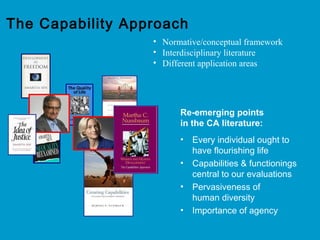
The Capability Approach
• Normative/conceptual framework
• Interdisciplinary literature
• Different application areas
Re-emerging points
in the CA literature:
• Every individual ought to
have flourishing life
• Capabilities & functionings
central to our evaluations
• Pervasiveness of
human diversity
• Importance of agency
Defended:
Jan. 2013
Forthcoming May 2015
Oosterlaken &
Van den Hoven,
eds. (2012)
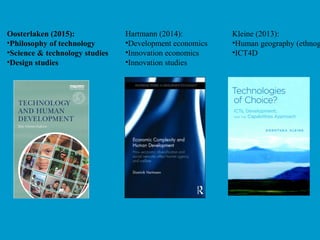
Oosterlaken (2015):
•Philosophy of technology
•Science & technology studies
•Design studies
Hartmann (2014):
•Development economics
•Innovation economics
•Innovation studies
Kleine (2013):
•Human geography (ethnog
•ICT4D
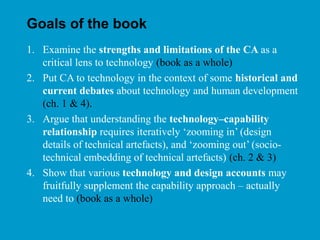
Goals of the book
1. Examine the strengths and limitations of the CA as a
critical lens to technology (book as a whole)
2. Put CA to technology in the context of some historical and
current debates about technology and human development
(ch. 1 & 4).
3. Argue that understanding the technology–capability
relationship requires iteratively ‘zooming in’ (design
details of technical artefacts), and ‘zooming out’ (socio-
technical embedding of technical artefacts) (ch. 2 & 3)
4. Show that various technology and design accounts may
fruitfully supplement the capability approach – actually
need to (book as a whole)
Chapters in the book
1. The Appropriate Technology Movement and the CA
2. The Details of Technological Design
3. Embedding Technology in Socio-Technical Networks
4. Taking a CA of ICT for Development (ICT4D)
2 + 3:
Understanding the relationship between
technical artifacts & human capabilities
1 + 4:
‘Case studies’ of how CA relates to
existing debates on technology & human development
1. Central Concepts & Ideas in
the Capability Approach
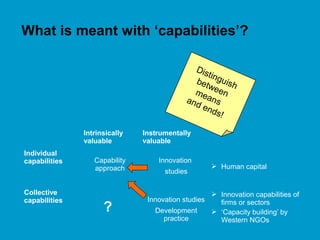
What is meant with ‘capabilities’?
Intrinsically
valuable
Instrumentally
valuable
Individual
capabilities Capability
approach
Innovation
studies
Collective
capabilities Innovation studies
Development
practice
 Human capital
 Innovation capabilities of
firms or sectors
 ‘Capacity building’ by
Western NGOs
?
Distinguishbetweenmeansand ends!
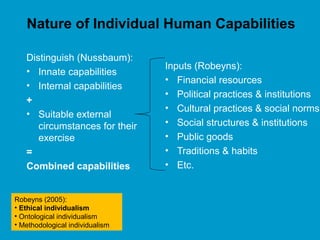
Nature of Individual Human Capabilities
Inputs (Robeyns):
• Financial resources
• Political practices & institutions
• Cultural practices & social norms
• Social structures & institutions
• Public goods
• Traditions & habits
• Etc.
Distinguish (Nussbaum):
• Innate capabilities
• Internal capabilities
+
• Suitable external
circumstances for their
exercise
=
Combined capabilities
Robeyns (2005):
• Ethical individualism
• Ontological individualism
• Methodological individualism
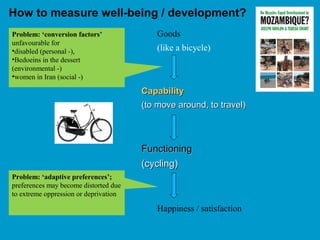
How to measure well-being / development?
Goods
(like a bicycle)
CapabilityCapability
(to move around, to travel)(to move around, to travel)
FunctioningFunctioning
(cycling)(cycling)
Happiness / satisfaction
Problem: ‘adaptive preferences’;
preferences may become distorted due
to extreme oppression or deprivation
Problem: ‘conversion factors’
unfavourable for
•disabled (personal -),
•Bedoeins in the dessert
(environmental -)
•women in Iran (social -)
“Agency refers to a person’s ability to pursue and
realize goals that he or she values and has reason
to value. An agent is ‘someone who acts and brings
about change.’ The opposite of a person with
agency is someone who is forced, oppressed, or
passive.”
(Source: HDCA briefing note Capability and
Functionings:Definition & Justification)
Well-being + Agency Important
“We see the person as
having activity, goals,
and projects”, “a dignified
free being who shapes
his or her own life”
“The ‘good life’ is partly a life of
genuine choice, and not one in
which the person is forced into a
particular life – however rich it
might be in other respects”
Participation /
public debate /
democratic practice /
empowerment
important themes
in the CA !
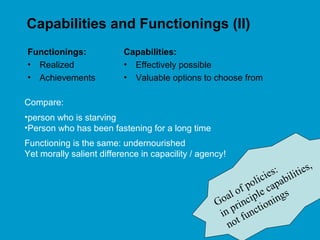
Capabilities and Functionings (II)
Functionings:
• Realized
• Achievements
Capabilities:
• Effectively possible
• Valuable options to choose from
Compare:
•person who is starving
•Person who has been fastening for a long time
Functioning is the same: undernourished
Yet morally salient difference in capacility / agency!
Goal of policies:
in principle capabilities,
not functionings
2. The Application of the CA
to Technology
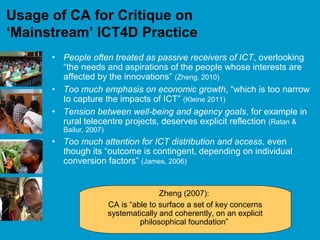
• People often treated as passive receivers of ICT, overlooking
“the needs and aspirations of the people whose interests are
affected by the innovations” (Zheng, 2010)
• Too much emphasis on economic growth, “which is too narrow
to capture the impacts of ICT” (Kleine 2011)
• Tension between well-being and agency goals, for example in
rural telecentre projects, deserves explicit reflection (Ratan &
Bailur, 2007)
• Too much attention for ICT distribution and access, even
though its “outcome is contingent, depending on individual
conversion factors” (James, 2006)
Zheng (2007):
CA is “able to surface a set of key concerns
systematically and coherently, on an explicit
philosophical foundation”
Usage of CA for Critique on
‘Mainstream’ ICT4D Practice
Does the Technology itself Still Matter?
“A key
recommendation […] is
that the human
development of
people, rather than
technology itself,
should be the center of
the design and
evaluation of ICT
programs”
Gigler (2008)
in a chapter
on the
CA & ICT4D
Does focus on human
development not require
– somewhat
paradoxically - more
rather than less attention
for technology itself?
?
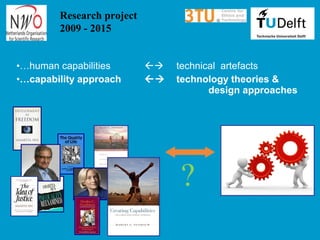
•…human capabilities  technical artefacts
•…capability approach  technology theories &
design approaches
Research project
2009 - 2015
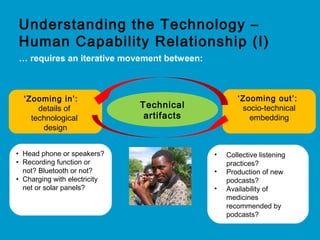
Understanding the Technology –
Human Capability Relationship (I)
… requires an iterative movement between:
‘Zooming in’:
details of
technological
design
‘Zooming out’:
socio-technical
embedding
Technical
artifacts
• Head phone or speakers?
• Recording function or
not? Bluetooth or not?
• Charging with electricity
net or solar panels?
• Collective listening
practices?
• Production of new
podcasts?
• Availability of
medicines
recommended by
podcasts?
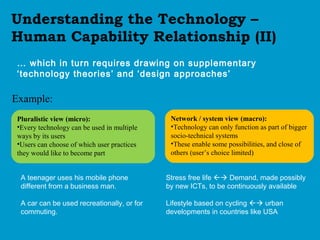
Understanding the Technology –
Human Capability Relationship (II)
… which in turn requires drawing on supplementary
‘technology theories’ and ‘design approaches’
Pluralistic view (micro):
•Every technology can be used in multiple
ways by its users
•Users can choose of which user practices
they would like to become part
Network / system view (macro):
•Technology can only function as part of bigger
socio-technical systems
•These enable some possibilities, and close of
others (user’s choice limited)
A teenager uses his mobile phone
different from a business man.
A car can be used recreationally, or for
commuting.
Stress free life  Demand, made possibly
by new ICTs, to be continuously available
Lifestyle based on cycling  urban
developments in countries like USA
Example:
3. The CA, Technology &
Development (Ch. 1)
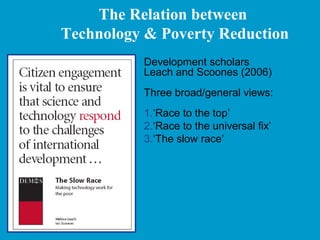
The Relation between
Technology & Poverty Reduction
Development scholars
Leach and Scoones (2006)
Three broad/general views:
1.‘Race to the top’
2.‘Race to the universal fix’
3.‘The slow race’
Outline of the chapter
PART I – Exploring the CA in relation to technology & development
o Examination of Leach & Scoones’ “3 races” through lens of the CA
o Conclusion: CA seems best aligned with the ‘slow race’
o Zooming in on Appropriate Technology movement as example
o Conclusion: commonalities. But CA has also added value:
• Agency
• Gender
PART II – Adding nuance: Will the real CA stand up now?
o Different versions of the CA
o Normative/conceptual framework – different extension possible
o Illustration with agency / gender
o Compatible with all ‘3 races’
o Illustration with case of KickStart
The ‘Race to the Top’
Leach and Scoones:
• ‘The top’  the top in the global economy
• “Science and technology driven
economic growth” ‘trickling down’ to the
poor
• ‘development as modernization’
(1950s/1960s) fits with this view
• Technology transfer from developed to
developing countries
Some keywords:
• scientific progress, diffusion,
• investments, risks, patents,
• network age, skilled labor
force
Criticism &
the Capability Approach
Leach and Scoones:
•Growth  distribution (‘trickling down’ does not always occur)
•Negative side effects of growth (the poor most vulnerable)
Perspective that CA offers?
•Ethical individualism: concern with capabilities of each and every
person, careful with relying on group averages
•Critical of sacrificing the capabilities of individuals to “non-capability
collective goals”, such as growth or modernization
•Income & economic growth: poor indicators of well-being /
development ( alternative: capabilities)
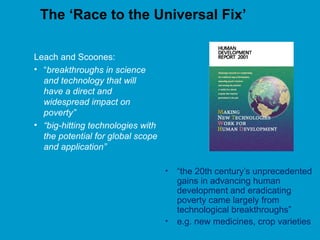
The ‘Race to the Universal Fix’
Leach and Scoones:
• “breakthroughs in science
and technology that will
have a direct and
widespread impact on
poverty”
• “big-hitting technologies with
the potential for global scope
and application”
• “the 20th century’s unprecedented
gains in advancing human
development and eradicating
poverty came largely from
technological breakthroughs”
• e.g. new medicines, crop varieties
Criticism &
the Capability Approach
Leach and Scoones:
• Social, technical and political aspects closely intertwined,
thus “treating S&T as a separate issue is dangerous”
• Ecologies & livelihood practices are highly diverse,”
technologies have to fit these local circumstances
• Problems of poverty not just the result of technical matters.”
Also other causes, such as conflict and market failures
Perspective that CA offers?
• Pervasiveness of human diversity, conversion factors
• Sen warns against “commodity fetishism” of economists 
also technology fetishism?
• Focus on the ultimate ends (valuable individual capabilities)
stimulates openness to different available means
The ‘Slow Race’
Leach and Scoones:
• Making technology fit the local context
• Attention for social, cultural &
institutional dimensions
• Active role for citizens in “both the
‘upstream’ choice and design of
technologies, and their ‘downstream’
delivery and regulation”
Criticism of Indian activist
Vandana Shiva:
human concerns overlooked,
does not discuss participation/ active role
of global South, nor diversity of
cultures & solutions
Best match
with the CA!?
Capability approach:
• Human diversity significant &
far-reaching
• Puts people central, as active
agents  participation
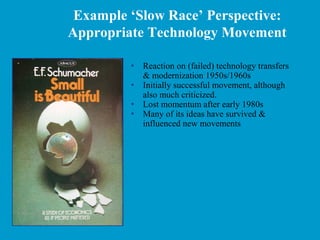
Example ‘Slow Race’ Perspective:
Appropriate Technology Movement
• Reaction on (failed) technology transfers
& modernization 1950s/1960s
• Initially successful movement, although
also much criticized.
• Lost momentum after early 1980s
• Many of its ideas have survived &
influenced new movements
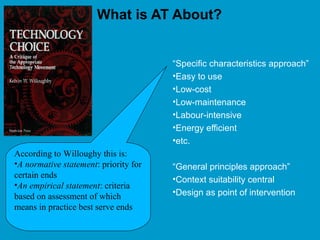
What is AT About?
“Specific characteristics approach”
•Easy to use
•Low-cost
•Low-maintenance
•Labour-intensive
•Energy efficient
•etc.
“General principles approach”
•Context suitability central
•Design as point of intervention
According to Willoughy this is:
•A normative statement: priority for
certain ends
•An empirical statement: criteria
based on assessment of which
means in practice best serve ends
How Does the CA Relate?
• CA compatible with ‘general principles AT approach’
• ‘Specific characteristics AT approach’  assumption of “Third World’
and its inhabitants as homogenous entities”? (Schuurman, 2008)
• Taken to the extreme: distinction with ‘race to the universal fix’
becomes blurry
• Still: AT has always taken ‘conversion factors’ seriously
• Practical solutions of AT worth considering for expanding capabilities
• Example podcasting devices Zimbabwe (Oosterlaken, Grimshaw &
Janssen, 2012)
Beyond AT: Agency (I)
Projects introducing micro hydro power plants in rural Latin America
(Fernández-Baldor et al. 2012):
•Case 1: community hardly involved, maintenance problems 
frequent power interruptions (classic failure case)
•Case 2: strong participatory process, still operational  variety of
well-being improvements (AT: respecting agency instrumentally
important)
•Case 3: project as driving force for the community to take on new
development challenges (CA: constructive + intrinsic value of
agency)
Beyond AT: Agency (II)
“Participatory development” on the agenda since mid-1970s.
Yet problems (Mohan 2008):
•Tokenism: more about rhetoric than actual empowerment 
message of CA not redundant
•People are situated & embodied agents, their ability to
participate depends on material and social structures  CA as
comprehensive & holistic approach acknowledges this
•Communities often treated as socially homogenous, ignoring
e.g. power & gender differences  emphasis CA on human
diversity
Appropriate for Whom?
Gender and Technology (I)
• AT movement: attention for social & environmental factors, less
attention for personal conversion factors
• Appropriate for whom? Whose interest does the technology serve?
• Gender often one of most salient facts of interpersonal diversity
within communities
• “appropriate technology […] is often inappropriate when gender
issues are taken into account” (Stamp 1989)
• Not until 1980s that gender & technology became distinct topic of
research. Yet still a challenge
• E.g. impacts of appropriate energy technologies on lives man &
women differ significantly (Fernández-Baldor et al. 2014)
Gender and Technology (II):
What Can the CA Offer
CA in several ways “gender-sensitive evaluative framework” (Robeyns
2008)
 Focus on capabilities and functions, instead of resources, helpful in
revealing gender differences
 Looks into both market and non-market settings
 Attention for human diversity in terms of conversion factors
 Ethical individualism: household not primary unit of analysis
 Yet no ontological / methodological individualism: so within CA
one can study influence of social structures on women’s capabilities
and choices
 Acknowledgement of problem of adjusted preferences
Will the Real Capability Approach Stand
Up Now?
•To summarize:
•CA natural ally of proponents ‘slow race’
•CA very compatible with AT, although it also goes beyond AT
Two concerns:
1.CA is merely normative framework, not theory about empirical reality /
phenomena. What one sees through the ‘lens’ of the CA depends on
‘filters’ (technology theories) one adds
2.‘The’ CA does not exist. Only limited number of normative/ethical claims
shared by all partisans of CA
 Argument so far overestimates what CA can do / underestimates
degree to which people - even when all adopting the CA - can still differ of
opinion about technology
‘The’ CA Does Not Exist
• Multidisciplinary literature: economics, political
science, philosophy, development studies, etc.
• Even differences between Sen (economist,
social choice theory) and Nussbaum
(philosopher, narrative approach)
• Robeyns: ‘narrow’ versus ‘broad’ application of
the CA
o Well-being vs. broader range of values (agency, justice, ….)
o Individual wellbeing vs. policies/institutions/social practices
Robeyns:
“Concentric Circles Account” of the CA
Core of CA:
• People should be able to lead flourishing, truly human life –
functionings/capabilities as core ‘evaluative space / informational base’
• Normative evaluation of functionings / capabilities is needed
• There may be other elements of value & claims of the right which do not
refer to capabilitarian notion of the good
• Ethical individualism
Around this inner circle different types of applications:
• Quality of life assessments (focus of Sen)
• Theory of justice (focus of Sen)
• (Re)conceptualization of phenomena (e.g. education, technology)
Further circles depending on e.g. further normative commitments, or
additional ‘explanatory theories’
The CA and
Gender Theory / Feminist Concerns
Different capability analyses / normative evaluations of
gender cases possible, depending on e.g.:
• conservative or feminist gender theory
• (normative) theory of preference formation
(Robeyns, 2008)
The CA and Agency
• Sen: distinction between agency freedom & well-
being freedom. Nussbaum: capability/functioning
distinction enough to capture importance of agency
• Nussbaum: more focus on agency as integral part of
outcome of development. Sen: role of agency in
process of development very important.
• “Agency-based development ethics” of David Crocker:
Sen’s CA + deliberative democracy + modes of
participation from development ethics
• Agency & technology? Draw on STS, design studies,
etc?
Back to the ‘Three Races’
& the AT Movement
• There has been a lot of criticism on AT over time, e.g. “the AT
movement died because it was led by well-intentioned tinkerers
instead of hard-nosed entrepreneurs designing for the market”
(Polak and Warwick 2013)
• CA on its own does not have much if anything at all to say about
truth or convincingness of most of them
• CA is not incompatible with other two ‘races’
• Nussbaum sees central role for governments, but one may also
believe “that te capabilitarian ideal society is better reached by a
cooordinated commitment to individual action or relying on market
mechanisms” (Robeyns, 2014)
• Likewise, CA allows for many different views on how to make
technology work for the poor
Example: “KickStart”
• Non-profit social enterprise operating in Africa, founder greatly
disappointed in AT (Fisher 2006)
• Technologies need to be “designed to create individual opportunities”
• Impact is ultimately about things such as enabling people to send
their kids to school, or to improve diet & health
• We live in a cash economy, money is needed for this
• Focus: technologies which entrepreneurs can use to create income
• Reliance on “high-quality engineering and mass-production”
Do such initiatives truly empower people –
in all their human diversity – to lead the
lives they have reason to value?
Thank you for you attention!
Dr. Ir. Ilse Oosterlaken
e.t.oosterlaken@vu.nl

Technology & Human Development - A Capability Approach

  • 1.
    Technology & HumanDevelopment – A Capability Approach Dr. ir. Ilse Oosterlaken e.t.oosterlaken@vu.nl Department of Philosophy, VU University Amsterdam UNU-MERIT seminar series 30 April 2015
  • 2.
    The Capability Approach •Normative/conceptual framework • Interdisciplinary literature • Different application areas Re-emerging points in the CA literature: • Every individual ought to have flourishing life • Capabilities & functionings central to our evaluations • Pervasiveness of human diversity • Importance of agency
  • 3.
    Defended: Jan. 2013 Forthcoming May2015 Oosterlaken & Van den Hoven, eds. (2012)
  • 4.
    Oosterlaken (2015): •Philosophy oftechnology •Science & technology studies •Design studies Hartmann (2014): •Development economics •Innovation economics •Innovation studies Kleine (2013): •Human geography (ethnog •ICT4D
  • 5.
    Goals of thebook 1. Examine the strengths and limitations of the CA as a critical lens to technology (book as a whole) 2. Put CA to technology in the context of some historical and current debates about technology and human development (ch. 1 & 4). 3. Argue that understanding the technology–capability relationship requires iteratively ‘zooming in’ (design details of technical artefacts), and ‘zooming out’ (socio- technical embedding of technical artefacts) (ch. 2 & 3) 4. Show that various technology and design accounts may fruitfully supplement the capability approach – actually need to (book as a whole)
  • 6.
    Chapters in thebook 1. The Appropriate Technology Movement and the CA 2. The Details of Technological Design 3. Embedding Technology in Socio-Technical Networks 4. Taking a CA of ICT for Development (ICT4D) 2 + 3: Understanding the relationship between technical artifacts & human capabilities 1 + 4: ‘Case studies’ of how CA relates to existing debates on technology & human development
  • 7.
    1. Central Concepts& Ideas in the Capability Approach
  • 8.
    What is meantwith ‘capabilities’? Intrinsically valuable Instrumentally valuable Individual capabilities Capability approach Innovation studies Collective capabilities Innovation studies Development practice  Human capital  Innovation capabilities of firms or sectors  ‘Capacity building’ by Western NGOs ? Distinguishbetweenmeansand ends!
  • 9.
    Nature of IndividualHuman Capabilities Inputs (Robeyns): • Financial resources • Political practices & institutions • Cultural practices & social norms • Social structures & institutions • Public goods • Traditions & habits • Etc. Distinguish (Nussbaum): • Innate capabilities • Internal capabilities + • Suitable external circumstances for their exercise = Combined capabilities Robeyns (2005): • Ethical individualism • Ontological individualism • Methodological individualism
  • 10.
    How to measurewell-being / development? Goods (like a bicycle) CapabilityCapability (to move around, to travel)(to move around, to travel) FunctioningFunctioning (cycling)(cycling) Happiness / satisfaction Problem: ‘adaptive preferences’; preferences may become distorted due to extreme oppression or deprivation Problem: ‘conversion factors’ unfavourable for •disabled (personal -), •Bedoeins in the dessert (environmental -) •women in Iran (social -)
  • 11.
    “Agency refers toa person’s ability to pursue and realize goals that he or she values and has reason to value. An agent is ‘someone who acts and brings about change.’ The opposite of a person with agency is someone who is forced, oppressed, or passive.” (Source: HDCA briefing note Capability and Functionings:Definition & Justification) Well-being + Agency Important “We see the person as having activity, goals, and projects”, “a dignified free being who shapes his or her own life” “The ‘good life’ is partly a life of genuine choice, and not one in which the person is forced into a particular life – however rich it might be in other respects” Participation / public debate / democratic practice / empowerment important themes in the CA !
  • 12.
    Capabilities and Functionings(II) Functionings: • Realized • Achievements Capabilities: • Effectively possible • Valuable options to choose from Compare: •person who is starving •Person who has been fastening for a long time Functioning is the same: undernourished Yet morally salient difference in capacility / agency! Goal of policies: in principle capabilities, not functionings
  • 13.
    2. The Applicationof the CA to Technology
  • 14.
    • People oftentreated as passive receivers of ICT, overlooking “the needs and aspirations of the people whose interests are affected by the innovations” (Zheng, 2010) • Too much emphasis on economic growth, “which is too narrow to capture the impacts of ICT” (Kleine 2011) • Tension between well-being and agency goals, for example in rural telecentre projects, deserves explicit reflection (Ratan & Bailur, 2007) • Too much attention for ICT distribution and access, even though its “outcome is contingent, depending on individual conversion factors” (James, 2006) Zheng (2007): CA is “able to surface a set of key concerns systematically and coherently, on an explicit philosophical foundation” Usage of CA for Critique on ‘Mainstream’ ICT4D Practice
  • 15.
    Does the Technologyitself Still Matter? “A key recommendation […] is that the human development of people, rather than technology itself, should be the center of the design and evaluation of ICT programs” Gigler (2008) in a chapter on the CA & ICT4D Does focus on human development not require – somewhat paradoxically - more rather than less attention for technology itself?
  • 16.
    ? •…human capabilities technical artefacts •…capability approach  technology theories & design approaches Research project 2009 - 2015
  • 17.
    Understanding the Technology– Human Capability Relationship (I) … requires an iterative movement between: ‘Zooming in’: details of technological design ‘Zooming out’: socio-technical embedding Technical artifacts • Head phone or speakers? • Recording function or not? Bluetooth or not? • Charging with electricity net or solar panels? • Collective listening practices? • Production of new podcasts? • Availability of medicines recommended by podcasts?
  • 18.
    Understanding the Technology– Human Capability Relationship (II) … which in turn requires drawing on supplementary ‘technology theories’ and ‘design approaches’ Pluralistic view (micro): •Every technology can be used in multiple ways by its users •Users can choose of which user practices they would like to become part Network / system view (macro): •Technology can only function as part of bigger socio-technical systems •These enable some possibilities, and close of others (user’s choice limited) A teenager uses his mobile phone different from a business man. A car can be used recreationally, or for commuting. Stress free life  Demand, made possibly by new ICTs, to be continuously available Lifestyle based on cycling  urban developments in countries like USA Example:
  • 19.
    3. The CA,Technology & Development (Ch. 1)
  • 20.
    The Relation between Technology& Poverty Reduction Development scholars Leach and Scoones (2006) Three broad/general views: 1.‘Race to the top’ 2.‘Race to the universal fix’ 3.‘The slow race’
  • 21.
    Outline of thechapter PART I – Exploring the CA in relation to technology & development o Examination of Leach & Scoones’ “3 races” through lens of the CA o Conclusion: CA seems best aligned with the ‘slow race’ o Zooming in on Appropriate Technology movement as example o Conclusion: commonalities. But CA has also added value: • Agency • Gender PART II – Adding nuance: Will the real CA stand up now? o Different versions of the CA o Normative/conceptual framework – different extension possible o Illustration with agency / gender o Compatible with all ‘3 races’ o Illustration with case of KickStart
  • 22.
    The ‘Race tothe Top’ Leach and Scoones: • ‘The top’  the top in the global economy • “Science and technology driven economic growth” ‘trickling down’ to the poor • ‘development as modernization’ (1950s/1960s) fits with this view • Technology transfer from developed to developing countries Some keywords: • scientific progress, diffusion, • investments, risks, patents, • network age, skilled labor force
  • 23.
    Criticism & the CapabilityApproach Leach and Scoones: •Growth  distribution (‘trickling down’ does not always occur) •Negative side effects of growth (the poor most vulnerable) Perspective that CA offers? •Ethical individualism: concern with capabilities of each and every person, careful with relying on group averages •Critical of sacrificing the capabilities of individuals to “non-capability collective goals”, such as growth or modernization •Income & economic growth: poor indicators of well-being / development ( alternative: capabilities)
  • 24.
    The ‘Race tothe Universal Fix’ Leach and Scoones: • “breakthroughs in science and technology that will have a direct and widespread impact on poverty” • “big-hitting technologies with the potential for global scope and application” • “the 20th century’s unprecedented gains in advancing human development and eradicating poverty came largely from technological breakthroughs” • e.g. new medicines, crop varieties
  • 25.
    Criticism & the CapabilityApproach Leach and Scoones: • Social, technical and political aspects closely intertwined, thus “treating S&T as a separate issue is dangerous” • Ecologies & livelihood practices are highly diverse,” technologies have to fit these local circumstances • Problems of poverty not just the result of technical matters.” Also other causes, such as conflict and market failures Perspective that CA offers? • Pervasiveness of human diversity, conversion factors • Sen warns against “commodity fetishism” of economists  also technology fetishism? • Focus on the ultimate ends (valuable individual capabilities) stimulates openness to different available means
  • 26.
    The ‘Slow Race’ Leachand Scoones: • Making technology fit the local context • Attention for social, cultural & institutional dimensions • Active role for citizens in “both the ‘upstream’ choice and design of technologies, and their ‘downstream’ delivery and regulation” Criticism of Indian activist Vandana Shiva: human concerns overlooked, does not discuss participation/ active role of global South, nor diversity of cultures & solutions Best match with the CA!? Capability approach: • Human diversity significant & far-reaching • Puts people central, as active agents  participation
  • 27.
    Example ‘Slow Race’Perspective: Appropriate Technology Movement • Reaction on (failed) technology transfers & modernization 1950s/1960s • Initially successful movement, although also much criticized. • Lost momentum after early 1980s • Many of its ideas have survived & influenced new movements
  • 28.
    What is ATAbout? “Specific characteristics approach” •Easy to use •Low-cost •Low-maintenance •Labour-intensive •Energy efficient •etc. “General principles approach” •Context suitability central •Design as point of intervention According to Willoughy this is: •A normative statement: priority for certain ends •An empirical statement: criteria based on assessment of which means in practice best serve ends
  • 29.
    How Does theCA Relate? • CA compatible with ‘general principles AT approach’ • ‘Specific characteristics AT approach’  assumption of “Third World’ and its inhabitants as homogenous entities”? (Schuurman, 2008) • Taken to the extreme: distinction with ‘race to the universal fix’ becomes blurry • Still: AT has always taken ‘conversion factors’ seriously • Practical solutions of AT worth considering for expanding capabilities • Example podcasting devices Zimbabwe (Oosterlaken, Grimshaw & Janssen, 2012)
  • 30.
    Beyond AT: Agency(I) Projects introducing micro hydro power plants in rural Latin America (Fernández-Baldor et al. 2012): •Case 1: community hardly involved, maintenance problems  frequent power interruptions (classic failure case) •Case 2: strong participatory process, still operational  variety of well-being improvements (AT: respecting agency instrumentally important) •Case 3: project as driving force for the community to take on new development challenges (CA: constructive + intrinsic value of agency)
  • 31.
    Beyond AT: Agency(II) “Participatory development” on the agenda since mid-1970s. Yet problems (Mohan 2008): •Tokenism: more about rhetoric than actual empowerment  message of CA not redundant •People are situated & embodied agents, their ability to participate depends on material and social structures  CA as comprehensive & holistic approach acknowledges this •Communities often treated as socially homogenous, ignoring e.g. power & gender differences  emphasis CA on human diversity
  • 32.
    Appropriate for Whom? Genderand Technology (I) • AT movement: attention for social & environmental factors, less attention for personal conversion factors • Appropriate for whom? Whose interest does the technology serve? • Gender often one of most salient facts of interpersonal diversity within communities • “appropriate technology […] is often inappropriate when gender issues are taken into account” (Stamp 1989) • Not until 1980s that gender & technology became distinct topic of research. Yet still a challenge • E.g. impacts of appropriate energy technologies on lives man & women differ significantly (Fernández-Baldor et al. 2014)
  • 33.
    Gender and Technology(II): What Can the CA Offer CA in several ways “gender-sensitive evaluative framework” (Robeyns 2008)  Focus on capabilities and functions, instead of resources, helpful in revealing gender differences  Looks into both market and non-market settings  Attention for human diversity in terms of conversion factors  Ethical individualism: household not primary unit of analysis  Yet no ontological / methodological individualism: so within CA one can study influence of social structures on women’s capabilities and choices  Acknowledgement of problem of adjusted preferences
  • 34.
    Will the RealCapability Approach Stand Up Now? •To summarize: •CA natural ally of proponents ‘slow race’ •CA very compatible with AT, although it also goes beyond AT Two concerns: 1.CA is merely normative framework, not theory about empirical reality / phenomena. What one sees through the ‘lens’ of the CA depends on ‘filters’ (technology theories) one adds 2.‘The’ CA does not exist. Only limited number of normative/ethical claims shared by all partisans of CA  Argument so far overestimates what CA can do / underestimates degree to which people - even when all adopting the CA - can still differ of opinion about technology
  • 35.
    ‘The’ CA DoesNot Exist • Multidisciplinary literature: economics, political science, philosophy, development studies, etc. • Even differences between Sen (economist, social choice theory) and Nussbaum (philosopher, narrative approach) • Robeyns: ‘narrow’ versus ‘broad’ application of the CA o Well-being vs. broader range of values (agency, justice, ….) o Individual wellbeing vs. policies/institutions/social practices
  • 36.
    Robeyns: “Concentric Circles Account”of the CA Core of CA: • People should be able to lead flourishing, truly human life – functionings/capabilities as core ‘evaluative space / informational base’ • Normative evaluation of functionings / capabilities is needed • There may be other elements of value & claims of the right which do not refer to capabilitarian notion of the good • Ethical individualism Around this inner circle different types of applications: • Quality of life assessments (focus of Sen) • Theory of justice (focus of Sen) • (Re)conceptualization of phenomena (e.g. education, technology) Further circles depending on e.g. further normative commitments, or additional ‘explanatory theories’
  • 37.
    The CA and GenderTheory / Feminist Concerns Different capability analyses / normative evaluations of gender cases possible, depending on e.g.: • conservative or feminist gender theory • (normative) theory of preference formation (Robeyns, 2008)
  • 38.
    The CA andAgency • Sen: distinction between agency freedom & well- being freedom. Nussbaum: capability/functioning distinction enough to capture importance of agency • Nussbaum: more focus on agency as integral part of outcome of development. Sen: role of agency in process of development very important. • “Agency-based development ethics” of David Crocker: Sen’s CA + deliberative democracy + modes of participation from development ethics • Agency & technology? Draw on STS, design studies, etc?
  • 39.
    Back to the‘Three Races’ & the AT Movement • There has been a lot of criticism on AT over time, e.g. “the AT movement died because it was led by well-intentioned tinkerers instead of hard-nosed entrepreneurs designing for the market” (Polak and Warwick 2013) • CA on its own does not have much if anything at all to say about truth or convincingness of most of them • CA is not incompatible with other two ‘races’ • Nussbaum sees central role for governments, but one may also believe “that te capabilitarian ideal society is better reached by a cooordinated commitment to individual action or relying on market mechanisms” (Robeyns, 2014) • Likewise, CA allows for many different views on how to make technology work for the poor
  • 40.
    Example: “KickStart” • Non-profitsocial enterprise operating in Africa, founder greatly disappointed in AT (Fisher 2006) • Technologies need to be “designed to create individual opportunities” • Impact is ultimately about things such as enabling people to send their kids to school, or to improve diet & health • We live in a cash economy, money is needed for this • Focus: technologies which entrepreneurs can use to create income • Reliance on “high-quality engineering and mass-production” Do such initiatives truly empower people – in all their human diversity – to lead the lives they have reason to value?
  • 41.
    Thank you foryou attention! Dr. Ir. Ilse Oosterlaken e.t.oosterlaken@vu.nl

Editor's Notes

  • #3 Wellbeing is not just about income, but about sufficient (valuable) capabilities in all domains of life Different conceptions of ‘the good life’, but also differences in our ability to ‘convert’ resources into capabilities (i.e. capabilities best ‘space of equality’) People not as passive recipients of aid, capabilities as both means and ends, importance participation, policy focus in principle on capabilities not functionings
  • #10 Example of bicycle shows: capability is quite complex construct. Whether or not you have a capability is very much a matter of “all things considered”. Focus on ends: advantage may be openness to diversity of means to reach that end. E.g. to ensure that women get some capabilities, changing sexist practices may be more important than distributing more resources.
  • #11 Problem of adaptive/adjusted preferences (Sen, 1999): “Our desires and pleasure-taking abilities adjust to circumstances, especially to make life bearable in adverse situations. The utility calculus can be deeply unfair to those who are persistently deprived […] The deprived people tend to come to terms with their deprivation because of the sheer necessity of survival, and they may, as a result, lack the courage to demand any radical change, and may even adjust their desires and expectations to what they unambitiously see as feasible.”
  • #12 People not as passive patient to be helped, as ‘containers’ of well-being, but as agents in charge of their own life. This picture of human beings is an important reason to focus on capabilities; When people have a range of capabilities available, they can choose to realize their own idea of the good life
  • #13 Capabilities: real opportunities that people have to “live the lives that they have reason to value” / “what people are effectively able to do and be” / (positive) freedom that people have “to enjoy ‘valuable beings and doings’” Functionings: Examples: working, resting, being literate, being healthy, being part of a community, travelling, being confident, playing the guitar, riding a bicycle… One could choose to be well-nourished, but does not do so (exercise of agency: capability not turned into functioning) The other person has no choice / opportunity to change functioning (lack of agency: no capability)
  • #15 So several authors have argued that the CA has something to offer to ICT4D. Example of CA & ‘development ethics’ as field of applied ethics Or digital divide  unjustice? Kleine (2009: “the common way of measuring impact by defining the intended development outcomes top-down and a-priori is unsuitable in the context of multi-purpose technologies [i.e. like ICT] which could empower individuals to attain development outcomes of their own choosing”
  • #17 How can the CA be brought to bear on technology and design? What is the nature of the relation between technical artefacts and human capabilities? Which technology theories and design approaches could fruitfully supplement the CA?
  • #19 E.g. value sensitive design, participatory design, universal design, appropriate technology, actor-network theory, use plan account of technical artefacts Now what you see through the lens of the CA will at least partly depend of your choice of such supplements. Based on these two different views of technology one may therefore arrive at a quite different assessment of the capability impact of a new technology. With the view on the left, one is inclined to see mainly positive impacts, whereas the view on the rights invites a more mixed evaluation.
  • #21 Helpful pamphlet - abstracts away from specific disciplinary approaches and all sorts of detailed differences of opinion CA has a lot to offer for criticizing fixation on the first two races, and promoting the “slow race” instead. However, also “slow race” not beyond criticism, and CA may be used to evaluate and extend such work. Moreover: mistake to think that CA not at all compatible with the other two ‘races’.
  • #25 Bill & Melinda Gates Foundation has awarded Delft University of Technology a grant to ‘Reinvent the toilet’
  • #27 Slow race’ perspective & CA seem the best match: Human diversity significant & far- reaching Puts people central, as active agents  participation
  • #28 … such discussions go back to the 1970s, initiated by the so-called ‘appropriate technology movement Response to policy since the 1950s to view development as a process of economic growth and ‘modernization’, which would be achieved – a.o. - by transferring Western technologies to developing countries. Although the phrase “appropriate technology” is not used that much anymore nowadays: many of the issues and ideas still present in later movements and debates. (e.g. contemporary “technology for social inclusion” movement in Latin America)
  • #32 “participatory methods need to be complemented by a theory that explores the nature of people’s lives and the relations between the many dimensions of well-being” (Frediani, 2007). This theory, he sais should be comprehensive, but flexible and able to capture complex linkages between (aspects of) poverty, intervention, participation, and empowerment
  • #33 Part of the issue is of course the question of “who decides what technology is appropriate, and whose interests does it serve?” (Stamp 1989p.50) – and there is thus a relation with the before mentioned issue of power differences and participation.
  • #34 Part of the issue is of course the question of “who decides what technology is appropriate, and whose interests does it serve?” (Stamp 1989p.50) – and there is thus a relation with the before mentioned issue of power differences and participation.
  • #36 Sen: social choice theory. Nussbaum: more narrative approach Sen refuses to make a list, Nussbaum: list of 10 central categories of capabilities Sen: distinction between well-being freedom & agency freedom. Nussbaum: capability list ‘covers’ agency