How I feel about the government 2 functions of the government Maintain stability in the government Meet people’s needs
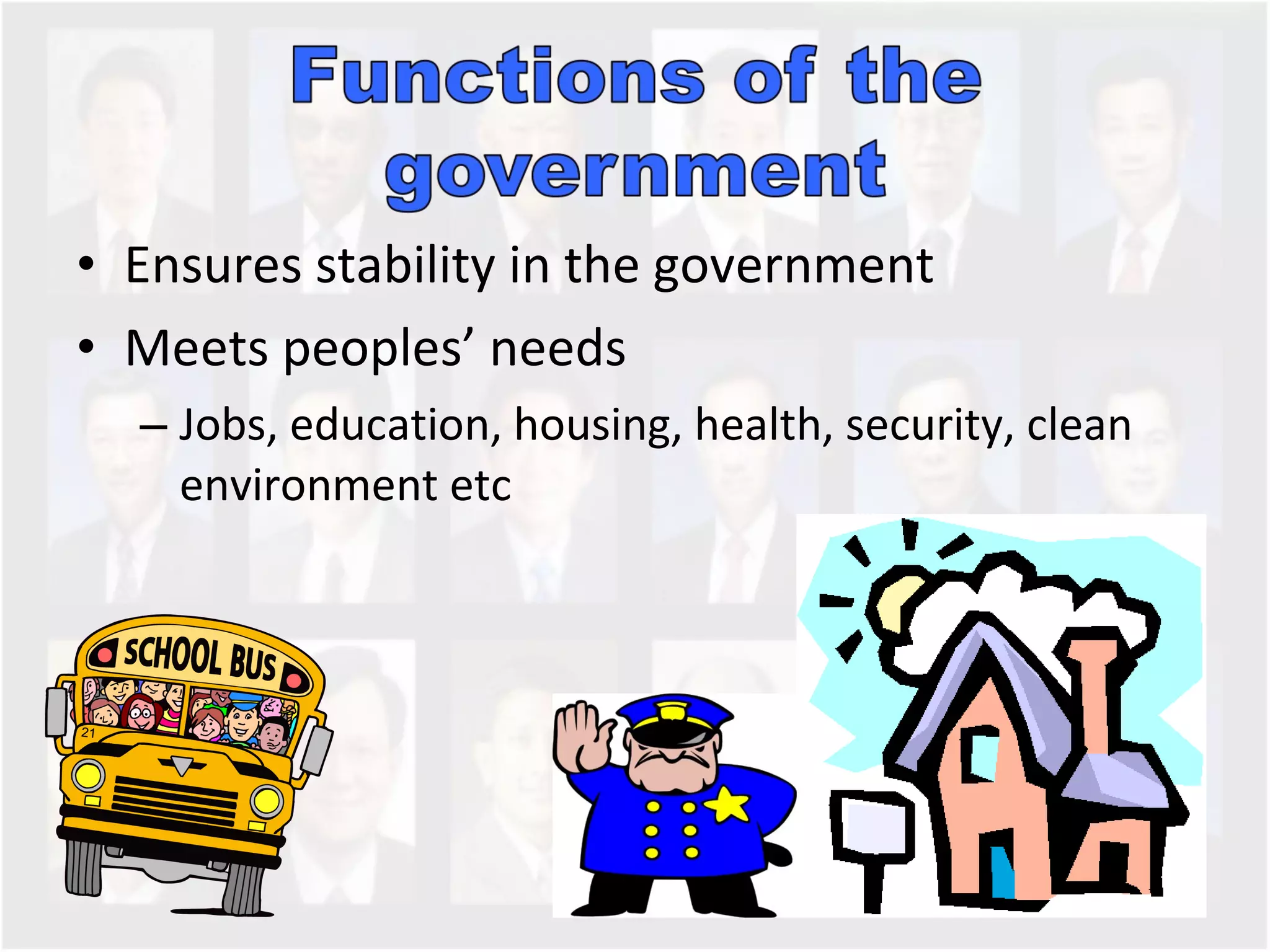
Ensures stability in the government Meets peoples’ needs Jobs, education, housing, health, security, clean environment etc
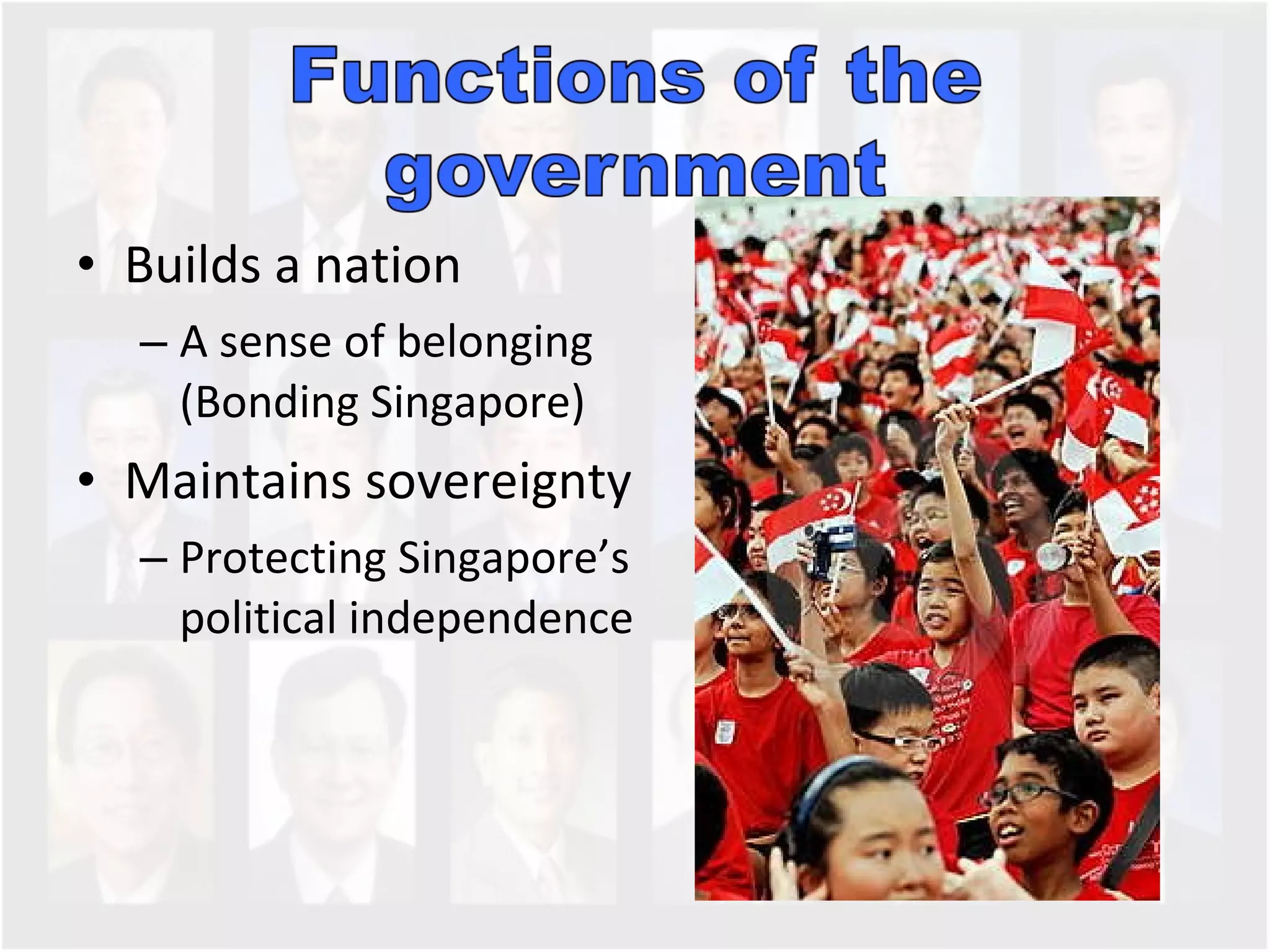
Builds a nation A sense of belonging (Bonding Singapore)  Maintains sovereignty Protecting Singapore’s political independence
Governance Refers to the way a government manages the resources of the country so as to carry out its functions.  Sovereignty  complete power over your  own country, and not being  controlled by other countries
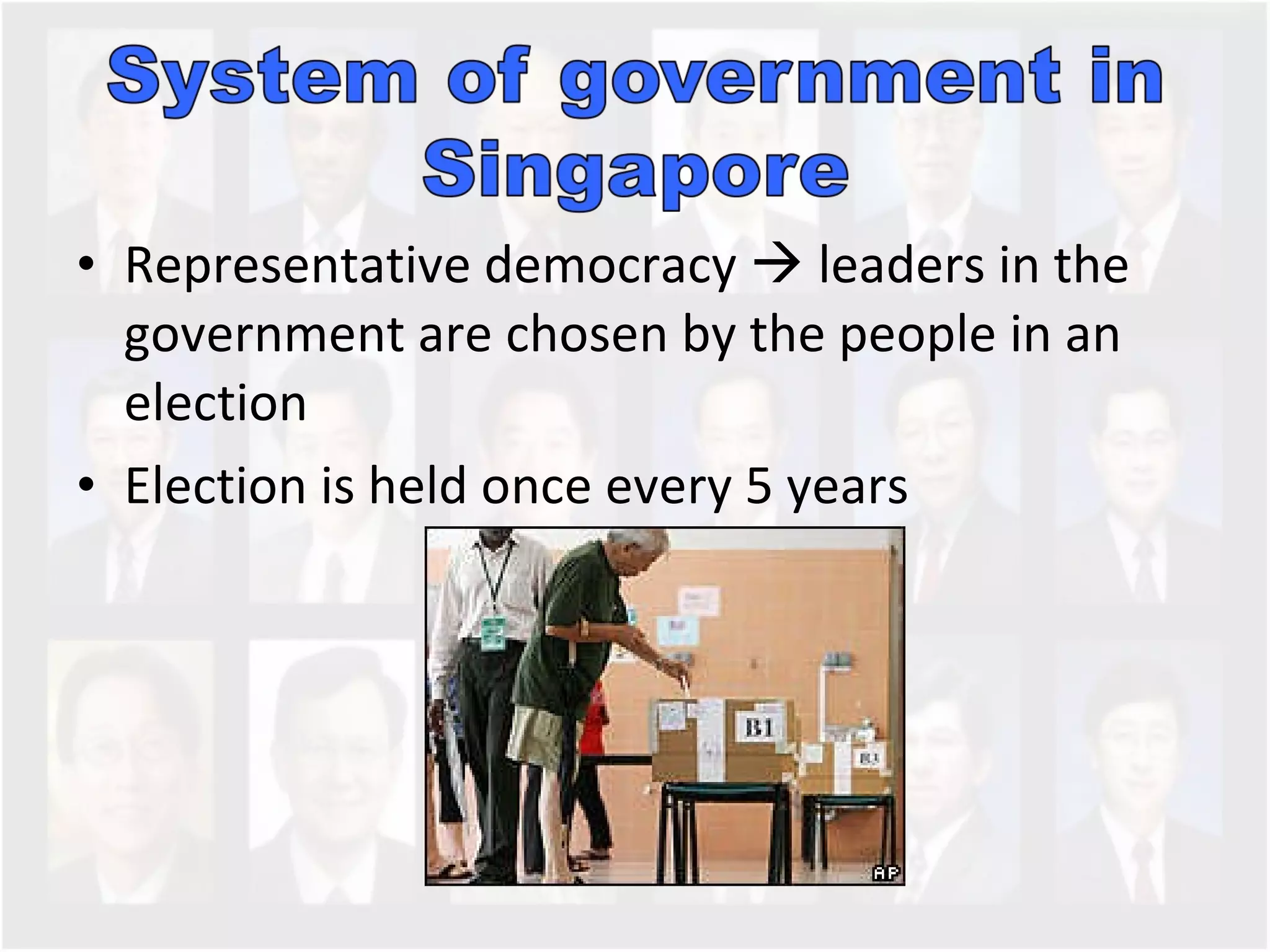
Representative democracy    leaders in the government are chosen by the people in an election  Election is held once every 5 years
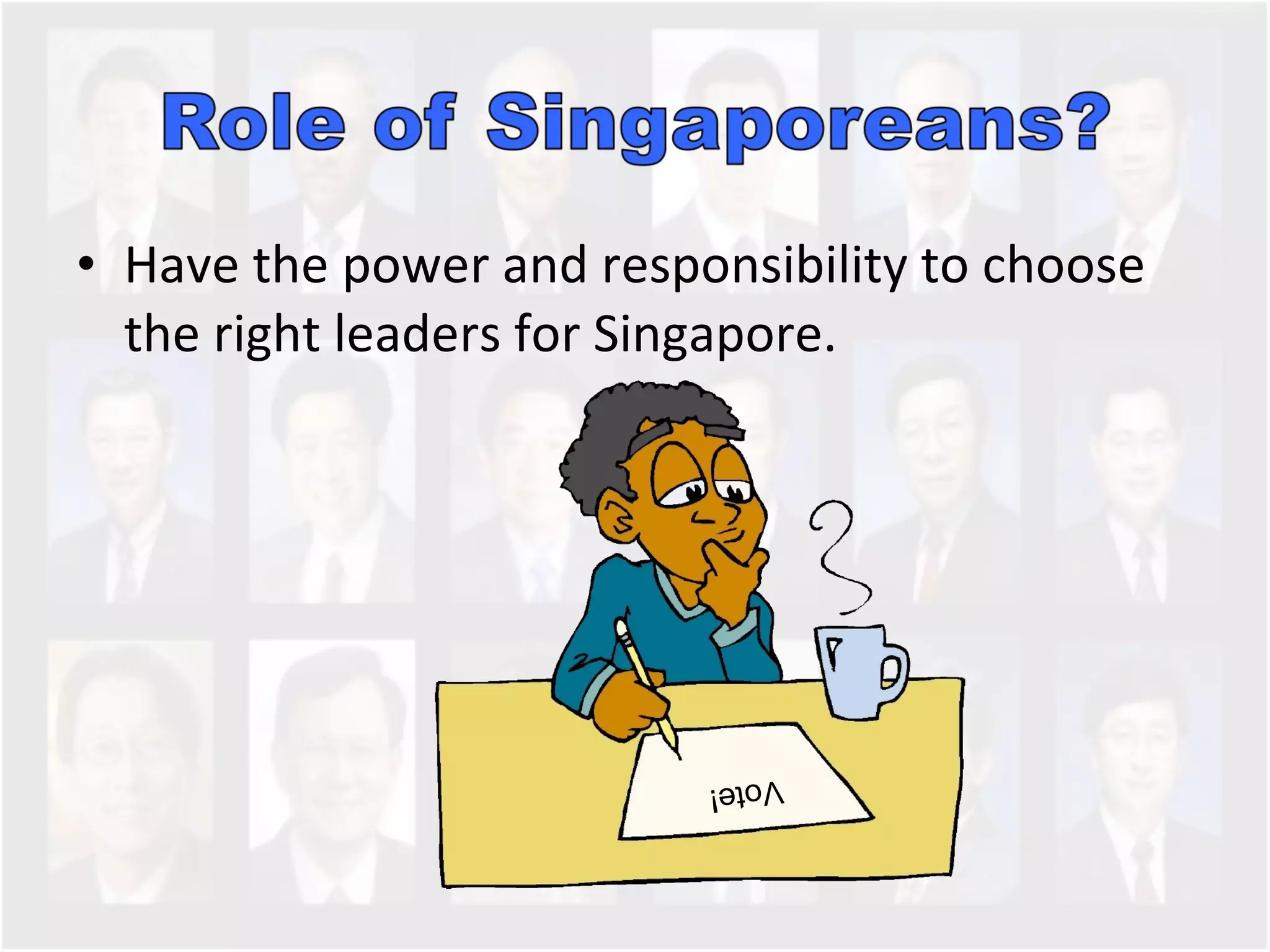
Have the power and responsibility to choose the right leaders for Singapore.  Vote!
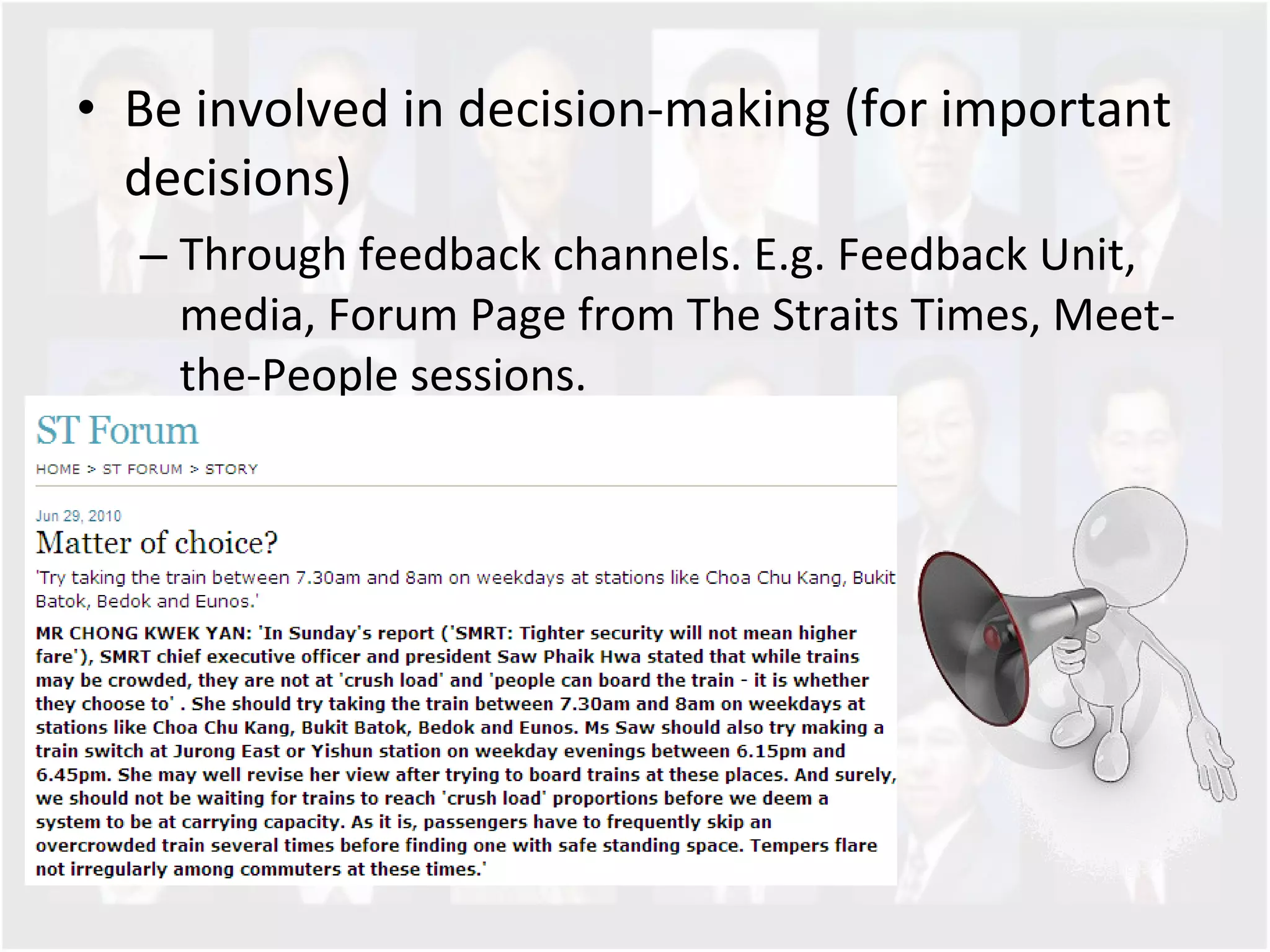
Be involved in decision-making (for important decisions)  Through feedback channels. E.g. Feedback Unit, media, Forum Page from The Straits Times, Meet-the-People sessions.
 
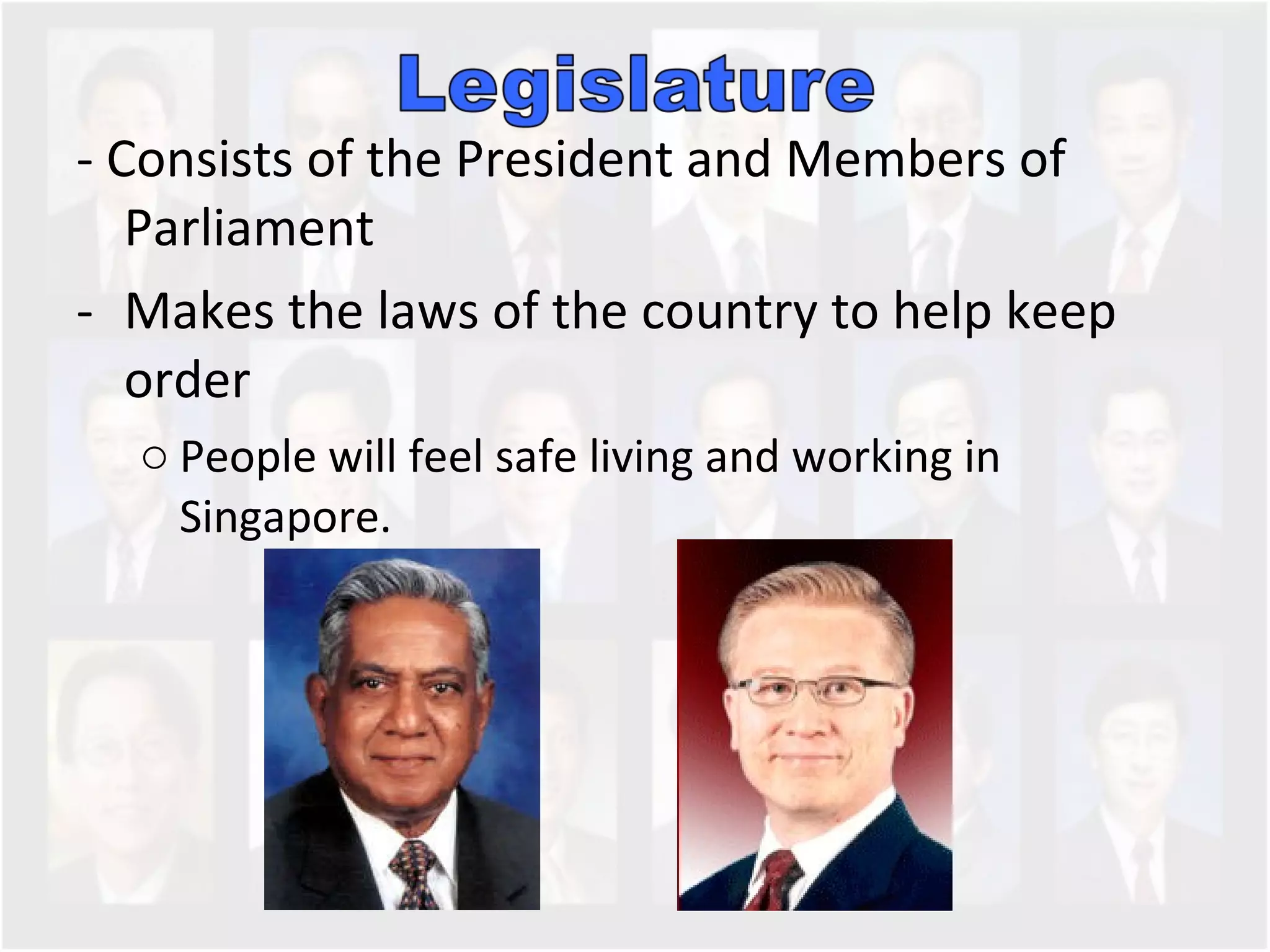
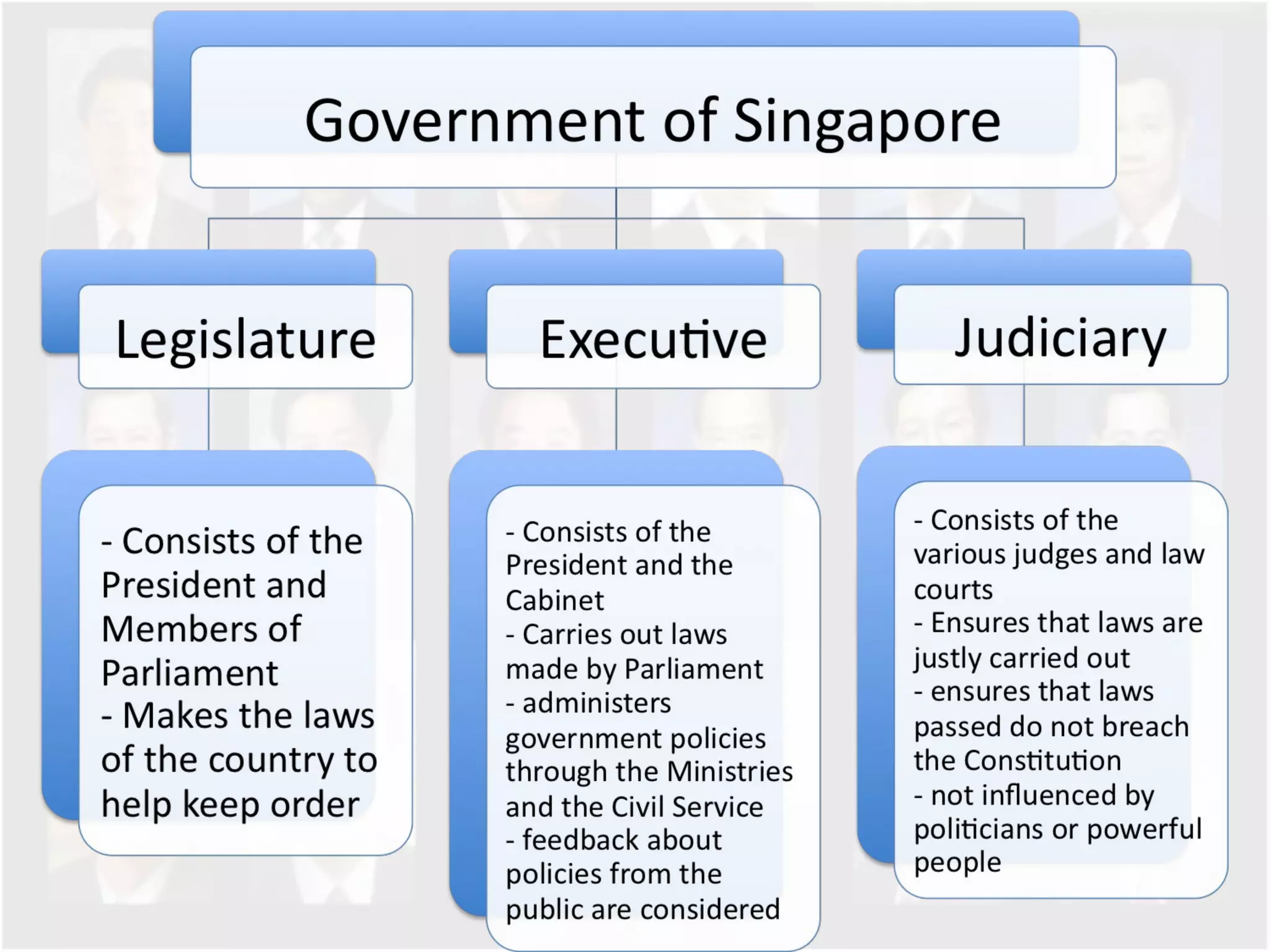
- Consists of the President and Members of Parliament Makes the laws of the country to help keep order People will feel safe living and working in Singapore.
 
Consists of the President and the Cabinet (Prime Minister and the Ministers in charge of the various ministries) Executes laws made by Parliament and carries out government policies through the Ministries and the Civil Service
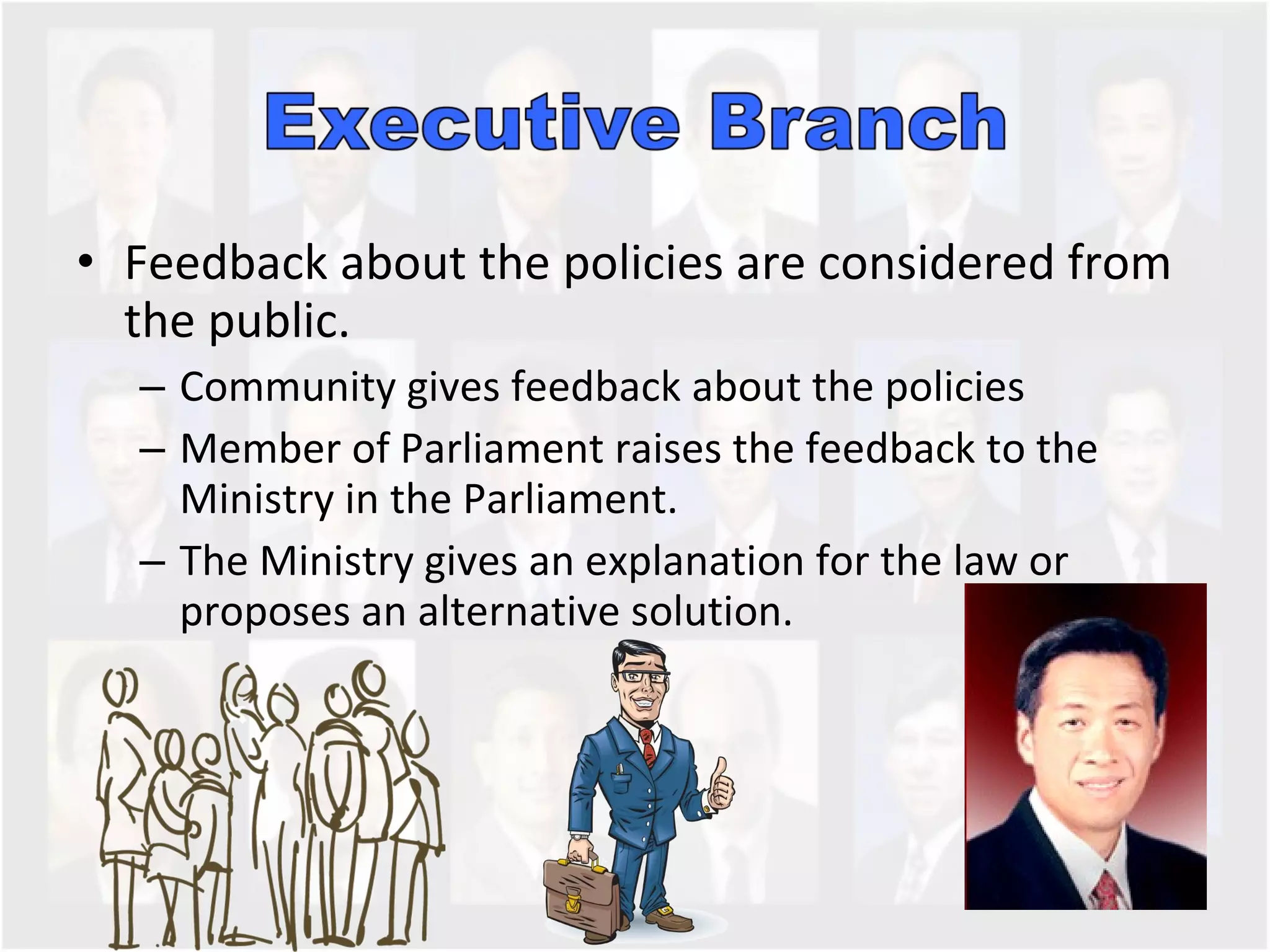
Feedback about the policies are considered from the public. Community gives feedback about the policies Member of Parliament raises the feedback to the Ministry in the Parliament.  The Ministry gives an explanation for the law or proposes an alternative solution.
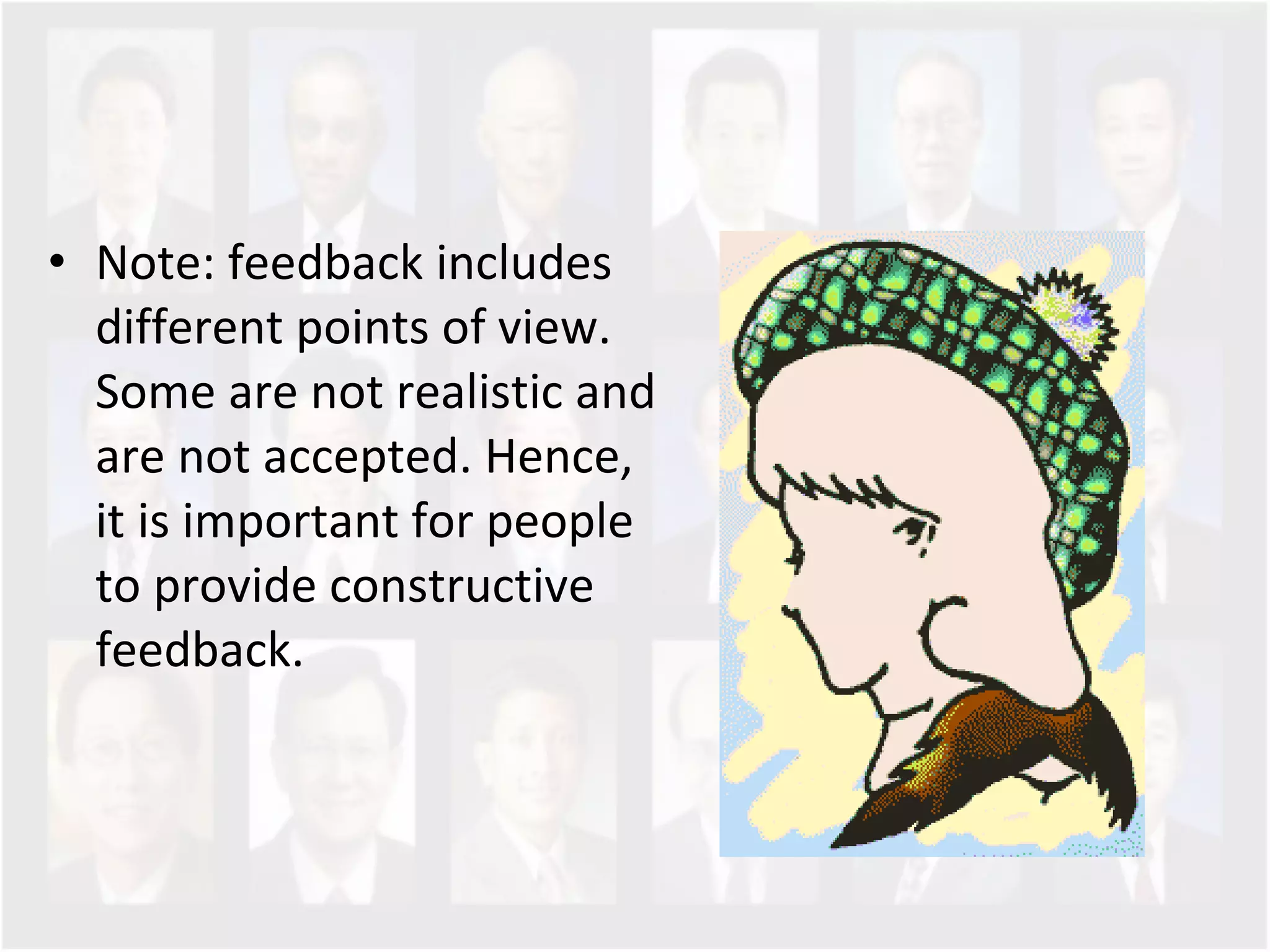
Note: feedback includes different points of view. Some are not realistic and are not accepted. Hence, it is important for people to provide constructive feedback.
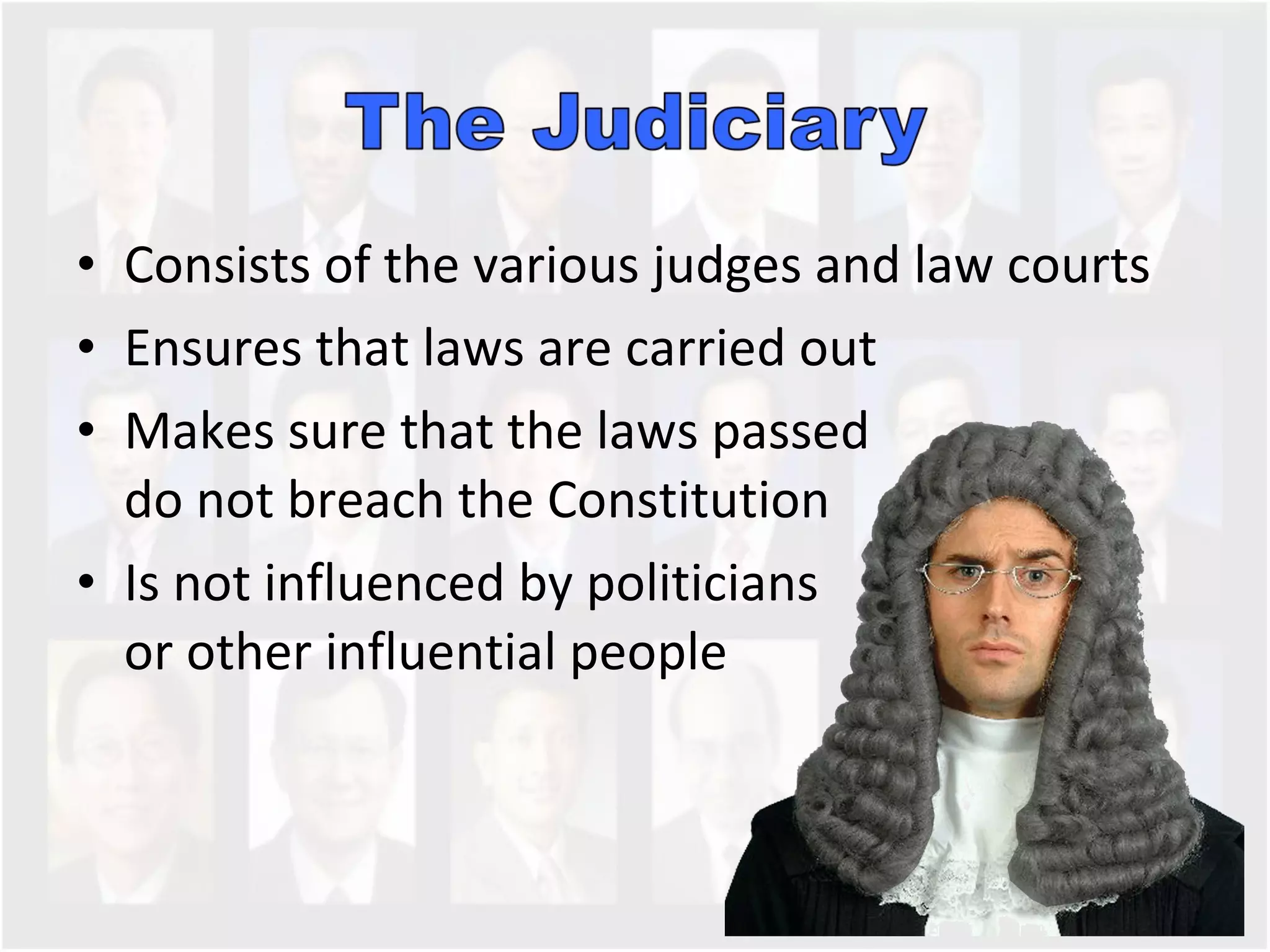
Consists of the various judges and law courts Ensures that laws are carried out Makes sure that the laws passed  do not breach the Constitution  Is not influenced by politicians  or other influential people
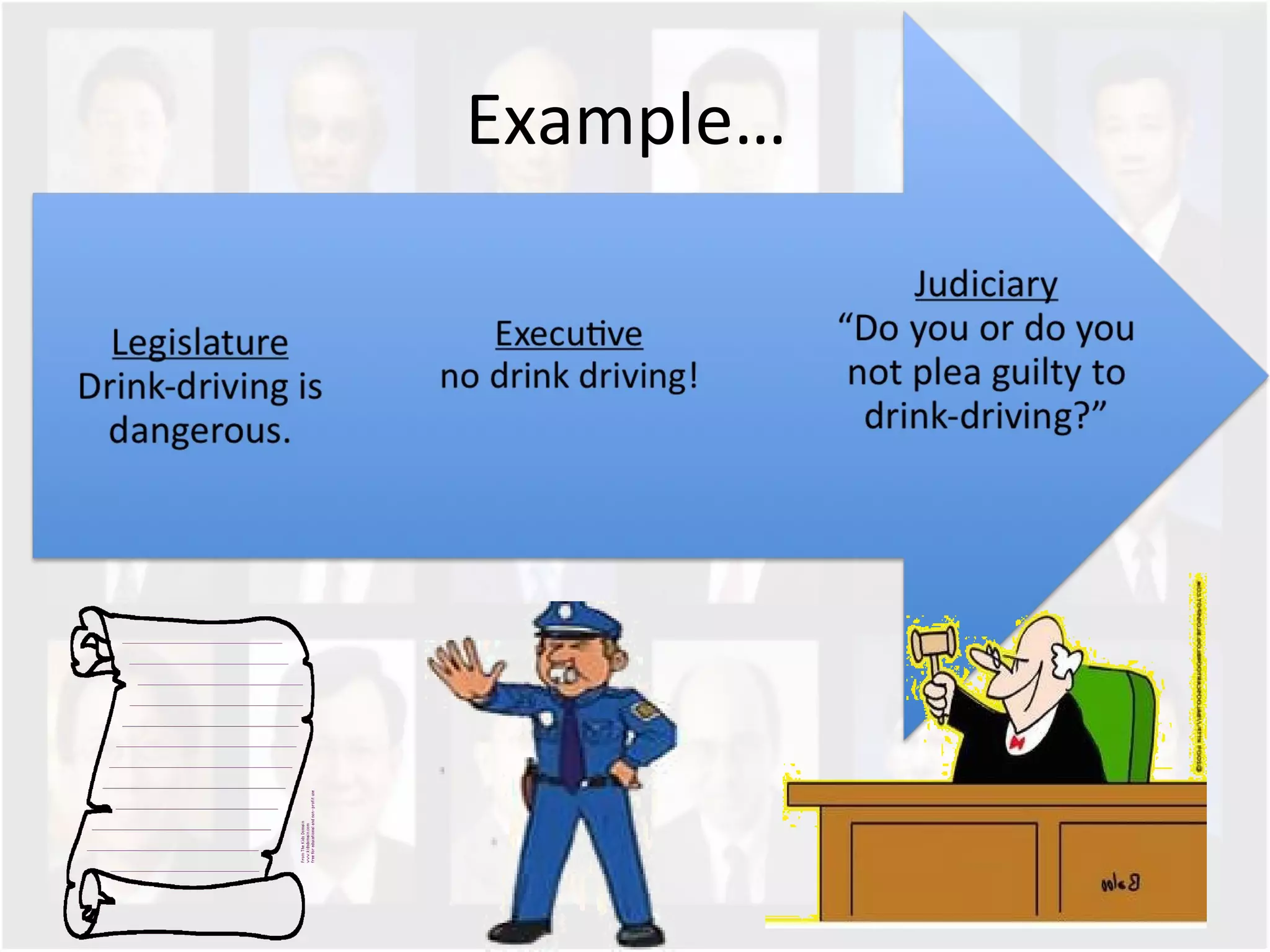
Example…
 
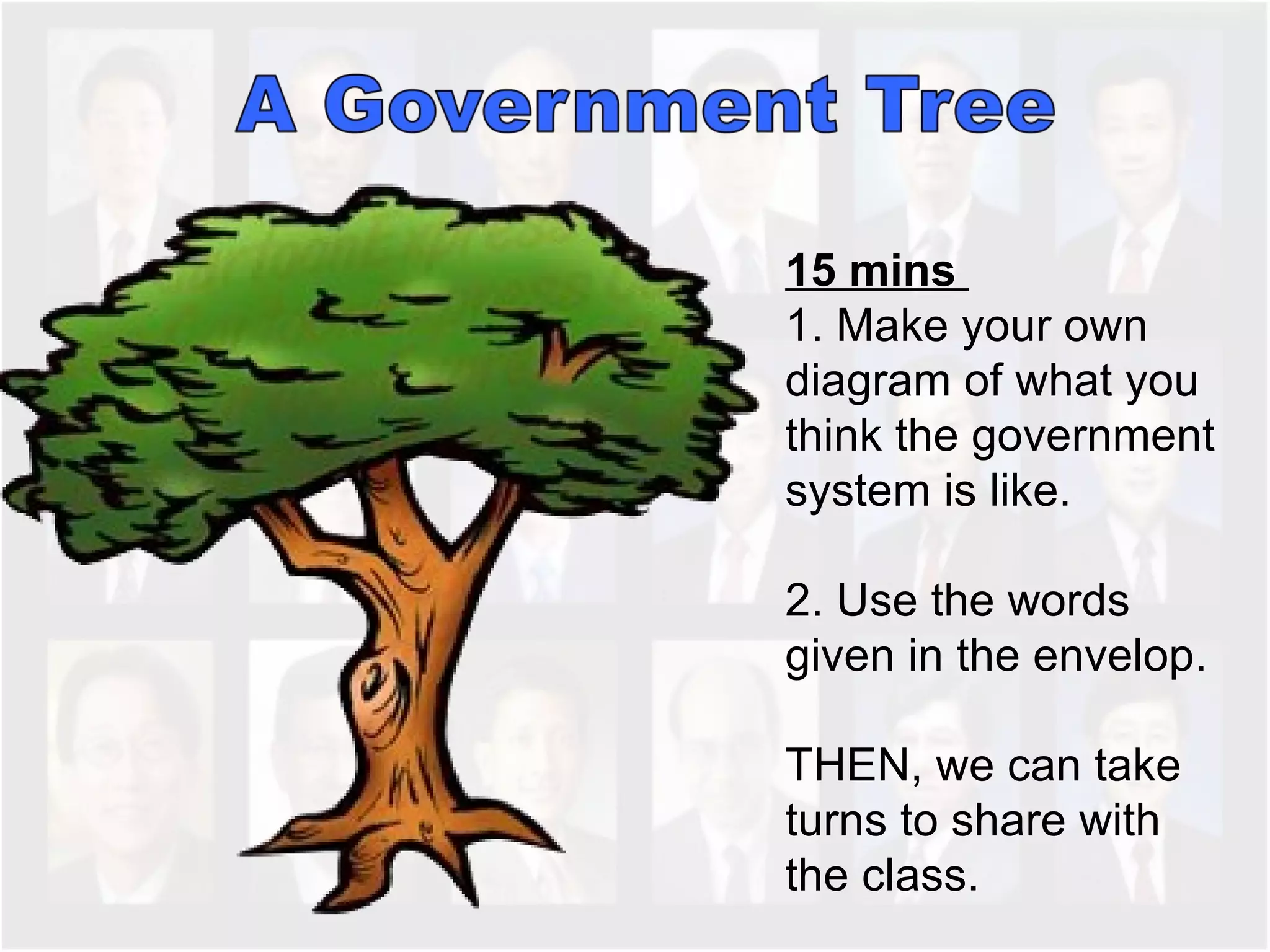
15 mins  1. Make your own diagram of what you think the government system is like. 2. Use the words given in the envelop. THEN, we can take turns to share with the class.
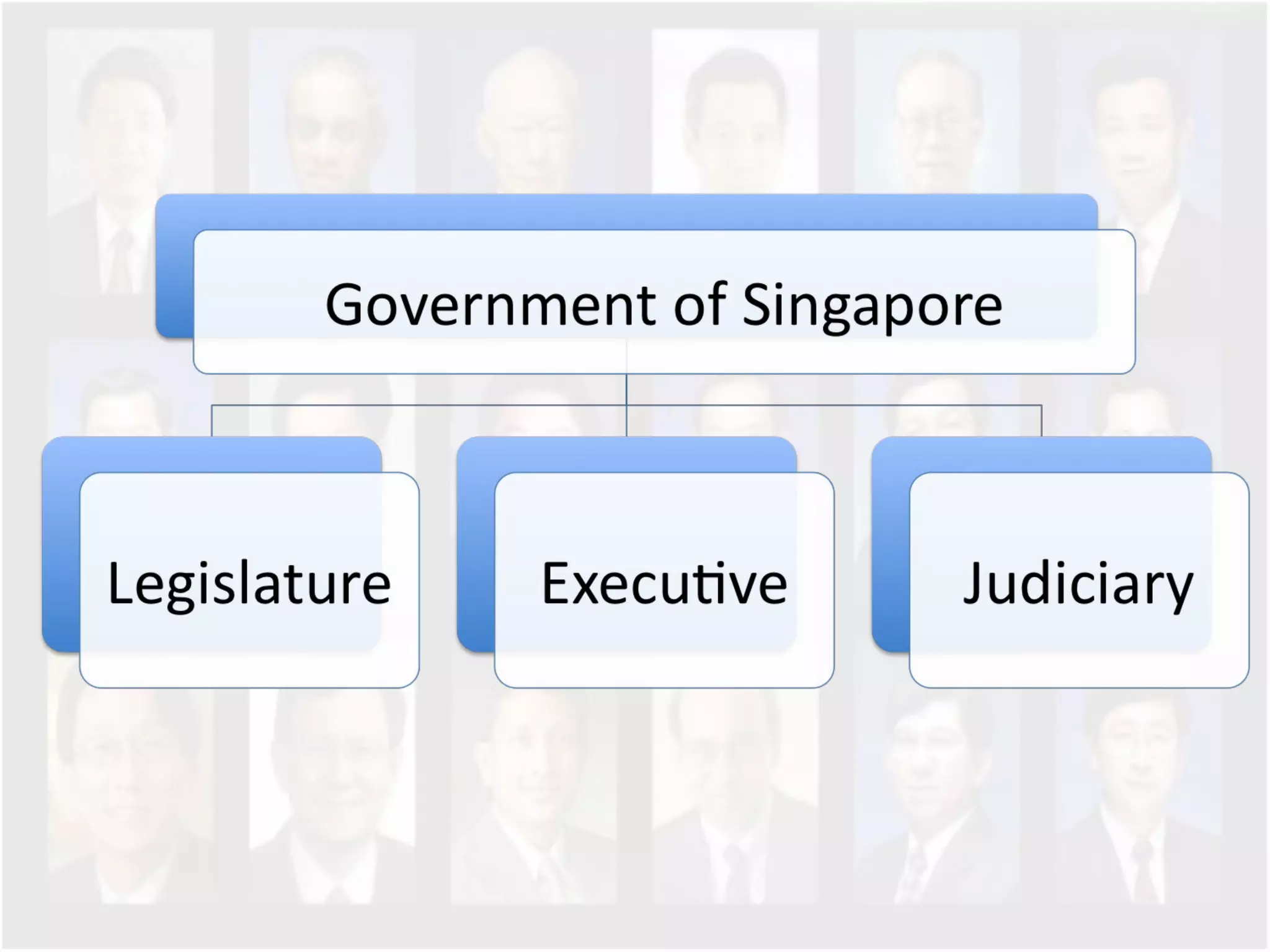
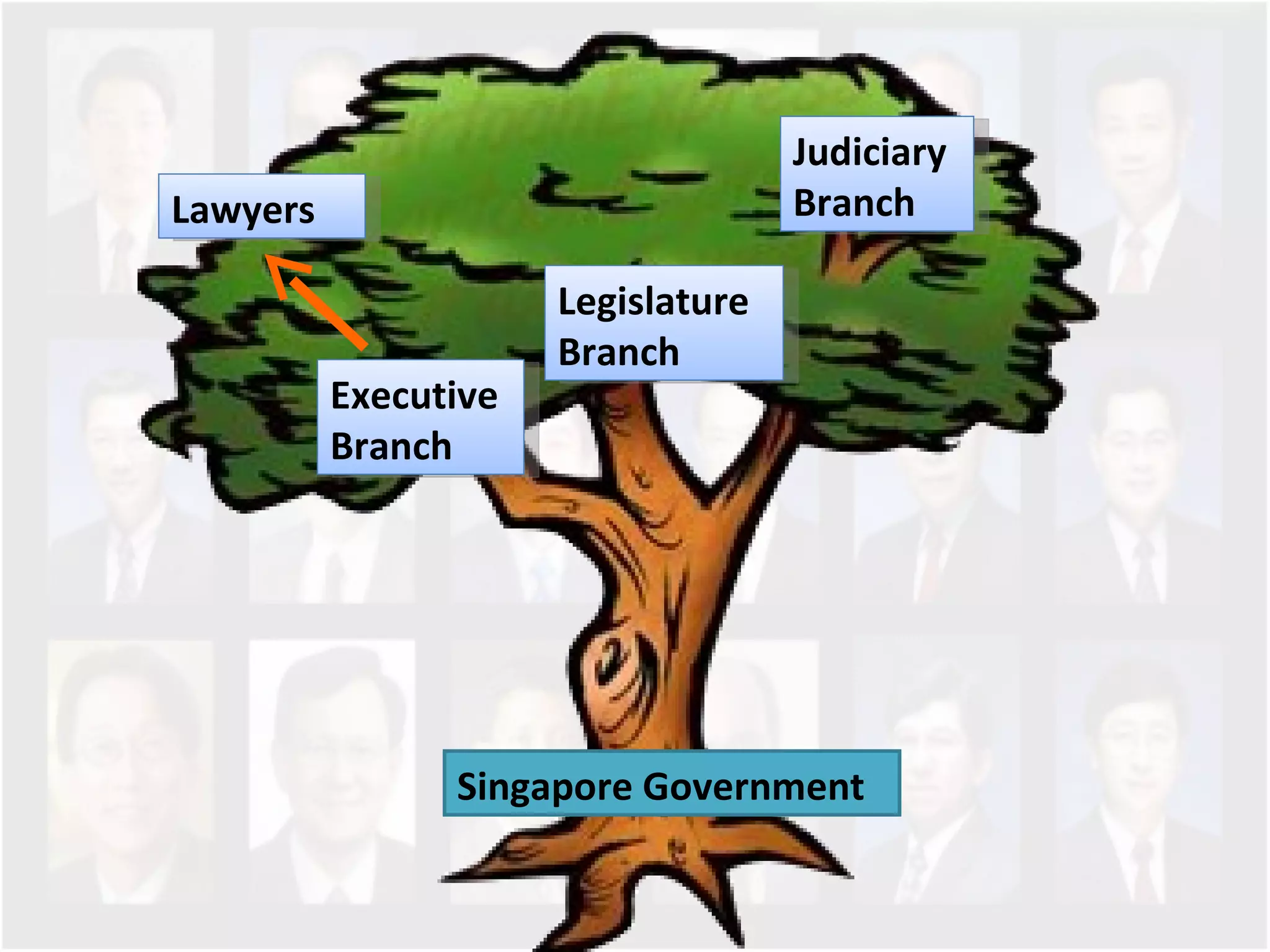
Singapore Government  Executive Branch Legislature Branch Judiciary Branch Lawyers
Lesson 2
What are the 4 functions of the government? What are the 3 branches of the government? What are the 2 keywords we learnt? What is 1 role of the people?  Recap
Today… we want to find out more about… 4 guiding principles of governance  How they are linked to the functions of the government
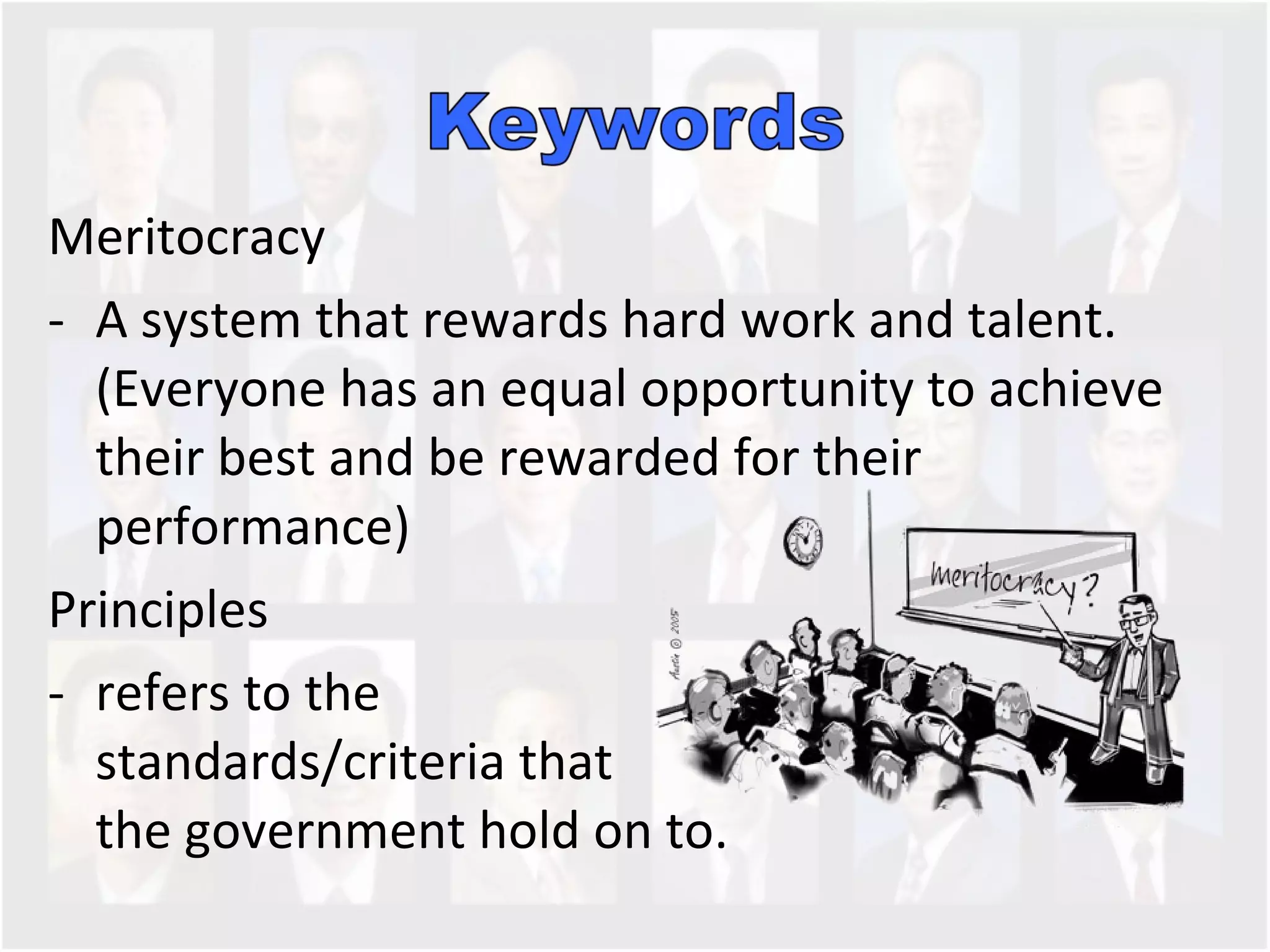
Meritocracy A system that rewards hard work and talent. (Everyone has an equal opportunity to achieve their best and be rewarded for their performance) Principles  refers to the  standards/criteria that  the government hold on to.
Leaders must be able to do what is right rather than what is popular. It is difficult to find good leadership and good governance. Potential leaders are specially selected and groomed.  Honesty is one quality highly valued by the government.
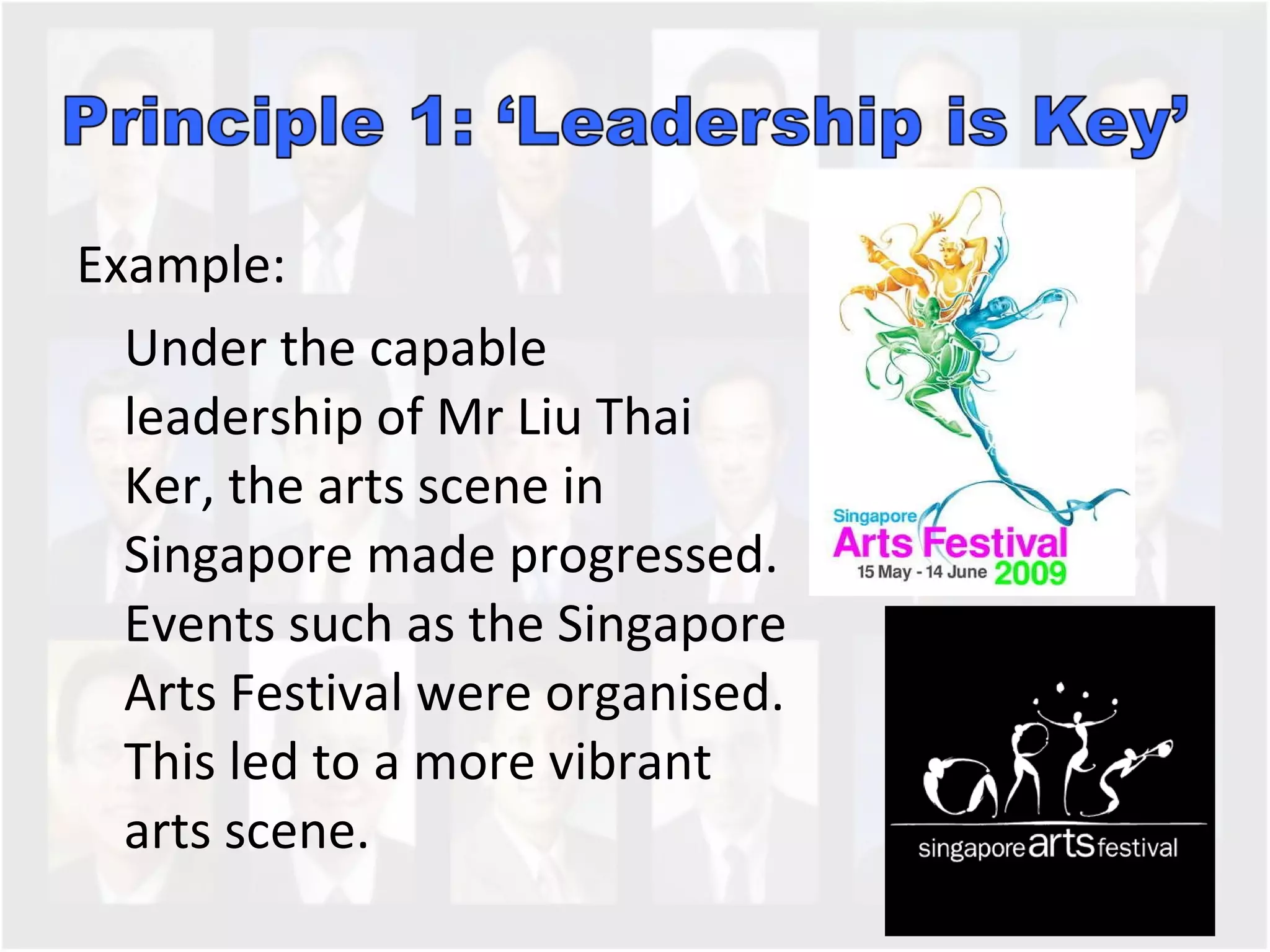
Example:  Under the capable leadership of Mr Liu Thai Ker, the arts scene in Singapore made progressed. Events such as the Singapore Arts Festival were organised. This led to a more vibrant arts scene.
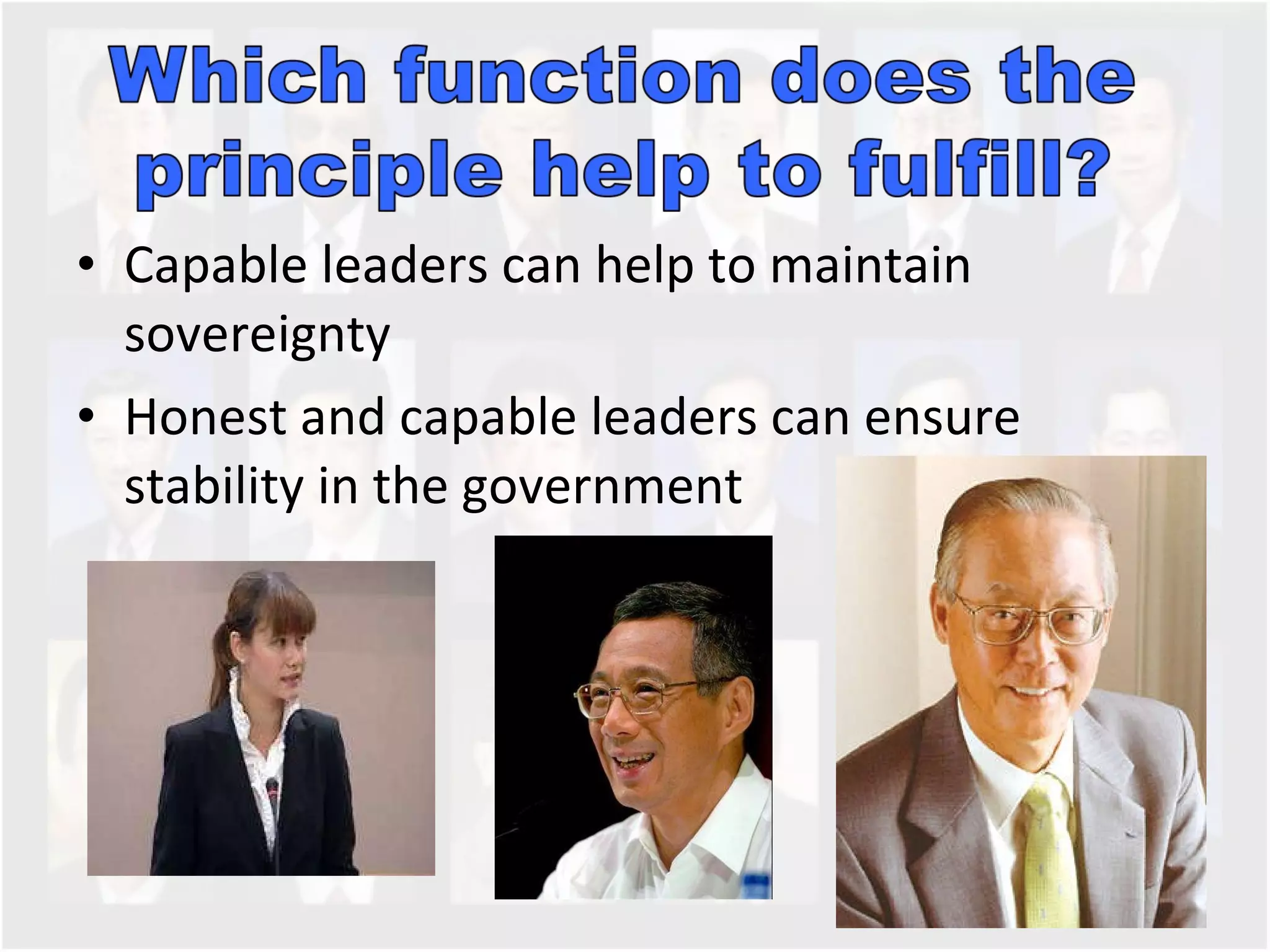
Capable leaders can help to maintain sovereignty  Honest and capable leaders can ensure stability in the government
Decisions made by the government need to be forward-looking The government anticipate future problems or technology and make decisions that can help Singapore tackle the problems. This helps to prepare Singapore for the future.
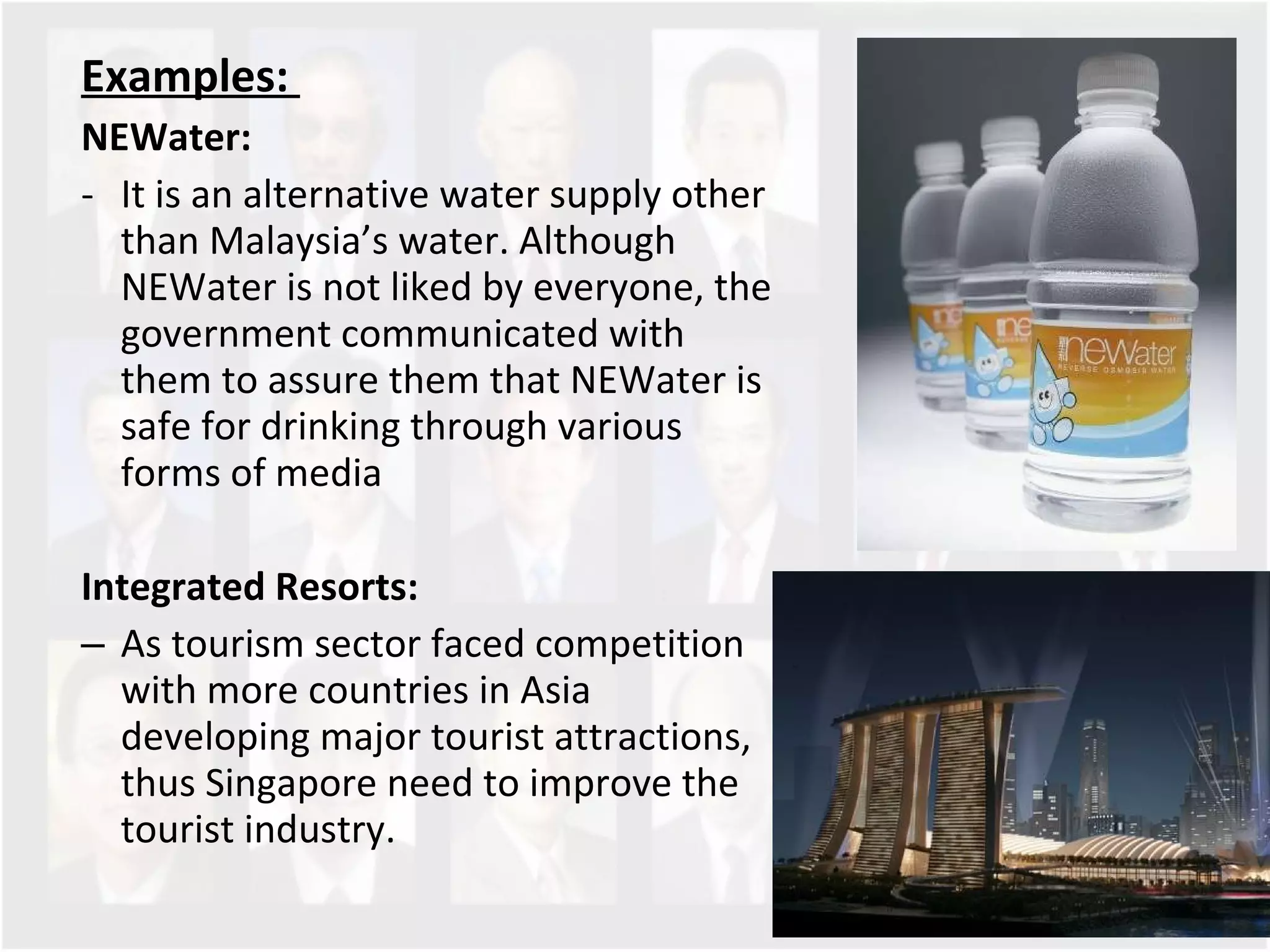
Examples:  NEWater: It is an alternative water supply other than Malaysia’s water. Although NEWater is not liked by everyone, the government communicated with them to assure them that NEWater is safe for drinking through various forms of media  Integrated Resorts: As tourism sector faced competition with more countries in Asia developing major tourist attractions, thus Singapore need to improve the tourist industry.
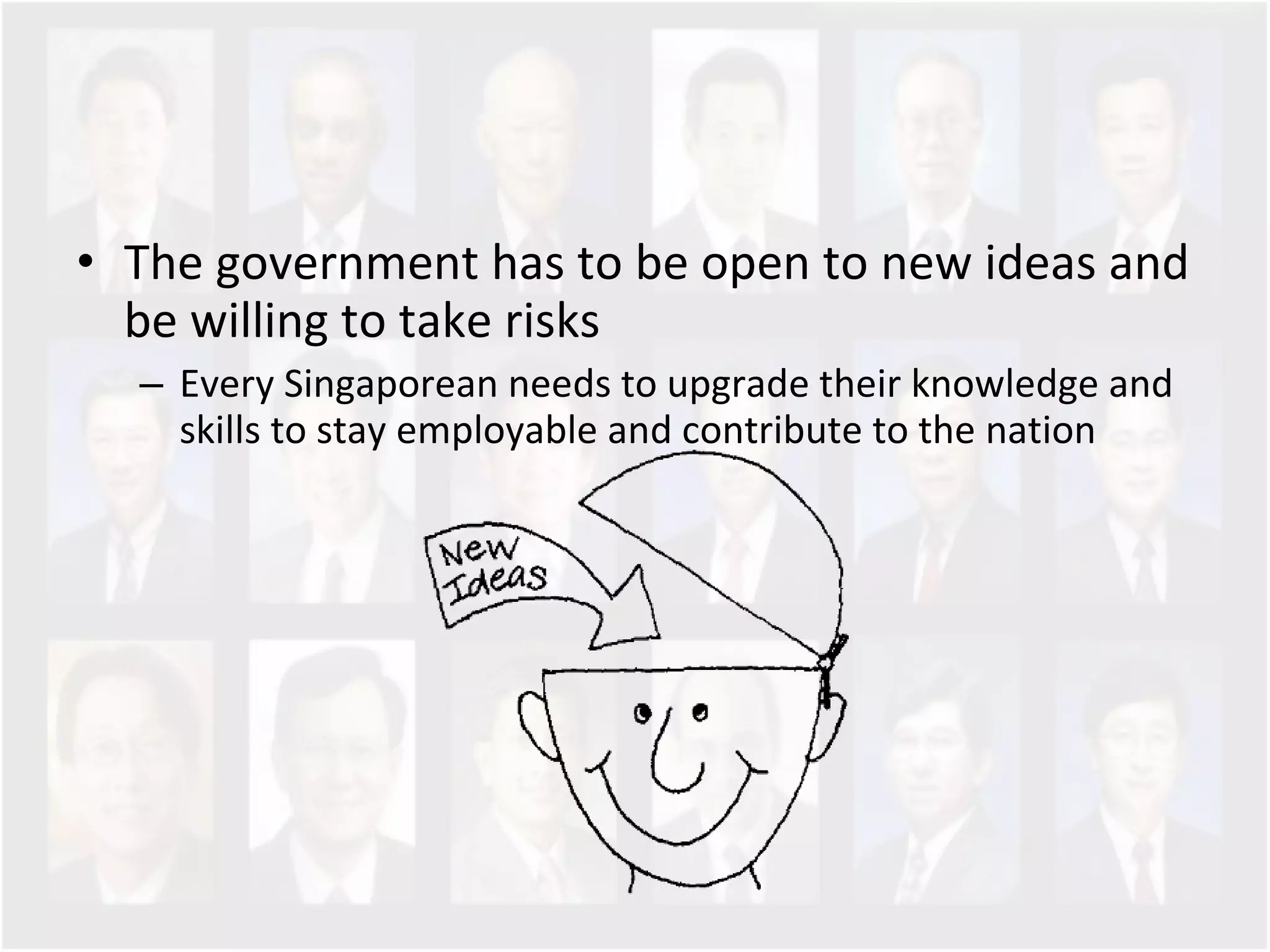
The government has to be open to new ideas and be willing to take risks  Every Singaporean needs to upgrade their knowledge and skills to stay employable and contribute to the nation
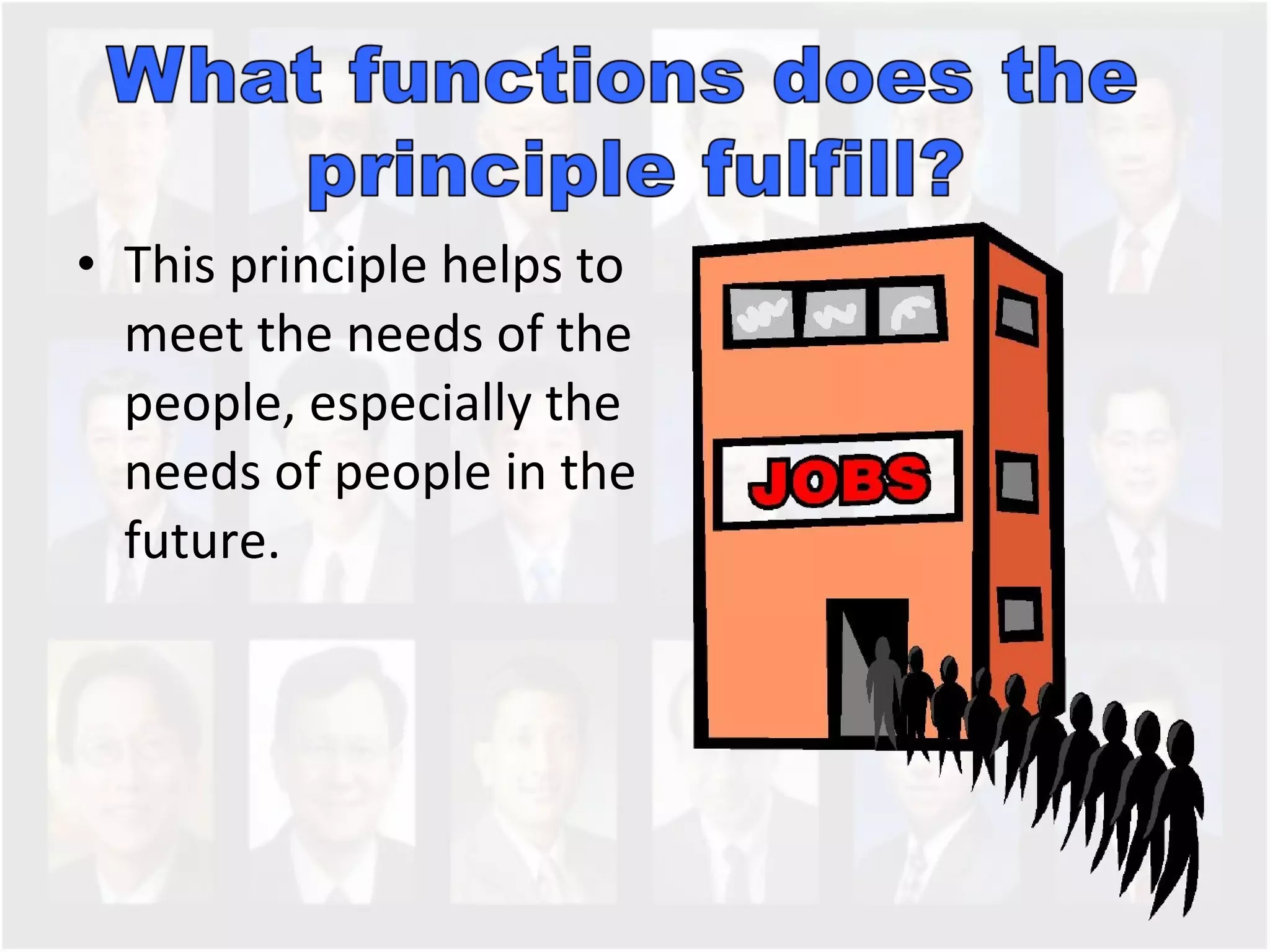
This principle helps to meet the needs of the people, especially the needs of people in the future.
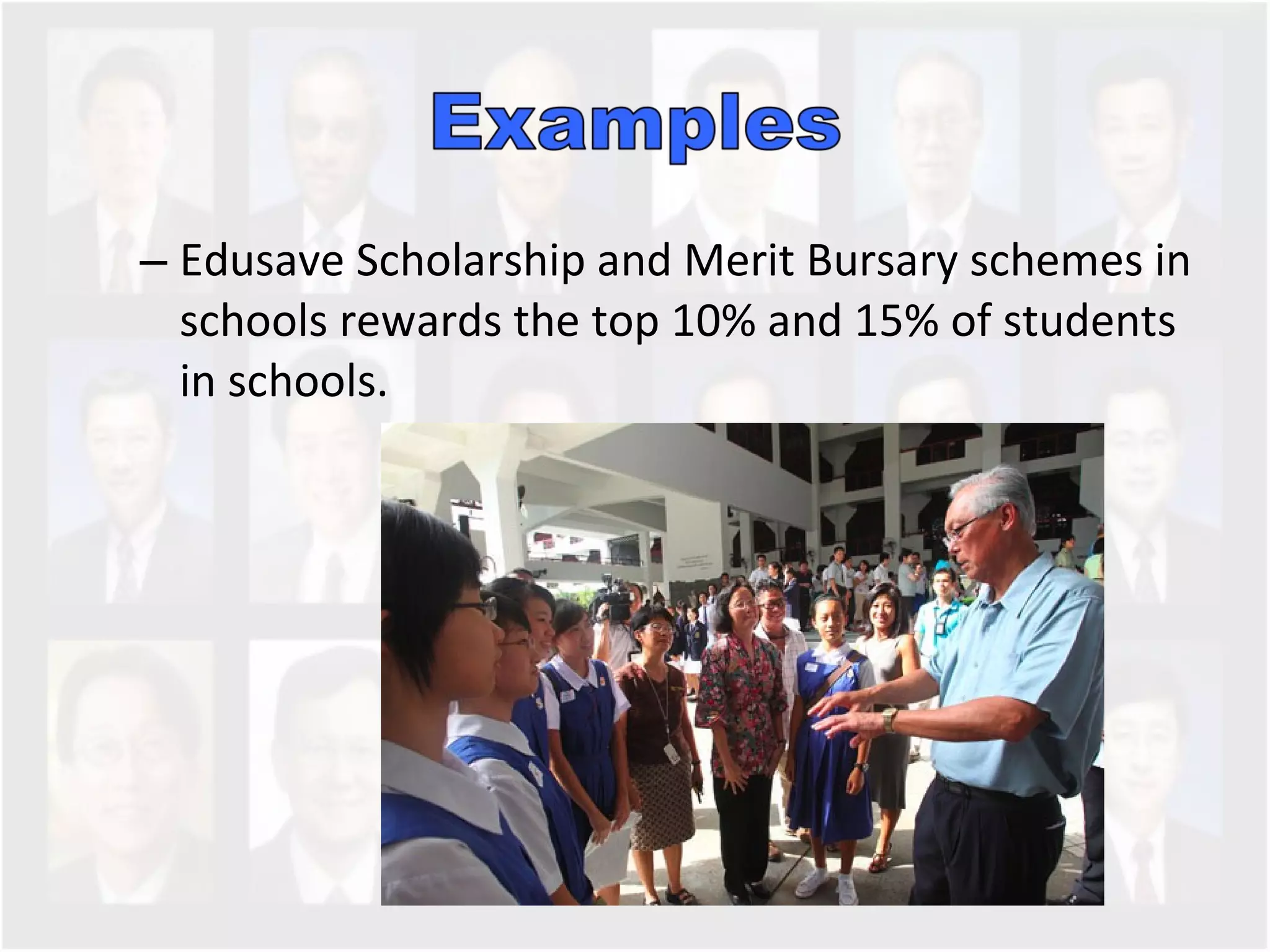
We can earn a living and safeguard our future only through our efforts and intelligence. When people are rewarded based on their abilities and hard work, they are encouraged to do well  This is done with the policy of Meritocracy
Edusave Scholarship and Merit Bursary schemes in schools rewards the top 10% and 15% of students in schools.
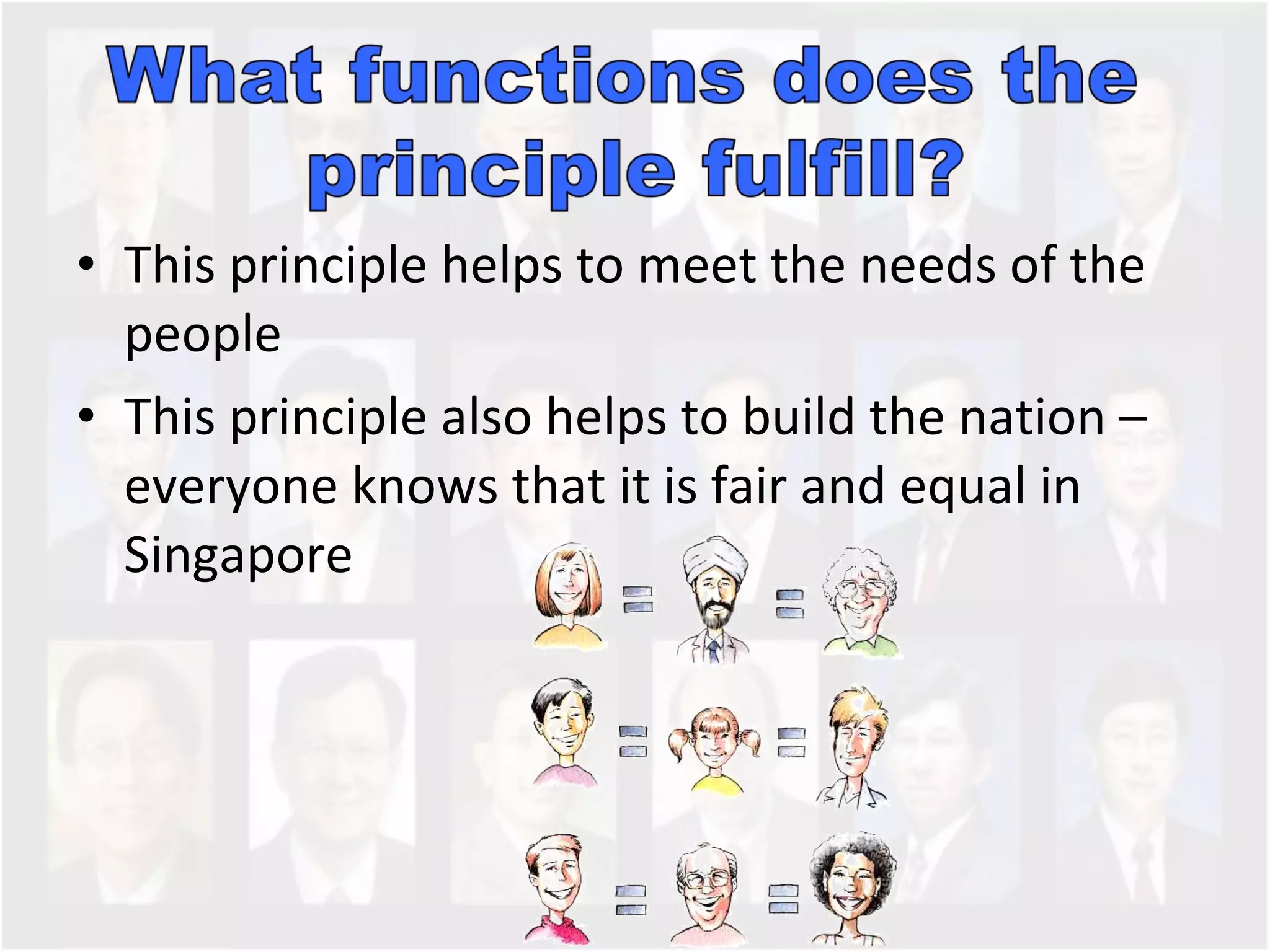
This principle helps to meet the needs of the people This principle also helps to build the nation – everyone knows that it is fair and equal in Singapore
The government wants to create an inclusive society where citizens feel a sense of belonging and ownership. This can be done through giving citizens more opportunities say in decision-making. E.g. Gathering feedback and responses from people regarding the building of the Integrated Resorts.
Policy decisions made to serve the needs of the nation may change to suit the needs of the people and the nation over time
Helps to build a nation  by encouraging a sense of belonging among people Helps to meet people’s needs  People can voice out their concerns and needs
To summarize…
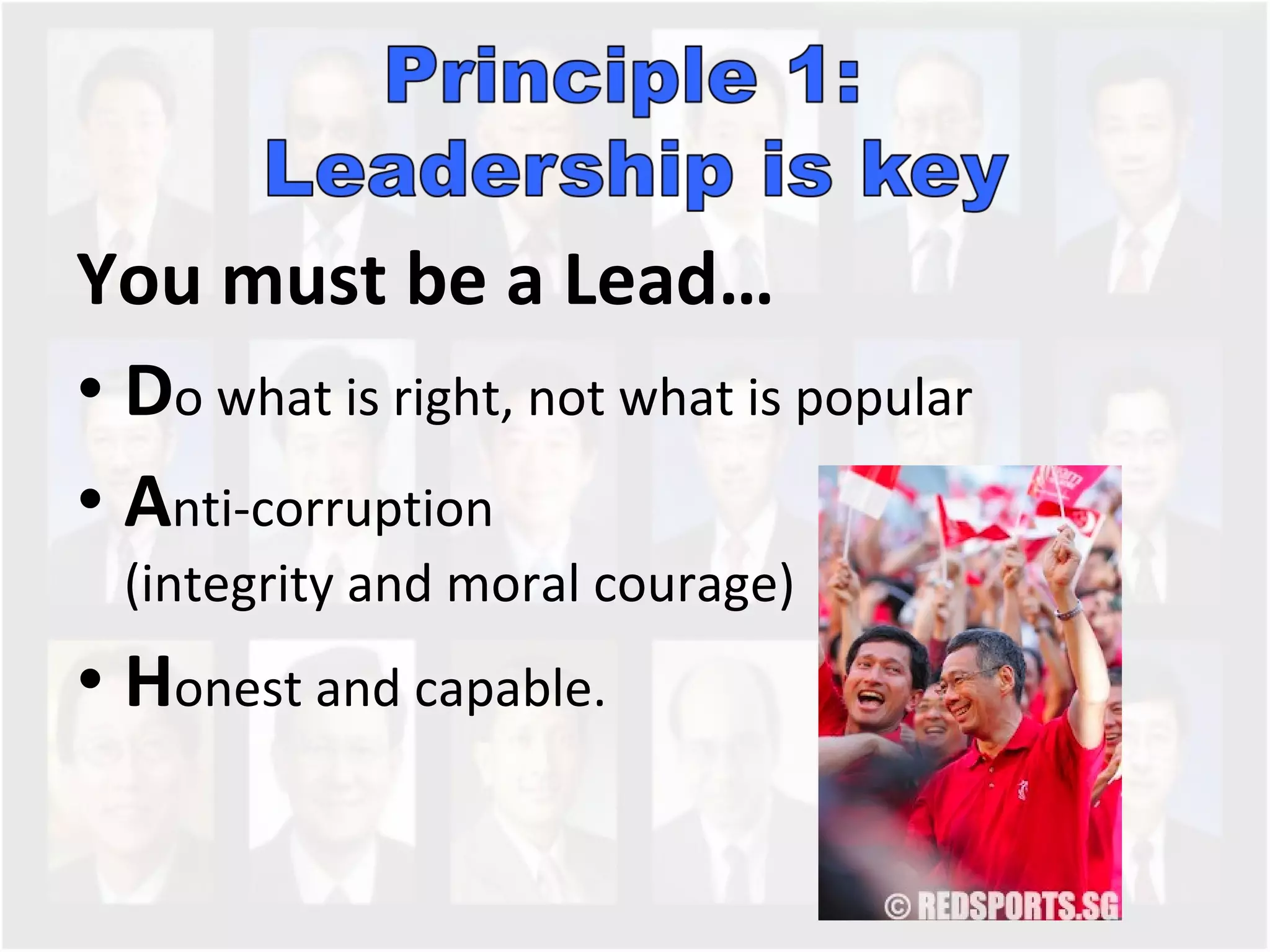
You must be a Lead… D o what is right, not what is popular A nti-corruption  (integrity and moral courage)  H onest and capable.
Leaders must... F orward looking, O pen minded, C reative,  U nderstanding the needs of… S ingapore
M eritocracy E ncourages Me to work hard!
We want Singaporeans to… B elong  O pportunities to take part in decision-making N eeds change, so…  D ecisions/policies may change over time.
Lesson 3
 
 
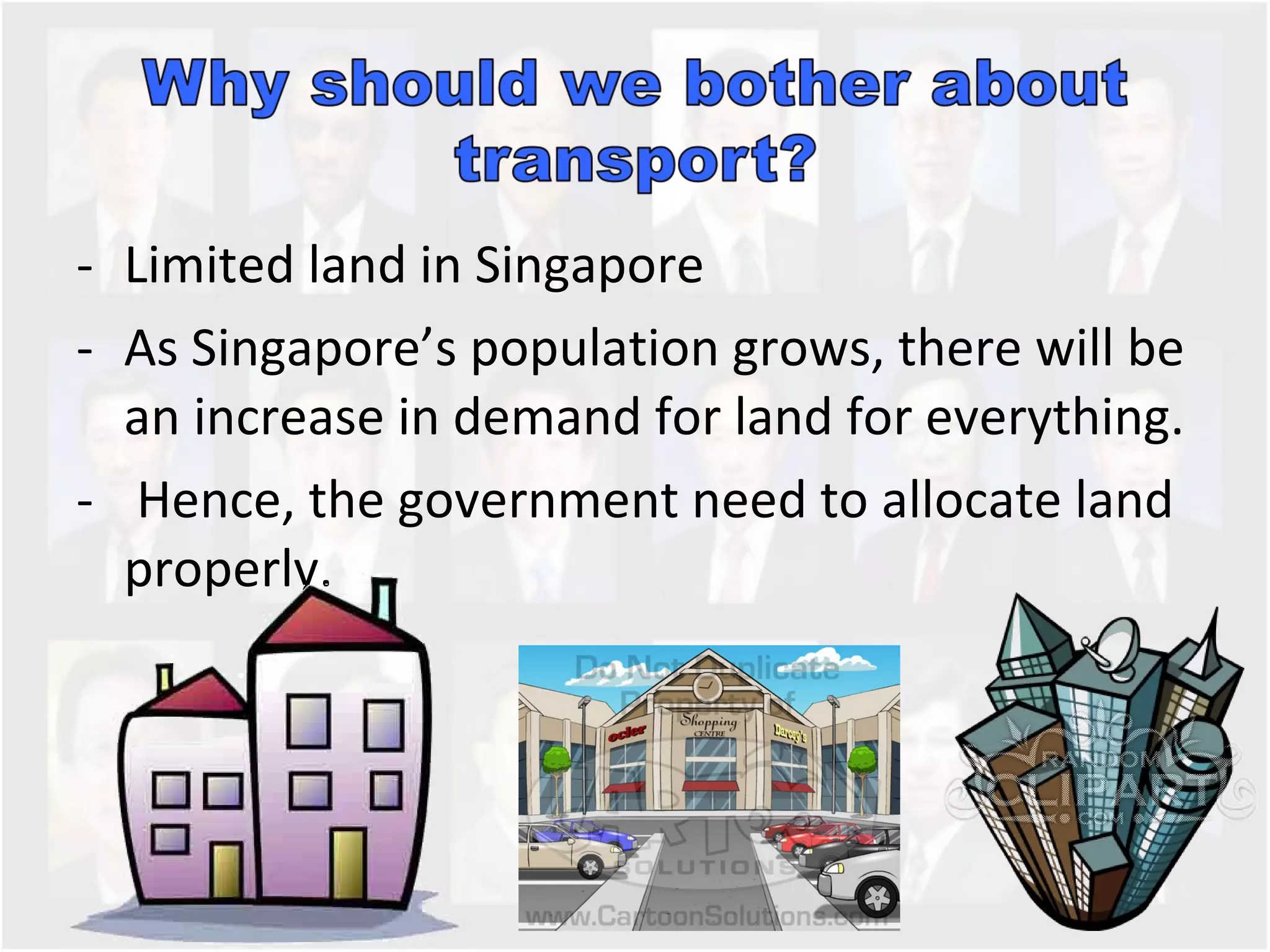
Limited land in Singapore As Singapore’s population grows, there will be an increase in demand for land for everything. Hence, the government need to allocate land properly.
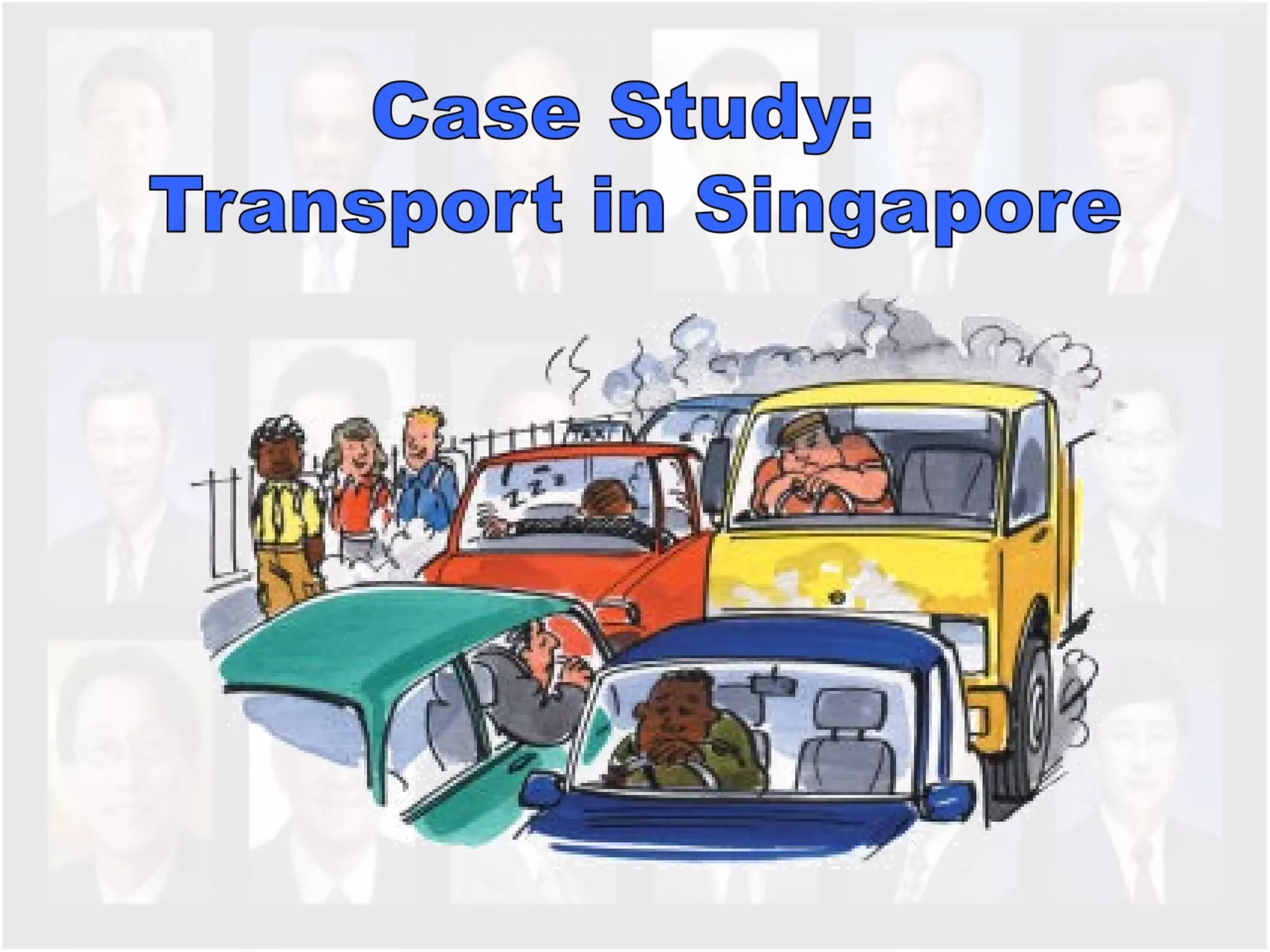
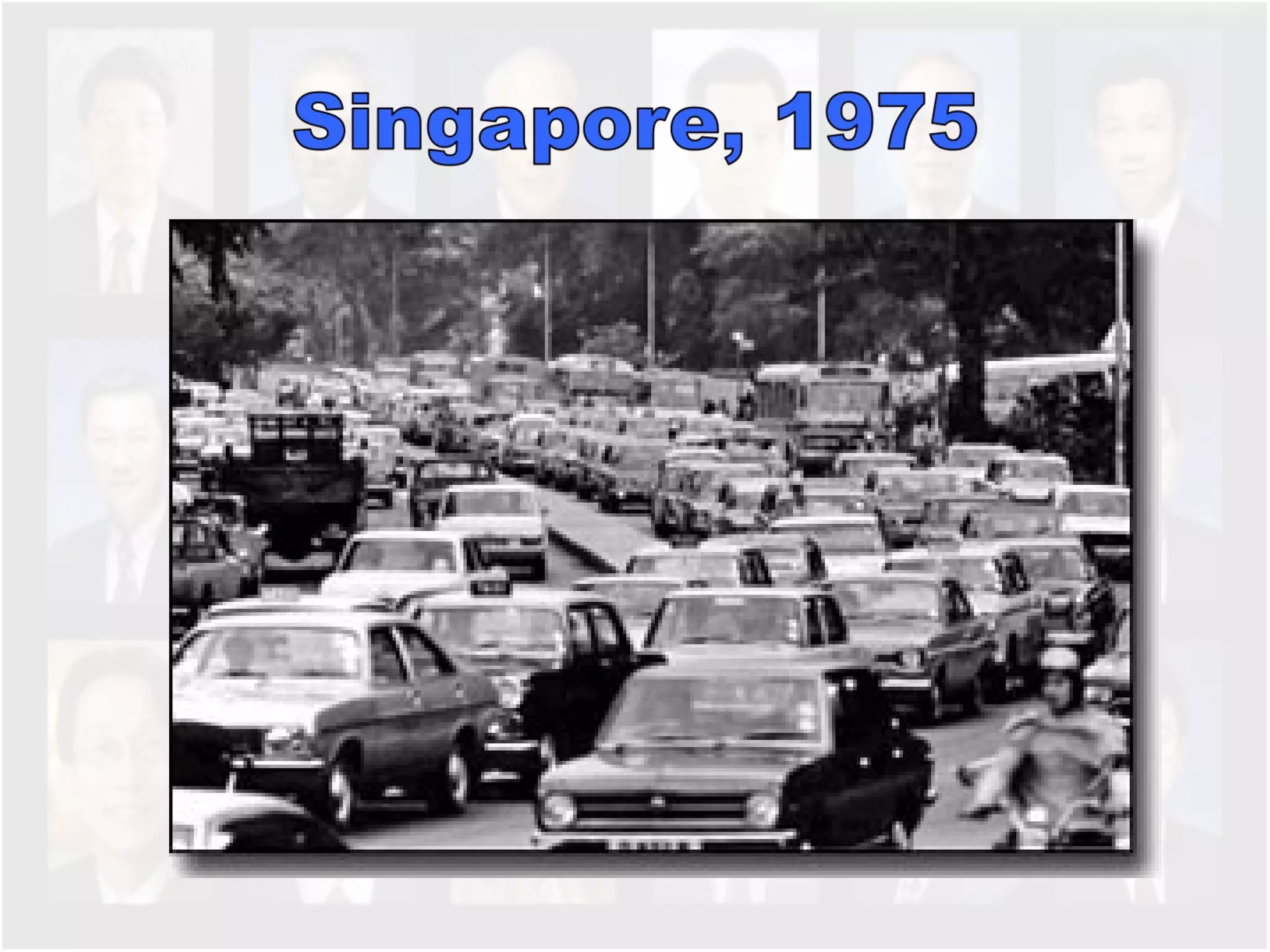
1970s: Singapore’s businesses were growing quickly Terrible traffic in the Central Business District (CBD) during peak period
 
Area Licensing Scheme (ALS) To manage traffic flow in the Central Business District (CBD) Motorists had to pay for the use of certain roads in Singapore, known as ‘Restricted Zones’
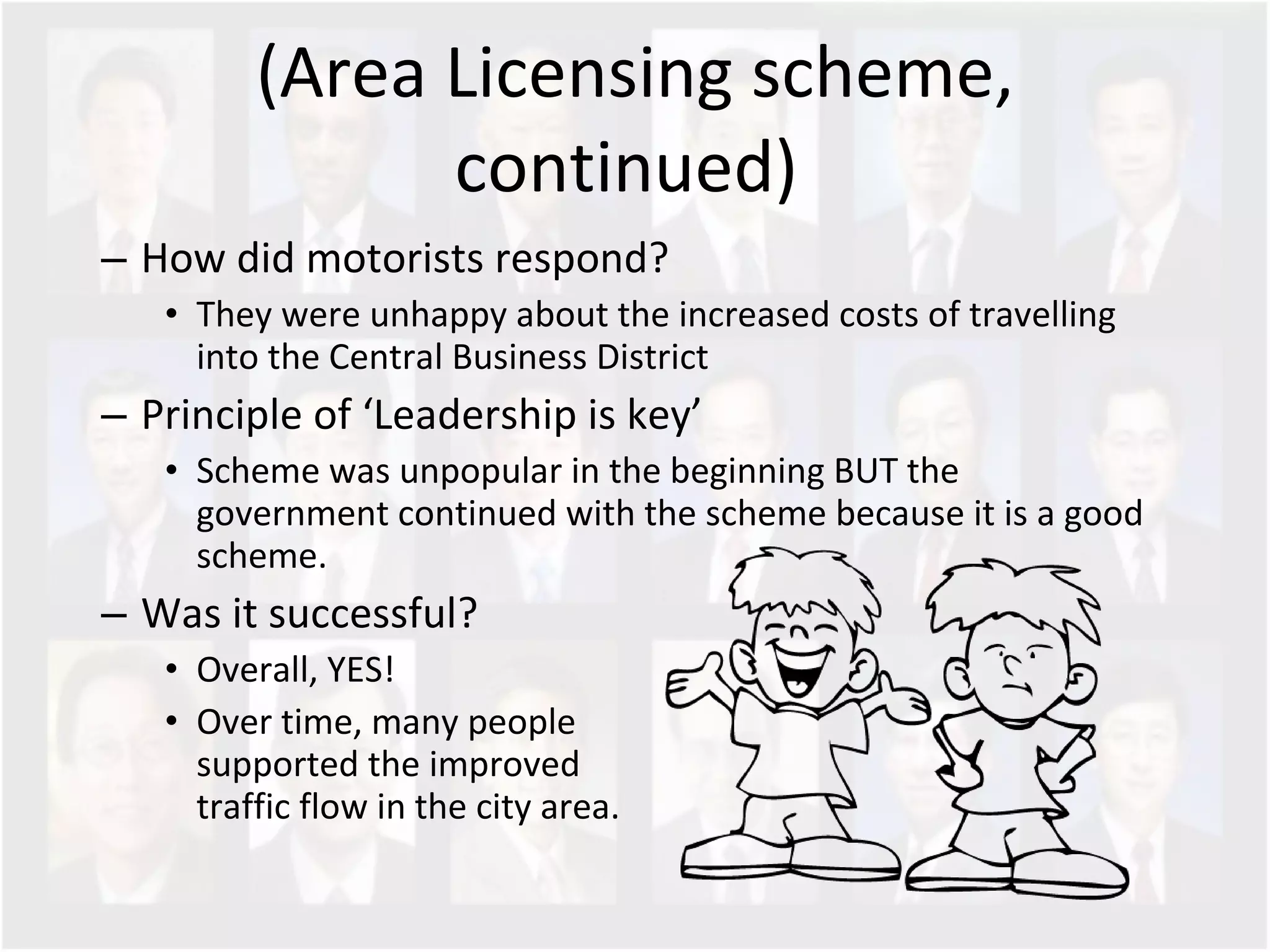
(Area Licensing scheme, continued)  How did motorists respond? They were unhappy about the increased costs of travelling into the Central Business District Principle of ‘Leadership is key’ Scheme was unpopular in the beginning BUT the government continued with the scheme because it is a good scheme.  Was it successful? Overall, YES!  Over time, many people  supported the improved  traffic flow in the city area.
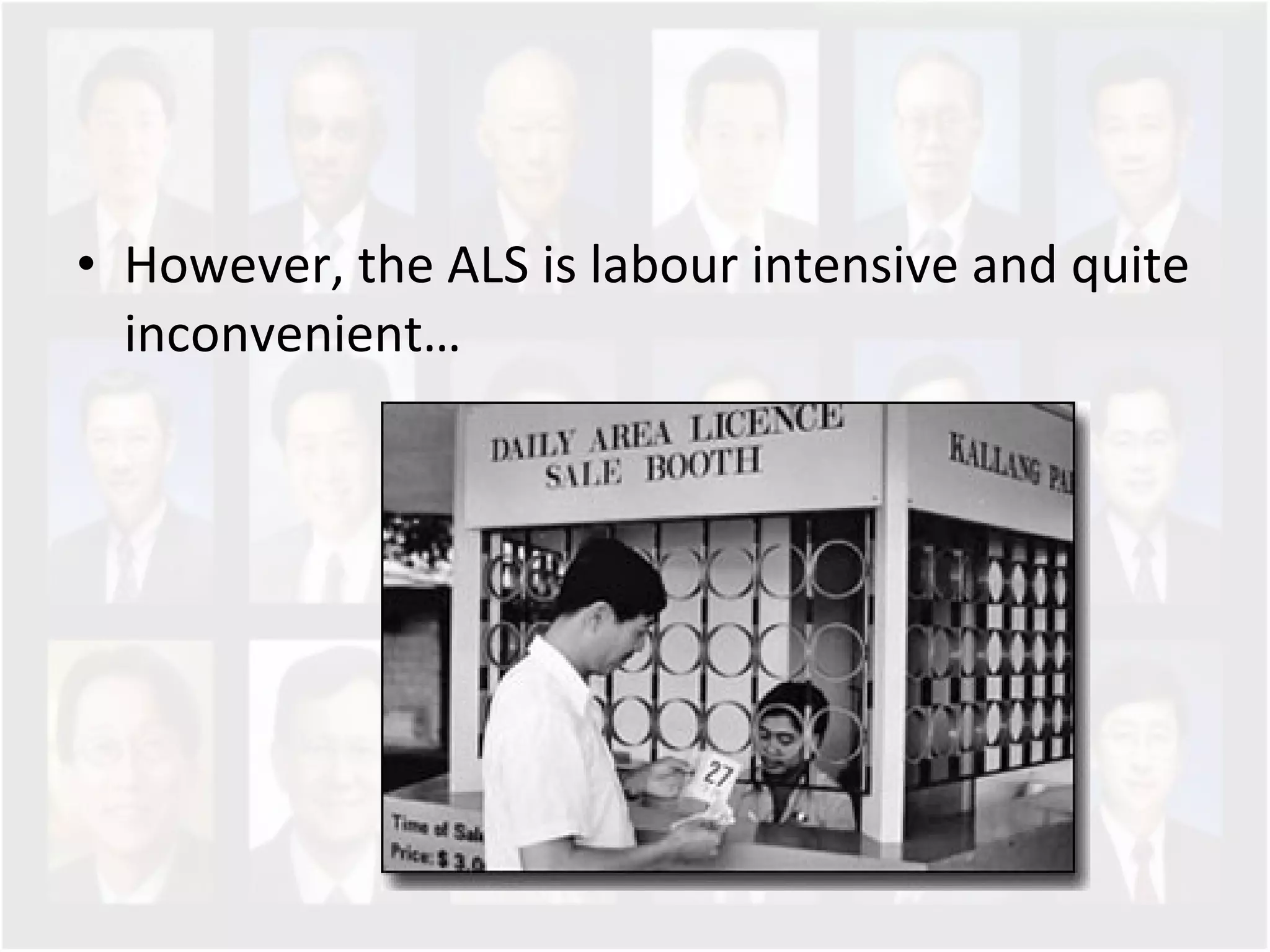
However, the ALS is labour intensive and quite inconvenient…
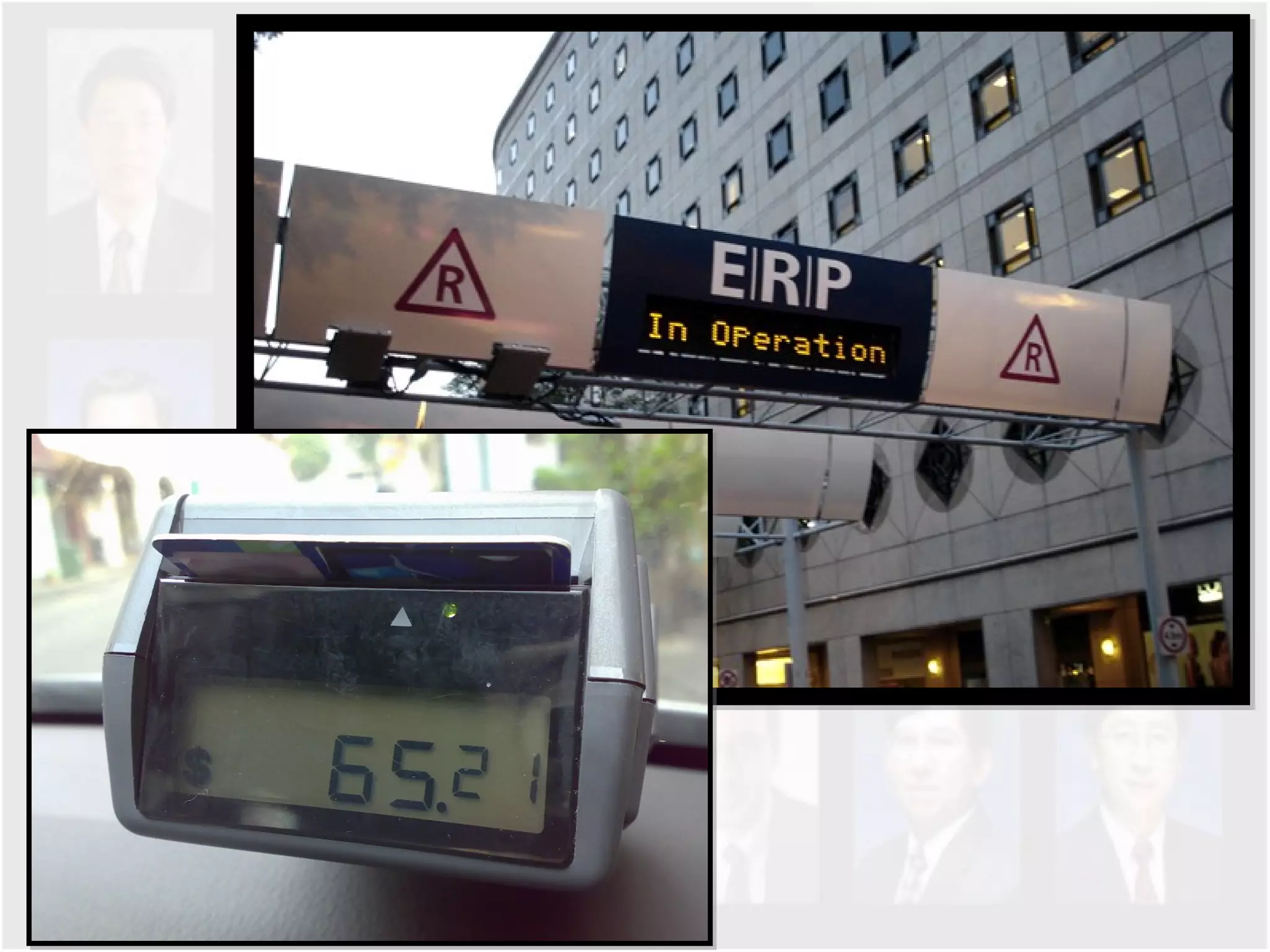
As technology improved, more efficient ways of monitoring and regulating traffic flow became possible ERP replaced ALS in 1988.  Same purpose as the ALS, but more efficient and effective.
 
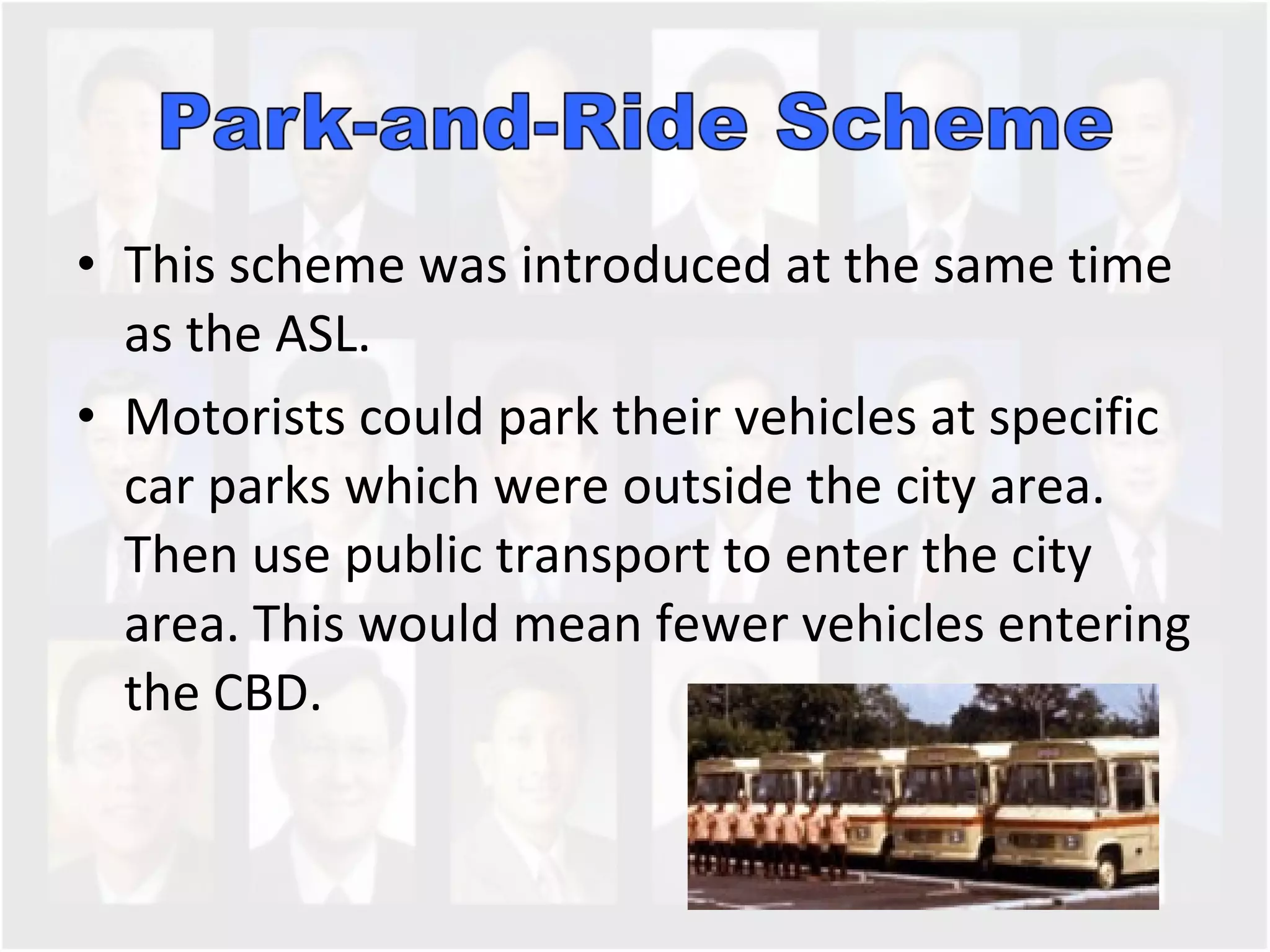
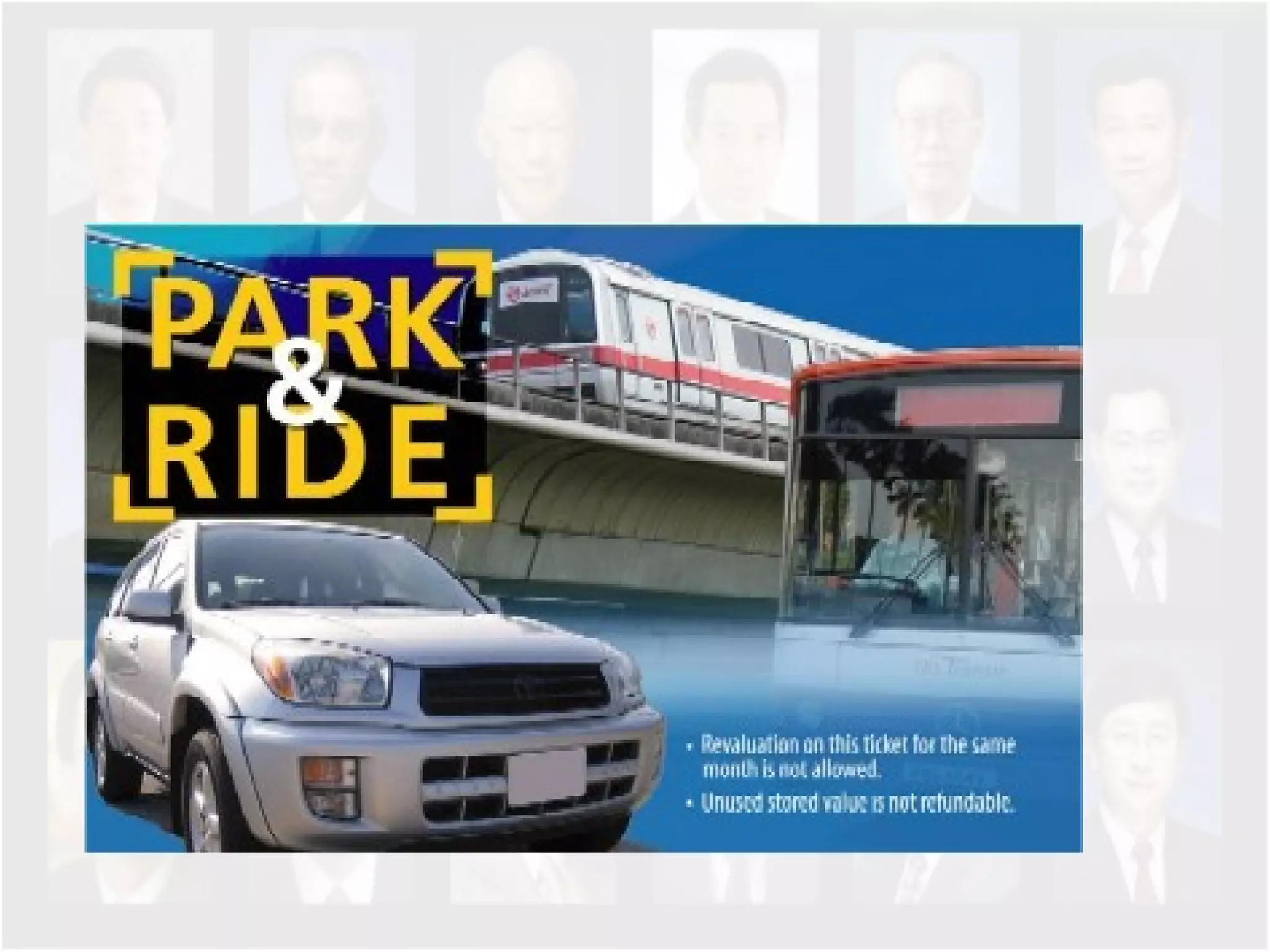
This scheme was introduced at the same time as the ASL.  Motorists could park their vehicles at specific car parks which were outside the city area. Then use public transport to enter the city area. This would mean fewer vehicles entering the CBD.
Was it successful? 1970s: NOPE. It did not work  Motorists just took public transport all the way, OR, drove into the CBD area before the ALS operation time of 7:30am. They did not think it was worthwhile to leave their cars parked outside the city all day. Today: Yes!  The scheme is still being used today.  What can we learn? As time passes and the needs of people change, methods that did not work in the past may work today.
 
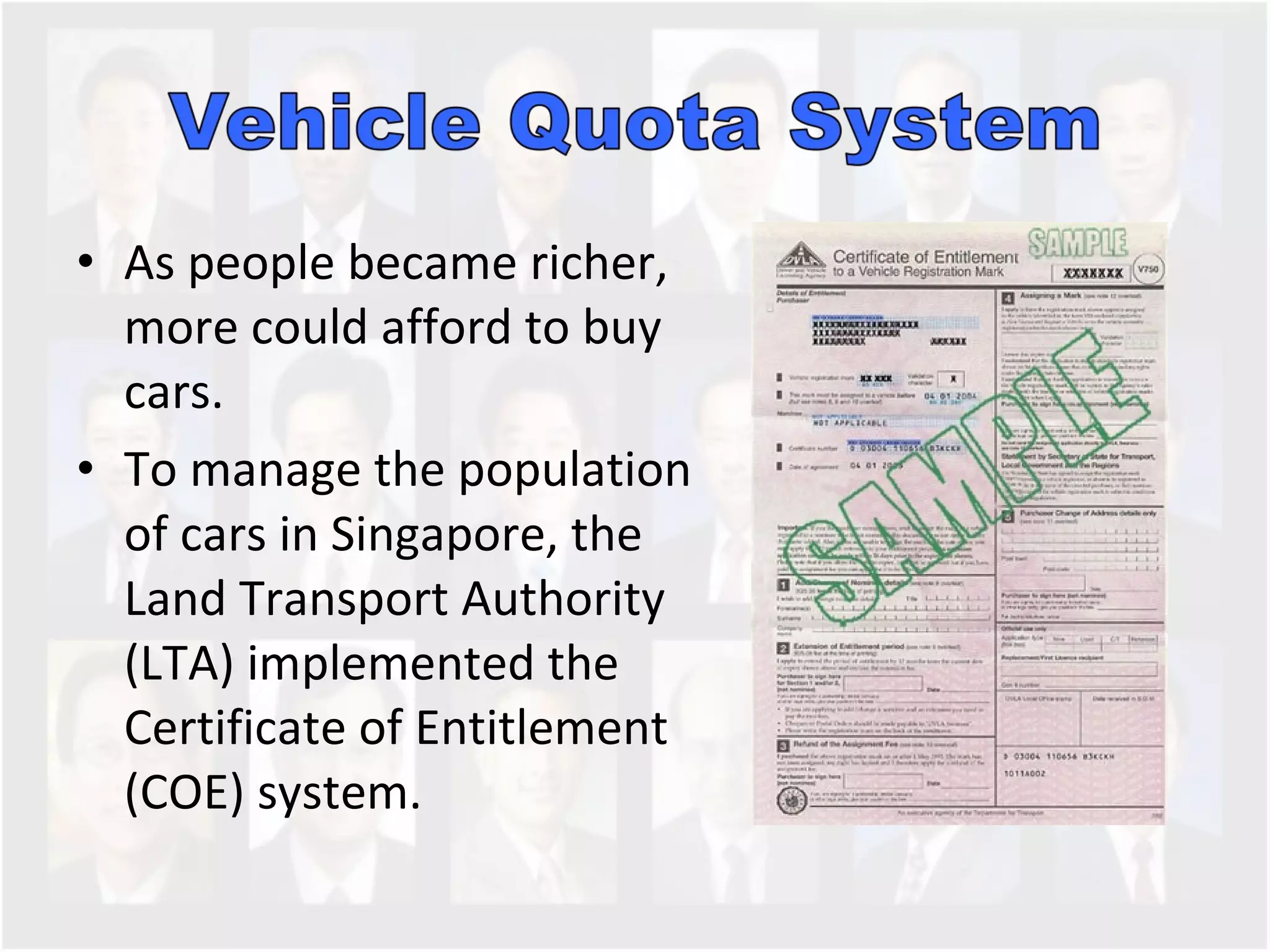
As people became richer, more could afford to buy cars.  To manage the population of cars in Singapore, the Land Transport Authority (LTA) implemented the Certificate of Entitlement (COE) system.
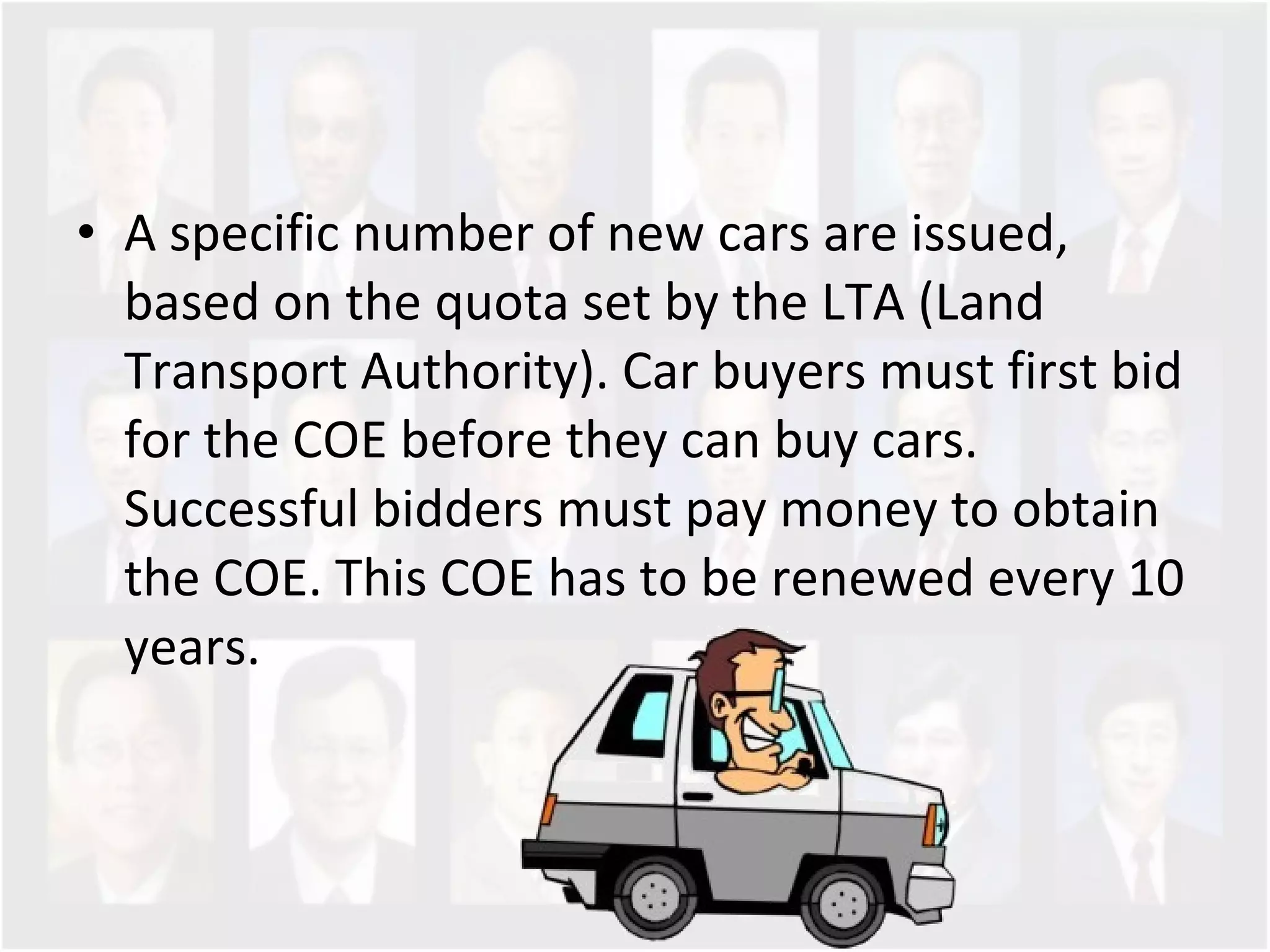
A specific number of new cars are issued, based on the quota set by the LTA (Land Transport Authority). Car buyers must first bid for the COE before they can buy cars. Successful bidders must pay money to obtain the COE. This COE has to be renewed every 10 years.
Summary  4 measures to manage traffic in Singapore: P ark-and-ride Scheme A rea Licensing Scheme V ehicle Quota System  E lectronic Road Pricing The government must  PAVE  the way for smoother traffic flow!
Lesson 4
Recap: We have learnt… The 4 functions of the government 4 guiding principles that the government tries to follow 1 case study: Transport    how does the government manage transport
Today… we will start on… Population policy  Why do we need to study about population policy?  How does the government manage the population?
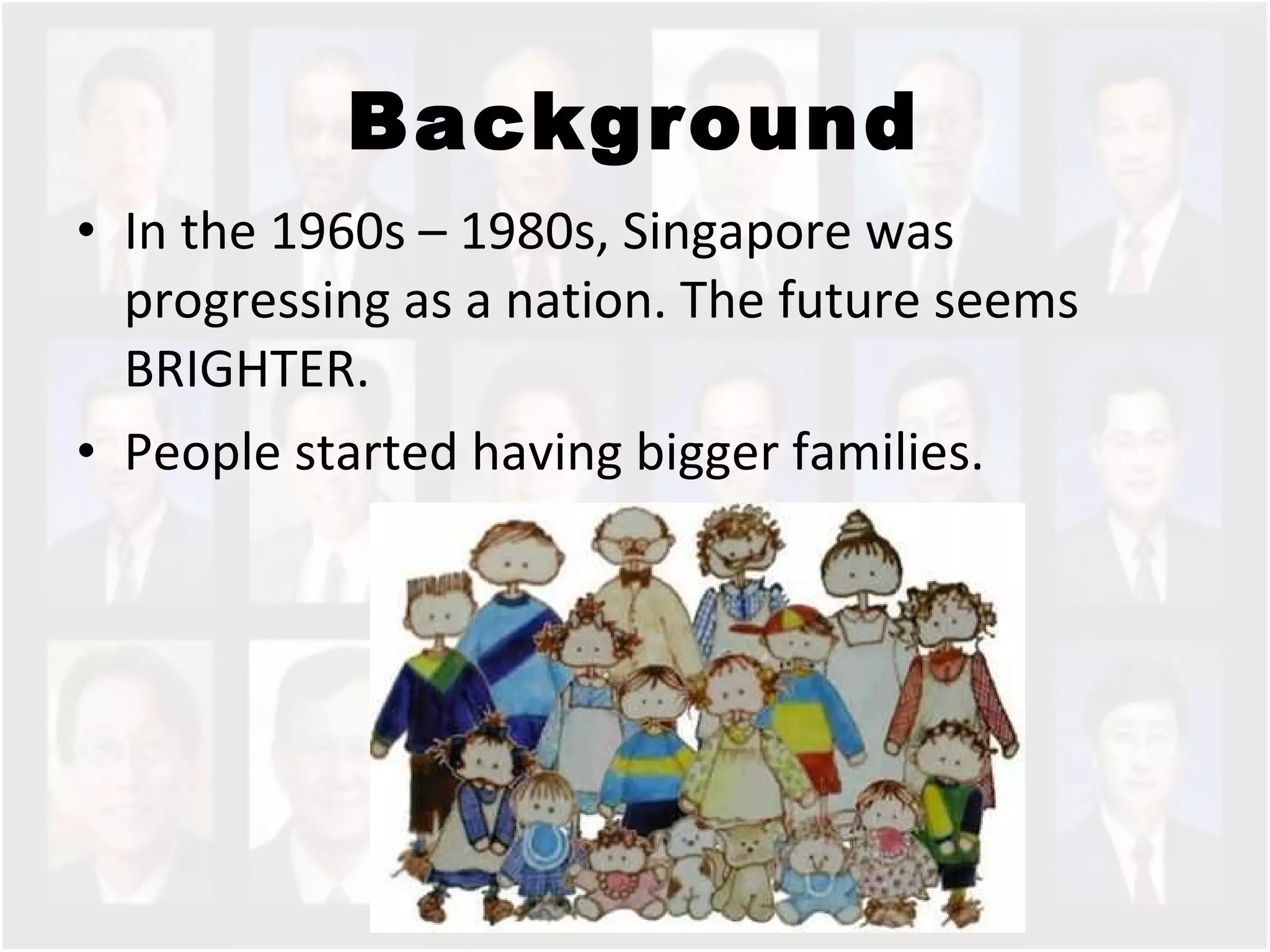
Background In the 1960s – 1980s, Singapore was progressing as a nation. The future seems BRIGHTER.  People started having bigger families.
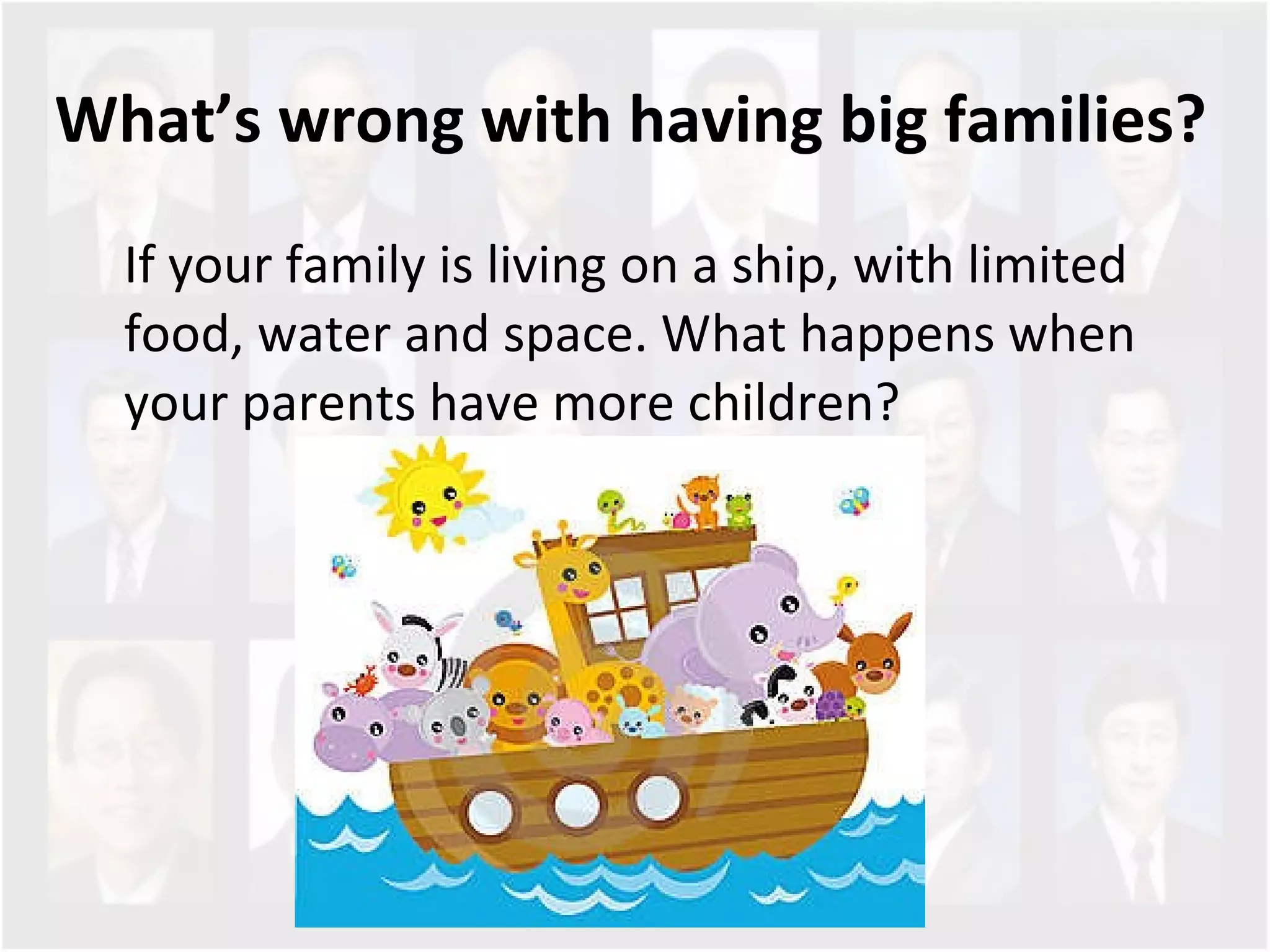
What’s wrong with having big families?  If your family is living on a ship, with limited food, water and space. What happens when your parents have more children?
Impacts of population explosion  Unemployment  There will not be enough jobs for everyone.  Shortage of housing There will not be enough houses for everyone .
Not enough healthcare services How are the queues like when you go to polyclinics these days? What happens when there is a population explosion?  Not enough education services There will be a need to build more schools (primary, secondary, polytechnics, ITEs, universities)  Impacts of population explosion  Problem of not having  enough resources
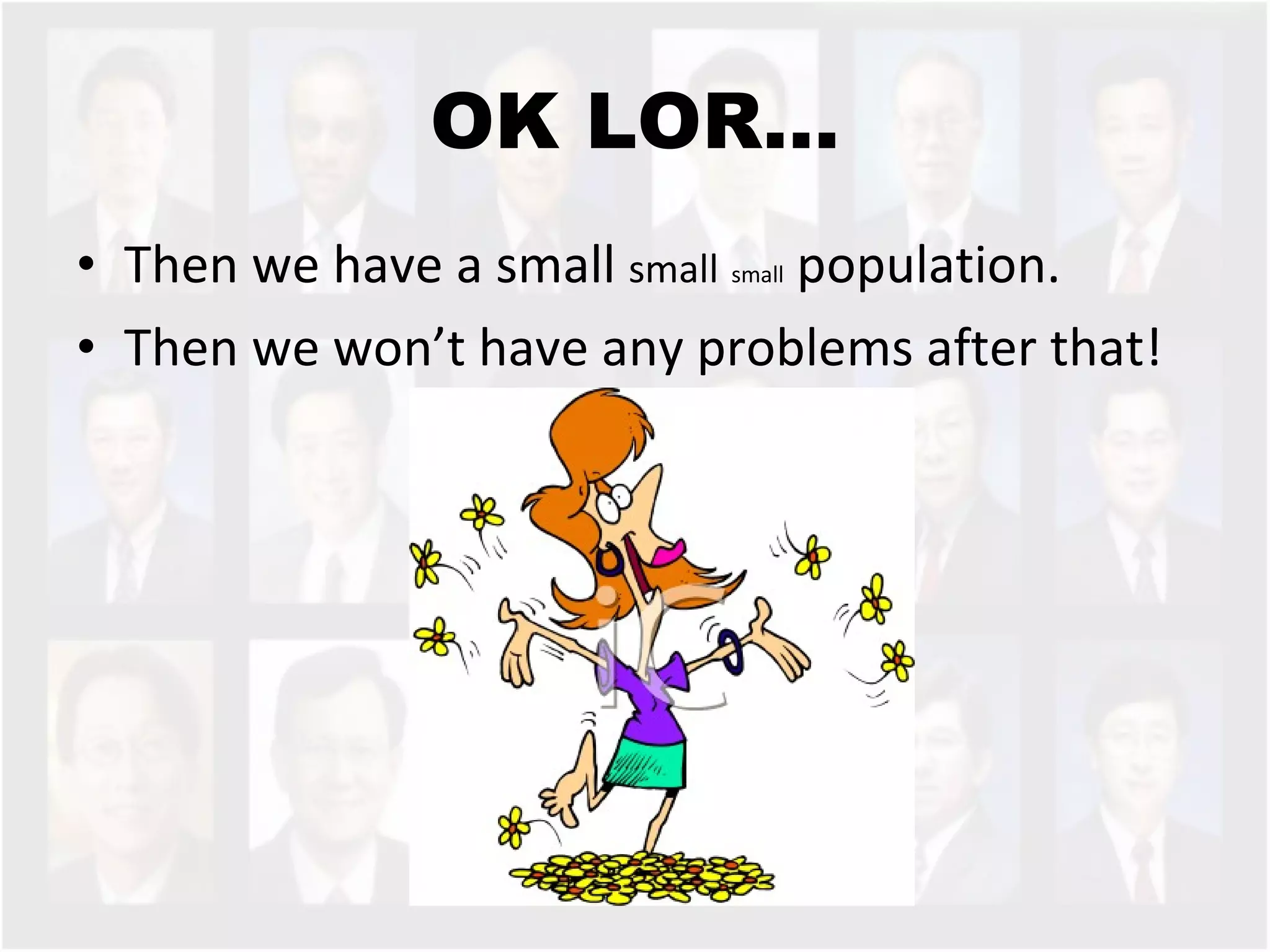
OK LOR… Then we have a small  small   small  population.  Then we won’t have any problems after that!
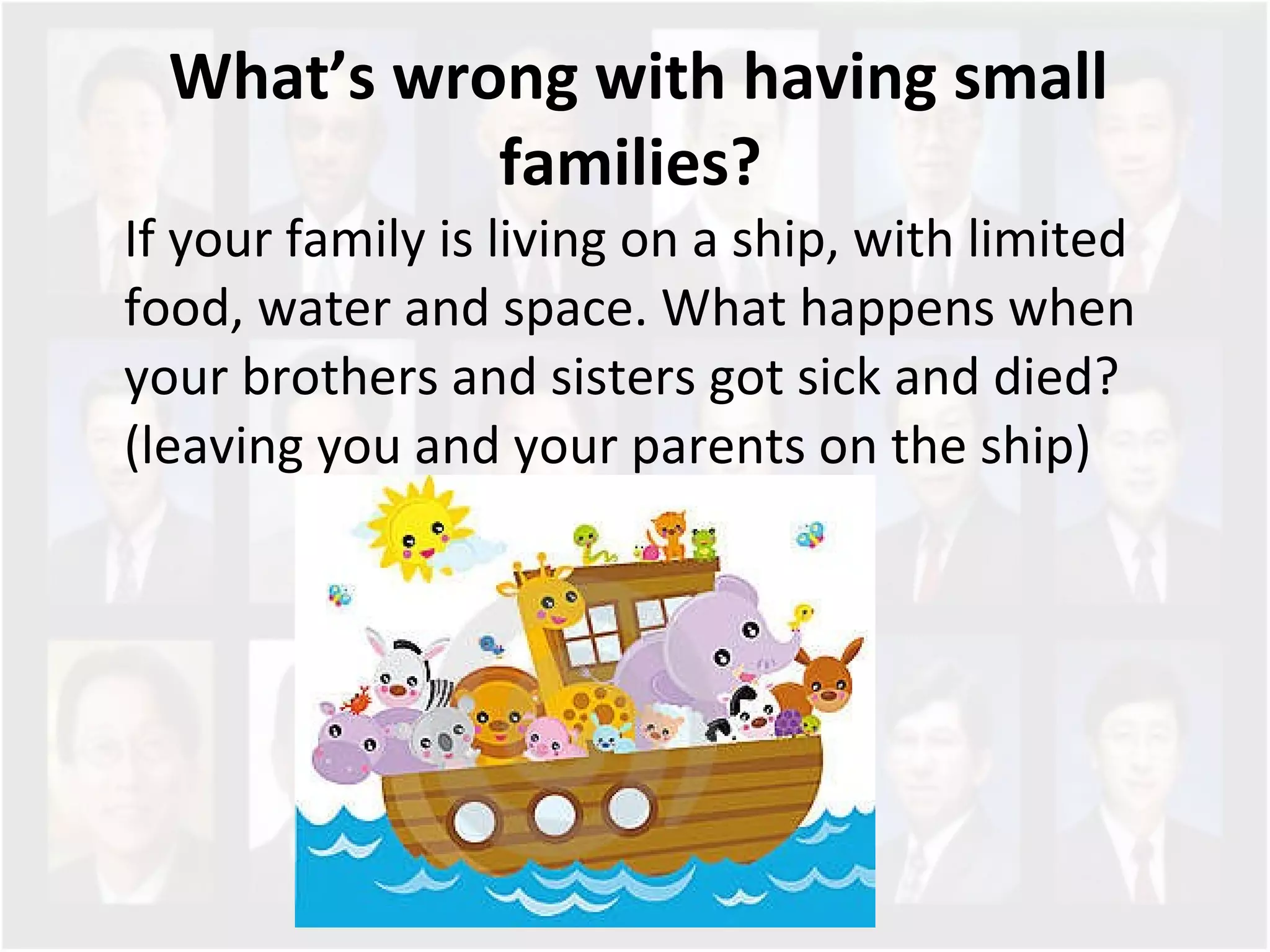
What’s wrong with having small families?  If your family is living on a ship, with limited food, water and space. What happens when your brothers and sisters got sick and died?  (leaving you and your parents on the ship)
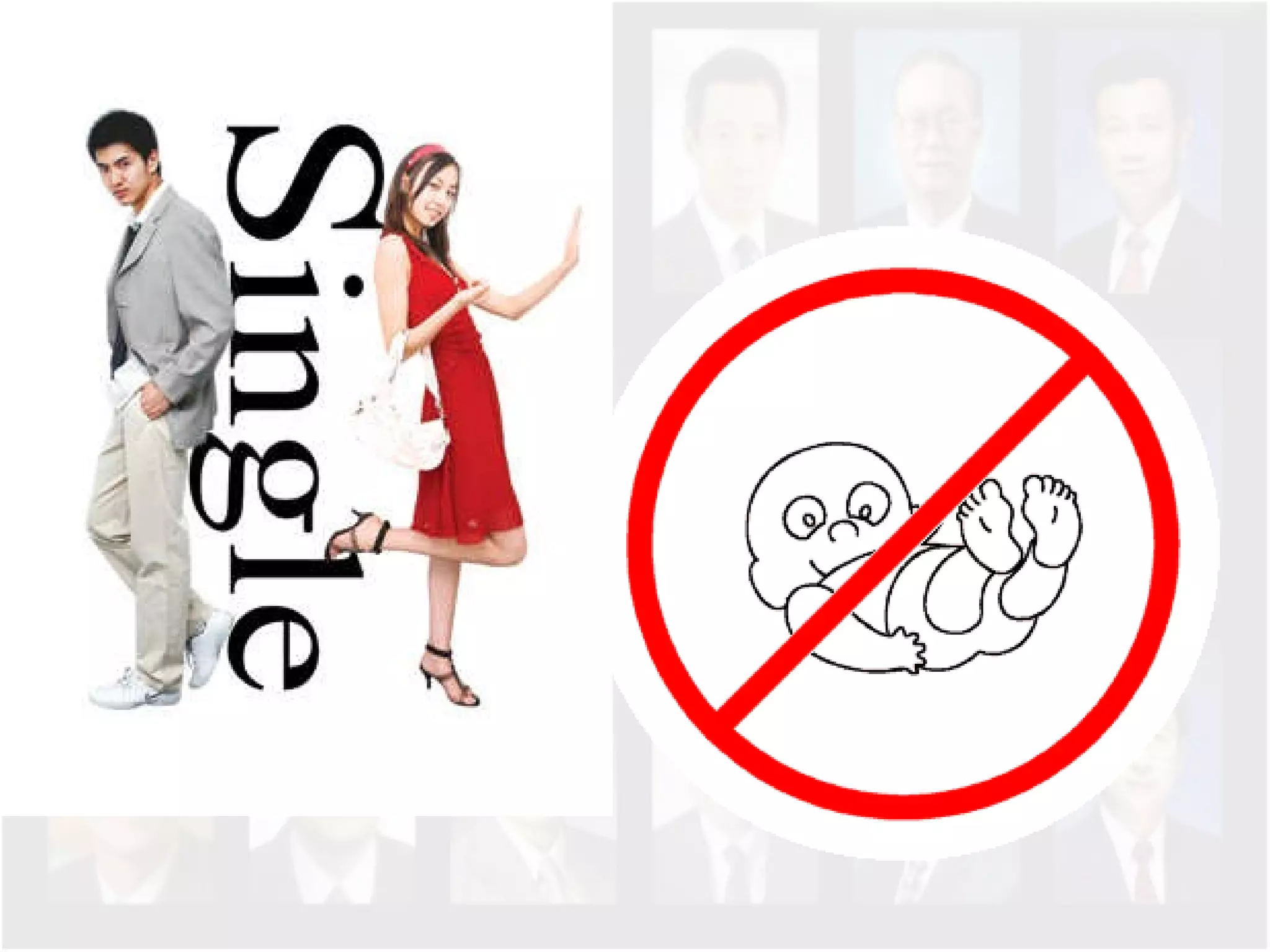
Impact of declining birthrate Economic progress will slow down Multinational companies will not be interested to set up their businesses here in Singapore Labour costs too high, not enough talent found in Singapore Consumer market too small    cannot make money
There will be ageing population   Lesser young children, more old people     Singapore will have to focus on caring for old people (resources and time) Weakening of Singapore’s defense Lesser men to serve in NS and to fight for the country.  Impact of declining birthrate
 
What did Singapore do, when they experience a huge population increase?  Set up the Singapore Family Planning and Population Board to plan its population policy Aim: To control the population growth
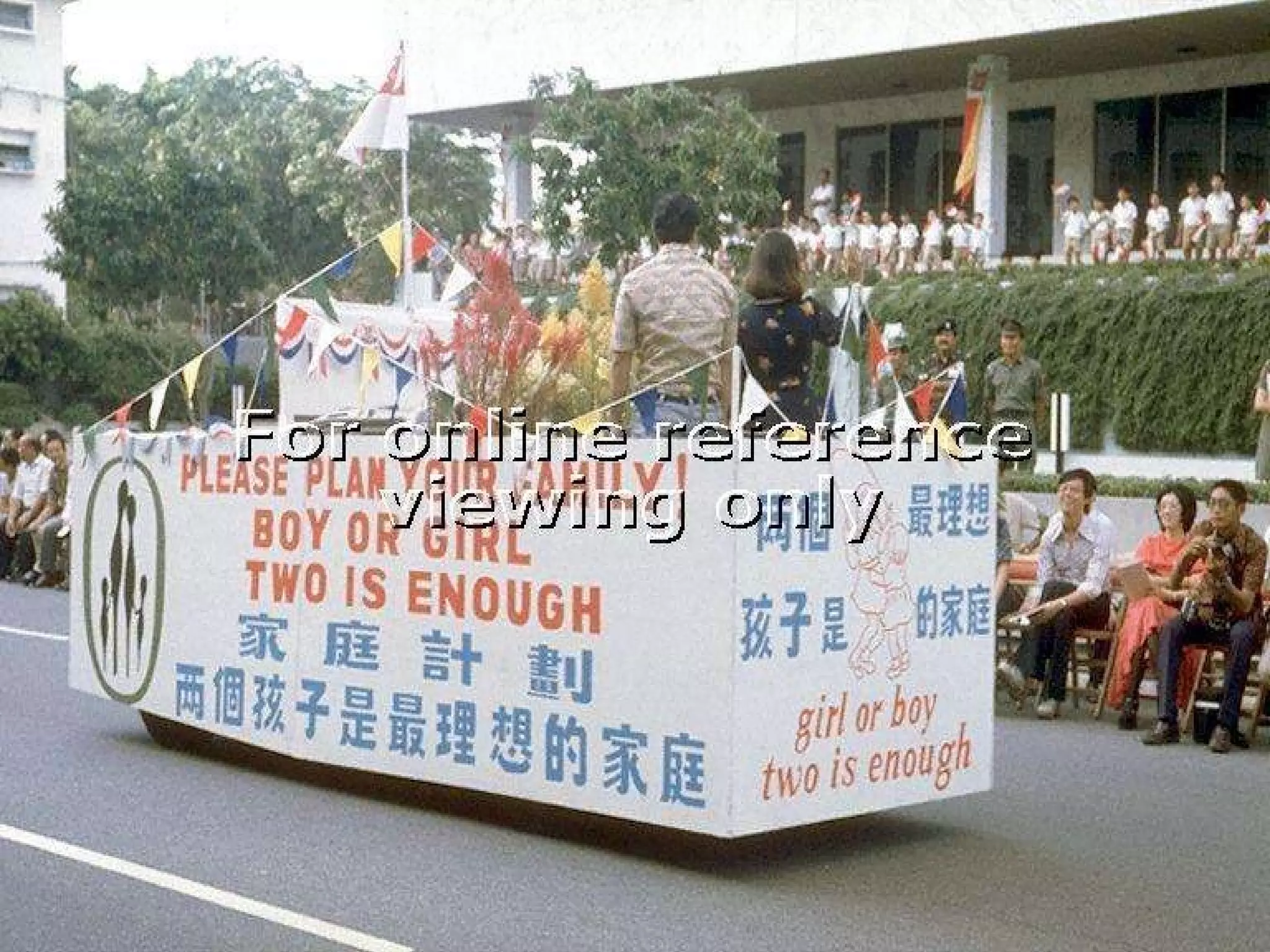
3 Five-Year Plans  1 st  plan:  emphasized the need for smaller families 2 nd  plan:  encouraged married couples to ‘stop at two’ 3 rd  plan:  aimed to maintain the replacement level at 2.1 children


Other measures pg.44 No paid maternity leave to be given to the 3 rd  and subsequent children No priority to be given to large families in the allocation of government flats No income tax relief to be given for the 4 th  and subsequent children Delivery charges in hospitals to be increased with each additional child Encouraged contraception Legalized abortion
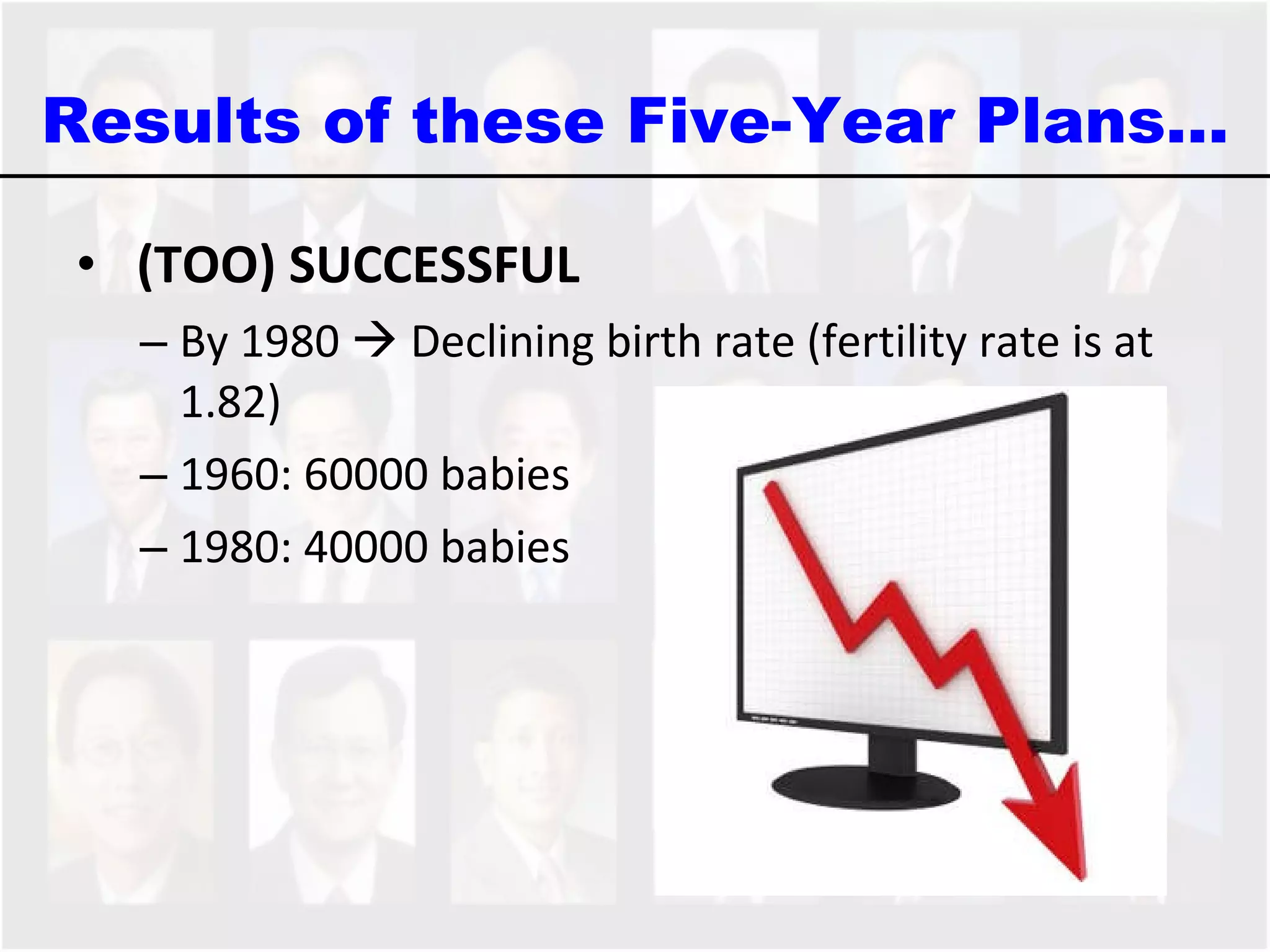
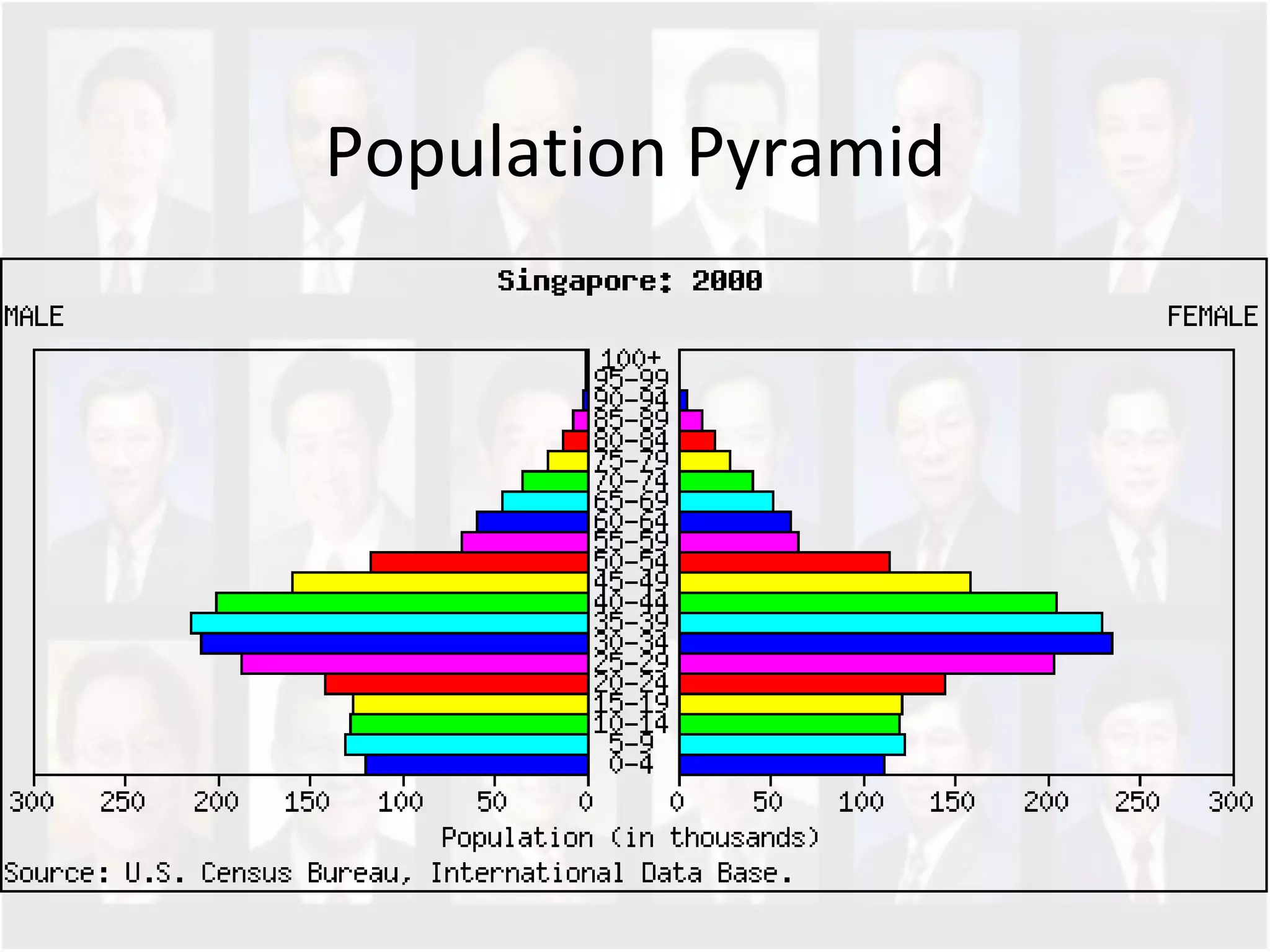
Results of these Five-Year Plans… (TOO) SUCCESSFUL By 1980    Declining birth rate (fertility rate is at 1.82) 1960: 60000 babies 1980: 40000 babies
So what happens? The government has to reverse their policies.  Now, they have to increase the population.  So they started promoting population growth through  4  different measures.


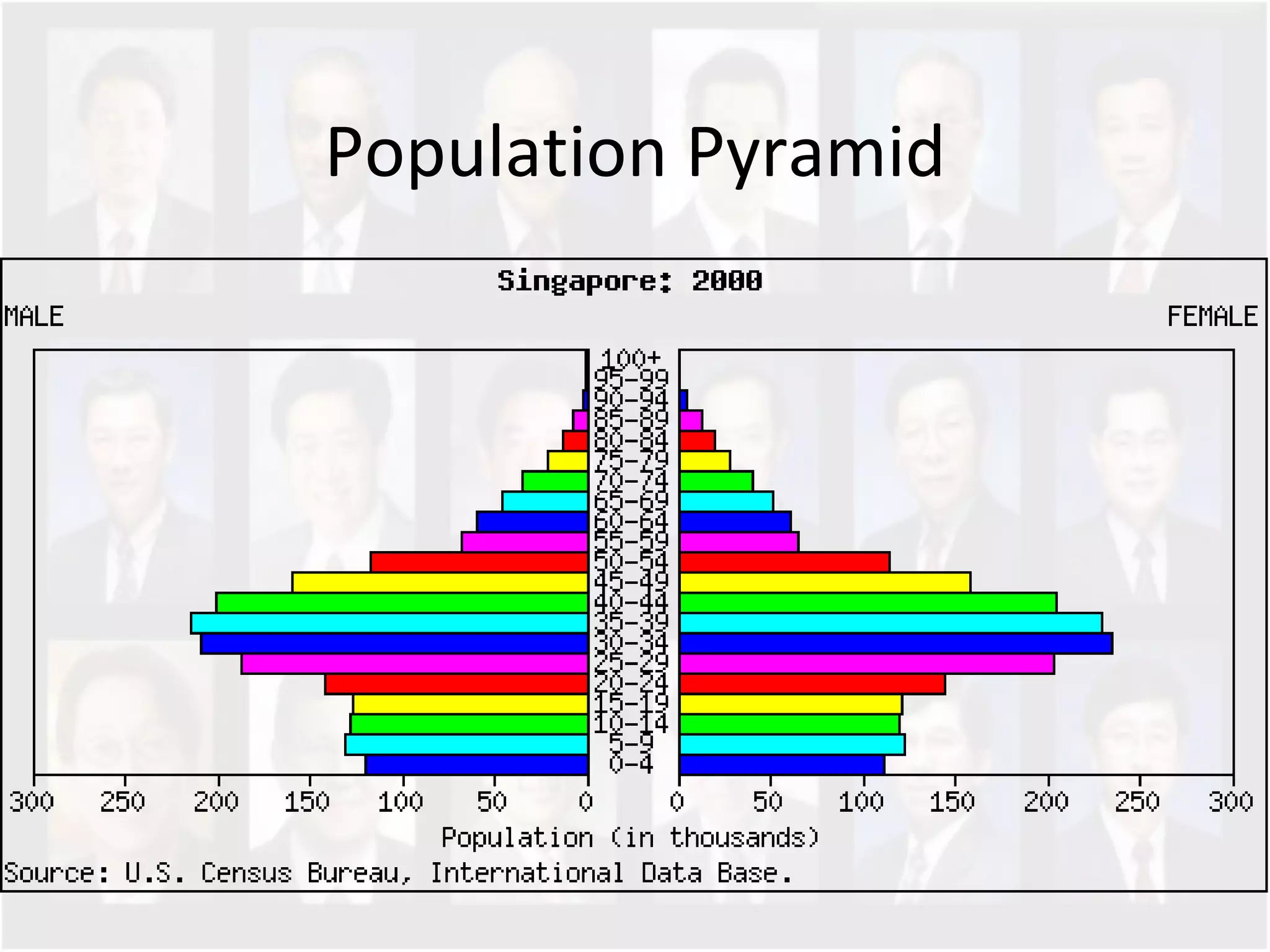
Population Pyramid
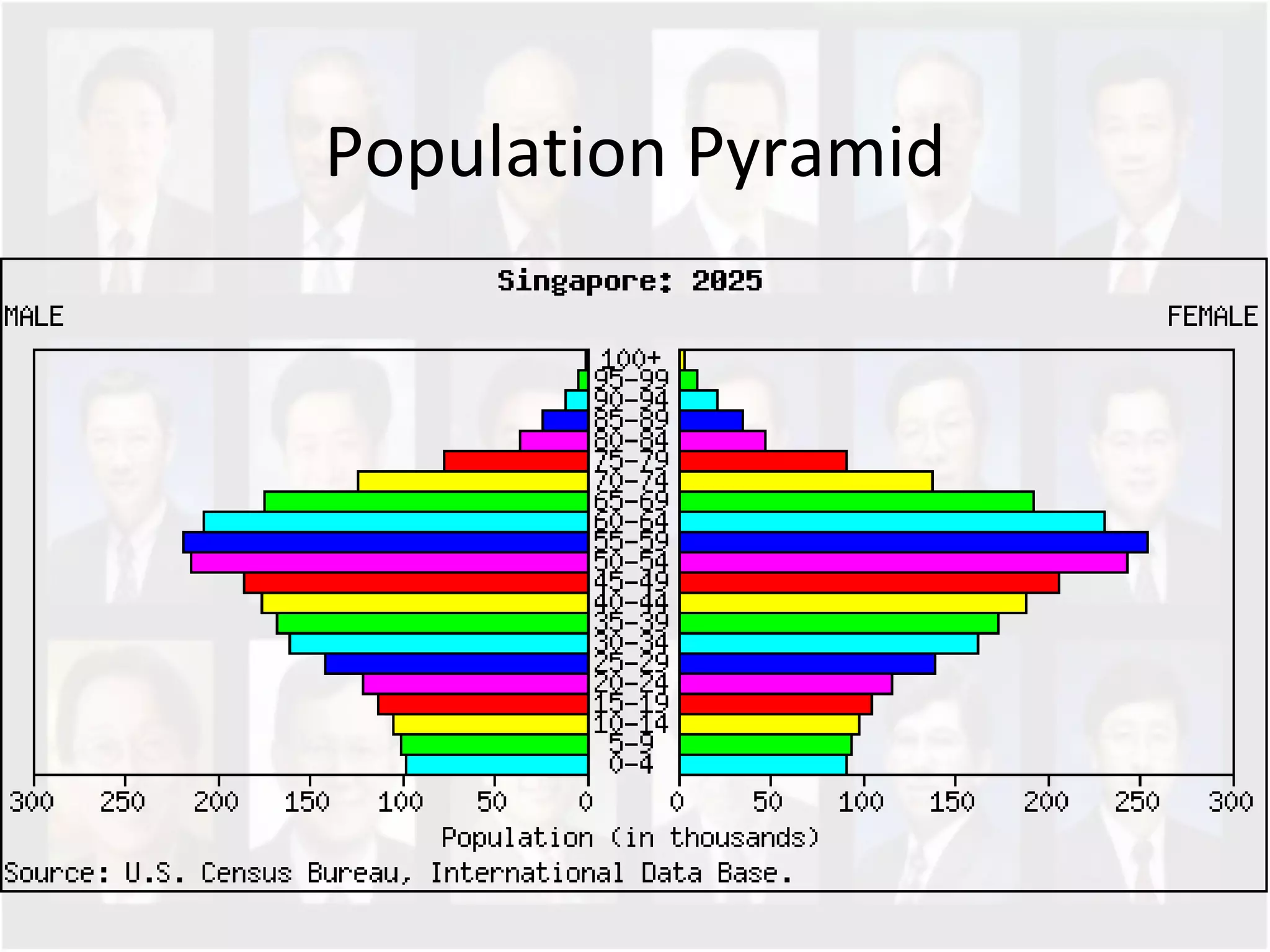
Population Pyramid
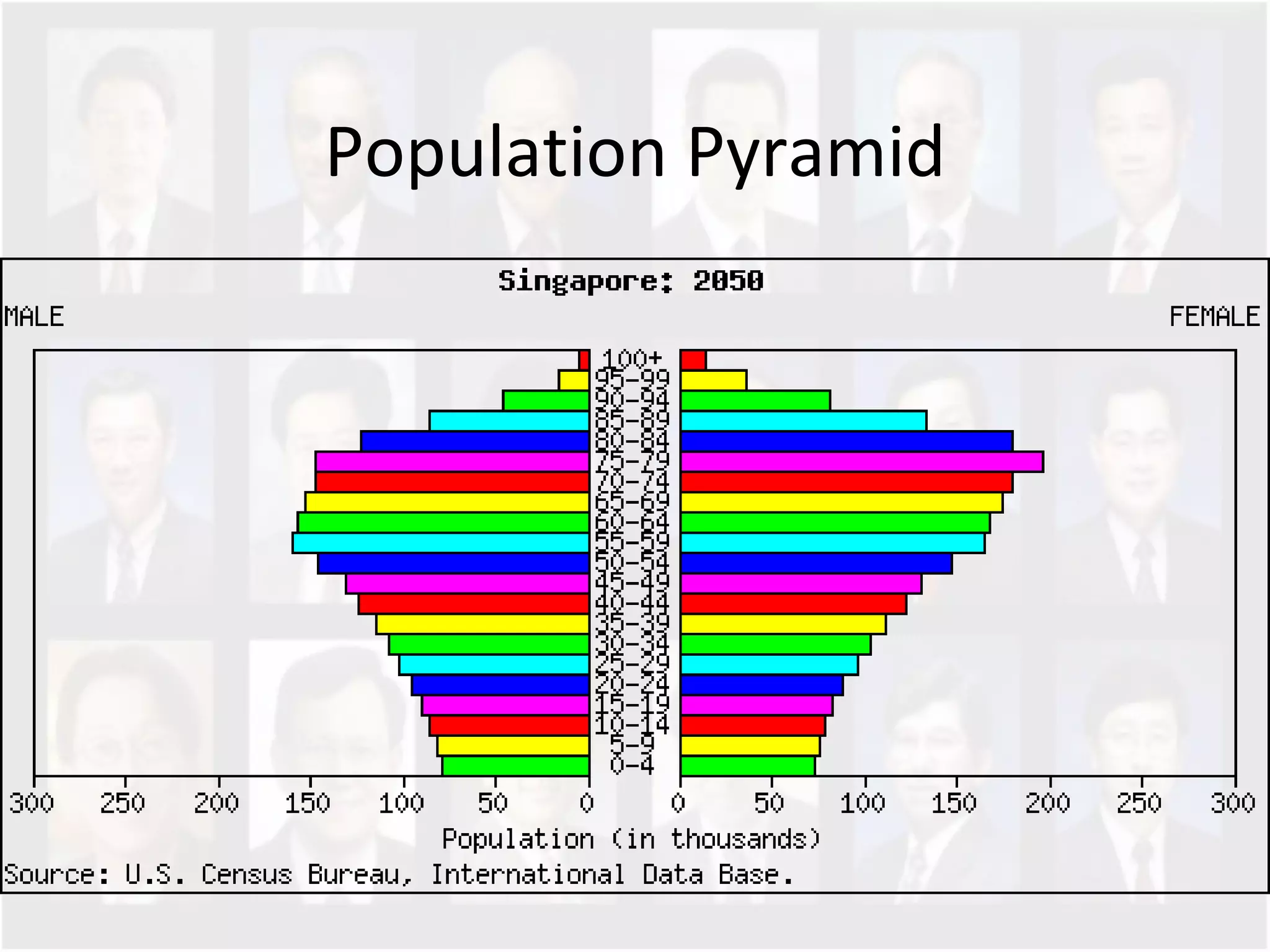
Population Pyramid
What did the government do to promote population growth?  Graduate Mothers Scheme What is it?  To encourage marriage among graduates and to encourage graduates to have more children  Why this scheme?  It is believed that the education level of the parents will affect the performance of their children in schools  (new generation of workforce being  more educated)
 
1. Graduate Mothers Scheme Was it successful? NO Less-educated were unhappy about this policy. They felt ignored by the policy.  Scheme was stopped after 1 year because Singaporeans did not like it. What did the government do to promote population growth?
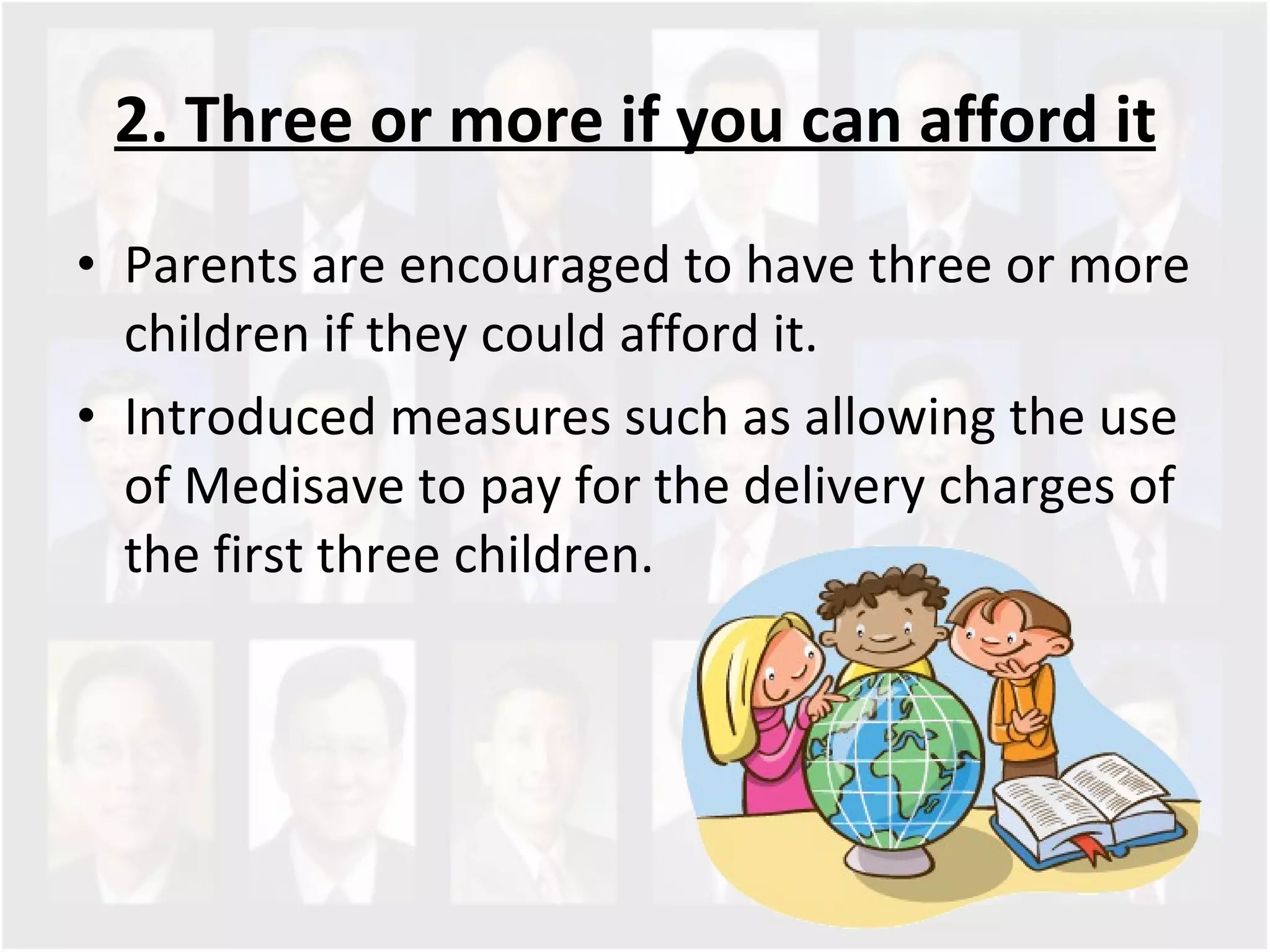
2. Three or more if you can afford it Parents are encouraged to have three or more children if they could afford it.  Introduced measures such as allowing the use of Medisave to pay for the delivery charges of the first three children.
2. Three or more if you can afford it Limited success Not all married couples wanted so many children  Some felt that government was not doing enough to promote population growth
3. Other pro-family measures pg. 51) Measures:  Equalized medical benefits Grandparent caregiver relief 5 day work week for Civil Service Extended maternity leave
3. Other pro-family measures Why? To address 2 concerns: the high costs of raising children, the lack of suitable childcare services  Not much success because birthrate continued to  drop.
 
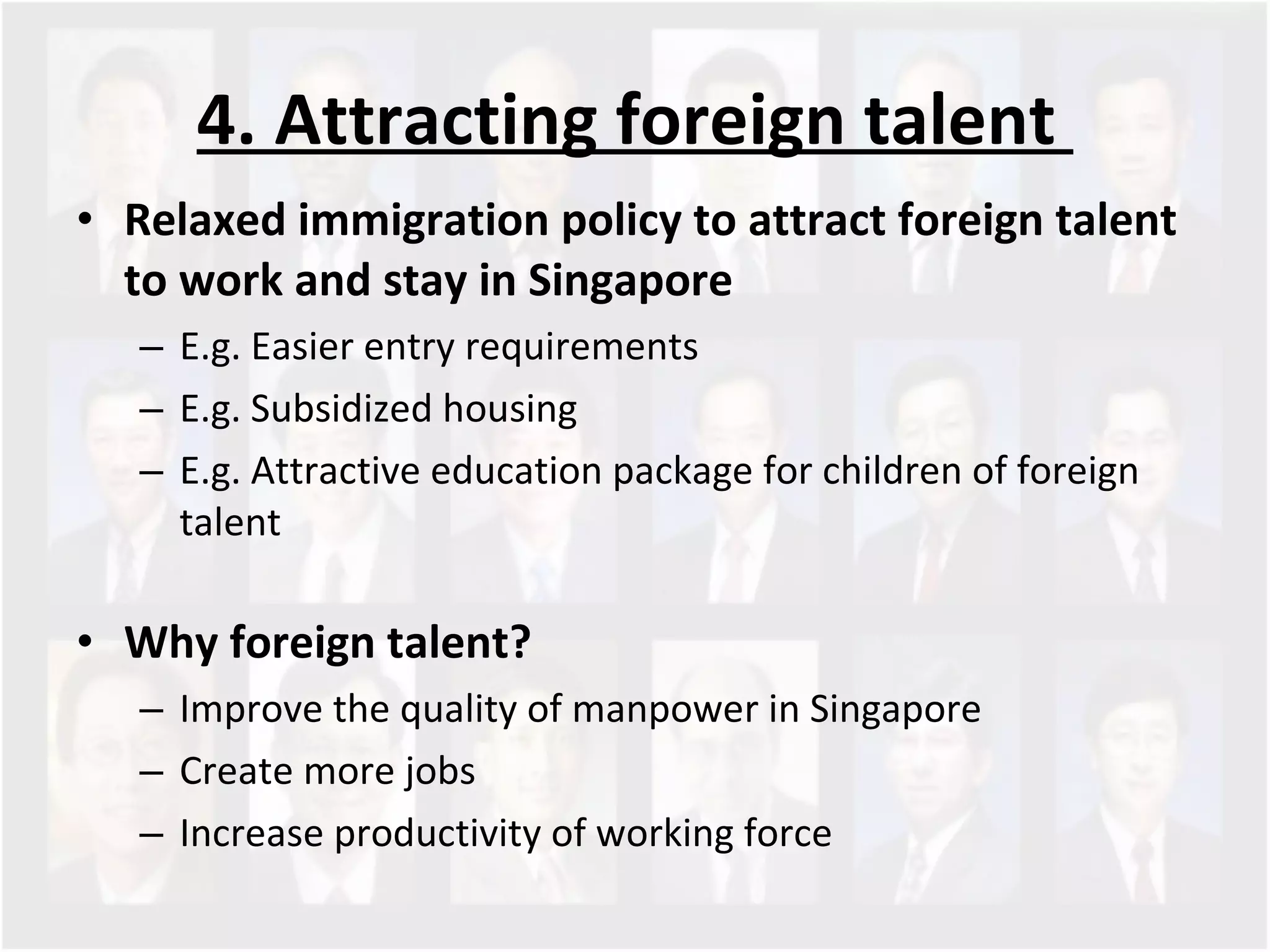
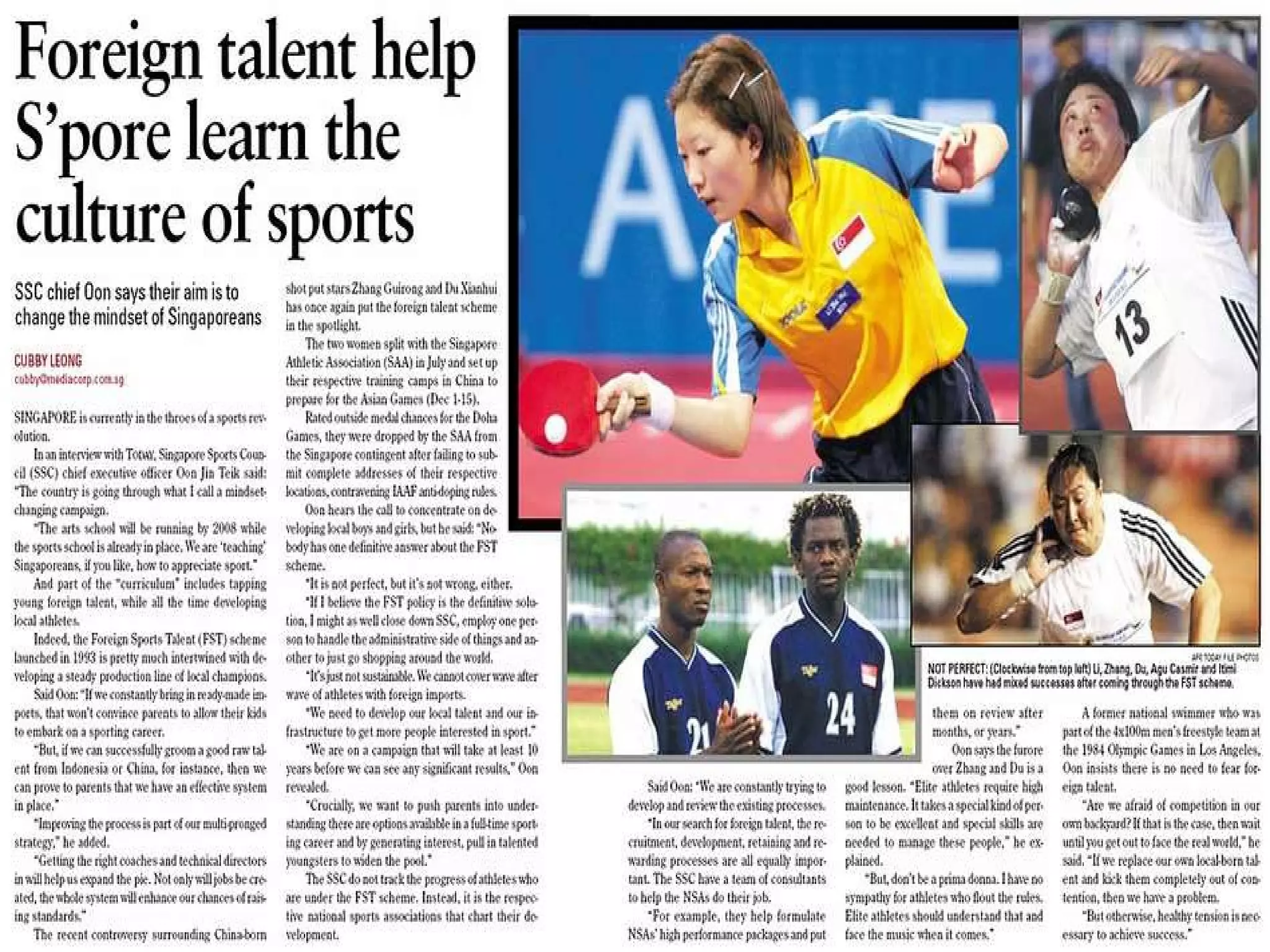
4. Attracting foreign talent  Relaxed immigration policy to attract foreign talent to work and stay in Singapore   E.g. Easier entry requirements E.g. Subsidized housing E.g. Attractive education package for children of foreign talent  Why foreign talent? Improve the quality of manpower in Singapore Create more jobs Increase productivity of working force
 
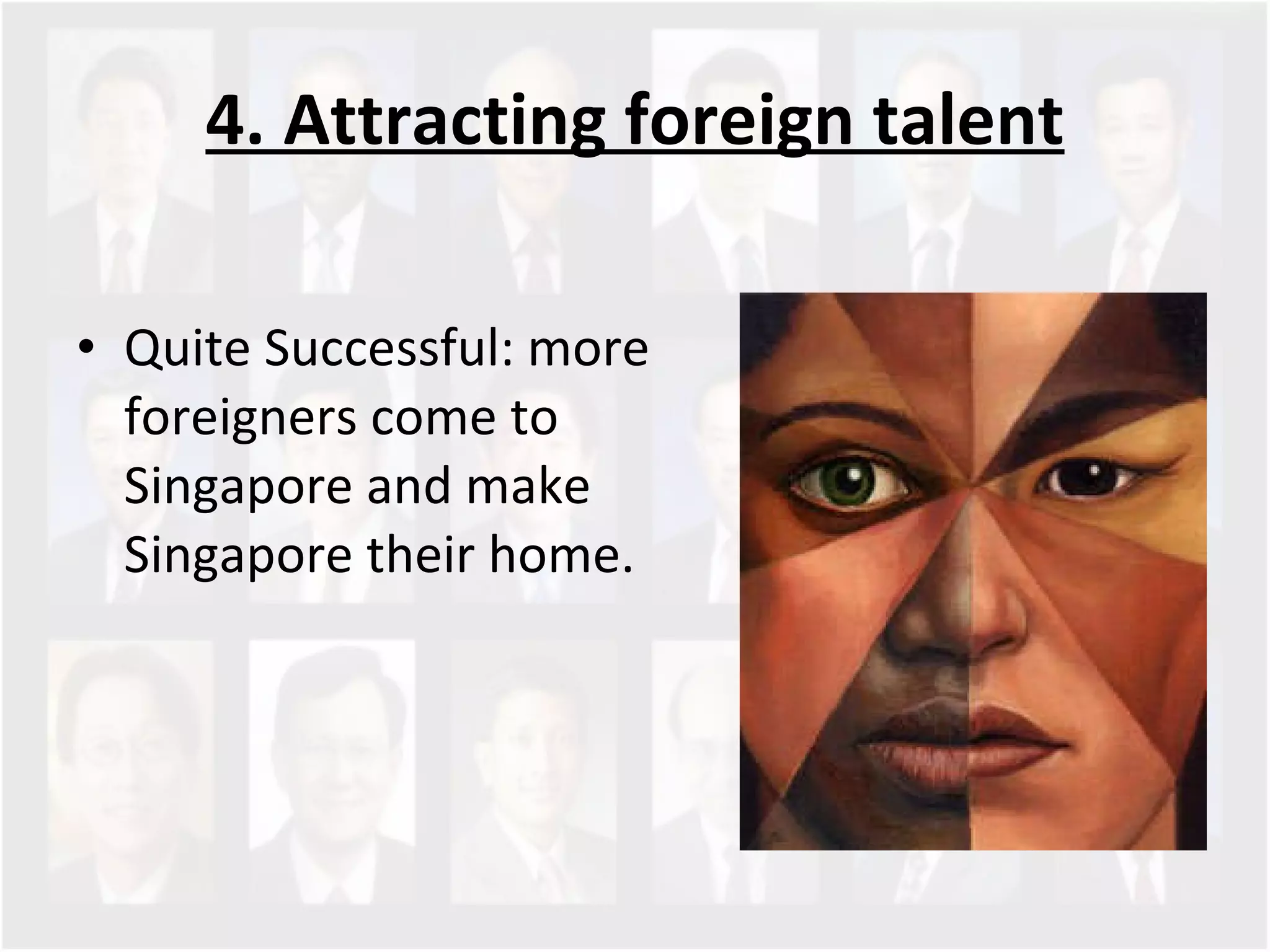
4. Attracting foreign talent Quite Successful: more foreigners come to Singapore and make Singapore their home.
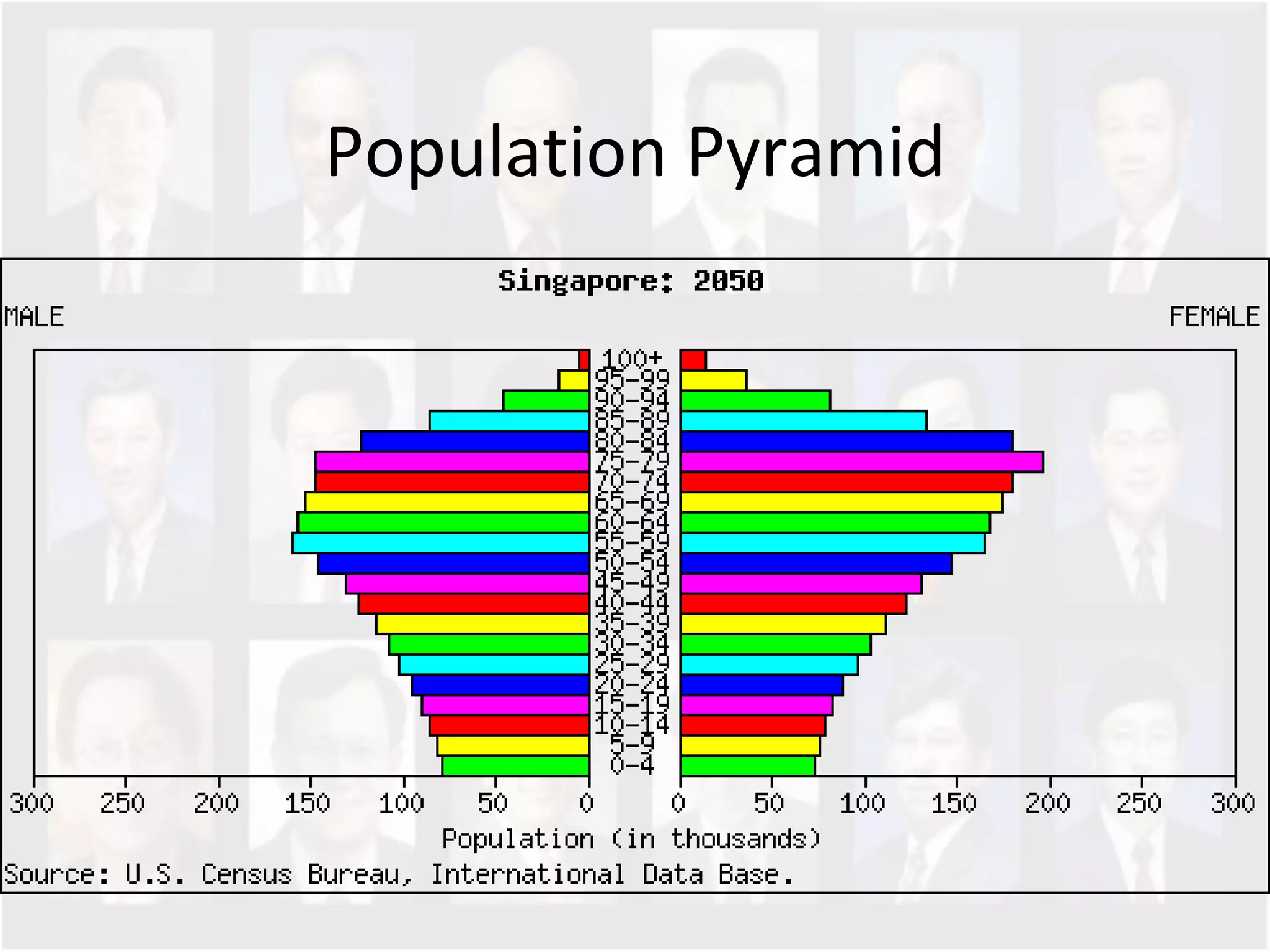
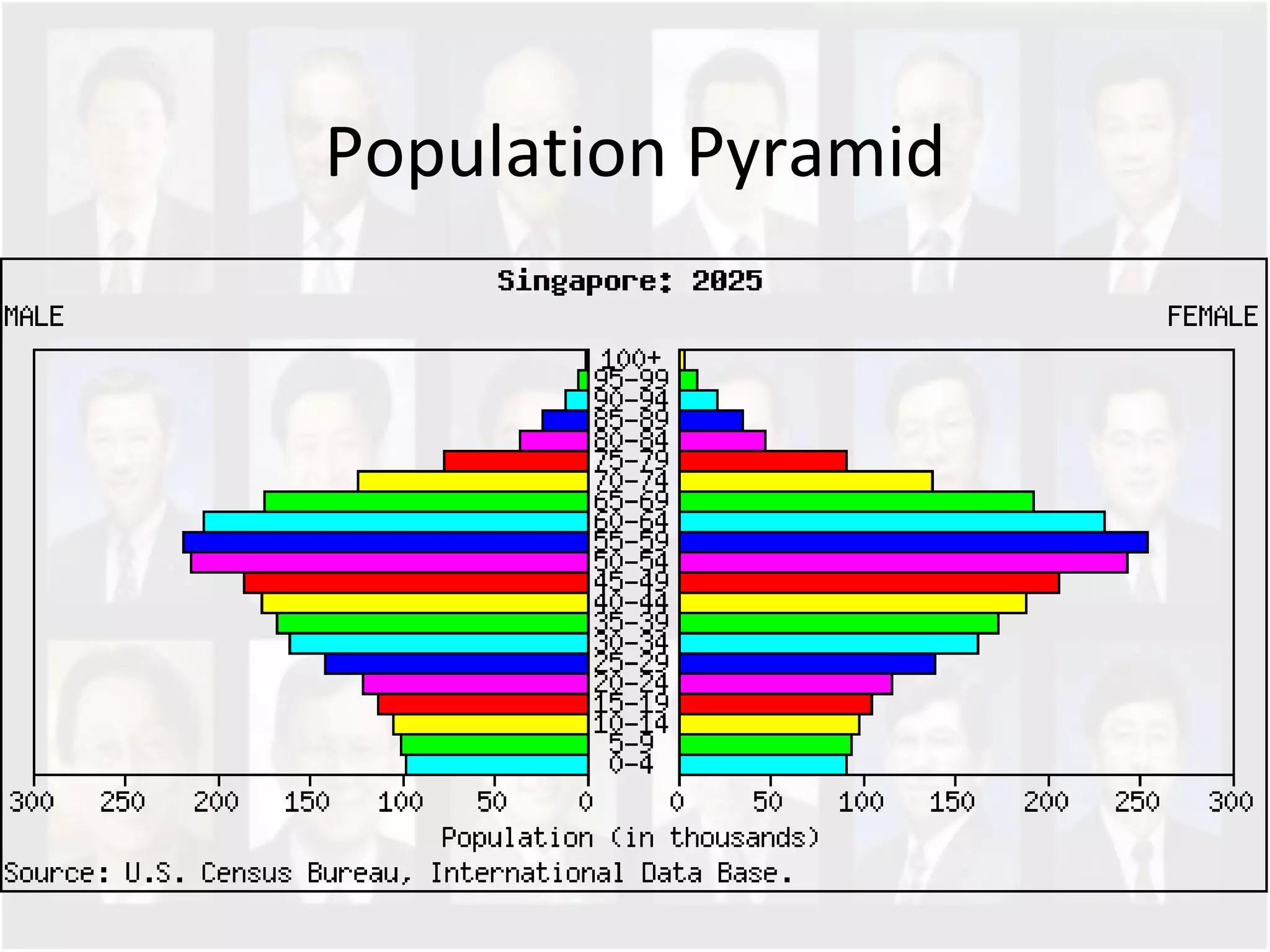
3 factors that led to an ageing population  Baby Boomers of the 1960s People who were born in the 1960s  Declining birthrates Lesser families want to have children/more children Longevity Healthcare has improved, leading to healthier people who die at a later age.
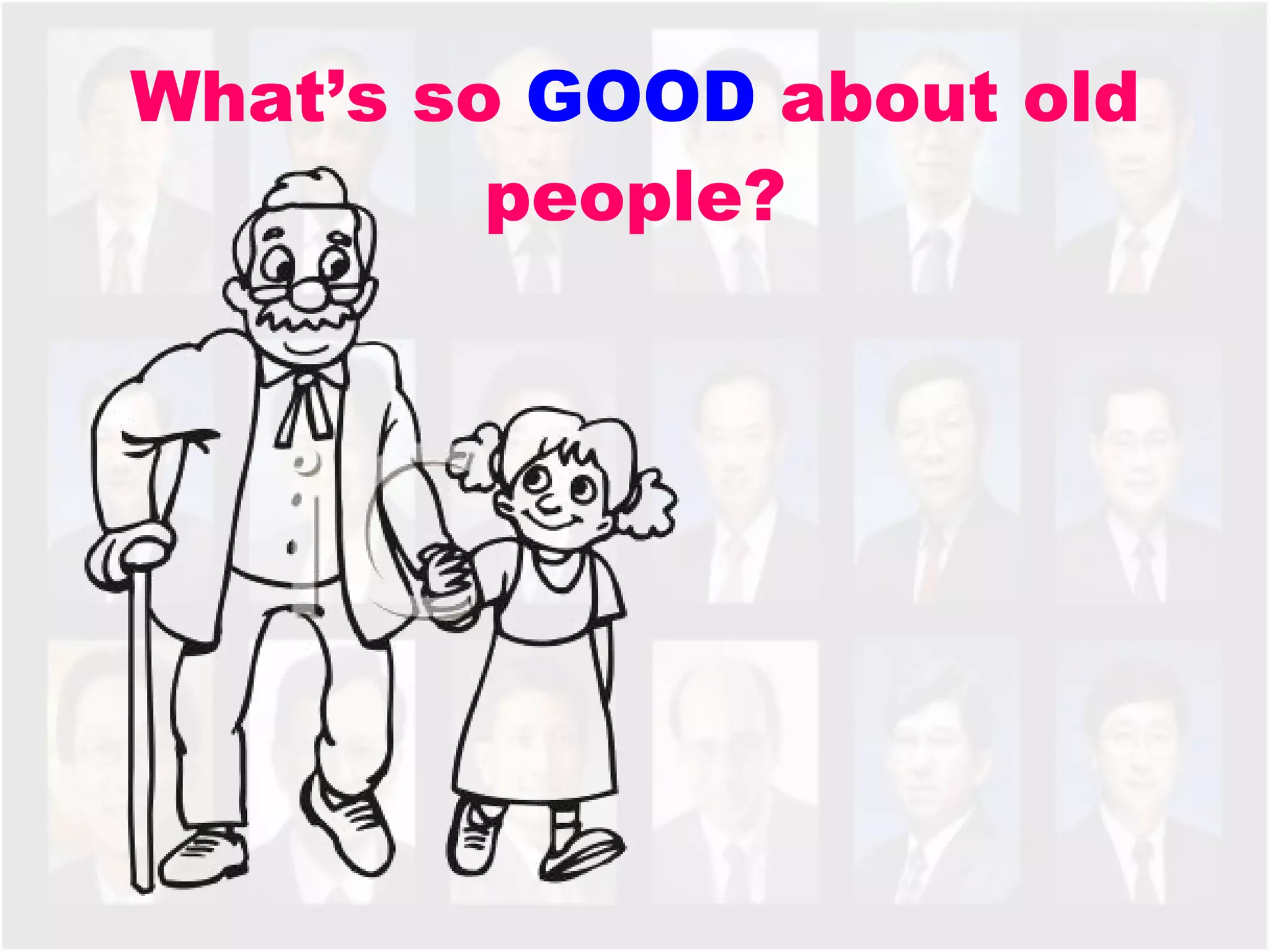
What’s so  GOOD  about old people?
What’s so  BAD  about old people?
Population Pyramid
Population Pyramid
Population Pyramid
Impacts of ageing population  demand for more healthcare and social services Smaller security forces Reduction in competitiveness Strain on working population
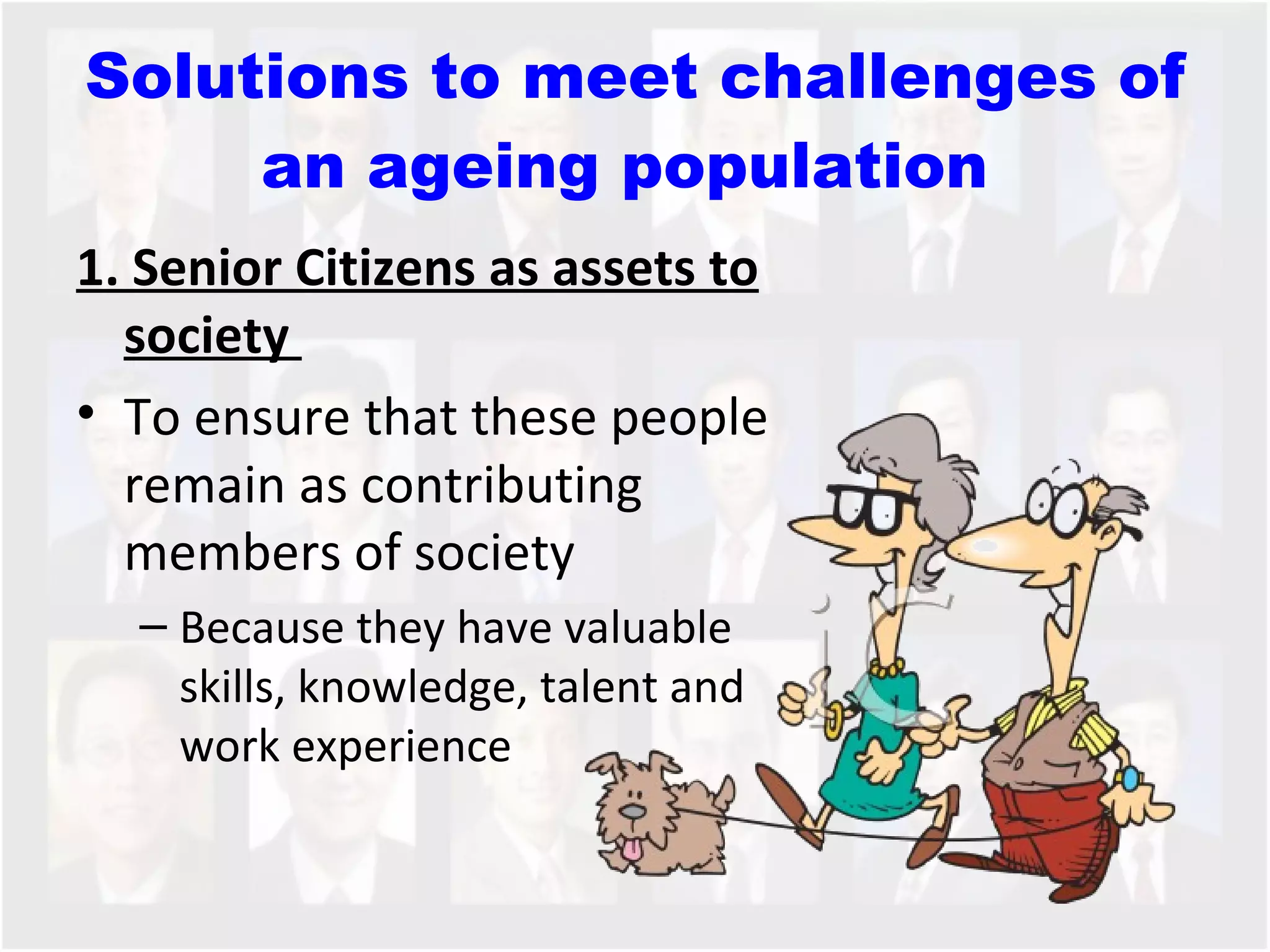
Solutions to meet challenges of an ageing population  1. Senior Citizens as assets to society  To ensure that these people remain as contributing members of society Because they have valuable skills, knowledge, talent and work experience
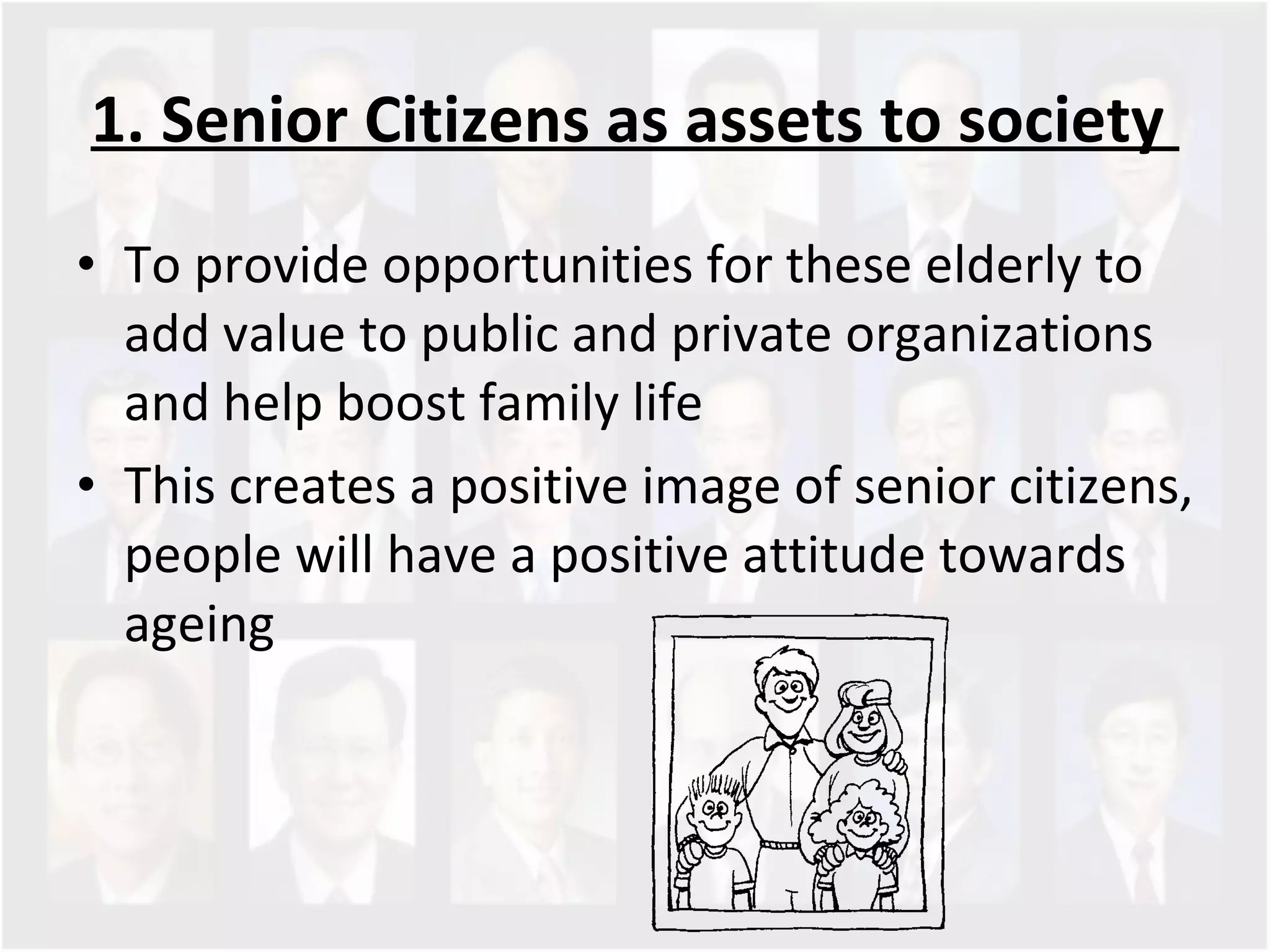
1. Senior Citizens as assets to society  To provide opportunities for these elderly to add value to public and private organizations and help boost family life This creates a positive image of senior citizens, people will have a positive attitude towards ageing
2. ‘Many Helping Hands’ approach Everyone has a part to play in helping the nation prepare for an ageing population Individual, family and community will all have a role They will complement the government’s efforts to provide help.  Government’s burden is lessened    resources can be saved for other needs of the nation
Individual responsibility  Early lifelong planning… Maintain health by having a  healthy lifestyle Being financially stable by  having financial planning
 
Individual responsibility Important because they can be independent and self-sufficient in their old age.  This helps the government to save a lot of money (government can build lesser healthcare and social services facilities)
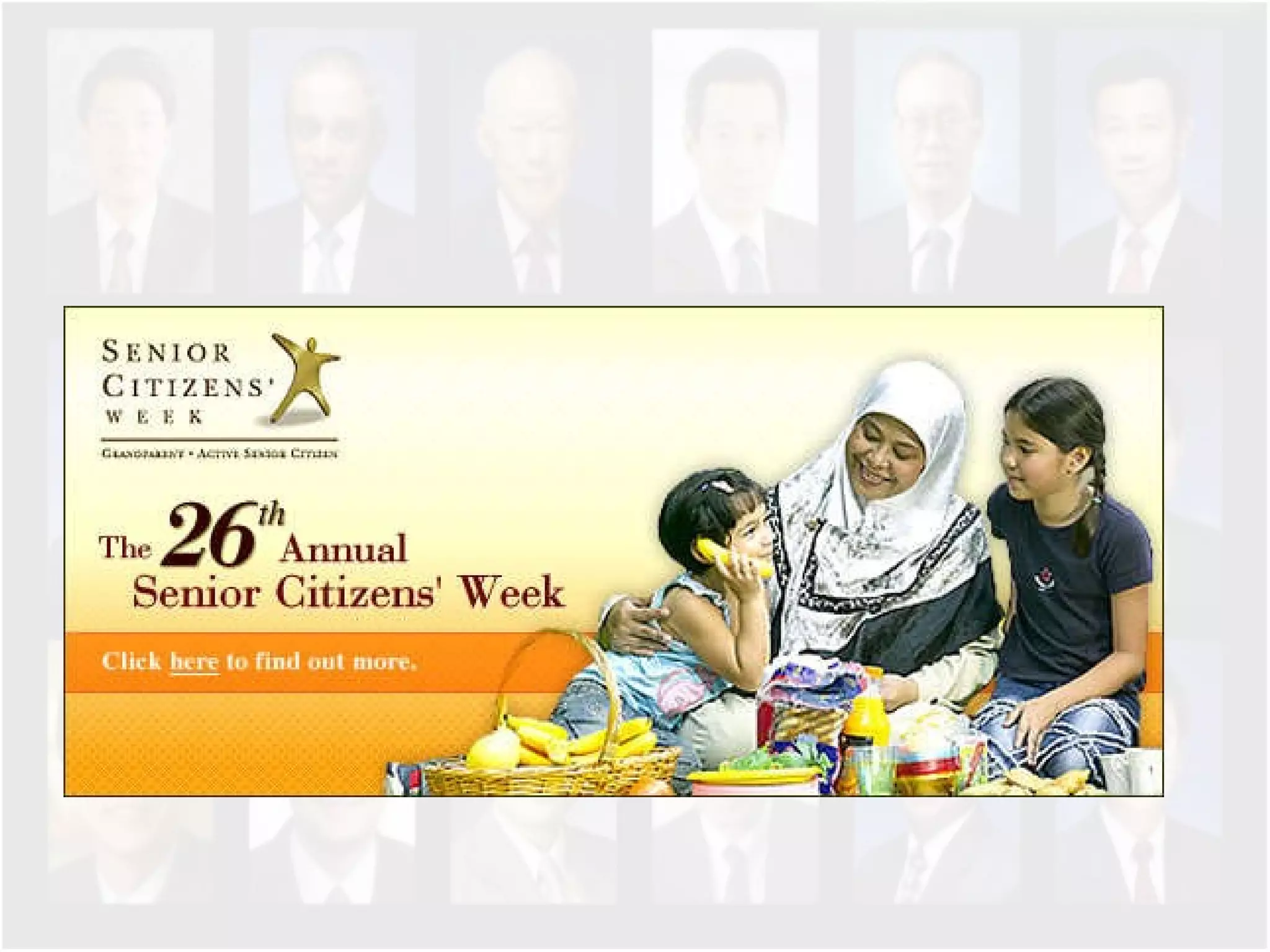
Family support Strong and stable family becomes the main emotional, social and financial support for the elderly Measures introduced to help family bond and stay strong and stable: Senior Citizens’ Week: encourages elderly to stay active in the family and community  Grandparents’ Day: to show appreciation for the elderly.
Family support This is important because the family can support individuals with emotional, social and financial support
 
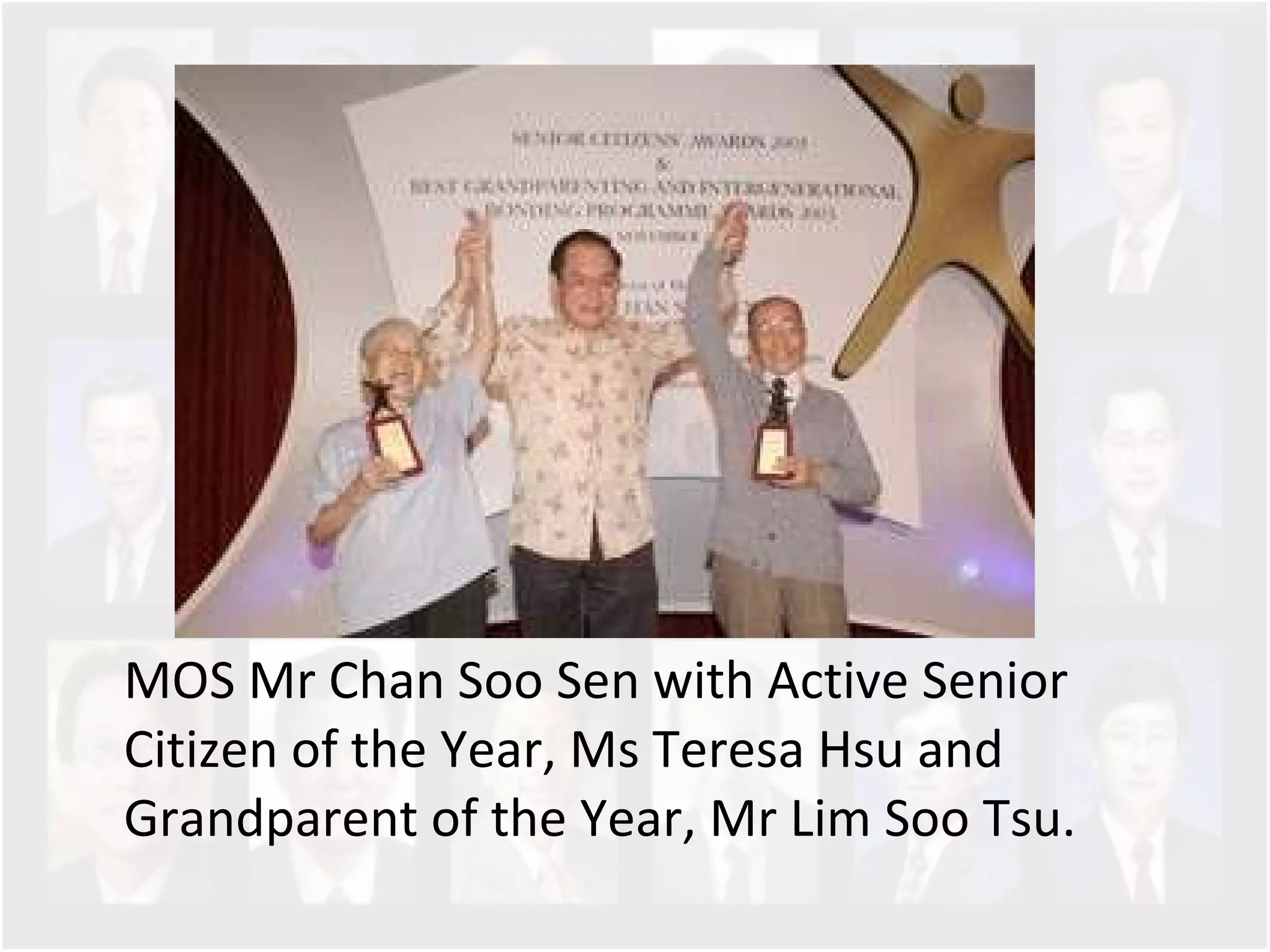
MOS Mr Chan Soo Sen with Active Senior Citizen of the Year, Ms Teresa Hsu and Grandparent of the Year, Mr Lim Soo Tsu.
Community  Community can also provide social and emotional support; healthcare and social services Voluntary welfare organizations run community-based services for senior citizens  Financially supported by the government  To help senior citizens remain physically, mentally and socially active E.g. Home Nursing Foundation for Elders
 
Community  This is important because the community acts as a replacement for senior citizens who have no families to support them emotionally and financially
Government support Government supports an ageing population in two ways.  Financial support Legal support: laws and measures are introduced to protect the interests of senior citizens E.g. Tribunal for the maintenance of parents Parents can get the court’s help to seek financial support from their children Tax relief Income tax deduction if they are taking care of their grandparents  CPF Elderly receives a monthly sum from their CPF retirement account Public Housing schemes  You get priority to buy houses if you stay with your grandparents
Government support The government can contribute the financial support needed to help individuals, families and the community meet the challenges of an ageing population
 

Sec 3 Social Studies Chapter 2

  • 1.
  • 2.
  • 3.
    How I feelabout the government 2 functions of the government Maintain stability in the government Meet people’s needs
  • 4.
    Ensures stability inthe government Meets peoples’ needs Jobs, education, housing, health, security, clean environment etc
  • 5.
    Builds a nationA sense of belonging (Bonding Singapore) Maintains sovereignty Protecting Singapore’s political independence
  • 6.
    Governance Refers tothe way a government manages the resources of the country so as to carry out its functions. Sovereignty complete power over your own country, and not being controlled by other countries
  • 7.
    Representative democracy  leaders in the government are chosen by the people in an election Election is held once every 5 years
  • 8.
    Have the powerand responsibility to choose the right leaders for Singapore. Vote!
  • 9.
    Be involved indecision-making (for important decisions) Through feedback channels. E.g. Feedback Unit, media, Forum Page from The Straits Times, Meet-the-People sessions.
  • 10.
  • 11.
    - Consists ofthe President and Members of Parliament Makes the laws of the country to help keep order People will feel safe living and working in Singapore.
  • 12.
  • 13.
    Consists of thePresident and the Cabinet (Prime Minister and the Ministers in charge of the various ministries) Executes laws made by Parliament and carries out government policies through the Ministries and the Civil Service
  • 14.
    Feedback about thepolicies are considered from the public. Community gives feedback about the policies Member of Parliament raises the feedback to the Ministry in the Parliament. The Ministry gives an explanation for the law or proposes an alternative solution.
  • 15.
    Note: feedback includesdifferent points of view. Some are not realistic and are not accepted. Hence, it is important for people to provide constructive feedback.
  • 16.
    Consists of thevarious judges and law courts Ensures that laws are carried out Makes sure that the laws passed do not breach the Constitution Is not influenced by politicians or other influential people
  • 17.
  • 18.
  • 19.
    15 mins 1. Make your own diagram of what you think the government system is like. 2. Use the words given in the envelop. THEN, we can take turns to share with the class.
  • 20.
    Singapore Government Executive Branch Legislature Branch Judiciary Branch Lawyers
  • 21.
  • 22.
    What are the4 functions of the government? What are the 3 branches of the government? What are the 2 keywords we learnt? What is 1 role of the people? Recap
  • 23.
    Today… we wantto find out more about… 4 guiding principles of governance How they are linked to the functions of the government
  • 24.
    Meritocracy A systemthat rewards hard work and talent. (Everyone has an equal opportunity to achieve their best and be rewarded for their performance) Principles refers to the standards/criteria that the government hold on to.
  • 25.
    Leaders must beable to do what is right rather than what is popular. It is difficult to find good leadership and good governance. Potential leaders are specially selected and groomed. Honesty is one quality highly valued by the government.
  • 26.
    Example: Underthe capable leadership of Mr Liu Thai Ker, the arts scene in Singapore made progressed. Events such as the Singapore Arts Festival were organised. This led to a more vibrant arts scene.
  • 27.
    Capable leaders canhelp to maintain sovereignty Honest and capable leaders can ensure stability in the government
  • 28.
    Decisions made bythe government need to be forward-looking The government anticipate future problems or technology and make decisions that can help Singapore tackle the problems. This helps to prepare Singapore for the future.
  • 29.
    Examples: NEWater:It is an alternative water supply other than Malaysia’s water. Although NEWater is not liked by everyone, the government communicated with them to assure them that NEWater is safe for drinking through various forms of media Integrated Resorts: As tourism sector faced competition with more countries in Asia developing major tourist attractions, thus Singapore need to improve the tourist industry.
  • 30.
    The government hasto be open to new ideas and be willing to take risks Every Singaporean needs to upgrade their knowledge and skills to stay employable and contribute to the nation
  • 31.
    This principle helpsto meet the needs of the people, especially the needs of people in the future.
  • 32.
    We can earna living and safeguard our future only through our efforts and intelligence. When people are rewarded based on their abilities and hard work, they are encouraged to do well This is done with the policy of Meritocracy
  • 33.
    Edusave Scholarship andMerit Bursary schemes in schools rewards the top 10% and 15% of students in schools.
  • 34.
    This principle helpsto meet the needs of the people This principle also helps to build the nation – everyone knows that it is fair and equal in Singapore
  • 35.
    The government wantsto create an inclusive society where citizens feel a sense of belonging and ownership. This can be done through giving citizens more opportunities say in decision-making. E.g. Gathering feedback and responses from people regarding the building of the Integrated Resorts.
  • 36.
    Policy decisions madeto serve the needs of the nation may change to suit the needs of the people and the nation over time
  • 37.
    Helps to builda nation by encouraging a sense of belonging among people Helps to meet people’s needs People can voice out their concerns and needs
  • 38.
  • 39.
    You must bea Lead… D o what is right, not what is popular A nti-corruption (integrity and moral courage) H onest and capable.
  • 40.
    Leaders must... Forward looking, O pen minded, C reative, U nderstanding the needs of… S ingapore
  • 41.
    M eritocracy Encourages Me to work hard!
  • 42.
    We want Singaporeansto… B elong O pportunities to take part in decision-making N eeds change, so… D ecisions/policies may change over time.
  • 43.
  • 44.
  • 45.
  • 46.
    Limited land inSingapore As Singapore’s population grows, there will be an increase in demand for land for everything. Hence, the government need to allocate land properly.
  • 47.
    1970s: Singapore’s businesseswere growing quickly Terrible traffic in the Central Business District (CBD) during peak period
  • 48.
  • 49.
    Area Licensing Scheme(ALS) To manage traffic flow in the Central Business District (CBD) Motorists had to pay for the use of certain roads in Singapore, known as ‘Restricted Zones’
  • 50.
    (Area Licensing scheme,continued) How did motorists respond? They were unhappy about the increased costs of travelling into the Central Business District Principle of ‘Leadership is key’ Scheme was unpopular in the beginning BUT the government continued with the scheme because it is a good scheme. Was it successful? Overall, YES! Over time, many people supported the improved traffic flow in the city area.
  • 51.
    However, the ALSis labour intensive and quite inconvenient…
  • 52.
    As technology improved,more efficient ways of monitoring and regulating traffic flow became possible ERP replaced ALS in 1988. Same purpose as the ALS, but more efficient and effective.
  • 53.
  • 54.
    This scheme wasintroduced at the same time as the ASL. Motorists could park their vehicles at specific car parks which were outside the city area. Then use public transport to enter the city area. This would mean fewer vehicles entering the CBD.
  • 55.
    Was it successful?1970s: NOPE. It did not work Motorists just took public transport all the way, OR, drove into the CBD area before the ALS operation time of 7:30am. They did not think it was worthwhile to leave their cars parked outside the city all day. Today: Yes! The scheme is still being used today. What can we learn? As time passes and the needs of people change, methods that did not work in the past may work today.
  • 56.
  • 57.
    As people becamericher, more could afford to buy cars. To manage the population of cars in Singapore, the Land Transport Authority (LTA) implemented the Certificate of Entitlement (COE) system.
  • 58.
    A specific numberof new cars are issued, based on the quota set by the LTA (Land Transport Authority). Car buyers must first bid for the COE before they can buy cars. Successful bidders must pay money to obtain the COE. This COE has to be renewed every 10 years.
  • 59.
    Summary 4measures to manage traffic in Singapore: P ark-and-ride Scheme A rea Licensing Scheme V ehicle Quota System E lectronic Road Pricing The government must PAVE the way for smoother traffic flow!
  • 60.
  • 61.
    Recap: We havelearnt… The 4 functions of the government 4 guiding principles that the government tries to follow 1 case study: Transport  how does the government manage transport
  • 62.
    Today… we willstart on… Population policy Why do we need to study about population policy? How does the government manage the population?
  • 63.
    Background In the1960s – 1980s, Singapore was progressing as a nation. The future seems BRIGHTER. People started having bigger families.
  • 64.
    What’s wrong withhaving big families? If your family is living on a ship, with limited food, water and space. What happens when your parents have more children?
  • 65.
    Impacts of populationexplosion Unemployment There will not be enough jobs for everyone. Shortage of housing There will not be enough houses for everyone .
  • 66.
    Not enough healthcareservices How are the queues like when you go to polyclinics these days? What happens when there is a population explosion? Not enough education services There will be a need to build more schools (primary, secondary, polytechnics, ITEs, universities) Impacts of population explosion Problem of not having enough resources
  • 67.
    OK LOR… Thenwe have a small small small population. Then we won’t have any problems after that!
  • 68.
    What’s wrong withhaving small families? If your family is living on a ship, with limited food, water and space. What happens when your brothers and sisters got sick and died? (leaving you and your parents on the ship)
  • 69.
    Impact of decliningbirthrate Economic progress will slow down Multinational companies will not be interested to set up their businesses here in Singapore Labour costs too high, not enough talent found in Singapore Consumer market too small  cannot make money
  • 70.
    There will beageing population Lesser young children, more old people  Singapore will have to focus on caring for old people (resources and time) Weakening of Singapore’s defense Lesser men to serve in NS and to fight for the country. Impact of declining birthrate
  • 71.
  • 72.
    What did Singaporedo, when they experience a huge population increase? Set up the Singapore Family Planning and Population Board to plan its population policy Aim: To control the population growth
  • 73.
    3 Five-Year Plans 1 st plan: emphasized the need for smaller families 2 nd plan: encouraged married couples to ‘stop at two’ 3 rd plan: aimed to maintain the replacement level at 2.1 children
  • 74.
  • 75.
  • 76.
  • 77.
  • 78.
    Other measures pg.44No paid maternity leave to be given to the 3 rd and subsequent children No priority to be given to large families in the allocation of government flats No income tax relief to be given for the 4 th and subsequent children Delivery charges in hospitals to be increased with each additional child Encouraged contraception Legalized abortion
  • 79.
    Results of theseFive-Year Plans… (TOO) SUCCESSFUL By 1980  Declining birth rate (fertility rate is at 1.82) 1960: 60000 babies 1980: 40000 babies
  • 80.
    So what happens?The government has to reverse their policies. Now, they have to increase the population. So they started promoting population growth through 4 different measures.
  • 81.
  • 82.
  • 83.
  • 84.
    What did thegovernment do to promote population growth? Graduate Mothers Scheme What is it? To encourage marriage among graduates and to encourage graduates to have more children Why this scheme? It is believed that the education level of the parents will affect the performance of their children in schools (new generation of workforce being more educated)
  • 85.
  • 86.
    1. Graduate MothersScheme Was it successful? NO Less-educated were unhappy about this policy. They felt ignored by the policy. Scheme was stopped after 1 year because Singaporeans did not like it. What did the government do to promote population growth?
  • 87.
    2. Three ormore if you can afford it Parents are encouraged to have three or more children if they could afford it. Introduced measures such as allowing the use of Medisave to pay for the delivery charges of the first three children.
  • 88.
    2. Three ormore if you can afford it Limited success Not all married couples wanted so many children Some felt that government was not doing enough to promote population growth
  • 89.
    3. Other pro-familymeasures pg. 51) Measures: Equalized medical benefits Grandparent caregiver relief 5 day work week for Civil Service Extended maternity leave
  • 90.
    3. Other pro-familymeasures Why? To address 2 concerns: the high costs of raising children, the lack of suitable childcare services Not much success because birthrate continued to drop.
  • 91.
  • 92.
    4. Attracting foreigntalent Relaxed immigration policy to attract foreign talent to work and stay in Singapore E.g. Easier entry requirements E.g. Subsidized housing E.g. Attractive education package for children of foreign talent Why foreign talent? Improve the quality of manpower in Singapore Create more jobs Increase productivity of working force
  • 93.
  • 94.
    4. Attracting foreigntalent Quite Successful: more foreigners come to Singapore and make Singapore their home.
  • 95.
    3 factors thatled to an ageing population Baby Boomers of the 1960s People who were born in the 1960s Declining birthrates Lesser families want to have children/more children Longevity Healthcare has improved, leading to healthier people who die at a later age.
  • 96.
    What’s so GOOD about old people?
  • 97.
    What’s so BAD about old people?
  • 98.
  • 99.
  • 100.
  • 101.
    Impacts of ageingpopulation demand for more healthcare and social services Smaller security forces Reduction in competitiveness Strain on working population
  • 102.
    Solutions to meetchallenges of an ageing population 1. Senior Citizens as assets to society To ensure that these people remain as contributing members of society Because they have valuable skills, knowledge, talent and work experience
  • 103.
    1. Senior Citizensas assets to society To provide opportunities for these elderly to add value to public and private organizations and help boost family life This creates a positive image of senior citizens, people will have a positive attitude towards ageing
  • 104.
    2. ‘Many HelpingHands’ approach Everyone has a part to play in helping the nation prepare for an ageing population Individual, family and community will all have a role They will complement the government’s efforts to provide help. Government’s burden is lessened  resources can be saved for other needs of the nation
  • 105.
    Individual responsibility Early lifelong planning… Maintain health by having a healthy lifestyle Being financially stable by having financial planning
  • 106.
  • 107.
    Individual responsibility Importantbecause they can be independent and self-sufficient in their old age. This helps the government to save a lot of money (government can build lesser healthcare and social services facilities)
  • 108.
    Family support Strongand stable family becomes the main emotional, social and financial support for the elderly Measures introduced to help family bond and stay strong and stable: Senior Citizens’ Week: encourages elderly to stay active in the family and community Grandparents’ Day: to show appreciation for the elderly.
  • 109.
    Family support Thisis important because the family can support individuals with emotional, social and financial support
  • 110.
  • 111.
    MOS Mr ChanSoo Sen with Active Senior Citizen of the Year, Ms Teresa Hsu and Grandparent of the Year, Mr Lim Soo Tsu.
  • 112.
    Community Communitycan also provide social and emotional support; healthcare and social services Voluntary welfare organizations run community-based services for senior citizens Financially supported by the government To help senior citizens remain physically, mentally and socially active E.g. Home Nursing Foundation for Elders
  • 113.
  • 114.
    Community Thisis important because the community acts as a replacement for senior citizens who have no families to support them emotionally and financially
  • 115.
    Government support Governmentsupports an ageing population in two ways. Financial support Legal support: laws and measures are introduced to protect the interests of senior citizens E.g. Tribunal for the maintenance of parents Parents can get the court’s help to seek financial support from their children Tax relief Income tax deduction if they are taking care of their grandparents CPF Elderly receives a monthly sum from their CPF retirement account Public Housing schemes You get priority to buy houses if you stay with your grandparents
  • 116.
    Government support Thegovernment can contribute the financial support needed to help individuals, families and the community meet the challenges of an ageing population
  • 117.

Editor's Notes

  • #14 Dr Ng Eng Hen
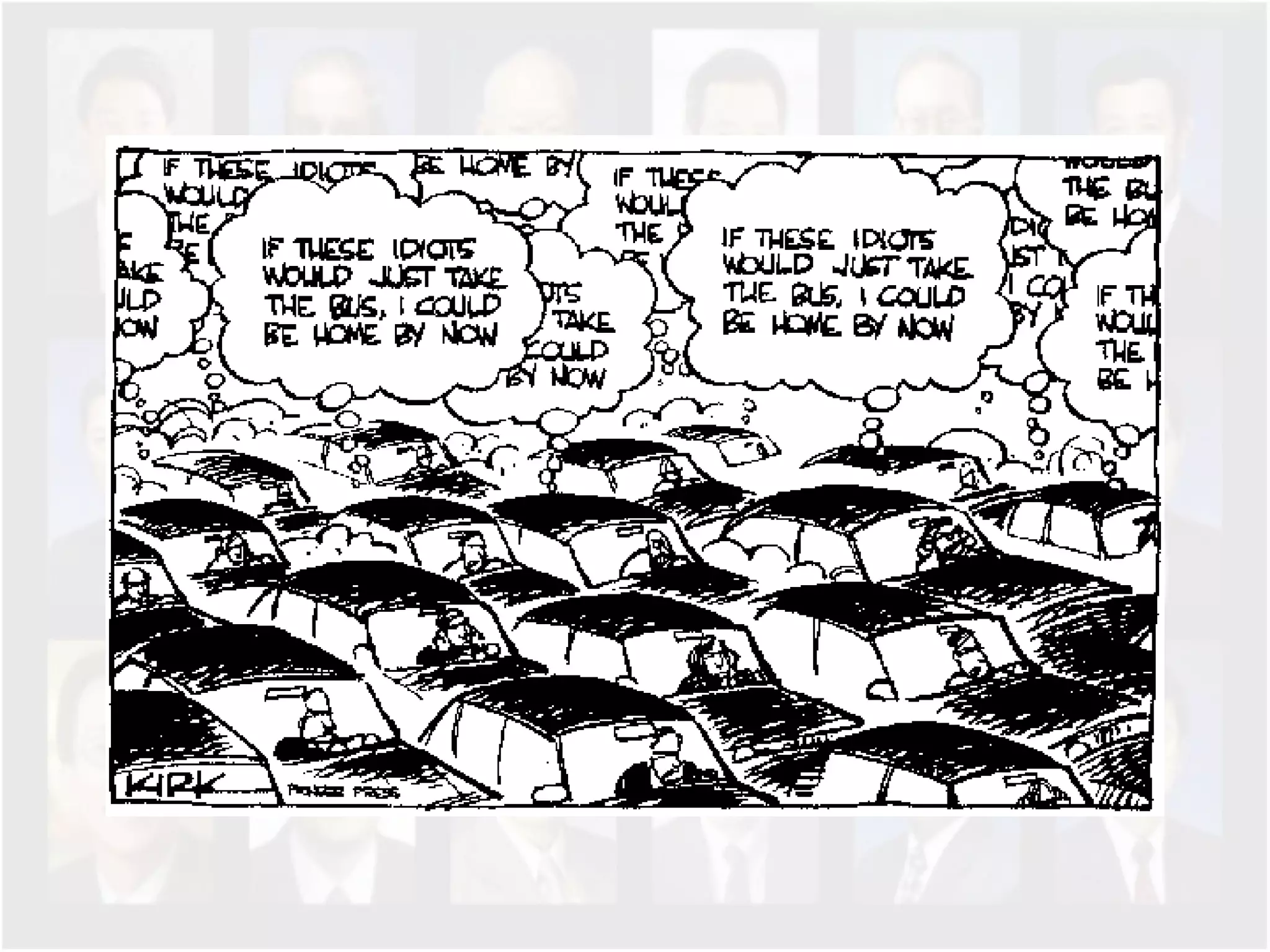
  • #45 What does the picture tell you about the transport system in this area? What does the picture tell you about the public transport system? What does the picture tell you about the people’s mentality/thought/attitude? Do you think they are right to think this way?