Chapter 5:  Bonding Singapore
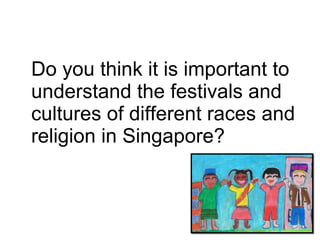
Do you think it is important to understand the festivals and cultures of different races and religion in Singapore?
List down the reasons why it is important to manage ethnic diversity Describe Singapore’s demographics
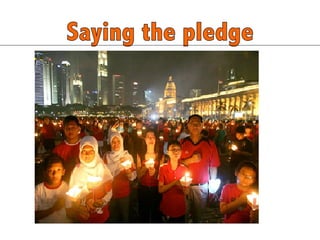
We, the citizens of Singapore, pledge ourselves as  one united people, regardless of race, language or religion,  to build a democratic society based on justice and equality so as to achieve happiness, prosperity, and progress for our nation.
Why is there this sentence in the pledge?  Why do we need to think or worry about bonding Singapore?
From this phrase, what are some issues that we are worried about when we thinking about bonding Singapore? Why these issues?
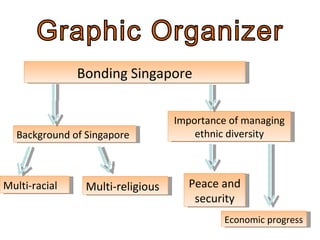
Bonding Singapore Background of Singapore Multi-racial Multi-religious Importance of managing ethnic diversity Economic progress Peace and security
Bonding Singapore
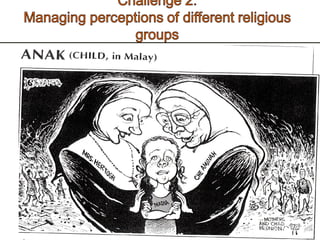
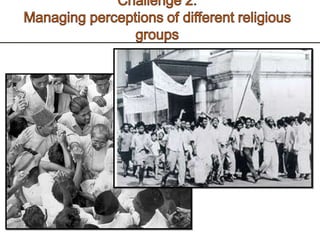
Describe the first two challenges of a multiethnic society Managing perceptions of different racial groups Managing perceptions of different religious groups
Do assumptions apply to everyone in a group? Do most people have the same assumptions about a group? Why or why not? How do assumptions affect your behavior toward others? How do assumptions about you, affect your own behavior?
Do you think it is fair to judge, and treat people according to how they look, or what group they belong to?
We will learn…  what can happen when we believe in stereotypes, assumptions, and rumors,  and behave accordingly.
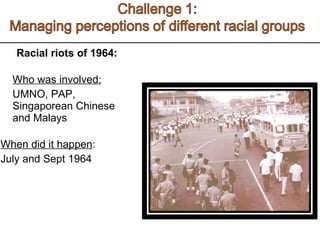
Racial riots of 1964: Who was involved: UMNO, PAP, Singaporean Chinese and Malays When did it happen : July and Sept 1964
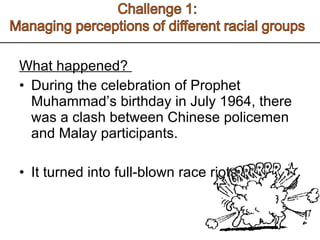
What happened?  During the celebration of Prophet Muhammad’s birthday in July 1964, there was a clash between Chinese policemen and Malay participants.  It turned into full-blown race riots.
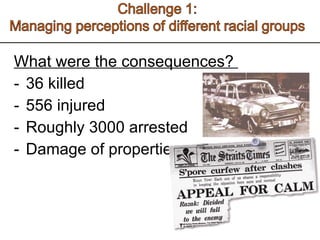
What were the consequences?  36 killed 556 injured Roughly 3000 arrested Damage of properties
“ When the movie ended, we found that the whole cinema was already surrounded by some Chinese people, waiting to attack us. Some of the Malay viewers ran towards Bedok Village while the rest of the views, including my brother-in-law ran and jumped into the East Coast Beach and swim to Bedok Village” - MrYahya, a Malay. (During the racial riots)
“ Suddenly, one of the Malays came charging towards me. He grabbed me in a head lock and forced me to walk with him. But the man then said in Malay ‘don’t be afraid’. I was only then I realized he was Abdul, an office colleague. Abdul faked the capture so that other Malays would not attack me.” - Mr Ng, a Chinese.
Why did it happen?  Different political approaches between UMNO and PAPcaused a strain in their relations Even though they were the same country, Malaysia in 1964 UMNO felt threatened by PAP’s non-communal approach.  Anti-PAP campaign organized by some UMNO leaders to weaken PAP’s support in Singapore.
They used PAP’s resettlement and redevelopment programmes to create problems for PAP.  They purposely focused on the poverty of the Singapore Malays.  The programmes were portrayed as anti-Malay.  UMNO claimed Malays were being kicked out of their homes.
UtusanMelayu (Malay newspaper) was used by UMNO to spread the anti-PAP campaign  Paper said that PAP did not care about Malays in  Singapore UMNO wanted to Singapore Malays to be angry and unhappy with PAP.
“ I am very happy today we Malays and Muslims in Singapore have shown unity and are prepared to live or die together for our race and future generation. … Not one LeeKuanYew, a thousand Lee Kuan Yews… we finish them off… According to Lee Kuan Yew’s logic: Hey, shut up, you minority race in this island. Here I say to Lee Kuan Yew: You shut up and don’t tell us to shut up.” - SyedJaafar bin Hassan Albar, Malaysian politician, a member of UMNO.
“ Lee responsible for Singapore riots.” - UtusanMelayu, a Malay newspaper in  Singapore.    “ The fact is that UMNO must bear the responsibility for the recent riot because they purposely provoked Malay racial sentiments.” - New Zealand Department of External  Affairs.
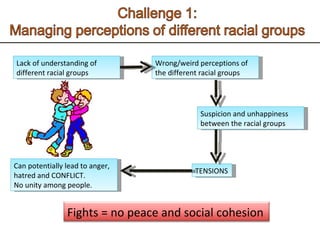
Lack of understanding of different racial groups Wrong/weird perceptions of the different racial groups Suspicion and unhappiness between the racial groups TENSIONS Can potentially lead to anger, hatred and CONFLICT. No unity among people.  Fights = no peace and social cohesion
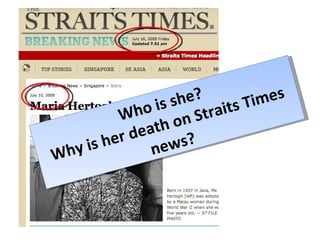
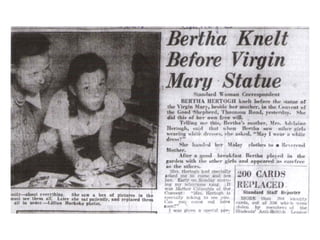
Who is she?  Why is her death on Straits Times news?
 
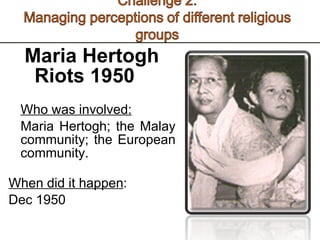
Maria Hertogh Riots 1950 Who was involved: Maria Hertogh; the Malay community; the European community.  When did it happen : Dec 1950
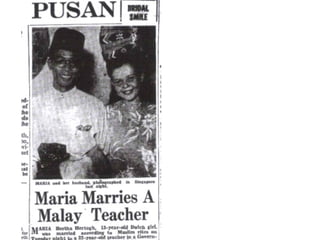
What happened? Custody struggle between the Dutch parents and the foster mother, CheAminah.  Media coverage given was bias, and it created misunderstandings on both side.  Custody given to the Dutch parents, her marriage to a Malay teacher was annulled.  Malay community felt that the system was unfair to the Muslims. RIOTS.
 
Maria’s father, when interviewed: [Maria] was threatened by her foster mother and her so-called husband, Mansoor. She is like a child frightened of Black Peter, a Dutch classic villain. Maria was similarly frightened of those cruel people in the East... Our child was captured by Aminah, hidden by her all these years and raised to hate Europeans. She taught her to hate her own parents, race and religion.
Maria’s Malay husband says:  [The Dutch had imagined] Maria a “jungle girl”, although she is as much a city girl as any girl in Chicago, USA. One of the [Dutch] papers spoke of her dodging tigers in Singapore. Where do such writers think we live? In the middle of a jungle?
 
 
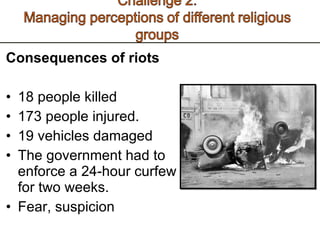
Consequences of riots  18 people killed  173 people injured. 19 vehicles damaged The government had to enforce a 24-hour curfew for two weeks.  Fear, suspicion
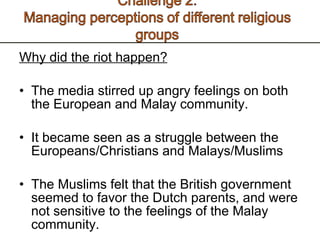
Why did the riot happen? The media stirred up angry feelings on both the European and Malay community.  It became seen as a struggle between the Europeans/Christians and Malays/Muslims The Muslims felt that the British government seemed to favor the Dutch parents, and were not sensitive to the feelings of the Malay community.
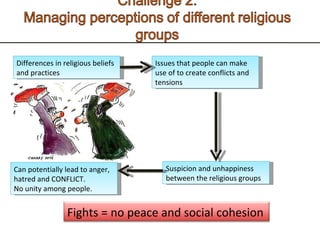
Differences in religious beliefs and practices Issues that people can make use of to create conflicts and tensions Suspicion and unhappiness between the religious groups Can potentially lead to anger, hatred and CONFLICT. No unity among people.  Fights = no peace and social cohesion
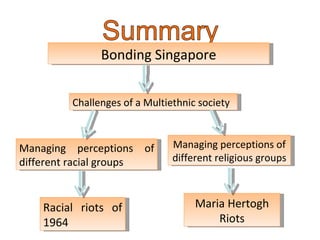
Bonding Singapore Challenges of a Multiethnic society  Managing perceptions of different racial groups Racial riots of 1964 Managing perceptions of different religious groups Maria Hertogh Riots
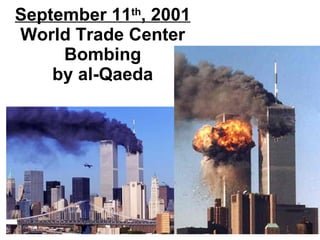
September 11 th , 2001 World Trade Center Bombing by al-Qaeda
 
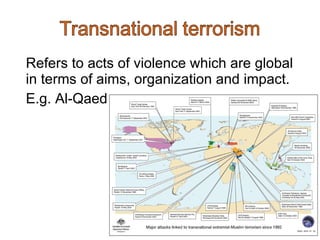
Refers to acts of violence which are global in terms of aims, organization and impact.  E.g. Al-Qaeda
Do you think transnational terrorist will attack Singapore? Why or Why not?
What do you think will happen if there is a terrorist attack in Singapore?  (Politically, economically and socially?)
What is JemaahIslamiyah (JI)? A Southeast Asian-based terrorist network with links to the international terrorist organization known as the al-Qaeda.  JI’s goal is to create an Islamic state comprising of Brunei, Indonesia, Malaysia, Singapore and southern Philippines.  They use violence to achieve their aims.
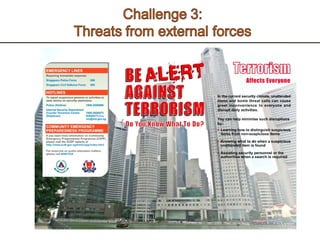
Transnational Terrorism in Singapore 34 JI members arrested in Singapore since 2001 Attempts of terrorism in Singapore  Wanted to bomb government buildings and the US embassy in Singapore.  Why target Singapore?  Put Singaporeans on high alert against terrorism
Various political and religious leaders in Singapore appealed to Singaporeans to remain calm In a united voice, Muslim leaders condemned the JI group and emphasized that it did not have the support of Muslims. (Why did the Muslim leaders announce that to Singapore?)
Response from Singapore: Anti-terrorism stance  Improve security, alertness  Organizations voiced support to maintain ethnic harmony in Singapore  Continue to ensure social cohesion
 
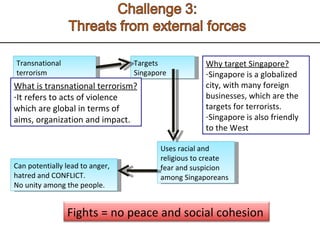
Transnational terrorism Targets Singapore Uses racial and religious to create fear and suspicion among Singaporeans Can potentially lead to anger, hatred and CONFLICT.  No unity among the people.  Why target Singapore? Singapore is a globalized city, with many foreign businesses, which are the targets for terrorists.  Singapore is also friendly to the West What is transnational terrorism? It refers to acts of violence which are global in terms of aims, organization and impact. Fights = no peace and social cohesion
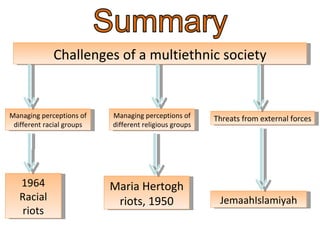
Challenges of a multiethnic society Managing perceptions of different racial groups 1964 Racial riots Maria Hertogh riots, 1950 Threats from external forces JemaahIslamiyah Managing perceptions of different religious groups
 
Why? Helps Singaporeans to be united as one people (and not 4 different races)  helps to nurture racial and religious harmony!
What are some things that KRSS does to build school identity?  How do the measures help to build identity?
What are some things that we do in our lives, that helps to build national identity?


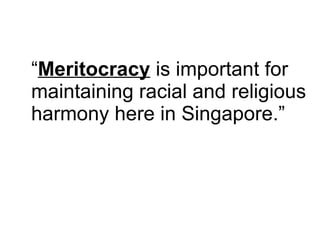
“ Meritocracy  is important for  maintaining racial and religious harmony here in Singapore.”
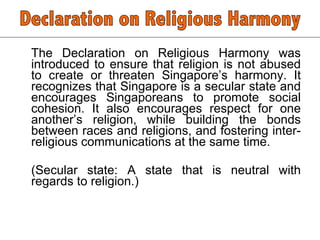
The Declaration on Religious Harmony was introduced to ensure that religion is not abused to create or threaten Singapore’s harmony. It recognizes that Singapore is a secular state and encourages Singaporeans to promote social cohesion. It also encourages respect for one another’s religion, while building the bonds between races and religions, and fostering inter-religious communications at the same time.  (Secular state: A state that is neutral with regards to religion.)
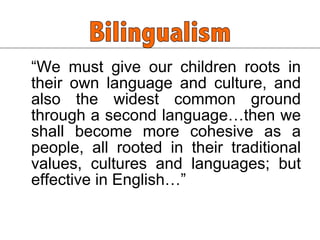
“ We must give our children roots in their own language and culture, and also the widest common ground through a second language…then we shall become more cohesive as a people, all rooted in their traditional values, cultures and languages; but effective in English…”
Presidential Council of Minority Rights The Presidential Council for Minority Rights is meant to protect and check against the government put into practice any discriminatory laws. It has to make sure that new laws passed by Singapore's Parliament are not discriminatory against any race, religion or community. It will also investigate complaints as well as report any issues affecting the racial or religious community to the government.
The success of the Self-Help Groups in helping their respective communities shows our ability to make good use of Singapore’s ethnic diversity. While there are existing programmes at the national level that helps Singaporeans, regardless of race, the Self-Help Groups add to these programmes in helping their own communities to deal with specific challenges, as they understand the background and the needs of their own communities.  (Self-help groups are groups that help members of their community, e.g. CDAC: Chinese Development Assistance Council; Mendaki: Malay self-help group; SINDA: Singapore Indian Development Association]
2 ways of managing Singapore’s ethnic diversity:  Building a national identity  Ensuring minority representation
Write down…  3 things about building national identity 2 ways of ensuring minority representation 1 interesting fact that you learn today
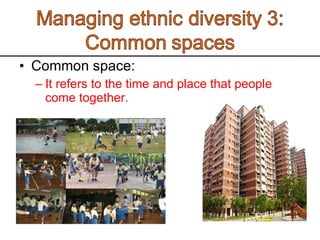
Common space: It refers to the time and place that people come together.
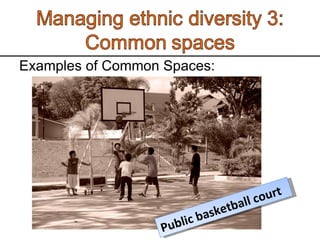
Examples of Common Spaces:  Public basketball court
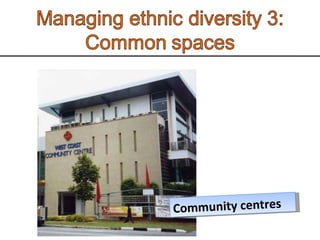
Community centres
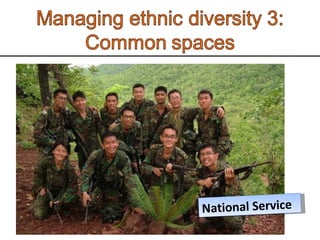
National Service
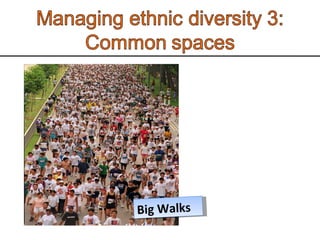
Big Walks
What is something that all the examples have in common? What are the characteristics of ‘Common Spaces’? Think-Pair-Share
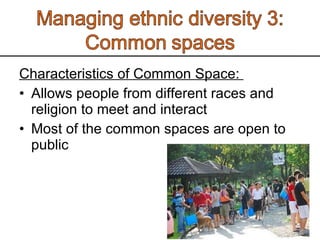
Characteristics of Common Space:  Allows people from different races and religion to meet and interact Most of the common spaces are open to public
MORE Examples of common space:  Events and programmes organized by grassroots organization (e.g. People’s Association) E.g. home stay opportunities with a host family from another ethnic group.  Participants can gain a better understanding of the cultures and customs of other races    mutual respect    friendship    more unity among Singaporeans
MORE Examples of common space:  Opportunities offered by educational institutions E.g. in the classrooms and in CCAs.  Students from different races and religions study together.  Interaction among students    provides opportunities to form friendships; learning to appreciate talents and respect one another as individuals.
MORE Examples of common space:  Common living space provided by public housing Ethnic integration policy    ensures that in each HDB estates, there will be an even distribution of the different races.
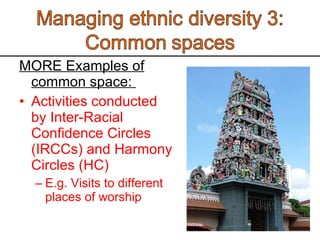
MORE Examples of common space:  Activities conducted by Inter-Racial Confidence Circles (IRCCs) and Harmony Circles (HC) E.g. Visits to different places of worship
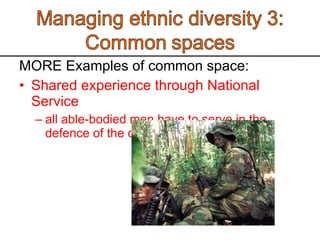
MORE Examples of common space:  Shared experience through National Service all able-bodied men have to serve in the defence of the country.
How does all these common spaces help to encourage social cohesion?  These common spaces provide opportunities for Singaporeans from all races and religions to meet and interact. This can help to deepen their understanding of each other as they form friendships. Hence, there will be more unity among Singaporeans, which encourages social cohesion.
3 ways to manage ethnic diversity Building national identity Minority representation Common spaces
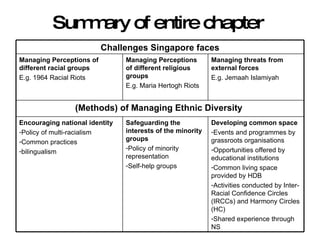
Summary of entire chapter  Challenges Singapore faces Developing common space Events and programmes by grassroots organisations Opportunities offered by educational institutions Common living space provided by HDB Activities conducted by Inter-Racial Confidence Circles (IRCCs) and Harmony Circles (HC) Shared experience through NS Safeguarding the interests of the minority groups Policy of minority representation Self-help groups Encouraging national identity Policy of multi-racialism Common practices bilingualism (Methods) of Managing Ethnic Diversity  Managing threats from external forces E.g. Jemaah Islamiyah Managing Perceptions of different religious groups E.g. Maria Hertogh Riots Managing Perceptions of different racial groups E.g. 1964 Racial Riots

Sec 3 Social Studies Chapter 5

  • 1.
    Chapter 5: Bonding Singapore
  • 2.
    Do you thinkit is important to understand the festivals and cultures of different races and religion in Singapore?
  • 3.
    List down thereasons why it is important to manage ethnic diversity Describe Singapore’s demographics
  • 4.
    We, the citizensof Singapore, pledge ourselves as one united people, regardless of race, language or religion, to build a democratic society based on justice and equality so as to achieve happiness, prosperity, and progress for our nation.
  • 5.
    Why is therethis sentence in the pledge? Why do we need to think or worry about bonding Singapore?
  • 6.
    From this phrase,what are some issues that we are worried about when we thinking about bonding Singapore? Why these issues?
  • 7.
    Bonding Singapore Backgroundof Singapore Multi-racial Multi-religious Importance of managing ethnic diversity Economic progress Peace and security
  • 8.
  • 9.
    Describe the firsttwo challenges of a multiethnic society Managing perceptions of different racial groups Managing perceptions of different religious groups
  • 10.
    Do assumptions applyto everyone in a group? Do most people have the same assumptions about a group? Why or why not? How do assumptions affect your behavior toward others? How do assumptions about you, affect your own behavior?
  • 11.
    Do you thinkit is fair to judge, and treat people according to how they look, or what group they belong to?
  • 12.
    We will learn… what can happen when we believe in stereotypes, assumptions, and rumors, and behave accordingly.
  • 13.
    Racial riots of1964: Who was involved: UMNO, PAP, Singaporean Chinese and Malays When did it happen : July and Sept 1964
  • 14.
    What happened? During the celebration of Prophet Muhammad’s birthday in July 1964, there was a clash between Chinese policemen and Malay participants. It turned into full-blown race riots.
  • 15.
    What were theconsequences? 36 killed 556 injured Roughly 3000 arrested Damage of properties
  • 16.
    “ When themovie ended, we found that the whole cinema was already surrounded by some Chinese people, waiting to attack us. Some of the Malay viewers ran towards Bedok Village while the rest of the views, including my brother-in-law ran and jumped into the East Coast Beach and swim to Bedok Village” - MrYahya, a Malay. (During the racial riots)
  • 17.
    “ Suddenly, oneof the Malays came charging towards me. He grabbed me in a head lock and forced me to walk with him. But the man then said in Malay ‘don’t be afraid’. I was only then I realized he was Abdul, an office colleague. Abdul faked the capture so that other Malays would not attack me.” - Mr Ng, a Chinese.
  • 18.
    Why did ithappen? Different political approaches between UMNO and PAPcaused a strain in their relations Even though they were the same country, Malaysia in 1964 UMNO felt threatened by PAP’s non-communal approach. Anti-PAP campaign organized by some UMNO leaders to weaken PAP’s support in Singapore.
  • 19.
    They used PAP’sresettlement and redevelopment programmes to create problems for PAP. They purposely focused on the poverty of the Singapore Malays. The programmes were portrayed as anti-Malay. UMNO claimed Malays were being kicked out of their homes.
  • 20.
    UtusanMelayu (Malay newspaper)was used by UMNO to spread the anti-PAP campaign Paper said that PAP did not care about Malays in Singapore UMNO wanted to Singapore Malays to be angry and unhappy with PAP.
  • 21.
    “ I amvery happy today we Malays and Muslims in Singapore have shown unity and are prepared to live or die together for our race and future generation. … Not one LeeKuanYew, a thousand Lee Kuan Yews… we finish them off… According to Lee Kuan Yew’s logic: Hey, shut up, you minority race in this island. Here I say to Lee Kuan Yew: You shut up and don’t tell us to shut up.” - SyedJaafar bin Hassan Albar, Malaysian politician, a member of UMNO.
  • 22.
    “ Lee responsiblefor Singapore riots.” - UtusanMelayu, a Malay newspaper in Singapore.   “ The fact is that UMNO must bear the responsibility for the recent riot because they purposely provoked Malay racial sentiments.” - New Zealand Department of External Affairs.
  • 23.
    Lack of understandingof different racial groups Wrong/weird perceptions of the different racial groups Suspicion and unhappiness between the racial groups TENSIONS Can potentially lead to anger, hatred and CONFLICT. No unity among people. Fights = no peace and social cohesion
  • 24.
    Who is she? Why is her death on Straits Times news?
  • 25.
  • 26.
    Maria Hertogh Riots1950 Who was involved: Maria Hertogh; the Malay community; the European community. When did it happen : Dec 1950
  • 27.
    What happened? Custodystruggle between the Dutch parents and the foster mother, CheAminah. Media coverage given was bias, and it created misunderstandings on both side. Custody given to the Dutch parents, her marriage to a Malay teacher was annulled. Malay community felt that the system was unfair to the Muslims. RIOTS.
  • 28.
  • 29.
    Maria’s father, wheninterviewed: [Maria] was threatened by her foster mother and her so-called husband, Mansoor. She is like a child frightened of Black Peter, a Dutch classic villain. Maria was similarly frightened of those cruel people in the East... Our child was captured by Aminah, hidden by her all these years and raised to hate Europeans. She taught her to hate her own parents, race and religion.
  • 30.
    Maria’s Malay husbandsays: [The Dutch had imagined] Maria a “jungle girl”, although she is as much a city girl as any girl in Chicago, USA. One of the [Dutch] papers spoke of her dodging tigers in Singapore. Where do such writers think we live? In the middle of a jungle?
  • 31.
  • 32.
  • 33.
    Consequences of riots 18 people killed 173 people injured. 19 vehicles damaged The government had to enforce a 24-hour curfew for two weeks. Fear, suspicion
  • 34.
    Why did theriot happen? The media stirred up angry feelings on both the European and Malay community. It became seen as a struggle between the Europeans/Christians and Malays/Muslims The Muslims felt that the British government seemed to favor the Dutch parents, and were not sensitive to the feelings of the Malay community.
  • 35.
    Differences in religiousbeliefs and practices Issues that people can make use of to create conflicts and tensions Suspicion and unhappiness between the religious groups Can potentially lead to anger, hatred and CONFLICT. No unity among people. Fights = no peace and social cohesion
  • 36.
    Bonding Singapore Challengesof a Multiethnic society Managing perceptions of different racial groups Racial riots of 1964 Managing perceptions of different religious groups Maria Hertogh Riots
  • 37.
    September 11 th, 2001 World Trade Center Bombing by al-Qaeda
  • 38.
  • 39.
    Refers to actsof violence which are global in terms of aims, organization and impact. E.g. Al-Qaeda
  • 40.
    Do you thinktransnational terrorist will attack Singapore? Why or Why not?
  • 41.
    What do youthink will happen if there is a terrorist attack in Singapore? (Politically, economically and socially?)
  • 42.
    What is JemaahIslamiyah(JI)? A Southeast Asian-based terrorist network with links to the international terrorist organization known as the al-Qaeda. JI’s goal is to create an Islamic state comprising of Brunei, Indonesia, Malaysia, Singapore and southern Philippines. They use violence to achieve their aims.
  • 43.
    Transnational Terrorism inSingapore 34 JI members arrested in Singapore since 2001 Attempts of terrorism in Singapore Wanted to bomb government buildings and the US embassy in Singapore. Why target Singapore? Put Singaporeans on high alert against terrorism
  • 44.
    Various political andreligious leaders in Singapore appealed to Singaporeans to remain calm In a united voice, Muslim leaders condemned the JI group and emphasized that it did not have the support of Muslims. (Why did the Muslim leaders announce that to Singapore?)
  • 45.
    Response from Singapore:Anti-terrorism stance Improve security, alertness Organizations voiced support to maintain ethnic harmony in Singapore  Continue to ensure social cohesion
  • 46.
  • 47.
    Transnational terrorism TargetsSingapore Uses racial and religious to create fear and suspicion among Singaporeans Can potentially lead to anger, hatred and CONFLICT. No unity among the people. Why target Singapore? Singapore is a globalized city, with many foreign businesses, which are the targets for terrorists. Singapore is also friendly to the West What is transnational terrorism? It refers to acts of violence which are global in terms of aims, organization and impact. Fights = no peace and social cohesion
  • 48.
    Challenges of amultiethnic society Managing perceptions of different racial groups 1964 Racial riots Maria Hertogh riots, 1950 Threats from external forces JemaahIslamiyah Managing perceptions of different religious groups
  • 49.
  • 50.
    Why? Helps Singaporeansto be united as one people (and not 4 different races) helps to nurture racial and religious harmony!
  • 51.
    What are somethings that KRSS does to build school identity? How do the measures help to build identity?
  • 52.
    What are somethings that we do in our lives, that helps to build national identity?
  • 53.
  • 54.
  • 55.
  • 56.
    “ Meritocracy is important for maintaining racial and religious harmony here in Singapore.”
  • 57.
    The Declaration onReligious Harmony was introduced to ensure that religion is not abused to create or threaten Singapore’s harmony. It recognizes that Singapore is a secular state and encourages Singaporeans to promote social cohesion. It also encourages respect for one another’s religion, while building the bonds between races and religions, and fostering inter-religious communications at the same time. (Secular state: A state that is neutral with regards to religion.)
  • 58.
    “ We mustgive our children roots in their own language and culture, and also the widest common ground through a second language…then we shall become more cohesive as a people, all rooted in their traditional values, cultures and languages; but effective in English…”
  • 59.
    Presidential Council ofMinority Rights The Presidential Council for Minority Rights is meant to protect and check against the government put into practice any discriminatory laws. It has to make sure that new laws passed by Singapore's Parliament are not discriminatory against any race, religion or community. It will also investigate complaints as well as report any issues affecting the racial or religious community to the government.
  • 60.
    The success ofthe Self-Help Groups in helping their respective communities shows our ability to make good use of Singapore’s ethnic diversity. While there are existing programmes at the national level that helps Singaporeans, regardless of race, the Self-Help Groups add to these programmes in helping their own communities to deal with specific challenges, as they understand the background and the needs of their own communities. (Self-help groups are groups that help members of their community, e.g. CDAC: Chinese Development Assistance Council; Mendaki: Malay self-help group; SINDA: Singapore Indian Development Association]
  • 61.
    2 ways ofmanaging Singapore’s ethnic diversity: Building a national identity Ensuring minority representation
  • 62.
    Write down… 3 things about building national identity 2 ways of ensuring minority representation 1 interesting fact that you learn today
  • 63.
    Common space: Itrefers to the time and place that people come together.
  • 64.
    Examples of CommonSpaces: Public basketball court
  • 65.
  • 66.
  • 67.
  • 68.
    What is somethingthat all the examples have in common? What are the characteristics of ‘Common Spaces’? Think-Pair-Share
  • 69.
    Characteristics of CommonSpace: Allows people from different races and religion to meet and interact Most of the common spaces are open to public
  • 70.
    MORE Examples ofcommon space: Events and programmes organized by grassroots organization (e.g. People’s Association) E.g. home stay opportunities with a host family from another ethnic group. Participants can gain a better understanding of the cultures and customs of other races  mutual respect  friendship  more unity among Singaporeans
  • 71.
    MORE Examples ofcommon space: Opportunities offered by educational institutions E.g. in the classrooms and in CCAs. Students from different races and religions study together. Interaction among students  provides opportunities to form friendships; learning to appreciate talents and respect one another as individuals.
  • 72.
    MORE Examples ofcommon space: Common living space provided by public housing Ethnic integration policy  ensures that in each HDB estates, there will be an even distribution of the different races.
  • 73.
    MORE Examples ofcommon space: Activities conducted by Inter-Racial Confidence Circles (IRCCs) and Harmony Circles (HC) E.g. Visits to different places of worship
  • 74.
    MORE Examples ofcommon space: Shared experience through National Service all able-bodied men have to serve in the defence of the country.
  • 75.
    How does allthese common spaces help to encourage social cohesion? These common spaces provide opportunities for Singaporeans from all races and religions to meet and interact. This can help to deepen their understanding of each other as they form friendships. Hence, there will be more unity among Singaporeans, which encourages social cohesion.
  • 76.
    3 ways tomanage ethnic diversity Building national identity Minority representation Common spaces
  • 77.
    Summary of entirechapter Challenges Singapore faces Developing common space Events and programmes by grassroots organisations Opportunities offered by educational institutions Common living space provided by HDB Activities conducted by Inter-Racial Confidence Circles (IRCCs) and Harmony Circles (HC) Shared experience through NS Safeguarding the interests of the minority groups Policy of minority representation Self-help groups Encouraging national identity Policy of multi-racialism Common practices bilingualism (Methods) of Managing Ethnic Diversity Managing threats from external forces E.g. Jemaah Islamiyah Managing Perceptions of different religious groups E.g. Maria Hertogh Riots Managing Perceptions of different racial groups E.g. 1964 Racial Riots

Editor's Notes

  • #6 Think about chapter 4, on the religious conflicts in Northern Ireland and racial conflicts in Sri Lanka. What were the consequences of the conflicts? How do these two conflicts link to this sentence, or about bonding Singapore? What do we want to prevent here in Singapore? SO in other words, what are some reasons for the need to ensure that Singapore bonds?
  • #7 What do you mean by ‘united’? Why is it “regardless of race, language or religion” and not “regardless of sports, arts and literature” or “regardless of facebook, twitter or wordpress”? What is so important about language, race and religion?
  • #38 Coordinated suicide attacks by al-Qaeda 19 al-Qaela terrorists took over 4 commercial airlines  and intentionally crashed two of the airlines into the Twin Towers of the World Trade Center. 3 rd one grashed into the Pentagon in Virginia, and the 4 th one in a field in Pennsylvania. In response, US launched the war on terrorism.
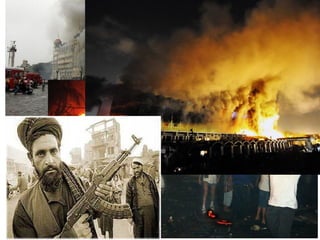
  • #39 Terrorism in Mumbai Faces of Terrorism in India Bali bombs Marriott Hotel, Islamabad set ablaze on Sep 21, 2008
  • #44 Why Singapore? Open, cosmopolitan society hosting many foreign establishments – targets to terrorists Friendly to the West