Explain the concept of a welfare state State the rationale for Britain’s system of welfare state Describe the source of money for British’s healthcare system  Describe the problems of healthcare expenditure.
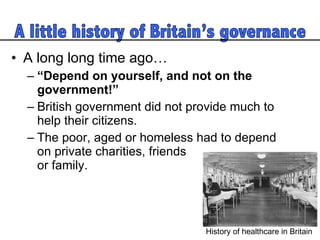
A long long time ago…  “ Depend on yourself, and not on the government!” British government did not provide much to help their citizens.  The poor, aged or homeless had to depend on private charities, friends  or family.  History of healthcare in Britain
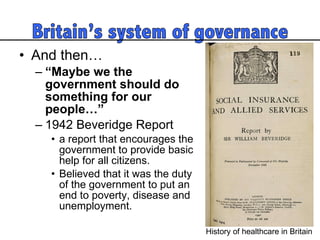
And then… “ Maybe we the government should do something for our people…” 1942 Beveridge Report  a report that encourages the government to provide basic help for all citizens.  Believed that it was the duty of the government to put an end to poverty, disease and unemployment.  History of healthcare in Britain
Today…  “ Everyone should have some welfare. We the government will help  everyone!”  Welfare state After WW2, Britain was faced with high unemployment and poverty was common.  British government believed that the best services should be made available to all who needed them.  History of healthcare in Britain
Welfare state:  a government that provides for the welfare, or the well-being, of its citizens  completely .  E.g. Government providing for the  physical, material, and social  needs rather than the people providing for their own  [i.e. a home, a job and medical care]  Concept of a welfare state
The purpose of the welfare state is to create economic equality or to assure a minimum standard of living for all.  Rationale for a welfare state
Recap A little history of British’s welfare system Concept of ‘Welfare state’ Reasons for ‘Welfare state’
One way to achieve a welfare state: Provision of Health and Medical Care  National Health Service (NHS)  Welfare state and NHS
Who?  What? When? Where? Why?  How?
Who/What is NHS? British’s  public  healthcare system  When was NHS created? 1948 Where is NHS? Everywhere in Britain Why is there NHS? NHS exist as part of the welfare state system How is NHS managed by the government?
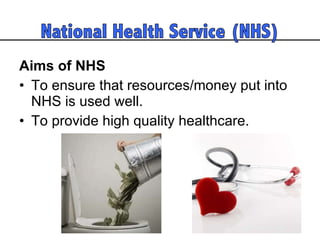
Aims of NHS To ensure that resources/money put into NHS is used well.  To provide high quality healthcare.
 
Managing government spending Increasing efficiency  Providing quality service How has the British government managed the NHS over the years  – Government spending
What is managing government spending all about? What are some examples of managing government spending? Why is managing government spending so important?  How has the British government managed the NHS over the years  – Government spending
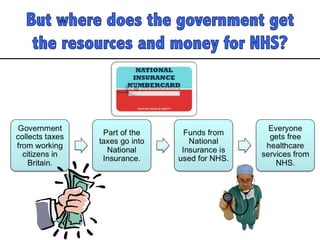
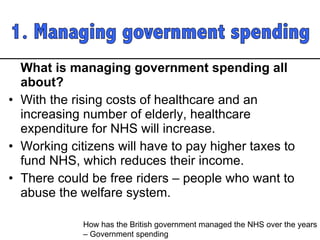
What is managing government spending all about? With the rising costs of healthcare and an increasing number of elderly, healthcare expenditure for NHS will increase.  Working citizens will have to pay higher taxes to fund NHS, which reduces their income.  There could be free riders – people who want to abuse the welfare system.  How has the British government managed the NHS over the years  – Government spending
What are some examples of managing government spending?  To cut back on government spending Increase the responsibility of healthcare on the individual.  Note: It is impossible to take away free healthcare because British citizens will withdraw their support for the government.  [a very sneaky political strategy]  How has the British government managed the NHS over the years  – Government spending
 
Why is managing government spending so important?  Managing government spending ensures that resources and money of the country are well spent. There is no wastage of resources and money.  The country’s resources and money can be used for other areas such as the economy.  How has the British government managed the NHS over the years  – Government spending
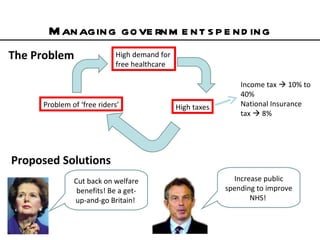
Managing government spending High demand for free healthcare High taxes Income tax    10% to 40%  National Insurance tax    8% Problem of ‘free riders’ The Problem Proposed Solutions Cut back on welfare benefits! Be a get-up-and-go Britain!  Increase public spending to improve NHS!
 
 
Managing government spending Increasing efficiency  Providing quality service How has the British government managed the NHS over the years  – Government spending
What is increasing efficiency for healthcare all about?  What are some examples to increase efficiency in healthcare? Why is it important to increase efficiency in healthcare?  How has the British government managed the NHS over the years  – Government spending
What is increasing efficiency for healthcare all about?  Not enough resources in NHS: doctors, nurses, facilities  Due to: Increase in demand for healthcare (elderly population and growing expectations) How has the British government managed the NHS over the years  – Government spending
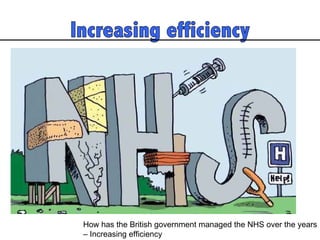
How has the British government managed the NHS over the years  – Increasing efficiency
What is increasing efficiency for healthcare all about?  Policy of privatisation within the NHS  Privatisation: the move to transfer government control to private ownership.  Aim: to reduce government subsidies, save costs, and make the NHS more efficient.  How has the British government managed the NHS over the years  – Increasing efficiency
What are some examples to increase efficiency in healthcare? An example of privatisation is that NHS hospitals contract out non-medical services.  Private contractors provide services such as laundry, cleaning, and catering in hospitals.  Hospitals can concentrate more on providing better medical services.  How has the British government managed the NHS over the years  – Increasing efficiency
What are some examples to increase efficiency in healthcare? Another example is that British citizens were encouraged to take responsibility for their own healthcare.  Medicine, dental treatment and services provided were only free for students (below 19 years old), expectant mothers, and mothers with children under one year old.  How has the British government managed the NHS over the years  – Increasing efficiency
Why is it important to increase efficiency in healthcare?   Increasing efficiency helps to fulfill one of the aims of NHS. This also ensures no wastage of resources due to inefficiency in procedures or processes.  How has the British government managed the NHS over the years  – Increasing efficiency
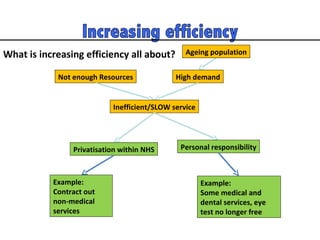
High demand Not enough Resources Ageing population Inefficient/SLOW service Privatisation within NHS What is increasing efficiency all about? Example:  Contract out non-medical services Personal responsibility Example:  Some medical and dental services, eye test no longer free
What does it mean to provide quality service? What are some examples of providing quality service? Why does the government want to provide quality service for healthcare? How has the British government managed the NHS over the years  – Providing quality service
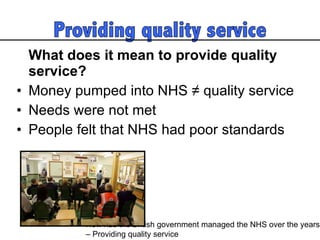
What does it mean to provide quality service? Money pumped into NHS ≠ quality service Needs were not met  People felt that NHS had poor standards  How has the British government managed the NHS over the years  – Providing quality service
What does it mean to provide quality service?   Provide quality service for people By providing more information to help patients decide on their own treatment and care.  How has the British government managed the NHS over the years  – Providing quality service
What are some examples of providing quality service? NHS Plan 2000  Planned to work towards offering patients faster and more convenient services.  E.g. let NHS make use of facilities in private hospitals without having the patient pay for it.  How has the British government managed the NHS over the years  – Providing quality service
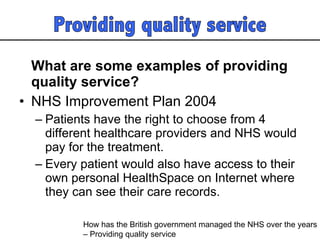
What are some examples of providing quality service? NHS Improvement Plan 2004 Patients have the right to choose from 4 different healthcare providers and NHS would pay for the treatment.  Every patient would also have access to their own personal HealthSpace on Internet where they can see their care records.  How has the British government managed the NHS over the years  – Providing quality service
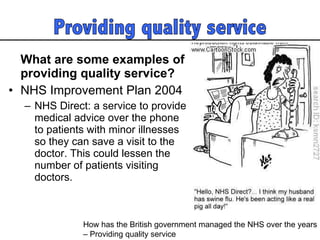
What are some examples of providing quality service? NHS Improvement Plan 2004 NHS Direct: a service to provide medical advice over the phone to patients with minor illnesses so they can save a visit to the doctor. This could lessen the number of patients visiting doctors.  How has the British government managed the NHS over the years  – Providing quality service
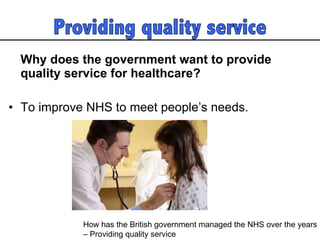
Why does the government want to provide quality service for healthcare? To improve NHS to meet people’s needs.  How has the British government managed the NHS over the years  – Providing quality service
3 challenges:  Government spending:  F ree-Riders A geing population M ore demands,  I ndividual responsibility,  L esser expenditure Y ay! Problem solved…
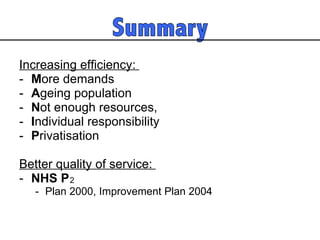
Increasing efficiency:  M ore demands  A geing population N ot enough resources,  I ndividual responsibility P rivatisation Better quality of service:  NHS P Plan 2000, Improvement Plan 2004  2
Source A: A comment by Mike, a British citizen living in Bristol, UK Isn’t it time we thanked our lucky stars that we have a free NHS! If, like the rest of the world, we have to pay every time we saw a doctor, then we would have something to complain about. As it is, we have the option of free treatment, or, if you want treatment quicker, pay for it. Be thankful we have the choice.  What does Source A tell you about the author’s perspective towards NHS?
What can you say about the author’s perspective about NHS?  Source A : A cartoon drawn by a politician against the British government.
SEQ practice Do you agree that increasing efficiency is the best way to manage the British healthcare system?  [12]

Chapter 3: Healthcare in Britain

  • 1.
  • 2.
    Explain the conceptof a welfare state State the rationale for Britain’s system of welfare state Describe the source of money for British’s healthcare system Describe the problems of healthcare expenditure.
  • 3.
    A long longtime ago… “ Depend on yourself, and not on the government!” British government did not provide much to help their citizens. The poor, aged or homeless had to depend on private charities, friends or family. History of healthcare in Britain
  • 4.
    And then… “Maybe we the government should do something for our people…” 1942 Beveridge Report a report that encourages the government to provide basic help for all citizens. Believed that it was the duty of the government to put an end to poverty, disease and unemployment. History of healthcare in Britain
  • 5.
    Today… “Everyone should have some welfare. We the government will help everyone!” Welfare state After WW2, Britain was faced with high unemployment and poverty was common. British government believed that the best services should be made available to all who needed them. History of healthcare in Britain
  • 6.
    Welfare state: a government that provides for the welfare, or the well-being, of its citizens completely . E.g. Government providing for the physical, material, and social needs rather than the people providing for their own [i.e. a home, a job and medical care] Concept of a welfare state
  • 7.
    The purpose ofthe welfare state is to create economic equality or to assure a minimum standard of living for all. Rationale for a welfare state
  • 8.
    Recap A littlehistory of British’s welfare system Concept of ‘Welfare state’ Reasons for ‘Welfare state’
  • 9.
    One way toachieve a welfare state: Provision of Health and Medical Care National Health Service (NHS) Welfare state and NHS
  • 10.
    Who? What?When? Where? Why? How?
  • 11.
    Who/What is NHS?British’s public healthcare system When was NHS created? 1948 Where is NHS? Everywhere in Britain Why is there NHS? NHS exist as part of the welfare state system How is NHS managed by the government?
  • 12.
    Aims of NHSTo ensure that resources/money put into NHS is used well. To provide high quality healthcare.
  • 13.
  • 14.
    Managing government spendingIncreasing efficiency Providing quality service How has the British government managed the NHS over the years – Government spending
  • 15.
    What is managinggovernment spending all about? What are some examples of managing government spending? Why is managing government spending so important? How has the British government managed the NHS over the years – Government spending
  • 16.
    What is managinggovernment spending all about? With the rising costs of healthcare and an increasing number of elderly, healthcare expenditure for NHS will increase. Working citizens will have to pay higher taxes to fund NHS, which reduces their income. There could be free riders – people who want to abuse the welfare system. How has the British government managed the NHS over the years – Government spending
  • 17.
    What are someexamples of managing government spending? To cut back on government spending Increase the responsibility of healthcare on the individual. Note: It is impossible to take away free healthcare because British citizens will withdraw their support for the government. [a very sneaky political strategy] How has the British government managed the NHS over the years – Government spending
  • 18.
  • 19.
    Why is managinggovernment spending so important? Managing government spending ensures that resources and money of the country are well spent. There is no wastage of resources and money. The country’s resources and money can be used for other areas such as the economy. How has the British government managed the NHS over the years – Government spending
  • 20.
    Managing government spendingHigh demand for free healthcare High taxes Income tax  10% to 40% National Insurance tax  8% Problem of ‘free riders’ The Problem Proposed Solutions Cut back on welfare benefits! Be a get-up-and-go Britain! Increase public spending to improve NHS!
  • 21.
  • 22.
  • 23.
    Managing government spendingIncreasing efficiency Providing quality service How has the British government managed the NHS over the years – Government spending
  • 24.
    What is increasingefficiency for healthcare all about? What are some examples to increase efficiency in healthcare? Why is it important to increase efficiency in healthcare? How has the British government managed the NHS over the years – Government spending
  • 25.
    What is increasingefficiency for healthcare all about? Not enough resources in NHS: doctors, nurses, facilities Due to: Increase in demand for healthcare (elderly population and growing expectations) How has the British government managed the NHS over the years – Government spending
  • 26.
    How has theBritish government managed the NHS over the years – Increasing efficiency
  • 27.
    What is increasingefficiency for healthcare all about? Policy of privatisation within the NHS Privatisation: the move to transfer government control to private ownership. Aim: to reduce government subsidies, save costs, and make the NHS more efficient. How has the British government managed the NHS over the years – Increasing efficiency
  • 28.
    What are someexamples to increase efficiency in healthcare? An example of privatisation is that NHS hospitals contract out non-medical services. Private contractors provide services such as laundry, cleaning, and catering in hospitals. Hospitals can concentrate more on providing better medical services. How has the British government managed the NHS over the years – Increasing efficiency
  • 29.
    What are someexamples to increase efficiency in healthcare? Another example is that British citizens were encouraged to take responsibility for their own healthcare. Medicine, dental treatment and services provided were only free for students (below 19 years old), expectant mothers, and mothers with children under one year old. How has the British government managed the NHS over the years – Increasing efficiency
  • 30.
    Why is itimportant to increase efficiency in healthcare? Increasing efficiency helps to fulfill one of the aims of NHS. This also ensures no wastage of resources due to inefficiency in procedures or processes. How has the British government managed the NHS over the years – Increasing efficiency
  • 31.
    High demand Notenough Resources Ageing population Inefficient/SLOW service Privatisation within NHS What is increasing efficiency all about? Example: Contract out non-medical services Personal responsibility Example: Some medical and dental services, eye test no longer free
  • 32.
    What does itmean to provide quality service? What are some examples of providing quality service? Why does the government want to provide quality service for healthcare? How has the British government managed the NHS over the years – Providing quality service
  • 33.
    What does itmean to provide quality service? Money pumped into NHS ≠ quality service Needs were not met People felt that NHS had poor standards How has the British government managed the NHS over the years – Providing quality service
  • 34.
    What does itmean to provide quality service? Provide quality service for people By providing more information to help patients decide on their own treatment and care. How has the British government managed the NHS over the years – Providing quality service
  • 35.
    What are someexamples of providing quality service? NHS Plan 2000 Planned to work towards offering patients faster and more convenient services. E.g. let NHS make use of facilities in private hospitals without having the patient pay for it. How has the British government managed the NHS over the years – Providing quality service
  • 36.
    What are someexamples of providing quality service? NHS Improvement Plan 2004 Patients have the right to choose from 4 different healthcare providers and NHS would pay for the treatment. Every patient would also have access to their own personal HealthSpace on Internet where they can see their care records. How has the British government managed the NHS over the years – Providing quality service
  • 37.
    What are someexamples of providing quality service? NHS Improvement Plan 2004 NHS Direct: a service to provide medical advice over the phone to patients with minor illnesses so they can save a visit to the doctor. This could lessen the number of patients visiting doctors. How has the British government managed the NHS over the years – Providing quality service
  • 38.
    Why does thegovernment want to provide quality service for healthcare? To improve NHS to meet people’s needs. How has the British government managed the NHS over the years – Providing quality service
  • 39.
    3 challenges: Government spending: F ree-Riders A geing population M ore demands, I ndividual responsibility, L esser expenditure Y ay! Problem solved…
  • 40.
    Increasing efficiency: M ore demands A geing population N ot enough resources, I ndividual responsibility P rivatisation Better quality of service: NHS P Plan 2000, Improvement Plan 2004 2
  • 41.
    Source A: Acomment by Mike, a British citizen living in Bristol, UK Isn’t it time we thanked our lucky stars that we have a free NHS! If, like the rest of the world, we have to pay every time we saw a doctor, then we would have something to complain about. As it is, we have the option of free treatment, or, if you want treatment quicker, pay for it. Be thankful we have the choice. What does Source A tell you about the author’s perspective towards NHS?
  • 42.
    What can yousay about the author’s perspective about NHS? Source A : A cartoon drawn by a politician against the British government.
  • 43.
    SEQ practice Doyou agree that increasing efficiency is the best way to manage the British healthcare system? [12]