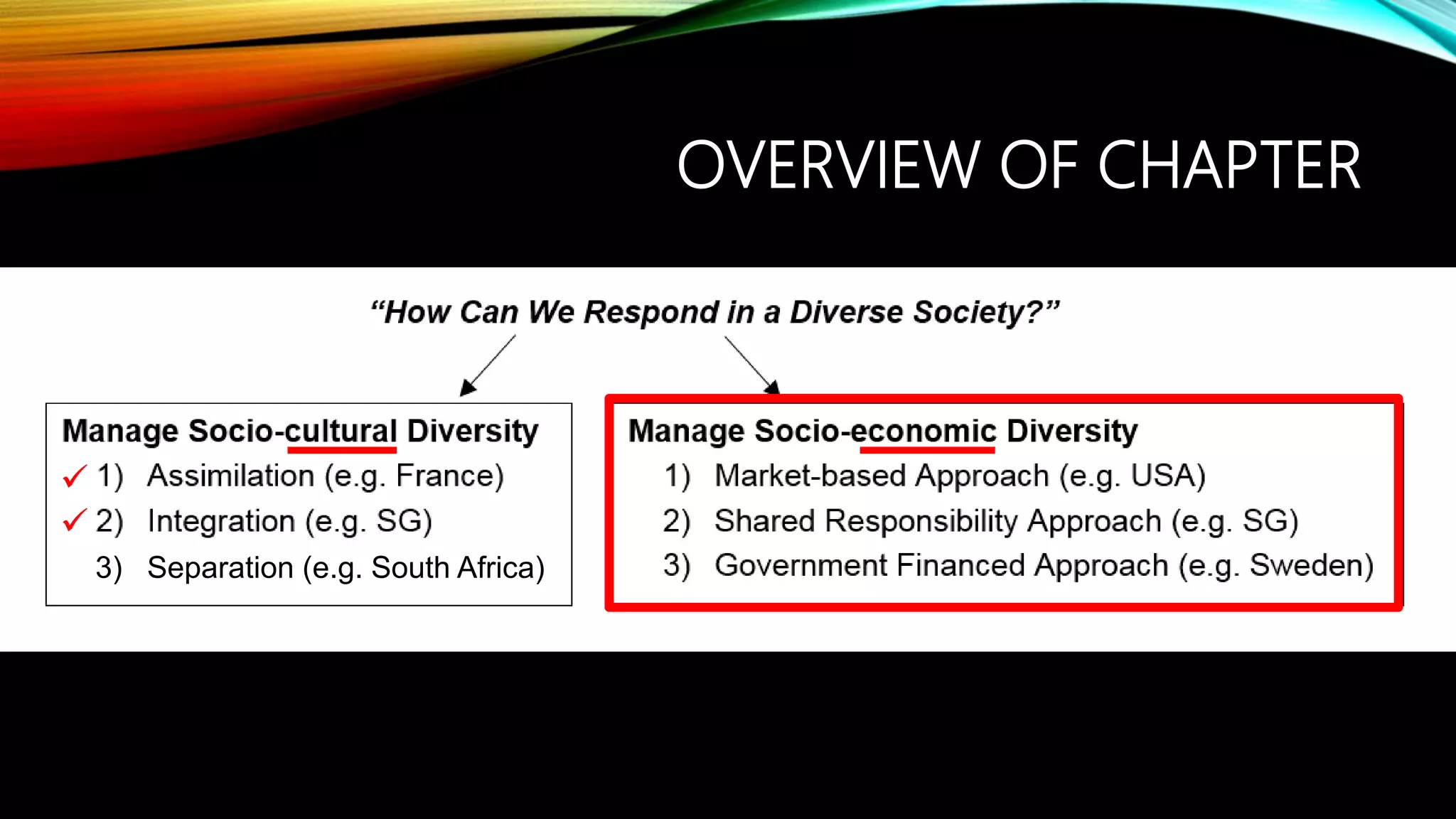
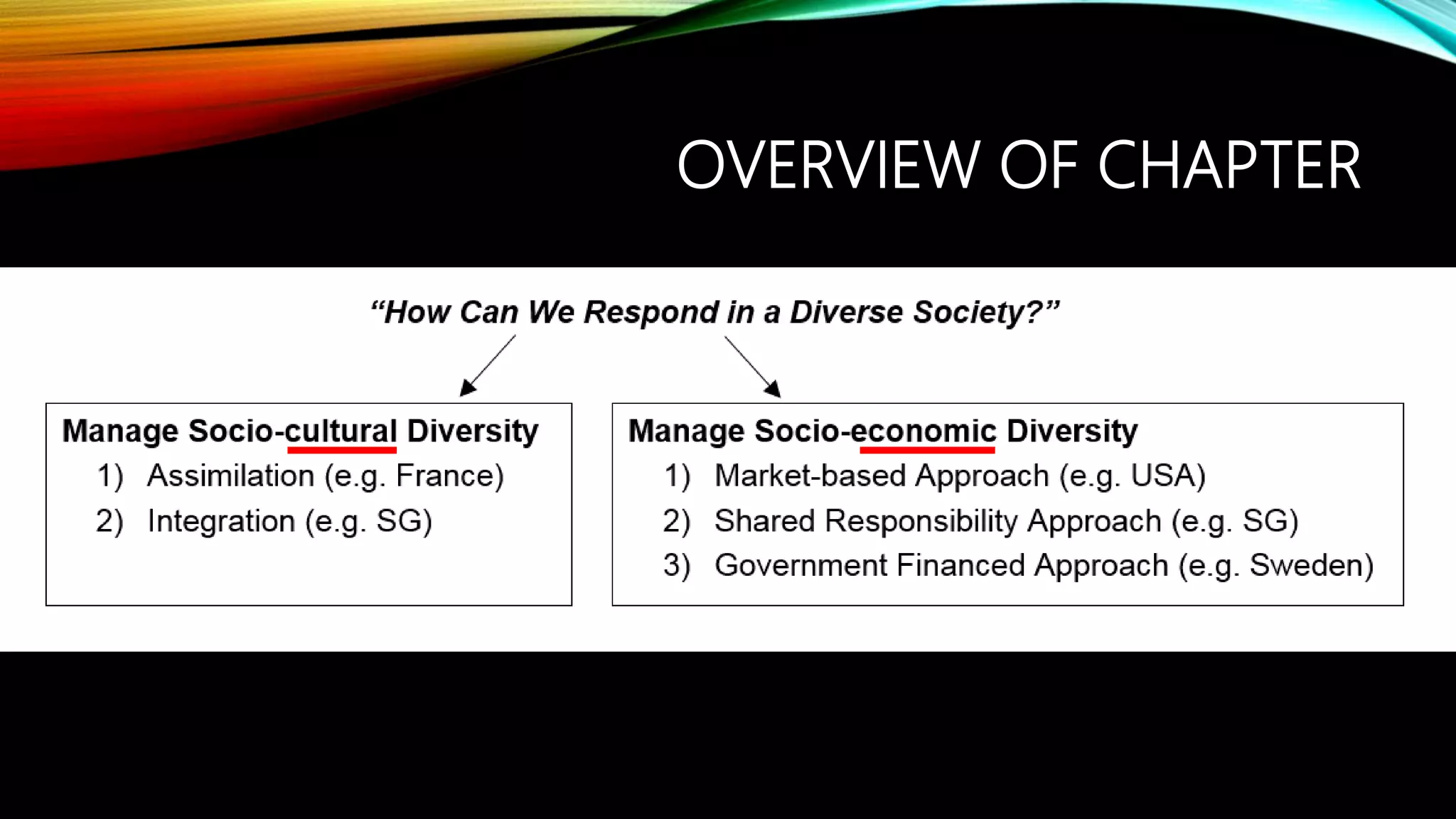
OVERVIEW OF CHAPTER
3) Separation (e.g. South Africa)


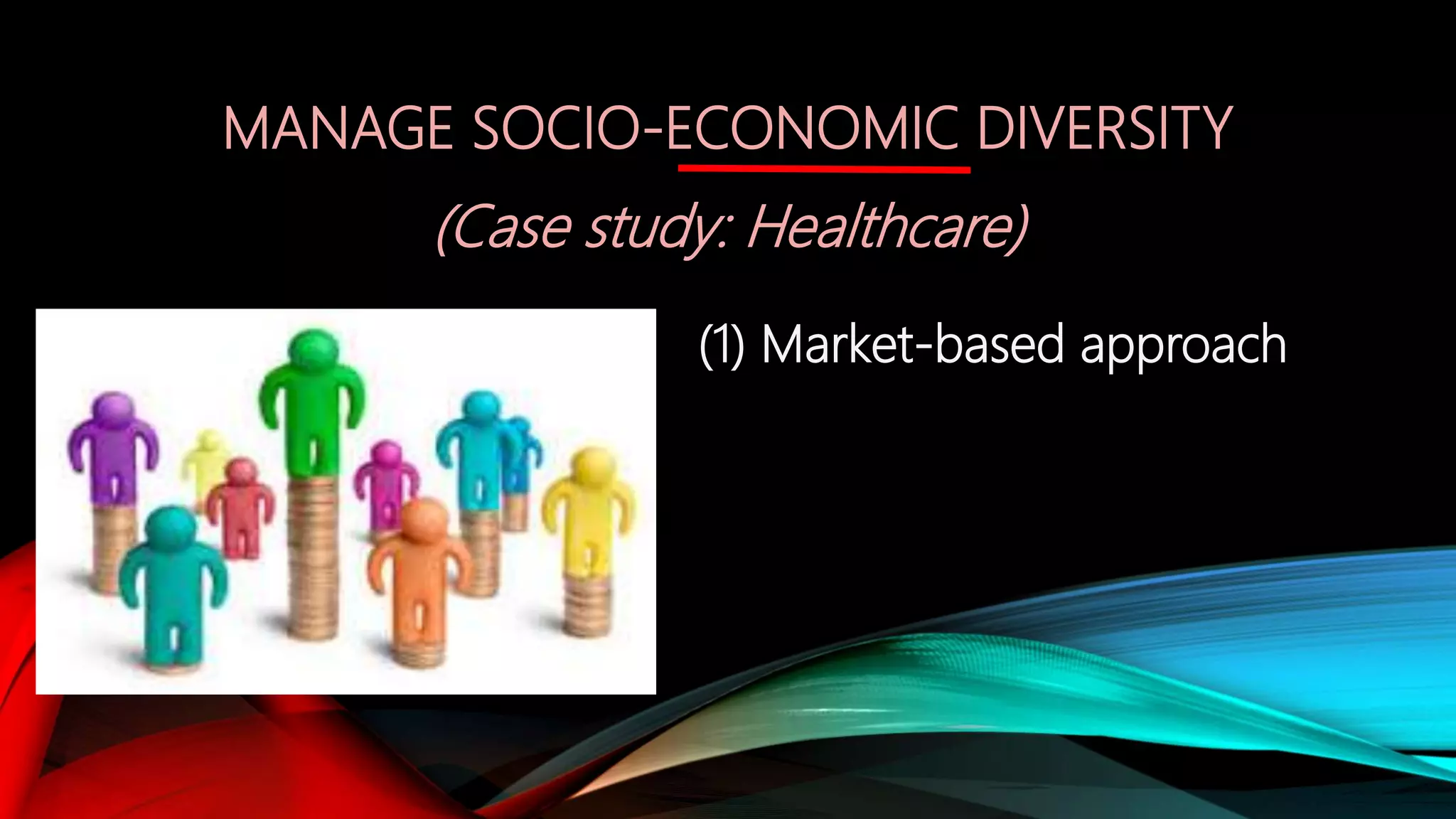
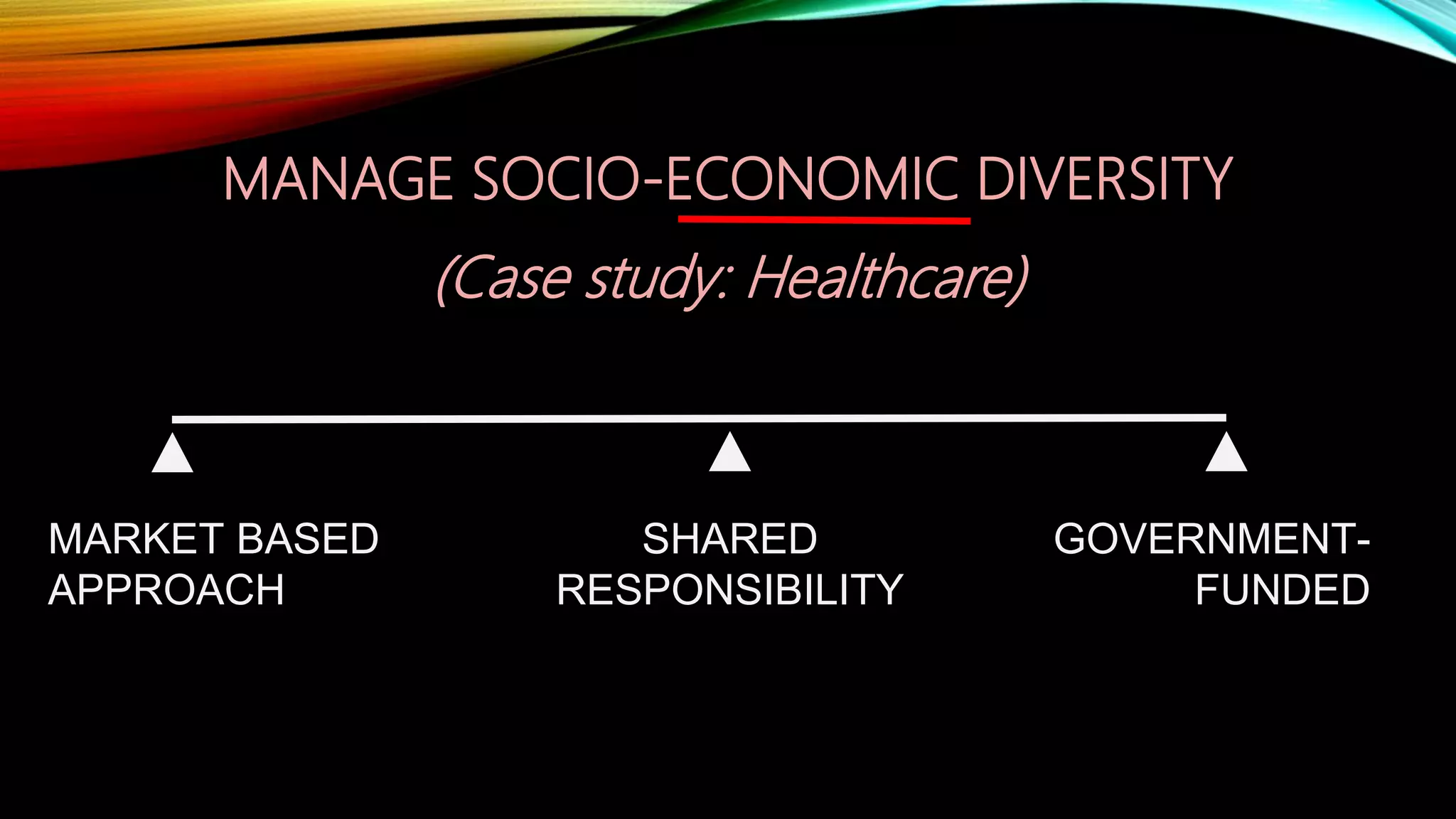
MANAGE SOCIO-ECONOMIC DIVERSITY
(Case study: Healthcare)
(1) Market-based approach
MANAGE SOCIO-ECONOMIC DIVERSITY
(1) MARKET-BASED APPROACH
TB pg. 220
• Citizens have the freedom to decide how much they
wish to pay for healthcare services
• The market determines the price & provision of
healthcare services
• Demand : $
• Supply : $
MANAGE SOCIO-ECONOMIC DIVERSITY
(Case study: Healthcare)
(1) MARKET BASED APPROACH
•Q1: How does this approach help to manage
socio-economic diversity? (LINK)
•Q2: What are the problems that might
result?
Individuals
Who bears the responsibility for the cost of healthcare?
MANAGE SOCIO-ECONOMIC DIVERSITY
(Case study: Healthcare)
(1) MARKET BASED APPROACH
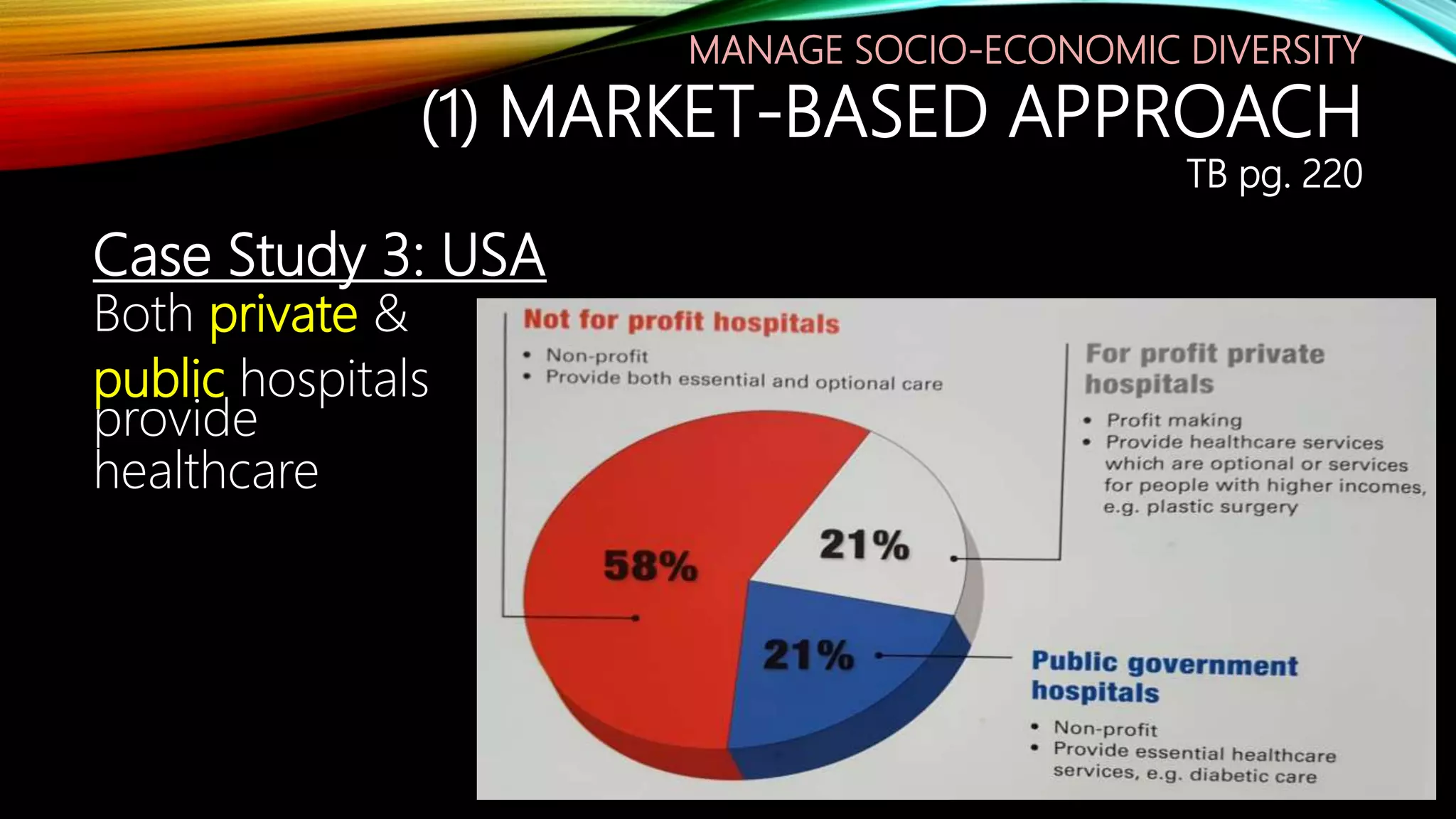
Case Study 3: USA
Both private &
public hospitals
provide
healthcare
MANAGE SOCIO-ECONOMIC DIVERSITY
(1) MARKET-BASED APPROACH
TB pg. 220
Case Study 3: USA
US government does NOT intervene in:
• Healthcare service providers
►Have freedom to set prices they want
►Depends on market (demand vs supply)
• Citizens’ choice of healthcare service option
Prices can vary greatly
• E.g. mammogram (in NY): US$100…… US$1,700 or more
MANAGE SOCIO-ECONOMIC DIVERSITY
(1) MARKET-BASED APPROACH
TB pg. 221
Case Study 3: USA
US government does NOT intervene in:
• Healthcare service providers
►Have freedom to set prices they want
►Depends on market (demand vs supply)
• Citizens’ choice of healthcare service option
As a result, citizens:
 Have to cope with healthcare cost on their own
 Expected to buy own medical insurance
MANAGE SOCIO-ECONOMIC DIVERSITY
(1) MARKET-BASED APPROACH
TB pg. 221
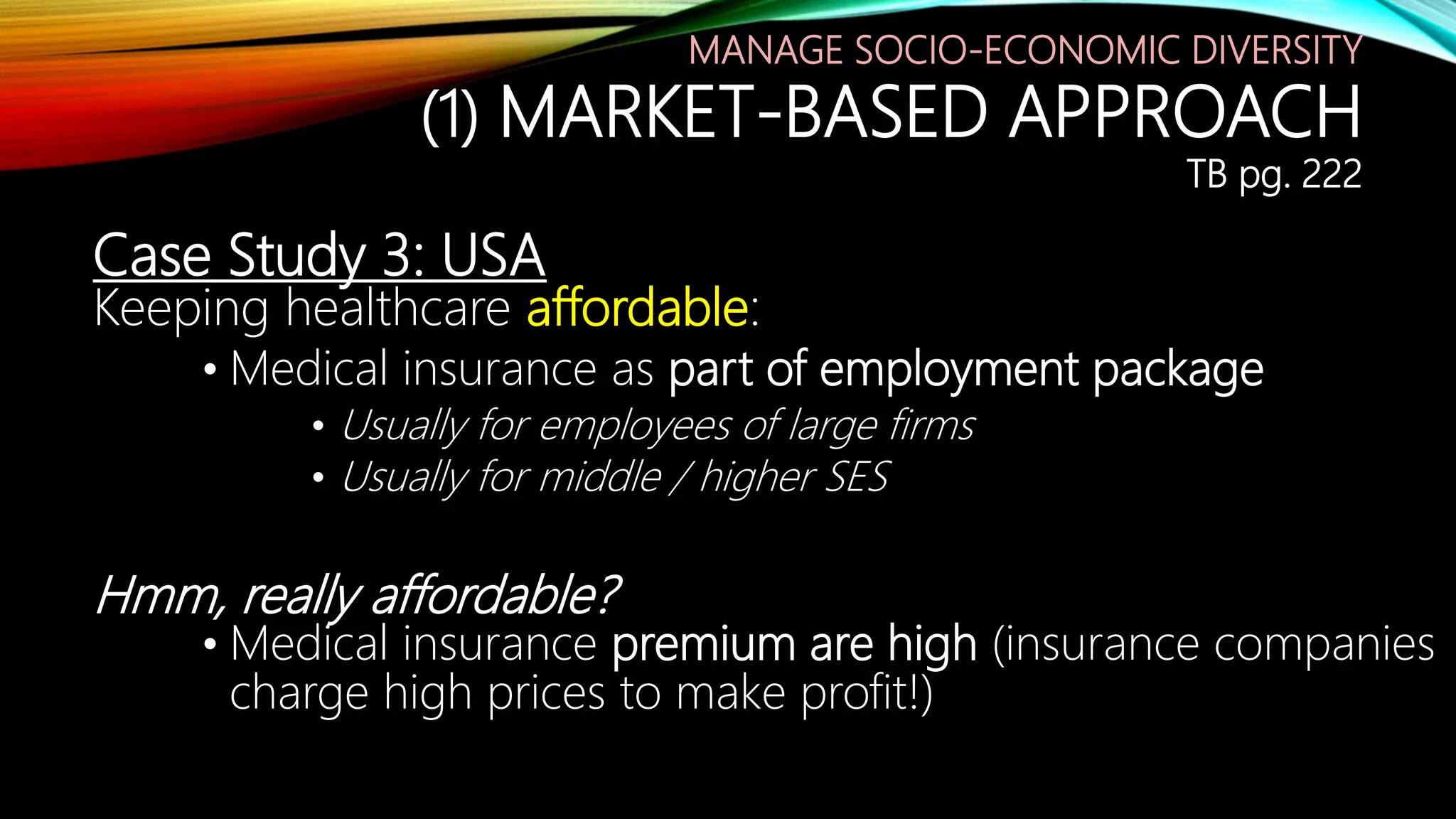
Case Study 3: USA
Keeping healthcare affordable:
• Medical insurance as part of employment package
• Usually for employees of large firms
• Usually for middle / higher SES
Hmm, really affordable?
• Medical insurance premium are high (insurance companies
charge high prices to make profit!)
MANAGE SOCIO-ECONOMIC DIVERSITY
(1) MARKET-BASED APPROACH
TB pg. 222
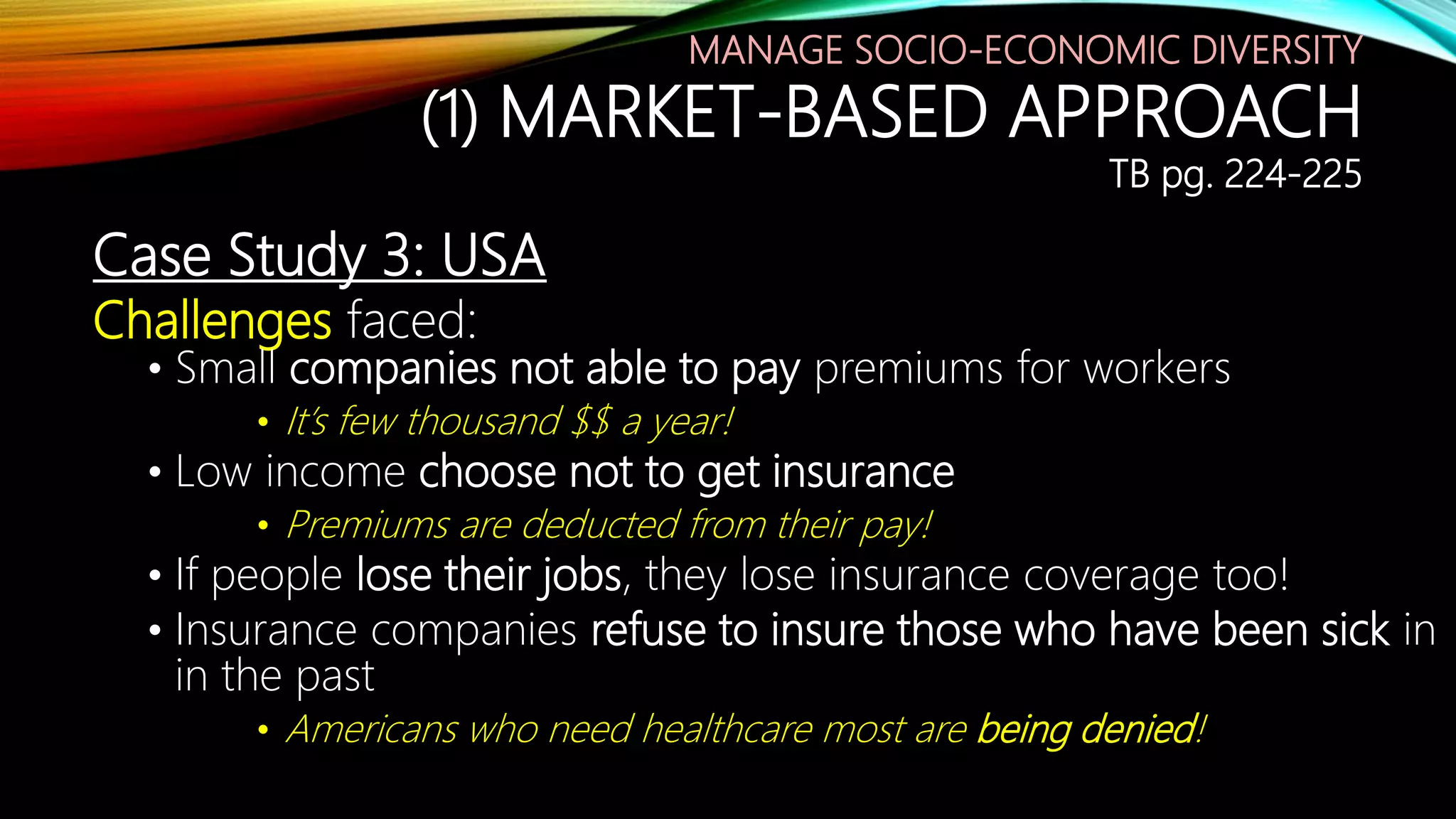
Case Study 3: USA
Challenges faced:
• Small companies not able to pay premiums for workers
• It’s few thousand $$ a year!
• Low income choose not to get insurance
• Premiums are deducted from their pay!
• If people lose their jobs, they lose insurance coverage too!
• Insurance companies refuse to insure those who have been sick in
in the past
• Americans who need healthcare most are being denied!
MANAGE SOCIO-ECONOMIC DIVERSITY
(1) MARKET-BASED APPROACH
TB pg. 224-225
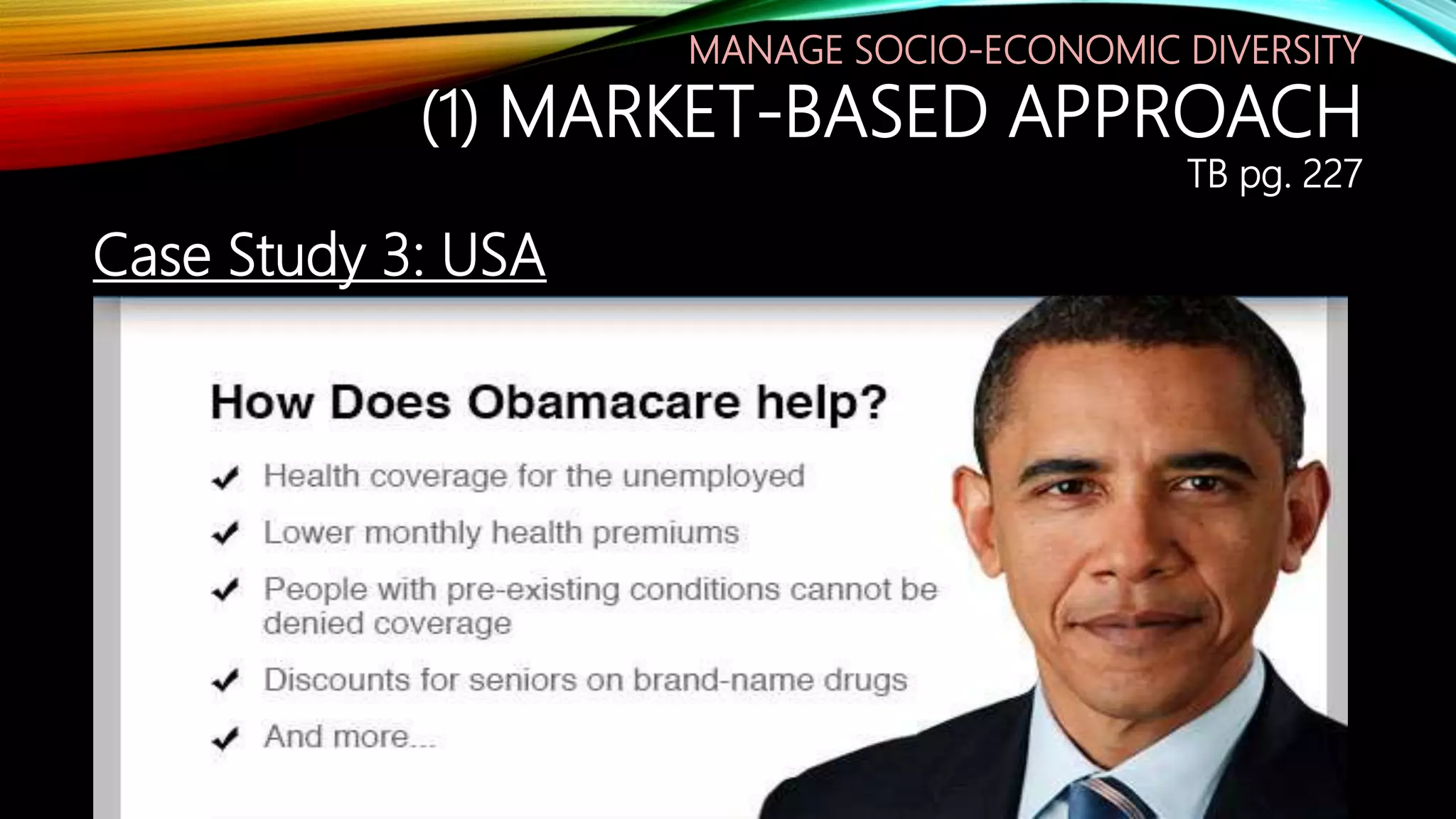
Case Study 3: USA
MANAGE SOCIO-ECONOMIC DIVERSITY
(1) MARKET-BASED APPROACH
TB pg. 227
MANAGE SOCIO-ECONOMIC DIVERSITY
(Case study: Healthcare)
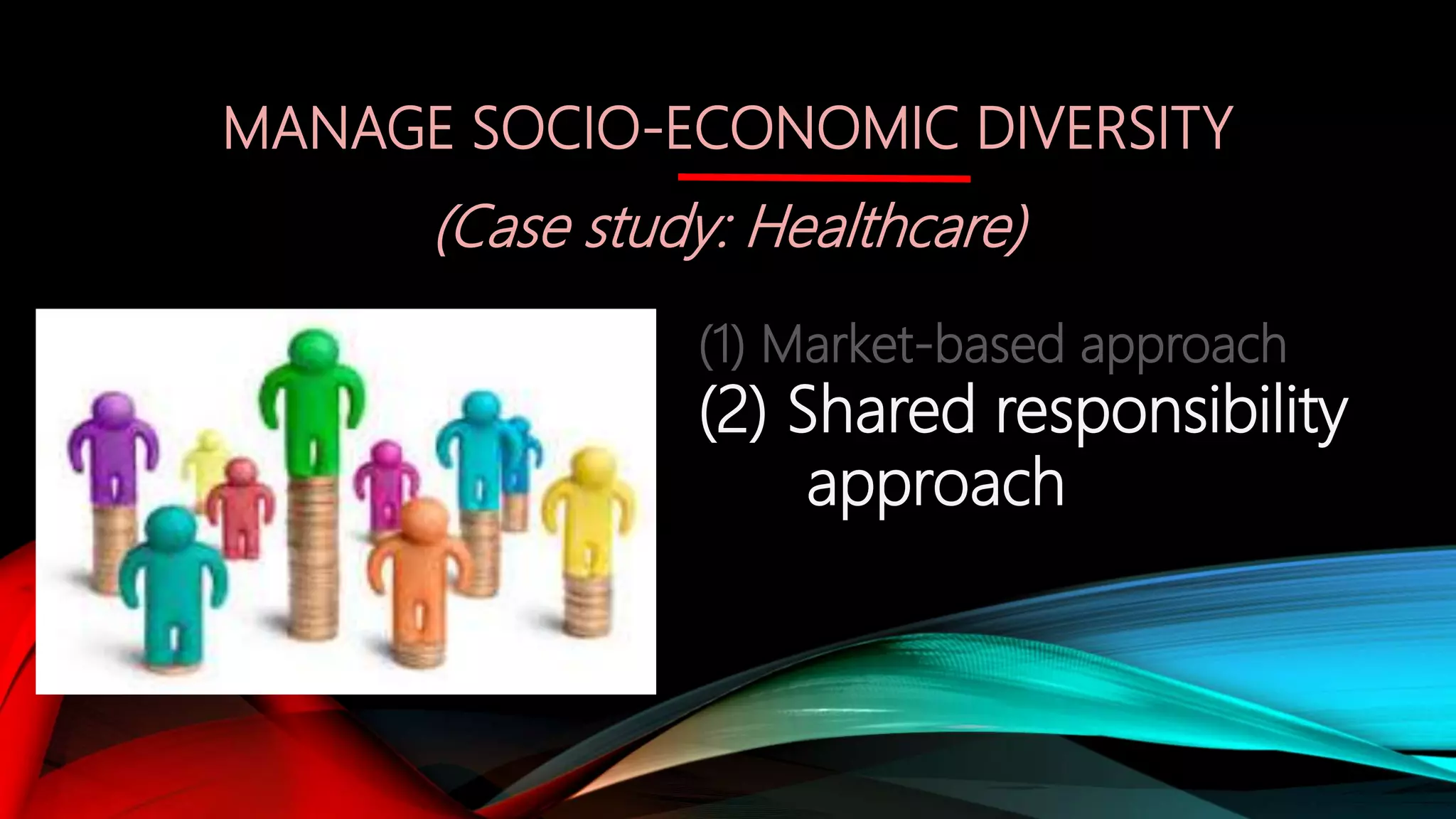
(1) Market-based approach
(2) Shared responsibility
approach
MANAGE SOCIO-ECONOMIC DIVERSITY
(2) SHARED RESPONSIBILITY
TB pg. 228
• Government intervenes through the provision of basic
healthcare services
• Government shares the costs of some aspects of
healthcare
MANAGE SOCIO-ECONOMIC DIVERSITY
(Case study: Healthcare)
(2) SHARED RESPONSIBILILITY APPROACH
•Q1: How does this approach help to manage
socio-economic diversity? (LINK)
•Q2: What are the problems that might
result?
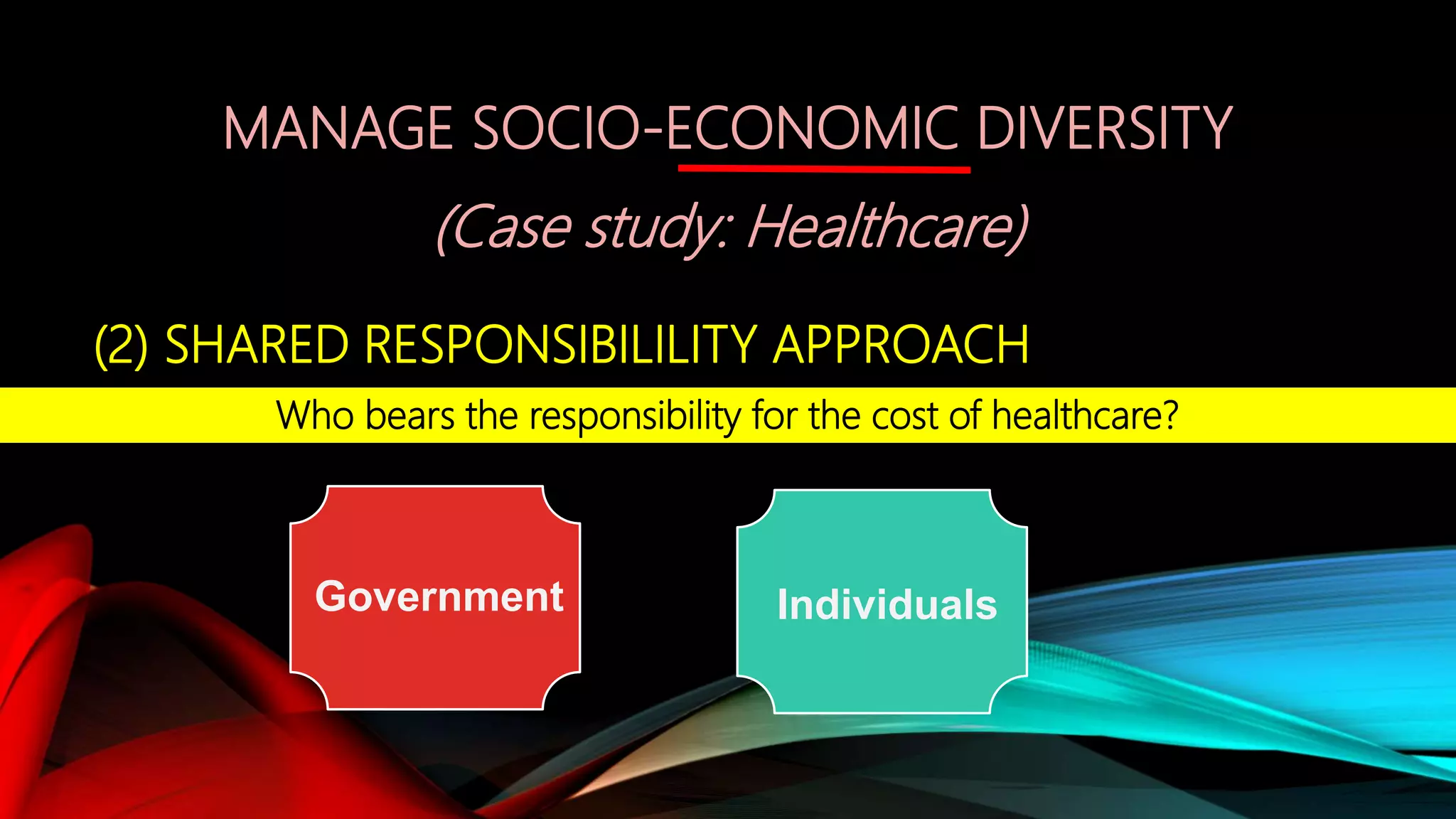
IndividualsGovernment
Who bears the responsibility for the cost of healthcare?
MANAGE SOCIO-ECONOMIC DIVERSITY
(Case study: Healthcare)
(2) SHARED RESPONSIBILILITY APPROACH
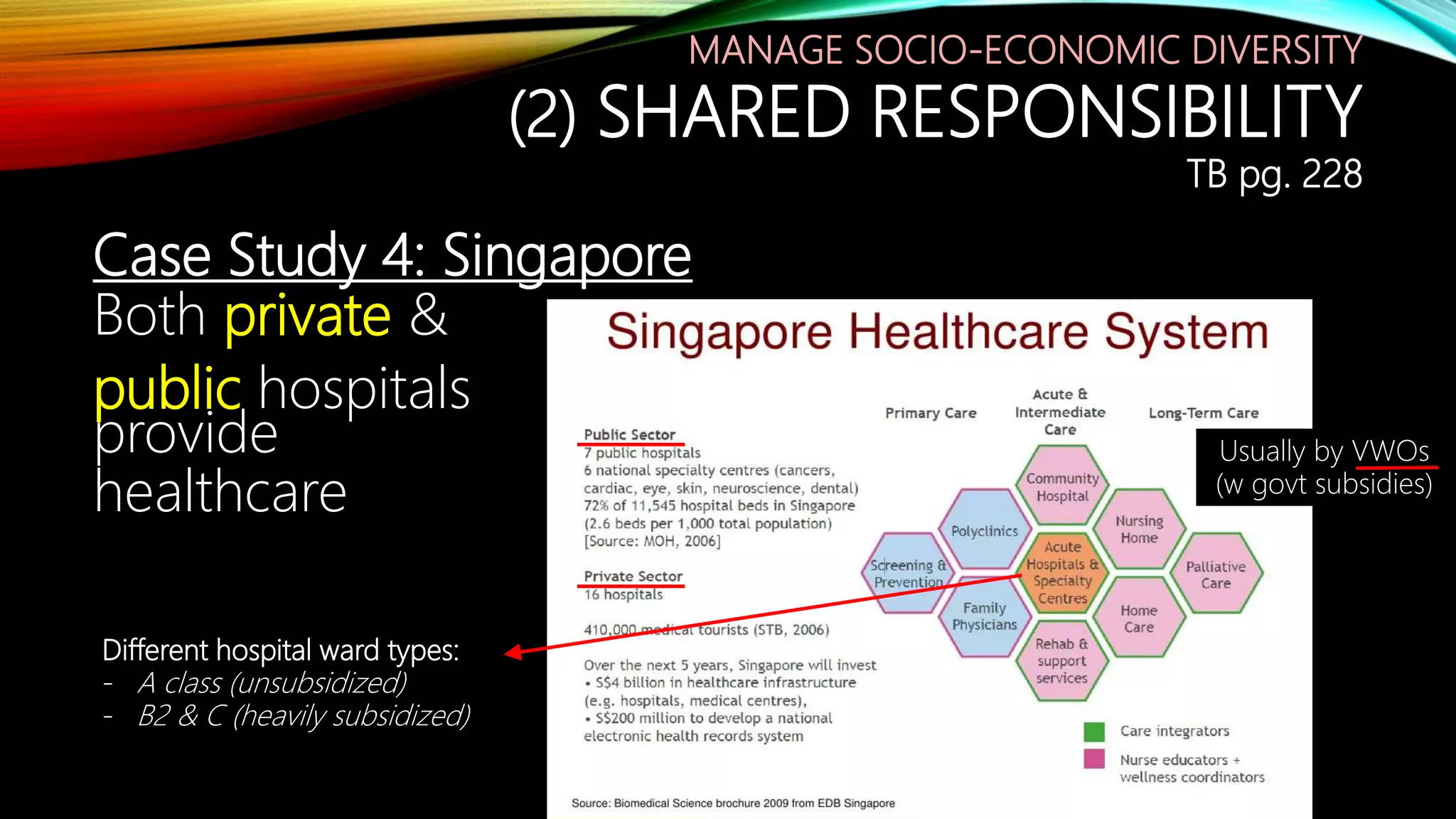
Case Study 4: Singapore
Both private &
public hospitals
provide
healthcare
Different hospital ward types:
- A class (unsubsidized)
- B2 & C (heavily subsidized)
Usually by VWOs
(w govt subsidies)
MANAGE SOCIO-ECONOMIC DIVERSITY
(2) SHARED RESPONSIBILITY
TB pg. 228
Case Study 4: Singapore
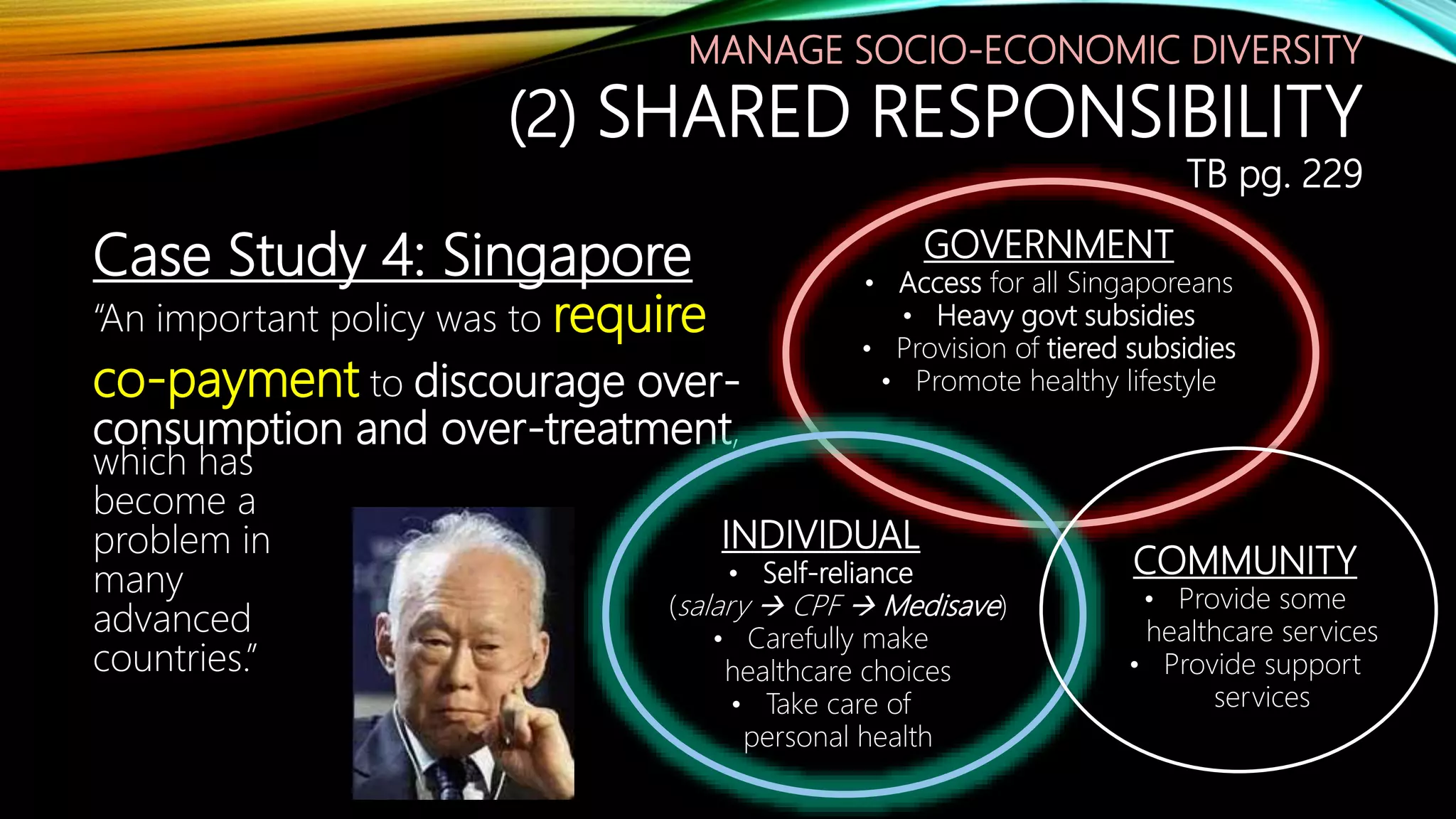
“An important policy was to require
co-payment to discourage over-
consumption and over-treatment,
which has
become a
problem in
many
advanced
countries.”
GOVERNMENT
• Access for all Singaporeans
• Heavy govt subsidies
• Provision of tiered subsidies
• Promote healthy lifestyle
COMMUNITY
• Provide some
healthcare services
• Provide support
services
INDIVIDUAL
• Self-reliance
(salary  CPF  Medisave)
• Carefully make
healthcare choices
• Take care of
personal health
MANAGE SOCIO-ECONOMIC DIVERSITY
(2) SHARED RESPONSIBILITY
TB pg. 229
Case Study 4: Singapore
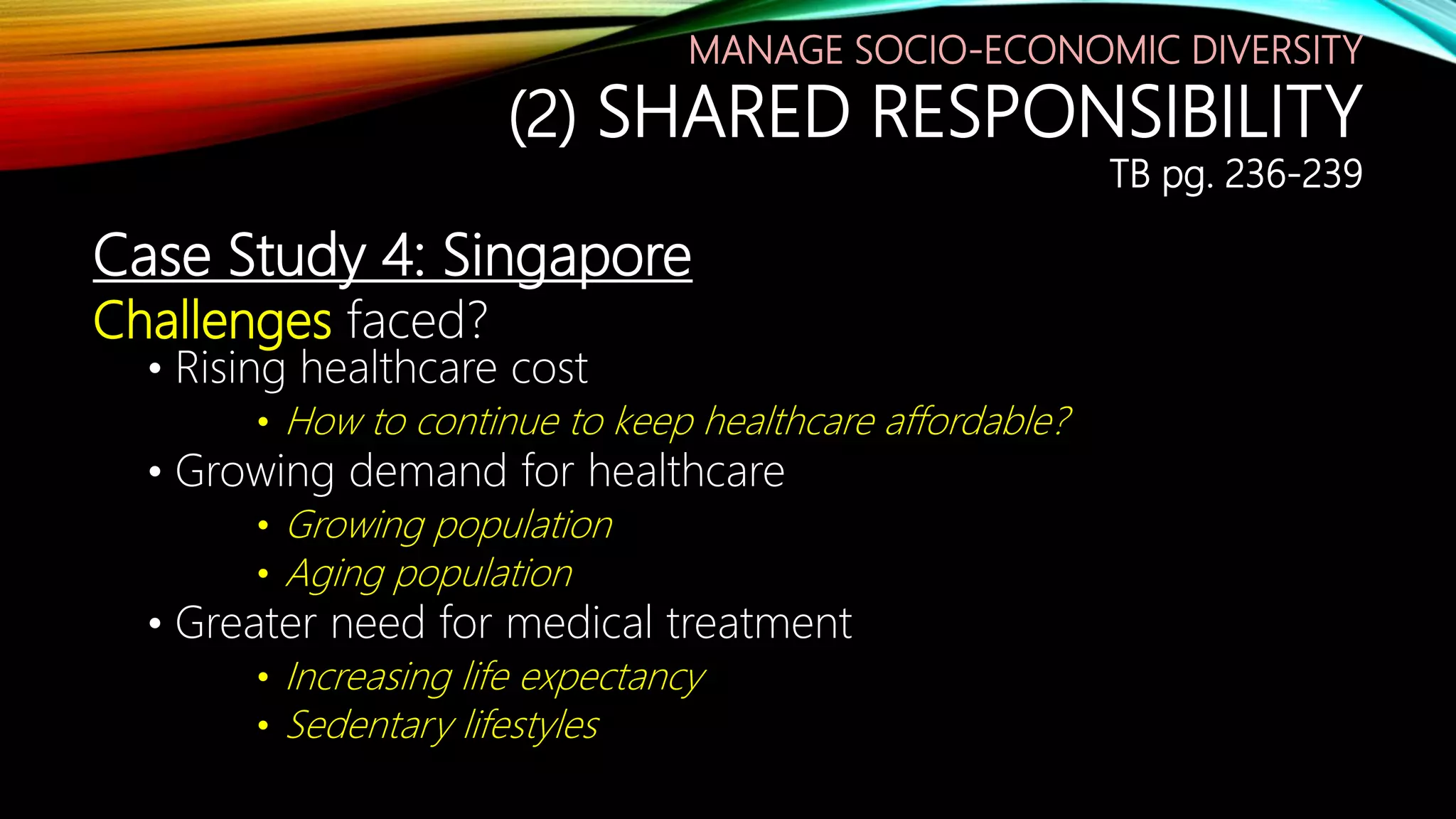
Challenges faced?
• Rising healthcare cost
• How to continue to keep healthcare affordable?
• Growing demand for healthcare
• Growing population
• Aging population
• Greater need for medical treatment
• Increasing life expectancy
• Sedentary lifestyles
MANAGE SOCIO-ECONOMIC DIVERSITY
(2) SHARED RESPONSIBILITY
TB pg. 236-239
Do you think healthcare should be made free for everyone?
What are the costs and benefits of free healthcare for everyone?
MANAGE SOCIO-ECONOMIC DIVERSITY
(Case study: Healthcare)
MANAGE SOCIO-ECONOMIC DIVERSITY
(Case study: Healthcare)
(1) Market-based approach
(2) Shared responsibility
approach
(3) Government
financed approach
MANAGE SOCIO-ECONOMIC DIVERSITY
(3) GOVERNMENT FINANCED
TB pg. 241
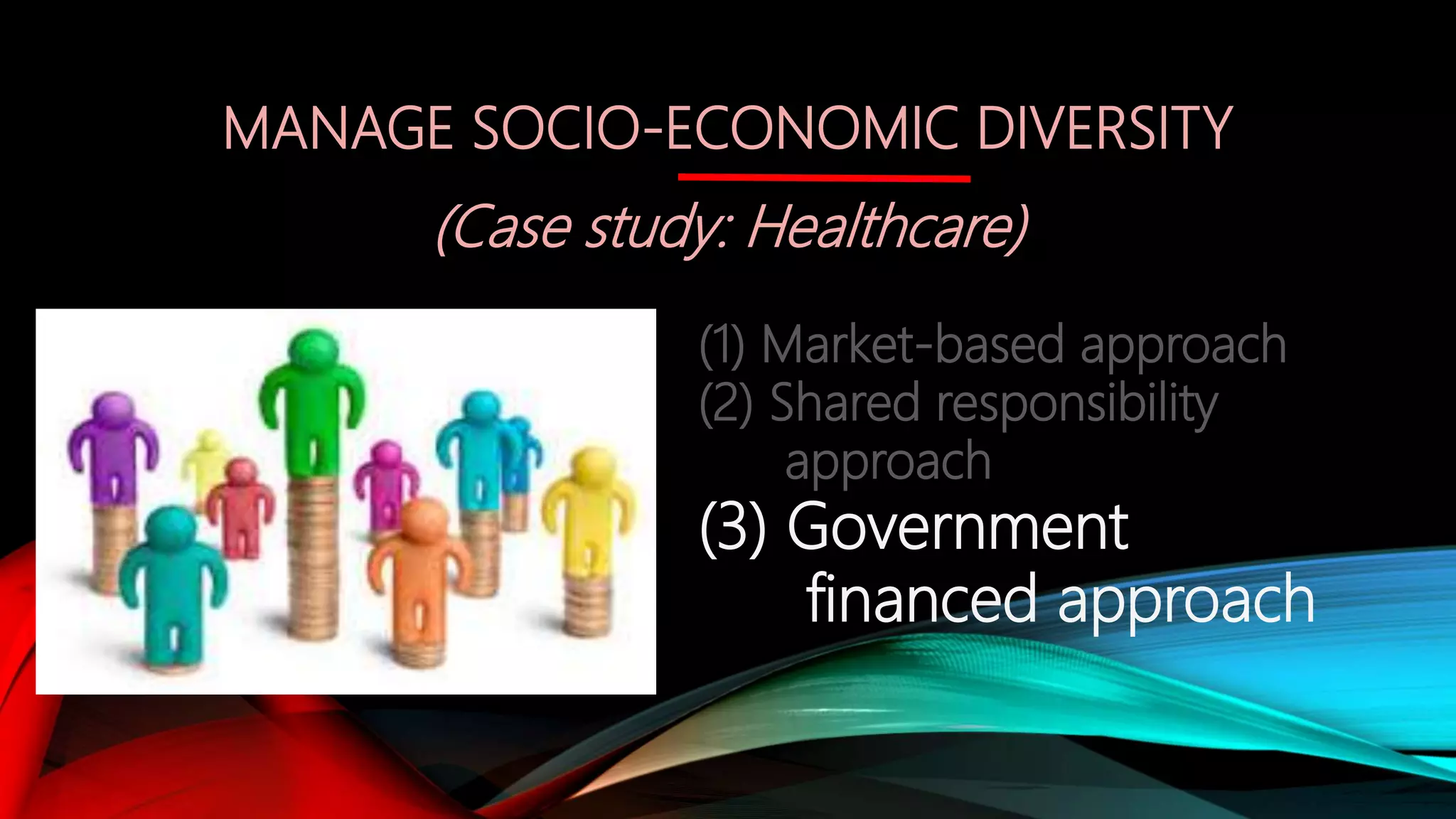
• Government provides substantial subsidies and services
for most of the healthcare needs of its citizens
• Healthcare services could sometimes be free
MANAGE SOCIO-ECONOMIC DIVERSITY
(Case study: Healthcare)
(3) GOVERNMENT FINANCED APPROACH
•Q1: How does this approach help to manage
socio-economic diversity? (LINK)
•Q2: What are the problems that might
result?
Government
Who bears the responsibility for the cost of healthcare?
MANAGE SOCIO-ECONOMIC DIVERSITY
(Case study: Healthcare)
(3) GOVERNMENT FINANCED APPROACH
Case Study 5: Sweden
Keeping healthcare affordable:
• All citizens have access to healthcare services regardless
background or socio-economic status
• Public healthcare – owned and financed by govt
• Private healthcare – receives funding from govt
• Payment ceiling for healthcare visits & medication
MANAGE SOCIO-ECONOMIC DIVERSITY
(3) GOVERNMENT FINANCED
TB pg. 242-243
Case Study 5: Sweden
Challenges faced?
• High taxation
MANAGE SOCIO-ECONOMIC DIVERSITY
(3) GOVERNMENT FINANCED
TB pg. 244
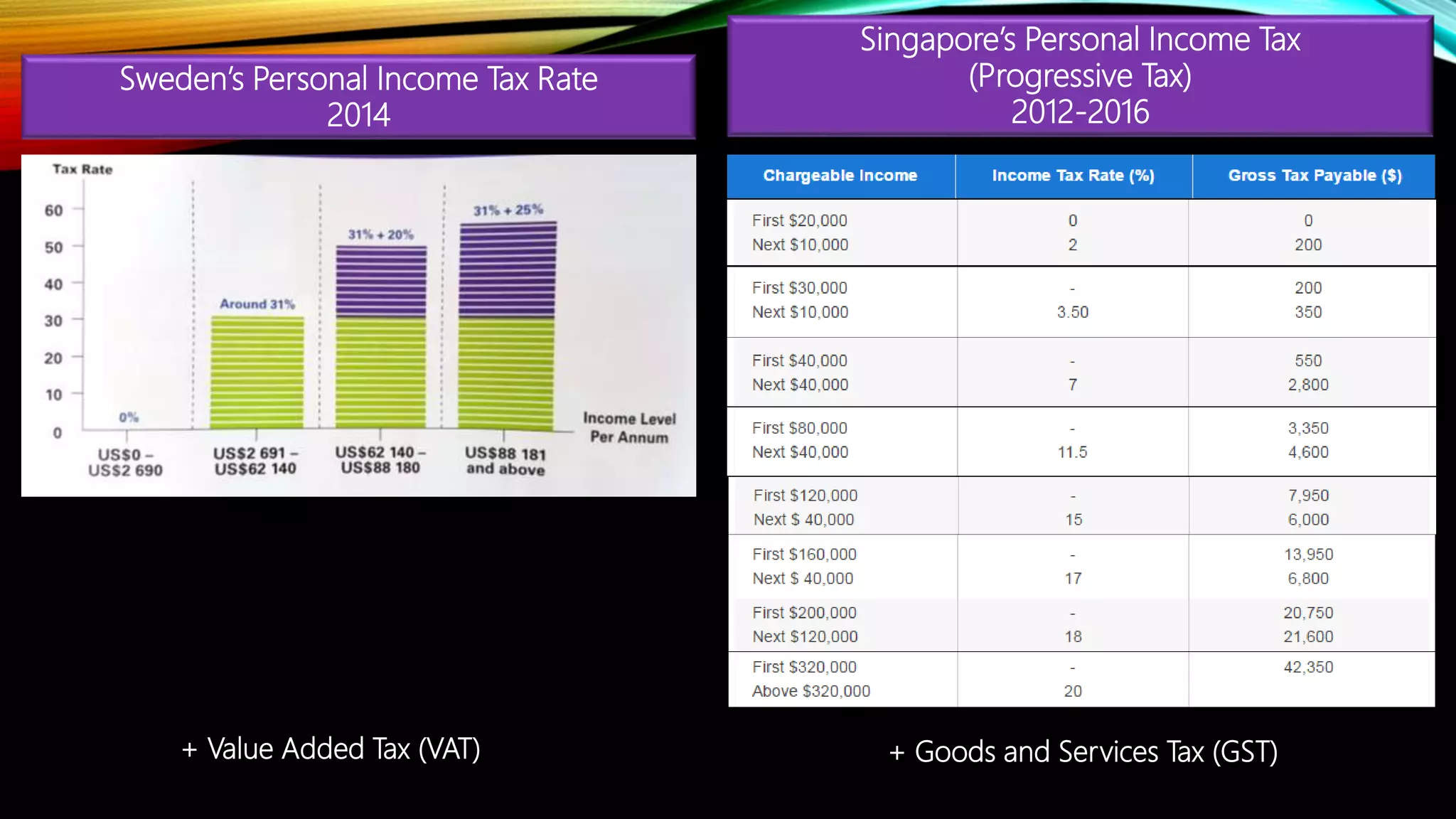
+ Value Added Tax (VAT) + Goods and Services Tax (GST)
Singapore’s Personal Income Tax
(Progressive Tax)
2012-2016
Sweden’s Personal Income Tax Rate
2014
Case Study 5: Sweden
Challenges faced?
• High taxation
• But growing ageing population!
• Growing no. of people needing healthcare
• More immigrants & citizens of the European Union (EU)
consuming Sweden’s healthcare services
MANAGE SOCIO-ECONOMIC DIVERSITY
(3) GOVERNMENT FINANCED
TB pg. 245
MANAGE SOCIO-ECONOMIC DIVERSITY
SUMMARY
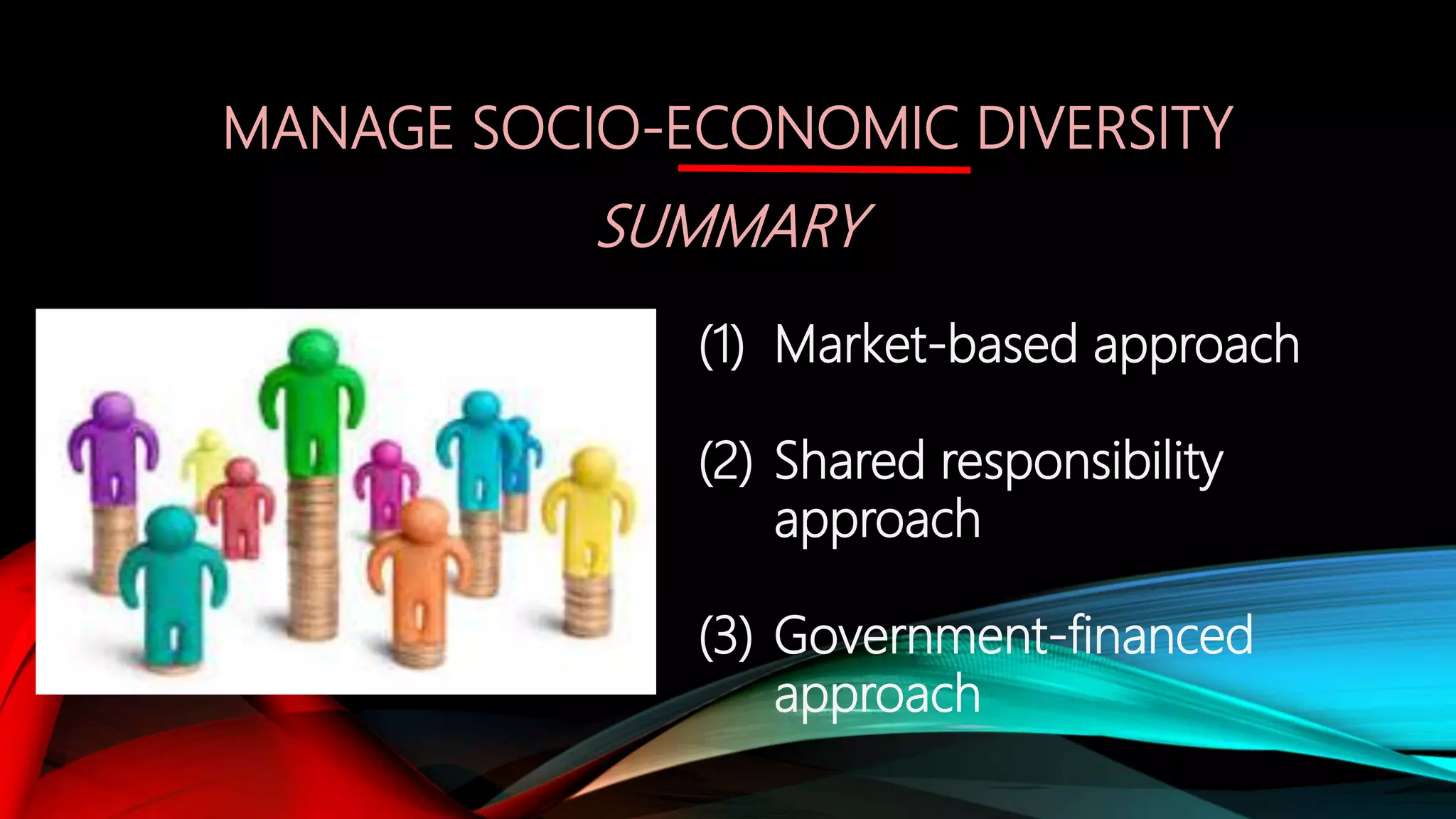
(1) Market-based approach
(2) Shared responsibility
approach
(3) Government-financed
approach
$$$$$$
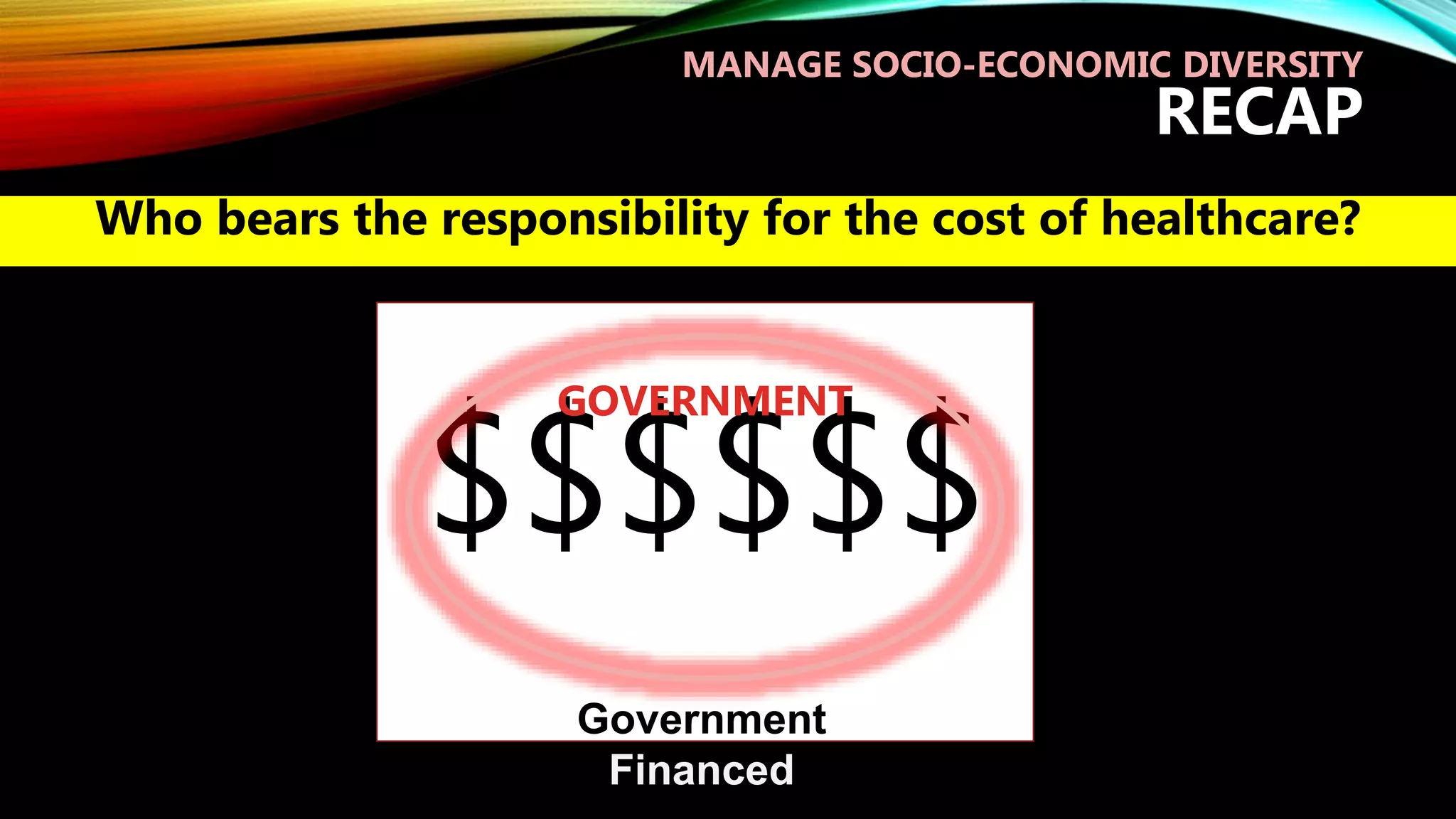
Who bears the responsibility for the cost of healthcare?
MANAGE SOCIO-ECONOMIC DIVERSITY
RECAP
GOVERNMENT
Government
Financed
$$$$$$
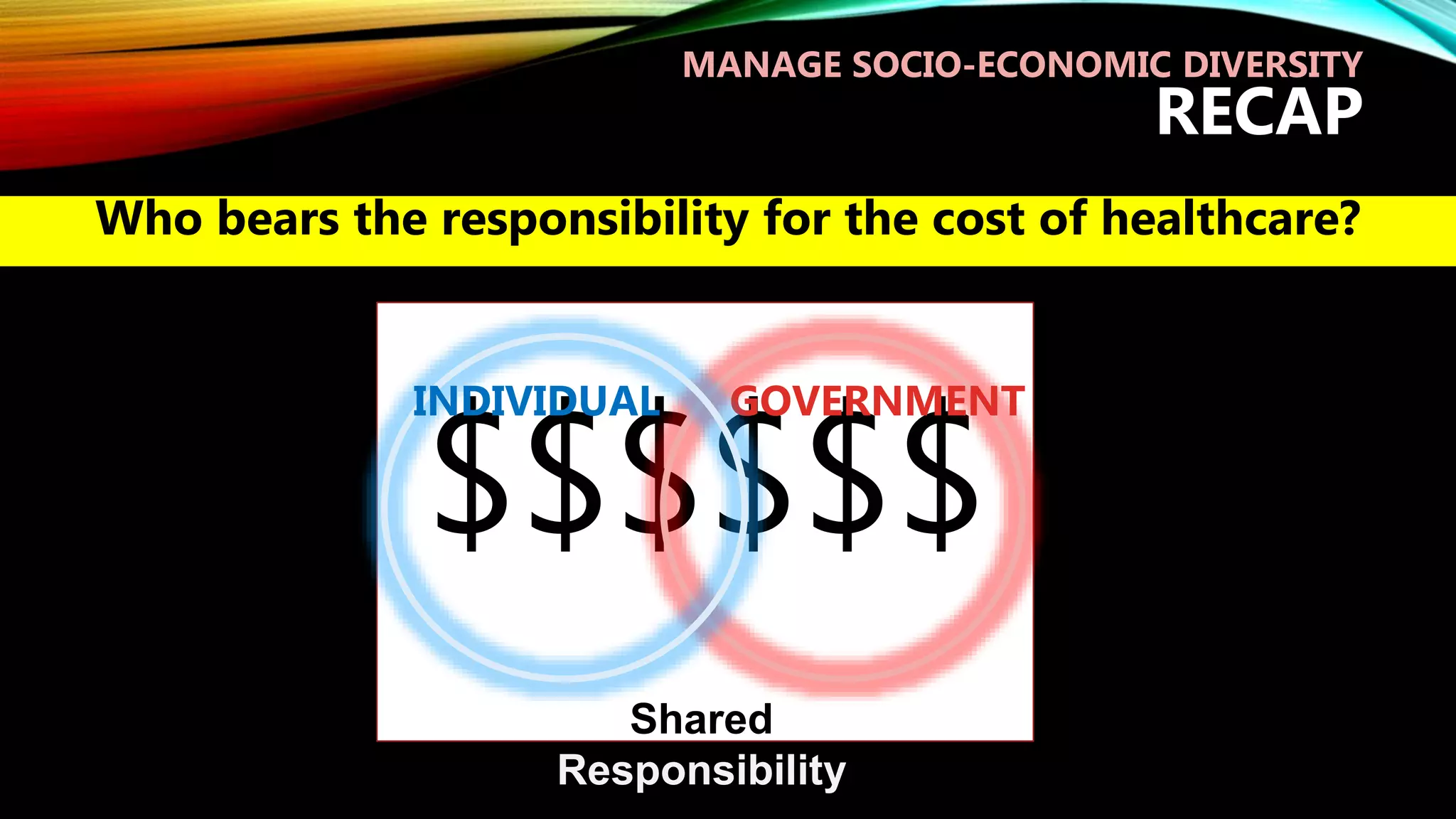
GOVERNMENTINDIVIDUAL
Shared
Responsibility
Who bears the responsibility for the cost of healthcare?
MANAGE SOCIO-ECONOMIC DIVERSITY
RECAP
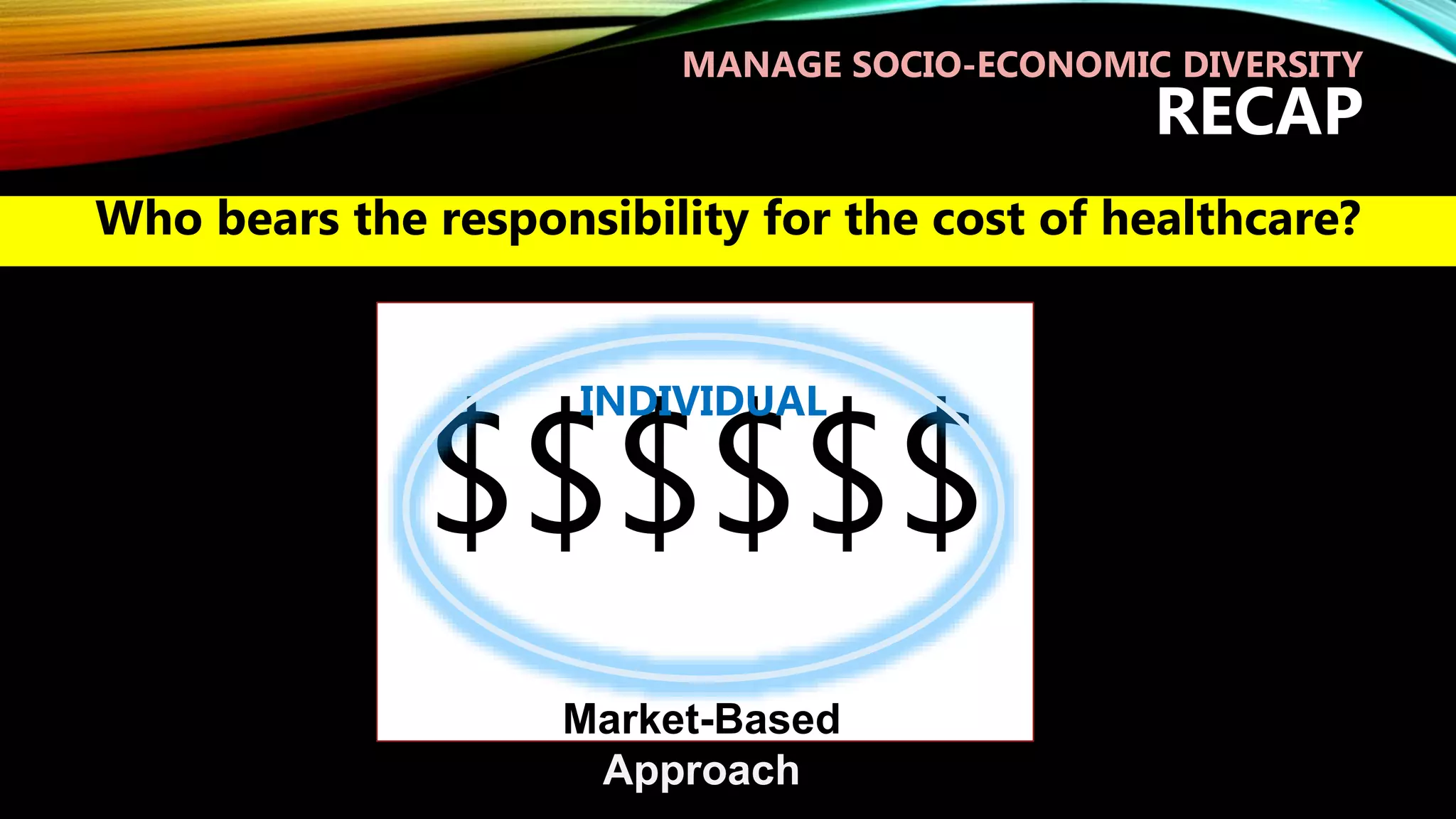
$$$$$$
INDIVIDUAL
Market-Based
Approach
MANAGE SOCIO-ECONOMIC DIVERSITY
RECAP
Who bears the responsibility for the cost of healthcare?
GOVERNMENT-
FUNDED
SHARED
RESPONSIBILITY
MARKET BASED
APPROACH
MANAGE SOCIO-ECONOMIC DIVERSITY
(Case study: Healthcare)
OVERVIEW OF CHAPTER

Issue 2 Chapter 7 Slides (Part 2)

  • 1.
    OVERVIEW OF CHAPTER 3)Separation (e.g. South Africa)  
  • 2.
    MANAGE SOCIO-ECONOMIC DIVERSITY (Casestudy: Healthcare) (1) Market-based approach
  • 3.
    MANAGE SOCIO-ECONOMIC DIVERSITY (1)MARKET-BASED APPROACH TB pg. 220 • Citizens have the freedom to decide how much they wish to pay for healthcare services • The market determines the price & provision of healthcare services • Demand : $ • Supply : $
  • 4.
    MANAGE SOCIO-ECONOMIC DIVERSITY (Casestudy: Healthcare) (1) MARKET BASED APPROACH •Q1: How does this approach help to manage socio-economic diversity? (LINK) •Q2: What are the problems that might result?
  • 5.
    Individuals Who bears theresponsibility for the cost of healthcare? MANAGE SOCIO-ECONOMIC DIVERSITY (Case study: Healthcare) (1) MARKET BASED APPROACH
  • 6.
    Case Study 3:USA Both private & public hospitals provide healthcare MANAGE SOCIO-ECONOMIC DIVERSITY (1) MARKET-BASED APPROACH TB pg. 220
  • 7.
    Case Study 3:USA US government does NOT intervene in: • Healthcare service providers ►Have freedom to set prices they want ►Depends on market (demand vs supply) • Citizens’ choice of healthcare service option Prices can vary greatly • E.g. mammogram (in NY): US$100…… US$1,700 or more MANAGE SOCIO-ECONOMIC DIVERSITY (1) MARKET-BASED APPROACH TB pg. 221
  • 8.
    Case Study 3:USA US government does NOT intervene in: • Healthcare service providers ►Have freedom to set prices they want ►Depends on market (demand vs supply) • Citizens’ choice of healthcare service option As a result, citizens:  Have to cope with healthcare cost on their own  Expected to buy own medical insurance MANAGE SOCIO-ECONOMIC DIVERSITY (1) MARKET-BASED APPROACH TB pg. 221
  • 9.
    Case Study 3:USA Keeping healthcare affordable: • Medical insurance as part of employment package • Usually for employees of large firms • Usually for middle / higher SES Hmm, really affordable? • Medical insurance premium are high (insurance companies charge high prices to make profit!) MANAGE SOCIO-ECONOMIC DIVERSITY (1) MARKET-BASED APPROACH TB pg. 222
  • 10.
    Case Study 3:USA Challenges faced: • Small companies not able to pay premiums for workers • It’s few thousand $$ a year! • Low income choose not to get insurance • Premiums are deducted from their pay! • If people lose their jobs, they lose insurance coverage too! • Insurance companies refuse to insure those who have been sick in in the past • Americans who need healthcare most are being denied! MANAGE SOCIO-ECONOMIC DIVERSITY (1) MARKET-BASED APPROACH TB pg. 224-225
  • 12.
    Case Study 3:USA MANAGE SOCIO-ECONOMIC DIVERSITY (1) MARKET-BASED APPROACH TB pg. 227
  • 13.
    MANAGE SOCIO-ECONOMIC DIVERSITY (Casestudy: Healthcare) (1) Market-based approach (2) Shared responsibility approach
  • 14.
    MANAGE SOCIO-ECONOMIC DIVERSITY (2)SHARED RESPONSIBILITY TB pg. 228 • Government intervenes through the provision of basic healthcare services • Government shares the costs of some aspects of healthcare
  • 15.
    MANAGE SOCIO-ECONOMIC DIVERSITY (Casestudy: Healthcare) (2) SHARED RESPONSIBILILITY APPROACH •Q1: How does this approach help to manage socio-economic diversity? (LINK) •Q2: What are the problems that might result?
  • 16.
    IndividualsGovernment Who bears theresponsibility for the cost of healthcare? MANAGE SOCIO-ECONOMIC DIVERSITY (Case study: Healthcare) (2) SHARED RESPONSIBILILITY APPROACH
  • 17.
    Case Study 4:Singapore Both private & public hospitals provide healthcare Different hospital ward types: - A class (unsubsidized) - B2 & C (heavily subsidized) Usually by VWOs (w govt subsidies) MANAGE SOCIO-ECONOMIC DIVERSITY (2) SHARED RESPONSIBILITY TB pg. 228
  • 18.
    Case Study 4:Singapore “An important policy was to require co-payment to discourage over- consumption and over-treatment, which has become a problem in many advanced countries.” GOVERNMENT • Access for all Singaporeans • Heavy govt subsidies • Provision of tiered subsidies • Promote healthy lifestyle COMMUNITY • Provide some healthcare services • Provide support services INDIVIDUAL • Self-reliance (salary  CPF  Medisave) • Carefully make healthcare choices • Take care of personal health MANAGE SOCIO-ECONOMIC DIVERSITY (2) SHARED RESPONSIBILITY TB pg. 229
  • 20.
    Case Study 4:Singapore Challenges faced? • Rising healthcare cost • How to continue to keep healthcare affordable? • Growing demand for healthcare • Growing population • Aging population • Greater need for medical treatment • Increasing life expectancy • Sedentary lifestyles MANAGE SOCIO-ECONOMIC DIVERSITY (2) SHARED RESPONSIBILITY TB pg. 236-239
  • 22.
    Do you thinkhealthcare should be made free for everyone? What are the costs and benefits of free healthcare for everyone? MANAGE SOCIO-ECONOMIC DIVERSITY (Case study: Healthcare)
  • 23.
    MANAGE SOCIO-ECONOMIC DIVERSITY (Casestudy: Healthcare) (1) Market-based approach (2) Shared responsibility approach (3) Government financed approach
  • 24.
    MANAGE SOCIO-ECONOMIC DIVERSITY (3)GOVERNMENT FINANCED TB pg. 241 • Government provides substantial subsidies and services for most of the healthcare needs of its citizens • Healthcare services could sometimes be free
  • 25.
    MANAGE SOCIO-ECONOMIC DIVERSITY (Casestudy: Healthcare) (3) GOVERNMENT FINANCED APPROACH •Q1: How does this approach help to manage socio-economic diversity? (LINK) •Q2: What are the problems that might result?
  • 26.
    Government Who bears theresponsibility for the cost of healthcare? MANAGE SOCIO-ECONOMIC DIVERSITY (Case study: Healthcare) (3) GOVERNMENT FINANCED APPROACH
  • 27.
    Case Study 5:Sweden Keeping healthcare affordable: • All citizens have access to healthcare services regardless background or socio-economic status • Public healthcare – owned and financed by govt • Private healthcare – receives funding from govt • Payment ceiling for healthcare visits & medication MANAGE SOCIO-ECONOMIC DIVERSITY (3) GOVERNMENT FINANCED TB pg. 242-243
  • 28.
    Case Study 5:Sweden Challenges faced? • High taxation MANAGE SOCIO-ECONOMIC DIVERSITY (3) GOVERNMENT FINANCED TB pg. 244
  • 29.
    + Value AddedTax (VAT) + Goods and Services Tax (GST) Singapore’s Personal Income Tax (Progressive Tax) 2012-2016 Sweden’s Personal Income Tax Rate 2014
  • 30.
    Case Study 5:Sweden Challenges faced? • High taxation • But growing ageing population! • Growing no. of people needing healthcare • More immigrants & citizens of the European Union (EU) consuming Sweden’s healthcare services MANAGE SOCIO-ECONOMIC DIVERSITY (3) GOVERNMENT FINANCED TB pg. 245
  • 31.
    MANAGE SOCIO-ECONOMIC DIVERSITY SUMMARY (1)Market-based approach (2) Shared responsibility approach (3) Government-financed approach
  • 32.
    $$$$$$ Who bears theresponsibility for the cost of healthcare? MANAGE SOCIO-ECONOMIC DIVERSITY RECAP GOVERNMENT Government Financed
  • 33.
    $$$$$$ GOVERNMENTINDIVIDUAL Shared Responsibility Who bears theresponsibility for the cost of healthcare? MANAGE SOCIO-ECONOMIC DIVERSITY RECAP
  • 34.
  • 35.
  • 36.

Editor's Notes

  • #4 Limited resources Economics – Demand and supply Demand increases – price increases Supply increases – price drops
  • #9 Medical insurance as part of employment package – still not enough, why? Medicare – for 65- older, or those with disabilities andd permanent kidney failure Medicaid – for limited income households and those with disabilities Emergency Medical Treatment – providing care to anyone needing emergency treatment until he/she is stable
  • #12 US Healthcare OPAL Social Studies  US Healthcare.m4v  The video discusses the problem of the rising costs of healthcare in the United Sates (U.S) which has resulted in its citizens buying their medicine from Mexico instead of in the U.S itself. It highlights the challenges of a market based approach of the U
  • #13 Obamacare Amal: https://www.youtube.com/watch?v=vju70I6qSKk Lena: https://www.youtube.com/watch?v=JZkk6ueZt-U
  • #18 85% of inpatient beds are in public hospitals (remaining are in private specialist hospitals)
  • #20 Video_CPF- As easy as 1, 2, 3
  • #22 Healthcare cost in Singapore OPAL Social Studies  Healthcare cost in Singapore.m4v  The video presents a panel discussion on the 1% increase in contribution to Medisave which is a move is to help Singaporeans to save more for their healthcare needs.