COASTAL
STUDIES
 FACTORS
influencing the RATE
OF EROSION
TYPES OF
WAVES
TYPES OF WAVES
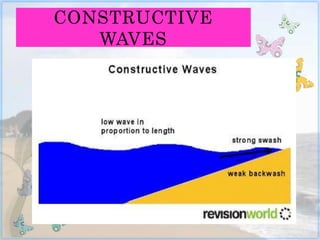
CONSTRUCTIVE
WAVES
CHARACTERISTICS
 Low energy and are common along gently
sloping coasts
 The swash STRONGER than the backwash
(swash > backwash)
 The constructive waves are called spilling
breakers
 Spilling breakers are produced by waves of
long wavelength and low height
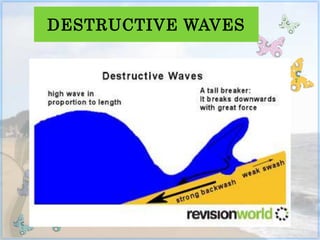
DESTRUCTIVE WAVES
 High energy waves that erode the coast.
 They are common along steep sloping coasts.
 These waves are called plunging breakers
where it tend to carry material off the beach
and into the sea (BACKWASH > SWASH)
 Plunging breakers are produced by waves of
short wavelength and high height
CHARACTERISTICS
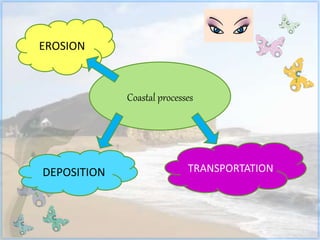
Coastal processes
EROSION
TRANSPORTATIONDEPOSITION
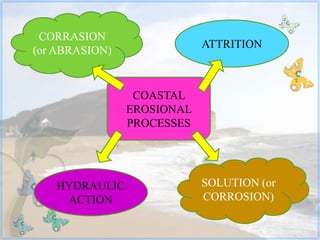
COASTAL
EROSIONAL
PROCESSES
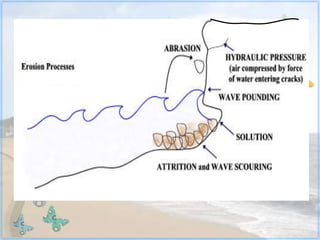
CORRASION
(or ABRASION)
ATTRITION
SOLUTION (or
CORROSION)
HYDRAULIC
ACTION
C A S H
CORRASION (or ABRASION)
 When materials carried by
waves are thrown repeatedly against a
coast, they gradually erode the coast
ATTRITION
 When materials are carried
in waves, they collide with
one another
 Eventually, the materials
break down into smaller pieces
and become smoother and more
rounded over time
SOLUTION (or CORROSION)
 Water in the waves reacts chemically
with the soluble minerals in the rocks
along the coast and dissolves them
 Over time, the coast
becomes weakened and is
eroded.
HYDRAULIC ACTION
 The force of moving
water currents rushing into a
crack in the rock face or cliff
face
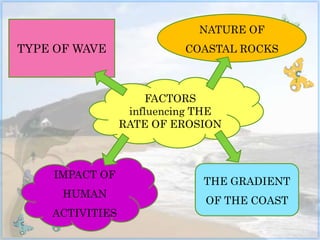
FACTORS
influencing THE
RATE OF EROSION
TYPE OF WAVE
NATURE OF
COASTAL ROCKS
THE GRADIENT
OF THE COAST
IMPACT OF
HUMAN
ACTIVITIES
TYPE OF WAVE
Destructive waves cause MORE
EROSION that constructive
waves – have a more powerful
backwash than swash
NATURE OF COASTAL ROCKS
Rocks that make up the coast may have different
resistance to erosion
In terms of mineral
composition:
 Coasts that are made up of
granite, basalt, and dolomite
– MORE RESISTANT TO
EROSION than,
 Coasts that are made up of
limestone, shale, and clay
In terms of lines of
weakness:
 Coastal rocks that have more
lines of weakness will be MORE
EASILY ERODED than,
 Those with fewer lines of
weakness
THE GRADIENT OF THE COAST
Coasts with a STEEPER GRADIENT
tend to COLLAPSE FASTER
IMPACT OF HUMAN
ACTIVITIES
Human through their activities can speed up or slow
down the process of coastal erosion
 Construction works – speed up
 Dredging – speed up
 Constructing groynes to trap sand and
rock debris and others - slow down
COASTAL
STUDIES
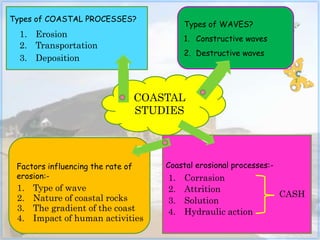
Types of COASTAL PROCESSES?
1. Erosion
2. Transportation
3. Deposition
Coastal erosional processes:-
1. Corrasion
2. Attrition
3. Solution
4. Hydraulic action
CASH
Factors influencing the rate of
erosion:-
1. Type of wave
2. Nature of coastal rocks
3. The gradient of the coast
4. Impact of human activities
Types of WAVES?
1. Constructive waves
2. Destructive waves

Coastal erosion processes

  • 1.
    COASTAL STUDIES  FACTORS influencing theRATE OF EROSION TYPES OF WAVES
  • 2.
  • 3.
  • 4.
    CHARACTERISTICS  Low energyand are common along gently sloping coasts  The swash STRONGER than the backwash (swash > backwash)  The constructive waves are called spilling breakers  Spilling breakers are produced by waves of long wavelength and low height
  • 5.
  • 6.
     High energywaves that erode the coast.  They are common along steep sloping coasts.  These waves are called plunging breakers where it tend to carry material off the beach and into the sea (BACKWASH > SWASH)  Plunging breakers are produced by waves of short wavelength and high height CHARACTERISTICS
  • 7.
  • 8.
  • 9.
  • 10.
    CORRASION (or ABRASION) When materials carried by waves are thrown repeatedly against a coast, they gradually erode the coast
  • 11.
    ATTRITION  When materialsare carried in waves, they collide with one another  Eventually, the materials break down into smaller pieces and become smoother and more rounded over time
  • 12.
    SOLUTION (or CORROSION) Water in the waves reacts chemically with the soluble minerals in the rocks along the coast and dissolves them  Over time, the coast becomes weakened and is eroded.
  • 13.
    HYDRAULIC ACTION  Theforce of moving water currents rushing into a crack in the rock face or cliff face
  • 15.
    FACTORS influencing THE RATE OFEROSION TYPE OF WAVE NATURE OF COASTAL ROCKS THE GRADIENT OF THE COAST IMPACT OF HUMAN ACTIVITIES
  • 16.
    TYPE OF WAVE Destructivewaves cause MORE EROSION that constructive waves – have a more powerful backwash than swash
  • 17.
    NATURE OF COASTALROCKS Rocks that make up the coast may have different resistance to erosion In terms of mineral composition:  Coasts that are made up of granite, basalt, and dolomite – MORE RESISTANT TO EROSION than,  Coasts that are made up of limestone, shale, and clay In terms of lines of weakness:  Coastal rocks that have more lines of weakness will be MORE EASILY ERODED than,  Those with fewer lines of weakness
  • 18.
    THE GRADIENT OFTHE COAST Coasts with a STEEPER GRADIENT tend to COLLAPSE FASTER
  • 19.
    IMPACT OF HUMAN ACTIVITIES Humanthrough their activities can speed up or slow down the process of coastal erosion  Construction works – speed up  Dredging – speed up  Constructing groynes to trap sand and rock debris and others - slow down
  • 20.
    COASTAL STUDIES Types of COASTALPROCESSES? 1. Erosion 2. Transportation 3. Deposition Coastal erosional processes:- 1. Corrasion 2. Attrition 3. Solution 4. Hydraulic action CASH Factors influencing the rate of erosion:- 1. Type of wave 2. Nature of coastal rocks 3. The gradient of the coast 4. Impact of human activities Types of WAVES? 1. Constructive waves 2. Destructive waves