
Sec 1 Unit 3
Lesson 1
Tropical Rainforest


At the end of the lesson you will be
able to :

1.Identify a tropical rainforest

2.List the characteristics of a
tropical rainforest
3.Label and describe the layers of
a tropical rainforest.
 How

can we save tropical
rainforest?
◦ What are tropical rainforests?
◦ What is deforestation?
◦ Where are tropical rainforests found?
◦ Which areas have been deforested?
◦ Why do we deforest?
◦ How should we manage
deforestation?



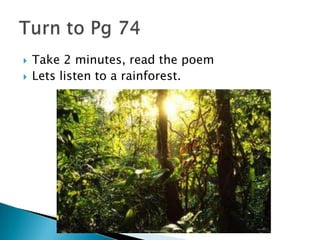
Take 2 minutes, read the poem
Lets listen to a rainforest.
 Earth’s

oldest ecosystem.
 High rainfall and high
temperatures throughout the
year.
 Thick, luxuriant evergreen forests.
◦ Evergreen = no distinct shedding
season.
1. Diversity

of types
2. Structure of rainforest
3. Plant Adaptations
 Highest

plant diversity in all forest

types.
 Warm temperatures and constant
rainfall encourages plant growth.
 Over 300 species in 0.01sq km
 Source of common local food

◦ Bananas, mangoes, pepper, cinnamo
n, corn, pandan, walnuts
 Plants

grown to different
heights
 Three-layered structure
found in tropical
rainforests
 Trees

up to 50m talls.
 Clearly visible from above
 Trees that rise above the even
canopy below.
 Trees tend to have
tall, straight and smooth
trunks.
 Tualang, Kapok tree.
 Layer

of trees that grow to
between 20 – 30m
 The crowns form an
interlocking layer.
 Blocks 90% of sunlight from
the forest floor.
 Deflects most rainfall.
 Dark

most of the day as sun
rays are blocked by canopy.
 Plants tend to be small and
widely-spaced apart.
 Vegetation is sparse on
forest floor, mostly
decomposing leaves.
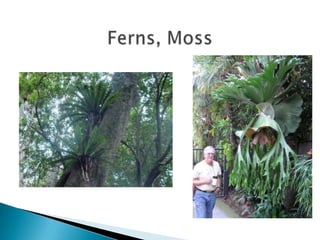
 Epiphytes

grow on trees to
receive more sunlight.
◦Ferns, orchids, mosses

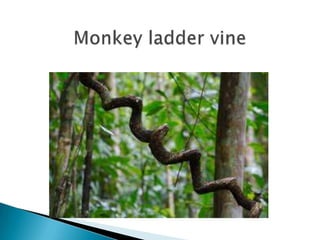
 Lianas

are woody vines that
twine up trees for more
sunlight.
◦Monkey ladder vine










50m
20m
Emergent layer
Canopy layer
Epiphytes
Lianas
Buttress Roots
Ferns
 Plants

adapt to the climatic
conditions with special
features.
 Without adaptations, they will
not survive the high
temperatures and heavy
rainfall.
PG 78
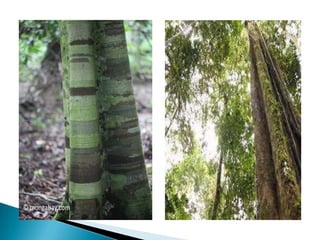
 Tall

straight trunks
 Branches spread out near the
top to reach for sunlight.
 Smooth bark to allow
rainwater to flow easily down
to the roots.
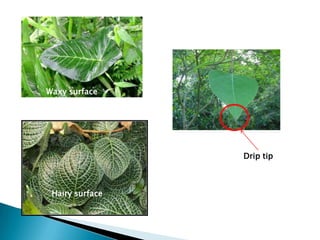
 Broad

leaves to capture more
sunlight
 Waxy, leathery or hairy surfaces to
minimise water loss.
 Drip tips to allow water to runoff.
◦ Reduces the growth of fungi and
bacteria
Waxy surface

Drip tip

Hairy surface
 Still

air and lack of wind is
bad for seed dispersal.
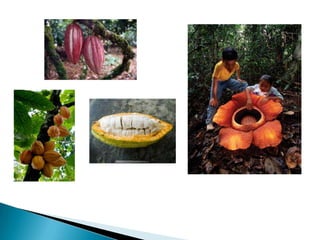
 Strong smelling flowers and
fruit encourage animal and
insect pollination.


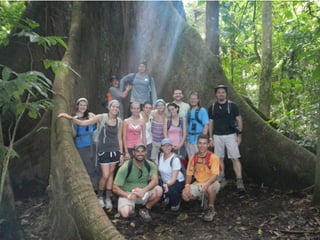
Large spread roots that grow up to 5m
above the ground.
◦ Help to support the tall emergent and
canopy trees

Shallow roots that reach for the
nutrients in the topsoil and
decomposing foliage.
 Constant presence of water, no need
for deep roots that search for ground
water.

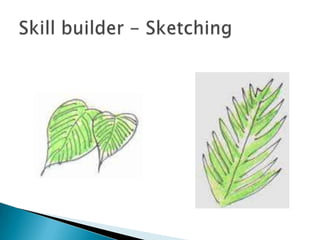
 By

the next lesson, pick a leaf
that you think is from a
rainforest tree and sketch it on
a piece of blank paper.
 Submit both the leaf and the
paper as your homework.
 Complete

the test in the time

allocated.
 Remember to write in black ink.
 If you are drawing diagrams, you
can use pencil.

Sec 1 geog unit 3 lesson 1

  • 1.
    Sec 1 Unit3 Lesson 1 Tropical Rainforest
  • 2.
     At the endof the lesson you will be able to : 1.Identify a tropical rainforest 2.List the characteristics of a tropical rainforest 3.Label and describe the layers of a tropical rainforest.
  • 3.
     How can wesave tropical rainforest? ◦ What are tropical rainforests? ◦ What is deforestation? ◦ Where are tropical rainforests found? ◦ Which areas have been deforested? ◦ Why do we deforest? ◦ How should we manage deforestation?
  • 4.
      Take 2 minutes,read the poem Lets listen to a rainforest.
  • 5.
     Earth’s oldest ecosystem. High rainfall and high temperatures throughout the year.  Thick, luxuriant evergreen forests. ◦ Evergreen = no distinct shedding season.
  • 6.
    1. Diversity of types 2.Structure of rainforest 3. Plant Adaptations
  • 7.
     Highest plant diversityin all forest types.  Warm temperatures and constant rainfall encourages plant growth.  Over 300 species in 0.01sq km  Source of common local food ◦ Bananas, mangoes, pepper, cinnamo n, corn, pandan, walnuts
  • 8.
     Plants grown todifferent heights  Three-layered structure found in tropical rainforests
  • 9.
     Trees up to50m talls.  Clearly visible from above  Trees that rise above the even canopy below.  Trees tend to have tall, straight and smooth trunks.  Tualang, Kapok tree.
  • 10.
     Layer of treesthat grow to between 20 – 30m  The crowns form an interlocking layer.  Blocks 90% of sunlight from the forest floor.  Deflects most rainfall.
  • 11.
     Dark most ofthe day as sun rays are blocked by canopy.  Plants tend to be small and widely-spaced apart.  Vegetation is sparse on forest floor, mostly decomposing leaves.
  • 12.
     Epiphytes grow ontrees to receive more sunlight. ◦Ferns, orchids, mosses  Lianas are woody vines that twine up trees for more sunlight. ◦Monkey ladder vine
  • 15.
  • 16.
     Plants adapt tothe climatic conditions with special features.  Without adaptations, they will not survive the high temperatures and heavy rainfall. PG 78
  • 17.
     Tall straight trunks Branches spread out near the top to reach for sunlight.  Smooth bark to allow rainwater to flow easily down to the roots.
  • 19.
     Broad leaves tocapture more sunlight  Waxy, leathery or hairy surfaces to minimise water loss.  Drip tips to allow water to runoff. ◦ Reduces the growth of fungi and bacteria
  • 20.
  • 21.
     Still air andlack of wind is bad for seed dispersal.  Strong smelling flowers and fruit encourage animal and insect pollination.
  • 23.
     Large spread rootsthat grow up to 5m above the ground. ◦ Help to support the tall emergent and canopy trees Shallow roots that reach for the nutrients in the topsoil and decomposing foliage.  Constant presence of water, no need for deep roots that search for ground water. 
  • 26.
     By the nextlesson, pick a leaf that you think is from a rainforest tree and sketch it on a piece of blank paper.  Submit both the leaf and the paper as your homework.
  • 27.
     Complete the testin the time allocated.  Remember to write in black ink.  If you are drawing diagrams, you can use pencil.

Editor's Notes

  • #5 Click on pic to launch clip with rainforest sounds…(58 mins)http://www.youtube.com/watch?v=LTiRw7kx97E