Search Techniques
Lecture-07
Hema Kashyap
Problem Solving
• By problem solving we mean that, the agent is in a desired, is in some situation and
wants to be in some desired situation.
• So, given to desired situation and the task of the agent is to make a series of
decisions or a series of moves, which will transform the given situation to the
desired situation.
• Problem solving in artificial intelligence may be characterized as a systematic
search through a range of possible actions in order to reach some predefined goal or
solution.
• In AI problem solving by search algorithms is quite common technique.
• In the coming age of AI it will have big impact on the technologies of the robotics
and path finding. It is also widely used in travel planning.
• A search algorithm takes a problem as input and returns the solution in the form of
an action sequence.
• Once the solution is found, the actions it recommends can be carried out. This
phase is called as the execution phase. After formulating a goal and problem to
solve the agent cells a search procedure to solve it.
• A problem can be defined by 5 components.
a) The initial state: The state from which agent will start.
b) The goal state: The state to be finally reached.
c) The current state: The state at which the agent is present after starting from the initial state.
d) Successor function: It is the description of possible actions and their outcomes.
e) Path cost: It is a function that assigns a numeric cost to each path.
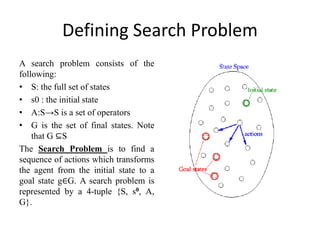
Defining Search Problem
A search problem consists of the
following:
• S: the full set of states
• s0 : the initial state
• A:S→S is a set of operators
• G is the set of final states. Note
that G ⊆S
The Search Problem is to find a
sequence of actions which transforms
the agent from the initial state to a
goal state g∈G. A search problem is
represented by a 4-tuple {S, s0, A,
G}.
Search Framework
• How real the world problem is
1. State Space Search: how a real world problem is mapped into a state space and then
we can have goals to meet through search algorithms
I. Uninformed/Blind Search: No domain specific information is available
II. Informed/Heuristic search: functions to guide the search procedural
2. Problem Reduction Search: problems which could be decomposed into sub-
problems in a flavor similar to dynamic problems. In addition, how best to solve a
problem
3. Game tree Search: gives idea how chess playing game works
4. Advances:
1. Memory Bounded search
2. Multi Objective Search
3. Learning how to search
Search Algorithm
1. Initialize: set OPEN=s, CLOSED={}
2. Fail: If OPEN={}, terminate with failure
3. Select: Select a state from OPEN and save in CLOSED
4. Terminate: If n∈G, terminate with success
5. Expand: generate the successor of n
For each successor, m, insert m in OPEN only if
m∈[OPEN∪CLOSED]
6. Loop: Goto step 2
Evaluating Search Strategies
• To find minimum set of operators to reach to goal
• We will look at the following three factors to measure performance, characteristics
and efficiency of various search strategies.
1. Completeness: Is the strategy guaranteed to find a solution if one exists?
2. Optimality: Does the solution have low cost or the minimal cost?
3. What is the search cost associated with the time and memory required to find a
solution?
a. Time complexity: Time taken (number of nodes expanded) (worst or average case) to
find a solution.
b. Space complexity: Space used by the algorithm measured in terms of the maximum size
of fringe

Lecture 07 search techniques

  • 1.
  • 2.
    Problem Solving • Byproblem solving we mean that, the agent is in a desired, is in some situation and wants to be in some desired situation. • So, given to desired situation and the task of the agent is to make a series of decisions or a series of moves, which will transform the given situation to the desired situation. • Problem solving in artificial intelligence may be characterized as a systematic search through a range of possible actions in order to reach some predefined goal or solution. • In AI problem solving by search algorithms is quite common technique. • In the coming age of AI it will have big impact on the technologies of the robotics and path finding. It is also widely used in travel planning.
  • 3.
    • A searchalgorithm takes a problem as input and returns the solution in the form of an action sequence. • Once the solution is found, the actions it recommends can be carried out. This phase is called as the execution phase. After formulating a goal and problem to solve the agent cells a search procedure to solve it. • A problem can be defined by 5 components. a) The initial state: The state from which agent will start. b) The goal state: The state to be finally reached. c) The current state: The state at which the agent is present after starting from the initial state. d) Successor function: It is the description of possible actions and their outcomes. e) Path cost: It is a function that assigns a numeric cost to each path.
  • 4.
    Defining Search Problem Asearch problem consists of the following: • S: the full set of states • s0 : the initial state • A:S→S is a set of operators • G is the set of final states. Note that G ⊆S The Search Problem is to find a sequence of actions which transforms the agent from the initial state to a goal state g∈G. A search problem is represented by a 4-tuple {S, s0, A, G}.
  • 5.
    Search Framework • Howreal the world problem is 1. State Space Search: how a real world problem is mapped into a state space and then we can have goals to meet through search algorithms I. Uninformed/Blind Search: No domain specific information is available II. Informed/Heuristic search: functions to guide the search procedural 2. Problem Reduction Search: problems which could be decomposed into sub- problems in a flavor similar to dynamic problems. In addition, how best to solve a problem 3. Game tree Search: gives idea how chess playing game works 4. Advances: 1. Memory Bounded search 2. Multi Objective Search 3. Learning how to search
  • 6.
    Search Algorithm 1. Initialize:set OPEN=s, CLOSED={} 2. Fail: If OPEN={}, terminate with failure 3. Select: Select a state from OPEN and save in CLOSED 4. Terminate: If n∈G, terminate with success 5. Expand: generate the successor of n For each successor, m, insert m in OPEN only if m∈[OPEN∪CLOSED] 6. Loop: Goto step 2
  • 7.
    Evaluating Search Strategies •To find minimum set of operators to reach to goal • We will look at the following three factors to measure performance, characteristics and efficiency of various search strategies. 1. Completeness: Is the strategy guaranteed to find a solution if one exists? 2. Optimality: Does the solution have low cost or the minimal cost? 3. What is the search cost associated with the time and memory required to find a solution? a. Time complexity: Time taken (number of nodes expanded) (worst or average case) to find a solution. b. Space complexity: Space used by the algorithm measured in terms of the maximum size of fringe