Artificial Intelligence
Hill Climbing and Local Search
Portland Data Science Group
Created by Andrew Ferlitsch
Community Outreach Officer
July, 2017
Hill Climbing Algorithm
• A search method of selecting the best local choice at
each step in hopes of finding an optimal solution.
• Does not consider how optimal the current solution is.
• Does not consider steps past the next immediate choice.
• Steps:
1. Define an evaluation function f(x) to determine the
value of a state.
2. From the current state, determine the search space
(actions) for one step ahead.
3. Select the action from the search space that returns the
highest value.
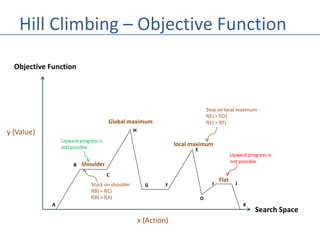
Hill Climbing – Objective Function
x (Action)
y (Value)
Global maximum
local maximum
Shoulder
Search Space
Objective Function
Stuck on shoulder
f(B) = f(C)
f(B) > f(A)
A
B
C
D
E
F
Stop on local maximum
f(E) > f(D)
f(E) > f(F)
G
H
Flat
I J
K
Upward progress is
still possible
Upward progress is
not possible
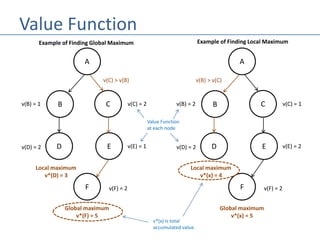
Value Function
A
B
E
C
D
v(B) = 1 v(C) = 2
v(E) = 1v(D) = 2
F v(F) = 2
Global maximum
v*(F) = 5
Local maximum
v*(D) = 3
A
B
E
C
D
v(B) = 2 v(C) = 1
v(E) = 2v(D) = 2
F v(F) = 2
Global maximum
v*(x) = 5
Local maximum
v*(x) = 4
v(C) > v(B)
Example of Finding Global Maximum Example of Finding Local Maximum
Value Function
at each node
v*(x) is total
accumulated value.
v(B) > v(C)
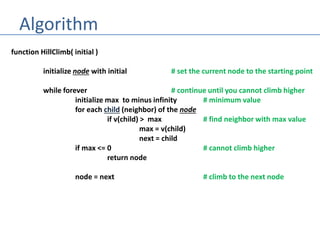
Algorithm
function HillClimb( initial )
initialize node with initial # set the current node to the starting point
while forever # continue until you cannot climb higher
initialize max to minus infinity # minimum value
for each child (neighbor) of the node
if v(child) > max # find neighbor with max value
max = v(child)
next = child
if max <= 0 # cannot climb higher
return node
node = next # climb to the next node
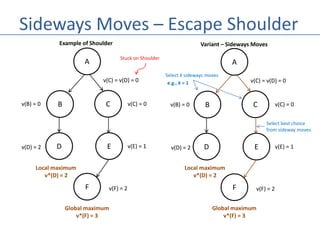
Sideways Moves – Escape Shoulder
A
B
E
C
D
v(B) = 0 v(C) = 0
v(E) = 1v(D) = 2
F v(F) = 2
Global maximum
v*(F) = 3
Local maximum
v*(D) = 2
v(C) = v(D) = 0
Example of Shoulder
Stuck on Shoulder
Variant – Sideways Moves
A
B
E
C
D
v(B) = 0 v(C) = 0
v(E) = 1v(D) = 2
F v(F) = 2
Global maximum
v*(F) = 3
Local maximum
v*(D) = 2
v(C) = v(D) = 0
Select k sideways moves
e.g., k = 1
Select best choice
from sideway moves
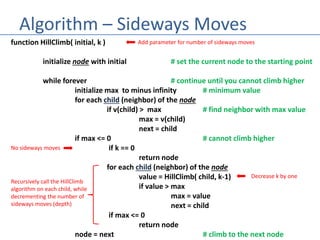
Algorithm – Sideways Moves
function HillClimb( initial, k )
initialize node with initial # set the current node to the starting point
while forever # continue until you cannot climb higher
initialize max to minus infinity # minimum value
for each child (neighbor) of the node
if v(child) > max # find neighbor with max value
max = v(child)
next = child
if max <= 0 # cannot climb higher
if k == 0
return node
for each child (neighbor) of the node
value = HillClimb( child, k-1)
if value > max
max = value
next = child
if max <= 0
return node
node = next # climb to the next node
Add parameter for number of sideways moves
No sideways moves
Recursively call the HillClimb
algorithm on each child, while
decrementing the number of
sideways moves (depth)
Decrease k by one
Variant - Stochastic
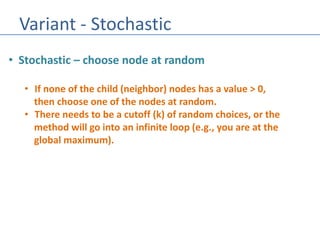
• Stochastic – choose node at random
• If none of the child (neighbor) nodes has a value > 0,
then choose one of the nodes at random.
• There needs to be a cutoff (k) of random choices, or the
method will go into an infinite loop (e.g., you are at the
global maximum).
Variant - Local Beam Search
Hill
Climber
Hill
Climber
Hill
Climber
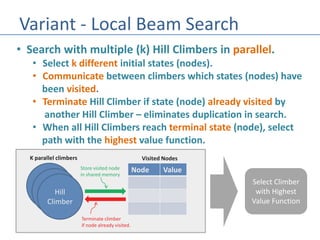
• Search with multiple (k) Hill Climbers in parallel.
• Select k different initial states (nodes).
• Communicate between climbers which states (nodes) have
been visited.
• Terminate Hill Climber if state (node) already visited by
another Hill Climber – eliminates duplication in search.
• When all Hill Climbers reach terminal state (node), select
path with the highest value function.
Node Value
Visited NodesK parallel climbers
Terminate climber
if node already visited.
Store visited node
in shared memory
Select Climber
with Highest
Value Function

AI - Local Search - Hill Climbing

  • 1.
    Artificial Intelligence Hill Climbingand Local Search Portland Data Science Group Created by Andrew Ferlitsch Community Outreach Officer July, 2017
  • 2.
    Hill Climbing Algorithm •A search method of selecting the best local choice at each step in hopes of finding an optimal solution. • Does not consider how optimal the current solution is. • Does not consider steps past the next immediate choice. • Steps: 1. Define an evaluation function f(x) to determine the value of a state. 2. From the current state, determine the search space (actions) for one step ahead. 3. Select the action from the search space that returns the highest value.
  • 3.
    Hill Climbing –Objective Function x (Action) y (Value) Global maximum local maximum Shoulder Search Space Objective Function Stuck on shoulder f(B) = f(C) f(B) > f(A) A B C D E F Stop on local maximum f(E) > f(D) f(E) > f(F) G H Flat I J K Upward progress is still possible Upward progress is not possible
  • 4.
    Value Function A B E C D v(B) =1 v(C) = 2 v(E) = 1v(D) = 2 F v(F) = 2 Global maximum v*(F) = 5 Local maximum v*(D) = 3 A B E C D v(B) = 2 v(C) = 1 v(E) = 2v(D) = 2 F v(F) = 2 Global maximum v*(x) = 5 Local maximum v*(x) = 4 v(C) > v(B) Example of Finding Global Maximum Example of Finding Local Maximum Value Function at each node v*(x) is total accumulated value. v(B) > v(C)
  • 5.
    Algorithm function HillClimb( initial) initialize node with initial # set the current node to the starting point while forever # continue until you cannot climb higher initialize max to minus infinity # minimum value for each child (neighbor) of the node if v(child) > max # find neighbor with max value max = v(child) next = child if max <= 0 # cannot climb higher return node node = next # climb to the next node
  • 6.
    Sideways Moves –Escape Shoulder A B E C D v(B) = 0 v(C) = 0 v(E) = 1v(D) = 2 F v(F) = 2 Global maximum v*(F) = 3 Local maximum v*(D) = 2 v(C) = v(D) = 0 Example of Shoulder Stuck on Shoulder Variant – Sideways Moves A B E C D v(B) = 0 v(C) = 0 v(E) = 1v(D) = 2 F v(F) = 2 Global maximum v*(F) = 3 Local maximum v*(D) = 2 v(C) = v(D) = 0 Select k sideways moves e.g., k = 1 Select best choice from sideway moves
  • 7.
    Algorithm – SidewaysMoves function HillClimb( initial, k ) initialize node with initial # set the current node to the starting point while forever # continue until you cannot climb higher initialize max to minus infinity # minimum value for each child (neighbor) of the node if v(child) > max # find neighbor with max value max = v(child) next = child if max <= 0 # cannot climb higher if k == 0 return node for each child (neighbor) of the node value = HillClimb( child, k-1) if value > max max = value next = child if max <= 0 return node node = next # climb to the next node Add parameter for number of sideways moves No sideways moves Recursively call the HillClimb algorithm on each child, while decrementing the number of sideways moves (depth) Decrease k by one
  • 8.
    Variant - Stochastic •Stochastic – choose node at random • If none of the child (neighbor) nodes has a value > 0, then choose one of the nodes at random. • There needs to be a cutoff (k) of random choices, or the method will go into an infinite loop (e.g., you are at the global maximum).
  • 9.
    Variant - LocalBeam Search Hill Climber Hill Climber Hill Climber • Search with multiple (k) Hill Climbers in parallel. • Select k different initial states (nodes). • Communicate between climbers which states (nodes) have been visited. • Terminate Hill Climber if state (node) already visited by another Hill Climber – eliminates duplication in search. • When all Hill Climbers reach terminal state (node), select path with the highest value function. Node Value Visited NodesK parallel climbers Terminate climber if node already visited. Store visited node in shared memory Select Climber with Highest Value Function