U N I T 2
B Y : S U R B H I S A R O H A
A S S I S T A N T P R O F E S S O R
ARTIFICIAL INTELLIGENCE
1
SURBHI SAROHA
Syllabus
 Searching for solutions.
 Uniformed search strategies.
 Informed search strategies.
 Local search algorithms.
 Optimistic problems.
 Adversarial Search.
 Search for games.
 Alpha-Beta pruning.
2
SURBHI SAROHA
Searching for solutions.
 Search Algorithms in Artificial Intelligence
 Search algorithms are one of the most important areas of
Artificial Intelligence. This topic will explain all about the
search algorithms in AI.
 Problem-solving agents:
 In Artificial Intelligence, Search techniques are universal
problem-solving methods.
 Rational agents or Problem-solving agents in AI mostly
used these search strategies or algorithms to solve a specific
problem and provide the best result.
 Problem-solving agents are the goal-based agents and use
atomic representation. In this topic, we will learn various
problem-solving search algorithms.
3
SURBHI SAROHA
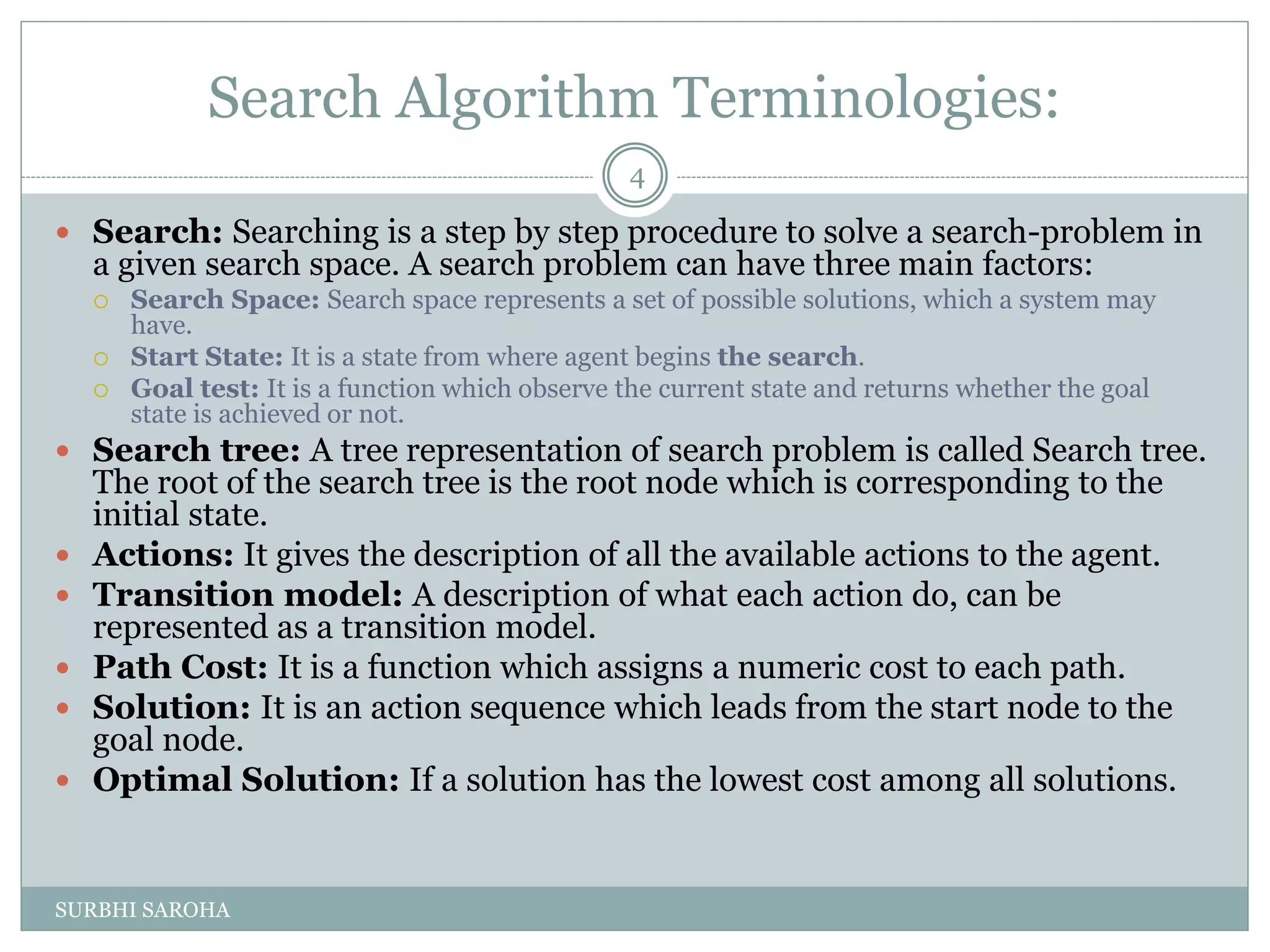
Search Algorithm Terminologies:
 Search: Searching is a step by step procedure to solve a search-problem in
a given search space. A search problem can have three main factors:
 Search Space: Search space represents a set of possible solutions, which a system may
have.
 Start State: It is a state from where agent begins the search.
 Goal test: It is a function which observe the current state and returns whether the goal
state is achieved or not.
 Search tree: A tree representation of search problem is called Search tree.
The root of the search tree is the root node which is corresponding to the
initial state.
 Actions: It gives the description of all the available actions to the agent.
 Transition model: A description of what each action do, can be
represented as a transition model.
 Path Cost: It is a function which assigns a numeric cost to each path.
 Solution: It is an action sequence which leads from the start node to the
goal node.
 Optimal Solution: If a solution has the lowest cost among all solutions.
4
SURBHI SAROHA
Properties of Search Algorithms:
 Following are the four essential properties of search
algorithms to compare the efficiency of these algorithms:
 Completeness: A search algorithm is said to be complete if
it guarantees to return a solution if at least any solution exists
for any random input.
 Optimality: If a solution found for an algorithm is
guaranteed to be the best solution (lowest path cost) among
all other solutions, then such a solution for is said to be an
optimal solution.
 Time Complexity: Time complexity is a measure of time for
an algorithm to complete its task.
 Space Complexity: It is the maximum storage space
required at any point during the search, as the complexity of
the problem.
5
SURBHI SAROHA
Types of search algorithms
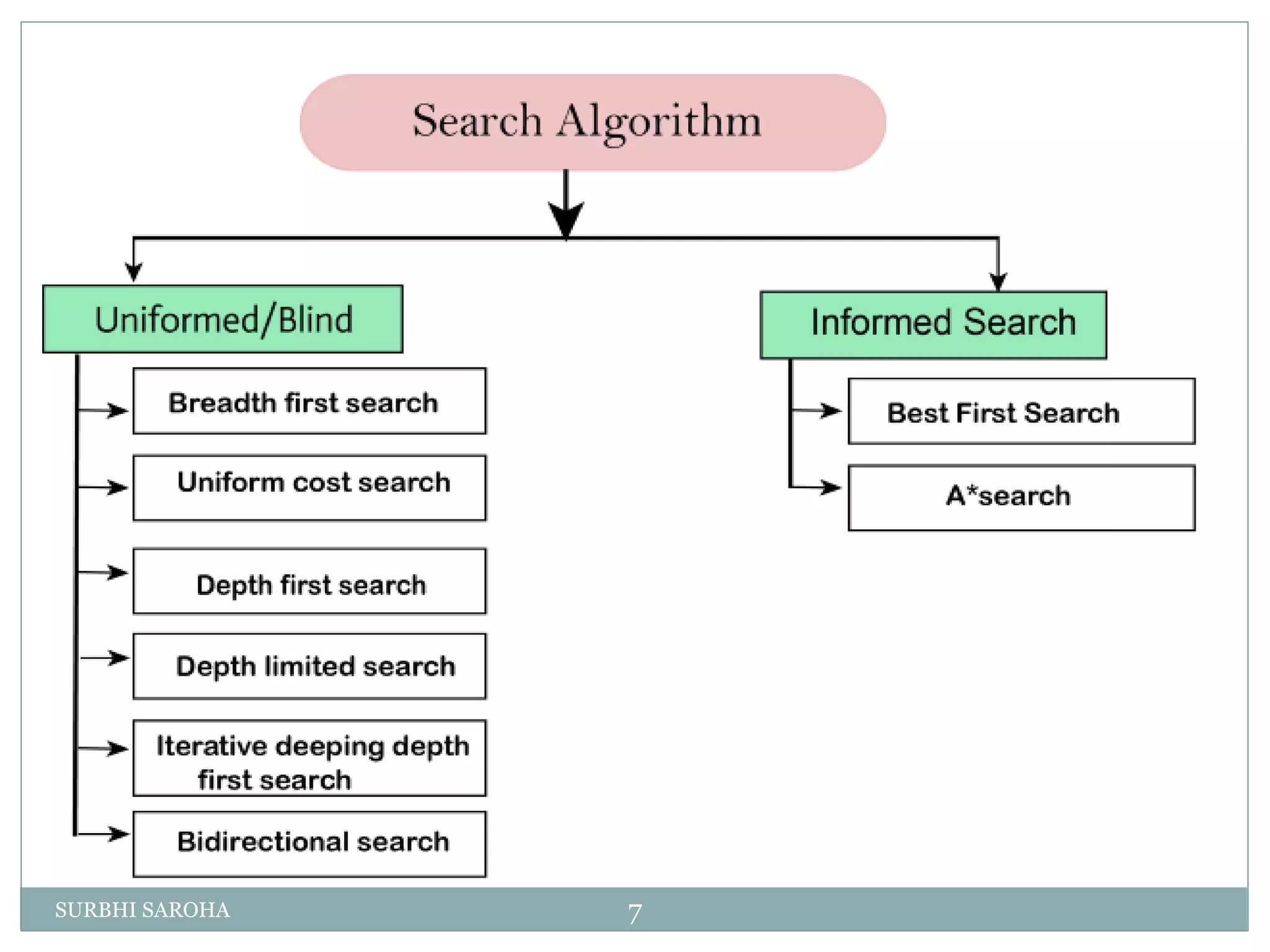
 Based on the search problems we can classify
the search algorithms into uninformed
(Blind search) search and informed search
(Heuristic search) algorithms.
6
SURBHI SAROHA
7SURBHI SAROHA
Uninformed/Blind Search:
 The uninformed search does not contain any domain
knowledge such as closeness, the location of the goal.
 It operates in a brute-force way as it only includes
information about how to traverse the tree and how
to identify leaf and goal nodes.
 Uninformed search applies a way in which search
tree is searched without any information about the
search space like initial state operators and test for
the goal, so it is also called blind search.
 It examines each node of the tree until it achieves the
goal node.
8
SURBHI SAROHA
Cont….
 It can be divided into five main types:
 Breadth-first search
 Uniform cost search
 Depth-first search
 Iterative deepening depth-first search
 Bidirectional Search
9
SURBHI SAROHA
Informed Search
 Informed search algorithms use domain knowledge. In an informed
search, problem information is available which can guide the
search.
 Informed search strategies can find a solution more efficiently than
an uninformed search strategy. Informed search is also called a
Heuristic search.
 A heuristic is a way which might not always be guaranteed for best
solutions but guaranteed to find a good solution in reasonable time.
 Informed search can solve much complex problem which could not
be solved in another way.
 An example of informed search algorithms is a traveling salesman
problem.
 Greedy Search
 A* Search
10
SURBHI SAROHA
 Thank you 
11
SURBHI SAROHA

Artificial intelligence 2 Part 1

  • 1.
    U N IT 2 B Y : S U R B H I S A R O H A A S S I S T A N T P R O F E S S O R ARTIFICIAL INTELLIGENCE 1 SURBHI SAROHA
  • 2.
    Syllabus  Searching forsolutions.  Uniformed search strategies.  Informed search strategies.  Local search algorithms.  Optimistic problems.  Adversarial Search.  Search for games.  Alpha-Beta pruning. 2 SURBHI SAROHA
  • 3.
    Searching for solutions. Search Algorithms in Artificial Intelligence  Search algorithms are one of the most important areas of Artificial Intelligence. This topic will explain all about the search algorithms in AI.  Problem-solving agents:  In Artificial Intelligence, Search techniques are universal problem-solving methods.  Rational agents or Problem-solving agents in AI mostly used these search strategies or algorithms to solve a specific problem and provide the best result.  Problem-solving agents are the goal-based agents and use atomic representation. In this topic, we will learn various problem-solving search algorithms. 3 SURBHI SAROHA
  • 4.
    Search Algorithm Terminologies: Search: Searching is a step by step procedure to solve a search-problem in a given search space. A search problem can have three main factors:  Search Space: Search space represents a set of possible solutions, which a system may have.  Start State: It is a state from where agent begins the search.  Goal test: It is a function which observe the current state and returns whether the goal state is achieved or not.  Search tree: A tree representation of search problem is called Search tree. The root of the search tree is the root node which is corresponding to the initial state.  Actions: It gives the description of all the available actions to the agent.  Transition model: A description of what each action do, can be represented as a transition model.  Path Cost: It is a function which assigns a numeric cost to each path.  Solution: It is an action sequence which leads from the start node to the goal node.  Optimal Solution: If a solution has the lowest cost among all solutions. 4 SURBHI SAROHA
  • 5.
    Properties of SearchAlgorithms:  Following are the four essential properties of search algorithms to compare the efficiency of these algorithms:  Completeness: A search algorithm is said to be complete if it guarantees to return a solution if at least any solution exists for any random input.  Optimality: If a solution found for an algorithm is guaranteed to be the best solution (lowest path cost) among all other solutions, then such a solution for is said to be an optimal solution.  Time Complexity: Time complexity is a measure of time for an algorithm to complete its task.  Space Complexity: It is the maximum storage space required at any point during the search, as the complexity of the problem. 5 SURBHI SAROHA
  • 6.
    Types of searchalgorithms  Based on the search problems we can classify the search algorithms into uninformed (Blind search) search and informed search (Heuristic search) algorithms. 6 SURBHI SAROHA
  • 7.
  • 8.
    Uninformed/Blind Search:  Theuninformed search does not contain any domain knowledge such as closeness, the location of the goal.  It operates in a brute-force way as it only includes information about how to traverse the tree and how to identify leaf and goal nodes.  Uninformed search applies a way in which search tree is searched without any information about the search space like initial state operators and test for the goal, so it is also called blind search.  It examines each node of the tree until it achieves the goal node. 8 SURBHI SAROHA
  • 9.
    Cont….  It canbe divided into five main types:  Breadth-first search  Uniform cost search  Depth-first search  Iterative deepening depth-first search  Bidirectional Search 9 SURBHI SAROHA
  • 10.
    Informed Search  Informedsearch algorithms use domain knowledge. In an informed search, problem information is available which can guide the search.  Informed search strategies can find a solution more efficiently than an uninformed search strategy. Informed search is also called a Heuristic search.  A heuristic is a way which might not always be guaranteed for best solutions but guaranteed to find a good solution in reasonable time.  Informed search can solve much complex problem which could not be solved in another way.  An example of informed search algorithms is a traveling salesman problem.  Greedy Search  A* Search 10 SURBHI SAROHA
  • 11.
     Thank you 11 SURBHI SAROHA