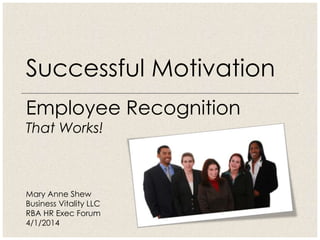
Employee Recognition
That Works!
Successful Motivation
Mary Anne Shew
Business Vitality LLC
RBA HR Exec Forum
4/1/2014
2
Happy employees =
productive employees
Your Dream
3
Self-motivation versus
external “nagging”
Your Dream
4
Creativity unleashed
Your Dream
5
Budget pressures
Problem
6
Deadline pressures
Problem
7
Raises / bonuses /
promotions in short supply
Problem
8
Solution: Think Differently
9
The Motivation
Match-Up
10
Understand Six
Universal Motivators
Organize Rewards to
Support Motivators
Match Rewards with
Employees
The Motivation
Match-Up
11
Mary Anne Shew
2nd Career: 1999-today
Web Site Design/Development
3rd Career: 2005-today
Internet Consulting &
Business Coaching
1st Career:
IT (Software)
1. Understand Six Motivators
2. Organize Rewards
3. Match with Employees
12
What we’ll cover
Preface: Set Context
13
Context is everything…
14
Employee turnover costs
(See Employee Turnover Cost Handout)
What could your company do
with an extra $54,000+ every year?
For 75-person company, 10% annual
turnover of $30K-salary employees
costs $54,000 per year, not including
cost of productivity losses.
15
Employee turnover costs
Out-of-Pocket “Hidden” / Unmeasured
Lost training that will have to
be repeated
Impact of no one doing that
job for 1+ months: Customer
satisfaction, etc.
Recruiting costs Manager focused on new hire
versus existing staff, projects
Candidate costs: Travel, meals,
hotel
Team has to pick up the slack
until replacement hired
New hire onboarding costs:
Relocation, training
Time it takes for new employee
to fully ramp up
(See Employee Turnover Cost Handout)
16
Recognizing and valuing
Recognition Valuing
Acknowledge good work,
appreciate efforts
Appreciate worth of
someone; hold in high esteem
Tied to what we do, not who
we are
Acknowledge not just for tasks
but for intrinsic worth
For successfully completing a
project
Letting someone know you’re
glad they’re on the team, and
it wouldn’t be as good
without them
Event-driven (singular
experience)
Environment-driven
(sustained)
Shows up as driver of
employee engagement 30%
of the time
Shows up as driver of
employee engagement 85%
of the time
It’s a difference in experience
17
Recognizing and valuing
“I receive recognition when I do good work.”
• Across industries and countries: Average
score is 55% favorable
• For top 10% of companies: 66%
• But rest of their scores in 80-90% range
• So even they don’t do as well as they
could in recognition
“I feel valued as an employee of this company.”
• When asked, average score is 41%
favorable, 32% unfavorable
18
Recognizing and valuing
To recognize employees To make them feel valued
Identify outstanding customer
service
Actively solicit people’s thoughts
Look at team performance Recognize real contributions
Train supervisors for appropriate
day-to-day recognition
Allow open discussion
Encourage initiative, risk-taking Show respect: No bullying, yelling,
trivializing, patronizing, deceiving
Ensure job performance and pay
are linked
Let people have input to the
decisions that affect them
Be transparent and fair Discuss expectations and
responsibility
Build culture of celebration over
competition
Explain why they are important to
success of company
R&R is part of a system
19
Engaged
Enabled
Energized
Attachment to the
company and
willingness to give
discretionary effort
A local work
environment that
supports productivity and
performance
Individuals’ physical,
interpersonal, and
emotional well-being at
work
Well-
functioning
equipment
Necessary
supplies
on hand
Effective
work
processes
Clear
direction
from
supervisors
Clear
priorities
Effective
teams
Respectful
colleagues
Expectations
balanced
against
pressures
Attitude
towards
immediate
manager
Senior
leadership
Work/life
balance
Goals and
Objectives
Company
image
20
R&R is part of a system
What are you rewarding?
1. If focus is on vital
behaviors that have
intrinsic satisfaction, and
2. Social support is in place
for vital behaviors,
3. THEN external rewards
work well.
Engaged
Enabled
Energized
21
R&R is part of a system
Vital behavior is the key concept
• A high-leverage behavior that
makes the difference
• What does a person do that
gets the desired outcome?
• Reward a vital behavior, and
the outcome will take care of
itself
22
Examples of Vital Behavior
Weight loss: Lost 30 lbs and kept it off
for 6+ years
• Exercised on home equipment
• Ate breakfast
• Weighed themselves daily
23
Examples of Vital Behavior
Epidemic: Eliminated infectious worm
spread through drinking water
• Strained all drinking water
• Kept infected people away from
water source
• Entire village took responsibility for
compliance
24
Who’s On Your Front Lines?
Supervisors
and
Managers
25
What are their vital behaviors?
The Diminisher
• Somewhat irresponsible, not trusted
• Uses blame instead of accountability
The Neutralizer
• Gets work done at level specified
• Frequently invokes authority (no personal power)
The Enhancer
• Self-confident, respected, accountable, trusted
• Brings more to the organization than is paid for
(See Handout Pages 2-3)
26
Leadership
Management
Supervision
Emotional IQ
Communication
Goal Setting
Time
Management
Conflict
Management
Research
Manufacturing
Engineering
Production
Product/Service
Marketing
Sales
Finance
Accounting
IT
How prepared are they for their jobs?
Job:Managing
people
Promoted
time
They started
career here
Job: Doing the work
Now need to
do these
Build it starting from the top down
If senior management doesn’t
exhibit R&R vital behavior
themselves, first-line managers
won’t believe it’s an important
part of their own job either
27
Culture of recognition
28
• Individuals—regardless of rank, title,
expertise, or tenure—freely and
readily recognize one another’s
contributions
• Thoughtful, timely, personal
• Keep it fresh and meaningful
• Avoid “rote recognition” that has no
real purpose or thought behind it
Culture of recognition
29
(See Handout Page 5)
Culture of recognition
TRUST is a key foundation for
effective rewards and
recognition
• Four components of trust: Sincerity,
Reliability, Competence, Caring
• If Caring (a.k.a. “valuing”) is missing, R&R
efforts will likely not pay off as you hope,
even if other 3 components are in place
Part 1
30
Understand Six
Universal Motivators
An internal process that makes a
person move toward a goal
• Can’t be directly observed
• Can only infer from behavior
• Internal: Survival, pleasure,
achievement
• External: Money, award, connection
to others
31
Part 1
What is motivation?
Three internally-focused
• Material possessions
• Self-improvement
• Sense of mission
32
Part 1
Six Universal Motivators
(See Handout Page 4)
Three externally-focused
• Personal relationships
• Sense of belonging
• Status and recognition
33
Part 1
Six Universal Motivators
(See Handout Page 4)
Everyone is motivated to some level by all six
motivators, some more strongly than others.
Placing too much importance on any one
motivator will cause that person to over-
focus on that motivation.
These motivators can be measured by an
assessment.
34
Part 1
Six Universal Motivators
People with a more balanced motivation
mix tend to have more motivators to which
they are drawn.
These people respond to a wider rage of
rewards.
35
Part 1
Six Universal Motivators
People with a more focused motivation mix
tend to have fewer motivating forces.
This means they often respond more
intensely to them.
36
Part 1
Six Universal Motivators
How to know what works?
Get to know your people
• Ask them what they like and want
• Surveys, 1-1 or group discussions,
assessments
• Experiment
• No single way to reach everyone
The Generations: See Handout p. 6
37
Part 1
Six Universal Motivators
(See Handout Page 5)
Part 2
38
Organize Rewards to
Support Motivators
Principles of reward
• You get what you reward
• Must be in response to
something significant
• Timely, specific, meaningful
• Immediate manager has huge
impact
39
Part 2
Organize Rewards
40
R&R is an ongoing investment
• Mostly of time and thought
• Do free things first
• Invest in teaching “valuing” behavior
Evaluate what you already have
in place for impact
• Get anonymous employee feedback
through survey
Part 2
Organize Rewards
41
Consider having an employee
group organize R&R awards and
events.
• Teach them to incorporate the six
types of motivation and match
generational appeal
• Give them copies of 1501
Part 2
Organize Rewards
42
Why go through all
this?
Outperform Competitors
43
“Companies that
manage people
right will outperform
companies that
don’t by 30-40%.”
--Jeffrey Pfeffer,
Stanford Business
School Professor
2012 Industry
Profit Margins 2.9%
Food & Staples
Retailing
19.5%
Pharma, BioTech,
Life Sciences
8.4%
Capital Goods
20.2%
Software&
Services
Impact on
your
company?
Retain Top Talent
44
Cost to replace
employee with
salary up to $75K:
20% of salary
--2012 Study by
Center for
American Progress
45
Inspire Engagement
“Effectively recognizing
performance can increase
employee engagement by
almost 60%.”
--Towers Watson Report:
http://bit.ly/1bQv499
Engaged
Enabled
Energized
46
Values Visible in Behavior
“Companies with
values-based
strategic
recognition, 91%
of employees feel
they have strong
grasp on goals
and objectives.”
--Globoforce.com
Respect
Account-
ability
Integrity
We’re in the home stretch…
47
Part 3
48
Match Rewards with
Employees
The best recognition is FREE
49
Part 3
Match Rewards to Employees
To recognize employees To make them feel valued
Identify outstanding customer
service
Actively solicit people’s thoughts
Look at team performance Recognize real contributions
Train supervisors for appropriate
day-to-day recognition
Allow open expression
Encourage initiative, risk taking Show respect: No bullying, yelling,
trivializing, patronizing, deceiving
Ensure job performance and pay
are linked
Let people input to the decisions
that affect them
Be transparent and fair Discuss expectations and
responsibility
Build culture of celebration over
competition
Explain why they are important to
success of company
50
Part 3
Match Rewards to Employees
1501 is a comprehensive, well-written, easy-
to-read handbook for all aspects of reward
and recognition
• The ideas listed were implemented at
hundreds of companies across many
industries
1501 Ways to Reward
Employees
51
Part 3
Match Rewards to Employees
Use the 1501 book to
• Select ideas that fit your culture,
budget, and employees’
interests
• Organize the ideas to match
the motivators
52
Part 3
Match Rewards to Employees
Then
• Let employees choose a reward
from what you’ve chosen
(when appropriate), or take a
guess yourself
• Use humor and fun too
53
Part 3
Match Rewards to Employees
Page Idea From Book 1501 Ways to Reward
Employees
Matching
Motivator
443 Reward employees $10 for every customer compliment
they get and deduct $10 for every complaint.
Material
Possessions
58 Offer employees access to wellness information and
workshops.
Self-
Improvement
63 Have an employee-run environmental issues committee
to educate and try ideas both for employees’ personal
lives as well as the working environment.
Sense of
Mission
49 Pal of the Week: Everyone in the department asked to
do or say something nice to the person in the course of a
week.
Personal
Relationships
263 Reward when someone they refer (usually a friend) is
hired. Another one when new hire stays 6 months.
Sense of
Belonging
262 Invite employees to your home for a special celebration,
and recognize them in front of spouses and colleagues.
Status &
Recognition
54
Summary: The Motivation
Match-Up
Engaged
Enabled
Energized
Reward and recognition
is part of a system
• Valuing employees sets the
stage
• How well it works depends
on the other parts
55
Understand Six
Universal Motivators
Organize Rewards to
Support Motivators
Match Rewards with
Employees
Summary: The Motivation
Match-Up
56
Successful Motivation
Resources
Influencer: The Power to
Change Anything
1501 Ways to
Reward Employees
The Thin Book of Trust: An Essential
Primer of Building Trust at Work
57
Mary Anne Shew
www.BizVitality.com | 585-746-9140
mashew@BizVitality.com
Wishing You
Motivation Success!

Successful Motivation: Employee Recognition That Works!

  • 1.
    Employee Recognition That Works! SuccessfulMotivation Mary Anne Shew Business Vitality LLC RBA HR Exec Forum 4/1/2014
  • 2.
    2 Happy employees = productiveemployees Your Dream
  • 3.
  • 4.
  • 5.
  • 6.
  • 7.
    7 Raises / bonuses/ promotions in short supply Problem
  • 8.
  • 9.
  • 10.
    10 Understand Six Universal Motivators OrganizeRewards to Support Motivators Match Rewards with Employees The Motivation Match-Up
  • 11.
    11 Mary Anne Shew 2ndCareer: 1999-today Web Site Design/Development 3rd Career: 2005-today Internet Consulting & Business Coaching 1st Career: IT (Software)
  • 12.
    1. Understand SixMotivators 2. Organize Rewards 3. Match with Employees 12 What we’ll cover Preface: Set Context
  • 13.
  • 14.
    14 Employee turnover costs (SeeEmployee Turnover Cost Handout) What could your company do with an extra $54,000+ every year? For 75-person company, 10% annual turnover of $30K-salary employees costs $54,000 per year, not including cost of productivity losses.
  • 15.
    15 Employee turnover costs Out-of-Pocket“Hidden” / Unmeasured Lost training that will have to be repeated Impact of no one doing that job for 1+ months: Customer satisfaction, etc. Recruiting costs Manager focused on new hire versus existing staff, projects Candidate costs: Travel, meals, hotel Team has to pick up the slack until replacement hired New hire onboarding costs: Relocation, training Time it takes for new employee to fully ramp up (See Employee Turnover Cost Handout)
  • 16.
    16 Recognizing and valuing RecognitionValuing Acknowledge good work, appreciate efforts Appreciate worth of someone; hold in high esteem Tied to what we do, not who we are Acknowledge not just for tasks but for intrinsic worth For successfully completing a project Letting someone know you’re glad they’re on the team, and it wouldn’t be as good without them Event-driven (singular experience) Environment-driven (sustained) Shows up as driver of employee engagement 30% of the time Shows up as driver of employee engagement 85% of the time It’s a difference in experience
  • 17.
    17 Recognizing and valuing “Ireceive recognition when I do good work.” • Across industries and countries: Average score is 55% favorable • For top 10% of companies: 66% • But rest of their scores in 80-90% range • So even they don’t do as well as they could in recognition “I feel valued as an employee of this company.” • When asked, average score is 41% favorable, 32% unfavorable
  • 18.
    18 Recognizing and valuing Torecognize employees To make them feel valued Identify outstanding customer service Actively solicit people’s thoughts Look at team performance Recognize real contributions Train supervisors for appropriate day-to-day recognition Allow open discussion Encourage initiative, risk-taking Show respect: No bullying, yelling, trivializing, patronizing, deceiving Ensure job performance and pay are linked Let people have input to the decisions that affect them Be transparent and fair Discuss expectations and responsibility Build culture of celebration over competition Explain why they are important to success of company
  • 19.
    R&R is partof a system 19 Engaged Enabled Energized Attachment to the company and willingness to give discretionary effort A local work environment that supports productivity and performance Individuals’ physical, interpersonal, and emotional well-being at work Well- functioning equipment Necessary supplies on hand Effective work processes Clear direction from supervisors Clear priorities Effective teams Respectful colleagues Expectations balanced against pressures Attitude towards immediate manager Senior leadership Work/life balance Goals and Objectives Company image
  • 20.
    20 R&R is partof a system What are you rewarding? 1. If focus is on vital behaviors that have intrinsic satisfaction, and 2. Social support is in place for vital behaviors, 3. THEN external rewards work well. Engaged Enabled Energized
  • 21.
    21 R&R is partof a system Vital behavior is the key concept • A high-leverage behavior that makes the difference • What does a person do that gets the desired outcome? • Reward a vital behavior, and the outcome will take care of itself
  • 22.
    22 Examples of VitalBehavior Weight loss: Lost 30 lbs and kept it off for 6+ years • Exercised on home equipment • Ate breakfast • Weighed themselves daily
  • 23.
    23 Examples of VitalBehavior Epidemic: Eliminated infectious worm spread through drinking water • Strained all drinking water • Kept infected people away from water source • Entire village took responsibility for compliance
  • 24.
    24 Who’s On YourFront Lines? Supervisors and Managers
  • 25.
    25 What are theirvital behaviors? The Diminisher • Somewhat irresponsible, not trusted • Uses blame instead of accountability The Neutralizer • Gets work done at level specified • Frequently invokes authority (no personal power) The Enhancer • Self-confident, respected, accountable, trusted • Brings more to the organization than is paid for (See Handout Pages 2-3)
  • 26.
  • 27.
    Build it startingfrom the top down If senior management doesn’t exhibit R&R vital behavior themselves, first-line managers won’t believe it’s an important part of their own job either 27 Culture of recognition
  • 28.
    28 • Individuals—regardless ofrank, title, expertise, or tenure—freely and readily recognize one another’s contributions • Thoughtful, timely, personal • Keep it fresh and meaningful • Avoid “rote recognition” that has no real purpose or thought behind it Culture of recognition
  • 29.
    29 (See Handout Page5) Culture of recognition TRUST is a key foundation for effective rewards and recognition • Four components of trust: Sincerity, Reliability, Competence, Caring • If Caring (a.k.a. “valuing”) is missing, R&R efforts will likely not pay off as you hope, even if other 3 components are in place
  • 30.
  • 31.
    An internal processthat makes a person move toward a goal • Can’t be directly observed • Can only infer from behavior • Internal: Survival, pleasure, achievement • External: Money, award, connection to others 31 Part 1 What is motivation?
  • 32.
    Three internally-focused • Materialpossessions • Self-improvement • Sense of mission 32 Part 1 Six Universal Motivators (See Handout Page 4)
  • 33.
    Three externally-focused • Personalrelationships • Sense of belonging • Status and recognition 33 Part 1 Six Universal Motivators (See Handout Page 4)
  • 34.
    Everyone is motivatedto some level by all six motivators, some more strongly than others. Placing too much importance on any one motivator will cause that person to over- focus on that motivation. These motivators can be measured by an assessment. 34 Part 1 Six Universal Motivators
  • 35.
    People with amore balanced motivation mix tend to have more motivators to which they are drawn. These people respond to a wider rage of rewards. 35 Part 1 Six Universal Motivators
  • 36.
    People with amore focused motivation mix tend to have fewer motivating forces. This means they often respond more intensely to them. 36 Part 1 Six Universal Motivators
  • 37.
    How to knowwhat works? Get to know your people • Ask them what they like and want • Surveys, 1-1 or group discussions, assessments • Experiment • No single way to reach everyone The Generations: See Handout p. 6 37 Part 1 Six Universal Motivators (See Handout Page 5)
  • 38.
    Part 2 38 Organize Rewardsto Support Motivators
  • 39.
    Principles of reward •You get what you reward • Must be in response to something significant • Timely, specific, meaningful • Immediate manager has huge impact 39 Part 2 Organize Rewards
  • 40.
    40 R&R is anongoing investment • Mostly of time and thought • Do free things first • Invest in teaching “valuing” behavior Evaluate what you already have in place for impact • Get anonymous employee feedback through survey Part 2 Organize Rewards
  • 41.
    41 Consider having anemployee group organize R&R awards and events. • Teach them to incorporate the six types of motivation and match generational appeal • Give them copies of 1501 Part 2 Organize Rewards
  • 42.
  • 43.
    Outperform Competitors 43 “Companies that managepeople right will outperform companies that don’t by 30-40%.” --Jeffrey Pfeffer, Stanford Business School Professor 2012 Industry Profit Margins 2.9% Food & Staples Retailing 19.5% Pharma, BioTech, Life Sciences 8.4% Capital Goods 20.2% Software& Services Impact on your company?
  • 44.
    Retain Top Talent 44 Costto replace employee with salary up to $75K: 20% of salary --2012 Study by Center for American Progress
  • 45.
    45 Inspire Engagement “Effectively recognizing performancecan increase employee engagement by almost 60%.” --Towers Watson Report: http://bit.ly/1bQv499 Engaged Enabled Energized
  • 46.
    46 Values Visible inBehavior “Companies with values-based strategic recognition, 91% of employees feel they have strong grasp on goals and objectives.” --Globoforce.com Respect Account- ability Integrity
  • 47.
    We’re in thehome stretch… 47
  • 48.
  • 49.
    The best recognitionis FREE 49 Part 3 Match Rewards to Employees To recognize employees To make them feel valued Identify outstanding customer service Actively solicit people’s thoughts Look at team performance Recognize real contributions Train supervisors for appropriate day-to-day recognition Allow open expression Encourage initiative, risk taking Show respect: No bullying, yelling, trivializing, patronizing, deceiving Ensure job performance and pay are linked Let people input to the decisions that affect them Be transparent and fair Discuss expectations and responsibility Build culture of celebration over competition Explain why they are important to success of company
  • 50.
    50 Part 3 Match Rewardsto Employees 1501 is a comprehensive, well-written, easy- to-read handbook for all aspects of reward and recognition • The ideas listed were implemented at hundreds of companies across many industries 1501 Ways to Reward Employees
  • 51.
    51 Part 3 Match Rewardsto Employees Use the 1501 book to • Select ideas that fit your culture, budget, and employees’ interests • Organize the ideas to match the motivators
  • 52.
    52 Part 3 Match Rewardsto Employees Then • Let employees choose a reward from what you’ve chosen (when appropriate), or take a guess yourself • Use humor and fun too
  • 53.
    53 Part 3 Match Rewardsto Employees Page Idea From Book 1501 Ways to Reward Employees Matching Motivator 443 Reward employees $10 for every customer compliment they get and deduct $10 for every complaint. Material Possessions 58 Offer employees access to wellness information and workshops. Self- Improvement 63 Have an employee-run environmental issues committee to educate and try ideas both for employees’ personal lives as well as the working environment. Sense of Mission 49 Pal of the Week: Everyone in the department asked to do or say something nice to the person in the course of a week. Personal Relationships 263 Reward when someone they refer (usually a friend) is hired. Another one when new hire stays 6 months. Sense of Belonging 262 Invite employees to your home for a special celebration, and recognize them in front of spouses and colleagues. Status & Recognition
  • 54.
    54 Summary: The Motivation Match-Up Engaged Enabled Energized Rewardand recognition is part of a system • Valuing employees sets the stage • How well it works depends on the other parts
  • 55.
    55 Understand Six Universal Motivators OrganizeRewards to Support Motivators Match Rewards with Employees Summary: The Motivation Match-Up
  • 56.
    56 Successful Motivation Resources Influencer: ThePower to Change Anything 1501 Ways to Reward Employees The Thin Book of Trust: An Essential Primer of Building Trust at Work
  • 57.
    57 Mary Anne Shew www.BizVitality.com| 585-746-9140 mashew@BizVitality.com Wishing You Motivation Success!