Marilyn P. Allanigue, MMC
A thing given in recognition
of service, effort, or
achievement.
(Wikipedia)
Company must formulate a sound
compensation policy on which basis
the elements, design, relative
important, cost, nature, and
frequency of administration of its
cash, near-cash compensation, and
benefits would be strategically
positioned, developed and reviewed.
 PAY FOR PERFORMANCE
“We reward outstanding
performance with outstanding pay”
Companies adapt it for pragmatic
reasons – it is flexible and can be
changed to respond to new goals and
priorities.
Companies show appreciation
for an employee’s loyalty and
commitment and long service,
or when a company increases
pay levels or introduces a pay
item during hard economic times
to help employees cope with the
cost of living.
 MARKET COMPETITIVENESS
This can be seen through the
manner by which a company
approaches its market.
Market rates will be expressed in
terms of total compensation – the
value of benefits, base salaries or
wages, and incentive awards.
When a “pay for performance” is
blended with a “market”
philosophy, it means that the
compensation programs are designed
to value and rewards employee’s
performance, as well as the
acquisition and development of
skills and competencies, while
maintaining competitiveness with
the external labor market.
Most companies will need an
external reference or benchmark
against which to position salaries.
It may be geographical community
such as industrial zone or city or
region in the country. It can also be
a specific industry like textile, high
technology, or an agricultural
plantation.
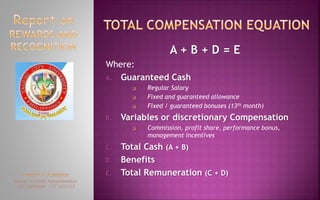
A + B + D = E
Where:
A. Guaranteed Cash
 Regular Salary
 Fixed and guaranteed allowance
 Fixed / guaranteed bonuses (13th month)
B. Variables or discretionary Compensation
 Commission, profit share, performance bonus,
management incentives
C. Total Cash (A + B)
D. Benefits
E. Total Remuneration (C + D)
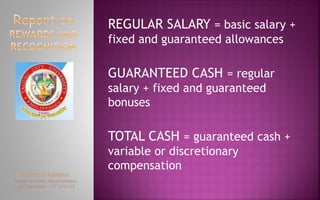
REGULAR SALARY = basic salary +
fixed and guaranteed allowances
GUARANTEED CASH = regular
salary + fixed and guaranteed
bonuses
TOTAL CASH = guaranteed cash +
variable or discretionary
compensation
Pay must be equitable in relation to
what other employees get for what
they do. Equity can be set based
either on qualifications required for
the job; the duties and
responsibilities of the job; the
supply and demand of workers so
that where it is scarce, the rate
may naturally be higher. An
employee pay must be
commensurate to his efforts.
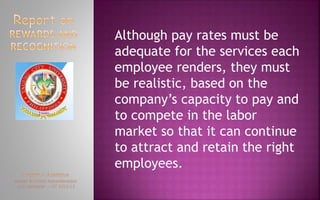
Although pay rates must be
adequate for the services each
employee renders, they must
be realistic, based on the
company’s capacity to pay and
to compete in the labor
market so that it can continue
to attract and retain the right
employees.
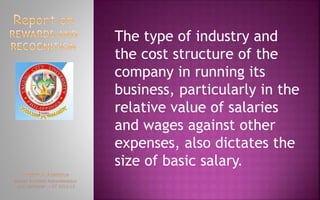
The type of industry and
the cost structure of the
company in running its
business, particularly in the
relative value of salaries
and wages against other
expenses, also dictates the
size of basic salary.
The purchasing power of
the money that the
employee receives from his
employer determines the
amount of essential needs
for a descent living that
the employee can provide
for himself and his family.
Any regulation on
wages such as minimum
wage or a wage order
adjustment should
dictate a minimum
level of basic salary.
 MERIT INCREASE
Merit pay funding (merit
budgets) is the result of the
consideration of several factors:
external salary surveys, economic
considerations, market movement,
internal/external pay equity, and
business performance.
 PROMOTION INCREASE
Based on the positioning of
current job skills on the new job.
The skills and knowledge an
associate has will also help
determine where to position pay.
Two categories may be used:
1. New
2. Qualified
NEW - is someone who is new to the
band and refers to the minimum time
normally expected for someone to learn
the job and develop the skills
QUALIFIED - is the normal time
expected for an associate to demonstrate
the requisite skills
 SALARY STRUCTURE INCREASE
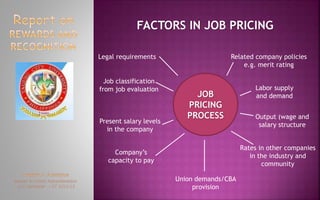
FACTORS IN JOB PRICING
JOB
PRICING
PROCESS
Legal requirements
Output (wage and
salary structure
Labor supply
and demand
Related company policies
e.g. merit rating
Job classification
from job evaluation
Present salary levels
in the company
Company’s
capacity to pay
Union demands/CBA
provision
Rates in other companies
in the industry and
community
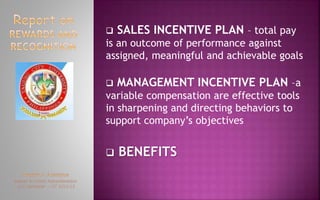
 SALES INCENTIVE PLAN – total pay
is an outcome of performance against
assigned, meaningful and achievable goals
 MANAGEMENT INCENTIVE PLAN –a
variable compensation are effective tools
in sharpening and directing behaviors to
support company’s objectives
 BENEFITS
BENEFITS
• Social Security
created with RA 1161
• Health Insurance / Health Plan
a. Who are covered by the health plan
b. Outpatient and annual physical examination
c. Maternity benefits
d. In-patient benefits
e. Dental benefits
f. Outpatient medical reimbursement
g. Eyeglasses benefits and reimbursement
procedure
h. Wellness programs
• Life Insurance
a. Coverage
b. Premium
c. Beneficiary
• Retirement
a. RA 7641 – Retirement Law
b. The key provision of which is a mandatory
retirement pay of 22.5 days of monthly basic
salary for every year of service at age 60.
• Car and car-related benefits
• OTHER BENEFITS
Overtime Meal
Transportation Allowance
Provincial Allowance
Standby Allowance
Companies use recognition
programs and contest to
focus effort on tactical
objectives and celebrate the
success of teams and
individuals.
Maria Luisa Salonga-Agamata, Ph.D., CESO V
Director IV
Public Assistance and Information Office
Why should you consider
joining government service|?
“Malaking suweldo at maalwang buhay man ang kapalit ng mangibang-bansa, mas gusto ko dito
sa Pilipinas at makatulong sa mga kababayan natin. Ako po ay naniniwala na mga Pilipino lang
ang tunay na makapagpapaunlad sa ating bansa.”-- Pablo Y. Lasprilla, Jr., Aircraft Mechanic II,
Philippine Air Force, 2010 Presidential or Lingkod Bayan
 Uphold and defend the Constitution;
 Lead the nation, promulgate and enforce laws;
 Uplift the poor, educate the ignorant, protect
the weak, and give honest, efficient and
excellent service to the million who rely on
government every day; and
 To make Philippine public service the best we
can give our people.
“Public service is a special calling. It is not for
everyone and those who respond to the call pay
a price. The price is submitting to very high
standards of professional conduct; accepting
public scrutiny and accountability; learning to
hold a public trust and to put public interests
ahead of self; respecting the authority of law
and of democratic will; and entering into a
community that values these as the
foundations of good government. The values
of public service are both its pride and its
reward.”
- “A Strong Foundation” by the
Task Force on Public Service Values and Ethics in Canada
As a public servant, I have endeavored to be hardworking and selfless, even using my
weekends, at times without pay, to help those in need of my expertise. Others have died
for our country; I want to live for my country!”-- Victorio C. Palabay, Associate Professor III,
College of Technology, Don Mariano Marcos Memorial State University, 2009 CSC or Pagasa
Security of tenure/fixed term
Standardized Salary/Benefits
Promotion Structure/Career Pathing
Training and continued education
Recognition
 The terms and conditions of employment of all government
employees shall be fixed by law;
 Those employment terms that are not fixed by law may be
subject of negotiation between recognized employees’
association and appropriate gov’t authorities.
Terms and Conditions of Employment
 The Congress shall provide for the standardization of
compensation of government officials and employees
taking into account the nature of responsibilities, and
qualifications required for the position concerned.
Compensation
Kung may magagawa ka sa sarili mong pamamaraan, gawin mo na. Kapag pumasok ka sa
public service, dapat kalimutan mo ang sarili mo. Sa halip, isipin mo ang kapakanan ng
nakararami.”-- Senior Fire Officer I Estanislao N. Temblor, Naguilian Fire Station,Bureau of
Fire Protection, 2009 Dangal ng Bayan awardee
 QS expresses minimum requirements
for a class of position in terms of:
1. education
2. training and experience
3. civil service eligibility
4. physical fitness
5. other qualities required for a successful
performance
Qualification Standards
 The passing grade in CS examinations, except for
examinations covered by special laws, shall be at least
eighty (80) percent;
 Every examinee who obtains a general rating of 80% or
over shall be eligible for appointment;
 The names of those who pass the bar or board
examinations shall be automatically entered in the
register of eligibles under Republic Act No. 1080;
 Eligibility is automatically granted to honor graduates,
subject to the provisions of Presidential Decree No. 907,
as amended.
 For Career Service Professional – In English and Filipino;
vocabulary, grammar and correct usage, paragraph
organization, reading comprehension, analogy, logic, and
numerical reasoning
 For Career Service Subprofessional – In English and
Filipino; vocabulary, grammar and correct usage,
paragraph organization, reading comprehension, spelling,
clerical operations, and numerical reasoning
One of the CSC’s priority goals is for all state
workers to meet their job competency standards.
The CSC has launched a competency-based project
which is sponsored by the Philippine-Australia
Human Resource and Organizational Development
Facility or PAHRODF.
This project aims to come up with the required
competencies of various positions in the public
sector. Initially, we have identified core
competencies that all CSC officials and employees
should have.
Competency-based HR System in the Philippine civil Service
 Career service is characterized by:
1. entrance based on merit and fitness to be
determined by practicable competitive
examination or based on highly technical
qualifications;
2. opportunity for advancement to higher career
positions;
3. security of tenure
Positions in the Civil Service are classified
into career and non-career
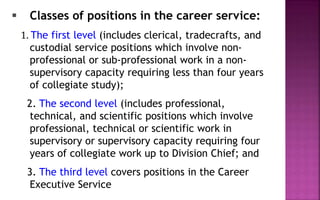
 Classes of positions in the career service:
1. The first level (includes clerical, tradecrafts, and
custodial service positions which involve non-
professional or sub-professional work in a non-
supervisory capacity requiring less than four years
of collegiate study);
2. The second level (includes professional,
technical, and scientific positions which involve
professional, technical or scientific work in
supervisory or supervisory capacity requiring four
years of collegiate work up to Division Chief; and
3. The third level covers positions in the Career
Executive Service
 Non-career service includes:
1. Elective officials and their personal or confidential staff;
2. Secretaries and other officials of Cabinet rank who hold
their positions at the pleasure of the President and their
personal or confidential staff;
3. Chairman and members of commissions and boards with
fixed terms of office and their personal or confidential
staff;
4. Contractual personnel or those whose employment is in
accordance with a special contract to undertake a
specific work or job, to be accomplished within a specific
period and shall not exceed one year; and
5. Emergency and seasonal personnel.
“Being a medical officer and a public servant is not an 8 to 5 profession, but a social obligation
that goes beyond the call of duty.”-- Celia Flor C. Brillantes, Medical Officer V, City Government of
Baguio, 2008 Presidential or Lingkod Bayan awardee
Nationwide Search for
Outstanding Public Officials and Employees
The Civil Service Commission (CSC)
administers the annual Honor Awards
Program (HAP) in accordance with
its constitutional mandate to adopt
measures to promote morale,
efficiency, integrity,
responsiveness and courtesy in the
civil service, as well as to strengthen
the merit and awards systems.
The HONOR AWARDS PROGRAM
The program seeks to recognize and
reward state officials and employees
for their outstanding contributions
and achievements in the delivery of
public service.
The HONOR AWARDS PROGRAM
AWARD CATEGORIES:
 Presidential or Lingkod Bayan award
 Outstanding Public Officials and Employees
or Dangal ng Bayan award
 Civil Service Commission Pagasa Award
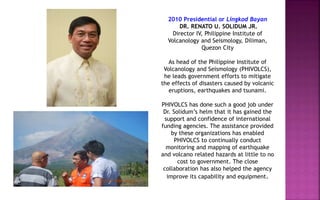
2010 Presidential or Lingkod Bayan
DR. RENATO U. SOLIDUM JR.
Director IV, Philippine Institute of
Volcanology and Seismology, Diliman,
Quezon City
As head of the Philippine Institute of
Volcanology and Seismology (PHIVOLCS),
he leads government efforts to mitigate
the effects of disasters caused by volcanic
eruptions, earthquakes and tsunami.
PHIVOLCS has done such a good job under
Dr. Solidum’s helm that it has gained the
support and confidence of international
funding agencies. The assistance provided
by these organizations has enabled
PHIVOLCS to continually conduct
monitoring and mapping of earthquake
and volcano related hazards at little to no
cost to government. The close
collaboration has also helped the agency
improve its capability and equipment.
2008 Dangal ng Bayan
WENIFREDA V. SOTO, Midwife III,
Municipal Government of Nabua,
Camarines Sur
On countless occasions, she had to
brave strong typhoons and wade
through floodwaters in the middle of
the night when summoned to deliver
babies.
2007 CSC Pagasa awardee
LEOPOLDO B. BATAOIL, Regional
Director, Philippine National Police
Regional Office 1
Improving the image of the Philippine
National Police as guardians of peace
and justice is a serious goal and always a
work in progress, and this is what
former Police Chief Supt. Leopoldo
Bataoil, now representative of the 2nd
District of Pangasinan had in mind when
he implemented socio-economic
programs geared towards building
meaningful public relations and
partnerships in the areas of Caloocan,
Malabon, Navotas and Valenzuela
(CAMANAVA). His initiatives were
ultimately rewarded with the noted
decrease in the crime rate, illegal drug
dealings, and incidences of robbery,
kidnapping, carnapping and snatching.
He also spearheaded educational
projects such as the Pulis ko, Teacher ko
and Edukasyon mo, Sagot ko.
2. Outstanding Public Officials and Employees or
Dangal ng Bayan
• Conferred to an individual for performance of
extraordinary act or public service and consistent
demonstration of exemplary ethical behavior on the basis
of the employee’s observation of the eight norms of
conduct provided under Republic Act No. 6713 or the Code
of Conduct and Ethical Standards for Public Officials and
Employees.
• Awardees receive a trophy designed and executed by
National Artist for Sculpture Napoleon V. Abueva, and a cash
prize of P200,000.00.
3. Civil Service Commission or Pagasa Award
• Conferred to an individual or group of individuals for
outstanding contribution resulting from an idea or
performance which directly benefit more than one
department of the government.
• Awardees receive a gold-gilded medallion expertly
crafted by the Bangko Sentral ng Pilipinas, a plaque
containing the citation and signature of the Chairperson of
the Civil Service Commission, and a cash prize of
P100,000.00.
HOPE I WAS ABLE TO SHARE
BENEFICIAL TO ALL OF YOU.
M. ALLANIGUE

Reward and Recognition

  • 1.
  • 2.
    A thing givenin recognition of service, effort, or achievement. (Wikipedia)
  • 3.
    Company must formulatea sound compensation policy on which basis the elements, design, relative important, cost, nature, and frequency of administration of its cash, near-cash compensation, and benefits would be strategically positioned, developed and reviewed.
  • 4.
     PAY FORPERFORMANCE “We reward outstanding performance with outstanding pay” Companies adapt it for pragmatic reasons – it is flexible and can be changed to respond to new goals and priorities.
  • 5.
    Companies show appreciation foran employee’s loyalty and commitment and long service, or when a company increases pay levels or introduces a pay item during hard economic times to help employees cope with the cost of living.
  • 6.
     MARKET COMPETITIVENESS Thiscan be seen through the manner by which a company approaches its market. Market rates will be expressed in terms of total compensation – the value of benefits, base salaries or wages, and incentive awards.
  • 7.
    When a “payfor performance” is blended with a “market” philosophy, it means that the compensation programs are designed to value and rewards employee’s performance, as well as the acquisition and development of skills and competencies, while maintaining competitiveness with the external labor market.
  • 8.
    Most companies willneed an external reference or benchmark against which to position salaries. It may be geographical community such as industrial zone or city or region in the country. It can also be a specific industry like textile, high technology, or an agricultural plantation.
  • 9.
    A + B+ D = E Where: A. Guaranteed Cash  Regular Salary  Fixed and guaranteed allowance  Fixed / guaranteed bonuses (13th month) B. Variables or discretionary Compensation  Commission, profit share, performance bonus, management incentives C. Total Cash (A + B) D. Benefits E. Total Remuneration (C + D)
  • 10.
    REGULAR SALARY =basic salary + fixed and guaranteed allowances GUARANTEED CASH = regular salary + fixed and guaranteed bonuses TOTAL CASH = guaranteed cash + variable or discretionary compensation
  • 11.
    Pay must beequitable in relation to what other employees get for what they do. Equity can be set based either on qualifications required for the job; the duties and responsibilities of the job; the supply and demand of workers so that where it is scarce, the rate may naturally be higher. An employee pay must be commensurate to his efforts.
  • 12.
    Although pay ratesmust be adequate for the services each employee renders, they must be realistic, based on the company’s capacity to pay and to compete in the labor market so that it can continue to attract and retain the right employees.
  • 13.
    The type ofindustry and the cost structure of the company in running its business, particularly in the relative value of salaries and wages against other expenses, also dictates the size of basic salary.
  • 14.
    The purchasing powerof the money that the employee receives from his employer determines the amount of essential needs for a descent living that the employee can provide for himself and his family.
  • 15.
    Any regulation on wagessuch as minimum wage or a wage order adjustment should dictate a minimum level of basic salary.
  • 16.
     MERIT INCREASE Meritpay funding (merit budgets) is the result of the consideration of several factors: external salary surveys, economic considerations, market movement, internal/external pay equity, and business performance.
  • 17.
     PROMOTION INCREASE Basedon the positioning of current job skills on the new job. The skills and knowledge an associate has will also help determine where to position pay. Two categories may be used: 1. New 2. Qualified
  • 18.
    NEW - issomeone who is new to the band and refers to the minimum time normally expected for someone to learn the job and develop the skills QUALIFIED - is the normal time expected for an associate to demonstrate the requisite skills  SALARY STRUCTURE INCREASE
  • 19.
    FACTORS IN JOBPRICING JOB PRICING PROCESS Legal requirements Output (wage and salary structure Labor supply and demand Related company policies e.g. merit rating Job classification from job evaluation Present salary levels in the company Company’s capacity to pay Union demands/CBA provision Rates in other companies in the industry and community
  • 20.
     SALES INCENTIVEPLAN – total pay is an outcome of performance against assigned, meaningful and achievable goals  MANAGEMENT INCENTIVE PLAN –a variable compensation are effective tools in sharpening and directing behaviors to support company’s objectives  BENEFITS
  • 21.
    BENEFITS • Social Security createdwith RA 1161 • Health Insurance / Health Plan a. Who are covered by the health plan b. Outpatient and annual physical examination c. Maternity benefits d. In-patient benefits e. Dental benefits f. Outpatient medical reimbursement g. Eyeglasses benefits and reimbursement procedure h. Wellness programs
  • 22.
    • Life Insurance a.Coverage b. Premium c. Beneficiary • Retirement a. RA 7641 – Retirement Law b. The key provision of which is a mandatory retirement pay of 22.5 days of monthly basic salary for every year of service at age 60. • Car and car-related benefits
  • 23.
    • OTHER BENEFITS OvertimeMeal Transportation Allowance Provincial Allowance Standby Allowance
  • 24.
    Companies use recognition programsand contest to focus effort on tactical objectives and celebrate the success of teams and individuals.
  • 25.
    Maria Luisa Salonga-Agamata,Ph.D., CESO V Director IV Public Assistance and Information Office
  • 26.
    Why should youconsider joining government service|? “Malaking suweldo at maalwang buhay man ang kapalit ng mangibang-bansa, mas gusto ko dito sa Pilipinas at makatulong sa mga kababayan natin. Ako po ay naniniwala na mga Pilipino lang ang tunay na makapagpapaunlad sa ating bansa.”-- Pablo Y. Lasprilla, Jr., Aircraft Mechanic II, Philippine Air Force, 2010 Presidential or Lingkod Bayan
  • 27.
     Uphold anddefend the Constitution;  Lead the nation, promulgate and enforce laws;  Uplift the poor, educate the ignorant, protect the weak, and give honest, efficient and excellent service to the million who rely on government every day; and  To make Philippine public service the best we can give our people.
  • 28.
    “Public service isa special calling. It is not for everyone and those who respond to the call pay a price. The price is submitting to very high standards of professional conduct; accepting public scrutiny and accountability; learning to hold a public trust and to put public interests ahead of self; respecting the authority of law and of democratic will; and entering into a community that values these as the foundations of good government. The values of public service are both its pride and its reward.” - “A Strong Foundation” by the Task Force on Public Service Values and Ethics in Canada
  • 29.
    As a publicservant, I have endeavored to be hardworking and selfless, even using my weekends, at times without pay, to help those in need of my expertise. Others have died for our country; I want to live for my country!”-- Victorio C. Palabay, Associate Professor III, College of Technology, Don Mariano Marcos Memorial State University, 2009 CSC or Pagasa
  • 30.
    Security of tenure/fixedterm Standardized Salary/Benefits Promotion Structure/Career Pathing Training and continued education Recognition
  • 31.
     The termsand conditions of employment of all government employees shall be fixed by law;  Those employment terms that are not fixed by law may be subject of negotiation between recognized employees’ association and appropriate gov’t authorities. Terms and Conditions of Employment  The Congress shall provide for the standardization of compensation of government officials and employees taking into account the nature of responsibilities, and qualifications required for the position concerned. Compensation
  • 32.
    Kung may magagawaka sa sarili mong pamamaraan, gawin mo na. Kapag pumasok ka sa public service, dapat kalimutan mo ang sarili mo. Sa halip, isipin mo ang kapakanan ng nakararami.”-- Senior Fire Officer I Estanislao N. Temblor, Naguilian Fire Station,Bureau of Fire Protection, 2009 Dangal ng Bayan awardee
  • 33.
     QS expressesminimum requirements for a class of position in terms of: 1. education 2. training and experience 3. civil service eligibility 4. physical fitness 5. other qualities required for a successful performance Qualification Standards
  • 34.
     The passinggrade in CS examinations, except for examinations covered by special laws, shall be at least eighty (80) percent;  Every examinee who obtains a general rating of 80% or over shall be eligible for appointment;  The names of those who pass the bar or board examinations shall be automatically entered in the register of eligibles under Republic Act No. 1080;  Eligibility is automatically granted to honor graduates, subject to the provisions of Presidential Decree No. 907, as amended.
  • 35.
     For CareerService Professional – In English and Filipino; vocabulary, grammar and correct usage, paragraph organization, reading comprehension, analogy, logic, and numerical reasoning  For Career Service Subprofessional – In English and Filipino; vocabulary, grammar and correct usage, paragraph organization, reading comprehension, spelling, clerical operations, and numerical reasoning
  • 36.
    One of theCSC’s priority goals is for all state workers to meet their job competency standards. The CSC has launched a competency-based project which is sponsored by the Philippine-Australia Human Resource and Organizational Development Facility or PAHRODF. This project aims to come up with the required competencies of various positions in the public sector. Initially, we have identified core competencies that all CSC officials and employees should have. Competency-based HR System in the Philippine civil Service
  • 37.
     Career serviceis characterized by: 1. entrance based on merit and fitness to be determined by practicable competitive examination or based on highly technical qualifications; 2. opportunity for advancement to higher career positions; 3. security of tenure Positions in the Civil Service are classified into career and non-career
  • 38.
     Classes ofpositions in the career service: 1. The first level (includes clerical, tradecrafts, and custodial service positions which involve non- professional or sub-professional work in a non- supervisory capacity requiring less than four years of collegiate study); 2. The second level (includes professional, technical, and scientific positions which involve professional, technical or scientific work in supervisory or supervisory capacity requiring four years of collegiate work up to Division Chief; and 3. The third level covers positions in the Career Executive Service
  • 39.
     Non-career serviceincludes: 1. Elective officials and their personal or confidential staff; 2. Secretaries and other officials of Cabinet rank who hold their positions at the pleasure of the President and their personal or confidential staff; 3. Chairman and members of commissions and boards with fixed terms of office and their personal or confidential staff; 4. Contractual personnel or those whose employment is in accordance with a special contract to undertake a specific work or job, to be accomplished within a specific period and shall not exceed one year; and 5. Emergency and seasonal personnel.
  • 40.
    “Being a medicalofficer and a public servant is not an 8 to 5 profession, but a social obligation that goes beyond the call of duty.”-- Celia Flor C. Brillantes, Medical Officer V, City Government of Baguio, 2008 Presidential or Lingkod Bayan awardee
  • 41.
    Nationwide Search for OutstandingPublic Officials and Employees
  • 42.
    The Civil ServiceCommission (CSC) administers the annual Honor Awards Program (HAP) in accordance with its constitutional mandate to adopt measures to promote morale, efficiency, integrity, responsiveness and courtesy in the civil service, as well as to strengthen the merit and awards systems. The HONOR AWARDS PROGRAM
  • 43.
    The program seeksto recognize and reward state officials and employees for their outstanding contributions and achievements in the delivery of public service. The HONOR AWARDS PROGRAM
  • 44.
    AWARD CATEGORIES:  Presidentialor Lingkod Bayan award  Outstanding Public Officials and Employees or Dangal ng Bayan award  Civil Service Commission Pagasa Award
  • 45.
    2010 Presidential orLingkod Bayan DR. RENATO U. SOLIDUM JR. Director IV, Philippine Institute of Volcanology and Seismology, Diliman, Quezon City As head of the Philippine Institute of Volcanology and Seismology (PHIVOLCS), he leads government efforts to mitigate the effects of disasters caused by volcanic eruptions, earthquakes and tsunami. PHIVOLCS has done such a good job under Dr. Solidum’s helm that it has gained the support and confidence of international funding agencies. The assistance provided by these organizations has enabled PHIVOLCS to continually conduct monitoring and mapping of earthquake and volcano related hazards at little to no cost to government. The close collaboration has also helped the agency improve its capability and equipment.
  • 46.
    2008 Dangal ngBayan WENIFREDA V. SOTO, Midwife III, Municipal Government of Nabua, Camarines Sur On countless occasions, she had to brave strong typhoons and wade through floodwaters in the middle of the night when summoned to deliver babies.
  • 47.
    2007 CSC Pagasaawardee LEOPOLDO B. BATAOIL, Regional Director, Philippine National Police Regional Office 1 Improving the image of the Philippine National Police as guardians of peace and justice is a serious goal and always a work in progress, and this is what former Police Chief Supt. Leopoldo Bataoil, now representative of the 2nd District of Pangasinan had in mind when he implemented socio-economic programs geared towards building meaningful public relations and partnerships in the areas of Caloocan, Malabon, Navotas and Valenzuela (CAMANAVA). His initiatives were ultimately rewarded with the noted decrease in the crime rate, illegal drug dealings, and incidences of robbery, kidnapping, carnapping and snatching. He also spearheaded educational projects such as the Pulis ko, Teacher ko and Edukasyon mo, Sagot ko.
  • 48.
    2. Outstanding PublicOfficials and Employees or Dangal ng Bayan • Conferred to an individual for performance of extraordinary act or public service and consistent demonstration of exemplary ethical behavior on the basis of the employee’s observation of the eight norms of conduct provided under Republic Act No. 6713 or the Code of Conduct and Ethical Standards for Public Officials and Employees. • Awardees receive a trophy designed and executed by National Artist for Sculpture Napoleon V. Abueva, and a cash prize of P200,000.00.
  • 49.
    3. Civil ServiceCommission or Pagasa Award • Conferred to an individual or group of individuals for outstanding contribution resulting from an idea or performance which directly benefit more than one department of the government. • Awardees receive a gold-gilded medallion expertly crafted by the Bangko Sentral ng Pilipinas, a plaque containing the citation and signature of the Chairperson of the Civil Service Commission, and a cash prize of P100,000.00.
  • 51.
    HOPE I WASABLE TO SHARE BENEFICIAL TO ALL OF YOU. M. ALLANIGUE

Editor's Notes

  • #26 In accordance with its constitutional mandate to adopt measures to promote morale, efficiency, integrity, responsiveness and courtesy in the civil service, as well as to strengthen the merit and awards systems, the Civil Service Commission (CSC) administers an annual, nationwide Honor Awards Program (HAP). The program seeks to recognize and reward state officials and employees for their outstanding contributions and achievements in the delivery of public service.