AIR Augmented
ROCKET
Presented by :
Arbind kapar
reg no:
1634
Guided by :
Vikram Kapoor
What is air
augmented
rockets
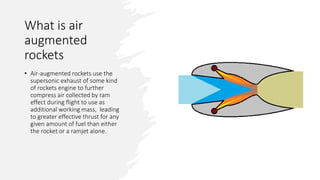
• Air-augmented rockets use the
supersonic exhaust of some kind
of rockets engine to further
compress air collected by ram
effect during flight to use as
additional working mass, leading
to greater effective thrust for any
given amount of fuel than either
the rocket or a ramjet alone.
History of air
augmented
rocket
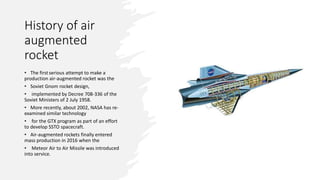
• The firstserious attempt to make a
production air-augmented rocket was the
• Soviet Gnom rocket design,
• implemented by Decree 708-336 of the
Soviet Ministers of 2 July 1958.
• More recently, about 2002, NASA has re-
examined similar technology
• for the GTX program as part of an effort
to develop SSTO spacecraft.
• Air-augmented rockets finally entered
mass production in 2016 when the
• Meteor Air to Air Missile was introduced
into service.
WORKING PRINCIPLE
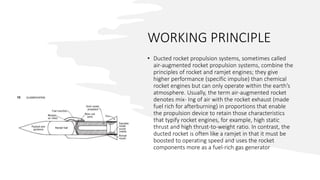
• Ducted rocket propulsion systems, sometimes called
air-augmented rocket propulsion systems, combine the
principles of rocket and ramjet engines; they give
higher performance (specific impulse) than chemical
rocket engines but can only operate within the earth’s
atmosphere. Usually, the term air-augmented rocket
denotes mix- Ing of air with the rocket exhaust (made
fuel rich for afterburning) in proportions that enable
the propulsion device to retain those characteristics
that typify rocket engines, for example, high static
thrust and high thrust-to-weight ratio. In contrast, the
ducted rocket is often like a ramjet in that it must be
boosted to operating speed and uses the rocket
components more as a fuel-rich gas generator
WORKING
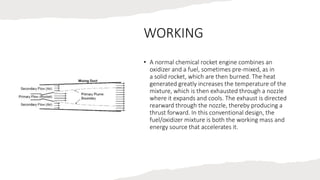
• A normal chemical rocket engine combines an
oxidizer and a fuel, sometimes pre-mixed, as in
a solid rocket, which are then burned. The heat
generated greatly increases the temperature of the
mixture, which is then exhausted through a nozzle
where it expands and cools. The exhaust is directed
rearward through the nozzle, thereby producing a
thrust forward. In this conventional design, the
fuel/oxidizer mixture is both the working mass and
energy source that accelerates it.
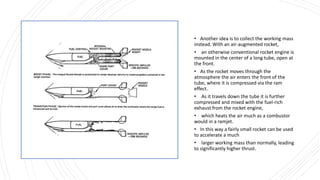
• Another idea is to collect the working mass
instead. With an air-augmented rocket,
• an otherwise conventional rocket engine is
mounted in the center of a long tube, open at
the front.
• As the rocket moves through the
atmosphere the air enters the front of the
tube, where it is compressed via the ram
effect.
• As it travels down the tube it is further
compressed and mixed with the fuel-rich
exhaust from the rocket engine,
• which heats the air much as a combustor
would in a ramjet.
• In this way a fairly small rocket can be used
to accelerate a much
• larger working mass than normally, leading
to significantly higher thrust.
Types of air
augmented
rocket
Shrouded rocket
Ducted rocket
Ejector ramjet
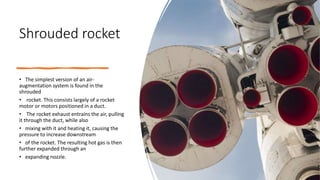
Shrouded rocket
• The simplest version of an air-
augmentation system is found in the
shrouded
• rocket. This consists largely of a rocket
motor or motors positioned in a duct.
• The rocket exhaust entrains the air, pulling
it through the duct, while also
• mixing with it and heating it, causing the
pressure to increase downstream
• of the rocket. The resulting hot gas is then
further expanded through an
• expanding nozzle.
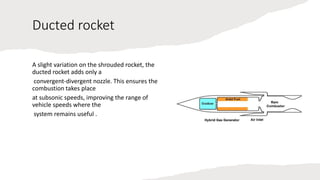
Ducted rocket
A slight variation on the shrouded rocket, the
ducted rocket adds only a
convergent-divergent nozzle. This ensures the
combustion takes place
at subsonic speeds, improving the range of
vehicle speeds where the
system remains useful .
Ejector ramjet
The ejector ramjet is a more complex system with
potentially higher performance. Like the
shrouded and ducted rocket, the system begins
with a rocket engine(s) in an air intake. It
differs in that the mixed exhaust enters a diffuser,
slowing the speed of the airflow to
subsonic speeds. Additional fuel is then injected,
burning in this expanded section. The
exhaust of that combustion then enters a
convergent-divergent nozzle as in a
conventional ramjet, or the ducted rocket case.
ADVANTAGES
• The effectiveness of this simple method can be dramatic.
• Typical solid rockets have a specific impulse of about 260
seconds (2.5 KN·s/kg) but using the same fuel in an air-
augmented design can improve this to over 500 seconds
(4.9 kN·s/kg), a figure even the best hydrogen/oxygen
engines can't match.
• This design can even be slightly more efficient than
a ramjet, as the exhaust from the rocket engine helps
compress the air more than a ramjet normally would; this
raises the combustion efficiency as a longer, more efficient
nozzle can be employed.
• Another advantage is that the rocket works even at zero
forward speed, whereas a ramjet requires forward motion
to feed air into the engine.
DISADVANTAGES
• The intakes of high-speed engines are
difficult to design and require careful
positioning on the airframe in order to
achieve reasonable performance – in
general, the entire airframe needs to
be built around the intake design.
• The air thins out as the rocket climbs.
Hence, the amount of additional
thrust is limited by how fast the rocket
climbs.
References
Books
Rocket Propulsion Elements by :-
George P. Sutton, Oscar Biblarz
Fundamentals of Rocket
Propulsion by :- DP Mishra
Introduction to flight by :- John
D. Anderson
Gas Turbines by :- V. Ganesan
Applied Gas Dynamic by :-
Ethirajan Rathakrishnan
Reference link
• https://forum.kerbalspaceprogram.com/index.php?
/topic/130851-limits-of-air-augmentation-in-rocket-
engine-design/
• https://en.wikipedia.org/wiki/Air-
augmented_rocket
• https://www.youtube.com/results?search_query=ai
r+augmented+rocket
• https://www.youtube.com/watch?v=0lUcEuKz0Kc
• https://space.stackexchange.com/questions/35375/
what-is-the-difference-between-air-augmented-
rocket-propulsion-and-integral-r
• https://arc.aiaa.org/doi/abs/10.2514/3.23374?jour
nalCode=jpp
Thank you

Air augmented rocket.pptx

  • 1.
    AIR Augmented ROCKET Presented by: Arbind kapar reg no: 1634 Guided by : Vikram Kapoor
  • 2.
    What is air augmented rockets •Air-augmented rockets use the supersonic exhaust of some kind of rockets engine to further compress air collected by ram effect during flight to use as additional working mass, leading to greater effective thrust for any given amount of fuel than either the rocket or a ramjet alone.
  • 3.
    History of air augmented rocket •The firstserious attempt to make a production air-augmented rocket was the • Soviet Gnom rocket design, • implemented by Decree 708-336 of the Soviet Ministers of 2 July 1958. • More recently, about 2002, NASA has re- examined similar technology • for the GTX program as part of an effort to develop SSTO spacecraft. • Air-augmented rockets finally entered mass production in 2016 when the • Meteor Air to Air Missile was introduced into service.
  • 4.
    WORKING PRINCIPLE • Ductedrocket propulsion systems, sometimes called air-augmented rocket propulsion systems, combine the principles of rocket and ramjet engines; they give higher performance (specific impulse) than chemical rocket engines but can only operate within the earth’s atmosphere. Usually, the term air-augmented rocket denotes mix- Ing of air with the rocket exhaust (made fuel rich for afterburning) in proportions that enable the propulsion device to retain those characteristics that typify rocket engines, for example, high static thrust and high thrust-to-weight ratio. In contrast, the ducted rocket is often like a ramjet in that it must be boosted to operating speed and uses the rocket components more as a fuel-rich gas generator
  • 5.
    WORKING • A normalchemical rocket engine combines an oxidizer and a fuel, sometimes pre-mixed, as in a solid rocket, which are then burned. The heat generated greatly increases the temperature of the mixture, which is then exhausted through a nozzle where it expands and cools. The exhaust is directed rearward through the nozzle, thereby producing a thrust forward. In this conventional design, the fuel/oxidizer mixture is both the working mass and energy source that accelerates it.
  • 6.
    • Another ideais to collect the working mass instead. With an air-augmented rocket, • an otherwise conventional rocket engine is mounted in the center of a long tube, open at the front. • As the rocket moves through the atmosphere the air enters the front of the tube, where it is compressed via the ram effect. • As it travels down the tube it is further compressed and mixed with the fuel-rich exhaust from the rocket engine, • which heats the air much as a combustor would in a ramjet. • In this way a fairly small rocket can be used to accelerate a much • larger working mass than normally, leading to significantly higher thrust.
  • 7.
    Types of air augmented rocket Shroudedrocket Ducted rocket Ejector ramjet
  • 8.
    Shrouded rocket • Thesimplest version of an air- augmentation system is found in the shrouded • rocket. This consists largely of a rocket motor or motors positioned in a duct. • The rocket exhaust entrains the air, pulling it through the duct, while also • mixing with it and heating it, causing the pressure to increase downstream • of the rocket. The resulting hot gas is then further expanded through an • expanding nozzle.
  • 9.
    Ducted rocket A slightvariation on the shrouded rocket, the ducted rocket adds only a convergent-divergent nozzle. This ensures the combustion takes place at subsonic speeds, improving the range of vehicle speeds where the system remains useful .
  • 10.
    Ejector ramjet The ejectorramjet is a more complex system with potentially higher performance. Like the shrouded and ducted rocket, the system begins with a rocket engine(s) in an air intake. It differs in that the mixed exhaust enters a diffuser, slowing the speed of the airflow to subsonic speeds. Additional fuel is then injected, burning in this expanded section. The exhaust of that combustion then enters a convergent-divergent nozzle as in a conventional ramjet, or the ducted rocket case.
  • 11.
    ADVANTAGES • The effectivenessof this simple method can be dramatic. • Typical solid rockets have a specific impulse of about 260 seconds (2.5 KN·s/kg) but using the same fuel in an air- augmented design can improve this to over 500 seconds (4.9 kN·s/kg), a figure even the best hydrogen/oxygen engines can't match. • This design can even be slightly more efficient than a ramjet, as the exhaust from the rocket engine helps compress the air more than a ramjet normally would; this raises the combustion efficiency as a longer, more efficient nozzle can be employed. • Another advantage is that the rocket works even at zero forward speed, whereas a ramjet requires forward motion to feed air into the engine.
  • 12.
    DISADVANTAGES • The intakesof high-speed engines are difficult to design and require careful positioning on the airframe in order to achieve reasonable performance – in general, the entire airframe needs to be built around the intake design. • The air thins out as the rocket climbs. Hence, the amount of additional thrust is limited by how fast the rocket climbs.
  • 13.
    References Books Rocket Propulsion Elementsby :- George P. Sutton, Oscar Biblarz Fundamentals of Rocket Propulsion by :- DP Mishra Introduction to flight by :- John D. Anderson Gas Turbines by :- V. Ganesan Applied Gas Dynamic by :- Ethirajan Rathakrishnan
  • 14.
    Reference link • https://forum.kerbalspaceprogram.com/index.php? /topic/130851-limits-of-air-augmentation-in-rocket- engine-design/ •https://en.wikipedia.org/wiki/Air- augmented_rocket • https://www.youtube.com/results?search_query=ai r+augmented+rocket • https://www.youtube.com/watch?v=0lUcEuKz0Kc • https://space.stackexchange.com/questions/35375/ what-is-the-difference-between-air-augmented- rocket-propulsion-and-integral-r • https://arc.aiaa.org/doi/abs/10.2514/3.23374?jour nalCode=jpp
  • 15.