Research
protocol
Dr. Anil Bindu S
Professor of Community
Medicine
Sree Gokulam Medical
College
Trivandrum
LEARNING OBJECTIVES
What Why Parts
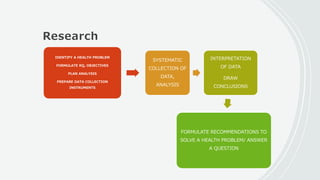
Research
IDENTIFY A HEALTH PROBLEM
FORMULATE RQ, OBJECTIVES
PLAN ANALYSIS
PREPARE DATA COLLECTION
INSTRUMENTS
SYSTEMATIC
COLLECTION OF
DATA,
ANALYSIS
INTERPRETATION
OF DATA
DRAW
CONCLUSIONS
FORMULATE RECOMMENDATIONS TO
SOLVE A HEALTH PROBLEM/ ANSWER
A QUESTION
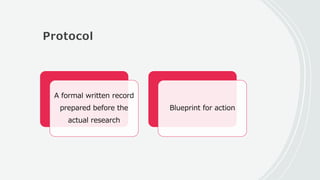
Protocol
A formal written record
prepared before the
actual research
Blueprint for action
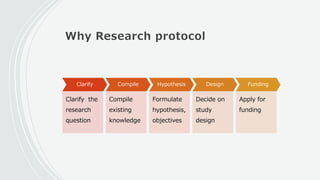
Why Research protocol
Clarify
Clarify the
research
question
Compile
Compile
existing
knowledge
Hypothesis
Formulate
hypothesis,
objectives
Design
Decide on
study
design
Funding
Apply for
funding
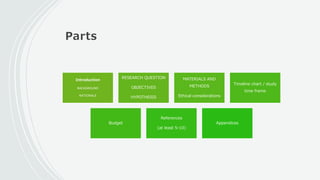
Parts
Introduction
BACKGROUND
RATIONALE
RESEARCH QUESTION
OBJECTIVES
HYPOTHESIS
MATERIALS AND
METHODS
Ethical considerations
Timeline chart / study
time frame
Budget
References
(at least 5-10)
Appendices
TITLE
CONCISE AND
DESCRIPTIVE
INFORMATIVE AND
CATCHY
MUST REFLECT THE
CENTRAL THEME
AVOID NON
INFORMATIVE WORDS
LIKE “A STUDY OF……
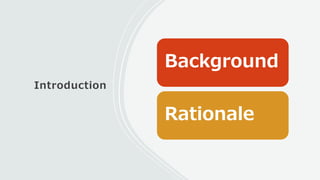
Introduction
Background
Rationale
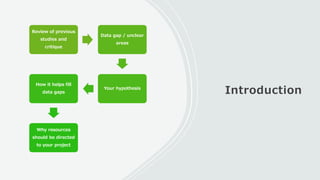
Introduction
Review of previous
studies and
critique
Data gap / unclear
areas
Your hypothesis
How it helps fill
data gaps
Why resources
should be directed
to your project
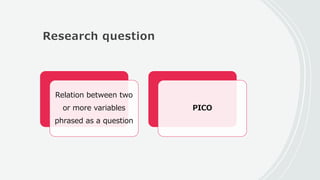
Research question
Relation between two
or more variables
phrased as a question
PICO
Research question
Eg. Does brisk walking for at least 45 minutes in diabetic
patients reduce the FBS as compared to those who do not?
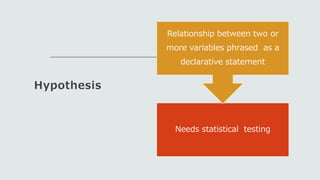
Hypothesis
Needs statistical testing
Relationship between two or
more variables phrased as a
declarative statement
Hypothesis
E.g. Std care plus a new drug will be superior to std care alone
in reducing CVD mortality in patients with Coronary Artery
Disease
Purely descriptive question: do not require hypothesis
Hypothesis
eg. The type 2 diabetic patients who do brisk walking for at least
45 minutes daily results in average reduction of 10mg% of FBS
compared to those who do not
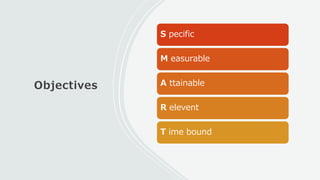
Objectives
S pecific
M easurable
A ttainable
R elevent
T ime bound
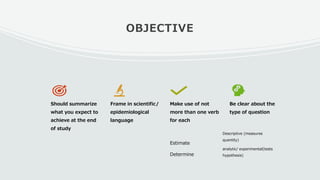
OBJECTIVE
Should summarize
what you expect to
achieve at the end
of study
Frame in scientific/
epidemiological
language
Make use of not
more than one verb
for each
Estimate
Determine
Be clear about the
type of question
Descriptive (measures
quantity)
analytic/ experimental(tests
hypothesis)
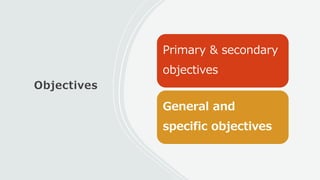
Objectives
Primary & secondary
objectives
General and
specific objectives
Why review
of literature
Work done by
others on it or
similar subject
To understand the
difficulties faced by other
investigator, corrective
steps and modifications
Assist in
identifying
various
variables in
research
protocol
Assess feasibility of
the study
REVIEW OF
LITERATURE
Relevant
information from
authentic, easily
retrievable
references
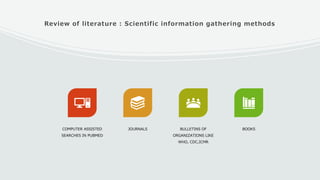
Review of literature : Scientific information gathering methods
COMPUTER ASSISTED
SEARCHES IN PUBMED
JOURNALS BULLETINS OF
ORGANIZATIONS LIKE
WHO, CDC,ICMR
BOOKS
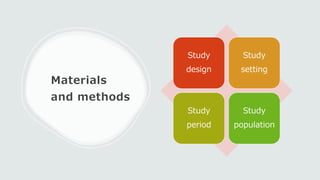
Materials
and methods
Study
design
Study
setting
Study
period
Study
population
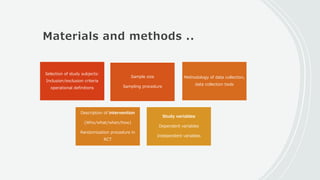
Materials and methods ..
Selection of study subjects:
Inclusion/exclusion criteria
operational definitions
Sample size
Sampling procedure
Methodology of data collection,
data collection tools
Description of intervention
(Who/what/when/how)
Randomization procedure in
RCT
Study variables
Dependent variables
Independent variables
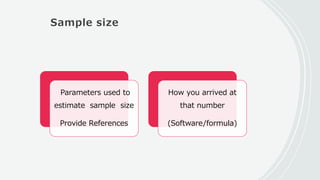
Sample size
Parameters used to
estimate sample size
Provide References
How you arrived at
that number
(Software/formula)
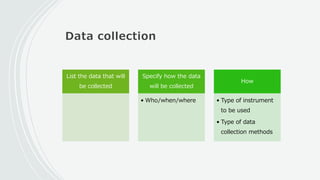
Data collection
List the data that will
be collected
Specify how the data
will be collected
• Who/when/where
How
• Type of instrument
to be used
• Type of data
collection methods
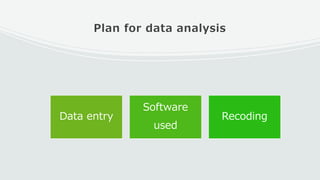
Plan for data analysis
Data entry
Software
used
Recoding
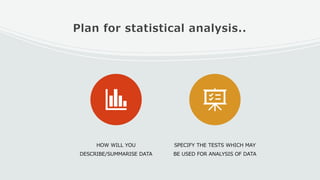
Plan for statistical analysis..
HOW WILL YOU
DESCRIBE/SUMMARISE DATA
SPECIFY THE TESTS WHICH MAY
BE USED FOR ANALYSIS OF DATA
Project implementation
plan
Steps that will be used to ensure data quality
at each stage
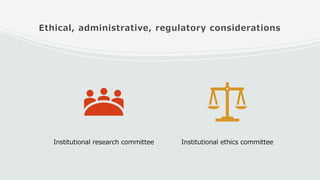
Ethical, administrative, regulatory considerations
Institutional research committee Institutional ethics committee
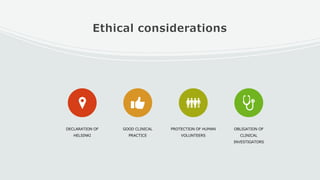
Ethical considerations
DECLARATION OF
HELSINKI
GOOD CLINICAL
PRACTICE
PROTECTION OF HUMAN
VOLUNTEERS
OBLIGATION OF
CLINICAL
INVESTIGATORS
Timeline chart Gantt chart
Timeline chart
References
All references should be cited Vancouver style
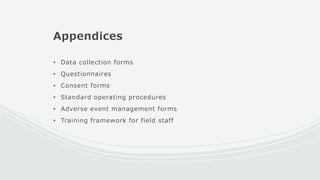
Appendices
• Data collection forms
• Questionnaires
• Consent forms
• Standard operating procedures
• Adverse event management forms
• Training framework for field staff
Research
protocol for
clinical
research
Systematically structured
Scientific framework for
clarifying the research question
Proper and appropriate solution
should be drawn by applying
appropriate protocol
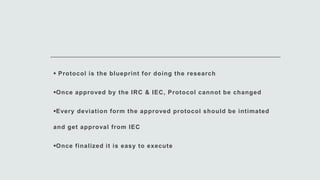
 Protocol is the blueprint for doing the research
Once approved by the IRC & IEC, Protocol cannot be changed
Every deviation form the approved protocol should be intimated
and get approval from IEC
Once finalized it is easy to execute
Thank you

Research protocol