Report Writing forPublic
Health Physicians
Daprim Ogaji
MBBS (UPH), MQI(Helsinki), MBA (South Wales), PhD (Manchester),
MNIM, FMCPH, FISQUa
Professor of Health Systems & Community Medicine.
Leader, Africa Centre of Excellent in Public Health & Toxicological
Research, UNIPORT, Rivers State
2.
Intended Learning Outcomes
•At the end of this discourse, the participant
would be able to:
– Understand some fundamentals in report writing
– Identify key components in different reports
– Learn to improve clarity, structure and
presentation of a report
– Understand how to create clear, professional &
impactful reports in various context
– Apply best practices in writing technical & research
reports
2
3.
The Accountability Era
3
Whatgets measured gets done
If you don’t measure results, you can’t tell success from failure
If you can’t see success, you can’t reward it
If you can’t reward success, you’re probably rewarding failure
If you can’t see success, you can’t learn from it
If you can’t recognize failure, you can’t correct it.
If you can demonstrate results, you can win public support.
Re-inventing government, Osborne and Gaebler, 1992
4.
Importance of ReportWriting
4
Ensures accountability & transparency
Effective communication to internal & external stakeholders
Documentation of progress and results
Informs decision-making for policy & further interventions
Promote collaboration
Problem solving
Facilitate public engagement & knowledge translation
Professional development
Critical thinking, problem solving,
communication skills
5.
Types of Reportsin Public Health
• Academic Research Reports –
Thesis/Dissertation
• Scientific Reports – Research manuscript,
clinical, field trials
• Surveillance & Epidemiologicl Reports
• Case Investigation reports
• Training Report
• Project Report
• Programme Evaluation Reports
5
Academic
Business
Scientific
6.
Types of Reportsin Public Health
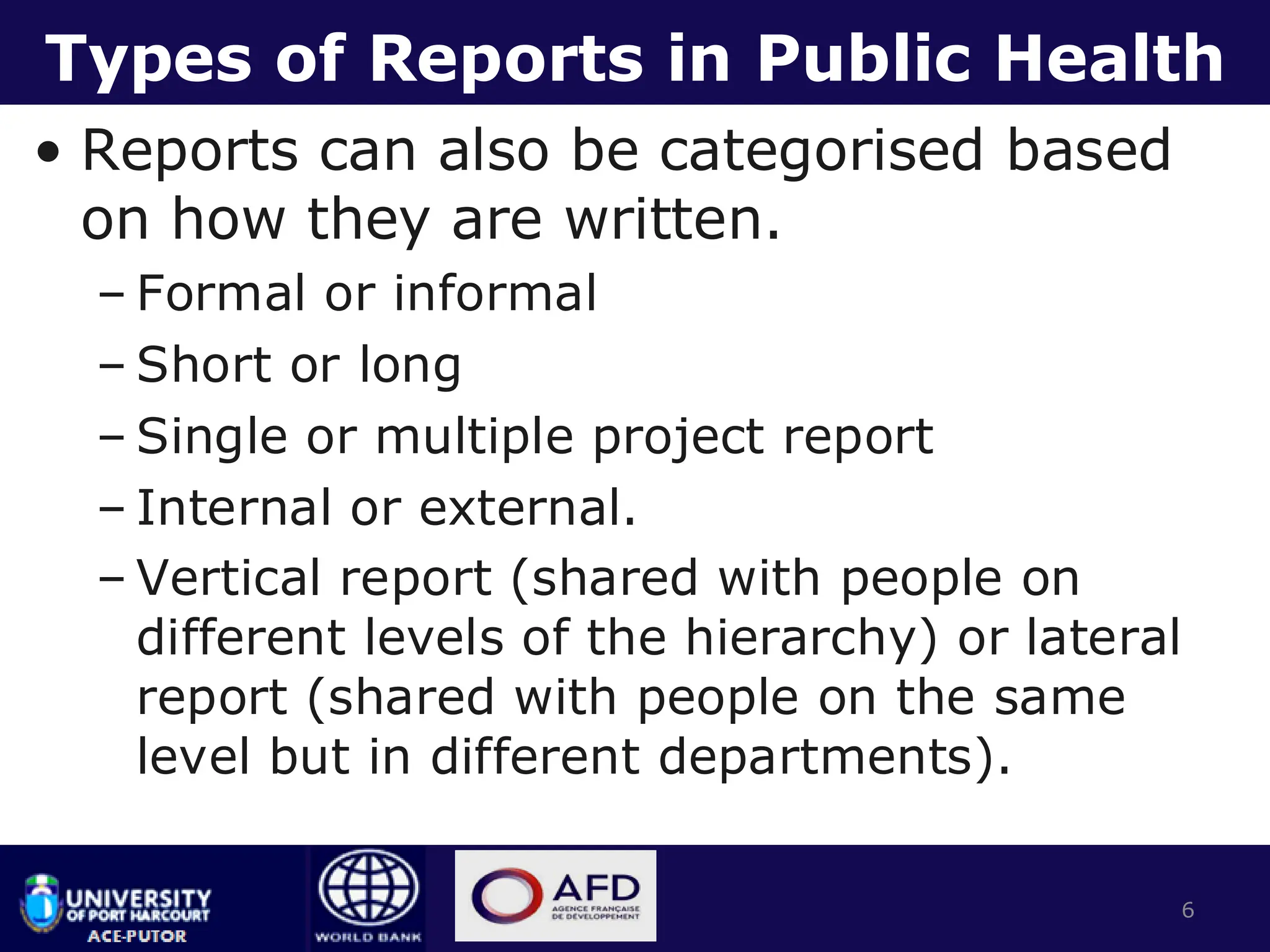
• Reports can also be categorised based
on how they are written.
– Formal or informal
– Short or long
– Single or multiple project report
– Internal or external.
– Vertical report (shared with people on
different levels of the hierarchy) or lateral
report (shared with people on the same
level but in different departments).
6
7.
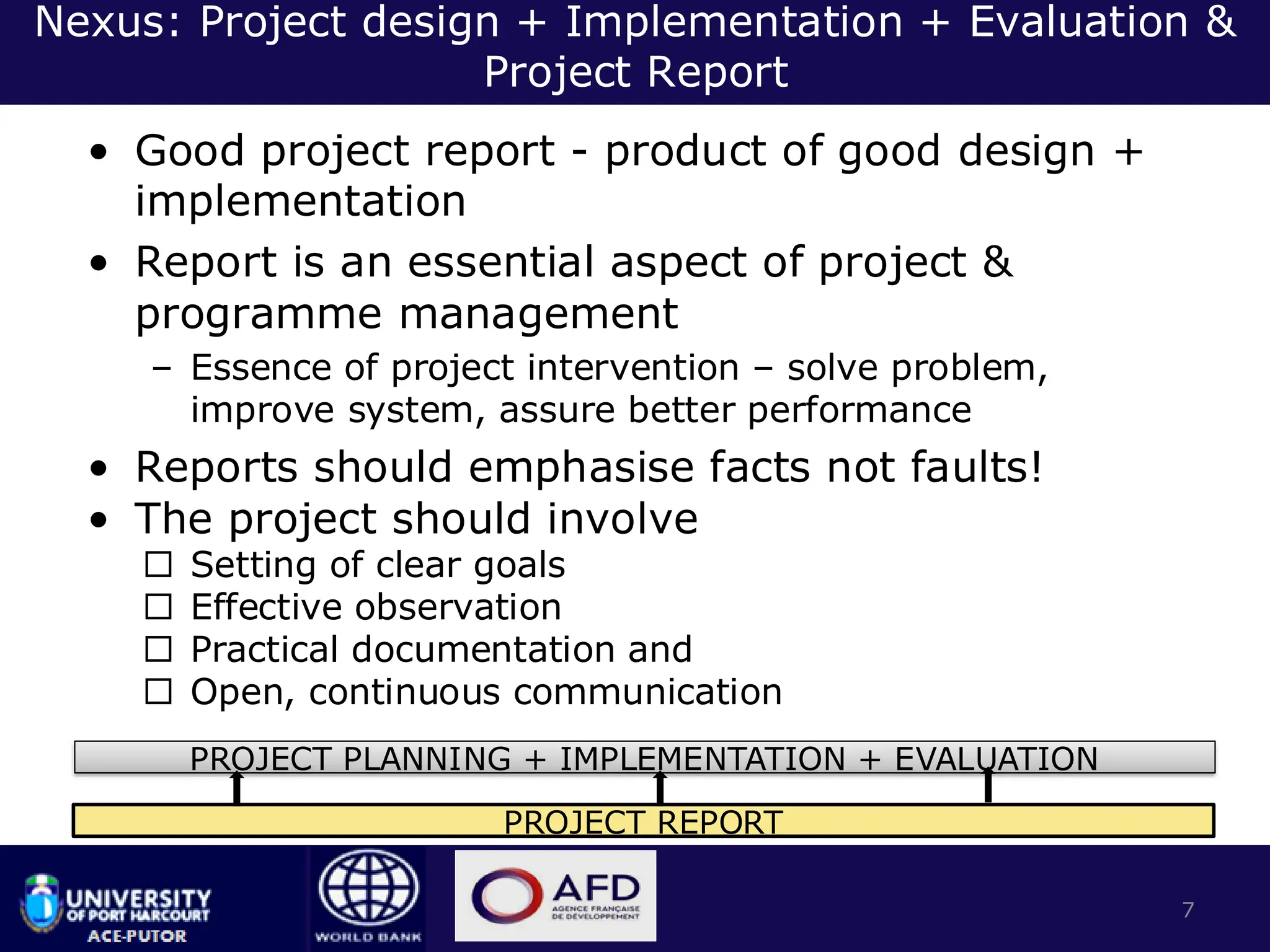
Nexus: Project design+ Implementation + Evaluation &
Project Report
• Good project report - product of good design +
implementation
• Report is an essential aspect of project &
programme management
– Essence of project intervention – solve problem,
improve system, assure better performance
• Reports should emphasise facts not faults!
• The project should involve
Setting of clear goals
Effective observation
Practical documentation and
Open, continuous communication
7
PROJECT PLANNING + IMPLEMENTATION + EVALUATION
PROJECT REPORT
Writing Style
• Usesimple direct language
• Logical sequence
• Avoid jargon; define all technical terms
• Use active voice for clarity
• Be concise but informative
• Provide citations (footnote or reference list)
• Use tables and charts effectively
• Label figures and tables clearly
• Ensure accurancy and consistency in data reporting style
• Follow ethical guidelines for data presentation &
disclosures during reporting
• ToC for lengthy reports
9
10.
Structure of aScientific Report
• IMRAD format
– Introduction
– Methods
– Results
– Discussion
• A standard for original articles set in
1972 by the American National
Standards Institute and the most used
format today.
11.
If you arehaving difficulty writing, consider
Manuscript section
• Introduction =
• Methodology =
• Results =
• Discussion =
• Conclusion =
What I read
What I did
What I found
What I reckon
Summary of all
12.
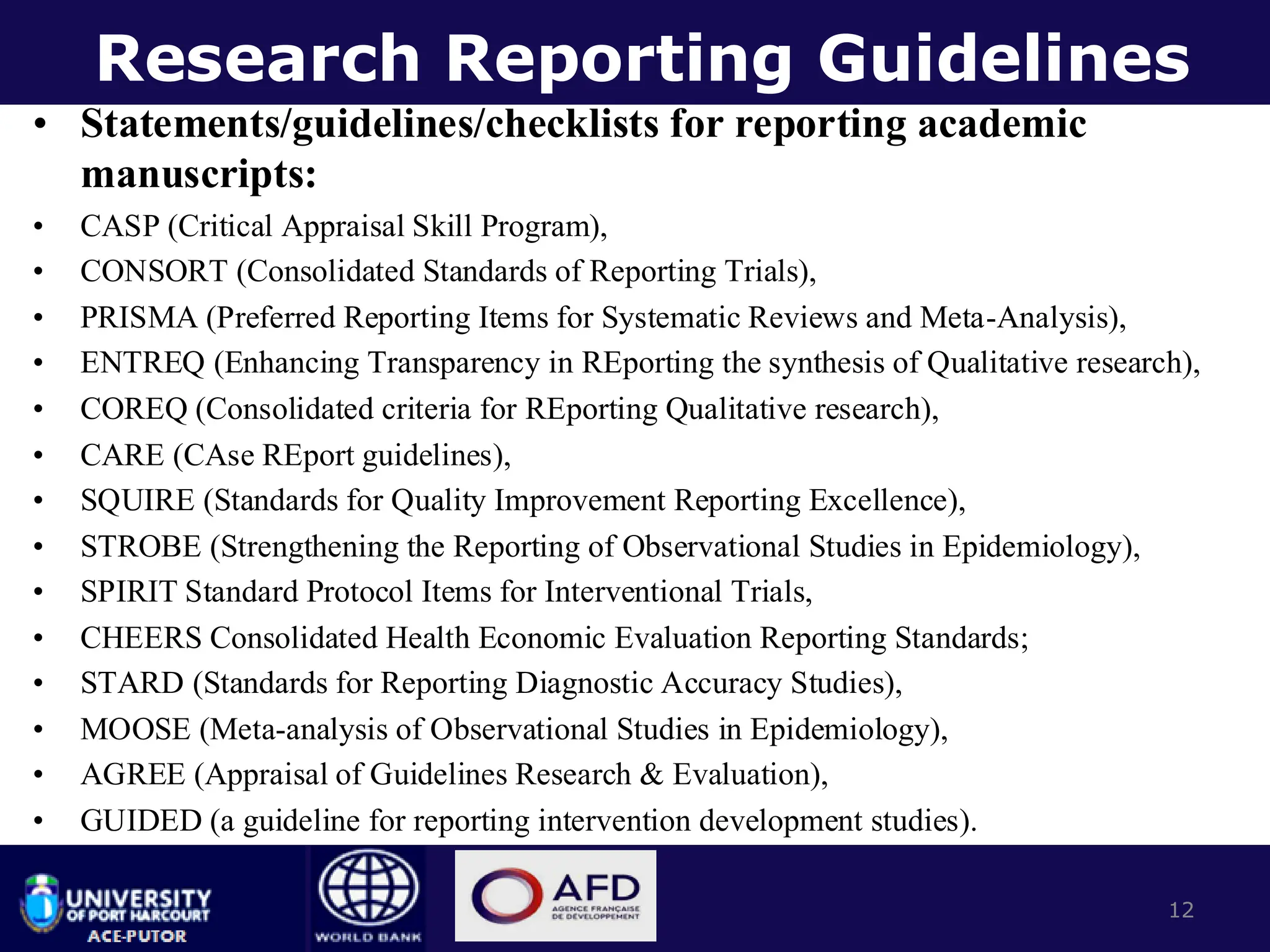
Research Reporting Guidelines
•Statements/guidelines/checklists for reporting academic
manuscripts:
• CASP (Critical Appraisal Skill Program),
• CONSORT (Consolidated Standards of Reporting Trials),
• PRISMA (Preferred Reporting Items for Systematic Reviews and Meta-Analysis),
• ENTREQ (Enhancing Transparency in REporting the synthesis of Qualitative research),
• COREQ (Consolidated criteria for REporting Qualitative research),
• CARE (CAse REport guidelines),
• SQUIRE (Standards for Quality Improvement Reporting Excellence),
• STROBE (Strengthening the Reporting of Observational Studies in Epidemiology),
• SPIRIT Standard Protocol Items for Interventional Trials,
• CHEERS Consolidated Health Economic Evaluation Reporting Standards;
• STARD (Standards for Reporting Diagnostic Accuracy Studies),
• MOOSE (Meta-analysis of Observational Studies in Epidemiology),
• AGREE (Appraisal of Guidelines Research & Evaluation),
• GUIDED (a guideline for reporting intervention development studies).
12
13.
Structure of aProject Report
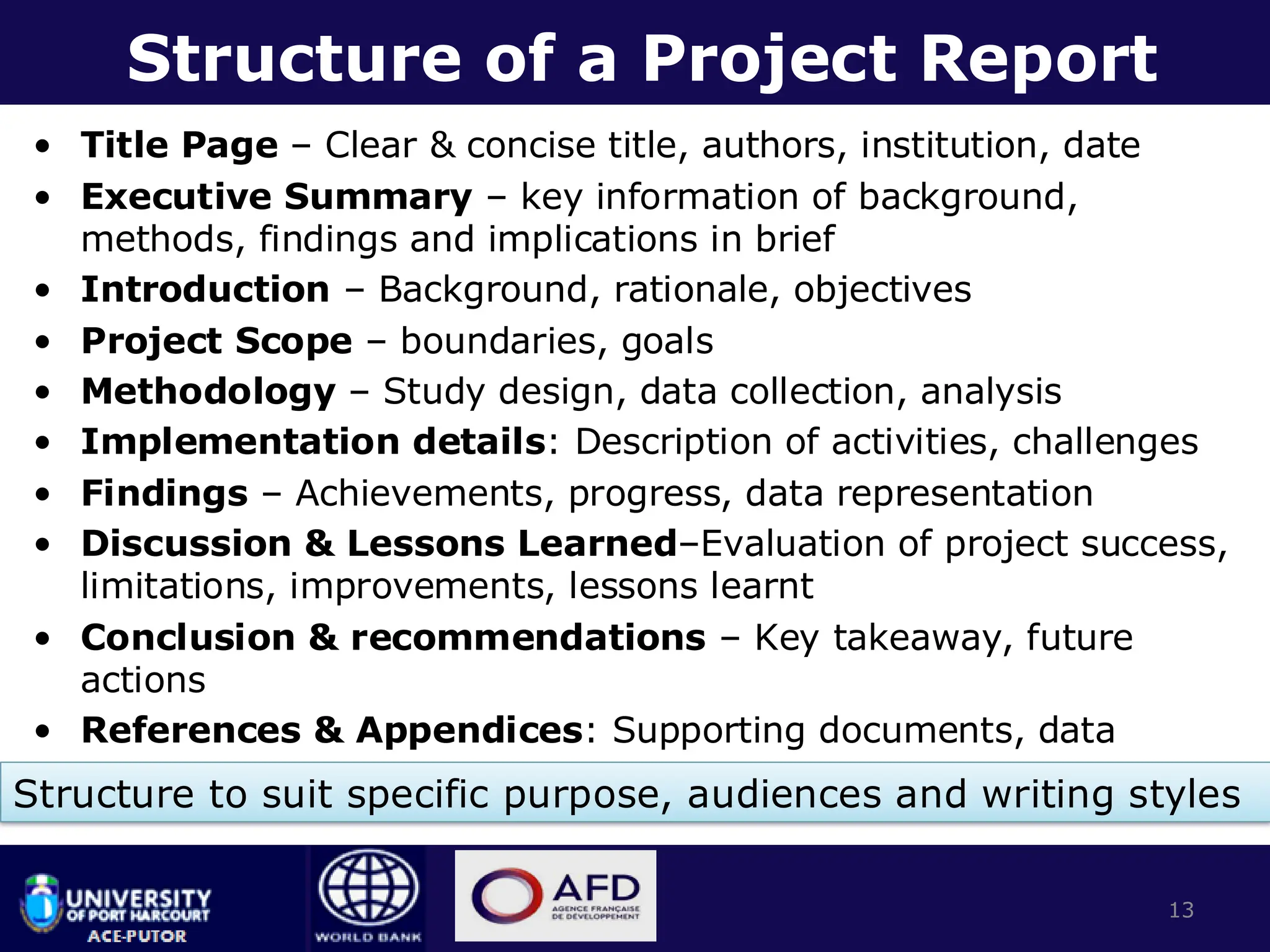
• Title Page – Clear & concise title, authors, institution, date
• Executive Summary – key information of background,
methods, findings and implications in brief
• Introduction – Background, rationale, objectives
• Project Scope – boundaries, goals
• Methodology – Study design, data collection, analysis
• Implementation details: Description of activities, challenges
• Findings – Achievements, progress, data representation
• Discussion & Lessons Learned–Evaluation of project success,
limitations, improvements, lessons learnt
• Conclusion & recommendations – Key takeaway, future
actions
• References & Appendices: Supporting documents, data
13
Structure to suit specific purpose, audiences and writing styles
14.
Research Versus ProjectReports
Criteria Research Report Project Report
Purpose Present findings from
original or review
research
Report progress, challenges or
outcomes of a project
Philosophy Inductive, deductive Realist, pragmatism
Focus Investigates a hypothesis
or a research question
Describes implementation &
execution of a project
Structure Includes literature
review, methodology,
results, discussion
Includes objectives, timeline,
methodology, outcomes
Audience Academic, scientific and
policy makers
Stakeholders, funding agencies,
project teams
Data
Presentation
Emphasis on data
analysis & interpretation
Emphasis on achievements,
lessons learnt and impacts
Example Thesis, clinical trials,
field trial
Training report, PH intervantion
reports, programme
implementation reports
14
15.
Sample Training Report
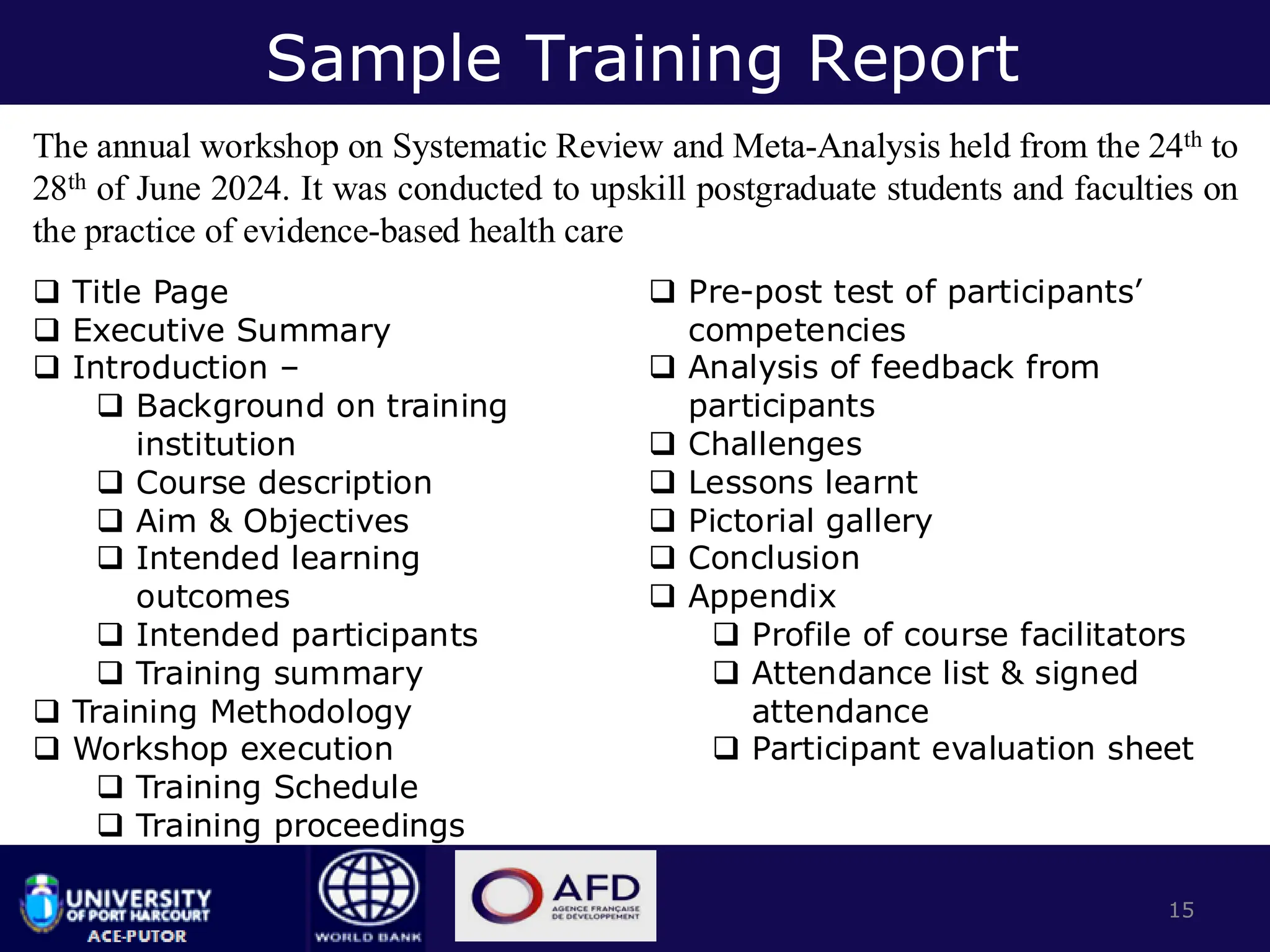
Theannual workshop on Systematic Review and Meta-Analysis held from the 24th to
28th of June 2024. It was conducted to upskill postgraduate students and faculties on
the practice of evidence-based health care
15
❑ Title Page
❑ Executive Summary
❑ Introduction –
❑ Background on training
institution
❑ Course description
❑ Aim & Objectives
❑ Intended learning
outcomes
❑ Intended participants
❑ Training summary
❑ Training Methodology
❑ Workshop execution
❑ Training Schedule
❑ Training proceedings
❑ Pre-post test of participants’
competencies
❑ Analysis of feedback from
participants
❑ Challenges
❑ Lessons learnt
❑ Pictorial gallery
❑ Conclusion
❑ Appendix
❑ Profile of course facilitators
❑ Attendance list & signed
attendance
❑ Participant evaluation sheet
16.
Pre- & postcompetency scores
16
COMPETENCE ON ASPECTS OF EVIDENCE-
BASED HEALTHCARE AND SYSTEMATIC
REVIEW
MEAN COMPETENCY
SCORE
MEAN DIFF T-TEST
DF = 259
P-VALUE
Pretest Post-test
Knowledge of the common types of reviews in
healthcare
2.01 2.99 0.98 7.14 0.000
Setting up or joining a Systematic Review Team 1.63 2.85 1.22 8.47 0.000
Structuring systematic review title 1.68 3.01 1.33 10.03 0.000
Formulating systematic review questions 1.63 2.97 1.34 10.28 0.000
Defining inclusion and exclusion search criteria 1.88 3.21 1.33 9.31 0.000
Conducting literature searches for Systematic
Review
1.95 3.02 1.07 7.70 0.000
Managing search results with reference managers 1.82 2.86 1.04 7.66 0.000
Eligibility Assessment of Studies for a Systematic
Review
1.67 2.90 1.23 9.55 0.000
Selecting studies that should be included in a
systematic review
1.70 2.87 1.17 8.88 0.000
Extracting data from studies included
for the systematic review
1.75 2.89 1.14 8.71 0.000
17.
Evaluation of TrainingProcess & Facilitation
17
Evaluation focus
Response – freq (%)
Poor Good
Excelle
nt
Appropriateness or usefulness of the
training (n=104)
0 (0.0) 16
(15.4)
88
(84.6)
Workshop support (n = 102) 2 (2.0) 44
(43.1)
56
(54.9)
Registration (n = 102) 2 (2.0) 44
(44.4)
53
(53.5)
Virtual/Physical Learning
Environment (n = 99)
2 (2.0) 44
(42.3)
53
(53.5)
Facilitator
Evaluation focus
Response – freq (%)
Poor Good Excellent
XXXXX Knowledge on the subject matter 1 (1.0) 11 (10.8) 90 (88.2)
Teaching skills 0 (0.0) 16 (15.8) 85 (84.2)
Engagement with participants 0 (0.0) 15 (14.7) 87 (85.3)
XXXX Knowledge on the subject matter 0 (0.0) 7 (6.7) 97 (93.3)
Teaching skills 0 (0.0) 13 (12.5) 91 (87.5)
Engagement with participants 0 (0.0) 18 (17.3) 86 (82.7)
18.
Sample Project EvaluationReport
The MDGs-Conditional Grants Scheme Interventions were implemented across all
LGAs in Nigeria including the FCT. An independent monitoring team were engaged
to periodically monitor and report progress
18
❑ Title Page
❑ Executive Summary
❑ Introduction –
❑ Background on MDG-CGS
❑ Independent monitoring
❑ Aim & Objectives of M&E
❑ Methodology for the M&E
❑ Findings from the M&E Exercise
❑ M&E Schedule & Participants
❑ Project characteristics
❑ Phases of project
❑ Receipt of “No Objection”,
Contract award, Implementation
❑ Presentation of summary
performance of all project
❑ Performance on each project
❑ Narrative report on project
performance
❑ Constraints & Solutions
❑ Lessons learnt
❑ Pictorial gallery showing state of
each project
❑ Conclusion
19.
Project Performance
19
AREA Visitdate Date of contract
Award
Project
Duration
Av. Contract
Duration
% Compl % branded % in use
Abakaliki 12.02.17 25.05.16 3 months 8 months 93.6 95.5 95.5
Afikpo South 13.02.17 25.05.16 3 months 8 months 100.0 100.0 100.0
Ezza South 14.02.17 25.05.16 3 months 8 months 100.0 100.0 100.0
Ikwo 15.05.17 25.05.16 3 months 8 months 95.4 96.4 100.0
Ishielu 16.02.17 25.05.16 3 months 8 months 100.0 100.0 100.0
Izzi 18.02.17 25.05.16 3 months 8 months 100.0 100.0 100.0
State 98.2 98.7 99.4
20.
Conclusion
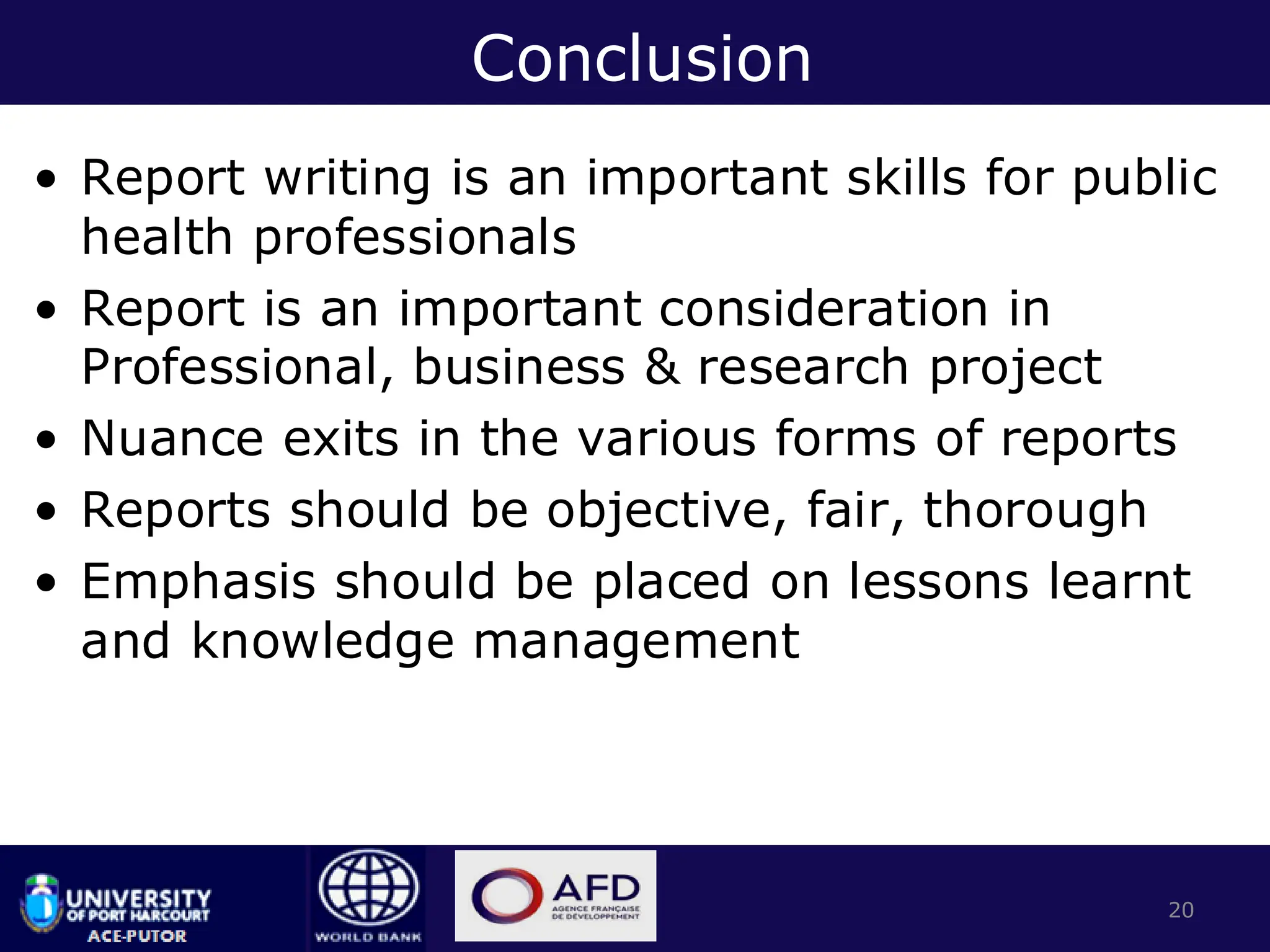
• Report writingis an important skills for public
health professionals
• Report is an important consideration in
Professional, business & research project
• Nuance exits in the various forms of reports
• Reports should be objective, fair, thorough
• Emphasis should be placed on lessons learnt
and knowledge management
20