• Research question / Problem
• Background / Observation
• Formulate hypothesis
• Design experiment
• Test hypothesis / Collect data
• Interpret / Analyze results
• Publish findings
1
2
3
4
5
6
7
What are you interested in?
What do you have to know about it?
Make observations & gather background
information about the problem
An educated guess …
It shall be possible to measure / test it.
It should help answer the original question
How will you test your hypothesis?
What tests will answer your question?
Test your hypothesis by executing your
experiments. Collect data from them
What do your results tell you?
Do they prove or disprove the hypothesis.
It is OK to be wrong
Write papers for conferences & journals.
Write thesis
Scientific Research Steps
LITERATURE REVIEW
The review of the literature is defined as a
broad, comprehensive, in-depth, systematic,
and critical review of scholarly publications,
unpublished scholarly print materials,
audiovisual materials, and personal
communications
• The review of the literature is traditionally
considered a systematic and critical review of the
most important published scholarly literature on a
particular topic.
• Scholarly literature refer to published and
unpublished data based literature and conceptual
literature materials found in print and non print
forms
• Data based literature reports of completed
research
• Conceptual literature reports of theories,
concepts
LITERATURE REVIEW
PURPOSES OF LITERATURE REVIEW
1. Determines what is known about a subject,
concept or problem
2. Determines gaps, consistencies & inconsistencies
about a subject, concept or problem
3. Discovers unanswered questions about a subject,
concept or problem
4. Describes strengths & weaknesses of designs,
methods of inquiry and instruments used in earlier
works
5. Discovers conceptual traditions used to
examine problems
6. Generates useful research questions or
projects/activities for the discipline
7. Promotes development of protocols & policies
related to e.g. nursing practice
8. Uncovers a new practice intervention, or gains
support for changing a practice intervention
PURPOSES OF LITERATURE REVIEW
The Use of Literature Review in
Quantitative Research
• Theoretical framework
The literature defines concepts and terms in relation to
the study
• Problem statement and hypotheses
The literature review helps to determine what is known
and not known; to uncover gaps, consistencies, or
inconsistencies, and/or to reveal unanswered questions
about a subject, concept or problem
The literature review allows for refinement of research
problems and questions and/or hypotheses
• Design and method
The literature review reveals strengths and
weaknesses of designs and methods of
previous research studies
• Outcome of the analysis (findings, implications, and
recommendations)
The literature review is used to discuss the
results or findings of a study. The discussion
relates the study’s findings to what was or was
not found in the review of literature
The Use of Literature Review in
Quantitative Research
Steps of Searching the Literature
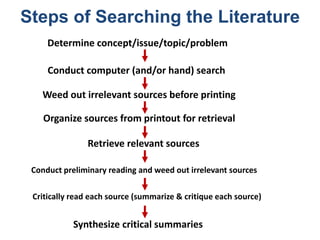
Determine concept/issue/topic/problem
Conduct computer (and/or hand) search
Weed out irrelevant sources before printing
Organize sources from printout for retrieval
Retrieve relevant sources
Conduct preliminary reading and weed out irrelevant sources
Critically read each source (summarize & critique each source)
Synthesize critical summaries
Primary and Secondary Sources
Primary source: is written by a person(s) who
developed the theory or conducted the
research
Secondary source: is written by a person(s) other
than the individual who developed the theory
or conducted the research
10
The Role of Secondary Sources
Two general reasons for using secondary sources:
1. A primary sources is literally unavailable
2. A secondary source can provide different ways
of looking at an issue or problem
Secondary sources should not be overused
Critiquing Criteria for a Review of
the Literature
1. Does the literature review uncover gaps or
inconsistencies in knowledge?
2. How does the review reflect critical thinking?
3. Are all the relevant concepts and variables included
in the review?
4. Does the summary of each reviewed study reflect the
essential components of the study design?
Critiquing Criteria for a Review of
the Literature
5. Does the critique of each reviewed study include
strengths, weaknesses, or limitations of the
design; conflicts; and gaps or inconsistencies in
information in relation to the area of interest?
6. Were both conceptual and data based literature
included?
7. Were primary sources mainly included?
8. Is there a written summary synthesis of the
reviewed scholarly literature?
HYPOTHESIS
DEFINITIONS OF HYPOTHESIS (1)
• “A hypothesis is a tentative statement of the relationship
between two or more variables. Hypotheses are always in
declarative sentence form and they relate, either generally or
specifically variable and variables.”
• James E. Greighton, “It is a tentative supposition or provisional
guess which seems to explain the situation under observation.”
• A.D. Carmichael, “Science employs hypothesis in guiding the
thinking process. When our experience tells us that a given
phenomenon follows regularly upon the appearance of certain
other phenomena, we conclude that the former is connected
with the latter by some sort of relationship and we form an
hypothesis concerning this relationship.”
DEFINITIONS OF HYPOTHESIS (2)
• Goode and Han, “A hypothesis states what we are looking for.
A hypothesis looks forward. It is a proposition which can be put
to a test to determine its validity. It may prove to be correct or
incorrect.
• Bruce W. Tuckman, “A hypothesis then could be defined as an
expectation about events based on generalization of the
assumed relationship between variables.”
• M. Verma, “A theory when stated as a testable proposition
formally and clearly and subjected to empirical or
experimental verification is known as a hypothesis.”
NATURE OF HYPOTHESIS
1. It is conceptual in nature. Some kind of conceptual
elements in the framework are involved in a hypothesis.
2. It is a verbal statement in a declarative form. It is a verbal
expression of ideas and concepts, it is not merely idea but
in the verbal form, the idea is ready enough for empirical
verification.
3. It has the empirical referent. A hypothesis contains some
empirical referent. It indicates the tentative relationship
between two or more variables.
4. It has a forward or future reference. A hypothesis is future
oriented. It relates to the future verification not the past
facts and informations.
5. It is the pivot of a scientific research. All the research
activities are designed for its verification.
FUNCTIONS OF HYPOTHESIS
1. To delimit the field of the investigation.
2. To sensitize the researcher so that he should
work selectively, and have very realistic
approach to the problem.
3. To offer the simple means for collecting
evidences to the verification.
IMPORTANCE OF A HYPOTHESIS (1)
1. Hypothesis as the Investigator’s “Eyes”: Carter V. Good
thinks that by guiding the investigator in further
investigation it serves as the investigator’s “Eyes” in
seeking answers to tentatively adopted generalization.
2. It Focuses Research: Without it, research is unfocussed
research and remains like a random empirical
wandering. It serves as necessary link between theory
and the investigation.
3. It Places Clear and Specific Goals: A well thought out set
of hypothesis is that they place clear and specific goals
before the research worker and provide him with a
basis for selecting sample and research procedure to
meet these goals.
IMPORTANCE OF A HYPOTHESIS (2)
4. It Links Together: “It serves the important
function of linking together related facts and
information and organizing them into wholes.”
5. It Prevents Blind Research: “The use of
hypothesis prevents a blind search and
indiscriminate gathering of masses of data
which may later prove irrelevant to the
problem under study.”
6. As a Sort of Guiding Light: A hypothesis serves
as a powerful beacon that lights the way for
the research work.
CHARACTERISTICS OF A GOOD HYPOTHESIS (1)
1. A good hypothesis is in agreement with the
observed facts.
2. A good hypothesis does not conflict with any law
of nature which is known to be true.
3. A good hypothesis is stated in the simplest
possible term.
4. A good hypothesis permits of the application of
deductive reasoning.
5. A good hypothesis shows very clear verbalization.
6. A good hypothesis ensures that the methods of
verification are under control of the investigator.
CHARACTERISTICS OF A GOOD HYPOTHESIS (2)
7. A good hypothesis guarantees that available tools
and techniques will be effectively used for the
purpose of verification.
8. A good hypothesis takes into account the
different types controls which are to be exercised
for the purpose of verification.
9. A good hypothesis ensures that the sample is
readily approachable.
10. A good hypothesis indicates clearly the role of
different variables involved in the study.
11. A good hypothesis maintains a very apparent
distinction with what is called theory law, facts,
assumption and postulate.
Hypothesis – independent & dependent variables
• The hypothesis shall contain two types of
variables: Independent Variable(s) and
• Dependent Variable(s)
• Independent Variable - the one the researcher controls.
It is what you, the researcher, change to cause a certain
effect.
• Dependent Variable - the one you measure or
observe. It’s the effect of the researcher’s change.
“If skin cancer is related to ultraviolet light, then people with a high
exposure to UV light will have a higher frequency of skin cancer.”
“If temperature affects leaf color change, then exposing the plant to
low temperatures will result in changes in leaf color.”
HOMEWORK
• Refine the last homework and state the
hypothesis.
• Report must be submitted/e_mailed on or
before Oct. 31 midnight.

Scientific Research Steps Part 1

  • 1.
    • Research question/ Problem • Background / Observation • Formulate hypothesis • Design experiment • Test hypothesis / Collect data • Interpret / Analyze results • Publish findings 1 2 3 4 5 6 7 What are you interested in? What do you have to know about it? Make observations & gather background information about the problem An educated guess … It shall be possible to measure / test it. It should help answer the original question How will you test your hypothesis? What tests will answer your question? Test your hypothesis by executing your experiments. Collect data from them What do your results tell you? Do they prove or disprove the hypothesis. It is OK to be wrong Write papers for conferences & journals. Write thesis Scientific Research Steps
  • 2.
    LITERATURE REVIEW The reviewof the literature is defined as a broad, comprehensive, in-depth, systematic, and critical review of scholarly publications, unpublished scholarly print materials, audiovisual materials, and personal communications
  • 3.
    • The reviewof the literature is traditionally considered a systematic and critical review of the most important published scholarly literature on a particular topic. • Scholarly literature refer to published and unpublished data based literature and conceptual literature materials found in print and non print forms • Data based literature reports of completed research • Conceptual literature reports of theories, concepts LITERATURE REVIEW
  • 4.
    PURPOSES OF LITERATUREREVIEW 1. Determines what is known about a subject, concept or problem 2. Determines gaps, consistencies & inconsistencies about a subject, concept or problem 3. Discovers unanswered questions about a subject, concept or problem 4. Describes strengths & weaknesses of designs, methods of inquiry and instruments used in earlier works
  • 5.
    5. Discovers conceptualtraditions used to examine problems 6. Generates useful research questions or projects/activities for the discipline 7. Promotes development of protocols & policies related to e.g. nursing practice 8. Uncovers a new practice intervention, or gains support for changing a practice intervention PURPOSES OF LITERATURE REVIEW
  • 6.
    The Use ofLiterature Review in Quantitative Research • Theoretical framework The literature defines concepts and terms in relation to the study • Problem statement and hypotheses The literature review helps to determine what is known and not known; to uncover gaps, consistencies, or inconsistencies, and/or to reveal unanswered questions about a subject, concept or problem The literature review allows for refinement of research problems and questions and/or hypotheses
  • 7.
    • Design andmethod The literature review reveals strengths and weaknesses of designs and methods of previous research studies • Outcome of the analysis (findings, implications, and recommendations) The literature review is used to discuss the results or findings of a study. The discussion relates the study’s findings to what was or was not found in the review of literature The Use of Literature Review in Quantitative Research
  • 8.
    Steps of Searchingthe Literature Determine concept/issue/topic/problem Conduct computer (and/or hand) search Weed out irrelevant sources before printing Organize sources from printout for retrieval Retrieve relevant sources Conduct preliminary reading and weed out irrelevant sources Critically read each source (summarize & critique each source) Synthesize critical summaries
  • 9.
    Primary and SecondarySources Primary source: is written by a person(s) who developed the theory or conducted the research Secondary source: is written by a person(s) other than the individual who developed the theory or conducted the research
  • 10.
    10 The Role ofSecondary Sources Two general reasons for using secondary sources: 1. A primary sources is literally unavailable 2. A secondary source can provide different ways of looking at an issue or problem Secondary sources should not be overused
  • 11.
    Critiquing Criteria fora Review of the Literature 1. Does the literature review uncover gaps or inconsistencies in knowledge? 2. How does the review reflect critical thinking? 3. Are all the relevant concepts and variables included in the review? 4. Does the summary of each reviewed study reflect the essential components of the study design?
  • 12.
    Critiquing Criteria fora Review of the Literature 5. Does the critique of each reviewed study include strengths, weaknesses, or limitations of the design; conflicts; and gaps or inconsistencies in information in relation to the area of interest? 6. Were both conceptual and data based literature included? 7. Were primary sources mainly included? 8. Is there a written summary synthesis of the reviewed scholarly literature?
  • 13.
  • 14.
    DEFINITIONS OF HYPOTHESIS(1) • “A hypothesis is a tentative statement of the relationship between two or more variables. Hypotheses are always in declarative sentence form and they relate, either generally or specifically variable and variables.” • James E. Greighton, “It is a tentative supposition or provisional guess which seems to explain the situation under observation.” • A.D. Carmichael, “Science employs hypothesis in guiding the thinking process. When our experience tells us that a given phenomenon follows regularly upon the appearance of certain other phenomena, we conclude that the former is connected with the latter by some sort of relationship and we form an hypothesis concerning this relationship.”
  • 15.
    DEFINITIONS OF HYPOTHESIS(2) • Goode and Han, “A hypothesis states what we are looking for. A hypothesis looks forward. It is a proposition which can be put to a test to determine its validity. It may prove to be correct or incorrect. • Bruce W. Tuckman, “A hypothesis then could be defined as an expectation about events based on generalization of the assumed relationship between variables.” • M. Verma, “A theory when stated as a testable proposition formally and clearly and subjected to empirical or experimental verification is known as a hypothesis.”
  • 16.
    NATURE OF HYPOTHESIS 1.It is conceptual in nature. Some kind of conceptual elements in the framework are involved in a hypothesis. 2. It is a verbal statement in a declarative form. It is a verbal expression of ideas and concepts, it is not merely idea but in the verbal form, the idea is ready enough for empirical verification. 3. It has the empirical referent. A hypothesis contains some empirical referent. It indicates the tentative relationship between two or more variables. 4. It has a forward or future reference. A hypothesis is future oriented. It relates to the future verification not the past facts and informations. 5. It is the pivot of a scientific research. All the research activities are designed for its verification.
  • 17.
    FUNCTIONS OF HYPOTHESIS 1.To delimit the field of the investigation. 2. To sensitize the researcher so that he should work selectively, and have very realistic approach to the problem. 3. To offer the simple means for collecting evidences to the verification.
  • 18.
    IMPORTANCE OF AHYPOTHESIS (1) 1. Hypothesis as the Investigator’s “Eyes”: Carter V. Good thinks that by guiding the investigator in further investigation it serves as the investigator’s “Eyes” in seeking answers to tentatively adopted generalization. 2. It Focuses Research: Without it, research is unfocussed research and remains like a random empirical wandering. It serves as necessary link between theory and the investigation. 3. It Places Clear and Specific Goals: A well thought out set of hypothesis is that they place clear and specific goals before the research worker and provide him with a basis for selecting sample and research procedure to meet these goals.
  • 19.
    IMPORTANCE OF AHYPOTHESIS (2) 4. It Links Together: “It serves the important function of linking together related facts and information and organizing them into wholes.” 5. It Prevents Blind Research: “The use of hypothesis prevents a blind search and indiscriminate gathering of masses of data which may later prove irrelevant to the problem under study.” 6. As a Sort of Guiding Light: A hypothesis serves as a powerful beacon that lights the way for the research work.
  • 20.
    CHARACTERISTICS OF AGOOD HYPOTHESIS (1) 1. A good hypothesis is in agreement with the observed facts. 2. A good hypothesis does not conflict with any law of nature which is known to be true. 3. A good hypothesis is stated in the simplest possible term. 4. A good hypothesis permits of the application of deductive reasoning. 5. A good hypothesis shows very clear verbalization. 6. A good hypothesis ensures that the methods of verification are under control of the investigator.
  • 21.
    CHARACTERISTICS OF AGOOD HYPOTHESIS (2) 7. A good hypothesis guarantees that available tools and techniques will be effectively used for the purpose of verification. 8. A good hypothesis takes into account the different types controls which are to be exercised for the purpose of verification. 9. A good hypothesis ensures that the sample is readily approachable. 10. A good hypothesis indicates clearly the role of different variables involved in the study. 11. A good hypothesis maintains a very apparent distinction with what is called theory law, facts, assumption and postulate.
  • 22.
    Hypothesis – independent& dependent variables • The hypothesis shall contain two types of variables: Independent Variable(s) and • Dependent Variable(s) • Independent Variable - the one the researcher controls. It is what you, the researcher, change to cause a certain effect. • Dependent Variable - the one you measure or observe. It’s the effect of the researcher’s change. “If skin cancer is related to ultraviolet light, then people with a high exposure to UV light will have a higher frequency of skin cancer.” “If temperature affects leaf color change, then exposing the plant to low temperatures will result in changes in leaf color.”
  • 23.
    HOMEWORK • Refine thelast homework and state the hypothesis. • Report must be submitted/e_mailed on or before Oct. 31 midnight.

Editor's Notes