Chapter 2
Solving a Biological
Problem
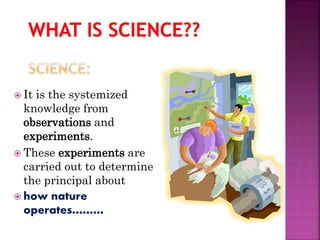
 It is the systemized
knowledge from
observations and
experiments.
 These experiments are
carried out to determine
the principal about
 how nature
operates………
 What is problem?
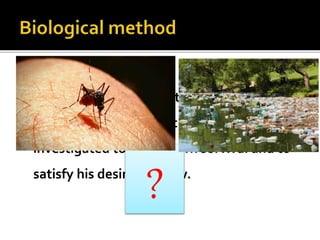
 Questions about living things have
provided problems that man has
investigated to aid his own survival and to
satisfy his desire to know.
?
 What is biological method?
 The scientific method in which
biological problems are solved, is
termed as biological method.
OR
 An organized way of solving
problems
IMPORTANCE
 In scientific research
 Advancements of
medicines
 Ecology
 Technology
 Also ensures the
quality of data for
public use.
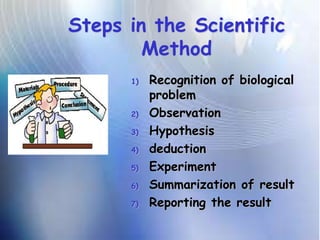
Steps in the Scientific
Method
1) Recognition of biological
problem
2) Observation
3) Hypothesis
4) deduction
5) Experiment
6) Summarization of result
7) Reporting the result
STEP 1.
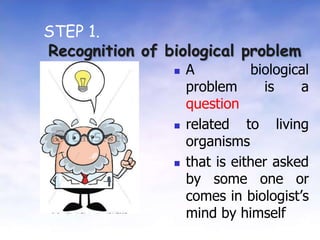
Recognition of biological problem
 A biological
problem is a
question
 related to living
organisms
 that is either asked
by some one or
comes in biologist’s
mind by himself
STEP 2. Observations
 Biologist recall previous
observation or make new
ones.
 Made with five senses
 vision
 Hearing
 Smell
 Taste
 touch
AH—Look at this!
Observations
 An example of an
observation might
be noticing that
many salamanders
near a pond have
curved, not
straight, tails
Observations
 I observe that plants
near my neighbors yard
grow bigger than the
others in my yard.
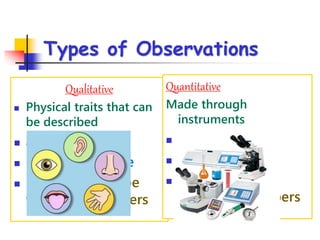
Types of Observations
Qualitative
 Physical traits that can
be described
 are variable
 not measureable
 These can not be
written in numbers
Quantitative
Made through
instruments
 are invariable
 measureable
 These can be
written in numbers
EXAMPLE:
WHAT TYPE OF
OBSERVATION IS THIS?
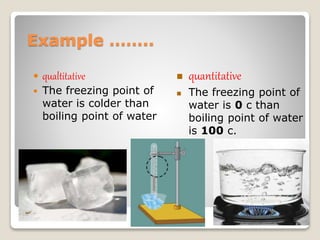
Example ……..
 qualtitative
 The freezing point of
water is colder than
boiling point of water
 quantitative
 The freezing point of
water is 0 c than
boiling point of water
is 100 c.
qualtitative
The liter of
water is heavier
than liter of
ethanol.
 Quantitative
 The liter of
water is heavier
than liter of
ethanol.
STEP 3. Hypothesis
 Biologist organize
observations into
data form and
construct a
statement that may
prove to be the
 “Answer of the biological
problem”
 Tentative explanation
of observations is
called hypothesis.
Hypothesis
 An example of a
hypothesis might
be that the
salamanders have
curved tails due to
a pollutant in the
moist soil where
they live.
Characteristics of hypothesis
 It should be general statement
 It should agree with available
observations
 It should be kept as simple as
possible.
 Must be testable
Step 4.
DEDUCTIONS…..(expect)
 Definition:
 The logical consequences of hypothesis
Or
the conclusion drawn from Hypothesis using if-then..........
 For this purpose, a hypothesis is taken as true
and expected results are drawn from it.
Sometimes written as If…Then… statements
Predicts an outcome
 “If……then……”
 If I put fertilizer on
my plants, then they
will grow bigger
Step 4. DEDUCTIONS
Step 5.
EXPERIMENTATION
Experimentation
 The most basic step
 Biologists perform
experiment to see if
hypothesis are true or not
 A procedure to test the
hypothesis.
Remember: To be a Valid
Experiment:
 Two groups are required ---
the control & experimental
groups
 There should be only one
variable
What is the Purpose of a
Control?
 Controls are NOT being
tested
 Controls are used for
COMPARISON
#1 Experimental Group-given the experimental factor
or changed in some way
#2 Control Group:-NOT changed
Experimental Group
Fertilizer
Control Group
No Fertilizer
Step 6.
Summarization of results
 Biologist gather actual,
quantitative data from
experiments.
 Data are then averaged and
compared statistically.
 To draw conclusions,
biologist also uses statistical
analysis.
Step 7.
Reporting results
 In scientific journals and books, in talks at
national and international meetings and in
seminars at colleges and universities.
 Essential part of scientific method.
 Allows other people to verify the results
Or
 Apply knowledge to solve other
problems
Overview
Question or Problem
Form a Hypothesis
Summarization of Result
Reporting Results
Observations
Experimentation
Deduction
 The end……….

1 scientific method

  • 2.
    Chapter 2 Solving aBiological Problem
  • 3.
     It isthe systemized knowledge from observations and experiments.  These experiments are carried out to determine the principal about  how nature operates………
  • 4.
     What isproblem?  Questions about living things have provided problems that man has investigated to aid his own survival and to satisfy his desire to know. ?
  • 5.
     What isbiological method?  The scientific method in which biological problems are solved, is termed as biological method. OR  An organized way of solving problems
  • 6.
    IMPORTANCE  In scientificresearch  Advancements of medicines  Ecology  Technology  Also ensures the quality of data for public use.
  • 7.
    Steps in theScientific Method 1) Recognition of biological problem 2) Observation 3) Hypothesis 4) deduction 5) Experiment 6) Summarization of result 7) Reporting the result
  • 8.
    STEP 1. Recognition ofbiological problem  A biological problem is a question  related to living organisms  that is either asked by some one or comes in biologist’s mind by himself
  • 9.
    STEP 2. Observations Biologist recall previous observation or make new ones.  Made with five senses  vision  Hearing  Smell  Taste  touch AH—Look at this!
  • 10.
    Observations  An exampleof an observation might be noticing that many salamanders near a pond have curved, not straight, tails
  • 11.
    Observations  I observethat plants near my neighbors yard grow bigger than the others in my yard.
  • 12.
    Types of Observations Qualitative Physical traits that can be described  are variable  not measureable  These can not be written in numbers Quantitative Made through instruments  are invariable  measureable  These can be written in numbers
  • 14.
  • 15.
  • 17.
    Example ……..  qualtitative The freezing point of water is colder than boiling point of water  quantitative  The freezing point of water is 0 c than boiling point of water is 100 c.
  • 18.
    qualtitative The liter of wateris heavier than liter of ethanol.  Quantitative  The liter of water is heavier than liter of ethanol.
  • 19.
    STEP 3. Hypothesis Biologist organize observations into data form and construct a statement that may prove to be the  “Answer of the biological problem”  Tentative explanation of observations is called hypothesis.
  • 20.
    Hypothesis  An exampleof a hypothesis might be that the salamanders have curved tails due to a pollutant in the moist soil where they live.
  • 21.
    Characteristics of hypothesis It should be general statement  It should agree with available observations  It should be kept as simple as possible.  Must be testable
  • 22.
    Step 4. DEDUCTIONS…..(expect)  Definition: The logical consequences of hypothesis Or the conclusion drawn from Hypothesis using if-then..........  For this purpose, a hypothesis is taken as true and expected results are drawn from it. Sometimes written as If…Then… statements Predicts an outcome
  • 23.
     “If……then……”  IfI put fertilizer on my plants, then they will grow bigger Step 4. DEDUCTIONS
  • 24.
  • 25.
    Experimentation  The mostbasic step  Biologists perform experiment to see if hypothesis are true or not  A procedure to test the hypothesis.
  • 26.
    Remember: To bea Valid Experiment:  Two groups are required --- the control & experimental groups  There should be only one variable
  • 27.
    What is thePurpose of a Control?  Controls are NOT being tested  Controls are used for COMPARISON
  • 28.
    #1 Experimental Group-giventhe experimental factor or changed in some way #2 Control Group:-NOT changed Experimental Group Fertilizer Control Group No Fertilizer
  • 29.
    Step 6. Summarization ofresults  Biologist gather actual, quantitative data from experiments.  Data are then averaged and compared statistically.  To draw conclusions, biologist also uses statistical analysis.
  • 30.
    Step 7. Reporting results In scientific journals and books, in talks at national and international meetings and in seminars at colleges and universities.  Essential part of scientific method.  Allows other people to verify the results Or  Apply knowledge to solve other problems
  • 31.
    Overview Question or Problem Forma Hypothesis Summarization of Result Reporting Results Observations Experimentation Deduction
  • 32.