Parts of an Argument
Background Information Include only what is necessary to help readers understand the issue fully.
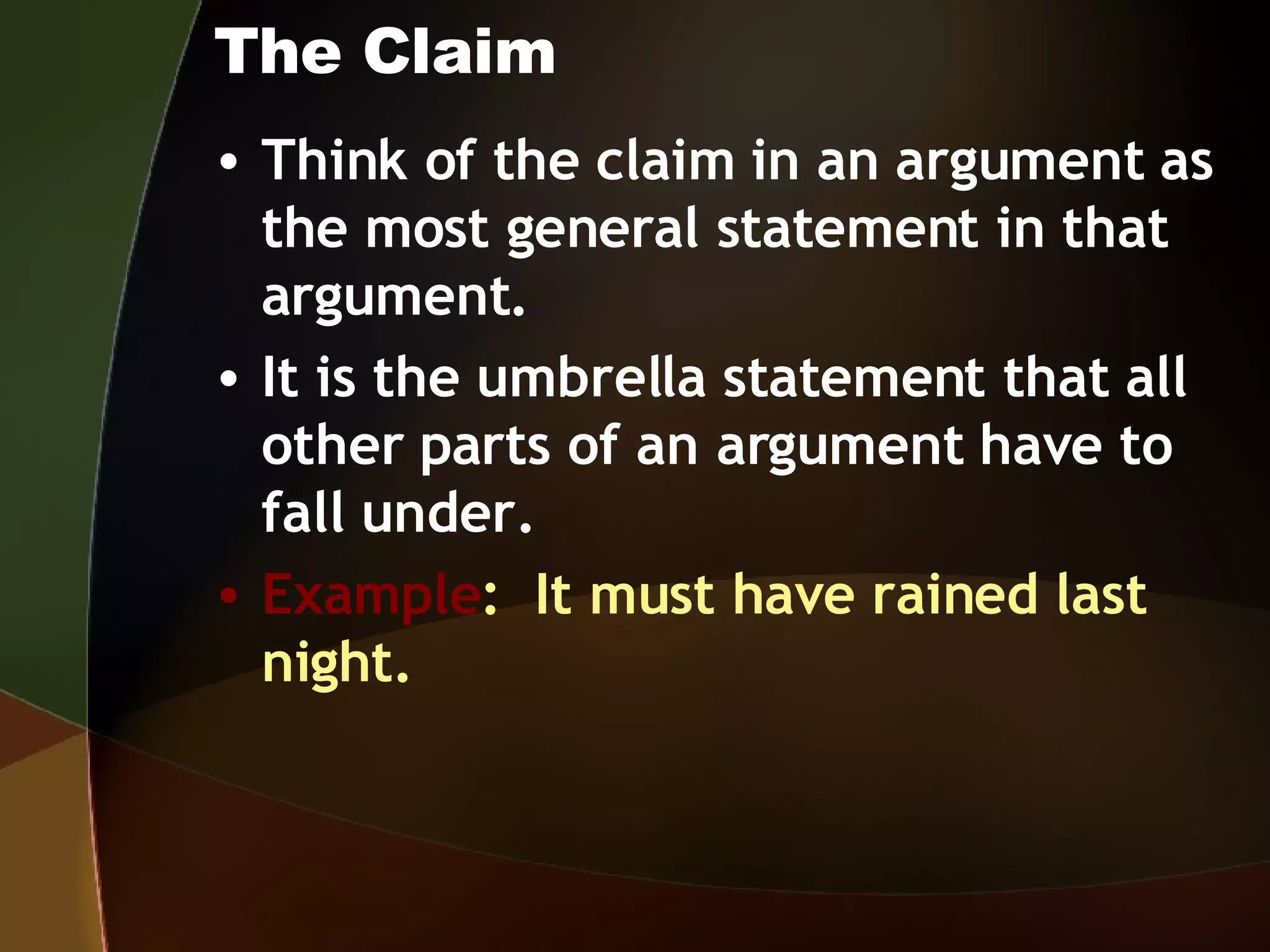
The Claim Think of the claim in an argument as the most general statement in that argument.  It is the umbrella statement that all other parts of an argument have to fall under.  Example :  It must have rained last night.
Claim Statements Write a sentence that expresses your position on 5 of the general issues in the following list: Abortion Capital punishment Drunk driving laws Gun control Legalizing marijuana Euthanasia Stem cells War in Iraq National debt Income Tax Affirmative Action Prison Reform DO NOT begin your position statement with “I believe.” Just make your statement. You are not allowed to do your paper on any of the topics on the left.
The Reasons (Data) Why does a writer believe the claim s/he makes?  The reasons a writer gives are the first line of development of any argument.
The Evidence (Data) We would all probably like to believe that the people we argue with will accept our claims and reasons as perfect and complete by themselves, but most readers are unlikely to do that.  Readers want evidence of some sort--facts, examples, statistics, expert testimony, among others--to back up our reasons.   Example :  The streets are wet this morning
The Warrant A statement or general  principle that connects the data to the claim. This may be stated or unstated. It is the bottom line. Example :  Wet streets are always a good sign of rain.
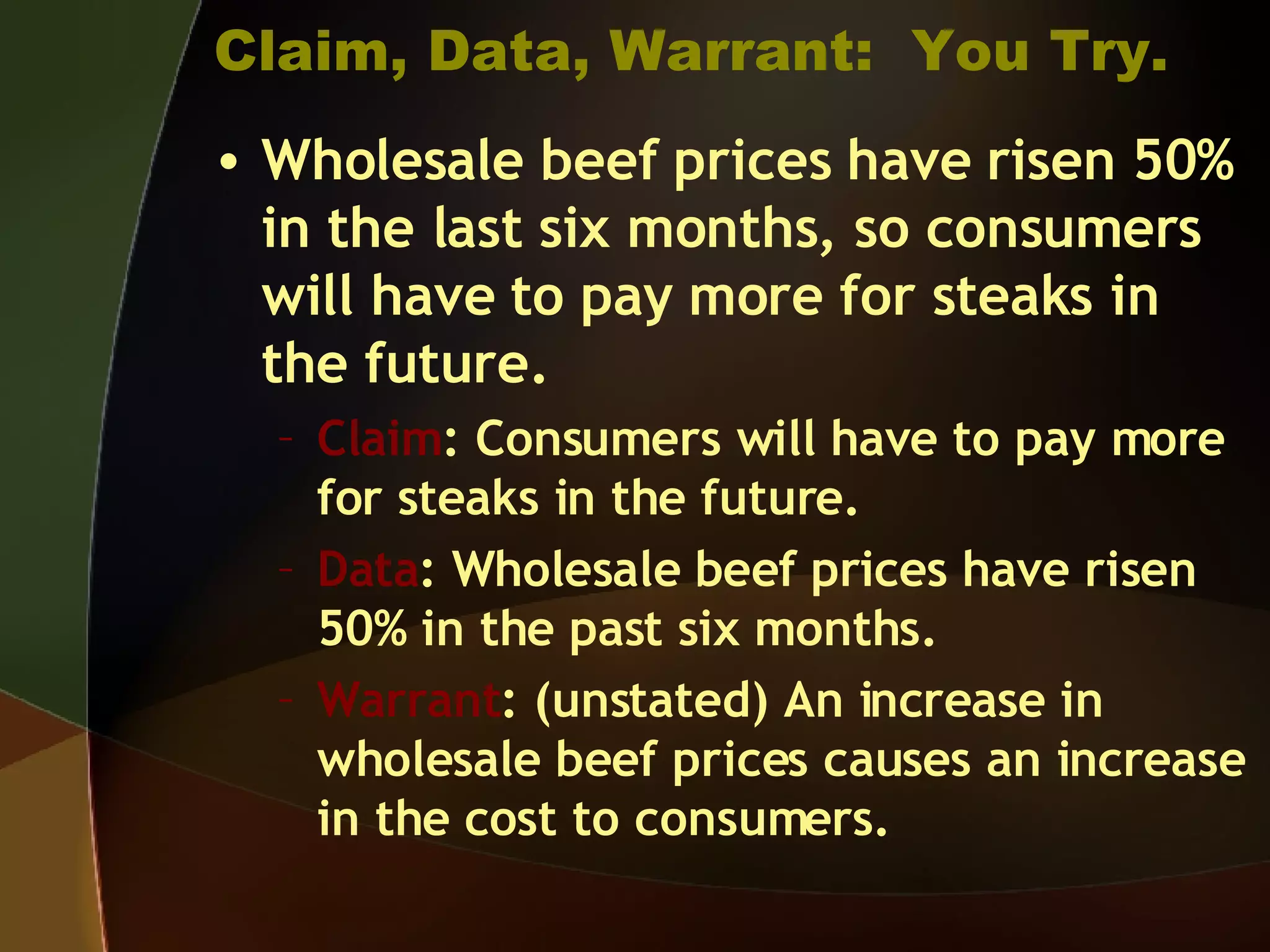
Claim, Data, Warrant:  You Try. Wholesale beef prices have risen 50% in the last six months, so consumers will have to pay more for steaks in the future. Claim : Consumers will have to pay more for steaks in the future. Data : Wholesale beef prices have risen 50% in the past six months. Warrant : (unstated) An increase in wholesale beef prices causes an increase in the cost to consumers.
Claim, Data, Warrant:  You Try. Children become consumers at an early age today because they spend more than half of their waking time watching television. Claim :  Children become consumers at an early age today. Data :  Children spend more than half of their waking time watching television. Warrant : (unstated) Watching television conditions children to become consumers. worksheet
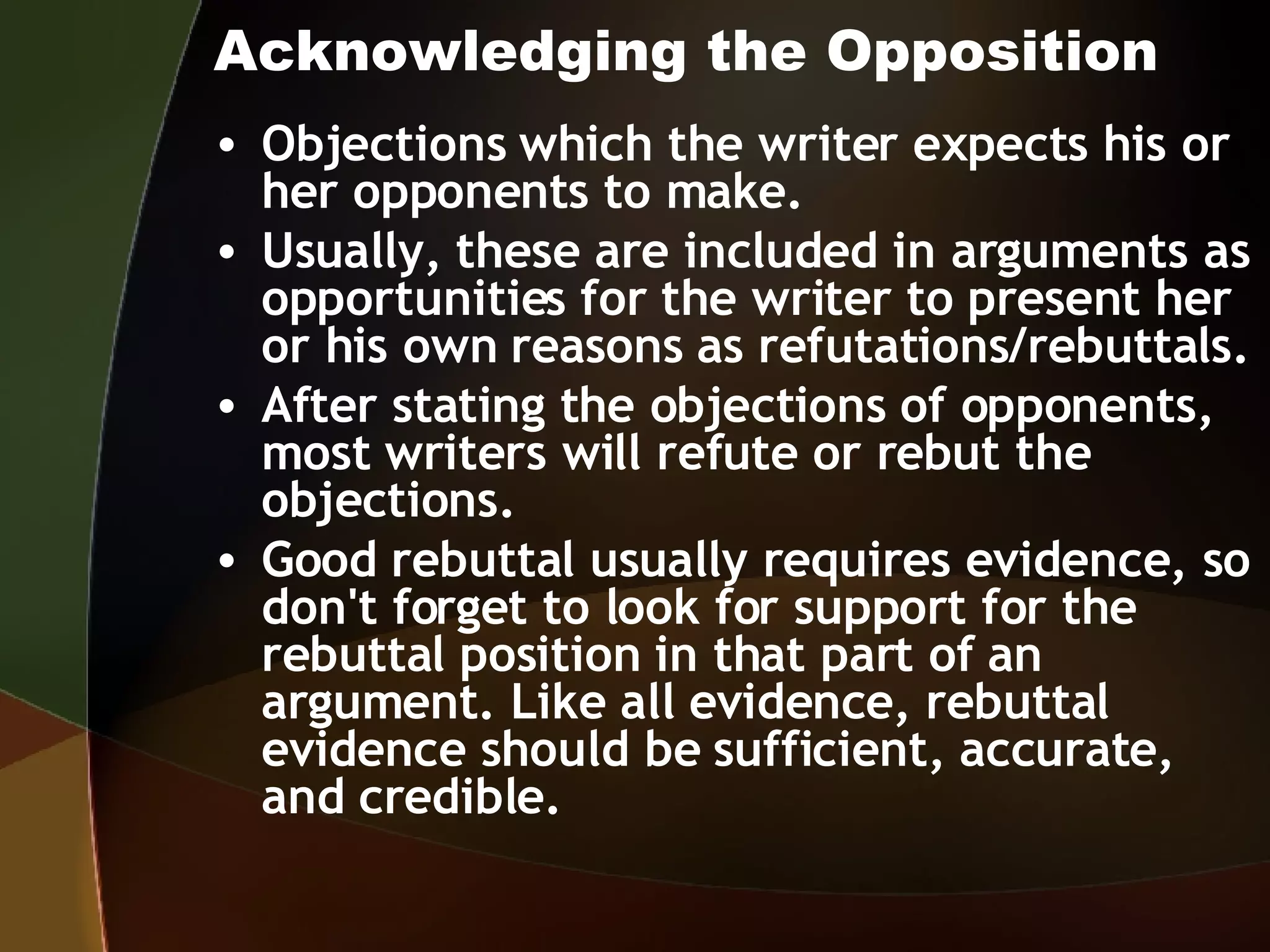
Acknowledging the Opposition Objections which the writer expects his or her opponents to make.  Usually, these are included in arguments as opportunities for the writer to present her or his own reasons as refutations/rebuttals.  After stating the objections of opponents, most writers will refute or rebut the objections.  Good rebuttal usually requires evidence, so don't forget to look for support for the rebuttal position in that part of an argument. Like all evidence, rebuttal evidence should be sufficient, accurate, and credible.
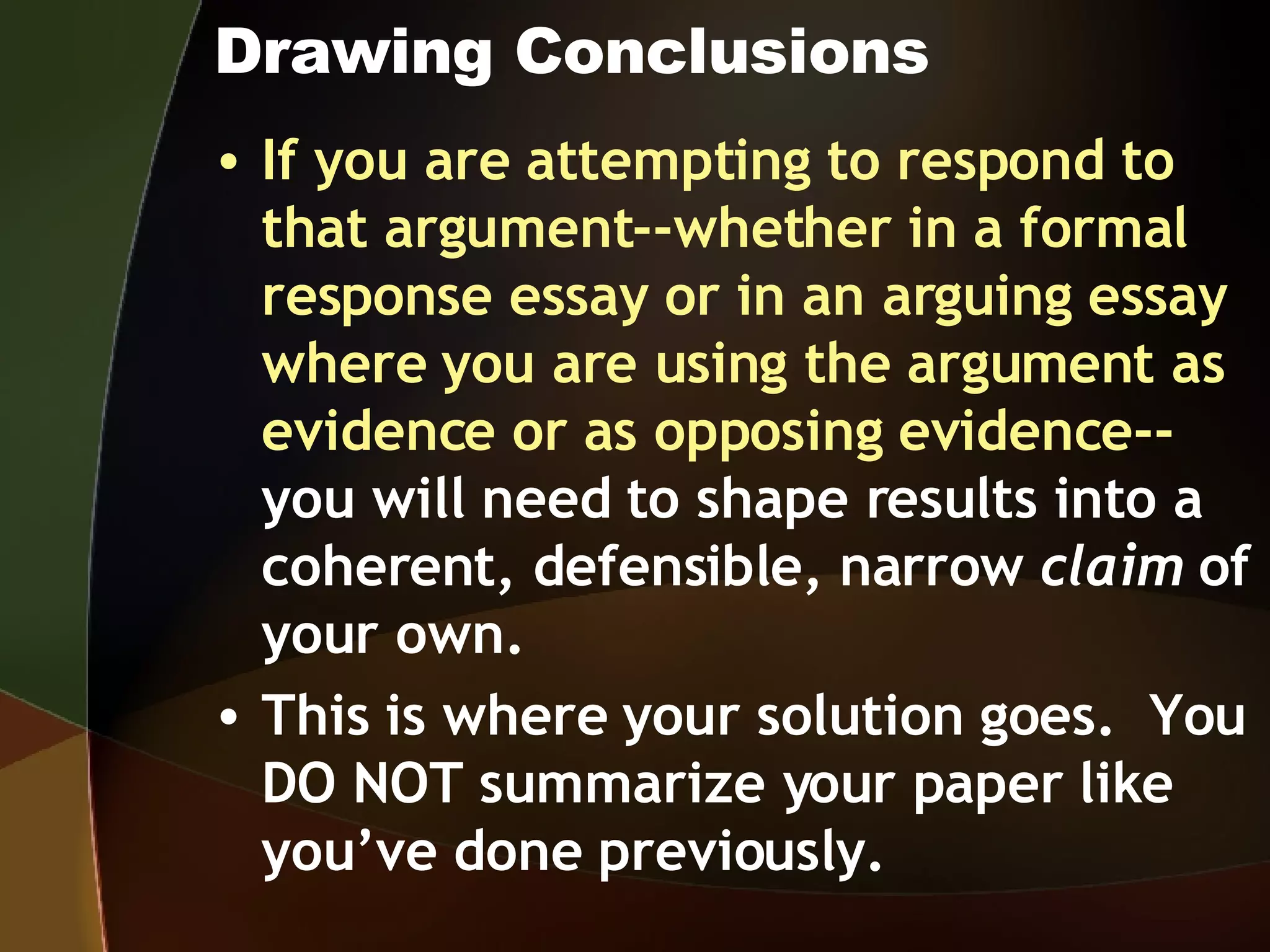
Drawing Conclusions If you are attempting to respond to that argument--whether in a formal response essay or in an arguing essay where you are using the argument as evidence or as opposing evidence-- you will need to shape results into a coherent, defensible, narrow  claim  of your own.   This is where your solution goes.  You DO NOT summarize your paper like you’ve done previously.
Inductive and Deductive Reasoning Inductive :  Begin with specific facts and then reach a general conclusion based on them Deductive :  You begin with a general statement and then infer specific statements from it.
Arguable Statements Should: Attempt to convince readers of something, change their minds about something, or urge them to do something Address a problem for which no easily acceptable solution exists or ask a question to which no absolute answer exists Consists of an argument where at least two views exist.
Arguable Statements Should Not: Be a fact that cannot be argued: Example :  My college major requires that I complete 28 hours of laboratory science. Debatable Thesis : My college needs to install more up-to-date equipment in the chemistry labs.
Arguable Statements Should Not: Be matters of personal taste or opinion: Example :  A vegetarian diet is as satisfying as one that includes meat and fish. Debatable Thesis :  Following a vegetarian diet can help lower cholesterol and prevent heart disease
Arguable Statements Should Not: Be ones where no doubt exists: Example :  People who wear leather and fur are cruel to animals. Defensible :  People who wear leather and fur support industries whose harvesting methods are cruel to animals.
Know Your Audience Be familiar with their needs, interests, and opinions. Age Gender Beliefs Etc. Express yourself clearly. Watch your tone.  Keep your emotions in check.

Parts of an Argument

  • 1.
    Parts of anArgument
  • 2.
    Background Information Includeonly what is necessary to help readers understand the issue fully.
  • 3.
    The Claim Thinkof the claim in an argument as the most general statement in that argument. It is the umbrella statement that all other parts of an argument have to fall under. Example : It must have rained last night.
  • 4.
    Claim Statements Writea sentence that expresses your position on 5 of the general issues in the following list: Abortion Capital punishment Drunk driving laws Gun control Legalizing marijuana Euthanasia Stem cells War in Iraq National debt Income Tax Affirmative Action Prison Reform DO NOT begin your position statement with “I believe.” Just make your statement. You are not allowed to do your paper on any of the topics on the left.
  • 5.
    The Reasons (Data)Why does a writer believe the claim s/he makes? The reasons a writer gives are the first line of development of any argument.
  • 6.
    The Evidence (Data)We would all probably like to believe that the people we argue with will accept our claims and reasons as perfect and complete by themselves, but most readers are unlikely to do that. Readers want evidence of some sort--facts, examples, statistics, expert testimony, among others--to back up our reasons. Example : The streets are wet this morning
  • 7.
    The Warrant Astatement or general principle that connects the data to the claim. This may be stated or unstated. It is the bottom line. Example : Wet streets are always a good sign of rain.
  • 8.
    Claim, Data, Warrant: You Try. Wholesale beef prices have risen 50% in the last six months, so consumers will have to pay more for steaks in the future. Claim : Consumers will have to pay more for steaks in the future. Data : Wholesale beef prices have risen 50% in the past six months. Warrant : (unstated) An increase in wholesale beef prices causes an increase in the cost to consumers.
  • 9.
    Claim, Data, Warrant: You Try. Children become consumers at an early age today because they spend more than half of their waking time watching television. Claim : Children become consumers at an early age today. Data : Children spend more than half of their waking time watching television. Warrant : (unstated) Watching television conditions children to become consumers. worksheet
  • 10.
    Acknowledging the OppositionObjections which the writer expects his or her opponents to make. Usually, these are included in arguments as opportunities for the writer to present her or his own reasons as refutations/rebuttals. After stating the objections of opponents, most writers will refute or rebut the objections. Good rebuttal usually requires evidence, so don't forget to look for support for the rebuttal position in that part of an argument. Like all evidence, rebuttal evidence should be sufficient, accurate, and credible.
  • 11.
    Drawing Conclusions Ifyou are attempting to respond to that argument--whether in a formal response essay or in an arguing essay where you are using the argument as evidence or as opposing evidence-- you will need to shape results into a coherent, defensible, narrow claim of your own. This is where your solution goes. You DO NOT summarize your paper like you’ve done previously.
  • 12.
    Inductive and DeductiveReasoning Inductive : Begin with specific facts and then reach a general conclusion based on them Deductive : You begin with a general statement and then infer specific statements from it.
  • 13.
    Arguable Statements Should:Attempt to convince readers of something, change their minds about something, or urge them to do something Address a problem for which no easily acceptable solution exists or ask a question to which no absolute answer exists Consists of an argument where at least two views exist.
  • 14.
    Arguable Statements ShouldNot: Be a fact that cannot be argued: Example : My college major requires that I complete 28 hours of laboratory science. Debatable Thesis : My college needs to install more up-to-date equipment in the chemistry labs.
  • 15.
    Arguable Statements ShouldNot: Be matters of personal taste or opinion: Example : A vegetarian diet is as satisfying as one that includes meat and fish. Debatable Thesis : Following a vegetarian diet can help lower cholesterol and prevent heart disease
  • 16.
    Arguable Statements ShouldNot: Be ones where no doubt exists: Example : People who wear leather and fur are cruel to animals. Defensible : People who wear leather and fur support industries whose harvesting methods are cruel to animals.
  • 17.
    Know Your AudienceBe familiar with their needs, interests, and opinions. Age Gender Beliefs Etc. Express yourself clearly. Watch your tone. Keep your emotions in check.