

Cause and Effect
Essays
• Everyday we try to figure out the causes for something.
– For example, when a problem arises, when any significant change in our
lives occur, or when we identify emotional problems
• Knowing the cause can help us cure a problem, prevent a
problem from reoccurring, or help us to repeat success.
• Likewise, we try to analyze results or effects.
• Therefore, the cause-and-effect analysis is an important
analytical skill to develop, and writing papers that analyze cause
or effects will help you develop this skill.
Writing
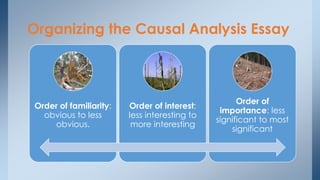
Order of familiarity:
obvious to less
obvious.
Order of interest:
less interesting to
more interesting
Order of
importance: less
significant to most
significant
Organizing the Causal Analysis Essay
• Necessary Causes = any factor that must be in place for something to
occur
• Sufficient Causes = any factor that, in itself, is enough to bring on a
particular effect
• Precipitating Causes = any factor that, by itself may seem trivial, but
becomes the spark that creates a blaze
• Proximate Causes = a factor that is nearby and often easy to spot in a
given topic
• Reciprocal Causes = when a cause leads to an effect which, in turn,
strengthens the cause
• Contributing Factors = factors which are too remote to be considered
causes, but still play a role in explaining an event
Causal Relationships
• Be certain that your analysis is logical.
• Avoid logical fallacies, including the fallacy of false cause.
• Do not assume that just because an incident happened first, it
caused something that came after.
• When analyzing the relationship between two events, make sure
to look beyond the chronological order and ensure that other
events, facts, or actions support the causal relationship.
Faulty Causality (false cause) Reasoning
• We usually find that there is not a single cause; rather, it is a
combination of causes that actually produces the result.
• In analyzing a topic, a writer could plan to spend about one
paragraph on each of the causes; each paragraph would have
to provide an explanation of the cause to show how it
contributes to the effect.
Multiple Causes with a Single Effect
• A thesis statement for a causal analysis essay can simply state
the causes to be discussed.
– Conflicts over money, interfering relatives, and career problems all
contributed to the demise of their relationship.
• Another option is to give a summary of the causes.
– Conflicts about several unresolved issues ultimately caused the demise of
their relationship.
– In both cases, the topic is the demise of their relationship and the central
idea is reasons for its demise.
The Thesis Statement for the Causal
Analysis Essay
• Just as an effect can have multiple causes, so can a single
cause have multiple effects.
• When an analysis is primarily of effects, expect to devote a
paragraph to each effect.
• Each paragraph should explain the relationship between the
cause and the effect.
Single Cause with Multiple Effects
• Like a causal analysis essay, the thesis statement for an effect
analysis essay does not have to be persuasive.
• The thesis statement can have a more simply stated central
idea.
– The tax increase will bring benefits to our city.
– Of course, the topic here is tax increase, and the central idea is that it will
bring benefits to the city.
The Thesis Statement for the
Effect Analysis Essay
• Another type of cause-and-effect analysis is the causal chain.
• The causes and effects are always directly related; in fact, they
are linked.
• One effect can become a cause of another effect, which in turn
can become a cause of another effect, and so on.
• In fact, another name for the pattern is “the domino effect”
because the causes affect each other one after the other like
dominoes falling.
• The causal chain if often used in science to analyze various kinds
of cycles, such as biological or chemical chains.
The Causal Chain
• Sometimes writers choose a quotation that is famous, clever, or
from an expert on their topic and work it into their introduction to
attract the reader’s attention.
• A quote from an authority can lend credibility to your essay and
catch the attention of people who have heard of this authority.
• The quote may start out looking at a broad topic, which the
author narrows down to a specific topic of discussion.
Introductory Paragraph:
The Relevant Quotation
Type Example
Phrases
To introduce cause:
because of + noun
as a result of + noun
Verbs
To express cause:
To express result:
1) result from
be caused by
2) result in
cause
lead to
Coordinating Conjunctions so + result (informal)
for + cause (formal)
Introductory Adverbs therefore, consequently,
thus + independent clause,
as a result, for this reason
Transitions and Expressions for
Cause and Effect
• Luna, Mara. UPR Carolina.
• Ruszkiewicz, John J. and Jay T. Dolmage. How to Write Anything,
2nd ed. NY: Bedford/St. Martin’s, 2012.
Works Cited

Cause and effect essays

  • 1.
  • 2.
    • Everyday wetry to figure out the causes for something. – For example, when a problem arises, when any significant change in our lives occur, or when we identify emotional problems • Knowing the cause can help us cure a problem, prevent a problem from reoccurring, or help us to repeat success. • Likewise, we try to analyze results or effects. • Therefore, the cause-and-effect analysis is an important analytical skill to develop, and writing papers that analyze cause or effects will help you develop this skill. Writing
  • 3.
    Order of familiarity: obviousto less obvious. Order of interest: less interesting to more interesting Order of importance: less significant to most significant Organizing the Causal Analysis Essay
  • 4.
    • Necessary Causes= any factor that must be in place for something to occur • Sufficient Causes = any factor that, in itself, is enough to bring on a particular effect • Precipitating Causes = any factor that, by itself may seem trivial, but becomes the spark that creates a blaze • Proximate Causes = a factor that is nearby and often easy to spot in a given topic • Reciprocal Causes = when a cause leads to an effect which, in turn, strengthens the cause • Contributing Factors = factors which are too remote to be considered causes, but still play a role in explaining an event Causal Relationships
  • 5.
    • Be certainthat your analysis is logical. • Avoid logical fallacies, including the fallacy of false cause. • Do not assume that just because an incident happened first, it caused something that came after. • When analyzing the relationship between two events, make sure to look beyond the chronological order and ensure that other events, facts, or actions support the causal relationship. Faulty Causality (false cause) Reasoning
  • 6.
    • We usuallyfind that there is not a single cause; rather, it is a combination of causes that actually produces the result. • In analyzing a topic, a writer could plan to spend about one paragraph on each of the causes; each paragraph would have to provide an explanation of the cause to show how it contributes to the effect. Multiple Causes with a Single Effect
  • 7.
    • A thesisstatement for a causal analysis essay can simply state the causes to be discussed. – Conflicts over money, interfering relatives, and career problems all contributed to the demise of their relationship. • Another option is to give a summary of the causes. – Conflicts about several unresolved issues ultimately caused the demise of their relationship. – In both cases, the topic is the demise of their relationship and the central idea is reasons for its demise. The Thesis Statement for the Causal Analysis Essay
  • 8.
    • Just asan effect can have multiple causes, so can a single cause have multiple effects. • When an analysis is primarily of effects, expect to devote a paragraph to each effect. • Each paragraph should explain the relationship between the cause and the effect. Single Cause with Multiple Effects
  • 9.
    • Like acausal analysis essay, the thesis statement for an effect analysis essay does not have to be persuasive. • The thesis statement can have a more simply stated central idea. – The tax increase will bring benefits to our city. – Of course, the topic here is tax increase, and the central idea is that it will bring benefits to the city. The Thesis Statement for the Effect Analysis Essay
  • 10.
    • Another typeof cause-and-effect analysis is the causal chain. • The causes and effects are always directly related; in fact, they are linked. • One effect can become a cause of another effect, which in turn can become a cause of another effect, and so on. • In fact, another name for the pattern is “the domino effect” because the causes affect each other one after the other like dominoes falling. • The causal chain if often used in science to analyze various kinds of cycles, such as biological or chemical chains. The Causal Chain
  • 11.
    • Sometimes writerschoose a quotation that is famous, clever, or from an expert on their topic and work it into their introduction to attract the reader’s attention. • A quote from an authority can lend credibility to your essay and catch the attention of people who have heard of this authority. • The quote may start out looking at a broad topic, which the author narrows down to a specific topic of discussion. Introductory Paragraph: The Relevant Quotation
  • 12.
    Type Example Phrases To introducecause: because of + noun as a result of + noun Verbs To express cause: To express result: 1) result from be caused by 2) result in cause lead to Coordinating Conjunctions so + result (informal) for + cause (formal) Introductory Adverbs therefore, consequently, thus + independent clause, as a result, for this reason Transitions and Expressions for Cause and Effect
  • 13.
    • Luna, Mara.UPR Carolina. • Ruszkiewicz, John J. and Jay T. Dolmage. How to Write Anything, 2nd ed. NY: Bedford/St. Martin’s, 2012. Works Cited