Downloaded 11 times

![Scientific Approach
It [science] is not perfect. It is only a tool. But it is by far the best tool we
have, self correcting, ongoing, [and] applicable to everything. It has two
rules. First: there are no sacred truths; all assumptions must be critically
examined; arguments from authority are worthless. Second: whatever is
inconsistent with the facts must be discarded or revised.
—Carl Sagan (1980, p. 333)](https://image.slidesharecdn.com/scientificapproach-140410221004-phpapp01/85/Scientific-approach-2-320.jpg)
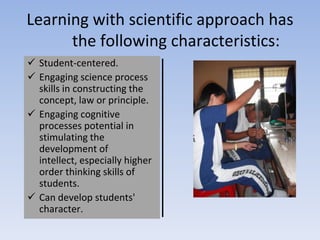


The document discusses the scientific approach to teaching science. It defines science as a self-correcting tool for examining the world, and notes that scientific learning is designed to help students develop concepts, laws, and principles through the scientific method. The document then outlines how the 2013 curriculum incorporates the scientific approach by engaging students' attitudes, knowledge, and skills. It describes three learning models - discovery learning, project based learning, and problem based learning. Finally, it lists the key aspects of scientific behavior and notes that the scientific approach is compatible with constructivist learning theories.


