Multi –levels in science
Presented by
Dr. G S Bhatnagar
Principal,
MIMT college ,Kota
Rajasthan,India
• Science (from Latin scientia, meaning "knowledge") is a
systematic enterprise that builds and
organizes knowledge in the form of testable explanations
and predictions about the universe.
• In an older and closely related meaning, "science" also
refers to a body of knowledge itself, of the type that can be
rationally explained and reliably applied. A practitioner of
science is known as a scientist.
• In modern usage, "science" most often refers to a way of
pursuing knowledge, not only the knowledge itself. It is also
often restricted to those branches of study that seek to
explain the phenomena of the material universe.
• However, "science" has also continued to be used in a
broad sense to denote reliable and teachable knowledge
about a topic, as reflected in modern terms like library
science or computer science.
• This is also reflected in the names of some areas of
academic study such as "social science" or "political
science“.
In the 17th and 18th centuries
scientists increasingly sought to formulate knowledge in terms
of laws of nature such as Newoton’s law of motion.
In the 19th century,
the word "science" became increasingly associated with the
scientific method itself, as a disciplined way to study the
naturalworld,including physics, chemistry, geology and biology.
Over the 19th century
However, "science" has also continued to be used in a broad
sense to denote reliable and teachable knowledge about a topic, as
reflected in modern terms like- library science or computer
science.
This is also reflected in some areas of academic study such
as "social science" or "political science".
The scale of the universe mapped to the
branches of science and the hierarchy of science
• The process of science works at multiple levels —
from the small scale (e.g., study of microrganism) to
the large scale (expedition to the moon).
• The process of science works in much the same way
whether embodied by an individual scientist tackling a
specific problem in the following steps-
1-Hypothesis
2-Experiment
3-Observation
4-Theories
-
Hypotheses are proposed explanations for a fairly
narrow set of phenomena.
When scientists formulate new hypotheses, they are
usually based on prior experience, scientific
background knowledge, preliminary observations, and
logic.
Theories
Theories on the other hand, are broad explanation for
a wide range of phenomena.
They are concise, coherent, systematic, predictive,
and broadly applicable. In fact, theories often integrate
and generalize many hypotheses.
This theory helps us to understand a wide range of,
makes predictions in new situations
(e.g. treating AIDS patients with a cocktail of
medications should slow the evolution of the virus),
and has proven itself time and time again in thousands
of experiments and observational studies.
Theories are powerful explanations for a wide range of
phenomena. Accepted theories are not tenuous.
Some theories are so broad and powerful that they
frame whole disciplines of study and encompass many
smaller hypotheses and theories.
A theory (in the scientific sense of the word) must be
strongly supported by many different lines of evidence .
Over-arching theories
Some theories, are particularly important and reflect broad
understandings of a particular part of the natural world are
known as Over-arching theories
Evolutionary theory, atomic theory, gravity, quantum theory, and
plate tectonics are examples of this sort of over-arching theory.
These theories have been broadly supported by multiple lines of
evidence and help frame our understanding of the world around
us.
Over-arching theories are so important because they help
scientists to choose their methods of study and mode of
reasoning, connect important phenomena in new ways, and
open new areas of study.
For example, evolutionary theory highlighted an entirely new
set of questions for exploration: How did this characteristic
evolve? How are these species related to one another? How has
life changed over time?
A MODEL EXPLANATION
Hypotheses and theories can be complex.
For example, a particular hypothesis about
meteorological interactions or nuclear reactions
might be so complex that it is best described in
the form of a computer program or a long
mathematical equation. In such cases, the
hypothesis or theory may be called a model.
A usual morning routine might include a spritz of hairspray, a
spurt of shaving cream, or a spray of deodorant.
We do these things almost automatically, not really even
thinking about it.
At that time, many normal household items contained CFCs
— a class of chemicals that are made up of combinations of
chlorine (C), fluorine (F), and carbon atoms. Developed in the
1930s under the trade name Freon, they were thought to be
wonder chemicals
EXAMPLE
They are nontoxic, nonflammable,
don't react with any common
chemicals, and thus were assumed
to be safe for the environment.
Aerosols are common, convenient,
and harmless,
Developed in the 1930s under the trade name Freon, they were
thought to be wonder chemicals.
They are nontoxic, nonflammable, don't react with any common
chemicals,
CFCs were used in all kinds of things — refrigerators, Styrofoam,
and aerosols (like hairspray or cleaning supplies), and thus were
assumed to be safe for the environment.
Most uses of CFCs are now banned or severely restricted by the
Montreal Protocol as they have shown to be responsible for ozone
depletion.
Brands of Freon containing hydrofluorocarbons (HFCs) instead have
replaced many uses, but they too are under strict control under the Kyoto
protocol as they are super-greenhouse effect gases.
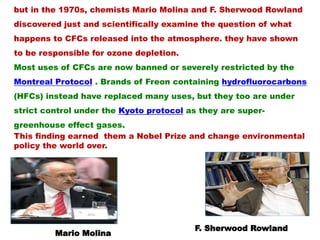
but in the 1970s, chemists Mario Molina and F. Sherwood Rowland
discovered just and scientifically examine the question of what
happens to CFCs released into the atmosphere. they have shown
to be responsible for ozone depletion.
Most uses of CFCs are now banned or severely restricted by the
Montreal Protocol . Brands of Freon containing hydrofluorocarbons
(HFCs) instead have replaced many uses, but they too are under
strict control under the Kyoto protocol as they are super-
greenhouse effect gases.
This finding earned them a Nobel Prize and change environmental
policy the world over.
Mario Molina
F. Sherwood Rowland
Data analysis and interpretation
Science is a community endeavor that benefits from a
diverse and broad range of perspectives, practices,
and technologies.
Science helps us understand how our actions today are
likely to affect future outcomes.
Different scientists can interpret the same data in different
ways.
Scientific ideas evolve with new evidence; however, well-
supported scientific ideas are not tenuous ,they may be
changed or corrected
Even theories change
Accepted theories are the best explanations
available so far for how the world works.
They have been thoroughly tested, are supported
by multiple lines of evidence, and have proved
useful in generating explanations and opening up
new areas for research.
However, science is always
a work in progress, and
even theories change.
• In this section, we've seen that the real process of
science is not much like The Scientific Method
often portrayed in textbooks.
• The real process of science is exciting, iterative,
nonlinear depends upon the scientific community,
and is intertwined with the society at large.
• The real process of science proceeds at multiple
levels and sorts through many ideas, retaining and
building upon those that work. However, despite all
these complications, the core of that process,
checking ideas against evidence from the natural
world, is straightforward.
THANKS

Science and research

  • 1.
    Multi –levels inscience Presented by Dr. G S Bhatnagar Principal, MIMT college ,Kota Rajasthan,India
  • 2.
    • Science (fromLatin scientia, meaning "knowledge") is a systematic enterprise that builds and organizes knowledge in the form of testable explanations and predictions about the universe. • In an older and closely related meaning, "science" also refers to a body of knowledge itself, of the type that can be rationally explained and reliably applied. A practitioner of science is known as a scientist. • In modern usage, "science" most often refers to a way of pursuing knowledge, not only the knowledge itself. It is also often restricted to those branches of study that seek to explain the phenomena of the material universe. • However, "science" has also continued to be used in a broad sense to denote reliable and teachable knowledge about a topic, as reflected in modern terms like library science or computer science. • This is also reflected in the names of some areas of academic study such as "social science" or "political science“.
  • 3.
    In the 17thand 18th centuries scientists increasingly sought to formulate knowledge in terms of laws of nature such as Newoton’s law of motion. In the 19th century, the word "science" became increasingly associated with the scientific method itself, as a disciplined way to study the naturalworld,including physics, chemistry, geology and biology. Over the 19th century However, "science" has also continued to be used in a broad sense to denote reliable and teachable knowledge about a topic, as reflected in modern terms like- library science or computer science. This is also reflected in some areas of academic study such as "social science" or "political science".
  • 4.
    The scale ofthe universe mapped to the branches of science and the hierarchy of science
  • 5.
    • The processof science works at multiple levels — from the small scale (e.g., study of microrganism) to the large scale (expedition to the moon). • The process of science works in much the same way whether embodied by an individual scientist tackling a specific problem in the following steps- 1-Hypothesis 2-Experiment 3-Observation 4-Theories -
  • 6.
    Hypotheses are proposedexplanations for a fairly narrow set of phenomena. When scientists formulate new hypotheses, they are usually based on prior experience, scientific background knowledge, preliminary observations, and logic. Theories Theories on the other hand, are broad explanation for a wide range of phenomena. They are concise, coherent, systematic, predictive, and broadly applicable. In fact, theories often integrate and generalize many hypotheses.
  • 7.
    This theory helpsus to understand a wide range of, makes predictions in new situations (e.g. treating AIDS patients with a cocktail of medications should slow the evolution of the virus), and has proven itself time and time again in thousands of experiments and observational studies. Theories are powerful explanations for a wide range of phenomena. Accepted theories are not tenuous. Some theories are so broad and powerful that they frame whole disciplines of study and encompass many smaller hypotheses and theories. A theory (in the scientific sense of the word) must be strongly supported by many different lines of evidence .
  • 8.
    Over-arching theories Some theories,are particularly important and reflect broad understandings of a particular part of the natural world are known as Over-arching theories Evolutionary theory, atomic theory, gravity, quantum theory, and plate tectonics are examples of this sort of over-arching theory. These theories have been broadly supported by multiple lines of evidence and help frame our understanding of the world around us. Over-arching theories are so important because they help scientists to choose their methods of study and mode of reasoning, connect important phenomena in new ways, and open new areas of study. For example, evolutionary theory highlighted an entirely new set of questions for exploration: How did this characteristic evolve? How are these species related to one another? How has life changed over time?
  • 9.
    A MODEL EXPLANATION Hypothesesand theories can be complex. For example, a particular hypothesis about meteorological interactions or nuclear reactions might be so complex that it is best described in the form of a computer program or a long mathematical equation. In such cases, the hypothesis or theory may be called a model.
  • 10.
    A usual morningroutine might include a spritz of hairspray, a spurt of shaving cream, or a spray of deodorant. We do these things almost automatically, not really even thinking about it. At that time, many normal household items contained CFCs — a class of chemicals that are made up of combinations of chlorine (C), fluorine (F), and carbon atoms. Developed in the 1930s under the trade name Freon, they were thought to be wonder chemicals EXAMPLE They are nontoxic, nonflammable, don't react with any common chemicals, and thus were assumed to be safe for the environment. Aerosols are common, convenient, and harmless,
  • 11.
    Developed in the1930s under the trade name Freon, they were thought to be wonder chemicals. They are nontoxic, nonflammable, don't react with any common chemicals, CFCs were used in all kinds of things — refrigerators, Styrofoam, and aerosols (like hairspray or cleaning supplies), and thus were assumed to be safe for the environment. Most uses of CFCs are now banned or severely restricted by the Montreal Protocol as they have shown to be responsible for ozone depletion. Brands of Freon containing hydrofluorocarbons (HFCs) instead have replaced many uses, but they too are under strict control under the Kyoto protocol as they are super-greenhouse effect gases.
  • 12.
    but in the1970s, chemists Mario Molina and F. Sherwood Rowland discovered just and scientifically examine the question of what happens to CFCs released into the atmosphere. they have shown to be responsible for ozone depletion. Most uses of CFCs are now banned or severely restricted by the Montreal Protocol . Brands of Freon containing hydrofluorocarbons (HFCs) instead have replaced many uses, but they too are under strict control under the Kyoto protocol as they are super- greenhouse effect gases. This finding earned them a Nobel Prize and change environmental policy the world over. Mario Molina F. Sherwood Rowland
  • 13.
    Data analysis andinterpretation Science is a community endeavor that benefits from a diverse and broad range of perspectives, practices, and technologies. Science helps us understand how our actions today are likely to affect future outcomes. Different scientists can interpret the same data in different ways. Scientific ideas evolve with new evidence; however, well- supported scientific ideas are not tenuous ,they may be changed or corrected
  • 14.
    Even theories change Acceptedtheories are the best explanations available so far for how the world works. They have been thoroughly tested, are supported by multiple lines of evidence, and have proved useful in generating explanations and opening up new areas for research. However, science is always a work in progress, and even theories change.
  • 15.
    • In thissection, we've seen that the real process of science is not much like The Scientific Method often portrayed in textbooks. • The real process of science is exciting, iterative, nonlinear depends upon the scientific community, and is intertwined with the society at large. • The real process of science proceeds at multiple levels and sorts through many ideas, retaining and building upon those that work. However, despite all these complications, the core of that process, checking ideas against evidence from the natural world, is straightforward.
  • 16.