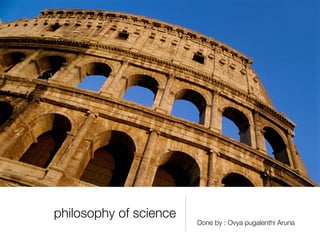
philosophy of science
Done by : Ovya pugalenthi Aruna
Introduction
• Philosophy of science is a sub-field of philosophy
concerned with the foundations, methods, and
implications of science.
• There is no consensus among philosophers about many
of the central problems concerned with the philosophy of
science, including whether science can reveal the truth
about unobservable things and whether scientific
reasoning can be justified at all.
• In addition to these general questions about science as
a whole, philosophers of science consider problems that
apply to particular sciences (such as biology or physics).
• Some philosophers of science also use contemporary
results in science to reach conclusions about philosophy
itself.
• While philosophical thought pertaining to science dates
back at least to the time of Aristotle, general philosophy
of science emerged as a distinct discipline only in the
20th century in the wake of the logical positivist
movement, which aimed to formulate criteria for
ensuring all philosophical statements' meaningfulness
and objectively assessing them.
Defining science
• Distinguishing between science and non-science is
referred to as the demarcation problem. For example,
should psychoanalysis be considered science? How
about creation science, the inflationary multiverse
hypothesis, or macroeconomics? Karl Popper called this
the central question in the philosophy of science.[2]
However, no unified account of the problem has won
acceptance among philosophers, and some regard the
problem as unsolvable or uninteresting
Philosophy and natural science
• The history of philosophy is intertwined with the history
of the natural sciences. Long before the 19th century,
when the term science began to be used with its modern
meaning, those who are now counted among the major
figures in the history of Western philosophy were often
equally famous for their contributions to “natural
philosophy,” the bundle of inquiries now designated as
sciences.
• Aristotle (384–322 BCE) was the first great biologist;
René Descartes (1596–1650) formulated analytic
geometry (“Cartesian geometry”) and discovered the
laws of the reflection and refraction of light.
• Gottfried Wilhelm Leibniz (1646–1716) laid claim to
priority in the invention of the calculus; and Immanuel
Kant (1724–1804) offered the basis of a still-current
hypothesis regarding the formation of the solar
system (the Kant-Laplace nebular hypothesis).
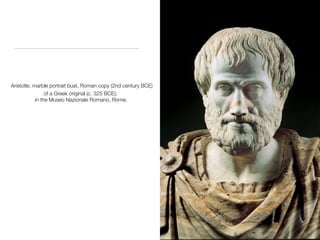
Aristotle, marble portrait bust, Roman copy (2nd century BCE)
of a Greek original (c. 325 BCE);
in the Museo Nazionale Romano, Rome.
Logical positivism and logical empiricism
• A series of developments in early 20th-century philosophy made the
general philosophy of science central to philosophy in the English-
speaking world.
• Inspired by the articulation of mathematical logic, or formal logic, in the
work of the philosophers Gottlob Frege (1848–1925) and Bertrand Russell
(1872–1970) and the mathematician David Hilbert (1862–1943), a group of
European philosophers known as the Vienna Circle attempted to diagnose
the difference between the inconclusive debates that mark the history of
philosophy and the firm accomplishments of the sciences they admired.
• They offered criteria of meaningfulness, or “cognitive significance,” aiming
to demonstrate that traditional philosophical questions (and their proposed
answers) are meaningless.
• The correct task of philosophy, they suggested, is to
formulate a “logic of the sciences” that would be
analogous to the logic of pure mathematics
formulated by Frege, Russell, and Hilbert.
• In the light of logic, they thought, genuinely fruitful
inquiries could be freed from the encumbrances of
traditional philosophy.
Philosophers of science actively study such questions
as:
• What is a law of nature? Are there any in non-physical sciences
like biology and psychology?
• What kind of data can be used to distinguish between real causes
and accidental regularities?
• How much evidence and what kinds of evidence do we need
before we accept hypotheses?
• Why do scientists continue to rely on models and theories which
they know are at least partially inaccurate (like Newton's physics)?
•
• Though the field is highly specialised, a few touchstone
ideas have made their way into the mainstream. Here's a
quick explanation of just a few concepts associated with
the philosophy of science, which you might (or might not)
have encountered.
Epistemology
• A branch of philosophy that deals with what knowledge
is, how we come to accept some things as true, and how
we justify that acceptance.
Empiricism
• Set of philosophical approaches to building knowledge
that emphasizes the importance of observable evidence
from the natural world.
Induction
• Method of reasoning in which a generalization is argued
to be true based on individual examples that seem to fit
with that generalization. For example, after observing that
trees, bacteria, sea anemones, fruit flies, and humans
have cells, one might inductively infer that all organisms
have cells.
Thank you

Philosophy

  • 1.
    philosophy of science Doneby : Ovya pugalenthi Aruna
  • 2.
    Introduction • Philosophy ofscience is a sub-field of philosophy concerned with the foundations, methods, and implications of science. • There is no consensus among philosophers about many of the central problems concerned with the philosophy of science, including whether science can reveal the truth about unobservable things and whether scientific reasoning can be justified at all.
  • 3.
    • In additionto these general questions about science as a whole, philosophers of science consider problems that apply to particular sciences (such as biology or physics). • Some philosophers of science also use contemporary results in science to reach conclusions about philosophy itself. • While philosophical thought pertaining to science dates back at least to the time of Aristotle, general philosophy of science emerged as a distinct discipline only in the 20th century in the wake of the logical positivist movement, which aimed to formulate criteria for ensuring all philosophical statements' meaningfulness and objectively assessing them.
  • 4.
    Defining science • Distinguishingbetween science and non-science is referred to as the demarcation problem. For example, should psychoanalysis be considered science? How about creation science, the inflationary multiverse hypothesis, or macroeconomics? Karl Popper called this the central question in the philosophy of science.[2] However, no unified account of the problem has won acceptance among philosophers, and some regard the problem as unsolvable or uninteresting
  • 5.
    Philosophy and naturalscience • The history of philosophy is intertwined with the history of the natural sciences. Long before the 19th century, when the term science began to be used with its modern meaning, those who are now counted among the major figures in the history of Western philosophy were often equally famous for their contributions to “natural philosophy,” the bundle of inquiries now designated as sciences.
  • 6.
    • Aristotle (384–322BCE) was the first great biologist; René Descartes (1596–1650) formulated analytic geometry (“Cartesian geometry”) and discovered the laws of the reflection and refraction of light. • Gottfried Wilhelm Leibniz (1646–1716) laid claim to priority in the invention of the calculus; and Immanuel Kant (1724–1804) offered the basis of a still-current hypothesis regarding the formation of the solar system (the Kant-Laplace nebular hypothesis).
  • 7.
    Aristotle, marble portraitbust, Roman copy (2nd century BCE) of a Greek original (c. 325 BCE); in the Museo Nazionale Romano, Rome.
  • 8.
    Logical positivism andlogical empiricism • A series of developments in early 20th-century philosophy made the general philosophy of science central to philosophy in the English- speaking world. • Inspired by the articulation of mathematical logic, or formal logic, in the work of the philosophers Gottlob Frege (1848–1925) and Bertrand Russell (1872–1970) and the mathematician David Hilbert (1862–1943), a group of European philosophers known as the Vienna Circle attempted to diagnose the difference between the inconclusive debates that mark the history of philosophy and the firm accomplishments of the sciences they admired. • They offered criteria of meaningfulness, or “cognitive significance,” aiming to demonstrate that traditional philosophical questions (and their proposed answers) are meaningless.
  • 9.
    • The correcttask of philosophy, they suggested, is to formulate a “logic of the sciences” that would be analogous to the logic of pure mathematics formulated by Frege, Russell, and Hilbert. • In the light of logic, they thought, genuinely fruitful inquiries could be freed from the encumbrances of traditional philosophy.
  • 10.
    Philosophers of scienceactively study such questions as: • What is a law of nature? Are there any in non-physical sciences like biology and psychology? • What kind of data can be used to distinguish between real causes and accidental regularities? • How much evidence and what kinds of evidence do we need before we accept hypotheses? • Why do scientists continue to rely on models and theories which they know are at least partially inaccurate (like Newton's physics)? •
  • 11.
    • Though thefield is highly specialised, a few touchstone ideas have made their way into the mainstream. Here's a quick explanation of just a few concepts associated with the philosophy of science, which you might (or might not) have encountered.
  • 12.
    Epistemology • A branchof philosophy that deals with what knowledge is, how we come to accept some things as true, and how we justify that acceptance.
  • 13.
    Empiricism • Set ofphilosophical approaches to building knowledge that emphasizes the importance of observable evidence from the natural world.
  • 14.
    Induction • Method ofreasoning in which a generalization is argued to be true based on individual examples that seem to fit with that generalization. For example, after observing that trees, bacteria, sea anemones, fruit flies, and humans have cells, one might inductively infer that all organisms have cells.
  • 15.