Chapter:  The Nature of Science    and Technology Table of Contents Section 3:  Science and Technology Section 1:  What is science? Section 2:  Doing Science
Science  is a way or a process used to investigate what is happening around you.   It can provide answers to many questions. Tools, such as thermometers and metersticks, are used to give numbers to descriptions.   Science in Society What is science? 1 Scientists observe, investigate, and experiment to find answers.
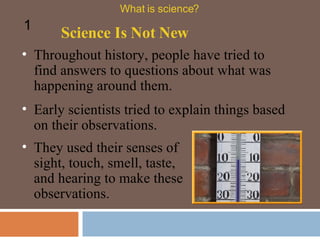
Throughout history, people have tried to find answers to questions about what was happening around them.  Early scientists tried to explain things based on their observations.  Science Is Not New What is science? 1 They used their senses of sight, touch, smell, taste, and hearing to make these observations.
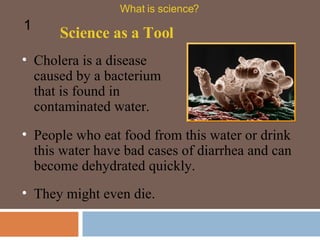
Cholera is a disease caused by a bacterium that is found in contaminated water.  People who eat food from this water or drink this water have bad cases of diarrhea and can become dehydrated quickly.  Science as a Tool What is science? 1 They might even die.
E. Coli  is another type of bacterium that can contaminate modern food and water supplies.  Some types of  E. Coli  are harmless, but others cause intestinal problems when contaminated food and water are consumed.  Science as a Tool What is science? 1 Science can be used to compare how people tracked down the source of the cholera in 1871 with how they track down the source of the  E. Coli  now.
People in the past followed clues to track the source of cholera epidemics and solve their problem.  Using Science Every Day—Scientists Use Clues What is science? 1 Today, scientists do the same thing by finding and following clues to track the source of  E. Coli  in food and water supplies.
Scientists use prior experience to predict what will occur in investigations.  Using Prior Knowledge What is science? 1 Scientists form theories when their predictions have been well tested. A theory is an explanation that is supported by facts.  Scientists also form laws, which are rules that describe a pattern in nature, like gravity.
Scientists use skills and tools to find the similarities and differences.  Using Science and Technology What is science? 1 They use a variety of resource materials to find information.
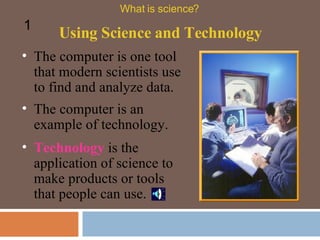
Using Science and Technology What is science? 1 The computer is one tool that modern scientists use to find and analyze data.  The computer is an example of technology.  Technology  is the application of science to make products or tools that people can use.
Doctors and scientists use skills such as observing, classifying, and interpreting data.  Science Skills What is science? 1
Sometimes observation alone does not provide a complete picture of what is happening.  Observation and Measurement What is science? 1 To ensure that your data are useful, accurate measurements must be taken, in addition to making careful observations.
Observation and Measurement What is science? 1 Comparing and contrasting are other important skills.  When scientists look for similarities among data, they compare them.  Contrasting the data is looking for differences.
The results of observations, experiments, and investigations are not of use to the rest of the world unless they are shared.  Communication in Science What is science? 1 Scientists use several methods to communicate their observations.
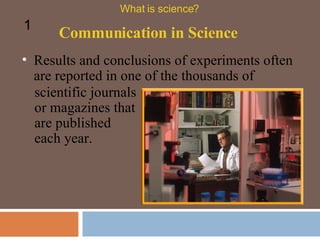
Communication in Science What is science? 1 Results and conclusions of experiments often are reported in one of the thousands of scientific journals or magazines that are published each year.
Another method to communicate scientific data and results is to keep a Science Journal.  Science Journal What is science? 1 Observations and plans for investigations can be recorded, along with the step-by-step procedures that were followed.  Listings of materials and drawings of how equipment was set up should be in a journal, along with the specific results of an investigation.
You should record mathematical measurements or formulas that were used to analyze the data.  Science Journal What is science? 1 Problems that occurred and questions that came up during the investigation should be noted, as well as any possible solutions. Your data might be summarized in the form of tables, charts, or graphs, or they might be recorded in a paragraph.
Solving Problems—Identify the Problem Although the investigation of each problem is different, scientists use some steps in all investigations.  Scientists first make sure that everyone working to solve the problem has a clear understanding of the problem.  Sometimes, scientists find that the problem is easy to identify or that several problems need to be solved.  Doing Science 2
How can the problem be solved? Two of the methods used to answer questions are descriptive research and experimental research design.  Descriptive research  answers scientific questions through observation.  Experimental research design  is used to answer scientific questions by testing a hypothesis through the use of a series of carefully controlled steps.  Doing Science 2
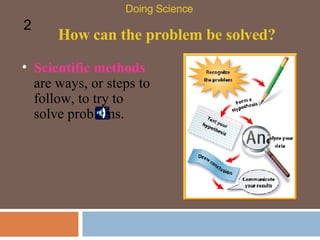
How can the problem be solved? Scientific methods  are ways, or steps to follow, to try to solve problems.  Doing Science 2
Descriptive Research Some scientific problems can be solved, or questions answered, by using descriptive research.  Doing Science 2 Descriptive research is based mostly on observations.  Descriptive research can be used in investigations when experiments would be impossible to perform.  Descriptive research usually involves the following steps.
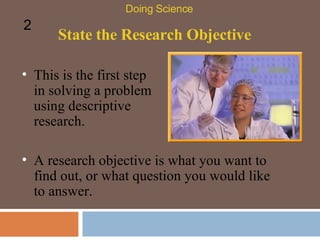
State the Research Objective This is the first step in solving a problem using descriptive research.  Doing Science 2 A research objective is what you want to find out, or what question you would like to answer.
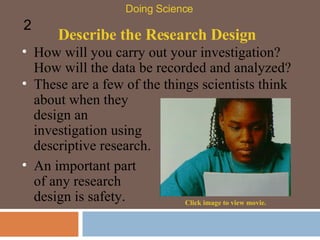
Describe the Research Design How will you carry out your investigation? How will the data be recorded and analyzed?  Doing Science 2 An important part of any research design is safety. Click image to view movie. These are a few of the things scientists think about when they design an investigation using descriptive research.
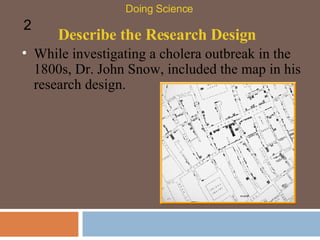
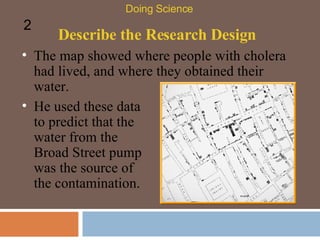
Describe the Research Design While investigating a cholera outbreak in the 1800s, Dr. John Snow, included the map in his research design.  Doing Science 2
Describe the Research Design Doing Science 2 He used these data to predict that the water from the Broad Street pump was the source of the contamination.  The map showed where people with cholera had lived, and where they obtained their water.
Eliminate Bias Sometimes, scientists might expect certain results. This is known as bias.  Doing Science 2 Good investigations avoid bias.  One way to avoid bias is to use careful numerical measurements for all data.  Another type of bias can occur in surveys or groups that are chosen for investigations.  To get an accurate result, you need to use a random sample.
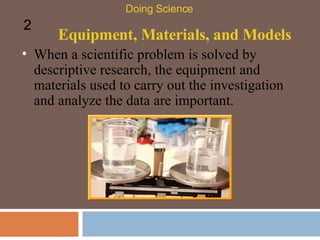
Equipment, Materials, and Models When a scientific problem is solved by descriptive research, the equipment and materials used to carry out the investigation and analyze the data are important.  Doing Science 2
Selecting Your Materials Scientists try to use the most up-to-date materials available to them.  Doing Science 2 If possible, you should use scientific equipment such as balances, spring sales, microscopes, and metric measurements when performing investigations and gathering data.
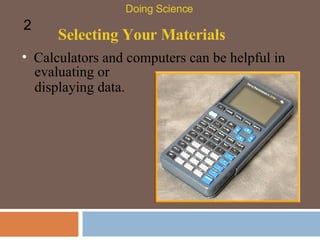
Selecting Your Materials Doing Science 2 Calculators and computers can be helpful in evaluating or displaying data.
Selecting Your Materials However, you don’t have to have the latest or most expensive materials and tools to conduct good scientific investigations.  Doing Science 2 Your investigations can be completed successfully and the data displayed with materials found in your home or classroom.  An organized presentation of data is as effective as a computer graphic or an extravagant display.
Using Models One part of carrying out the investigation plan might include making or using scientific models.  Doing Science 2 In science, a  model  represents things that happen too slowly, too quickly, or are too big or too small to observe directly.  Models also are useful in situations in which direct observation would be too dangerous or expensive.
Using Models Dr. John Snow’s map of the cholera epidemic was a model that allowed him to predict possible sources of the epidemic.  Doing Science 2 Many kinds of models are made on computers. Graphs, tables, and spreadsheets are models that display information.
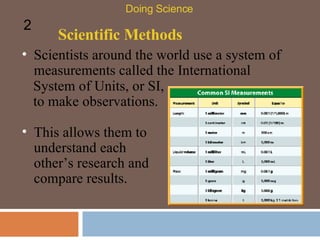
Scientific Methods Doing Science 2 This allows them to understand each other’s research and compare results.  Scientists around the world use a system of measurements called the International System of Units, or SI, to make observations.
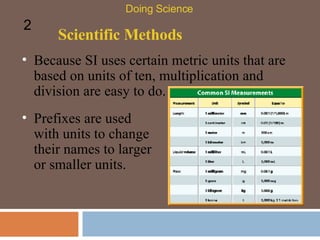
Scientific Methods Because SI uses certain metric units that are based on units of ten, multiplication and division are easy to do.  Doing Science 2 Prefixes are used with units to change their names to larger or smaller units.
Data—Designing Your Data Tables A well-planned investigation includes ways to record results and observations accurately.  Doing Science 2 Data tables are one way to do this.
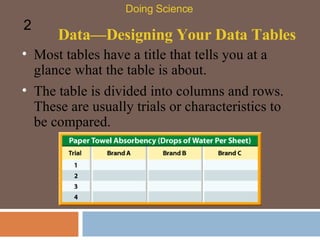
Data—Designing Your Data Tables Doing Science 2 Most tables have a title that tells you at a glance what the table is about.  The table is divided into columns and rows.  These are usually trials or characteristics to be compared.
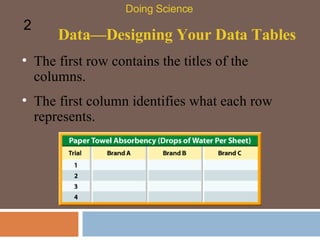
Data—Designing Your Data Tables Doing Science 2 The first row contains the titles of the columns.  The first column identifies what each row represents.
Analyze Your Data Your data must be organized to analyze them.  Doing Science 2 Charts and graphs are excellent ways to organize data.  You can draw the charts and graphs or use a computer to make them.
Draw Conclusions After you have organized your data, you are ready to draw a conclusion.  Doing Science 2 Sometimes, your data are not what you expected, but remember, scientists understand that it is important to know when something doesn’t work.  A successful investigation is not always the one that comes out the way you originally predicted.
Communicating Your Results Every investigation begins because a problem needs to be solved. Doing Science 2 Analyzing data and drawing conclusions are the end of the investigation. Usually, scientists communicate their results to other scientists, government agencies, private industries, or the public. Scientists usually publish their most important findings.
Communicating Your Results You can communicate your data and conclusions to other members of your science class.  Doing Science 2 Organized data and careful analysis will enable you to answer most questions and to discuss your work confidently.  Analyzing and sharing data are important parts of descriptive and experimental research.
Experimental Research Design Another way to solve scientific problems is through experimentation.  Doing Science 2 Experimental research design answers scientific questions by observation of a controlled situation.  Experimental research design includes several steps.
Form a Hypothesis A  hypothesis  (hi PAH thuh sus) is a prediction, or statement, that can be tested.  Doing Science 2 You use your prior knowledge, new information, and any previous observations to form a hypothesis.
Variables In well-planned experiments, one factor, or variable, is changed at a time.  Doing Science 2 This means that the variable is controlled.  The variable that is changed is called the  independent variable .  A  dependant variable  is the factor being measured.
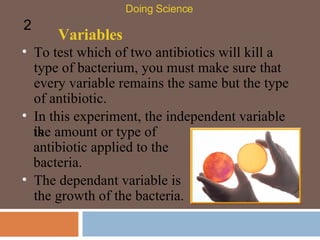
Variables To test which of two antibiotics will kill a type of bacterium, you must make sure that every variable remains the same but the type of antibiotic.  Doing Science 2 The dependant variable is the growth of the bacteria.  In this experiment, the independent variable is the amount or type of antibiotic applied to the bacteria.
Variables The variables that stay the same are called  constants .  Doing Science 2 You cannot run the experiments at two different room temperatures, for different lengths of time, or with different amounts of antibiotics.
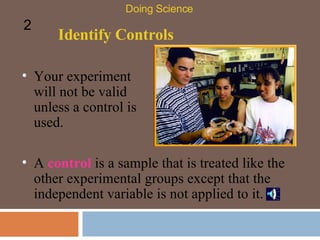
Identify Controls Your experiment will not be valid unless a control is used.  Doing Science 2 A  control  is a sample that is treated like the other experimental groups except that the independent variable is not applied to it.
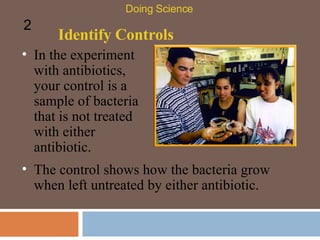
Identify Controls Doing Science 2 In the experiment with antibiotics, your control is a sample of bacteria that is not treated with either antibiotic. The control shows how the bacteria grow when left untreated by either antibiotic.
Identify Controls Once you begin an experiment, make sure to carry it out as planned.  Doing Science 2 Don’t skip or change steps in the middle. Also, you should record your observations and complete your data tables in a timely manner.  Incomplete observations and reports result in data that are difficult to analyze and threaten the accuracy of your conclusions.
Number of Trials Experiments done the same way do not always have the same results. Doing Science 2 To make sure that your results are valid, you need to conduct several trials of your experiment.  Multiple trials mean that an unusual outcome of the experiment won’t be considered the true result.  The more trials you do using the same methods, the more likely it is that your results will be reliable and repeatable.
Analyze Your Results When you analyze your results, you can see if your data support your hypothesis.  Doing Science 2 If the data do not support your original hypothesis, you can still learn from the experiment.  Experiments that don’t work out as you had planned can still provide valuable information.  Professional scientists rarely have results that support their hypothesis without completing numerous trials first.
Analyze Your Results After your results are analyzed, you can communicate them to your teacher and your class.  Doing Science 2 Sharing the results of experiments allows you to hear new ideas from other students that might improve your research.  Your results might contain information that will be helpful to other students.
Scientific Discoveries New discoveries constantly lead to new products that influence your lifestyle or standard of living.  In the last 100 years, technological advances have enabled environments to move from live stage shows to large movie screens.  Science and Technology 3
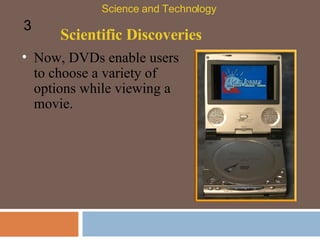
Scientific Discoveries Science and Technology 3 Now, DVDs enable users to choose a variety of options while viewing a movie.
Technological Advances Technology also makes your life more convenient.  Foods can be prepared quickly in microwave ovens, and hydraulic tools make construction work easier and faster.  Science and Technology 3 New discoveries influence other areas of your life as well, including your health.  A disease might be controlled by a skin patch that releases a constant dose of medicine into your body.
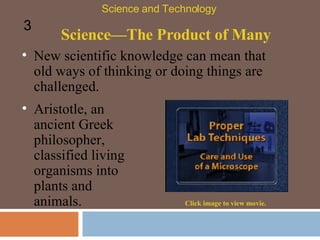
Science—The Product of Many New scientific knowledge can mean that old ways of thinking or doing things are challenged.  Science and Technology 3 Aristotle, an ancient Greek philosopher, classified living organisms into plants and animals.  Click image to view movie.
Science—The Product of Many This system worked until new tools, such as the microscope, enabled scientists to study organisms in greater detail.  Science and Technology 3 The new information changed how scientists viewed the living world.  The current classification system will be used only as long as it continues to answer questions scientists have or until a new discovery enables them to look at information in a different way.
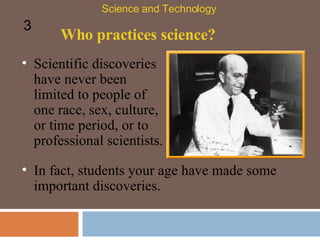
Who practices science? Scientific discoveries have never been limited to people of one race, sex, culture, or time period, or to professional scientists.  Science and Technology 3 In fact, students your age have made some important discoveries.
Use of Scientific Information Science provides new information every day that people use to make decisions.  Science and Technology 3 However, science cannot decide whether the new information is good or bad, moral or immoral.  People decide whether the new information is used to help or harm the world and its inhabitants.
Looking to the Future Today’s scientists use cellular phones and computers to communicate with each other.  Science and Technology 3 This  information technology  has led to the globalization, or worldwide distribution, of information.

01 Chapter Notes

  • 1.
    Chapter: TheNature of Science and Technology Table of Contents Section 3: Science and Technology Section 1: What is science? Section 2: Doing Science
  • 2.
    Science isa way or a process used to investigate what is happening around you. It can provide answers to many questions. Tools, such as thermometers and metersticks, are used to give numbers to descriptions. Science in Society What is science? 1 Scientists observe, investigate, and experiment to find answers.
  • 3.
    Throughout history, peoplehave tried to find answers to questions about what was happening around them. Early scientists tried to explain things based on their observations. Science Is Not New What is science? 1 They used their senses of sight, touch, smell, taste, and hearing to make these observations.
  • 4.
    Cholera is adisease caused by a bacterium that is found in contaminated water. People who eat food from this water or drink this water have bad cases of diarrhea and can become dehydrated quickly. Science as a Tool What is science? 1 They might even die.
  • 5.
    E. Coli is another type of bacterium that can contaminate modern food and water supplies. Some types of E. Coli are harmless, but others cause intestinal problems when contaminated food and water are consumed. Science as a Tool What is science? 1 Science can be used to compare how people tracked down the source of the cholera in 1871 with how they track down the source of the E. Coli now.
  • 6.
    People in thepast followed clues to track the source of cholera epidemics and solve their problem. Using Science Every Day—Scientists Use Clues What is science? 1 Today, scientists do the same thing by finding and following clues to track the source of E. Coli in food and water supplies.
  • 7.
    Scientists use priorexperience to predict what will occur in investigations. Using Prior Knowledge What is science? 1 Scientists form theories when their predictions have been well tested. A theory is an explanation that is supported by facts. Scientists also form laws, which are rules that describe a pattern in nature, like gravity.
  • 8.
    Scientists use skillsand tools to find the similarities and differences. Using Science and Technology What is science? 1 They use a variety of resource materials to find information.
  • 9.
    Using Science andTechnology What is science? 1 The computer is one tool that modern scientists use to find and analyze data. The computer is an example of technology. Technology is the application of science to make products or tools that people can use.
  • 10.
    Doctors and scientistsuse skills such as observing, classifying, and interpreting data. Science Skills What is science? 1
  • 11.
    Sometimes observation alonedoes not provide a complete picture of what is happening. Observation and Measurement What is science? 1 To ensure that your data are useful, accurate measurements must be taken, in addition to making careful observations.
  • 12.
    Observation and MeasurementWhat is science? 1 Comparing and contrasting are other important skills. When scientists look for similarities among data, they compare them. Contrasting the data is looking for differences.
  • 13.
    The results ofobservations, experiments, and investigations are not of use to the rest of the world unless they are shared. Communication in Science What is science? 1 Scientists use several methods to communicate their observations.
  • 14.
    Communication in ScienceWhat is science? 1 Results and conclusions of experiments often are reported in one of the thousands of scientific journals or magazines that are published each year.
  • 15.
    Another method tocommunicate scientific data and results is to keep a Science Journal. Science Journal What is science? 1 Observations and plans for investigations can be recorded, along with the step-by-step procedures that were followed. Listings of materials and drawings of how equipment was set up should be in a journal, along with the specific results of an investigation.
  • 16.
    You should recordmathematical measurements or formulas that were used to analyze the data. Science Journal What is science? 1 Problems that occurred and questions that came up during the investigation should be noted, as well as any possible solutions. Your data might be summarized in the form of tables, charts, or graphs, or they might be recorded in a paragraph.
  • 17.
    Solving Problems—Identify theProblem Although the investigation of each problem is different, scientists use some steps in all investigations. Scientists first make sure that everyone working to solve the problem has a clear understanding of the problem. Sometimes, scientists find that the problem is easy to identify or that several problems need to be solved. Doing Science 2
  • 18.
    How can theproblem be solved? Two of the methods used to answer questions are descriptive research and experimental research design. Descriptive research answers scientific questions through observation. Experimental research design is used to answer scientific questions by testing a hypothesis through the use of a series of carefully controlled steps. Doing Science 2
  • 19.
    How can theproblem be solved? Scientific methods are ways, or steps to follow, to try to solve problems. Doing Science 2
  • 20.
    Descriptive Research Somescientific problems can be solved, or questions answered, by using descriptive research. Doing Science 2 Descriptive research is based mostly on observations. Descriptive research can be used in investigations when experiments would be impossible to perform. Descriptive research usually involves the following steps.
  • 21.
    State the ResearchObjective This is the first step in solving a problem using descriptive research. Doing Science 2 A research objective is what you want to find out, or what question you would like to answer.
  • 22.
    Describe the ResearchDesign How will you carry out your investigation? How will the data be recorded and analyzed? Doing Science 2 An important part of any research design is safety. Click image to view movie. These are a few of the things scientists think about when they design an investigation using descriptive research.
  • 23.
    Describe the ResearchDesign While investigating a cholera outbreak in the 1800s, Dr. John Snow, included the map in his research design. Doing Science 2
  • 24.
    Describe the ResearchDesign Doing Science 2 He used these data to predict that the water from the Broad Street pump was the source of the contamination. The map showed where people with cholera had lived, and where they obtained their water.
  • 25.
    Eliminate Bias Sometimes,scientists might expect certain results. This is known as bias. Doing Science 2 Good investigations avoid bias. One way to avoid bias is to use careful numerical measurements for all data. Another type of bias can occur in surveys or groups that are chosen for investigations. To get an accurate result, you need to use a random sample.
  • 26.
    Equipment, Materials, andModels When a scientific problem is solved by descriptive research, the equipment and materials used to carry out the investigation and analyze the data are important. Doing Science 2
  • 27.
    Selecting Your MaterialsScientists try to use the most up-to-date materials available to them. Doing Science 2 If possible, you should use scientific equipment such as balances, spring sales, microscopes, and metric measurements when performing investigations and gathering data.
  • 28.
    Selecting Your MaterialsDoing Science 2 Calculators and computers can be helpful in evaluating or displaying data.
  • 29.
    Selecting Your MaterialsHowever, you don’t have to have the latest or most expensive materials and tools to conduct good scientific investigations. Doing Science 2 Your investigations can be completed successfully and the data displayed with materials found in your home or classroom. An organized presentation of data is as effective as a computer graphic or an extravagant display.
  • 30.
    Using Models Onepart of carrying out the investigation plan might include making or using scientific models. Doing Science 2 In science, a model represents things that happen too slowly, too quickly, or are too big or too small to observe directly. Models also are useful in situations in which direct observation would be too dangerous or expensive.
  • 31.
    Using Models Dr.John Snow’s map of the cholera epidemic was a model that allowed him to predict possible sources of the epidemic. Doing Science 2 Many kinds of models are made on computers. Graphs, tables, and spreadsheets are models that display information.
  • 32.
    Scientific Methods DoingScience 2 This allows them to understand each other’s research and compare results. Scientists around the world use a system of measurements called the International System of Units, or SI, to make observations.
  • 33.
    Scientific Methods BecauseSI uses certain metric units that are based on units of ten, multiplication and division are easy to do. Doing Science 2 Prefixes are used with units to change their names to larger or smaller units.
  • 34.
    Data—Designing Your DataTables A well-planned investigation includes ways to record results and observations accurately. Doing Science 2 Data tables are one way to do this.
  • 35.
    Data—Designing Your DataTables Doing Science 2 Most tables have a title that tells you at a glance what the table is about. The table is divided into columns and rows. These are usually trials or characteristics to be compared.
  • 36.
    Data—Designing Your DataTables Doing Science 2 The first row contains the titles of the columns. The first column identifies what each row represents.
  • 37.
    Analyze Your DataYour data must be organized to analyze them. Doing Science 2 Charts and graphs are excellent ways to organize data. You can draw the charts and graphs or use a computer to make them.
  • 38.
    Draw Conclusions Afteryou have organized your data, you are ready to draw a conclusion. Doing Science 2 Sometimes, your data are not what you expected, but remember, scientists understand that it is important to know when something doesn’t work. A successful investigation is not always the one that comes out the way you originally predicted.
  • 39.
    Communicating Your ResultsEvery investigation begins because a problem needs to be solved. Doing Science 2 Analyzing data and drawing conclusions are the end of the investigation. Usually, scientists communicate their results to other scientists, government agencies, private industries, or the public. Scientists usually publish their most important findings.
  • 40.
    Communicating Your ResultsYou can communicate your data and conclusions to other members of your science class. Doing Science 2 Organized data and careful analysis will enable you to answer most questions and to discuss your work confidently. Analyzing and sharing data are important parts of descriptive and experimental research.
  • 41.
    Experimental Research DesignAnother way to solve scientific problems is through experimentation. Doing Science 2 Experimental research design answers scientific questions by observation of a controlled situation. Experimental research design includes several steps.
  • 42.
    Form a HypothesisA hypothesis (hi PAH thuh sus) is a prediction, or statement, that can be tested. Doing Science 2 You use your prior knowledge, new information, and any previous observations to form a hypothesis.
  • 43.
    Variables In well-plannedexperiments, one factor, or variable, is changed at a time. Doing Science 2 This means that the variable is controlled. The variable that is changed is called the independent variable . A dependant variable is the factor being measured.
  • 44.
    Variables To testwhich of two antibiotics will kill a type of bacterium, you must make sure that every variable remains the same but the type of antibiotic. Doing Science 2 The dependant variable is the growth of the bacteria. In this experiment, the independent variable is the amount or type of antibiotic applied to the bacteria.
  • 45.
    Variables The variablesthat stay the same are called constants . Doing Science 2 You cannot run the experiments at two different room temperatures, for different lengths of time, or with different amounts of antibiotics.
  • 46.
    Identify Controls Yourexperiment will not be valid unless a control is used. Doing Science 2 A control is a sample that is treated like the other experimental groups except that the independent variable is not applied to it.
  • 47.
    Identify Controls DoingScience 2 In the experiment with antibiotics, your control is a sample of bacteria that is not treated with either antibiotic. The control shows how the bacteria grow when left untreated by either antibiotic.
  • 48.
    Identify Controls Onceyou begin an experiment, make sure to carry it out as planned. Doing Science 2 Don’t skip or change steps in the middle. Also, you should record your observations and complete your data tables in a timely manner. Incomplete observations and reports result in data that are difficult to analyze and threaten the accuracy of your conclusions.
  • 49.
    Number of TrialsExperiments done the same way do not always have the same results. Doing Science 2 To make sure that your results are valid, you need to conduct several trials of your experiment. Multiple trials mean that an unusual outcome of the experiment won’t be considered the true result. The more trials you do using the same methods, the more likely it is that your results will be reliable and repeatable.
  • 50.
    Analyze Your ResultsWhen you analyze your results, you can see if your data support your hypothesis. Doing Science 2 If the data do not support your original hypothesis, you can still learn from the experiment. Experiments that don’t work out as you had planned can still provide valuable information. Professional scientists rarely have results that support their hypothesis without completing numerous trials first.
  • 51.
    Analyze Your ResultsAfter your results are analyzed, you can communicate them to your teacher and your class. Doing Science 2 Sharing the results of experiments allows you to hear new ideas from other students that might improve your research. Your results might contain information that will be helpful to other students.
  • 52.
    Scientific Discoveries Newdiscoveries constantly lead to new products that influence your lifestyle or standard of living. In the last 100 years, technological advances have enabled environments to move from live stage shows to large movie screens. Science and Technology 3
  • 53.
    Scientific Discoveries Scienceand Technology 3 Now, DVDs enable users to choose a variety of options while viewing a movie.
  • 54.
    Technological Advances Technologyalso makes your life more convenient. Foods can be prepared quickly in microwave ovens, and hydraulic tools make construction work easier and faster. Science and Technology 3 New discoveries influence other areas of your life as well, including your health. A disease might be controlled by a skin patch that releases a constant dose of medicine into your body.
  • 55.
    Science—The Product ofMany New scientific knowledge can mean that old ways of thinking or doing things are challenged. Science and Technology 3 Aristotle, an ancient Greek philosopher, classified living organisms into plants and animals. Click image to view movie.
  • 56.
    Science—The Product ofMany This system worked until new tools, such as the microscope, enabled scientists to study organisms in greater detail. Science and Technology 3 The new information changed how scientists viewed the living world. The current classification system will be used only as long as it continues to answer questions scientists have or until a new discovery enables them to look at information in a different way.
  • 57.
    Who practices science?Scientific discoveries have never been limited to people of one race, sex, culture, or time period, or to professional scientists. Science and Technology 3 In fact, students your age have made some important discoveries.
  • 58.
    Use of ScientificInformation Science provides new information every day that people use to make decisions. Science and Technology 3 However, science cannot decide whether the new information is good or bad, moral or immoral. People decide whether the new information is used to help or harm the world and its inhabitants.
  • 59.
    Looking to theFuture Today’s scientists use cellular phones and computers to communicate with each other. Science and Technology 3 This information technology has led to the globalization, or worldwide distribution, of information.