Math in Science
Research on Science disciplines
Teaching: An effective key to self-learning
This project is funded by European Union.
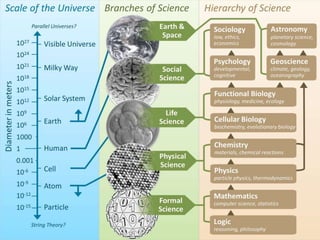
Branches of Science
• The branches of science (also referred to as "sciences",
"scientific fields", or "scientific disciplines") are
commonly divided into four major groups:
• Natural sciences, which study natural phenomena
(including fundamental forces and biological life)
• Formal sciences (such as mathematics and logic, which
use an a priori, as opposed to factual, methodology)
• Social sciences, which study human behaviour and
societies
• Applied sciences, which apply existing scientific
knowledge to develop more practical applications, like
technology or inventions.
Empirical Sciences
Empirical sciences are the natural sciences and
social sciences.
What is the meaning of the word empirical?
It means that the knowledge must be based on
observable phenomena and must be capable of
being verified by other researchers working
under the same conditions.
Fundamental Sciences
Natural science, social science, and formal
science make up the fundamental sciences.
They form the basis of interdisciplinary and
applied sciences such as engineering and
medicine.
Specialized scientific disciplines that exist in
multiple categories may include parts of other
scientific disciplines but often possess their own
terminologies and expertises.
Natural Science
Natural science is a branch of science that seeks the
rules that govern the natural world. Natural science
applies an empirical and scientific method to the
study of the universe. The term natural sciences is
used to distinguish it from the social sciences,
which apply the scientific method to study human
behavior and social patterns; the humanities, which
use a critical, or analytical approach to the study of
the human condition; and the formal sciences.
Physical Science
Physical science is an encompassing term for the
branches of natural science and science that
study non-living systems, in contrast to the life
sciences. However, the term "physical" creates
an unintended, somewhat arbitrary distinction,
since many branches of physical science also
study biological phenomena. There is a
difference between physical science and physics.
Physics
Physics is a natural science. It studies energy, force, and matter and
its motion in time. More broadly, it is the general analysis of nature,
conducted in order to understand how the universe behaves.
Physics is one of the oldest academic disciplines, perhaps the oldest
through its inclusion of astronomy. It was a part of natural
philosophy along with chemistry, certain branches of mathematics,
and biology. During the Scientific Revolution in the 16th century,
the natural sciences emerged as unique research programs in their
own right. Certain research areas are interdisciplinary, such
as biophysics and quantum chemistry, which means that the
boundaries of physics are not rigidly defined.
In the nineteenth and twentieth centuries physicalism emerged as a
major unifying feature of the philosophy of science as physics
provides fundamental explanations for every observed natural
phenomenon. New ideas in physics often explain the fundamental
mechanisms of other sciences, while opening to new research areas
in mathematics and philosophy.
Chemistry
Chemistry is the science of matter and the changes it undergoes. The
science of matter is also addressed by physics, but while physics takes
a more general and fundamental approach, chemistry is more
specialized, being concerned with the composition, behavior (or
reaction), structure, and properties of matter, as well as the changes it
undergoes during chemical reactions.
Chemistry studies various substances, atoms, molecules, and matter
(especially carbon based).
- biochemistry studies substances found in biological organisms
- physical chemistry studies chemical processes using physical
concepts such as thermodynamics and quantum mechanics
- analytical chemistry analyses material samples to gain an
understanding of their chemical composition and structure.
Many more specialized disciplines have emerged in recent years,
e.g. neurochemistry which studies chemistry of the nervous system.
Earth Science
Earth science (also known as geoscience) is related to
the planet Earth. It is a special case in planetary science
because the Earth is the only known life-bearing planet.
There are both reductionist and holistic approaches to
Earth sciences. The formal discipline of Earth sciences
may include the study of the atmosphere, hydrosphere,
oceans and biosphere, as well as the solid earth.
Typically Earth scientists will use tools from physics,
chemistry, biology, geography, chronology and of
course mathematics to build a quantitative
understanding of how the Earth system works, and how
it evolved to its current state.
Ecology
Ecology is the scientific study of the
relationships that living organisms have with
each other and with their abiotic environment.
Topics of interest to ecologists include the
composition, distribution, amount (biomass),
number, and changing states of organisms
within and among ecosystems.
Oceanography
Oceanography, or marine science, is the branch
of Earth science that studies the ocean. It covers
a wide range of topics, including marine
organisms and ecosystem dynamics; ocean
currents, waves, and geophysical fluid dynamics;
plate tectonics and the geology of the sea floor;
and fluxes of various chemical substances and
physical properties within the ocean and across
its boundaries. Oceanographers study the world
ocean and processes within it, they use many
disciplines: biology, chemistry, geology,
meteorology, and physics as well as geography.
Geology
Geology is the science which study solid Earth, the rocks of
which it is composed, and the processes by which they
change. Geology can also refer generally to the study of the
solid features of any celestial body (such as the geology of
the Moon or geology of Mars).
Geology gives insight into the history of the Earth, as it
provides the primary evidence for plate tectonics, the
evolutionary history of life, and past climates. In modern
times, geology is commercially important for mineral and
hydrocarbon exploration and exploitation and for
evaluating water resources. It is publicly important for the
prediction and understanding of natural hazards, the
remediation of environmental problems, and for providing
insights into past climate change. Geology plays a role
in geotechnical engineering and is a major academic
discipline.
Meteorology
Meteorology is the interdisciplinary scientific
study of the atmosphere. Studies in the field
started thousands years ago but significant
progress in meteorology did not occur until the
18th century. In the 19th century, observing
networks were developed across several
countries. After the development of the
computer in the latter half of the 20th century,
breakthroughs in weather forecasting were
achieved.
Space Science (Astronomy)
Space science is the study of everything in outer
space. This was called astronomy, but recently
astronomy became one part of broader space
science, which includes other related fields.
Space science studies also space travel and
space exploration (including space medicine),
space archaeology and science performed
in outer space (see space research).
Life Science
Life science studies living organisms, like plants,
animals, and human beings. However, the study
of behavior of organisms, such as practiced in
ethology and psychology, is only included in as
much as it involves a clearly biological aspect.
While biology remains the centerpiece of life
science, technological advances in molecular
biology and biotechnology have led to new
specializations and new interdisciplinary fields.
Biology
Biology is the branch of natural science which is
concerned with the study of life and living
organisms, including their structure, function,
growth, origin, evolution, distribution, and
taxonomy. Biology is a vast subject containing
many subdivisions, topics, and disciplines.
Zoology
Zoology is the branch of biology that relates to
the animal kingdom, including the structure,
embryology, evolution, classification, habits, and
distribution of all animals, both living and
extinct.
Human biology
Human biology is an interdisciplinary academic
field of biology, biological anthropology, nutrition
and medicine which focuses on humans. It is
closely related to primate biology, and a number
of other fields.
Some branches of biology include:
microbiology, anatomy, genetics, psychology,
immunology, physiology, pathology, biophysics,
ophthalmology, neurology and neuroscience.
Botany
Botany is a branch of biology that involves the
scientific study of plant life. Botany covers a
wide range of scientific disciplines including
structure, growth, reproduction, metabolism,
development, diseases, chemical properties,
and evolutionary relationships among
taxonomic groups. Botany began with early
human efforts to identify edible, medicinal and
poisonous plants, making it one of the oldest
sciences. Today botanists study over 550,000
species of living organisms.
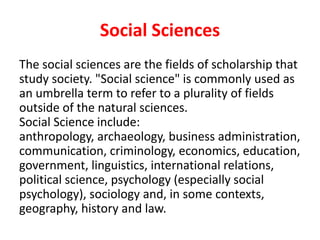
Social Sciences
The social sciences are the fields of scholarship that
study society. "Social science" is commonly used as
an umbrella term to refer to a plurality of fields
outside of the natural sciences.
Social Science include:
anthropology, archaeology, business administration,
communication, criminology, economics, education,
government, linguistics, international relations,
political science, psychology (especially social
psychology), sociology and, in some contexts,
geography, history and law.
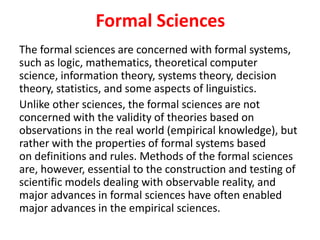
Formal Sciences
The formal sciences are concerned with formal systems,
such as logic, mathematics, theoretical computer
science, information theory, systems theory, decision
theory, statistics, and some aspects of linguistics.
Unlike other sciences, the formal sciences are not
concerned with the validity of theories based on
observations in the real world (empirical knowledge), but
rather with the properties of formal systems based
on definitions and rules. Methods of the formal sciences
are, however, essential to the construction and testing of
scientific models dealing with observable reality, and
major advances in formal sciences have often enabled
major advances in the empirical sciences.
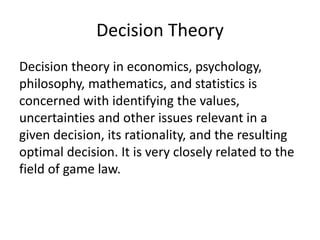
Decision Theory
Decision theory in economics, psychology,
philosophy, mathematics, and statistics is
concerned with identifying the values,
uncertainties and other issues relevant in a
given decision, its rationality, and the resulting
optimal decision. It is very closely related to the
field of game law.
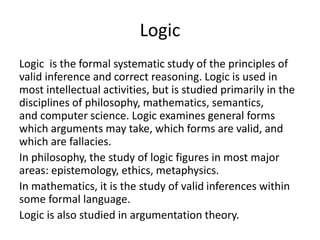
Logic
Logic is the formal systematic study of the principles of
valid inference and correct reasoning. Logic is used in
most intellectual activities, but is studied primarily in the
disciplines of philosophy, mathematics, semantics,
and computer science. Logic examines general forms
which arguments may take, which forms are valid, and
which are fallacies.
In philosophy, the study of logic figures in most major
areas: epistemology, ethics, metaphysics.
In mathematics, it is the study of valid inferences within
some formal language.
Logic is also studied in argumentation theory.
Mathematics
Mathematics, which is classified as a formal
science,has both similarities and differences with
the empirical sciences (the natural and social
sciences).
Mathematics is similar to empirical sciences
because it also involves an objective, careful and
systematic study of an area of knowledge.
Mathematics is different because of its method of
verifying its knowledge, using a priori rather than
empirical methods.
Statistics
Statistics is the study of the collection, organization, and
interpretation of data. It deals with all aspects of this,
including the planning of data collection in terms of the design
of surveys and experiments.
A statistician is someone who is very good in the ways of
thinking necessary for the successful application of statistical
analysis. Such people have often gained this experience
through working in any of a wide number of fields. There is
also a discipline called mathematical statistics, which is
concerned with the theoretical basis of the subject.
The word statistics, when referring to the scientific discipline,
is singular, as in "Statistics is an art." This should not be
confused with the word statistic, referring to a quantity (such
as mean or median) calculated from a set of data, whose
plural is statistics ("this statistic seems wrong" or "these
statistics are misleading").
Systems Theory
Systems theory is the transdisciplinary study
of systems in general. The goal is to explain
principles that can be applied to all types of systems
in all fields of research. The systems theory can be
considered a specialization of systems thinking and
a generalization of systems science. The term is
used in later efforts in other fields, such as the
action theory and the system-theory.
In this context the word systems is used to refer
specifically to self-regulating systems, i.e. that are
self-correcting through feedback. Self-regulating
systems are found in nature, including the
physiological systems of our body, in local and
global ecosystems, and in climate.
Theoretical Computer Science
Theoretical computer science (TCS) is a division or subset
of general computer science and focuses on more
abstract or mathematical aspects of computing.
These divisions and subsets include analysis of
algorithms and formal semantics of programming
languages. Technically, there are hundreds of divisions
and subsets besides these two. Each of the multiple parts
have their own individual personal leaders (of popularity)
and there are many associations and professional social
groups and publications of distinction.
Applied Science
Applied science is the application of scientific knowledge
transferred into a physical environment. Examples include
testing a theoretical model through the use of formal science
or solving a practical problem through the use of natural
science.
Applied science differs from fundamental science, which seeks
to describe the most basic objects and forces, having less
emphasis on practical applications. Applied science can be like
biological science and physical science.
Example fields of applied science: Engineering, Applied
mathematics, Applied physics, Medicine, Computer science
Fields of engineering are closely related to applied sciences.
Applied science is important for technology development. Its
use in industrial settings is usually referred to as research and
development (R&D).
Sources
• https://en.wikipedia.org/wiki/Branches_of_sci
ence
• http://www.school-for-
champions.com/science/math.htm#.Vrh9aBj
hDcs
• https://www.shodor.org/unchem/math/

4a Math in Science - research on science disciplines

  • 1.
    Math in Science Researchon Science disciplines Teaching: An effective key to self-learning This project is funded by European Union.
  • 2.
    Branches of Science •The branches of science (also referred to as "sciences", "scientific fields", or "scientific disciplines") are commonly divided into four major groups: • Natural sciences, which study natural phenomena (including fundamental forces and biological life) • Formal sciences (such as mathematics and logic, which use an a priori, as opposed to factual, methodology) • Social sciences, which study human behaviour and societies • Applied sciences, which apply existing scientific knowledge to develop more practical applications, like technology or inventions.
  • 3.
    Empirical Sciences Empirical sciencesare the natural sciences and social sciences. What is the meaning of the word empirical? It means that the knowledge must be based on observable phenomena and must be capable of being verified by other researchers working under the same conditions.
  • 4.
    Fundamental Sciences Natural science,social science, and formal science make up the fundamental sciences. They form the basis of interdisciplinary and applied sciences such as engineering and medicine. Specialized scientific disciplines that exist in multiple categories may include parts of other scientific disciplines but often possess their own terminologies and expertises.
  • 6.
    Natural Science Natural scienceis a branch of science that seeks the rules that govern the natural world. Natural science applies an empirical and scientific method to the study of the universe. The term natural sciences is used to distinguish it from the social sciences, which apply the scientific method to study human behavior and social patterns; the humanities, which use a critical, or analytical approach to the study of the human condition; and the formal sciences.
  • 7.
    Physical Science Physical scienceis an encompassing term for the branches of natural science and science that study non-living systems, in contrast to the life sciences. However, the term "physical" creates an unintended, somewhat arbitrary distinction, since many branches of physical science also study biological phenomena. There is a difference between physical science and physics.
  • 8.
    Physics Physics is anatural science. It studies energy, force, and matter and its motion in time. More broadly, it is the general analysis of nature, conducted in order to understand how the universe behaves. Physics is one of the oldest academic disciplines, perhaps the oldest through its inclusion of astronomy. It was a part of natural philosophy along with chemistry, certain branches of mathematics, and biology. During the Scientific Revolution in the 16th century, the natural sciences emerged as unique research programs in their own right. Certain research areas are interdisciplinary, such as biophysics and quantum chemistry, which means that the boundaries of physics are not rigidly defined. In the nineteenth and twentieth centuries physicalism emerged as a major unifying feature of the philosophy of science as physics provides fundamental explanations for every observed natural phenomenon. New ideas in physics often explain the fundamental mechanisms of other sciences, while opening to new research areas in mathematics and philosophy.
  • 9.
    Chemistry Chemistry is thescience of matter and the changes it undergoes. The science of matter is also addressed by physics, but while physics takes a more general and fundamental approach, chemistry is more specialized, being concerned with the composition, behavior (or reaction), structure, and properties of matter, as well as the changes it undergoes during chemical reactions. Chemistry studies various substances, atoms, molecules, and matter (especially carbon based). - biochemistry studies substances found in biological organisms - physical chemistry studies chemical processes using physical concepts such as thermodynamics and quantum mechanics - analytical chemistry analyses material samples to gain an understanding of their chemical composition and structure. Many more specialized disciplines have emerged in recent years, e.g. neurochemistry which studies chemistry of the nervous system.
  • 10.
    Earth Science Earth science(also known as geoscience) is related to the planet Earth. It is a special case in planetary science because the Earth is the only known life-bearing planet. There are both reductionist and holistic approaches to Earth sciences. The formal discipline of Earth sciences may include the study of the atmosphere, hydrosphere, oceans and biosphere, as well as the solid earth. Typically Earth scientists will use tools from physics, chemistry, biology, geography, chronology and of course mathematics to build a quantitative understanding of how the Earth system works, and how it evolved to its current state.
  • 11.
    Ecology Ecology is thescientific study of the relationships that living organisms have with each other and with their abiotic environment. Topics of interest to ecologists include the composition, distribution, amount (biomass), number, and changing states of organisms within and among ecosystems.
  • 12.
    Oceanography Oceanography, or marinescience, is the branch of Earth science that studies the ocean. It covers a wide range of topics, including marine organisms and ecosystem dynamics; ocean currents, waves, and geophysical fluid dynamics; plate tectonics and the geology of the sea floor; and fluxes of various chemical substances and physical properties within the ocean and across its boundaries. Oceanographers study the world ocean and processes within it, they use many disciplines: biology, chemistry, geology, meteorology, and physics as well as geography.
  • 13.
    Geology Geology is thescience which study solid Earth, the rocks of which it is composed, and the processes by which they change. Geology can also refer generally to the study of the solid features of any celestial body (such as the geology of the Moon or geology of Mars). Geology gives insight into the history of the Earth, as it provides the primary evidence for plate tectonics, the evolutionary history of life, and past climates. In modern times, geology is commercially important for mineral and hydrocarbon exploration and exploitation and for evaluating water resources. It is publicly important for the prediction and understanding of natural hazards, the remediation of environmental problems, and for providing insights into past climate change. Geology plays a role in geotechnical engineering and is a major academic discipline.
  • 14.
    Meteorology Meteorology is theinterdisciplinary scientific study of the atmosphere. Studies in the field started thousands years ago but significant progress in meteorology did not occur until the 18th century. In the 19th century, observing networks were developed across several countries. After the development of the computer in the latter half of the 20th century, breakthroughs in weather forecasting were achieved.
  • 15.
    Space Science (Astronomy) Spacescience is the study of everything in outer space. This was called astronomy, but recently astronomy became one part of broader space science, which includes other related fields. Space science studies also space travel and space exploration (including space medicine), space archaeology and science performed in outer space (see space research).
  • 16.
    Life Science Life sciencestudies living organisms, like plants, animals, and human beings. However, the study of behavior of organisms, such as practiced in ethology and psychology, is only included in as much as it involves a clearly biological aspect. While biology remains the centerpiece of life science, technological advances in molecular biology and biotechnology have led to new specializations and new interdisciplinary fields.
  • 17.
    Biology Biology is thebranch of natural science which is concerned with the study of life and living organisms, including their structure, function, growth, origin, evolution, distribution, and taxonomy. Biology is a vast subject containing many subdivisions, topics, and disciplines.
  • 18.
    Zoology Zoology is thebranch of biology that relates to the animal kingdom, including the structure, embryology, evolution, classification, habits, and distribution of all animals, both living and extinct.
  • 19.
    Human biology Human biologyis an interdisciplinary academic field of biology, biological anthropology, nutrition and medicine which focuses on humans. It is closely related to primate biology, and a number of other fields. Some branches of biology include: microbiology, anatomy, genetics, psychology, immunology, physiology, pathology, biophysics, ophthalmology, neurology and neuroscience.
  • 20.
    Botany Botany is abranch of biology that involves the scientific study of plant life. Botany covers a wide range of scientific disciplines including structure, growth, reproduction, metabolism, development, diseases, chemical properties, and evolutionary relationships among taxonomic groups. Botany began with early human efforts to identify edible, medicinal and poisonous plants, making it one of the oldest sciences. Today botanists study over 550,000 species of living organisms.
  • 21.
    Social Sciences The socialsciences are the fields of scholarship that study society. "Social science" is commonly used as an umbrella term to refer to a plurality of fields outside of the natural sciences. Social Science include: anthropology, archaeology, business administration, communication, criminology, economics, education, government, linguistics, international relations, political science, psychology (especially social psychology), sociology and, in some contexts, geography, history and law.
  • 22.
    Formal Sciences The formalsciences are concerned with formal systems, such as logic, mathematics, theoretical computer science, information theory, systems theory, decision theory, statistics, and some aspects of linguistics. Unlike other sciences, the formal sciences are not concerned with the validity of theories based on observations in the real world (empirical knowledge), but rather with the properties of formal systems based on definitions and rules. Methods of the formal sciences are, however, essential to the construction and testing of scientific models dealing with observable reality, and major advances in formal sciences have often enabled major advances in the empirical sciences.
  • 23.
    Decision Theory Decision theoryin economics, psychology, philosophy, mathematics, and statistics is concerned with identifying the values, uncertainties and other issues relevant in a given decision, its rationality, and the resulting optimal decision. It is very closely related to the field of game law.
  • 24.
    Logic Logic is theformal systematic study of the principles of valid inference and correct reasoning. Logic is used in most intellectual activities, but is studied primarily in the disciplines of philosophy, mathematics, semantics, and computer science. Logic examines general forms which arguments may take, which forms are valid, and which are fallacies. In philosophy, the study of logic figures in most major areas: epistemology, ethics, metaphysics. In mathematics, it is the study of valid inferences within some formal language. Logic is also studied in argumentation theory.
  • 25.
    Mathematics Mathematics, which isclassified as a formal science,has both similarities and differences with the empirical sciences (the natural and social sciences). Mathematics is similar to empirical sciences because it also involves an objective, careful and systematic study of an area of knowledge. Mathematics is different because of its method of verifying its knowledge, using a priori rather than empirical methods.
  • 26.
    Statistics Statistics is thestudy of the collection, organization, and interpretation of data. It deals with all aspects of this, including the planning of data collection in terms of the design of surveys and experiments. A statistician is someone who is very good in the ways of thinking necessary for the successful application of statistical analysis. Such people have often gained this experience through working in any of a wide number of fields. There is also a discipline called mathematical statistics, which is concerned with the theoretical basis of the subject. The word statistics, when referring to the scientific discipline, is singular, as in "Statistics is an art." This should not be confused with the word statistic, referring to a quantity (such as mean or median) calculated from a set of data, whose plural is statistics ("this statistic seems wrong" or "these statistics are misleading").
  • 27.
    Systems Theory Systems theoryis the transdisciplinary study of systems in general. The goal is to explain principles that can be applied to all types of systems in all fields of research. The systems theory can be considered a specialization of systems thinking and a generalization of systems science. The term is used in later efforts in other fields, such as the action theory and the system-theory. In this context the word systems is used to refer specifically to self-regulating systems, i.e. that are self-correcting through feedback. Self-regulating systems are found in nature, including the physiological systems of our body, in local and global ecosystems, and in climate.
  • 28.
    Theoretical Computer Science Theoreticalcomputer science (TCS) is a division or subset of general computer science and focuses on more abstract or mathematical aspects of computing. These divisions and subsets include analysis of algorithms and formal semantics of programming languages. Technically, there are hundreds of divisions and subsets besides these two. Each of the multiple parts have their own individual personal leaders (of popularity) and there are many associations and professional social groups and publications of distinction.
  • 29.
    Applied Science Applied scienceis the application of scientific knowledge transferred into a physical environment. Examples include testing a theoretical model through the use of formal science or solving a practical problem through the use of natural science. Applied science differs from fundamental science, which seeks to describe the most basic objects and forces, having less emphasis on practical applications. Applied science can be like biological science and physical science. Example fields of applied science: Engineering, Applied mathematics, Applied physics, Medicine, Computer science Fields of engineering are closely related to applied sciences. Applied science is important for technology development. Its use in industrial settings is usually referred to as research and development (R&D).
  • 30.