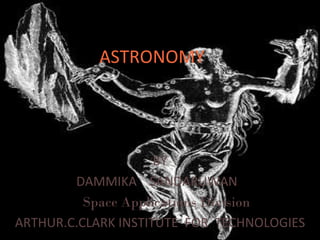
ASTRONOMY BY DAMMIKA  SANDARUWAN  Space Applications Division  ARTHUR.C.CLARK INSTITUTE  FOR  TECHNOLOGIES
    2)SCIENTIFIC  TYPE  3)SCIENTIST  4) SUCCESS  OF  SCIENCE 1) NATURE  OF  THE  SCIENCE
5)LIMIT OF THE  SCIENCE 6)ASTRONOMY & ASTROLOGY 7) Objectives  of  Astronomy  8) NUMBERS
1) What’s the  Astronomy ?  2) Why  Are You  Study  From  Astronomy?
ASTRONOMY  ENVIRONMENT  Economical  environment familiarly national 1) 2) Technological  environment 3)  Political  environment
Economics  1)  What is a economic ? 2) Human  needs & wants 4) Self  interest 5) Why sturdy econ 3) Classified  of Goods  &  service 6)  Limited resources 7) Opportunity  cost 8)  Utility
Classification of  Astronomy Astronomy Astro  Biology Astro Chemistry Astro Physics Observation, Theory &  research
Solar System Main  Star ;  SUN Mercury Venus Earth Mars Jupiter Saturn Uranus Neptune PLANETS Statistics 0 0 1 2 65 35 28 15
SUN SATURN  Sixth planet from the Sun  Mean distance from Sun:  9.54 AU = 1,427,000,000 KM Diameter:  120,000 KM Mass:  95.15 Earths Density:  0.7 grams / cubic centimeter Surface temperature:  -274 F Orbital period:  29 years, 168 days Saturn is perhaps the best known astronomical object by picture.  Its beauty in even small telescopes is breathtaking, and larger  scopes reveal details in the delicate ring structure and colored  bands in the outer layers of the atmosphere.  The rings consist  of billions of particles (probably water and methane ice) ranging  from a few centimeters to a few meters in diameter.  There are  three major ring systems, separated by the Cassini division (outer)  and the Encke division (inner).
sun
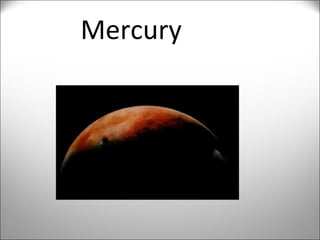
Mercury MERCURY  First planet from the Sun Mean distance from Sun:  .39 AU = 58,000,000 KM  Diameter:  4880 KM Mass:  0.06 Earths Density:  5.4 grams / cubic centimeter Surface temperature:  800 F to -360 F Orbital period:  88 days Mercury is hard to see from Earth because it is so small and  so close to the sun.  At certain times of the year, it can be  seen just after sunset or before sunrise.  The rest of the  time it is lost in the sun's glare.
Mercury
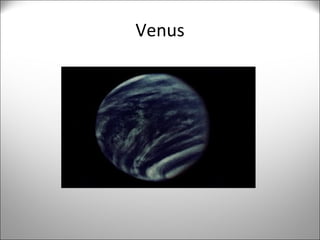
venus VENUS  Second planet from the Sun Mean distance from Sun:  .72 AU = 108,000,000 KM Diameter:  12100 KM Mass:  0.95 Earths Density:  5.2 grams / cubic centimeter Surface temperature:  900 F Orbital period:  226 days Venus, the brightest object in the sky except for the Sun and the Moon, is often visible for several hours just after sunset or before sunrise (hence it's name as the "Evening" or "Morning" star.)  Visited by spacecraft from both the U.S.A and U.S.S.R, much of the surface has been mapped by radar.  When viewed with a small telescope, Venus exhibits phases like the Moon and larger instruments may reveal details in the  thick clouds covering the entire planet.
Venus
EARTH EARTH  Third planet from the Sun Mean distance from Sun:  1 AU = 150,000,000 KM  Diameter:  12,760 KM Mass:  6.0 x 10 to the 27th grams Density:  5.5 grams / cubic centimeter Surface temp:  -60 to 120 F
EARTH
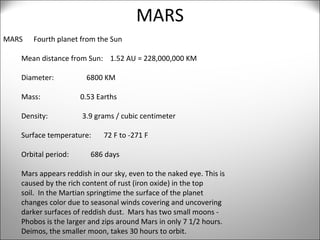
MARS MARS  Fourth planet from the Sun Mean distance from Sun:  1.52 AU = 228,000,000 KM Diameter:  6800 KM Mass:  0.53 Earths Density:  3.9 grams / cubic centimeter Surface temperature:  72 F to -271 F Orbital period:  686 days Mars appears reddish in our sky, even to the naked eye. This is  caused by the rich content of rust (iron oxide) in the top  soil.  In the Martian springtime the surface of the planet  changes color due to seasonal winds covering and uncovering  darker surfaces of reddish dust.  Mars has two small moons - Phobos is the larger and zips around Mars in only 7 1/2 hours.  Deimos, the smaller moon, takes 30 hours to orbit.
MARS
JUPITER JUPITER  Fifth planet from the Sun Mean distance from Sun:  5.20 AU = 778,000,000 KM Diameter:  143,800 KM Mass:  317.89 Earths Density:  1.3 grams / cubic centimeter Surface temperature:  -200 F Orbital period:  11 years, 321 days Jupiter is the Solar System's largest planet - its composition is more like a star than a planet.  Bright belts,  changing cloud structures, four main moons (each larger than  Earth's satellite) and the Great Red Spot are all easily  visible in small telescopes.
JUPITER
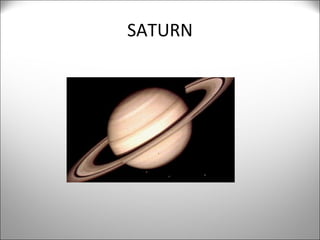
SATURN SATURN  Sixth planet from the Sun  Mean distance from Sun:  9.54 AU = 1,427,000,000 KM Diameter:  120,000 KM Mass:  95.15 Earths Density:  0.7 grams / cubic centimeter Surface temperature:  -274 F Orbital period:  29 years, 168 days Saturn is perhaps the best known astronomical object by picture.  Its beauty in even small telescopes is breathtaking, and larger  scopes reveal details in the delicate ring structure and colored  bands in the outer layers of the atmosphere.  The rings consist  of billions of particles (probably water and methane ice) ranging  from a few centimeters to a few meters in diameter.  There are  three major ring systems, separated by the Cassini division (outer)  and the Encke division (inner).
SATURN
URANUS URANUS  Seventh planet from the Sun Mean distance from Sun:  19.2 AU = 2,870,000,000 KM Diameter:  52,300 KM Mass:  14.54 Earths Density:  1.2 grams / cubic centimeter Surface temperature:  < -250 F Orbital period:  84.01 years Without the information gathered by Voyager 2, little would be  known about this distant planet.  Although visible in small to  medium telescopes, not nuch is revealed by Earth-based  observation other than Uranus' pale blue color.  The planet is  now know to have a system of at least nine rings.
URANUS
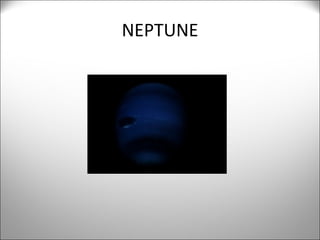
NEPTUNE NEPTUNE  Eighth planet from the Sun Mean distance from Sun:  30.06 AU = 4,497,000,000 KM Diameter:  49,500 KM Mass:  17.23 Earths Density:  1.7 grams / cubic centimeter Surface temperature:  < -250 F Orbital period:  164.79 years Similar in size and composition to Uranus, the eighth  planet is so far from Earth that ground-based observations reveal little detail.  Voyager 2 data confirm the presence of a tenuous ring system.  Neptune's largest moon, Triton, may be glimpsed in telescopes of apertures of 30 cm.
NEPTUNE
MOONS MOON  Earth's Satellite Mean distance from Earth:  384,400 KM  Diameter:  3476 KM Mass:  0.0123 Earths Density:  3.34 grams / cubic centimeter Surface temperature:  248 F to -274 F Orbital period (Synodic):  29.53 days The Earth and Moon form a double-planet system.  The Moon is the closest astronomical body to the Earth and we know more about it than any other object in the heavens.  Many surface features are visible to the unaided eye, and a pair of binoculars reveals a great amount of detail.  A small telescope shows vast seas of lava, large mountain ranges and hundreds of craters of all sizes.  Studies of the 382 kg of lunar rock and soil brought back by the Apollo missions have revealed much about the early history of both the Moon and the Earth.
MOONS
Stars  Planets  Asteroids  Comets  galaxies Pulsars  Black holes
 
 
THANK YOU

Astronomy (1)

  • 1.
    ASTRONOMY BY DAMMIKA SANDARUWAN Space Applications Division ARTHUR.C.CLARK INSTITUTE FOR TECHNOLOGIES
  • 2.
    2)SCIENTIFIC TYPE 3)SCIENTIST 4) SUCCESS OF SCIENCE 1) NATURE OF THE SCIENCE
  • 3.
    5)LIMIT OF THE SCIENCE 6)ASTRONOMY & ASTROLOGY 7) Objectives of Astronomy 8) NUMBERS
  • 4.
    1) What’s the Astronomy ? 2) Why Are You Study From Astronomy?
  • 5.
    ASTRONOMY ENVIRONMENT Economical environment familiarly national 1) 2) Technological environment 3) Political environment
  • 6.
    Economics 1) What is a economic ? 2) Human needs & wants 4) Self interest 5) Why sturdy econ 3) Classified of Goods & service 6) Limited resources 7) Opportunity cost 8) Utility
  • 7.
    Classification of Astronomy Astronomy Astro Biology Astro Chemistry Astro Physics Observation, Theory & research
  • 8.
    Solar System Main Star ; SUN Mercury Venus Earth Mars Jupiter Saturn Uranus Neptune PLANETS Statistics 0 0 1 2 65 35 28 15
  • 9.
    SUN SATURN Sixth planet from the Sun Mean distance from Sun: 9.54 AU = 1,427,000,000 KM Diameter: 120,000 KM Mass: 95.15 Earths Density: 0.7 grams / cubic centimeter Surface temperature: -274 F Orbital period: 29 years, 168 days Saturn is perhaps the best known astronomical object by picture. Its beauty in even small telescopes is breathtaking, and larger scopes reveal details in the delicate ring structure and colored bands in the outer layers of the atmosphere. The rings consist of billions of particles (probably water and methane ice) ranging from a few centimeters to a few meters in diameter. There are three major ring systems, separated by the Cassini division (outer) and the Encke division (inner).
  • 10.
  • 11.
    Mercury MERCURY First planet from the Sun Mean distance from Sun: .39 AU = 58,000,000 KM Diameter: 4880 KM Mass: 0.06 Earths Density: 5.4 grams / cubic centimeter Surface temperature: 800 F to -360 F Orbital period: 88 days Mercury is hard to see from Earth because it is so small and so close to the sun. At certain times of the year, it can be seen just after sunset or before sunrise. The rest of the time it is lost in the sun's glare.
  • 12.
  • 13.
    venus VENUS Second planet from the Sun Mean distance from Sun: .72 AU = 108,000,000 KM Diameter: 12100 KM Mass: 0.95 Earths Density: 5.2 grams / cubic centimeter Surface temperature: 900 F Orbital period: 226 days Venus, the brightest object in the sky except for the Sun and the Moon, is often visible for several hours just after sunset or before sunrise (hence it's name as the &quot;Evening&quot; or &quot;Morning&quot; star.) Visited by spacecraft from both the U.S.A and U.S.S.R, much of the surface has been mapped by radar. When viewed with a small telescope, Venus exhibits phases like the Moon and larger instruments may reveal details in the thick clouds covering the entire planet.
  • 14.
  • 15.
    EARTH EARTH Third planet from the Sun Mean distance from Sun: 1 AU = 150,000,000 KM Diameter: 12,760 KM Mass: 6.0 x 10 to the 27th grams Density: 5.5 grams / cubic centimeter Surface temp: -60 to 120 F
  • 16.
  • 17.
    MARS MARS Fourth planet from the Sun Mean distance from Sun: 1.52 AU = 228,000,000 KM Diameter: 6800 KM Mass: 0.53 Earths Density: 3.9 grams / cubic centimeter Surface temperature: 72 F to -271 F Orbital period: 686 days Mars appears reddish in our sky, even to the naked eye. This is caused by the rich content of rust (iron oxide) in the top soil. In the Martian springtime the surface of the planet changes color due to seasonal winds covering and uncovering darker surfaces of reddish dust. Mars has two small moons - Phobos is the larger and zips around Mars in only 7 1/2 hours. Deimos, the smaller moon, takes 30 hours to orbit.
  • 18.
  • 19.
    JUPITER JUPITER Fifth planet from the Sun Mean distance from Sun: 5.20 AU = 778,000,000 KM Diameter: 143,800 KM Mass: 317.89 Earths Density: 1.3 grams / cubic centimeter Surface temperature: -200 F Orbital period: 11 years, 321 days Jupiter is the Solar System's largest planet - its composition is more like a star than a planet. Bright belts, changing cloud structures, four main moons (each larger than Earth's satellite) and the Great Red Spot are all easily visible in small telescopes.
  • 20.
  • 21.
    SATURN SATURN Sixth planet from the Sun Mean distance from Sun: 9.54 AU = 1,427,000,000 KM Diameter: 120,000 KM Mass: 95.15 Earths Density: 0.7 grams / cubic centimeter Surface temperature: -274 F Orbital period: 29 years, 168 days Saturn is perhaps the best known astronomical object by picture. Its beauty in even small telescopes is breathtaking, and larger scopes reveal details in the delicate ring structure and colored bands in the outer layers of the atmosphere. The rings consist of billions of particles (probably water and methane ice) ranging from a few centimeters to a few meters in diameter. There are three major ring systems, separated by the Cassini division (outer) and the Encke division (inner).
  • 22.
  • 23.
    URANUS URANUS Seventh planet from the Sun Mean distance from Sun: 19.2 AU = 2,870,000,000 KM Diameter: 52,300 KM Mass: 14.54 Earths Density: 1.2 grams / cubic centimeter Surface temperature: < -250 F Orbital period: 84.01 years Without the information gathered by Voyager 2, little would be known about this distant planet. Although visible in small to medium telescopes, not nuch is revealed by Earth-based observation other than Uranus' pale blue color. The planet is now know to have a system of at least nine rings.
  • 24.
  • 25.
    NEPTUNE NEPTUNE Eighth planet from the Sun Mean distance from Sun: 30.06 AU = 4,497,000,000 KM Diameter: 49,500 KM Mass: 17.23 Earths Density: 1.7 grams / cubic centimeter Surface temperature: < -250 F Orbital period: 164.79 years Similar in size and composition to Uranus, the eighth planet is so far from Earth that ground-based observations reveal little detail. Voyager 2 data confirm the presence of a tenuous ring system. Neptune's largest moon, Triton, may be glimpsed in telescopes of apertures of 30 cm.
  • 26.
  • 27.
    MOONS MOON Earth's Satellite Mean distance from Earth: 384,400 KM Diameter: 3476 KM Mass: 0.0123 Earths Density: 3.34 grams / cubic centimeter Surface temperature: 248 F to -274 F Orbital period (Synodic): 29.53 days The Earth and Moon form a double-planet system. The Moon is the closest astronomical body to the Earth and we know more about it than any other object in the heavens. Many surface features are visible to the unaided eye, and a pair of binoculars reveals a great amount of detail. A small telescope shows vast seas of lava, large mountain ranges and hundreds of craters of all sizes. Studies of the 382 kg of lunar rock and soil brought back by the Apollo missions have revealed much about the early history of both the Moon and the Earth.
  • 28.
  • 29.
    Stars Planets Asteroids Comets galaxies Pulsars Black holes
  • 30.
  • 31.
  • 32.

Editor's Notes