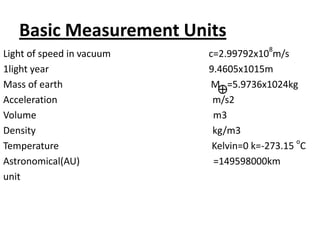
Basic Measurement Units
Light of speed in vacuum   c=2.99792x10⁸m/s
1light year                9.4605x10¹⁵m
Mass of earth              M =5.9736x1024kg
Acceleration                m/s2
Volume                      m3
Density                     kg/m3
Temperature                 Kelvin=0 k=-273.15 oC
Astronomical(AU)            =149598000km
unit
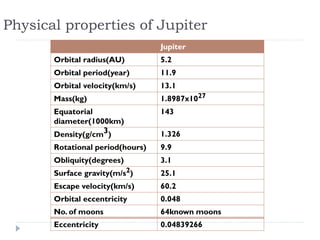
Physical properties of Jupiter
                                  Jupiter
       Orbital radius(AU)         5.2
       Orbital period(year)       11.9
       Orbital velocity(km/s)     13.1
       Mass(kg)                   1.8987x1027
       Equatorial                 143
       diameter(1000km)
       Density(g/cm3)             1.326
       Rotational period(hours)   9.9
       Obliquity(degrees)         3.1
       Surface gravity(m/s2)      25.1
       Escape velocity(km/s)      60.2
       Orbital eccentricity       0.048
       No. of moons               64known moons
       Eccentricity               0.04839266
Ancient astronomers didn’t have telescopes, but they knew
 there was something strange about the planets. They
 tracked the motion of the planets with incredible accuracy
 and believed that they were somehow associated with gods
 in their mythologies. Jupiter is named after the Roman god,
 thought to be the head of the gods; he’s the same as Zeus in
 Greek mythology.
when Galileo pointed his first rudimentary telescope at
 Jupiter. What he saw was the disk of Jupiter and the 4
 largest moons orbiting the planet. Since all the heavenly
 bodies were thought to orbit the Earth, it was thought to be
 impossible for objects to orbit one another.
Jupiter’s Great Red Spot
The Great Red Spot
is a huge storm
measuring 12,000 by
25,000 km (7,500 by
15,500 miles), which
is big enough to hold
two Earths side by
side. While Jupiter's
cloud patterns can
change within hours
or days like on Earth,
the Spot has lasted
for over 300 years.
Mystery of storms in Jupiter
Magnetic Powerhouse - Jupiter
 At very high pressures inside Jupiter, hydrogen begins to act
  like a liquid metal This provides an electrically conducting
  fluid in which a magnetic field is generated.
 Jupiter's magnetic field is inclined 10o to its rotation axis, an
  orientation similar too Earth’s, but its axis is displaced about
  a tenth of a radius from the planet’s center.
 The total strength of Jupiter’s magnetic field is nearly 20,000
  times that of Earth’s.
Magnetic Powerhouse - Jupiter
Are there any seasons in Jupiter
  There is almost no seasons in Jupiter. This is
   due to 3 degree inclination. As the inclination
   of its equatorial plane to its orbital plane
   called obliquity.
JUPITER MAGNETOSPHERER PRODUCE
     SYNCHROTORN RADITAION
Rapidly moving ELECTRONS IN Jupiter
 magnetosphere spiral around the direction of
 magnetic field, and as they do so they emit
 synchrotron radiation. To emit synchrotron
 radiation electrons have to spiral to nearly
 speed of light. To listen synchrotron radiation
 you can take radio and the charrrrr…. When
 the radio doesn’t catch any frequency that
 voice contain 10 % of synchrotron radiation
 coming from different cosmos.
SYNCHROTORN RADITAION
Radiation Belts
The fast moving charged particles slam into
  neutral atoms in magnetosphere of Jupiter,
  and the energy released in the resulting high-
  speed collision heats the plasma to extreme
  temp. The temperature of plasma is over 300
  Kelvins : 20times the temperature at the
  center of the Sun! The density of plasma
  (around 10,000atoms/m3) was much lower
  than the vacuum we can produce on Earth.
  This situation was encountered by Voyager1.
Io’s Plasma Torus
The most intense radiation belt in the solar
  system is a toroidal ring of plasma associated
  with Io, the innermost of Jupiter's four
  Galilean moons. Because of its low surface
  gravity violence of volcanism, some of the
  gases erupting from its interior can escape
  moon and can become the part of Jupiter’s
  radiation belt.
Io’s Flux tube
Jupiter’s auroras have an added twist that we do
  not see on Earth , however. As Jupiter's
  magnetic field sweeps past Io, it behave like a
  dynamo, generating an electric potential of
  4000,000 volts. Electrons accelerate by this
  enormous electric field spiral along the
  direction of Jupiter’s magnetic field. This
  result in magnetic channel, called a flux tube.
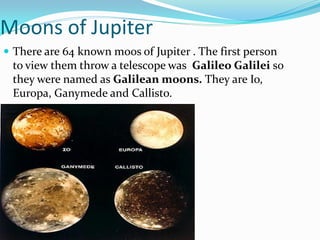
Moons of Jupiter
 There are 64 known moos of Jupiter . The first person
 to view them throw a telescope was Galileo Galilei so
 they were named as Galilean moons. They are Io,
 Europa, Ganymede and Callisto.
• Europa or Jupiter II, is the sixth closest moon of
  the planet Jupiter, and the smallest of its
  four Galilean satellites. Europa was discovered in
  1610 by Galileo Galilei. Slightly smaller than
  Earth's Moon, Europa is primarily made
  of silicate rock and probably has an iron core. It
  has a tenuous atmosphere composed primarily
  of oxygen. Its surface is composed of ice and is
  one of the smoothest in the Solar System. It is
  believed that beneath the surface there is liquid
  water and life is also possible.
Callisto
Jupiter
Jupiter

Jupiter

  • 2.
    Basic Measurement Units Lightof speed in vacuum c=2.99792x10⁸m/s 1light year 9.4605x10¹⁵m Mass of earth M =5.9736x1024kg Acceleration m/s2 Volume m3 Density kg/m3 Temperature Kelvin=0 k=-273.15 oC Astronomical(AU) =149598000km unit
  • 3.
    Physical properties ofJupiter Jupiter Orbital radius(AU) 5.2 Orbital period(year) 11.9 Orbital velocity(km/s) 13.1 Mass(kg) 1.8987x1027 Equatorial 143 diameter(1000km) Density(g/cm3) 1.326 Rotational period(hours) 9.9 Obliquity(degrees) 3.1 Surface gravity(m/s2) 25.1 Escape velocity(km/s) 60.2 Orbital eccentricity 0.048 No. of moons 64known moons Eccentricity 0.04839266
  • 4.
    Ancient astronomers didn’thave telescopes, but they knew there was something strange about the planets. They tracked the motion of the planets with incredible accuracy and believed that they were somehow associated with gods in their mythologies. Jupiter is named after the Roman god, thought to be the head of the gods; he’s the same as Zeus in Greek mythology. when Galileo pointed his first rudimentary telescope at Jupiter. What he saw was the disk of Jupiter and the 4 largest moons orbiting the planet. Since all the heavenly bodies were thought to orbit the Earth, it was thought to be impossible for objects to orbit one another.
  • 8.
    Jupiter’s Great RedSpot The Great Red Spot is a huge storm measuring 12,000 by 25,000 km (7,500 by 15,500 miles), which is big enough to hold two Earths side by side. While Jupiter's cloud patterns can change within hours or days like on Earth, the Spot has lasted for over 300 years.
  • 9.
  • 11.
    Magnetic Powerhouse -Jupiter At very high pressures inside Jupiter, hydrogen begins to act like a liquid metal This provides an electrically conducting fluid in which a magnetic field is generated. Jupiter's magnetic field is inclined 10o to its rotation axis, an orientation similar too Earth’s, but its axis is displaced about a tenth of a radius from the planet’s center. The total strength of Jupiter’s magnetic field is nearly 20,000 times that of Earth’s.
  • 12.
  • 15.
    Are there anyseasons in Jupiter There is almost no seasons in Jupiter. This is due to 3 degree inclination. As the inclination of its equatorial plane to its orbital plane called obliquity.
  • 16.
    JUPITER MAGNETOSPHERER PRODUCE SYNCHROTORN RADITAION Rapidly moving ELECTRONS IN Jupiter magnetosphere spiral around the direction of magnetic field, and as they do so they emit synchrotron radiation. To emit synchrotron radiation electrons have to spiral to nearly speed of light. To listen synchrotron radiation you can take radio and the charrrrr…. When the radio doesn’t catch any frequency that voice contain 10 % of synchrotron radiation coming from different cosmos.
  • 17.
  • 18.
    Radiation Belts The fastmoving charged particles slam into neutral atoms in magnetosphere of Jupiter, and the energy released in the resulting high- speed collision heats the plasma to extreme temp. The temperature of plasma is over 300 Kelvins : 20times the temperature at the center of the Sun! The density of plasma (around 10,000atoms/m3) was much lower than the vacuum we can produce on Earth. This situation was encountered by Voyager1.
  • 19.
    Io’s Plasma Torus Themost intense radiation belt in the solar system is a toroidal ring of plasma associated with Io, the innermost of Jupiter's four Galilean moons. Because of its low surface gravity violence of volcanism, some of the gases erupting from its interior can escape moon and can become the part of Jupiter’s radiation belt.
  • 20.
    Io’s Flux tube Jupiter’sauroras have an added twist that we do not see on Earth , however. As Jupiter's magnetic field sweeps past Io, it behave like a dynamo, generating an electric potential of 4000,000 volts. Electrons accelerate by this enormous electric field spiral along the direction of Jupiter’s magnetic field. This result in magnetic channel, called a flux tube.
  • 22.
    Moons of Jupiter There are 64 known moos of Jupiter . The first person to view them throw a telescope was Galileo Galilei so they were named as Galilean moons. They are Io, Europa, Ganymede and Callisto.
  • 25.
    • Europa orJupiter II, is the sixth closest moon of the planet Jupiter, and the smallest of its four Galilean satellites. Europa was discovered in 1610 by Galileo Galilei. Slightly smaller than Earth's Moon, Europa is primarily made of silicate rock and probably has an iron core. It has a tenuous atmosphere composed primarily of oxygen. Its surface is composed of ice and is one of the smoothest in the Solar System. It is believed that beneath the surface there is liquid water and life is also possible.
  • 29.