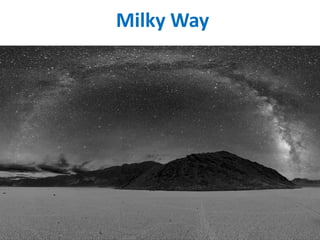
Milky Way
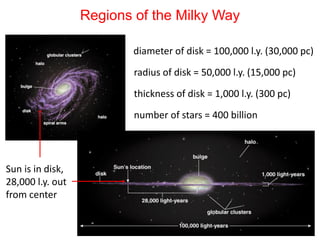
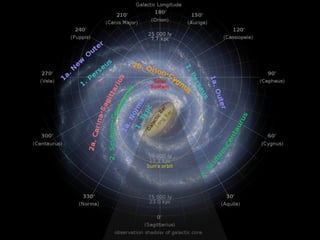
Regions of the Milky Way
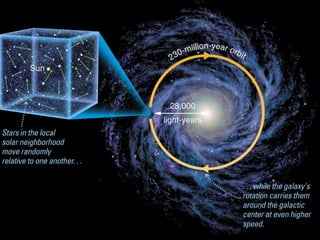
diameter of disk = 100,000 l.y. (30,000 pc)
radius of disk = 50,000 l.y. (15,000 pc)
number of stars = 400 billion
thickness of disk = 1,000 l.y. (300 pc)
Sun is in disk,
28,000 l.y. out
from center
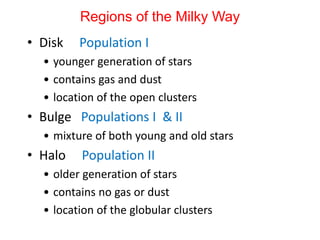
Regions of the Milky Way
• Disk Population I
• younger generation of stars
• contains gas and dust
• location of the open clusters
• Bulge Populations I & II
• mixture of both young and old stars
• Halo Population II
• older generation of stars
• contains no gas or dust
• location of the globular clusters
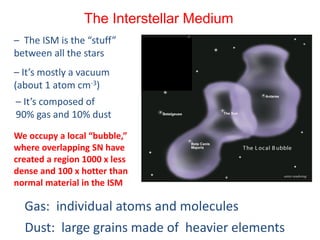
The Interstellar Medium
– The ISM is the “stuff”
between all the stars
– It’s mostly a vacuum
(about 1 atom cm-3)
– It’s composed of
90% gas and 10% dust
Gas: individual atoms and molecules
Dust: large grains made of heavier elements
We occupy a local “bubble,”
where overlapping SN have
created a region 1000 x less
dense and 100 x hotter than
normal material in the ISM
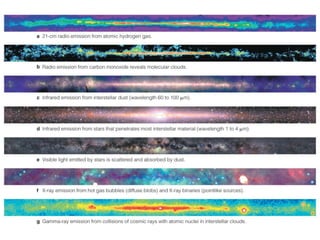
Multiwavelength
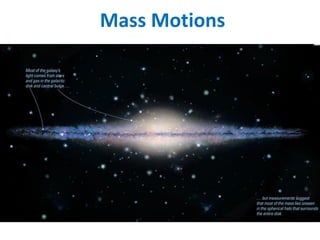
Mass Motions
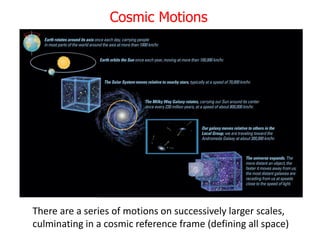
Cosmic Motions
There are a series of motions on successively larger scales,
culminating in a cosmic reference frame (defining all space)
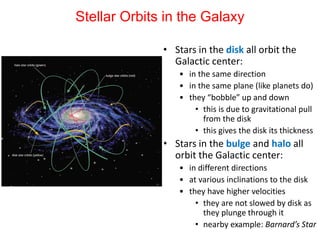
Stellar Orbits in the Galaxy
• Stars in the disk all orbit the
Galactic center:
• in the same direction
• in the same plane (like planets do)
• they “bobble” up and down
• this is due to gravitational pull
from the disk
• this gives the disk its thickness
• Stars in the bulge and halo all
orbit the Galactic center:
• in different directions
• at various inclinations to the disk
• they have higher velocities
• they are not slowed by disk as
they plunge through it
• nearby example: Barnard’s Star
Spiral Arms
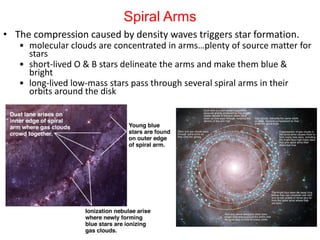
• The compression caused by density waves triggers star formation.
• molecular clouds are concentrated in arms…plenty of source matter for
stars
• short-lived O & B stars delineate the arms and make them blue &
bright
• long-lived low-mass stars pass through several spiral arms in their
orbits around the disk
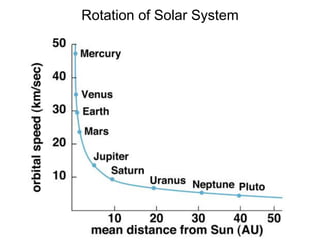
Rotation of Solar System
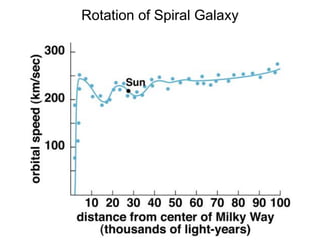
Rotation of Spiral Galaxy
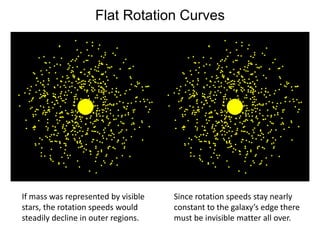
Flat Rotation Curves
If mass was represented by visible
stars, the rotation speeds would
steadily decline in outer regions.
Since rotation speeds stay nearly
constant to the galaxy’s edge there
must be invisible matter all over.
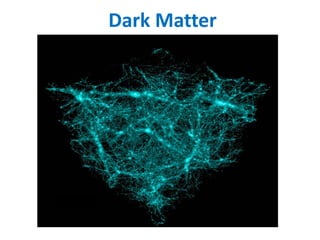
Dark Matter
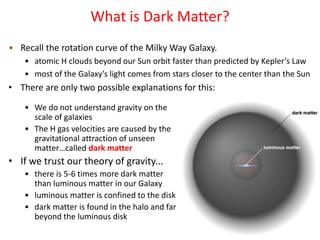
What is Dark Matter?
• Recall the rotation curve of the Milky Way Galaxy.
• atomic H clouds beyond our Sun orbit faster than predicted by Kepler’s Law
• most of the Galaxy’s light comes from stars closer to the center than the Sun
• There are only two possible explanations for this:
• We do not understand gravity on the
scale of galaxies
• The H gas velocities are caused by the
gravitational attraction of unseen
matter…called dark matter
• If we trust our theory of gravity...
• there is 5-6 times more dark matter
than luminous matter in our Galaxy
• luminous matter is confined to the disk
• dark matter is found in the halo and far
beyond the luminous disk
Mass-to-Light Ratio
• This is the mass of a galaxy divided by its luminosity.
• we measure both mass [M] and luminosity [L] in Solar units
• Within the orbit of the Sun, M/L = 6 M/ L for the Milky Way
• this is typical for the inner regions of most spiral galaxies
• for inner regions of elliptical galaxies, M/L = 10 M/ L
• not surprising since ellipticals contain dimmer stars
• However, when we include the outer regions of galaxies…
• M/L increases dramatically
• for entire spirals, M/L can be as high as 50 M/ L
• dwarf galaxies can have even higher M/L
• Thus we conclude that most matter in galaxies are not stars.
• the amount of M/L over 6 M/ L is the amount of dark matter
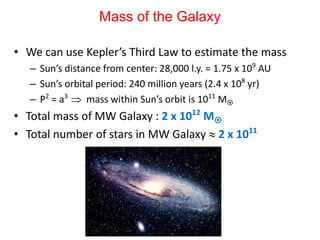
Mass of the Galaxy
• We can use Kepler’s Third Law to estimate the mass
– Sun’s distance from center: 28,000 l.y. = 1.75 x 10⁹
AU
– Sun’s orbital period: 240 million years (2.4 x 10⁸
yr)
– P2
= a3
 mass within Sun’s orbit is 1011
M
• Total mass of MW Galaxy : 2 x 10¹²
M
• Total number of stars in MW Galaxy  2 x 10¹¹
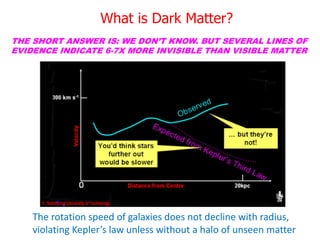
What is Dark Matter?
THE SHORT ANSWER IS: WE DON’T KNOW. BUT SEVERAL LINES OF
EVIDENCE INDICATE 6-7X MORE INVISIBLE THAN VISIBLE MATTER
The rotation speed of galaxies does not decline with radius,
violating Kepler’s law unless without a halo of unseen matter
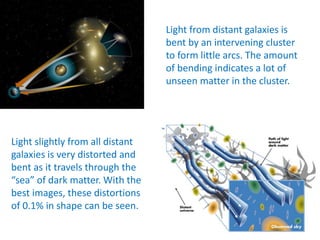
Light from distant galaxies is
bent by an intervening cluster
to form little arcs. The amount
of bending indicates a lot of
unseen matter in the cluster.
Light slightly from all distant
galaxies is very distorted and
bent as it travels through the
“sea” of dark matter. With the
best images, these distortions
of 0.1% in shape can be seen.
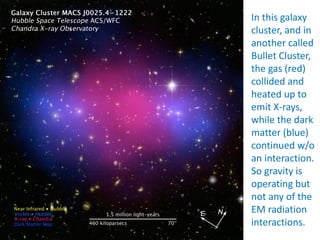
In this galaxy
cluster, and in
another called
Bullet Cluster,
the gas (red)
collided and
heated up to
emit X-rays,
while the dark
matter (blue)
continued w/o
an interaction.
So gravity is
operating but
not any of the
EM radiation
interactions.
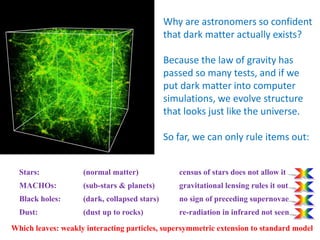
Why are astronomers so confident
that dark matter actually exists?
Because the law of gravity has
passed so many tests, and if we
put dark matter into computer
simulations, we evolve structure
that looks just like the universe.
So far, we can only rule items out:
Stars: (normal matter) census of stars does not allow it
MACHOs: (sub-stars & planets) gravitational lensing rules it out
Black holes: (dark, collapsed stars) no sign of preceding supernovae
Dust: (dust up to rocks) re-radiation in infrared not seen
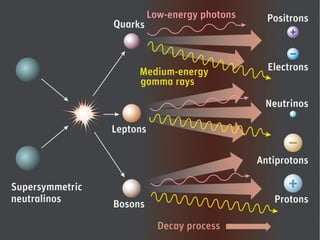
Which leaves: weakly interacting particles, supersymmetric extension to standard model
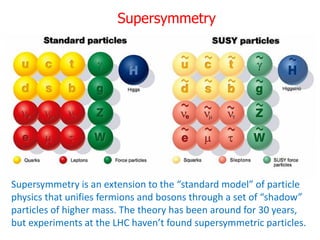
Supersymmetry
Supersymmetry is an extension to the “standard model” of particle
physics that unifies fermions and bosons through a set of “shadow”
particles of higher mass. The theory has been around for 30 years,
but experiments at the LHC haven’t found supersymmetric particles.
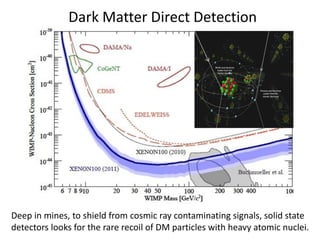
Dark Matter Direct Detection
Deep in mines, to shield from cosmic ray contaminating signals, solid state
detectors looks for the rare recoil of DM particles with heavy atomic nuclei.
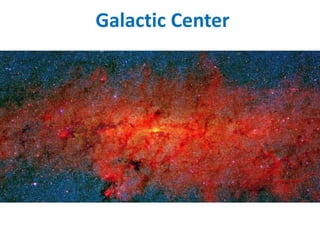
Galactic Center
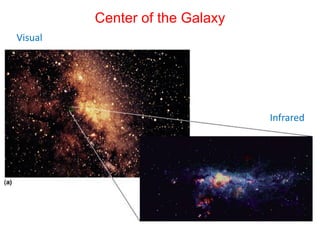
Center of the Galaxy
Visual
Infrared
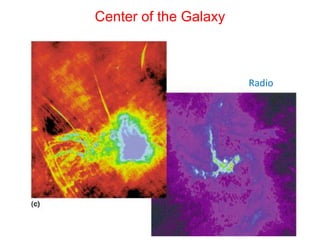
Center of the Galaxy
Radio
Center of the Galaxy
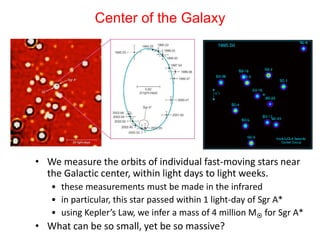
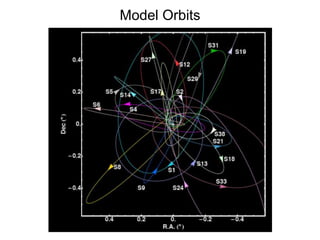
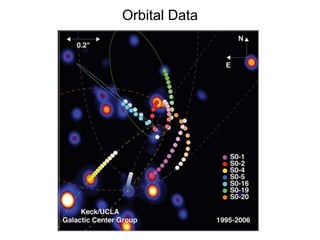
• We measure the orbits of individual fast-moving stars near
the Galactic center, within light days to light weeks.
• these measurements must be made in the infrared
• in particular, this star passed within 1 light-day of Sgr A*
• using Kepler’s Law, we infer a mass of 4 million M for Sgr A*
• What can be so small, yet be so massive?
Center of the Galaxy
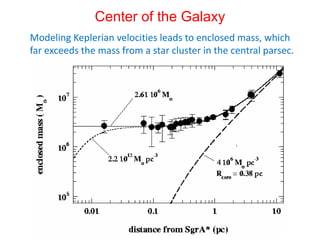
Modeling Keplerian velocities leads to enclosed mass, which
far exceeds the mass from a star cluster in the central parsec.
X-ray Flare from Sgr A*
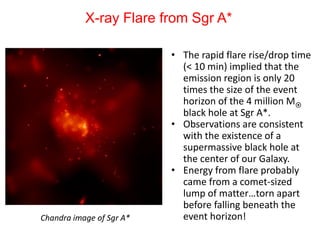
• The rapid flare rise/drop time
(< 10 min) implied that the
emission region is only 20
times the size of the event
horizon of the 4 million M
black hole at Sgr A*.
• Observations are consistent
with the existence of a
supermassive black hole at
the center of our Galaxy.
• Energy from flare probably
came from a comet-sized
lump of matter…torn apart
before falling beneath the
event horizon!Chandra image of Sgr A*
Model Orbits
Orbital Data
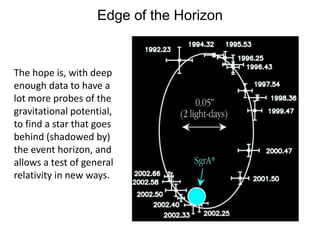
Edge of the Horizon
The hope is, with deep
enough data to have a
lot more probes of the
gravitational potential,
to find a star that goes
behind (shadowed by)
the event horizon, and
allows a test of general
relativity in new ways.
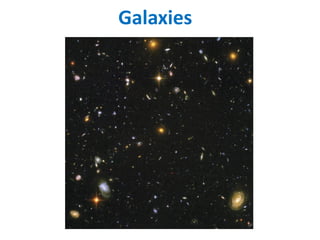
Galaxies
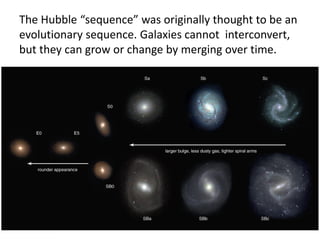
The Hubble “sequence” was originally thought to be an
evolutionary sequence. Galaxies cannot interconvert,
but they can grow or change by merging over time.
Distances
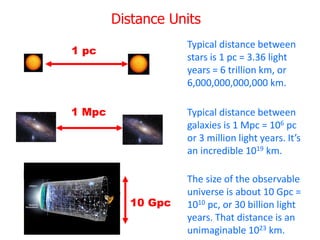
Distance Units
1 pc
1 Mpc
10 Gpc
Typical distance between
stars is 1 pc = 3.36 light
years = 6 trillion km, or
6,000,000,000,000 km.
Typical distance between
galaxies is 1 Mpc = 106 pc
or 3 million light years. It’s
an incredible 1019 km.
The size of the observable
universe is about 10 Gpc =
1010 pc, or 30 billion light
years. That distance is an
unimaginable 1023 km.
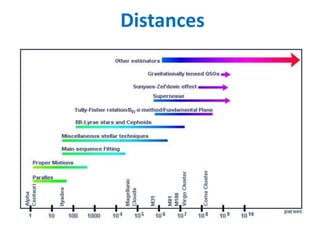
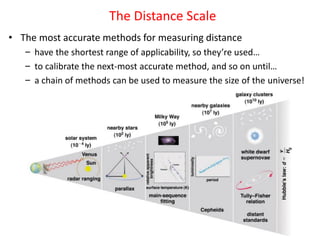
The Distance Scale
• The most accurate methods for measuring distance
– have the shortest range of applicability, so they’re used…
– to calibrate the next-most accurate method, and so on until…
– a chain of methods can be used to measure the size of the universe!
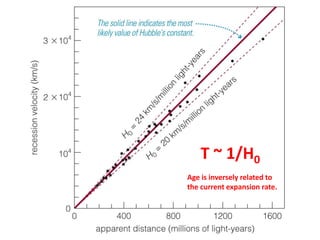
T ~ 1/H0
Age is inversely related to
the current expansion rate.
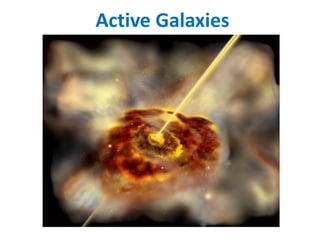
Active Galaxies
Active Galaxies
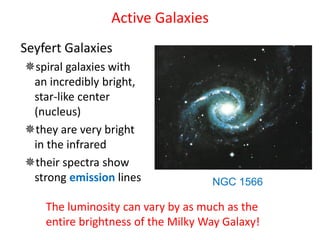
Seyfert Galaxies
spiral galaxies with
an incredibly bright,
star-like center
(nucleus)
they are very bright
in the infrared
their spectra show
strong emission lines NGC 1566
The luminosity can vary by as much as the
entire brightness of the Milky Way Galaxy!
Active Galaxies
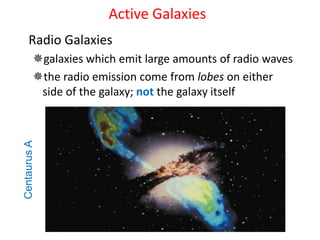
Radio Galaxies
galaxies which emit large amounts of radio waves
the radio emission come from lobes on either
side of the galaxy; not the galaxy itself
CentaurusA
Active Galactic Nuclei
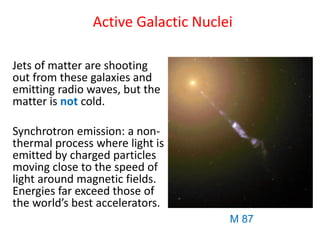
Jets of matter are shooting
out from these galaxies and
emitting radio waves, but the
matter is not cold.
Synchrotron emission: a non-
thermal process where light is
emitted by charged particles
moving close to the speed of
light around magnetic fields.
Energies far exceed those of
the world’s best accelerators.
M 87
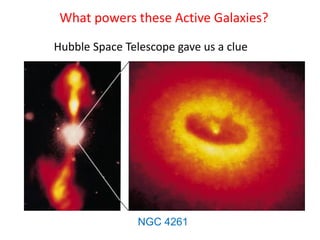
What powers these Active Galaxies?
Hubble Space Telescope gave us a clue
NGC 4261
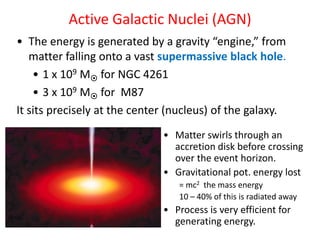
Active Galactic Nuclei (AGN)
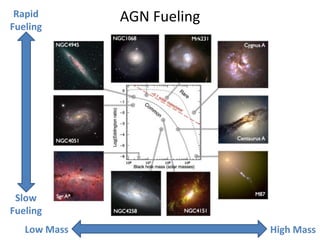
• The energy is generated by a gravity “engine,” from
matter falling onto a vast supermassive black hole.
• 1 x 10⁹ M for NGC 4261
• 3 x 10⁹ M for M87
It sits precisely at the center (nucleus) of the galaxy.
• Matter swirls through an
accretion disk before crossing
over the event horizon.
• Gravitational pot. energy lost
= mc2 the mass energy
10 – 40% of this is radiated away
• Process is very efficient for
generating energy.
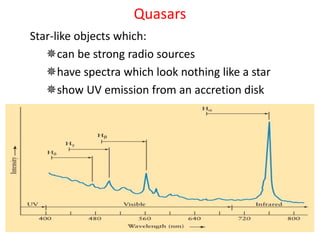
Quasars
Star-like objects which:
can be strong radio sources
have spectra which look nothing like a star
show UV emission from an accretion disk
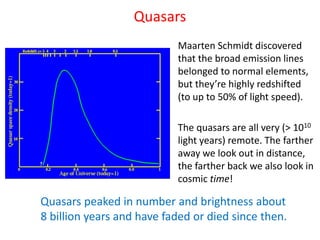
Quasars
Maarten Schmidt discovered
that the broad emission lines
belonged to normal elements,
but they’re highly redshifted
(to up to 50% of light speed).
The quasars are all very (> 1010
light years) remote. The farther
away we look out in distance,
the farther back we also look in
cosmic time!
Quasars peaked in number and brightness about
8 billion years and have faded or died since then.
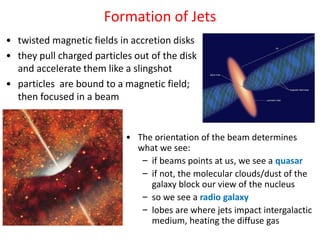
Formation of Jets
• twisted magnetic fields in accretion disks
• they pull charged particles out of the disk
and accelerate them like a slingshot
• particles are bound to a magnetic field;
then focused in a beam
• The orientation of the beam determines
what we see:
– if beams points at us, we see a quasar
– if not, the molecular clouds/dust of the
galaxy block our view of the nucleus
– so we see a radio galaxy
– lobes are where jets impact intergalactic
medium, heating the diffuse gas
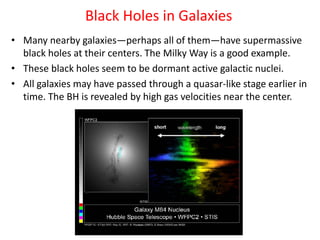
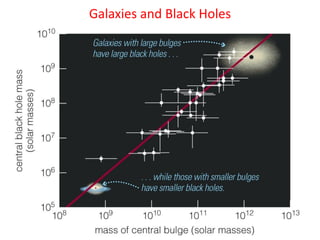
• Many nearby galaxies—perhaps all of them—have supermassive
black holes at their centers. The Milky Way is a good example.
• These black holes seem to be dormant active galactic nuclei.
• All galaxies may have passed through a quasar-like stage earlier in
time. The BH is revealed by high gas velocities near the center.
Black Holes in Galaxies
Galaxies and Black Holes
AGN FuelingRapid
Fueling
Slow
Fueling
Low Mass High Mass
Large Scale Structure
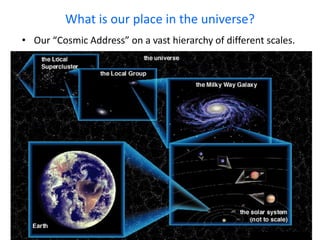
What is our place in the universe?
• Our “Cosmic Address” on a vast hierarchy of different scales.
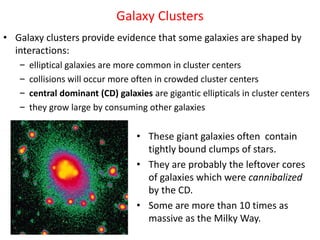
Galaxy Clusters
• Galaxy clusters provide evidence that some galaxies are shaped by
interactions:
– elliptical galaxies are more common in cluster centers
– collisions will occur more often in crowded cluster centers
– central dominant (CD) galaxies are gigantic ellipticals in cluster centers
– they grow large by consuming other galaxies
• These giant galaxies often contain
tightly bound clumps of stars.
• They are probably the leftover cores
of galaxies which were cannibalized
by the CD.
• Some are more than 10 times as
massive as the Milky Way.
Mass of a Cluster
• There are three independent ways to measure
galaxy cluster mass:
1. measure the speeds and positions of the galaxies
within the cluster
2. measure the temperature and distribution of the
hot gas between the galaxies
3. observe how clusters bend light as gravitational
lenses
• They all agree within a factor of two or so and
indicate that 80-90% of a cluster is dark matter.
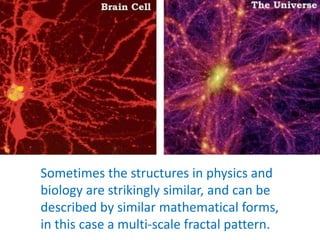
Sometimes the structures in physics and
biology are strikingly similar, and can be
described by similar mathematical forms,
in this case a multi-scale fractal pattern.
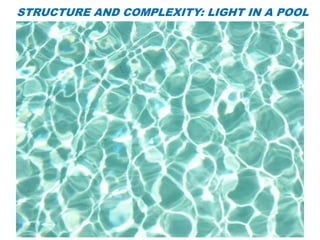
STRUCTURE AND COMPLEXITY: LIGHT IN A POOL
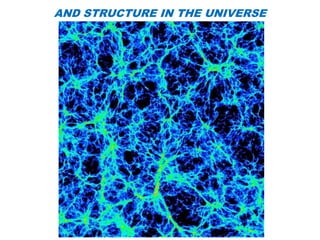
AND STRUCTURE IN THE UNIVERSE
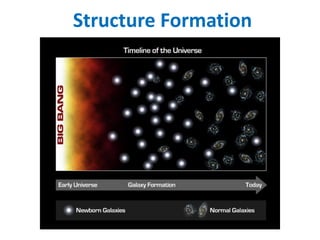
Structure Formation
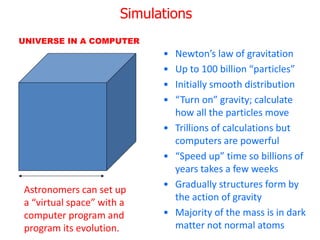
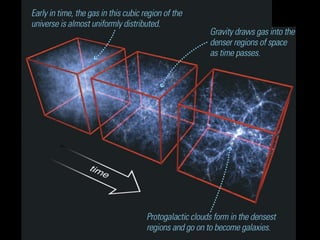
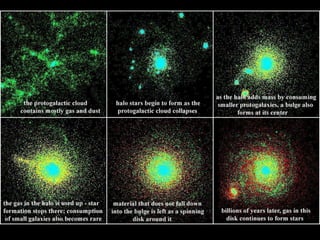
• Newton’s law of gravitation
• Up to 100 billion “particles”
• Initially smooth distribution
• “Turn on” gravity; calculate
how all the particles move
• Trillions of calculations but
computers are powerful
• “Speed up” time so billions of
years takes a few weeks
• Gradually structures form by
the action of gravity
• Majority of the mass is in dark
matter not normal atoms
Simulations
UNIVERSE IN A COMPUTER
Astronomers can set up
a “virtual space” with a
computer program and
program its evolution.
Heirarchical Structure
Expansion
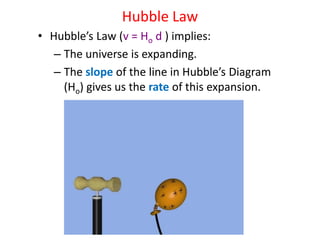
Hubble Law
• Hubble’s Law (v = Ho d ) implies:
– The universe is expanding.
– The slope of the line in Hubble’s Diagram
(Ho) gives us the rate of this expansion.
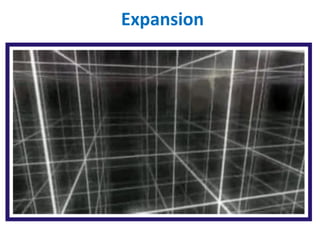
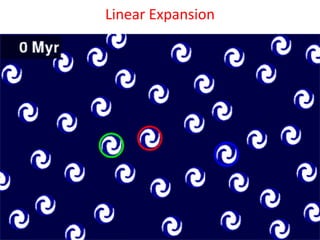
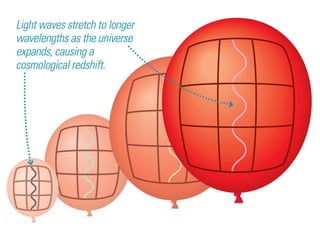
Linear Expansion
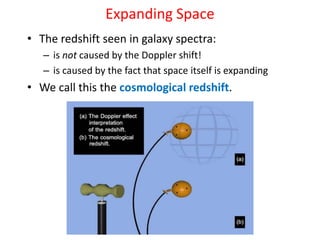
Expanding Space
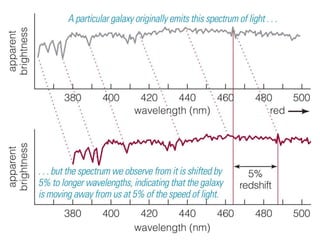
• The redshift seen in galaxy spectra:
– is not caused by the Doppler shift!
– is caused by the fact that space itself is expanding
• We call this the cosmological redshift.
© 2005 Pearson Education Inc., publishing
as Addison-Wesley
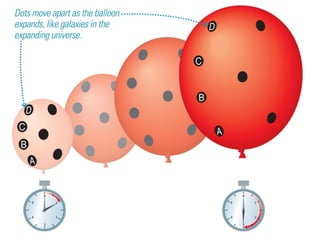
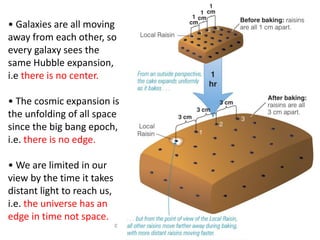
• Galaxies are all moving
away from each other, so
every galaxy sees the
same Hubble expansion,
i.e there is no center.
• The cosmic expansion is
the unfolding of all space
since the big bang epoch,
i.e. there is no edge.
• We are limited in our
view by the time it takes
distant light to reach us,
i.e. the universe has an
edge in time not space.
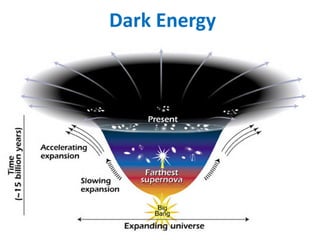
Dark Energy
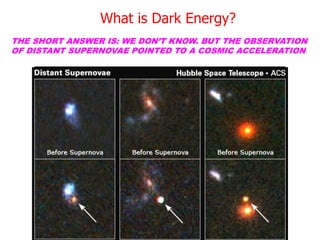
What is Dark Energy?
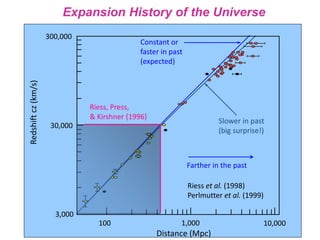
THE SHORT ANSWER IS: WE DON’T KNOW. BUT THE OBSERVATION
OF DISTANT SUPERNOVAE POINTED TO A COSMIC ACCELERATION
Redshiftcz(km/s)
Riess et al. (1998)
Perlmutter et al. (1999)
Constant or
faster in past
(expected)
Slower in past
(big surprise!)
Riess, Press,
& Kirshner (1996)
30,000
300,000
3,000
100 1,000 10,000
Distance (Mpc)
Farther in the past
Expansion History of the Universe
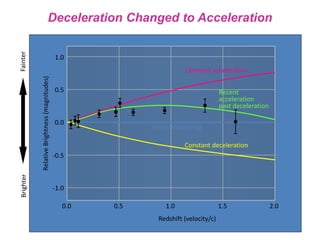
FainterBrighter
1.0
0.5
0.0
-0.5
-1.0
RelativeBrightness(magnitudes)
0.0 0.5 1.0 1.5 2.0
Redshift (velocity/c)
Constant deceleration
Freely expanding
Recent
acceleration
past deceleration
Constant acceleration
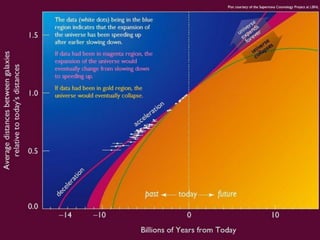
Deceleration Changed to Acceleration
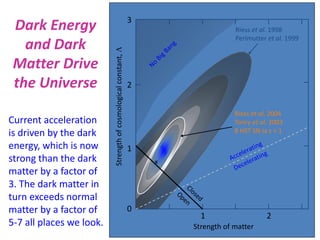
Dark Energy
and Dark
Matter Drive
the Universe
Riess et al. 1998
Perlmutter et al. 1999
0
1
2
3
1 2
Strength of matter
Strengthofcosmologicalconstant,L
x
Current acceleration
is driven by the dark
energy, which is now
strong than the dark
matter by a factor of
3. The dark matter in
turn exceeds normal
matter by a factor of
5-7 all places we look.
Riess et al. 2004
Tonry et al. 2003
8 HST SN Ia z > 1
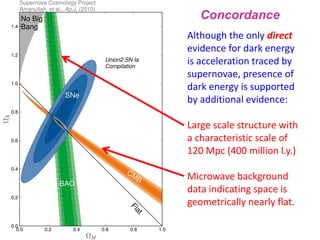
Concordance
Although the only direct
evidence for dark energy
is acceleration traced by
supernovae, presence of
dark energy is supported
by additional evidence:
Large scale structure with
a characteristic scale of
120 Mpc (400 million l.y.)
Microwave background
data indicating space is
geometrically nearly flat.
91
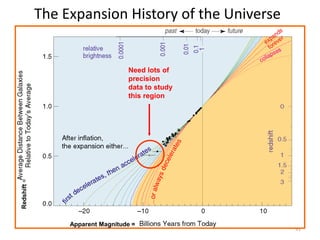
The Expansion History of the Universe
Need lots of
precision
data to study
this region
Apparent Magnitude =
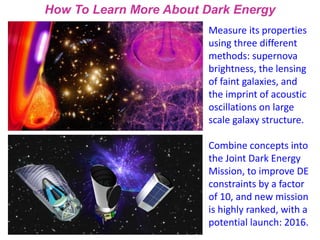
How To Learn More About Dark Energy
Measure its properties
using three different
methods: supernova
brightness, the lensing
of faint galaxies, and
the imprint of acoustic
oscillations on large
scale galaxy structure.
Combine concepts into
the Joint Dark Energy
Mission, to improve DE
constraints by a factor
of 10, and new mission
is highly ranked, with a
potential launch: 2016.
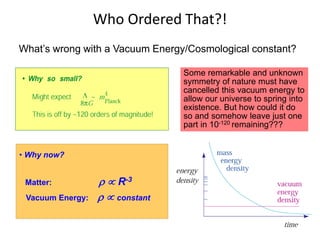
Who Ordered That?!
What’s wrong with a Vacuum Energy/Cosmological constant?
Some remarkable and unknown
symmetry of nature must have
cancelled this vacuum energy to
allow our universe to spring into
existence. But how could it do
so and somehow leave just one
part in 10-120 remaining???
• Why now?
Matter: r  R-3
Vacuum Energy: r  constant
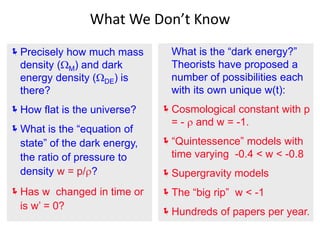
What We Don’t Know
Precisely how much mass
density (M) and dark
energy density (DE) is
there?
How flat is the universe?
What is the “equation of
state” of the dark energy,
the ratio of pressure to
density w = p/r?
Has w changed in time or
is w’ = 0?
What is the “dark energy?”
Theorists have proposed a
number of possibilities each
with its own unique w(t):
Cosmological constant with p
= - r and w = -1.
“Quintessence” models with
time varying -0.4 < w < -0.8
Supergravity models
The “big rip” w < -1
Hundreds of papers per year.
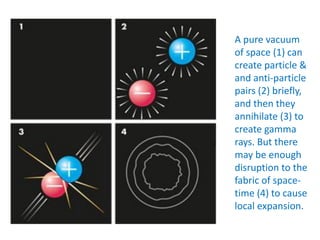
A pure vacuum
of space (1) can
create particle &
and anti-particle
pairs (2) briefly,
and then they
annihilate (3) to
create gamma
rays. But there
may be enough
disruption to the
fabric of space-
time (4) to cause
local expansion.
Future of the Universe
1. Recollapsing Universe: the expansion will someday halt and
reverse into a “big crunch” [closed]
2. Critical Universe: will not collapse, but will expand more
slowly with time, asymptotic [flat]
3. Coasting Universe: will expand forever with little slowdown
and ever-decreasing density [open]
4. Accelerating Universe*: expansion will accelerate with time
*currently favored
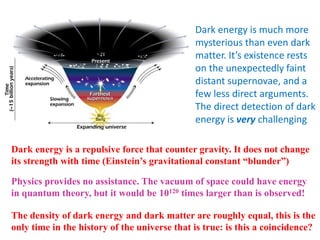
Dark energy is much more
mysterious than even dark
matter. It’s existence rests
on the unexpectedly faint
distant supernovae, and a
few less direct arguments.
The direct detection of dark
energy is very challenging
Physics provides no assistance. The vacuum of space could have energy
in quantum theory, but it would be 10120 times larger than is observed!
Dark energy is a repulsive force that counter gravity. It does not change
its strength with time (Einstein’s gravitational constant “blunder”)
The density of dark energy and dark matter are roughly equal, this is the
only time in the history of the universe that is true: is this a coincidence?
Astronomy - State of the Art - Galaxies

Astronomy - State of the Art - Galaxies

  • 3.
  • 4.
    Regions of theMilky Way diameter of disk = 100,000 l.y. (30,000 pc) radius of disk = 50,000 l.y. (15,000 pc) number of stars = 400 billion thickness of disk = 1,000 l.y. (300 pc) Sun is in disk, 28,000 l.y. out from center
  • 5.
    Regions of theMilky Way • Disk Population I • younger generation of stars • contains gas and dust • location of the open clusters • Bulge Populations I & II • mixture of both young and old stars • Halo Population II • older generation of stars • contains no gas or dust • location of the globular clusters
  • 6.
    The Interstellar Medium –The ISM is the “stuff” between all the stars – It’s mostly a vacuum (about 1 atom cm-3) – It’s composed of 90% gas and 10% dust Gas: individual atoms and molecules Dust: large grains made of heavier elements We occupy a local “bubble,” where overlapping SN have created a region 1000 x less dense and 100 x hotter than normal material in the ISM
  • 8.
  • 10.
  • 11.
    Cosmic Motions There area series of motions on successively larger scales, culminating in a cosmic reference frame (defining all space)
  • 12.
    Stellar Orbits inthe Galaxy • Stars in the disk all orbit the Galactic center: • in the same direction • in the same plane (like planets do) • they “bobble” up and down • this is due to gravitational pull from the disk • this gives the disk its thickness • Stars in the bulge and halo all orbit the Galactic center: • in different directions • at various inclinations to the disk • they have higher velocities • they are not slowed by disk as they plunge through it • nearby example: Barnard’s Star
  • 15.
    Spiral Arms • Thecompression caused by density waves triggers star formation. • molecular clouds are concentrated in arms…plenty of source matter for stars • short-lived O & B stars delineate the arms and make them blue & bright • long-lived low-mass stars pass through several spiral arms in their orbits around the disk
  • 16.
  • 17.
  • 18.
    Flat Rotation Curves Ifmass was represented by visible stars, the rotation speeds would steadily decline in outer regions. Since rotation speeds stay nearly constant to the galaxy’s edge there must be invisible matter all over.
  • 19.
  • 20.
    What is DarkMatter? • Recall the rotation curve of the Milky Way Galaxy. • atomic H clouds beyond our Sun orbit faster than predicted by Kepler’s Law • most of the Galaxy’s light comes from stars closer to the center than the Sun • There are only two possible explanations for this: • We do not understand gravity on the scale of galaxies • The H gas velocities are caused by the gravitational attraction of unseen matter…called dark matter • If we trust our theory of gravity... • there is 5-6 times more dark matter than luminous matter in our Galaxy • luminous matter is confined to the disk • dark matter is found in the halo and far beyond the luminous disk
  • 21.
    Mass-to-Light Ratio • Thisis the mass of a galaxy divided by its luminosity. • we measure both mass [M] and luminosity [L] in Solar units • Within the orbit of the Sun, M/L = 6 M/ L for the Milky Way • this is typical for the inner regions of most spiral galaxies • for inner regions of elliptical galaxies, M/L = 10 M/ L • not surprising since ellipticals contain dimmer stars • However, when we include the outer regions of galaxies… • M/L increases dramatically • for entire spirals, M/L can be as high as 50 M/ L • dwarf galaxies can have even higher M/L • Thus we conclude that most matter in galaxies are not stars. • the amount of M/L over 6 M/ L is the amount of dark matter
  • 22.
    Mass of theGalaxy • We can use Kepler’s Third Law to estimate the mass – Sun’s distance from center: 28,000 l.y. = 1.75 x 10⁹ AU – Sun’s orbital period: 240 million years (2.4 x 10⁸ yr) – P2 = a3  mass within Sun’s orbit is 1011 M • Total mass of MW Galaxy : 2 x 10¹² M • Total number of stars in MW Galaxy  2 x 10¹¹
  • 23.
    What is DarkMatter? THE SHORT ANSWER IS: WE DON’T KNOW. BUT SEVERAL LINES OF EVIDENCE INDICATE 6-7X MORE INVISIBLE THAN VISIBLE MATTER The rotation speed of galaxies does not decline with radius, violating Kepler’s law unless without a halo of unseen matter
  • 24.
    Light from distantgalaxies is bent by an intervening cluster to form little arcs. The amount of bending indicates a lot of unseen matter in the cluster. Light slightly from all distant galaxies is very distorted and bent as it travels through the “sea” of dark matter. With the best images, these distortions of 0.1% in shape can be seen.
  • 25.
    In this galaxy cluster,and in another called Bullet Cluster, the gas (red) collided and heated up to emit X-rays, while the dark matter (blue) continued w/o an interaction. So gravity is operating but not any of the EM radiation interactions.
  • 26.
    Why are astronomersso confident that dark matter actually exists? Because the law of gravity has passed so many tests, and if we put dark matter into computer simulations, we evolve structure that looks just like the universe. So far, we can only rule items out: Stars: (normal matter) census of stars does not allow it MACHOs: (sub-stars & planets) gravitational lensing rules it out Black holes: (dark, collapsed stars) no sign of preceding supernovae Dust: (dust up to rocks) re-radiation in infrared not seen Which leaves: weakly interacting particles, supersymmetric extension to standard model
  • 27.
    Supersymmetry Supersymmetry is anextension to the “standard model” of particle physics that unifies fermions and bosons through a set of “shadow” particles of higher mass. The theory has been around for 30 years, but experiments at the LHC haven’t found supersymmetric particles.
  • 29.
    Dark Matter DirectDetection Deep in mines, to shield from cosmic ray contaminating signals, solid state detectors looks for the rare recoil of DM particles with heavy atomic nuclei.
  • 30.
  • 31.
    Center of theGalaxy Visual Infrared
  • 32.
    Center of theGalaxy Radio
  • 33.
    Center of theGalaxy • We measure the orbits of individual fast-moving stars near the Galactic center, within light days to light weeks. • these measurements must be made in the infrared • in particular, this star passed within 1 light-day of Sgr A* • using Kepler’s Law, we infer a mass of 4 million M for Sgr A* • What can be so small, yet be so massive?
  • 34.
    Center of theGalaxy Modeling Keplerian velocities leads to enclosed mass, which far exceeds the mass from a star cluster in the central parsec.
  • 35.
    X-ray Flare fromSgr A* • The rapid flare rise/drop time (< 10 min) implied that the emission region is only 20 times the size of the event horizon of the 4 million M black hole at Sgr A*. • Observations are consistent with the existence of a supermassive black hole at the center of our Galaxy. • Energy from flare probably came from a comet-sized lump of matter…torn apart before falling beneath the event horizon!Chandra image of Sgr A*
  • 36.
  • 37.
  • 38.
    Edge of theHorizon The hope is, with deep enough data to have a lot more probes of the gravitational potential, to find a star that goes behind (shadowed by) the event horizon, and allows a test of general relativity in new ways.
  • 39.
  • 42.
    The Hubble “sequence”was originally thought to be an evolutionary sequence. Galaxies cannot interconvert, but they can grow or change by merging over time.
  • 47.
  • 48.
    Distance Units 1 pc 1Mpc 10 Gpc Typical distance between stars is 1 pc = 3.36 light years = 6 trillion km, or 6,000,000,000,000 km. Typical distance between galaxies is 1 Mpc = 106 pc or 3 million light years. It’s an incredible 1019 km. The size of the observable universe is about 10 Gpc = 1010 pc, or 30 billion light years. That distance is an unimaginable 1023 km.
  • 49.
    The Distance Scale •The most accurate methods for measuring distance – have the shortest range of applicability, so they’re used… – to calibrate the next-most accurate method, and so on until… – a chain of methods can be used to measure the size of the universe!
  • 51.
    T ~ 1/H0 Ageis inversely related to the current expansion rate.
  • 52.
  • 53.
    Active Galaxies Seyfert Galaxies spiralgalaxies with an incredibly bright, star-like center (nucleus) they are very bright in the infrared their spectra show strong emission lines NGC 1566 The luminosity can vary by as much as the entire brightness of the Milky Way Galaxy!
  • 54.
    Active Galaxies Radio Galaxies galaxieswhich emit large amounts of radio waves the radio emission come from lobes on either side of the galaxy; not the galaxy itself CentaurusA
  • 55.
    Active Galactic Nuclei Jetsof matter are shooting out from these galaxies and emitting radio waves, but the matter is not cold. Synchrotron emission: a non- thermal process where light is emitted by charged particles moving close to the speed of light around magnetic fields. Energies far exceed those of the world’s best accelerators. M 87
  • 56.
    What powers theseActive Galaxies? Hubble Space Telescope gave us a clue NGC 4261
  • 57.
    Active Galactic Nuclei(AGN) • The energy is generated by a gravity “engine,” from matter falling onto a vast supermassive black hole. • 1 x 10⁹ M for NGC 4261 • 3 x 10⁹ M for M87 It sits precisely at the center (nucleus) of the galaxy. • Matter swirls through an accretion disk before crossing over the event horizon. • Gravitational pot. energy lost = mc2 the mass energy 10 – 40% of this is radiated away • Process is very efficient for generating energy.
  • 58.
    Quasars Star-like objects which: canbe strong radio sources have spectra which look nothing like a star show UV emission from an accretion disk
  • 59.
    Quasars Maarten Schmidt discovered thatthe broad emission lines belonged to normal elements, but they’re highly redshifted (to up to 50% of light speed). The quasars are all very (> 1010 light years) remote. The farther away we look out in distance, the farther back we also look in cosmic time! Quasars peaked in number and brightness about 8 billion years and have faded or died since then.
  • 60.
    Formation of Jets •twisted magnetic fields in accretion disks • they pull charged particles out of the disk and accelerate them like a slingshot • particles are bound to a magnetic field; then focused in a beam • The orientation of the beam determines what we see: – if beams points at us, we see a quasar – if not, the molecular clouds/dust of the galaxy block our view of the nucleus – so we see a radio galaxy – lobes are where jets impact intergalactic medium, heating the diffuse gas
  • 61.
    • Many nearbygalaxies—perhaps all of them—have supermassive black holes at their centers. The Milky Way is a good example. • These black holes seem to be dormant active galactic nuclei. • All galaxies may have passed through a quasar-like stage earlier in time. The BH is revealed by high gas velocities near the center. Black Holes in Galaxies
  • 62.
  • 63.
  • 64.
  • 65.
    What is ourplace in the universe? • Our “Cosmic Address” on a vast hierarchy of different scales.
  • 67.
    Galaxy Clusters • Galaxyclusters provide evidence that some galaxies are shaped by interactions: – elliptical galaxies are more common in cluster centers – collisions will occur more often in crowded cluster centers – central dominant (CD) galaxies are gigantic ellipticals in cluster centers – they grow large by consuming other galaxies • These giant galaxies often contain tightly bound clumps of stars. • They are probably the leftover cores of galaxies which were cannibalized by the CD. • Some are more than 10 times as massive as the Milky Way.
  • 68.
    Mass of aCluster • There are three independent ways to measure galaxy cluster mass: 1. measure the speeds and positions of the galaxies within the cluster 2. measure the temperature and distribution of the hot gas between the galaxies 3. observe how clusters bend light as gravitational lenses • They all agree within a factor of two or so and indicate that 80-90% of a cluster is dark matter.
  • 69.
    Sometimes the structuresin physics and biology are strikingly similar, and can be described by similar mathematical forms, in this case a multi-scale fractal pattern.
  • 70.
  • 71.
    AND STRUCTURE INTHE UNIVERSE
  • 72.
  • 73.
    • Newton’s lawof gravitation • Up to 100 billion “particles” • Initially smooth distribution • “Turn on” gravity; calculate how all the particles move • Trillions of calculations but computers are powerful • “Speed up” time so billions of years takes a few weeks • Gradually structures form by the action of gravity • Majority of the mass is in dark matter not normal atoms Simulations UNIVERSE IN A COMPUTER Astronomers can set up a “virtual space” with a computer program and program its evolution.
  • 74.
  • 77.
  • 78.
    Hubble Law • Hubble’sLaw (v = Ho d ) implies: – The universe is expanding. – The slope of the line in Hubble’s Diagram (Ho) gives us the rate of this expansion.
  • 79.
  • 80.
    Expanding Space • Theredshift seen in galaxy spectra: – is not caused by the Doppler shift! – is caused by the fact that space itself is expanding • We call this the cosmological redshift.
  • 83.
    © 2005 PearsonEducation Inc., publishing as Addison-Wesley • Galaxies are all moving away from each other, so every galaxy sees the same Hubble expansion, i.e there is no center. • The cosmic expansion is the unfolding of all space since the big bang epoch, i.e. there is no edge. • We are limited in our view by the time it takes distant light to reach us, i.e. the universe has an edge in time not space.
  • 84.
  • 85.
    What is DarkEnergy? THE SHORT ANSWER IS: WE DON’T KNOW. BUT THE OBSERVATION OF DISTANT SUPERNOVAE POINTED TO A COSMIC ACCELERATION
  • 86.
    Redshiftcz(km/s) Riess et al.(1998) Perlmutter et al. (1999) Constant or faster in past (expected) Slower in past (big surprise!) Riess, Press, & Kirshner (1996) 30,000 300,000 3,000 100 1,000 10,000 Distance (Mpc) Farther in the past Expansion History of the Universe
  • 87.
    FainterBrighter 1.0 0.5 0.0 -0.5 -1.0 RelativeBrightness(magnitudes) 0.0 0.5 1.01.5 2.0 Redshift (velocity/c) Constant deceleration Freely expanding Recent acceleration past deceleration Constant acceleration Deceleration Changed to Acceleration
  • 88.
    Dark Energy and Dark MatterDrive the Universe Riess et al. 1998 Perlmutter et al. 1999 0 1 2 3 1 2 Strength of matter Strengthofcosmologicalconstant,L x Current acceleration is driven by the dark energy, which is now strong than the dark matter by a factor of 3. The dark matter in turn exceeds normal matter by a factor of 5-7 all places we look. Riess et al. 2004 Tonry et al. 2003 8 HST SN Ia z > 1
  • 89.
    Concordance Although the onlydirect evidence for dark energy is acceleration traced by supernovae, presence of dark energy is supported by additional evidence: Large scale structure with a characteristic scale of 120 Mpc (400 million l.y.) Microwave background data indicating space is geometrically nearly flat.
  • 90.
    91 The Expansion Historyof the Universe Need lots of precision data to study this region Apparent Magnitude =
  • 92.
    How To LearnMore About Dark Energy Measure its properties using three different methods: supernova brightness, the lensing of faint galaxies, and the imprint of acoustic oscillations on large scale galaxy structure. Combine concepts into the Joint Dark Energy Mission, to improve DE constraints by a factor of 10, and new mission is highly ranked, with a potential launch: 2016.
  • 93.
    Who Ordered That?! What’swrong with a Vacuum Energy/Cosmological constant? Some remarkable and unknown symmetry of nature must have cancelled this vacuum energy to allow our universe to spring into existence. But how could it do so and somehow leave just one part in 10-120 remaining??? • Why now? Matter: r  R-3 Vacuum Energy: r  constant
  • 94.
    What We Don’tKnow Precisely how much mass density (M) and dark energy density (DE) is there? How flat is the universe? What is the “equation of state” of the dark energy, the ratio of pressure to density w = p/r? Has w changed in time or is w’ = 0? What is the “dark energy?” Theorists have proposed a number of possibilities each with its own unique w(t): Cosmological constant with p = - r and w = -1. “Quintessence” models with time varying -0.4 < w < -0.8 Supergravity models The “big rip” w < -1 Hundreds of papers per year.
  • 95.
    A pure vacuum ofspace (1) can create particle & and anti-particle pairs (2) briefly, and then they annihilate (3) to create gamma rays. But there may be enough disruption to the fabric of space- time (4) to cause local expansion.
  • 97.
    Future of theUniverse 1. Recollapsing Universe: the expansion will someday halt and reverse into a “big crunch” [closed] 2. Critical Universe: will not collapse, but will expand more slowly with time, asymptotic [flat] 3. Coasting Universe: will expand forever with little slowdown and ever-decreasing density [open] 4. Accelerating Universe*: expansion will accelerate with time *currently favored
  • 98.
    Dark energy ismuch more mysterious than even dark matter. It’s existence rests on the unexpectedly faint distant supernovae, and a few less direct arguments. The direct detection of dark energy is very challenging Physics provides no assistance. The vacuum of space could have energy in quantum theory, but it would be 10120 times larger than is observed! Dark energy is a repulsive force that counter gravity. It does not change its strength with time (Einstein’s gravitational constant “blunder”) The density of dark energy and dark matter are roughly equal, this is the only time in the history of the universe that is true: is this a coincidence?