universe
The galaxy
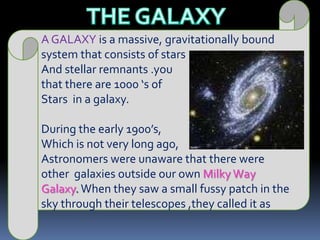
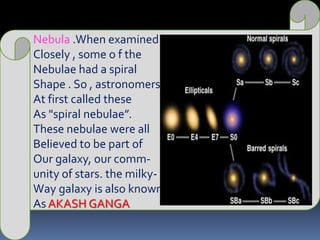
THE GALAXYA GALAXY is a massive, gravitationally bound system that consists of starsAnd stellar remnants .you that there are 1000 ‘s of Stars  in a galaxy.During the early 1900’s, Which is not very long ago,Astronomers were unaware that there were other  galaxies outside our own Milky Way Galaxy. When they saw a small fussy patch in the sky through their telescopes ,they called it as
Nebula .When examinedClosely , some o f the Nebulae had a spiral Shape . So , astronomersAt first called these As "spiral nebulae”. These nebulae were allBelieved to be part of Our galaxy, our comm-unity of stars. the milky-Way galaxy is also known As AKASH GANGA
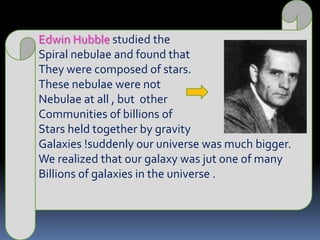
Edwin Hubble studied the Spiral nebulae and found that They were composed of stars.These nebulae were notNebulae at all , but  other Communities of billions of Stars held together by gravity Galaxies !suddenly our universe was much bigger.We realized that our galaxy was jut one of manyBillions of galaxies in the universe .
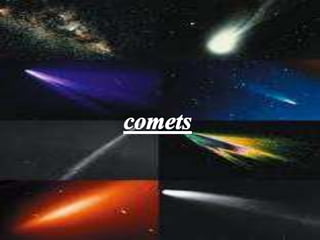
comets
cometsA comet is a small solar system body bigger than a MeteoroidYou know that some of the cometsStrikes for a short period . Do you know what JFC  means ? It means Jupiter Family Comets. Do You know that in early times people Believe that seeing a comet is aMisfortune for  the man\woman whoIs seeing it.
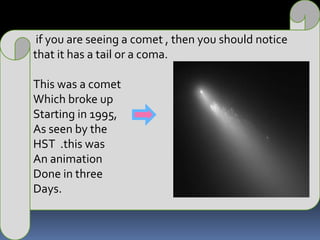
 if you are seeing a comet , then you should notice that it has a tail or a coma.This was a comet Which broke up Starting in 1995, As seen by the HST  .this was An animationDone in three Days.
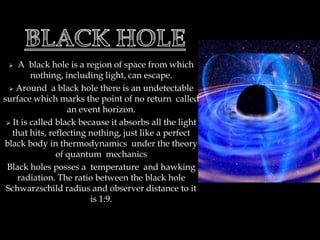
BLACK HOLEBLACK HOLE  A  black hole is a region of space from which nothing, including light, can escape.
Around  a black hole there is an undetectable surface which marks the point of no return  called an event horizon.
It is called black because it absorbs all the light that hits, reflecting nothing, just like a perfect black body in thermodynamics  under the theory of quantum  mechanicsBlack holes posses a  temperature  and hawking radiation. The ratio between the black hole Schwarzschild radius and observer distance to it is 1:9.
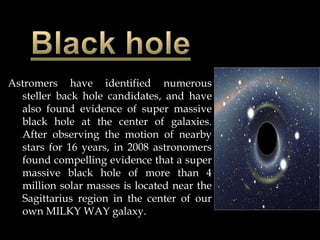
Black holeAstromers have identified numerous steller back hole candidates, and have also found evidence of super massive black hole at the center of galaxies. After observing the motion of nearby stars for 16 years, in 2008 astronomers found compelling evidence that a super massive black hole of more than 4 million solar masses is located near the Sagittarius region in the center of our own MILKY WAY galaxy.
Solar system
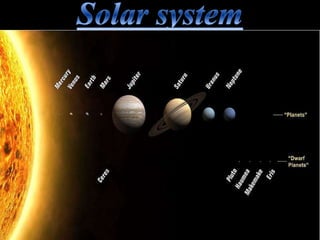
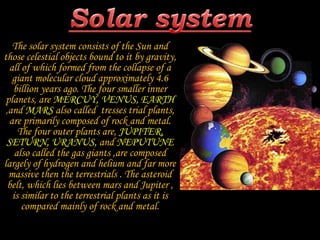
Solar systemThe solar system consists of the Sun and those celestial objects bound to it by gravity, all of which formed from the collapse of a giant molecular cloud approximately 4.6 billion years ago. The four smaller inner planets, are MERCUY, VENUS, EARTH ,and MARS also called  tresses trial plants, are primarily composed of rock and metal. The four outer plants are, JUPITER, SETURN, URANUS, and NEPUTUNE also called the gas giants ,are composed largely of hydrogen and helium and far more massive then the terrestrials . The asteroid belt, which lies between mars and Jupiter , is similar to the terrestrial plants as it is  compared mainly of rock and metal.
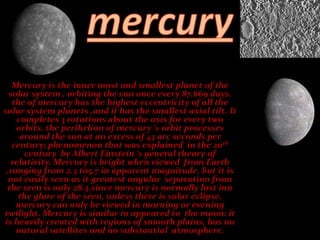
mercuryMercury is the inner most and smallest planet of the solar system , orbiting the sun once every 87.669 days. the of mercury has the highest eccentricity of all the solar system planets ,and it has the smallest axial tilt. It completes 3 rotations about the axis for every two orbits. the perihelion of mercury ‘s orbit processes around the sun at an excess of 43 arc seconds per century; phenomenon that was explained  in the 20th century  by Albert Einstein ‘s general theory of relativity. Mercury is bright when viewed  from Earth ,ranging from 2.3 to5.7 in apparent magnitude. but it is not easily seen as it greatest angular  separation from the seen is only 28.3.since mercury is normally lost inn the glare of the seen, unless there is solar eclipse, mercury can only be viewed in morning or evening twilight. Mercury is similar in appeared to  the moon: it is heavily created with regions of smooth plains, has no natural satellites and no substantial  atmosphere.
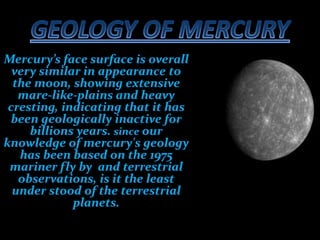
GEOLOGY OF MERCURYMercury’s face surface is overall very similar in appearance to the moon, showing extensive mare-like-plains and heavy cresting, indicating that it has been geologically inactive for billions years. since our knowledge of mercury's geology has been based on the 1975 mariner fly by  and terrestrial observations, is it the least under stood of the terrestrial  planets.
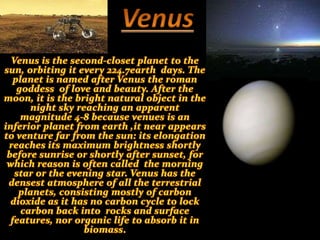
VenusVenus is the second-closet planet to the sun, orbiting it every 224.7earth  days. The planet is named after Venus the roman goddess  of love and beauty. After the moon, it is the bright natural object in the night sky reaching an apparent magnitude 4-8 because venues is an inferior planet from earth ,it near appears to venture far from the sun: its elongation reaches its maximum brightness shortly before sunrise or shortly after sunset, for which reason is often called  the morning star or the evening star. Venus has the densest atmosphere of all the terrestrial planets, consisting mostly of carbon dioxide as it has no carbon cycle to lock carbon back into  rocks and surface features, nor organic life to absorb it in biomass.
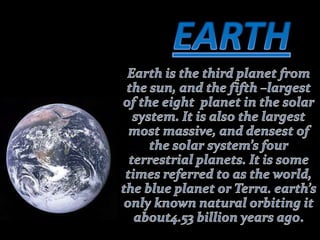
EARTHEarth is the third planet from the sun, and the fifth –largest of the eight  planet in the solar system. It is also the largest  most massive, and densest of the solar system’s four terrestrial planets. It is some times referred to as the world, the blue planet or Terra. earth’s only known natural orbiting it about4.53 billion years ago.
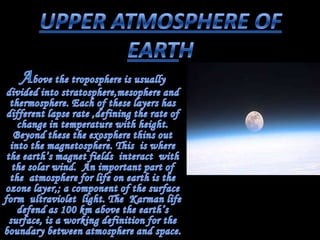
UPPER ATMOSPHERE OF EARTHAbove the troposphere is usually divided into stratosphere,mesophere and thermosphere. Each of these layers has different lapse rate ,defining the rate of change in temperature with height. Beyond these the exosphere thins out into the magnetosphere. This  is where the earth’s magnet fields  interact  with   the solar wind.  An important part of the  atmosphere for life on earth is the ozone layer,; a component of the surface form  ultraviolet  light. The  Karman life  defend as 100 km above the earth’s surface, is a working definition for the boundary between atmosphere and space.
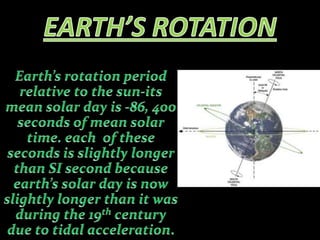
EARTH’S ROTATIONEarth’s rotation period relative to the sun-its mean solar day is -86, 400 seconds of mean solar time. each  of these seconds is slightly longer than SI second because earth’s solar day is now slightly longer than it was during the 19th century  due to tidal acceleration.
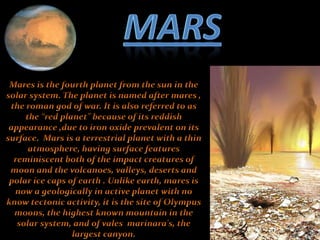
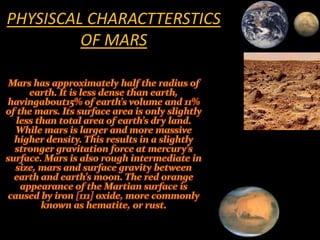
marsMares is the fourth planet from the sun in the solar system. The planet is named after mares , the roman god of war. It is also referred to as the “red planet” because of its reddish appearance ,due to iron oxide prevalent on its surface.  Mars is a terrestrial planet with a thin atmosphere, having surface features reminiscent both of the impact creatures of moon and the volcanoes, valleys, deserts and polar ice caps of earth . Unlike earth, mares is now a geologically in active planet with no know tectonic activity, it is the site of Olympus moons, the highest known mountain in the solar system, and of vales  marinara's, the largest canyon.
PHYSISCAL CHARACTTERSTICS OF MARSMars has approximately half the radius of earth. It is less dense than earth, havingabout15% of earth’s volume and 11% of the mars. Its surface area is only slightly less than total area of earth’s dry land. While mars is larger and more massive higher density. This results in a slightly stronger gravitation force at mercury’s  surface. Mars is also rough intermediate in size, mars and surface gravity between earth and earth’s moon. The red orange appearance of the Martian surface is caused by iron [111] oxide, more commonly known as hematite, or rust.
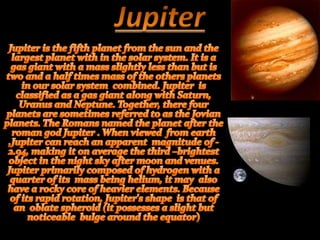
JupiterJupiter is the fifth planet from the sun and the largest planet with in the solar system. It is a gas giant with a mass slightly less than but is two and a half times mass of the others planets in our solar system  combined. Jupiter  is classified as a gas giant along with Saturn, Uranus and Neptune. Together, there four planets are sometimes referred to as the Jovian planets. The Romans named the planet after the roman god Jupiter . When viewed  from earth ,Jupiter can reach an apparent  magnitude of -2.94, making it on average the third –brightest object in the night sky after moon and venues. Jupiter primarily composed of hydrogen with a quarter of its  mass being helium, it may  also have a rocky core of heavier elements. Because of its rapid rotation, Jupiter's shape  is that of  an  oblate spheroid (it possesses a slight but noticeable  bulge around the equator)
SaturnSaturn is the 6th planet from the sun and the second largest planet in the solar system , after Jupiter . Saturn , along with Jupiter, Uranus and Neptune is classified as a gas  giant . Together, there 4 planets are some times referred to as the Jovian, meaning “Jupiter-like” planets . Saturn  is named  after the roman god Saturn , equated to the Greek kronos (the titan of Zeus) the Babylonian ninurta  and to the Hindu shani . Saturn’s symbol represents the god’s sickle. The planet Saturn  is composed  of hydrogen, with small proportions of helium and trace elements. The  interior consists of a small core of rock and ice, surrounded by a thick layer of metallic hydrogen and gaseous outer layer. Saturn  has  a prominent system of rings. Consisting mostly of ice particles with a smaller amount of rocky debris and dust.
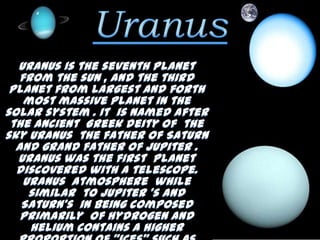
UranusUranus is the seventh planet from the sun , and the third planet from largest and forth most massive planet in the solar system . It  is named after  the ancient  Greek deity of  the sky Uranus  the father of Saturn  and grand father of Jupiter . Uranus was the first  planet  discovered with a telescope. Uranus  atmosphere  while similar  to Jupiter ’s and Saturn's  in being composed primarily  of hydrogen and helium contains a higher  proportion of “ices” such as   water  ammonia and methane, along with taxes of hydrocarbons.
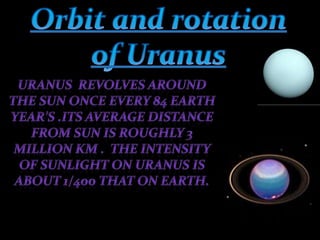
Orbit and rotation of Uranus Uranus  revolves around the sun once every 84 earth year’s .Its average distance from sun is roughly 3 million Km .  The intensity  of sunlight on Uranus is about 1/400 that on earth.

OUR SOLAR SYSTEM

  • 1.
  • 2.
  • 3.
    THE GALAXYA GALAXYis a massive, gravitationally bound system that consists of starsAnd stellar remnants .you that there are 1000 ‘s of Stars in a galaxy.During the early 1900’s, Which is not very long ago,Astronomers were unaware that there were other galaxies outside our own Milky Way Galaxy. When they saw a small fussy patch in the sky through their telescopes ,they called it as
  • 4.
    Nebula .When examinedClosely, some o f the Nebulae had a spiral Shape . So , astronomersAt first called these As "spiral nebulae”. These nebulae were allBelieved to be part of Our galaxy, our comm-unity of stars. the milky-Way galaxy is also known As AKASH GANGA
  • 5.
    Edwin Hubble studiedthe Spiral nebulae and found that They were composed of stars.These nebulae were notNebulae at all , but other Communities of billions of Stars held together by gravity Galaxies !suddenly our universe was much bigger.We realized that our galaxy was jut one of manyBillions of galaxies in the universe .
  • 6.
  • 7.
    cometsA comet isa small solar system body bigger than a MeteoroidYou know that some of the cometsStrikes for a short period . Do you know what JFC means ? It means Jupiter Family Comets. Do You know that in early times people Believe that seeing a comet is aMisfortune for the man\woman whoIs seeing it.
  • 8.
    if youare seeing a comet , then you should notice that it has a tail or a coma.This was a comet Which broke up Starting in 1995, As seen by the HST .this was An animationDone in three Days.
  • 9.
    BLACK HOLEBLACK HOLE A black hole is a region of space from which nothing, including light, can escape.
  • 10.
    Around ablack hole there is an undetectable surface which marks the point of no return called an event horizon.
  • 11.
    It is calledblack because it absorbs all the light that hits, reflecting nothing, just like a perfect black body in thermodynamics under the theory of quantum mechanicsBlack holes posses a temperature and hawking radiation. The ratio between the black hole Schwarzschild radius and observer distance to it is 1:9.
  • 12.
    Black holeAstromers haveidentified numerous steller back hole candidates, and have also found evidence of super massive black hole at the center of galaxies. After observing the motion of nearby stars for 16 years, in 2008 astronomers found compelling evidence that a super massive black hole of more than 4 million solar masses is located near the Sagittarius region in the center of our own MILKY WAY galaxy.
  • 13.
  • 14.
    Solar systemThe solarsystem consists of the Sun and those celestial objects bound to it by gravity, all of which formed from the collapse of a giant molecular cloud approximately 4.6 billion years ago. The four smaller inner planets, are MERCUY, VENUS, EARTH ,and MARS also called tresses trial plants, are primarily composed of rock and metal. The four outer plants are, JUPITER, SETURN, URANUS, and NEPUTUNE also called the gas giants ,are composed largely of hydrogen and helium and far more massive then the terrestrials . The asteroid belt, which lies between mars and Jupiter , is similar to the terrestrial plants as it is compared mainly of rock and metal.
  • 15.
    mercuryMercury is theinner most and smallest planet of the solar system , orbiting the sun once every 87.669 days. the of mercury has the highest eccentricity of all the solar system planets ,and it has the smallest axial tilt. It completes 3 rotations about the axis for every two orbits. the perihelion of mercury ‘s orbit processes around the sun at an excess of 43 arc seconds per century; phenomenon that was explained in the 20th century by Albert Einstein ‘s general theory of relativity. Mercury is bright when viewed from Earth ,ranging from 2.3 to5.7 in apparent magnitude. but it is not easily seen as it greatest angular separation from the seen is only 28.3.since mercury is normally lost inn the glare of the seen, unless there is solar eclipse, mercury can only be viewed in morning or evening twilight. Mercury is similar in appeared to the moon: it is heavily created with regions of smooth plains, has no natural satellites and no substantial atmosphere.
  • 16.
    GEOLOGY OF MERCURYMercury’sface surface is overall very similar in appearance to the moon, showing extensive mare-like-plains and heavy cresting, indicating that it has been geologically inactive for billions years. since our knowledge of mercury's geology has been based on the 1975 mariner fly by and terrestrial observations, is it the least under stood of the terrestrial planets.
  • 17.
    VenusVenus is thesecond-closet planet to the sun, orbiting it every 224.7earth days. The planet is named after Venus the roman goddess of love and beauty. After the moon, it is the bright natural object in the night sky reaching an apparent magnitude 4-8 because venues is an inferior planet from earth ,it near appears to venture far from the sun: its elongation reaches its maximum brightness shortly before sunrise or shortly after sunset, for which reason is often called the morning star or the evening star. Venus has the densest atmosphere of all the terrestrial planets, consisting mostly of carbon dioxide as it has no carbon cycle to lock carbon back into rocks and surface features, nor organic life to absorb it in biomass.
  • 18.
    EARTHEarth is thethird planet from the sun, and the fifth –largest of the eight planet in the solar system. It is also the largest most massive, and densest of the solar system’s four terrestrial planets. It is some times referred to as the world, the blue planet or Terra. earth’s only known natural orbiting it about4.53 billion years ago.
  • 19.
    UPPER ATMOSPHERE OFEARTHAbove the troposphere is usually divided into stratosphere,mesophere and thermosphere. Each of these layers has different lapse rate ,defining the rate of change in temperature with height. Beyond these the exosphere thins out into the magnetosphere. This is where the earth’s magnet fields interact with the solar wind. An important part of the atmosphere for life on earth is the ozone layer,; a component of the surface form ultraviolet light. The Karman life defend as 100 km above the earth’s surface, is a working definition for the boundary between atmosphere and space.
  • 20.
    EARTH’S ROTATIONEarth’s rotationperiod relative to the sun-its mean solar day is -86, 400 seconds of mean solar time. each of these seconds is slightly longer than SI second because earth’s solar day is now slightly longer than it was during the 19th century due to tidal acceleration.
  • 21.
    marsMares is thefourth planet from the sun in the solar system. The planet is named after mares , the roman god of war. It is also referred to as the “red planet” because of its reddish appearance ,due to iron oxide prevalent on its surface. Mars is a terrestrial planet with a thin atmosphere, having surface features reminiscent both of the impact creatures of moon and the volcanoes, valleys, deserts and polar ice caps of earth . Unlike earth, mares is now a geologically in active planet with no know tectonic activity, it is the site of Olympus moons, the highest known mountain in the solar system, and of vales marinara's, the largest canyon.
  • 22.
    PHYSISCAL CHARACTTERSTICS OFMARSMars has approximately half the radius of earth. It is less dense than earth, havingabout15% of earth’s volume and 11% of the mars. Its surface area is only slightly less than total area of earth’s dry land. While mars is larger and more massive higher density. This results in a slightly stronger gravitation force at mercury’s surface. Mars is also rough intermediate in size, mars and surface gravity between earth and earth’s moon. The red orange appearance of the Martian surface is caused by iron [111] oxide, more commonly known as hematite, or rust.
  • 23.
    JupiterJupiter is thefifth planet from the sun and the largest planet with in the solar system. It is a gas giant with a mass slightly less than but is two and a half times mass of the others planets in our solar system combined. Jupiter is classified as a gas giant along with Saturn, Uranus and Neptune. Together, there four planets are sometimes referred to as the Jovian planets. The Romans named the planet after the roman god Jupiter . When viewed from earth ,Jupiter can reach an apparent magnitude of -2.94, making it on average the third –brightest object in the night sky after moon and venues. Jupiter primarily composed of hydrogen with a quarter of its mass being helium, it may also have a rocky core of heavier elements. Because of its rapid rotation, Jupiter's shape is that of an oblate spheroid (it possesses a slight but noticeable bulge around the equator)
  • 24.
    SaturnSaturn is the6th planet from the sun and the second largest planet in the solar system , after Jupiter . Saturn , along with Jupiter, Uranus and Neptune is classified as a gas giant . Together, there 4 planets are some times referred to as the Jovian, meaning “Jupiter-like” planets . Saturn is named after the roman god Saturn , equated to the Greek kronos (the titan of Zeus) the Babylonian ninurta and to the Hindu shani . Saturn’s symbol represents the god’s sickle. The planet Saturn is composed of hydrogen, with small proportions of helium and trace elements. The interior consists of a small core of rock and ice, surrounded by a thick layer of metallic hydrogen and gaseous outer layer. Saturn has a prominent system of rings. Consisting mostly of ice particles with a smaller amount of rocky debris and dust.
  • 25.
    UranusUranus is theseventh planet from the sun , and the third planet from largest and forth most massive planet in the solar system . It is named after the ancient Greek deity of the sky Uranus the father of Saturn and grand father of Jupiter . Uranus was the first planet discovered with a telescope. Uranus atmosphere while similar to Jupiter ’s and Saturn's in being composed primarily of hydrogen and helium contains a higher proportion of “ices” such as water ammonia and methane, along with taxes of hydrocarbons.
  • 26.
    Orbit and rotationof Uranus Uranus revolves around the sun once every 84 earth year’s .Its average distance from sun is roughly 3 million Km . The intensity of sunlight on Uranus is about 1/400 that on earth.
  • 27.
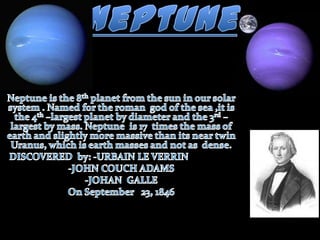
    NeptuneNeptune is the8th planet from the sun in our solar system . Named for the roman god of the sea ,it is the 4th –largest planet by diameter and the 3rd – largest by mass. Neptune is 17 times the mass of earth and slightly more massive than its near twin Uranus, which is earth masses and not as dense. DISCOVERED by: -URBAIN LE VERRIN JOHN COUCH ADAMS
  • 28.
    JOHAN GALLEOnSeptember 23, 1846
  • 29.

Editor's Notes

  • #10 Astromers have identified numerous steller black hole candidates, and have also found evidence of super massive black holes at the center of galaxies. After observing the motion of nearby stars for 16 years ,in that a super massive black hole of more than 4 million solar masses is located near the Sagittarius A region in the centre of our own MILKY WAY galaxy.