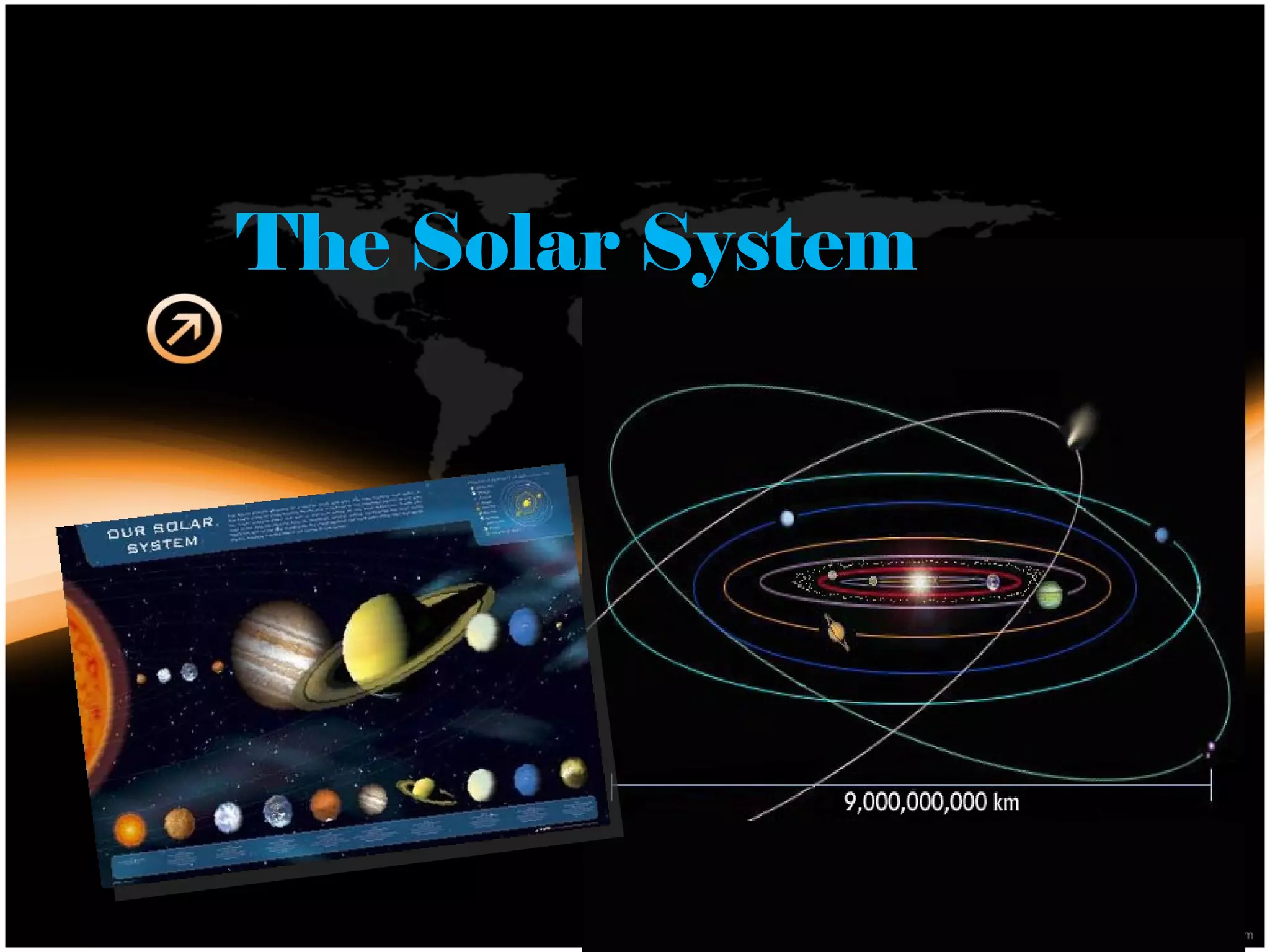
The Solar System
Content After this studying, the student should be able; To identify the 9 planet in our Solar System. Knowing what is consist in our Solar System. Introduction The Solar System Asteroid  Belt Comet 9 Planet In Solar System Mercury Venus Earth Mars Jupiter Saturn Uranus Neptune Pluto
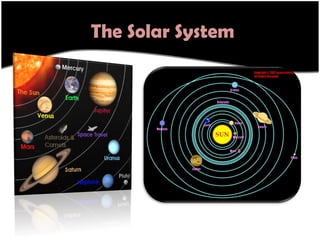
Introduction The  Solar System  consists of the Sun  and the  astronomical objects  bound to it by gravity. Formed from the collapse of a giant molecular cloud approximately 4.6 billion years ago. The  four smaller inner  planets,  Mercury, Venus, Earth  and  Mars,  also called the  terrestrial planets , are primarily composed of rock and metal. The  two largest,  Jupiter and Saturn , are composed mainly of hydrogen and helium.
The Solar System
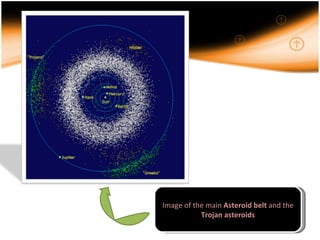
Asteroid belt The main  asteroid belt  occupies the orbit between Mars and Jupiter, between 2.3 and 3.3 AU from the Sun. Asteroids with diameters between 10 and 10−4 m are called meteoroids. Comet Comets are small Solar System bodies, typically only a few kilometres across, composed largely of volatile ices.  Short-period comets have orbits lasting less than two hundred years. Short-period comets are believed to originate in the Kiuper belt. Long-period comets have orbits lasting thousands of years.
Image of the main  Asteroid belt  and the  Trojan asteroids
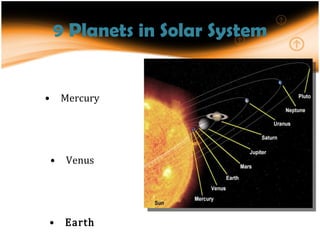
9 Planets in Solar System Mercury Venus Earth Mars Jupiter Saturn Uranus Neptune Pluto
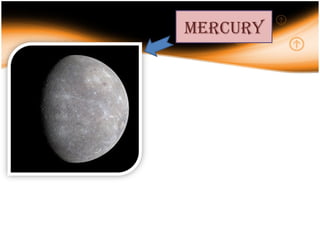
Mercury is the  closest planet to the Sun ,  innermost  and  smallest  (0.055 Earth masses) planet in the Solar System,  orbiting the Sun once every 87.969 Earth days . Mercury  is similar in appearance to the  Moon : it is heavily cratered with regions of smooth plains, has no natural satellites and  no substantial atmosphere . However, unlike the Moon, it has a large  iron core , which generates a  magnetic field  about 1% as strong as that of the Earth. Mercury
Mercury
Venus
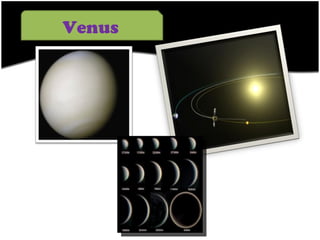
Cont’d Venus is the second planet from the Sun, orbiting it every 224.7 Earth days. The planet is named after Venus, the Roman goddess of love and beauty.  Venus has no natural satellites. The diameter of Venus is only 650 km less than the Earth's, and its mass is 81.5% of the Earth's. A day on Venus lasts 243 Earth days, while its year is 224.7 Earth days.
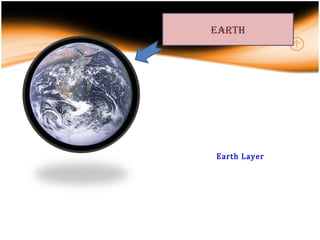
Earth  (or the Earth) is the  third planet  from the Sun, and the  densest  and  fifth-largest  of the eight planets in the Solar System. It has  one natural satellite, the  Moon. Earth  orbits  the Sun once for every roughly  366.26 times  it rotates about its axis, which is equal to  365.26 solar days. The Earth's  axis of rotation is tilted 23.4 ° away from the perpendicular to its orbital plane. Earth
earth Earth Layer
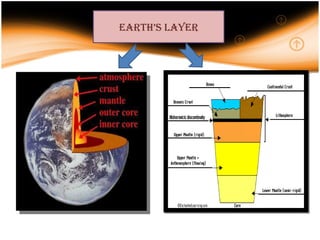
Earth’s layer
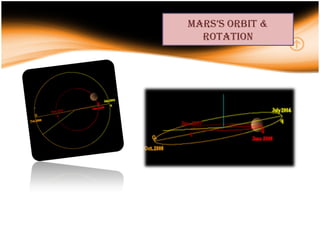
Orbit & Rotation Mars is the  fourth planet  from the Sun in the Solar System. The planet is  named after the Roman god of war,  Mars . It is often described as the "Red Planet", as the iron oxide prevalent on its surface gives it a reddish appearance. Mars  has two tiny natural satellites  (Deimos and Phobos)  thought to be captured asteroids. Mars’  average distance  from the Sun  is roughly  230 million km  (1.5 AU) and its  orbital period is 687  (Earth) days. The  axial tilt of Mars is 25.19 degrees. Mars
mars’s orbit & rotation
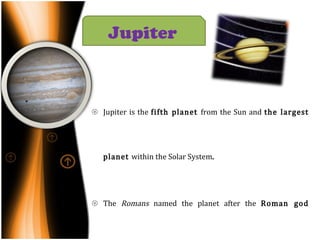
Jupiter is the  fifth planet  from the Sun and  the largest planet  within the Solar System .  The  Romans  named the planet after the  Roman god Jupiter. Having a  diameter of 142,984 km  at its equator. Jupiter's  density, 1.326 g/cm³. The only planet that has a  center of mass  with the Sun.  Jupiter's  rotation  is the fastest  of all the Solar System's planets, completing a rotation on its axis in slightly  less than ten hours.  Jupiter
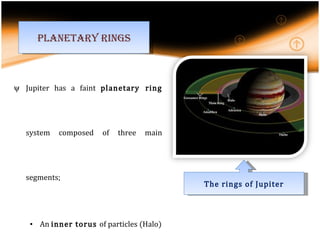
Jupiter has a faint  planetary ring  system composed of three main segments; An  inner torus  of particles (Halo) Bright main ring Outer gossamer ring . Rings appear to be  made of dust. Planetary rings The rings of Jupiter
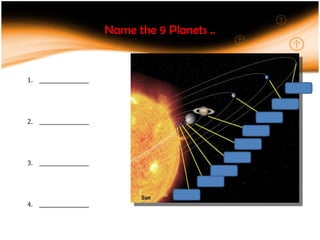
Name the 9 Planets .. ___________________ ___________________ ___________________ ___________________ ___________________ ___________________ ___________________ ___________________ ___________________
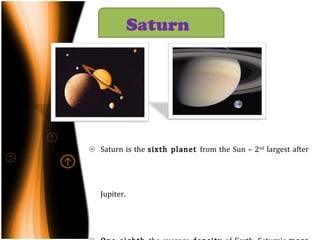
Saturn is the  sixth planet  from the Sun – 2 nd  largest after Jupiter. One-eighth  the average  density  of Earth. Saturn's  mass  is just  over ninety-five times greater  than Earth's. Wind speeds  on Saturn can reach  1,800 km/h. Saturn has  nine  rings . 62  known  moons  orbit the planet , 53  are   officially named. Saturn
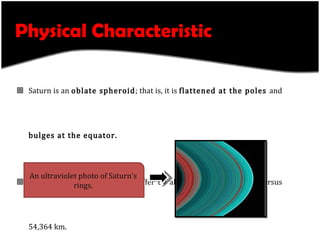
Physical Characteristic Saturn is an  oblate spheroid ; that is, it is  flattened at the poles  and  bulges at the equator. Its equatorial and polar radii differ by almost 10%—60,268 km versus 54,364 km. Average  specific density  of the planet is  0.69 g/cm³.   Saturn is only  95 Earth masses . An ultraviolet photo of Saturn's rings.
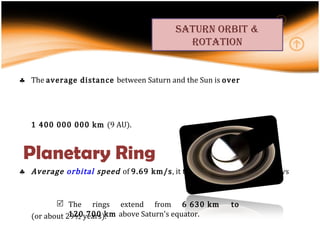
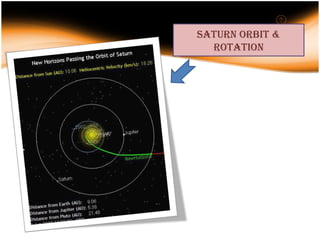
The  average distance  between Saturn and the Sun is  over 1 400 000 000 km  (9 AU).  Average  orbital  speed  of  9.69 km/s , it takes Saturn 10,759 Earth days (or about 29½ years). The  elliptical orbit  of Saturn is inclined  2.48°. Planetary Ring saturn orbit & rotation The rings extend from  6 630 km to 120 700 km  above Saturn's equator.
saturn orbit & rotation
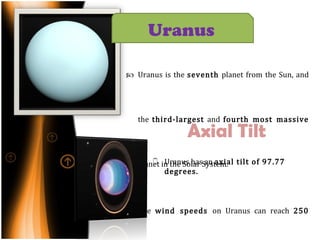
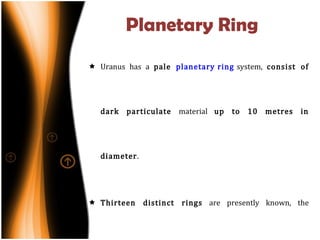
Uranus is the  seventh  planet from the Sun, and the  third-largest  and  fourth most massive  planet in the Solar System. The  wind speeds  on Uranus can reach  250 meters per second (900 km/h, 560 mph). Axial Tilt Uranus   Uranus has an  axial tilt of 97.77 degrees.
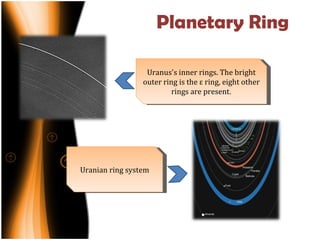
Planetary Ring Uranus has a  pale  planetary ring  system,  consist of dark particulate  material  up to 10 metres in diameter . Thirteen distinct rings  are presently known, the brightest being the ε ring. All except two rings of Uranus are extremely narrow—they are usually a few kilometres wide.
Planetary Ring Uranus's inner rings. The bright outer ring is the ε ring, eight other rings are present . Uranian ring system
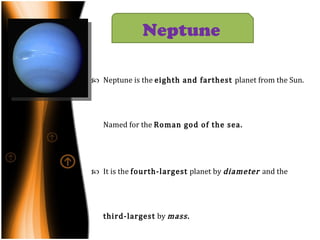
Neptune is the  eighth and farthest  planet from the Sun. Named for the  Roman god of the sea. It is the  fourth-largest  planet by  diameter  and the  third-largest  by  mass. On average, Neptune orbits the Sun at a distance of 30.1 AU. categorize Uranus and Neptune as  "ice giants“. Wind speeds  as high as  2,100 km/h. Temperatures  at its cloud tops approaching  −218 °C (55 K) .  Temperatures at the planet's centre , however, are approximately  5,400 K (5,000 °C). Neptune
From its discovery in 1930 until 2006, Pluto was considered the Solar System's  ninth planet. It has an  eccentric  and  highly inclined orbit  that takes it from  30 to 49 AU (4.4–7.4 billion km) from the Sun. Pluto has  two  known  smaller moons; Nix  and  Hydra , discovered in 2005. Pluto
Pluto's  rotation period , its day, is equal to  6.39 Earth days.  Pluto  rotates on its "side"  on its orbital plane, with an  axial tilt of 120°. At its solstices, one hemisphere is in permanent daylight, while the other is in permanent darkness. Orbit & Rotation pluto orbit & rotation
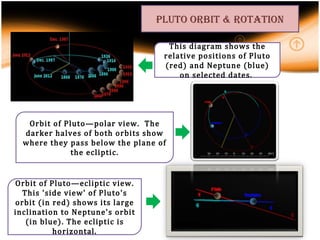
pluto orbit & rotation Orbit of Pluto—ecliptic view. This 'side view' of Pluto's orbit (in red) shows its large inclination to Neptune's orbit (in blue). The ecliptic is horizontal. This diagram shows the relative positions of Pluto (red) and Neptune (blue) on selected dates.  Orbit of Pluto—polar view.  The darker halves of both orbits show where they pass below the plane of the ecliptic.
Let’s Watch Out A Video Of The Solar System …
References  Davies, Merton E;  et al.  (October, 1976).  "Antoniadi's Map of Mercury" .  SP-423 Atlas of Mercury . NASA.  http://history.nasa.gov/SP-423/p15a.htm . Retrieved 2010-08-09. "Dawn: A Journey to the Beginning of the Solar System" .  Space Physics Center: UCLA . 2005.  http://www-ssc.igpp.ucla.edu/dawn/background.html. Retrieved 2007-11-03 . Luhmann J. G., Russell C. T. (1997). J. H. Shirley and R. W. Fainbridge. ed.  Venus: Magnetic Field and Magnetosphere . Chapman and Hall, New York.  Nineplanets.org.  "An Overview of the Solar System" .  http://www.nineplanets.org/overview.html. Retrieved 2007-02-15 . Staff (2008-07-24).  "World" .  The World Factbook . Central Intelligence Agency.  https://www.cia.gov/library/publications/the-world-factbook/geos/xx.html . Retrieved 2008-08-05. "Space Topics: Compare the Planets: Mercury, Venus, Earth, The Moon, and Mars". Planetary Society.  http://www.planetary.org/explore/topics/compare_the_planets/terrestrial.html. Retrieved 2007-04-12 . http://www.spacestationinfo.my  retrieved 2010-10-19
Thank You For Your Attention … =)

The solar system new

  • 1.
  • 2.
    Content After thisstudying, the student should be able; To identify the 9 planet in our Solar System. Knowing what is consist in our Solar System. Introduction The Solar System Asteroid Belt Comet 9 Planet In Solar System Mercury Venus Earth Mars Jupiter Saturn Uranus Neptune Pluto
  • 3.
    Introduction The Solar System consists of the Sun and the astronomical objects bound to it by gravity. Formed from the collapse of a giant molecular cloud approximately 4.6 billion years ago. The four smaller inner planets, Mercury, Venus, Earth and Mars, also called the terrestrial planets , are primarily composed of rock and metal. The two largest, Jupiter and Saturn , are composed mainly of hydrogen and helium.
  • 4.
  • 5.
    Asteroid belt Themain asteroid belt occupies the orbit between Mars and Jupiter, between 2.3 and 3.3 AU from the Sun. Asteroids with diameters between 10 and 10−4 m are called meteoroids. Comet Comets are small Solar System bodies, typically only a few kilometres across, composed largely of volatile ices. Short-period comets have orbits lasting less than two hundred years. Short-period comets are believed to originate in the Kiuper belt. Long-period comets have orbits lasting thousands of years.
  • 6.
    Image of themain Asteroid belt and the Trojan asteroids
  • 7.
    9 Planets inSolar System Mercury Venus Earth Mars Jupiter Saturn Uranus Neptune Pluto
  • 8.
    Mercury is the closest planet to the Sun , innermost and smallest (0.055 Earth masses) planet in the Solar System, orbiting the Sun once every 87.969 Earth days . Mercury is similar in appearance to the Moon : it is heavily cratered with regions of smooth plains, has no natural satellites and no substantial atmosphere . However, unlike the Moon, it has a large iron core , which generates a magnetic field about 1% as strong as that of the Earth. Mercury
  • 9.
  • 10.
  • 11.
    Cont’d Venus isthe second planet from the Sun, orbiting it every 224.7 Earth days. The planet is named after Venus, the Roman goddess of love and beauty. Venus has no natural satellites. The diameter of Venus is only 650 km less than the Earth's, and its mass is 81.5% of the Earth's. A day on Venus lasts 243 Earth days, while its year is 224.7 Earth days.
  • 12.
    Earth (orthe Earth) is the third planet from the Sun, and the densest and fifth-largest of the eight planets in the Solar System. It has one natural satellite, the Moon. Earth orbits the Sun once for every roughly 366.26 times it rotates about its axis, which is equal to 365.26 solar days. The Earth's axis of rotation is tilted 23.4 ° away from the perpendicular to its orbital plane. Earth
  • 13.
  • 14.
  • 15.
    Orbit & RotationMars is the fourth planet from the Sun in the Solar System. The planet is named after the Roman god of war, Mars . It is often described as the "Red Planet", as the iron oxide prevalent on its surface gives it a reddish appearance. Mars has two tiny natural satellites (Deimos and Phobos) thought to be captured asteroids. Mars’ average distance from the Sun is roughly 230 million km (1.5 AU) and its orbital period is 687 (Earth) days. The axial tilt of Mars is 25.19 degrees. Mars
  • 16.
  • 17.
    Jupiter is the fifth planet from the Sun and the largest planet within the Solar System . The Romans named the planet after the Roman god Jupiter. Having a diameter of 142,984 km at its equator. Jupiter's density, 1.326 g/cm³. The only planet that has a center of mass with the Sun. Jupiter's rotation is the fastest of all the Solar System's planets, completing a rotation on its axis in slightly less than ten hours. Jupiter
  • 18.
    Jupiter has afaint planetary ring system composed of three main segments; An inner torus of particles (Halo) Bright main ring Outer gossamer ring . Rings appear to be made of dust. Planetary rings The rings of Jupiter
  • 19.
    Name the 9Planets .. ___________________ ___________________ ___________________ ___________________ ___________________ ___________________ ___________________ ___________________ ___________________
  • 20.
    Saturn is the sixth planet from the Sun – 2 nd largest after Jupiter. One-eighth the average density of Earth. Saturn's mass is just over ninety-five times greater than Earth's. Wind speeds on Saturn can reach 1,800 km/h. Saturn has nine rings . 62 known moons orbit the planet , 53 are officially named. Saturn
  • 21.
    Physical Characteristic Saturnis an oblate spheroid ; that is, it is flattened at the poles and bulges at the equator. Its equatorial and polar radii differ by almost 10%—60,268 km versus 54,364 km. Average specific density of the planet is 0.69 g/cm³. Saturn is only 95 Earth masses . An ultraviolet photo of Saturn's rings.
  • 22.
    The averagedistance between Saturn and the Sun is over 1 400 000 000 km (9 AU). Average orbital speed of 9.69 km/s , it takes Saturn 10,759 Earth days (or about 29½ years). The elliptical orbit of Saturn is inclined 2.48°. Planetary Ring saturn orbit & rotation The rings extend from 6 630 km to 120 700 km above Saturn's equator.
  • 23.
  • 24.
    Uranus is the seventh planet from the Sun, and the third-largest and fourth most massive planet in the Solar System. The wind speeds on Uranus can reach 250 meters per second (900 km/h, 560 mph). Axial Tilt Uranus Uranus has an axial tilt of 97.77 degrees.
  • 25.
    Planetary Ring Uranushas a pale planetary ring system, consist of dark particulate material up to 10 metres in diameter . Thirteen distinct rings are presently known, the brightest being the ε ring. All except two rings of Uranus are extremely narrow—they are usually a few kilometres wide.
  • 26.
    Planetary Ring Uranus'sinner rings. The bright outer ring is the ε ring, eight other rings are present . Uranian ring system
  • 27.
    Neptune is the eighth and farthest planet from the Sun. Named for the Roman god of the sea. It is the fourth-largest planet by diameter and the third-largest by mass. On average, Neptune orbits the Sun at a distance of 30.1 AU. categorize Uranus and Neptune as "ice giants“. Wind speeds as high as 2,100 km/h. Temperatures at its cloud tops approaching −218 °C (55 K) . Temperatures at the planet's centre , however, are approximately 5,400 K (5,000 °C). Neptune
  • 28.
    From its discoveryin 1930 until 2006, Pluto was considered the Solar System's ninth planet. It has an eccentric and highly inclined orbit that takes it from 30 to 49 AU (4.4–7.4 billion km) from the Sun. Pluto has two known smaller moons; Nix and Hydra , discovered in 2005. Pluto
  • 29.
    Pluto's  rotation period, its day, is equal to 6.39 Earth days. Pluto rotates on its "side" on its orbital plane, with an axial tilt of 120°. At its solstices, one hemisphere is in permanent daylight, while the other is in permanent darkness. Orbit & Rotation pluto orbit & rotation
  • 30.
    pluto orbit &rotation Orbit of Pluto—ecliptic view. This 'side view' of Pluto's orbit (in red) shows its large inclination to Neptune's orbit (in blue). The ecliptic is horizontal. This diagram shows the relative positions of Pluto (red) and Neptune (blue) on selected dates. Orbit of Pluto—polar view. The darker halves of both orbits show where they pass below the plane of the ecliptic.
  • 31.
    Let’s Watch OutA Video Of The Solar System …
  • 32.
    References Davies,Merton E; et al. (October, 1976). "Antoniadi's Map of Mercury" . SP-423 Atlas of Mercury . NASA. http://history.nasa.gov/SP-423/p15a.htm . Retrieved 2010-08-09. "Dawn: A Journey to the Beginning of the Solar System" . Space Physics Center: UCLA . 2005. http://www-ssc.igpp.ucla.edu/dawn/background.html. Retrieved 2007-11-03 . Luhmann J. G., Russell C. T. (1997). J. H. Shirley and R. W. Fainbridge. ed. Venus: Magnetic Field and Magnetosphere . Chapman and Hall, New York. Nineplanets.org. "An Overview of the Solar System" . http://www.nineplanets.org/overview.html. Retrieved 2007-02-15 . Staff (2008-07-24). "World" . The World Factbook . Central Intelligence Agency. https://www.cia.gov/library/publications/the-world-factbook/geos/xx.html . Retrieved 2008-08-05. "Space Topics: Compare the Planets: Mercury, Venus, Earth, The Moon, and Mars". Planetary Society. http://www.planetary.org/explore/topics/compare_the_planets/terrestrial.html. Retrieved 2007-04-12 . http://www.spacestationinfo.my retrieved 2010-10-19
  • 33.
    Thank You ForYour Attention … =)