
Inequality and inequity Dr. Scott McLeod September 19, 2006
Question If you were to perform in the circus, what would you do?
Housekeeping Attendance Note discussion group / location Syllabus  Textbook Electronic assignments
Definitions and prior knowledge What is the difference between these terms? Inequality is… Inequity is…
Definitions While inequality implies differences between individuals or population groups, inequity refers to differences which are unnecessary and avoidable but, in addition, are also considered unfair and unjust. Not all inequalities are unjust, but all inequities are the product of unjust inequalities.  http://www.paho.org/english/sha/be991ineq.htm
Prior knowledge What do we already know about inequality and inequity in education?
Root causes What are our beliefs about the  root causes  behind existing inequalities and/or inequities?
Societal impacts What are the societal impacts of failing to remedy existing inequities and/or inequalities? Rich keep getting richer We think it’s the way it’s supposed to be – comfort with the status quo
Societal impacts Inability of people to become upwardly mobile Feelings of helplessness by individuals and/or groups Those left behind become burden on society Systematic alienation / disenfranchisement Lack of concern that disadvantaged are increasingly becoming more so
Societal impacts Feelings of resentment lead to lack of support for education system Lack of global competitiveness b/c not tapping into full potential of citizens Exploitation of underserved Apathy of those left behind Inability to check consolidations of power
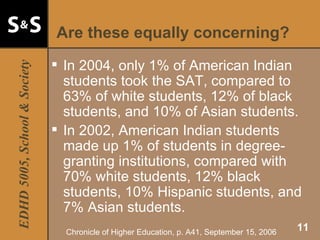
Are these equally concerning? In 2004, only 1% of American Indian students took the SAT, compared to 63% of white students, 12% of black students, and 10% of Asian students. In 2002, American Indian students made up 1% of students in degree-granting institutions, compared with 70% white students, 12% black students, 10% Hispanic students, and 7% Asian students. Chronicle of Higher Education, p. A41, September 15, 2006
State funding equity lawsuits Litigation in progress
Review and questions Technology review What kind of questions do you have?

School & Society PowerPoint - Sep 19

  • 1.
    Inequality and inequityDr. Scott McLeod September 19, 2006
  • 2.
    Question If youwere to perform in the circus, what would you do?
  • 3.
    Housekeeping Attendance Notediscussion group / location Syllabus Textbook Electronic assignments
  • 4.
    Definitions and priorknowledge What is the difference between these terms? Inequality is… Inequity is…
  • 5.
    Definitions While inequalityimplies differences between individuals or population groups, inequity refers to differences which are unnecessary and avoidable but, in addition, are also considered unfair and unjust. Not all inequalities are unjust, but all inequities are the product of unjust inequalities. http://www.paho.org/english/sha/be991ineq.htm
  • 6.
    Prior knowledge Whatdo we already know about inequality and inequity in education?
  • 7.
    Root causes Whatare our beliefs about the root causes behind existing inequalities and/or inequities?
  • 8.
    Societal impacts Whatare the societal impacts of failing to remedy existing inequities and/or inequalities? Rich keep getting richer We think it’s the way it’s supposed to be – comfort with the status quo
  • 9.
    Societal impacts Inabilityof people to become upwardly mobile Feelings of helplessness by individuals and/or groups Those left behind become burden on society Systematic alienation / disenfranchisement Lack of concern that disadvantaged are increasingly becoming more so
  • 10.
    Societal impacts Feelingsof resentment lead to lack of support for education system Lack of global competitiveness b/c not tapping into full potential of citizens Exploitation of underserved Apathy of those left behind Inability to check consolidations of power
  • 11.
    Are these equallyconcerning? In 2004, only 1% of American Indian students took the SAT, compared to 63% of white students, 12% of black students, and 10% of Asian students. In 2002, American Indian students made up 1% of students in degree-granting institutions, compared with 70% white students, 12% black students, 10% Hispanic students, and 7% Asian students. Chronicle of Higher Education, p. A41, September 15, 2006
  • 12.
    State funding equitylawsuits Litigation in progress
  • 13.
    Review and questionsTechnology review What kind of questions do you have?