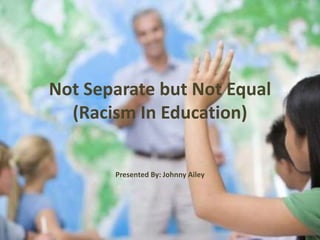
Not Separate but Not Equal
(Racism In Education)
Presented By: Johnny Ailey
What is Social Justice?
Social justice is the view that everyone
deserves equal economic, political and social
rights and opportunities.

Encyclopedia of Social Work
(19th ed., Vol. 1, pp. 95-100).
What is Racism?
The belief that race accounts for differences in
human character or ability and that a
particular race is superior to others.

The American Heritage® Dictionary of the English Language
"When attempting to correct so many
generations of bad faith and cruelty operating
in classroom and society, you will meet the
most fantastic, brutal, determined resistance.
There is no need in pretending this will not
happen."
(Baldwin, p.185)
Why Should We Be Concerned?
Children across the nation are entitled to a
quality education and equal access to that
education. The United States has
acknowledged this right of children, but so far
the country has not turned it into a reality.
Background Information
Most times in lower economic communities
there are basically Blacks, Hispanics and other
minorities. Sometimes, when there are nonminorities teachers in a low economic area
they do not expect the minorities to measure
up to white-Americans academic
achievements. It affects the minorities by not
giving them an equal opportunity to learn and
further their accomplishments in education.
What impact does Social Justice Have
On Education?

• Individual Racism
• Institutional Form of Racism
Individual Racism
Refers to an individual's racist assumptions,
beliefs or behaviors and is "a form of racial
discrimination that stems from conscious and
unconscious, personal prejudice." (Henry &
Tator, 2006, p. 329). Individual Racism is
connected to/learned from broader socioeconomic histories and processes and is
supported and reinforced by systemic racism.
Institutional Form of Racism
Includes the policies and practices entrenched
in established institutions, which result in the
exclusion or promotion of designated groups.
It differs from overt discrimination in that no
individual intent is necessary.
(Toronto Mayor's Committee on Community and Race Relations. Race Relations.
Myths and Facts)
“It is teachers and parents - not central
government - that know what is happening in
their schools, and they are best placed to deal
with racist behavior when it happens”
Department for Education
Building the Future for All Students
We believe that No child will be knowingly
discriminated by ethnicity, culture, gender, or
learning capability.
Our policy includes…
• All teachers are required to instruct students
to reach their full potential regardless of
ethnicity, gender, religion and social economic
status.
We Believe That…
When all students are valued and created equal
we build a bridge with a foundation of
equality, students can succeed with our help
to become better leaders in their community,
school, home, and most importantly
throughout the nation.
The Potential Barriers
• Increased evaluation of teachers in classrooms
to make sure the policy is properly
implemented.
• The curriculum would be in more depth to
insure all students are on target level.
Call To Action
The United States must make the necessary
steps to address the problems in the American
public education system before the education
system will ever reflect the intent of the
Brown decision. We may not uphold the
"separate but equal" doctrine but we have
certainly not created an integrated and equal
system.
Conclusion
To move forward for social justice, educators
need the strategies, revolutionary ones in
some contexts, for rethinking and taking
leadership for school practices to better meet
diverse students’ needs. Also, educators need
the language to translate intellectual concepts
into practice and experiential understandings.
Raise Awareness to
end

Discrimination within

the

Education System for ALL students
Join Me, Make A Connection
Change, Change, Change…
Be Smart. Have Heart.
References
Baldwin, J. "A Talk to Teachers" in Schultz, F. 2001. "Sources: Notable Selections in Education" Guilford:
McGraw-Hill/Dushkin
Henry, F., & Tator, C. (Eds.). (2009). Racism in the Canadian university demanding social justice, inclusion, and
equity. Toronto, ON, Canada: University of Toronto Press.
The American Heritage® Dictionary of the English Language, Fourth Edition copyright ©2000 by Houghton
Mifflin Company. Updated in 2009. Published by Houghton Mifflin Company. All rights reserved.
http://www.thefreedictionary.com/racism
http://www.bbc.co.uk/news/education-18155255

Not separate but not equal

  • 1.
    Not Separate butNot Equal (Racism In Education) Presented By: Johnny Ailey
  • 2.
    What is SocialJustice? Social justice is the view that everyone deserves equal economic, political and social rights and opportunities. Encyclopedia of Social Work (19th ed., Vol. 1, pp. 95-100).
  • 3.
    What is Racism? Thebelief that race accounts for differences in human character or ability and that a particular race is superior to others. The American Heritage® Dictionary of the English Language
  • 4.
    "When attempting tocorrect so many generations of bad faith and cruelty operating in classroom and society, you will meet the most fantastic, brutal, determined resistance. There is no need in pretending this will not happen." (Baldwin, p.185)
  • 5.
    Why Should WeBe Concerned? Children across the nation are entitled to a quality education and equal access to that education. The United States has acknowledged this right of children, but so far the country has not turned it into a reality.
  • 6.
    Background Information Most timesin lower economic communities there are basically Blacks, Hispanics and other minorities. Sometimes, when there are nonminorities teachers in a low economic area they do not expect the minorities to measure up to white-Americans academic achievements. It affects the minorities by not giving them an equal opportunity to learn and further their accomplishments in education.
  • 7.
    What impact doesSocial Justice Have On Education? • Individual Racism • Institutional Form of Racism
  • 8.
    Individual Racism Refers toan individual's racist assumptions, beliefs or behaviors and is "a form of racial discrimination that stems from conscious and unconscious, personal prejudice." (Henry & Tator, 2006, p. 329). Individual Racism is connected to/learned from broader socioeconomic histories and processes and is supported and reinforced by systemic racism.
  • 9.
    Institutional Form ofRacism Includes the policies and practices entrenched in established institutions, which result in the exclusion or promotion of designated groups. It differs from overt discrimination in that no individual intent is necessary. (Toronto Mayor's Committee on Community and Race Relations. Race Relations. Myths and Facts)
  • 10.
    “It is teachersand parents - not central government - that know what is happening in their schools, and they are best placed to deal with racist behavior when it happens” Department for Education
  • 11.
    Building the Futurefor All Students We believe that No child will be knowingly discriminated by ethnicity, culture, gender, or learning capability.
  • 12.
    Our policy includes… •All teachers are required to instruct students to reach their full potential regardless of ethnicity, gender, religion and social economic status.
  • 13.
    We Believe That… Whenall students are valued and created equal we build a bridge with a foundation of equality, students can succeed with our help to become better leaders in their community, school, home, and most importantly throughout the nation.
  • 14.
    The Potential Barriers •Increased evaluation of teachers in classrooms to make sure the policy is properly implemented. • The curriculum would be in more depth to insure all students are on target level.
  • 15.
    Call To Action TheUnited States must make the necessary steps to address the problems in the American public education system before the education system will ever reflect the intent of the Brown decision. We may not uphold the "separate but equal" doctrine but we have certainly not created an integrated and equal system.
  • 16.
    Conclusion To move forwardfor social justice, educators need the strategies, revolutionary ones in some contexts, for rethinking and taking leadership for school practices to better meet diverse students’ needs. Also, educators need the language to translate intellectual concepts into practice and experiential understandings.
  • 17.
    Raise Awareness to end Discriminationwithin the Education System for ALL students Join Me, Make A Connection Change, Change, Change… Be Smart. Have Heart.
  • 18.
    References Baldwin, J. "ATalk to Teachers" in Schultz, F. 2001. "Sources: Notable Selections in Education" Guilford: McGraw-Hill/Dushkin Henry, F., & Tator, C. (Eds.). (2009). Racism in the Canadian university demanding social justice, inclusion, and equity. Toronto, ON, Canada: University of Toronto Press. The American Heritage® Dictionary of the English Language, Fourth Edition copyright ©2000 by Houghton Mifflin Company. Updated in 2009. Published by Houghton Mifflin Company. All rights reserved. http://www.thefreedictionary.com/racism http://www.bbc.co.uk/news/education-18155255