Downloaded 15 times
![2
Inequality and education [Feito, R. 2003. Alumnado. At Fernández Palomares, F. (coord.) Sociología
de la educación. Pearson, Madrid 333-356]
Inequalities have gone
through different phases:
Inequality
Class (capitalist)
Most affected: working class
Exclusion
Segregation
Assimilation
(and egalitarianism)
Inequalities have been articulated
by reason of differences in:
Gender (patriarchal)
Most affected: women
Ethnicity (ethnocentrism)
Most affected: ethnic minorities](https://image.slidesharecdn.com/classinequality-150527102429-lva1-app6892/85/Class-inequality-2-320.jpg)
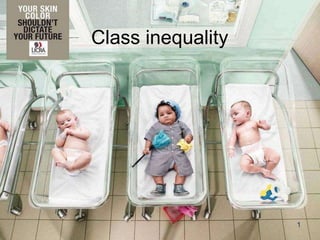
![Class inequality
[Industrial Worker, 1911. Available at
http://en.wikipedia.org/wiki/File:Pyramid_of
_Capitalist_System.png]](https://image.slidesharecdn.com/classinequality-150527102429-lva1-app6892/85/Class-inequality-3-320.jpg)

![Life expectancy at birth by social class and sex, 1997-99 [ref.]](https://image.slidesharecdn.com/classinequality-150527102429-lva1-app6892/85/Class-inequality-5-320.jpg)

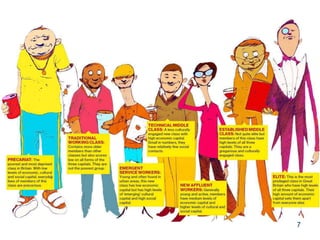
![Wright's social class [Galobardes, B., Shaw, M., Lawlor, D.A., Lynch, J.W. and Smith G.D. (2006) J
Epidemiology Community Health 60 95-101]](https://image.slidesharecdn.com/classinequality-150527102429-lva1-app6892/85/Class-inequality-8-320.jpg)
![9
Class inequality and education [Feito, R. 2003. Alumnado. At Fernández Palomares, F. (coord.)
Sociología de la educación. Pearson, Madrid 333-356]
Despite the extension of schooling,
inequalities in educational
opportunities remain (however
with exceptions, no determinism)
Class inequality
Pierre Bourdieu introduced the concept of
Cultural capital which refers to the no
correspondence between the cultural
practices of the family (or close environment)
and the school
Another explanation is based on income differences,
not because of direct costs of education (like fees)
but because of opportunity costs
But we can not claim determinism, not all children from unfavorable
environments do fail in the school system. However, these cases have been of
rather scarce interest in sociological studies (as the study of Willis ,1988)
Everhart (1983) did study these students stating that although
their involvement was minimal, it was enough to succeed.
Some ethnic minorities connect in some basic feature of the
school as frugality and effort (for instance Asian).
Bernard Lahire found that in families with little or no
literacy this circumstance might serve as a stimulus
for school children success.](https://image.slidesharecdn.com/classinequality-150527102429-lva1-app6892/85/Class-inequality-9-320.jpg)
![10
Jean Anyon (1981) found in five schools (5th grade)
that, depending on the social class the parents of
the students belonged to, teachers had different
expectations, and students different understanding,
regarding the origin of knowledge. Accordingly teachers
approached differently the activities in the classroom:
- If working class children → need for discipline, taking notes,
coloring, avoiding controversial issues, following procedures
away from their thinking processes the purpose of which is
not explained.
- If middle class children → more effort on understanding
materials and flexibility, but little discussion
- If professionals’ children → focus on high concepts, creativity
and a lot of discussion about concepts and visions.
- If senior executives children → make them to think for
themselves.
Baudelot and Establet (1976) found a similar discriminatory process at the dual
vocational and academic tracking, where ‘future proletarian workers’ were given a
compact body of simple bourgeois ideas, and ‘future bourgeois’ learnt to become
interpreters, actors and improvisers of bourgeois ideology.
The role of
teachers
inside the
classroom
Class inequality and education [Feito, R. 2003. Alumnado. At Fernández Palomares, F. (coord.)
Sociología de la educación. Pearson, Madrid 333-356]
The teaching behavior of
teachers varies according to
the type of students,
this is known as
Pygmalion effect](https://image.slidesharecdn.com/classinequality-150527102429-lva1-app6892/85/Class-inequality-10-320.jpg)
![11
Emilio Pedro (Portuguese sociolinguist) found that when
the lower social background of the students, the greater
the imperative control, the more explicit the evaluations,
the hierarchical relations, less room for negotiation, and
more passive the behavior of the students.
On the contrary, the higher the social background of the
students, the asymmetry was less explicit, control was
more adapted to the individual person and to the context,
explanations were given to provoke changes in their
behavior, and they were encouraged to participate as
individuals in the classroom activities.
The role of
teachers
inside the
classroom
Class inequality and education [Feito, R. 2003. Alumnado. At Fernández Palomares, F. (coord.)
Sociología de la educación. Pearson, Madrid 333-356]
Other factors:
- Most able teachers tend to teach in more affluent neighborhoods, in
which students are closer to the methodologies and ideologies of
teachers.
- Schools of less affluent neighborhoods have less material resources
and equipment, which hinders the stability of staff.](https://image.slidesharecdn.com/classinequality-150527102429-lva1-app6892/85/Class-inequality-11-320.jpg)


1. Inequalities in education have historically manifested through class, gender, and ethnicity. Working classes, women, and ethnic minorities have faced exclusion, segregation, and lack of assimilation in school systems. 2. Cultural capital, or the correspondence between a student's family culture and school culture, plays a role in inequality, as do income differences which impact opportunity costs of education. However, determinism is avoided as some students from disadvantaged backgrounds succeed. 3. Teachers have different expectations of students based on social class that impact classroom experiences - working class students face more discipline while wealthy students are encouraged to think independently. Inequality is also present in tracking students into vocational or academic paths.


![T7 se 2015 [mcap9y10]](https://cdn.slidesharecdn.com/ss_thumbnails/t7se2015mcap9y10-150507141533-lva1-app6892-thumbnail.jpg?width=640&height=640&fit=bounds)
![T6 se 2015 [mcap6]](https://cdn.slidesharecdn.com/ss_thumbnails/t6se2015mcap6-150507135837-lva1-app6892-thumbnail.jpg?width=640&height=640&fit=bounds)


![T7 es desigualtats socials d'etnia [m8]](https://cdn.slidesharecdn.com/ss_thumbnails/t7esdesigualtatssocialsdetniam8-150329182507-conversion-gate01-thumbnail.jpg?width=640&height=640&fit=bounds)


![T4 se 2015 [pcap9]](https://cdn.slidesharecdn.com/ss_thumbnails/t4se2015pcap9-150329151002-conversion-gate01-thumbnail.jpg?width=640&height=640&fit=bounds)
![T3 se 2015 [pcap 14]](https://cdn.slidesharecdn.com/ss_thumbnails/t3se2015pcap14-150329150848-conversion-gate01-thumbnail.jpg?width=640&height=640&fit=bounds)
![T2 se 2015 [cap5&5]](https://cdn.slidesharecdn.com/ss_thumbnails/t2se2015cap55-150329150719-conversion-gate01-thumbnail.jpg?width=640&height=640&fit=bounds)
![T1 se 2015 [m hcap1&2]](https://cdn.slidesharecdn.com/ss_thumbnails/t1se2015mhcap12-150329150604-conversion-gate01-thumbnail.jpg?width=640&height=640&fit=bounds)
![T0 se 2015 [presentación]](https://cdn.slidesharecdn.com/ss_thumbnails/t0se2015presentacin-150329150415-conversion-gate01-thumbnail.jpg?width=640&height=640&fit=bounds)


