Unpacking Structural Inequity and the
Disproportionate Impact on Children:
Lesson Learned before During and
(Hopefully) After COVID
Casey Family Programs
June 16, 2021
Presented by Debra Furr-Holden, PhD
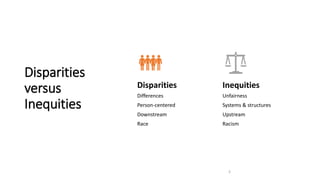
Disparities
versus
Inequities
3
Disparities
Differences
Person-centered
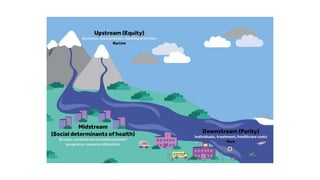
Downstream
Race
Inequities
Unfairness
Systems & structures
Upstream
Racism
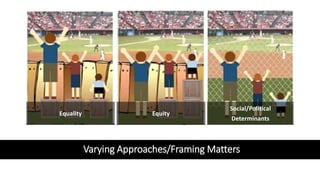
Equality Equity
Social/Political
Determinants
Varying Approaches/Framing Matters
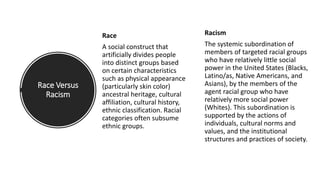
Race Versus
Racism
Race
A social construct that
artificially divides people
into distinct groups based
on certain characteristics
such as physical appearance
(particularly skin color)
ancestral heritage, cultural
affiliation, cultural history,
ethnic classification. Racial
categories often subsume
ethnic groups.
Racism
The systemic subordination of
members of targeted racial groups
who have relatively little social
power in the United States (Blacks,
Latino/as, Native Americans, and
Asians), by the members of the
agent racial group who have
relatively more social power
(Whites). This subordination is
supported by the actions of
individuals, cultural norms and
values, and the institutional
structures and practices of society.
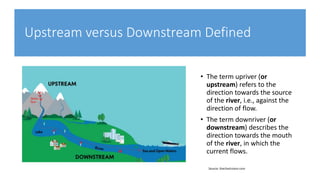
Upstream versus Downstream Defined
• The term upriver (or
upstream) refers to the
direction towards the source
of the river, i.e., against the
direction of flow.
• The term downriver (or
downstream) describes the
direction towards the mouth
of the river, in which the
current flows.
Source: thechartroom.com
Opportunities
before Us to
Be Better and
Do Better
1. Seize the moment to elevate the cause and
power of public health
• Business case for public health and
preparedness
• Business case for equity
• Need for more and better public health
prepared professionals, at all levels
2. Resource the Solutions
• Funding  if racism is a public health crisis,
where’s the $$$$ to address it?
3. Shift the 3 P’s
• Power
• Privilege
• Politic(al meddling, knowledge, &
accountability)
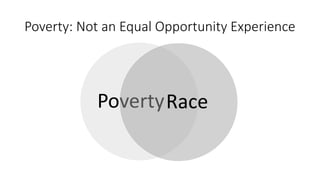
Poverty: Not an Equal Opportunity Experience
PovertyRace
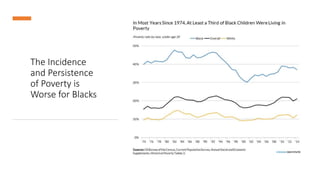
The Incidence
and Persistence
of Poverty is
Worse for Blacks
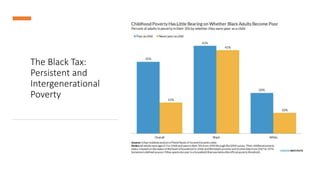
The Black Tax:
Persistent and
Intergenerational
Poverty
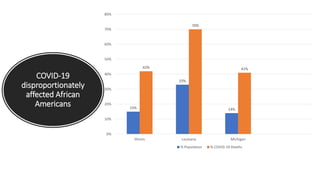
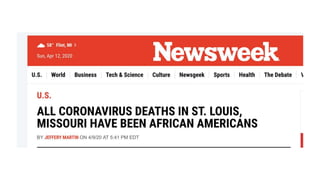
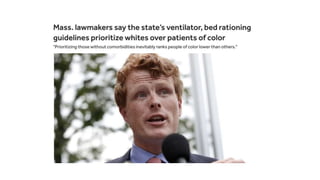
COVID-19
disproportionately
affected African
Americans 15%
33%
14%
42%
70%
41%
0%
10%
20%
30%
40%
50%
60%
70%
80%
Illinois Louisana Michigan
% Population % COVID-19 Deaths
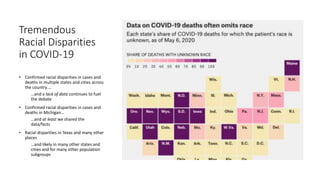
Tremendous
Racial Disparities
in COVID-19
• Confirmed racial disparities in cases and
deaths in multiple states and cities across
the country….
…and a lack of data continues to fuel
the debate
• Confirmed racial disparities in cases and
deaths in Michigan…
…and at least we shared the
data/facts
• Racial disparities in Texas and many other
places
…and likely in many other states and
cities and for many other population
subgroups
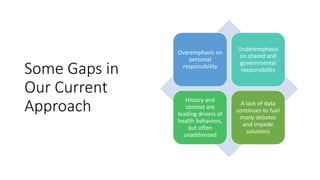
Some Gaps in
Our Current
Approach
Overemphasis on
personal
responsibility
Underemphasis
on shared and
governmental
responsibility
History and
context are
leading drivers of
health behaviors,
but often
unaddressed
A lack of data
continues to fuel
many debates
and impede
solutions
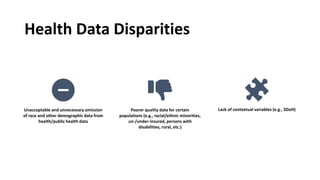
Health Data Disparities
Unacceptable and unnecessary omission
of race and other demographic data from
health/public health data
Poorer quality data for certain
populations (e.g., racial/ethnic minorities,
un-/under-insured, persons with
disabilities, rural, etc.)
Lack of contextual variables (e.g., SDoH)
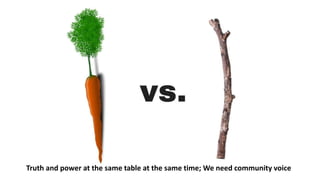
Truth and power at the same table at the same time; We need community voice
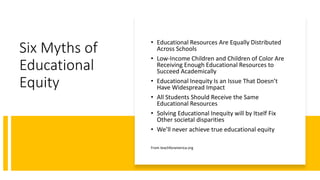
Six Myths of
Educational
Equity
• Educational Resources Are Equally Distributed
Across Schools
• Low-Income Children and Children of Color Are
Receiving Enough Educational Resources to
Succeed Academically
• Educational Inequity Is an Issue That Doesn’t
Have Widespread Impact
• All Students Should Receive the Same
Educational Resources
• Solving Educational Inequity will by Itself Fix
Other societal disparities
• We’ll never achieve true educational equity
From teachforamerica.org
FUTURE
DIRECTIONS
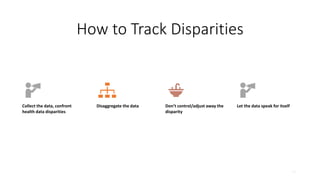
How to Track Disparities
PRESENTATION TITLE 23
Collect the data, confront
health data disparities
Disaggregate the data Don’t control/adjust away the
disparity
Let the data speak for itself
FUTURE
DIRECTIONS
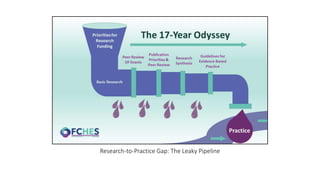
Research-to-Practice Gap: The Leaky Pipeline
25
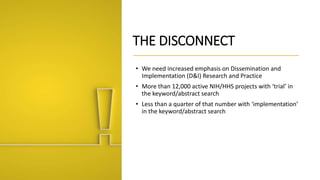
THE DISCONNECT
• We need increased emphasis on Dissemination and
Implementation (D&I) Research and Practice
• More than 12,000 active NIH/HHS projects with ‘trial’ in
the keyword/abstract search
• Less than a quarter of that number with ‘implementation’
in the keyword/abstract search
FUTURE
DIRECTIONS
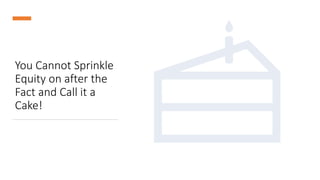
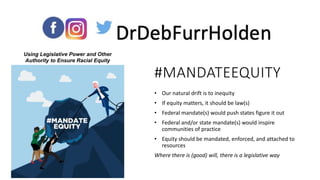
You Cannot Sprinkle
Equity on after the
Fact and Call it a
Cake!
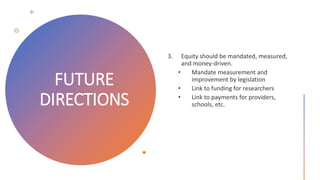
• Our natural drift is to inequity
• If equity matters, it should be law(s)
• Federal mandate(s) would push states figure it out
• Federal and/or state mandate(s) would inspire
communities of practice
• Equity should be mandated, enforced, and attached to
resources
Where there is (good) will, there is a legislative way
#MANDATEEQUITY
Using Legislative Power and Other
Authority to Ensure Racial Equity
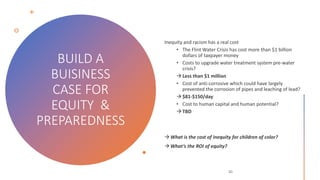
BUILD A
BUISINESS
CASE FOR
EQUITY &
PREPAREDNESS
FUTURE
DIRECTIONS
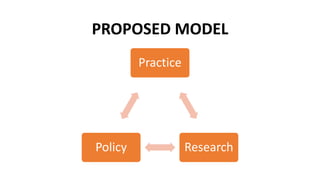
4. Strengthen the practice to research and policy
pathway
32
PROPOSED MODEL
Practice
Research
Policy
FUTURE
DIRECTIONS
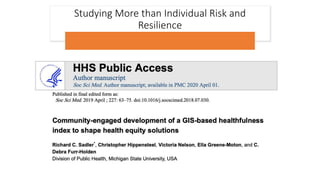
Studying More than Individual Risk and
Resilience
Where are the Solutions?
1. They will need to be upstream
• What’s downstream are mainly the ‘fixes’
2. We will never program our way of these problems
3. We must deal with bias, racism, and white supremacy and privilege to achieve
equity, especially in education and health care
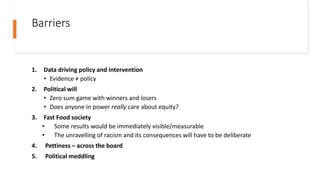
Barriers
1. Data driving policy and intervention
• Evidence ≠ policy
2. Political will
• Zero sum game with winners and losers
• Does anyone in power really care about equity?
3. Fast Food society
• Some results would be immediately visible/measurable
• The unravelling of racism and its consequences will have to be deliberate
4. Pettiness – across the board
5. Political meddling
Final Words of Wisdom:
What I say to
Community
Members/Stakeholders
Contact Information and Questions
HOLDENC3@MSU.EDU DRDEBFURRHOLDEN ON
SOCIAL MEDIA
443-226-2807 (MOBILE)

Casey Family Program

  • 1.
    Unpacking Structural Inequityand the Disproportionate Impact on Children: Lesson Learned before During and (Hopefully) After COVID Casey Family Programs June 16, 2021 Presented by Debra Furr-Holden, PhD
  • 3.
  • 4.
  • 5.
    Race Versus Racism Race A socialconstruct that artificially divides people into distinct groups based on certain characteristics such as physical appearance (particularly skin color) ancestral heritage, cultural affiliation, cultural history, ethnic classification. Racial categories often subsume ethnic groups. Racism The systemic subordination of members of targeted racial groups who have relatively little social power in the United States (Blacks, Latino/as, Native Americans, and Asians), by the members of the agent racial group who have relatively more social power (Whites). This subordination is supported by the actions of individuals, cultural norms and values, and the institutional structures and practices of society.
  • 6.
    Upstream versus DownstreamDefined • The term upriver (or upstream) refers to the direction towards the source of the river, i.e., against the direction of flow. • The term downriver (or downstream) describes the direction towards the mouth of the river, in which the current flows. Source: thechartroom.com
  • 8.
    Opportunities before Us to BeBetter and Do Better 1. Seize the moment to elevate the cause and power of public health • Business case for public health and preparedness • Business case for equity • Need for more and better public health prepared professionals, at all levels 2. Resource the Solutions • Funding  if racism is a public health crisis, where’s the $$$$ to address it? 3. Shift the 3 P’s • Power • Privilege • Politic(al meddling, knowledge, & accountability)
  • 9.
    Poverty: Not anEqual Opportunity Experience PovertyRace
  • 10.
    The Incidence and Persistence ofPoverty is Worse for Blacks
  • 11.
    The Black Tax: Persistentand Intergenerational Poverty
  • 12.
  • 15.
    Tremendous Racial Disparities in COVID-19 •Confirmed racial disparities in cases and deaths in multiple states and cities across the country…. …and a lack of data continues to fuel the debate • Confirmed racial disparities in cases and deaths in Michigan… …and at least we shared the data/facts • Racial disparities in Texas and many other places …and likely in many other states and cities and for many other population subgroups
  • 18.
    Some Gaps in OurCurrent Approach Overemphasis on personal responsibility Underemphasis on shared and governmental responsibility History and context are leading drivers of health behaviors, but often unaddressed A lack of data continues to fuel many debates and impede solutions
  • 19.
    Health Data Disparities Unacceptableand unnecessary omission of race and other demographic data from health/public health data Poorer quality data for certain populations (e.g., racial/ethnic minorities, un-/under-insured, persons with disabilities, rural, etc.) Lack of contextual variables (e.g., SDoH)
  • 20.
    Truth and powerat the same table at the same time; We need community voice
  • 21.
    Six Myths of Educational Equity •Educational Resources Are Equally Distributed Across Schools • Low-Income Children and Children of Color Are Receiving Enough Educational Resources to Succeed Academically • Educational Inequity Is an Issue That Doesn’t Have Widespread Impact • All Students Should Receive the Same Educational Resources • Solving Educational Inequity will by Itself Fix Other societal disparities • We’ll never achieve true educational equity From teachforamerica.org
  • 22.
  • 23.
    How to TrackDisparities PRESENTATION TITLE 23 Collect the data, confront health data disparities Disaggregate the data Don’t control/adjust away the disparity Let the data speak for itself
  • 24.
  • 25.
  • 26.
    THE DISCONNECT • Weneed increased emphasis on Dissemination and Implementation (D&I) Research and Practice • More than 12,000 active NIH/HHS projects with ‘trial’ in the keyword/abstract search • Less than a quarter of that number with ‘implementation’ in the keyword/abstract search
  • 27.
  • 28.
    You Cannot Sprinkle Equityon after the Fact and Call it a Cake!
  • 29.
    • Our naturaldrift is to inequity • If equity matters, it should be law(s) • Federal mandate(s) would push states figure it out • Federal and/or state mandate(s) would inspire communities of practice • Equity should be mandated, enforced, and attached to resources Where there is (good) will, there is a legislative way #MANDATEEQUITY Using Legislative Power and Other Authority to Ensure Racial Equity
  • 30.
  • 32.
    FUTURE DIRECTIONS 4. Strengthen thepractice to research and policy pathway 32
  • 33.
  • 34.
  • 36.
    Studying More thanIndividual Risk and Resilience
  • 37.
    Where are theSolutions? 1. They will need to be upstream • What’s downstream are mainly the ‘fixes’ 2. We will never program our way of these problems 3. We must deal with bias, racism, and white supremacy and privilege to achieve equity, especially in education and health care
  • 38.
    Barriers 1. Data drivingpolicy and intervention • Evidence ≠ policy 2. Political will • Zero sum game with winners and losers • Does anyone in power really care about equity? 3. Fast Food society • Some results would be immediately visible/measurable • The unravelling of racism and its consequences will have to be deliberate 4. Pettiness – across the board 5. Political meddling
  • 39.
    Final Words ofWisdom: What I say to Community Members/Stakeholders
  • 41.
    Contact Information andQuestions HOLDENC3@MSU.EDU DRDEBFURRHOLDEN ON SOCIAL MEDIA 443-226-2807 (MOBILE)

Editor's Notes

  • #7 Obtained from: https://thechartroom.co/2019/05/20/are-we-travelling-upstream-or-downstream/
  • #11 Black children 3-4 times more likely to be living in poverty than White children since 1974 https://www.urban.org/urban-wire/two-american-experiences-racial-divide-poverty
  • #12 Excerpt from Urban Institute: Poverty is more persistent across generations of black families than white families. Thinking back to our black and white children born in the late 1960s, what is the likelihood that their childhood poverty carries over into adulthood? Among children who spent at least one year in poverty, a black child is twice as likely as a white child to also be poor as an adult (43 versus 20 percent). Perhaps more astonishingly, though, black adults have roughly the same chance of experiencing poverty (43 versus 41 percent) regardless of whether or not they were ever poor as children. This stark finding suggests that black families are paying an unfairly high social and economic price in our society.* https://www.urban.org/urban-wire/two-american-experiences-racial-divide-poverty
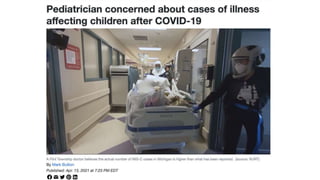
  • #17 99 Multi-inflammatory at least 5 died
  • #18 https://www.abc12.com/2021/04/13/pediatrician-concerned-about-cases-of-illness-affecting-children-after-covid-19/
  • #26 This phenomenon in which the research pipeline from basic science to intervention development, then to efficacy research, and finally to attempts at dissemination and implementation has been termed “the leaky pipeline” This is due in part because this traditional model for research to be conducted has lead to a research-to-practice gap wherein it takes 17 years for only 14% of original research to be translated into practice. This often slow process has led community stakeholders to criticize scientists and academia for conducting fragmented research that is disconnected from the community needs. This is largely in part due to the academic infrastructures that are developed in funding agencies and research-based institutions that do not align with the pace of community and public/population health needs
  • #34 The standard model is research to practice to policy What if we began to leverage the extensive wealth of knowledge from Extension to inform the evidence-base, aka research, to promote practice-based evidence? What if research and policy/ translation were informed by practice? And by the communities being served?