What constitutes anMCI?
• More than one patient and system resources
are TAXED/STRAINED at the time
• Anytime there are more Patients than
Rescuers
2
3.
INTRODUCTION
• A masscasualty incident (MCI) is defined as “an event that overwhelms the local healthcare system, where the
number of casualties vastly exceeds the local resources and capabilities in a short period of time.”
• Any MCI can rapidly exhaust available resources for not only the MCI but the normal day-to-day tasks of the
hospital.
• Each hospital should institute a surge plan in preparation for anticipated, progressive, insidious ("notice" events),
and sudden-onset ("no-notice" events) disasters occurring within the community.
4.
DEFINITIONS: DISASTER ANDMASS
CASUALTY INCIDENT
• The terms disaster and mass casualty incident are often
used interchangeably but describe different entities.
• Both imply a discrepancy between the number of victims
and the treatment capacity of the community.
• A mass casualty incident (MCI) is more limited in scope.
• The number of casualties in an MCI may strain the
hospital or receiving facility, but resources are sufficient
to cope without outside support.
• In a disaster, the casualty burden will exceed local
capabilities and on-site resources, necessitating support
from the outside (5).
5.
The Goal ofall Responders Should
be to
“Save as Many Lives
as Possible”
6.
INTRODUCTION
• The keysin successfully managing the chaos of a fast-paced, moving MCI can be delineated with the organization
of the 5 “S's”:
i. scene safety assessment
ii.scene size-up
iii.send information
iv.scene set-up
v. START.
7.
The Basics
• Yourfirst 5 minutes will determine how the
incident will go: Emotions are Contagious
• Think Incident Command
• Think Triage
• Pre-plan and train or you will fail
7
8.
Incident Command
• Firstperson on scene sends an Initial On Scene
Report
– See as much at the scene as you can
in 30 seconds
– Process what you see,hear and told.
– THINK - Don’t Panic
– Paint an accurate picture of the scene
with your brief report
– Declare yourself the IC, Where the IC Post will be
and where responding units should report to
8
9.
Triage - “Tosort by priority”
• Hard to do for the inexperienced, but it is
really very easy
• All responders must know
what the goal is……..
• Sometimes most severely injured patient does
not get treated and dies
9
10.
How to Triageusing the Tags
• Conduct an Initial Walkthrough
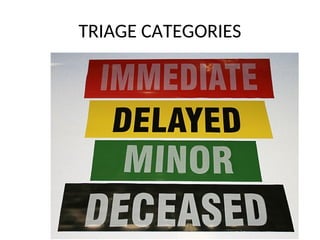
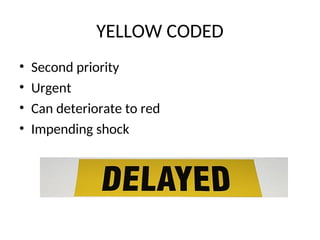
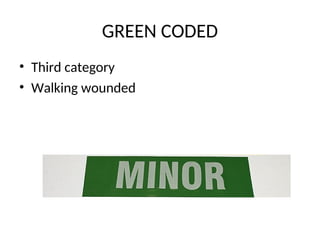
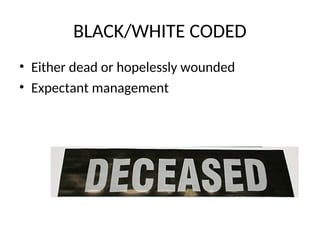
• Tag Patients as
Red, Yellow, Green or Black
• Remember - Triage is constantly conducted so
don’t panic with your first tag
10
Treatment
• Once Triageis done, move patients to the
proper treatment area
• Use tarps, cones, flags, to mark areas
• Control access to areas
• Constantly re-triage
20
17.
Transportation
• Ambulances reportto staging area
• Transportation Officer assigns patients to
ambulances
• Broadcast the “All Immediates Transported”
21
18.
Management of theDeceased
• If it is a crime scene, leave the bodies
where they are
• Cover the victim with a white sheet if possible
• If the bodies can be seen by the surviving
patients, consider moving them
22
19.
Handling the Dead
•Show respect and dignity
• Reduce the pain that witnesses may feel
(they will watch)
• Package them as if they were still alive
24
20.
CONCLUSION
• Triage isthe single most important decision involving
management of mass casualty incidences.
• Medical facilities are encouraged to develop Mass casualty
plans (hospital plans) for their facilities based on operating
capacity and resources
• District committees and local authorities should identify
key players in S/R, and pre-hospital care.
Incident Command System(ICS) is, "a set
of personnel, policies, procedures,
facilities, and equipment, integrated into
a common organizational structure
designed to improve emergency response
operations of all types and complexities.
Introduction
24.
INTRODUCTION
• A masscasualty incident (MCI) is defined as “an event that overwhelms the local healthcare system, where the
number of casualties vastly exceeds the local resources and capabilities in a short period of time.”
• Any MCI can rapidly exhaust available resources for not only the MCI but the normal day-to-day tasks of the
hospital.
• Each hospital should institute a surge plan in preparation for anticipated, progressive, insidious ("notice" events),
and sudden-onset ("no-notice" events) disasters occurring within the community.
25.
ICS was originallydeveloped in the 1970s
during massive wildfire suppression efforts in
California.
Property damage ran into the millions, and
many people died or were injured.
Studies determined that response problems
were often related to communication and
management deficiencies rather than lack of
resources or failure of tactics.
History
26.
• Lack ofaccountability, including unclear
chains of command and supervision.
• Poor communication due to both
inefficient uses of available
communications systems and conflicting
codes and terminology.
• Lack of an orderly, systematic planning
process.
Weaknesses in incident management were
often due to:
27.
• No predefinedmethods to integrate inter-
agency requirements into the management
structure and planning process effectively.
• Freelancing by individuals with specialized
skills during an incident without
coordination with other first responders
• Lack of knowledge with common
terminology during an incident.
Weaknesses Cont..
28.
Use of ICS
•ICS is used in management of
Incidences
Events
29.
Incidents
Incidents are definedwithin ICS as
unplanned situations necessitating a
response. These are categorized as follows:
Natural disasters which are either rapid
onset or slow onset in nature.
Emergency medical situation (ambulance
service)
Man made Incidents
Complex Incidents
30.
Events
• This areplanned situations where Incident
command is commonly applied to. Examples
of events may include:
– Concerts
– Parades and other ceremonies
– Fairs and other gatherings
– Training exercises
31.
Incident Command System(ICS)
Type and magnitude of a disaster will
determine the kind of response required.
Coordination of the efforts has to be
done from one focal point.
Management and coordination efforts
summed up in agreed manner known as
Incident Command System.
Command system is broken into three
levels, Gold, Silver and Bronze.
•
32.
INCIDENT COMMAND SYSTEMCont..
Gold -Strategic level e.g. Cabinet/
National Disaster Coordination
committee.
Silver -Operational Level e.g.
Provincial disaster coordination
committee.
Bronze-Tactical level on the ground
implementing decisions.
(Implementation done by DC)
33.
Incident command andcontrol of
the scene activities is very essential. To
ensure command and control, the
following control units must be
established. Some of the units overlap
or duplicate their tasks according to
need and time frame. The essential units
to establish are:
Incident Command System Cont..
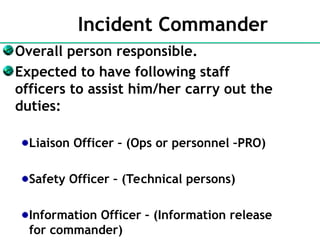
Incident Commander
Overall personresponsible.
Expected to have following staff
officers to assist him/her carry out the
duties:
Liaison Officer – (Ops or personnel –PRO)
Safety Officer – (Technical persons)
Information Officer – (Information release
for commander)
36.
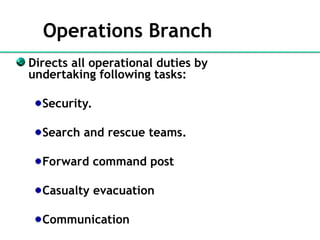
Operations Branch
Directs alloperational duties by
undertaking following tasks:
Security.
Search and rescue teams.
Forward command post
Casualty evacuation
Communication
37.
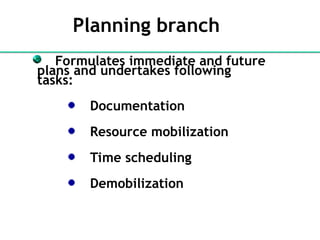
Planning branch
Formulates immediateand future
plans and undertakes following
tasks:
Documentation
Resource mobilization
Time scheduling
Demobilization
38.
Logistics branch
Make provisionsfor necessary
supplies e.g. water and sanitation,
food, health care, transport,
accomndation and general
procurement.
Size of anincident Command
Incident command can be contracted or expanded depending
on:
The magnitude of the incident
Duration of the incident
Number of people /Teams involved
Distance from developed zones
Terrain
Weather
41.
Span of Control
•Refers to the number of individuals or
resources that one person can effectively
manage
• Effective span of control ranges from 3 to 7
reporting elements per supervisor
• If the number of reporting elements is not
within this range, expansion or consolidation
of the ICS organization may be needed
42.
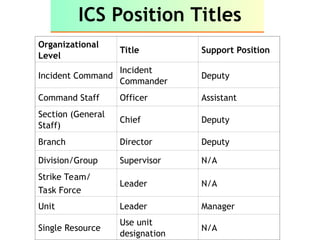
ICS Position Titles
Organizational
Level
TitleSupport Position
Incident Command
Incident
Commander
Deputy
Command Staff Officer Assistant
Section (General
Staff)
Chief Deputy
Branch Director Deputy
Division/Group Supervisor N/A
Strike Team/
Task Force
Leader N/A
Unit Leader Manager
Single Resource
Use unit
designation
N/A
43.
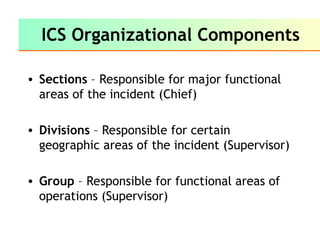
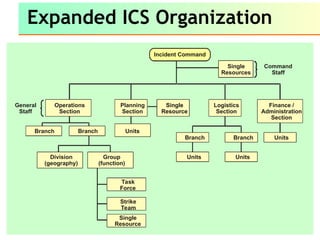
ICS Organizational Components
•Sections – Responsible for major functional
areas of the incident (Chief)
• Divisions – Responsible for certain
geographic areas of the incident (Supervisor)
• Group – Responsible for functional areas of
operations (Supervisor)
44.
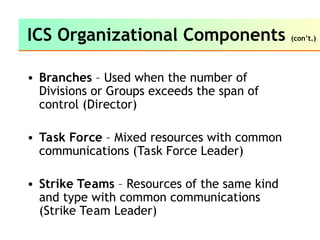
ICS Organizational Components(con’t.)
• Branches – Used when the number of
Divisions or Groups exceeds the span of
control (Director)
• Task Force – Mixed resources with common
communications (Task Force Leader)
• Strike Teams – Resources of the same kind
and type with common communications
(Strike Team Leader)
45.
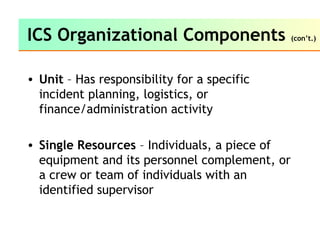
• Unit –Has responsibility for a specific
incident planning, logistics, or
finance/administration activity
• Single Resources – Individuals, a piece of
equipment and its personnel complement, or
a crew or team of individuals with an
identified supervisor
ICS Organizational Components (con’t.)
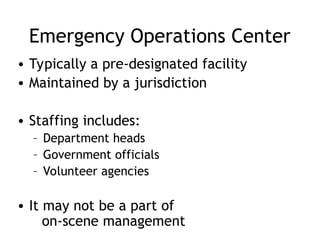
Emergency Operations Center
•Typically a pre-designated facility
• Maintained by a jurisdiction
• Staffing includes:
– Department heads
– Government officials
– Volunteer agencies
• It may not be a part of
on-scene management
51.
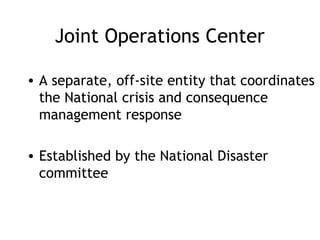
Joint Operations Center
•A separate, off-site entity that coordinates
the National crisis and consequence
management response
• Established by the National Disaster
committee
#28 Instructor Notes
To set the context for this presentation, inform the class that ICS began out of necessity in the 1970s, when several wildfires in California caused millions in damage and several people died. Local, state, and federal fire authorities collaborated to form FIRESCOPE (Firefighting Resources of California Organized for Potential Emergencies). FIRESCOPE looked at the recent wildfire responses, and discovered that poor incident management was to blame, not a lack of resources. Problems that were identified were:
Nonstandard terminology.
Lack of organizational flexibility to expand and contract.
Nonstandard and nonintegrated communications.
Lack of consolidated action plans.
Lack of designated facilities.
ICS was developed to overcome these five problems. Today, incidents demand so many resources and skills that one local, state, or federal agency couldn’t possibly provide them, so ICS provides a way for many agencies to work together smoothly under one management system.
#34 Instructor Notes
As an instructor, you should inform the group that incidents are either natural or man-made, and require emergency service personnel in order to prevent or minimize loss of life or damage to property and/or the environment. Incident examples include:
Fires
Hazardous material (HAZMAT) incidents
Search and Rescue Missions
Oil spills
Natural disasters
Terrorist/WMD events
Planned events such as parades
You should also inform the students that the Incident Command System, or ICS, allows its users to adopt an organizational structure to fit any situation regardless of jurisdictional boundaries. ICS is very flexible and can grow or shrink to meet the changing needs of an incident. This makes it applicable to both small and large incidents.
#35 Instructor Notes
As an instructor, you should inform the group that incidents are either natural or man-made, and require emergency service personnel in order to prevent or minimize loss of life or damage to property and/or the environment. Incident examples include:
Fires
Hazardous material (HAZMAT) incidents
Search and Rescue Missions
Oil spills
Natural disasters
Terrorist/WMD events
Planned events such as parades
You should also inform the students that the Incident Command System, or ICS, allows its users to adopt an organizational structure to fit any situation regardless of jurisdictional boundaries. ICS is very flexible and can grow or shrink to meet the changing needs of an incident. This makes it applicable to both small and large incidents.
#36 Instructor Notes
As an instructor, you should inform the group that incidents are either natural or man-made, and require emergency service personnel in order to prevent or minimize loss of life or damage to property and/or the environment. Incident examples include:
Fires
Hazardous material (HAZMAT) incidents
Search and Rescue Missions
Oil spills
Natural disasters
Terrorist/WMD events
Planned events such as parades
You should also inform the students that the Incident Command System, or ICS, allows its users to adopt an organizational structure to fit any situation regardless of jurisdictional boundaries. ICS is very flexible and can grow or shrink to meet the changing needs of an incident. This makes it applicable to both small and large incidents.
#40 Instructor Notes
It should be pointed out that the ICS organization does not match the administrative structure of any single agency or jurisdiction. This was done on purpose to ensure that incident management would not be compromised by or confused with existing agency structures.
Stress that every incident requires a certain number of incident functions to be performed:
The problem must be identified and assessed.
A plan must be developed and implemented.
The necessary resources must be procured and paid for.
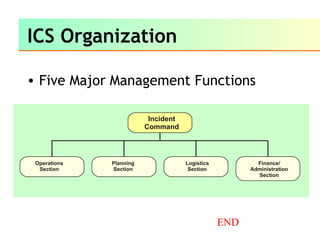
The above five management functions are the foundation of ICS and apply to a routine emergency, organizing for a major non-emergency event, or managing a response to a major disaster:
Incident Command – sets incident objectives, strategies and priorities and has overall responsibility.
Operations – develops tactical objectives, conducts tactical operations to carry out the plan and directs all tactical resources.
Planning – prepares Incident Action Plan to meet incident objectives, collects and evaluates information, and maintains both resource status and incident documentation.
Logistics – provides support, resources, and all services to meet operational objectives.
Finance/Administration – monitors costs, provides accounting, procurement, time recording, and cost analyses.
#47 Instructor Notes
Instruct the class that span of control is extremely important in incidents or events where safety and accountability are top priorities.
Also, the class should be made aware that FEMA strongly recommends a ratio of 1 supervisor to 5 reporting elements. There are are exceptions, especially in lower-risk assignments or where resources work on close proximity to each other. Point out that the terms “elements” and “resources” can refer to people.
#48 Instructor Notes
Inform the class that the ICS organization can be divided into many levels of supervision. At each level, persons with primary responsibility positions have the distinct titles mentioned in the table. Having specific ICS titles serves three important purposes:
Titles provide a common standard for all users. For example, if one agency uses the term Branch Director but another were to use the term Branch Manager, this could cause confusion at the incident.
Distinct titles allows the Incident Commander to fill ICS positions with qualified personnel, not by seniority.
Standardized titles allow agencies to determine who is best qualified to serve based on the position title.
#49 Instructor Notes
Sections were described in a previous slide, and include Operations, Planning, Logistics, and Finance/Administration.
#50 Instructor Notes
Point out that branches can be either geographical or functional. This is also a good time to mention again that under ICS, the term “resources” refers to people as well as materials and equipment.
#51 Instructor Notes
Examples of units include “Cost” and “Time” Units under the Finance and Administration Section. Another example is the “Situation” Unit under the Planning Section.
An example of a single resource is a generator.
#52 Instructor Notes
Several points should be brought up in conjunction with this slide:
The Operations Section develops from the bottom up. For example, at the start of the incident, the Operations Section may consist of a few single resources. As the incident grows and the single resources reporting to the Operations Chief expands beyond 5, a group or division may be formed. Branches may be necessary when there are too many groups or divisions.
Groups and divisions are at an equal level in the ICS organization; one does not supervise the other. Remember, groups form based on function, and divisions form based on geography.
Point out that single resources under Incident Command are known as the command staff, and that the four sections under Incident Command are comprised of general staff.
#53 Instructor Notes
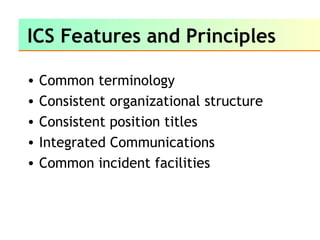
Stress that the ability to communicate within ICS is critical, and that using standard or common terminology is essential. Point out that the only acronym used in this presentation is ICS: clear communications mean the use of “clear text” language so that agency acronyms or jargon are not used and meaning is clear.
Let the students know that no matter where they are or what the incident, the ICS structure and its elements are the same.
Stress again that ICS uses distinct titles:
Only the Incident Commander is called Commander.
Only the heads of Sections in the General Staff are called Chiefs.
These titles reduce confusion between the day-to-day position held by an individual and the position they hold during the incident.
Every incident requires a communications plan that covers:
Hardware systems that transfer information
Plans for the use of all communication resources
Guidance on transferring information internally or externally
Let the students know that common terminology is also used to define incident facilities, to help clarify what occurs at the facility, and to identify who can be found at the facility. Also let them know that more details on incident facilities will follow.
#54 Instructor Notes
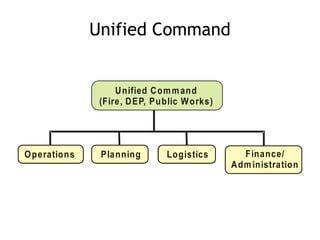
A unified command may be established under ICS when an incident has more than one responding agency with responsibility, or when an incident crosses political jurisdictions.
For example, in the diagram above, you can see that the role of Incident Commander has been replaced with a Unified Command consisting of fire, the DEP, and public works. In this example, a hazardous material spill has contaminated a reservoir. Since this incident has more than one responding agency with responsibility, a Unified Command has been established.
Under the Unified Command, agencies work together through the designated members of the Unified Command to manage an incident. Unified command changes no other aspect of ICS. It just allows all agencies with a responsibility in the incident to participate in the decision making process. Under Unified Command, the following always apply:
The incident functions under a single, coordinated Incident Action Plan.
One Operations Section Chief has responsibility for implementing the IAP.
One Incident Command Post is established.
#55 Instructor Notes
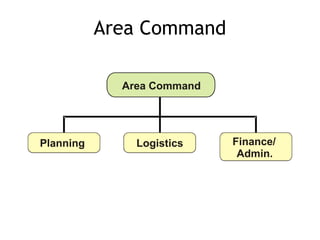
An Area Command is an organization that oversees the management of multiple incidents that are each being managed by an ICS organization, and to oversee the management of large incidents that cross jurisdictional boundaries. Area commands are useful for incidents that are not site specific, not immediately identifiable, are geographically dispersed and evolve over time.
Area Commands have the responsibility for:
Setting overall strategy and priorities
Allocating critical resources according to priorities
Ensuring that incidents are properly managed
Ensuring that objectives are met
Ensuring that strategies are followed
An Area Command may become a Unified Area Command when incidents are multi-jurisdictional or involve multiple agencies. As can be seen in the second diagram above, an Area Command is very similar to an ICS structure except that is lacks an Operations Section. This is because operations are conducted on-scene.
#56 Instructor Notes:
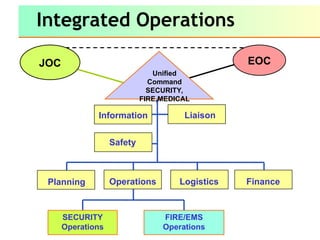
Many workshop participants may be familiar with an Emergency Operations Center or EOC. It is usually a brick-and-mortar facility that is maintained by many communities as part of their emergency preparedness programs. They can be formed at the agency, local, county, regional, and state level. It is a good idea to have established what the interface will be between the EOC and the Incident Command Post prior to any incident occurring. The Incident Command operation is responsible for on-scene response activities, and the EOC is responsible for community-wide resource management.
#57 Instructor Notes:
The Joint Operations Center, or JOC as it is sometimes referred to, is essentially a federal equivalent to the local EOC. Established by the FBI, it is a fairly safe to assume that a JOC would be activated during a bioterrorist or WMD event. The Incident Command Post will still retain on-scene control over the incident, but FBI agents would join the Incident Command structure at the local level in order to feed information back to the JOC. The FBI’s main focus through the JOC would be on crisis management activities such as:
Crime scene preservation;
Evidence collection;
Investigation;
Prevention of additional attacks; and
Coordination of federal assistance to local and state authorities
#58 Instructor Notes:
This slide serves to graphically show how EOCs and JOCs become integrated into the Incident Command structure. To follow up on the previous slide, point out to the class that in this example the FBI has integrated itself into the local Incident Command structure by assigning an agent to the Operations section. One way the FBI may do this is by assigning the agent, with the authorization of the Incident Commander, to become the deputy chief of operations.
Note: This slide is from an FBI agent’s presentation given in January of 2004.